

Submitted:
02 October 2025
Posted:
03 October 2025
You are already at the latest version
Abstract
This letter seeks to examine the current state of sexual and reproductive health among Romanian adolescents, alongside concerns related to bullying and name-calling in school environments. It advocates for the mandatory and sustained integration of Comprehensive Sexual Education (CSE) and inclusive health education into the national curriculum, aiming to promote informed, respectful and safe behaviors among youth.
Keywords:
comprehensive education
; bullying
; sexual and reproductive health
Background
In Romania, CSE is not offered as a mandatory, standalone subject in the national curriculum. Instead, it is partially included in the optional “Health Education” program available for students in grades I through XII (UNICEF Romania, 2024). Participation in this course requires written parental consent, which limits its implementation and reach. Although Parliament passed legislation in 2020 mandating the introduction of “life education, including sexual education” in the curriculum, the law was later amended due to pressure from conservative and religious groups, replacing “sexual education” with “health education” and further enforcing the requirement for parental approval (Balkan Insight, 2020). Despite these constraints, public support for CSE is growing. A 2022 national survey conducted by the Society for Contraceptive and Sexual Education (SECS) found that 77% of Romanians believe sexual education should be taught in schools, particularly for its role in preventing teenage pregnancies and sexually transmitted infections (STI) (Romania Insider, n.d.). Furthermore, initiatives such as the 2024 UNICEF–Ministry of Education project on safe and supportive schools emphasize social and emotional learning and mental health, contributing indirectly to a more holistic educational framework (UNICEF Romania, 2024). Nevertheless, the lack of a consistent, scientifically grounded and compulsory national strategy continues to hinder equitable access to sexual and reproductive health education.
During the recent Romanian presidential elections campaign, the topic of sexual education became a battleground for misinformation and fake news. Various claims were distributed on social media and some partisan outlets, claiming that sexual education promotes inappropriate content for children or undermine traditional family values. Some political figures and media outlets circulated distorted statistics and fear-mongering narratives, aiming to stoke public anxiety and rally conservative voters. Certain political figures propagated false narratives, claiming that European Union directives mandated the teaching of “sexology” and explicit sexual content to young children. For instance, a Romanian deputy alleged that a supposed EU directive would enforce “early education” programs in kindergartens, which he described as “masked pedophilia,” falsely asserting that children as young as six would receive lessons on masturbation and that parents opposing these classes could face severe penalties (Spotmedia, 2025). These claims were widely disseminated on social media platforms and amplified by extremist groups, fuelling public debates and misunderstandings. In fact, a misrepresentation of a French national program, was inaccurately portrayed as an EU mandate. Part of the population claimed that European Union directives mandated the teaching of “sexology” and exposing young children to explicit sexual content, alleging that this would undermine traditional family values. These narratives were propagated through social media platforms, particularly Facebook, Telegram and Tiktok.
This misinformation not only confused the public but also hindered constructive debate about a critical public health issue, diverting attention from the proven benefits of sexual education in reducing teenage pregnancies, sexually transmitted infections and abuse (WHO, 2023). These narratives often aimed to inflame public fears and polarize voters, overshadowing the documented benefits of CSE in improving adolescent health and reducing early pregnancies (Doublet, 2019; European Parliament, 2023; European Parliament, 2022). Such misinformation risks hindering constructive public discourse and delaying urgent public health measures. To counter this, transparent communication from health authorities and educators is mandatory (Bernhardt, 2004; PHCC, 2024; Thomas et al., 2004).
Combating these falsehoods with transparent, evidence-based communication is essential to ensure that policy decisions are made in the best interest of Romanian youth and society at large which is crucial for addressing issues like Romania’s high rates of teenage pregnancies and sexually transmitted infections.
Facts
Health education refers to a wide-ranging curriculum that includes topics such as nutrition, hygiene, physical activity, mental well-being, prevention of substance abuse and personal safety (Mitic et al., 2012). CSE, on the other hand, is a focused component that deals with human development (anatomy and physiology, emotional and psychological changes), reproductive health (conception, pregnancy, birth and child care), contraception, sexually transmitted infections (STIs), gender identity (understanding and accepting diversity), consent and interpersonal relationships (the significance of shared understanding, mutual respect, and honest communication in maintaining healthy intimate relationships), family planning, etc. (UNESCO, 2018). Both should be implemented using an age-appropriate, progressive approach, meaning that children are introduced to basic concepts in early years–such as body parts, personal boundaries and the difference between safe and unsafe touch–and are gradually taught more complex topics during adolescence, like contraception, emotional intimacy and the prevention of sexual abuse (BIÖG WHO-CC, n.d.; Mitic et al., 2012). Contrary to popular myths amplified during Romanian electoral debates, with CSE, young children are not exposed to explicit content, nor is the curriculum designed to promote sexual activity.
Romanian studies revealed approximately 15% of children received information about sex between the ages of 5 and 11(Faludi and Rada, 2019), 7,2% reported having engaged in their first sexual intercourse before the age of 15 and less than 25% used protection at first intercourse (Rada, 2014; Rada et al., 2023). The lack of structured, age-appropriate sexual education throughout the years results in a series of public health issues that require immediate intervention.
High Incidence of Teenage Pregnancies
Romania consistently reports one of the highest rates of teenage pregnancies in the European Union, nearly 45% of all mothers under the age of 15 across the EU coming from Romania (Turcu et al., 2022; UNICEF Romania, 2022). In 2020 alone, 16,821 teenagers under the age of 19 became mothers, as reported by the National Institute of Statistics (INS). In 2023, 648 births were recorded among girls under the age of 15 and 14714 girls between 15 and 19 years old gave birth. These statistics reflect not just a health concern but also a failure of the education system to provide adolescents with essential and resources in order to make informed decisions about their sexual health.
Given that more teenagers start their sex life at 15 years old or earlier, CSE must be part of the curriculum (Faludi and Rada, 2019; Reis et al., 2024). Comprehensive, age-appropriate sexual education has been proven to reduce rates of unintended pregnancies, sexually transmitted infections and sexual violence. It also empowers young people with the knowledge and confidence to make informed decisions and to seek help when needed.
Low HPV Vaccination Rates and Cervical Cancer Burden
The human papillomavirus (HPV) is a leading cause of cervical cancer, which continues to have a high prevalence in Romania. A Romanian woman is diagnosed with cervical cancer every two hours; the country ranks second in Europe in terms of the mortality and incidence rate of this disease (Simion et al., 2023; Todor et al., 2021). Studies in Romania indicate significant knowledge gaps in sexually transmitted diseases and sexual health among adolescents, young people and adults (Manolescu et al., 2022; Rada et al., 2010). Also other risk factors remain unknown for breast cancer (Petrescu et al., 2024). The initial HPV vaccination campaign started in 2008 achieved a coverage of merely 2.57%, leading to its suspension in 2011 due to low interest. Subsequent efforts have continued to face challenges, with data indicating persistently low vaccination rates among the target population (INSP, 2025). In Romania, the vaccine is administered free of charge to girls and boys aged 11–18.
Many Romanian women delay or avoid regular screenings and HPV vaccinations due to lack of knowledge and financial means resulting in 47.4% of Romanian women never had a Pap smear (EU average 13.4%) (Eurostat, 2022; Simion et al., 2023). The study advises incorporating sexual education into school curricula as a strategy to increase awareness and normalize preventive care from an early age.
According to the European Cancer Organisation, Romania has one of the lowest HPV vaccination rates in the EU, with only 13% of eligible girls vaccinated. The same source reports over 1,800 deaths annually due to cervical cancer in Romania—figures that could be significantly reduced with effective vaccination and awareness campaigns, both of which are often introduced through schoolbased education (ECO, 2024; EP, 2022).
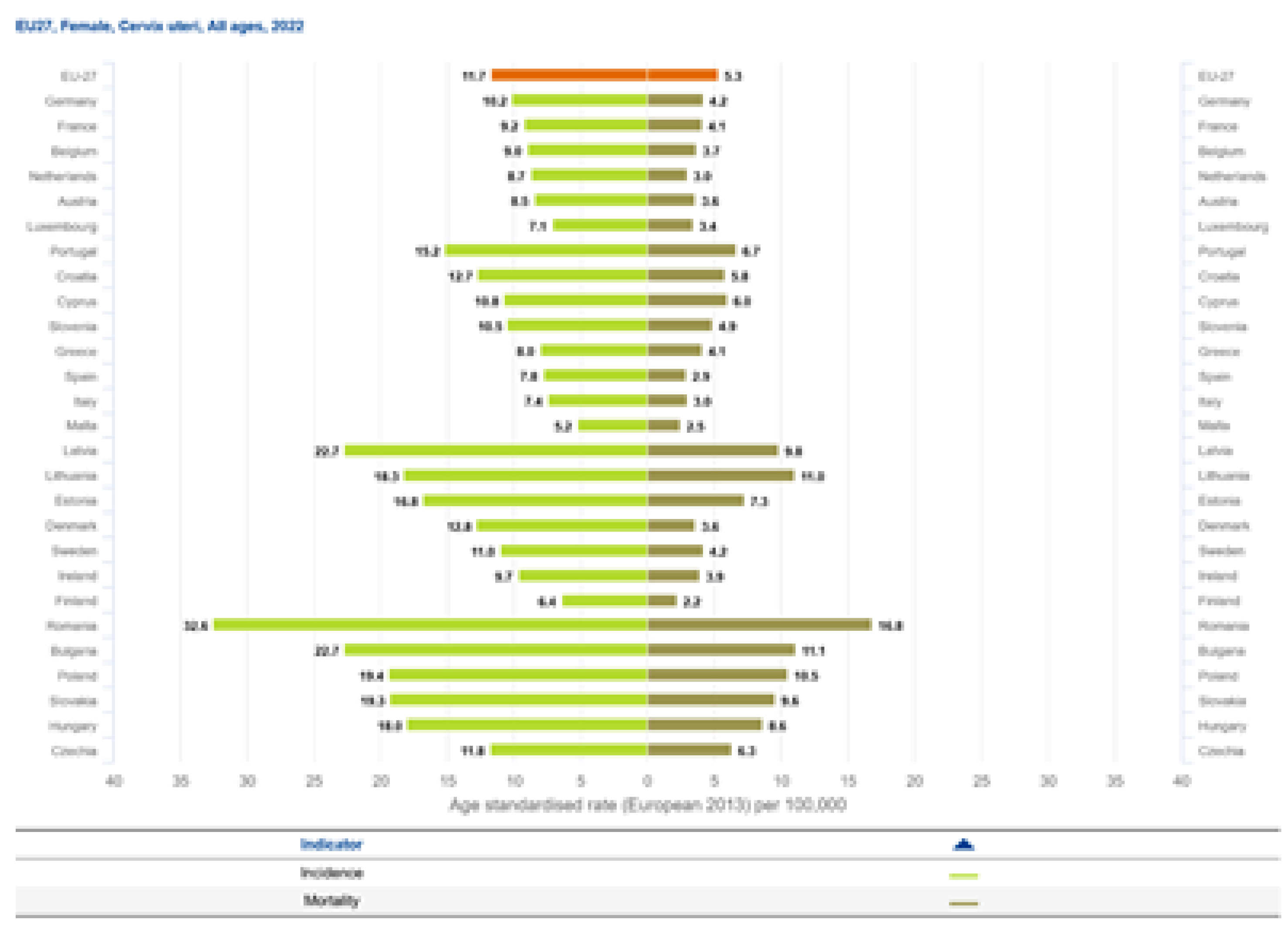
The situation of estimated incidence and mortality due to cervical cancer, according to the European Cancer Information System (European Commission), is presented in Figure 1 showing that Romania recorded rates twice as high as the European average (EU27) (EC, 2022).
High Prevalence of Sexual Abuse Among Minors
The lack of education regarding consent and sexual boundaries leaves minors vulnerable to abuse. In 2024 approximately 78% of rape cases were closed without legal action (Poliția Română, 2025.; Centrul FILIA, 2025). Reports from Romanian law enforcement agencies indicate that, on average, eight children are sexually abused each day and in approximately 80% of these cases, the perpetrator is a family member. Many of sexual aggression against minors, go unreported or unresolved due to systemic gaps in prevention and education (NGO Norway, n.d.).
NGO Norway published a report with data revealing that a minor becomes a victim of sexual abuse every six hours in Romania. This trend has seen a yearly increase of 20%, with a staggering 70% rise for boys and 24% for girls over the past three years (NGO Norway, n.d.).
In 2024, 3,999 crimes of rape of a minor and 934 crimes of sexual assault on minors were registered at the General Inspectorate of the Romanian Police (Poliția
Română, 2025.; Centrul FILIA, 2025)
These statistics highlight not only a failure in the justice system but also a societal gap in educating youth about recognizing and reporting abuse, providing knowledge about consent and personal boundaries.
Lack of Medical Services, Lack of Education
Save the Children reports, based on data from the National Federation of Family Physician Associations, report that 53% of localities in Romania lack sufficient family doctors or have none at all. As a result, pregnant women in disadvantaged rural areas cannot access medical services for pregnancy monitoring. 80% of pregnant women or mothers under 18 did not use any contraceptive method because they did not have information about their use, 85% of mothers and pregnant women under the age of 18 no longer go to school, most of them dropping out before pregnancy and 4 out of 10 pregnant underage mothers do not access other medical services during pregnancy.
Additional Topics for Consideration in School-Based Education
Social learning, defined as the process by which individuals acquire behaviors through the observation and imitation of significant others, is pivotal in the development of behavior. However, it also has the potential to result in the adoption of undesirable behaviors. For example, when children are exposed to aggressive reactions, lack of empathy, or negative patterns of interaction, they are more likely to imitate them and find them acceptable (Bandura, 1977). Over time, such influences can affect the development of moral norms and prosocial behavior, therefore, the responsibility of adults to provide appropriate role models is essential in the childʼs socialization process (Eisenberg and Mussen, 1997; Rada and Turcu, 2012).
In the last part of the electoral campaign, the term “autistic” was used as a pejorative term addressed to one of the candidates and his supporters. This labelling prompted strong stances from civil society, including NGOs, parents of children diagnosed with autism and medical associations.
According to American Psychiatric Association – DSM-5-TR (Diagnostic and Statistical Manual of Mental Disorders, Fifth Edition, Text Revision) Autism, or Autism Spectrum Disorder (ASD), is a neurodevelopmental disorder characterized by persistent deficits in social communication and social interaction across multiple contexts and restricted, repetitive patterns of behavior, interests, or activities (APA, 2022; APA, 2000). Oxford Concise Medical Dictionary defines this disorder as a condition usually appearing in early childhood, characterized by difficulties in communication and forming relationships with other people and in using language and abstract concepts (Martin, 2015). The prevalence of autism has notably increased over the years, with studies estimating that globally about one in 100 children is diagnosed with autism. Studies indicate rates exceeding 1% in Europe and 2.64% in South Korea (Petre et al., 2023).
The use of the term “autistic” as a pejorative expression reflects a multifaceted problematic attitude that can be critically analysed through several lenses. First of all, it constitutes ableism, as it reinforces negative stereotypes and social hierarchies that tend to marginalize individuals with neurodevelopmental differences. There is also the perspective of discriminatory behavior, where a clinical diagnosis is used in a manner that may contribute to patterns of exclusion and stigmatization. Furthermore, such language often indicates emotional immaturity, as it reveals an underdeveloped capacity for empathy and respectful interpersonal communication. Such behavior may also be rooted in ignorance, specifically a lack of understanding regarding autism spectrum conditions and the living realities of neurodivergent individuals. In specific contexts, particularly when employed repetitively or in a targeted manner, this behaviour may constitute hate speech, especially if it incites hostility or perpetuates a hostile environment toward a vulnerable group. As such, the casual misuse of clinical terms with the intention of offending not only reflects individual prejudice but also reinforces systemic barriers to inclusion and acceptance.
Bullying represents a significant issue that requires substantial attention within both family environments and educational institutions. According to the official data communicated by Save the Children Romania, between 2021 and 2022, 10,971 bullying situations were registered in the official education system (as compared to 7.715 in 2020–2021).
Smoking and substance abuse are other public health issues that parents and the educational system must manage in the sense of prevention. Recent studies emphasized that the critical age that people start to smoke and remain smokers is before 14 years old and (Baciu, 2024; Dadulescu et al., 2025)
It is essential to convey accurate information to the young generation, as stigmatization, even when achieved by using improper terminology, constitutes a form of abuse with lasting psychological effects.
Recommendations
These statistics highlight a pressing public health concern that necessitates immediate action. Comprehensive, age-appropriate education has been proven to reduce rates of unintended pregnancies, sexually transmitted infections, sexual violence, substance abuse and improve mental well-being. It empowers young individuals with the knowledge and confidence to make informed decisions and seek assistance when needed.
In a society where sexuality is for a lot of people tabu, it is incumbent upon the scientific, educational and medical communities to advocate for evidence-based solutions. Implementing comprehensive sexual education in the national curriculum transcends political discourse, being a public health imperative.
Although data slightly improved in the last decades, this initiative is not only timely but necessary for safeguarding the health and well-being of future generations.
To address these public health issues, I propose the following:
- Implementing Comprehensive Sexual Education Programs: Introduce compulsory, age-appropriate sexual education within the Romanian educational curriculum. This program should encompass comprehensive topics such as reproductive health, consent, sexually transmitted infections (STIs) and the promotion of healthy relationships.
- Public Awareness Campaigns: Execute national initiatives aimed at enhancing awareness and education regarding sexual health, HPV vaccination, principles of consent.
- A Social-Emotional Learning curricula integration in schools in order to build empathy, self-awareness, conflict resolution and responsible decision-making.
- Establish well-defined, enforceable policies that recognize bullying and name-calling as public health concerns rather than solely disciplinary matters
- Healthcare Provider Training: Provide educators and healthcare professionals with comprehensive tools and training to discuss sexual health accurately and empathetically.
- Policy Reforms and Funding: Increase state funding for HPV vaccination programs and remove location and financial barriers to reproductive health services.
Comprehensive education is not subject to a moral, political or cultural debate; it is a matter of public health and human rights. Denying Romanian youth access to accurate, scientific information about their bodies and health may increase their risk of disease, abuse and systemic inequality.
References
- American Psychiatric Association. 2022. Diagnostic and Statistical Manual of Mental Disorders.
- American Psychiatric Association (Ed.). 2000. Diagnostic and statistical manual of mental disorders: DSM-IV-TR. American Psychiatric Association, Washington, DC.
- Baciu, A. B. 2024. Aspects of drug consumption among youth in Bucharest. A medical anthropology perspective. Proc. Rom. Acad., Series B, 26(2), 55–63.
- Balkan Insight. 2020. Romania Bows to Church, Scraps Mandatory Sex Education. https://balkaninsight.com/2020/06/03/romania-bows-to-church-scraps-mandatory-sex-education/.
- Bandura, A. 1977. Social learning theory. Prentice-Hall series in social learning theory, Prentice-Hall, Englewood Cliffs, New Jersey.
- Bernhardt, J. M. 2004. Communication at the Core of Effective Public Health. American Journal of Public Health, 94(12), 2051–2053. [CrossRef]
- BIÖG WHO-CC. n.d. Sexuality Education in Europe. https://whocc.bioeg.de/en/sexuality-educationin-europe/#romania.
- Centrul FILIA. 2025. Violența sexuală: între stigmă și justiție. RAPORT DE MONITORIZARE 2025.
- Dadulescu, A.-M., Glavce, C. S., Turcu, S., and Borosanu, A. 2025. Adolescents Caught Between the Temptation and the Habit of Smoking. Cureus, 17(4), 1–9. [CrossRef]
- Doublet, Y.-M. 2019. Désinformation et campagnes électorales. Conseil de l’Europe, Strasbourg.
- ECO. 2024. European Cancer Summit Report.
- Eisenberg, N., and Mussen, P. H. 1997. The roots of prosocial behavior in children. Cambridge studies in social and emotional development, Cambridge Univ. Press, Cambridge.
- European Commission. 2022. European Cancer Information System. Data explorer | ECIS, https://ecis.jrc.ec.europa.eu/data-explorer#/.
- European Parliament. 2023. Sexual education in Eastern Europe: Challenges and progress. European Parliamentary Forum for Sexual and Reproductive Rights.
- European Parliament. Directorate General for Internal Policies of the Union. 2022. Comprehensive sexuality education: why is it important? Publications Office, LU.
- Eurostat. 2022. Self-reported last cervical smear test among women by age and educational attainment level. Eurostat.
- Faludi, C., and Rada, C. 2019. Gender differences in sexual and reproductive health education in the family: a mixed methods study on Romanian young people. BMC Public Health, 19(1), 1103. [CrossRef]
- INSP. 2025. Raport privind evoluția vaccinării împotriva HPV 2024. INSP, 13.
- Manolescu, L. S. C., Zugravu, C., Zaharia, C. N., Dumitrescu, A. I., Prasacu, I., Radu, M. C., Letiția, G. D., Nita, I., Cristache, C. M., and Gales, L. N. 2022. Barriers and Facilitators of Romanian HPV (Human Papillomavirus) Vaccination. Vaccines, 10(10), 1722. [CrossRef]
- Martin, E. 2015. Concise Medical Dictionary. Oxford University Press.
- Mitic, W., Ben Abdelaziz, F., and Madi, H. 2012. Health education: theoretical concepts, effective strategies and core competencies. World Health Organization, Regional Office for the Eastern Mediterranean, Cairo, Egypt.
- NGO Norway. n.d. Combatting Child Abuse in Romania. https://activecitizensfund.no/bilateralprojects/combating-child-abuse-in-romania/?utm_source=chatgpt.com.
- Petre, L., Pătrașcu, A., and Milici, N. 2023. Early intervention and the importance of age in the recovery process of autistic children. Proc. Rom. Acad., Series B, 25(1), 11–17.
- Petrescu, M., Turcu, S., Kozma, A., and Glavce, C. 2024. Anthropological Aspects of the Body Mass Index in Breast Cancer. Acta Endocrinologica (Bucharest), 20(3), 286–294.
- Poliția Română. n.d. Comunicate. https://politiaromana.ro/ro/stiri-si-media/comunicate.
- Public Health Communications Collaborative. 2024. The Public Health Communicators Guide to Misinformation.
- Rada, C. 2014. Sexual behaviour and sexual and reproductive health education: a cross-sectional study in Romania. Reproductive Health, 11(1), 48. [CrossRef]
- Rada, C. Rada, C., Hudiţa, D., Manolescu, S., Prejbeanu, I., and Zugravu, C. 2010. Attitudinal and behavioral patterns, socio-demographical characteristics of risk for cervical cancer. Gineco.ro., 6(20.2), 102–9.
- Rada, C., Tair, E., Lingu, M., and Bekir, S. 2023. Sexual education and sexual activity of students before and during the COVID-19 pandemic. A Romanian-Bulgarian qualitative comparative study. Psychological Research (in the Balkans), 26(3). [CrossRef]
- Rada, C., and Turcu, S. 2012. Family psychological markers in a systemic and anthropological approach. International Journal of Collaborative Research on Internal Medicine & Public Health, 4(6), 1185–1195.
- Reis, L. F., Surkan, P. J., Atkins, K., Garcia-Cerde, R., and Sanchez, Z. M. 2024. Risk Factors for Early Sexual Intercourse in Adolescence: A Systematic Review of Cohort Studies. Child Psychiatry & Human Development, 55(6), 1677–1690. [CrossRef]
- Romania Insider. n.d. Survey shows that 77% of Romanians think that sex education needs to be taught in school. https://www.romania-insider.com/survey-romanians-sex-education-schoolsecs.
- Simion, L., Rotaru, V., Cirimbei, C., Gales, L., Stefan, D.-C., Ionescu, S.-O., Luca, D., Doran, H., and Chitoran, E. 2023a. Inequities in Screening and HPV Vaccination Programs and Their Impact on Cervical Cancer Statistics in Romania. Diagnostics, 13(17), 2776. [CrossRef]
- Spotmedia. 2025. A teacher dismantles the lies of Deputy Coarnă, about how the EU forces us into ‘masked pedophilia’ and ‘lessons about masturbation starting at 6 years old’. https://spotmedia.ro/en/news/education/a-teacher-dismantles-the-lies-of-deputy-coarna-abouthow-the-eu-forces-us-into-masked-pedophilia-and-lessons-about-masturbation-starting-at-6years-old.
- Thomas, S. B., Fine, M. J., and Ibrahim, S. A. 2004. Health Disparities: The Importance of Culture and Health Communication. American Journal of Public Health, 94(12), 2050–2050. [CrossRef]
- Todor, R. D., Bratucu, G., Moga, M. A., Candrea, A. N., Marceanu, L. G., and Anastasiu, C. V. 2021. Challenges in the Prevention of Cervical Cancer in Romania. International Journal of Environmental Research and Public Health, 18(4), 1721. [CrossRef]
- Turcu, S., Petrescu, M., Stan, C., and Glavce, C. 2022. Family health and natality at the beginning of XXIst century from the anthropologist’s perspective. Proceedings of the Romanian Academy, B, 24(2).
- UNESCO, Joint United Nations Programme on HIV/AIDS, United Nations Children’s Fund, United Nations Entity for Gender Equality and the Empowerment of Women, and World Health Organization. 2018. International technical guidance on sexuality education: an evidenceinformed approach. UNESCO.
- UNICEF Romania. 2022. Prevention of teenage pregnancy and its consequences.
- https://www.unicef.org/romania/documents/policy-brief-prevention-teenage-pregnancy-andits-consequences.
- UNICEF Romania. 2024. European Commission, Ministry of Education and UNICEF to join forces for promoting a healthy and safe school environment in Romanian schools. https://www.unicef.org/romania/press-releases/european-commission-ministry-education-andunicef-join-forces-promoting-healthy-and.
Figure 1.
Estimated incidence and mortality due to cervical cancer by country (Source: European Commission).
Figure 1.
Estimated incidence and mortality due to cervical cancer by country (Source: European Commission).
Disclaimer/Publisher’s Note: The statements, opinions and data contained in all publications are solely those of the individual author(s) and contributor(s) and not of MDPI and/or the editor(s). MDPI and/or the editor(s) disclaim responsibility for any injury to people or property resulting from any ideas, methods, instructions or products referred to in the content. |
© 2025 by the authors. Licensee MDPI, Basel, Switzerland. This article is an open access article distributed under the terms and conditions of the Creative Commons Attribution (CC BY) license (http://creativecommons.org/licenses/by/4.0/).
Copyright: This open access article is published under a Creative Commons CC BY 4.0 license, which permit the free download, distribution, and reuse, provided that the author and preprint are cited in any reuse.


