

Submitted:
16 September 2025
Posted:
17 September 2025
You are already at the latest version
Abstract
This paper provides a systematic review of supply chain management strategies in the context of supply disruption risk and consumer panic buying. It examines how supply disruptions, triggered by natural disasters, epidemics, or other unforeseen events, lead to consumer panic buying, resulting in substantial fluctuations in demand. The study explores the underlying drivers of consumer panic-buying behavior, including information asymmetry, perception of resource scarcity, social influence, and individual psychological factors like anxiety caused by unknown risks. It further analyzes the multifaceted impact of panic buying on supply chain performance and social welfare, encompassing escalated costs, inventory mismatches, price fluctuations, exacerbation of the bullwhip effect, reduced supply chain efficiency, and loss of consumer welfare. To mitigate these adverse effects, the paper reviews a spectrum of supply chain management strategies, such as flexible inventory management, supply chain elasticity enhancement, dynamic production capacity adjustment, diversified supplier networks, and collaborative interventions by governments and retailers. The findings underscore the intricate interplay between supply chain dynamics and consumer panic-buying behavior, providing valuable insights for developing resilient supply chains.
Keywords:
supply chain management
; supply disruption risk
; consumer panic buying
1. Introduction
Supply disruption risk causes multiple challenges to retailers’ supply chain management. On the one hand, retailers need to adjust their procurement, inventory, and other operational strategies in light of the risk of future supply disruptions; on the other hand, the risk of supply disruptions caused by factors such as natural disasters and epidemics usually triggers consumers’ panic stockpiling behavior, resulting in large demand fluctuations in a short time and further complicates retailers’ situations. In particular, under supply disruption risk, consumers are usually not sure whether the future supply of goods will be normal or not, and fears of future supply shortages will prompt some consumers to stockpile significant inventories of goods. During the COVID-19 pandemic, panic-buying incidents were observed in many countries, such as Singapore, Japan, Australia, Italy, Israel, Spain, the United Kingdom, and the United States [1]. For example, in the spring of 2020, affected by the COVID-19 pandemic, citizens hoarded a large number of daily necessities such as grain and oil, resulting in serious shortages of daily necessities in many supermarkets [2]. Market research indicates that in January 2020 alone, the demand for hand sanitizers among Chinese consumers skyrocketed by 1400% [2]. In the situation of intensive panic buying, if retailers or the government do not take any intervention, substantial stock-outs may induce more panic buying and increase consumer anxiety about supply shortage, and make panic buying and stock-outs worse.
Retailers may employ multiple tactics to address panic buying stemming from supply chain disruption risks, such as maintaining safety stock in advance, increasing prices, imposing purchasing quotas, taking transshipment actions, or utilizing backup suppliers when observing consumers’ intense panic buying. For example, under the impact of panic buying during the epidemic, Wellcome Supermarket in Hong Kong temporarily restricted the purchase of rice, eggs, toilet rolls, and other goods, limiting the purchase of designated goods to two pieces per person[3]. Categories such as food and medical supplies have seen significant price increases[4], with Argentina, Honduras, Colombia, Georgia, the Philippines, and other countries imposing price caps on basic foodstuffs. In addition, some retailers try to ease consumers’ panic stockpiling behavior through announcing that they are sufficiently stocked and ready for supply during extreme events [5,6]. Manufacturers can switch to or ramp up production to cope with the surge in demand [7]. The government can also impose many types of controls to intervene in consumers’ panic stockpiling behavior. For instance, censoring and controlling the spread of shortage rumors, regulating product price and shopping times, announcing sufficient support for future supply, and punishing untoward sellers. In addition, the Ministry of Commerce of China encourages consumers to stock up on a certain amount of daily necessities as needed in normal times in case of emergencies [8].
This study reviews the literature on consumer panic buying amid supply disruptions, focusing on its impact on firms’ supply chains and operations management strategies. The contributions of this study are in two folds. First, the analysis yields novel critical perspectives on managing supply disruption risks in conjunction with consumer panic buying. Second, the research analyzes the interaction between mitigation strategies of consumer panic stockpiling behavior and social welfare. By integrating these dimensions, the research establishes theoretical frameworks and actionable guidelines for designing resilient supply chain strategies amid disruptions and consumer panic-buying behavior. Guided by this focus, the review addresses two core questions: What are the main reasons and impacts of consumer panic buying behavior? How can we effectively manage supply chains under supply disruption risk and consumer panic buying behavior?
The remainder of the article proceeds as follows: Section 2 presents the systematic review methodology and execution process. Section 3, Section 4 and Section 5 synthesize extant literature and principal findings. The conclusion section discusses theoretical underpinnings, managerial applications, and emerging research avenues in supply disruption risk management.
2. Methodology
In this review paper, we follow the Systematic Literature Review approach to ensure the rigor and systematic nature of the research process [9]. First, we clearly define the research topic and design the literature retrieval strategy accordingly [10]. Next, we searched for relevant literature from academic databases, including Web of Science and Google Scholar. The literature corpus encompasses peer-reviewed articles, opinion pieces, discussion papers, review articles, and letters to the editor published in academic journals. In addition, we further screened for relevant literature through forward and backward reference checking to ensure the comprehensiveness of the final corpus. All included literature must satisfy the following conditions: It is available online as of July 1st, 2025, including both formally published articles and preprints.
Our initial retrieval strategy targets two major academic databases, including Web of Science and Google Scholar, and we employ Boolean operators to combine the keywords “supply disruption", “panic buying", and “supply chain management". The screening criteria are limited to peer-reviewed articles published in English between 2010 and 2025. The searched keywords and corresponding number of searched results are summarized in Table 1. There are 251 distinct related records from Web of Science, most of which were published between 2019 and 2025, as shown in Figure 1. There are 2260 records from Google Scholar, and after screening these records based on title and abstract, 236 refined records from Google Scholar were obtained. Next, we manually check the records from Web of Science and Google Scholar, after removing duplicate and irrelevant records, we obtain 102 relevant articles. Through forward and backward reference checking, we further identified 11 additional relevant articles, bringing the final corpus to 113 articles. Moreover, in the literature review process, we omit some similar literature on food and agricultural supply chain management during the pandemic, which finally results in the literature reviewed in this paper.
3. Consumer Panic Stockpiling Behavior under Supply Disruption Risk
Understanding consumer behavioral responses to supply disruption risks has become a critical area of research, particularly in the wake of events like the COVID-19 pandemic, which starkly revealed the profound impact of panic-driven actions on supply chains and societal well-being. Scholars have increasingly turned their attention to dissecting the mechanisms, classifications, and consequences of these behaviors. Prior research has delved into various facets of this phenomenon, including the distinct drivers and manifestations of panic buying versus rational stockpiling, the psychological and social triggers of hoarding, the resulting amplification of supply-demand mismatches, and the complex interplay between consumer stockpiling decisions and supply chain resilience strategies. This section synthesizes key findings on how consumers react to perceived or actual supply disruption risks, focusing on the nature of their stockpiling behaviors and the subsequent chain reactions within supply systems.
3.1. Consumers’ Behavioral Responses to the Risk of Supply Disruption
Consumers’ behavioral responses to supply disruption risks primarily manifest as hoarding products. In particular, hoarding behavior encompasses the identification of diverse types of stockpiling behavior, including irrational panic buying and rational stockpiling [11,12]. These behaviors are triggered by factors such as product shortage expectations, price fluctuations, social learning effects, and information asymmetry [13,14].
3.1.1. Behavioral Classification and Trigger Mechanisms
Panic Buying: Typically induced by sudden events (e.g., natural disasters, public health crises), panic buying reflects irrational hoarding driven by uncertainty about future availability. For example, consumers rushed to purchase medical supplies and daily necessities during the early COVID-19 pandemic [13,15,16,17,18]. This behavior is contagious, spreading rapidly through social media or networks, leading to "mass panic".
Panic Stockpiling. Defined as the excessive and often irrational accumulation of goods beyond immediate needs, panic stockpiling is a subset of panic buying behavior characterized by consumers purchasing large quantities of products due to fears of future scarcity or price increases. This behavior is typically triggered by heightened anxiety and uncertainty, often exacerbated by external events such as pandemics, natural disasters, or geopolitical tensions. Research indicates that consumers’ expectations of shortage probability and holding costs are critical determinants: higher perceived shortage probabilities and lower holding costs incentivize increased stockpiling [12]. Yuen et al. [19] further emphasize that psychological factors, such as fear, anxiety, and a sense of loss of control, significantly contribute to panic stockpiling. During the COVID-19 pandemic, studies highlighted that the perception of health risks and the influence of social media amplified panic-buying behaviors [20]. For instance, social media platforms often disseminated images of empty shelves, which further fueled consumer anxiety and prompted more stockpiling [21].
Rational Stockpiling. Strategic buyers engage in rational stockpiling based on cost-benefit analysis, anticipating supply disruptions or price increases. For instance, semiconductor manufacturers hoard raw materials during supply shortages [11,22]. This behavior is influenced by inventory holding costs, price hikes, and the duration of shortages, involving dynamic decision-making. Consumers compare utilities across periods (e.g., two-period consumption utility vs. holding costs) to determine optimal stockpiling quantities [12]. Gangwar et al. [14] demonstrate that retailers’ promotional strategies (e.g., limited-time discounts) can strategically induce rational stockpiling while mitigating panic-driven demand surges.
3.1.2. Chain Reactions on the Supply Chain
Consumer stockpiling can intensify supply-demand imbalances, creating stockpiling-driven shortages [11]. Key impacts include the following aspects.
Premature shortages: Strategic buyers’ hoarding depletes inventory, leaving non-strategic buyers facing shortages earlier [23,24]. This was evident during the early stages of the COVID-19 pandemic when panic buying of essential goods led to rapid depletion of supermarket stocks [15].
Price vicious cycles: Shortage expectations prompt manufacturers to raise prices, further stimulating hoarding. For example, cocoa price surges in 2024 triggered chocolate price hikes, leading to increased consumer stockpiling of chocolate products [12]. Retailers can mitigate these effects through dynamic pricing, inventory prioritization (e.g., prioritizing non-strategic buyers’ real-time demand), or purchase restrictions [23]. Ivanov [25] proposes a resilience framework where supply chain actors dynamically adjust production and pricing to absorb stockpiling shocks. For example, purchase limit policies (e.g., limiting purchases to 1 unit per customer) can curtail excessive hoarding but require balancing inventory capacity and consumer needs [11].
Understanding the nuances of panic buying and panic stockpiling, along with their triggers and impacts on the supply chain, is crucial for developing effective strategies to manage supply disruptions and mitigate their adverse effects on consumers and retailers alike. Table 2 summarizes some key studies on consumer behavior under supply disruption risk.
3.2. Factors Affecting Consumers’ Panic Stockpiling Behavior
Panic stockpiling behavior is influenced by a multitude of factors, and understanding these is crucial for grasping the dynamics of consumer behavior during times of crisis [26,27,28]. Psychology and behavior literature developed a four-dimensional motivation model and attributed panic buying to the following factors: perceived resource scarcity triggering defensive stockpiling, the emergence of generalized anxiety driven by unknown risks, stress-induced compensatory behavior, and the herd effect triggered by social imitation. Li et al. [29] explored the influencing factors of panic buying behavior during the COVID-19 pandemic and found that panic buying is the result of both environmental stimuli and reflective thinking. Particularly, perceived susceptibility, severity, social influence, and social norms influence perceived scarcity and emotional responses, leading to impulsive purchasing behavior. Moreover, perceived lack of control, as part of the reflective system, directly influences and moderates the impact of emotional responses on panic buying. This section reviews the related literature and summarizes four main aspects that affect consumers’ panic stockpiling behavior.
Firstly, information asymmetry. In the face of supply disruptions, consumers often lack complete and accurate information. This can lead to uncertainty about future product availability, under which consumers may rely on others’ actions to infer supply reliability [12]. For example, during the early stages of the COVID-19 pandemic, misinformation and limited data on the supply of essential goods like masks and hand sanitizers caused consumers to panic-buy. They feared shortages and thus stocked up, not fully aware of the actual supply situation. In 2023, when Japan announced the discharge of radioactive water from the Fukushima Daiichi Nuclear Power Plant, there was misinformation and a lack of clear data on the safety of salt production. This led to panic buying of salt in China and South Korea. People feared that the salt supply would be contaminated, despite the fact that most of China’s salt comes from well-mine salt and lake salt, which are not affected by the nuclear pollution. As Avi Herbon [30] reported, disruptions can bring about uncertainties in supply, and when consumers have incomplete information, they are more likely to engage in panic buying.
Secondly, social influence. Social factors have a profound impact on consumers’ panic hoarding decisions. The behavior of peers can create a sense of urgency. In the case of social influence or social learning, consumers update their perceptions of shortage risks by observing others’ purchasing behaviors, adjusting their decisions accordingly [13]. For instance, during the 2003 SARS outbreak, in the Chinese province of Guangdong and neighboring areas such as Hainan and Hong Kong, several rounds of panic buying of various products, including salt, rice, and face masks, took place. When some consumers saw others stockpiling, they felt pressured to do the same, assuming those stockpiling might have some information or foresight that they lacked. Social media and word-of-mouth also play a role. In the age of information, news and rumors spread quickly, which can trigger panic buying. In 2020, when the Japanese capital region’s local governments called on people to reduce unnecessary outings during the pandemic, news spread on social media about potential shortages. This led to a large number of citizens in Tokyo rushing to supermarkets to buy food and daily necessities. Some people bought so much that certain items like cup noodles and frozen foods were quickly sold out in many supermarkets. As Shima Soltanzadeh [31] said, social media posts about shortages led to increased stockpiling in many regions. Yoon et al. [32] discussed how consumers’ stockpiling behavior, resulting from supply disruptions, is influenced by both single and multiple purchasing strategies. They found that consumers who had previous similar experiences were more likely to exhibit stronger panic-buying tendencies.
Thirdly, network diffusion. Social media amplifies panic, exacerbating demand volatility. Yuen et al. [19] found that misinformation on platforms like Twitter increased hoarding by 30% during the COVID-19 pandemic. Wilk et al. [33] found that negative news and false information on social media further exacerbated public panic, causing consumers to be anxious about the uncertainty of the timely availability of products, which led to irrational hoarding behaviors. Collective hoarding during extreme weather events (e.g., the 2022 U.S. winter storm) depleted supermarket inventories, worsening actual shortages [11].
Finally, individual psychological factors. Personal psychological states, such as fear, anxiety, and the desire for control, also contribute to panic hoarding. Consumers worry about not being able to meet their future needs, especially during uncertain times. This fear of shortage drives them to purchase excessive amounts of products. In 1973, during the toilet paper panic in the United States, consumers, driven by fear and anxiety about future shortages, bought large quantities of toilet paper. Some individuals may have a higher level of anxiety, making them more prone to panic buying. For example, people with a stronger sense of insecurity may be more likely to hoard supplies during a crisis. As Sadeque Hamdan [34] and Ana Alina Tudoran [35] said, individual psychological factors play a vital part in consumers’ panic hoarding behavior. Table 3 and Figure 2 summarize the main factors that influence consumers’ panic hoarding behavior.
4. Supply Chain Management under Consumer Panic Buying Behavior
4.1. How does supply chain strategy affect consumer behavior?
In a broad scope, supply chain operational strategies such as product design, product quality, pricing strategy, inventory strategy, distribution channels, and return policies all impact consumers’ purchase behavior. In the context of panic hoarding, supply chain strategies influence consumer behavior through multiple mechanisms, including the asymmetry of price transmission, adaptive shifts in consumption channels, the regulatory effect of psychological expectations, and the buffering role of changing market structures. From the perspective of consumer behavior, Jothilingam and Kalaivani [42] highlighted that the pandemic accelerated the shift toward online shopping, making inventory integration and delivery efficiency critical factors in curbing panic-driven demand. Rahman et al. [43] argues that supply instability in the supply chain weakens consumers’ trust in the market and affects their long-term consumption behavior. Aflaki and Swinney [44] further revealed that inventory integration strategies can achieve a better match between supply and demand. Qi et al. [45] found that when consumers perceive a high level of inventory availability due to integration, they may be more inclined to delay purchases and wait for discounts, thereby altering their purchase timing. However, during periods of surging demand, the increased visibility of integrated inventory may paradoxically intensify panic buying, prompting consumers to stockpile goods in advance. In general, supply chain strategies impact consumers’ willingness to pay and purchase behavior. In addition, consumers often consider two key decision-making risks, one is "action regret", that is, the psychological gap caused by the fact that the actual value of the product is lower than expectation, and the second is "regret for inaction", that is, the opportunity cost anxiety caused by consumers’ missing purchase opportunities [46].
4.2. How does consumer behavior affect supply chain management?
Consumer behavior critically governs supply chain operations, shaping product development, production processes, and logistics systems. Shifting consumption preferences generate demand volatility, necessitating recalibrations across demand planning, stock control, procurement strategies, and distribution infrastructures [47]. In a rational stockpiling situation, the price forecasting behavior of strategic consumers can smooth the fluctuation of demand by adjusting the purchase opportunity [48]. In contrast, panic hoarding is an irrational surge in demand, which breaks the conventional demand pattern and leads to the order fluctuation between supply chain levels far exceeding the normal level [49]. Gupta et al. [50] investigated how the COVID-19 pandemic affected inventory and impulsive purchasing behavior among Indian consumers, revealing that the pandemic significantly impacted consumer behavior, influencing supply chain management and efforts to reduce consumer fear and anxiety. Wang et al. [51] demonstrate that when consumers exhibit moderate price sensitivity, the bullwhip effect is significantly reduced. This suppression is particularly pronounced for goods with elastic demand. In panic buying, consumers’ fear of shortage may lead to higher price sensitivity and abnormal price fluctuation, which makes the traditional forecasting model invalid. In addition, consumers’ multi-period price dependence, where demand is influenced by historical pricing, and differences in channel loyalty, with some consumers remaining loyal to offline channels and others choosing online channels due to loss aversion, compel supply chains to adjust their forecasting models, such as adopting linear or elastic demand frameworks. Zhang et al. [46] reveal that consumers’ loss aversion leads to heightened sensitivity to inter-channel price disparities, driving them toward the lower-priced channel and creating a "price gap externality." In response, manufacturers may employ vertical restraints to widen price gaps and stimulate purchases, for example, by imposing minimum retail prices. Loss-averse consumers are highly sensitive to price disparities and tend to concentrate their purchases of non-perishable goods through online channels[52]. This behavior not only exacerbates inventory imbalances in offline channels but also introduces vertical coordination challenges within the supply chain due to the “externality of channel price differentials” [46]. Meanwhile, Ma et al. [53], examining consumer preferences for product quality, highlighted that blockchain technology can significantly enhance supply chain transparency regarding product quality.
4.3. An example of interaction between supply chain management and consumer behavior during COVID-19 epidemics
The COVID-19 pandemic inflicted unprecedented disruptions on global supply chains, affecting the entire process from raw material procurement to final delivery. Following the outbreak, market demand patterns underwent dramatic shifts—demand for non-essential goods such as fashion, apparel, and automobiles plummeted, while demand for essentials like food, pharmaceuticals, masks, and personal protective equipment (PPE) surged [26].
Amidst abrupt market volatility, the global supply network’s core elements—procurement streams, consumption patterns, manufacturing operations, stock reserves, logistics flows, and delivery infrastructures—collectively encountered cascading disturbances. Manufacturers struggled to rapidly adjust production to accommodate extreme demand fluctuations[54]. Against the backdrop of raw material shortages, many firms failed to effectively scale up production, while consumer panic buying of high-demand goods further exacerbated supply-demand imbalances. For instance, concerns over supply shortages led consumers to hoard essential goods such as toilet paper, resulting in widespread market shortages[55]. Simultaneously, retail enterprises experienced significant reputation damage stemming from fulfillment failures during demand surges [56]. In the long run, COVID-19 had profound implications for the resilience and overall performance of global supply networks [40]. Lockdown policies triggered panic buying of basic necessities, yet supply chain systems struggled to respond effectively due to a lack of accurate dynamic demand forecasting, technological support, and robust infrastructure [57]. Rahman et al. [58] pointed out that supply chain managers failed to fully account for the pandemic’s unique disruptive nature, creating significant challenges for supply chain recovery.
Despite the surge in demand for PPE (e.g., masks, hand sanitizers) and hygiene products like toilet paper, some manufacturers attempted to ramp up production. However, large-scale factory shutdowns worldwide imposed substantial shortage costs on supply chains[59]. Moreover, the economic recession triggered by the pandemic further intensified operational pressures on businesses, leading to rising operational costs, increased debt burdens, and even liquidity crises. Consequently, many firms were forced into permanent closure, resulting in widespread unemployment and severe long-term damage to corporate reputations[60].
In crisis scenarios, the interaction between supply chain management and consumer behavior exhibits a complex and dynamic relationship. Panic buying, as a typical external shock, exacerbates supply chain vulnerability through irrational stockpiling driven by fear. In an attempt to mitigate uncertainty, consumers engage in excessive purchasing of essential goods, leading to demand forecasting failures, inventory imbalances, and the propagation of the bullwhip effect upstream in the supply chain. This, in turn, triggers raw material shortages and logistical breakdowns, setting off a chain reaction of disruptions. The vicious cycle created by such behavior not only intensifies product shortages and price volatility but also exposes fundamental weaknesses in traditional supply chains, particularly their reliance on just-in-time production and lack of resilience buffers. At the same time, supply chain disruptions and information opacity further reinforce consumer anxiety, creating a self-perpetuating feedback loop of “panic buying—supply chain disruption—escalated panic.” This phenomenon underscores critical challenges in crisis management and the need for enhanced supply chain resilience. Figure 3 illustrates the interaction between supply disruption risk and consumer behavior.
4.4. Supply Chain Management Strategies for Responding to Consumer Panic Buying Behavior
During periods of panic buying triggered by emergencies, supply chain management strategies must dynamically adjust to the non-linear shifts in consumer behavior [61]. The strategies for managing consumer panic stockpiling behavior are proposed based on factors that cause consumer panic stockpiling behavior. The following summarizes the main strategies.
4.4.1. Strategies to Alleviate Consumers’ Panic Psychology
Intervening in consumers’ perceived loss of control from a psychological perspective is an effective long-term strategy. Based on Consumer Culture Theory (CCT),Barnes et al. [62] suggested that anxiety-induced feelings of loss of control drive compensatory hoarding behaviors. Therefore, providing alternative control mechanisms, such as encouraging participation in community support activities or enhancing individual self-efficacy through public health education, can reduce irrational purchasing behaviors. Liren et al. [63] proposed guiding consumers toward rational decision-making through product labeling and informational campaigns. For instance, placing reminders such as “Purchase As Needed” on product packaging leverages psychological cues and information design to alleviate panic buying. This approach offers businesses and governments a low-cost, easily implementable intervention strategy. Additionally, Dulam et al. [24] developed a model demonstrating that short-term panic buying exhibits a "self-reinforcing" effect. They suggested that government-led public messaging—such as emphasizing the adequacy of supply—can break this psychological cycle and restore consumer confidence. Nguyen et al. [64] elucidated how AI-driven emotion decoding and sentiment analytics enhance demand prediction amid supply chain crises. Their examination of unstructured media streams demonstrated AI’s capacity to mitigate panic purchasing through effective response mapping and precision intervention design. Transparent communication within the supply chain, such as real-time inventory information sharing, along with the implementation of purchase restrictions, can effectively alleviate consumer panic. Government interventions, including authoritative information dissemination and policy regulation, play a crucial role in reducing public anxiety and curbing panic buying behavior. Barnes et al. [62], drawing on Compensatory Control Theory (CCT), found that official government announcements significantly reduce consumers’ perceived loss of control, thereby decreasing hoarding tendencies. For instance, during the early stages of the COVID-19 pandemic, the Italian government’s policy statements helped reassure the public, indirectly mitigating anxiety-driven purchasing behavior. Kurihara et al. [65], in their study on hoarding behavior following the Great East Japan Earthquake, found that excessive media emphasis on product shortages exacerbated panic, creating a vicious cycle of “panic—stockpiling—shortages.” To prevent such escalation, governments and businesses must collaborate with media outlets to ensure objective reporting of supply conditions and avoid fueling unnecessary anxiety. Keane and Neal [66] highlighted that the real-time nature of social media can amplify panic effects, recommending the use of algorithmic filters to suppress misinformation while promoting authoritative data.
4.4.2. Supply Chain Elasticity and Inventory Management
Supply chain flexibility and priority management are crucial strategies for addressing panic buying [67,68,69,70,71,72]. Tsao and Raj [73] proposed two key approaches to balancing supply and demand during supply chain disruptions. First, product substitution strategies can enhance inventory flexibility, such as repackaging bulk items into smaller units to accommodate varying consumer needs. Second, customer segmentation mechanisms allow businesses to prioritize order fulfillment for high-value customers, ensuring optimal inventory allocation. This approach not only maximizes profitability but also mitigates panic-driven demand among lower-priority customers. Similarly, Dulam et al. [24] validated the effectiveness of quota policies through agent-based modeling. Their findings suggest that implementing purchase limits on essential goods, such as toilet paper, during the pandemic can prevent the self-reinforcing cycle of stockpiling and shortages, thereby stabilizing the market and reducing supply chain fluctuations. Similarly, Rahman et al. [43] predict and propose four strategies to optimize the supply chain during demand fluctuations, including flexibly adjusting the production capacity according to the demand fluctuations, determining the optimal reordering points and order sizes through the optimization model, dynamically adjusting inventory strategies, and optimizing the distribution networks. Multiple optional suppliers in the supply chain is also a major measure to cope with supply chain disruptions. For example, Prentice et al. [27] point out that the government can encourage diversified supply networks to reduce the dependence on a single supplier. Gurnani et al. [74] propose that enterprises should establish an emergency purchasing network, so that when the main supplier has a problem, the enterprise can quickly activate the backup suppliers. Jain et al. [75] demonstrated that while supplier diversification extends post-disruption restoration periods, cultivating long-term supplier alliances significantly shortens recovery cycles. Yoon et al. [32] analyze how retailers adapt sourcing strategies in response to consumer stockpiling behavior when the retailer sells different substitutable products. Tsao et al. [76] examine the impact of panic buying on the retailer’s optimal ordering quantities when the retailer sells different substitutable products. In addition, several studies propose production conversion and expansion strategies for building resilient supply chains in times of emergency [77,78,79]. The conversion strategies often include production location conversion, production line conversion, storage conversion, usage conversion, distribution channel conversion, workforce skill conversion, and digital transformation.
4.4.3. Government intervention and retailer intervention
In addition to flexible supply chain control and inventory management, government policies and retailer measures are also essential in dealing with consumer panic buying, which work together to alleviate market imbalances and maintain social stability [4,80]. First of all, the government can control panic buying through price control, emergency reserve, and releasing authoritative information. Gurnani et al. [74] pointed out that, in response to consumers’ panic hoarding behavior, the government should implement price control measures to combat price gouging to prevent price fluctuations from exacerbating consumer panic. Arafat et al. [39] suggested that it is possible to establish a government-wholesaler cooperative emergency stockpile to plan in advance the distribution of critical supplies to ensure rapid supply after a disaster. Song et al. [81] study the Bayesian persuasion problem with a signal sender, such as a retailer or government, for managing consumer panic buying behavior through signal releasing under supply disruption risk.
At the retailer level, they directly intervene in the market through demand-side dynamic regulation. Retailers can guide consumer behavior by restricting purchases, adjusting prices [82], return policies, improving online supply chain capabilities, and developing digital platforms. For example, Prentice et al. [27] pointed out that retailers can respond to consumer panic hoarding through three measures. First, for high-demand products (e.g., toilet paper, disinfectant), implementing single-piece purchase restrictions (e.g., a limit of two packages per person) can alleviate the pressure of shortages in the short term. Second, to reasonably adjust the price when the demand surges to balance the supply and demand, but the need to avoid the vicious circle of “price increase–more panic" [83]. The third is to adjust the return policy to limit non-essential returns and reduce inventory waste. Similarly, Arafat et al. [39] suggest that retailers can implement single-item purchase limits while enhancing online supply chain capabilities to cope with demand shifts. Keane and Neal [66] state that large retailers can respond to initial demand surges by stocking additional inventory of key consumer goods in advance or restricting the number of items purchased, thus preventing consumer panic at the earliest stage. Zheng et al. [36] proposed that retailers can take the impact of the social learning effect into account when preparing inventory in the situation of consumer panic buying. Through empirical analysis, Lopez-Salido et al. [84] confirm that a limited pricing increase can effectively mitigate demand surge during a supply disruption crisis. Zheng et al. [83] propose and compare the effectiveness of price increase and fixed quota polilcy for manaing consumer panic stockpiling behavior, which finds that when consumers are in a middle level of panic, price-increase policy outperforms fixed quota policy, while if consumer are in very intensive panic, retailers should implement fixed quota policy to limit consumers’ panic stockpiling. In addition, Prentice et al. [27] proposed an innovative strategy of digitization and precision services, arguing that an online platform can be developed to provide inventory information, which can be used to guide consumers to stagger their purchases, thereby reducing the pressure of concentrated rush purchases, and also prioritize the needs of vulnerable groups (e.g., the elderly, healthcare workers) by monitoring inventory levels in real time [85]. Gurnani et al. [74] also point out that companies can use data-driven methods to improve the accuracy of demand forecasting, thereby reducing consumer panic hoarding triggered by information asymmetry. Table 4 summarize the frequently adopted strategies for managing consumer panic stockpiling behavior.
5. Impact of Panic Buying on Supply Chain Performance and Social Welfare
5.1. Impact of Panic Buying on Supply Chain Performance
Sudden demand surges often cause irreversible short-term damage to supply chain performance. Rahman et al. [43] found that panic buying leads to a significant increase in shortage costs, discount costs, inventory costs, and transportation costs in the supply chain. In the face of consumer panic buying, retailers and suppliers need to constantly adjust their orders to replenish their stocks on an emergency basis, which raises their costs of holding [90]. In addition, panic buying may lead to a surge in demand that exceeds the production and transportation capacity of the supply chain, leading to shortages. In addition, delays and uncertainty in supplier deliveries to retailers lead to backlogs or out-of-stocks, which makes it difficult for retailers to manage their inventories, and ultimately makes them susceptible to overstocking or under-ordering, which can directly increase costs [91]. Sometimes, enterprises are difficult to respond quickly to changes in consumer demand, resulting in a lack of supply chain flexibility, logistics disruptions, and exacerbating the vulnerability of the supply chain [33], leading to a significant increase in the overall cost of the supply chain. Similarly, Sterman and Dogan [91] showed that panic buying leads to a surge in orders on the demand side, which in turn leads to higher order volatility upstream of the supply chain, exacerbating the bullwhip effect [90], which increases inventory costs and supply chain instability, leading to lower supply chain performance. Chua et al. [26] showed that panic buying can lead to a significant reduction in supply chain performance due to price uncertainty triggered by consumer competition and demand surge. The price of some commodities is inflated, which can alleviate some of the cost pressures on retailers, but excessive stockpiling of perishable products is prone to waste, increasing production resources and energy consumption, which in turn raises the cost of production and results in a net loss to society.
5.2. Impact of Panic Buying on Consumer Welfare
Consumers are both the initiators of panic buying and the ultimate bearers of its consequences. When individuals participate in panic buying to avoid the risk of shortage, their decision-making is often caught in the paradox of “individual rationality” and “collective irrationality” [92]. Studies suggest that moderate initial panic intensity optimizes consumer decisions and social welfare through a moderate quantity of stockpiling, while excessive panic causes retailer stockouts, resource misallocation, and loss of social welfare [12,83]. Social anxiety and psychological stress induced by panic buying can also further reduce consumer welfare [90]. Hoarding behavior leads to the off-sale of essential supermarket products, and prices rise due to the imbalance between supply and demand [67], increasing the cost of purchases for consumers [43]. Moreover, during product shortages, price increases, or purchase restriction policies may result in consumers not being able to access essential goods, with a particularly significant impact on low-income earners [90], thereby panic hoarding behavior can exacerbate social inequality by depriving others of access to goods. Chua et al. [26] also found that consumers may overpay for non-essential goods or waste them due to excess inventory, which also increases their economic costs. Dulam et al. [24] found that out-of-stock leads to consumers being forced to adjust their purchasing behavior (e.g., multiple attempts at different stores), which also increases the cost of consumers’ time and effort. Sheu and Choi [93] found that retailers’ low-degree proactive hoarding strategy benefits both retailers and society by mitigating price volatility and enhancing expected profits.
5.3. Interaction between supply chain performance and consumer welfare
The interaction between supply chain performance and consumer welfare is not a unidirectional causality, but is embedded in the cycle of “panic-shortage-repeat panic”. Chua et al. [26] show that supply chain disruptions trigger panic buying by consumers, which further exacerbates the pressure on inventories and creates a cycle of “shortage → rush to buy → more shortage” cycle, where consumers’ uncertainty of future supply drives their hoarding behavior, which leads to imbalance in supply chain resource allocation, thus forming a vicious cycle. Rahman et al. [43] found that consumers’ panic hoarding behavior leads to retailers’ inability to predict demand, which further distorts their supply chain decision-making, resulting in higher product costs, and high cost pressures are transmitted to end-user prices, which reduces consumer welfare, and consumer panic and supply chain vulnerability reinforce each other to form a vicious cycle. The impact of panic buying on the supply chain and consumer welfare presents a complex two-way interlocking effect. At the supply chain level, demand surges amplify order volatility and intensify the bullwhip effect, forcing firms to bear excess inventory costs and contingency logistics premiums. At the same time, panic hoarding triggers resource mismatches, such as the waste of perishables, which contributes to a net loss to society. For consumers, individual rational decisions (e.g., avoiding shortages) lead to collective irrationality. Price inflation and shortages of necessities increase the economic burden, while the collapse of trust caused by social media anxiety and supply chain disruptions further erodes psychological well-being, and disadvantaged groups face greater inequality due to resource deprivation. Table 5 summarizes the impact of panic buying on supply chain performance and consumer welfare. Figure 4 illustrates some interesting aspects of supply chain management under supply disruption risk and consumer panic buying.
6. Discussion
6.1. Enhanced Examination of Supply Chain Disruptions, Consumer Panic Buying, and Their Impact
This study provides a comprehensive and structured examination of the intricate relationship between supply chain disruptions, consumer panic buying, and their subsequent effects on supply chain performance and consumer welfare. Systematic review reveals that supply chain disruptions, stemming from natural disasters, pandemics, or other unforeseen events, significantly influence consumer behavior, precipitating panic buying and stockpiling. This behavior, driven by factors such as information asymmetry, social influence, and psychological uncertainties, not only exacerbates supply-demand imbalances but also leads to increased costs, inventory mismanagement, and reduced supply chain efficiency. Our analysis underscores the critical importance of proactive supply chain strategies in mitigating these adverse effects. Strategies such as inventory flexibility, dynamic production capacity adjustment, and diversified supplier networks are essential for enhancing supply chain resilience. Additionally, government and retailer interventions, including price controls, purchase limits, and authoritative information dissemination, play a pivotal role in alleviating consumer panic and stabilizing markets.
6.2. Dynamic Adjustment of Supply Chain Management Strategies During Panic Buying
During periods of consumer panic hoarding, supply chain management strategies must be dynamically adjusted to adapt to the nonlinear changes in consumer behavior. The triggers of consumer panic hoarding encompass the perception of resource scarcity, anxiety caused by unknown risks, compensatory behavior driven by stress response, and herd effects resulting from group imitation. Psychological factors such as perceived susceptibility, severity, social influence, and lack of control also significantly influence panic buying behavior. To address these challenges, supply chains can enhance their flexibility through measures like optimizing transportation capacity and dynamically adjusting production capacity. Retailers, on the other hand, can guide consumer behavior by restricting purchases, adjusting prices and return policies, improving online supply chain capabilities, and developing digital platforms. These collective measures can maintain market stability during emergencies and reduce the impact of consumer panic hoarding on the supply chain.
6.3. Complex Impact of Panic Buying on Consumer Welfare and Supply Chain Performance
Furthermore, our review highlights the complex and multifaceted impact of panic buying on consumer welfare. While consumers may seek short-term security through hoarding, this behavior often leads to long-term resource waste, economic burdens, and social inequality. The vicious cycle of "panic-shortage-repeat panic" underscores the need for holistic and coordinated interventions that address both supply chain vulnerabilities and consumer psychological drivers. Panic buying can cause fluctuations in supply chain performance, affecting logistics efficiency and inventory levels. For consumer welfare, although hoarding may provide a temporary sense of security, it can result in resource waste and increased economic costs over time. Under certain conditions, a moderate panic intensity can optimize consumer decisions and social welfare. Good supply chain performance helps ensure consumer welfare, while rational purchasing behavior by consumers is also conducive to improving supply chain performance. Our study of the interactive relationship between supply chain interruption management and consumer panic buying behavior provides valuable insights for enterprises to develop reasonable supply chain strategies. Future research should focus on optimizing supply chain management under new risk challenges, guiding reasonable consumer behavior, and achieving synergistic improvement of supply chain performance and consumer welfare.
Funding
This work was supported by the National Natural Science Foundation of China [grant numbers 72474167, 72101193]; the Humanities and Social Sciences Foundation of the Chinese Education Commission [grant number 21YJC630173].
References
- Sim, K.; Chua, H.C.; Vieta, E.; Fernandez, G. The anatomy of panic buying related to the current COVID-19 pandemic. Psychiatry research 2020, 288, 113015. [Google Scholar] [CrossRef] [PubMed]
- Ennews.com. Demand Surged 1400the Shelves! https://www.ennews.com/article-14484-1.html, 2020. Accessed: 2025-04-04.
- News, S. Fearing a further escalation of the epidemic, citizens in Hong Kong are hoarding, and supermarkets issue purchase restrictions. https://www.sohu.com/a/407848066_120051716, 2020. Accessed: 2025-04-05.
- Kogan, K.; Herbon, A. Retailing under panic buying and consumer stockpiling: Can governmental intervention make a difference? International Journal of Production Economics 2022, 254, 108631. [Google Scholar] [CrossRef]
- Zhenjie, S. Information Disclosure and Irrational Panic Buying Behavior: Based on COVID-19 Epidemic Analysis. Research Management 2020, 41, 149–156. [Google Scholar]
- Arafat, S.Y.; Hakeem, S.; Kar, S.K.; Singh, R.; Shrestha, A.; Kabir, R. Communication during disasters: role in contributing to and prevention of panic buying. In Panic Buying and Environmental Disasters: Management and Mitigation Approaches; Springer, 2022; pp. 161–175. [CrossRef]
- Panic buying: How grocery stores restock shelves in the age of coronavirus | CNN Business. https://edition.cnn.com/2020/03/20/business/panic-buying-how-stores-restock-coronavirus/index.html, 2020. Accessed: 2025-04-05.
- Commerce. The Ministry of commerce deploys the work of ensuring supply and stabilizing prices of vegetable and other essential goods in the market. http://www.mofcom.gov.cn/article/syxwfb/202111/20211103213485.shtml, 2021. Accessed: 2025-04-05.
- Tranfield, D.; Denyer, D.; Smart, P. Towards a methodology for developing evidence-informed management knowledge by means of systematic review. British journal of management 2003, 14, 207–222. [Google Scholar] [CrossRef]
- Cooper, C.; Booth, A.; Varley-Campbell, J.; Britten, N.; Garside, R. Defining the process to literature searching in systematic reviews: a literature review of guidance and supporting studies. BMC medical research methodology 2018, 18, 1–14. [Google Scholar] [CrossRef]
- Li, S.; He, Y.; Jin, S.; Yan, X. Strategic buyer stockpiling in supply chains under uncertain product availability and price fluctuation. Omega 2025, 133, 103283. [Google Scholar] [CrossRef]
- Xu, Q.; He, Y.; Shao, Z. Retailer’s ordering decisions with consumer panic buying under unexpected events. International Journal of Production Economics 2023, 266, 109032. [Google Scholar] [CrossRef]
- Islam, T.; Pitafi, A.; Arya, V.e.a. Panic buying in the COVID-19 pandemic: A multi-country examination. Journal of Retailing and Consumer Services 2021, 59, 102387. [Google Scholar] [CrossRef]
- Gangwar, M.; Kumar, N.; Rao, R. Consumer stockpiling and competitive promotional strategies. Marketing Science 2014, 33, 94–113. [Google Scholar] [CrossRef]
- Billore, S.; Anisimova, T. Panic buying research: A systematic literature review and future research agenda. International Journal of Consumer Studies 2021, 45, 777–804. [Google Scholar] [CrossRef]
- Huan, C.; Park, S.; Kang, J. Panic buying: Modeling what drives it and how it deteriorates emotional well-being. Family and Consumer Sciences Research Journal 2021, 50, 150–164. [Google Scholar] [CrossRef]
- Cai, L.; Yuen, K.F.; Fang, M.; Wang, X. A literature review on the impact of the COVID-19 pandemic on consumer behaviour: implications for consumer-centric logistics. Asia Pacific Journal of Marketing and Logistics 2023, 35, 2682–2703. [Google Scholar] [CrossRef]
- Jazemi, R.; Farahani, S.; Otieno, W.; Jang, J. Review on panic buying behavior during pandemics: influencing factors, stockpiling, and intervention strategies. Behavioral Sciences 2024, 14, 222. [Google Scholar] [CrossRef]
- Yuen, K.; Wang, X.; Ma, F.e.a. The psychological causes of panic buying following a health crisis. International Journal of Environmental Research and Public Health 2020, 17, 3513. [Google Scholar] [CrossRef]
- Yuen, K.F.; Wang, X.; Ma, F.; Li, K.X. The psychological causes of panic buying following a health crisis. International journal of environmental research and public health 2020, 17, 3513. [Google Scholar] [CrossRef]
- Chen, Y.; Rajabifard, A.; Sabri, S.; Potts, K.E.; Laylavi, F.; Xie, Y.; Zhang, Y. A discussion of irrational stockpiling behaviour during crisis. Journal of Safety Science and Resilience 2020, 1, 57–58. [Google Scholar] [CrossRef]
- Noda, S.; Teramoto, K. A dynamic model of rational “panic buying”. Quantitative Economics 2024, 15, 489–521. [Google Scholar] [CrossRef]
- Zheng, R.; Shou, B.; Yang, J. Supply disruption management under consumer panic buying and social learning effects. Omega 2021, 101, 102238. [Google Scholar] [CrossRef]
- Dulam, R.; Furuta, K.; Kanno, T. Consumer panic buying: Realizing its consequences and repercussions on the supply chain. Sustainability 2021, 13, 4370. [Google Scholar] [CrossRef]
- Ivanov, D. Supply chain resilience: Conceptual and formal models drawing from hormone system analogy. Omega 2023, 127, 103081. [Google Scholar] [CrossRef]
- Chua, G.; Yuen, K.F.; Wang, X.; Wong, Y.D. The determinants of panic buying during COVID-19. International Journal of Environmental Research and Public Health 2021, 18, 3247. [Google Scholar] [CrossRef]
- Prentice, C.; Quach, S.; Thaichon, P. Antecedents and consequences of panic buying: The case of COVID-19. International Journal of Consumer Studies 2022, 46, 132–146. [Google Scholar] [CrossRef]
- Lavuri, R.; Jaiswal, D.; Thaichon, P. Extrinsic and intrinsic motives: panic buying and impulsive buying during a pandemic. International Journal of Retail & Distribution Management 2023, 51, 190–204. [Google Scholar]
- Li, X.; Zhou, Y.; Wong, Y.D.; Wang, X.; Yuen, K.F. What influences panic buying behaviour? A model based on dual-system theory and stimulus-organism-response framework. International Journal of Disaster Risk Reduction 2021, 64, 102484. [Google Scholar] [CrossRef]
- Avi Herbon, K.K. Apportioning limited supplies to competing retailers under panic buying and associated consumer traveling costs 2021. [CrossRef]
- Shima Soltanzadeh, Majid Raffee, G.W.W. Disruption, panic buying, and pricing: A comprehensive game-theoretic exploration 2024. [CrossRef]
- Yoon, J.; Narasimhan, R.; Kim, M.K. Retailer’s sourcing strategy under consumer stockpiling in anticipation of supply disruptions. International Journal of Production Research 2018, 56, 3615–3635. [Google Scholar] [CrossRef]
- Wilk, V.; Mat Roni, S.; Jie, F. Supply chain insights from social media users’ responses to panic buying during COVID-19: The herd mentality. Asia Pacific Journal of Marketing and Logistics 2023, 35, 290–306. [Google Scholar] [CrossRef]
- Sadeque Hamdan, Youssef Boulaksil, K.G.Y.H. Simplicity or flexibility? Dual sourcing in multi-echelon systems under disruption 2025. [CrossRef]
- Ana Alina Tudoran, Charlotte Hjerrild Thomsen, S.T. Understanding consumer behavior during and after a Pandemic: Implications for customer lifetime value prediction models 2024. [CrossRef]
- Zheng, R.; Shou, B.; Yang, J. Supply disruption management under consumer panic buying and social learning effects. Omega 2021, 101, 102238. [Google Scholar] [CrossRef]
- Hossain, M.A.; Chowdhury, M.M.H.; Pappas, I.O.; Metri, B.; Hughes, L.; Dwivedi, Y.K. Fake news on Facebook and their impact on supply chain disruption during COVID-19. Annals of Operations Research 2023, 327, 683–711. [Google Scholar] [CrossRef] [PubMed]
- Sarraf, S.; Kushwaha, A.K.; Kar, A.K.; Dwivedi, Y.K.; Giannakis, M. How did online misinformation impact stockouts in the e-commerce supply chain during COVID-19–A mixed methods study. International Journal of Production Economics 2024, 267, 109064. [Google Scholar] [CrossRef]
- Arafat, S.; Kar, S.; Kabir, R. Panic Buying: Perspectives and Prevention; SpringerBriefs in Psychology, Springer International Publishing, 2021. [CrossRef]
- Paul, S.K.; Chowdhury, P. A production recovery plan in manufacturing supply chains for a high-demand item during COVID-19. International Journal of Physical Distribution & Logistics Management 2021, 51, 104–125. [Google Scholar] [CrossRef]
- Cao, C.; Chu, C.; Yang, J. " If you don’t buy it, it’s gone!": The effect of perceived scarcity on panic buying. Electronic Research Archive 2023, 31. [Google Scholar] [CrossRef]
- Jothilingam, P.; Kalaivani, Y. How Pandemic Has Influenced the Purchasing Behaviour of Consumers. International Journal of Health Sciences 2022, 1986–1995. [Google Scholar] [CrossRef]
- Rahman, T.; Paul, S.K.; Shukla, N.; Agarwal, R.; Taghikhah, F. Managing panic buying-related instabilities in supply chains: A covid-19 pandemic perspective. Ifac-papersonline 2022, 55, 305–310. [Google Scholar] [CrossRef]
- Aflaki, A.; Swinney, R. Inventory integration with rational consumers. Operations Research 2021, 69, 1025–1043. [Google Scholar] [CrossRef]
- Qi, Y.; Wang, X.; Zhang, M.; Wang, Q. Developing supply chain resilience through integration: An empirical study on an e-commerce platform. Journal of Operations Management 2023, 69, 477–496. [Google Scholar] [CrossRef]
- Zhang, M.; Ying, S.; Xu, X. Dual-Channel Supply Chain Coordination with Loss-Averse Consumers. Discrete Dynamics in Nature and Society 2023, 2023, 3172590. [Google Scholar] [CrossRef]
- Adeleke, A. Understanding consumer behaviour and its impact on supply chain planning. https://businessday.ng/columnist/article/understanding-consumer-behaviour-and-its-impact-on-supply-chain-planning/, 2024. Accessed: 2025-04-05.
- Su, X. Intertemporal pricing and consumer stockpiling. Operations research 2010, 58, 1133–1147. [Google Scholar] [CrossRef]
- Soltanzadeh, S.; Rafiee, M.; Weber, G.W. Analyzing the impact of panic purchasing and customer behavior on customer purchasing decisions and retailer strategies during disruption. Annals of Operations Research 2024, 1–28. [Google Scholar] [CrossRef]
- Gupta, R.; Nair, K.; Radhakrishnan, L. Impact of COVID-19 crisis on stocking and impulse buying behaviour of consumers. International Journal of Social Economics 2021, 48, 1794–1809. [Google Scholar] [CrossRef]
- Wang, N.; Ma, Y.; He, Z.; Che, A.; Huang, Y.; Xu, J. The impact of consumer price forecasting behaviour on the bullwhip effect. International Journal of Production Research 2014, 52, 6642–6663. [Google Scholar] [CrossRef]
- Profeta, A.; Smetana, S.; Siddiqui, S.; Hossaini, S.; Heinz, V.; Kircher, C. The impact of Corona pandemic on consumer’s food con-sumption. Int. J. Environ. Res. Pub-lic Health 2021, 1. [Google Scholar] [CrossRef]
- Ma, B.J.; Liu, S.S.; Huang, G.Q.; Ng, C.T. How does consumer quality preference impact blockchain adoption in supply chains? Electronic Markets 2025, 35, 1–16. [Google Scholar] [CrossRef]
- Dohale, V.; Verma, P.; Gunasekaran, A.; Ambilkar, P. COVID-19 and supply chain risk mitigation: a case study from India. The International Journal of Logistics Management 2023, 34, 417–442. [Google Scholar] [CrossRef]
- Paul, S.K.; Chowdhury, P. Strategies for managing the impacts of disruptions during COVID-19: an example of toilet paper. Global Journal of Flexible Systems Management 2020, 21, 283–293. [Google Scholar] [CrossRef] [PubMed]
- Nicola, M.; Alsafi, Z.; Sohrabi, C.; Kerwan, A.; Al-Jabir, A.; Iosifidis, C.; Agha, M.; Agha, R. The socio-economic implications of the coronavirus pandemic (COVID-19): A review. International journal of surgery 2020, 78, 185–193. [Google Scholar] [CrossRef] [PubMed]
- Taghikhah, F.; Voinov, A.; Shukla, N.; Filatova, T. Exploring consumer behavior and policy options in organic food adoption: Insights from the Australian wine sector. Environmental science & policy 2020, 109, 116–124. [Google Scholar] [CrossRef]
- Rahman, T.; Paul, S.K.; Shukla, N.; Agarwal, R.; Taghikhah, F. Supply chain resilience initiatives and strategies: A systematic review. Computers & Industrial Engineering 2022, 170, 108317. [Google Scholar] [CrossRef]
- Wang, M.; Yao, J. Intertwined supply network design under facility and transportation disruption from the viability perspective. International Journal of Production Research 2023, 61, 2513–2543. [Google Scholar] [CrossRef]
- Belhadi, A.; Kamble, S.; Jabbour, C.J.C.; Gunasekaran, A.; Ndubisi, N.O.; Venkatesh, M. Manufacturing and service supply chain resilience to the COVID-19 outbreak: Lessons learned from the automobile and airline industries. Technological forecasting and social change 2021, 163, 120447. [Google Scholar] [CrossRef]
- Okeagu, C.N.; Reed, D.S.; Sun, L.; Colontonio, M.M.; Rezayev, A.; Ghaffar, Y.A.; Kaye, R.J.; Liu, H.; Cornett, E.M.; Fox, C.J.; et al. Principles of supply chain management in the time of crisis. Best Practice & Research Clinical Anaesthesiology 2021, 35, 369–376. [Google Scholar] [CrossRef]
- Barnes, S.J.; Diaz, M.; Arnaboldi, M. Understanding panic buying during COVID-19: A text analytics approach. Expert Systems with Applications 2021, 169, 114360. [Google Scholar] [CrossRef]
- Liren, X.; Junmei, C.; Mingqin, Z. Research on panic purchase’s behavior mechanism. Innovation and Management 2012, 1332–1337. [Google Scholar]
- Nguyen, A.; Pellerin, R.; Lamouri, S.; Lekens, B. Managing demand volatility of pharmaceutical products in times of disruption through news sentiment analysis. International Journal of Production Research 2023, 61, 2829–2840. [Google Scholar] [CrossRef]
- Kurihara, S.; Maruyama, A.; Luloff, A. Analysis of consumer behavior in the Tokyo metropolitan area after the Great East Japan Earthquake. Journal of Food System Research 2012, 18, 415–426. [Google Scholar] [CrossRef]
- Keane, M.; Neal, T. Consumer panic in the COVID-19 pandemic. Journal of econometrics 2021, 220, 86–105. [Google Scholar] [CrossRef] [PubMed]
- Rahman, T.; Paul, S.K.; Agarwal, R.; Shukla, N.; Taghikhah, F. A viable supply chain model for managing panic-buying related challenges: lessons learned from the COVID-19 pandemic. International Journal of Production Research 2024, 62, 3415–3434. [Google Scholar] [CrossRef]
- Govindan, K.; Sethi, S.P.; Cheng, T.; Lu, S.F. Designing supply chain strategies against epidemic outbreaks such as COVID-19: Review and future research directions. Decision Sciences 2023, 54, 365–374. [Google Scholar] [CrossRef]
- Cardoso, B.d.F.O.; Fontainha, T.C.; Leiras, A. Looking back and forward to disaster readiness of supply chains: a systematic literature review. International Journal of Logistics Research and Applications 2024, 27, 1569–1595. [Google Scholar] [CrossRef]
- Montoya-Torres, J.R.; Muñoz-Villamizar, A.; Mejia-Argueta, C. Mapping research in logistics and supply chain management during COVID-19 pandemic. International Journal of Logistics Research and Applications 2023, 26, 421–441. [Google Scholar] [CrossRef]
- Durugbo, C.M.; Al-Balushi, Z. Supply chain management in times of crisis: a systematic review. Management Review Quarterly 2023, 73, 1179–1235. [Google Scholar] [CrossRef]
- Yan, X.; Li, J.; Sun, Y.; De Souza, R. Supply chain resilience enhancement strategies in the context of supply disruptions, demand surges, and time sensitivity. Fundamental Research 2025, 5, 496–504. [Google Scholar] [CrossRef]
- Tsao, Y.C.; Raj, P.V.R.P. Product substitution with customer segmentation under panic buying behavior. Scientia Iranica 2020, 27, 2514–2528. [Google Scholar] [CrossRef]
- Gurnani, H.; Mehrotra, A.; Ray, S. Supply chain disruptions: Theory and practice of managing risk; Springer, 2012. [CrossRef]
- Jain, N.; Girotra, K.; Netessine, S. Recovering Global Supply Chains from Sourcing Interruptions: The Role of Sourcing Strategy. Manufacturing & Service Operations Management 2022, 24, 846–863. [Google Scholar] [CrossRef]
- Tsao, Y.C.; Raj, P.V.R.P.; Yu, V. Product substitution in different weights and brands considering customer segmentation and panic buying behavior. Industrial Marketing Management 2018. [Google Scholar] [CrossRef]
- Haraguchi, M.; Neise, T.; She, W.; Taniguchi, M. Conversion strategy builds supply chain resilience during the COVID-19 pandemic: A typology and research directions. Progress in Disaster Science 2023, 17, 100276. [Google Scholar] [CrossRef]
- Zhang, J.; Wu, Y.; Li, Q. Production Change Optimization Model of Nonlinear Supply Chain System under Emergencies. Sensors 2023, 23. [Google Scholar] [CrossRef]
- Vega, D.; Arvidsson, A.; Saiah, F. Resilient Supply Management Systems in Times of Crisis. International Journal of Operations & Production Management 2023, 43, 70–98. [Google Scholar] [CrossRef]
- Li, D.; Dong, C. Government regulations to mitigate the shortage of life-saving goods in the face of a pandemic. European Journal of Operational Research 2022, 301, 942–955. [Google Scholar] [CrossRef]
- Song, T.; Shou, B.; Guo, P. Managing Panic Buying with Bayesian Persuasion. Working paper 2024. [Google Scholar]
- Soltanzadeh, S.; Rafiee, M.; Weber, G.W. Disruption, panic buying, and pricing: a comprehensive game-theoretic exploration. Journal of Retailing and Consumer Services 2024, 78, 103733. [Google Scholar] [CrossRef]
- Zheng, R.; Wang, Y.; Bao, L. Managing consumers’ panic stockpiling behavior under supply disruption risk: Price increase vs. quota policy. Journal of Industrial Engineering and Engineering Management 2025, 39. [Google Scholar]
- Lopez-Salido, J.D.; Gagnon, E.; et al. Small Price Responses to Large Demand Shocks. In Proceedings of the 2015 Meeting Papers. Society for Economic Dynamics, 2015, number 1480.
- Muzamil, A.Z.A.; Pyeman, J.; Mutalib, S.b.; Azma binti Kamaruddin, K.; Abdul Rahman, N.b. Enabling retail food supply chain, viability and resilience in pandemic disruptions by digitalization–a conceptual perspective. International Journal of Industrial Engineering and Operations Management 2025, 7, 175–203. [Google Scholar] [CrossRef]
- Van Hoek, R. Research opportunities for a more resilient post-COVID-19 supply chain–closing the gap between research findings and industry practice. International journal of operations & production management 2020, 40, 341–355. [Google Scholar]
- Xu, Q.; He, Y.; Shao, Z. Retailer’s ordering decisions with consumer panic buying under unexpected events. International Journal of Production Economics 2023, 266, 109032. [Google Scholar] [CrossRef]
- Pellegrino, R.; Gaudenzi, B. Impacts and supply chain resilience strategies to cope with COVID-19 pandemic: a literature review. Supply Chain Resilience 2023, 5–18. [Google Scholar] [CrossRef]
- Huang, J.; Wu, G.; Wang, Y. Retailer’s emergency ordering policy when facing an impending supply disruption. Sustainability 2021, 13, 7041. [Google Scholar] [CrossRef]
- Ovezmyradov, B. Product availability and stockpiling in times of pandemic: causes of supply chain disruptions and preventive measures in retailing. Annals of Operations Research 2022, 1–33. [Google Scholar] [CrossRef] [PubMed]
- Sterman, J.D.; Dogan, G. “I’m not hoarding, I’m just stocking up before the hoarders get here.”: Behavioral causes of phantom ordering in supply chains. Journal of Operations Management 2015, 39, 6–22. [Google Scholar] [CrossRef]
- Islam, T.; Pitafi, A.H.; Arya, V.; Wang, Y.; Akhtar, N.; Mubarik, S.; Xiaobei, L. Panic buying in the COVID-19 pandemic: A multi-country examination. Journal of Retailing and Consumer Services 2021, 59, 102357. [Google Scholar] [CrossRef]
- Sheu, J.B.; Choi, T.M. Proactive hoarding, precautionary buying, and postdisaster retail market recovery. IEEE Transactions on Engineering Management 2021, 70, 4263–4277. [Google Scholar] [CrossRef]
Figure 1.
Number of related publications and preprints in Web of Science (2019-2025)
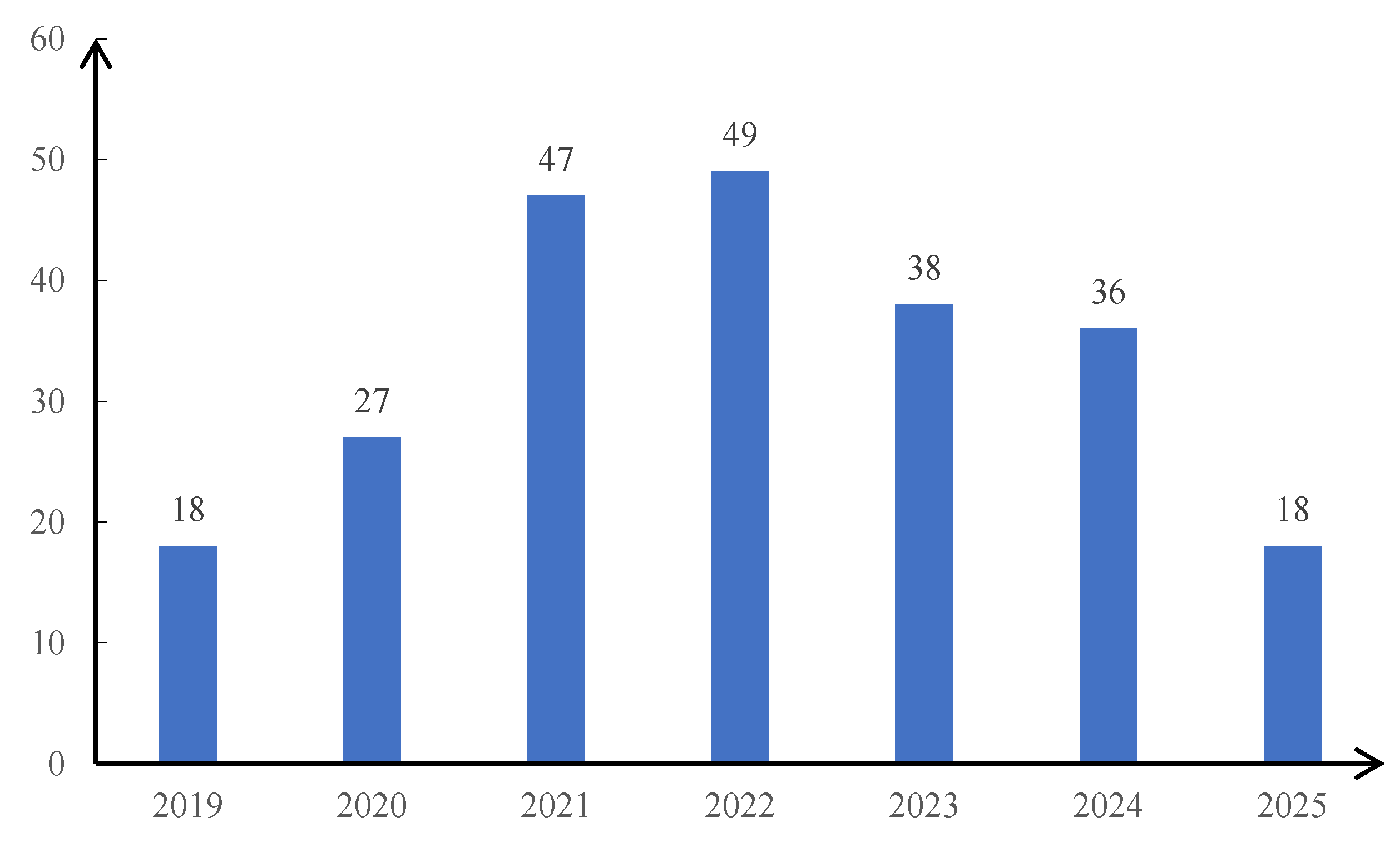
Figure 2.
Factors affecting consumers’ panic hoarding behavior
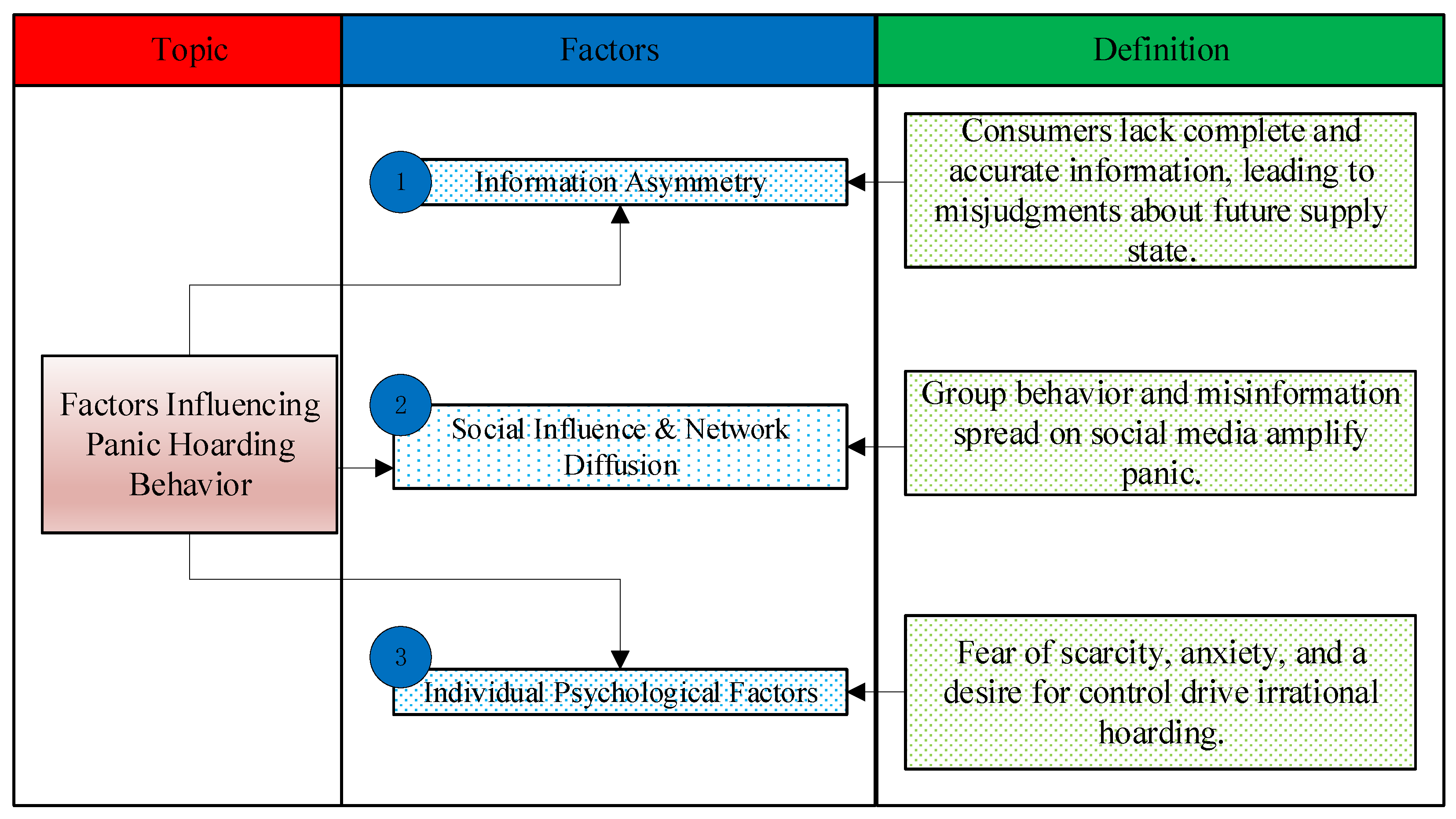
Figure 3.
Interaction between supply chain management and consumer panic-buying behavior

Figure 4.
Supply disruption risk and panic buying
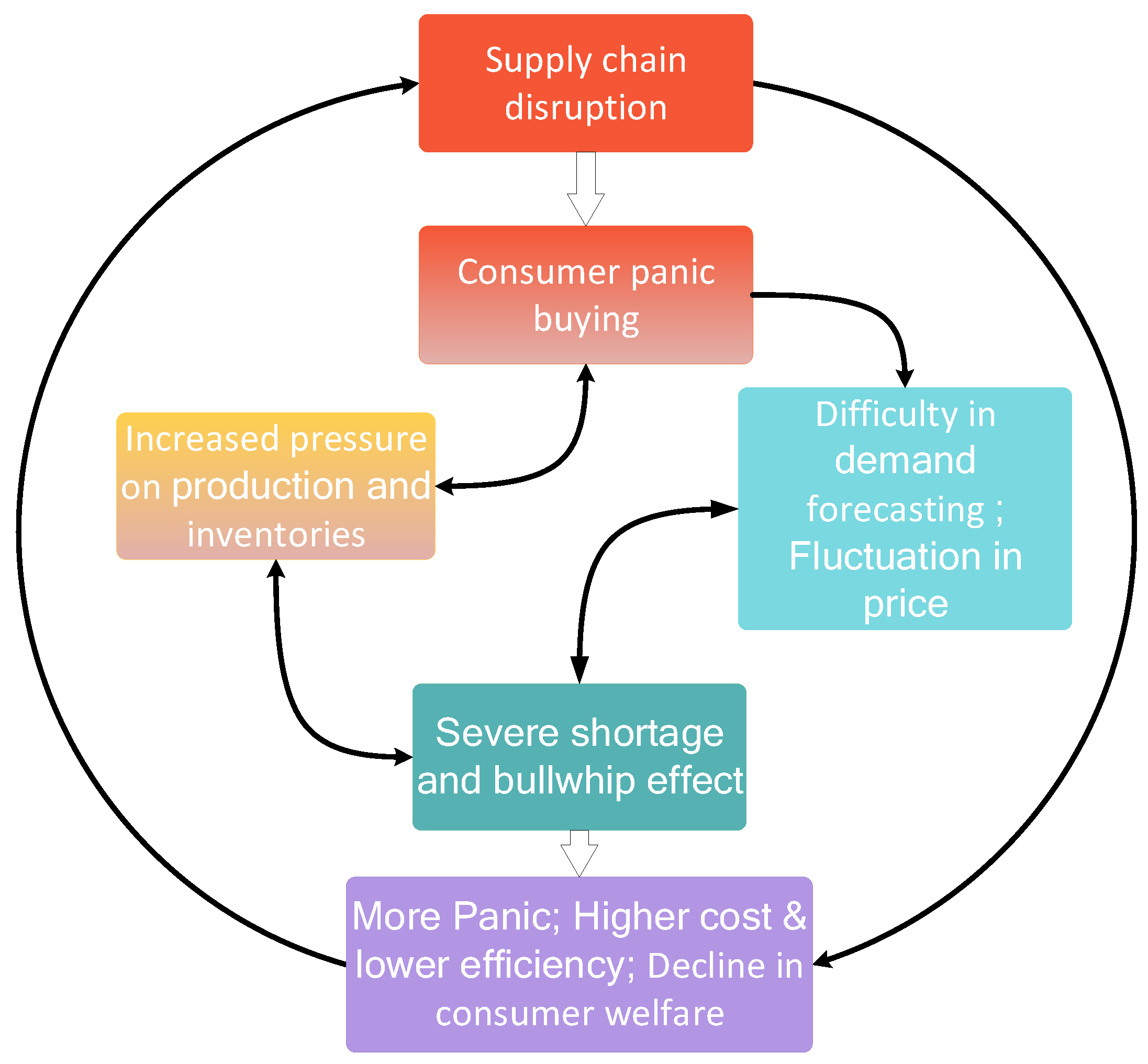

Table 1.
Literature summary (from 2010-2025, published articles and preprints).
| Academic platform | Keywords | Number records |
|---|---|---|
| Web of Science (WoS) | Supply disruption and panic buying | 77 |
| Web of Science | Panic buying and supply chain management | 137 |
| Web of Science | Managing consumer panic buying behavior | 87 |
| Distinct records from WoS | 251 | |
| Google Scholar (GS) | Supply disruption and panic buying and supply chain management | 2260 |
| Refined records from GS | 236 |
Table 2.
Summary of key studies on consumer behavior under supply disruption risk
| Author (Year) | Research Focus | Key Findings |
|---|---|---|
| Islam et al. [13] | Panic buying across countries during COVID-19 |
|
| Gangwar et al. [14] | Promotional strategies and rational stockpiling |
|
| Li et al. [11] | Strategic stockpiling under price fluctuations |
|
| Xu et al. [12] | Retailer ordering under panic buying |
|
| Zheng et al. [23] | Social learning effects and inventory management |
|
| Ivanov [25] | Supply chain resilience modeling |
|
| Yuen et al. [19] | Psychological mechanisms of panic buying |
|
Table 3.
Factors influencing panic hoarding behavior
| Factors | Key Examples & Findings | Sample reference |
|---|---|---|
| Information Asymmetry |
|
[20,30] |
| Social Influence |
|
[31,36] |
| Network Diffusion |
|
[19,37,38] |
| Individual Psychology |
|
[20,39,40,41] |
Table 4.
Strategies to address panic buying
| Strategies | Interventions | Concrete Measures | Sample References |
|---|---|---|---|
| Alleviating Consumer Panic Psychology | Psychological Intervention and Control Restoration | Encourage community engagement to enhance self-efficacy. | [62] |
| Transparency and Rational Guidance | Use "Purchase As Needed" labels to nudge behavior. | [63] | |
| Avoid media sensationalism of shortages. | [65] | ||
| Technology and Sentiment Analysis | Leverage AI for consumer sentiment analysis and demand forecasting. | [64] | |
| Flexible Supply and Adjustments | Dynamic production capacity adjustment. | [43,86,87] | |
| Enhancing Supply Chain Elasticity and Inventory Management | Quotas and Priority Management | Enforce purchase limits on essentials. | [24,88] |
| Customer segmentation for priority access. | [73] | ||
| Logistics and Supplier Networks | Build emergency procurement channels. | [74,89] | |
| Diversify supplier networks to reduce dependency risks. | [27] | ||
| Production conversion and expansion; Digitization | [77,78,79] | ||
| Government-Retailer Collaboration | Government Actions | Implement price controls during crises. | [74] |
| Establish joint emergency reserves. | [39] | ||
| Issue authoritative supply chain statements. | [62] | ||
| Retailer Measures | Adopt dynamic pricing and real-time inventory platforms. | [27] | |
| Pre-stock key goods to curb early panic. | [36,66] | ||
| Implement purchase limit and adjust price | [83] |
Table 5.
Impacts of Panic Buying on Supply Chain Performance and Consumer Welfare
| Dimensions | Specific Impacts | Concrete Expression | References |
|---|---|---|---|
| Supply Chain Performance |
Insufficient flexibility | Demand response lags Obstructed global circulation |
[33] |
| Cost increase | Rising shortage costs, inventory costs, transportation costs Increased bullwhip effect |
[43];[90];[91] | |
| Resource mismatch | Overstocking leads to waste of resources; Irrational demand leads to waste of energy and raw materials |
[26] | |
| Consumer Welfare |
Economic burden | Price increases Additional cost increases Wasteful spending |
[67];[43];[24] |
| Psychological pressure |
Social anxiety spreads to fuel panic Consumers’ long-term trust in markets collapses |
[33];[43] | |
| Social inequality | Difficulty in accessing necessities for disadvantaged groups Policies (limiting purchases/high prices) disproportionately affect low-income populations |
[90];[26] | |
| Two-way Interaction Mechanism |
The "Shortage→ Rush→Shortage" cycle |
Supply chain disruptions trigger consumer panic buying, further exacerbating inventory pressures |
[26] |
| Retailer behavioral conditioning | Active stockpiling may temporarily ease supply pressures, but excessive stockpiling prolongs recovery times |
Rahman et al. [43], Zheng et al. [83] |
Note: This table spans two pages.
Disclaimer/Publisher’s Note: The statements, opinions and data contained in all publications are solely those of the individual author(s) and contributor(s) and not of MDPI and/or the editor(s). MDPI and/or the editor(s) disclaim responsibility for any injury to people or property resulting from any ideas, methods, instructions or products referred to in the content. |
© 2025 by the authors. Licensee MDPI, Basel, Switzerland. This article is an open access article distributed under the terms and conditions of the Creative Commons Attribution (CC BY) license (http://creativecommons.org/licenses/by/4.0/).
Copyright: This open access article is published under a Creative Commons CC BY 4.0 license, which permit the free download, distribution, and reuse, provided that the author and preprint are cited in any reuse.


