

Submitted:
17 August 2025
Posted:
18 August 2025
You are already at the latest version
Abstract
To understand the foundations of productive potential, it would be necessary to examine the utilisation of human noetic (intellectual) power to help unleash the latent productive potential inherent within. This intellectual power is the driving force which need be triggered as it is the characteristic ability of the mind—the potentialities within us that can make a difference. The noetic power potential can be whetted by various means which act as triggers. The effect being that, human beings become more productive, and which is a necessity in today’s context to match the productive power of artificial intelligent agents—that are continuously redefining productivity. These AI-based tools can, however, be used to augment our productivity levels, to make us become more efficient, intelligent, and smarter. But we cannot ignore the power of our own innate natural intelligence, which has many things to offer beyond boosting productivity. This paper is the result of such an inquiry.
Keywords:
noetic potential
; productivity
; productive potential
; intelligence
; effort
; semantic frame
1. Introduction
Productivity is a relatively modern concept, as it was seldom defined or understood, nor even considered seriously in the ancient times or the middle ages. What is known about the concept or idea of productivity in the ancient past refers to peasant and agricultural productivity (Olivieri, 1972; Hatcher, 2024). In the ancient times, as noted by Olivieri (1972), productivity was limited by limitations in technological growth and availability of practical mechanical tools. An analysis of productivity, its foundations, origin, trends and perspective has been performed by Zelenyuk (2023), which delineates various dimensions of productivity which the readers could find absorbing. In this research, however, we examine the nature of productive potential, without delving into the details of the foundations and origin of the idea of productivity itself.
The primary goal of this brief research is to help individuals awaken their inner productive potential. By this, it is meant here the potentialities which people have within them in latent, unutilised form, and which need be awakened to help individuals become discretely productive. Here, “productivity” means any act of performance that results in positive outcomes having economic, social, artistic, intellectual, financial, or any other significance (Tangen, 2005). It may result from productive transformation of an individual or of ideas into practical solutions having some definite commercial prospects. The concept of productivity is equated with higher cognitive or physical capabilities that can be channelized toward attainment of a set goals and ambitions. In sense of economics, productivity is the key metric of economic foundations of growth and prosperity (Froud et al., 2020)
Productivity in other sense is equated with noetic achievements of excellence. Now whatever may be the reason for productivity, the inner productive potential of an individual must be awakened through adoption of positive habits and routine practice of necessary actions aimed towards positive transformation of the individual. Practical solutions to becoming productive may refer to building productivity tools, applications (apps) or programs that showcase the strength of productivity (Bonney et al., 2024). However, the productive power of practical thinking cannot be ignored as it reflects the process of ideation which provides analytical understanding of the knowledge and wisdom acquired through actions that support productivity.
Individuals acquire knowledge for achieving their goals—whether intangible intellectual (noetic) goals or tangible objectives that have positive outcomes. However, individuals should be able to understand the influence of productive motives. Motives are designated productive when they denote something constructive, fruitful. Such motives are characteristic of intentions and reasons for positive action. We shall confine ourselves in this paper with the idea and concept of “positive action”. Here, the role of intelligence cannot be flouted, since the wisdom of positive action acts on the objects of intelligence. Under organisational settings, however, expert management and organisation of productivity characterising production of values (goods and services) are attained through application of methods of production supported by intelligent tools of automation and decision-support systems. These productive systems are those that we may call agents of intelligence (Reaidy et al., 2003)—which symbolise modern “productive intelligence” (Zhang, 2025). The intelligence of this kind is also found to be embodied in the art of learning for productivity.
However, this paper deals with human productive power potential—the power within us that exists in latent form—and which has been the subject of study and debate among researchers and psychologists, both. We are aware that the productive power of science is one of the prime factors of economic growth (Perepechko & Yagolnitser, 2021) and prosperity. Furthermore, technology, gadgets, social networking, and tools of artificial intelligence are redefining the limits of power potentialities for machines (Vidal, 2025), and it is also reshaping human productivity with its ability to make us more productive, by helping us in realising the potential latent within. Empowering people to know more about their own potential is a positive thing, and is a way forward toward a more productive and fulfilling life. In fact, more about this kind of embodied wisdom of human potential could be found in the book “Awaken the Giant Within”, written by Robbins, (2012).
2. The Semantic Frame of Productivity: Cognitive Aspects
This section examine the cognitive aspects of productivity captured in semantic frames. Cognition involves the active participation of the intellect. It is based on the kinematics of the mind: noetic kinesis. Productivity is often the result of stimulus-led action. This could be in the form of motives, instincts, or physical sense, i.e., perception and experience, some triggers, inspirations, and the will to action. Values expressed in terms of cognitive functions describe the nature of productivity. It may be expressed in economic terms or social terms, or both. Within the semantic frame, the meaning of productivity becomes apparent. Human productivity is also a test of endurance which defines a productive life and ways of living, itself being the result of productiveness. But when we are talking about collective economic productivity, we denote organisational approach with a definite purpose, i.e., to attain organisational goals and objectives.
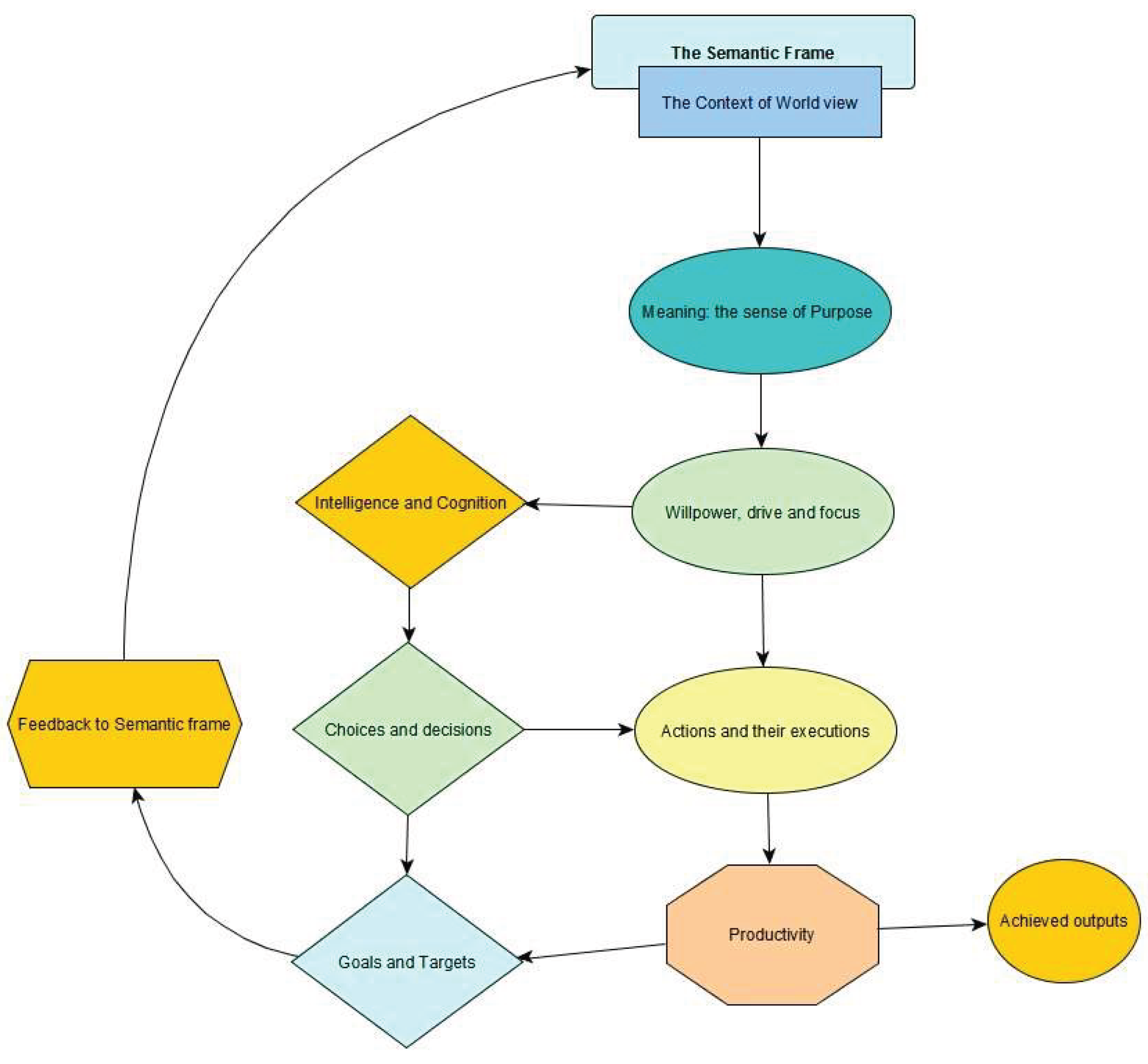
In the Figure 1 above, the semantic frame of productive potential is presented graphically, and the interrelationships between meaning, willpower, action, intelligence, goals and productivity are illuminated as well. The semantic frame is described which exhibits the things that are meaningful, and explains how intelligence interprets meaning related to productivity. Meaning provides the direction to willpower—the drive which is needed for sustained use of intelligence to make the effort to become productive, or produce something of value and utility. Human effort is guided by intelligence, which unleashes the full productive potential inherent within us. The effort is the actions carried out to achieve goals, which arise from making decisions based on choices. Productivity in this sense is referred to as attainment of meaningful goals that are realised through intelligent application of willpower and effort. Figure 1 also depicts the flow of causality which indicates feedback loop and major influencers of productivity. By productive potential, it is meant herein the “power of possibility” within us found in latent form, in the form of “condensed energy state”, which must be stimulated in order for the individual to achieve something.
Figure 1.
The Semantic Frame of Productive Potential.
We must first understand the power by which actions acquire “productive” nature. It pertains to contribution of efforts towards achieving goals, whether collective or individual it doesn’t matter as a matter of fact. The power empowering actions to become profitable as a result of being productive in nature stems from the needs and necessities of the times. Therefore, to make a productive effort renders a life dynamic. But this dynamicity is the result of commitment and tireless efforts by which one can accomplish great things in life. It stimulates activity and counters latency that resides within us. To awaken this latent potential within, it necessitates transformation in habits and actions on the part of the doer. This explains the art and science of empowerment by words and imports which stimulate and inspire the mind to become productive. Therefore, within the semantic frame, cognitive aspects are bounded by the intellect in a manner where words become images in the mind as undergo semantic transformation.
3. The Foundations of Productive Potential
3.1. The Statics and Dynamics of Productivity
The rational theory of productivity states that there must be some “powers” required to become productive or produce fruitful actions. The mechanics of productivity has economic implications by way of goal-oriented actions within a sphere of productive boundary. This boundary is defined by means of production with attached limitations and constraints. By such means of production—i.e., methods by which to attain aims and objectives—things are produced that have value and comes with attached utility—a function. With the help of value one can ascertain the extent and limits of the powers of human will and its capacity. The will to action depends on choice and options. Choice is a prerequisite which can be constructive or destructive: e.g., an act which can destroy life or frustrate plans (Ikeda, 2016). The productive potential of a human being could be unleashed effectively if one makes the right choice to act or decide which course of actions would maximise productivity (Heath & Heath, 2013), with least minimum effort. This explains the dynamics of productivity. Regarding the static part, we have something else to talk about. The goal is to utilise the maximum energy available to a system to attain the desired effects (objectives). If individuals are capable of nurturing an optimistic, productive frame of awareness, then their true potential will reflect on their productivity. And this explains the dynamic part of human potentiality.
3.2. The Prophets of Productivity
The history of humanity is highly saturated with productive geniuses known for their works of creativity. Among them, some have become legends in their own rights. They were not only pioneers in many aspects of science, technology, literature, and entrepreneurship, but also in arts and music and painting, as their works bear true marks of creativity that has inspired generations and motivated individuals towards productivity. Isaac Newton, Benjamin Franklin, Goethe, Andrew Carnegie, Henri Ford, among many others can be truly called the “Prophets of Productivity” owing to their tireless productive endeavors that changed the lives of millions of people across the world. They were the true beacons of productivity. Among the literary geniuses were Shakespeare, Voltaire, Victor Hugo, Charles Dickens and some of the most productive and influential philosophers like Francis Bacon, David Hume, Immanuel Kant, Arthur Schopenhauer, Karl Marx, Nietzsche, have walked upon earth and redefined productivity through their works—those very works that are still considered the finest examples of human creative endeavor. They were not only productive but highly inventive as well in their professional frontiers. The long list of productive individuals as we come to know who can be dubbed as the prophets of productivity is “exhaustive” in nature, as the reader may find it so. And then, the productivity of the Nobel Laureates are difficult to ignore, given their diversity and different nature which were definitive, as much as their pioneering works of literature and science that have shaped social and scientific progress, and which have had maximum effects on the humanity. At the individual level, their prolific contributions have defined the relation between human productivity and cognitive capability. These prophets of productivity had great potential within them. They perhaps looked upon productivity as their highest aim. And these examples are, perhaps, the creative exhibitions of the greatest minds. In similar tune, the modern world is full of creative ingenuity, and there are best examples of creative and productive talents being honed that we encounter every instant.
We, too, in fact have within us full potentiality which many of us aren’t fully able to exploit for various reasons. In order to do so, we must comprehend the true nature or essence of this foundation of noetic potentiality. It would help those who lack the productive dynamicity to become more compatible with the pace of productivity in the modern context, in economic sense to say so.
3.3. The Foundations of Productive Potential
The fundamental results of productive experiences are amazing and inspiring. In modern context, however, productivity can be defined as a ratio—the relation between inputs and outputs. At the collective level, it pertains to industrial or organisational output. In industries, systems are continuously being modified, updated or replaced to achieve maximum efficiency. Industrial productivity is the result of highly organised, coordinated systems which function in a controlled environment. Industrial productivity is a process-oriented activity. Today, firms and companies don’t just compete, they face each other, establish synergistic partnerships, and do their best to surpass each other in value creation and distribution of utility. But being competitive isn’t enough: being competent plus productive is the motto of the economics of productivity. Productivity is often considered one of the primary cornerstones of success (Bernolak, 2009). Perhaps, what we are doing today isn’t enough to achieve higher goals. But what are those higher goals? Well, they could mean many things to many individuals. To achieve those higher goals, however, one must be a dynamic, productive individual.
“It is imperative to nurture a vitally active, dynamic, and productive mind to pursue great objectives…”
We are often driven by “productive impulse”—the impulse which is generated following specific events. This can be defined as instincts under the influence of good, productive conscience. There exists several portals of knowledge on human productivity (see Appendix) that can help boost our own productive potential and help us perform better. We may call these “productive portals”. Even, some ancient writings, too, make a strong reference to productivity1. It is not just about learning “how” to produce things faster and better, but something which is beyond to help us continue to expand outside our conventional boundaries. Why limit our creative abilities and creative productivity work within a boundary? There are many possibilities to explore, by which we can uncover new knowledge dimensions. But in attempting to do so, we must acknowledge the power of intelligence to make us become more active and vibrant.
Knowledge helps us become virtuous representative of expertise and productivity, for the former is correlated to the latter. There are “specific skillsets” that could be mastered by learning, to help us become more dynamic and productive beings. The search for these skillsets is to search for new knowledge—that’ll facilitate our understanding of human potentialities. Intellectual training grounds, for instance, provide a rich setting for augmenting our noetic skills. It justifies the spirit of productive learning. Stephen Covey, in fact, tells us about acquiring the qualities, i.e., productive, positive habits of highly successful individuals in “The Seven Habits of Highly Effective People”. In the book, the author (Covey, 2020) has identified the most essential (aka productive) qualities of highly effective and successful individuals. Indeed, highly successful individuals exhibit their greatest talents through productivity. In today’s context, these would fit sufficiently to redefine the essence of e-productivity—electronic and digital productiveness. It is to be noted that today, the creation of wealth, too, largely depends on our creative and productive abilities. Hence, output efficiency has become the highest aim and objective for most industries, and for many industrious individuals it has become a necessity.
4. Conclusion
In this brief paper, we have discussed the nature of productive potential of individuals and the semantic framework within which this potentiality is put into good use. Meaning that, the potential in latent form within us must be stimulated and awakened to help us achieve something meaningful. The true nature of productive potential and its essence should be understood and realised in order to utilise its full power. Meaning that, how productive an individual could become in pursuing her goals? This question has been answered in part while explaining the basis of productive actions in terms of human potentiality. More detailed research should be undertaken to explore and examine the interrelationships between the variables that influence human productivity and the potential latent within us, with intelligence, goals, actions, and choices playing important part of the conceptual network of productivity attained from utilising human potential.
Acknowledgements
The author extends his gratitude to the V.S. Krishna Central Library, Andhra University for providing access to conduct this research.
Disclaimer
The views expressed in this paper are exclusively of the author and do not represent the views of the QNM Lab or Andhra University, or any other entity. This is only a theoretical research and in no way involve any use of animal or human subjects.
References
- Bernolak, I. (2009). Succeed with Productivity and Quality. Quality Press.
- Bonney, S. O., Yankah, J. E., Adjei, K. O., & Tieru, C. K. (2024). Software and Mobile Apps as a Strategy for Productivity Improvement in the Construction Industry. Journal of Building Construction and Planning Research, 12(1), 1-35.
- Covey, S. R. (2020). The 7 habits of highly effective people. Simon & Schuster.
- Finley, M. I. (1965). Technical innovation and economic progress in the ancient world. The Economic History Review, 18(1), 29-45.
- Froud, J., Haslam, C., Johal, S., & Williams, K. (2020). (How) does productivity matter in the foundational economy?. Local Economy, 35(4), 316-336.
- Hatcher, J. (2024). Peasant productivity and welfare in the Middle Ages and beyond. Past & Present, 262(1), 281-314.
- Heath, C., & Heath, D. (2013). Decisive: How to make better choices in life and work. Random House.
- Ikeda, S. (2016). The economics of self-destructive choices. Springer Japan.
- Olivieri, A. (1972). Productivity and Technologies in the 12th to the 17th Centuries. Journal of European Economic History, 1(1), 170.
- Perepechko, L. N., & Yagolnitser, M. A. (2021). Innovative Potential of Industry and Productive Power of Science as the Factors of Economic Growth. Журнал Сибирскoгo федеральнoгo университета. Серия: Гуманитарные науки, 14(7), 966-977.
- Reaidy, J., Yingjiu, L., Diep, D., Massotte, P., & Guinet, A. (2003). Intelligent agents for production systems. Intelligent Agentbased Operations management, S. d’Amours and A. Guinet (eds), Hermes Penton Science, 147-164.
- Robbins, T. (2012). Awaken the giant within. Simon and Schuster.
- Tangen, S. (2005). Demystifying productivity and performance. International Journal of Productivity and performance management, 54(1), 34-46.
- Vidal, J. (2025). Productive power in social networks: challenges for post-phenomenological mediation theory. AI & SOCIETY, 1-11.
- Zelenyuk, V. (2023). Productivity analysis: roots, foundations, trends and perspectives. Journal of Productivity Analysis, 60(3), 229-247.
- Zhang, Z. (2025). Co-productive Intelligence. In Cybernetics and the Constructed Environment. Taylor & Francis.
| 1 | See, for example, Finley, M. I. (1965). Technical innovation and economic progress in the ancient world. The Economic History Review, 18(1), 29-45. |
Disclaimer/Publisher’s Note: The statements, opinions and data contained in all publications are solely those of the individual author(s) and contributor(s) and not of MDPI and/or the editor(s). MDPI and/or the editor(s) disclaim responsibility for any injury to people or property resulting from any ideas, methods, instructions or products referred to in the content. |
© 2025 by the authors. Licensee MDPI, Basel, Switzerland. This article is an open access article distributed under the terms and conditions of the Creative Commons Attribution (CC BY) license (http://creativecommons.org/licenses/by/4.0/).
Copyright: This open access article is published under a Creative Commons CC BY 4.0 license, which permit the free download, distribution, and reuse, provided that the author and preprint are cited in any reuse.


