

Submitted:
12 July 2025
Posted:
28 July 2025
You are already at the latest version
Abstract
This editorial offers a frontline perspective on Poland’s 2024 flood (based on ~170 paged report) through a One Health lens, intertwining veterinary and human epidemiology, environmental science, and real-time infodemic management. Drawing on field experience—from coordinating rescue actions, post-exposure vaccinations and ad-hoc water-quality testing to monitoring social-media–driven risk narratives—the piece illustrates how pandemic-era misinformation patterns resurfaced during the disaster and influenced operational decisions. By situating practical lessons within a concise evidence framework, we seek to catalyse dialogue among clinicians, public-health officers, and disaster scientists, fostering more integrated readiness for future high-impact events.
Keywords:
disasters
; One Health
; social determinants of health
; waterborne diseases
; disaster risk reduction
This is a summary of the extensive report [1], which emphasises strengthening interdisciplinary cooperation among human and veterinary medical professionals, environmental specialists, and emergency services in flood situations.
Disaster background. Storm Boris, a Genoa-related cut-off low, unleashed record-breaking rainfall across Central Europe in mid-September 2024, triggering severe floods in the Oder river basin in Poland and exposing critical public-health vulnerabilities—from infrastructure collapse to widespread waterborne disease risk. The 2024 flood in southwestern Poland laid bare these systemic deficiencies, revealing risks such as contaminated water, disrupted healthcare access, mental-health impacts, and sanitation breakdowns. This study, embedded in a One Health framework (an integrated, unifying approach that recognizes the interconnection between human, animal, and environmental health to improve outcomes across all three domains), investigates the flood’s societal and health impacts, highlighting the interconnectedness of human, animal, and environmental health. The theoretical framework draws on competing concepts of "health ageing" and resilience, identifying mechanisms of social responses to threats and inequalities in the face of disasters [2]. Different types of socio-economic structure and natural environments mean that each place has a different level of sensitivity to climate change and sudden disaster phenomena. Heavy rainfall and flooding pose a serious challenge to the well-being and health of local communities. The weathering hypothesis frames health ageing as the result of cumulative socioeconomic and environmental stressors, showing how disadvantaged communities experience accelerated health decline during and after disasters, such as floods [3].
Moreover, social memory emerges through communal weathering in a developmental pathway [4]. Among vulnerable communities, shared recollections of past floods both exacerbate stress, health and well-being, and guide collective preparedness and adaptive strategies. On the other hand, a distinctive strength of this resilient agency lies in its social capital. Social ties, a key component of social capital, play a crucial role—not only in fostering resilience but also in contributing to the accumulation of cultural and economic capital. These ties form networks of enduring and meaningful interpersonal relationships that support individuals in navigating society, shaping their actions, and co-constructing the social structure through normative, emotional, and cultural frameworks. Social capital refers to the relationships between communities and government institutions (such as voivodeship and poviat crisis management teams), organizations (e.g., healthcare facilities and the Emergency Medical Services [EMS] system), or services (e.g., sanitary and veterinary inspections). It is especially vital during crises [3], as it facilitates access to systemic support (e.g., for protecting health), public resources (e.g., EMS teams), and strategic information (e.g., health advisories).
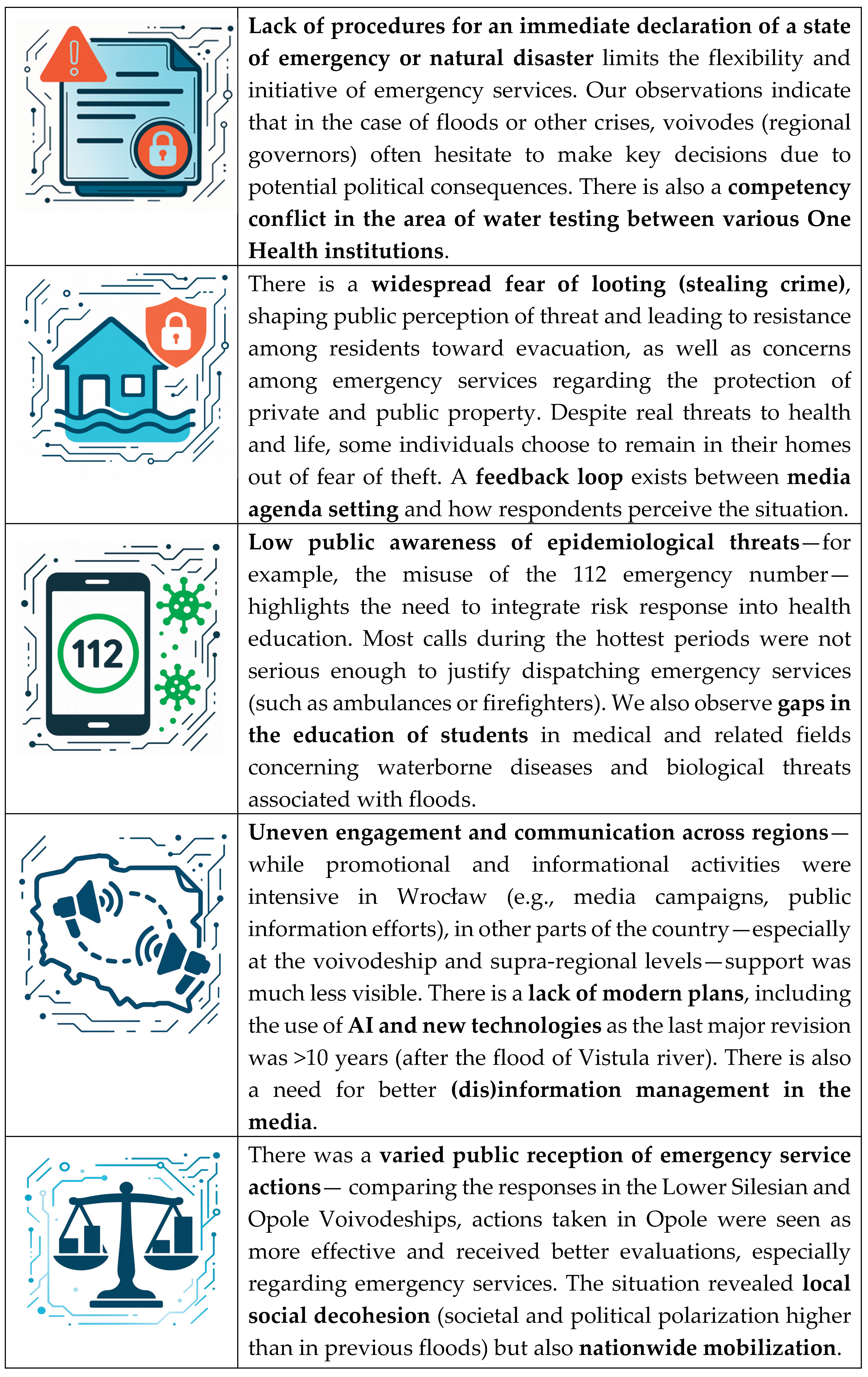
Triangulation. In our study, we employed a mixed-methods research design [3] integrating triangulated multiple sources and data types [Figure 1] to enhance validity and depth of findings [5]. Quantitative survey data were collected through structured questionnaires [6], while qualitative insights were gathered via over 100 semi-structured or informal interviews with affected residents, health professionals, sanitary or veterinary inspectors, emergency responders, and health-related students. Secondary data analyses included health and microbiological assessments contextualizing individual-level reports within broader environmental and epidemiological trends. Media discourse analysis evaluated public risk perception and crisis communication effectiveness [7]. Health-related disinformation during crises, amplified by social media, has emerged as a significant public health threat. False or manipulated content influences public attitudes and health behaviours, reducing societal resilience during polycrises. This triangulated approach [Figure 2] enabled a comprehensive assessment of immediate and longer-term health impacts, including PTSD, post-exposure skin and respiratory conditions, physical injuries, microbial water contamination, outbreak potential, and broader population-level health threats [8].
Water and food/feed contamination. Traditional and non-traditional surveillance showed no significant increase in typical water-borne infections; however, localised episodes of nonspecific diarrhoea were recorded. It was the only health metric to show a substantial increase during the flood period, while typical waterborne surveillance pathogens remained unchanged, and no significant new threats emerged. Post-exposure vaccination campaigns and the functioning of field hospitals were viewed positively by respondents (mainly in response phase). Multiple problems were noted with water and soil testing procedures and with coordination among various One Health actors. Local scientists often conducted analyses of public-health importance without promptly informing relevant authorities. One such problem was the lack of quick access to research on the consequences of the flood conducted by local scientists. This phenomenon reflects the previously identified issue of "science as an ivory tower" in Poland, especially in the context of climate change research. It is associated with missed opportunities to target proper authorities and with a lack of effective communication skills among researchers [9]. Public understanding of water-safety risks was fragmented and exacerbated by social-media misinformation. Notably, One Health surveillance was inconsistently applied across sectors, limiting real-time response. The absence of immediate disaster declaration procedures curtailed the initiative of One Health inspection services [10]. Low awareness of epidemiological threats and educational gaps among medical students were observed. An announcement of unconditional testing of residents’ wells caused significant disruptions in foothill districts. A major communication issue arose when the Government Security Centre (RCB) disseminated incorrect water safety messages, which required correction by local authorities.
Healthcare adaptation. Respondents noted substantial improvements in healthcare preparedness compared with floods in 1997 and 2010. Successful deployment of a field hospital and hospital evacuation in Nysa were key achievements. Emergency medical services were efficiently redeployed across the Opole Voivodeship. Nevertheless, healthcare facilities in the Sudeten districts of Lower Silesia reported considerable chaos and lack of support [11]. Local healthcare professionals complained about being unprepared for the event and lacking support from Wrocław during the critical first 24 hours of the flood (in contrast to the situation in Opole Voivodeship). Poor adherence to follow-up doses of post-exposure vaccinations was a concern—initial uptake was high due to fear and public alerts, but motivation later declined. Misunderstandings and conflicts of interest were identified between disaster response biomedical agencies and political actors regarding emergency declarations [10].
New-technology adaptation. AI-supported satellite imagery provided situational awareness, and drones verified evacuation needs [12,13]. Mobile hydrological sensor networks were deployed in conjunction with satellite-based situational awareness platforms, feeding into live dashboards used by municipal crisis teams. Water and soil were assessed using advanced technologies such as 16S sequencing and mass spectrometry, which had not been anticipated in older sanitary and veterinary preparedness plans [14]. Large Language models [15] were used to profile health communicates. Volunteer technologists collaborated with emergency authorities to pilot social-media monitoring tools for early detection of disinformation trends, particularly during the critical response phase. Non-state/university paid researchers tested the systems (such as FLEXTH), integrating satellite imagery with topographic and environmental data to improve near-real-time flood modelling and communicate with healthcare professionals about current situation. In Wrocław and Nysa among others, field-level coordination benefited from improvised water-quality analytics based on mobile sensor kits, contributing to a more adaptive local health response. The Wrocław municipality implemented a professional infodemic management strategy, systematically monitoring the local infosphere and addressing both disinformation and misinformation, including those disseminated by national government bodies and their Lower Silesian delegations. Unfortunately, the use of these modern technologies remains limited outside research and development centers, as none of our respondents had used or even encountered AI-based solutions, and telemedicine was restricted to basic telecommunication systems.
Psychological and social support. Affected populations exhibited both supportive and egoistic behaviours. Compared with findings from 1997, community fragmentation and atomisation tendencies (mainly among young adults) may be postulated [16]. Nevertheless, social support mobilization occurred during the harshest crisis periods, leaving some residents unsupported afterward. Overestimated crime threats, amplified by social media, are psychological phenomena that warrant further research. The Internet facilitated community self-organization, though awareness of psychological support availability remained limited. Our observations suggest that while successive floods enhance institutional preparedness, they may paradoxically diminish residents’ willingness to engage in collective action in chronically affected regions—consistent with the "safe development paradox" [17].
Discussion. The flood experiences of 1997, 2010 [3], and 2024—alongside other crises affecting southwestern Poland—demonstrate that resilient agency functions as a protective shield in coping with the impacts of both quasi-natural (e.g., COVID-19 pandemic) and strictly human-made hazards, such as the refugee crisis resulting from Russia’s aggression against Ukraine in 2022. Disasters must be recognised as multifaceted public health emergencies that demand interdisciplinary, anticipatory responses. Notably, students do not actively seek disaster-response training—paradoxically, those in non-flooded areas demonstrated greater willingness to engage—yet the accelerating effects of climate change make such training increasingly essential [8]. Notably, the vast majority of respondents—across all categories, including health-related students, flood victims, and emergency services—did not associate the increasing frequency of catastrophic floods with climate change. Our findings highlight the practical potential of artificial intelligence in enhancing disaster preparedness and response efforts [12,13,15], mainly volunteers from the private sector. Recommendations (particularly regarding first aid and emergency protocols and services such as European emergency number 112) have already been integrated into health education curricula at Wrocław Medical University and civil preparedness initiatives such as the Safety Observatory Foundation. Such “community hosts” are needed: social leaders, general practitioners, animators of local activities, and formal and informal guardians of community life. In a world experiencing successive crises, climatic, social, and economic, the presence of co-hosts (for there are many of them) caring for the common good can determine the durability and resilience of society. Particularly social capital of microbiologists and psychologists was successfully incorporated into response. The implementation of the Civil Protection and Population Safety Act, accompanied by training initiatives throughout 2025, offers a promising opportunity to strengthen regional coordination mechanisms in emergency response. In July 2025, a similar meteorological mechanism emerged in eastern Poland, though on a smaller scale, again underscoring the fragility of current monitoring systems and the need for proactive public-health preparedness, where some lessons learnt from previous events have been already applied [Figure 2]. Despite methodological limitations, such as non-representative sampling and limited generalizability, the study provides novel and unique insights into biomedical aspects of flood preparedness. Our initiative aligns with EU priorities, as in 2024/2025 the European Parliament advanced the AI and One Health systems approach by regulating integrative responses across human, animal, and environmental health, ensuring safe and coordinated technological applications across sectors. Future strategies should adopt a One Health approach, incorporating coordinated water quality monitoring, targeted vaccination campaigns, and comprehensive mental health support. Media monitoring underscores the need for more effective water-safety communication and rapid rumour-control mechanisms for countering misinformation. Crucially, scientific risk assessments must be translated into clear, actionable public-friendly messages.
References
- Jarynowski A, Maksymowicz S, Romanowska M, Nowakowska I, Mokrzycki P, Stochmal M. Powódź 2024 w Polsce w perspektywie społecznych aspektów Jednego Zdrowia publicznego. Wrocław: IBI; 2025.
- Działek J, Biernacki W, Konieczny R, Fiedeń Ł, Franczak P, Grzeszna K, Listwan-Franczak K. Understanding flood preparedness: flood memories, social vulnerability and risk communication in Southern Poland. Cham (CH): Springer; 2019.
- Voss M. Zustand und Zukunft des Bevölkerungsschutzes in Deutschland: Lessons to learn. Berlin: Katastrophenforschungsstelle; 2022.
- Strauss E. “Everything Is Old”: National Socialism and the weathering of the Jews of Łódź. Genealogy. 2024;8(2):33.
- Kaźmierczak D. Civil protection systems and disaster governance: a cross-regional approach. Cham (CH): Springer Nature; 2024.
- Stochmal M. Caringly subjective agency of Volunteer Fire Brigade members expressing the benefits of gifts and sacrifice for local communities. Forum Soc. 2019;10:177–199. [CrossRef]
- Meletis E, Jarynowski A, Maksymowicz S, Kostoulas P, Belik V. Animal health discourse during ecological crises in the media—lessons learnt from the flood in Thessaly from the One Health perspective. Vet Sci. 2024;11(4):147. [CrossRef]
- Goniewicz K. Flooding crisis in Poland: a global call to fortify healthcare against climate disasters. Am J Emerg Med. 2025;87:204–205. [CrossRef]
- Krawczyk A, Jaguszewska N, Ziółkiewicz W, Grodzińska-Jurczak M. The ivory tower of academia in the era of climate change: European scientists’ engagement in science popularization related to single-use plastics. Environ Sci Policy. 2023;146:185–202. [CrossRef]
- Florczak-Wątor M, Gárdos-Orosz F, Malíř J, Steuer M, editors. States of emergency and human rights protection: the theory and practice of the Visegrad countries. London: Taylor & Francis; 2024.
- Gawlowski PP, Iskrzycki L. The preparation and usage of public rescue units cooperating with the national medical rescue system towards actions taken on the spot of a disaster—an analysis based on the example of Wrocław and Lower Silesia. Disaster Emerg Med J. 2017;2(1):27–32. [CrossRef]
- Chaparro PA, Rincón EH, Betancourt GA, Sierra NM, Gomez MD, Peñuela CL. Artificial intelligence for the prediction of health emergencies and disasters. Disaster Emerg Med J. 2024;9(4):250–258. [CrossRef]
- Goniewicz K, Magiera M, Burkle FM, Goniewicz M. Prospective study on the potential use of satellite data for disaster prevention, preparedness, and mitigation in Poland. Prehosp Disaster Med. 2020;35(3):331–334. [CrossRef]
- Płoneczka-Janeczko K, Rypuła K, Rohm W, Magdziarz M, Zielak-Steciwko A. Epidemiological insight into bacterial risk associated with flooded areas of city agglomeration (Wrocław, Poland 2024). Sci Rep. 2025;15(1):1–2. [CrossRef]
- Blek N, Maj BW, Mikolap K. Large language models in emergency medicine: potential and challenges. Disaster and Emergency Medicine Journal. 2024;9(3):140-2. [CrossRef]
- Kaniasty K. Social support, interpersonal, and community dynamics following disasters caused by natural hazards. Curr Opin Psychol. 2020;32:105–109. [CrossRef]
- Fusinato E, Han S, Kobiyama M, de Brito MM. Safe development paradox: Evidence and methodological insights from a systematic review. Natural Hazards. 2024 Dec;120(15):13693-714. [CrossRef]
Figure 1.
Triangulation of data sources and methods combining secondary research, surveys, media analytics, interviews, and medical records.
Figure 1.
Triangulation of data sources and methods combining secondary research, surveys, media analytics, interviews, and medical records.
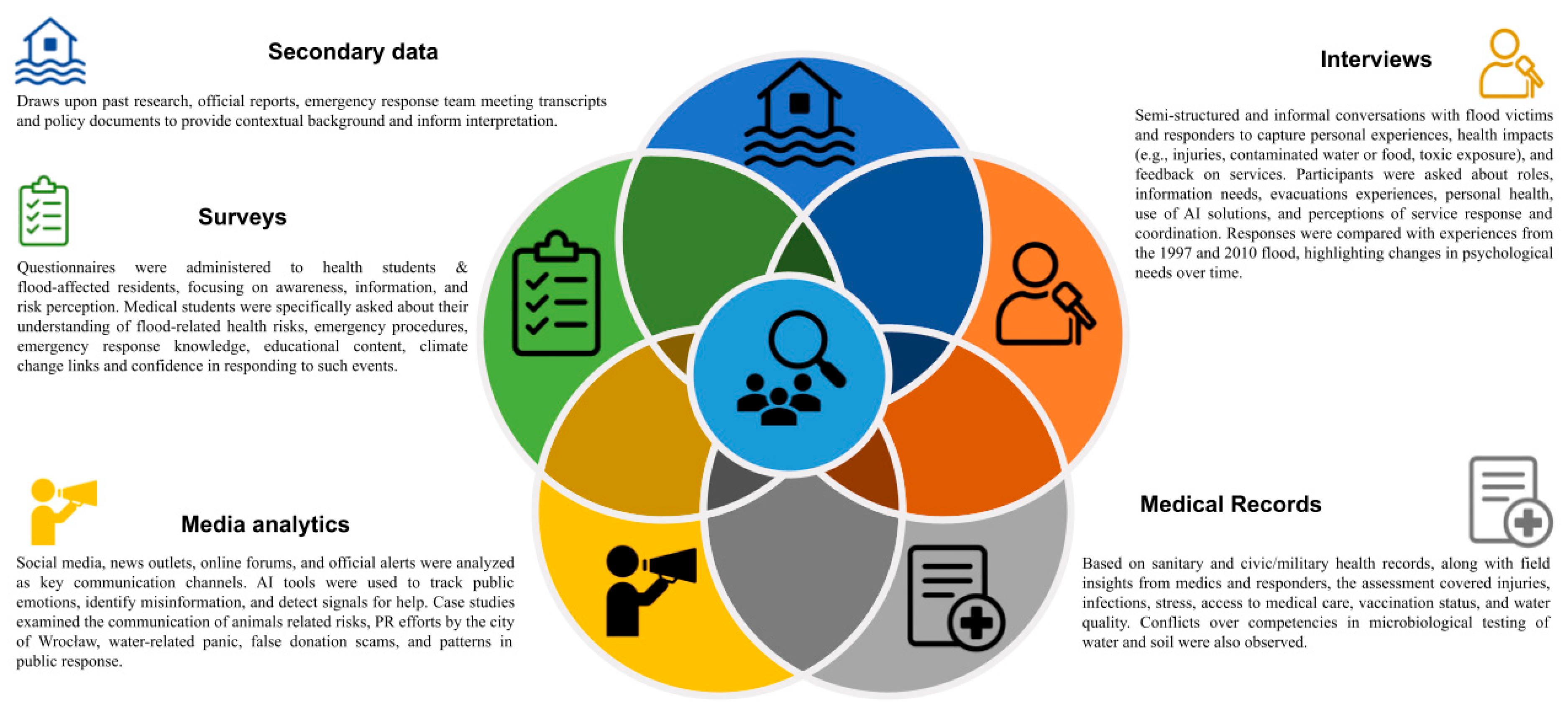
Figure 2.
General conclusions and recommendations from our study emphasize nontrivial, context-specific local observations that are not necessarily addressed (due to specificity or our region) in international frameworks such as the Sendai Framework [3].
Figure 2.
General conclusions and recommendations from our study emphasize nontrivial, context-specific local observations that are not necessarily addressed (due to specificity or our region) in international frameworks such as the Sendai Framework [3].
Disclaimer/Publisher’s Note: The statements, opinions and data contained in all publications are solely those of the individual author(s) and contributor(s) and not of MDPI and/or the editor(s). MDPI and/or the editor(s) disclaim responsibility for any injury to people or property resulting from any ideas, methods, instructions or products referred to in the content. |
© 2025 by the authors. Licensee MDPI, Basel, Switzerland. This article is an open access article distributed under the terms and conditions of the Creative Commons Attribution (CC BY) license (http://creativecommons.org/licenses/by/4.0/).
Copyright: This open access article is published under a Creative Commons CC BY 4.0 license, which permit the free download, distribution, and reuse, provided that the author and preprint are cited in any reuse.