
Submitted:
20 July 2025
Posted:
22 July 2025
You are already at the latest version
Abstract
In this narrative review, a panel of early-career clinician-scientists within the Swiss Federation of Clinical Neuro-Societies (YouCliN-SFCNS) present an interdisciplinary overview of how climate change-related factors influence brain health across clinical neuroscience. Drawing on insights from experts in diverse neuroscience specialties and climate science, we explore emerging links between environmental stressors and brain health, examine their clinical implications, and propose potential mitigation strategies. We provide a concise synthesis of current knowledge on the intersection of climate change with neurological and mental health, highlighting key priorities for future research. Stressors, such as displacement resulting from natural disasters, ecosystem disruptions, and extreme ambient temperatures, are poised to have significant impacts on the neuroscience landscape in Switzerland and worldwide. Few studies investigate the mechanisms and potential effects of climate change on brain health, hindering the development of effective mitigation strategies and policies. Understanding how anthropological climate change-related environmental changes affect brain health and disease is increasingly urgent. By highlighting knowledge gaps and emphasizing the need for interdisciplinary research, our review aims to promote research and practice, ultimately enhancing resilience, informing public health policies, and guiding clinical interventions for the increasing threats of climate change.
Keywords:
brain health
; neurology
; psychiatry
; neuroradiology
; neuropathology
; climate change
; dementia
; stroke
; depression
1. Introduction
The societal and economic burden of brain disorders is increasing and is estimated to be one of the leading causes of disability and economic impact worldwide [1]. National and international initiatives have been launched to raise awareness, broaden research, and implement strategies for preventing brain disorders and improving brain health [2]. Brain health—the state of brain functioning across cognitive, sensory, social-emotional, behavioral, and motor domains, […], irrespective of the presence or absence of disorders according to the World Health Organization—is influenced by a complex interplay of genetic, emotional, social, and environmental factors [3]. Research is increasingly indicating that environmental changes associated with climate change have a significant impact on brain health, encompassing nervous system conditions and mental well-being [4,5].
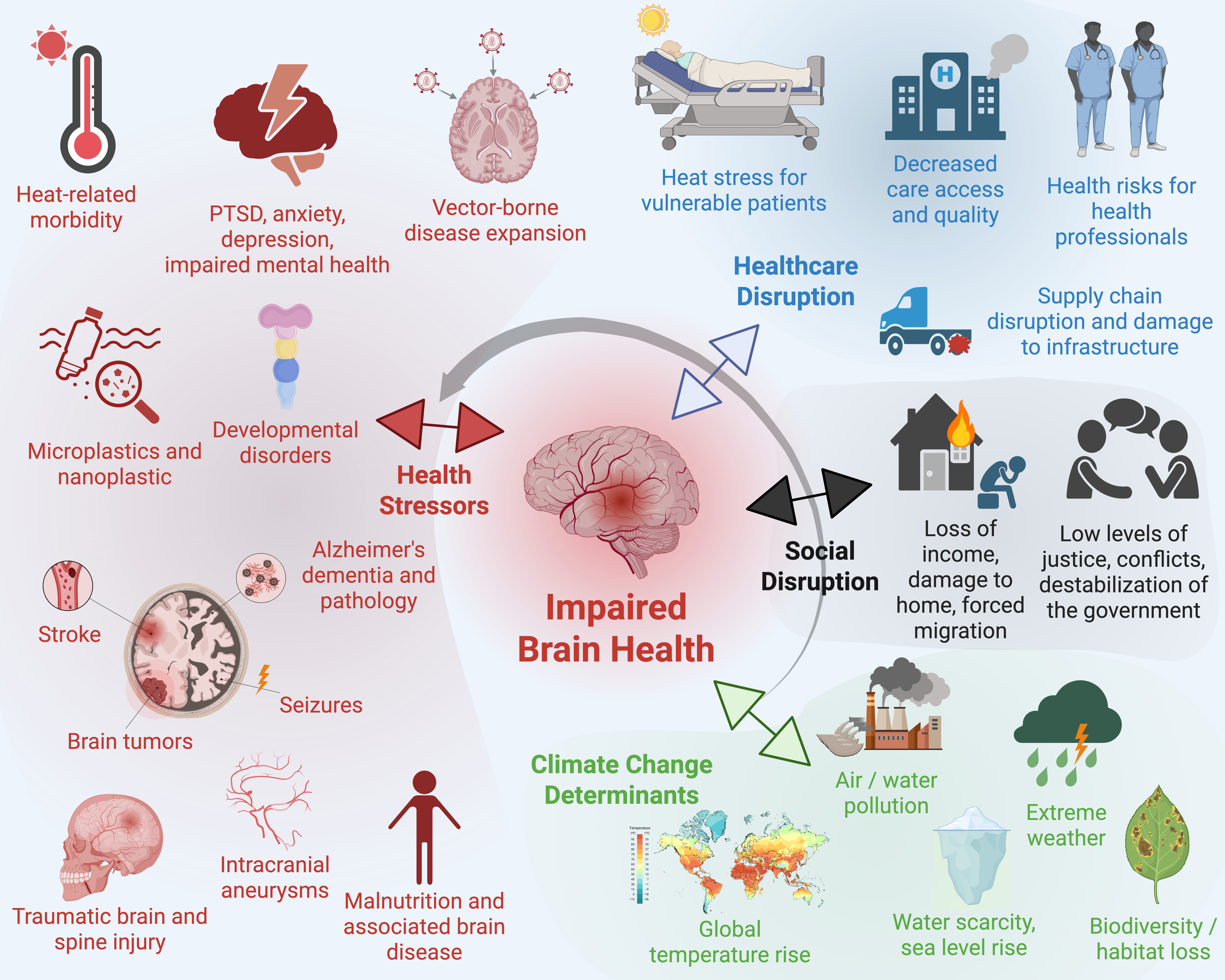
Various aspects of climate change, such as pollution, heatwaves, natural disasters, climate-induced migration, and other climate extremes, are increasingly recognized as risk factors that impact brain health (Figure 1). However, studying the relationship between climate change and brain health is challenging due to the overall lack of data, the complex underlying mechanisms, different study methods, limited details on disease subtypes, minimal consideration of individual and population genetics, and heterogeneous effects modulated by regional factors [4]. Many of the risk factors related to climate change may be modifiable and could help preserve brain health if addressed efficiently. A better understanding is urgently needed between changing environmental factors and brain health and disease.
This review discusses the most recent evidence on how climate change-related factors affect brain health across various clinical neuroscience disciplines, on behalf of the Young Clinical Neuroscientists Network within the Swiss Federation of Clinical Neuro-Societies (YouCliN-SFCNS). This interdisciplinary review is provided by early-career clinician-scientists, who will likely have to face the direct and indirect consequences of climate change in the coming decades and is reinforced by consultations with climate change specialists. This review presents current evidence on the connections between climate change-related factors and brain health, their clinical implications, potential mitigation strategies (Table 1), and areas for future research and improvement.
2. Methods
Studies and reviews were identified using search terms related to climate change, pollutants, and brain disease in PubMed, MEDLINE, EMBASE, gray literature, and personal collections. Studies published between 2000 and 2024 were included if they pertained to human incidence or prevalence of disease, were in English, and were relevant to brain diseases.
3. Mechanisms of Climate Change-Related Effects on Brain Health
Climate change can affect brain health through multiple interrelated mechanisms. Rising temperatures and more frequent heatwaves may induce oxidative stress, neuroinflammation, blood–brain barrier dysfunction, and even tau pathology—hallmarks of neurodegenerative diseases such as Alzheimer’s and related disorders [4]. Extreme temperatures significantly impact the body’s physiology, and these temperature extremes are projected to increase globally [6].
Air pollution, exacerbated by wildfires and fossil fuel use, seems to promote systemic vascular inflammation and allows fine particulates, heavy metals, and nanoparticles to penetrate the brain, accelerating cognitive decline, dementia, stroke, ALS, epilepsy, and multiple sclerosis [7]. Extreme weather events—hurricanes, floods, droughts—have been linked to psychological trauma and chronic stress, leading to post-traumatic stress disorder (PTSD), depression, anxiety, eco-anxiety, and increased suicide rates [8,9].
Additionally, expanding ranges of infectious vectors and harmful algal bloom neurotoxins may contribute to vascular stress and inflammatory processes, raising risks for neurodegeneration, mental disorders, atypical neurotoxic injuries, and other deleterious processes leading to altered brain health [10,11,12,13,14]. Collectively, these exposures impact brain development, mental health, and neurovascular integrity across the lifespan.
4. Interdisciplinary Overview Including Disease-Specific Findings
Neurology
Stroke is the third leading cause of disability overall (after ischemic heart disease and neonatal disorders) worldwide, and it is the second leading cause of death [15]. We are currently observing a demographic transition, which is responsible for the growth of the global population, the increasing proportion of older adults, the rising prevalence of stroke, and even increases in incidence in people younger than 55 years. Growing evidence indicates a link between stroke incidence and mortality with rising ambient temperatures and air pollution [16,17]. Since stroke is a potent risk factor and driving factor of future dementia, it will also contribute to increasing number of dementia cases, estimated at 152.8 million people living with dementia by 2050 [18]. Therefore, we face a major public health challenge: to improve dementia prevention through better stroke prevention, and considering emerging climate change factors, to identify new prevention strategies.
The association between air pollution and stroke risk seems to be more pronounced in patients with vascular risk factors, such as hypercholesterolemia, diabetes, hypertension, and smoking [19]. A synergistic effect was suggested, where people with vascular risk factors may be more vulnerable to the deleterious cerebrovascular impacts of air pollution. Therefore, acting on climate change and controlling risk factors appears to have additional benefits for brain health prevention. Overall, the existing data suggest that long-term air pollution exposure may be a risk factor for stroke. In contrast, short-term pollution exposure is suggested to be a trigger of stroke, especially in those with vascular risk factors.
Increasing ambient temperatures also seem to contribute to the risk of stroke. A study conducted in Madrid showed that increasing temperatures were associated with an increased rate of ischemic stroke and mortality [20]. A transient exposure to high temperature was associated with an increased risk of stroke, which occurred in the hour following heat exposure and lasted for 10 hours [21,22]. On the other hand, lower temperatures hours to days before the index event were shown to have an association with an increased risk of hemorrhagic stroke [22]. The effect was more pronounced in patients with hypertension and women, again suggesting increased susceptibility to cerebrovascular effects of extreme temperatures in patients with hypertension and gender-specific effects. Interestingly, people living in northern areas were more exposed to this deleterious association than people living in southern regions, due to the likely preconditioning effect of extreme temperatures [21]. Overall, this suggests that individuals residing in areas with historically cooler temperatures may be more susceptible to the risk of rising air temperatures and associated stroke risk.
In addition to the increased risk of stroke, emerging data show a connection between air pollution and the development of neurodegenerative diseases. New evidence suggests that PM2.5 (particulate matter with a diameter of 2.5 micrometers or less) pollution may influence the accumulation of amyloid-beta (Aβ) in the brain, particularly in individuals without a known genetic risk, notably those who do not carry the APOE4 allele [23]. While APOE4 is recognized as the strongest known risk factor for Alzheimer’s disease, it may obscure the weaker effects of air pollution. These findings suggest that environmental pollution may independently contribute to dementia cases that could be preventable through better control of environmental factors.
Psychiatry
The impact of global warming on mental health is increasingly documented and researched [24]. Factors like temperatures, extreme weather events, pollution, the disappearance of green spaces, and other consequences of global warming caused by humans may harm the mental health of individuals and significantly increase hospital admissions for mood and behavioral disorders [25]. For example, heat waves elevate stress and anxiety in susceptible individuals, such as older adults and individuals with pre-existing mental health disorders, but also is associated with increased hospitalization risk by 4.0% for every 10°C increase in mean daily temperature, notably related to schizophrenia and developmental disorders, according to a Swiss study conducted in the canton of Bern [26]. The rates of post-traumatic stress disorder and depression were higher among individuals who were exposed to natural disasters related to climate change, such as hurricanes or floods [27]. Such climate change-induced events can trigger and increase symptoms of anxiety, depression, trauma, and even suicidal thoughts [28].
As expected, the most vulnerable groups in low-income communities, marginalized populations, and individuals in developing nations suffer more from the mental health impacts of climate change as they have limited resources, insufficient psychiatric infrastructure, and social support [5]. The individuals' general ability to function can also be impacted by stress and anxiety stemming from climate change-related effects [29]. Indirect economic consequences of climate change, such as food shortages, economic crises, violent conflicts, and involuntary migration, are additional massive psychological risk factors for developing mental disorders [30]. Solastalgia, the distress caused by environmental change and loss of a beloved home environment, as well as climate anxiety, are furthermore newly emerging psychological syndromes in the face of the existential threat posed by the climate crisis [31].
Natural disasters resulting from climate change can have significant consequences for individuals' well-being, including starvation, flooding, displacement, and unemployment, all of which are likely to contribute to mental health problems. Consequently, there is a growing need for psychiatry to recognize and address these issues, emphasizing psychiatric management focused on prevention and the efficient allocation of resources, initiatives encouraging to reduce CO2 emissions, and infrastructure adaptations [32,33]. Continuing education programs and psychiatric training should sensitize, inform, and encourage climate-friendly and health-promoting behaviors among professionals, patients, and the public alike [34].
Neurosurgery
Intracranial aneurysms (IA) represent a relatively common structural neurovascular pathology, affecting about 2-4% of the population, with often devastating consequences when rupturing and resulting in subarachnoid hemorrhage [35]. As extreme temperatures and their variability are projected to increase [6], there is preliminary, although conflicting, evidence on the association between temperature extremes and IA-related subarachnoid hemorrhage [36,37].
Higher temperatures are linked to increased blood pressure and heart rate, elevating hemodynamic stress on arterial walls and contributing to the rupture of IAs. Current literature indicates a higher incidence of IA ruptures during warmer months and with increasing temperature fluctuations [37,38,39]. With IA rupture carrying high mortality rates and serious long-term complications, it is crucial to investigate further the effects of climate change on IA risks to enhance prevention, early detection, and treatment strategies.
Several vector-borne diseases that can lead to central nervous system infections, including chikungunya, West Nile virus (WNV), Lyme disease, and Zika virus, are on the rise due to climate change. Zika-syndrome encompasses conditions such as microcephaly, ventriculomegaly, and hydrocephalus, potentially necessitating shunt placement [10,40,41]. Although rare, severe neuroinvasive cases of vector-borne diseases may require neurosurgical emergency interventions, such as decompressive hemicraniectomy, and can lead to permanent neurological deficits. A further spread of vector-borne diseases to new areas, as seen in the last decades, would likely be associated with an increase in neuroinvasive course and increased emergency neurosurgical operations. Low-income communities and regions with less access to healthcare may be disproportionately affected.
Climate change is associated with an increase in extreme weather events such as floods, hurricanes, and wildfires, which often lead to accidents and injuries, including head and spine trauma, and therefore pose a significant challenge for healthcare systems, especially in low-income countries [42,43]. Excessive heat can lead to heat exhaustion, dehydration, and heatstroke, which in severe cases might cause confusion, falls, or other accidents that result in head or spine trauma [44]. Particularly vulnerable populations, such as the elderly, are more prone to falls and experience higher mortality risks during heat waves [45] . Further investigation is required to find direct evidence for a cause-and-effect relationship as well as to develop prevention strategies for said traumas.
Air pollution is a relevant and known factor that drives climate change[46], and at the same time, extreme weather events related to climate change, such as wildfires or droughts, are known to pollute the air further [47]. Several studies have shown a correlation between air pollution and lung adenocarcinoma, but also other types of cancer known to metastasize to the brain or spine, show a higher prevalence with increased air pollution, including breast cancer and prostate cancer [48,49,50,51]. Also, exposure to pesticides has been linked to elevated incidence of astrocytoma, and the use of pesticides in agriculture has increased also due to climate-induced droughts, extended growing seasons, and altered crop resilience due to altered soil microbial communities affecting pest resistance [52,53,54].
Neuropediatrics
Pediatric neurology is affected by rising temperatures and natural disasters, changes in environmental neurotoxins, and the spread of climate-sensitive infections [5,55]. Children and adolescents are generally more vulnerable to the effects of climate change than adults due to their immature physical and cognitive development. Moreover, neurodevelopmental disorders pose a high societal and economic burden due to their occurrence early in the lifetime of an individual[56]. A wide range of significant effects on brain development and neurobehavioral function in children have been described for climate events: maternal stress/anxiety due to exposure to climatic stressors, extreme heat exposure during pregnancy with significant effects on fetal brain development [57,58,59].
The existing literature on climate change and brain developmental disorders suggests that environmental changes, including increased temperatures, extreme weather events, and pollution, can have significant impacts on brain development in children and adolescents [60] These effects can lead to an increased risk of developmental disorders due to the vulnerability of the developing brain, immature immune systems, and the challenges of regulating body temperature under extreme conditions.
Increased air pollution has been linked to a range of neurodevelopmental disorders, including developmental delay, neuropsychiatric diseases such as anxiety, depression, and inattention, and reduced brain white matter volume in children [61,62,63]. Environmental neurotoxins can also lead to food contamination and malnutrition. Climate changes seriously impact the transmission and epidemiology of many vector-borne diseases, including malaria, Lyme neuroborreliosis, tick-borne encephalitis, bacterial meningitis, toxoplasmosis, and many others with potentially severe neurological conditions [11] . Structural brain abnormalities, microcephaly, epilepsy, and severe developmental delay can result from such infections and are associated with high socio-economic costs.
Finally, poverty exacerbates exposure to climatic events and is exacerbated by malnutrition and lack of adequate health, social, and educational systems, which are more prevalent in populations with lower socio-economic backgrounds [64]. Climate-related stress leads to delayed achievement of developmental milestones, increased vulnerability to mental health issues, and even reduced academic performance, hindering children's educational trajectories. As children are the future of our society, it is of paramount importance that we devote much effort to their rights to survival, nutrition, development, and protection from the effects of climate change.
Neuropathology
Interestingly, it has recently been reported that microplastics and nanoplastics (MNPs) enter the human body through ingestion, inhalation, and dermal contact [65]. MNPs are not only a pollutant but also a consequence of fossil fuel–based production and waste mismanagement, both of which contribute to climate change [66]. Their degradation and incineration release greenhouse gases, while plastic production is a significant and growing driver of carbon emissions.
Once inside the body, MNPs have been detected in several tissues and fluids, including the placenta, lungs, liver, breast milk, urine, and blood. Emerging research suggests that MNPs could pose a new risk factor for cardiovascular diseases. Preclinical studies have shown that MNPs can induce oxidative stress, inflammation, and apoptosis in endothelial and other vascular cells. Animal models have revealed that exposure to MNPs can result in altered heart rate, cardiac function impairment, myocardial fibrosis, and endothelial dysfunction [67].
Another study found a significant association between traffic-related PM2.5 exposure and Alzheimer’s disease-related brain tissue pathological changes in an autopsy cohort [23]. This finding contributes to the growing body of epidemiologic evidence suggesting that PM2.5 exposure affects Aβ deposition in the brain. Exposure to PM2.5 was significantly associated with neuritic plaque density in the neocortex, the CERAD score, indicating greater Aβ deposition and more severe AD-related pathology [68,69,70].
Brain cancer is among the most fatal cancers and one of the leading causes of death worldwide, as it accounts for substantial morbidity and mortality. While anyone can develop brain cancer, understanding and recognizing the various risk factors can aid in early detection and prevention strategies. Genetic predispositions, individual health history, and demographic characteristics all play a role in the risk profile for developing brain cancer. Interestingly, it has been reported in the literature that farming is associated with a 13% increase in the risk of brain cancer morbidity or mortality [71]. Farmers with documented exposure to pesticides had more than a 20% elevated risk of brain cancer.
The existing literature on climate change and brain developmental disorders suggests that environmental changes, including increased temperatures, extreme weather events, and pollution, can have significant impacts on brain development, especially in children and adolescents [60] These effects can lead to an increased risk of developmental disorders due to the vulnerability of the developing brain, immature immune systems, and the challenges of regulating body temperature under extreme conditions. Exposure to extreme heat can affect brain function, leading to heatstroke, cognitive impairments, and an increased risk for neurological disorders. Prolonged heat exposure may also disrupt the brain's thermoregulation, resulting in heat-induced cognitive fatigue and decreased mental performance.
A direct link between climate change and prion diseases, such as Creutzfeldt-Jakob disease (CJD), has not been established. Nevertheless, studies suggest that climate change may exacerbate the spread and transmission of more than half of the known human pathogenic diseases [72]. While CJD is primarily a prion disease and not directly impacted by climate change, the broader connection between climate change and infectious diseases might indirectly influence their spread. Low-income communities and regions with less access to healthcare are disproportionately affected by climate-aggravated diseases.
Ultimately, increased ambient temperatures can lead to heat stress, which has been associated with a systemic inflammatory response. This systemic inflammation can influence the brain's immune responses, potentially exacerbating neuroinflammatory conditions. It is reported that hyperthermia increased microglial activation and pro-inflammatory cytokine production in animal models, suggesting a link between heat stress and neuroinflammation [73]. It has been described that rising temperatures can worsen air pollution, increasing levels of particulate matter (PM2.5) and other pollutants like ground-level ozone. These pollutants can penetrate the bloodstream and reach the brain, potentially causing inflammation, and oxidative stress, and contributing to neurodegenerative diseases like Alzheimer’s and Parkinson’s.
Neuropsychology
Climate change exerts increasingly recognized, subtle, yet far-reaching, neuropsychological effects [74]. Research indicates that environmental shifts associated with climate change can impair cognitive functions through multiple pathways.
Exposure to extreme heat can affect brain function, leading to heatstroke, cognitive impairments, and an increased risk for neurological disorders. Prolonged heat exposure may also disrupt the brain's thermoregulation, resulting in heat-induced cognitive fatigue and decreased mental performance.
Long-term exposure to pollutants like CO₂ is linked to neuroinflammation, microglial activation, and impaired neurogenesis, which collectively compromise executive function and cognitive performance [75]. Furthermore, extreme heat exposure during sensitive developmental periods—such as in utero—has been shown to correlate with diminished cognitive outcomes in later life, suggesting a direct impact on brain development [55].
This impact on cognitive functions and mental health arises through interconnected mechanisms, influenced by both environmental shifts and human activities [74]. Furthermore, these cognitive challenges are particularly concerning for vulnerable populations, such as older adults. Rising temperatures are associated with immediate cognitive effects, like increased agitation and confusion in dementia patients, often resulting in elevated hospital admissions during extreme heat. Given these biological pathways, climate change emerges as a significant risk factor for cognitive decline and neurodegenerative diseases, emphasizing the importance of targeted interventions to reduce cognitive risks.
Psychological responses to climate change vary widely but often include stress, anxiety, and depressive symptoms, particularly among vulnerable and marginalized communities [76,77]. The stressors associated with climate change, such as extreme weather events, forced displacement from natural disasters, food and water insecurity, and a breakdown of social networks, exacerbate mental health challenges, including anxiety, depression, and suicidal ideation [78]. The compounding of psychological burdens underscores climate change as not only an environmental but also a mental health crisis. Public perception of climate risks also shapes mental health outcomes. Since climate change is difficult to perceive directly, personal experience alone often fails to instill a sense of urgency, especially in less-affected regions. Consequently, many individuals experience low anxiety, moderated by perceptions of uncertainty, temporal distance, and geographic remoteness [79,80].
Another important dimension is the role that human behavior and cultural factors play in the progression of climate change. Population growth and shifts toward higher consumption levels increase resource demand, resulting in higher greenhouse gas emissions. Consumption patterns are influenced by socio-economic status, cultural norms, and individual values, while contextual factors, such as residing in pro-sustainability communities, can promote environmentally friendly behaviors [81,82]. Ethical considerations are also part of the neuropsychologist's role in climate change. Issues of equity and justice need to be discussed as the effects of climate change disproportionately affect poorer nations and marginalized communities [83,84].
Neuroradiology
Climate change exacerbates various neurological conditions, which require neuroradiological evaluation. As such, rising temperatures and extreme weather events increase the incidence of heat-related illnesses and strokes, necessitating more frequent imaging studies to assess brain damage [85]. Furthermore, climate-induced stressors, as mentioned in the previous section on neuropsychology, and forced displacement may lead to a surge in mental health disorders, such as depression and anxiety. These psychological outcomes are not only observable clinically [32,86], but their neurobiology is increasingly explored through advanced neuroimaging techniques [87,88]. In addition, many vector-borne diseases, exacerbated by climate change, may increasingly require imaging resources for diagnosis and management [89,90].
In addition, healthcare infrastructure is vulnerable to climate change. Extreme weather events can damage facilities, disrupt power supplies, and impede access to medical imaging equipment [91,92]. Neuroradiology departments must adapt by implementing resilient infrastructure, ensuring backup power sources, and developing protocols for operating under adverse conditions. This resilience is crucial for maintaining continuous, high-quality care during and after climate-related disruptions. Furthermore, climate change drives technological and procedural adaptations in neuroradiology. For instance, the need for energy-efficient practices has spurred the development of greener imaging technologies. Efforts to reduce the carbon footprint of neuroradiology departments include adopting energy-saving MRI machines and implementing tele-radiology and telemedicine services to minimize patient travel and associated emissions.
5. Limitations
This narrative review provides an interdisciplinary synthesis of how climate change may impact brain health, but several limitations should be noted. The current evidence base remains limited and largely correlational, with many studies relying on ecological designs or indirect exposure estimates (e.g., residential address-based pollution measures), which may lead to misclassification and confound the interpretation of long-term effects. Moreover, findings are often region-specific and may not be generalized to low-resource or climate-vulnerable settings, where the burden is likely higher. Our review is not exhaustive and focuses on selected brain conditions, which may overlook other relevant disorders. As a narrative rather than systematic review, selection bias may be present, and the field's rapid evolution means that some recent studies may not have been included. Finally, while we outline potential mitigation strategies, their effectiveness and implementation remain largely untested, underscoring the need for more robust, interdisciplinary, and globally inclusive research.
6. Perspectives and Conclusions
Climate change affects brain health through diverse and interrelated mechanisms, including impacts on cognitive function, neurophysiology, and mental well-being. It contributes to rising rates of neurological and psychiatric conditions, places strain on healthcare infrastructure, and necessitates technological adaptation—particularly in imaging, telemedicine, and emergency care. The resulting burden on society is substantial, encompassing increased disability, high economic costs, and significant stress on families and caregivers. Addressing these challenges calls for a comprehensive approach that integrates environmental sustainability with medical innovation to reduce the neuroscientific carbon footprint.
Emerging frameworks increasingly emphasize the deep interconnections between human health, the environment, and other living systems. One such framework is Planetary Health[93], which connects molecular and global scales, highlighting the vital ties between human well-being and environmental integrity. Clinician-scientists play a critical role in advancing planetary health by fostering cross-sector collaboration, driving research, highlighting the links and co-benefits of interventions, and shaping policies that promote both human health and environmental sustainability [94]. This includes addressing health inequities, reducing the ecological footprint of healthcare systems, and strengthening their resilience, as well as that of populations, to environmental change.
To prepare future leaders in this space, there is an urgent need to integrate planetary health and sustainable healthcare topics into medical and scientific curricula [82]. National initiatives like the Swiss Brain Health Plan [2], exemplify this approach by incorporating the One Health framework [95], which promotes a systemic view of brain health. This strategy aims to enhance brain capital and resilience at both individual and societal levels, which is essential in the face of growing environmental and global health challenges.
While meaningful reductions in air pollution have been observed during periods of major societal disruption—such as COVID-19 lockdowns—these were not sustainable under normal socioeconomic conditions [96,97,98]. Nevertheless, long-term improvements remain possible through coordinated policy and structural changes, which suggests that climate change mitigation efforts may also benefit brain health.
Many pathways linking environmental stressors to neurological disease remain poorly understood. Ongoing interdisciplinary research and education [99] are crucial for clarifying these links and informing targeted interventions. As trusted voices in society, clinician-scientists and health professionals have a unique opportunity to influence public discourse and policy, strengthen health system resilience, and advocate for strategies that protect both planetary and brain health [100].
Through interdisciplinary collaboration, clinicians-scientists can enhance public health strategies, promote resilience, and support adaptive behaviors in response to climate challenges.
Author Contributions
Conceptualization, I.P.P., I.B., L.S.; writing—original draft preparation, I.P.P, L.S.; writing—review and editing, I.P.P, I.B., L.A., A.E., B.G., J.H., T.M., Y.M., A.S., N.S., N.V.C., A.M.V.C., L.S. Critical review and expertise on environmental health and climate change, A.M.V.C. All authors have read and agreed to the published version of the manuscript. Authors are listed in alphabetical order, except for the first and the last author.
Funding
Nothing to declare.
Institutional Review Board Statement
non-pertinent.
Acknowledgments
L.S. acknowledges research funding from the University of Geneva and the Alzheimer's Association (AACSF-22-922907). A.M.V.C. acknowledges funding from the Swiss National Science Foundation (TMSGI3_211626) and Mobiliar Cooperative. The latter did not participate in any stage of the preparation of this manuscript. We declare no other competing interests.
Conflicts of Interest
I.B. serves as Chair, L.S. as Vice-Chair, and A.E. as Secretary at the Young Clinical Neuroscientists Network within the Swiss Federation of Clinical Neuro-Societies (YouCliN-SFCNS). I.P.P, I.B., L.A., A.E., B.G., J.H., T.M., Y.M., A.S., N.S., N.V.C., and L.S are members of the Steering Committee at YouCliN-SFCNS.
References
- GBD 2021 Nervous System Disorders Collaborators; Steinmetz, J.D.; Seeher, K.M.; Schiess, N.; Nichols, E.; Cao, B.; Servili, C.; Cavallera, V.; Cousin, E.; Hagins, H.; et al. Global, regional, and national burden of disorders affecting the nervous system, 1990–2021: a systematic analysis for the Global Burden of Disease Study 2021. Lancet Neurol. 2024, 23, 344–381. [Google Scholar] [CrossRef] [PubMed]
- Bassetti, C.L.A.; Heldner, M.R.; Adorjan, K.; Albanese, E.; Allali, G.; Arnold, M.; Bègue, I.; Bochud, M.; Chan, A.; Cuénod, K.Q. do; et al. The Swiss Brain Health Plan 2023–2033. Clin. Transl. Neurosci. 2023, 7, 38. [Google Scholar] [CrossRef]
- World Health Organization Optimizing brain health across the life course: WHO position paper; World Health Organization: Geneva, 2022.
- Sisodiya, S.M.; Gulcebi, M.I.; Fortunato, F.; Mills, J.D.; Haynes, E.; Bramon, E.; Chadwick, P.; Ciccarelli, O.; David, A.S.; Meyer, K.D.; et al. Climate change and disorders of the nervous system. Lancet Neurol. 2024, 23, 636–648. [Google Scholar] [CrossRef] [PubMed]
- Watts, N.; Amann, M.; Arnell, N.; Ayeb-Karlsson, S.; Belesova, K.; Berry, H.; Bouley, T.; Boykoff, M.; Byass, P.; Cai, W.; et al. The 2018 report of the Lancet Countdown on health and climate change: shaping the health of nations for centuries to come. Lancet 2018, 392, 2479–2514. [Google Scholar] [CrossRef] [PubMed]
- Bathiany, S.; Dakos, V.; Scheffer, M.; Lenton, T.M. Climate models predict increasing temperature variability in poor countries. Sci. Adv. 2018, 4, eaar5809. [Google Scholar] [CrossRef] [PubMed]
- Louis, S.; Carlson, A.K.; Suresh, A.; Rim, J.; Mays, M.; Ontaneda, D.; Dhawan, A. Impacts of Climate Change and Air Pollution on Neurologic Health, Disease, and Practice. Neurology 2023, 100, 474–483. [Google Scholar] [CrossRef] [PubMed]
- Goenjian, A.K.; Molina, L.; Steinberg, A.M.; Fairbanks, L.A.; Alvarez, M.L.; Goenjian, H.A.; Pynoos, R.S. Posttraumatic Stress and Depressive Reactions Among Nicaraguan Adolescents After Hurricane Mitch. Am. J. Psychiatry 2001, 158, 788–794. [Google Scholar] [CrossRef] [PubMed]
- Majeed, H.; Lee, J. The impact of climate change on youth depression and mental health. Lancet Planet. Heal. 2017, 1, e94–e95. [Google Scholar] [CrossRef] [PubMed]
- Souza, W.M. de; Weaver, S.C. Effects of climate change and human activities on vector-borne diseases. Nat. Rev. Microbiol. 2024, 22, 476–491. [Google Scholar] [CrossRef] [PubMed]
- Paz, S. Climate change: A driver of increasing vector-borne disease transmission in non-endemic areas. PLOS Med. 2024, 21, e1004382. [Google Scholar] [CrossRef] [PubMed]
- Kazmi, S.S.U.H.; Yapa, N.; Karunarathna, S.C.; Suwannarach, N. Perceived Intensification in Harmful Algal Blooms Is a Wave of Cumulative Threat to the Aquatic Ecosystems. Biology 2022, 11, 852. [Google Scholar] [CrossRef] [PubMed]
- Sonak, S.; Patil, K.; Devi, P.; D’Souza, L. Causes, Human Health Impacts and Control of Harmful Algal Blooms: A Comprehensive Review. Environ. Pollut. Prot. 2018, 3, 40–55. [Google Scholar] [CrossRef]
- Burke, M.; González, F.; Baylis, P.; Heft-Neal, S.; Baysan, C.; Basu, S.; Hsiang, S. Higher temperatures increase suicide rates in the United States and Mexico. Nat. Clim. Chang. 2018, 8, 723–729. [Google Scholar] [CrossRef]
- Collaborators, G. 2021 S.R.F.; Feigin, V.L.; Abate, M.D.; Abate, Y.H.; ElHafeez, S.A.; Abd-Allah, F.; Abdelalim, A.; Abdelkader, A.; Abdelmasseh, M.; Abd-Elsalam, S.; et al. Global, regional, and national burden of stroke and its risk factors, 1990–2021: a systematic analysis for the Global Burden of Disease Study 2021. Lancet Neurol. 2024, 23, 973–1003. [Google Scholar] [CrossRef]
- Ranta, A.; Kang, J.; Saad, A.; Wasay, M.; Béjot, Y.; Ozturk, S.; Giroud, M.; Reis, J.; Douwes, J. Climate Change and Stroke: A Topical Narrative Review. Stroke 2024, 55, 1118–1128. [Google Scholar] [CrossRef] [PubMed]
- Kulick, E.R.; Kaufman, J.D.; Sack, C. Ambient Air Pollution and Stroke: An Updated Review. Stroke 2023, 54, 882–893. [Google Scholar] [CrossRef] [PubMed]
- GBD 2019 Dementia Forecasting Collaborators; Nichols, E. ; Steinmetz, J.D.; Vollset, S.E.; Fukutaki, K.; Chalek, J.; Abd-Allah, F.; Abdoli, A.; Abualhasan, A.; Abu-Gharbieh, E.; et al. Estimation of the global prevalence of dementia in 2019 and forecasted prevalence in 2050: an analysis for the Global Burden of Disease Study 2019. Lancet Public Heal 2022, 7, e105–e125. [Google Scholar] [CrossRef]
- Henrotin, J.-B.; Zeller, M.; Lorgis, L.; Cottin, Y.; Giroud, M.; Béjot, Y. Evidence of the role of short-term exposure to ozone on ischaemic cerebral and cardiac events: the Dijon Vascular Project (DIVA). Heart 2010, 96, 1990–1996. [Google Scholar] [CrossRef] [PubMed]
- Royé, D.; Zarrabeitia, M.T.; Riancho, J.; Santurtún, A. A time series analysis of the relationship between apparent temperature, air pollutants and ischemic stroke in Madrid, Spain. Environ. Res. 2019, 173, 349–358. [Google Scholar] [CrossRef] [PubMed]
- Zhu, X.; Chen, R.; Yuan, J.; Liu, Y.; Wang, Y.; Ji, X.; Kan, H.; Zhao, J. Hourly Heat Exposure and Acute Ischemic Stroke. JAMA Netw. Open 2024, 7, e240627. [Google Scholar] [CrossRef] [PubMed]
- Rowland, S.T.; Chillrud, L.G.; Boehme, A.K.; Wilson, A.; Rush, J.; Just, A.C.; Kioumourtzoglou, M.-A. Can weather help explain “why now?”: The potential role of hourly temperature as a stroke trigger. Environ. Res. 2022, 207, 112229. [Google Scholar] [CrossRef] [PubMed]
- Christensen, G.M.; Li, Z.; Liang, D.; Ebelt, S.; Gearing, M.; Levey, A.I.; Lah, J.J.; Wingo, A.; Wingo, T.; Hüls, A. Association of PM 2.5 Exposure and Alzheimer Disease Pathology in Brain Bank Donors—Effect Modification by APOE Genotype. Neurology 2024, 102, e209162. [Google Scholar] [CrossRef] [PubMed]
- Cuijpers, P.; Kumar, M.; Karyotaki, E. Climate Change and Mental Health—Time to Act Now. JAMA Psychiatry 2023, 80, 1183–1184. [Google Scholar] [CrossRef] [PubMed]
- Hayes, K.; Blashki, G.; Wiseman, J.; Burke, S.; Reifels, L. Climate change and mental health: risks, impacts and priority actions. Int. J. Ment. Heal. Syst. 2018, 12, 28. [Google Scholar] [CrossRef] [PubMed]
- Bundo, M.; Schrijver, E. de; Federspiel, A.; Toreti, A.; Xoplaki, E.; Luterbacher, J.; Franco, O.H.; Müller, T.; Vicedo-Cabrera, A.M. Ambient temperature and mental health hospitalizations in Bern, Switzerland: A 45-year time-series study. PLoS ONE 2021, 16, e0258302. [Google Scholar] [CrossRef] [PubMed]
- Golitaleb, M.; Mazaheri, E.; Bonyadi, M.; Sahebi, A. Prevalence of Post-traumatic Stress Disorder After Flood: A Systematic Review and Meta-Analysis. Front. Psychiatry 2022, 13, 890671. [Google Scholar] [CrossRef] [PubMed]
- Bär, S.; Bundo, M.; Schrijver, E. de; Müller, T.J.; Vicedo-Cabrera, A.M. Suicides and ambient temperature in Switzerland: A nationwide time-series analysis. Swiss Méd. Wkly. 2022, 152, w30115–w30115. [Google Scholar] [CrossRef] [PubMed]
- Clayton, S. Climate anxiety: Psychological responses to climate change. J. Anxiety Disord. 2020, 74, 102263. [Google Scholar] [CrossRef] [PubMed]
- Berry, H.L.; Waite, T.D.; Dear, K.B.G.; Capon, A.G.; Murray, V. The case for systems thinking about climate change and mental health. Nat. Clim. Chang. 2018, 8, 282–290. [Google Scholar] [CrossRef]
- Albrecht, G.; Sartore, G.-M.; Connor, L.; Higginbotham, N.; Freeman, S.; Kelly, B.; Stain, H.; Tonna, A.; Pollard, G. Solastalgia: the distress caused by environmental change. Australas. Psychiatry 2009, 15, S95–S98. [Google Scholar] [CrossRef] [PubMed]
- Clayton, S.; Manning, C.; Krygsman, K.; Speiser, M. Mental Health And Our Changing Climate: Impacts, Implications, and Guidance - ClimaHealth; American Psychological Association, and ecoAmerica: Washington, D.C, 2017. [Google Scholar]
- Fritze, J.G.; Blashki, G.A.; Burke, S.; Wiseman, J. Hope, despair and transformation: Climate change and the promotion of mental health and wellbeing. Int. J. Ment. Heal. Syst. 2008, 2, 13. [Google Scholar] [CrossRef] [PubMed]
- Palinkas, L.A.; Wong, M. Global climate change and mental health. Curr. Opin. Psychol. 2020, 32, 12–16. [Google Scholar] [CrossRef] [PubMed]
- Brown, R.D.; Broderick, J.P. Unruptured intracranial aneurysms: epidemiology, natural history, management options, and familial screening. Lancet Neurol. 2014, 13, 393–404. [Google Scholar] [CrossRef] [PubMed]
- Kockler, M.; Schlattmann, P.; Walther, M.; Hagemann, G.; Becker, P.N.; Rosahl, S.; Witte, O.W.; Schwab, M.; Rakers, F. Weather conditions associated with subarachnoid hemorrhage: a multicenter case-crossover study. BMC Neurol. 2021, 21, 283. [Google Scholar] [CrossRef] [PubMed]
- Han, M.-H.; Kim, J.; Choi, K.-S.; Kim, C.H.; Kim, J.M.; Cheong, J.H.; Yi, H.-J.; Lee, S.H. Monthly variations in aneurysmal subarachnoid hemorrhage incidence and mortality: Correlation with weather and pollution. PLoS ONE 2017, 12, e0186973. [Google Scholar] [CrossRef] [PubMed]
- Piters, W.A.A. de S.; Algra, A.; Broek, M.F.M. van den; Mees, S.M.D.; Rinkel, G.J.E. Seasonal and meteorological determinants of aneurysmal subarachnoid hemorrhage: a systematic review and meta-analysis. J. Neurol. 2013, 260, 614–619. [Google Scholar] [CrossRef] [PubMed]
- Li, R.; Chen, X.; Zhao, Y. Potential triggering factors associated with aneurysmal subarachnoid hemorrhage: A large single-center retrospective study. J. Clin. Hypertens. 2022, 24, 861–869. [Google Scholar] [CrossRef] [PubMed]
- Wang, J.-N.; Ling, F. Zika Virus Infection and Microcephaly: Evidence for a Causal Link. Int. J. Environ. Res. Public Heal. 2016, 13, 1031. [Google Scholar] [CrossRef] [PubMed]
- VHP, L.; Aragão, M.; Pinho, R.; Hazin, A.; Paciorkowski, A.; Oliveira, A.P. de; Masruha, M.R. Congenital Zika Virus Infection: a Review with Emphasis on the Spectrum of Brain Abnormalities. Curr. Neurol. Neurosci. Rep. 2020, 20, 49. [Google Scholar] [CrossRef] [PubMed]
- Clarke, B.; Otto, F.; Stuart-Smith, R.; Harrington, L. Extreme weather impacts of climate change: an attribution perspective. Environ. Res.: Clim. 2022, 1, 012001. [Google Scholar] [CrossRef]
- Salam, A.; Wireko, A.A.; Jiffry, R.; Ng, J.C.; Patel, H.; Zahid, M.J.; Mehta, A.; Huang, H.; Abdul-Rahman, T.; Isik, A. The impact of natural disasters on healthcare and surgical services in low- and middle-income countries. Ann. Med. Surg. 2023, 85, 3774–3777. [Google Scholar] [CrossRef] [PubMed]
- Hamrick, I.; Norton, D.; Birstler, J.; Chen, G.; Cruz, L.; Hanrahan, L. Association Between Dehydration and Falls. Mayo Clin. Proc.: Innov., Qual. Outcomes 2020, 4, 259–265. [Google Scholar] [CrossRef] [PubMed]
- Li, M.; Gu, S.; Bi, P.; Yang, J.; Liu, Q. Heat Waves and Morbidity: Current Knowledge and Further Direction-A Comprehensive Literature Review. Int. J. Environ. Res. Public Heal. 2015, 12, 5256–5283. [Google Scholar] [CrossRef] [PubMed]
- World Health Organization WHO global air quality guidelines: particulate matter (PM2.5 and PM10), ozone, nitrogen dioxide, sulfur dioxide and carbon monoxide; Geneva. 2021.
- Jaffe, D.A.; O’Neill, S.M.; Larkin, N.K.; Holder, A.L.; Peterson, D.L.; Halofsky, J.E.; Rappold, A.G. Wildfire and prescribed burning impacts on air quality in the United States. J. Air Waste Manag. Assoc. 2020, 70, 583–615. [Google Scholar] [CrossRef] [PubMed]
- Huang, Y.; Zhu, M.; Ji, M.; Fan, J.; Xie, J.; Wei, X.; Jiang, X.; Xu, J.; Chen, L.; Yin, R.; et al. Air Pollution, Genetic Factors, and the Risk of Lung Cancer: A Prospective Study in the UK Biobank. Am. J. Respir. Crit. Care Med. 2021, 204, 817–825. [Google Scholar] [CrossRef] [PubMed]
- Hiatt, R.A.; Beyeler, N. Cancer and climate change. Lancet Oncol. 2020, 21, e519–e527. [Google Scholar] [CrossRef] [PubMed]
- Youogo, L.M.-A.K.; Parent, M.-E.; Hystad, P.; Villeneuve, P.J. Ambient air pollution and prostate cancer risk in a population-based Canadian case-control study. Environ. Epidemiology 2022, 6, e219. [Google Scholar] [CrossRef] [PubMed]
- Praud, D.; Deygas, F.; Amadou, A.; Bouilly, M.; Turati, F.; Bravi, F.; Xu, T.; Grassot, L.; Coudon, T.; Fervers, B. Traffic-Related Air Pollution and Breast Cancer Risk: A Systematic Review and Meta-Analysis of Observational Studies. Cancers 2023, 15, 927. [Google Scholar] [CrossRef] [PubMed]
- Kost, E.; Kundel, D.; Conz, R.F.; Mäder, P.; Krause, H.-M.; Six, J.; Mayer, J.; Hartmann, M. Soil microbial resistance and resilience to drought under organic and conventional farming. Eur. J. Soil Biol. 2024, 123, 103690. [Google Scholar] [CrossRef]
- Li, D.; Jiang, K.; Wang, X.; Liu, D. Insecticide activity under changing environmental conditions: a meta-analysis. J. Pest Sci. 2024, 97, 1711–1723. [Google Scholar] [CrossRef]
- Maluvu, Z.M.; Oludhe, C.; Kisangau, D.; Maweu, J. Adaptation Strategies and Interventions to Increase Yield in Green Gram Production Under a Changing Climate in Eastern Kenya. Afr. J. Clim. Chang. Resour. Sustain. 2024, 3, 370–386. [Google Scholar] [CrossRef]
- Kidd, S.A.; Gong, J.; Massazza, A.; Bezgrebelna, M.; Zhang, Y.; Hajat, S. Climate change and its implications for developing brains – In utero to youth: A scoping review. J. Clim. Chang. Heal. 2023, 13, 100258. [Google Scholar] [CrossRef]
- Payne-Sturges, D.C.; Marty, M.A.; Perera, F.; Miller, M.D.; Swanson, M.; Ellickson, K.; Cory-Slechta, D.A.; Ritz, B.; Balmes, J.; Anderko, L.; et al. Healthy Air, Healthy Brains: Advancing Air Pollution Policy to Protect Children’s Health. Am. J. Public Heal. 2019, 109, e1–e5. [Google Scholar] [CrossRef] [PubMed]
- Bartlett, S. Climate change and urban children: impacts and implications for adaptation in low- and middle-income countries. Environ. Urban. 2008, 20, 501–519. [Google Scholar] [CrossRef]
- Auger, N.; Fraser, W.D.; Sauve, R.; Bilodeau-Bertrand, M.; Kosatsky, T. Risk of Congenital Heart Defects after Ambient Heat Exposure Early in Pregnancy. Environ. Heal. Perspect. 2017, 125, 8–14. [Google Scholar] [CrossRef] [PubMed]
- Anderko, L.; Chalupka, S.; Du, M.; Hauptman, M. Climate changes reproductive and children’s health: a review of risks, exposures, and impacts. Pediatr. Res. 2020, 87, 414–419. [Google Scholar] [CrossRef] [PubMed]
- Sisodiya, S.M. Climate change and the brain. Brain 2023, 146, 1731–1733. [Google Scholar] [CrossRef] [PubMed]
- Perera, F.P.; Chang, H.; Tang, D.; Roen, E.L.; Herbstman, J.; Margolis, A.; Huang, T.-J.; Miller, R.L.; Wang, S.; Rauh, V. Early-Life Exposure to Polycyclic Aromatic Hydrocarbons and ADHD Behavior Problems. PLoS ONE 2014, 9, e111670. [Google Scholar] [CrossRef] [PubMed]
- Perera, F.P.; Li, Z.; Whyatt, R.; Hoepner, L.; Wang, S.; Camann, D.; Rauh, V. Prenatal Airborne Polycyclic Aromatic Hydrocarbon Exposure and Child IQ at Age 5 Years. Pediatrics 2009, 124, e195–e202. [Google Scholar] [CrossRef] [PubMed]
- Peterson, B.S.; Rauh, V.A.; Bansal, R.; Hao, X.; Toth, Z.; Nati, G.; Walsh, K.; Miller, R.L.; Arias, F.; Semanek, D.; et al. Effects of Prenatal Exposure to Air Pollutants (Polycyclic Aromatic Hydrocarbons) on the Development of Brain White Matter, Cognition, and Behavior in Later Childhood. JAMA Psychiatry 2015, 72, 531–540. [Google Scholar] [CrossRef] [PubMed]
- Perera, F.P. Multiple Threats to Child Health from Fossil Fuel Combustion: Impacts of Air Pollution and Climate Change. Environ. Heal. Perspect. 2017, 125, 141–148. [Google Scholar] [CrossRef] [PubMed]
- Marfella, R.; Prattichizzo, F.; Sardu, C.; Fulgenzi, G.; Graciotti, L.; Spadoni, T.; D’Onofrio, N.; Scisciola, L.; Grotta, R.L.; Frigé, C.; et al. Microplastics and Nanoplastics in Atheromas and Cardiovascular Events. N. Engl. J. Med. 2024, 390, 900–910. [Google Scholar] [CrossRef] [PubMed]
- Zheng, J.; Suh, S. Strategies to reduce the global carbon footprint of plastics. Nat. Clim. Chang. 2019, 9, 374–378. [Google Scholar] [CrossRef]
- Zhu, X.; Wang, C.; Duan, X.; Liang, B.; Xu, E.G.; Huang, Z. Micro- and nanoplastics: A new cardiovascular risk factor? Environ. Int. 2023, 171, 107662. [Google Scholar] [CrossRef] [PubMed]
- Li, C.; Donkelaar, A. van; Hammer, M.S.; McDuffie, E.E.; Burnett, R.T.; Spadaro, J.V.; Chatterjee, D.; Cohen, A.J.; Apte, J.S.; Southerland, V.A.; et al. Reversal of trends in global fine particulate matter air pollution. Nat. Commun. 2023, 14, 5349. [Google Scholar] [CrossRef] [PubMed]
- Thal, D.R.; Rüb, U.; Orantes, M.; Braak, H. Phases of Aβ-deposition in the human brain and its relevance for the development of AD. Neurology 2002, 58, 1791–1800. [Google Scholar] [CrossRef] [PubMed]
- Braak, H.; Alafuzoff, I.; Arzberger, T.; Kretzschmar, H.; Tredici, K.D. Staging of Alzheimer disease-associated neurofibrillary pathology using paraffin sections and immunocytochemistry. Acta Neuropathol. 2006, 112, 389–404. [Google Scholar] [CrossRef] [PubMed]
- Gatto, N.M.; Ogata, P.; Lytle, B. Farming, Pesticides, and Brain Cancer: A 20-Year Updated Systematic Literature Review and Meta-Analysis. Cancers 2021, 13, 4477. [Google Scholar] [CrossRef] [PubMed]
- Mora, C.; McKenzie, T.; Gaw, I.M.; Dean, J.M.; Hammerstein, H. von; Knudson, T.A.; Setter, R.O.; Smith, C.Z.; Webster, K.M.; Patz, J.A.; et al. Over half of known human pathogenic diseases can be aggravated by climate change. Nat. Clim. Chang. 2022, 12, 869–875. [Google Scholar] [CrossRef] [PubMed]
- Kiyatkin, E.A.; Brown, P.L.; Wise, R.A. Brain temperature fluctuation: a reflection of functional neural activation. Eur. J. Neurosci. 2002, 16, 164–168. [Google Scholar] [CrossRef] [PubMed]
- Core Writing Team; Lee, H. ; Romero, J. IPCC, 2023: Sections. In: Climate Change 2023: Synthesis Report. Contribution of Working Groups I, II and III to the Sixth Assessment Report of the Intergovernmental Panel on Climate Change; Geneva, Switzerland, 2023; pp. 35–115;
- Karnauskas, K.B.; Miller, S.L.; Schapiro, A.C. Fossil Fuel Combustion Is Driving Indoor CO2 Toward Levels Harmful to Human Cognition. GeoHealth 2020, 4, e2019GH000237. [Google Scholar] [CrossRef] [PubMed]
- Doherty, T.J.; Clayton, S. The Psychological Impacts of Global Climate Change. Am. Psychol. 2011, 66, 265–276. [Google Scholar] [CrossRef] [PubMed]
- Reser, J.P.; Swim, J.K. Adapting to and Coping With the Threat and Impacts of Climate Change. Am. Psychol. 2011, 66, 277–289. [Google Scholar] [CrossRef] [PubMed]
- Treble, M.; Cosma, A.; Martin, G. Child and Adolescent Psychological Reactions to Climate Change: A Narrative Review Through an Existential Lens. Curr. Psychiatry Rep. 2023, 25, 357–363. [Google Scholar] [CrossRef] [PubMed]
- Leiserowitz, A. Climate Change Risk Perception and Policy Preferences: The Role of Affect, Imagery, and Values. Clim. Chang. 2006, 77, 45–72. [Google Scholar] [CrossRef]
- Weber, E.U. What shapes perceptions of climate change? Wiley Interdiscip. Rev.: Clim. Chang. 2010, 1, 332–342. [Google Scholar] [CrossRef]
- Stern, P.C.; Dietz, T.; Abel, T.D.; Guagnano, G.; Kalof, L. A Value-Belief-Norm Theory of Support for Social Movements: The Case of Environmentalism. Human Ecology Review 1999, 6, 81–97. [Google Scholar]
- Gifford, R. The Dragons of Inaction. Am. Psychol. 2011, 66, 290–302. [Google Scholar] [CrossRef] [PubMed]
- Ford, J.D. Indigenous Health and Climate Change. Am. J. Public Heal. 2012, 102, 1260–1266. [Google Scholar] [CrossRef] [PubMed]
- Astone, R.; Vaalavuo, M. Climate Change and Health: Consequences of High Temperatures among Vulnerable Groups in Finland. Int. J. Soc. Determinants Heal. Heal. Serv. 2022, 53, 94–111. [Google Scholar] [CrossRef] [PubMed]
- Basu, R.; Samet, J.M. Relation between Elevated Ambient Temperature and Mortality: A Review of the Epidemiologic Evidence. Epidemiologic Rev. 2002, 24, 190–202. [Google Scholar] [CrossRef] [PubMed]
- Charlson, F.; Ali, S.; Benmarhnia, T.; Pearl, M.; Massazza, A.; Augustinavicius, J.; Scott, J.G. Climate Change and Mental Health: A Scoping Review. Int. J. Environ. Res. Public Heal. 2021, 18, 4486. [Google Scholar] [CrossRef] [PubMed]
- Hansen, A.; Bi, L.; Saniotis, A.; Nitschke, M. Vulnerability to extreme heat and climate change: is ethnicity a factor? Glob. Heal. Action 2013, 6, 21364. [Google Scholar] [CrossRef] [PubMed]
- McEwen, B.S.; Gianaros, P.J. Central role of the brain in stress and adaptation: Links to socioeconomic status, health, and disease. Ann. N. York Acad. Sci. 2010, 1186, 190–222. [Google Scholar] [CrossRef] [PubMed]
- Semenza, J.C.; Suk, J.E.; Estevez, V.; Ebi, K.L.; Lindgren, E. Mapping Climate Change Vulnerabilities to Infectious Diseases in Europe. Environ. Heal. Perspect. 2012, 120, 385–392. [Google Scholar] [CrossRef] [PubMed]
- Power, M.C.; Adar, S.D.; Yanosky, J.D.; Weuve, J. Exposure to air pollution as a potential contributor to cognitive function, cognitive decline, brain imaging, and dementia: A systematic review of epidemiologic research. NeuroToxicology 2016, 56, 235–253. [Google Scholar] [CrossRef] [PubMed]
- Paterson, J.; Berry, P.; Ebi, K.; Varangu, L. Health Care Facilities Resilient to Climate Change Impacts. Int. J. Environ. Res. Public Heal. 2014, 11, 13097–13116. [Google Scholar] [CrossRef] [PubMed]
- Salas, R.N.; Burke, L.G.; Phelan, J.; Wellenius, G.A.; Orav, E.J.; Jha, A.K. Impact of extreme weather events on healthcare utilization and mortality in the United States. Nat. Med. 2024, 30, 1118–1126. [Google Scholar] [CrossRef] [PubMed]
- Whitmee, S.; Haines, A.; Beyrer, C.; Boltz, F.; Capon, A.G.; Dias, B.F. de S.; Ezeh, A.; Frumkin, H.; Gong, P.; Head, P.; et al. Safeguarding human health in the Anthropocene epoch: report of The Rockefeller Foundation–Lancet Commission on planetary health. Lancet 2015, 386, 1973–2028. [Google Scholar] [CrossRef] [PubMed]
- Sveikata, L.; Bègue, I.; Guzman, R.; Remonda, L.; Bassetti, C.L. Changing the landscape of neurological education. Lancet Neurol. 2024, 23, 1078–1079. [Google Scholar] [CrossRef] [PubMed]
- Bègue, I.; Flahault, A.; Bolon, I.; Castañeda, R.R. de; Vicedo-Cabrera, A.M.; Bassetti, C.L.A. One brain, one mind, one health, one planet—a call from Switzerland for a systemic approach in brain health research, policy and practice. Lancet Reg. Heal. - Eur. 2025, 50, 101229. [Google Scholar] [CrossRef] [PubMed]
- Chen, F.; Wang, Y.; Du, X. Changes in healthy effects and economic burden of PM2.5 in Beijing after COVID-19. Environ. Sci. Pollut. Res. 2023, 30, 60294–60302. [Google Scholar] [CrossRef] [PubMed]
- Venter, Z.S.; Aunan, K.; Chowdhury, S.; Lelieveld, J. COVID-19 lockdowns cause global air pollution declines. Proc. Natl. Acad. Sci. 2020, 117, 18984–18990. [Google Scholar] [CrossRef] [PubMed]
- Schneider, R.; Masselot, P.; Vicedo-Cabrera, A.M.; Sera, F.; Blangiardo, M.; Forlani, C.; Douros, J.; Jorba, O.; Adani, M.; Kouznetsov, R.; et al. Differential impact of government lockdown policies on reducing air pollution levels and related mortality in Europe. Sci. Rep. 2022, 12, 726. [Google Scholar] [CrossRef] [PubMed]
- Accorroni, A.; Nencha, U.; Bègue, I. The Interdisciplinary Synergy Between Neurology and Psychiatry: Advancing Brain Health. Clin. Transl. Neurosci. 2025, 9, 18. [Google Scholar] [CrossRef]
- Howard, C.; MacNeill, A.J.; Hughes, F.; Alqodmani, L.; Charlesworth, K.; Almeida, R. de; Harris, R.; Jochum, B.; Maibach, E.; Maki, L.; et al. Learning to treat the climate emergency together: social tipping interventions by the health community. Lancet Planet. Heal. 2023, 7, e251–e264. [Google Scholar] [CrossRef] [PubMed]
- Kioumourtzoglou, M.-A.; Schwartz, J.D.; Weisskopf, M.G.; Melly, S.J.; Wang, Y.; Dominici, F.; Zanobetti, A. Long-term PM2.5 Exposure and Neurological Hospital Admissions in the Northeastern United States. Environ. Heal. Perspect. 2016, 124, 23–29. [Google Scholar] [CrossRef] [PubMed]
- Shi, L.; Wu, X.; Yazdi, M.D.; Braun, D.; Awad, Y.A.; Wei, Y.; Liu, P.; Di, Q.; Wang, Y.; Schwartz, J.; et al. Long-term effects of PM2·5 on neurological disorders in the American Medicare population: a longitudinal cohort study. Lancet Planet. Heal. 2020, 4, e557–e565. [Google Scholar] [CrossRef] [PubMed]
- Munro, A.; Kovats, R.S.; Rubin, G.J.; Waite, T.D.; Bone, A.; Armstrong, B.; Group, E.N.S. of F. and H.S.; Waite, T.D.; Beck, C.R.; Bone, A.; et al. Effect of evacuation and displacement on the association between flooding and mental health outcomes: a cross-sectional analysis of UK survey data. Lancet Planet. Heal. 2017, 1, e134–e141. [Google Scholar] [CrossRef] [PubMed]
- Erazo, D.; Grant, L.; Ghisbain, G.; Marini, G.; Colón-González, F.J.; Wint, W.; Rizzoli, A.; Bortel, W.V.; Vogels, C.B.F.; Grubaugh, N.D.; et al. Contribution of climate change to the spatial expansion of West Nile virus in Europe. Nat. Commun. 2024, 15, 1196. [Google Scholar] [CrossRef] [PubMed]
- Lukan, M.; Bullova, E.; Petko, B. Climate Warming and Tick-borne Encephalitis, Slovakia - Volume 16, Number 3—March 2010 - Emerging Infectious Diseases journal - CDC. Emerg. Infect. Dis. 2010, 16, 524–526. [Google Scholar] [CrossRef] [PubMed]
- Kelly, P.H.; Kwark, R.; Marick, H.M.; Davis, J.; Stark, J.H.; Madhava, H.; Dobler, G.; Moïsi, J.C. Different environmental factors predict the occurrence of tick-borne encephalitis virus (TBEV) and reveal new potential risk areas across Europe via geospatial models. Int. J. Heal. Geogr. 2025, 24, 3. [Google Scholar] [CrossRef] [PubMed]
- Suryawan, A.; Jalaludin, M.Y.; Poh, B.K.; Sanusi, R.; Tan, V.M.H.; Geurts, J.M.; Muhardi, L. Malnutrition in early life and its neurodevelopmental and cognitive consequences: a scoping review. Nutr. Res. Rev. 2021, 35, 136–149. [Google Scholar] [CrossRef] [PubMed]
- Camille, C.; Ghislaine, B.; Yolande, E.; Clément, P.; Lucile, M.; Camille, P.; Pascale, F.-P.; Pierre, L.; Isabelle, B. Residential proximity to agricultural land and risk of brain tumor in the general population. Environ. Res. 2017, 159, 321–330. [Google Scholar] [CrossRef] [PubMed]
- Burke, M.; Childs, M.L.; Cuesta, B. de la; Qiu, M.; Li, J.; Gould, C.F.; Heft-Neal, S.; Wara, M. The contribution of wildfire to PM2.5 trends in the USA. Nature 2023, 622, 761–766. [Google Scholar] [CrossRef] [PubMed]
- Mazhin, S.A.; Khankeh, H.; Farrokhi, M.; Aminizadeh, M.; Poursadeqiyan, M. Migration health crisis associated with climate change: A systematic review. J. Educ. Heal. Promot. 2020, 9, 97. [Google Scholar] [CrossRef] [PubMed]
- Fransen, S.; Hunns, A.; Jaber, T.; Janz, T. Climate risks for displaced populations: a scoping review and research agenda. J. Refug. Stud. 2024, feae074. [Google Scholar] [CrossRef]
- Astell-Burt, T.; Feng, X. Association of Urban Green Space With Mental Health and General Health Among Adults in Australia. JAMA Netw. Open 2019, 2, e198209. [Google Scholar] [CrossRef] [PubMed]
- Maes, J.; Zulian, G.; Günther, S.; Thijssen, M.; Raynal, J. Enhancing Resilience Of UrbanEcosystems through Green Infrastructure. Final Report, EUR 29630 EN; Publications Office of the European Union: Luxembourg, 2019. [Google Scholar]
- Banwell, N.; Michel, S.; Senn, N. Greenspaces and Health: Scoping Review of studies in Europe. Public Heal. Rev. 2024, 45, 1606863. [Google Scholar] [CrossRef] [PubMed]
- Araújo, L.D.; Zanotta, D.C.; Ray, N.; Veronez, M.R. Earth observation data uncover green spaces’ role in mental health. Sci. Rep. 2024, 14, 20933. [Google Scholar] [CrossRef] [PubMed]
- Barboza, E.P.; Cirach, M.; Khomenko, S.; Iungman, T.; Mueller, N.; Barrera-Gómez, J.; Rojas-Rueda, D.; Kondo, M.; Nieuwenhuijsen, M. Green space and mortality in European cities: a health impact assessment study. Lancet Planet. Heal. 2021, 5, e718–e730. [Google Scholar] [CrossRef] [PubMed]
- Abebe, Y.A.; Pregnolato, M.; Jonkman, S.N. Flood impacts on healthcare facilities and disaster preparedness – A systematic review. Int. J. Disaster Risk Reduct. 2025, 119, 105340. [Google Scholar] [CrossRef]
- Balikuddembe, J.K.; Zheng, Y.; Prisno, D.E.L.; Stodden, R. Impact of climate-induced floods and typhoons on geriatric disabling health among older Chinese and Filipinos: a cross-country systematic review. BMC Geriatr. 2024, 24, 320. [Google Scholar] [CrossRef] [PubMed]
Figure 1.
Climate change impacts on brain health: pathways, determinants, and vulnerable systems. Abbreviations: PTSD = post-traumatic stress syndrome. Created in https://BioRender.com.
Figure 1.
Climate change impacts on brain health: pathways, determinants, and vulnerable systems. Abbreviations: PTSD = post-traumatic stress syndrome. Created in https://BioRender.com.
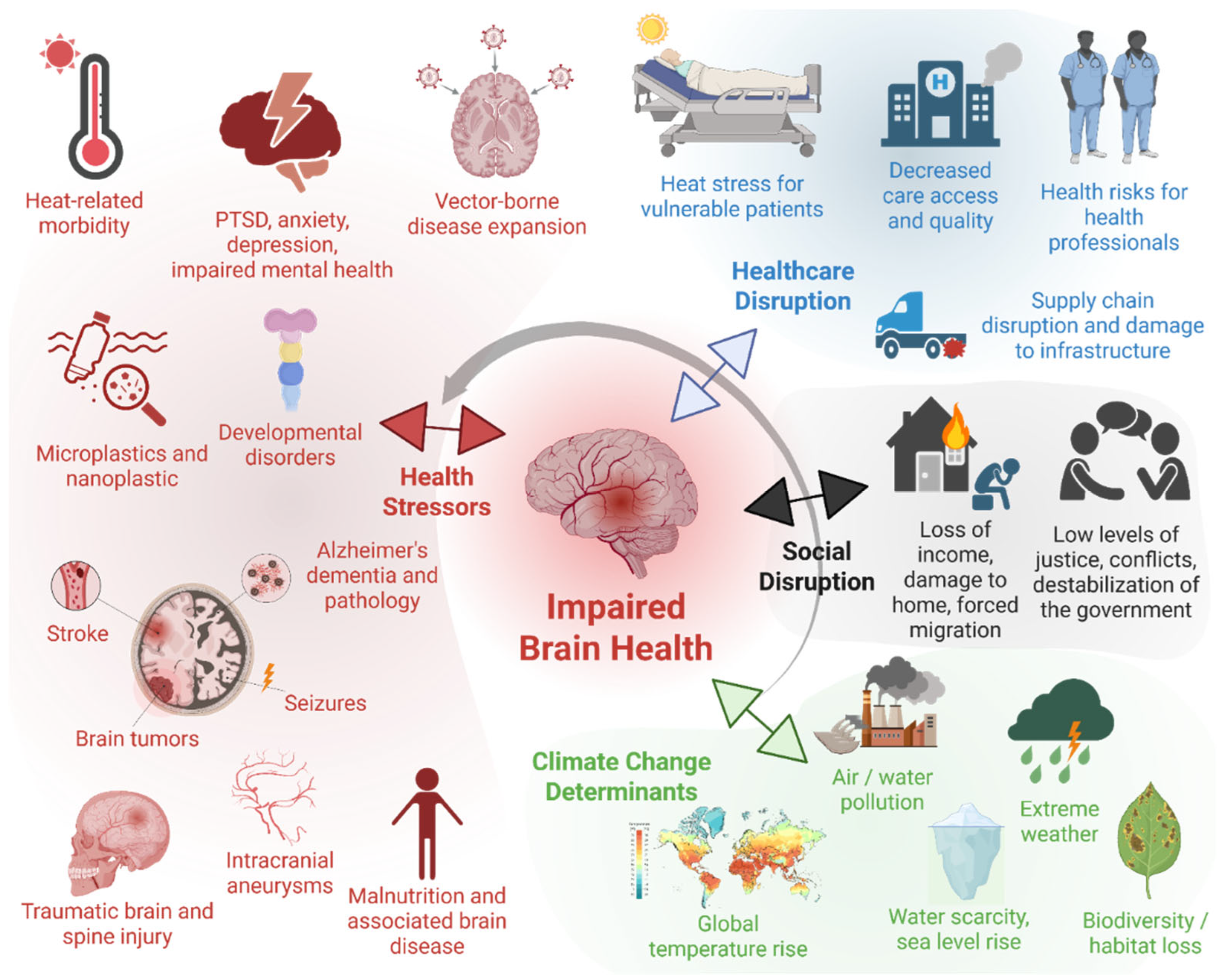

Table 1.
Climate change-related environmental stressors, impact on brain health, and adaptation strategies.
Table 1.
Climate change-related environmental stressors, impact on brain health, and adaptation strategies.
| Climate change stressors | Brain health impact | Mechanisms | Population and geographical area studied | Adaptation strategies | Future research directions | References |
|---|---|---|---|---|---|---|
| Extreme temperatures (heat/cold), heatwaves | ↑ Stroke (especially ischemic):
↑ hospitalizations in dementia ↑ dehydration and risk of falls ↑ Heat-related mental morbidity in people with impaired thermoregulation, namely with pre-existing mental health illness and taking prescription medications (lithium, neuroleptic, anticholinergic) or substance abuse (alcohol and drugs)
|
|
|
|
|
[6,16,17,20,21,22,45,57] |
| Air pollution (e.g., PM2.5, NO₂) | ↑ Stroke ↑ Burden of Alzheimer’s pathology
↑ Developmental disorders ↑ Neuroinflammatory CNS disease (e.g. multiple sclerosis) |
|
|
|
|
[7,19,23,68,101,102] |
| Natural disasters (e.g. earthquakes, floods) | ↑ PTSD, depression, anxiety, suicide ↑ TBI/spinal trauma |
|
|
|
|
[8,9,27,42,103] |
| Vector-borne disease expansion | ↑ CNS infections (e.g., Zika, Tick-borne encephalitis), epilepsy, encephalitis |
|
|
|
|
[10,11,40,41,89,104,105,106] |
| Food insecurity / malnutrition | Developmental delay ↑ Cognitive dysfunction Vulnerability to mental illness |
|
|
|
|
[56,57,58,64,107] |
| Exposure to neurotoxins (e.g., pesticides, algal toxins, wildfire smoke) | ↑ Brain tumors ↑ Developmental disorders ↑ Seizures ↑ Neurodegeneration |
|
|
|
|
[12,13,48,50,52,53,108,109] |
| Displacement / forced migration | ↑ Anxiety, PTSD, depression, adjustment disorder, psychosis |
|
|
|
|
[29,30,31,78,110,111] |
| Loss of green space/urbanization | ↑ Depression, anxiety, ↓ executive function and attention |
|
|
|
|
[25,26,32,74,112,113,114,115,116] |
| Healthcare Infrastructure Disruption | ↓ Stroke/thrombectomy care Delayed neuroimaging Medication and treatment interruption |
|
|
|
|
[85,86,91,92,117,118] |
Abbreviations: ↑ = increase; ↓ = decrease; APOE4 = Apolipoprotein E ε4 allele; BBB = blood–brain barrier; CNS = central nervous system; PM2.5 = particulate matter ≤ 2.5 μm; NO₂ = nitrogen dioxide; PTSD = post-traumatic stress disorder; TBI = traumatic brain injury; TBE = tick-borne encephalitis; WHO = World Health Organization.
Disclaimer/Publisher’s Note: The statements, opinions and data contained in all publications are solely those of the individual author(s) and contributor(s) and not of MDPI and/or the editor(s). MDPI and/or the editor(s) disclaim responsibility for any injury to people or property resulting from any ideas, methods, instructions or products referred to in the content. |
© 2025 by the authors. Licensee MDPI, Basel, Switzerland. This article is an open access article distributed under the terms and conditions of the Creative Commons Attribution (CC BY) license (http://creativecommons.org/licenses/by/4.0/).
Copyright: This open access article is published under a Creative Commons CC BY 4.0 license, which permit the free download, distribution, and reuse, provided that the author and preprint are cited in any reuse.