

Submitted:
25 June 2025
Posted:
26 June 2025
You are already at the latest version
Abstract
With the advent of AI- and robot-systems, the current Human-Computer Interaction (HCI) paradigm, which treats interaction as a transactional exchange, is increasingly insufficient for complex socio-technical systems. This paper argues for a shift toward an agential realist perspective, which understands interaction not as an exchange between separate entities, but as a phenomenon continuously enacted through dynamic, material-discursive practices known as ’intra-actions’. Through a diffractive reading of agential realism, HCI, complex systems theory, and an empirical case study of a touring exhibition on skateboarding culture, this paper explores an alternative approach. A key finding emerged from a sound-recording workshop when a participant described the recordings not as ”how it sounds,” but as ”how it feels” to skate. The finding reveals the limits of traditional HCI and it illustrates how interacting parts are co-constituted through the intra-actions of entangled agencies. An argument is made that design for interactive complex systems should change from focusing on causal transactional interaction towards organizing relational complexity, that is staging the conditions for a rich scope of emergent encounters to unfold. The paper concludes by suggesting further research into non-causal explanation and computation.
Keywords:
agential realism
; interaction
; HCI
; complex systems
1. Introduction
The ways in which system-interactions are designed, particularly within increasingly complex socio-technical systems involving AI and robots, are fit for re-examination. The current paradigm within Human-Computer Interaction (HCI) approach interaction as transactional exchange between pre-defined entities, a perspective that falls short in capturing the nuanced, emergent, and entangled nature of reality. This paper argues for a fundamental shift, proposing an agential realist perspective to understand interaction not as a linear causal exchange between separate components, but as a phenomenon continuously enacted through dynamic, material-discursive practices. Agential realism, as conceptualized by Karen Barad [1], posits that the world is in a constant state of becoming, where phenomena are not pre-existing but come into being through specific ‘intra-actions’, the mutual constitution of entangled agencies.
This perspective offers a more robust framework for engaging with interaction and complex systems, suggesting that such systems are themselves not pre-defined entities but are enacted by the relational complexity of the situation at hand. Traditional approaches often seek to simplify reality for analysis or design, potentially overlooking the richness of possibilities that characterize these systems. In contrast, an agential realist viewpoint makes us acknowledge our own entanglement within the phenomena we study and design. This viewpoint emphasizes accountability for the ’agential cuts’ we are part of, that delineate subjects and objects [2].
To empirically ground these arguments, the paper draws upon a case study: a prize-winning, three-year project that designed and created a touring pop-up exhibition about Swedish skateboarding culture . The project, with its evolving content and collaborative nature, provided a thorough base for exploring how interactions are enacted and how complex socio-material interactions come to matter. The exhibition as such, although not explicitly designed based on agential realism will be used as an illustrative example to discuss agential reality.
This paper offers a diffractive reading of agential realism, HCI, complex systems theory, and the empirical case of a skateboarding exhibition. To read diffractively is to be respectful and attentive to affirmative and relational differences between different disciplines. Diffractive reading tries to provoke new thoughts by bringing different disciplines closer together, rather than trying to set them apart [3]. The paper will first situate the arguments by highlighting current challenges within HCI and in conjunction with complex systems, showing the need for new theoretical lenses. Then it will present and explore the skateboarding culture project, using specific events and design choices. The focus will be on an eye-opening experience during a sound recording workshop that illustrates evidence of key agential realist concepts. Finally, the paper will discuss the implications of this perspective for design, suggesting a shift for the design of interactions in complex systems towards organizing relational complexity, before offering conclusions and suggesting future research directions.
1.1. HCI and Complex Systems – a Call for a New Perspective
To understand the phenomenal utility of an agential realist framework for complex systems, it is crucial to first look at the current landscape of Human-Computer Interaction (HCI) and the study of complex systems. This reveals the gaps that necessitate a rethinking of some fundamental assumptions.
HCI has long sought to understand and improve the relationship between humans and technology. Dominant research approaches often focus on causal interactions between users and technology, employing methods such as experimental comparisons, observational model-based analyses, and qualitative descriptive studies [4]. Although these methods have yielded valuable insights, they often operate with inherent limitations, including simplification of reality in controlled settings, structural assumptions embedded in models, and inherent idiosyncrasy of user experiences [4].
The rapid emergence of omnipresent technologies and intelligent agents like AI and robots has led to calls to rethink the traditional human-centric focus of HCI. Stephanidis et al. [5] outlined seven ”grand challenges” for the field, urging a change
in order to formulate and address the critical issues that underlie a more trustful and beneficial relationship between humankind and technology ([5] p. 1230).
However, even many forward-looking perspectives within HCI tend to maintain a conceptual separation, an a priori cut between the human and the computer, often positioning human experiences as the primary, if not sole, objective for interaction and interaction design. Furthermore, the application of systems thinking inadvertently introduces pre-made conceptual divisions between entities, thus framing design problems around already established relations rather than focusing on the reciprocal nature of these relations themselves. This tendency obscures the performative and co-constitutive nature of human-technology entanglements.
The term "complex system" itself is fraught with ambiguity. Ernesto Estrada’s study of complex systems highlights that definitions often fail to clearly distinguish such systems from systems in general, which is broadly understood as a non-empty set of interconnected entities [6]. Properties commonly attributed to complex systems include non-linearity, the presence of feedback loops, a large number of interacting entities, hierarchical organization, spontaneous order, and emergence. These properties reflect a proposed definition of a complex system as
an ensemble of many elements which are interacting in a disordered way, resulting in robust organization and memory ([7] p. 57).
However, this definition remains vague regarding quantities like "many" or what constitutes "disordered". Estrada, referring to the philosopher Edgar Morin, offers a more processual definition:
A system is said to be complex if there is a bidirectional non-separability between the identities of the parts and the identity of the whole ([6] p. 1159).
With this definition, not only is the whole determined by the constituent parts, the identity of the parts is also determined by the whole. This is due to what Estrada calls the Morinian nature of the interactions among the parts. Morinian interactions put emphasis on reciprocal relations that transform the nature of the related elements. A systems-thinking approach will, according to Morin, always be inadequate because it is based on the logic of simplification. Morin further argues that complexity is not merely a surface phenomenon but resides in the very principles of organization, which is a ”continually generative and regenerative activity” ([8] p. 28). This resonates deeply with agential realism. The challenges in clearly defining complex systems and the limitations of traditional systems thinking and HCI paradigms in addressing thoroughly entangled human-technology relations signal a need for a theoretical framework that can more adequately account for the dynamic, co-constitutive, and emergent nature of phenomena. Agential realism, with its focus on intra-action and material-discursive practices, offers this, as its evidence is observed through the case study that follows.
2. Materials and Methods
2.1. Case Study – How Skateboarding Culture Reveals Morinian Interactions and Agential Reality
The empirical material for this paper comes from a project that designed and created a touring pop-up exhibition about skateboarding culture in Sweden. The project was run as a partnership between a regional museum, a senior high school with a specialization in skateboarding, and a university department with specialization in media technologies. The project was run for 3 years with 1 year of design work followed by one year of production and lastly 1 year traveling on tour with 8 stops. The project won the title ‘Exhibition of the year’1 in 2019 in Sweden. The content of the exhibition was dynamic and produced by different stakeholders: the high school’s pupils, visitors, and non-profit organizations (NPOs) working with skateboarding in various parts of the country. The NPOs were invited to join the tour to show and tell their local history and practices. In this way, the exhibition collected and presented fragments of skateboarding cultures, which expanded throughout the tour.
Figure 1.
Part of the pop-up exhibition on a town square at one of the tour stops.
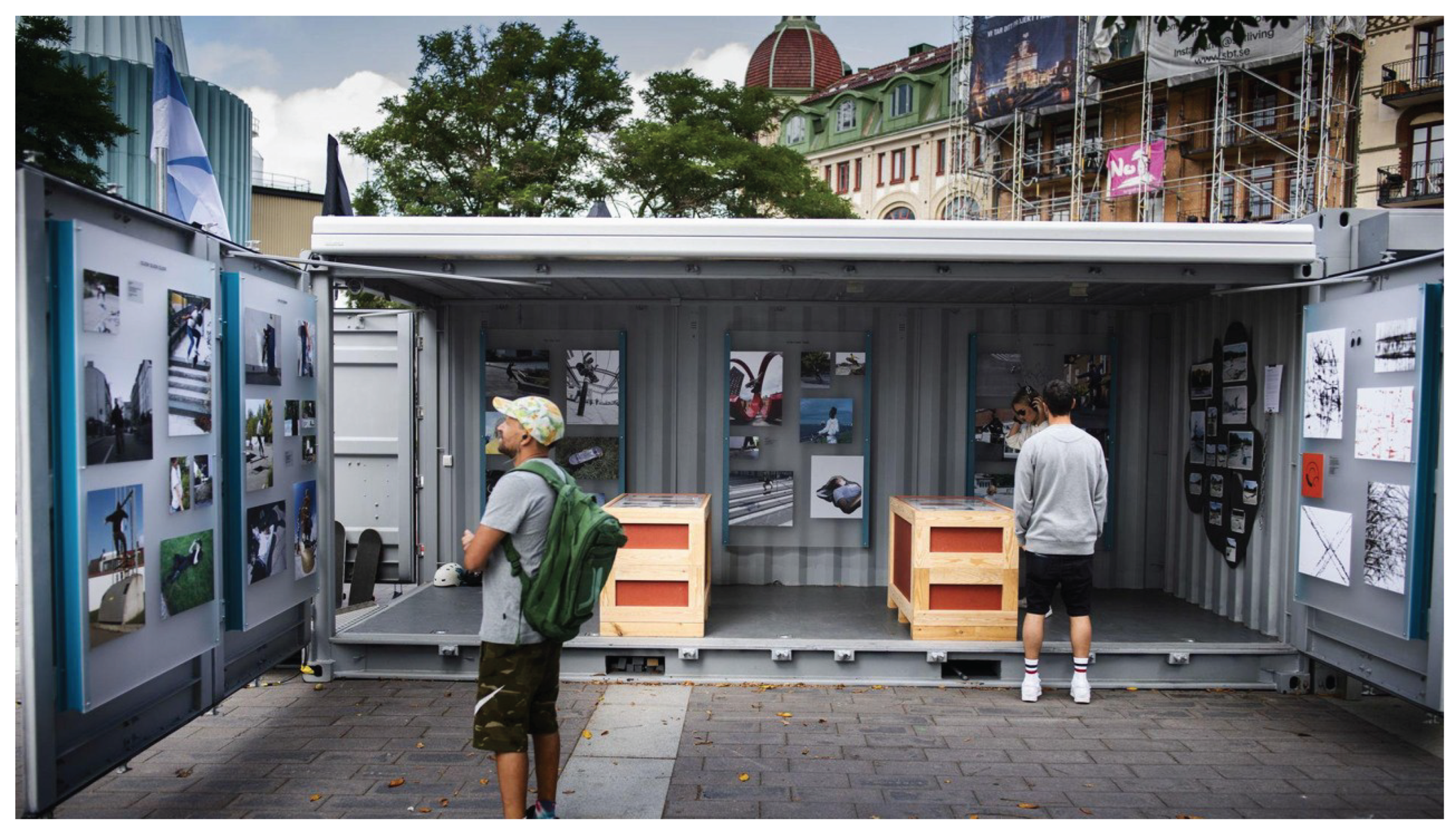
The project identified three main themes to work with: essentials, identity, and marks. These correspond to skateboarding practices in different ways. Essentials as a theme explored how skateboarding practices are dependent and contingent upon physical artifacts. The theme of identity explored how skateboarders have developed their own style, language and embodied knowledge. And lastly, the theme marks explored how skateboarding leaves its marks in the built environment as well as on skateboarders and non-skateboarders.
Ian Borden’s work on skateboarding culture [9] was used as a point of departure for the design of the exhibition. Borden’s work posits skateboarding culture as a dynamic generative practice, impossible to represent with a single representation. Borden also emphasize how skateboarding has a history of transgression within the built environment. In many places around the world restrictions are put in place to keep skateboarding out of urban areas. In contrast to other urban restrictions, these are often physically manifested in the built environment. An example of this is so called skate-stoppers, typically in the form of brackets put evenly distributed along smooth edges on benches, low walls, and other built objects [9]. The history in Sweden is no exception to this. However, in recent years, skateboarding has gained a lot of attention in urban planning. Many skateboarding- parks and -plazas have been built around the country. On the one hand, this shows that skateboarding has gained more positive attention. On the other hand, many of the skateboarding parks are built apart from the city center, thus keeping skateboarding out of the general urban public space. In Malmö, one of Sweden’s largest cities, they have addressed this issue by instituting a new official role at their urban planning office called skateboarding coordinator. The purpose of this new role is to engage in the city’s planning processes by finding ways to make the urban environment accessible also for skateboarding [10].
2.1.1. Skateboarding Practices as Procedural Architecture
Skateboarding practices have had an impact on urban built environments around the world. In some places to fend off skateboarding, in others to promote it. Novel architectural forms have been introduced to the built environment due to skateboarding practices. But, as Iain Borden eloquently shows in his book, the biggest contribution from skateboarding is not the built forms per se. The biggest contribution is that skateboarding makes explicit the procedural or generative ‘nature’ of architecture. Skateboarding expresses how activities in urban spaces continually re-produce the architecture of a site and how the practitioners themselves are re-produced as skateboarders [9]. This can be likened to ’landing sites’, a concept introduced by Madeline Gins and Shusaku Arakawa in their book Architectural Body [11]. Working as architects, they introduced the concept to make explicit the procedural nature of architecture. A person to Arakawa and Gins is always determined together with its surroundings. Places and persons are procedurally made meaningful by specific actions and events taking place at particular sites, ”the world one finds in place lends itself to being mapped by means of a multiple, complex siting process or procedure” ([11] p. 7). It is through these complex siting procedures that we find ourselves affected by some things rather than others. We are close to some things, and we are familiar with some. This is all part of how sites are ‘landed’.
The concept of ‘landing’ a site literally relates to skateboarding lingo in how skateboarders try to land their tricks. To land a trick is to complete a series of moves with the skateboard, using the built surroundings as an obstacle, without losing balance and falling off the board. But it also relates to how the materiality of the surroundings plays an important part in shaping our experiences. As Sara Ahmed notes, ”To be affected by something is to evaluate that thing. Evaluations are expressed in how bodies turn toward things. To give value to things is to shape what is near us.” ([12] p. 31). Understandings and meanings for people are not generic attributes built into sites, they are procedurally ‘landed’ differently for different persons and different places. Neither are landing sites static. Landing sites emerge through and within other landing sites. They are temporary manifestations, although they vary greatly in space-time extent. For each ’landing site’ there are multiple lines of attention and affect. Attention and affect work like fuel for a particular landing of a site. With an urban place in mind, that place is procedurally evaluated differently for skateboarders and other urban dwellers. A site with a bench can land as a quick lunch break for someone. The same place can land as a romantic moment for a couple strolling through the city, or as a skateboarding opportunity to explore a new trick. The relations between people and things are formed by this complex procedural process. Thus, it can be said that transgression is implicit for all activities in urban spaces, although some are not perceived as such because they are within general urban norms. Some activities such as skateboarding require a special form of know-how or skills to perform and thus cannot be fully interpreted or experienced outside the practice itself, ending up outside the norm. All activities are produced by, and produce, physical manifestations and specific use of architectural objects. Norms are also (re)produced, enacting who gets included/excluded and what can be done or said within a community of practice.
Due to the complexity of how a site is landed, we can end up with an experiential gap in the affective power of an object. How we experience an object can be based, not on one, but on a range of affects [13]. This directs our evaluations and the way we find explanations to fill this gap. If we become disappointed by something, we find explanations to why it is disappointing, which as Sara Ahmed notes,
can lead to a rage directed toward those that promised us happiness through the elevation of this or that object as being good. We become strangers, or affect aliens, in such moments ([12] p. 37).
Thus, (un)happy objects can capture attention and can generate a range of affects, which also can spread in contagious ways and thus become vested in a place. But it is not the feeling of (un)happiness that is passed around, it ”would simply mean you would share an orientation toward those objects as being good.” ([12] pp. 37-38). An example of this evaluation gap was noted during the project. In different cities in Sweden, in urban places such as town squares or parks, some local governments have chosen to put up skate-stoppers on benches and low walls to fend off skateboarders while others instead have tried to use durable material such as granite to allow a diversity of use, including skateboarding. The project found one case particularly interesting. In one town square, where the local government changed their use of durable material, allowing for skateboarding, things took an unexpected turn. Based on interviews with the locals (both skateboarders and non-skateboarders) we found that the experienced transgressive nature of skateboarding made some of the nearby living non-skating inhabitants act aggressive towards skateboarders. They put up homemade skate stoppers and used tools to dent the edges of low walls to hinder skating. Ironically, what in the end became transgressive turned out to be based not on skateboarding, but on the attempt to keep skateboarding out, based on the idea of normative use of the square (personal interviews, 2019).
Figure 2.
Sketch of the pop-up exhibition with objects designed for a diversity of use.
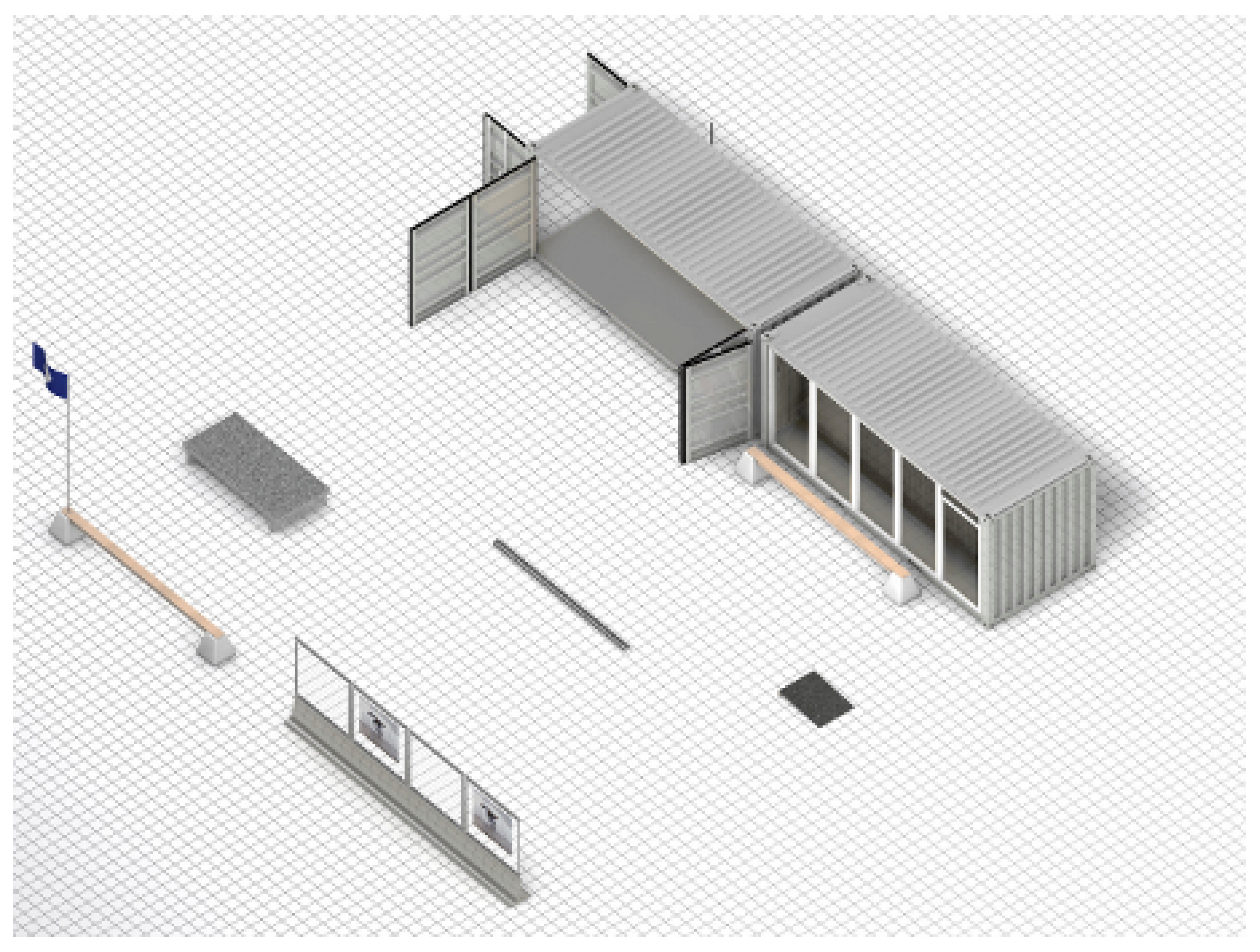
To be able to account for the generative nature of, and diversity in skateboarding culture, the exhibition was shipped half-full and later added to at each stop along the tour, collecting more and different additions to extend on representations of skateboarding culture. The exhibition traveled with a set of mobile skateboarding obstacles designed to accommodate a diversity of uses (relaxing, sitting down to talk, skating, etc.). It was important that the exhibition attracted skateboarders so that skateboarding could be experienced live and up close by non-skateboarders.
3. Results
3.1. Skateboarding Interactions
During the project, a collaborative design workshop was arranged together with participants from the high school and the NPOs. The aim of the workshop was to create sound recordings of skateboarding. The idea was that these sounds as a collection would give an audial experience of skateboarding. A web application was developed to enable skaters to record audio using a mobile phone. The application was implemented using standard web technologies, HTML 5, CSS 3, and DOM4 via ECMAScript. The sounds were stored both locally using an in-browser database (PouchDB) and on a webserver using a document database (CouchDB). This allowed offline use once the application was loaded into the browser. The recordings were stored and shared together with text descriptions and photos that give background information to the recorded sounds. Recorded sounds with photos and text descriptions were presented as a gallery in the recording application. The idea was to later present this gallery on the website of the exhibition.
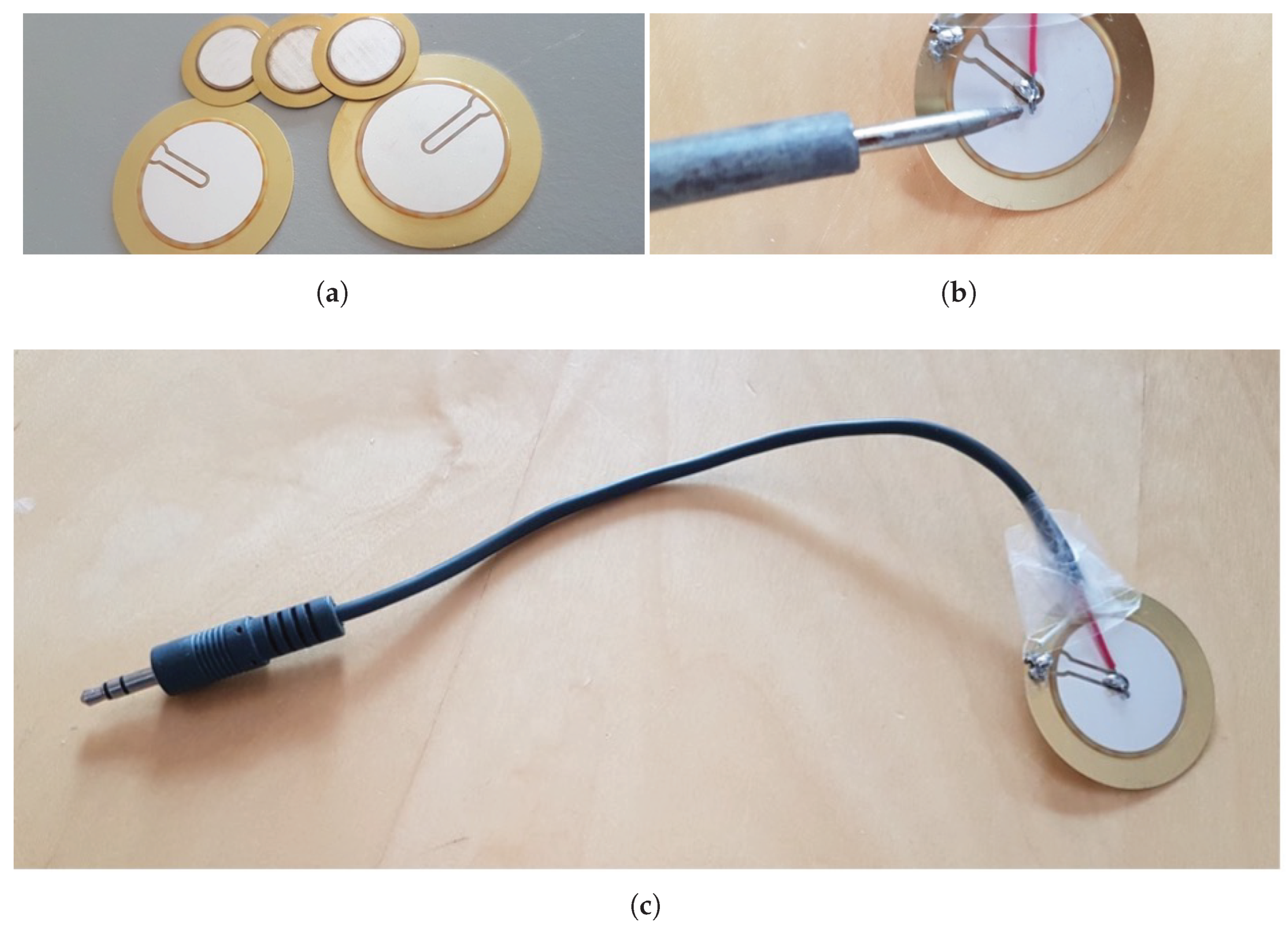
One thing that needed to be figured out was how to get good quality recordings. Anyone who has tried to record audio using a mobile phone has realized how hard it is to isolate specific sounds. Background noise from traffic, wind, etc. will be caught by the microphone. Also, the acoustics in the surroundings will ‘color’ the audio recording. This sparked the idea to create so-called contact microphones using piezo elements. A piezo element reacts to differences in applied mechanical pressure by producing voltage spikes which can be digitized and stored in a computer. The stored values can be used to generate images, like in obstetric ultrasonography (prenatal ultrasound) or to record material vibrations as audio files. A contact microphone only picks up material vibration from what it is attached to. Sounds in the surroundings carried through air will not be picked up. Thus, it was decided to divide the design workshop into two steps. In the first step, the workshop leader presented the aim of the workshop and explained the basics of recording sounds using contact microphones. The workshop leader then showed how to build a contact microphone using cheap ‘off the shelf’ electronics. After going through the building procedure, each participant made a microphone with the components provided. The electronic components used were 35mm piezo elements, resistors with high resistance (1M Ohm), shielded 2-wire cable, and 4-pole 3,5mm audio connectors. After testing the functionality of the microphones, step two started. In step two, the participants used their microphones, connected to their mobile phones, and the Web application to record audio from places and objects that they skate. Some did this directly at workshop time; others did so later at different places. The microphones can be attached to skateboarding obstacles, walls, floors, railings, etc. One could also attach the microphone to the skateboard to allow a moving recording. The application allowed for short recordings of up to 30 seconds which were complemented with a short text description and an optional photo of the recording situation. Due to the web application, further recordings were possible after the initial workshop. This allowed for more recordings during the tour. With the use of ‘off the shelf’ components and instructions in the Web application, anyone interested could build their own contact microphone. In total, depending on availability, the material for a microphone like this costs about 4 $US. This enabled participants during the touring exhibition to create one on their own and contribute more recordings.
Figure 3.
(a) Piezoelectric sensors of different sizes, (b) an example of soldering a contact microphone, and (c) a finished contact microphone.
Figure 3.
(a) Piezoelectric sensors of different sizes, (b) an example of soldering a contact microphone, and (c) a finished contact microphone.
During the workshop, outside in the parking lot, one of the participants came up to us. Pointing at the ground, he said,
I know how that asphalt will feel in my body if I skate it.
That seemed reasonable to us, but we were a little surprised with him continuing,
when I recorded sounds with the microphone, something felt odd, I now realized what. It sounds like rolling, yeah, that’s how it sounds when I roll. But not like when I hear it, but how it sounds inside my body. It’s like how it feels to roll. (Workshop participant, 2019)
The idea of the workshop was to gather material to offer an audiovisual experience of skateboarding using sound, photo, and text, but we had not thought of the ‘tangible feel’ of the recorded sounds. After the workshop, it was decided to alter the use of the recordings. They were not common sounds of skateboarding. Instead of letting exhibition visitors just listen to the sounds, the sounds were emitted from material surfaces when a visitor touched them. Materials were used that matched the ones skated upon. About 50 recordings were made, of which 4 were chosen to be part of the new tangible setup. Pieces of asphalt, concrete, granite, and wood were installed in an exhibition stand for visitors to touch and listen to. The sounds were played back using surface transducers enabling a tangible feel of the material at hand in combination with the audial sound waves emitted from the vibration of the surfaces.
The sounds we hear from skateboarding are not the same as the material sounds. Sounds are also experienced based on their specific evaluations in each situation. Using a contact microphone, the only sound recorded is from vibrations in the materials; vibrations produced by the skateboarding practice. The sounds recorded are generated by the complex siting procedure in which both the architecture and the skateboarder are (re)produced. These facts indicate that the interactions with sound are Morinian, reciprocal emergent relations. This is a prime example of concepts from agential realism. When Karen Barad introduced agential realism, she exemplified it with a discussion about piezo elements used for obstetric ultrasonography [14]. The key point Barad conveys with her example is the relationship between the material and the discursive, how material instruments not only operate through signals but also discourses. In Barads example, the object of observation, a fetus, is not a pre-existing object of investigation without its other intra-acting ‘components’, especially including the pregnant woman. But the woman, per se, is literally not in the images generated. Moreover, a fetus as an object of investigation would not be possible in this sense at all without the material-discursive constraints (re)produced by techno-scientific apparatuses, that is the technology for ultrasonography and the medical expertise to interpret the images. This is what was going on with the skateboarding sounds. The sounds themselves do not operate separately. They are both material and discursive. Depending on how they are experienced and by whom, the sounds will be made intelligible through intra-actions, paving the way for different evaluations and interpretations. The sounds would not exist without their other intra-acting components which, like in the ultrasonography example, are not in the saved recordings. It takes a skateboarder to make a bodily interpretation of how it ‘feels’. Others, if they have encountered skateboarding at all, will experience the recordings as how it ‘sounds’.
4. Discussion
4.1. Agential Realism and Difference Making – How Interactions Are Enacted
Agential realism means that the world is in a process of becoming and makes itself intelligible by specific practices. Knowledge is partial and situated. It also means that attributes and properties are not statically bound within things, but performatively enacted through ‘intra-actions’ [1]. Interaction stems from representationalism and Cartesian causality, where interaction is something that occurs between two or more distinct entities with pre-defined properties. Intra-action, derived from quantum causality, is the driving force that makes change in the becoming of the real. It points to the iterative continuous (re)configuration of the real world. What comes into being/in relation is co-constituted by intra-action. This means that concepts and properties of objects are temporally determined by their relations. Coming back to the sounds or ‘feels’ of skateboarding, re-membered relations procedurally enact who we become, mediating how we experience the sounds. The sounds recorded are not pre-filled with a specific meaning. Depending on the situation, different relations will be enacted. A skateboarder experiences the sounds as “how it feels” while a non-skateboarder experiences them as “how it sounds”.
Agential realism entails a similarity to how Gilles Deleuze argued for an affirmative understanding of differences [15]. What affirmative means is that difference is not used to denote opposition or separateness but as difference within. Difference-making is what makes part of the world (e.g. ordinary everyday activities, games, skateboarding) intelligible, not as separate parts but as temporally manifested evaluations. Difference is what makes it possible to distinguish something, and for this to happen, that which something is distinguished from must be in relation. Difference-making is thus based on relations. But relations, as previously shown in the paper, are not formed between independent objects with pre-determined attributes and meanings. In fact, it is precisely the opposite. Relations between people and things are formed by intra-actions, enacting how things are perceived and how interactions occur. Who we become and what we find in place is based on the situated complex procedural process that forms our experience. We will be affected by things surrounding us such as physical artifacts, prior experiences, technologies. It’s a process of re-membering, but
not a process of recollection, of the reproduction of what was, [...] Rather, it is a matter of re-membering, of tracing entanglements, responding to yearnings for connection, materialized into fields of longing/belonging ([16] pp. 406-407).
Differences do not stand in opposition; they are an integration of possibilities for a situation at hand. How we are affected guides the relations formed and the experience we get. Experiences are mediated by intra-actions making agential cuts. A site will be mediated in one way for a skateboarder with her board, and in another way for a tourist with a guidebook in hand. On the one hand, a skateboarder will re-member, more strongly affected by some objects, re-producing new layers of skateboarding norms. On the other hand, a tourist will be affected by other objects, re-membering other layers of norms. As an additional complexity, being a skateboarder or a tourist can be the same person on different occasions.
4.2. From Designing Interaction to – Organizing Relational Complexity
If we regard the design of interactions for the exhibition and the situation with skateboarding sounds as a complex system, how can such complexity be designed? As the case study made clear, skateboarding as a whole is more than the sum of its representational parts, and vice versa, the parts entail more than skateboarding in general. The experience one gets is emergent. There are no predefined experiences built into a system that is readily available through an interface. Questions thus surface. Is it possible to provide a priori account for all the different performative (un)foldings of material-discursive practices? How can we understand interaction from an agential realist standpoint? This poses a fundamental ethical, epistemological, and ontological question for HCI.
Several studies in HCI have investigated the concept of intra-action. Affective interaction has been suggested to shift focus from an informational model where the aim is to make computers better understand user emotions, to an interactional model where the aim is to make users better aware of their own emotions [17,18]. This change in approaches has been shown to be linked with the ‘material turn’ and efforts to shift HCI away from a cartesian body and mind dualism [19,20]. Flanagan (2016) discusses the entanglement of body, media and fabrics and suggests a visceral approach in the design of wearables [21]. Frauenberger (2019) developed Entanglement HCI to capture the performative relationship between humans and technology, trying to move beyond user-centered design by designing meaningful relations, not user experiences [22]. Draude (2020) has contributed to bridging new materialism and computing, outlining how HCI can benefit from reconfiguration [23]. Hespanhol (2023) suggests a new design method called intra-action mapping. The method posits Human-Computer Intra-Action as the process of mapping out relationships in a spatio-temporal socio-technical scenario [24]. These studies are all interesting examples of rethinking design from an agential realist perspective. Intra-action fundamentally adds to HCI in two main ways. First it adds a performative ethical perspective to design practices, putting focus on the need for accountability to the relationalities and presuppositions that our design practices put in motion. Second, it makes visible the limitations of dichotomies like subject/object, human/machine, and nature/culture, arguing for a more balanced approach to how agency gets distributed among humans and non-humans.
The exhibition, with its open dynamic approach provided insight into intra-actions and the design of interactions. It was not designed to offer a single representation of skateboarding culture, but to invite a diversity of representations and offer a procedural ‘tangible’ experience of skateboarding. It added content along the way and aimed to make aware of the historicity and (re)production of norms in skateboarding practices. But by introducing intra-action, where does that leave interaction? Or perhaps the question is better put, when is interaction? Barad does not suggest that we simply replace one word with another. Obviously, we still have interactions between humans and things. Even though we surely benefit from untangling the ethico-onto-epistemological constituencies and consequences for our design practices. And even though we may benefit from design of relations instead of experience, it seems that from a design perspective you still risk being trapped with a pre-supposed cut between human and machine. Gemeinboeck (2021) tries to account for this by taking another approach to design, working with encounters between humans and robots [25]. Gemeinboeck lays out a framework for relational-performative aesthetics in human-robot interaction. The design focus shifts from designing an agent to exploring the dynamics through which social agencies can emerge between humans and robots. Gemeinboeck does not prioritize human rationality over that of machines. The aesthetics of the proposed encounters, “does not serve to make the strange look more familiar but is about rendering differences relational.” ([25] p. 5). This fits well with a Deleuzian affirmative difference. Instead of trying to force specific relations to undo differences on human terms, it enables a playful inquiry to embrace differences, (re)configuring humans and non-humans in new co-constituting relations. What is interesting about Gemeinboecks relations is that they are not defined as traditional interactions between static entities. These relations are Morinian interactions, reciprocal relations that transform the nature of the related elements. Morin like Barad questions the veracity of cartesian causality.
Trying to delineate whether a system is complex or not may very well be futile. All systems are enacted with some form of complexity. It is the complexity of the relations (interactions) and the organization that makes a system actual. A systems first approach will always be inadequate because it is based on the logic of simplification, ”complexity is not merely the phenomenal froth of reality; it is in the principles themselves.” [8]. Morin suggests a rationality based on organization, ”the play of interactions between the parts involved and the whole” [8]. It is important to note that organization for Morin is not a static establishment, it is “continually generative and regenerative activity at all levels based on computation, strategic planning, communication, and dialogue.” ([8] p. 128). So, to answer the last question, when is interaction. Interaction emerges from intra-action and is inexorably enacted without a priori existing human-machine relation. Interaction thus is not what we should be seeking to design. Doing so will prematurely make cuts in the space of differential possibilities. Searching for other design work with a similar approach led to the Scandinavian participatory tradition. Design Things is a concept suggested by Pelle Ehn [26] as a response to Bruno Latour’s Making Things Public [27]. It was further explained in a collaboratively written book [28]. From a Scandinavian perspective, the etymology of the word "thing" reveals a shift in its understanding. Contemporary, things are often understood as a physical (isolated) object with intrinsic boundaries and properties. But by following the etymology of "thing" one finds that it dates to pre-Christian Nordic and Germanic societies. In these societies, "thing" was an assembly, decided beforehand to be held at a certain place in time to deal with common matters of concern. Not only the people, but the place itself played an important role for these societies. Ehn suggest,
rather than thinking of a project as a design thing in terms of phases of analysis, design, construction and implementation, a participatory approach to this collective of humans and non-humans might rather look for the performative ‘staging’ of it. ([26] p. 93).
What Ehn suggests is to shift the idea of the object of design from a pre-thought design object, instead the object of design should be the organizing of a situation in which design can emerge by the participants in situ. The design of interactive complex systems can thus be thought of as the organization of relational complexity, opening for both expected and unexpected emergent interaction between entities. By trying to impose as few pre-made cuts as possible, the integration of possible differences has greater potential for new and innovative relational encounters between humans and machines. This resonates directly with Morin’s emphasis on organization itself, not as a static structure, but as a “continually generative and regenerative activity” as the core principle of complexity. In this view, the designer’s role shifts from architecting a final product to curating the conditions for this generative organization, much like Ehn’s ’staging’ of a ’Thing’. The exhibition studied in the paper is a successful example of this, not trying to present a single representation of skateboarding culture. Instead, the exhibition was an evolving organization of relational complexity, configured and reconfigured throughout its tour. Local fragments of skateboarding culture were added to the exhibition during the tour. Like Pelle Ehn suggested, instead of focusing on a single object of design, the exhibition focused on organizing a ‘stage’ for skateboarding experiences to take place. Perhaps this was one of the main reasons for its success.
The case study shows that there is no way to offer a Cartesian objective external viewpoint into skateboarding culture. But objectivity from an agential realist perspective is not about offering transcendent undistorted representations of the world.
Objectivity means being accountable for marks on bodies, that is, specific materializations in their differential mattering. We are responsible for the cuts that we help enact not because we do the choosing […], but because we are an agential part of the material becoming of the universe. ([1] p. 178)
This view of reality harmonizes with skateboarding as a performative architectural practice. It resonates with skateboarding practices as presented by [9] and echoes similarities with procedural understandings of architecture [11]. And for the project, it resonates for how marks as a design theme showcased how skateboarding culture leaves its marks in the built environment as well as on the bodies of skateboarders. Skate stoppers, skateboarding- parks and -plazas are explicit examples of this. Non-skateboarders are also marked, sometimes by triggering aggressive behavior, sometimes by creating awe and wonder.
5. Conclusions and Further Studies
As this paper has shown, interactions are Morinian; reciprocal relations that emergently transform the nature of the related elements, formed by organization of relational complexity. Based on a real-world case, the paper has argued that HCI and complex systems need a fundamental shift in both focus and methods. The paper has also argued for a fundamental shift in the approach to designing complex interactive systems, moving from a human-centered, representational paradigm to one grounded in agential realism. Through a diffractive reading of agential realism, HCI, complex systems theory, and the empirical case of a skateboarding exhibition, this paper arrives at a main conclusion: interaction is not a process to be explicitly designed, but an emergent phenomenon that is formed by the organization of relational complexity. This requires a move away from designing interaction and towards designing the conditions for its emergence.
The limitations of traditional HCI and systems thinking, which often rely on a priori separations between entities like human/computer or part/whole and a logic of simplification, has been shown to be insufficient for thoroughly handling entangled phenomena. The skateboarding project served as an illustration of this. The initial goal of the sound recording workshop was informational: to record and present the sounds of skateboarding. However, the intra-actions in the situation, the skateboarder, the contact microphone, and the ground produced a somewhat unexpected revelation. The participant’s reaction that the recording did not capture "how it sounds" but "how it feels" demonstrated the enactment of an affective reality that cannot be experientially transferred as information. The workshop thus showed how an expanded understanding of interaction as emergent, embodied, and co-constituted. This further points to focusing on design, not for a single specific outcome, but for a rich scope of relations.
The implication for design is a change in its object and aim. Drawing inspiration from Pelle Ehn’s concept of "Design Things," this paper advocates a design practice focused on the performative "staging" of situations. Instead of creating a finished object or prethough experience for a user, the goal becomes the organizing of complexity, a Thing where relations and interactions can emerge in situ. The aim of such a design goal is to create space for possible unfolding relations. The success of the evolving, co-created exhibition, which reconfigured itself at each stop on its tour, can be seen as confirmation of this approach of organizing relational complexity.
But even though the findings in this paper clearly point to the limits of Cartesian causality, research is to a large extent done this way. Also, in the end, a computer is based on linear causality, simplified as a Turing machine, manipulating symbols based on predefined rules in an infinite linear time strip. Likewise, AI-models and robot decision algorithms often use the logic of Markov processes [29], where state changes create a linear chain of events where the probability of moving to the next state is dependent only on the current state. Or, put the other way around, the current state is dependent only on the previous. This apparent gap between the relational, co-constitutive nature of reality described by agential realism and the linear causality of our computing machines presents a fundamental challenge. However, this tension is actively being explored in fields from theoretical computer science to the philosophy of science as "non-causal" computation and explanation. These emerging frameworks offer a concrete path for integrating the findings in this paper into concrete implementation.
For instance, Alisa Bokulich distinguishes between causal and non-causal explanations of the same phenomenon [30]. In her case study of sand ripple formation, a causal explanation models the specific physical processes of wind and grain-to-grain interactions (a process called reptation) that form ripples in a desert. This explanation is tied to one specific causal chain of events. However, a non-causal explanation, called the "defect dynamics model", explains the formation of ripples decoupled from the underlying physics. Interestingly, it explains not only wind-blown ripples but also underwater ripples, which were explained by entirely different causal chain of events. The defect dynamics model thus explains by revealing an organizational pattern that is independent of its situational specific causal realization. This distinction between causal and non-causal ways of explanation directly emphasize the change this paper advocates for. Traditional HCI, by focusing on transactional user-computer exchanges, operates like the causal model by trying to design specific, predetermined causal interactions. The proposed approach, focused on organizing relational complexity, is analogous to the non-causal defect dynamics model. The goal is not to design the specific causal steps of an interaction, but to "stage a Thing" where relations can emerge and self-organize, just as the skateboarding exhibition allowed for the emergence of cultural patterns without trying to predefine a single representation of the culture.
But can such a non-causal system be used for computing? The work of Baumeler and Wolf suggests it can [31]. They propose a model of "non-causal circuits" that takes away the assumption of a fixed, linear causal order and replaces it with the requirement of mere logical consistency. In their model, information can loop back from the "future" of a computation to the "past". Paradoxes are avoided by demanding that the system as a whole can only settle into a unique fixed point. Any state that would lead to a logical contradiction is forbidden. This leads to a computational advantage; to find the fixed point of a function (a difficult task for a causal computer), a non-causal circuit simply connects the output back to the input. Only the correct solution—the fixed point—is a logically consistent state for the loop, so the system finds it in a single step. This is a potential computational paradigm that, like non-causal explanation, directly emphasize the change this paper advocates for.
While these non-causal approaches are still largely theoretical, they demonstrate that computation does not have to be conceptually bound to linear causality. They offer a concrete direction for developing systems that operate not on simplified cause-and-effect, but on the entangled, relational principles that, as this paper has argued, truly bring phenomena into being. Our ongoing studies are dedicated to further exploring this gap by bringing these findings into our work on agential realist anticipation [32] and robot decision making [33]. By introducing anticipation in robot and AI behavior, we aim for new relational encounters between humans and machines. As an example, instead of being bound to a fixed input-output interface like prompting, an AI could instead function as a co-creative part, suggesting, questioning, responding to the rhythm, deletions, recurring words, or pauses that emerge. This kind of AI does not necessarily have to be modeled to ‘understand’ in a human sense, instead it could be allowed to be perceived as ambiguous or irrational and contribute based on its own material-discursive capacities. From a design perspective this would mean to create conditions for complex relationality to occur, staging a Thing were controversies can unfold. In contrast to designing an AI as a tool with a pre-defined informational or interactional purpose. Fewer pre-made agential cuts will be made, blurring the distinction between agent and tool. The designer can thus also be free from a fixed focus on a user as interacting with an AI-system, opening for curating a diversity of potential stimuli and responses. The value lies in the richness of unfolding relations and novelty of co-created artifacts, not in the optimization and efficiency of a tool.
Funding
This research was partly funded by Allmäna arvsfonden.
Institutional Review Board Statement
The authors declare that this research was conducted in accordance with ethical principles for human-involved studies. As per the Swedish Act concerning the Ethical Review of Research Involving Humans (2003:460), this specific case study did not require a formal ethical review by the Swedish Ethical Review Authority (Etikprövningsmyndigheten) as, per precedent for case-studies, it did not involve physical interventions on research subjects, methods intended to cause physical or psychological harm, or the processing of sensitive personal data or criminal offense data in a manner that falls under the mandatory review categories. All participants were informed about the study’s purpose, and their voluntary participation was ensured. The research focused on systemic interactions and emergent phenomena, ensuring that no identifiable personal information was collected or revealed in a way that could compromise individual integrity.
Informed Consent Statement
All participants in workshops and interviews were informed about the nature of the project and their voluntary participation. Although written consent was not obtained, their active participation implied consent to the extent of their involvement. Great care was taken to ensure that no identifying information about individuals was collected or would be revealed in a way that could compromise their personal integrity.
Acknowledgments
This research would not have been possible without the fine work of Nils Lilja (the main designer of the exhibition), the pupils and teachers at the senior high school Bryggeriet, the NPOs, and the employees at Regionmuseet Kristianstad.”
Conflicts of Interest
The authors declare no conflicts of interest. The funders had no role in the design of the study; in the collection, analyses, or interpretation of data; in the writing of the manuscript; or in the decision to publish the results.
Abbreviations
The following abbreviations are used in this manuscript:
| AI | Artificial Intelligence |
| HCI | Human Computer Interaction |
| NPO | Non Profit Organization |
References
- Barad, K. Meeting the Universe Halfway: Quantum Physics and the Entanglement of Matter and Meaning; Duke University Press, 2007.
- Barad, K. Posthumanist Performativity: Toward an Understanding of How Matter Comes to Matter. Signs: Journal of Women in Culture and Society 2003, 28, 801–831.
- Geerts, E.; van der Tuin, I. Diffraction & Reading Diffractively. http://newmaterialism.eu/almanac/d/diffraction, 2016. Accessed: 2018-03-12.
- van Berkel, N.; Dennis, S.; Zyphur, M.; Li, J.; Heathcote, A.; Kostakos, V. Modeling Interaction as a Complex System. Human-Computer Interaction 2021, 36, 279–305. [CrossRef]
- Stephanidis, C.; Salvendy, G.; Antona, M.; Chen, J.Y.C.; Dong, J.h.; Duffy, V.G.; Fang, X.; Fidopiastis, C.; Fukuda, S.; Fu, L.; et al. Seven HCI Grand Challenges. International Journal of Human-Computer Interaction 2019, 35, 1229–1269. [CrossRef]
- Estrada, E. What is a complex system, after all? Foundations of Science 2024, 29, 1143–1170.
- Ladyman, J.; Lambert, J.; Wiesner, K. What Is a Complex System? European Journal for Philosophy of Science 2013, 3, 33–67.
- Heath-Carpentier, A., Ed. The Challenge of Complexity: Essays by Edgar Morin; Liverpool University Press, 2023. [CrossRef]
- Borden, I.M. Skateboarding, Space and the City: Architecture and the Body; Berg, 2001; pp. 1–318.
- Edén, G. Personal communication. Malmö, Sweden, September 30.
- Arakawa, S.; Gins, M. Architectural Body; The University of Alabama Press, 2002.
- Ahmed, S. Happy Objects. In The Affect Theory Reader; Gregg, M.; Seigworth, G.J., Eds.; Duke University Press, 2010; pp. 29–51.
- de Petris, L.; Giger, P.; Carlsson, P. Affect and Intimacy in Generative Places. In Proceedings of the Proceedings of the CITTA 8th Annual Conference on Planning Research / AESOP TG Public Spaces & Urban Cultures, 2015.
- Barad, K. Getting Real: Technoscientific Practices and the Materialization of Reality. Differences: A Journal of Feminist Cultural Studies 1998, 10, 87–128.
- Deleuze, G. Difference and Repetition; Columbia University Press, 1994.
- Barad, K. Transmaterialities: Trans*/matter/realities and queer political imaginings. GLQ: A Journal of Lesbian and Gay Studies 2015, 21, 387–422.
- Boehner, K.; DePaula, R.; Dourish, P.; Sengers, P. Affect: From Information to Interaction. In Proceedings of the Proceedings of the Fourth Decennial Conference on Critical Computing: Between Sense and Sensibility, New York, NY, USA, 2005; pp. 59–68.
- Guribye, F.; Gjøsæter, T.; Bjartli, C. Designing for Tangible Affective Interaction. In Proceedings of the Proceedings of the 9th Nordic Conference on Human-Computer Interaction, 2016, NordiCHI ’16.
- Nansen, B.; van Ryn, L.; Vetere, F.; Robertson, T.; Brereton, M.; Dourish, P. An Internet of Social Things. In Proceedings of the Proceedings of the 26th Australian Computer-Human Interaction Conference on Designing Futures: The Future of Design. ACM, 2014, pp. 87–96.
- Sundström, P.; Ståhl, A.; Höök, K. In Situ Informants: Exploring an Emotional Mobile Messaging System in Their Everyday Practice. International Journal of Human-Computer Studies 2007, 65, 388–403. [CrossRef]
- Flanagan, P. Visceral Design: Sites of Intra-action at the Interstices of Waves and Particles. In Proceedings of the International Conference of Design, User Experience, and Usability, Cham, June 2016; pp. 3–15.
- Frauenberger, C. Entanglement HCI: The Next Wave? ACM Transactions on Computer-Human Interaction (TOCHI) 2019, 27, 1–27.
- Draude, C. “Boundaries Do Not Sit Still” from Interaction to Agential Intra-action in HCI. In Proceedings of the Human-Computer Interaction. Design and User Experience: Thematic Area, HCI 2020, Held as Part of the 22nd International Conference, HCII 2020, Copenhagen, Denmark, July 19–24, 2020, Proceedings, Part I. Springer International Publishing, 2020, Vol. 12181, Lecture Notes in Computer Science, pp. 20–32.
- Hespanhol, L. Human-computer Intra-action: A Relational Approach to Digital Media and Technologies. Frontiers in Computer Science 2023, 5, 1083800. [CrossRef]
- Gemeinboeck, P. The Aesthetics of Encounter: A Relational-Performative Design Approach to Human-Robot Interaction. Frontiers in Robotics and AI 2021, 7, 577900. [CrossRef]
- Ehn, P. Participation in Design Things. In Proceedings of the Proceedings of the Tenth Anniversary Conference on Participatory Design, 2008, pp. 92–101.
- Weibel, P.; Latour, B. Making Things Public: Atmospheres of Democracy; MIT Press, 2005.
- Binder, T.; De Michelis, G.; Ehn, P.; Jacucci, G.; Linde, P. Design things; MIT press, 2011.
- Stroock, D.W. An introduction to Markov processes; Vol. 230, Springer Science & Business Media, 2013.
- Bokulich, A. Searching for Non-Causal Explanations in a Sea of Causes. In Explanation Beyond Causation: Philosophical Perspectives on Non-Causal Explanations; Oxford University Press, 2018.
- Baumeler, Ä.; Wolf, S. Non-causal computation. Entropy 2017, 19, 326. [CrossRef]
- de Petris, L.; Gullbrandson, F.; Falk, A.; Zhou, Y.; Khatibi, S. Agential RealistAnticipation. In Proceedings of the Proceedings of IEEE Gaming, Entertainment and Media (GEM 2025), 2025.
- Zhou, Y.; de Petris, L.; Khatibi, S. Towards Human-Like Behavior Generation by Appling Markov Chain Monte Carlo in realization of Agential Realism. In Proceedings of the Proceedings of International Conference on Artificial Intelligence, Computer, Data Sciences and Applications (ACDSA 2025), 2025.
| 1 |
Disclaimer/Publisher’s Note: The statements, opinions and data contained in all publications are solely those of the individual author(s) and contributor(s) and not of MDPI and/or the editor(s). MDPI and/or the editor(s) disclaim responsibility for any injury to people or property resulting from any ideas, methods, instructions or products referred to in the content. |
© 2025 by the authors. Licensee MDPI, Basel, Switzerland. This article is an open access article distributed under the terms and conditions of the Creative Commons Attribution (CC BY) license (http://creativecommons.org/licenses/by/4.0/).
Copyright: This open access article is published under a Creative Commons CC BY 4.0 license, which permit the free download, distribution, and reuse, provided that the author and preprint are cited in any reuse.


