

Submitted:
18 June 2025
Posted:
20 June 2025
You are already at the latest version
Abstract
This article proposes a unified concept of topological types of convergence for nets of multifunctions between topological spaces. Any kind of convergence is representable by a (2n+2)-tuple, n = 0, 1,..., of two special functions u and l, such that their compositions ul and lu create the Choquet supremum and infimum operations, respectively, on the filters considered in terms of the upper Vietoris topology on the range hyperspace of the considered multifunctions. Convergence operators are defined by establishing the order of composition of the functions from such (2n+2) tuples. An allocation of places for the two distinguished functions in a convergence operator reflects the structure of the used (2n+2)-tuple. A monoid of special three-parameter functions called products describes the set of all possible structures. The monoid of products is the domain space of the convergence operators. The family of all convergence operators forms a finite monoid whose neutral element determines the pointwise convergence and possesses the structure determined by the neutral element of the monoid of products. We demonstrate the construction process of every convergence operator and show that the notions of the presented concept can characterize many well-known classical types of convergence. Of particular importance are the types of convergence derived from the concept of continuous convergence introduced by O. Frink in 1942. We establish some general theorems about the necessary and sufficient conditions for the continuity of the limit multifunctions without any assumptions about the type of continuity of the members of the nets.
Keywords:
multifunctions
; general continuity
; topological convergences
; continuous convergences
; nets
; filters
MSC: Primary 54A20; 54B20; 54C08; 54C60; Secondary 26E25
1. Introduction
We denote the closure (resp. interior) of a subset A of a topological space by (resp. ). Throughout the paper, it is assumed that is . For any nonempty set A, let denote the family of all nonempty subsets of A. Generally, we will use the notation where and . The hyperspace topologies which we are about to use were introduced by L. Vietoris in [1], [2] (see also [3], [4]). We recall that for a topological space , the upper (resp. lower) Vietoris topology (resp. ) on is generated by the basis (resp. subbasis ). The upper Vietoris topology plays a crucial role in our investigation. The closure of a subset with respect to will be denoted by .
The following specific property of the upper Vietoris topology will be used later, without explicitly referring to it.
Remark 1.
For any family (X) and U the following properties are equivalent:
• and
• for all .
By a multifunction from one topological space to another we mean a point-to-set correspondence and we always assume that for all . Given a multifunction F, we denote its upper and lower inverse images of a subset B of Y by and , respectively, i.e., and [5]. Of course, a single-valued function is naturally associated with the multifunction F given by for all . Obviously, in this case, and for all and . The inverse images of a multifunction F we formulate in the topological terms by using the following two functions from X to :
and for all .
The usefulness of these functions results from the following properties
Remark 2.
For any multifunction , and , the following equivalences hold:
• if and only if and,
• if and only if .
It follows from the following obvious equivalences for any and :
• if and only if and,
• if and only if .
In this paper, we will use the notion of filter as a tool for studying multifunctions. For the sake of fixing notation, we recall some classical notions that can be found, e.g., in [6] and [7]. A filter base on a set Y is a nonempty collection of nonempty subsets of Y such that the intersection of any two members of contains a member of . A filter on a set Y is a nonempty collection of nonempty subsets of Y such that:
• if A and A⊂B, then B and
• if A and B, then A∩B for all .
For a family of subsets of Y, let [] denote the family that consists of all supersets of each . Every filter base on Y generates a unique the smallest filter containing as a subset, it consists of the subsets of Y containing a member of , i.e., it is equal to . Obviously, if , then . A family of type , where , is called the principal filter generated by B. In the case when for some , the term principal filter generated by y is used.
G. Choquet [7] has used the concept of supremum (Sup) and the infimum (Inf) of filters on as follows.
If is a topological space and is a filter on , then
• the supremum of is the set of all points such that for every open set W containing y and for each there exists such that K and,
• the infimum of is the set of all points such that for every open set W containing y, there exists such that for each K, W∩ K .
In this paper, we will use Choquet’s concept of limits in the case of filters on , considered in terms of the upper Vietoris topology on . To simplify the notation, we denote the infimum and supremum operations by and , respectively. The following characterizations of the infimum and supremum operations will serve as useful tools in our investigations. They follow immediately from the definition and the equivalences from Remark 1.
Remark 3.
Let be a topological space and be a filter on . Then
• and,
• .
2. The Monoid of Cluster Operators
This chapter introduces the notions of cluster functions and cluster operators that are the far generalizations of the concepts of cluster sets for multifunctions in the sense of [8] and earlier, for single-valued functions studied in [9]. For that purpose, we will use the supremum and infimum operations represented by the pair (l, u) of functions : defined in terms of the upper Vietoris topology on as follows:
• and
• for any .
The functions u and l are highly related to each other, as we will show in the lemma below. First, let us consider the relation ≅ on defined by the formula:
• , if ,
where .
It is easy to see that the relation ≅ is symmetric. Indeed, if , , and , where , then using the assumption that we obtain which proves that and consequently, that .
For any set X, the relation ≅ induces a relation on , also denoted by ≅, which consists of all pairs that satisfy the following condition
• for all .
The following property will be used later to prove one of the two main results of this work about the continuity of limits of nets of multifunctions.
Lemma 1.
Let be a topological space and let X be a nonempty set. If α and β are functions from X into such that , then for any .
Proof.
Assuming that , we will show that . We, therefore, take two arbitrary sets such that and . Then there exists such that and . Using the assumption we obtain and consequently, which implies that and ends the proof. □
The following characterizations of the infimum and supremum operations will serve as useful tools in our investigations. They follow immediately from the definitions and Remark 3.
Lemma 2.
Let be a topological space and let be a filter on . Then
- and
- (
- .
2.1. Limits of Filters in Terms of the Upper Vietoris Topology
The following elementary property will be used in the proof of Theorem 1, which will be stated later.
Lemma 3.
Let be a topological space, , and let be a filter on such that , then .
Proof.
Since for every , we have for any and consequently, which, according to the above lemma, finishes the proof. □
Any filter base that generates a filter on , can be used to characterize the value of the operations and by the combinations and , respectively. Namely,
) and .
This property immediately follows from the following one.
Lemma 4.
Let be a topological space and a filter base on . Then the following equalities hold for any family such that :
- (i)
- and
- (ii)
- .
Proof.
Since , for every there exists such that , which gives and i.e., and . So, in summary, we now know that for every (resp. ) there exists (resp. ) such that (resp. ). Consequently,
and i.e.,
and .
Let us now note that the inclusion implies the inclusions
and .
Hence, and i.e.,
and .
Thus, according to , the proof is completed. □
Remark 4.
Let us note that the following hold for any topological space and a filter ξ on :
and .
However, it is easy to check that in the case of a filter base ξ on , the above equalities do not have to be true.
Indeed, if and , where , then we can take that, of course, belongs to ξ and . So, certainly, , which proves that and consequently, .
Now, suppose that , then , where for some . If we take and , then . So, , i.e. . Therefore, we have proved that . On the other hand, it is clear that for every , so , which means that , and finishes the proof of the equalities.
Now, let us consider a function Ψ from X to , where X is a topological space with a topology τ. Then, for any , the family , is a filter base on X. So, the family is a filter base on and then, as we will show, the following equalities are true:
and .
Indeed, by definition, we have
and .
Since , we conclude that
and .
The opposite inclusions are evident because for all .
Remark 5.
It is easy to see that the formulas for the functions u and l permit the use of instead of for each . So, the following equalities are true for any filter base which generates a filter ξ:
and ,
where for .
We will follow the tradition by denoting the principal filter on generated by , as instead of , and denoting the principal filter on generated by , as instead of .
Let us note some facts concerning the filters of type , where , that will prove useful for the investigation of functions in terms of filters. Namely, using the lemma stated below and Remark 2, one can note the following fact
Remark 6.
For a multifunction , and , the following equivalences are true:
• if and only if and,
• if and only if .
Lemma 5.
For any topological space , and , the following hold:
- (i)
- and ,
- (ii)
- .
Proof.
(i). According to Remark 4, we have
• and
• .
So, if and B, where , then for we obtain i.e., which proves that B. Conversely, if B, and B, where , then and, since , we have which proves that B .
Now, suppose that and B, where , then there exists such that . Consequently, for some , , so , which proves that B. Conversely, let and , where , then there exist such that , hence we have such that which proves that .
Part (ii) follows immediately from Remark 5. □
Since each filter on a set Y belongs to the set (Y), it is convenient to denote by the set of all such filters. If a set Y is itself a filter, we will use the following notation:
for n = 1, 2,...,
where and .
It is clear that, according to Lemma 2 and Remark 4, the operations and , as well as the compositions and , might be thought to be the functions from to .
Following Schwarz [10], for each function f:X →Y, we will also denote by f the induced function that assigns to each nonempty subset A of X its image f(A). In general, for and , we have = . So, we will consider the following compositions:
(Y))(Y))...(Y))(Y) i.e.,
(Y))(Y)),
where i = 1, 2,..., n, and .
Equivalently,
(Y),
where (Y))(Y)),
and () .
Bearing in mind the case described in Remark 4 and according to Lemma 4, one can use in the above compositions instead of filters, their filter bases, when () .
2.2. Cluster Operators
Given a topological space , we will use the notation also for the function defined by the formula
= for all .
We denote by the function defined as
for all , i.e.,
for all .
In general, for any , we consider the function defined by the pattern
(x)) for all ,
where , and denotes the identity function on X.
It is easy to show inductively that for all and . Of course, because of the assumption that is a space, the function is injective.
Indeed, if and , then the subset belongs to and , so , but .
Remark 7.
From now on, we will use the following three alternative formulas for , where and .
Directly from definition:
or, on the short form:
, where
= for and,
= for .
So, any 2n-tuple of index sets of is of the form
, , , , ,..., ,
,
i.e., , where .
The justification of the third formula comes from the lemma below.
.
For the same reasons, we have the following two equivalences:
(1) if and only if and,
(2) if and only if
for and .
Lemma 6.
Let be a topological space, and Then the following statements are equivalent for any :
W,
,
.
Proof.
Let us first show that for any , the function is injective. If for some , which means that , then for every there exists such that which implies that , because the function is injective. Consequently, . Analogously, one can show that . Since is injective, the equality implies that and proves that the function is injective. Now, assume that the function is injective for , and let for . Then we have , so and, using the assumption on , analogously as in the case of , we obtain that .
The implication is obvious, so assume that . Then there exists a w such that and, because of the injectivity property of we have . So, and thus , i.e., . The assumption (iii) means that . Therefore, for some and consequently , so which finishes the proof. □
It is evident that for a given pair , of topological spaces, for any function and , the set is a filter base on , so . For the same reason, in the case of a function we have .
In general, given a function and , we define the function
by
= for all ,
where .
We also consider such a function corresponding to the number n = 0, defined by
= for all .
Of course, sets of the form , , , are arguments of the compositions , where for i = 1, 2,..., 2n, so we can consider the following functions:
.
Because the number of the functions for i = 1, 2,..., 2n, that is used in this expression is determined by , we will use the following short notation to describe those compositions:
(C.F) .
The function plays a special role since, according to Lemma 5(ii), we have for all . So, denoting the function by , i.e.,
for all ,
and bearing in mind Remark 5, we obtain the following equality:
for all , where for i = 1, 2,..., 2n.
Therefore, in the special case when n = 0, we mean that is the value of the function denoted in accordance with the above convention (CL.F), by , i.e.,
.
So, according to the above findings, we have the following equality:
for all .
Given , we denote by the constant function taking the value i.e.,
for all .
For any composition , where for i = 1, 2,..., 2n, we will use the symbol to denote the function
(C.O)
defined by
for all :X.
For the case where , is understood to be the value of the function of type (C.O) denoted by , for the argument , i.e.,
for all .
For a convenient terminology, we establish the following definition.
Definition 1.
Let and be topological spaces and let Ψ be a function from X to .
(i) Any function of the form
defined in (C.F) will be called a cluster function.
(ii) By a cluster operator, we mean any function of the form
defined in (C.O).
The following simple properties will be used later, where denotes the collection of all cluster operators for a given pair of topological spaces.
Lemma 7.
For any functions Ψ, and , the following conditions hold:
=
for all
, .
For any we have:
,
and
.
For any we have:
= ,
= ,
= and
= .
If for all , then
for all
and .
Proof.
To show (i), let us observe that
, thus
.
The properties (a) and (b) described in part (ii) follow immediately from Remark 4 after using (i). To check property (c), one needs only note that for any , and then to use Lemma 5(ii) and Remark 5.
For the proof of (iii), we consider the two cases, or , and then, using (ii), part (c) (resp. part (b)), we obtain = (resp. = ) or, using (ii), part (c) (resp. part (a)), we obtain = (resp. = ). So, it remains to show that = and = .
For this purpose let us take a function , , and let us apply Lemma 3. It is clear that for all we have
and , hence
and .
Consequently,
and
for all which implies that
and
, and proves the following inclusions:
• and , respectively, for all and
To prove the inverse inclusions, let us note that
and for all .
So, and
which implies, according to Lemma 3, that
and
So, the following inclusions hold true
and , respectively.
Finally, using • and we obtain = and = which finishes the proof of part (iii). The statement (iv) follows immediately from the definitions of functions u and l. □
Of course, the set is partially ordered by the inclusion relation. Thus, there is a naturally induced partial order ⪯ on in which one function dominates another if this is true pointwise, i.e., for , means that for all .
Analogously, the partial order ⪯ on induces a partial order on , which we will also denote by ⪯, i.e.,
if and belong to , then
just when
for all i.e.,
for every and , the following inclusion holds
.
Now, let us recall some definitions. By a monoid, we mean a semigroup with a neutral element. A partially ordered monoid [11] is an ordered quadruple such that
(i) is a monoid,
(ii) is a partially ordered set and
(iii) the order ⪯ is compatible with ⊙, in the sense that for all , implies and .
Lemma 8.
For any topological spaces and , the set has the structure of a partially ordered monoid under the binary operation ⊙ defined by
=
for any , and a function .
Proof.
According to Lemma 7 (i), for any
, we have
. So, the operation ⊙ fulfills the associative law.
The function defined by for all , is the neutral element for the operation ⊙.
Indeed, applying Lemma 7 (i), we get
=
for all and .
In the reverse order, we have
because, according to Lemma 2, the values of cluster functions are closed in the space (.
We will now show that the relation ⪯ is compatible with ⊙. For this purpose, let us take two arbitrary cluster operators and such that . So, according to the definition,
i.e.,
for every .
Of course, it holds for every function such that , where and . Thus, for every and we have
which means that
or equivalently,
. So,
.
Now, let us note that the assumption means that
for all . Consequently, according to Lemma 7 (iv), for every and we have
. So,
for all , i.e.,
which, according to , completes the proof of compatibility between ⪯ and ⊙. □
Theorem 1. 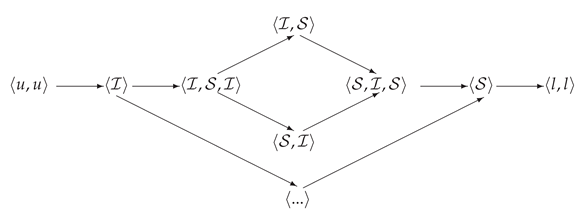
For any topological spaces and , the monoid has at most nine elements related to each other, as shown in the diagram below, where the arrows are compatible with the relation ⪯.
Proof.
When it comes to the diagram, let us first prove that
,
and ,
and and,
i.e.,
for all and , the following hold:
(a) and
(b) .
For that purpose, let us note that
- and
-
for any and .
Therefore, using Lemma 3, we obtain
and for all , respectively. Hence, since according to Lemma 7 (iii) and (iv), we have = and = and therefore and for all i.e., the first inclusion in (a) and the second inclusion in (b) are true.
Now let us observe that, by Lemma 3, we have or equivalently, for all since for all and . So, according to Lemma 7 (iv) and (i), we have
- and
for all .
Consequently, again from Lemma 7 (iv), we obtain
- and
for all .
We will finish the proof of (a) and (b) by showing, in an entirely analogous way, that
- and for all .
Indeed, since it is clear that
- and
-
for all and ,
applying Lemma 2.3 we obtain
- and
- respectively,
for all .
We now show that the set is closed under the operation ⊙ as presents the following table, where the factor that labels the row comes first.
| ⊙ | ||||||
It is enough to verify the following two pairs of equalities:
(c) = and
=
for any , and,
(d) and .
For the proof of (c), let us note that by applying Lemma 7 (iii), we have = and = and, according to part (i) of this lemma we get
for any .
In the same way, one can check the second part of (c).
Now, since condition (b) implies that , by Lemma 7 (iv) we have and consequently,
- for all and .
On the other hand, for the same reason as the above, we obtain
and consequently,
- for all and .
This ends the proof of the first equality in (d).
The checking of the second equality proceeds analogously by using condition (a) instead of (b).
To finish the proof, it suffices to note that for all , and , the following two properties hold:
• and
• if for some , then
or
.
The first property is an obvious consequence of Remark 4 and Lemma 2. When it comes to the second property, according to Remark 4, applying Lemma 7 (i) and then (ii) parts (a) and (c), we obtain
.
The proof for the case follows exactly in the same manner. So, the proof of Theorem 1 is finished. □
2.3. Generalized Continuity in Terms of the Cluster Operators
The concept of cluster functions of the form is closely related to the classical notion of cluster sets of a single-valued function at a point [9], [12] defined by
.
In [8], this concept has naturally been extended to multifunctions as
.
It is easy to check that
.
According to Remark 2, we use the functions defined as
and for all .
Using Lemma 5, we can see that these functions may be presented in the form of patterns through the operations and as
and for all .
We will use the shorter notation, namely and , respectively i.e.,
and for all .
Of course, so, one can consider the cluster functions of types and .
Using the concept of cluster functions, we can characterize cluster sets as follows
Remark 8.
For any multifunction and , the following properties are equivalent:
(i) and
(ii) .
Indeed, it is enough to use, according to the characterization of given in Lemma 2, the equality . Next, according to Remark 1, the property (ii) means that for every open sets W and with and , there exists such that i.e., .
The analogous characterizations we have in the case of the other types of cluster sets listed below that are investigated in [13] as an extension of the concept studied in [14] and [15]. Those types of cluster sets describe many kinds of generalized continuity of multifunctions [13], and for many types of convergence of nets of multifunctions, there are strict relations between the cluster set of the limit multifunction and the appropriate cluster sets of the members of the nets of multifunctions [16].
• ,
• ,
• ,
• ,
• ,
• ,
• ,
• .
In the case of single-valued functions that are interpreted as multifunctions F defined by for all , we have the following suitable definitions of cluster sets:
• .
• ,
• and
• .
The concept of cluster sets of type was introduced in [14] and used later in [15] and [17]. Another type of cluster set [18], of multifunctions has been defined as follows:
If is a non-empty family of non-empty subsets of X, then a point is called a -cluster point of F at , i.e., , if for any open sets U, V with and , there exists such that and .
This concept is used in further investigations e.g., [18,19,20,21,22,23,24,25] and, it describes two of those listed above types. Namely, it is easy to show that in the case when is the family of all nonempty open subsets , then and, the equality is also true if is the family of all nonempty -open [26] (resp. semi-open [27]) subsets defined by the condition (resp. ). Analogously, in the case when is the family of all nonempty pre-open (locally dense) subsets [28], ([29]) defined by the condition , we have and, the equality is also true if is the family of all nonempty -open [30] subsets defined by the condition .
Cluster sets may be also considered as the values of multifunctions from , to . Such multifunctions have been used in [19,20,31].
Analogously to Remark 2.15, the following simple observation shows the connection between the concepts of cluster functions of the forms
and , and cluster sets.
Remark 9.
For any multifunction , and , the following equivalences hold:
if and only if
(resp. if and only if and ,
if and only if
(resp. if and only if and ,
if and only if
(resp. if and only if and ,
if and only if
(resp. if and only if and .
Proof.
Let us note that, according to the characterizations of and given in Lemma 2, we have the following equalities:
() =
,
() =
,
() = ,
() = ,
() =,
() = ,
() =
,
() =
.
Now, it is enough to use Remark 1 and then, we immediately obtain the following equivalences for each :
• if and only if ,
• if and only if ,
• if and only if ,
• if and only if ,
• if and only if ,
• if and only if ,
• if and only if ,
• if and only if .
□
The cluster functions of the form are convenient tools to characterize the properties related to the continuity of multifunctions. By way of illustration, let us recall the classical types of continuity for multifunctions.
The continuity of a multifunction is defined by its upper and lower continuity [32]. A multifunction is said to by upper semi continuous (briefly ) (resp. lower semi continuous (briefly )) at a point if whenever W is an open subset of Y such that (resp. , then (resp. . The set of all such points will be denoted by (resp. ). A multifunction F is called (resp. ) if (resp. ).
It is easy to see that a multifunction is (resp. ) if and only if it is continuous when it is considered to be a single-valued function (resp. ) [3,33].
By using the concept of cluster functions of the forms
and , both these types of continuity can be characterized in terms of the upper Vietoris topology as follows:
Lemma 9.
A multifunction is upper semi continuous (resp. lower semi continuous) at a point if and only if
(resp. .
Proof.
Since, according to Lemma 2, we have
() = and
() =.
So, the following pairs of statements are equivalent for each and :
• and ,
• and .
Of course, (resp. means that (resp. ). Hence, the characterization is true. □
Remark 10.
One can also consider the other two possible relations, namely
and
for .
We denote those types of continuity as and , respectively. The set of all such points will be denoted by and ), respectively. Of course, the first of these properties is equivalent to for any open subset W such that , which defines the type of continuity introduced in [34].
The second property means that for any open subset W such that or equivalently, F is at x and is a singleton.
Analogous characterizations one can formulate for many types of generalized continuity. Let us first quote the definitions of some classical types of them.
Definition 2.
A multifunction is called
• (resp. )[35] at a point i.e.,
(resp. ), if (resp.
implies (resp.
for all ,
• (resp. )[36] at a point i.e.,
(resp. ), if (resp.
implies (resp.
for all ,
• (resp. )[37] at a point i.e.,
(resp. ), if (resp.
implies (resp.
for all ,
• (resp. )[38]) at a point x ∈ X i.e.,
(resp. ), if (resp.
implies (resp.
for all .
In [39] the property is called the lower demicontinuity ().
Analogously to the case of and , a multifunction F is
(or. ) (resp. (or ), (or ), (or )) if and only if it is -continuous (resp. semi-continuous, pre-continuous,
-continuous) when it is considered to be a function (or )).
The requirements stated in the above forms of generalized continuity apply to upper inverse image - in the type u (resp. lower inverse image - in the type l) of open subsets W of Y. The use of mixed types of the inverse images leads to the following kinds of continuity.
Definition 3.
A multifunction is said to be
• (resp. )[40] at a point i.e.,
(resp. ), if (resp.
implies (resp.
for all ,
• [40](or , [39]), at a point i.e.,
(resp. ), if (resp.
implies (resp.
for all ,
• (or , )[40], at a point i.e.,
(resp. ), if (resp.
implies (resp.
for all ,
• (resp. )[40] at a point i.e.,
(resp. ), if (resp.
implies (resp.
for all .
In [41] and [42], the property was used under the name of minimality of u.s.c.with compact values) multifunction. But in [43,44] and [39],this property has been used independently of the condition
Of course, if a single-valued function is treated as a multifunction F given by for all , then we have the following equalities:
• ,
• ,
• ,
• and
• ,
where (resp. , , , ) denotes the set of all continuity (resp. -continuity [45], semi-continuity [46,27], pre-continuity [28], -continuity [30]) points of f.
The following characterizations are analogous to those in Lemma 2.17.
Lemma 10.
For any multifunction and , the following equivalences hold:
• if and only if ,
• if and only if ,
• if and only if ,
• if and only if ,
• if and only if ,
• if and only if ,
• if and only if ,
• if and only if ,
• if and only if ,
• if and only if ,
• if and only if ,
• if and only if ,
• if and only if ,
• if and only if ,
• if and only if ,
• if and only if .
Proof.
It is enough to use the equivalences resulting from the characterizations (), (), (), (), (), (), () and () listed in Remark 9, and the equivalences listed in its proof. □
The following quite different types of generalized continuity can also be characterized using cluster operators.
Definition 4.
A multifunction is said to be
• continuous [47,48] at a point i.e., , if
holds for all
such that ,
• quasicontinuous [49] at a point i.e., , if
holds for all
such that ,
• precontinuous [47,48] at a point i.e., , if
holds for all
such that ,
• continuous [48] at a point i.e., , if
holds for all
such that .
With any multifunction we consider the function
× defined by
× for all ,
where is equipped with the product topology derived from the upper Vietoris topology on . So, it is clear that
× if and only if for all and .
We will use the following functions:
(A) =
,
(Q) = ,
(P) = ,
(B) =
.
Thus, the following pairs of statements are equivalent for all and :
• and
,
• and
,
• and
,
• and
.
Hence we have the following characterizations:
Lemma 11.
For any multifunction and , the following equivalences hold:
• if and only if ,
• if and only if ,
• if and only if ,
• if and only if .
At the end of this chapter, we will characterize some types of continuity, originating in some generalized continuity of functions with the values in metric spaces.
A function f from a topological space to a metric space is said to be cliquish at a point [50,51], if for any and any open subset containing x there exists an open nonempty subset such that for all . Or equivalently,
for any ,
where and denotes the ball with center y and radius .
The appropriate topological form of this condition called cliquishness [52] (equivalently cliquish [53], (Proposition 2.3 (iii)), applies to functions f from a topological space to a topological space and is given by the property
•
for any open covering of .
It is a simple generalization of the notion of continuity [53] defined by
for any open covering of .
The other types of topological forms of cliquishness [54] called pre cliquishness (resp. cliquishness, pre cliquishness, cliquishness, pre cliquishness) at a point X, are defined by the following conditions:
• (resp.
• ,
• ,
• ,
• )
for any open covering of .
The extensions of those definitions to multifunctions have the following forms.
Definition 5.
A multifunction is said to be
• u-t-α-cliquish (resp. l-t-α-cliquish)[13] at a point i.e.,
(resp. ), if (resp. for any open cover of Y,
• u-t-q-cliquish (resp. l-t-q-cliquish)[13] at a point i.e.,
(resp. ), if
(resp. for any open cover of Y,
• u-t-p-cliquish (resp. l-t-p-cliquish)[13] at a point i.e.,
(resp. ), if
(resp. for any open cover of Y,
• u-t-β-cliquish (resp. l-t-β-cliquish)[13] at a point i.e.,
(resp. ), if
(resp. for any open cover of Y,
• u-t-cliquish (resp. l-t-cliquish) [55] at a point i.e.,
(resp. ), if
(resp. for any open cover of Y,
• pre u-t-cliquish (resp. pre l-t-cliquish) at a point i.e.,
(resp. ), if
(resp. for any open cover of Y.
We have the following characterizations of those types of generalized continuity in terms of the cluster operators.
Lemma 12.
For any multifunction and , the following equivalences hold:
(resp. if and only if the family
(resp. contains a singleton,
(resp. if and only is the family
(resp. contains a singleton;
(resp. if and only if the family
(resp. contains a singleton;
(resp. if and only if the family
(resp. contains a singleton
(resp. if and only if for any ,
the family (resp. contains a singleton,
(resp. if and only if for any ,
the family (resp. contains
a singleton.
Proof.
If is an open covering of and
(resp. , , for some , then for some and according to the equivalences listed in the proof of Remark 9, we obtain
(resp. . So, (resp. , , ).
Now assume that (resp. , , ) and (resp. , , for all points . Then, since the values of cluster functions are closed with respect to the upper Vietoris topology, for every there exists an open such that
and
(resp. , ,
. So, the family forms an open covering of Y such that
(resp. which gives a contradiction and finishes the proof of , the case . The proof of the second case is analogous.
To prove and , let assume first that
(resp. ) and there exists such that (resp. ) for every . Then, for every there exists an open such that
(resp. ) which is equivalent to
(resp. . As a result, we obtain an open covering of Y such that
(resp. which gives a contradiction.
Now, let us take an open covering of and assume that for every there exists such that
(resp. ). Then, there exists such that and
(resp. ) which means that
(resp. ) for some .
So, we have (resp. .
This shows that
(resp. for any open set U containing x, i.e., that
(resp. and finishes the proof of and , the case . The proof of the second case is analogous. □
3. Convergence in Terms of Topologically Determined Operators
Given any net of multifunctions , shortly , where , and is a directed set, we will apply the function defined by
for all ,
i.e., H is the value of the exponential map:
given by the formula:
,
where , and ,
It defines one-to-one correspondence between and .
Analogously to the case of multifunctions , we will use the following two functions defined by
= and = for all .
Of course, the following equivalences are true:
• if and only if and
• if and only if
for any open subset and .
In the chapter below, we introduce a class of functions called products, which play an analogous role to the functions of type used in the definition of cluster operators. For this purpose, we shall need a special type of functions from to . Here, we introduce the general form of such functions.
Namely, for a Cartesian product and a point , using the same symbol to denote the function defined by for all , for any subset and for any non-negative integer k, we define the function , by
for all .
The Cartesian product reference is visible in the following equality:
for all and .
For each non-decreasing n-tuple (), 2, of non-negative integers, and for each (Z) we define the function
, by
for all .
3.1. The Monoid of Products
Let us consider a Cartesian product , of a directed set and a topological space . denotes the filter base of sections of , more precisely, =, where =. To simplify, we will write instead of , where . Of course, and hence we can contemplate the use of the functions
, where .
Since for any , one can then consider the following compositions
whenever .
Definition 6.
Let be a directed set and let be a topological space. Then the functions of the form , where n, p, q are non-negative integers such that , will be called the products of the pair , (or simply of ).
By , we will denote the set of all products of .
Adequately to the formulas given in Remark 7, any product of is uniquely determined by the structure of the 2(n+1)-tuple of the sets of indexes as the lemma below shows, where, according to Remark 7 (ii), we will use the notations:
= for and,
= for .
We will, in the lemma below, introduce a uniform denotation for these two types of index sets as follows:
for .
Lemma 13.
Let n, s, q be non-negative integers such that and . Then any 2(n+1)-tuple of index sets of is of the form
i.e.,
any product is of the form
.
Proof.
According to Remark 7, belongs to the domain of and thus,
=
.
By the definition we have and in this exposition of , we have used the following sequence of sets of indexes
Analogously, =
and, by definition, So, we have used the following sequence of sets of indexes
.
Finally,
and,
we have used the following sequence of sets of indexes
.
So, , and taken together show that any 2(n+1)-tuple of index sets of is of the form
which finishes the proof. □
Remark 11.
With the above lemma, we can see that the equivalences established in Remark 7 (iv) take the following form:
if and only if ,
where and .
Theorem 2.
Let be a topological space, and a directed set. Then the set of all products of forms an Abelian monoid under the operation ⊕ defined by
,
with the neutral element .
The monoid is generated by the subset of all six products of the form .
Proof.
The axioms for commutative monoids are clearly fulfilled. We will show that is generated by the family
and , where .
Let us consider the functions defined by
for all and .
Firstly, we will show that
for all and k = 0, 1,...
Indeed, basing on the description and given in the proof of Lemma 3, we have
,
and = , where, according to the notation of Remark 7 and Lemma 3, we have (X) for j = 1, 2,... and . So, any 2(n+1)-tuple of index sets of such description of belongs to
.
It follows by definition, that , where
= , = , i and . So, any 2k-tuple of index sets of belongs to
and consequently, the structure of is determined by
which corresponds to . Thus, we have proved the equality .
We now show that every product , where , can be presented in the following form
= ,
where and, belongs to the set of all products of type
, or
, where
For this purpose, let us first note that
= ,
which follows directly from . Next, we note that is of the form or , where .
Now, it is enough to decompose as follows:
.
So, we obtain
= ,
where , which ends the proof of .
We will now show that is generated by .
Let us take , where and suppose that , where i = 0, 1,... Then we have
i.e.,
.
If we assume that , where i = 1,2,... Then
.
Let us now check the products , where and first suppose that , where i = 0, 1,... Then,
i.e.,
.
If , where i = 1,2,... Then
i.e.,
.
So, and together prove that the part of the presentation can be built from the members of the set .
Finally, let us note that for every product , hold
and, according to ,
.
Indeed,
.
Similarly, we have
.
Therefore, the presentation has the form i.e., one of the following forms:
(i) , i = 0, 1, ...,
(ii) , i = 1, 2, ...,
(iii) , i = 0, 1, ..., or
(iv) , i = 1, 2, ....
This finishes the proof. □
3.2. Convergence Operators
Let be a function from to and let let us take a product . It is evident that belongs to for all , so these sets belong to the domain of every composition of 2n+2 functions taken from the set . One can therefore consider the following functions
,
where for i = 1, 2,..., 2n+2.
Of course, the number of the functions , , in the above composition is determined by the function , so one can use the following shorter notation for such compositions
.
As shown above, in Lemma 3, the structure of any product is unequivocally represented by a sequence of index sets
().
So, in accordance with the structure of we will use the following more precise notation for the above compositions:
,
where and correspond to and , respectively.
In fact, one might consider two kinds of functions:
,
which assigns to every function , the function
=
.
Definition 7.
Let and be two topological spaces, be a directed set and let .
(i) Any function of the form
,
will be called a convergence function.
(ii) Any function of the form
,
will be called a convergence operator.
Let us denote by the set of all convergence operators for given (), and .
The function obtained from a convergence function (resp. operator ) by exchanging u and l will be denoted by (resp. ), where .
In connection with the characterization of and by the operations and as and respectively, where , according to Lemma 5, we have the following equalities:
and
.
Of course,
and
, .
We will use the notion of convergence operator to define many types of convergence of nets of multifunctions. A type of convergence of a net to a multifunction F at a point is determined by
• a convergence function ,
where
• a function and
• some relationship between
and .
So, by a type of convergence determined by a convergence operator , we mean a pair of the form , where and .
Definition 8.
We say that a net of multifunctions , , is -convergent to a multifunction at a point , if , where Δ is a convergence operator, and .
3.3. Classical Types of Convergence in Terms of the Convergence Operators
We will show that the convergence operators characterize the classical types of convergence of nets of multifunctions. In this connection, we need to recall some definitions.
For a net, of subsets of a topological space X, a point is called a limit point (resp. cluster point) of shortly, (resp. ) [32,56], if for every open subset such that , there is such that U meets for each (resp. for every there is such that U meets .
We say that a net topologically converges to a subset A, denoted by , if .
By and we denote the upper and lower limits in the sense of the set-theory i.e., the set and , respectively.
The concepts of convergence of nets of subsets and convergence of nets of multi-functions are closely related. Generally, one could consider the following properties for a given multifunction , a net of multifunctions and a point :
(PC1) ;
(PC2) ;
(PC3) ;
(PC4) ;
(PC5) ;
(PC6) ;
(PC7) .
For the graphs of multifunctions, one can formulate conditions analogous to the above.
(GC1) ;
(GC2) ;
(GC3) ;
(GC4) ;
(GC5) ;
(GC6) ;
(GC7) .
The theorem below shows that the types of convergences listed above one can characterize in terms of convergence operators.
Let us first recall some definitions. A subset B of a topological space is -paracompact [57], if every open cover of B has a locally finite open covering refinement.
We will use the following two properties of -paracompact subsets:
• for every paracompact subset B of a regular topological space and for every open subset W with there exists an open subset V such that ,
• for every paracompact subset B of a topological space and for every point there exist disjoint open subsets V and W such that and .
Theorem 3.
The following conditions hold for an arbitrary net of multifunctions , a multifunction and a point
if and only if ,
if and only if ,
if and only if ,
if and only if ,
if is and the values of F are α-paracompact, then
whenever ,
whenever ,
whenever ,
whenever .
Proof.
: According to the definition,
.
The assumption , implies that for every
we have because . Consequently, according to , for every open set W containing y, there exists such that for every , i.e., , which proves that .
Now, conversely, assume that . Since is a closed subset in the space , it is enough to show that for every , the property implies that . So, let us take such that i.e., , then and consequently, there exists such that for every , or equivalently,
. Thus, using Remark 1, we get
for some and, according to (I) we have .
Proof of . It is clear that
The assumption that that for all , and for some and , implies , i.e., and consequently we obtain . According to , we get
i.e.,
there exists such that for every
we have for some .
The condition is equivalent to i.e., for some , so and, according to , this ends the proof that .
For the converse implication, suppose that i.e., , where and . Then for every we have for some and according to the assumption, . So, there exists such that for every we have .
The condition is equivalent to the existence of such that , so or equivalently, and consequently, for all . Finally, in accordance with Remark 1, we obtain for all and again Remark 1 yields which means, according to (II), that and finishes the proof.
Proof of : In an entirely analogous way to the above, we have
.
If , and , where , then and consequently, according to (IV), for every there exists such that i.e., . So, .
Now, assume that and let , where . It is enough to show that . It is clear that, and therefore by the assumption, for every there exists such that i.e., . So, for all and using Remark 1. we get which, according to (IV), finishes the proof.
Proof of . Similarly to the previous cases, we note that
If for all , and for some , and , then , equivalently, and therefore, according to (V), we have
Consequently,
i.e., for every there exist and such that i.e., . Thus, for some we have thus and the proof that is finished.
Conversely, assume now that , and . It is enough to prove that i.e., considering (V), that . It is clear that , so for some and therefore, according to that assumption, for every , we have . Hence, for every there exists such that i.e, there exist and such that . So, or equivalently, and, we have shown that for all . Now, using Remark 1, we get for all , and reusing Remark 1 finished the proof.
Proof of of . Suppose on the contrary that i.e., for some . Because of the property of and paracompactness of there exist two disjoint open subsets W and V of Y such that and . Consequently, since , we have , and since , there exists such that , i.e., holds for every . This, according to Remark 1, means that i.e., by (I), . Since, according to Lemma 1, , we obtain which gives a contradiction.
Proof of . Let us assume on the contrary that , i.e. that there exists such that . Then the property of the space and the paracompactness of imply the existence of two disjoint open subsets W and V of Y such that and . Therefore, since , we have . But, analogously to (II), . So, the following holds for some :
for every there exists such that
for all .
Of course, , hence there exists such that for all we have i.e., for some , which contradicts because .
The proof of goes analogously to (a). The assumption that implies the existence of two disjoint open subsets W and V of Y that satisfy the following conditions: and . So, or equivalently, which implies and gives a contradiction.
The proof of . Analogously to the proof of , let us assume that there exist such that , and disjoint open subsets W and V of Y such that and . Consequently, we have or equivalently,
which means that, for some the following holds:
there exists such that for every we have
for all .
Since , for every there exists such that i.e., for some . This gives, in accordance with , i.e., we have a contradiction. □
Let us quote some direct conclusions of the above theorem.
Corollary 1.
Let be a net of multifunctions from a topological space to a topological space , a multifunction whose values are α-paracompact and let . Then the following statements hold:
If and ,
then ,
If and ,
then ,
If and ,
then ,
If and ,
then ,
If and ,
then ,
If and ,
then .
The property is called topologically convergence in point [58], topologically convergence [59] or pointwise topologically convergence [60].
The property is called topological convergence in graphs [58], graph convergence [59], topological convergence [61,62], Hausdorff topological convergence of graphs [63] or topologically graph convergence [60].
The set (resp. ) is called the topological upper Kuratowski limit of (resp. the pointwise upper Kuratowski limit of at x) in [23,24] and [64].
It is easy to check [65], (Lemmas 1.4 and 1.5), that the property is equivalent to the lower pointwise convergence defined in [66] as follows:
Definition 9.
A net of multifunctions is said to be lower (resp. upper) pointwise convergent to at if for each open subset such that ) (resp. ), there exists such that (resp. ) for all . Equivalently,
lim inf (resp. lim inf ) for every open subset such that (resp. .
Remark 12.
As we can see (Theorem 3 (i)), the lower pointwise convergence can be characterized by the following three equivalent sentences:
(i) implies lim inf for every open ,
(ii) and
(iii) .
In the case of the upper pointwise convergence, analogously as in the proof of Theorem 3 (i), one can prove that this property is characterized by the following two equivalent sentences:
(iv) implies lim inf for every open ,
(v) .
Remark 13.
The reasoning analogous to the above remark leads to the following two types of equivalent sentences:
Type :
(i) implies lim sup for every open ,
(ii) and
(iii) .
Type :
(iv) implies lim sup for every open
(v) .
Those types of convergence are called the lower pointwise sub convergence and upper pointwise sub convergence [67], respectively.
Analogously to Remark 12, below we present the characterizations of the global version of the point types of graph convergences defined as follows
Definition 10.
A net of multifunctions is said to be lower (resp. upper) graph-convergent to at [66], if (resp. ) for every open subset such that (resp. .
Remark 14.
The following two lists of sentences present equivalent characterizations, respectively, for the lower and upper graph-convergence at all points
Type :
implies for every open subset
and all ,
and
.
Type :
implies Li for every open subset
and all ,
.
The equivalence of (ii) and (iii) is proved in Theorem 3 (ii). We will show that (i) and (ii) are equivalent, as well as the sentences (iv) and (v).
Proof.
If , and W is an open subset of Y such that i.e., , then there exists such that for every open subset U of X containing x we have . Consequently, there exists such that for all . The property means that for some we have and hence which ends the proof that .
Conversely, if and for some open subsets and , then and therefore, . According to (i) we have and consequently, there exists such that for all . The property means that for some which implies the existence of such that . This proves that .
To prove the equivalence of (iv) and (v) let us assume that and let i.e., , for some open subset , which means that . Therefore, i.e.,
. Consequently, for every open set U containing x there exists such that for all , i.e., for some or equivalently, . So, .
Conversely, assume that (iv) holds and let , where . Then, i.e., and, according to the assumption, Li . So, for every open set U containing x there exists such that for all , i.e., for some . It means that for all which, according to Remark 1.1, gives . In the same way one can show that which is equivalent to and finishes the proof. □
The replacement of the operation by the in Definition 10 gives the type of convergence called the lower (resp. upper) graph-subconvergence at the points [67]. Analogously to the remark above, we obtain the following characterizations.
Remark 15.
The following two lists of sentences give equivalent characterizations, respectively, for the lower and upper graph-subconvergence at all points
Type :
implies for every open subset
and all ,
and
.
Type :
implies Ls for every open subset
and all ,
.
The equivalence of (ii) and (iii) is proved in Theorem 3 (iv). The proof that (i) and (ii) are equivalent is quite analogous to that in Remark 14. We will show the equivalence of (iv) and (v).
Proof. If i.e., and , then i.e.,
. So, for every open set U containing x and there exist and such that i.e., which proves that Ls .
Conversely, assume that (iv) holds and let , where . Then, and, according to the assumption, Ls . So, for every open set U containing x and there exists such that i.e., for some , or equivalently, for every and . Hence, in accordance with Remark 1.1 we get
i.e., or equivalently, , which finishes the proof. □
In the present work, we are particularly interested in the concept of convergence defined by O. Frink in [68]:
Definition 11.
A net of functions ) is said to be:
(i) continuously convergent to ) at if, for each open subset such that there exist an open subset U containing x and such that for all and ,
(ii) quasi-continuously convergent to ) at if, for each open subset such that there exists an open subset U containing x such that for every there exists such that for all .
The basic result concerning those types of convergence is the following:
Theorem 4.
Let be a net of functions from a topological space X to a regular topological space Y convergent pointwise to a function . Then f is continuous if and only if the convergence is quasi-continuous.
This leads to the following conclusion:
Corollary 2.
The limit f of a continuously convergent net of functions from a topological space X to a regular topological space Y is, continuous.
The continuous convergence was extended to the case of multifunctions in [58] as follows.
Definition 12.
A net of multifunctions ) is said to be lower (resp. upper) continuously convergent to F at x, if for each open subset such that (resp. ), there exist an open subset U containing x and such that (resp. ) for all and .
Remark 16.
It follows directly from the definition that a net of multifunctions ) is lower (resp. upper) continuously convergent to F at x if and only if for every open subset ,
• implies
(resp. implies .
These types of convergence have the following characterization in terms of convergence operators.
Lemma 14.
A net of multifunctions is lower (resp. upper) continuously convergent to at a point if and only if (resp. ).
Proof.
According to the definition,
Analogously,
So, (resp. ) is equivalent to the existence of an open subset containing and such that for all and , (resp. ). Besides, of course, the condition (resp. ) means that (resp. ) and the proof is finished. □
Remark 17.
A simple analysis of the above proof shows that
.
Using Theorem 3 (v), (d), we immediately get the following fact:
Corollary 3.
([57], Theorem 3.2 (2)) If is a topological space and the values of are α-paracompact, then the upper continuous convergence of to F at any point implies that .
Proceeding analogously as in the case of continuous convergence, one can define quasi-continuous convergence for multifunctions as a generalization of Frink’s notion of quasi-continuous convergence for single-valued functions as follows.
Definition 13.
A net of multifunctions ) is said to be lower (resp. upper) quasi-continuously convergent to ) at if, for each open subset such that (resp. ), there exists an open subset U containing such that for every there exists such that (resp. ) for all .
Remark 18.
Analogously to Remark 16, we can say that a net of multifunctions ) is lower (resp. upper) quasi-continuously convergent to F at x if and only if for every open subset ,
• implies
(resp. implies .
The characterization of these types of convergence in terms of the convergence operators may be proven in an entirely analogous manner to such characterization for the continuous convergence given in the previous lemma.
Lemma 15.
A net of multifunctions is lower (resp. upper) quasi-continuously convergent to ) at a point if and only if (resp. ).
Proof.
It is enough to observe that, by definition, for any point , we have
and analogously,
. □
A direct generalization and extension of Frink’s result take the form of the following pair of theorems. We omit the proof because those theorems immediately follow from a general theorem about the continuity of the limit multifunctions, which we will state in the next chapter.
Theorem 5.
If is a net of multifunctions from to a regular topological space , then for every multifunction the following hold:
Under the assumption that ,
the lower quasi-continuous convergence at implies that .
If is α-paracompact, then under the assumption that
, the upper quasi-continuous convergence at
implies that .
Theorem 6.
If is a net of multifunctions from to , then for every multifunction the following hold:
Under the assumption that ,
implies the lower quasi-continuous convergence at .
Under the assumption that ,
implies the upper quasi-continuous convergence at .
Remark 19.
In the case of single-valued functions, the assumption means the pointwise convergence, so Theorem 5 is an extension of Frink’s result to multifunctions. What is more, in the case of single-valued functions, the assumption is weaker than the pointwise convergence. Thus, Theorem 5 improves Frink’s result in the part concerning the sufficient condition for the continuity of the limit functions.
Indeed, if the single-valued functions , are interpreted as multifunctions F and given by and respectively, for all , then we have , or equivalently, and of course, .
Analogously, and, because we are using the function given by
for , the following four conditions are equivalent for any open subset and :
• ,
• ,
• and
• .
Of course, for the same reasons, for any open subset and , the following three conditions are equivalent:
• ,
• and
• .
So, the pointwise convergence of a net to a function f can be phrased in one of the following two equivalent ways:
• or
•
Analogously, according to Lemmas 14 and 15, the continuous convergence (resp. quasi-continuous convergence) at a point in the sense of Frink means that
• (resp. ) or equivalently,
• (resp. ).
Finalle, let us note that the condition considered in the case of single-valued functions, means
• or equivalently,
• .
And, this condition turns out to be weaker than the pointwise convergence because it means that ⊂ for all open subset , whereas, the pointwise convergence means that ⊂ for all open subset .
3.4. Types of Convergence Guaranteeing the Continuity of the Limit
We are interested in finding all types of convergence of nets of multifunctions that guarantee the required types of continuity or some generalized form of continuity of the limit multifunction. We will present general theorems that constitute a complete concept of the relationship between the type of convergence of the nets of multifunctions and the type of continuity of the limit multifunction without any assumptions on the type of continuity of the members of the nets. The following result refers to Theorem 5. The results of Theorem 5 are obtained by taking (resp. ) in part (i) (resp. part (ii)) of the below theorem.
Theorem 7.
Let be a net of multifunctions from a topological space to a regular topological space , and let Δ be a convergence operator. Then, for any and every multifunction satisfying the condition (resp. ), the following hold:
implies that
(resp. ).
If additionally, is α-paracompact, then
implies that
(resp. .
Proof.
(i). Let and let us assume to the contrary that (resp. . Then, according to Lemma 9 (resp. Remark 10),
(resp. ). Thus, there exists an open subset such that and (resp. ) i.e.,
for every there exists such that
(resp. ) so,
(resp. ) or equivalently,
(resp. ).
The regularity of implies the existence of an open subset such that and , so
(resp. ) and therefore by and Remark 1, we obtain
;
(resp. ) i.e.,
(resp. ).
By the assumption,
(resp. ) for all . So, according to
Lemma 7 (iv), we have
(resp. ) and consequently,
or equivalently,
.
Since , and , we get
, and since, by Lemma 2,
, according to , we obtain
, which gives a contradiction and finishes the proof of (i).
(ii). Let and let
(resp. ) then, using Remark 10 (resp. Lemma 9), we have (resp. ). So, there exists an open subset such that and the condition is fulfilled. Since is -paracompact, there exists an open subset such that , and and hence, analogously as above, we have (resp. ), i.e., the property . Now following the same procedure as above, we get a contradiction that finishes the proof of (ii). □
Remark 20.
The relation between types of convergence and types of continuity of the limits proved in the above theorem illustrates the following simplified table.
The next theorem concerning the reverse implications states a generalized version of Theorem 6. By simplified table, it may be illustrated as follows.
The equivalences stated in Corollary 4 of Theorems 7 and 8 have the following simple illustration.
Theorem 8.
Let be a net of multifunctions , and let Δ be a convergence operator. Then, for any and every multifunction the following hold:
If then
implies that and
implies that .
If then
implies that and
implies that .
Proof.
(i). If (resp. ) then, according to Remark 10 (resp. Lemma 9), (resp. ). So, since by the assumption we have for all , using Lemma 7 (iv), we obtain (resp. and the proof of (i) is finished. The proof of the second part proceeds in an analogous manner. □
Remark 21.
The results (i) and (ii) of Theorem 6 follow from the above theorem by taking (resp. ) in part (i) (resp. part (ii)).
As a corollary from Theorems 7 and 8, we obtain the following equivalences between the types of convergence of the nets of multifunctions and the types of continuity of the limit multifunctions.
Corollary 4.
Let be a net of multifunctions from a topological space to a regular topological space , and let Δ be a convergence operator. Then, for any and every multifunction satisfying the conditions and
(resp. and )), the following hold:
is equivalent to
(resp. ) and
If additionally, is α-paracompact, then
is equivalent to
(resp. ).
In Theorems 9 and 10 below, we state the corresponding version of Theorems 7 and 8 for generalized types of continuity characterized in Lemma 10 where, as one can see, we have used the compositions , , or in these characterizations, whereas in the case of standard continuity (Lemma 9 and Remark 10), the composition . We omit the proof of these theorems because it is analogous to that of Theorems 7 and 8, it is enough to use the compositions , , or instead of .
Theorem 9.
Let be a net of multifunctions from a topological space to a regular topological space , and let Δ be a convergence operator. Then, for any and every multifunction satisfying the condition (resp. ), the following hold:
implies
(resp. ).
If additionally, is α-paracompact, then
implies
(resp. ).
implies
(resp. ).
If additionally, is α-paracompact, then
implies
(resp. ).
implies
(resp. ).
If additionally, is α-paracompact, then
implies
(resp. ).
implies
(resp. ).
If additionally, is α-paracompact, then
implies
(resp. ).
Theorem 10.
Let be a net of multifunctions , and let Δ be a convergence operator. Then, for any and every multifunction the following hold:
If then
− implies that and
− implies that .
If then
− implies that and
− implies that .
If then
− implies that and
− implies that .
If then
− implies that and
− implies that .
If then
− implies that and
− implies that .
If then
− implies that and
− implies that .
If then
− implies that and
− implies that .
If then
− implies that and
− implies that .
Analogous to Corollary 4, we immediately obtain the following equivalences
Corollary 5.
Let be a net of multifunctions from a topological space to a regular topological space , and let Δ be a convergence operator. Then, for any and every multifunction satisfying the condition and (resp. and )), the following hold:
is equivalent to
(resp. ).
If additionally, is α-paracompact, then
is equivalent to
(resp. ).
is equivalent to
(resp. ).
If additionally, is α-paracompact, then
is equivalent to
(resp. ).
is equivalent to
(resp. ).
If additionally, is α-paracompact, then
is equivalent to
(resp. ).
is equivalent to
(resp. ).
If additionally, is α-paracompact, then
is equivalent to
(resp. ).
Remark 22.
The use of , , or , instead of in the tablets in Remark 20, gives the analogous simplified illustrations of Theorems 9 and 10, and of Corollary 5 concerning the α-continuity, quasi-continuity, pre-continuity, or β-continuity, respectively.
3.5. The Monoid of Convergence Operators
The basic idea in this chapter is to consider the binary operation
defined by
,
where denotes the set of all convergence operators for given (), and .
It is easy to see that the operator is the neutral element for this operation. We will denote this operator by adequately to the notations used in Theorem 2.
The associativity of the operation ⊙ can be shown in the same manner as in the proof of Lemma 8. So, the set forms a monoid.
In this chapter, we will consider the question of how many convergence operators are there. An application of the lemma below significantly narrows down the search area.
Lemma 16.
Any convergence operator can be presented in the following form
,
where or, both s and q are even numbers.
Proof.
Assume that there exists a convergence function
such that s≠q and s is an odd number.
We will show, that
=
for some even number .
Let us consider the segment of our convergence function. It is clear that this segment has one of the following forms:
(i)
(ii)
(iii) or
(iv) .
The following equalities for the cases (i), (ii) and (iii) follow directly from the definition of the functions u and l:
• (i.e., ),
• (i.e., ) and
• (i.e., ).
We will prove that the following equality, corresponding to the case (iv), is also true:
• .
According to the definition of convergence function and Lemma 13 we have
and
.
Of course, the number is even, so and, this means that depends on . Therefore, denoting by the function defined on the product by
for all , we obtain
.
Now, using Remark 11 for the case that , since and of course , we have
.
So, the structure of is represented by the sequence
i.e., the structure of . Therefore,
=
.
We will show that
=
.
So, it is enough to prove that
= i.e., the family
is equal to the family
.
For this purpose let us note that . So,
for all .
Therefore, and thus, because the set is closed in the space .
Now let us observe that
because , so
which means that and ends the proof of the equality .
Now, let us consider a convergence function
such that s≠q and q is an odd number. We will show, that
=
for some even number .
Analogously to the previous case (with the number s), let us consider the segment
of our convergence function, in one of the following forms:
(v)
(vi)
(vii) or
(viii) .
Of course,
• (i.e., ),
• (i.e., ) and
• (i.e., ).
For the case (viii) we will prove the following equality which will finish the proof of the lemma:
• .
Analogously to the first part of this proof we have
and
.
Since is an even number, we have . So, depends on and denoting by the function given by
for all , we get
.
Using Remark 11 for , we have
.
Therefore,
.
We will show that the family
is equal to the family
.
We claim that
i.e.,
the family
is equal to the family
.
Indeed, for any and the inclusion
holds.
So,
for any and
hence,
which gives
.
Now let us note that the family belongs to
because of
and consequently, .
But since
for all and any , and consequently, for all we have
. So,
.
This proves the inclusion and finishes the proof of the lemma. □
As the above lemma shows, a combination can be an ambiguous description of the operator in the sense of order. The following lemma shows that the descriptions of convergence operators can reduce.
Lemma 17.
The following segments of a convergence operator
are equal:
(resp. ),
(resp. ),
(resp. ),
(resp. ).
Proof.
We will start by showing that for any convergence function
= ,
where s and q are even numbers, the segments of the following types one may regard as cluster operators in the sense of Definition 1:
(i) for some even number such that ,
(ii) for some even number and an odd number k such that
or
(iii) for some even number and an odd number p such that
.
This will allow us to use Lemma 7 and Theorem 1.
Of course, the appropriate 2(n+1)-tuple of index sets of has the form
.
So, consider a segment of for some even number . Then
.
Of course, and = is a function from X to . Hence,
and therefore we can regard the composition as a cluster operator in the sense of Definition 1.
Let us now consider a segment of for some even number and an odd number k such that .
It is clear that
,
where and is defined by
for all .
For this reason, one can write the function
as follows
since
.
So, we can regard the family as a value of the cluster function .
Finally, let us consider a segment of for some even number and an odd number p such that . Then,
, where and is defined by .
Therefore,
.
Thus, the family is a value of the cluster function .
We are now ready to prove that and
.
Applying Lemma 7 (iii)(b) and (a), and the equalities (d) stated in the proof of Theorem 1, we get
. And,
.
Analogously,
.
And,
.
Finally,
.
So, .
Analogously one can prove that and finish the proof of the lemma. □
Theorem 3.4 shows that the set of all six products of the form , i.e., , generates the monoid of all products of . It is easy to check that these products designate at most the following seven operators
For simplicity purposes, we will use the following shorter denotes:
,
and .
Below, we will indicate all possible convergence operators and present them in the form of multiplications of members of the collection .
Theorem 11.
For given (), and , the set of all convergence operators, contains at most the following non-neutral elements:
(i) Specified by ,n = 1, 2,...:
,
,
,
,
,
.
(ii) Specified by for an even natural number s:
,
,
,
,
,
,
,
,
,
,
,
,
,
,
,
,
,
,
,
,
,
,
,
,
,
,
,
,
,
,
,
,
,
,
,
,
,
,
,
,
,
,
,
,
,
,
,
.
(iii) Specified by , for an even natural number s:
,
,
,
,
,
,
,
,
,
,
,
,
,
,
,
,
,
,
,
,
,
,
.
(iv) Specified by , for an even natural number s:
,
,
,
,
,
,
,
,
,
,
(v) Specified by , for an even natural number s:
,
,
,
(vi) Specified by for an odd natural number q:
,
,
,
,
,
,
,
,
.
Proof.
For a given function and , the composition is a function from X to . So, we can consider the cluster functions in the sense of Definition 1, of type . Thus, any cluster operator designates the function
defined by
for all .
In the first step, we will prove that for any convergence operator
, the following equality holds true:
=
.
Indeed, by definition, for any , we have
=.
According to Lemma 13 we have
{...:
:...}:::
: ...}: ::
:...}:
{...:
:...}:::
:...}: ::
:...}:
:
:...}:::
:...}: ::
:...}:
::...}:
:
:...}:::
:...}: ::
:...}:
::...}:
:
:...}:
::
:...}:
::
:...}:
, where in the last two equations, we have used the property noted in Remark 11 and the fact that .
So, and consequently, the value described in is equal to
which proves the equality .
According to Theorem 1, one can use at most the following six non-neutral cluster operators in the formula :
, , , , and .
So, as a consequence of , for any convergence operator
, where ,
there exist at most the following six convergence operators of the type
, namely:
,
,
,
,
and
.
Now, let us observe that any convergence function
is a function from X to . So, any convergence function of the type
is a cluster function in the sense of Definition 1, and consequently, according to Theorem 1, for any convergence operator
, where , we can obtain at most the following convergence operators of the type
:
,
,
,
,
and
.
Now, considering the convergence operators of the type , for a given function and , we define the function by
, for all .
Then, for each point we have
.
But, because of Theorem 1, we know that must be equal to , , , , , or .
So, all possible non-neutral operators of the type are listed in part (i) of the theorem as , , , , and , respectively.
For this reason, we can obtain the following seven types of operators of the form
:
(C1) ,
(C2) ,
(C3) ,
(C4) ,
(C5) ,
(C6) ,
(C7) ,
The alternating application of the operations and on the operator , allows for the determination of all convergence operators of the type (C7), i.e., specified by for an even natural number s, listed in part (ii) of the theorem.
Below, in the same way, using the operators listed in part (i) instead of , we will determine all operators of the type (C1),...,(C6), i.e., specified by , or , for an even natural number s. We will consider all possible cases. Next, by applying Lemma 7, and the equalities (d) stated in the proof of Theorem 1 without reference to them and using Lemma 17, we will show that some of the descriptions designate the same operator. As a result, we will indicate all possible operators of this type mentioned in parts (iii), (iv), and (v) of the theorem.
In the case (C1).
• Type :
−
i.e., ,
−
i.e., ,
− = =
i.e., ,
− =
i.e., .
• Type :
− = =
= i.e., ,
− =
i.e., ,
− = =
i.e., ,
− =
i.e., .
• Type :
− =
= i.e., ,
−
i.e., ,
− =
i.e., ,
−
i.e., .
• Type :
− = =
= i.e., ,
− =
i.e., ,
− =
i.e., ,
−
i.e., .
In the case (C2).
• Type :
− i.e., ,
−
i.e., ,
− = =
i.e., ,
− i.e., ,
− =
i.e., ,
− = =
i.e., .
• Type
− i.e.,
−
i.e., ,
− i.e., ,
−
i.e., ,
−
i.e., ,
−
i.e., ,
• Type
− i.e., ,
−
i.e., ,
−
i.e., ,
−
,
i.e., ,
−
i.e., ,
−
i.e., .
• Type
−
i.e., .
−
i.e., ,
−
i.e., ,
−
i.e., ,
−
i.e., ,
−
i.e., ,
• Type
:
−
i.e., ,
−
i.e., ,
−
i.e., ,
−
i.e., ,
−
i.e., ,
−
i.e., .
In the case (C3).
• Type :
− i.e., ,
−
i.e., ,
−
i.e., ,
−
i.e., ,
−
i.e., ,
−
i.e., .
• Type
:
−
i.e., ,
−
i.e., ,
−
i.e., ,
−
i.e., .
• Type
:
−
i.e., ,
−
i.e.,
−
i.e., ,
−
i.e., .
In the case (C4).
• Type :
−
i.e., ,
−
i.e., ,
−
i.e., ,
−
i.e., ,
• Type :
− i.e., ,
−
i.e., ,
−
i.e., ,
−
i.e., ,
−
i.e., ,
−
i.e., .
• Type
:
−
i.e., ,
−
i.e., ,
−
i.e., ,
−
i.e., ,
−
i.e., ,
−
i.e., ,
• Type
:
−
i.e., ,
−
i.e., ,
−
i.e., ,
−
i.e., ,
−
i.e., ,
−
i.e., .
In the case (C5).
• Type :
−
i.e., ,
−
i.e., ,
−
i.e., ,
−
i.e., ,
−
i.e., ,
−
i.e., .
• Type
:
−
i.e., ,
−
i.e., ,
−
i.e., ,
−
i.e., ,
−
i.e., ,
−
i.e., .
In the case (C6).
• Type
:
− i.e., ,
−
i.e., ,
−
i.e., ,
−
i.e., ,
−
i.e., ,
−
i.e., .
• Type
:
− i.e., ,
−
i.e., ,
−
i.e., ,
−
i.e., ,
−
i.e., ,
−
i.e., .
• Type
:
−
i.e., ,
−
i.e., ,
−
i.e., ,
−
i.e., ,
−
i.e., ,
−
i.e., .
Finally, we will prove that the alternating application of the operations and on the operator , leads to the determination of all convergence operators specified by for an odd natural number s, listed in part (vi) of the theorem.
• Type :
− i.e., ,
−
i.e., ,
−
i.e., ,
− i.e., ,
−
i.e., ,
− i.e., .
• Type :
− i.e., ,
−
i.e., ,
− i.e., ,
−
i.e., ,
−
i.e., ,
− i.e., .
• Type :
− i.e., ,
−
,
i.e., ,
−
i.e., ,
−
i.e., ,
−
i.e., ,
−
i.e., .
• Type
:
−
i.e., ,
−
i.e., ,
−
i.e., ,
−
i.e., ,
−
i.e., ,
−
i.e., .
The proof is finished. □
Finally, in the diagrams below, we present the relationships between the studied here operators, where we will use only the numbers used in the denotations of the operators listed in the last theorem.
Diagrams.
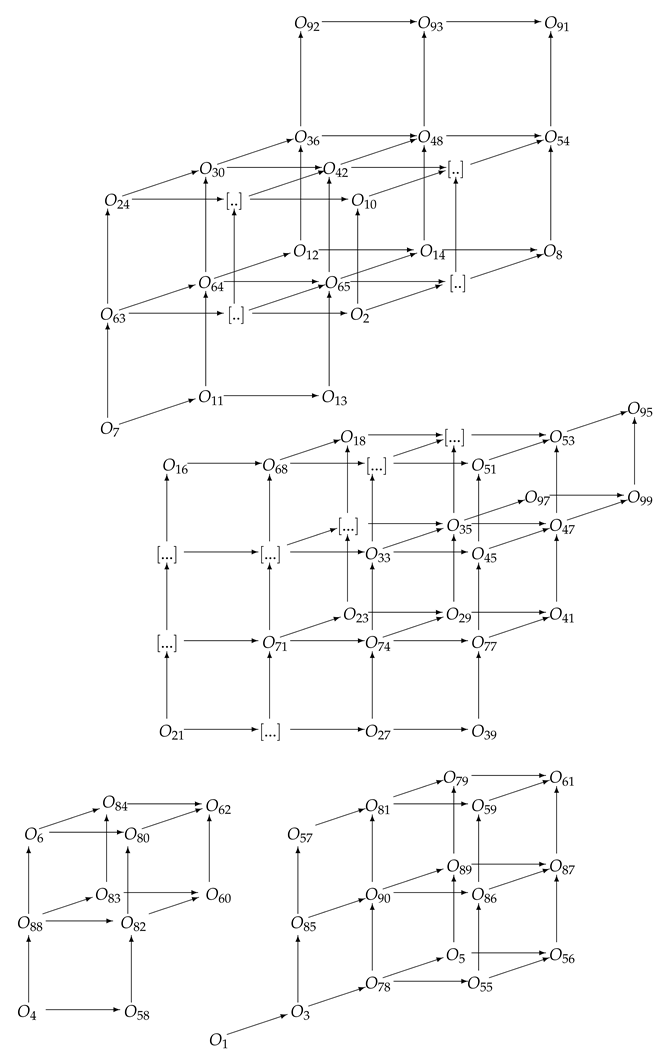
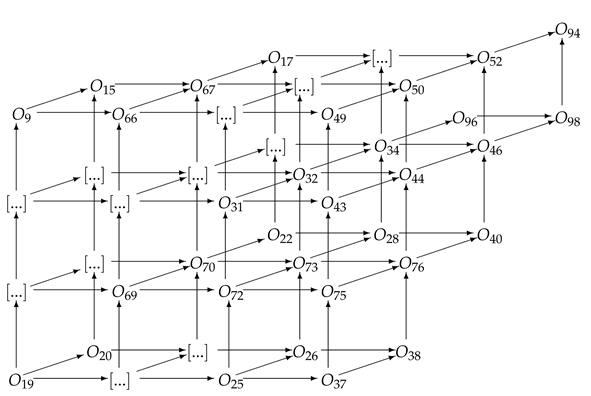
References
- Vietoris, L. Bereiche zweiter ordnung. Monatshefte für Mathematik und Physik 1922, 32, 258–280. [Google Scholar] [CrossRef]
- Vietoris, L. Kontinua zweiter Ordnung. Monatshefte für Mathematik und Physik 1923, 33, 49–62. [Google Scholar] [CrossRef]
- Michael, E. Topologies on spaces of sets. Trans. Amer. Math. Soc. 1951, 71, 152–182. [Google Scholar] [CrossRef]
- Nadler, L. Hyperspaces of Sets. Pure and Applied Mathematics 1978, 4. [Google Scholar]
- Berge, L. Dunod:, Paris, France 1959.
- Bourbaki, N. General topology; Hermann: 1959; Vol. 1.
- Choquet, G. Convergences. Ann. Univ. Grenoble Sect. Sci. Math. Phys. 1948, 23, 57–112. [Google Scholar]
- Hrycay, R. Noncontinuous multifuctions. Pacific Journal of Mathematics 1970, 35, 141–154. [Google Scholar] [CrossRef]
- Weston, J.D. Some theorems on cluster sets. Journal of the London Mathematical Society 1958, 1.4, 435–441. [Google Scholar] [CrossRef]
- Schwarz, F. Connections between convergence and nearness. Lecture Notes in Mathematics 1979, 719, 345–357. [Google Scholar]
- Bloki, W.; Ferreirim, I. Hoops and their implicational reducts. Banach Center Publications 1993, 28.1, 219–230. [Google Scholar] [CrossRef]
- Aumann, G. Reelle Funktionen; Springer-Verlag: 1959.
- Przemski, M. Cluster sets and related properties of multifunctions. Demonstratio Mathematicae 2009, 42.1, 205–219. [Google Scholar]
- Richter, C.; Stephani, J. Cluster sets and approximation properties of quasi-continuous and cliquish functions. Real Analysis Exchange 2004, 29.1, 299–322. [Google Scholar] [CrossRef]
- Richter, C. The cluster function of single-valued functions. Set-Valued Analysis 2006, 14.1, 25–40. [Google Scholar] [CrossRef]
- Przemski, M. On some forms of quasi-uniform convergence of transfinite sequence of multifunctions. Commentationes Mathematicae 2010, 50.1, 3–21. [Google Scholar]
- Richter, C. Uniform Approximation by Bivariate Step Functions Quasicontinuous with Respect to Single Coordinates. Real Analysis Exchange 2008, 33.2, 323–338. [Google Scholar] [CrossRef]
- Matejdes, M. Sur les sélecteurs des multifonctions. Mathematica Slovaca 1987, 37.1, 111–124. [Google Scholar]
- Matejdes, M. Cliquishness and cluster multifunctions. New Zealand Journal of Mathematics 2008, 37, 33–42. [Google Scholar]
- Matejdes, M. Selection theorems and minimal mappings in a cluster setting. The Rocky Mountain Journal of Mathematics 2011, 1, 851–867. [Google Scholar] [CrossRef]
- Matejdes, M. Graph quasi-continuity of the functions. Acta Mathematica 2004, 7, 29–32. [Google Scholar]
- Matejdes, M. Topological and pointwise upper Kuratowski limits of a sequence of lower quasi-continuous multifunctions. Filomat 2016, 30, 2631–5. [Google Scholar] [CrossRef]
- Matejdes, M. Graph and pointwise upper Kuratowski limits. Colloquium Mathematicum 2017, 147, 195–201. [Google Scholar] [CrossRef]
- Matejdes, M. Upper quasi continuous maps and quasi continuous selections. Czechoslovak Mathematical Journal 2010, 60, 517–525. [Google Scholar] [CrossRef]
- A. Jankech, A.; Matejdes, M. Comparison of two unified continuity approaches. Acta Mathematica Hungarica 2010, 128, 190–198. [Google Scholar] [CrossRef]
- Njastad, O. On some classes of nearly open sets. Pacific J. Math. 1965, 15, 961–970. [Google Scholar] [CrossRef]
- Levine, N. Semi-open sets and semi-continuity in topological spaces. Amer. Math. Monthly 1963, 70, 36–41. [Google Scholar] [CrossRef]
- Mashhour, A. S. On precontinuous and weak precontinuous mappings. Proc. Math. Phys. Soc. Egypt 1982, 47–53. [Google Scholar]
- Corson, H. Metrizability of certain countable unions. Illinois Journal of Mathematics 1964, 8.2, 351–360. [Google Scholar] [CrossRef]
- El-Monsef, M. E.; El-Deep, S. N.; Mahmoud, R. A. β-continuous mappings. Bull. Fac. Sci. Assiut Univ. 1983, 12, 77–90. [Google Scholar]
- Jankech, A. The construction and some properties of cluster multifunction. Tatra Mountains Math. Publ. 2006, 34, 77–82. [Google Scholar]
- Kuratowski, K. Topology; Academic Press: New York, USA 1966. [Google Scholar]
- Klein, E,; Thompson, A.C. Theory of Correspondences; Acta Mathematica Hungarica, Wiley. 1984.
- Ewert, J. On quasi-continuous and cliquish maps. Bull. Acad. Polon. Math. 1984, 32, 81–88. [Google Scholar]
- Neubrunn, T. Strongly quasi-continuous multivalued mappings. Gen. Top. and its Rel. Mod. Anal. Algebra 1988, 4, 351–359. [Google Scholar]
- Popa, V. On a decomposition of quasicontinuity for multifunctions. Stud. Cerc. Mat. 1975, 27, 323–328. [Google Scholar]
- Popa, V. Some properties of H-almost continuous multifunctions. Problemy Mat. 1990, 10, 9–26. [Google Scholar]
- Popa, V. On upper and lower β-continuous multifunctions. Real Analysis Exchange 1996, 22, 362–367. [Google Scholar] [CrossRef]
- Coban, M. M; Kenderov, P.S. Densely defined selections of multivalued mappings. Trans. Amer. Math. Soc. 1994, 344, 533–552. [Google Scholar] [CrossRef]
- Przemski, M. On the relationships between the graphs of multifunctions. Demonstratio Mathematicae 2008, 41, 203–224. [Google Scholar]
- Choquet, G. Lectures on Analysis. Math. Lectures Notes 1969, 1-3, 1–3. [Google Scholar]
- J. P.R. Christensen, J.P.R. Theorems of J. Namioka and R.E.Johnson type for upper semi-continuous and compact-valued set-valued maps. Proc. Amer. Math. Soc. 1982, 86, 649–655. [Google Scholar] [CrossRef]
- Lassonde, M.; Revalski, J. Fragmentability of sequences of set-valued mappings with applications to variational principles. Proc. Amer. Math. Soc. 2005, 133, 2637–46. [Google Scholar] [CrossRef]
- Moors, W.B.; Giles, J.R. Generic continuity of minimal set-valued mappings. J. Austral. Math. Soc. 1997, 63, 238–262. [Google Scholar] [CrossRef]
- Mashhour, A.S.; Hasanein, I.A.; El-Deeb, S.N. α-continuous and α-open mappings. Acta Math. Hungar. 1983, 41, 213–218. [Google Scholar] [CrossRef]
- Kempisty, S. Sur les functions quasicontinues. Fund. Math. 1932, 19, 184–197. [Google Scholar] [CrossRef]
- Popa, V.; Noiri, T. Characterizations of α—continuous multifunctions. Univ. u Novom Sadu, Zb. Rad. Prirod.-Mat. Fak. Ser. Mat. 1993, 23, 29–38. [Google Scholar]
- Przemski, M. Some generalizations of continuity and quasi-continuity of multivalued maps. Demonstratio Mathematicae 1993, 26, 381–400. [Google Scholar] [CrossRef]
- Banzaru, T. Sur la quasicontinuité des applications multivoques. Bul. St. Tehn. Inst. Politehn.” T. Vuia”, Timisoara, Ser. Mat. Fiz. Mec. Teor. Apl, 1976, 21.35, 7–8. [Google Scholar]
- Bledsoe, W.W. Neighborly functions. Proceedings of the American Mathematical Society 1952, 1-3, 114–115. [Google Scholar] [CrossRef]
- Thielman, H.P. Connections between convergence and nearness. The American Mathematical Monthly 1953, 6.3, 156–161. [Google Scholar] [CrossRef]
- Przemski, M. ON T1-cliquish functions. Demonstratio Mathematicae 2008, 20, 537–546. [Google Scholar]
- Gentry, K.R.; Hoyle, H.B. Ti-continuous functions and separation axioms. Glasnik Matematicki 1982, 17.37, 139–145. [Google Scholar]
- Przemski, M. On forms of continuity and cliquishness. Rendiconti del Circolo Matematico di Palermo 1993, 43, 417–452. [Google Scholar] [CrossRef]
- Jankech, A. The construction and some properties of cluster multifunction. Tatra Mountains Math. Publ. 2006, 34, 77–82. [Google Scholar]
- Mrówka, S. On the convergence of net of sets. Fund. Math. 2006, 45, 237–246. [Google Scholar] [CrossRef]
- Aull, C.E. Paracompact subsets. General Topology and its Relations to Modern Analysis and Algebra 2006, 45–51. [Google Scholar]
- Cao, J.; Reilly, I.L.; Vamanamurthy, M.L. Comparison of convergences for multifunctions. Fund. Math. 1997, 30.1, 172–182. [Google Scholar] [CrossRef]
- Kowalczyk, S. Topological convergence of multivalued maps and topological convergence of graphs. Demonstratio Mathematica 1994, 27.1, 79–88. [Google Scholar] [CrossRef]
- Hola, L.; Kwiecinska, G. Pointwise topological convergence and topological graph convergence of set-valued maps. Filomat 2017, 31(9), 2779–85. [Google Scholar] [CrossRef]
- Beer, G. On uniform convergence of continuous functions and topological convergence of sets. Canadian Mathematical Bulletin 1983, 26.4, 418–424. [Google Scholar] [CrossRef]
- Beer, G. More on convergence of continuous functions and topological convergence of sets. Canadian Mathematical Bulletin 1985, 28, 52–59. [Google Scholar] [CrossRef]
- Poppe, H. Einige Bemerkungen über den Raum der abgeschlossenen Mengen. Fund. Math. 1966, 59, 159–169. [Google Scholar] [CrossRef]
- Banzaru, T.; Crivat, N. On the upper semicontinuity of upper topological limits for multifunction nets. Inst. Politehn. Traian Vuia Timisoara Lucrar. Sem. Mat. Fiz. 1983, 59–64. [Google Scholar]
- Przemski, M. A note on convergence of nets of multifunctions. Filomat 2018, 32, 2019–28. [Google Scholar] [CrossRef]
- Crivat, N; Banzaru, T. On the quasi-continuity of the limit for nets of multifunctions. Semin. Math. Fiz. Inst. Politehn. Timisoara 1983, 37–40.
- Przemski, M. On continuous convergence of nets of multifunctions. Demonstratio Mathematica 2011, 44.1, 181–200. [Google Scholar] [CrossRef]
- Frink, O. Topology in lattices. Transactions of the American Mathematical Society 1942, 51, 569–582. [Google Scholar] [CrossRef]
Disclaimer/Publisher’s Note: The statements, opinions and data contained in all publications are solely those of the individual author(s) and contributor(s) and not of MDPI and/or the editor(s). MDPI and/or the editor(s) disclaim responsibility for any injury to people or property resulting from any ideas, methods, instructions or products referred to in the content. |
© 2025 by the authors. Licensee MDPI, Basel, Switzerland. This article is an open access article distributed under the terms and conditions of the Creative Commons Attribution (CC BY) license (http://creativecommons.org/licenses/by/4.0/).
Copyright: This open access article is published under a Creative Commons CC BY 4.0 license, which permit the free download, distribution, and reuse, provided that the author and preprint are cited in any reuse.


