

Submitted:
16 May 2025
Posted:
19 May 2025
You are already at the latest version
Abstract
Growing concern over food safety and adulteration has thrust milk traceability technologies to the forefront of agrifood supply chains. This qualitative study explores the technological, organisational and environmental (TOE) determinants of traceability‑technology adoption in Saudi Arabia’s dairy sector. In‑depth interviews with nine senior managers from small‑, medium‑ and large‑scale dairies were analysed thematically in NVivo. Government policy, especially Sau-di Vision 2030 and SFDA regulations emerged as the dominant driver, while employee resistance and upfront cost were the primary inhibitors. Contrary to much prior literature, respondents downplayed technological complexity, arguing that training can offset it. The localisation initiative Saudisation surfaced as a double‑edged sword: essential for national goals yet often slowing digital uptake. We extend the TOE lens by showing how labour‑nationalisation and pandemic experience reshape environmental pressure in emerging markets. Insights guide managers and policymakers striving to improve supply‑chain transparency, efficiency and consumer trust while advancing several UN SDGs.
Keywords:
Traceability
; Internet of things (IoT)
; dairy firm
; TOE framework
; Saudi Arabia
1. Introduction
The occurrence of diseases such as COVID-19, Salmonella, and bird flu highlight the importance of food quality and the role that traceability can play in ensuring safety, particularly in the food industry (Melatu Samsi et al., 2012; Thakur, 2009). Even though the sector has been under increasing pressure to improving food safety, particularly during the recent COVID-19 pandemic causing infectious diseases spreading through human interactions, However, empirical evidence on how and why firms decide to adopt these technologies particularly in emerging-market dairy chains remains thin, calling for context-rich studies that go beyond technical feasibility to examine organisational realities (Zhou & Xu, 2022). Indeed, Aiyar and Pingali (2020) suggest a proactive approach to implementing efficient traceability technologies early on to preserve food quality and safety for consumers. Parties engaged in the food supply chain need to adopt appropriate technologies to support product quality and increase operational efficiency (Wang et al., 2009).
Traceability has been defined in many ways (Bosona & Gebresenbet, 2013; Islam & Cullen, 2021; ISO, 2011; Lin et al., 2021; Mattevi & Jones, 2016), and there is no single common definition since they are subjective to the context and perspective (Behnke & Janssen, 2020; Mattevi et al., 2016). Food traceability, for this study, is defined as the ability to trace the product through logistics processes from raw materials acquisition to production, processing, distribution, and retailing to preserve the quality, enhance safety and gain customer trust (Lin et al., 2021).
Previous scholarly investigations have explored the assimilation of traceability technologies such as RFID tag (radio frequency identification), ERP (enterprise resource planning), and sensors like IoT (Internet of Things) in diverse settings, with a focus on the Chinese food supply chain (Shi & Yan, 2016); organisational elements influencing RFID adoption (Vishvakarma et al., 2022); impediments to the incorporation of ERP systems (Verdouw et al., 2015); and the U.S. food industry’s adoption of IoT (Jayashankar et al., 2018). Kamilaris et al. (2019) investigate the trends of blockchain technology in agricultural supply chain and explore some of its adoption challenges. Some of these challenges are lack of government regulations and lack of training and training platforms.
Upon reviewing the previous literature on food traceability technologies, the researcher is confronted with noticeable gaps, especially while considering the devastating consequence of the COVID-19 pandemic on global supply chains (Zhou et al., 2022). A critical analysis of these gaps underpins the novelty of this research and illuminates avenues for significant contributions to both academic and practical knowledge. Further, the lack of sector-specific studies (i.e., dairy industry) on Supply Chain Traceability (SCT) in the dairy sector presents a clear research gap. Research focusing on the food and beverage industry is substantial (Baralla et al., 2021; Casino et al., 2021; dos Santos et al., 2019). While the most studies were on meat and meat products (Zhou & Xu, 2022), yet, the dairy sector with its unique operational complexities and market-specific challenges is noticeably under-researched. The proposed research addresses this shortfall by seeking to investigate technology adoption strategies, thereby offering a potential avenue in understanding this sector’s technology potential, and challenges facing the adoption of new technologies.
The objective of this study is to investigate the factors affecting the adoption of emerging traceability technologies within Saudi dairy firms by focusing on technological, organisational, and environmental framework. Further, it aims to explore how the technology adoption likely to enhance the overall supply chain performance.
The following research question guides the above objectives:
RQ. How can Saudi dairy firms leverage traceability technologies and overcome the challenges to improve supply chain performance? The sub-questions are:
RQ1.1 What are the traceability challenges and barriers they face?
RQ1.2 What factors determine the intention to adopt dairy traceability technologies in Saudi dairy firms?
RQ1.3 How can food traceability technologies help improve the supply chain performance for dairy firms?
This research is drawn on the theoretical perspectives of the Technology–Organisation–Environment (TOE) framework. This helped to identify key factors that could extend the suitability of the TOE framework in Dairy firm context. Following Ketokivi and Choi (2014), this research is classified as theory elaboration rather than theory development and theory testing. While this study has identified evidence in the interviews to support the traditional TOE factors in context of dairy firms, it also attempted to explore new factors that could potentially extend the TOE theory.
The rest of the paper is organised as below. Section 2 undertakes a literature review offering a snapshot of technologies in Saudi dairy sector, followed by various traceability technologies available in general, and the TOE dimensions affecting the adoption decision. Section 3 discusses the methodology of sampling and sampling frame, data collection, analysis and findings. Section 4 presents a detailed discussion and study implications, followed by section 5 on conclusion and limitations.
2. Literature Review
The dairy supply chain comprises dairy farms, milk processing units, distribution centres/warehouses, retail stores, customers and transporters for in-store and online operations. Wholesalers receive the dairy products from the manufacturers/milk processing units and sell them either directly to the market or the retailers. The retailers, supermarkets and hypermarkets receive milk and dairy products in bulk from manufacturers and stock them on shelves. The consumers can then pick the products from the shelves as per their preferences. The milk and milk products require extra refrigeration to protect them from spoilage. It implies that the stocking and sale of dairy products need extra care until it reaches the customers. Traceability technologies play vital role in tracking the food quality and safety.
2.1. Saudi Dairy Sector and Its Supply Chain
Dairy producers in Saudi Arabia, especially milk producers, have always been and continue to be the market leaders in the industry. The producers sell their products locally and within the Gulf region. The increasing population in these regions has contributed to the rising per capita milk consumption. Moreover, the high demand for nutrient-rich foods such as milk and other dairy products has rapidly driven the Saudi Arabian markets to grow. Milk is a rich source of Vitamin B12, potassium, magnesium, calcium, and proteins, all of which play a significant role in muscle growth, cognitive function, facilitating weight loss, and bone health (Cimmino et al., 2023). These factors have further driven the country’s sale of milk and other dairy products.
The Saudi government also offers new technologies and subsidies, which have played a part in the growth of the dairy sector. The country aims to be self-sustaining and produce all the milk and dairy products needed by the locals without importing. The development of the dairy sector has been very impactful and has resulted in a rise in the economy and reduced the levels of unemployment in the country. While the Saudi dairy sector has achieved a level of self-sufficiency with its legacy technologies, there remains significant room for improvement, especially in integrating technologies across different locations such as processing units, warehouses, transportation, and retail. The current localised technologies, while effective in their specific settings, however, fall short of the cohesive integration that Industry 4.0 promotes. The critical need is for technologies that not only perform tasks efficiently within a single location but also communicate seamlessly across the supply chain, ensuring a real-time flow of information. This integration is vital for keeping pace with the advancements encouraged by Industry 4.0, which is rapidly defining the future of industrial operations (Zhong & Moon, 2023).
The integration of supply chain processes is essential in achieving efficient tracking, tracing, and visibility of products. This holistic approach ensures that each segment of the supply chain, from production to retail, is interconnected, allowing for real-time data sharing and decision-making (Lopes et al., 2020). In the context of the Saudi dairy industry, the current practice lacks this level of integration. As a result, there are missed opportunities in terms of operational efficiency, risk management, and meeting customer expectations for transparency. Implementing integrated systems would allow for better control over the supply chain, enhancing the quality and safety of dairy products and bolstering consumer trust.
2.2. Traceability Technologies
Traceability is a technology-aided system that allows for tracking of products as they move along a supply chain (Wang et al., 2009). The commonly used traceability technologies are the barcode, Radio Frequency Identification (RFID) tags, the Internet of Things (IoT) or sensors (Shee et al., 2021), as well as other emerging technologies like blockchain (Ahmed & MacCarthy, 2023; Muduli et al., 2022), and Artificial Intelligence (Mishra et al., 2023). It is crucial to have a clear and consistent method for recording and storing captured data, along with a robust system for sharing information between parties in a supply chain (Bosona & Gebresenbet, 2013). However, firms perceive the real-time data sharing as a threat to their business (Tóth et al., 2022). This could be one of the reasons why the real-time decision-making through collaborative data sharing has not achieved its full potential despite its urgent need and benefits argued for years (Lechler et al., 2019). Nevertheless, adopting emerging technologies in traceability are expected to have positive impact on supply chain performance (Legenvre & Hameri, 2024).
In traceability technologies context, IoTs have been identified as catalyst for technological advancement, especially within the supply chain industry (De Vass et al., 2018). IoT facilitates interaction between intelligent objects with environment, or with other computer devices. These objects, initially associated with RFID technology, have now expanded to include a vast array of embedded technologies (e.g., micro-chips) within physical entities, culminating in far-reaching and eclectic diffusion capabilities (de Vass et al., 2020). RFID technology consists of identification tags that store information captured through radio waves by remote readers. This tool can be linked to several food categories and food supply chains, demonstrating its versatility. For example, animals can be traced individually from birth to distribution; fresh fish can be traced from the fishing vessel to the port (Abad et al., 2009). Mainetti et al. (2013) even suggest a traceability system of plants using radio frequency technologies. Yet, RFID is not frequently cited in the individual identification of final products/items due to its high cost. Instead, barcodes are considered more economical as retailers use them frequently and customers can easily read them through radio-frequency (RF) guns (Feng et al., 2013). Moreover, de vass et al. (2018) state that RFID is not yet popular for individual items, although it is economical for cases or pallets of items. By connecting a RFID reader to the Wi-Fi-enabled Internet terminal, users can recognise, track and control tag-attached objects globally, automatically and, if necessary, in real time, as RFID is also considered as having a sensor mechanism similar to IoT (Jia et al., 2012). In fact, RFID is considered as the most predominant technology for sensing and communication protocols in the context of technological traceability systems (Corallo et al., 2020).
Near Field Communication (NFC) is increasingly gaining attention for its potential to transform food traceability systems. As Pigini and Conti (2017) claim, NFC technology serves as a conduit for short-range communication between electronic devices, thereby facilitating an intricate yet easily accessible information network spanning from producers to consumers. This advancement is particularly relevant given the increasing societal demand for transparency and accountability in food sourcing and quality assurance. NFC technology also fulfills contemporary industry prerequisites for wireless, passive, low-cost, and portable detection systems (El Matbouly et al., 2022). Nonetheless, existing literature is yet to provide a substantive comparative analysis between NFC with RFID and Quick Response (QR) codes. Such a gap in literature raises questions about the specific benefits and drawbacks of NFC, which could otherwise provide valuable insights for organisations deliberating on which technology to adopt for optimal traceability.
The wireless sensor network (WSN) is a group of linked sensor nodes used to track the weather (Ruiz-Garcia et al., 2009). Temperature, relative humidity and levels of volatile compounds, among other environmental data, can be sensed by these sensors. Each node in the WSN consists of a microcontroller and an antenna for communication with other nodes (Xiao et al., 2017). The WSN records the real-time temperature and humidity in cold chains that store and distribute temperature-sensitive foods, such as vegetables, fresh fruits, meats and other perishables (Kim et al., 2015). WSN technology shows the promise for use in the food supply chain; however, it needs to be further developed to meet more complex and stringent security requirements.
Blockchain technology (BCT) operates as a distributed and decentralized system composed of time-stamped blocks linked via cryptographic hash (Andoni et al., 2019; Feng et al., 2020; Galvez et al., 2018; Ølnes et al., 2017). Renowned for addressing fundamental problems related to trust, security, information transparency, and tampering prevention, BCT offers a promising approach to enhance trust mechanisms and resolve confidentiality and security issues within supply chains. While BCT is most widely used in the financial sector, its potential as a transformative driver is gradually being recognised by other industries as well (Caro et al., 2018). The advent of international standards like ISO 22739:2020 and ISO 23257:2022 is testament to the growing efforts to facilitate BCT applications. Given the growing significance of real-time monitoring systems in food supply chain logistics, BCT application in AFSCs is increasingly essential (Surasak et al., 2019). It enables the creation of a transparent, immutable, and reliable system, which in turn fosters real-time decision-making. In the context of digital food traceability systems, Internet of Things (IoT) tools such as RFID are already being utilised, while BCT is emerging as a potentially efficacious solution (Demestichas et al., 2020; Feng et al., 2020; Surasak et al., 2019). Additionally, the potential impacts of BCT-based traceability systems in FSCs remain inadequately understood (Compagnucci et al., 2022).
In case of food traceability, where many technologies are available, each one has its own set of advantages and challenges. However, the focus of this literature review was deliberately narrowed down to some key technologies—IoT, RFID, NFC, WSN, and Blockchain—due to their frequent mention and utilisation in the food supply chain literature and real-life applications. These technologies are at the forefront of innovation in food traceability, offering a combination of robustness, scalability, and real-time data capture capabilities that are critical for modern supply chain management. Furthermore, they have demonstrated their potential in enhancing transparency, safety, and efficiency of products flowing from farm to fork, thus making the case highly relevant for in-depth investigation. Table 1 presents a brief list of traceability technologies applicable to food sector.
In general, the traceability of a product is to assure its quality, and dairy products are no exception. Milk and dairy products are high in nutrients, making them suitable growth environments for a variety of microorganisms, including milk spoilage organisms (Charlebois & Haratifar, 2015). Dairy products could be a key source of foodborne illness, the presence of which is determined by the health of the cattle, the raw milk’s quality, milking conditions, facilities and technologies used in storage, as well as in animals and workers’ hygiene. In addition to hazards due to microorganisms, milk and dairy products have chemical and contaminants hazards as well. The weather, animal feedstuffs, livestock farming, and poor practices all contribute to their spread (IFIF/FAO, 2020). To reduce the health risks associated with dairy products including milk, a continuous preventive measure is required, beginning with the supply of animal feed, through controlling the farmers and in-farm good-hygiene practices.
In fact, the key health risks associated with milk and dairy products can be divided into three categories: first, biological risk (i.e., toxigenic fungi, bacteria, and viruses); second, chemical risk (i.e., toxins, food additives, pesticide residues, presence of veterinary drugs such as antibiotics, deworming and antimicrobials in the dairy product); finally, physical risk (i.e., shards of glass, insect fragments, stones, and hair). However, studies reveal that food-borne illness outbreak linked to milk and dairy products are mainly due to bacteria (e.g., Salmonella spp., E-coli, Clostridium spp, Listeria), rather than chemical contaminants (IFIF/FAO, 2020). Therefore, traceability is believed to prevent these problems since it helps in recall of unsafe food if required by keeping track of food in the entire supply chain. The more information you have, the better and faster it would be to detect the effected food, reduce consumer risk, and save money and time.
2.3. Technological, Organisational and Environmental (TOE) Dimensions
Research has applied many theories that underpin the technology adoption research. The commonly used frameworks are Technology Acceptance Model (TAM), Theory of Reasoned Action (TRA), Technology-Organisation-environment (TOE) framework and Innovation Diffusion Theory (IDT). The last two frameworks are used to explain technology adoption from the perspective of organisational use (Gangwar et al., 2015; Gharaibeh et al., 2020; Kalaitzi et al., 2019). Although, IDT takes technological and organisational factors into account, it does not include environmental factors, such as competitor pressure or government policy (Gharaibeh et al., 2020; Kalaitzi et al., 2019). Therefore, this study employs the TOE framework, proposed by Tornatzky et al. (1990), to explore the adoption of new technologies based on technological, organisational and environmental factors within an organisation (Gangwar et al., 2015; Shee et al., 2021; Shee et al., 2018). It is adopted for exploring factors affecting the decision on traceability technologies adoption in logistics and supply chain (Shee et al., 2021; Shee et al., 2018). TOE is widely used in technology adoption literature more than other adoption frameworks, e.g., the IDT and the TRA (Awa et al., 2016).
The literature outlined in Table 2 shows the dominant factors influencing the adoption of various advanced technologies within the context of the TOE framework. The studies reviewed a range of technologies, from Industry 4.0 to blockchain and cloud computing, and highlight key technological factors like compatibility and complexity. Organisational factors such as top management support and environmental factors like competitive pressure are consistently noted as influential.
2.3.1. Technological Factors
The technological context focuses on internal and external technologies that are beneficial for organisations. The advantages of external emerging technologies over the internal legacy systems play a crucial role in adoption decision. As various technologies emerge from the range of technologies under Industry 4.0 era (e.g., artificial intelligence, robotics, blockchain, 3D printing, Internet of Things, and digital twins) and the importance of socio-technical factors under Industry 5.0 (e.g., workers’ experience, physical capacity and limitations, postural ergonomic risks, noise and vibration exposure, and workers’ boredom) (Battini et al., 2022), firms have the options to choose and adopt the right technologies as they deem fit. The technological features such as relative advantage, compatibility, and complexity are critical in new technologies adoption decision (Gangwar et al., 2015).
Rogers (2010) describes relative advantage as the extent to which a technological factor is regarded as offering superior benefits to organisations. Luomala et al. (2015) demonstrate that food tracing systems using technologies have improved operational efficiency in organisations. Adoption of food traceability technology can significantly contribute to sustainability and transparency of traceability management (Chang et al., 2019; Galvez et al., 2018; Hong et al., 2018). Some food traceability technologies offer users the ability to access and improve documents from anywhere in the world, provided they have access to computer and Internet (Jain & Bhardwaj, 2010). Users do not need to own a computer for cloud computing services. Shared resources is another advantage for companies offered by cloud systems, which enables employees to access resources in the cloud from any location, saving businesses time and money (Jain & Bhardwaj, 2010; Shee et al., 2018). With the relative advantage of emerging technologies, it is likely that the technologies will be adapted into the organisations.
Rogers (2010) defines compatibility as the extent to which an innovation aligns with the values, previous experiences, and technological requirements of prospective adopters. Later, Calisir et al. (2009) define it as the degree to which technology is considered compatible with the current values, past experiences and requirements of potential users. Perceived compatibility considers whether an organisation and its employees’ current values, behavioural habits, and experiences are reconcilable with emerging technologies and/or innovation (Calisir et al., 2009; Chen et al., 2019; Gangwar et al., 2015; Peng et al., 2012). It has been suggested that the more compliant a foreign technology is with the current technology, the greater the trust in mastering the new technology and the more positive the attitude that can be obtained (Gangwar et al., 2015; Kai-ming Au & Enderwick, 2000).
Complexity is the perceived level of difficulty in learning and using a system (Gangwar et al., 2015; Sonnenwald et al., 2001). The more complicated the technology, the less likely its successful application. When a type of technology is considered complex for a company to adopt, upper management decides whether to ignore it or to adopt it later. Thus, the complexity of food traceability technologies has a negative relationship with its adoption (Shi & Yan, 2016). Generally, it is quite similar to ease of use. However, numerous studies treat it as different and independent factor (Chau & Hu, 2001; Parveen & Sulaiman, 2008).
2.3.2. Organisational Factors
The organisational context refers to the firm’s structure, as well as the resources and intra-firm communications (Lian, 2015). In this research, organisational culture, top management support, and training and education are included as organisational variables. Organisational culture plays critical role since cultural and social norms have strong impact on technology adoption in the organisations within the Arab world. Thus, technology adoption is not only difficult but also risky for Saudi organisations (Aldraehim, 2013). Saudi Arabia’s culture is tightly bound by Islamic belief and norms, which is supported by the government of Saudi Arabia (Alqasir & Ohtsuka, 2023; AlBar & Hoque, 2019; Alqahtani et al., 2018). To improving the technological adoption in Saudi Arabia, it is important to better understand the cultural factors to investigate the reason behind the slow process of technology adoption (Alqahtani et al., 2018). Some studies have explored environmental and behavioural factors while others investigated the logistics, legislation, and technology infrastructure (AlGhamdi et al., 2011; Alqahtani & Wamba, 2012; Eid, 2011). However, a very few research has focused on understanding and identifying the cultural factors related to technology adoption in the form of traceability. As a result, focusing on organisational culture and its effect on technology adoption in Saudi Arabia is both important and timely.
Culture wields a significant impact on technology adoption, specifically in developing countries such as those with Arab histories (Ameen & Willis, 2015). Abunadi (2013) states that individuals carry cultural biases, beliefs and values that affect their perceptions of what new technologies may offer and its acceptance decision. Moreover, the results of Al-Ghaith (2016) suggest that attitude and subjective norms significantly affect the intention of adopters. The incompatibility of any technology with cultural practices, values and traditions is considered as one of the main factors in rejecting new technologies adoption (Hill et al., 1994).
While technological attributes form the bedrock of adoption, organisational factors, specifically the role of top management support, play critical role (Gangwar et al., 2014; Gökalp et al., 2022; Shee et al., 2018). Low et al. (2011), on cloud computing context, emphasise on organisation’s readiness and the broader scope of business operations. Gangwar et al. (2015) highlighted the significant influence of top management in driving technological change within organisations. Salwani et al. (2009) argue that the perceptions and awareness of top management about the usefulness of technology create substantial value for organisations. This value is manifested through a long-term vision, enhancement of resources, and fostering an ideal organisational environment, which includes higher evaluation of employee self-efficacy and support in overcoming obstacles and employee resistance (Jang, 2010; Ramdani et al., 2009; Teo et al., 2009; Wang et al., 2010). Additionally, the impact of top management support is often intertwined with organizational culture, as argued by Li et al. (2018). Shee et al. (2018) further elucidate that top management support positively influences the decision on new technologies adoption. In integrating these findings, this research aims to explore how top management support within Saudi organisations, shaped by the unique cultural and strategic landscape of Saudisation, influences the adoption of technology.
Training is defined as how an organisation teaches its workers to use a tool in terms of quantity and quality (Schillewaert et al., 2005). Since food traceability technologies can be too complex, employees need to be trained and educated before implementing these tools. It decreases employee stress levels and anxiety about the technology; also increases motivation and provides improved understanding about the technological benefits for employee tasks. In addition, training reduces ambiguity and assists employees in understanding successful use in future (Gangwar et al., 2015), which improves overall ease of use and usefulness.
2.3.3. Environmental Factors
A variety of external factors may influence organisational decisions on technology adoption. These factors include, but is not limited to, broader socio-economic crisis such as the adverse impact of COVID-19 pandemic (Rizou et al., 2020), consumer pressure (Liu et al., 2019; Lusk et al., 2018), competitive pressure (Gangwar et al., 2015; Matias & Hernandez, 2021) and regulatory/government policy (Hsu et al., 2014; Ifinedo, 2011).
The socio-economic crisis, such as COVID-19 pandemic, adds another layer of complexity, magnifying the need for more robust and transparent supply chain systems. As organisations were not prepared for such a low-frequency but high-impact crisis (Reid et al., 2020), food supply chain safety, among others, was the first urgent problem under consideration, requiring safety measures for the entire food supply chain (from farm to fork) (Rizou et al., 2020). In fact, advanced and more appropriate digital traceability technologies are largely argued for in an emerging public health crisis (Hahn, 2020). Traceability technologies such as blockchain, artificial intelligence (AI), and sensor technology (e.g., Internet of Things), would allow direct tracing and tracking of goods from farm to fork. By combining advanced traceability technologies with new analytical and smart technologies such as remote or virtual inspections, data streams could help minimise the time required to respond to foodborne outbreaks (Galanakis et al., 2021).
In parallel, consumer pressure for transparency, investigated by Liu et al. (2019) and Lusk et al. (2018), supports organisations to revisit and possibly upgrade their traditional supply chain traceability technologies. Consumer pressure, particularly in areas concerning food safety and traceability, has increasingly become a primary catalyst in shaping business strategies. The consumer preferences are not only rapidly evolving (Liu et al., 2019), but also exerting a profound influence on organisational decision-making processes. This offers an understanding of how consumer-driven demands can spur technological innovation and adoption, especially in sectors where transparency and safety are paramount.
The urgency of ensuring food supply chain safety, particularly in the context of farm-to-fork traceability, was brought to the forefront by Rizou et al. (2020). This concern was further amplified by increasing consumer demand for information about the traceability of food products, spurred by concerns over food quality, safety, and environmental considerations, as illustrated in many prior studies (Gao & Schroeder, 2009; Liu et al., 2019; Lusk et al., 2018; Wongprawmas & Canavari, 2017). They increasingly request information about the source and ingredients of their food products due to the COVID-19 pandemic(Marchant-Forde & Boyle, 2020). Hence, food industry is facing challenges of tracking and tracing the food products through production, processing and distribution (Liu et al., 2019). Therefore, food traceability systems can reduce consumer information asymmetry and food safety risks (Dandage et al., 2017; Jin & Zhou, 2014; Wu et al., 2016).
The ability of organisations to maintain competitiveness is intrinsically linked to their adoption of new technologies, which in turn is influenced by competitive pressures and support from trading partners. Gangwar et al. (2015) noted the interdependence between competitive pressure, regulatory support, and the adoption of new technologies. This perspective is further supported by Bhattacharya and Wamba (2018) and Matias and Hernandez (2021), who identified competitive advantage, regulatory support, and competitive pressure as key determinants in the adoption of new technology. This body of literature collectively underscores the multifaceted and dynamic nature of technology adoption within the context of organisational and environmental factors.
Moreover, government policy is a critical factor, acting both as an enabler and a regulatory framework within which businesses operate (Orji et al., 2020). Policies can dictate the pace and nature of technological adoption, either by encouraging innovation through incentives or by imposing restrictions that necessitate adaptation. Understanding the interplay between policy and technology adoption sheds light on how regulatory environments shape and sometimes even redefine technological trajectories. Regulatory aspects, as highlighted by Nam et al. (2021) and Gökalp et al. (2022), either facilitate or hinder the technology adoption, depending on their alignment with the technology’s objectives and capabilities.
On 15 July 2017, the Strategic Management Committee in Saudi Arabia, approved the delivery plan for the National Industrial Development and Logistics Program (NIDLP) (NILDP, 2025). The program is mandated to transform the Kingdom of Saudi Arabia into a leading industrial powerhouse and a global logistics hub in promising growth sectors, including the food sector, focusing on automation and transformation toward Industry 4.0 (Taboada & Shee, 2020), which is consistent with Saudi Vision 2030, and emphasises adopting new technologies, requiring massive investments in technology to ensure its success (Alshuaibi, 2017). Hence, Saudi companies have been under pressure to adopt and implement new technologies to meet government requirements.
3. Methodology
3.1. Sampling and Data Collection
The Kingdom of Saudi Arabia (KSA)’s dairy sector is highly competitive and has few local companies catering to the country’s high demand for milk and milk products. As of the year 2020, data obtained from the head of the National Committee for Fresh Dairy Producers at the Council of Saudi Chambers revealed the presence of 12 national dairy firms operating within the KSA. The major players include Almarai Company, Sadafco (Saudia Dairy & Foodstuff Company), NADEC (National Agriculture Development Company), and ASD (Al Safi Danone Company). Remarkably, these four firms commanded a substantial 89% market share within the dairy industry (Asharq, 2021). This data served as a reference point for identifying the population of dairy firms for this research. The whole population has been treated as the sample for the study because of the small number.
Using a variety of data collection methods, such as semi-structured interviews, literature reviews, and dairy firms’ websites, a comprehensive understanding of traceability technology adoption in each individual Saudi dairy firm was sought. This approach offers a deep dive into each firm’s unique context while offering flexibility to draw comparisons across the firms. Interviews, as expounded upon by Creswell (2014), offer first-hand insights into the experiences and perceptions of dairy industry managers. The importance of member checking, highlighted by Birt et al. (2016), has been observed to ensure the credibility of collected data, addressing potential challenges faced by them (Marshall & Rossman, 2014).
To facilitate access to key participants within these dairy companies, the Head of the National Committee for Dairy Producers at the Council of Saudi Chambers was contacted. The potential participants were then approached using email, WhatsApp, LinkedIn, and phone calls. All 12 dairy companies were formally invited to participate voluntarily in this research to ensure a comprehensive representation of the industry. Ultimately, nine senior production and distribution managers from nine small to large dairy firms agreed to participate. Therefore, focusing on the nine participating companies ensures a comprehensive understanding of the supply chain and technological adoption strategies within the Saudi dairy sector. All nine interviewees held managerial positions and played integral roles in making strategic decisions about the technology adoption within their respective organisations. Table 3 shows the interviewees’ work experience, job title, firm size and the year of adoption of food traceability technology (FTT).
This study used semi-structured interview questionnaire with flexibility to ask questions linked to the research context (Kallio et al., 2016). Semi-structured interviews allow flexibility for the interviewee’s spontaneous speech and narratives, while also providing structure to obtain the interviewee’s insights in a systematic way (Denzin & Lincoln, 1998; Yin, 2009). It enables the researcher to ask “how” and “why” questions while exploring information that had not been expected.
Following the TOE framework underpinning this research, the open-ended questions aimed to investigate the factors that affect the adoption of food traceability technologies based on technology, organisation and environment perspective. The questionnaire had 33 questions under 5 sections which focused on general information about the respondents and traceability technologies adoption in diary supply chain. Section 1 focused on interviewees’ demographic background along with key information about the dairy firms. Section 2 was about the technological factors that affected the company’s adoption decision. Participants were asked to reflect on the traceability technologies employed in their supply chain, their future adoption plans and how these technologies influence the performance of the supply chain. In section 3, the participants were asked about the organisational culture if it supports adoption, and how top management thinks about the traceability technologies adoption. In section 4, the role of environmental factors such as socio-economic crisis, consumer pressure, competitive pressure and government policy in adoption decision were explored. The supervisory team and a couple of industry professional were engaged in pre-testing the questionnaire where they were asked to verify their relevance, clarity/ambiguity.
3.2. Data Analysis
This research adopted a combination of thematic analysis and cross-case analysis to ensure comprehensive and accurate exploration. Utilising the capabilities of the NViv o12 Pro qualitative software, thematic analysis was meticulously executed using the interview transcripts. NVivo served as an invaluable ally, enhancing the precision, depth, and systematic approach to theme generation. TOE theoretical framework and the Literature was the basis of pattern recognition within the data (Fereday & Muir-Cochrane, 2006).
The theme generation followed the following steps:
Data Import and Familiarisation: All interview transcripts were systematically imported into NVivo.
Coding Process: Using NVivo’s robust coding functionalities, segments of the primary data were methodically coded. This entailed segmenting the data and assigning labels to denote what each fragment represents contextually.
Theme Identification: Potential themes were discerned employing NVivo’s querying capabilities. This step congregated the coded data by mutual ideas or conceptual similarities.
Theme Refinement: A thorough review and refinement process was undertaken within NVivo. Certain themes were amalgamated, some were bifurcated, while others, lacking substantive support, were omitted.
Theme Definition: Post refinement, each theme was precisely defined within the context of the research.
Integration with Initial Themes: Leveraging NVivo’s comparison tools, the themes emerging from the interview data were seamlessly integrated with the initial themes rooted in the TOE framework. This ensured a comprehensive theme set rooted both in literature and empirical data.
Visualization: NVivo’s advanced visualization instruments, such as matrices and hierarchical charts, provided insights into theme interrelations, their prevalence among respondents, and their overarching relevance to the research.
3.3. Findings
The sample included nine dairy firms of the total 12 in Saudi dairy industry. The four of them are large firms (>500 employees, as classified in Nitaqat), and three were medium size (>50 & <499), the rest two were small size (>10 & <49) (Nitaqat, 2024). The participants have worked for their company for a minimum of 7 years to a maximum of twenty-six years. Table 4 shows the profiles of each participant. The participants’ identity is decoded for anonymity and coded as P1 to P9.
Table 5 encapsulates the prevalence of specific themes derived from the interviews with industry participants, labelled P1 through P9. The frequencies, expressed as percentages, reflect the extent to which each theme was referenced by participants, offering insights into areas such as technology adoption, environmental considerations, competitive pressures, and the impact of COVID-19. This data, organised through NVivo’s analytic capabilities, provide a quantitative look at the qualitative data, aiding in understanding the focal concerns and priorities within the industry’s current discourse.
Table 6 presents the main themes and subthemes pertinent to the adoption of traceability technology within the Saudi Dairy Industry. It offers a structured overview of the TOE factors influencing technology adoption, ranging from internal organisational dynamics to external market pressures. Each main theme is meticulously broken down into its constituent subthemes, painting a comprehensive picture of the various elements at play. This framework not only guides the analysis of qualitative data but also shapes the discussion of results, ensuring a thorough examination of each aspect of traceability technology adoption in the industry.
3.4. Reliability and Validity of the Findings
Ensuring the reliability and validity of findings is crucial to substantiate the contributions of this research. This study employed comprehensive methodological rigour to achieve these goals by drawing on the established academic references(Simpson et al., 2021; Yin, 2018). The validity of the study was supported through data triangulation, ensuring robust data collection from multiple sources. Information was gathered from semi-structured interviews and supplemented by reviews of dairy firm websites (Leonard-Barton, 1990). This approach not only corroborated the findings but also enhanced the depth and credibility of the data. Purposive and theoretical sampling techniques were utilised to select twelve national Saudi dairy firms representing the entire population within the dairy industry. Senior production and distribution managers from nine firms were interviewed based on their critical roles in decision-making processes relevant to the adoption of traceability technologies. This sampling strategy aligns with case study methodology recommendations (Eisenhardt, 1989) and ensures that the study captures comprehensive insights from key industry players.
To enhance reliability, the coding process was rigorously designed and implemented using NVivo software. The initial coding was performed by the researcher, followed by a review and verification by supervisors, ensuring consistency and accuracy in data interpretation. Discrepancies in coding were discussed and resolved through consensus, referring back to the literature to address intercoder reliability issues effectively (Miles & Huberman, 1984). Confidentiality of the data from participating firms was strictly maintained, reinforcing the study’s ethical integrity and further supporting the validity and reliability of the findings.
The study’s internal validity, or credibility, was underpinned by the plausibility of data and the trustworthiness of participant responses, corroborated by a thorough review of literature and secondary data from dairy firms’ website. External validity, or transferability, was addressed by detailed analysis within each interview context, allowing the findings to be applicable to similar regulatory and industrial environments both within and outside Saudi Arabia. Through these methodological measures, the study ensures that the findings are both reliable and valid, offering confident insights into the landscape of technology adoption in Saudi Arabian dairy firms.
4. Discussion and Implications
The adoption and successful implementation of traceability technologies within industries is a complex process, shaped by a confluence of technological, organisational, and environmental factors. The TOE framework has previously been used to understand this multifaceted process. However, the TOE framework is to be modified to encapsulate critical factors emerged as the themes from the analysis of Saudi dairy firms in this study. The research unveiled key influencing factors such as the unique labour policy of Workforce Localisation (Saudization), the strategic national plan ‘Vision 2030’, and the significant impact of the global COVID-19 pandemic on technology investment. In addition, it highlighted the importance of compatibility considerations and complexities in the adoption process, as well as the notable resistance to technology adoption among employees. Figure 1 below presents a modified TOE framework that explains how the adoption processes is guided by TOE dimensions leading to an improved firm performance.
4.1. Development of Study Proposition
The Saudi dairy industry’s landscape of traceability technologies is varied and evolving, shaped by factors such as governmental regulations, technological advancements, company size, and cultural contexts. Understanding this landscape and its influencing factors can help promoting the adoption of traceability technologies in this sector. Therefore, a proposition P1 is proposed as follows:
Proposition 1 (P1): Traceability technologies adoption and its process integration have no significant presence within the Saudi dairy industry, neither they meet the advanced standards of Industry 4.0 and the objectives of Vision 2030.
The research reveals a varied perspective of implementation of traceability technologies within the Saudi dairy sector. Although larger firms have started incorporating advanced systems like ERP and SCADA (Supervisory Control and Data Acquisition), enhancing certain aspects of supply chain efficiency and product quality, the industry as a whole still demonstrates a significant gap in fully embracing the ideals of Industry 4.0. Many medium-sized and smaller firms predominantly rely on more traditional methods, such as manual tracking and basic barcode systems. This mixed scenario of technology adoption points to a sector that is in the early stages of a more comprehensive technological transformation. The proposition thus reflects this uneven progression, highlighting the need for further development and integration of advanced traceability technologies across the sector to achieve the modernisation and efficiency envisaged by Vision 2030.
Proposition 2 (P2): The implementation of the Saudisation policy has less influence on the uptake of new technologies within the Saudi dairy sector.
This proposition indicates that financial constraints and employee resistance are significant impediments to implementation of traceability technologies within the Saudi dairy sector. The financial aspect primarily involves the costs associated with acquiring, implementing, and maintaining these advanced technologies, which can be particularly challenging for small and medium-sized enterprises. Employee resistance, often rooted in apprehension about new technologies and potential job security concerns, further complicates the adoption process. Addressing these two primary barriers is essential for the successful integration of traceability technologies, which are key to improving supply chain efficiency and meeting industry standards.
Proposition 3 (P3): Compatibility plays a critical role in influencing the decision to adopt traceability technologies in the Saudi dairy industry.
The findings highlight the multifaceted role of compatibility in the decision-making process for traceability technology adoption within the Saudi dairy sector. Saudi dairy firms place significant emphasis on ensuring that new traceability technologies are interoperable with existing systems and processes. This focus on compatibility extends beyond mere technical integration to include alignment with organisational culture and values, crucial for facilitating employee acceptance and smooth implementation. Additionally, compliance with industry standards and regulations is also a key aspect of this compatibility, underscoring its importance in maintaining legal and market standing. Therefore, this proposition reflects the sector’s collective approach to technology adoption, where compatibility is not an afterthought but a fundamental criterion guiding the selection and integration of traceability technologies, aligning with the broader objectives of operational efficiency and regulatory compliance.
Proposition 4 (P4): The complexity of traceability technology adoption is commonly underestimated and consequently not considered as a significant barrier in the decision-making process in the Saudi dairy industry.
This proposition is based on the study’s finding that participants from Saudi dairy companies largely dismiss the complexity of new technologies as a concern in their adoption decisions. Contrary to the views in existing literature which identify complexity as a notable barrier (Clohessy & Acton, 2019b; Wong et al., 2020), the participants in this research believe that complexities can be readily overcome, primarily through appropriate training programs. This perspective could be a reflection of the high-power distance and hierarchical culture prevalent in Saudi Arabian organisations, where managerial decisions may overshadow practical considerations of technology usage at the employee level. The neglect of complexity in decision-making processes suggests a potential oversight of the challenges and resistance that employees might face in adapting to new technologies. This scenario highlights a need for a more comprehensive approach in the adoption process, one that considers the practical implications of technology complexity and actively involves employees to ensure successful integration and utilisation of new technologies.
Proposition 5 (P5): The adoption of traceability technologies in the Saudi dairy industry is significantly influenced by the organisational culture, which is shaped predominantly by the Saudi cultural values of the top management.
This proposition stems from the finding that more than 75% of top management in the Saudi dairy industry are Saudis, thereby embedding strong Saudi cultural values within the organisational culture. The top management’s cultural background not only influences their supportive stance towards technology adoption but also affects the overall organisational approach to embracing technological change. This cultural dynamic plays a crucial role in how technology adoption is perceived and implemented within these organisations. It suggests that understanding the nuances of Saudi culture and its integration within the organisational context is essential to comprehend the adoption process of traceability technologies in the Saudi dairy industry fully. The proposition underscores the importance of considering cultural factors and management influence when examining technology adoption in culturally distinct environments.
Proposition 6 (P6): Among Saudi dairy firms, adopting traceability technologies is perceived to be associated with measurable improvements in supply-chain performance, specifically higher operational efficiency, better product-quality control, greater information transparency, and enhanced logistical flexibility.
This proposition is based on the findings from the current study, which indicate a positive impact of traceability technologies on the supply chain performance in the Saudi dairy industry. Participants from the industry have noted several key improvements as a result of implementing these technologies. These include increased operational efficiency, which encompasses cost reductions and productivity enhancements; enhanced food quality, particularly in terms of safety and reliability; augmented transparency throughout the supply chain, leading to improved accountability and consumer trust; and greater flexibility, allowing companies to adapt more effectively to changes and disruptions. These benefits reflect the direct experiences and observations of industry participants in this study, highlighting the substantial role that traceability technologies play in advancing the performance of the dairy supply chain in Saudi Arabia.
Proposition 7 (P7): The COVID-19 pandemic had no impact on the adoption of traceability technologies in the Saudi dairy industry.
The study indicates that while the industry is making steady strides in integrating traceability technologies, it has not reached the pace required to be fully aligned with the rapid advancements characterising Industry 4.0. The COVID-19 pandemic, contrary to the expectations and global trends, did not substantially expedite this process. Interviewees suggest that the adoption of these technologies continued at a measured pace, reflective of a long-term strategic approach rather than a rapid response to the pandemic. This gradual progression, while indicative of a commitment to modernisation, also highlights the gap between the current state of technology adoption in the Saudi dairy industry and the more advanced stages of Industry 4.0 adoption seen globally. This discrepancy underscores the need for a more accelerated approach to technology adoption to fully harness the benefits of Industry 4.0 and maintain competitiveness in the rapidly evolving global dairy market.
Proposition 8 (P8): Consumer pressure has a slightly less positive impact on the adoption of Food Traceability Technologies (FTT) in the Saudi dairy industry, driven by demands for more information about food safety and production.
This proposition demonstrate that consumer pressure plays a considerable role in motivating Saudi dairy companies to implement traceability technologies. Participants from the industry (e.g., P1) have acknowledged the growing consumer demand for detailed information about the food they consume, including its safety, production, and origin. This demand has led companies to consider more sophisticated traceability systems to meet these consumer expectations. However, the study also reveals variations in the intensity of this pressure. Some participants reported a lack of consumer pressure, attributing this to either the high perceived quality (P2, P6) of their products, which already fosters consumer trust, or to a general lack of consumer awareness about the concept and benefits of traceability (P2). This variation indicates that while consumer pressure is a notable driver for technology adoption in the Saudi dairy industry, its impact is not uniform across all companies and depends on specific consumer segments and their levels of awareness and trust in the product quality.
Proposition 9 (P9): Competitor pressure has a strong positive impact on the adoption of food traceability technologies in the Saudi dairy industry, driven by companies’ needs to stay competitive and maintain their market position.
The findings reveal that competitors’ actions and advancements play a critical role in influencing technology adoption decisions within the Saudi dairy industry. Participants in the study unanimously acknowledged the impact of their competitors’ technological strides, particularly in traceability technologies, on their own strategic decisions. This awareness of competitors’ advancements creates a sense of urgency and a need to keep pace, thereby motivating companies to adopt or upgrade their traceability systems. The desire to not fall behind in the market and to maintain or enhance their competitive edge is a key driver for these companies to embrace new technologies. This scenario mirrors similar findings in other industries, where competitor pressure is recognised as a pivotal factor in prompting businesses to adopt new technologies to stay relevant and competitive. The proposition highlights that in the Saudi dairy industry, keeping abreast of competitors’ technological advancements is not just a matter of staying current but is crucial for sustaining market presence and competitive advantage.
Proposition 10 (P10): Government policies positively drive the adoption of Food Traceability Technologies in the Saudi dairy industry.
This proposition is grounded in the study’s findings which demonstrate the significant impact of government policies on the adoption of traceability technologies in the Saudi dairy sector. The SFDA, in implementing policies that mandate the adoption of technologies like sensors and GPS systems, plays a pivotal role in this process. These policies are part of a larger strategic framework that includes the National Industrial Development and Logistics Program (NIDLP) and Saudi Vision 2030, which collectively aim to modernise the industry and integrate it into the global supply chain network. The government’s approach not only demands compliance but also supports companies in transitioning towards improved traceability capabilities. By necessitating the use of traceability technologies, the government is ensuring a more efficient and transparent supply chain, critical for managing safety risks and bolstering consumer trust. The study’s findings highlight the efficacy of government intervention as a catalyst in fostering technological adoption and innovation within the industry. However, it also points to the need for further exploration into the long-term effects and broader implications of these policies, including the challenges faced by companies in complying and the overall impact on stakeholders.
Proposition 11 (P11): Saudi Arabia’s Vision 2030 positively motivates dairy companies to invest in traceability technologies, and aligning their strategies with national development goals.
The findings reveal the substantial role of Vision 2030 in shaping the technological landscape of the Saudi dairy industry. The government’s strategic vision and associated regulations are instrumental in driving the companies towards increased investment in advanced technologies. This initiative is not only about regulatory compliance but is also aligned with the country’s broader goal of becoming an industrial powerhouse and integrating cutting-edge technologies. The participants confirm that these investments are a response to the new requirements set forth by Vision 2030. The enforcement of stringent regulatory requirements under Vision 2030 has thus become a key environmental factor, compelling dairy companies to adopt advanced technologies. This move towards greater technology integration is not only about adhering to regulations but also about enhancing operational efficiency, improving product quality, and increasing consumer confidence in the dairy products.
Proposition 12 (P12): Effective employee training programs positively influence the adoption of Food Traceability Technologies (FTT) in the Saudi dairy industry.
The findings clearly indicate that the success of implementing Food traceability technologies in the Saudi dairy sector is closely tied to the presence of specialised training programs for employees. Such training, as noted by P1, P3, and P4, needs to be specifically designed to address the unique requirements of different traceability technologies. This ensures that employees are not only technically proficient but also comfortable and confident in using these new systems. Tailored training programs help in mitigating the challenges associated with learning new technologies, reducing the anxiety and resistance often encountered during such transitions. They facilitate a smoother and more efficient adoption process by equipping employees with the necessary skills and understanding. The proposition underscores the significance of well-designed, technology-specific training as a key enabler for the successful adoption of traceability technologies in the Saudi dairy sector.
Proposition 13 (P13): The Saudisation policy has a slightly negative impact on the adoption of new technologies in the Saudi dairy.
Saudization policy on technology adoption has overly depended on Saudi nationals in leadership roles and the organisational culture reflective of Saudi Arabian societal values, as identified by Hofstede’s model. Characteristics such as high uncertainty avoidance, power distance, and collectivism may lead to a cautious approach towards new technologies, favouring stability and adherence to established procedures. This cultural disposition can manifest as resistance to change, particularly regarding the adoption of new and potentially disruptive technologies. Furthermore, the high-power distance characteristic prevalent in Saudi culture may result in centralised decision-making processes. Such concentration of power in the hands of a few senior managers could slow down technology adoption due to bureaucratic hurdles. The study thus reveals that Saudization, while aiming to empower the local workforce, may inadvertently create challenges in adopting new technologies, primarily due to its significant influence on the organisational culture and decision-making dynamics.
4.2. Theoretical Contribution
The study uniquely combines existing theories of technology adoption with specific domain knowledge, thus advancing our understanding in several ways: First, the study provides a significant extension to the well-accepted Technology-Organisation-Environment (TOE) framework by Tornatzky and Fleischer (1990) in context of dairy supply chain. Prior literature has applied this framework to understand technology adoption challenges primarily in context of information systems (Awa et al., 2016), with less emphasis on its applicability to traceability technologies in supply chains. This research, however, incorporates traceability technologies into the TOE framework, thus augmenting the model’s versatility and applicability not just in an organisational context, rather in a supply chain context, similar to investigations into Industry 4.0 Technology (Zhong & Moon, 2023), Blockchain technology (Gökalp et al., 2022; Orji et al., 2020), Artificial intelligence and robotics (Nam et al., 2021), Cloud computing (Zadeh et al., 2018), Big data analytics (Verma & Bhattacharyya, 2017), and smart logistics of SMEs (Shee et al., 2021). Second, by leveraging the TOE framework, this study encompasses a wider array of factors that include organisational factors, such as workforce localisation initiatives and management support, and environmental factors, such as government policy, Covid-19 and consumer pressure. Such a comprehensive view of technology adoption provides a richer, more nuanced understanding that can guide both academic research and practical implementation.
Third, the study contributes to literature by bringing a cultural perspective to technology adoption. Despite the global relevance of technology adoption, most studies have been conducted in developed countries, such as the United States, Australia, and China (Hu et al., 2018). By examining the issue in the context of Saudi Arabia, a developing country with a distinct cultural and regulatory environment, this study enriches our understanding of how cultural and environmental factors can shape technology adoption. Fourth, the study contributes to a new dimension Workforce Localisation initiative, specifically the “Saudisation” policy in Saudi Arabia, as an environmental factor influencing technology adoption. Workforce Localisation initiatives represent government policies designed to increase the proportion of local citizens in the workforce, which can significantly impact organisational decision-making and strategies. This research contributes to addressing this gap by investigating the role and impact of Saudisation policy in shaping the adoption of traceability technologies in Saudi Arabia’s dairy industry. This inquiry expands the TOE framework’s environmental dimension, traditionally encompassing factors, to include government workforce policies.
4.3. Practical Implications
The practical contributions of this research can be grouped into three primary categories: enhancing industry practices, improving policy-making, and contributing towards sustainable development goals. This research provides industry practitioners and managers with a clear understanding of the problems associated with current food traceability technologies in food processing, distribution, and retail. By proposing additional emerging and compatible technologies, the research offers practical solutions that can be integrated into food traceability processes. This will not only optimise the supply chain but also potentially increase operational efficiency. In the aftermath of the COVID-19 pandemic, the research assures managers that the adoption of traceability technologies can enhance consumer trust and confidence in food products, particularly in dairy items.
In addition, the insights gleaned from this research can assist policymakers in designing effective traceability programs and establishing pertinent regulations. By providing an understanding of the barriers and enablers in the adoption of traceability technology, policymakers can develop regulations that promote the use of such technologies. Additionally, the research underlines the importance of comprehensive training within food companies, thus enabling policymakers to develop policies that foster a culture of continuous learning and skill enhancement. Finally, this research makes substantial contributions to several United Nations’ SDGs. It provides a practical solution for enhancing food safety, reducing waste, and promoting sustainable production and consumption patterns. Specifically, it aligns with SDG #3 (Good Health and Well-being) by improving food safety and reducing the prevalence of foodborne illnesses. It also supports SDG #12 (Responsible Consumption and Production) by advancing efficient food traceability systems that help to minimise food waste and losses, while also empowering consumers with information for sustainable consumption. Additionally, the research contributes to SDG #13 (Climate Action) by enabling a more resilient food supply chain that can adapt to climate-related disruptions and by promoting sustainable land use, thereby reducing the carbon footprint of food production. Overall, the implementation of effective food traceability technologies as explored in this research is instrumental in advancing these critical global sustainability goals.
5. Conclusion and Limitations
The current research has examined the adoption of food traceability technologies in the Saudi dairy industry, aiming to bridge a critical gap in both academic and practical understanding. The researcher has applied a revised TOE framework, emphasizing technological, organisational, and environmental factors that influence the intention of Saudi dairy firms to implement traceability technologies in their operations and distribution networks. The main findings indicate a lag in the adoption of traceability technologies within the Saudi dairy sector, especially amongst small and medium enterprises. Despite awareness of the benefits of advanced traceability systems, the persistence of traditional methods such as manual reporting and excel sheet usage reflects a disparity between the reality on the ground and the goals of Saudi Vision 2030 (NILDP, 2025). Other factor such as Saudi Culture influenced technology adoption decisions; COVID-19 pandemic had a minor influence on technology adoption; employee resistance highlighting the user-friendly technology and adequate training for successful technology adoption. The study drew on theoretical and practical implications.
The study acknowledges some limitations. First, the qualitative insights drawn from this study were largely based on nine managers from the dairy industry sharing their invaluable perspectives. Although it might not encompass the whole industry, it represents an informative cross-section of experiences where each voice added depth and nuance to the findings, painting a textured landscape of the industry’s attitude towards traceability technologies. Further studies could explore the richness of these insights across an even larger sample or expanding to cover the entire food industry. Second, the findings were deeply embedded within the cultural and regulatory context of Saudi Arabia’s dairy industry, which added layers of cultural specificity and regional relevance to the study. Herein lies a wonderful opportunity for future research to apply the same lens to different contexts, thus broadening our understanding of traceability technology adoption in diverse settings. Third, the qualitative study allowed the researcher to delve into detailed narratives and lived experiences of the participants. While this might introduce an element of subjectivity, future research could complement these findings with survey data to capture a wider range of participants and the effect of TOE dimensions on supply chain performance within proposed framework may be tested objectively.
Author Contributions
Conceptualization, AA, HS, TD; methodology, AA, HS; Nvivo software, AA, TD; validation, AA, HS; formal analysis, AA, HS ; investigation, AA, HS, TD; resources, AA.; data curation, AA, HS.; writing—AA, HS.; writing—review and editing, AA, HS.; visualization, AA, TD.; supervision, HS, TD; project administration, HS, TD; funding acquisition, N/A. All authors have read and agreed to the published version of the manuscript.
Funding
Not applicable.
Institutional Review Board Statement
The study was conducted in accordance with the requirements of the National Health and Medical Research Council (NHMRC) by the Victoria University Human Research Ethics Committee, vide no HRE20-035, dt 2 April 2020.
Informed Consent Statement
Informed consent was obtained from all subjects involved in the study.
Data Availability Statement
Qualitative interview data will be available on request.
Conflicts of Interest
The authors declare no conflicts of interest.
References
- Abad, E.; Palacio, F.; Nuin, M.; De Zarate, A. G.; Juarros, A.; Gómez, J. M.; Marco, S. RFID smart tag for traceability and cold chain monitoring of foods: Demonstration in an intercontinental fresh fish logistic chain. Journal of food engineering 2009, 93(4), 394–399. [Google Scholar] [CrossRef]
- Abunadi, I. Influence of culture on e-government acceptance in Saudi Arabia. PhD thesis, Griffith University, 2013. [Google Scholar] [CrossRef]
- Ahmed, W. A. H.; MacCarthy, B. L. Blockchain-enabled supply chain traceability–How wide? How deep? International Journal of Production Economics 263 2023, 2023/09/01/, 108963. [Google Scholar] [CrossRef]
- Aiyar, A.; Pingali, P. J. F. S. Pandemics and food systems-towards a proactive food safety approach to disease prevention & management. 2020, 12(4), 749–756. [Google Scholar] [PubMed]
- Al-Ghaith, W. A. Applying decomposed theory of planned behaviour towards a comprehensive understanding of social network usage in Saudi Arabia. International Journal of Information Technology and Computer Science (IJITCS) 2016, 8(5), 52–73. [Google Scholar] [CrossRef]
- AlBar, A. M.; Hoque, M. R. Factors affecting the adoption of information and communication technology in small and medium enterprises: A perspective from rural Saudi Arabia. Information Technology for Development 2019, 25(4), 715–738. [Google Scholar] [CrossRef]
- Aldraehim, M. S. A. Cultural impact on e-service use in Saudi Arabia Queensland University of Technology. 2013. Available online: https://eprints.qut.edu.au/60899/3/Majid_Saad_Aldraehim_Thesis.pdf.
- AlGhamdi, R.; Drew, S.; Al-Ghaith, W. Factors Influencing e-commerce Adoption by Retailers in Saudi Arabia: a qualitative analysis. The Electronic Journal of Information Systems in Developing Countries 2011, 47(1), 1–23. [Google Scholar] [CrossRef]
- Alqasir, A.; Ohtsuka, K. The Impact of Religio-Cultural Beliefs and Superstitions in Shaping the Understanding of Mental Disorders and Mental Health Treatment among Arab Muslims. Journal of Spirituality in Mental Health 2023, 26(3), 279–302. [Google Scholar] [CrossRef]
- Alqahtani, A. S.; Goodwin, R.; de Vries, D. Cultural factors influencing e-commerce usability in Saudi Arabia. International Journal of Advanced and Applied Sciences 2018, 5(6), 1–10. [Google Scholar] [CrossRef]
- Alqahtani, S.; Wamba, S. F. Determinants of RFID technology adoption intention in the Saudi retail industry: an empirical study. 2012 45th Hawaii International Conference on System Sciences; 2012. [Google Scholar]
- Alshuaibi, A. Technology as an important role in the implementation of Saudi Arabia’s vision 2030. International Journal of Business, Humanities and Tchnology 2017, 7(2), 52–62. [Google Scholar]
- Ameen, N.; Willis, R. The effect of cultural values on technology adoption in the Arab countries. International Journal of Information Systems 2 2015, 1–7. [Google Scholar]
- Andoni, M.; Robu, V.; Flynn, D.; Abram, S.; Geach, D.; Jenkins, D.; McCallum, P.; Peacock, A. Blockchain technology in the energy sector: A systematic review of challenges and opportunities. Renewable and Sustainable Energy Reviews 100 2019, 143–174. [Google Scholar] [CrossRef]
- Asharq, A.-A. Saudi dairy industry produces 7 million liters per day. Saudi 24 News. 2021. Available online: https://www.saudi24news.com/2021/03/saudi-dairy-industry-to-produce-7-million-liters-per-day.html.
- Awa, H. O.; Ukoha, O.; Emecheta, B. C. Using TOE theoretical framework to study the adoption of ERP solution. Cogent Business & Management 2016, 3(1), 1–23. [Google Scholar]
- Baralla, G.; Pinna, A.; Tonelli, R.; Marchesi, M.; Ibba, S. Ensuring transparency and traceability of food local products: A blockchain application to a Smart Tourism Region. Concurrency and Computation: Practice and Experience 2021, 33(1), 1–18. [Google Scholar] [CrossRef]
- Battini, D.; Berti, N.; Finco, S.; Zennaro, I.; Das, A. Towards industry 5.0: A multi-objective job rotation model for an inclusive workforce. International Journal of Production Economics 2022, 250, 1–16. [Google Scholar] [CrossRef]
- Behnke, K.; Janssen, M. Boundary conditions for traceability in food supply chains using blockchain technology. International Journal of Information Management 2020, 52, 1–10. [Google Scholar] [CrossRef]
- Bhattacharya, M.; Wamba, S. F. A conceptual framework of RFID adoption in retail using TOE framework. In Technology adoption and social issues: Concepts, methodologies, tools, and applications; IGI global, 2018; pp. 69–102. [Google Scholar]
- Birt, L.; Scott, S.; Cavers, D.; Campbell, C.; Walter, F. Member checking: a tool to enhance trustworthiness or merely a nod to validation? Qualitative Health Research 2016, 26(13), 1802–1811. [Google Scholar] [CrossRef]
- Bosona, T.; Gebresenbet, G. Food traceability as an integral part of logistics management in food and agricultural supply chain. Food Control 2013, 33(1), 32–48. [Google Scholar] [CrossRef]
- Calisir, F.; Altin Gumussoy, C.; Bayram, A. Predicting the behavioral intention to use enterprise resource planning systems: An exploratory extension of the technology acceptance model. Management research news 2009, 32(7), 597–613. [Google Scholar] [CrossRef]
- Caro, M. P.; Ali, M. S.; Vecchio, M.; Giaffreda, R. Blockchain-based traceability in Agri-Food supply chain management: A practical implementation. 2018 IoT Vertical and Topical Summit on Agriculture-Tuscany (IOT Tuscany), May 8-9; 2018. [Google Scholar]
- Casino, F.; Kanakaris, V.; Dasaklis, T. K.; Moschuris, S.; Stachtiaris, S.; Pagoni, M.; Rachaniotis, N. P. Blockchain-based food supply chain traceability: a case study in the dairy sector. International journal of production research 2021, 59(19), 5758–5770. [Google Scholar] [CrossRef]
- Chang, S. E.; Chen, Y.-C.; Lu, M.-F. Supply chain re-engineering using blockchain technology: A case of smart contract based tracking process. Technological Forecasting and Social Change 144 2019, 2019/07/01/, 1–11. [Google Scholar] [CrossRef]
- Charlebois, S.; Haratifar, S. The perceived value of dairy product traceability in modern society: An exploratory study. Journal of dairy science 2015, 98(5), 3514–3525. [Google Scholar] [CrossRef] [PubMed]
- Chau, P. Y.; Hu, P. J. H. Information technology acceptance by individual professionals: A model comparison approach. Decision sciences 2001, 32(4), 699–719. [Google Scholar] [CrossRef]
- Chen, H.; Tian, Z.; Xu, F. What are cost changes for produce implementing traceability systems in China? Evidence from enterprise A. Applied Economics 2019, 51(7), 687–697. [Google Scholar] [CrossRef]
- Cimmino, F.; Catapano, A.; Petrella, L.; Villano, I.; Tudisco, R.; Cavaliere, G. Role of Milk Micronutrients in Human Health. Frontiers in Bioscience-Landmark 2023, 28(2), 1–16. [Google Scholar] [CrossRef]
- Clohessy, T.; Acton, T. Investigating the influence of organizational factors on blockchain adoption. Industrial Management & Data Systems 2019a, 119(7), 1457–1491. [Google Scholar]
- Clohessy, T.; Acton, T. Investigating the influence of organizational factors on blockchain adoption: An innovation theory perspective. Industrial management & data systems 2019b, 119(7), 1457–1491. [Google Scholar]
- Compagnucci, L.; Lepore, D.; Spigarelli, F.; Frontoni, E.; Baldi, M.; Di Berardino, L. Uncovering the potential of blockchain in the agri-food supply chain: An interdisciplinary case study. Journal of Engineering and Technology Management 65 2022, 1–18. [Google Scholar] [CrossRef]
- Corallo, A.; Latino, M. E.; Menegoli, M.; Pontrandolfo, P. A systematic literature review to explore traceability and lifecycle relationship. International journal of production research 2020, 58(15), 4789–4807. [Google Scholar] [CrossRef]
- Creswell, W. Research Design, Qualitative, Quantitave, and Mixed Methods Approaches, 4 ed.; Knight, V., Ed.; SAGE Publications, Inc., 2014. [Google Scholar]
- Dandage, K.; Badia-Melis, R.; Ruiz-García, L. Indian perspective in food traceability: A review. Food Control 71 2017, 217–227. [Google Scholar] [CrossRef]
- De Vass, T.; Shee, H.; Miah, S. J. The effect of “Internet of Things” on supply chain integration and performance: An organisational capability perspective. Australasian Journal of Information Systems 2018, 22(4), 1–10. [Google Scholar] [CrossRef]
- De Vass, T.; Shee, H.; Miah, S. J. IoT in supply chain management: a narrative on retail sector sustainability. International Journal of Logistics Research and Applications 2021, 2021/11/02, 24(6), 605–624. [Google Scholar] [CrossRef]
- Demestichas, K.; Peppes, N.; Alexakis, T.; Adamopoulou, E. Blockchain in Agriculture Traceability Systems: A Review. Applied Sciences 2020, 10(12), 4133. [Google Scholar] [CrossRef]
- Denzin, N.; Lincoln, Y. The landscape of qualitative research: theories and issues; Thousand Oaks: Sage, 1998; Vol. 1, Available online: https://library.wur.nl/WebQuery/titel/938654.
- dos Santos, R. B.; Torrisi, N. M.; Yamada, E. R. K.; Pantoni, R. P. IGR token-raw material and ingredient certification of recipe based foods using smart contracts. Informatics 2019. [Google Scholar] [CrossRef]
- Eid, M. I. Determinants of e-commerce customer satisfaction, trust, and loyalty in Saudi Arabia. Journal of Electronic Commerce Research 2011, 12(1), 78. [Google Scholar]
- Eisenhardt, K. M. Building theories from case study research. Academy of management review 1989, 14(4), 532–550. [Google Scholar] [CrossRef]
- Chandra, P. (Ed.) RFID Near-field Communication (NFC)-Based Sensing Technology in Food Quality Control. In Biosensing and Micro-Nano Devices: Design Aspects and Implementation in Food Industries; Chandra, P. (Ed.) Springer Nature Singapore; Singapore, 2022; pp. 219–241. [Google Scholar]
- Feng, H.; Wang, X.; Duan, Y.; Zhang, J.; Zhang, X. Applying blockchain technology to improve agri-food traceability: A review of development methods, benefits and challenges. Journal of Cleaner Production 260 2020, 2020/07/01/, 121031. [Google Scholar] [CrossRef]
- Feng, J.; Fu, Z.; Wang, Z.; Xu, M.; Zhang, X. Development and evaluation on a RFID-based traceability system for cattle/beef quality safety in China. Food Control 2013, 31(2), 314–325. [Google Scholar] [CrossRef]
- Fereday, J.; Muir-Cochrane, E. Demonstrating rigor using thematic analysis: A hybrid approach of inductive and deductive coding and theme development. International journal of qualitative methods 2006, 5(1), 80–92. [Google Scholar] [CrossRef]
- Galanakis, C. M.; Rizou, M.; Aldawoud, T. M. S.; Ucak, I.; Rowan, N. J. Innovations and technology disruptions in the food sector within the COVID-19 pandemic and post-lockdown era. Trends in food science & technology 110 2021, 2021/04/01/, 193–200. [Google Scholar] [CrossRef]
- Galvez, J. F.; Mejuto, J. C.; Simal-Gandara, J. Future challenges on the use of blockchain for food traceability analysis. TrAC Trends in Analytical Chemistry 107 2018, 2018/10/01/, 222–232. [Google Scholar] [CrossRef]
- Gangwar, H.; Date, H.; Ramaswamy, R. Understanding determinants of cloud computing adoption using an integrated TAM-TOE model. Journal of Enterprise Information Management 2015, 28(1), 107–130. [Google Scholar] [CrossRef]
- Gangwar, H.; Date, H.; Raoot, A. Review on IT adoption: insights from recent technologies. Journal of enterprise information management 2014, 27(4), 488–502. [Google Scholar] [CrossRef]
- Gao, Z.; Schroeder, T. C. Effects of label information on consumer willingness-to-pay for food attributes. American Journal of Agricultural Economics 2009, 91(3), 795–809. [Google Scholar] [CrossRef]
- Gharaibeh, M. K.; Gharaibeh, N. K.; De Villiers, M. V. A Qualitative Method to Explain Acceptance of Mobile Health Application: Using Innovation Diffusion Theory. International Journal of Advanced Science and Technology 2020, 29(4), 3426–3432. [Google Scholar]
- Gökalp, E.; Gökalp, M. O.; Çoban, S. Blockchain-based supply chain management: understanding the determinants of adoption in the context of organizations. Information systems management 2022, 39(2), 100–121. [Google Scholar] [CrossRef]
- Hahn, S. M. Pandemic Challenges Highlight the Importance of the New Era of Smarter Food Safety, 2020; Retrieved on 2 Jan 2025 from https://www.fda.gov/news-events/fda-voices/pandemic-challenges-highlight-importance-new-era-smarter-food-safety.
- Hill, C. E.; Straub, D. W.; Loch, K. D.; Cotterman, W.; El-Sheshai, K. The impact of Arab culture on the diffusion of information technology: a culture-centered model. Proceedings of The Impact of Informatics on Society: Key Issues for Developing Countries, IFIP, 9; 1994. [Google Scholar]
- Hong, J.; Zhang, Y.; Ding, M. Sustainable supply chain management practices, supply chain dynamic capabilities, and enterprise performance. Journal of Cleaner Production 172 2018, 2018/01/20/, 3508–3519. [Google Scholar] [CrossRef]
- Hsu, P.-F.; Ray, S.; Li-Hsieh, Y.-Y. Examining cloud computing adoption intention, pricing mechanism, and deployment model. International Journal of Information Management 2014, 34(4), 474–488. [Google Scholar] [CrossRef]
- Hu, H. f.; Hu, P. J.-H.; Al-Gahtani, S. S. User acceptance of computer technology at work in Arabian culture: A model comparison approach. In Technology Adoption and Social Issues: Concepts, Methodologies, Tools, and Applications; IGI Global, 2018; pp. 1521–1544. [Google Scholar]
- IFIF/FAO. Manual on Good Practices for the Feed Sector—Implementing the Codex Alimentarius Code of Practice on Good Animal Feeding, retrieved from https://ifif.org/our-work/project/ifif-fao-feed-manual/ on 2 Dec 2024. FAO Rome, Italy. 2020. [Google Scholar]
- Ifinedo, P. Internet/e-business technologies acceptance in Canada’s SMEs: an exploratory investigation. Internet research 2011, 21(3), 255–281. [Google Scholar] [CrossRef]
- Islam, S.; Cullen, J. M. Food traceability: A generic theoretical framework. Food Control 123 2021, 1–14. [Google Scholar] [CrossRef]
- ISO. ISO 12875 Traceability of finfish products—Specification on the information to be recorded in captured finfish distribution chains. 2011. [Google Scholar]
- Jain, L.; Bhardwaj, S. Enterprise cloud computing: key considerations for adoption. International Journal of Engineering and Information Technology for Development 2010, 2(2), 113–117. [Google Scholar]
- Jang, S.-H. An empirical study on the factors influencing RFID adoption and implementation. Management Review: An International Journal 2010, 5(2), 55–73. [Google Scholar]
- Jayashankar, P.; Nilakanta, S.; Johnston Wesley, J.; Gill, P.; Burres, R. IoT adoption in agriculture: the role of trust, perceived value and risk. Journal of Business & Industrial Marketing 2018, 33(6), 804–821. [Google Scholar] [CrossRef]
- Jia, X.; Feng, Q.; Fan, T.; Lei, Q. RFID technology and its applications in Internet of Things (IoT). 2012 2nd International Conference on Consumer Electronics, Communications and Networks (CECNet); 2012. [Google Scholar]
- Jin, S.; Zhou, L. Consumer interest in information provided by food traceability systems in Japan. Food Quality and Preference 2014, 36. [Google Scholar] [CrossRef]
- Kai-ming Au, A.; Enderwick, P. A cognitive model on attitude towards technology adoption. Journal of Managerial Psychology 2000, 15(4), 266–282. [Google Scholar] [CrossRef]
- Kalaitzi, D.; Jesus, V.; Campelos, I. DETERMINANTS OF BLOCKCHAIN ADOPTION AND PERCEIVED BENEFITS IN FOOD SUPPLY CHAINS. In Logistics Research Network (LRN); University of Northampton, 2019, 6 September 2019. [Google Scholar]
- Kallio, H.; Pietilä, A. M.; Johnson, M.; Kangasniemi, M. Systematic methodological review: developing a framework for a qualitative semi-structured interview guide. Journal of advanced nursing 2016, 72(12), 2954–2965. [Google Scholar] [CrossRef] [PubMed]
- Kamilaris, A.; Fonts, A.; Prenafeta-Boldύ, F. X. The rise of blockchain technology in agriculture and food supply chains. Trends in food science & technology 91 2019, 640–652. [Google Scholar]
- Ketokivi, M.; Choi, T. Renaissance of case research as a scientific method. Journal of Operations management 2014, 32(5), 232–240. [Google Scholar] [CrossRef]
- Kim, W. R.; Aung, M. M.; Chang, Y. S.; Makatsoris, C. Freshness Gauge based cold storage management: A method for adjusting temperature and humidity levels for food quality. Food Control 47 2015, 510–519. [Google Scholar] [CrossRef]
- Lechler, S.; Canzaniello, A.; Roßmann, B.; von der Gracht, H. A.; Hartmann, E. Real-time data processing in supply chain management: revealing the uncertainty dilemma. International Journal of Physical Distribution & Logistics Management 2019, 49(10), 1003–1019. [Google Scholar]
- Legenvre, H.; Hameri, A.-P. The emergence of data sharing along complex supply chains. International Journal of Operations & Production Management 2024, 44(1), 292–297. [Google Scholar]
- Leonard-Barton, D. A dual methodology for case studies: Synergistic use of a longitudinal single site with replicated multiple sites. Organization science 1990, 1(3), 248–266. [Google Scholar] [CrossRef]
- Li, W.; Bhutto, T. A.; Nasiri, A. R.; Shaikh, H. A.; Samo, F. A. Organizational innovation: the role of leadership and organizational culture. International Journal of Public Leadership 2018, 14(1), 33–47. [Google Scholar] [CrossRef]
- Lian, J.-W. Critical factors for cloud based e-invoice service adoption in Taiwan: An empirical study. International Journal of Information Management 2015, 35(1), 98–109. [Google Scholar] [CrossRef]
- Lin, X.; Chang, S.-C.; Chou, T.-H.; Chen, S.-C.; Ruangkanjanases, A. Consumers’ Intention to Adopt Blockchain Food Traceability Technology towards Organic Food Products. International Journal of Environmental Research and Public health 2021, 18(3), 912–931. [Google Scholar] [CrossRef]
- Liu, R.; Gao, Z.; Nayga, R. M., Jr.; Snell, H. A.; Ma, H. Consumers’ valuation for food traceability in China: Does trust matter? Food Policy 2019, 88, 101768. [Google Scholar] [CrossRef]
- Lopes, B.; Falcão, L.; Canellas, T. Supply-Side: Mapping High Capacity Suppliers of Goods and Services. In Supply Chain and Logistics Management: Concepts, Methodologies, Tools, and Applications; Management Association , I. R., Ed.; IGI Global: Hershey, PA, USA, 2020; pp. 1246–1264. [Google Scholar]
- Low, C.; Chen, Y.; Wu, M. Understanding the determinants of cloud computing adoption. Industrial management & data systems 2011, 111(7), 1006–1023. [Google Scholar]
- Luomala, H.; Jokitalo, M.; Karhu, H.; Hietaranta-Luoma, H.-L.; Hopia, A.; Hietamäki, S. Perceived health and taste ambivalence in food consumption. Journal of Consumer Marketing 2015, 32(4), 290–301. [Google Scholar] [CrossRef]
- Lusk, J. L.; Tonsor, G. T.; Schroeder, T. C.; Hayes, D. J. Effect of government quality grade labels on consumer demand for pork chops in the short and long run. Food Policy 77 2018, 91–102. [Google Scholar] [CrossRef]
- Mainetti, L.; Patrono, L.; Stefanizzi, M. L.; Vergallo, R. An innovative and low-cost gapless traceability system of fresh vegetable products using RF technologies and EPCglobal standard. Computers and Electronics in Agriculture 2013, 98, 146–157. [Google Scholar] [CrossRef]
- Marchant-Forde, J. N.; Boyle, L. A. COVID-19 effects on livestock production: a one welfare issue. Frontiers in veterinary science 7 2020, 585787. [Google Scholar]
- Marshall, C.; Rossman, G. B. Designing qualitative research; Sage publications, 2014. [Google Scholar]
- Matias, J. B.; Hernandez, A. A. Cloud computing adoption intention by MSMEs in the Philippines. Global Business Review 2021, 22(3), 612–633. [Google Scholar] [CrossRef]
- Mattevi, Mattia and Jones, & Alun, J. Traceability in the food supply chain: awareness and attitudes of UK small and medium-sized enterprises. Food control 2016, 64, 120–127. [Google Scholar] [CrossRef]
- Mattevi, M.; Jones, J. A. Food supply chain: are UK SMEs aware of concept, drivers, benefits and barriers, and frameworks of traceability? British Food Journal 2016, 118(5). [Google Scholar] [CrossRef]
- Melatu Samsi, S. Z.; Ibrahim, A. P. D. O.; Tasnim, R. Review on Knowledge Management as a Tool for Effective Traceability System in Halal Food Industry Supply Chain. Journal of research and innovation in information systems 1 2012, 78–85. [Google Scholar]
- Miles, M. B.; Huberman, A. M. Qualitative data analysis: A sourcebook of new methods; Sage, 1984. [Google Scholar]
- Mishra, D.; Muduli, K.; Raut, R.; Narkhede, B. E.; Shee, H.; Jana, S. K. Challenges Facing Artificial Intelligence Adoption during COVID-19 Pandemic: An Investigation into the Agriculture and Agri-Food Supply Chain in India. Sustainability 2023, 15(8), 318–339. [Google Scholar] [CrossRef]
- Muduli, K.; Raut, R.; Narkhede, B. E.; Shee, H. (Eds.) Blockchain technology for enhancing supply chain performance and reducing the threats arising from the COVID-19 pandemic (14); MDPI, 2022. [Google Scholar]
- Nam, K.; Dutt, C. S.; Chathoth, P.; Daghfous, A.; Khan, M. S. The adoption of artificial intelligence and robotics in the hotel industry: prospects and challenges. Electronic Markets 2021, 2021/09/01, 31(3), 553–574. [Google Scholar] [CrossRef]
- NILDP. National Industrial Development and Logistics Program; 2025. Available online: https://www.vision2030.gov.sa/en/programs/NIDLP (accessed on 2 Jan 2025).
- Nitaqat. Nitaqat Mutawar Program, accessed on 5 Jan 2025 in https://www.hrsd.gov.sa/en/knowledge-centre/decisions-and-regulations/regulation-and-procedures/832742. 2024. [Google Scholar]
- Ubacht, S.; Ubacht, J.; Janssen, M. Blockchain in government: Benefits and implications of distributed ledger technology for information sharing. Government Information Quarterly 2017, 2017/09/01/, 34(3), 355–364. [Google Scholar]
- Orji, I. J.; Kusi-Sarpong, S.; Huang, S.; Vazquez-Brust, D. Evaluating the factors that influence blockchain adoption in the freight logistics industry. Transportation Research Part E: Logistics and Transportation Review 141 2020, 102025. [Google Scholar] [CrossRef]
- Parveen, F.; Sulaiman, A. Technology complexity, personal innovativeness and intention to use wireless internet using mobile devices in Malaysia. International Review of Business Research Papers 2008, 4(5), 1–10. [Google Scholar]
- Peng, R.; Xiong, L.; Yang, Z. Exploring Tourist Adoption of Tourism Mobile Payment: An Empirical Analysis. Journal of Theoretical and Applied Electronic Commerce Research 2012, 7(1). [Google Scholar] [CrossRef]
- Pigini, D.; Conti, M. NFC-based traceability in the food chain. Sustainability 2017, 9(10), 1–20. [Google Scholar] [CrossRef]
- Ramdani, B.; Kawalek, P.; Lorenzo, O. Predicting SMEs’ adoption of enterprise systems. Journal of enterprise information management 2009, 22(1/2), 10–24. [Google Scholar] [CrossRef]
- Reid, G.; O’Beirne, N.; Gibson, N. How companies can reshape results and plan for a COVID-19 recovery. EY. 2020. Available online: https://www.ey.com/en_ie/strategy-transactions/companies-can-reshape-results-and-plan-for-covid-19-recovery.
- Rizou, M.; Galanakis, I. M.; Aldawoud, T. M.; Galanakis, C. M. Safety of foods, food supply chain and environment within the COVID-19 pandemic. Trends in food science & technology 102 2020, 293–299. [Google Scholar]
- Rogers, E. M. Diffusion of innovations; The Free Press, 2010. [Google Scholar]
- Ruiz-Garcia, L.; Lunadei, L.; Barreiro, P.; Robla, I. A review of wireless sensor technologies and applications in agriculture and food industry: state of the art and current trends. sensors 2009, 9(6), 4728–4750. [Google Scholar] [CrossRef]
- Salwani, M. I.; Marthandan, G.; Norzaidi, M. D.; Chong, S. C. J. I. M.; Security, C. E-commerce usage and business performance in the Malaysian tourism sector: empirical analysis. 2009. [Google Scholar]
- Saurabh, S.; Dey, K. Blockchain technology adoption, architecture, and sustainable agri-food supply chains. Journal of Cleaner Production 284 2021, 2021/02/15/, 124731. [Google Scholar] [CrossRef]
- Schillewaert, N.; Ahearne, M. J.; Frambach, R. T.; Moenaert, R. K. The adoption of information technology in the sales force. Industrial marketing management 2005, 34(4), 323–336. [Google Scholar] [CrossRef]
- Shee, H.; Miah, S.; De Vass, T. Impact of smart logistics on smart city sustainable performance: an empirical investigation. The International Journal of Logistics Management 2021, 32(3), 821–845. [Google Scholar] [CrossRef]
- Shee, H.; Miah, S.; Fairfield, L.; Pujawan, N. The impact of cloud-enabled process integration on supply chain performance and firm sustainability: the moderating role of top management. Supply Chain Management: An International Journal 2018, 23(6), 500–517. [Google Scholar] [CrossRef]
- Shi, P.; Yan, B. Factors affecting RFID adoption in the agricultural product distribution industry: empirical evidence from China. SpringerPlus 5 2016, 1–11. [Google Scholar] [CrossRef]
- Siew, E.-G.; Rosli, K.; Yeow, P. H. Organizational and environmental influences in the adoption of computer-assisted audit tools and techniques (CAATTs) by audit firms in Malaysia. International journal of accounting information systems 36 2020, 100445. [Google Scholar] [CrossRef]
- Simpson, D.; Segrave, M.; Quarshie, A.; Kach, A.; Handfield, R.; Panas, G.; Moore, H. The role of psychological distance in organizational responses to modern slavery risk in supply chains. Journal of Operations management 2021, 67(8), 989–1016. [Google Scholar] [CrossRef]
- Sonnenwald, D. H.; Maglaughlin, K. L.; Whitton, M. C. Using innovation diffusion theory to guide collaboration technology evaluation: work in progress. Paper presented at the Proceedings Tenth IEEE International Workshop on Enabling Technologies: Infrastructure for Collaborative Enterprises. WET ICE in 20-22 June; 2001. [Google Scholar]
- Surasak, T.; Wattanavichean, N.; Preuksakarn, C.; Huang, S. C. Thai agriculture products traceability system using blockchain and Internet of Things. International Journal of Advanced Computer Science and Applications 2019, 10(9), 578–583. [Google Scholar] [CrossRef]
- Taboada, I.; Shee, H. Understanding 5G technology for future supply chain management. International Journal of Logistics Research & Applications 2020, 1–15. [Google Scholar] [CrossRef]
- Teo, T. S.; Lin, S.; Lai, K.-h. Adopters and non-adopters of e-procurement in Singapore: An empirical study. Omega 2009, 37(5), 972–987. [Google Scholar] [CrossRef]
- Thakur, H. Traceability in the food industry: An overview. Journal of Food Science 2009, 74(8), 41–48. [Google Scholar] [CrossRef]
- Tornatzky, L. G.; Fleischer, M. The processes of technological innovation; Lexington, D.C. Heath & Company, 1990. [Google Scholar]
- Tornatzky, L. G.; Fleischer, M.; Chakrabarti, A. K. Processes of technological innovation; Lexington books, 1990. [Google Scholar]
- Tóth, Z.; Sklyar, A.; Kowalkowski, C.; Sörhammar, D.; Tronvoll, B.; Wirths, O. Tensions in digital servitization through a paradox lens. Industrial marketing management 102 2022, 438–450. [Google Scholar] [CrossRef]
- Verdouw, C.; Robbemond, R. M.; Wolfert, J. ERP in agriculture: Lessons learned from the Dutch horticulture. Computers and Electronics in Agriculture 114 2015, 125–133. [Google Scholar] [CrossRef]
- Verma, S.; Bhattacharyya, S. S. Perceived strategic value-based adoption of Big Data Analytics in emerging economy. Journal of Enterprise Information Management 2017, 30(3), 354–382. [Google Scholar] [CrossRef]
- Vishvakarma, N. K.; Singh, R. K.; Sharma, R. Cluster and DEMATEL analysis of key RFID implementation factors across different organizational strategies. Global Business Review 2022, 23(1), 176–191. [Google Scholar] [CrossRef]
- Caldwell, D. G. (Ed.) Wireless sensor networks (WSNs) in the agricultural and food industries. Caldwell, D. G. (Ed.) In Robotics and Automation in the Food Industry; Woodhead Publishing, 2013; pp. 171–199. [Google Scholar]
- Wang, X.; Li, D.; O’brien, C. Optimisation of traceability and operations planning: an integrated model for perishable food production. International journal of production research 2009, 47(11), 2865–2886. [Google Scholar] [CrossRef]
- Wang, Y.-M.; Wang, Y.-S.; Yang, Y.-F. Understanding the determinants of RFID adoption in the manufacturing industry. Technological forecasting and social change 2010, 77(5), 803–815. [Google Scholar] [CrossRef]
- Wong, L.-W.; Leong, L.-Y.; Hew, J.-J.; Tan, G. W.-H.; Ooi, K.-B. Time to seize the digital evolution: Adoption of blockchain in operations and supply chain management among Malaysian SMEs. International Journal of Information Management 52 2020, 1–19. [Google Scholar] [CrossRef]
- Wongprawmas, R.; Canavari, M. Consumers’ willingness-to-pay for food safety labels in an emerging market: The case of fresh produce in Thailand. Food Policy 69 2017, 25–34. [Google Scholar] [CrossRef]
- Wu, L.; Wang, H.; Zhu, D.; Hu, W.; Wang, S. Chinese consumers’ willingness to pay for pork traceability information—The case of Wuxi. Agricultural Economics 2016, 47(1), 71–79. [Google Scholar] [CrossRef]
- Xiao, X.; He, Q.; Li, Z.; Antoce, A. O.; Zhang, X. Improving traceability and transparency of table grapes cold chain logistics by integrating WSN and correlation analysis. Food Control 73 2017, 1556–1563. [Google Scholar] [CrossRef]
- Yin, R. K. Case study research: Design and methods fourth edition. In SAGE; Los Angeles, London, 2009. [Google Scholar]
- Yin, R. K. Case study research and Applications Design and methods, 6 ed.; Thousand Oaks, 2018. [Google Scholar]
- Zadeh, A.; Akinyemi, B.; Jeyaraj, A.; M Zolbanin, H. Cloud ERP Systems for Small-and-Medium Enterprises: A Case Study in the Food Industry. Journal of Cases on Information Technology 2018, 20, 18. [Google Scholar] [CrossRef]
- Zhong, Y.; Moon, H. C. Investigating the impact of Industry 4.0 technology through a TOE-based innovation model. Systems 2023, 11(6), 277. [Google Scholar] [CrossRef]
- Zhou, X.; Pullman, M.; Xu, Z. The impact of food supply chain traceability on sustainability performance. Operations Management Research 2022, 15(1), 93–115. [Google Scholar] [CrossRef]
- Zhou, X.; Xu, Z. Traceability in food supply chains: a systematic literature review and future research directions. International Food and Agribusiness Management Review 2022, 25(2), 173–196. [Google Scholar] [CrossRef]
- Žurbi, T.; Gregor-Svetec, D. Use of qr code in dairy sector in slovenia. SAGE open 2023, 13(2), 1–23. [Google Scholar] [CrossRef]
Figure 1.
Modified TOE Framework for Traceability Technology Adoption.
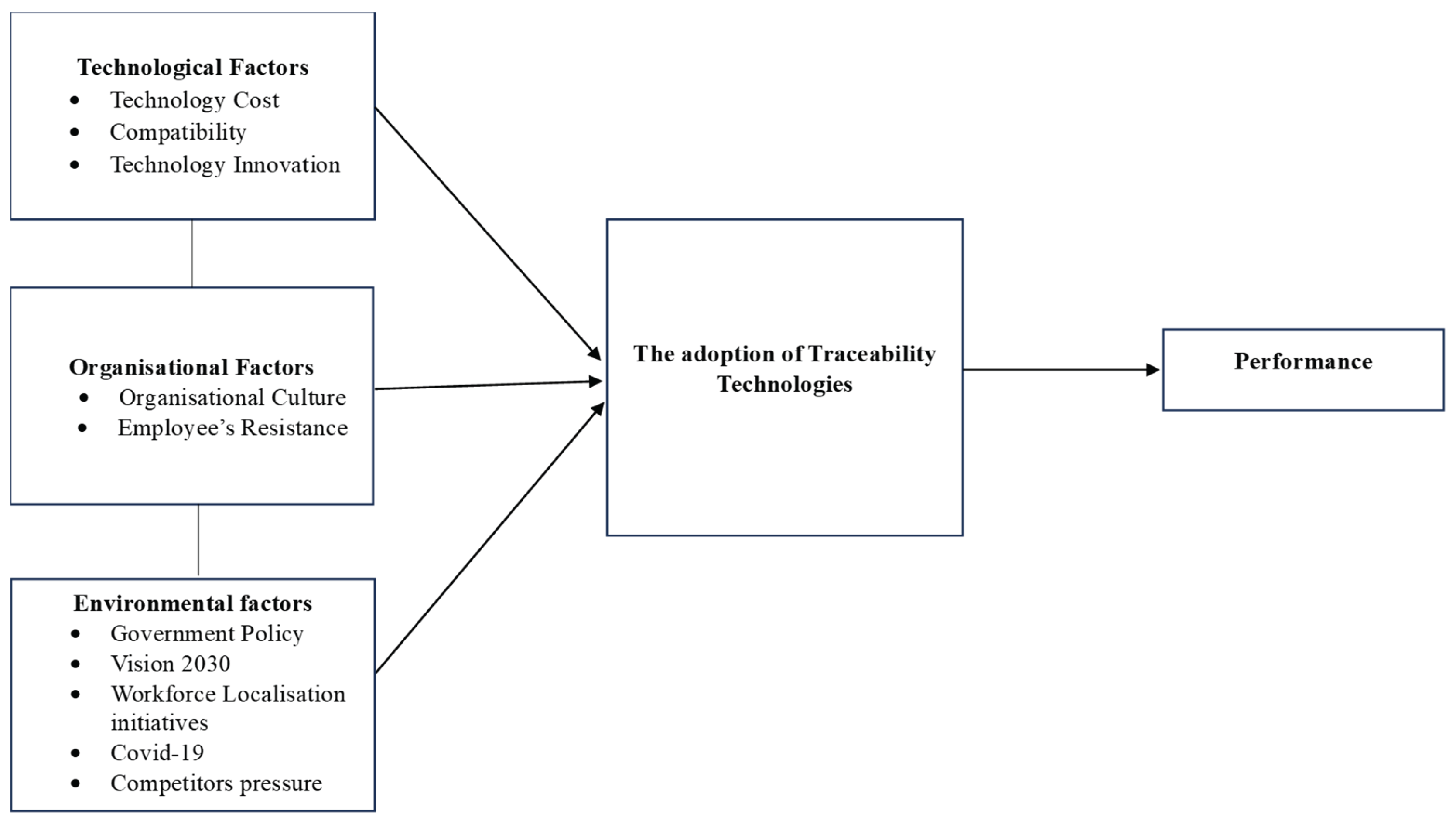

Table 1.
Food Traceability Technologies.
| Technologies | Purpose | Example | Features & Observations |
|---|---|---|---|
| Near Field Communication (NFC) | Identification | (Pigini & Conti, 2017) |
|
| Bar code | Identification | (Žurbi & Gregor-Svetec, 2023) |
|
| Radio Frequency Identification (RFID) | Identification | (Shi & Yan, 2016) |
|
| Blockchain | Data Integration | (Saurabh & Dey, 2021) |
|
| Internet of Things (IoT) | Data Integration | (de Vass et al., 2021) |
|
| Wireless Sensor Network (WSN) | Data Integration | (Wang & Li, 2013) |
|
Note: technologies were selected because they dominate current agrifood traceability discourse; other niche tools (e.g., QR variant codes, hyperspectral imaging) fell outside this review’s scope.
Table 2.
TOE Factors used in Existing Literature on Technology.
| Sl. No |
Authors | Study Focus | Technological Factors | Organisational Factors | Environmental Factors |
|---|---|---|---|---|---|
| 1 | (Zhong & Moon, 2023) | Industry 4.0 Technology: | compatibility, cost | Top management support, employee capability | Competitive pressure |
| 2 | Gökalp et al. (2022) | Blockchain technology | Complexity, relative advantage compatibility, trust standardisation, and scalability. |
Organisations’ IT resources, top management support, organisation size, financial resources | Competitive pressure, trading partner pressure, government policy and regulations, inter-organisational trust |
| 3 | Nam et al. (2021) |
Artificial intelligence and robotics | External IT expertise, relative advantage, complexity, internal IT expertise. | Market position, financial justification, resistance by employees | Customer readiness, customer expectation, competition, legal issues |
| 4 | Orji et al. (2020) | Blockchain technology | Infrastructural facility, complexity, availability of specific blockchain tools perceived benefits, privacy, compatibility, security | Presence of training facilities, top management support, firm size, capability of human resources, perceived costs, organisational culture | Government policies, competitive pressure, institutional-based trust, market turbulence, stakeholder pressure |
| 5 | Siew et al. (2020) | Computer-assisted audit tools and techniques (CAATTs) | n/a | Firm size, top management commitment, employee IT competency | Complexity of clients’ accounting information systems, perceived level of support of professional accounting bodies |
| 6 | (Clohessy & Acton, 2019a) | Blockchain technology | n/a | Top management support, organisational readiness, organisation size | n/a. |
| 7 | (Zadeh et al., 2018) | Cloud computing | Compatibility, relative advantage, complexity, ease of use, trialability, technology integration | Firm size | Competitive intensity, regulatory support |
| 8 | Verma and Bhattacharyya (2017) | Big data analytics | Complexity, compatibility, IT assets. | Top management support, organisation data environment, perceived costs | External pressure, industry type |
| 9 | Awa et al. (2016) | Enterprise resource planning (ERP) software | Technical know-how, perceived compatibility, perceived value, security, technology (ICT) infrastructure | Organisation-demographic composition, size, scope of business operations, subjective norms | Competitive pressure, external support, trading partners’ readiness |
Table 3.
Sample demographic data.
| Code | Work Exp. | Job title | Firm size | First adopted FTT |
|---|---|---|---|---|
| A | 32 | Head of quality | Large | 2002 |
| B | 14 | Supply chain manager | Large | 2011 |
| C | 21 | Senior director of manufacturing | Large | 2010 |
| D | 19 | Head of Production | Large | 2013 |
| E | 26 | Supply chain manager | Medium | 2019 |
| F | 21 | The CEO | Medium | Not yet- adopting |
| G | 20 | Supply chain manager | Medium | 2014 |
| H | 17 | Plant manager | Small | Not yet |
| J | 18 | Manufacturing Manager | Small | Not yet |
Table 4.
Participants’ demographics.
| Code | Age | Gender | Citizenship | job role | Experience (years) |
Firm size | Location | Traceability technologies adopted |
|---|---|---|---|---|---|---|---|---|
| P1 | 52 | Male | Non- citizen | Head of quality | 32 | Large | Riyadh | 2002 |
| P2 | 37 | Male | Citizen | Supply chain manager | 14 | Large | Alahsa | 2011 |
| P3 | 46 | Male | Citizen | Senior director of manufacturing | 21 | Large | Riyadh | 2010 |
| P4 | 45 | Male | Citizen | Head of production | 19 | Large | Jeddah | 2013 |
| P5 | 50 | Male | Non-citizen | Supply chain manager | 26 | Medium | Alahsa | 2019 |
| P6 | 46 | Male | Citizen | The CEO | 21 | Medium | Alqassim | Not yet-adopting |
| P7 | 47 | Male | Non-citizen | Supply chain manager | 20 | Medium | Alahsa | 2014 |
| P8 | 43 | Male | Non-citizen | Plant manager | 17 | Small | Alqassim | Not yet-adopting |
| P9 | 41 | Male | Citizen | Manufacturing manager | 18 | Small | Jeddah | Not yet-adopting |
Table 5.
NVivo-Generated Thematic Frequency Analysis in the Saudi Dairy Industry (P1 to P9 are not appearing in order).
Table 5.
NVivo-Generated Thematic Frequency Analysis in the Saudi Dairy Industry (P1 to P9 are not appearing in order).
| Themes | P2 | P9 | P5 | P3 | P4 | P6 | P8 | P7 | P1 |
|---|---|---|---|---|---|---|---|---|---|
| Technology adoption | 21.06% | 12.06% | 10.96% | 13.67% | 9.1% | 7.97% | 7.19% | 8.39% | 9.6% |
| Environment | 29.53% | 13.32% | 12.68% | 16.85% | 8.99% | 2.73% | 4.65% | 4.98% | 6.26% |
| Competitors | 4.25% | 20.4% | 15.01% | 27.2% | 3.4% | 4.82% | 8.22% | 5.67% | 11.05% |
| Consumer pressure | 62.59% | 4.07% | 9.63% | 3.33% | 16.3% | 0% | 0% | 4.07% | 0% |
| Consumer Awareness | 62.59% | 4.07% | 9.63% | 3.33% | 16.3% | 0% | 0% | 4.07% | 0% |
| Government Support | 24.04% | 11.86% | 16.67% | 10.26% | 8.97% | 11.54% | 8.01% | 4.49% | 4.17% |
| Mandatory SFDA | 17.49% | 4.96% | 12.29% | 23.4% | 28.84% | 5.91% | 0% | 0% | 7.09% |
| Vision 2030 | 50% | 0% | 0% | 23.08% | 0% | 21.37% | 0% | 0% | 5.56% |
| Future challenges | 12.96% | 14.2% | 5.86% | 13.27% | 7.41% | 27.47% | 6.17% | 3.4% | 9.26% |
| Organisation | 10.33% | 13.09% | 8.01% | 20.84% | 14.87% | 7.39% | 14.16% | 4.81% | 6.5% |
| Organisational culture | 0% | 0% | 11.11% | 64.05% | 11.11% | 0% | 13.73% | 0% | 0% |
| Saudization-OC | 10.99% | 10.64% | 17.38% | 10.28% | 12.77% | 7.8% | 11.35% | 5.32% | 13.48% |
| Top Management support | 16.25% | 19.11% | 9.29% | 14.11% | 7.5% | 9.11% | 13.39% | 0.71% | 10.54% |
| Training and development | 18.29% | 7.62% | 4% | 10.86% | 20.57% | 6.1% | 15.43% | 9.52% | 7.62% |
| Technology factors | 22.07% | 10.71% | 11.72% | 12.29% | 8.07% | 7.93% | 6.25% | 10.57% | 10.4% |
| Compatibility | 16.26% | 21.54% | 10.16% | 0% | 9.35% | 3.66% | 26.02% | 8.54% | 4.47% |
| Complexity | 9.12% | 20.85% | 14.33% | 9.12% | 11.73% | 14.66% | 15.31% | 4.89% | 0% |
| Employees’ resistance | 14.94% | 20.12% | 17.84% | 19.09% | 7.88% | 5.19% | 7.88% | 7.05% | 0% |
| Future technology | 23.62% | 20.09% | 7.95% | 9.05% | 8.39% | 16.56% | 5.52% | 6.62% | 2.21% |
| Technology advantages | 32.28% | 2.11% | 13.18% | 14.76% | 10.41% | 5.67% | 4.61% | 3.69% | 13.31% |
| SC performance | 9.33% | 18.48% | 23.43% | 5.71% | 7.62% | 12.57% | 8.95% | 6.48% | 7.43% |
| Current traceability technologies | 20.51% | 5.9% | 9.2% | 10.32% | 6.59% | 6.96% | 3.92% | 18.46% | 18.15% |
| Traceability technologies adoption motivation | 33.8% | 7.18% | 16.2% | 17.13% | 3.94% | 5.09% | 8.33% | 3.7% | 4.63% |
| COVID-19 | 21.73% | 8.25% | 14.08% | 10.26% | 9.96% | 12.37% | 5.23% | 2.31% | 15.79% |
Table 6.
Extended Overview of Themes and Subthemes of Traceability Technology. [Interviewees’ codes are indicated within bracket].
Table 6.
Extended Overview of Themes and Subthemes of Traceability Technology. [Interviewees’ codes are indicated within bracket].
| TOE factors | Main Theme | Subtheme 1 | Subtheme 2 | Subtheme 3 | Subtheme 4 |
|---|---|---|---|---|---|
| Technology | Existence of traceability technologies in Saudi dairy sector (p1,p2,p3,p4,p5,p8) | - | - | - | - |
| Technology and organisation | Traceability technology adoption challenges and barriers (p1,p2, p3, p6, p8,p9). | Employee’s Resistance (P2,P6,P3) | Compatibility Considerations (P2,P4,P6,P7) |
Complexity in the Adoption Process (P6,P1,P7,P2,P3) |
- |
| Organisation | Role of organisational culture and top management support in the adoption process (p2,p3,p6). | Role of Organisational Culture(P2, P6) | Role of Top Management Support (P3,P2,P6) | - | - |
| Technology and organisation | Impact of food traceability technologies on supply chain performance (p1,p2,p3,p4,p5,p6,p7,p8,p9) | Efficiency: Cost, Profit, Time, Effort (P1,P2,P3,P5,P7,P8) |
Flexibility (P5) | Food Quality (P1,P2,P5) | Transparency, Information Availability, and Accuracy(P7) |
| Environment | Impact of covid-19 and post-covid-19 period on technology investment (p1,p2,p3,p5,p7,p8) | - | - | - | - |
| Environment | Impact of consumer pressure on food traceability technology adoption. (p1,p2,p3,p9) |
Consumer Awareness (P2) | - | - | - |
| Environment | Influence of competitor pressure (p1,p2,p3,p4,p5,p6, p7,p8,p8) | - | - | - | - |
| Environment, technology | Role of Government Policy in Influencing FTT Adoption(P1,P2,P3,P4,P7,P8) | Vision 2030 Initiative (P1,P2,P3) | Technology Investment (P1,P4,P7,P8) | - | - |
| Organisation | Importance of Employee Training in Technology Adoption (P1,P2,P4) | - | - | - | - |
| Environment | Workforce localisation initiative (Saudization) (P1,P2P6,P9) | - | - | - | - |
Disclaimer/Publisher’s Note: The statements, opinions and data contained in all publications are solely those of the individual author(s) and contributor(s) and not of MDPI and/or the editor(s). MDPI and/or the editor(s) disclaim responsibility for any injury to people or property resulting from any ideas, methods, instructions or products referred to in the content. |
© 2025 by the authors. Licensee MDPI, Basel, Switzerland. This article is an open access article distributed under the terms and conditions of the Creative Commons Attribution (CC BY) license (http://creativecommons.org/licenses/by/4.0/).
Copyright: This open access article is published under a Creative Commons CC BY 4.0 license, which permit the free download, distribution, and reuse, provided that the author and preprint are cited in any reuse.


