

Submitted:
15 May 2025
Posted:
15 May 2025
You are already at the latest version
Abstract
If ϱ and H are simple, connected, undirected graphs, and ϱ can be covered by an H-covering, then for a positive integer p, a total p-labeling φ on ϱ is considered as a total H-irregular p-labeling if, for every subgraph K of ϱ that is isomorphic to H, the weight of K (the sum of the labels of all vertices and edges of K) is a unique number. The smallest integer p for which graph ϱ can be labeled with a total H-irregular p-labeling is called the total H-irregularity strength of graph G. This paper presents the exact total H-irregularity strength values for some particular graphs including balloon graphs, double balloon graphs, and double balloon ladder graphs.
Keywords:
total H−irregularity strength
; balloon graph
; double balloon graph
; double balloon ladder graph
MSC: 2000
1. Introduction
Wilson (see [11]) defines a graph as , where represents a finite set of nonempty vertices and is a finite set of unordered pairs of distinct elements from , known as edges.
Wallis in [10] describes a labeling on as a function whose domain is either , , or , and its codomain is a set of positive or nonnegative integers. When the domain is , it is called vertex labeling; when it is , it is edge labeling; and when it is , it is total labeling. Various labeling techniques can be employed, one of which is irregular labeling with the domain mapping to a set of positive integers. This labeling is discussed in this paper.
Gallian in [4] states that there are about 200 types of labeling techniques, evolving in approximately 3000 papers. These techniques include irregular labeling, introduced by Chartrand et al. (see [3]). In irregular labeling, the weight of a vertex relative to a total labeling is defined as the sum of the label of v and all labels of edges incident to v. From some types of irregular labeling on a graph , the concepts of total edge irregularity strength () and total vertex irregularity strength () arise.
Ashraf et al. (see [2]) introduced the strength of irregularity-H, an extension of and . A graph with an H-covering means that for any edge of , there exists a subgraph of isomorphic to H that includes the edge. Let be any total p-labeling on . For any subgraph K of isomorphic to H, the H-weight of K with respect to , denoted by , is defined as . A total p-labeling on is called H-irregular if for every two distinct subgraphs and isomorphic to H. The smallest integer p such that can be labeled with an H-irregular total p-labeling is called the total H-irregularity strength of , denoted by .
Recently, has been extensively studied. Agustin et al. in [1] obtained results on for shackles and amalgamation graphs. Nisviasari et al. in [7] researched for triangular ladder and grid graphs. Hidayatul et al. (see [5]) obtained results on for grid, butterfly, hexagonal, and diamond graphs. Suni et al. in [9] investigated diamond ladder, circular triple ladder, and prism graphs. Wahyujati et al. (see [12]) studied the total H-irregularity strength of edge comb product graphs. Shulhany et al. (see [8]) examined the same parameter for some classes of graphs, while Labane et al. (see [6]) have done so for cycles and diamond graphs. In this work, we introduce a new type of graph that has not been previously studied by other researchers, which involves applying specific graph operations. These results not only provide fresh insights but also extend the applicability of to a broader spectrum of graph types. The use of graph operations in the investigation further highlights the structural complexity and versatility of the studied graphs. This finding will significantly enrich the theory of by deepening our understanding of its behavior in diverse graph classes and paving the way for future studies in this area.
Theorem 1.
[2]. Let ϱ be a graph admitting an covering and have w subgraphs isomorphic to H. Then
2. Main Results
Our research findings will be presented in this section. First, we begin with the following definition.
Definition 1.
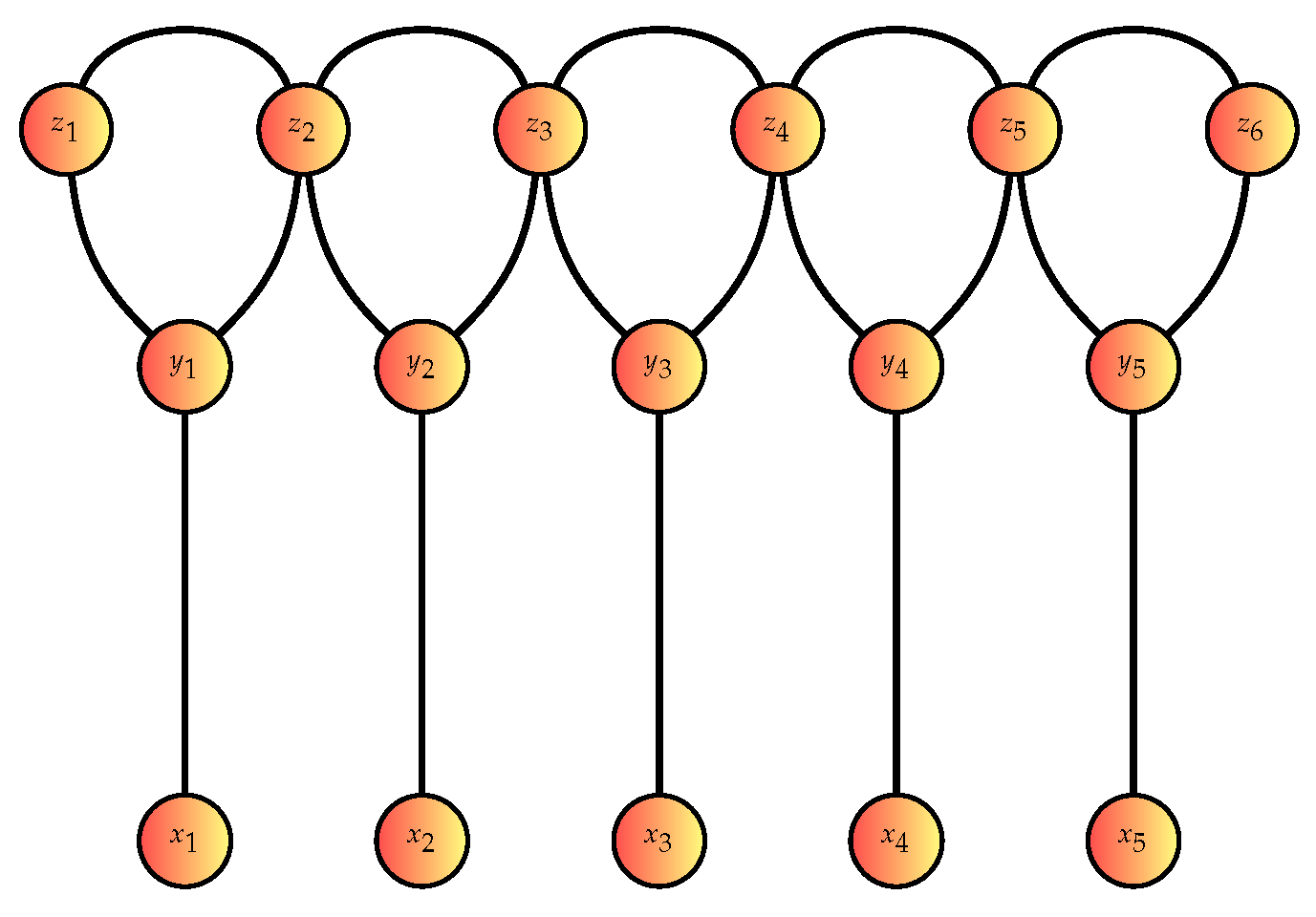
The balloon graph , , is a graph with
and
The following is provided as an example of balloon graph.
Figure 1.
Balloon Graph
Theorem 2.
Given with covering. Then, for ,
Proof. The balloon , admits covering with exactly balloons , and is a positive integer. From Theorem 1, it holds
Next, put , will be proven. On balloon graph with covering, , we define
for , in this manner:
for ,
for ,
The largest label is reached when , that is,
For every , the vertex set is
and edge set is
Furthermore, for every subgraph in the weight of , with respect to is
Then, for ,
For every we get . Hence, . Moreover, all weights are distinct. Therefore, is total irregular labeling of .
Since and , we have , which can be expressed as
□
The following on Figure 2 is an example of with covering and we have
Now, by double balloon graph, we mean the graph defined in Definition 2 as follows.
Definition 2.
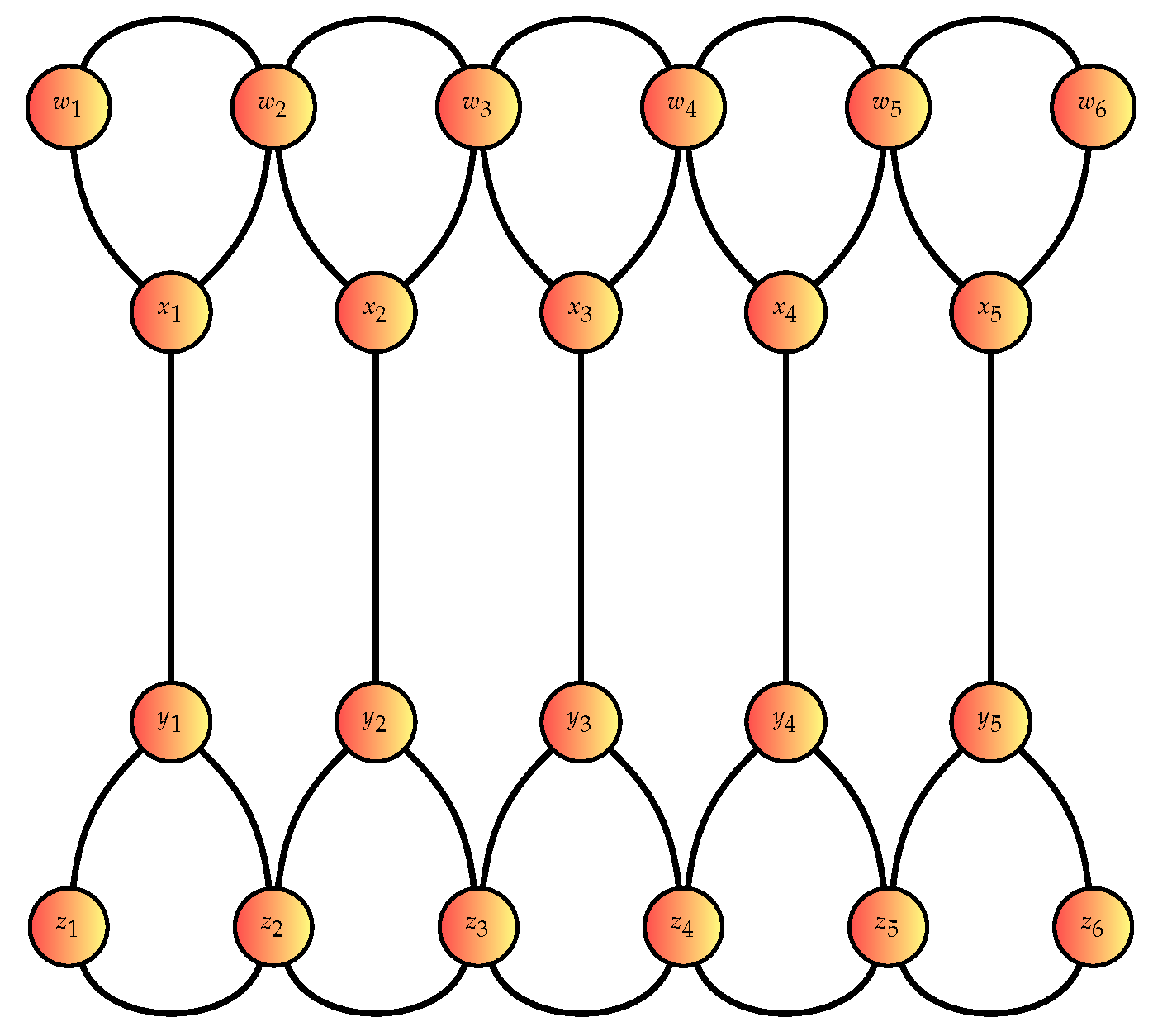
A double ballon graph , , is a graph with
and
The following figure is provided as an example of double balloon graph.
Figure 3.
Double Balloon Graph
Theorem 3.
Given with covering. Then, for ,
Proof. The double balloon graph, , admits covering with exactly double balloon , and is a positive integer. From Theorem 1, we obtain
Next, put , will be proven. On double balloon graph with covering, , we define
for , as follows:
for ,
for ,
The largest label is reached when , that is
For every , the vertex set is
and the edge set is
Furthermore, for every subgraph in , the weight of , with respect to is
Then, for , we have
For every we get . Hence, . Furthermore, all weights are distinct. Thus, is total irregular labeling of .
Since and , we have
which can be expressed as
□
Figure 4 is given as an example of with covering, and with
Subsequently, Definition 3 furnishes the definition of a double balloon ladder graph.
Definition 3.
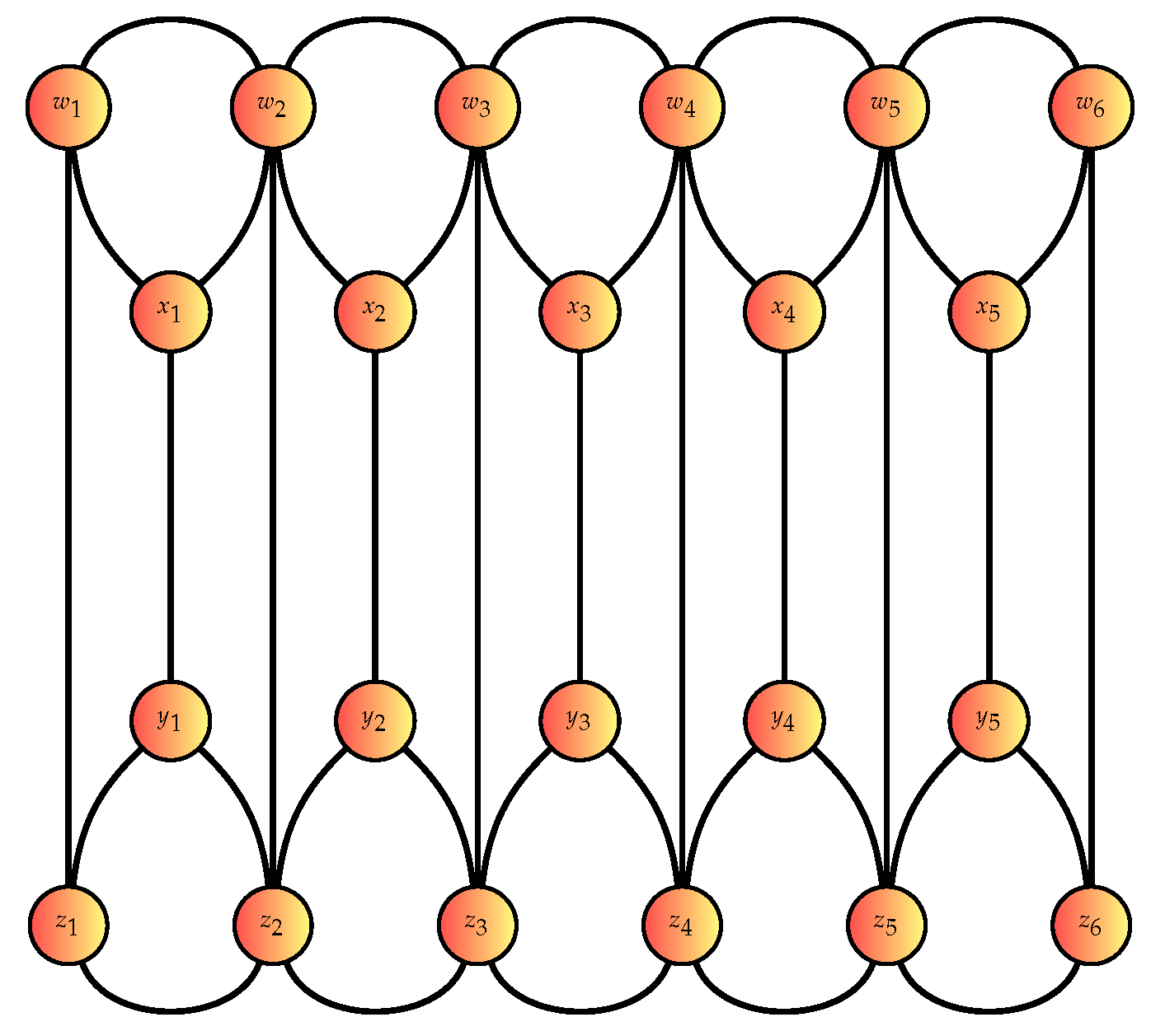
A double balloon ladder graph , , is a graph with
and
The following is provided as an example of double balloon ladder graph.
Figure 5.
Double Balloon Ladder Graph
Theorem 4.
Given with covering. Then, for ,
Proof.
The balloon , admits covering with exactly double balloon ladder , and is a positive integer. By Theorem 1,
Next, put , will be proven. On double balloon ladder with covering, , we define
for , in this way:
for ,
for ,
The largest label is obtained when , that is
For every , the vertex set is
and the edge set
Furthermore, for every subgraph in we have weight , with respect to is
Then, for , we have
For every we get . Hence, . Furthermore, all weights are distinct. Thus, is total irregular labeling of .
Since and we have
which can be expressed as
□
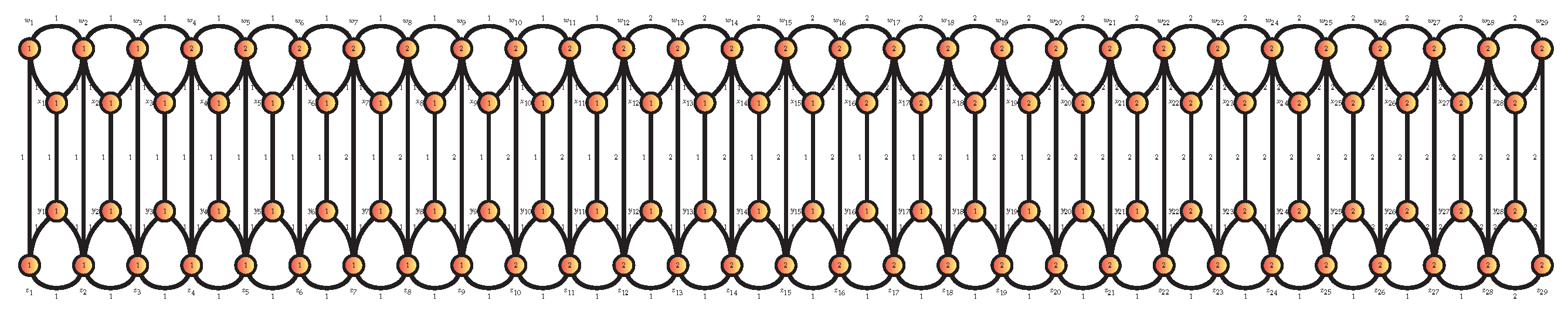
The following on Figure 6 is an example of with covering, and we get
3. Concluding Remarks
This research focuses on the total irregularity strength of balloon graph with covering, double balloon graph , and double balloon ladder graph with covering. We found that the lower bound given in Theorem 1 is sharp for all these graphs.
Acknowledgments
All authors gratitude all the reviewers for their valuable thoughtful feedback.
References
- Agustin, I. H. , Dafik, D., Marsidi, M., and Albirri, E. R., 2017, On the total H-irregularity strength of graphs: a new notion, Journal of Physics: Conference Series. 855 (1).
- Ashraf, F. , Bača, M., Lascśaková, M., Semaničová-Feňovčíková, A., 2017, On H-irregularity strength of graphs, Discussiones Mathematicae Graph Theory, 37(4) 1067-1078.
- Chartrand, G. , Jacobson, M. S., Lehel, J., 1988, Irregular networks. Congr. Numer, 64, 187-192.
- Gallian, J. A. , 2022, A dynamic survey of graph labeling, Electronic Journal of Combinatorics 1.
- Hidayatul, M. , Dafik, D., Agustin, I. H., Nisviasari, R., Kurniawati, E.Y., 2020, On total H-irregularity strength of graphs, Journal of Physics: Conference Series, 1465 (1).
- Labane, H. , Bouchemakh, I., and Semaničová-Feňovčíková, A., 2022, On H-irregularity strength of cycles and diamond graphs Discrete Mathematics, Algorithms and Applications 14 (5) 2150157.
- Nisviasari, R. , Dafik, D., Agustin, I. H., 2019, The total H-irregularity strength of triangular ladder and grid graphs, Journal of Physics: Conference Series, 1211 (1) 012005.
- Shulhany, M. A. , et al., 2022, The total H-irregularity strength of some graph classes, AIP Conference Proceedings, 2468 (1).
- Suni, D. M. O. , Dafik, D., Tirta, I. M., Kristiana, A. I., and Nisviasari, R., 2020, On total H-irregularity strength of diamond ladder, three circular ladder, and prism graphs, Journal of Physics: Conference Series, Vol. 1465 (1) 012021.
- Wallis, W. D. , 2007, A beginner’s guide to graph theory. Springer Science & Business Media.
- Wilson, R. J. , 2010, Introduction to graph theory, Fifth Edition, Pearson.
- Wahyujati, M. F. , Susanti, Y., 2022, Computing the total H-irregularity strength of edge comb product of graphs, " Analele ştiinţifice ale Universităţii Ovidius Constanţa. Seria Matematică, 31 (2) 177-189.
Figure 2.
Balloon graph with covering.
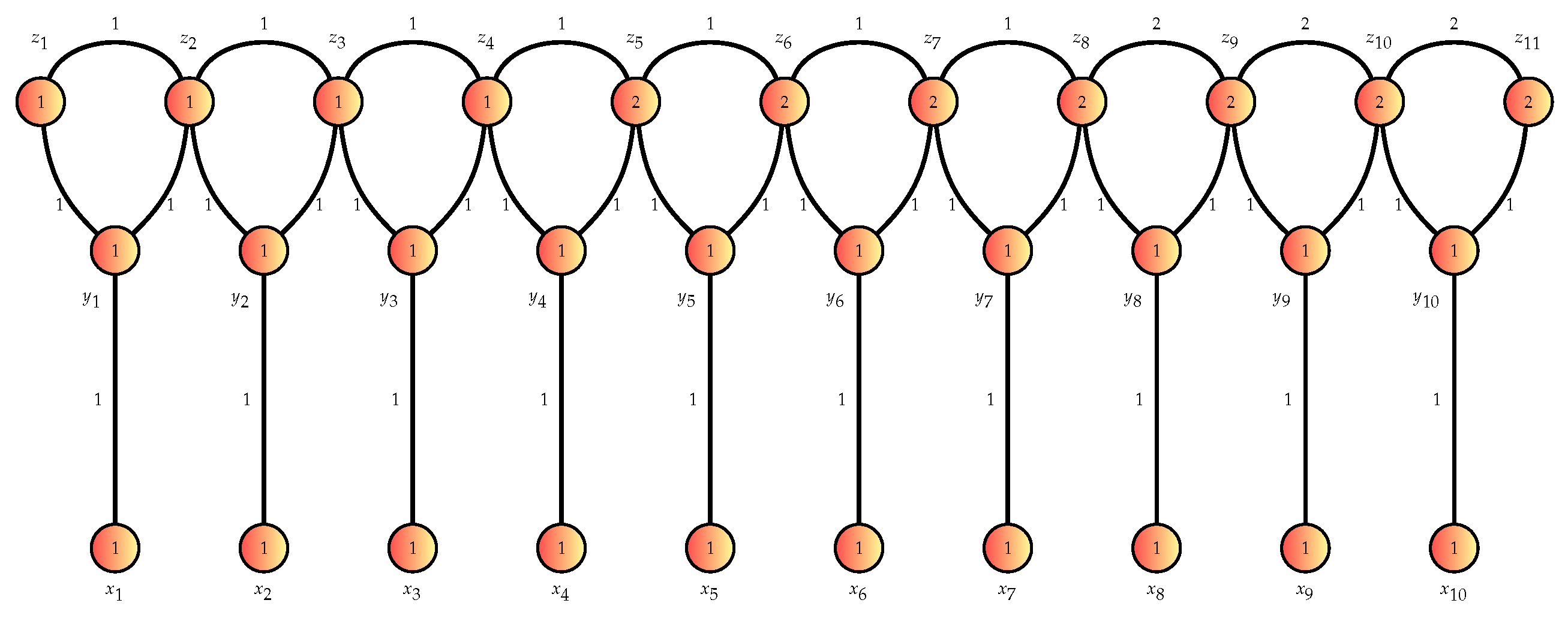
Figure 4.
Double Ballon Graph with covering
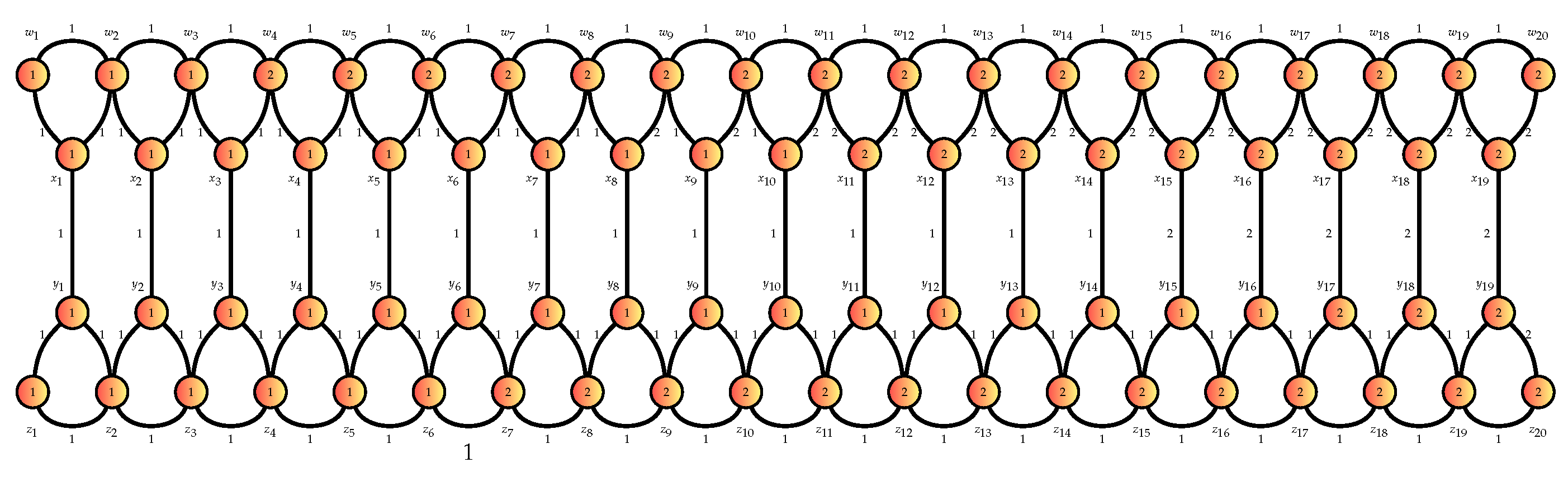
Figure 6.
Total Irregularity Labeling of
Disclaimer/Publisher’s Note: The statements, opinions and data contained in all publications are solely those of the individual author(s) and contributor(s) and not of MDPI and/or the editor(s). MDPI and/or the editor(s) disclaim responsibility for any injury to people or property resulting from any ideas, methods, instructions or products referred to in the content. |
© 2025 by the authors. Licensee MDPI, Basel, Switzerland. This article is an open access article distributed under the terms and conditions of the Creative Commons Attribution (CC BY) license (http://creativecommons.org/licenses/by/4.0/).
Copyright: This open access article is published under a Creative Commons CC BY 4.0 license, which permit the free download, distribution, and reuse, provided that the author and preprint are cited in any reuse.