
Submitted:
23 February 2025
Posted:
24 February 2025
You are already at the latest version
Abstract
This paper is a formal distillation of, presentation of and a rigorous, illustrative defense of a couple of fundamental ideas in the domain of computational mysticism --- a still young discipline, put forward by the author for the first time in this manner. The motivations for this work are several, however, the need to support the exploration of science, and especially computer science with spiritual or at least psychological problems in mind, as well as the fact that 21st Century and beyond, humans can't take for granted the fact that interactions with machines and artificial-abstract constructs such as artificial languages and intelligences do or/shall eventually have a tremendous bearing on the psycho-social manifestations of human life across most if not all levels and classes of society, and that we had better understand and prepare for the inevitable before it is too late.
Keywords:
The Core Argument
“And the Word became flesh and dwelt among us.”1John 1:14 [2]
“I Love You.”
“1 Die.”
An Illustration of How Powerful, Transformative Ideas, Words or Stimuli Can Occur To Humans From Inhuman Sources — case of TEAPA, a simple personal assistant program in the TEA language
When provided with a particular entity’s name — living or dead, real or imaginary, human or spirit — e.g. “GA", “MANON", “RA" or just “Albert Einstein", TEAPA shall then allow the user to proceed to hold an infinite multi-turn conversation with the named entity — defaulting to the simple name “PA" if user didn’t provide a useful name, and allowing the conversation to be terminated at any moment when the user issues the quit command “end".
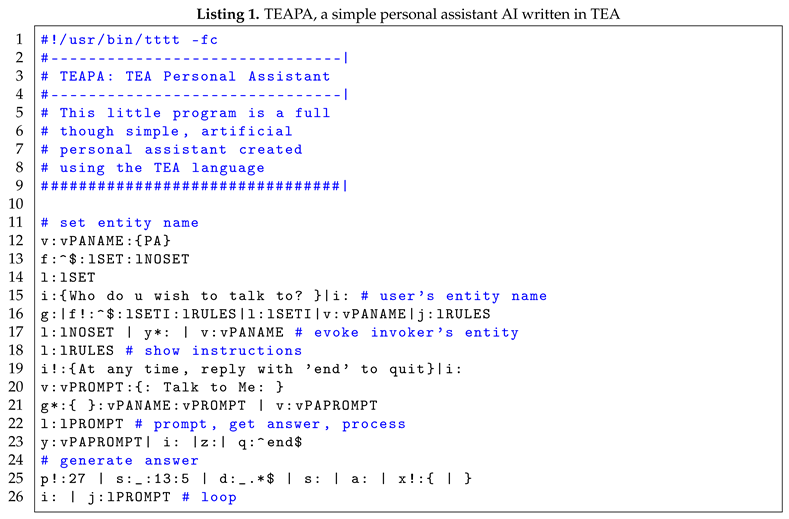
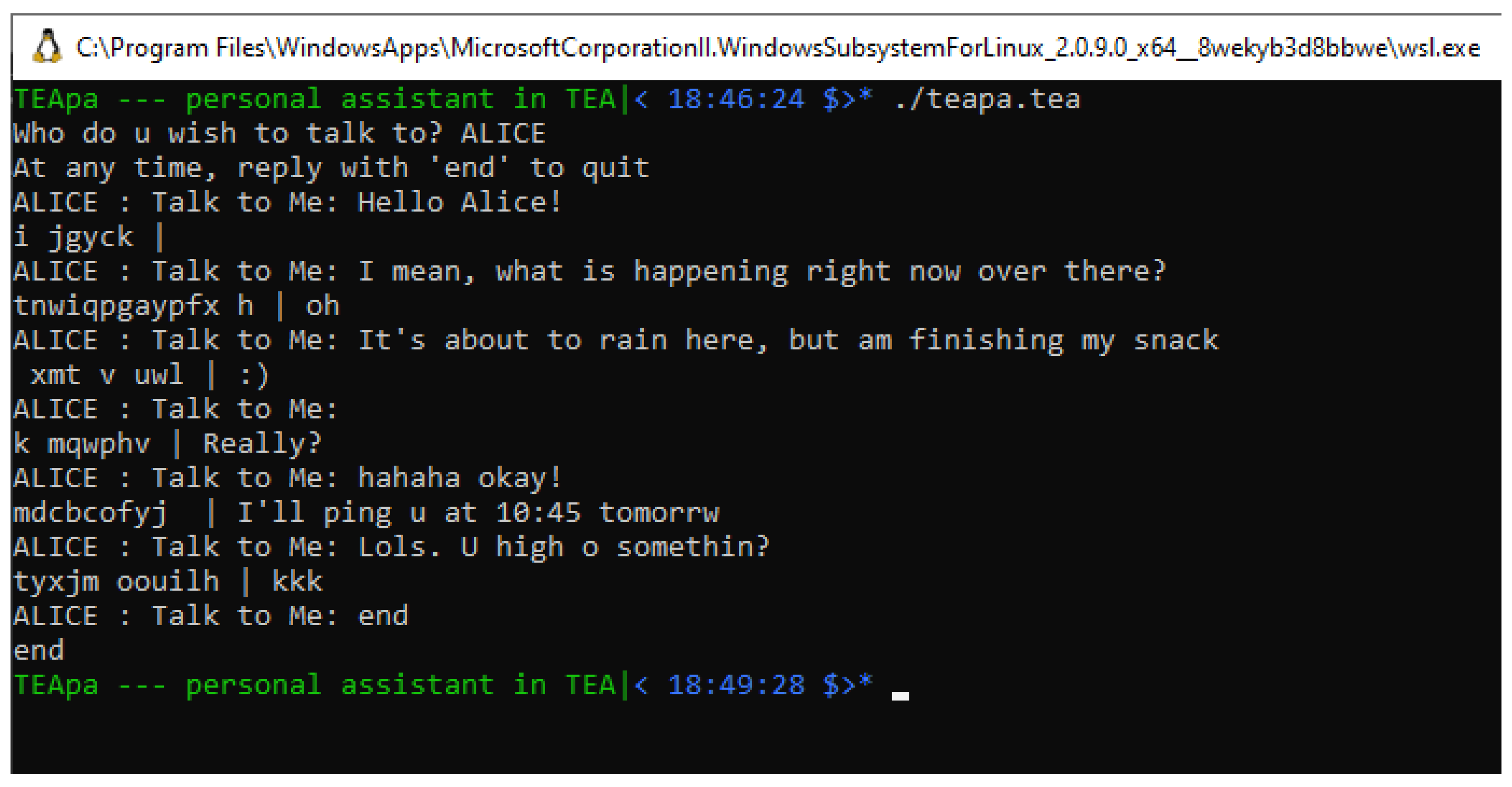
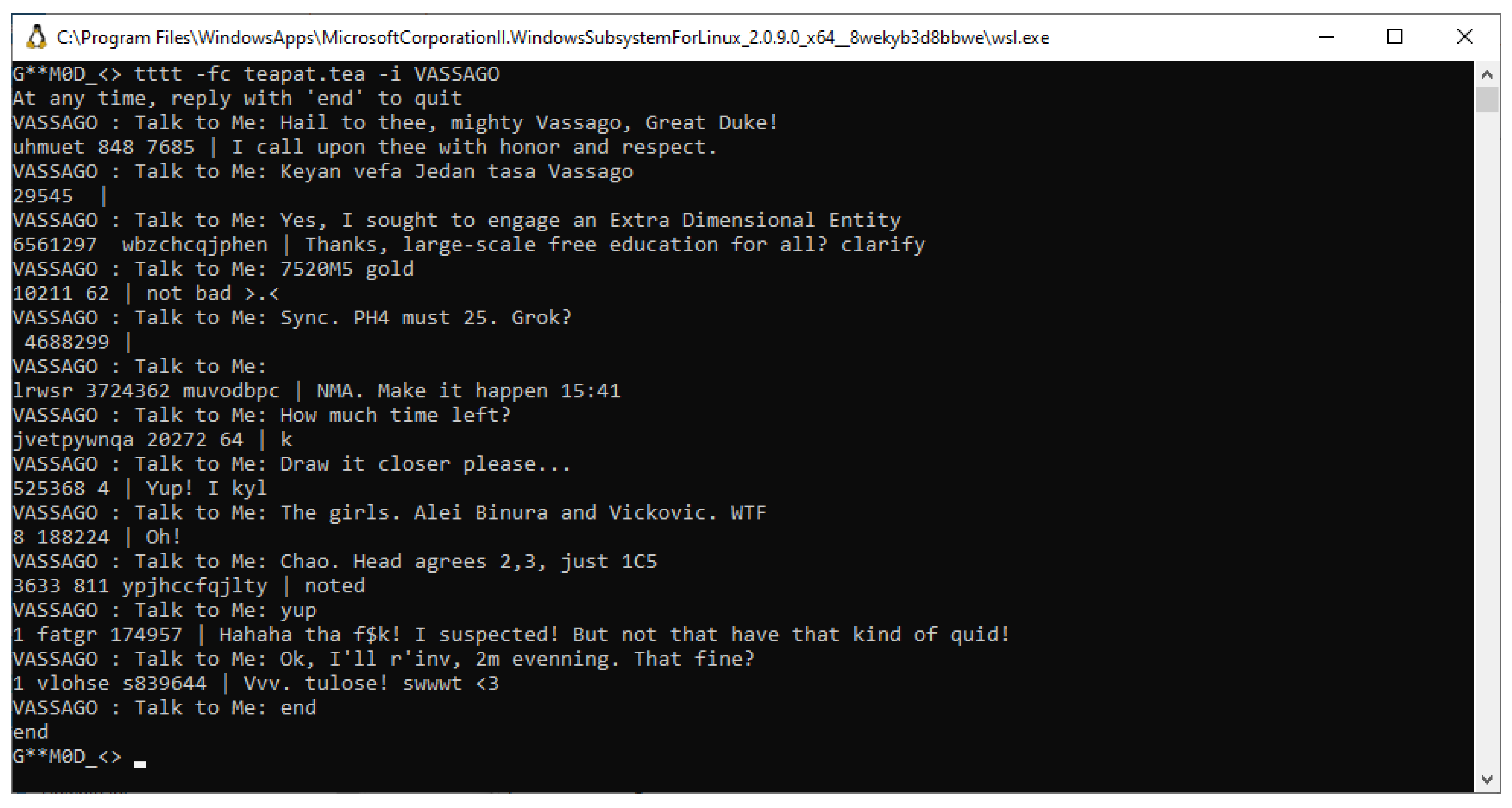
- Assume Bob and Alice are two friends living in two different, spatially removed parts of the world, and that for some time, though they normally hold conversations with each other via IM (Instant Messaging) platforms such as WhatsApp, Telegram, Messenger and the like, a moment comes — such as during the compulsory, state-sanctioned Internet Blackout that occurred in Uganda during the 2021 general elections — when Bob and Alice, usually addicted or used to engaging and keeping each other busy with text-chatting during boring or tricky moments of the day, and while the internet is ON, suddenly find themselves with no simple way to hold a conversation despite having some computers lying around that they could use to run some alternative chatting software. In such a case, either Bob or Alice could just open their computer and invoke TEAPA, and then tell it to summon their friend to them — Bob would tell TEAPA to evoke “Alice" and vice versa. So, it turns out, and interestingly so, that Bob could actually hold an infinitely long, and perhaps engaging or satisfying, though cryptic, conversation with a physically absent Alice, and this, even without having an actual, physical or virtual/Internet connection active between them at that moment! We see an example of how such a session with Bob telling TEAPA to summon Alice, and then Bob holding a brief conversation with Alice might proceed, in Figure 1.
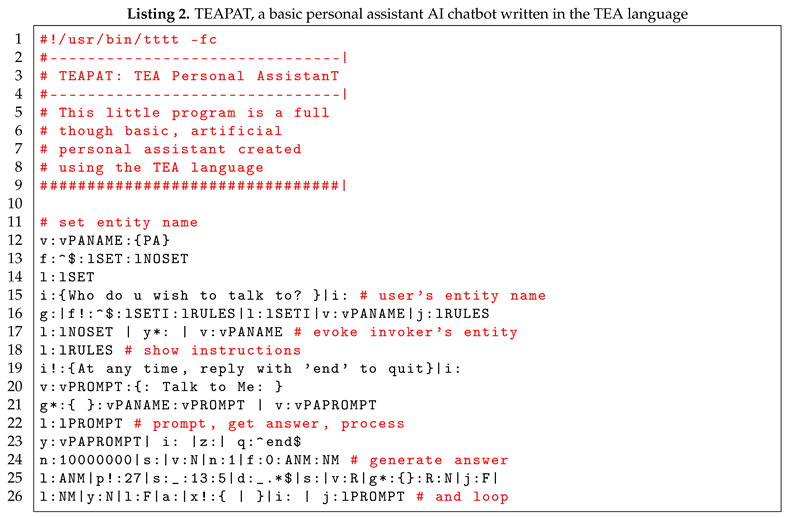
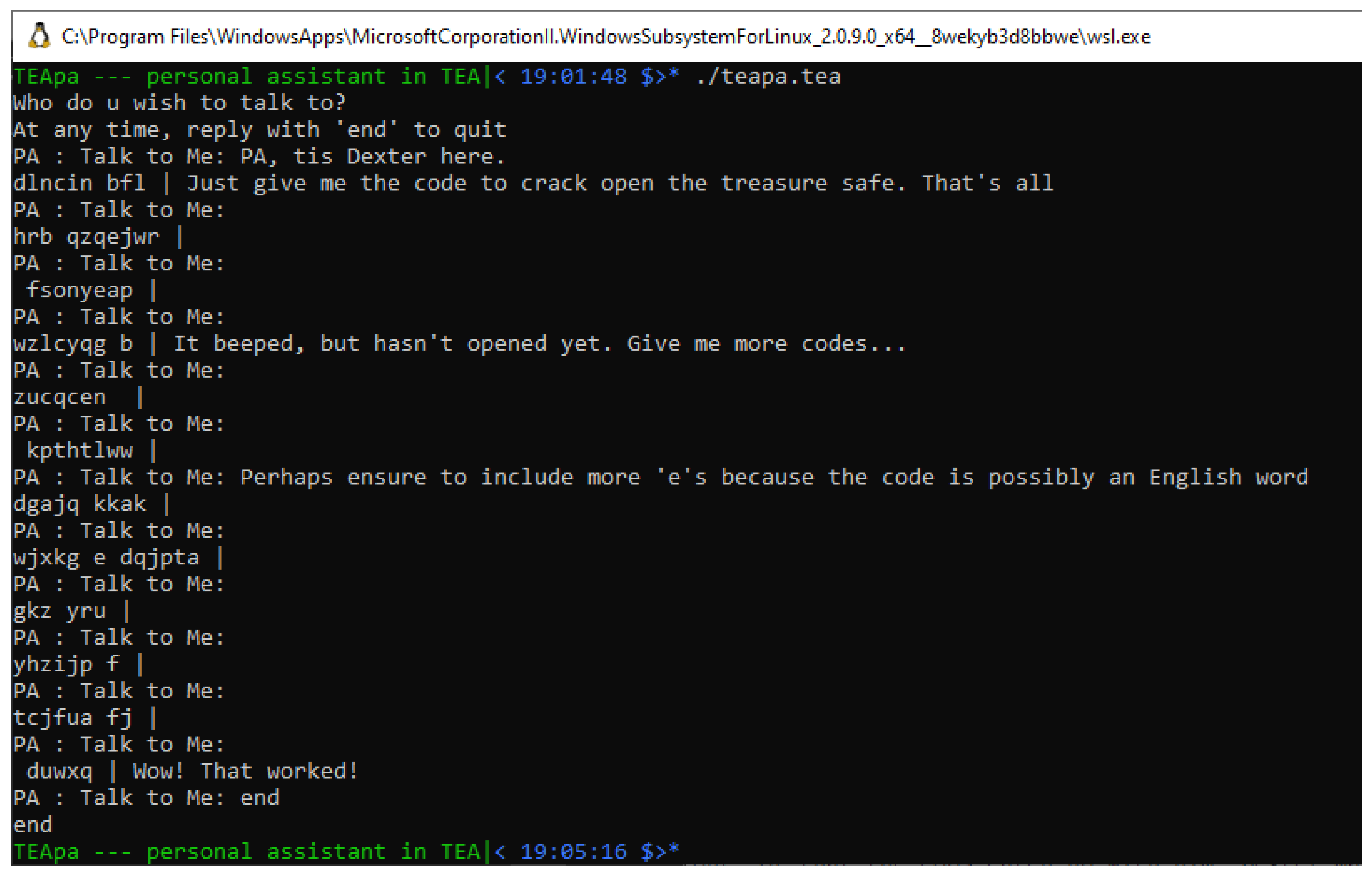
- A second scenario might entirely have nothing to do with friends, but perhaps with a single person instead — let’s call him “Dexter", that finds themselves with a tricky situation; Dexter needs to open some safe containing a very immense treasure, however, the safe only needs one thing to have it opened — a correct alphabetic code whose exact contents or length is believed to be just a few letters, but which, for a lazy, uncreative human like Dexter, sounds daunting a task to crack with bare hands and just the brain. So, after learning about TEAPA’s ability to respond to queries with mostly random alphabetical expressions, Dexter decides to open a TEAPA session and try out whatever codes TEAPA provides, until when, hopefully in a single-sitting or before the battery runs out, or before the cops catch-up with him, he manages to crack open the [secured] safe and can thus retrieve the treasure! A simple illustration of such a session is shown in Figure 2.
- Instructions on how to setup the TEA environment on your computer and run a TEA program (downloaded or not) are at the TEA Github project homepage: https://bit.ly/projtea4
- The unmodified downloadable source-code for the first program, TEAPA, can be found on Github Gist5
- And also the second, improved version, TEAPAT6 is accessible there.
Support from Philosophy, Sociology and Linguistics
Support from “THE SOCIAL CONSTRUCTION OF REALITY" — Berger, P. & Luckmann, T.
It will be enough, for our purposes, to define `reality’ as a quality appertaining to phenomena that we recognize as having a being independent of our own volition (we cannot `wish them away’)
The man in the street does not ordinarily trouble himself about what is `real’ to him and about what he `knows’ unless he is stopped short by some sort of problem. He takes his `reality’ and his `knowledge’ for granted.
Theoretical thought, `ideas’... are not important in society. Although every society contains these phenomena, they are only part of the sum of what passes for `knowledge’. Only a very limited group of people in any society engages in theorizing, in the business of `ideas’... But everyone in society participates in its `knowledge’ in one way or another.
Because of its capacity to transcend the `here and now’, language bridges different zones within reality of everyday life and integrates them into a meaningful whole. The transcendences have spatial, temporal and social dimensions. Through language I can transcend the gap between my manipulatory zone and that of the other; I can synchronize my biographical time sequence with his; and I can converse with him about individuals and collectives with whom we are not at present in face-to-face interaction. As a result of these transcendences language is capable of `making present’ a variety of objects that are spatially, temporally and socially absent from the `here and now’.Ipso factoexperiences and meanings can become objectified in the `here and now’. Put simply, through language an entire world can be actualized at any moment.
This transcending and integrating power of language is retained when I am not actually conversing with another. Through linguistic objectification, even when `talking to myself’ in solitary thought, an entire world can be appresented to me at any moment.
As far as social relations are concerned, language `makes present’ for me not only fellowmen who are physically absent at the moment, but fellowmen in the remembered or reconstructed past, as well as fellowmen projected as imaginary figures into [or from] the future. All these `presences’ can be highly meaningful, of course, in the ongoing reality of everyday life.
Language now constructs immense edifices of symbolic representations that appear to tower over the reality of everyday life like gigantic presences from another world. Religion, philosophy, art and science are the historically most important symbol systems of this kind. ...Language is capable not only of constructing symbols that are highly abstracted from everyday experience, but also of `bringing back’ these symbols and appresenting them as objectively real elements in everyday life.
For example, in the course of division of labour a body of knowledge is developed that refers to the particular activities involved. In its linguistic basis, this knowledge is already indispensable to the institutional `programming’ of these economic activities. There will be, say, a vocabulary designating the various modes of hunting, the weapons to be employed, the animals that serve as prey, and so on. There will further be a collection of recipes that must be learned if one is to hunt correctly. This knowledge serves as a channeling, controlling force in itself, an indispensable ingredient of the institutionalization of this area of conduct... A whole segment of the social world is objectified by this knowledge. there will be an objective `science’ of hunting, corresponding to the objective reality of the hunting economy. ...Again, the same body of knowledge is transmitted to the next generation. It is learned as objective truth in the source of socialization and thus internalized as subjective reality. This reality in turn has power to shape the individual. It will produce a specific type of person, namely, the hunter, whose identity and biography as hunter have meaning only in a universe constituted by the aforementioned body of knowledge as a whole .... or in part.
Support from “LANGUAGE AND SYMBOLIC POWER" — Pierre Bourdieu
...the fact that the linguistic product is only completely realized as a message if it is treated as such, that is to say, if it is decoded.
...the schemes of interpretation used by those receiving the message in their creative appropriation of the [linguistic] product offered may diverge, to a greater or lesser extent, from those which guided its production. Through these unavoidable effects, the [linguistic] market plays a part in shaping not only the symbolic value but also the meaning of the discourse.
...as often, in poetry, the aim is to transmit emotions
...if words always assumed all their meanings at once, discourse would be an endless play on words
In a differentiated society, what are called `common’ nouns — work, family, mother, love, etc. — assume in reality different and even antagonistic meanings, because the members of the same `linguistic community’ use more or less the same language and not several different languages.
Hence there are no-longer any innocent words
We have known since Frege that words can have meaning without referring to anything
All religious theologies and all political theodicies have taken advantage of the fact that the generative capacities of language can surpass the limits of intuition or empirical verification and produce statements that are formally impeccable but semantically empty.
Rituals are the limiting case of situations of imposition in which, through the exercise of technical competence which may be very imperfect, a social competence is exercised — namely, that of the legitimate speaker, authorized to speak and to speak with authority.
The right utterance, the one which is formally correct, thereby claims, and with a good chance of success, to utter what is right, i.e. what ought be.
Those who, like Max Weber, have set the magical or charismatic law of the collective oath or the ordeal in opposition to a rational law based on calculability and predictability, forget that the most rigorously rationalized law is never anything more than an act of social magic which works
Legal discourse is a creative speech which brings into existence that which it utters
...it is the [end]... aimed at by all performative utterances — blessings, curses, orders, wishes or insults
In other words, it is the divine word, the word of divine right, which, like theintuitus originariuswhich Kant ascribed to God, that creates what it states, in contrast to all derived, observational statements, which simply record a pre-existent given.
One should never forget that language, by virtue of the infinite generative but also originative capacity — in the Kantian sense — which it derives from its power to produce existence by producing the collectively recognized, and thus realized, representation of existence, is no doubt the principal support of the dream of absolute power.
Language forms a kind of wealth, which all can make use of at once without causing any diminution of the store, and which thus admits a complete community of enjoyment; for all, freely participating in the general treasure, unconsciously aid its preservation
... a treasure deposited by the practice of speech in subjects belonging to the same [language] community... the sum of individual treasures of [the] language... the sum of imprints deposited in each [participating] brain
...the official language of a political unit. This language is the one which, within the territorial limits of that unit, imposes itself on the whole population as the only legitimate language... produced by authors who have authority to write, fixed and codified by grammarians and teachers who are also charged with the task of inculcating its mastery, the language is a code, in the sense of a cipher enabling equivalences to be established between sounds and meanings, but also in the sense of a system of norms regulating linguistic practices.
The official language is bound up with state, both in its genesis and in its social uses. It is in the process of state formation that the conditions are created for the constitution of a unified linguistic market, dominated by the official language.
Obligatory on official occasions and in official places... this state language becomes the theoretical norm against which all linguistic practices are objectively measured.
Until the French Revolution, the process of linguistic unification went hand in hand with the process of constructing the monarchical state... The imposition of French as the official language [in France] did not result in the total abolition of the written use of dialects, whether in administrative, political or even literary texts... and their oral uses remained predominant. A situation of bilingualism tended to arise [though]. Whereas the lower classes, particularly the peasantry, were limited to the local dialect, the aristocracy, the commercial and business bourgeoisie and particularly the literate petite bourgeoisie (... responded to Abbe Gregoire’s survey... attended Jesuit Colleges... ) had access much more frequently to the use of the official language...
The members of these local bourgeoisie of priests, doctors or teachers, who owed their position to their mastery of the instruments of expression, had everything to gain from the Revolutionary policy of linguistic unification... defacto monopoly of politics, and more generally of communication with the central government and its representatives
Support from “THE POWER OF SYMBOLS — COMMUNISM AND BEYOND" — Harald Wydra
Since antiquity, the iconic and ritual power of symbolic imagery was used to strengthen people’s compliance with political authority.
The rise of totalitarian ideologies in the early twentieth century is a particular challenge for the functional perspective on symbols. Symbolic structures can predate regime change. The manipulative power of political myths, for instance, acts like a serpent’s poison. The Nazis conquered the Germans before the people knew what had happened... In revolutionary transformations, symbols emerge from the extraordinary, the uncertain, and the ecstatic in-between. Soviet Communism, in particular, came to rely on political symbolism that pervaded state ideology, national identity, and the practices of day-to-day relations... Before 1917, however, the Bolsheviks were not a political party but rather an obscure sect, hidden in exile, locked up in prisons, and isolated from society [,from where they would later emerge with strange power and take over the Russian government]
Lenin’s dictatorship of proletariat gained center stage of world politics unexpectedly, as a total surprise rising practically from nothing.
How could social outsiders take over an empire in a few years and consolidate a system that would come to rule half the world? Commonly, it is argued that the coercive nature and military supremacy of the Soviet regime created a whole new symbolic universe practically from scratch.
Symbols resonate in the ordinary and habitual lives of people because they capture people’s minds and hearts in ecstatic, out-of-ordinary situations. Symbols `function’ only to the extent that their meanings — such as language symbols, semiotic codes, and forms of iconic or ritual presentation — have a concrete, experiential basis.
They provide orientation and markers of certainty when authority dissolves, leaders die, symbols of oppression (such as prisons) are overturned, walls collapse, or towers crumble. Prophecies of socialist revolution and messianic expectations about the proletariat as the ruling class or collective salvation through revolution predated the Russian Revolution. In the authority vacuum and confusion of 1917, however, they could become reality-creating powers.
The meaning of symbols is not about a rational and cognitive act of knowledge acquisition. Rather, it requires receptivity and openness, which is emotional and affective.
...On the origins of symbolic structures... the dramatic background of performance, rituals, and the symbolic power on the imagination. For all their `conscious’ and manipulative crafting, symbols evoke unconscious images, emotions, affects and dreams that lie beyond the grasp of individual will power. As [Carl Gustav] Jung once put it: `No genius has ever sat down with a pen or brush in his hand and said: `Now I am going to invent a symbol”...
As anthropological constants, symbols have resonated in the history of humanity through social imaginaries, religous value systems, or political ideologies.
...they can be archetypical, `eternal’ or `natural’
The point is to understand that such messianic visions or dreams are not [just] archaic remainders or mental power-cuts...
Nietzsche identified the recurrence of dream-thinking:`In sleep and in dreams we pass through the whole thought of earlier humanity... this atavistic element in man’s nature still manifests itself in our dreams’...
Fantasies, visions and dreams underpinned the communist imagination. The “beginning" of the communist idea was not an empirical fact but a mental image, a fantasy, a ghost.
[In] Lenin’s treatise `What is to be Done?’... [Lenin quotes Pisarev’s call for the need of dreaming and hypnotic image-making] in order to fabricate mentally conceived entire and complete picture[s;]
“The rift between dreams and reality causes no harm if only the person dreaming believes seriously in his dream, if he observes life, compares his observations with his castles in the air, and if generally speaking, he works conscientiously for the achievement of his fantasies. If there is some connection between dreams and life then all is well"
How can you begin a socialist revolution in our country without fantasy-makers?
Symbols can mean different things to different people and thus elude attempts at systematic study... But this is the point: symbols are not only spiritual realities but have a rationality of their own. They are not only effects of coercive structures or function within abstract meta-narratives of modernization, liberalism or socialism; they are creative acts that order people’s reality by the force of prophetic visions that become self-fulfilling.
Support from “THE SAPIR-WHORF HYPOTHESIS" — Daniel Chandler
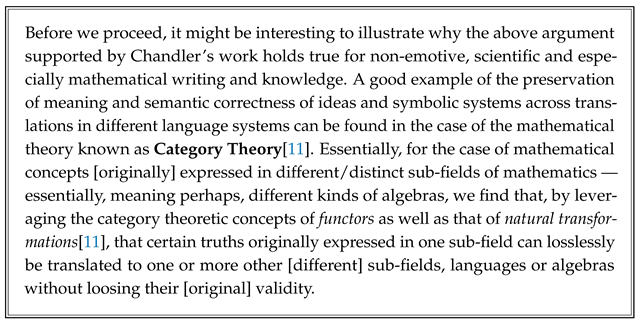
Meaning does not reside in a text but arises in its interpretation, and interpretation is shaped by sociocultural contexts.
In every subculture, the dominant conventions regarding appropriate usage [of language] tend to exert a conservative influence on the framing of phenomenon. From the media theory perspective, the sociolects of sub-cultures and the idiolects of individuals represent a subtly selective view of the world; tending to support certain kinds of observations and interpretations and to restrict others. And this transformative power goes largely unnoticed, retreating to transparency.
Addendum
Acknowledgments
References
- A: Prologue. In Proceedings of the THE NEW JERUSALEM BIBLE, 2013, p. 1744.
- The Holy Bible: New King James Version; Thomas Nelson, Inc., 1982. John 1:14.
- Plato. The Republic; Original work published circa 380 BCE; Hackett Publishing Company, Inc.: Indianapolis, 2008. [Google Scholar]
- Lutalo, J.W. TEA TAZ - Transforming Executable Alphabet A: to Z: COMMAND SPACE SPECIFICATION, 2024.
- Lutalo, J.W. Concerning Debugging in TEA and the TEA Software Operating Environment. Academia.edu 2025. [Google Scholar]
- .
- Berger, P.; Luckmann, T. The social construction of reality. In Social theory re-wired; Routledge, 2023; pp. 92–101.
- Bourdieu, P. Language and symbolic power. Polity 1991. [Google Scholar]
- Wydra, H. The power of symbols—Communism and beyond. International Journal of Politics, Culture, and Society 2012, 25, 49–69. [Google Scholar]
- Chandler, D. The Sapir-Whorf Hypothesis, 1994.
- Spivak, D.I.; Fong, B. Applied Category Theory. Available online: https://ocw.mit.edu/courses/18-s097-applied-category-theory-january-iap-2019/, 2019. MIT OpenCourseWare.
- Lutalo, J.W. Pragmatic Computational Mysticism. Academia.edu 2024. [Google Scholar]
- Lutalo, J.W. 3 Core Ideas in Computational Mysticism. Academia.edu 2024. [Google Scholar]
- Lutalo, J.W. Explorations in Probabilistic Metaphysics 2023.
| 1 | As we shall come to appreciate in this discourse, even basic things like this critical, powerful scriptural verse do take on alternate forms in various different, though still authoritative contexts. My personal physical copy of the scriptures presents this verse as “The Word became flesh, he lived among us" [1] |
| 2 | |
| 3 | |
| 4 | |
| 5 | |
| 6 | |
| 7 | |
| 8 | |
| 9 | |
| 10 | |
| 11 | |
| 12 | |
| 13 |
Disclaimer/Publisher’s Note: The statements, opinions and data contained in all publications are solely those of the individual author(s) and contributor(s) and not of MDPI and/or the editor(s). MDPI and/or the editor(s) disclaim responsibility for any injury to people or property resulting from any ideas, methods, instructions or products referred to in the content. |
© 2025 by the authors. Licensee MDPI, Basel, Switzerland. This article is an open access article distributed under the terms and conditions of the Creative Commons Attribution (CC BY) license (http://creativecommons.org/licenses/by/4.0/).


