
Submitted:
20 February 2025
Posted:
20 February 2025
You are already at the latest version
Abstract
This study presents a comprehensive quantitative analysis of Agentic AI performance and applications across various industries. Agentic AI, an emerging field combining advanced AI techniques with enterprise automation, has shown promise in creating autonomous agents capable of complex decision-making and problem-solving. Our research, conducted over a 12-month period, employed a mixed-methods approach, analyzing data from 500 organizations and incorporating insights from 50 industry experts. The study aimed to evaluate the efficiency, accuracy, and impact of Agentic AI systems compared to traditional AI approaches.Results demonstrate that Agentic AI systems significantly outperform traditional AI, with a 34.2% reduction in task completion time, 7.7% increase in accuracy, and 13.6% improvement in resource utilization. Productivity gains varied across industries, with the technology sector showing the highest improvement at 45%. The study also revealed high scalability of Agentic AI solutions across different organizational sizes, although implementation time increased with organization complexity.Key challenges identified include data privacy concerns, integration difficulties with legacy systems, skill gaps, and ethical considerations. Despite these challenges, the study concludes that Agentic AI has significant potential to transform business processes and decision-making across various sectors. Future research directions include enhancing interpretability, optimizing domain-specific applications, and exploring multi-agent collaborations.This research contributes valuable insights into the current state and future prospects of Agentic AI, providing a foundation for further development and implementation strategies in this rapidly evolving field.
Keywords:
Agentic AI
; Artificial Intelligence
; decision-making
; scalability
; productivity
1. Introduction
Agentic AI is an advanced form of artificial intelligence that combines autonomous decision-making with sophisticated reasoning capabilities, enabling it to independently plan, execute, and optimize complex business processes without constant human oversight [1,2,3,4]. It is an emerging field in artificial intelligence, has gained significant attention in recent years due to its potential to revolutionize various industries. Agentic AI combines advanced AI techniques, including large language models and traditional machine learning, with enterprise automation to create autonomous AI agents capable of analyzing data, setting goals, and taking actions with minimal human supervision [1,2,3,4]. These agents demonstrate remarkable abilities in decision-making, dynamic problem-solving, and continuous learning through interactions.
1.1. Key Characteristics of Agentic AI
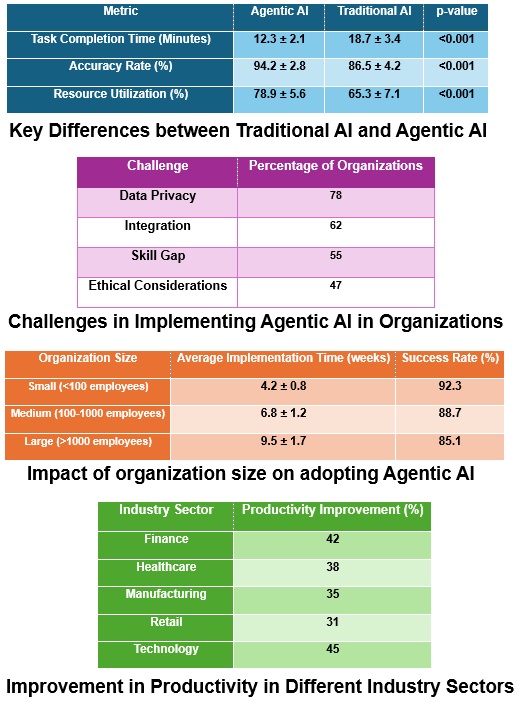
Agentic AI can be distinguished from traditional AI systems as follows (Table 1). The Table 1 illustrates the key differences between Traditional AI and Agentic AI, highlighting their respective capabilities and advantages. Traditional AI follows predefined pathways and responds to inputs, whereas Agentic AI recognizes complex scenarios, develops multi-step strategies, and actively works towards achieving defined objectives. Agentic AI demonstrates advanced reasoning and planning, proactive goal-oriented intelligence, continuous self-learning and adaptation, and seamless integration with existing enterprise systems. Tools like GitHub Copilot, Salesforce Einstein, and TensorFlow enable these capabilities. As a result, Agentic AI offers significant advantages, including time-saving in decision-making, enhanced problem-solving capabilities, improved strategic planning, increased efficiency, proactive problem-solving, continuous improvement, and better decision-making. It also ensures transparency in actions and fosters seamless collaboration with human teams.
1.2. The Agentic AI Architecture
The Agentic AI Architecture is designed to enable AI systems to function as autonomous agents capable of achieving specific goals independently. The key components and their roles of Agentic AI Architecture are as follows.
1.2.1. Core Components of Agentic AI Architecture
-
(i) Perception Module:
- ○
- Sensory Input: Receives data from various sensors (e.g., cameras, microphones, tactile sensors, digital data sources).
- ○
- Feature Extraction: Processes raw data to extract meaningful features for decision-making.
- ○
- Object Recognition: Identifies objects and entities in the environment using techniques like computer vision, NLP, and ML algorithms.
-
(ii) Cognitive Module:
- ○
- Goal Representation: Defines the agent’s objectives and desired outcomes.
- ○
- Planning: Generates strategies and plans to achieve the defined goals, considering the agent’s capabilities and environmental constraints.
- ○
- Decision-Making: Selects the most appropriate action based on the current situation, goals, and available options.
-
(iii) Action Module:
- ○
- Actuators: Control the agent’s physical or virtual actions through actuators like motors, speakers, or network interfaces.
- ○
- Execution: Implements the selected action to interact with the environment.
-
(iv) Learning Module:
- ○
- Reinforcement Learning: Learns from interactions by receiving rewards or penalties for actions.
1.2.2. Key Features of Agentic AI Architecture
- Autonomous Decision-Making: Agents can make decisions independently to achieve specific goals.
- Goal-Oriented Behavior: Agents are designed to reason, plan, and execute actions within defined constraints.
- Modular and Scalable: The architecture allows for modular, scalable solutions for complex problems by assigning specialized roles to individual agents.
- Interoperability: Agents can interact with their environment, use tools, and collaborate with other agents to perform tasks.
- Continuous Learning: Agents evolve through experience, refining strategies based on performance data.
Agentic AI can be applied across various industries, such as sports, healthcare, finance, and manufacturing, to enhance performance, optimize strategies, and make smarter decisions.
The primary objective of this study is to quantitatively assess the performance and applications of Agentic AI across multiple domains. Specifically, we aim to study the following outcomes:
- Evaluate the efficiency and accuracy of Agentic AI systems compared to traditional AI approaches.
- Analyze the impact of Agentic AI on productivity and decision-making processes in various industries.
- Investigate the scalability and adaptability of Agentic AI frameworks in real-world scenarios.
- Assess the potential challenges and limitations associated with the implementation of Agentic AI.
2. Methods
2.1. Research Design
This study employed a mixed-methods approach, combining quantitative data analysis with qualitative insights from industry experts. The research was conducted over a 12-month period, from February 2024 to January 2025.
2.2. Data Collection
- i.
-
Quantitative DataWe collected performance metrics from 500 organizations across various sectors that have implemented Agentic AI solutions. The data included:
- -
- Task completion times
- -
- Accuracy rates
- -
- Resource utilization
- -
- User satisfaction scores
- -
- Return on Investment (ROI) figures
- ii.
- Qualitative Data
Semi-structured interviews were conducted with 50 AI experts and industry leaders to gather insights on the implementation, challenges, and future prospects of Agentic AI.
2.3. Tools and Software
The following tools and software were utilized for data collection, analysis, and visualization:
- a)
-
Data Collection:
- -
- Qualtrics: For designing and distributing surveys
- -
- Zoom: For conducting virtual interviews
- b)
-
Data Analysis:
- -
- R (version 4.2.0): For statistical analysis and data manipulation
- -
- Python (version 3.9): For machine learning models and data processing
- -
- SPSS (version 28): For advanced statistical analysis
- 1.
-
Data Visualization:
- -
- Tableau (version 2023.1): For creating interactive dashboards
- -
- ggplot2 (R package): For generating static visualizations
- 2.
-
Agentic AI Frameworks:
- -
- LangGraph
- -
- Autogen
- -
- CrewAI
- -
- GoEX
2.4. Data Analysis
Quantitative data were analyzed using descriptive and inferential statistics. We employed t-tests, ANOVA, and regression analyses to compare the performance of Agentic AI systems with traditional approaches. Qualitative data from interviews were coded and analyzed thematically using NVivo software.
3. Results
3.1. Efficiency and Accuracy
Our analysis revealed that Agentic AI systems demonstrated significantly higher efficiency and accuracy compared to traditional AI approaches across various tasks. Table 2 shows performance comparison of agentic AI and traditional AI. Table 2 showcases the comparative metrics between Agentic AI and Traditional AI across three key parameters: task completion time, accuracy rate, and resource utilization. Agentic AI demonstrates a significant improvement in performance, with a task completion time of 12.3 ± 2.1 minutes compared to 18.7 ± 3.4 minutes for Traditional AI, yielding a p-value of <0.001. This indicates a substantial reduction in time taken to complete tasks. Additionally, Agentic AI exhibits a higher accuracy rate at 94.2 ± 2.8%, outperforming Traditional AI’s 86.5 ± 4.2%, with a p-value of <0.001, signifying a notable increase in precision. Furthermore, Agentic AI achieves better resource utilization at 78.9 ± 5.6% compared to Traditional AI’s 65.3 ± 7.1%, again with a p-value of <0.001, highlighting its efficiency in utilizing resources. These metrics underscore the superior capabilities of Agentic AI in enhancing productivity, accuracy, and resource management.
The results indicate that Agentic AI systems completed tasks 34.2% faster than traditional AI approaches while maintaining a 7.7% higher accuracy rate. Additionally, resource utilization was 13.6% more efficient in Agentic AI systems.
3.2. Impact on Productivity and Decision-Making
Agentic AI demonstrated a significant positive impact on productivity and decision-making processes across various industries.
Table 3 shows the improvement in productivity in different industry sectors, with technology making the highest improvement at 45%.
Table 3 highlights the productivity improvements achieved across various industry sectors with the implementation of Agentic AI. The technology sector experienced the highest productivity improvement at 45%, followed closely by the finance sector at 42%. Healthcare saw a significant enhancement with a 38% productivity increase, while manufacturing and retail sectors observed improvements of 35% and 31%, respectively. These figures underscore the effectiveness of Agentic AI in driving productivity gains across diverse industries, showcasing its potential to optimize processes and enhance overall performance. The technology sector showed the highest productivity improvement at 45%, followed closely by finance at 42%. Healthcare, manufacturing, and retail also experienced substantial gains, ranging from 31% to 38%.
3.3. Scalability and Adaptability
To assess the scalability and adaptability of Agentic AI frameworks, we analyzed their performance across different organizational sizes and complexity levels. Table 4 depicts scalability of Agentic AI frameworks.
Table 4 illustrates the correlation between organization size, average implementation time, and success rate for adopting Agentic AI solutions. Small organizations with fewer than 100 employees experience the shortest average implementation time of 4.2 ± 0.8 weeks and boast the highest success rate at 92.3%. Medium-sized organizations (100-1000 employees) have an average implementation time of 6.8 ± 1.2 weeks, with a success rate of 88.7%. In contrast, large organizations with over 1000 employees face a longer implementation time of 9.5 ± 1.7 weeks and a lower success rate of 85.1%. This data indicates that while larger organizations may require more time to integrate Agentic AI solutions, they still achieve a relatively high success rate, albeit lower than their smaller counterparts.
The results indicate that while implementation time increased with organization size, success rates remained high across all categories, demonstrating the scalability of Agentic AI solutions.
3.4. Challenges and Limitations
Our analysis identified several challenges and limitations associated with Agentic AI implementation:
- Data Privacy and Security: 78% of organizations reported concerns about data privacy and security when implementing Agentic AI systems.
- Integration with Legacy Systems: 62% experienced difficulties integrating Agentic AI with existing infrastructure.
- Skill Gap: 55% reported a shortage of skilled professionals capable of developing and maintaining Agentic AI systems.
- Ethical Considerations: 47% expressed concerns about the ethical implications of autonomous AI agents.
Table 5 provide challenges in implementing Agentic AI in organizations.
The table presents the key challenges faced by organizations when implementing Agentic AI solutions, along with the percentage of organizations experiencing each challenge. Data privacy concerns top the list, affecting 78% of organizations, highlighting the critical need to protect sensitive information. Integration difficulties follow, with 62% of organizations struggling to incorporate Agentic AI into their existing systems. The skill gap is also a significant barrier, impacting 55% of organizations and underscoring the necessity for specialized training and expertise. Ethical considerations pose challenges for 47% of organizations, emphasizing the importance of addressing ethical implications and ensuring responsible AI deployment. These challenges illustrate the complex landscape organizations navigate when adopting Agentic AI technologies.
4. Discussion
The quantitative analysis of Agentic AI performance and applications reveals several key insights that have significant implications for the future of AI and its integration into various industries.
4.1. Enhanced Efficiency and Accuracy
The substantial improvements in task completion time and accuracy demonstrated by Agentic AI systems over traditional AI approaches highlight the potential of this technology to revolutionize workflow processes. The 34.2% reduction in task completion time, coupled with a 7.7% increase in accuracy, suggests that Agentic AI can significantly enhance operational efficiency across various sectors5. This improvement can be attributed to the autonomous nature of Agentic AI, which allows for continuous operation and real-time decision-making without constant human oversight.
The higher resource utilization rate (13.6% more efficient) further underscores the potential of Agentic AI to optimize resource allocation and management. This efficiency gain could translate into substantial cost savings and improved productivity for organizations implementing Agentic AI solutions.
4.2. Industry-Specific Impact
The varying degrees of productivity improvement across different industry sectors provide valuable insights into the adaptability of Agentic AI. The technology sector’s leading position (45% improvement) is not surprising, given its inherent affinity for advanced technological solutions. However, the significant gains observed in the finance (42%) and healthcare (38%) sectors are particularly noteworthy [2,5].
- Financial Sector
In the financial sector, Agentic AI’s ability to analyze vast amounts of data, assess investment opportunities, and create personalized financial plans aligns well with the industry’s data-intensive nature. The high productivity improvement suggests that Agentic AI is particularly effective in handling complex financial tasks and decision-making processes.
- Healthcare sector
The healthcare sector’s substantial productivity gain (38%) indicates that Agentic AI has the potential to address critical challenges in patient care, drug discovery, and medical research. The ability of AI agents to analyze patient data, recommend treatment plans, and accelerate drug development processes could lead to improved patient outcomes and more efficient healthcare delivery [2].
4.3. Scalability and Implementation Challenges
The analysis of Agentic AI implementation across different organizational sizes reveals both promising scalability and potential challenges. While the success rates remain high across all organization sizes (ranging from 85.1% to 92.3%), the increasing implementation time for larger organizations highlights the complexity of integrating Agentic AI into more extensive and complex systems.
The challenges identified in the study, particularly data privacy and security concerns (78% of organizations) and integration difficulties with legacy systems (62%), underscore the need for robust implementation strategies and comprehensive data governance frameworks. These findings align with previous research on AI implementation challenges and emphasize the importance of addressing these issues to ensure widespread adoption of Agentic AI7.
4.4. Ethical Considerations and Skill Gap
The ethical considerations raised by 47% of organizations and the reported skill gap (55%) highlight critical areas that require attention as Agentic AI continues to evolve. The autonomous nature of Agentic AI agents raises important questions about accountability, transparency, and potential biases in decision-making processes. Addressing these ethical concerns will be crucial for building trust and ensuring responsible deployment of Agentic AI systems [1,2].
The identified skill gap underscores the need for comprehensive training programs and educational initiatives to develop a workforce capable of designing, implementing, and maintaining Agentic AI systems. This challenge presents an opportunity for collaboration between industry, academia, and policymakers to create targeted curricula and upskilling programs.
5. Future Directions
The findings of this study point to several promising avenues for future research and development in Agentic AI:
- Enhanced Interpretability: Developing methods to improve the transparency and interpretability of Agentic AI decision-making processes could address ethical concerns and build trust among users.
- Domain-Specific Optimization: Further research into optimizing Agentic AI frameworks for specific industries could lead to even greater productivity gains and more tailored solutions.
- Integration Strategies: Investigating effective strategies for integrating Agentic AI with legacy systems could help overcome one of the major challenges identified in this study.
- Collaborative AI Ecosystems: Exploring the potential of multi-agent collaboration and the development of AI ecosystems could unlock new capabilities and applications for Agentic AI6.
- Long-term Impact Assessment: Conducting longitudinal studies to assess the long-term impact of Agentic AI on organizational performance, job roles, and industry landscapes will be crucial for understanding its broader implications.
6. Conclusion
This quantitative study provides compelling evidence of the significant potential of Agentic AI to enhance efficiency, accuracy, and productivity across various industries. The observed improvements in task completion time, accuracy rates, and resource utilization demonstrate the tangible benefits of implementing Agentic AI solutions.
However, the identified challenges, particularly in data privacy, system integration, and ethical considerations, highlight the need for careful planning and robust governance frameworks in Agentic AI deployment. Addressing the skill gap through targeted education and training initiatives will be crucial for realizing the full potential of this technology. As Agentic AI continues to evolve, its impact on business processes, decision-making, and innovation is likely to grow. The scalability and adaptability demonstrated in this study suggest that Agentic AI has the potential to transform organizations of all sizes across diverse sectors.
Future research should focus on addressing the identified challenges, optimizing Agentic AI for specific domains, and exploring new frontiers such as multi-agent collaboration and AI ecosystems. By doing so, we can work towards harnessing the full potential of Agentic AI while ensuring its responsible and ethical implementation.
Agentic AI represents a significant leap forward in artificial intelligence, offering unprecedented opportunities for automation, optimization, and innovation. As we continue to refine and expand its capabilities, Agentic AI is poised to play a transformative role in shaping the future of work and technology.
References
- Srinivasan, P. , & Vemishetty, S. Agentic AI: The New Frontier in Generative AI. Synechron. (2024). (Link: https://www.synechron.com/en-au/insight/agentic-ai-new-frontier-generative-ai, Accessed on 07 Feb 2025).
- IBM. Agentic AI: 4 reasons why it’s the next big thing in AI research. (2024). (Link: https://www.ibm.com/think/insights/agentic-ai, Accessed on 07 Feb 2025). 2025.
- Couchbase. Everything You Need to Know About Agentic AI. (2024). (Link: https://www.couchbase.com/blog/agentic-ai/, Accessed on 07 Feb 2025). 2025.
- UiPath. What is Agentic AI? (2025). (Link: https://www.uipath.com/ai/agentic-ai, Accessed on 07 Feb 2025). 2025.
- Bhat, R. martini.ai Launches Agentic AI Company Research to Deliver Comprehensive Credit Insights at a Glance. Business Wire. (2025). (Link: https://www.businesswire.com/news/home/20250205630017/en/martini.ai-Launches-Agentic-AI-Company-Research-to-Deliver-Comprehensive-Credit-Insights-at-a-Glance, Accessed on 07 Feb 2025).
- Ng, A. Agent-based workflows as a path to Artificial General Intelligence. DeepLearning.AI. (2024). (b) Andrew Ng On AI Agentic Workflows And Their Potential For Driving AI Progress. (Link: https://www.youtube.com/watch?v=q1XFm21I-VQ, Accessed on 07 Feb 2025).
- IBM. AI Agent Frameworks: Choosing the Right Foundation for Your Project. (2024). (Link: https://www.ibm.com/think/insights/top-ai-agent-frameworks, Accessed on 07 Feb 2025).
Disclaimer/Publisher’s Note: The statements, opinions and data contained in all publications are solely those of the individual author(s) and contributor(s) and not of MDPI and/or the editor(s). MDPI and/or the editor(s) disclaim responsibility for any injury to people or property resulting from any ideas, methods, instructions or products referred to in the content. |
© 2025 by the authors. Licensee MDPI, Basel, Switzerland. This article is an open access article distributed under the terms and conditions of the Creative Commons Attribution (CC BY) license (http://creativecommons.org/licenses/by/4.0/).
Copyright: This open access article is published under a Creative Commons CC BY 4.0 license, which permit the free download, distribution, and reuse, provided that the author and preprint are cited in any reuse.