

Submitted:
31 January 2025
Posted:
03 February 2025
You are already at the latest version
Abstract
Pharmaceutical compounds in aquatic environments are recognized as emerging contaminants due to their potential risks to living organisms. The growing accessibility, widespread use, and disposal of pharmaceuticals have led to a significant increase in their presence within wastewater streams. Due to their persistence and resistance to biodegradation in aquatic environments, these water-soluble and pharmacologically active organic micropollutants often evade conventional wastewater treatment processes, leading to incomplete removal and an escalating global concern. This review examines the classification, occurrence, and associated environmental and health risks of commonly detected pharmaceutical contaminants in aquatic systems. Additionally, it provides an overview of advanced treatment methods being developed to implement a fourth purification stage in wastewater treatment plants. Biological, chemical, physical, and hybrid purification technologies are critically reviewed, with a focus on their performance characteristics and potential applications.
Keywords:
wastewater treatment
; micropollutants
; pharmaceutical contaminants
; diclofenac
; ibuprofen
; paracetamol
; advanced treatment processes
; membrane filtration
; nanofiltration
1. Introduction
In recent decades, the presence of micropollutants (MPs) in aquatic environments has become a growing global concern. Often referred to as emerging contaminants (ECs), these pollutants encompass a wide range of substances, including pharmaceuticals, endocrine-disrupting chemicals (EDCs), personal care products, industrial chemicals, microplastics, and pesticides [1,2,3]. These contaminants originate from various sources, such as agricultural runoff, industrial emissions, and household waste, and they enter the environment through different pathways, including leaching, atmospheric deposition, and wastewater discharge [4]. Many of these pollutants persist in the environment and accumulate in the food chain, potentially posing long-term risks to both ecosystems and human health [5].
The global production of MPs has increased dramatically, rising from 1 million tons per year in 1930 to 400 million tons annually by 2000 [6]. The European Union has registered over 100,000 chemical compounds, with 30,000 to 70,000 of these being consumed worldwide on a daily basis [7]. MPs are often found in water at low concentrations, ranging from nanograms per liter (ng/L) to micrograms per liter (μg/L), making their detection and analysis challenging and complicating water and wastewater treatment processes [8,9,10]. These compounds vary in molecular weight, with pharmaceuticals typically ranging between 150 and 500 Da [11].
Current wastewater treatment plants (WWTPs) are not designed to specifically remove micropollutants [12,13]. Many MPs can pass through conventional treatment stages without being degraded or removed due to their persistent nature . As a result, these substances can end up in the aquatic environment, threatening wildlife and complicating the provision of safe drinking water. The presence of MPs in aquatic ecosystems is linked to various adverse effects, including both short- and long-term toxicity, endocrine disruption, and the development of antibiotic resistance in microorganisms [14,15].
Although some countries and regions have established regulations for the control of certain micropollutants, WWTPs do not consistently adhere to emission guidelines or micropollutant standards. Nevertheless, progress has been made. The European Union’s water policy, initiated by Directive 2000/60/EC, provided a framework to address high-risk substances [16]. The 2008/105/EC Directive [17] identified 33 key substances with approved environmental quality standards [18,19]. The 2013/39/EU Directive [20]
expanded this list, recommending the monitoring and treatment of 45 priority substances, and the 2015/495/EU decision outlined measures for eliminating hazardous substances such as 17-alpha-ethinylestradiol (EE2), triallate, 17-beta-estradiol (E2), oxadiazon, diclofenac, 2,6-di-tert-butyl-4-methylphenol, macrolide antibiotics, methiocarb, neonicotinoids, 2-ethylhexyl-4-methoxycinnamate, and estrone (E1) [18,21,22]. Meanwhile, other harmful substances like ethoxylates and nonylphenol have already been regulated in Canada [23]. However, many micropollutants, particularly pharmaceuticals and steroid hormones, remain unregulated. To establish comprehensive standards, further research on the effects of these substances on human and environmental health is critical [24].
Given their significance and the many ecological risks they pose, this review focuses on the removal of pharmaceutical contaminants (PCs) from wastewater. The objective is to identify and categorize the major classes of pharmaceuticals contributing to wastewater and to provide an overview of the methods being explored to implement a fourth purification stage in WWTPs. Biological, chemical, and physical purification processes are reviewed, and their characteristics are discussed. The occurrence of the most commonly detected PCs in various water sources and regions, as well as the harmful effects of these substances on the environment, ecosystems, and human health, are also examined in the literature.
2. Micropollutants in Aquatic Ecosystems
2.1. Sources of Micropollutants
MPs comprise a wide range of emerging contaminants, which can be categorized into several groups such as pharmaceuticals, personal care products (PCPs), endocrine-disrupting chemicals (EDCs), pesticides, industrial chemicals, and microplastics. Each group has its own distinct characteristics and applications [2]. Table 1 summarizes the primary sources of these major categories of micropollutants in aquatic environments.
The sources of micropollutants in water are highly diverse and largely depend on how the substances are used, or, in the case of transformation products/metabolites, where they are produced [21]. Often influenced by rainfall, MPs enter water bodies from both point sources and diffuse sources. These substances typically coexist in environmental compartments alongside other chemicals, forming “environmental mixtures” that can interact with one another, potentially leading to increased toxicities and risks [25].
In recent years, the rise in pharmaceutical production and consumption—largely driven by advances in medicine—has contributed to a substantial increase in pharmaceutical contaminants in waste streams. This trend is particularly pronounced during pandemics, when drug usage surges [26]. The rapid growth in pharmaceutical manufacturing and use has significantly raised the concentrations of PCs in wastewater. Additionally, the widespread availability of over-the-counter medications, often sold without prescriptions or registration, further exacerbates the environmental presence of these contaminants [27]. As a result, water-soluble and pharmacologically active organic micropollutants have become a global issue due to their persistence and resistance to degradation in aquatic environments [28,29,30,31].
Pharmaceuticals in wastewater can be categorized based on their therapeutic applications. To remove these contaminants from wastewater, various physico-chemical and biological treatment methods are employed [26,32,33,34]. Understanding the molecular characteristics of each compound is crucial in selecting the most suitable removal process, as these characteristics determine how the compounds interact with different treatment methods. Factors such as molecular size, charge, hydrophobicity, and polarity play a significant role in how well a compound is adsorbed by membranes, retained by filters, or degraded by biological or chemical processes [35]. Table 2 provides an overview of key PCs along with their physicochemical properties. These pharmaceutical categories include analgesics and anti-inflammatories, antidepressants, antibiotics, antivirals, anticoagulants, sedatives, cardiovascular drugs, and more [35]. These contaminants may be ionic (pKa < 2), nonionizable (pKa > 2), hydrophobic (log Kow > 2), or hydrophilic (log Kow < 2). Polar compounds (log Kow < 1) typically escape effective removal by wastewater treatment plants [36].
2.2. Routes of Micropollutants in the Environment
Micropollutants enter the environment through a variety of sources, including industrial emissions (via air and effluents), domestic and hospital waste, livestock, and leachates from landfills, as shown in Figure 1. Among these sources, household wastewater is particularly significant in introducing micropollutants into surface waters, making aquatic environments the primary receptor of these pollutants [44].
Various pharmaceuticals are used in both human and veterinary medicine. Approximately 3,000 different compounds are employed as pharmaceuticals, with annual production quantities reaching hundreds of tons [48]. In Western Europe, the average individual consumes over 300 mg of active ingredients daily, with about 99% of this amount being concentrated in just 60 compounds [49,50]. In Germany alone, around 8,100 tons of active substances are used annually [51]. After ingestion, these pharmaceuticals are excreted in urine and feces, both as the original molecule (the portion not metabolized in the body) and as metabolites, which are typically hydroxylated, hydrolyzed, or conjugated forms of the parent compounds [52].
These substances then enter the municipal sewer system through hospitals, healthcare facilities, and private households, as shown in Figure 1 and Figure 2 [53]. Sewage containing pharmaceutical pollutants from manufacturing or processing (depending on the industry) is treated in WWTPs. After treatment in communal or industrial WWTPs, the resulting water is generally discharged into water bodies. However, due to their chemical stability, resistance to biodegradation, and ability to pass through filtration processes based on size, charge, or solubility, pharmaceuticals and other pollutants are often not completely removed in conventional treatment plants. Consequently, these contaminants can find their way into surface and groundwater [54]. Additionally, smaller quantities enter the sewer system through manufacturing processes or improper disposal via sinks and toilets. As a result, these active substances can ultimately contaminate drinking water through bank filtration or surface water contamination [25,55].
WWTPs are a significant source of pharmaceuticals [2,54,57]. Depending on drug consumption levels and excretion rates, the concentration of individual pharmaceuticals in untreated wastewater can range from nanograms per liter (ng/L) to micrograms per liter (µg/L) [25]. Pharmaceuticals that are commonly found in high concentrations in wastewater include non-steroidal anti-inflammatory drugs (NSAIDs), β-blockers, psychoactive compounds, analgesics, antibiotics, endocrine disruptors, antiretroviral drugs, and cancer treatments [58,59]. Among these, NSAIDs, antibiotics, and analgesics are the most frequently used worldwide [60]. For instance, approximately 35 million people use NSAIDs daily across the globe [61], and in China, domestic production increased from 41,537 tons in 2013 to 46,673 tons in 2017 [62].
In Cuernavaca, Mexico, high concentrations of naproxen (732-4,889 ng/L), acetaminophen (354-4,460 ng/L), and diclofenac (258-1,398 ng/L) have been detected in influent and effluent samples from a WWTP as well as in surface waters of the Apatalco River [63]. Similarly, diclofenac (10,221 ng/L) and acetaminophen (1,234-2,346 ng/L) have been detected in effluents from the Red Sea (Saudi Arabia) [64]. In Brazil, acetaminophen (17.4-34.6 ng/L), diclofenac (19.4 ng/L), and ibuprofen (326.1-2,094.4 ng/L) have been found in surface and bottom water samples from Santos Bay [65]. Table 2 further illustrates the global distribution of the most commonly detected pharmaceuticals in water bodies.
Among the pharmaceutical substances found in wastewater, antibiotics are of particular concern due to their persistent nature, incomplete metabolism, and their ability to spread easily through ecosystems [66]. In China, approximately 92,700 tons of antibiotics were produced, with 48% intended for human use and the remainder for livestock, 46% of which were active metabolites [67]. The most frequently detected antibiotics in wastewater include sulfonamides, quinolones, tetracyclines, fluoroquinolones, and nitroimidazoles [60]. Antibiotic concentrations in various water bodies range from 0.0013 to 0.0125 mg/mL in wastewater, 0.0005 to 0.0214 mg/mL in drinking water, and 0.0003 to 0.0039 mg/mL in river water [68,69,70] .
Veterinary pharmaceuticals are another direct source of MPs due to their widespread use in treating farm animals, leading to their presence in different aquatic environments [71]. Studies have identified these substances in animal production systems such as pig farming [72], poultry [73], dairy [74], sheep farming [75], and aquaculture [76,77,78]. In Germany, indoor livestock systems, including cattle, pigs, and poultry, are the primary sources of veterinary pharmaceutical pollution (82%), followed by pasture-raised animals (18%), with aquaculture contributing less than 0.5% . These substances can reach aquatic habitats through various pathways, as demonstrated by numerous studies [78,79,80].
Residues from veterinary medicinal products can runoff into surface waters or seep into groundwater if not absorbed by the soil, potentially contaminating drinking water [81]. Wastewater from concentrated animal feeding operations (CAFOs) often contains a mix of pharmaceuticals, including antibiotics, anthelmintics, synthetic and natural hormones, and NSAIDs, mainly originating from animal excretion [54,82]. Antibiotics are widely used in animal farming to promote growth and improve feeding efficiency in cattle, pigs, and poultry [83]. Research by Klein et al. (2018) highlights a 65% increase in antibiotic use between 2000 and 2015, growing from 21 to over 35 billion daily doses [84].
Aquaculture, particularly fish farming, is another significant route for pharmaceutical contamination. Antibiotics are often used in fish farming to prevent or treat bacterial infections in fish populations [85]. These antibiotics can enter surrounding water bodies directly through fish excretion, uneaten medicated feed, or improper disposal of unused medications [86]. The Asian aquaculture sector has expanded rapidly in recent decades, now accounting for nearly 90% of global production [87]. Studies have shown significant antibiotic use in Chinese aquaculture, contributing to veterinary contamination [78]. However, human activities may have an even greater impact on aquatic pollution than aquaculture due to the higher density of human populations.
2.3. Impact of Pharmaceutically Active Compounds (PhACs) in Water on Human Health and Ecosystems
The older generation in modern societies is increasingly reliant on pharmaceutical drugs, and with the rising prevalence of chronic diseases, the use of therapeutic products is expected to grow [88]. The high concentration of pharmaceutical and personal care product residues in water bodies can lead to long-term (chronic) effects on both human health and ecosystems. Potential health impacts of micropollutants are illustrated in Figure 3.
Exposure to PCs can lead to changes in inherited traits and the behavior of living organisms. One example of this is the transformation of male fish into females due to the presence of estrogen in water bodies, which leads to the development of female characteristics [91,92]. Additionally, PCs in drinking water pose significant risks to vulnerable groups such as newborns, the elderly, and individuals with kidney or liver failure. The presence of estrogens in drinking water has also been linked to reduced male fertility and an increased risk of breast and testicular cancers [93,94,95,96,97].
2.3.1. Non-Steroidal Anti-Inflammatory Drugs (NSAIDs)
NSAIDs are found in trace amounts (primarily in nano- and microgram quantities) in various environmental media, including soil, wastewater, surface water, groundwater, and drinking water. Although their concentrations are low, NSAIDs can cause prolonged ecotoxicological effects on the living components of ecosystems [98]. According to Feng et al. (2013), more than 30 million doses of NSAIDs are consumed daily, and this number is rapidly increasing [38]. Research by Selderslaghs et al. (2012) has shown that the presence of diclofenac and ketoprofen in aquatic environments can result in cardiovascular defects and cardiac anomalies in freshwater fish [99].
2.3.2. Antibiotics
The presence of antibiotics in the environment can facilitate the development and spread of antibiotic resistance genes, contributing to a global public health crisis. Antibiotics can disrupt the processes at WWTPs by killing or inhibiting the growth of microorganisms essential for the microbial activity that aids in purification [37]. According to Dolliver and Gupta, antibiotics contaminate groundwater and surface water through leaching and agricultural runoff [100]. The use of antibiotics poses significant health risks, including cardiac arrhythmia, immune system disruption, liver dysfunction, bone marrow suppression, and potential impacts on the food chain [26].
2.3.3. Antidepressants
Lajeunesse and Metcalfe et al. (2010) found through their research that antidepressants and their metabolites are present in surface water, sewage, and even in the effluent from wastewater treatment plants [101,102]. Some of the significant side effects linked to antidepressants include hypoglycemia, both acute and chronic toxicity, growth inhibition in aquatic organisms, and sexual dysfunction [26]. Additionally, there is an increased risk of suicidal thoughts and behaviors among children and adolescents who take these medications. When individuals stop using antidepressants, they may experience discontinuation syndrome, which can mimic the symptoms of their previous depression [103,104].
3. Presence of Micropollutants in the Aquatic Environment
Table 3 presents a comprehensive overview of key MPs, including substances like caffeine, diclofenac, and bisphenol A, and their concentrations across various water types—such as surface water, groundwater, drinking water, and wastewater—and countries. The data illustrate variations in pollutant levels depending on the water type and geographical region, providing insights into regional pollution patterns, potential sources from industries and agriculture, and the effectiveness of wastewater treatment processes. Moreover, the table offers valuable information on the influence of regulatory measures and can help inform strategies aimed at reducing pollution.
4. Techniques for the Removal of Pharmaceutical Contaminants
4.1. WWTPs Today
Conventional WWTPs employ a combination of advanced biological, physical, and chemical processes, which are categorized according to their operational principles, applications, and implementation methods to ensure efficient wastewater treatment (Figure 4) [135]. The mechanical stage of a WWTP consists of screening systems, sand traps, and primary clarifiers. In the biological stage, biological reactors are used to further degrade organic matter, followed by sedimentation to separate the biological flocs from the treated water. The chemical stage, which occurs after secondary treatment, involves adding a phosphate precipitant in a final clarifier to aid in the clarification process. The precipitated phosphate then settles with the sludge and is removed. Chlorine is commonly used as a chemical disinfectant in water and wastewater treatment due to its ability to inactivate microorganisms by oxidizing and damaging their cellular structures [136,137]. Some WWTPs may also include a sand filtration stage to further enhance removal efficiency. Finally, the treated and clarified wastewater is discharged into a natural water body [138].
Jelic et al. (2011) conducted a study on the presence of 43 pharmaceuticals in the influent, effluent, and sludge of three WWTPs in Catalonia [140]. These WWTPs primarily utilized mechanical and biological treatment stages, except for one plant, which incorporated a flocculation basin as an additional stage. Of the 43 pharmaceuticals examined, 32 were found in the influent, 29 in the effluent, and 21 in the sludge. Compounds such as diclofenac, carbamazepine, clarithromycin, and sulfamethazine were detected across all three stages. The concentrations of these substances ranged from ng/L in the influent and effluent to ng/g in the sludge. This study, along with others, underscores the importance of introducing a fourth treatment stage in WWTPs globally [141,142,143,144]. For pharmaceuticals that are difficult to biodegrade, the traditional three-stage treatment process is often inadequate. Its efficiency is greatly influenced by the physicochemical properties of the compounds and the specific treatment conditions [145]. While the activated sludge process is commonly employed to treat wastewater containing NSAIDs, it has been shown that these drugs are not entirely removed [146].
Ongoing research and development have led to the exploration of various technologies that could serve as a fourth treatment stage in WWTPs [147,148,149]. These technologies are classified into biological, chemical, and physical processes, with potential combinations of these methods (Figure 5). The following sections provide an overview of these individual processes, emphasizing their functionality and effectiveness in eliminating PCs from wastewater [145,146,150].
Table 4 presents a summary of the advantages and disadvantages of the wastewater treatment processes discussed above. It highlights that achieving the desired effluent quality often requires the coupling of multiple treatment technologies to overcome the limitations inherent in relying on a single treatment method.
4.2. Biological Treatment Technologies
Biological treatment utilizes the metabolic activity of environmental microorganisms to oxidize and break down organic pollutants in water, transforming them into stable and harmless inorganic substances. This approach provides an effective and sustainable solution for modern water purification [166]. The biological methods used to remove micropollutants in WWTPs can be divided into conventional and advanced processes (Figure 6). Conventional technologies largely depend on microbial activity and require minimal mechanical input. These methods include the activated sludge process, biotrickling filters, biofilm reactors, and nitrification/denitrification systems [167]. On the other hand, advanced biological processes, such as two-phase partitioning bioreactors, membrane bioreactors (MBRs), immobilized cell bioreactors, and moving bed biofilm reactors, utilize enhanced technologies to improve treatment efficiency [168]. Among these, the activated sludge process and membrane bioreactors are the most used biological treatment methods, and they will be explored in more detail in the following section [169].
4.2.1. Conventional Biological Processes
4.2.1.1. Activated Sludge
The removal of pharmaceuticals entering a WWTP primarily takes place during the biological treatment stage [133,170,171]. It is evident that the removal rates of these compounds can differ significantly between WWTPs, as the effectiveness of removal depends on a variety of factors, including the type of treatment process, the characteristics of the mixed liquor suspended solids (e.g., type of sludge), operational parameters of the WWTP (such as sludge retention time, hydraulic retention time, pH, and temperature), as well as the physicochemical properties of the pharmaceuticals themselves [37]. However, the type of treatment process used in the WWTP and the characteristics of the pharmaceuticals are likely the most significant factors influencing the removal efficiency of these compounds [172,173].
Treatment efficiencies for pharmaceuticals in the biological process of WWTPs can range from 20% to 99% [133,174], with some compounds, like carbamazepine, showing removal rates as low as below 20% [133,172,174,175]. This low removal rate for carbamazepine can be attributed to its persistent nature and water-soluble properties [133]. In Germany, about 68-69% of diclofenac was removed through secondary treatment in WWTPs, and similar results were found in five WWTPs in Ulsan, South Korea [133,176]. Typically, diclofenac removal rates range around 40%, but biodegradation can occur with varying efficiencies depending on the conditions [177]. A study by Sim et al. (2010) found the removal rates of naproxen and gemfibrozil to be 82 ± 20% [178], while Clara et al. (2005) reported a 99% removal of ibuprofen during biological treatment in a WWTP [179].
Behera et al. (2011) studied pharmaceutical removal in five WWTPs in Ulsan, South Korea, and found that WWTPs D and E achieved higher lincomycin removal rates (58% and 74%, respectively), likely due to the presence of anoxic-oxic conditions [133]. WWTP E, which employed the Symbio process, also showed enhanced removal of various pharmaceuticals, including acetaminophen, ibuprofen, ketoprofen, clofibric acid, gemfibrozil, caffeine, atenolol, estriol, and estradiol. The Symbio process creates dual oxic-anoxic zones within sludge flocs by controlling dissolved oxygen, enabling simultaneous nitrification and denitrification. This mechanism likely improves biodegradation, consistent with findings by Zwiener and Frimmel, who observed that anoxic-oxic processes enhance diclofenac degradation [180].
Pharmaceutical removal in biological treatment relies on two primary mechanisms: biodegradation and sorption (including absorption and adsorption) [37,173,181]. Biodegradation can occur via co-metabolism, where other substances serve as the primary carbon or energy source, or through microbial metabolism [182]. Sorption efficiency depends on electrostatic interactions [173,181,183] and compound hydrophobicity, with higher hydrophobicity often resulting in increased removal efficiency [174]. For example, Chen et al. (2022) observed strong adsorption of antibiotics like erythromycin and azithromycin during biological treatments, primarily driven by these interaction mechanisms [184]. Conversely, compounds with high water solubility (low hydrophobicity), such as sulfamethoxazole, are expected to exhibit lower sorption and removal rates [173].
The biological treatment of pharmaceuticals can lead to mineralization (conversion into CO₂, water, and inorganic ions), degradation into smaller molecules, or minor structural modifications [185]. The formation of metabolites or biotransformation products depends on the pharmaceutical’s nature and the type of microorganisms involved [186]. For example, during the treatment of the X-ray contrast agent iopromide, conventional activated sludge oxidized primary alcohols into carboxylates, while nitrifying activated sludge caused dehydroxylation of side chains, indicating a co-metabolism pathway [187].
4.2.2. Advanced Biological Processes
4.2.2.1. Membrane Bioreactor
A membrane bioreactor (MBR) combines biological treatment through activated sludge with a membrane process for separating liquids from solids. Compared to the conventional activated sludge process (CAS), the integration of microfiltration (MF) or ultrafiltration (UF) membranes offers notable advantages [188]. MBRs occupy less space, produce higher-quality wastewater, and can operate at higher suspended solids concentrations than traditional CAS plants. This single-step process maintains suspended solids concentrations between 8,000 and 12,000 mg/L, while CAS typically operates at around 5,000 mg/L, as higher mixed liquor suspended solids (MLSS) concentrations can lead to settling issues in the sedimentation basin [189].
MBRs use membranes that effectively retain sludge and remove pathogens, leading to cleaner water. Additionally, MBRs support long sludge retention times (SRT), which promote the growth of bacteria that degrade specific pollutants and reduce excess sludge production [188]. CAS is often insufficient for removing organic pollutants due to the quantity and variability of micropollutants [190]. Studies have shown that MBRs can efficiently remove various micropollutants, including pharmaceuticals, with varying degradation rates for compounds like ibuprofen, naproxen, and diclofenac. The microbial community in MBRs plays a crucial role in this process, with specific bacterial groups being more effective in degrading certain micropollutants [188,191,192].
As Mert et al. (2018) [192] and Nghiem et al. (2020) [188] have pointed out, MBRs are a promising alternative for micropollutant removal in water treatment. They offer efficient removal of these pollutants, making them particularly valuable for water reuse and environmental protection. However, MBRs show low efficiency in removing persistent, high molecular weight, hydrophilic organic pollutants [193]. Compounds like Enalapril (a pharmaceutical) and Atrazine (a pesticide) are highly resistant to biological degradation. Membrane bioreactors (MBRs) only achieve about 20% removal efficiency for these compounds due to their inherent stability [193]. To address this, high retention membrane bioreactors (HRMBRs), such as osmotic membrane bioreactors (OMBRs) [194], membrane distillation bioreactors [195], and bio-electrochemical membrane reactors (BEMRs) [196], can be used to enhance the removal of persistent, high molecular weight micropollutants [197].
Research by Song, Luo et al. (2018) has shown that combining membrane distillation (MD) with anaerobic membrane bioreactors (AnMBRs) can achieve almost complete removal of large organics and phosphates, including 26 trace organic contaminants (TrOCs) categorized as hydrophobic (Log D > 3.2) and hydrophilic (Log D < 3.2). These TrOCs represent emerging contaminants commonly found in municipal wastewater, such as pharmaceuticals, personal care products, endocrine disruptors, industrial chemicals, and pesticides. While the effectiveness of the AnMBR varied by compound, the addition of the MD process resulted in the complete removal of these contaminants [198].
Cornelissen et al. (2011) investigated the OMBRs, which integrates activated sludge treatment with forward osmosis (FO) membrane separation and reverse osmosis (RO) post-treatment for wastewater reclamation. Their research focused on FO membrane fouling and performance, using different activated sludge in both laboratory and pilot-scale systems. They concluded that the OMBR holds promise as a new development for industrial and municipal wastewater reuse, providing a double barrier against pathogens, organic micropollutants, and particulate matter [199]. Nguyen Hai et al. (2013) also explored the integration of UV oxidation and NF/RO membrane filtration in MBRs for removing several TrOCs. Their study showed that UV oxidation and NF/RO membrane filtration significantly improved MBR performance, achieving high overall removal of hydrophilic and biologically persistent TrOCs [200].
In conclusion, Pathak Van Tran et al. (2020) emphasized the advantages of using HRMBR in water treatment. These combined processes have demonstrated promising results, particularly in enhancing the efficiency of pollutant removal. However, a complete understanding of the nature of pollutants, their interactions, and the practical integration of various technologies is still lacking, and further research is necessary to address these gaps [197].
4.3. Adsorptive Treatment Technologies
4.3.1. Activated Carbon Adsorption
The adsorption process using solid adsorbents has shown significant potential as one of the most efficient methods for treating waters and wastewaters containing pharmaceutical products [201]. Adsorbents are generally classified into two categories: natural and synthetic. Natural adsorbents include materials like charcoal, clays, clay minerals, zeolites, and ores, while synthetic adsorbents are derived from agricultural products, waste, household waste, industrial waste, sewage sludge, and polymeric substances. Each type of adsorbent possesses unique characteristics, such as porosity, pore structure, and the nature of the adsorbent surface [202].
Activated carbon (AC) is the most widely used adsorbent for removing pharmaceuticals from wastewater due to its high adsorption capacity. This is attributed to its extensive porosity, large surface area (often exceeding 1000 m²/g), and strong surface interactions between pharmaceuticals and the adsorbent surface [203]. Additionally, newer materials like molecular imprinted polymers (MIPs) and magnetic nanoparticles have been explored, though these still lack substantial development and supporting case studies compared to AC [204]. Activated carbon is typically categorized into two types based on particle size: powdered activated carbon (PAC), with particles smaller than 0.2 mm, and granular activated carbon (GAC), which has particles ranging from 0.2 to 5 mm. Its pore structure is further divided into macropores (≥50 nm), mesopores (2–50 nm), and micropores (0.8–2 nm) [205].
The efficiency of adsorption is influenced by various factors, including both the properties of the wastewater and the adsorbent, as well as operational conditions. Key properties of adsorbents that affect efficiency include surface morphology, functional groups, pore size, and the content of ash and minerals [206]. For pollutants, factors such as solubility, molecular size, charge, and structural composition play a crucial role in determining the adsorption effectiveness. Operational conditions that impact the process include the initial concentration of pollutants, the pH of the wastewater, temperature, and the quantity of adsorbent used [207,208,209]. Table 5 demonstrates the high removal efficiency of certain pharmaceutical compounds from water and wastewater.
The AC/GAC process is limited by the specific properties of AC material and the contact time with the water, making it less adaptable [216]. Another drawback of AC is its declining removal performance as the volume of treated wastewater increases, requiring the AC to be replaced or regenerated to restore its effectiveness [217]. Additionally, the regeneration and activation of AC come with high costs, and an extra washing stage is necessary to eliminate chemical agents used in the process [218]. The frequent need for regeneration, replacement, and disposal of AC raises environmental concerns. In industrial settings, the presence of background organic matter can reduce the efficiency of the adsorption process and increase material consumption [219]. High levels of dissolved organic matter in wastewater (e.g., >20 mg/L) compete for adsorption sites on the AC, thus reducing the removal efficiency of pharmaceutical pollutants. Despite these limitations, AC remains a viable option for removing pharmaceutical compounds from effluents if the wastewater is pre-treated to reduce organic matter and suspended solids substantially [205].
The removal of PCs via the AC process is influenced by both the dose of AC and the contact time. Higher initial concentrations of pollutants typically require higher carbon dosages to achieve effective removal [162]. However, the required dosage varies between pharmaceuticals. For example, strongly adsorbing compounds like diclofenac can be removed by over 90% with low doses of PAC (5–10 mg/L) [220]. In contrast, compounds that adsorb weakly, such as sulfamethoxazole, require significantly higher PAC dosages, typically ranging from 10–50 mg/L or even up to 100 mg/L [221].
4.4. Physical Treatments Technologies
4.4.1. Membrane Technology
Membrane filtration is increasingly gaining attention in both research and industrial applications for drinking water and wastewater treatment, particularly in water reuse scenarios [222,223,224]. Recent studies demonstrate promising and feasible results when integrated systems are applied, showing improvements over conventional treatment technologies. Membranes act as physical barriers that either reject or reduce the flux of substances, effectively separating them from the rest of the stream. Membranes are classified into four types based on particle size: microfiltration (MF), ultrafiltration (UF), nanofiltration (NF), and reverse osmosis (RO) [225,226].
4.4.1.1. Removal Mechanism of PCs by Membrane Separation Processes
The removal mechanisms of PCs during membrane filtration are influenced by a combination of their properties, solute parameters, and the characteristics of the membranes used. Key properties of PCs, such as molecular weight, size, hydrophobicity or hydrophilicity, charge, and chemical structure, significantly affect their rejection by membranes. Similarly, membrane properties such as molecular weight cut-off (MWCO), pore size, surface charge (zeta potential), hydrophobicity or hydrophilicity (measured via contact angle), and surface morphology (measured via roughness) play a crucial role in facilitating the rejection of contaminants [3,227].
Membrane selectivity is governed by several mechanisms, including size exclusion, electrostatic interactions, hydrophobic interactions, adsorption, diffusion, solute-solute interactions, and fouling. Simon et al. [228] studied the adsorption of ibuprofen by NF and RO membranes and found that this phenomenon is closely related to electrostatic repulsion between the pollutant and the membrane material, as well as the pH of the solution. When the pH drops below the ibuprofen’s pKa (acid dissociation constant), electrostatic repulsion decreases, as the membrane acquires a positive charge, thus facilitating the drug’s adsorption onto the membrane, which has a negative surface charge. For instance, ibuprofen rejection by the loose NF membrane (NF 270) decreases from approximately 60% at pH levels above its pKa (4.4) to below 40% at pH levels below its pKa. This finding aligns with Shanmuganathan et al. (2017) [229], who observed that NF and RO membranes achieve higher removal rates for ionic substances (97%) compared to nonionic compounds (82%).
In further studies, Licona et al. (2018) found a strong correlation between PCs’ molecular weight (MW) and hydrophobicity in their rejection by NF and RO membranes. They identified size exclusion and adsorption as the main removal mechanisms, with negatively charged PCs, such as ibuprofen, dipyrone, and diclofenac, achieving higher removal efficiencies (>95%) at 20 bar and pH 7 due to electrostatic repulsion. On the other hand, neutrally charged PCs, such as caffeine and acetaminophen, showed lower rejection rates, with caffeine removed at below 95% and acetaminophen below 90% [230]. Similarly, Albergamo et al. (2019) found a complex relationship between the size, hydrophobicity, and chemical structure of PCs and their removal efficiency in RO membranes. While size exclusion predominantly influences the removal of neutral-hydrophilic and anionic PCs, hydrophobic interactions play a significant role in the passage of moderately hydrophobic PCs, resulting in lower removal efficiencies. The authors attributed this lower efficiency to the affinity between hydrophobic structures, such as aromatic rings and hydrocarbon chains, and the active layer of RO membranes [231]. Both studies emphasize the significant role of size and hydrophobicity in PCs removal, with electrostatic repulsion enhancing the rejection of negatively charged PCs.
4.4.1.2. MF and UF
The pore size of membrane filtration (MF and UF) significantly influences their efficiency in removing PCs. MF and UF membranes are considered less restrictive compared to other membrane separation techniques. Their pore diameters range from 0.1 to 0.005 µm for UF and 5 to 0.1 µm for MF. Since most PCs have molecular sizes smaller than these pore sizes, MF membranes are not effective in removing these substances from water. To enhance removal, a pretreatment process, such as coagulation or adsorption, is often used to increase the size of the pollutants, making them easier to filter. For even better performance, MF and UF membranes are often used in conjunction with reverse osmosis (RO), as pretreatment can improve removal efficiency and reduce membrane fouling [3].
In a study by Comerton et al. (2007), the removal of 22 endocrine-disrupting compounds (e.g., bisphenol A, estriol, estrone, 17α-estradiol, 17β-estradiol) and pharmaceuticals (e.g., acetaminophen, caffeine, carbamazepine, gemfibrozil, sulfamethoxazole) was tested using Polysulfone UF, polyamide NF, and polyamide RO membranes. They found that NF and RO membranes were more effective than UF membranes in removing the substances. However, adsorption played a more significant role in removing these compounds using UF membranes. Adsorption was strongly correlated with the compound’s log Ko/w (octanol-water partition coefficient) and membrane water permeability, and moderately correlated with water solubility. The study showed that adsorption increases with compound hydrophobicity and decreases with compound water solubility. The UF membrane exhibited the highest level of adsorption, followed by NF and RO membranes, as membranes with larger pores allow more access to the membrane’s internal adsorption sites [232].
Similar findings have been reported in other studies. While the removal efficiency of MPa using UF may be relatively low, hydrophobic adsorption remains the primary mechanism for removal, and it is influenced mainly by the hydrophobicity of the pollutants [233,234]. Jermann et al. (2009) pointed out that while adsorption onto some UF membranes can help retain pollutants during the initial filtration period, it cannot be considered a long-term removal mechanism [234]. Yoon et al. (2006) confirmed this by stating that once steady-state operation is reached, size exclusion becomes the dominant mechanism in retaining EDCs and pharmaceutical and personal care products (PPCPs) by UF membranes [235,236]. These observations highlight the importance of considering both size exclusion and adsorption mechanisms in membrane filtration for effective removal of pollutants. The summarized results are presented in Table 6.
4.4.1.3. NF and RO
NF and RO membrane processes, particularly those using polymeric membranes, have been extensively studied for the removal of micropollutants from water and wastewater. These processes are highly effective at retaining dissolved salts and solutes, and are suitable for most micropollutants with molecular weights ranging from 200 to 400 Da [223,237]. As the utilization of NF and RO for water treatment, wastewater treatment, and desalination continues to grow, these processes are becoming more integral despite their high-pressure requirements [238].
The primary removal mechanisms for micropollutants in RO and NF membranes include size exclusion, electrostatic repulsion, and sometimes, hydrophobic adsorption. These mechanisms differ significantly from those in ultrafiltration (UF) membranes, where adsorption to the membrane surface is the predominant removal mechanism. In contrast, NF membranes mainly operate by size exclusion, allowing the rejection of larger molecules while permitting smaller ones to pass through [3].
Several factors influence the removal efficiency of micropollutants in NF and RO membranes. Ionic strength, hydrophobicity, and the conditions of the feed solution, such as pH, are all known to affect the rejection rates of contaminants. The ionic rejection is largely due to electrostatic repulsion between charged compounds and the surface charge of the membrane. Uncharged compounds are generally rejected via size exclusion. The surface charge of polymeric NF membranes is typically negative, which repels negatively charged species (anions) while attracting positively charged species (cations) to maintain electroneutrality. As a result, NF membranes tend to reject divalent anions more effectively than monovalent ions, allowing the latter to pass through more easily into the permeate.
A review of available studies (as shown in Table 7) indicates that NF membranes generally exhibit very low MWCO, which makes them highly efficient for rejecting larger and more complex micropollutants. However, more research is needed to further optimize and understand the removal mechanisms and the effects of varying feed conditions on the performance of these membranes for micropollutant removal.
The use of loose NF membranes with larger pore sizes for micropollutant removal, including PCs, has been studied with promising results. These membranes can reject micropollutants via mechanisms such as absorption and Donnan exclusion, with minimal fouling. Optimization of parameters like pH, charge effects, and feed polarization has been shown to enhance rejection efficiency. For example, sulfonated polyethersulfone NF membranes have demonstrated improved rejection of micropollutants through dissociation of surface groups such as sulfonated or carboxyl acids. However, the efficiency of these membranes can decrease when exposed to a mixture of organic micropollutants, highlighting the complexity of membrane performance in real-world conditions. Hydrophilic functional groups like sulfone, carboxyl, hydroxyl, and amine groups, present on polyethersulfone membranes, assist in rejection by forming bonds with the pollutants, thereby enhancing retention [224,243,244].
Regarding inorganic membranes, research on their ability to remove pharmaceutical micropollutants from water remains limited, although a few studies have explored their potential. One such study, conducted by the Institute of Bioprocess Engineering and Pharmaceutical Technology (IBPT) at the University of Applied Sciences Mittelhessen, investigated ceramic UF and NF membranes made from materials such as Al₂O₃ and TiO₂. The study focused on the removal of diclofenac and ibuprofen, with removal rates for diclofenac reaching up to 40%, and ibuprofen reductions ranging from 32% to 47%. Since the molecular weights of these pharmaceuticals are smaller than the membrane’s cutoff, electrostatic interactions are believed to play a significant role in the retention of these compounds. This study suggests that ceramic membranes, particularly those composed of Al₂O₃ and TiO₂, hold promise for the removal of pharmaceutical micropollutants from water [135,245,246,247].
Additionally, research by Radeva et al. (2021) demonstrated that coating ceramic membranes with polyelectrolytes could increase the retention of diclofenac by up to 84%. However, factors such as the long-term stability of the coated membranes and the influence of different pH levels were not explored in detail, indicating areas for future research. The studies on ceramic membranes for pharmaceutical separation are summarized in Table 8. These studies contribute to the understanding of inorganic membranes as a viable alternative for the removal of pharmaceutical micropollutants from water, though more work is needed to optimize and stabilize these systems in real-world applications [247].
NF is a highly effective method for separating organic substances, including pharmaceutical residues, from WWTPs. NF membranes can retain molecules with a molar mass starting from approximately 200 g/mol, which aligns well with the size of most pharmaceutical pollutants. This makes NF an ideal technique for removing a wide range of pharmaceutical micropollutants from water.
Inorganic or ceramic membranes are particularly promising for NF applications due to their superior durability compared to polymeric membranes. These membranes offer excellent chemical and thermal stability, making them more resilient in harsh conditions. Furthermore, ceramic membranes exhibit better fouling resistance, which reduces the frequency of cleaning and extends the service life of the system. This robustness makes ceramic membranes an excellent choice for long-term water treatment processes, particularly when dealing with complex and challenging wastewater streams, such as those from WWTPs [248].
Incorporating inorganic membranes into NF systems could improve the efficiency and sustainability of water treatment, especially in the removal of persistent pharmaceutical pollutants. Their longevity and reduced maintenance needs can lead to more cost-effective and reliable water treatment solutions, particularly in industrial and municipal applications
4.5. Chemical Treatment Technologies
4.5.1. Oxidative Treatment Technologies for Pharmaceutical Contaminants
4.5.1.1. Ozonation
Ozonation is a process in which ozone is introduced into water, typically by bubbling it through a sparger at the bottom of a tank. Ozone functions as a potent oxidizing agent, engaging in direct reactions or through a series of oxidative radical processes. When acting alone, ozone is effective in oxidizing specific organic compounds [249]. However, in the presence of water, it can react with hydroxide ions to produce hydroxyl radicals (HO•), which are less selective but significantly more powerful oxidants [250].
Studies have demonstrated that ozone can effectively target electron-rich pharmaceutical aromatic compounds such as sulfamethoxazole, ciprofloxacin, carbamazepine, azithromycin, clarithromycin, diclofenac, erythromycin, and metoprolol [221,251,252,253]. On the other hand, hydroxyl radicals (HO•) operate more rapidly and non-selectively, enabling the oxidation of a wide array of pharmaceuticals, including those that are resistant to ozone under alkaline conditions, such as primidone, loperamide, cephalexin, and penicillin [251,253]. Table 9 illustrates a list of pharmaceuticals successfully degraded by ozonation.
Due to its strong oxidation potential, which exceeds that of many traditional oxidants, ozone has become a favored method for tertiary treatment of wastewater containing pharmaceuticals. Nonetheless, a significant operational challenge when employing ozonation in wastewater treatment is the abundant presence of organic carbon and other oxidizable substances. This necessitates the use of higher ozone quantities to achieve complete treatment of typical sewage [254]. A notable drawback of ozonation is the formation of potentially harmful by-products, which require additional filtration for removal. While increasing ozone doses can improve the removal of the targeted compounds, it also leads to higher operational costs and a greater likelihood of producing toxic by-products, such as bromate [219,255]. According to Östman et al., ozone was found to be less effective at removing pharmaceuticals compared to GAC [256].
4.5.1.2. Advanced Oxidation Processes (AOPs)
Advanced oxidation processes (AOPs) generate hydroxyl radicals, which oxidize organic compounds, including pharmaceuticals, transforming them into more stable and less toxic by-products. AOPs are increasingly employed for wastewater treatment, where they oxidize organic pollutants into CO2 and H2O. Various methods are used to produce hydroxyl radicals (-OH), including ozone (O3)-based AOPs [259] hydrogen peroxide (H2O2)-based approaches [260], heterogeneous photocatalysis [261,262,263,264] , sonochemical and electrochemical processes (EAOPs) [265], and combinations of these techniques. These processes aim to effectively eliminate pollutants. Table 10 highlights recent studies on the development and application of AOPs for wastewater treatment and the removal of micropollutants, mostly pharmaceuticals.
Gahrouei et al. (2024) present significant findings on the effectiveness of various AOPs for removing antibiotics from water. They highlight that AOPs, including ozonation, photo-Fenton processes, UV/H₂O₂, TiO₂ photocatalysis, and sonolysis, have proven successful in degrading antibiotics like ciprofloxacin, metronidazole, and sulfamethoxazole, achieving removal rates of up to 90% under optimal conditions. The specific removal efficiency varies based on the antibiotic type and operational parameters used in the AOP. While these processes effectively degrade antibiotics, the potential formation of toxic byproducts during treatment raises significant concerns. The authors stress the importance of considering the nature and toxicity of these byproducts when evaluating the overall efficacy of AOPs. They also call for further research, including cost analyses and pilot-scale studies, to better understand antibiotic removal dynamics in complex water matrices and bridge the gap between laboratory results and practical wastewater treatment applications [268].
Sturm et al. (2022) investigated the removal of 10 PCs, including ibuprofen, diclofenac, carbamazepine, metoprolol, and sulfamethoxazole, at a tertiary WWTP in Landau. They compared two advanced treatment methods: (1) AOP using UV and H₂O₂, and (2) GAC. The average removal efficiencies for micropollutants were 76.4 ± 6.2% for AOP and 90.0 ± 4.6% for GAC. However, GAC performance declined over time as the material became saturated, dropping from 97.6% in the first week to 80.7% by week 13 after processing 2,184 bed volumes. For AOP, optimizing UV and H₂O₂ doses significantly improved performance, achieving a removal efficiency of 97.1% with 40 ppm H₂O₂ and 10 kJ/m² UV. The adaptability of the AOP process to real-time water quality changes, its modular design, and the potential for reusing hydrogen peroxide in secondary treatment stages make it a promising option for enhancing the sustainability of wastewater treatment systems [217] .
4.5. Hybrid Technologies
Hybrid technologies combine two or more conventional or advanced treatment methods to achieve maximum, or even complete, removal of micropollutants. The need for hybrid systems arises because no single treatment technology appears capable of ensuring high removal efficiency for all parent compounds and their transformation products. Therefore, the degradation of persistent pollutants, such as pharmaceuticals, can be enhanced by combining processes to take advantage of synergistic effects and the strengths of individual methods.
Recent applications of hybrid membrane/adsorption processes have increased, particularly the combination of AC adsorption with MF or UF [269]. This approach effectively removes pollutants by combining AC’s adsorption and biodegradation properties with the membrane’s particle filtration capabilities. The hybrid system can be designed in three main ways: membrane filtration followed by AC adsorption, AC adsorption followed by membrane filtration, or both processes operating together in a single tank.
When membrane filtration is used before AC adsorption, it removes particles larger than the membrane pores, reducing clogging and minimizing backwashing frequency in the AC filter, which in turn enhances its performance. Baresel et al. (2019) reported that this hybrid system effectively removed micropollutants to below detection limits, achieving removal rates of 90-98% [270]. However, a challenge is that some AC fines may be carried over with the treated water, necessitating an additional post-treatment separation process [271]. In contrast, more studies have focused on AC adsorption followed by membrane filtration, which helps reduce membrane fouling by removing fouling agents and extending membrane lifespan [272,273]. This approach also improves permeate flux [274], reduces transmembrane pressure (TMP), and lowers energy consumption [275]. Both GAC [276,277,278] and PAC [279,280] have been used for this pretreatment. However, GAC requires regular backwashing to prevent blockages, and its continuous use can promote microbial growth, potentially extending its contaminant removal effectiveness [281] .
MBRs combined with nanofiltration NF or RO systems significantly enhance the removal of microorganic contaminants. Dolar et al. (2012) found that MBR + RO systems can nearly eliminate these contaminants [282]. MBRs are particularly effective for removing degradable hydrophilic contaminants through biological processes [193], while NF and RO primarily target hydrophobic contaminants via electrostatic interactions and resistance effects [283]. The integration of MBRs with NF/RO technologies effectively removes both hydrophilic and hydrophobic contaminants from wastewater [193,283] . In a long-term study, Melo-Guimarães et al. demonstrated that a system combining UF, AS, and flocculation (FC) was more effective at removing micro-organic contaminants, such as drugs and pesticides, than single-method approaches. AS was particularly effective for removing acidic drug compounds, while UF targeted phenolic chemicals. FC assisted AS in removing acidic drugs but did not enhance UF’s efficiency [284].
Moreover, Asheghmoalla et al. (2024) reviewed integrated and hybrid processes for microplastic (MP) removal from actual wastewater. They highlighted enhanced MBR systems with PAC and hybrid Moving Bed Biofilm Reactor (MBBR-MBR) systems as promising advancements. They also emphasized the need for more research on the performance of these integrated and hybrid technologies in real-world wastewater, which would provide better insights into their feasibility and effectiveness at a large scale [285].
5. Conclusions
The widespread presence of pharmaceuticals, personal care products, industrial chemicals, microplastics, and EDCs in water, at concentrations ranging from ngL⁻¹ to μgL⁻¹, poses a significant risk to both human health and aquatic ecosystems. This issue is exacerbated by the diverse sources and complex physicochemical properties of organic micropollutants, alongside the inability of conventional water and wastewater treatment systems to effectively eliminate these contaminants. As a result, water management authorities are increasingly turning to alternative and advanced treatment technologies. Of particular concern are pharmaceutical contaminants, which are commonly found in hospital, household, and industrial wastewaters, as well as in natural water bodies. The detection of pharmaceutically active compounds in aquatic environments has led to a surge in research into effective removal methods, including MBRs, ozonation and other AOPs, physical separation techniques, adsorption using activated carbon, and membrane filtration processes. These methods have shown promise in mitigating pharmaceutical pollution in water treatment.
Given the persistence and low biodegradability of pharmaceuticals, a single treatment approach is insufficient for complete removal. This highlights the need for advanced and hybrid treatment systems. Membrane technologies, including RO, NF, and UF, are recognized as highly effective for removing PCs from water. The efficiency of these processes is influenced by factors such as the physicochemical properties of the PCs, operating conditions, and membrane characteristics. Studies have shown that optimal removal typically occurs at pH values above the pKa of the compound, likely due to electrostatic repulsion. Additionally, the exclusion phenomenon, which is based on molecule size, plays a crucial role in removing pharmaceuticals. Membrane technologies also offer the advantage of adaptability, allowing them to be integrated with other treatment processes such as biological treatment and/or adsorption, enhancing their overall efficiency.
Author Contributions
Conceptualization, M.T., M.E.; writing—original draft preparation, M.T., S.R. and H.A.; writing—review and editing, P.C., M.E.; resources, supervision, project administration, M.E. All authors have read and agreed to the published version of the manuscript.
Funding
This research received no external funding
Data Availability Statement
The original contributions presented in the study are included in the article, further inquiries can be directed to the corresponding author/s.
Conflicts of Interest
The authors declare no conflicts of interest.
Abbreviations
The following abbreviations are used in this manuscript:
| AC | Activated Carbon |
| AnMBRs | Anaerobic Membrane Bioreactors |
| AOP | Advanced Oxidation Products |
| BEMRs | Bio-electrochemical Membrane Bioreactors |
| CAFOs | Concentrated Animal Feeding Operations |
| CAS | Conventional Activated Sludge |
| ECs | Emerging Contaminants |
| EDCs | Endocrine Disrupting Chemicals |
| FO | Forward Osmosis |
| GAC | Granular Activated Carbon |
| HRMBRs | High Retention Membrane Bioreactors |
| HRMBRs | High Retention Membrane Bioreactors |
| KOW | Octanol-Water Partition Coefficient |
| MBR | Membrane Bioreactor |
| MD | Membrane Distillation |
| MF | Microfiltration |
| MIPs | Molecular Imprinted Polymers |
| MLSS | Mixed Liquor Suspended Solids |
| MW | Molecular Weight |
| MWCO | Molecular Weight Cut-Off |
| NF | Nanofiltration |
| NSAIDs | Non-Steroidal Anti-Inflammatory Drugs |
| OMBRs | Osmotic Membrane Bioreactors |
| PCs | Pharmaceuticals Contaminants |
| PAC | Powdered Activated Carbon |
| PhACs | Pharmaceutically Active Compounds |
| PPCPs | Pharmaceutical and Personal Care Products |
| PCPs | Personal Care Products |
| PKa | The Acid Dissociation Constant |
| RO | Reverse Osmosis |
| SRT | Sludge Retention Time |
| TMP | Transmembrane Pressure |
| TrOCs | Trace Organic Contaminants |
| UF | Ultrafiltration |
| WWTPs | Wastewater Treatment Plants |
References
- Khanzada, N.K.; Farid, M.U.; Kharraz, J.A.; Choi, J.; Tang, C.Y.; Nghiem, L.D.; Am Jang; An, A. K. Removal of organic micropollutants using advanced membrane-based water and wastewater treatment: A review. Journal of Membrane Science 2020, 598, 117672. [Google Scholar] [CrossRef]
- Luo, Y.; Guo, W.; Ngo, H.H.; Nghiem, L.D.; Hai, F.I.; Zhang, J.; Liang, S.; Wang, X.C. A review on the occurrence of micropollutants in the aquatic environment and their fate and removal during wastewater treatment. Sci. Total Environ. 2014, 473-474, 619–641. [Google Scholar] [CrossRef] [PubMed]
- Ojajuni, O.; Saroj, D.; Cavalli, G. Removal of organic micropollutants using membrane-assisted processes: a review of recent progress. Environmental Technology Reviews 2015, 4, 17–37. [Google Scholar] [CrossRef]
- Khan, S.; Naushad, M.; Govarthanan, M.; Iqbal, J.; Alfadul, S.M. Emerging contaminants of high concern for the environment: Current trends and future research. Environ. Res. 2022, 207, 112609. [Google Scholar] [CrossRef] [PubMed]
- Li, X.; Shen, X.; Jiang, W.; Xi, Y.; Li, S. Comprehensive review of emerging contaminants: Detection technologies, environmental impact, and management strategies. Ecotoxicol. Environ. Saf. 2024, 278, 116420. [Google Scholar] [CrossRef]
- Gavrilescu, M.; Demnerová, K.; Aamand, J.; Agathos, S.; Fava, F. Emerging pollutants in the environment: present and future challenges in biomonitoring, ecological risks and bioremediation. N. Biotechnol. 2015, 32, 147–156. [Google Scholar] [CrossRef]
- Abbasi, N.A.; Shahid, S.U.; Majid, M.; Tahir, A. Introduction to environmental micropollutants. Environmental Micropollutants; Elsevier, 2022; pp 1–12, ISBN 9780323905558.
- Silva, L.L.S.; Moreira, C.G.; Curzio, B.A.; da Fonseca, F.V. Micropollutant Removal from Water by Membrane and Advanced Oxidation Processes—A Review. JWARP 2017, 09, 411–431. [Google Scholar] [CrossRef]
- Bila, D.M.; Dezotti, M. Desreguladores endócrinos no meio ambiente: efeitos e conseqüências. Quím. Nova 2007, 30, 651–666. [Google Scholar] [CrossRef]
- Bila, D.M.; Dezotti, M. Fármacos no meio ambiente. Quím. Nova 2003, 26, 523–530. [Google Scholar] [CrossRef]
- Chhaya; Raychoudhury, T.; Prajapati, S.K. Bioremediation of Pharmaceuticals in Water and Wastewater. In Microbial Bioremediation & Biodegradation; Shah, M.P., Ed.; Springer Singapore: Singapore, 2020; pp 425–446, ISBN 978-981-15-1811-9.
- Kim, M.-K.; Zoh, K.-D. Occurrence and removals of micropollutants in water environment. Environmental Engineering Research 2016, 21, 319–332. [Google Scholar] [CrossRef]
- Altaf, F.; Hashmi, M.Z.; Farooq, U.; Rehman, Z.U.; Hmeed, M.U.; Batool, R.; Pongpiachan, S. Nanotechnology to treat the environmental micropollutants. Environmental Micropollutants; Elsevier, 2022; pp 407–441, ISBN 9780323905558.
- Fent, K.; Weston, A.A.; Caminada, D. Ecotoxicology of human pharmaceuticals. Aquat. Toxicol. 2006, 76, 122–159. [Google Scholar] [CrossRef] [PubMed]
- Pruden, A.; Pei, R.; Storteboom, H.; Carlson, K.H. Antibiotic resistance genes as emerging contaminants: studies in northern Colorado. Environ. Sci. Technol. 2006, 40, 7445–7450. [Google Scholar] [CrossRef] [PubMed]
- Directive - 2000/60 - EN - Water Framework Directive - EUR-Lex. Available online: https://eur-lex.europa.eu/eli/dir/2000/60/oj/eng (accessed on 27 January 2025.849Z).
- Richtlinie - 2008/105 - EN - EUR-Lex. Available online: https://eur-lex.europa.eu/legal-content/DE/TXT/?qid=1579847753838&uri=CELEX:32008L0105 (accessed on 27 January 2025.022Z).
- Dosis, I.; Ricci, M.; Majoros, L.; Lava, R.; Emteborg, H.; Held, A.; Emons, H. Addressing Analytical Challenges of the Environmental Monitoring for the Water Framework Directive: ERM-CE100, a New Biota Certified Reference Material. Anal. Chem. 2017, 89, 2514–2521. [Google Scholar] [CrossRef] [PubMed]
- Backhaus, T. Commentary on the EU Commission’s proposal for amending the Water Framework Directive, the Groundwater Directive, and the Directive on Environmental Quality Standards. Environ Sci Eur 2023, 35, 1. [Google Scholar] [CrossRef]
- Directive - 2013/39 - EN - EUR-Lex. Available online: https://eur-lex.europa.eu/eli/dir/2013/39/oj (accessed on 27 January 2025.613Z).
- M. Ahting, F. Brauer, A. Duffek, I. Ebert, A. Eckhardt, E. Hassold, M. Helmecke, I. Kirst, B. Krause, P. Lepom, S. Leuthold, C. Mathan,V. Mohaupt, J.F. Moltmann, A. Müller, I. Nöh,C. Pickl, U. Pirntke, K. Pohl, J. Rechenberg, M. SuhrC. Thierbach, L. Tietjen, P. Von der Ohe, C. Winde. Recommendations for reducing micropollutants in waters 2017.
- Barbosa, M.O.; Moreira, N.F.F.; Ribeiro, A.R.; Pereira, M.F.R.; Silva, A.M.T. Occurrence and removal of organic micropollutants: An overview of the watch list of EU Decision 2015/495. Water Res. 2016, 94, 257–279. [Google Scholar] [CrossRef]
- Oliveira, M. de; Atalla, A.A.; Frihling, B.E.F.; Cavalheri, P.S.; Migliolo, L.; Filho, F.J.C.M. Ibuprofen and caffeine removal in vertical flow and free-floating macrophyte constructed wetlands with Heliconia rostrata and Eichornia crassipes. Chemical Engineering Journal 2019, 373, 458–467. [Google Scholar] [CrossRef]
- Verlicchi, P.; Al Aukidy, M.; Zambello, E. Occurrence of pharmaceutical compounds in urban wastewater: removal, mass load and environmental risk after a secondary treatment--a review. Sci. Total Environ. 2012, 429, 123–155. [Google Scholar] [CrossRef]
- Margot, J.; Rossi, L.; Barry, D.A.; Holliger, C. A review of the fate of micropollutants in wastewater treatment plants. WIREs Water 2015, 2, 457–487. [Google Scholar] [CrossRef]
- Mamta; Bhushan, S.; Rana, M.S.; Raychaudhuri, S.; Simsek, H.; Prajapati, S.K. Algae- and bacteria-driven technologies for pharmaceutical remediation in wastewater. Removal of Toxic Pollutants Through Microbiological and Tertiary Treatment; Elsevier, 2020; pp 373–408, ISBN 9780128210147.
- Gil, A.; García, A.M.; Fernández, M.; Vicente, M.A.; González-Rodríguez, B.; Rives, V.; Korili, S.A. Effect of dopants on the structure of titanium oxide used as a photocatalyst for the removal of emergent contaminants. Journal of Industrial and Engineering Chemistry 2017, 53, 183–191. [Google Scholar] [CrossRef]
- Chen, X.-Q.; Cho, S.J.; Li, Y.; Venkatesh, S. Prediction of aqueous solubility of organic compounds using a quantitative structure-property relationship. J. Pharm. Sci. 2002, 91, 1838–1852. [Google Scholar] [CrossRef]
- Cleuvers, M. Mixture toxicity of the anti-inflammatory drugs diclofenac, ibuprofen, naproxen, and acetylsalicylic acid. Ecotoxicol. Environ. Saf. 2004, 59, 309–315. [Google Scholar] [CrossRef] [PubMed]
- Aherne, G.W.; Briggs, R. The relevance of the presence of certain synthetic steroids in the aquatic environment. J. Pharm. Pharmacol. 1989, 41, 735–736. [Google Scholar] [CrossRef] [PubMed]
- Feier, B.; Gui, A.; Cristea, C.; Săndulescu, R. Electrochemical determination of cephalosporins using a bare boron-doped diamond electrode. Anal. Chim. Acta 2017, 976, 25–34. [Google Scholar] [CrossRef]
- CARMICHAEL, W. The Cyanotoxins. Incorporating in Plant Pathology - Classic Papers; Elsevier, 1997; pp 211–256, ISBN 9780120059270.
- Costanzo, S.D.; Murby, J.; Bates, J. Ecosystem response to antibiotics entering the aquatic environment. Mar. Pollut. Bull. 2005, 51, 218–223. [Google Scholar] [CrossRef] [PubMed]
- Abdulrazaq Yahaya*, Friday, J. Sale and Umar M. Salehdeen. Analytical Methods for Determination of Regulated and Unregulated Disinfection By- Products in Drinking Water: A Review. 2019, 25–36. [CrossRef]
- Samal, K.; Mahapatra, S.; Hibzur Ali, M. Pharmaceutical wastewater as Emerging Contaminants (EC): Treatment technologies, impact on environment and human health. Energy Nexus 2022, 6, 100076. [Google Scholar] [CrossRef]
- Gooty, J.M.; Srinivasulu, M.; Mosquera, J.A.N.; Llaguno, S.N.S. Occurrence and fate of micropollutants in surface waters. Environmental Micropollutants; Elsevier, 2022; pp 233–269, ISBN 9780323905558.
- Tiwari, B.; Sellamuthu, B.; Ouarda, Y.; Drogui, P.; Tyagi, R.D.; Buelna, G. Review on fate and mechanism of removal of pharmaceutical pollutants from wastewater using biological approach. Bioresour. Technol. 2017, 224, 1–12. [Google Scholar] [CrossRef]
- Feng, L.; van Hullebusch, E.D.; Rodrigo, M.A.; Esposito, G.; Oturan, M.A. Removal of residual anti-inflammatory and analgesic pharmaceuticals from aqueous systems by electrochemical advanced oxidation processes. A review. Chemical Engineering Journal 2013, 228, 944–964. [Google Scholar] [CrossRef]
- Taheran, M.; Brar, S.K.; Verma, M.; Surampalli, R.Y.; Zhang, T.C.; Valero, J.R. Membrane processes for removal of pharmaceutically active compounds (PhACs) from water and wastewaters. Sci. Total Environ. 2016, 547, 60–77. [Google Scholar] [CrossRef]
- Liu, J.-L.; Wong, M.-H. Pharmaceuticals and personal care products (PPCPs): a review on environmental contamination in China. Environ. Int. 2013, 59, 208–224. [Google Scholar] [CrossRef]
- Esplugas, S.; Bila, D.M.; Krause, L.G.T.; Dezotti, M. Ozonation and advanced oxidation technologies to remove endocrine disrupting chemicals (EDCs) and pharmaceuticals and personal care products (PPCPs) in water effluents. J. Hazard. Mater. 2007, 149, 631–642. [Google Scholar] [CrossRef]
- Luo, Y.; Guo, W.; Ngo, H.; Nghiem, L.; Hai, F.; Zhang, J.; Liang, S.; Wang, X. A review on the occurrence of micropollutants in the aquatic environment and their fate and removal during wastewater treatment. 2014, 473-474, 619–641. [CrossRef]
- Zhang, W.; Fourcade, F.; Amrane, A.; Geneste, F. Removal of Iodine-Containing X-ray Contrast Media from Environment: The Challenge of a Total Mineralization. Molecules 2023, 28. [Google Scholar] [CrossRef] [PubMed]
- Khan, N.H.; Rahman, A.u.; Zuljalal, F.; Saeed, T.; Aziz, S.; Ilyas, M. Food additives as environmental micropollutants. Environmental Micropollutants; Elsevier, 2022; pp 63–79, ISBN 9780323905558.
- Panda, B.P.; Majhi, B.K.; Parida, S.P. Occurrence and fate of micropollutants in water bodies. Environmental Micropollutants; Elsevier, 2022; pp 271–293, ISBN 9780323905558.
- Stefanakis, A.I.; Becker, J.A. A Review of Emerging Contaminants in Water. In Waste Management; Management Association, I.R., Ed.; IGI Global, 2020; pp 177–202, ISBN 9781799812104.
- Lamastra, L.; Balderacchi, M.; Trevisan, M. Inclusion of emerging organic contaminants in groundwater monitoring plans. MethodsX 2016, 3, 459–476. [Google Scholar] [CrossRef] [PubMed]
- Ternes, T.; Joss, A. Human Pharmaceuticals, Hormones and Fragrances - The Challenge of Micropollutants in Urban Water Management. Water Intelligence Online 2006, 5, 9781780402468–9781780402468. [Google Scholar] [CrossRef]
- Besse, J.-P.; Kausch-Barreto, C.; Garric, J. Exposure Assessment of Pharmaceuticals and Their Metabolites in the Aquatic Environment: Application to the French Situation and Preliminary Prioritization. Human and Ecological Risk Assessment: An International Journal 2008, 14, 665–695. [Google Scholar] [CrossRef]
- Ortiz de García, S.; Pinto Pinto, G.; García Encina, P.; Irusta Mata, R. Consumption and occurrence of pharmaceutical and personal care products in the aquatic environment in Spain. Sci. Total Environ. 2013, 444, 451–465. [Google Scholar] [CrossRef]
- Küster, A.; Adler, N. Pharmaceuticals in the environment: scientific evidence of risks and its regulation. Philos. Trans. R. Soc. Lond. B Biol. Sci. 2014, 369. [Google Scholar] [CrossRef] [PubMed]
- Ikehata, K.; Jodeiri Naghashkar, N.; Gamal El-Din, M. Degradation of Aqueous Pharmaceuticals by Ozonation and Advanced Oxidation Processes: A Review. Ozone: Science & Engineering 2006, 28, 353–414. [Google Scholar] [CrossRef]
- Gogoi, A.; Mazumder, P.; Tyagi, V.K.; Tushara Chaminda, G.G.; An, A.K.; Kumar, M. Occurrence and fate of emerging contaminants in water environment: A review. Groundwater for Sustainable Development 2018, 6, 169–180. [Google Scholar] [CrossRef]
- Jiang, J.-Q.; Zhou, Z.; Sharma, V.K. Occurrence, transportation, monitoring and treatment of emerging micro-pollutants in waste water — A review from global views. Microchemical Journal 2013, 110, 292–300. [Google Scholar] [CrossRef]
- Capdeville, M.J.; Budzinski, H. Trace-level analysis of organic contaminants in drinking waters and groundwaters. TrAC Trends in Analytical Chemistry 2011, 329, 99. [Google Scholar] [CrossRef]
- Khasawneh, O.F.S.; Palaniandy, P.; Aziz, H.A. Fate of common pharmaceuticals in the environment. The Treatment of Pharmaceutical Wastewater; Elsevier, 2023; pp 69–148, ISBN 9780323991605.
- Pereira, A.; Silva, L.; Laranjeiro, C.; Lino, C.; Pena, A. Selected Pharmaceuticals in Different Aquatic Compartments: Part I-Source, Fate and Occurrence. Molecules 2020, 25. [Google Scholar] [CrossRef] [PubMed]
- Roberts, P.H.; Thomas, K.V. The occurrence of selected pharmaceuticals in wastewater effluent and surface waters of the lower Tyne catchment. Sci. Total Environ. 2006, 356, 143–153. [Google Scholar] [CrossRef] [PubMed]
- Gros, M.; Petrović, M.; Ginebreda, A.; Barceló, D. Removal of pharmaceuticals during wastewater treatment and environmental risk assessment using hazard indexes. Environ. Int. 2010, 36, 15–26. [Google Scholar] [CrossRef] [PubMed]
- Ortúzar, M.; Esterhuizen, M.; Olicón-Hernández, D.R.; González-López, J.; Aranda, E. Pharmaceutical Pollution in Aquatic Environments: A Concise Review of Environmental Impacts and Bioremediation Systems. Front. Microbiol. 2022, 13, 869332. [Google Scholar] [CrossRef] [PubMed]
- Yu, Y.; Wu, L.; Chang, A.C. Seasonal variation of endocrine disrupting compounds, pharmaceuticals and personal care products in wastewater treatment plants. Sci. Total Environ. 2013, 442, 310–316. [Google Scholar] [CrossRef]
- Yan, J.; Lin, W.; Gao, Z.; Ren, Y. Use of selected NSAIDs in Guangzhou and other cities in the world as identified by wastewater analysis. Chemosphere 2021, 279, 130529. [Google Scholar] [CrossRef]
- Rivera-Jaimes, J.A.; Postigo, C.; Melgoza-Alemán, R.M.; Aceña, J.; Barceló, D.; López de Alda, M. Study of pharmaceuticals in surface and wastewater from Cuernavaca, Morelos, Mexico: Occurrence and environmental risk assessment. Sci. Total Environ. 2018, 613-614, 1263–1274. [Google Scholar] [CrossRef]
- Ali, A.M.; Rønning, H.T.; Alarif, W.; Kallenborn, R.; Al-Lihaibi, S.S. Occurrence of pharmaceuticals and personal care products in effluent-dominated Saudi Arabian coastal waters of the Red Sea. Chemosphere 2017, 175, 505–513. [Google Scholar] [CrossRef]
- Pereira, C.D.S.; Maranho, L.A.; Cortez, F.S.; Pusceddu, F.H.; Santos, A.R.; Ribeiro, D.A.; Cesar, A.; Guimarães, L.L. Occurrence of pharmaceuticals and cocaine in a Brazilian coastal zone. Sci. Total Environ. 2016, 548-549, 148–154. [Google Scholar] [CrossRef]
- Mukhtar, A.; Manzoor, M.; Gul, I.; Zafar, R.; Jamil, H.I.; Niazi, A.K.; Ali, M.A.; Park, T.J.; Arshad, M. Phytotoxicity of different antibiotics to rice and stress alleviation upon application of organic amendments. Chemosphere 2020, 258, 127353. [Google Scholar] [CrossRef]
- Zafar, R.; Bashir, S.; Nabi, D.; Arshad, M. Occurrence and quantification of prevalent antibiotics in wastewater samples from Rawalpindi and Islamabad, Pakistan. Sci. Total Environ. 2021, 764, 142596. [Google Scholar] [CrossRef] [PubMed]
- Zhang, Q.-Q.; Ying, G.-G.; Pan, C.-G.; Liu, Y.-S.; Zhao, J.-L. Comprehensive evaluation of antibiotics emission and fate in the river basins of China: source analysis, multimedia modeling, and linkage to bacterial resistance. Environ. Sci. Technol. 2015, 49, 6772–6782. [Google Scholar] [CrossRef] [PubMed]
- Pan, M.; Chu, L.M. Fate of antibiotics in soil and their uptake by edible crops. Sci. Total Environ. 2017, 599-600, 500–512. [Google Scholar] [CrossRef] [PubMed]
- Hanna, N.; Sun, P.; Sun, Q.; Li, X.; Yang, X.; Ji, X.; Zou, H.; Ottoson, J.; Nilsson, L.E.; Berglund, B.; et al. Presence of antibiotic residues in various environmental compartments of Shandong province in eastern China: Its potential for resistance development and ecological and human risk. Environ. Int. 2018, 114, 131–142. [Google Scholar] [CrossRef] [PubMed]
- Cardoso, O.; Porcher, J.-M.; Sanchez, W. Factory-discharged pharmaceuticals could be a relevant source of aquatic environment contamination: review of evidence and need for knowledge. Chemosphere 2014, 115, 20–30. [Google Scholar] [CrossRef]
- Combalbert, S.; Bellet, V.; Dabert, P.; Bernet, N.; Balaguer, P.; Hernandez-Raquet, G. Fate of steroid hormones and endocrine activities in swine manure disposal and treatment facilities. Water Res. 2012, 46, 895–906. [Google Scholar] [CrossRef]
- Chantziaras, I.; Boyen, F.; Callens, B.; Dewulf, J. Correlation between veterinary antimicrobial use and antimicrobial resistance in food-producing animals: a report on seven countries. J. Antimicrob. Chemother. 2014, 69, 827–834. [Google Scholar] [CrossRef]
- Prosser, R.S.; Sibley, P.K. Human health risk assessment of pharmaceuticals and personal care products in plant tissue due to biosolids and manure amendments, and wastewater irrigation. Environ. Int. 2015, 75, 223–233. [Google Scholar] [CrossRef]
- Daghrir, R.; Drogui, P. Tetracycline antibiotics in the environment: a review. Environ Chem Lett 2013, 11, 209–227. [Google Scholar] [CrossRef]
- Buschmann, A.H.; Tomova, A.; López, A.; Maldonado, M.A.; Henríquez, L.A.; Ivanova, L.; Moy, F.; Godfrey, H.P.; Cabello, F.C. Salmon aquaculture and antimicrobial resistance in the marine environment. PLoS One 2012, 7, e42724. [Google Scholar] [CrossRef]
- Cabello, F.C.; Godfrey, H.P.; Tomova, A.; Ivanova, L.; Dölz, H.; Millanao, A.; Buschmann, A.H. Antimicrobial use in aquaculture re-examined: its relevance to antimicrobial resistance and to animal and human health. Environ. Microbiol. 2013, 15, 1917–1942. [Google Scholar] [CrossRef] [PubMed]
- Zheng, Q.; Zhang, R.; Wang, Y.; Pan, X.; Tang, J.; Zhang, G. Occurrence and distribution of antibiotics in the Beibu Gulf, China: impacts of river discharge and aquaculture activities. Mar. Environ. Res. 2012, 78, 26–33. [Google Scholar] [CrossRef] [PubMed]
- He, X.; Wang, Z.; Nie, X.; Yang, Y.; Pan, D.; Leung, A.O.W.; Cheng, Z.; Yang, Y.; Li, K.; Chen, K. Residues of fluoroquinolones in marine aquaculture environment of the Pearl River Delta, South China. Environ. Geochem. Health 2012, 34, 323–335. [Google Scholar] [CrossRef] [PubMed]
- Rico, A.; Phu, T.M.; Satapornvanit, K.; Min, J.; Shahabuddin, A.M.; Henriksson, P.J.G.; Murray, F.J.; Little, D.C.; Dalsgaard, A.; van den Brink, P.J. Use of veterinary medicines, feed additives and probiotics in four major internationally traded aquaculture species farmed in Asia. Aquaculture 2013, 412-413, 231–243. [Google Scholar] [CrossRef]
- Du, L.; Liu, W. Occurrence, fate, and ecotoxicity of antibiotics in agro-ecosystems. A review. Agron. Sustain. Dev. 2012, 32, 309–327. [Google Scholar] [CrossRef]
- Iglesias, A.; Nebot, C.; Miranda, J.M.; Vázquez, B.I.; Cepeda, A. Detection and quantitative analysis of 21 veterinary drugs in river water using high-pressure liquid chromatography coupled to tandem mass spectrometry. Environ. Sci. Pollut. Res. Int. 2012, 19, 3235–3249. [Google Scholar] [CrossRef]
- Cowieson, A.J.; Kluenter, A.M. Contribution of exogenous enzymes to potentiate the removal of antibiotic growth promoters in poultry production. Animal Feed Science and Technology 2019, 250, 81–92. [Google Scholar] [CrossRef]
- Klein, E.Y.; van Boeckel, T.P.; Martinez, E.M.; Pant, S.; Gandra, S.; Levin, S.A.; Goossens, H.; Laxminarayan, R. Global increase and geographic convergence in antibiotic consumption between 2000 and 2015. Proc. Natl. Acad. Sci. U. S. A. 2018, 115, E3463–E3470. [Google Scholar] [CrossRef]
- Carvalho, I.T.; Santos, L. Antibiotics in the aquatic environments: A review of the European scenario. Environ. Int. 2016, 94, 736–757. [Google Scholar] [CrossRef]
- Ilurdoz, M.S. de; Sadhwani, J.J.; Reboso, J.V. Antibiotic removal processes from water & wastewater for the protection of the aquatic environment - a review. Journal of Water Process Engineering 2022, 45, 102474. [Google Scholar] [CrossRef]
- Obimakinde, S.; Fatoki, O.; Opeolu, B.; Olatunji, O. Veterinary pharmaceuticals in aqueous systems and associated effects: an update. Environ. Sci. Pollut. Res. Int. 2017, 24, 3274–3297. [Google Scholar] [CrossRef] [PubMed]
- Lee, D.; Choi, K. Comparison of regulatory frameworks of environmental risk assessments for human pharmaceuticals in EU, USA, and Canada. Science of The Total Environment 2019, 671, 1026–1035. [Google Scholar] [CrossRef]
- Thanh, P.N.; Phung, V.-D.; Nguyen, T.B.H. Recent advances and future trends in metal oxide photocatalysts for removal of pharmaceutical pollutants from wastewater: a comprehensive review. Environ. Geochem. Health 2024, 46, 364. [Google Scholar] [CrossRef] [PubMed]
- Ahmed, S.F.; Mofijur, M.; Nuzhat, S.; Chowdhury, A.T.; Rafa, N.; Uddin, M.A.; Inayat, A.; Mahlia, T.M.I.; Ong, H.C.; Chia, W.Y.; et al. Recent developments in physical, biological, chemical, and hybrid treatment techniques for removing emerging contaminants from wastewater. J. Hazard. Mater. 2021, 416, 125912. [Google Scholar] [CrossRef] [PubMed]
- Guillette, L.J.; Gross, T.S.; Masson, G.R.; Matter, J.M.; Percival, H.F.; Woodward, A.R. Developmental abnormalities of the gonad and abnormal sex hormone concentrations in juvenile alligators from contaminated and control lakes in Florida. Environ. Health Perspect. 1994, 102, 680–688. [Google Scholar] [CrossRef]
- Purdom, C.E.; Hardiman, P.A.; Bye, V.V.J.; Eno, N.C.; Tyler, C.R.; Sumpter, J.P. Estrogenic Effects of Effluents from Sewage Treatment Works. Chemistry and Ecology 1994, 8, 275–285. [Google Scholar] [CrossRef]
- Mahapatra, S.; Ali, M.H.; Samal, K. Assessment of compost maturity-stability indices and recent development of composting bin. Energy Nexus 2022, 6, 100062. [Google Scholar] [CrossRef]
- Schaider, L.A.; Rudel, R.A.; Ackerman, J.M.; Dunagan, S.C.; Brody, J.G. Pharmaceuticals, perfluorosurfactants, and other organic wastewater compounds in public drinking water wells in a shallow sand and gravel aquifer. Sci. Total Environ. 2014, 468-469, 384–393. [Google Scholar] [CrossRef]
- Webb, S.; Ternes, T.; Gibert, M.; Olejniczak, K. Indirect human exposure to pharmaceuticals via drinking water. Toxicol. Lett. 2003, 142, 157–167. [Google Scholar] [CrossRef]
- Zwiener, C. Occurrence and analysis of pharmaceuticals and their transformation products in drinking water treatment. Anal. Bioanal. Chem. 2007, 387, 1159–1162. [Google Scholar] [CrossRef]
- Arman, N.Z.; Salmiati, S.; Aris, A.; Salim, M.R.; Nazifa, T.H.; Muhamad, M.S.; Marpongahtun, M. A Review on Emerging Pollutants in the Water Environment: Existences, Health Effects and Treatment Processes. Water 2021, 13, 3258. [Google Scholar] [CrossRef]
- Tyumina, E.A.; Bazhutin, G.A.; Cartagena Gómez, A.d.P.; Ivshina, I.B. Nonsteroidal Anti-inflammatory Drugs as Emerging Contaminants. Microbiology 2020, 89, 148–163. [Google Scholar] [CrossRef]
- Selderslaghs, I.W.T.; Blust, R.; Witters, H.E. Feasibility study of the zebrafish assay as an alternative method to screen for developmental toxicity and embryotoxicity using a training set of 27 compounds. Reprod. Toxicol. 2012, 33, 142–154. [Google Scholar] [CrossRef] [PubMed]
- Dolliver, H.; Gupta, S. Antibiotic losses in leaching and surface runoff from manure-amended agricultural land. J. Environ. Qual. 2008, 37, 1227–1237. [Google Scholar] [CrossRef] [PubMed]
- Lajeunesse, A.; Smyth, S.A.; Barclay, K.; Sauvé, S.; Gagnon, C. Distribution of antidepressant residues in wastewater and biosolids following different treatment processes by municipal wastewater treatment plants in Canada. Water Res. 2012, 46, 5600–5612. [Google Scholar] [CrossRef]
- Metcalfe, C.D.; Chu, S.; Judt, C.; Li, H.; Oakes, K.D.; Servos, M.R.; Andrews, D.M. Antidepressants and their metabolites in municipal wastewater, and downstream exposure in an urban watershed. Environ. Toxicol. Chem. 2010, 29, 79–89. [Google Scholar] [CrossRef]
- Gabriel, M.; Sharma, V. Antidepressant discontinuation syndrome. CMAJ 2017, 189, E747. [Google Scholar] [CrossRef]
- Wilson, E.; Lader, M. A review of the management of antidepressant discontinuation symptoms. Ther. Adv. Psychopharmacol. 2015, 5, 357–368. [Google Scholar] [CrossRef]
- Loos, R.; Locoro, G.; Contini, S. Occurrence of polar organic contaminants in the dissolved water phase of the Danube River and its major tributaries using SPE-LC-MS(2) analysis. Water Res. 2010, 44, 2325–2335. [Google Scholar] [CrossRef]
- Matamoros, V.; Arias, C.A.; Nguyen, L.X.; Salvadó, V.; Brix, H. Occurrence and behavior of emerging contaminants in surface water and a restored wetland. Chemosphere 2012, 88, 1083–1089. [Google Scholar] [CrossRef]
- Choi, K.; Kim, Y.; Park, J.; Park, C.K.; Kim, M.; Kim, H.S.; Kim, P. Seasonal variations of several pharmaceutical residues in surface water and sewage treatment plants of Han River, Korea. Science of The Total Environment 2008, 405, 120–128. [Google Scholar] [CrossRef] [PubMed]
- Yang, X.; Chen, F.; Meng, F.; Xie, Y.; Chen, H.; Young, K.; Luo, W.; Ye, T.; Fu, W. Occurrence and fate of PPCPs and correlations with water quality parameters in urban riverine waters of the Pearl River Delta, South China. Environ. Sci. Pollut. Res. Int. 2013, 20, 5864–5875. [Google Scholar] [CrossRef] [PubMed]
- Hilton, M.J.; Thomas, K.V. Determination of selected human pharmaceutical compounds in effluent and surface water samples by high-performance liquid chromatography-electrospray tandem mass spectrometry. J. Chromatogr. A 2003, 1015, 129–141. [Google Scholar] [CrossRef] [PubMed]
- Björklund, E.; Svahn, O. Total Release of 21 Indicator Pharmaceuticals Listed by the Swedish Medical Products Agency from Wastewater Treatment Plants to Surface Water Bodies in the 1.3 Million Populated County Skåne (Scania), Sweden. Molecules 2021, 27. [Google Scholar] [CrossRef] [PubMed]
- Kim, S.D.; Cho, J.; Kim, I.S.; Vanderford, B.J.; Snyder, S.A. Occurrence and removal of pharmaceuticals and endocrine disruptors in South Korean surface, drinking, and waste waters. Water Res. 2007, 41, 1013–1021. [Google Scholar] [CrossRef]
- Zhao, J.-L.; Ying, G.-G.; Wang, L.; Yang, J.-F.; Yang, X.-B.; Yang, L.-H.; Li, X. Determination of phenolic endocrine disrupting chemicals and acidic pharmaceuticals in surface water of the Pearl Rivers in South China by gas chromatography-negative chemical ionization-mass spectrometry. Science of The Total Environment 2009, 407, 962–974. [Google Scholar] [CrossRef]
- Benotti, M.J.; Trenholm, R.A.; Vanderford, B.J.; Holady, J.C.; Stanford, B.D.; Snyder, S.A. Pharmaceuticals and endocrine disrupting compounds in U.S. drinking water. Environ. Sci. Technol. 2009, 43, 597–603. [Google Scholar] [CrossRef]
- Hernando, M.D.; Heath, E.; Petrovic, M.; Barceló, D. Trace-level determination of pharmaceutical residues by LC-MS/MS in natural and treated waters. A pilot-survey study. Anal. Bioanal. Chem. 2006, 385, 985–991. [Google Scholar] [CrossRef]
- Chopra, S.; Kumar, D. Ibuprofen as an emerging organic contaminant in environment, distribution and remediation. Heliyon 2020, 6, e04087. [Google Scholar] [CrossRef]
- Bendz, D.; Paxéus, N.A.; Ginn, T.R.; Loge, F.J. Occurrence and fate of pharmaceutically active compounds in the environment, a case study: Höje River in Sweden. J. Hazard. Mater. 2005, 122, 195–204. [Google Scholar] [CrossRef]
- Staples, C.; van der Hoeven, N.; Clark, K.; Mihaich, E.; Woelz, J.; Hentges, S. Distributions of concentrations of bisphenol A in North American and European surface waters and sediments determined from 19 years of monitoring data. Chemosphere 2018, 201, 448–458. [Google Scholar] [CrossRef] [PubMed]
- Yoon, Y.; Ryu, J.; Oh, J.; Choi, B.-G.; Snyder, S.A. Occurrence of endocrine disrupting compounds, pharmaceuticals, and personal care products in the Han River (Seoul, South Korea). Sci. Total Environ. 2010, 408, 636–643. [Google Scholar] [CrossRef] [PubMed]
- Li, S.; Wen, J.; He, B.; Wang, J.; Hu, X.; Liu, J. Occurrence of caffeine in the freshwater environment: Implications for ecopharmacovigilance. Environ. Pollut. 2020, 263, 114371. [Google Scholar] [CrossRef] [PubMed]
- Castiglioni, S.; Davoli, E.; Riva, F.; Palmiotto, M.; Camporini, P.; Manenti, A.; Zuccato, E. Mass balance of emerging contaminants in the water cycle of a highly urbanized and industrialized area of Italy. Water Res. 2018, 131, 287–298. [Google Scholar] [CrossRef]
- Deo, R.; Halden, R. Pharmaceuticals in the Built and Natural Water Environment of the United States. Water 2013, 5, 1346–1365. [Google Scholar] [CrossRef]
- Fram, M.S.; Belitz, K. Occurrence and concentrations of pharmaceutical compounds in groundwater used for public drinking-water supply in California. Sci. Total Environ. 2011, 409, 3409–3417. [Google Scholar] [CrossRef]
- Careghini, A.; Mastorgio, A.F.; Saponaro, S.; Sezenna, E. Bisphenol A, nonylphenols, benzophenones, and benzotriazoles in soils, groundwater, surface water, sediments, and food: a review. Environ. Sci. Pollut. Res. Int. 2015, 22, 5711–5741. [Google Scholar] [CrossRef]
- Borrull, J.; Colom, A.; Fabregas, J.; Borrull, F.; Pocurull, E. Presence, behaviour and removal of selected organic micropollutants through drinking water treatment. Chemosphere 2021, 276, 130023. [Google Scholar] [CrossRef]
- Tröger, R.; Klöckner, P.; Ahrens, L.; Wiberg, K. Micropollutants in drinking water from source to tap - Method development and application of a multiresidue screening method. Sci. Total Environ. 2018, 627, 1404–1432. [Google Scholar] [CrossRef]
- Nam, S.-W.; Jo, B.-I.; Yoon, Y.; Zoh, K.-D. Occurrence and removal of selected micropollutants in a water treatment plant. Chemosphere 2014, 95, 156–165. [Google Scholar] [CrossRef]
- Ayman, Z.; Işık, M. Pharmaceutically active compounds in water, Aksaray, Turkey. CLEAN Soil Air Water 2015, 43, 1381–1388. [Google Scholar] [CrossRef]
- Adomat, Y.; Grischek, T. Occurrence, fate and potential risks of pharmaceuticals and personal care products (PPCPs) in Elbe river water during water treatment in Dresden, Germany. Environmental Challenges 2024, 15, 100938. [Google Scholar] [CrossRef]
- Simazaki, D.; Kubota, R.; Suzuki, T.; Akiba, M.; Nishimura, T.; Kunikane, S. Occurrence of selected pharmaceuticals at drinking water purification plants in Japan and implications for human health. Water Res. 2015, 76, 187–200. [Google Scholar] [CrossRef] [PubMed]
- Sathishkumar, P.; Meena, R.A.A.; Palanisami, T.; Ashokkumar, V.; Palvannan, T.; Gu, F.L. Occurrence, interactive effects and ecological risk of diclofenac in environmental compartments and biota - a review. Sci. Total Environ. 2020, 698, 134057. [Google Scholar] [CrossRef] [PubMed]
- Vulliet, E.; Cren-Olivé, C. Screening of pharmaceuticals and hormones at the regional scale, in surface and groundwaters intended to human consumption. Environ. Pollut. 2011, 159, 2929–2934. [Google Scholar] [CrossRef]
- Loos, R.; Carvalho, R.; António, D.C.; Comero, S.; Locoro, G.; Tavazzi, S.; Paracchini, B.; Ghiani, M.; Lettieri, T.; Blaha, L.; et al. EU-wide monitoring survey on emerging polar organic contaminants in wastewater treatment plant effluents. Water Res. 2013, 47, 6475–6487. [Google Scholar] [CrossRef] [PubMed]
- Behera, S.K.; Kim, H.W.; Oh, J.-E.; Park, H.-S. Occurrence and removal of antibiotics, hormones and several other pharmaceuticals in wastewater treatment plants of the largest industrial city of Korea. Sci. Total Environ. 2011, 409, 4351–4360. [Google Scholar] [CrossRef] [PubMed]
- Ben, W.; Zhu, B.; Yuan, X.; Zhang, Y.; Yang, M.; Qiang, Z. Occurrence, removal and risk of organic micropollutants in wastewater treatment plants across China: Comparison of wastewater treatment processes. Water Res. 2018, 130, 38–46. [Google Scholar] [CrossRef]
- Ebrahimi, M.; Tarigan, M.; Schmitz, O.; Schütz, S.; Gießelmann, S.; Czermak, P. Ceramic Membranes for the Efficient Separation of Organic Micropollutants from Aqueous Solutions Using the Example of Pharmaceutical Agents. Chemie Ingenieur Technik 2023, 95, 1381–1387. [Google Scholar] [CrossRef]
- Freitas, B.d.O.; Leite, L.d.S.; Daniel, L.A. Chlorine and peracetic acid in decentralized wastewater treatment: Disinfection, oxidation and odor control. Process Safety and Environmental Protection 2021, 146, 620–628. [Google Scholar] [CrossRef]
- Albolafio, S.; Marín, A.; Allende, A.; García, F.; Simón-Andreu, P.J.; Soler, M.A.; Gil, M.I. Strategies for mitigating chlorinated disinfection byproducts in wastewater treatment plants. Chemosphere 2022, 288, 132583. [Google Scholar] [CrossRef] [PubMed]
- Voigt, M.; Wirtz, A.; Hoffmann-Jacobsen, K.; Jaeger, M. Prior art for the development of a fourth purification stage in wastewater treatment plant for the elimination of anthropogenic micropollutants-a short-review. AIMS Environmental Science 2020, 7, 69–98. [Google Scholar] [CrossRef]
- Fernandes, J.; Ramísio, P.J.; Puga, H. A Comprehensive Review on Various Phases of Wastewater Technologies: Trends and Future Perspectives. Eng 2024, 5, 2633–2661. [Google Scholar] [CrossRef]
- Jelic, A.; Gros, M.; Ginebreda, A.; Cespedes-Sánchez, R.; Ventura, F.; Petrovic, M.; Barcelo, D. Occurrence, partition and removal of pharmaceuticals in sewage water and sludge during wastewater treatment. Water Res. 2011, 45, 1165–1176. [Google Scholar] [CrossRef]
- Biel-Maeso, M.; Baena-Nogueras, R.M.; Corada-Fernández, C.; Lara-Martín, P.A. Occurrence, distribution and environmental risk of pharmaceutically active compounds (PhACs) in coastal and ocean waters from the Gulf of Cadiz (SW Spain). Sci. Total Environ. 2018, 612, 649–659. [Google Scholar] [CrossRef] [PubMed]
- Mirzaei, R.; Yunesian, M.; Nasseri, S.; Gholami, M.; Jalilzadeh, E.; Shoeibi, S.; Mesdaghinia, A. Occurrence and fate of most prescribed antibiotics in different water environments of Tehran, Iran. Sci. Total Environ. 2018, 619-620, 446–459. [Google Scholar] [CrossRef] [PubMed]
- Paredes, L.; Omil, F.; Lema, J.M.; Carballa, M. What happens with organic micropollutants during UV disinfection in WWTPs? A global perspective from laboratory to full-scale. J. Hazard. Mater. 2018, 342, 670–678. [Google Scholar] [CrossRef]
- Kostich, M.S.; Batt, A.L.; Lazorchak, J.M. Concentrations of prioritized pharmaceuticals in effluents from 50 large wastewater treatment plants in the US and implications for risk estimation. Environ. Pollut. 2014, 184, 354–359. [Google Scholar] [CrossRef]
- Rodríguez-Rodríguez, C.E.; Marco-Urrea, E.; Caminal, G. Degradation of naproxen and carbamazepine in spiked sludge by slurry and solid-phase Trametes versicolor systems. Bioresour. Technol. 2010, 101, 2259–2266. [Google Scholar] [CrossRef]
- Rodarte-Morales, A.I.; Feijoo, G.; Moreira, M.T.; Lema, J.M. Degradation of selected pharmaceutical and personal care products (PPCPs) by white-rot fungi. World J Microbiol Biotechnol 2011, 27, 1839–1846. [Google Scholar] [CrossRef]
- Rivera-Utrilla, J.; Sánchez-Polo, M.; Ferro-García, M.Á.; Prados-Joya, G.; Ocampo-Pérez, R. Pharmaceuticals as emerging contaminants and their removal from water. A review. Chemosphere 2013, 93, 1268–1287. [Google Scholar] [CrossRef] [PubMed]
- Oulton, R.L.; Kohn, T.; Cwiertny, D.M. Pharmaceuticals and personal care products in effluent matrices: A survey of transformation and removal during wastewater treatment and implications for wastewater management. J. Environ. Monit. 2010, 12, 1956–1978. [Google Scholar] [CrossRef] [PubMed]
- Tiedeken, E.J.; Tahar, A.; McHugh, B.; Rowan, N.J. Monitoring, sources, receptors, and control measures for three European Union watch list substances of emerging concern in receiving waters - A 20year systematic review. Sci. Total Environ. 2017, 574, 1140–1163. [Google Scholar] [CrossRef] [PubMed]
- Rout, P.R.; Zhang, T.C.; Bhunia, P.; Surampalli, R.Y. Treatment technologies for emerging contaminants in wastewater treatment plants: A review. Sci. Total Environ. 2021, 753, 141990. [Google Scholar] [CrossRef] [PubMed]
- Derco, J.; Žgajnar Gotvajn, A.; Guľašová, P.; Šoltýsová, N.; Kassai, A. Selected Micropollutant Removal from Municipal Wastewater. Processes 2024, 12, 888. [Google Scholar] [CrossRef]
- Shestakova, M.; Sillanpää, M. Removal of dichloromethane from ground and wastewater: a review. Chemosphere 2013, 93, 1258–1267. [Google Scholar] [CrossRef]
- Guo, Y.; Qi, P.S.; Liu, Y.Z. A Review on Advanced Treatment of Pharmaceutical Wastewater. IOP Conf. Ser.: Earth Environ. Sci. 2017, 63, 12025. [Google Scholar] [CrossRef]
- Gadipelly, C.; Pérez-González, A.; Yadav, G.D.; Ortiz, I.; Ibáñez, R.; Rathod, V.K.; Marathe, K.V. Pharmaceutical Industry Wastewater: Review of the Technologies for Water Treatment and Reuse. Ind. Eng. Chem. Res. 2014, 53, 11571–11592. [Google Scholar] [CrossRef]
- Casas, M.E.; Chhetri, R.K.; Ooi, G.; Hansen, K.M.S.; Litty, K.; Christensson, M.; Kragelund, C.; Andersen, H.R.; Bester, K. Biodegradation of pharmaceuticals in hospital wastewater by staged Moving Bed Biofilm Reactors (MBBR). Water Res. 2015, 83, 293–302. [Google Scholar] [CrossRef]
- Gutiérrez, M.; Grillini, V.; Mutavdžić Pavlović, D.; Verlicchi, P. Activated carbon coupled with advanced biological wastewater treatment: A review of the enhancement in micropollutant removal. Sci. Total Environ. 2021, 790, 148050. [Google Scholar] [CrossRef]
- Ferreira, J.A.; Varjani, S.; Taherzadeh, M.J. A Critical Review on the Ubiquitous Role of Filamentous Fungi in Pollution Mitigation. Curr Pollution Rep 2020, 6, 295–309. [Google Scholar] [CrossRef]
- Phoon, B.L.; Ong, C.C.; Mohamed Saheed, M.S.; Show, P.-L.; Chang, J.-S.; Ling, T.C.; Lam, S.S.; Juan, J.C. Conventional and emerging technologies for removal of antibiotics from wastewater. J. Hazard. Mater. 2020, 400, 122961. [Google Scholar] [CrossRef] [PubMed]
- Michael, I.; Rizzo, L.; McArdell, C.S.; Manaia, C.M.; Merlin, C.; Schwartz, T.; Dagot, C.; Fatta-Kassinos, D. Urban wastewater treatment plants as hotspots for the release of antibiotics in the environment: a review. Water Res. 2013, 47, 957–995. [Google Scholar] [CrossRef] [PubMed]
- Paździor, K.; Bilińska, L.; Ledakowicz, S. A review of the existing and emerging technologies in the combination of AOPs and biological processes in industrial textile wastewater treatment. Chemical Engineering Journal 2019, 376, 120597. [Google Scholar] [CrossRef]
- Ahmed, M.B.; Zhou, J.L.; Ngo, H.H.; Guo, W. Adsorptive removal of antibiotics from water and wastewater: Progress and challenges. Sci. Total Environ. 2015, 532, 112–126. [Google Scholar] [CrossRef]
- Mansour, F.; Al-Hindi, M.; Yahfoufi, R.; Ayoub, G.M.; Ahmad, M.N. The use of activated carbon for the removal of pharmaceuticals from aqueous solutions: a review. Rev Environ Sci Biotechnol 2018, 17, 109–145. [Google Scholar] [CrossRef]
- Benstoem, F.; Nahrstedt, A.; Boehler, M.; Knopp, G.; Montag, D.; Siegrist, H.; Pinnekamp, J. Performance of granular activated carbon to remove micropollutants from municipal wastewater-A meta-analysis of pilot- and large-scale studies. Chemosphere 2017, 185, 105–118. [Google Scholar] [CrossRef]
- Snyder, S.A.; Adham, S.; Redding, A.M.; Cannon, F.S.; DeCarolis, J.; Oppenheimer, J.; Wert, E.C.; Yoon, Y. Role of membranes and activated carbon in the removal of endocrine disruptors and pharmaceuticals. Desalination 2007, 202, 156–181. [Google Scholar] [CrossRef]
- Li, C.; Cabassud, C.; Guigui, C. Evaluation of membrane bioreactor on removal of pharmaceutical micropollutants: a review. Desalination and Water Treatment 2015, 55, 845–858. [Google Scholar] [CrossRef]
- Madondo, N.I.; Tetteh, E.K.; Rathilal, S.; Bakare, B.F. Synergistic Effect of Magnetite and Bioelectrochemical Systems on Anaerobic Digestion. Bioengineering (Basel) 2021, 8. [Google Scholar] [CrossRef]
- Chandran, P.; Suresh, S.; Balasubramain, B.; Gangwar, J.; Raj, A.S.; Aarathy, U.L.; Meyyazhagan, A.; Pappuswamy, M.; Sebastian, J.K. Biological treatment solutions using bioreactors for environmental contaminants from industrial waste water. J.Umm Al-Qura Univ. Appll. Sci. 2023, 20, 84. [Google Scholar] [CrossRef]
- Sravan, J.S.; Matsakas, L.; Sarkar, O. Advances in Biological Wastewater Treatment Processes: Focus on Low-Carbon Energy and Resource Recovery in Biorefinery Context. Bioengineering (Basel) 2024, 11. [Google Scholar] [CrossRef] [PubMed]
- Xue, J.; Lei, D.; Zhao, X.; Hu, Y.; Yao, S.; Lin, K.; Wang, Z.; Cui, C. Antibiotic residue and toxicity assessment of wastewater during the pharmaceutical production processes. Chemosphere 2022, 291, 132837. [Google Scholar] [CrossRef] [PubMed]
- Miège, C.; Choubert, J.M.; Ribeiro, L.; Eusèbe, M.; Coquery, M. Removal efficiency of pharmaceuticals and personal care products with varying wastewater treatment processes and operating conditions - conception of a database and first results. Water Sci. Technol. 2008, 57, 49–56. [Google Scholar] [CrossRef] [PubMed]
- Park, J.; Yamashita, N.; Park, C.; Shimono, T.; Takeuchi, D.M.; Tanaka, H. Removal characteristics of pharmaceuticals and personal care products: Comparison between membrane bioreactor and various biological treatment processes. Chemosphere 2017, 179, 347–358. [Google Scholar] [CrossRef] [PubMed]
- Suarez, S.; Lema, J.M.; Omil, F. Removal of pharmaceutical and personal care products (PPCPs) under nitrifying and denitrifying conditions. Water Res. 2010, 44, 3214–3224. [Google Scholar] [CrossRef]
- Peng, J.; Wang, X.; Yin, F.; Xu, G. Characterizing the removal routes of seven pharmaceuticals in the activated sludge process. Sci. Total Environ. 2019, 650, 2437–2445. [Google Scholar] [CrossRef]
- Rosal, R.; Rodríguez, A.; Perdigón-Melón, J.A.; Petre, A.; García-Calvo, E.; Gómez, M.J.; Agüera, A.; Fernández-Alba, A.R. Occurrence of emerging pollutants in urban wastewater and their removal through biological treatment followed by ozonation. Water Res. 2010, 44, 578–588. [Google Scholar] [CrossRef]
- Castiglioni, S.; Bagnati, R.; Fanelli, R.; Pomati, F.; Calamari, D.; Zuccato, E. Removal of pharmaceuticals in sewage treatment plants in Italy. Environ. Sci. Technol. 2006, 40, 357–363. [Google Scholar] [CrossRef]
- Ternes, T.A. Occurrence of drugs in German sewage treatment plants and rivers. Water Res. 1998, 32, 3245–3260. [Google Scholar] [CrossRef]
- Zhang, Y.; Geissen, S.-U.; Gal, C. Carbamazepine and diclofenac: removal in wastewater treatment plants and occurrence in water bodies. Chemosphere 2008, 73, 1151–1161. [Google Scholar] [CrossRef] [PubMed]
- Sim, W.-J.; Lee, J.-W.; Oh, J.-E. Occurrence and fate of pharmaceuticals in wastewater treatment plants and rivers in Korea. Environ. Pollut. 2010, 158, 1938–1947. [Google Scholar] [CrossRef] [PubMed]
- Clara, M.; Strenn, B.; Gans, O.; Martinez, E.; Kreuzinger, N.; Kroiss, H. Removal of selected pharmaceuticals, fragrances and endocrine disrupting compounds in a membrane bioreactor and conventional wastewater treatment plants. Water Res. 2005, 39, 4797–4807. [Google Scholar] [CrossRef] [PubMed]
- Zwiener, C.; Frimmel, F.H. Short-term tests with a pilot sewage plant and biofilm reactors for the biological degradation of the pharmaceutical compounds clofibric acid, ibuprofen, and diclofenac. Science of The Total Environment 2003, 309, 201–211. [Google Scholar] [CrossRef]
- Min, X.; Li, W.; Wei, Z.; Spinney, R.; Dionysiou, D.D.; Seo, Y.; Tang, C.-J.; Li, Q.; Xiao, R. Sorption and biodegradation of pharmaceuticals in aerobic activated sludge system: A combined experimental and theoretical mechanistic study. Chemical Engineering Journal 2018, 342, 211–219. [Google Scholar] [CrossRef]
- Huang, S.; Yu, J.; Li, C.; Zhu, Q.; Zhang, Y.; Lichtfouse, E.; Marmier, N. The Effect Review of Various Biological, Physical and Chemical Methods on the Removal of Antibiotics. Water 2022, 14, 3138. [Google Scholar] [CrossRef]
- Inyang, M.; Flowers, R.; McAvoy, D.; Dickenson, E. Biotransformation of trace organic compounds by activated sludge from a biological nutrient removal treatment system. Bioresour. Technol. 2016, 216, 778–784. [Google Scholar] [CrossRef]
- Tran, N.H.; Chen, H.; Reinhard, M.; Mao, F.; Gin, K.Y.-H. Occurrence and removal of multiple classes of antibiotics and antimicrobial agents in biological wastewater treatment processes. Water Res. 2016, 104, 461–472. [Google Scholar] [CrossRef]
- Kagle, J.; Porter, A.W.; Murdoch, R.W.; Rivera-Cancel, G.; Hay, A.G. Biodegradation of pharmaceutical and personal care products. Adv. Appl. Microbiol. 2009, 67, 65–108. [Google Scholar] [CrossRef]
- Alfonso-Muniozguren, P.; Serna-Galvis, E.A.; Bussemaker, M.; Torres-Palma, R.A.; Lee, J. A review on pharmaceuticals removal from waters by single and combined biological, membrane filtration and ultrasound systems. Ultrason. Sonochem. 2021, 76, 105656. [Google Scholar] [CrossRef]
- Xu, Y.; Yuan, Z.; Ni, B.-J. Biotransformation of pharmaceuticals by ammonia oxidizing bacteria in wastewater treatment processes. Sci. Total Environ. 2016, 566-567, 796–805. [Google Scholar] [CrossRef] [PubMed]
- Nghiem, L.D.; Nguyen, L.N.; Phan, H.V.; Ngo, H.H.; Guo, W.; Hai, F. Aerobic membrane bioreactors and micropollutant removal. Current Developments in Biotechnology and Bioengineering; Elsevier, 2020; pp 147–162, ISBN 9780128198094.
- Al-Asheh, S.; Bagheri, M.; Aidan, A. Membrane bioreactor for wastewater treatment: A review. Case Studies in Chemical and Environmental Engineering 2021, 4, 100109. [Google Scholar] [CrossRef]
- Kamaz, M.; Wickramasinghe, S.R.; Eswaranandam, S.; Zhang, W.; Jones, S.M.; Watts, M.J.; Qian, X. Investigation into Micropollutant Removal from Wastewaters by a Membrane Bioreactor. Int. J. Environ. Res. Public Health 2019, 16. [Google Scholar] [CrossRef] [PubMed]
- Arriaga, S.; Jonge, N. de; Nielsen, M.L.; Andersen, H.R.; Borregaard, V.; Jewel, K.; Ternes, T.A.; Nielsen, J.L. Evaluation of a membrane bioreactor system as post-treatment in waste water treatment for better removal of micropollutants. Water Res. 2016, 107, 37–46. [Google Scholar] [CrossRef] [PubMed]
- Mert, B.K.; Ozengin, N.; Dogan, E.C.; Aydıner, C. Efficient Removal Approach of Micropollutants in Wastewater Using Membrane Bioreactor. In Wastewater and Water Quality; Yonar, T., Ed.; InTech, 2018, ISBN 978-1-78923-620-0.
- Tadkaew, N.; Hai, F.I.; McDonald, J.A.; Khan, S.J.; Nghiem, L.D. Removal of trace organics by MBR treatment: the role of molecular properties. Water Res. 2011, 45, 2439–2451. [Google Scholar] [CrossRef] [PubMed]
- Blandin, G.; Gautier, C.; Sauchelli Toran, M.; Monclús, H.; Rodriguez-Roda, I.; Comas, J. Retrofitting membrane bioreactor (MBR) into osmotic membrane bioreactor (OMBR): A pilot scale study. Chemical Engineering Journal 2018, 339, 268–277. [Google Scholar] [CrossRef]
- Julian, H.; Nurgirisia, N.; Qiu, G.; Ting, Y.-P.; Wenten, I.G. Membrane distillation for wastewater treatment: Current trends, challenges and prospects of dense membrane distillation. Journal of Water Process Engineering 2022, 46, 102615. [Google Scholar] [CrossRef]
- Wang, Y.-K.; Sheng, G.-P.; Shi, B.-J.; Li, W.-W.; Yu, H.-Q. A novel electrochemical membrane bioreactor as a potential net energy producer for sustainable wastewater treatment. Sci. Rep. 2013, 3, 1864. [Google Scholar] [CrossRef]
- Pathak, N.; van Tran, H.; Merenda, A.; Johir, M.A.H.; Phuntsho, S.; Shon, H. Removal of Organic Micro-Pollutants by Conventional Membrane Bioreactors and High-Retention Membrane Bioreactors. Applied Sciences 2020, 10, 2969. [Google Scholar] [CrossRef]
- Song, X.; Luo, W.; McDonald, J.; Khan, S.J.; Hai, F.I.; Price, W.E.; Nghiem, L.D. An anaerobic membrane bioreactor - membrane distillation hybrid system for energy recovery and water reuse: Removal performance of organic carbon, nutrients, and trace organic contaminants. Sci. Total Environ. 2018, 628-629, 358–365. [Google Scholar] [CrossRef]
- Cornelissen, E.R.; Harmsen, D.; Beerendonk, E.F.; Qin, J.J.; Oo, H.; Korte, K.F. de; Kappelhof, J.W.M.N. The innovative osmotic membrane bioreactor (OMBR) for reuse of wastewater. Water Sci. Technol. 2011, 63, 1557–1565. [Google Scholar] [CrossRef] [PubMed]
- Nguyen, L.N.; Hai, F.I.; Kang, J.; Price, W.E.; Nghiem, L.D. Removal of emerging trace organic contaminants by MBR-based hybrid treatment processes. International Biodeterioration & Biodegradation 2013, 85, 474–482. [Google Scholar] [CrossRef]
- Patel, M.; Kumar, R.; Kishor, K.; Mlsna, T.; Pittman, C.U.; Mohan, D. Pharmaceuticals of Emerging Concern in Aquatic Systems: Chemistry, Occurrence, Effects, and Removal Methods. Chem. Rev. 2019, 119, 3510–3673. [Google Scholar] [CrossRef] [PubMed]
- Nageeb, M. Adsorption Technique for the Removal of Organic Pollutants from Water and Wastewater. In Organic Pollutants - Monitoring, Risk and Treatment; Rashed, M.N., Ed.; InTech, 2013, ISBN 978-953-51-0948-8.
- Dhangar, K.; Kumar, M. Tricks and tracks in removal of emerging contaminants from the wastewater through hybrid treatment systems: A review. Sci. Total Environ. 2020, 738, 140320. [Google Scholar] [CrossRef] [PubMed]
- El Mansouri, N.-E.; Yuan, Q.; Huang, F. Synthesis and characterization of kraft lignin-based epoxy resins. BioRes 2011, 6, 2492–2503. [Google Scholar] [CrossRef]
- Ghazal, H.; Koumaki, E.; Hoslett, J.; Malamis, S.; Katsou, E.; Barcelo, D.; Jouhara, H. Insights into current physical, chemical and hybrid technologies used for the treatment of wastewater contaminated with pharmaceuticals. Journal of Cleaner Production 2022, 361, 132079. [Google Scholar] [CrossRef]
- Rodriguez-Narvaez, O.M.; Peralta-Hernandez, J.M.; Goonetilleke, A.; Bandala, E.R. Treatment technologies for emerging contaminants in water: A review. Chemical Engineering Journal 2017, 323, 361–380. [Google Scholar] [CrossRef]
- Moreno-Castilla, C. Adsorption of organic molecules from aqueous solutions on carbon materials. Carbon 2004, 42, 83–94. [Google Scholar] [CrossRef]
- Finn, M.; Giampietro, G.; Mazyck, D.; Rodriguez, R. Activated Carbon for Pharmaceutical Removal at Point-of-Entry. Processes 2021, 9, 1091. [Google Scholar] [CrossRef]
- Rostvall, A.; Zhang, W.; Dürig, W.; Renman, G.; Wiberg, K.; Ahrens, L.; Gago-Ferrero, P. Removal of pharmaceuticals, perfluoroalkyl substances and other micropollutants from wastewater using lignite, Xylit, sand, granular activated carbon (GAC) and GAC+Polonite® in column tests - Role of physicochemical properties. Water Res. 2018, 137, 97–106. [Google Scholar] [CrossRef]
- Luna, M.D.G. de; Murniati; Budianta, W.; Rivera, K.K.P.; Arazo, R.O. Removal of sodium diclofenac from aqueous solution by adsorbents derived from cocoa pod husks. Journal of Environmental Chemical Engineering 2017, 5, 1465–1474. [Google Scholar] [CrossRef]
- Baghdadi, M.; Ghaffari, E.; Aminzadeh, B. Removal of carbamazepine from municipal wastewater effluent using optimally synthesized magnetic activated carbon: Adsorption and sedimentation kinetic studies. Journal of Environmental Chemical Engineering 2016, 4, 3309–3321. [Google Scholar] [CrossRef]
- İlbay, Z.; Şahin, S.; Kerkez, Ö.; Bayazit, Ş.S. Isolation of naproxen from wastewater using carbon-based magnetic adsorbents. Int. J. Environ. Sci. Technol. 2015, 12, 3541–3550. [Google Scholar] [CrossRef]
- Chu, L.; Wang, J. Regeneration of sulfamethoxazole-saturated activated carbon using gamma irradiation. Radiation Physics and Chemistry 2017, 130, 391–396. [Google Scholar] [CrossRef]
- Aksu, Z.; Tunç, Ö. Application of biosorption for penicillin G removal: comparison with activated carbon. Process Biochemistry 2005, 40, 831–847. [Google Scholar] [CrossRef]
- Haro, N.K.; Del Vecchio, P.; Marcilio, N.R.; Féris, L.A. Removal of atenolol by adsorption – Study of kinetics and equilibrium. Journal of Cleaner Production 2017, 154, 214–219. [Google Scholar] [CrossRef]
- Benstoem, F.; Pinnekamp, J. Characteristic numbers of granular activated carbon for the elimination of micropollutants from effluents of municipal wastewater treatment plants. Water Sci. Technol. 2017, 76, 279–285. [Google Scholar] [CrossRef]
- Sturm, M.T.; Myers, E.; Schober, D.; Thege, C.; Korzin, A.; Schuhen, K. Adaptable Process Design as a Key for Sustainability Upgrades in Wastewater Treatment: Comparative Study on the Removal of Micropollutants by Advanced Oxidation and Granular Activated Carbon Processing at a German Municipal Wastewater Treatment Plant. Sustainability 2022, 14, 11605. [Google Scholar] [CrossRef]
- González-García, P. Activated carbon from lignocellulosics precursors: A review of the synthesis methods, characterization techniques and applications. Renewable and Sustainable Energy Reviews 2018, 82, 1393–1414. [Google Scholar] [CrossRef]
- Margot, J.; Kienle, C.; Magnet, A.; Weil, M.; Rossi, L.; Alencastro, L.F. de; Abegglen, C.; Thonney, D.; Chèvre, N.; Schärer, M.; et al. Treatment of micropollutants in municipal wastewater: ozone or powdered activated carbon? Sci. Total Environ. 2013, 461-462, 480–498. [Google Scholar] [CrossRef]
- Mailler, R.; Gasperi, J.; Coquet, Y.; Deshayes, S.; Zedek, S.; Cren-Olivé, C.; Cartiser, N.; Eudes, V.; Bressy, A.; Caupos, E.; et al. Study of a large scale powdered activated carbon pilot: Removals of a wide range of emerging and priority micropollutants from wastewater treatment plant effluents. Water Res. 2015, 72, 315–330. [Google Scholar] [CrossRef] [PubMed]
- Altmann, J.; Ruhl, A.S.; Zietzschmann, F.; Jekel, M. Direct comparison of ozonation and adsorption onto powdered activated carbon for micropollutant removal in advanced wastewater treatment. Water Res. 2014, 55, 185–193. [Google Scholar] [CrossRef] [PubMed]
- Issaoui, M.; Jellali, S.; Zorpas, A.A.; Dutournie, P. Membrane technology for sustainable water resources management: Challenges and future projections. Sustainable Chemistry and Pharmacy 2022, 25, 100590. [Google Scholar] [CrossRef]
- Dharupaneedi, S.P.; Nataraj, S.K.; Nadagouda, M.; Reddy, K.R.; Shukla, S.S.; Aminabhavi, T.M. Membrane-based separation of potential emerging pollutants. Separation and Purification Technology 2019, 210, 850–866. [Google Scholar] [CrossRef]
- Maryam, B.; Buscio, V.; Odabasi, S.U.; Buyukgungor, H. A study on behavior, interaction and rejection of Paracetamol, Diclofenac and Ibuprofen (PhACs) from wastewater by nanofiltration membranes. Environmental Technology & Innovation 2020, 18, 100641. [Google Scholar] [CrossRef]
- Khan, A.; Ali, J.; Jamil, S.U.U.; Zahra, N.; Tayaba, T.B.; Iqbal, M.J.; Waseem, H. Removal of micropollutants. Environmental Micropollutants; Elsevier, 2022; pp 443–461, ISBN 9780323905558.
- Sui, Q.; Huang, J.; Deng, S.; Yu, G.; Fan, Q. Occurrence and removal of pharmaceuticals, caffeine and DEET in wastewater treatment plants of Beijing, China. Water Res. 2010, 44, 417–426. [Google Scholar] [CrossRef]
- Bellona, C.; Drewes, J.E.; Xu, P.; Amy, G. Factors affecting the rejection of organic solutes during NF/RO treatment--a literature review. Water Res. 2004, 38, 2795–2809. [Google Scholar] [CrossRef]
- Simon, A.; Nghiem, L.D.; Le-Clech, P.; Khan, S.J.; Drewes, J.E. Effects of membrane degradation on the removal of pharmaceutically active compounds (PhACs) by NF/RO filtration processes. Journal of Membrane Science 2009, 340, 16–25. [Google Scholar] [CrossRef]
- Shanmuganathan, S.; Johir, M.A.H.; Nguyen, T.V.; Kandasamy, J.; Vigneswaran, S. Experimental evaluation of microfiltration–granular activated carbon (MF–GAC)/nano filter hybrid system in high quality water reuse. Journal of Membrane Science 2015, 476, 1–9. [Google Scholar] [CrossRef]
- Licona, K.P.M.; Geaquinto, L.d.O.R.; Nicolini, J.V.; Figueiredo, N.G.; Chiapetta, S.C.; Habert, A.C.; Yokoyama, L. Assessing potential of nanofiltration and reverse osmosis for removal of toxic pharmaceuticals from water. Journal of Water Process Engineering 2018, 25, 195–204. [Google Scholar] [CrossRef]
- Albergamo, V.; Blankert, B.; Cornelissen, E.R.; Hofs, B.; Knibbe, W.-J.; van der Meer, W.; Voogt, P. de. Removal of polar organic micropollutants by pilot-scale reverse osmosis drinking water treatment. Water Res. 2019, 148, 535–545. [Google Scholar] [CrossRef] [PubMed]
- Comerton, A.M.; Andrews, R.C.; Bagley, D.M.; Yang, P. Membrane adsorption of endocrine disrupting compounds and pharmaceutically active compounds. Journal of Membrane Science 2007, 303, 267–277. [Google Scholar] [CrossRef]
- Acero, J.L.; Benitez, F.J.; Teva, F.; Leal, A.I. Retention of emerging micropollutants from UP water and a municipal secondary effluent by ultrafiltration and nanofiltration. Chemical Engineering Journal 2010, 163, 264–272. [Google Scholar] [CrossRef]
- Jermann, D.; Pronk, W.; Boller, M.; Schäfer, A.I. The role of NOM fouling for the retention of estradiol and ibuprofen during ultrafiltration. Journal of Membrane Science 2009, 329, 75–84. [Google Scholar] [CrossRef]
- Dolar, D.; Košutić, K. Removal of Pharmaceuticals by Ultrafiltration (UF), Nanofiltration (NF), and Reverse Osmosis (RO). Analysis, Removal, Effects and Risk of Pharmaceuticals in the Water Cycle - Occurrence and Transformation in the Environment; Elsevier, 2013; pp 319–344, ISBN 9780444626578.
- Yoon, Y.; Westerhoff, P.; Snyder, S.A.; Wert, E.C. Nanofiltration and ultrafiltration of endocrine disrupting compounds, pharmaceuticals and personal care products. Journal of Membrane Science 2006, 270, 88–100. [Google Scholar] [CrossRef]
- Yangali Quintanilla, V.A. Rejection of Emerging Organic Contaminants by Nanofiltration and Reverse Osmosis Membranes; CRC Press, 2010, ISBN 9780429063107.
- Ghaffour, N.; Missimer, T.M.; Amy, G.L. Technical review and evaluation of the economics of water desalination: Current and future challenges for better water supply sustainability. Desalination 2013, 309, 197–207. [Google Scholar] [CrossRef]
- Bellona, C.; Marts, M.; Drewes, J.E. The effect of organic membrane fouling on the properties and rejection characteristics of nanofiltration membranes. Separation and Purification Technology 2010, 74, 44–54. [Google Scholar] [CrossRef]
- Alturki, A.A.; Tadkaew, N.; McDonald, J.A.; Khan, S.J.; Price, W.E.; Nghiem, L.D. Combining MBR and NF/RO membrane filtration for the removal of trace organics in indirect potable water reuse applications. Journal of Membrane Science 2010, 365, 206–215. [Google Scholar] [CrossRef]
- Azaïs, A.; Mendret, J.; Gassara, S.; Petit, E.; Deratani, A.; Brosillon, S. Nanofiltration for wastewater reuse: Counteractive effects of fouling and matrice on the rejection of pharmaceutical active compounds. Separation and Purification Technology 2014, 133, 313–327. [Google Scholar] [CrossRef]
- Vergili, I. Application of nanofiltration for the removal of carbamazepine, diclofenac and ibuprofen from drinking water sources. J. Environ. Manage. 2013, 127, 177–187. [Google Scholar] [CrossRef]
- Wavhal, D.S.; Fisher, E.R. Hydrophilic modification of polyethersulfone membranes by low temperature plasma-induced graft polymerization. Journal of Membrane Science 2002, 209, 255–269. [Google Scholar] [CrossRef]
- Park, M.; Snyder, S.A. Attenuation of contaminants of emerging concerns by nanofiltration membrane: rejection mechanism and application in water reuse. Contaminants of Emerging Concern in Water and Wastewater; Elsevier, 2020; pp 177–206, ISBN 9780128135617.
- Fujioka, T.; Khan, S.J.; McDonald, J.A.; Nghiem, L.D. Nanofiltration of trace organic chemicals: A comparison between ceramic and polymeric membranes. Separation and Purification Technology 2014, 136, 258–264. [Google Scholar] [CrossRef]
- Zhao, Y.-y.; Wang, X.-m.; Yang, H.-w.; Xie, Y.-f.F. Effects of organic fouling and cleaning on the retention of pharmaceutically active compounds by ceramic nanofiltration membranes. Journal of Membrane Science 2018, 563, 734–742. [Google Scholar] [CrossRef]
- Radeva, J.; Roth, A.G.; Göbbert, C.; Niestroj-Pahl, R.; Dähne, L.; Wolfram, A.; Wiese, J. Hybrid Ceramic Membranes for the Removal of Pharmaceuticals from Aqueous Solutions. Membranes (Basel) 2021, 11. [Google Scholar] [CrossRef] [PubMed]
- Abdullayev, A.; Bekheet, M.F.; Hanaor, D.A.H.; Gurlo, A. Materials and Applications for Low-Cost Ceramic Membranes. Membranes (Basel) 2019, 9. [Google Scholar] [CrossRef] [PubMed]
- Testolin, R.C.; Mater, L.; Sanches-Simões, E.; Dal Conti-Lampert, A.; Corrêa, A.X.R.; Groth, M.L.; Oliveira-Carneiro, M.; Radetski, C.M. Comparison of the mineralization and biodegradation efficiency of the Fenton reaction and Ozone in the treatment of crude petroleum-contaminated water. Journal of Environmental Chemical Engineering 2020, 8, 104265. [Google Scholar] [CrossRef]
- Silva, L.M.d.; Jardim, W.F. Trends and strategies of ozone application in environmental problems. Quím. Nova 2006, 29, 310–317. [Google Scholar] [CrossRef]
- Kovalova, L.; Siegrist, H.; Gunten, U. von; Eugster, J.; Hagenbuch, M.; Wittmer, A.; Moser, R.; McArdell, C.S. Elimination of micropollutants during post-treatment of hospital wastewater with powdered activated carbon, ozone, and UV. Environ. Sci. Technol. 2013, 47, 7899–7908. [Google Scholar] [CrossRef]
- Lee, Y.; Gerrity, D.; Lee, M.; Bogeat, A.E.; Salhi, E.; Gamage, S.; Trenholm, R.A.; Wert, E.C.; Snyder, S.A.; Gunten, U. von. Prediction of micropollutant elimination during ozonation of municipal wastewater effluents: use of kinetic and water specific information. Environ. Sci. Technol. 2013, 47, 5872–5881. [Google Scholar] [CrossRef]
- Bourgin, M.; Beck, B.; Boehler, M.; Borowska, E.; Fleiner, J.; Salhi, E.; Teichler, R.; Gunten, U. von; Siegrist, H.; McArdell, C.S. Evaluation of a full-scale wastewater treatment plant upgraded with ozonation and biological post-treatments: Abatement of micropollutants, formation of transformation products and oxidation by-products. Water Res. 2018, 129, 486–498. [Google Scholar] [CrossRef]
- Farzaneh, H.; Loganathan, K.; Saththasivam, J.; McKay, G. Ozone and ozone/hydrogen peroxide treatment to remove gemfibrozil and ibuprofen from treated sewage effluent: Factors influencing bromate formation. Emerging Contaminants 2020, 6, 225–234. [Google Scholar] [CrossRef]
- Boer, S. de; González-Rodríguez, J.; Conde, J.J.; Moreira, M.T. Benchmarking tertiary water treatments for the removal of micropollutants and pathogens based on operational and sustainability criteria. Journal of Water Process Engineering 2022, 46, 102587. [Google Scholar] [CrossRef]
- Östman, M.; Björlenius, B.; Fick, J.; Tysklind, M. Effect of full-scale ozonation and pilot-scale granular activated carbon on the removal of biocides, antimycotics and antibiotics in a sewage treatment plant. Sci. Total Environ. 2019, 649, 1117–1123. [Google Scholar] [CrossRef] [PubMed]
- Polińska, W.; Kotowska, U.; Kiejza, D.; Karpińska, J. Insights into the Use of Phytoremediation Processes for the Removal of Organic Micropollutants from Water and Wastewater; A Review. Water 2021, 13, 2065. [Google Scholar] [CrossRef]
- Wang, C.; Lin, C.-Y.; Liao, G.-Y. Degradation of antibiotic tetracycline by ultrafine-bubble ozonation process. Journal of Water Process Engineering 2020, 37, 101463. [Google Scholar] [CrossRef]
- Singh, A.; Majumder, A.; Saidulu, D.; Bhattacharya, A.; Bhatnagar, A.; Gupta, A.K. Oxidative treatment of micropollutants present in wastewater: A special emphasis on transformation products, their toxicity, detection, and field-scale investigations. J. Environ. Manage. 2024, 354, 120339. [Google Scholar] [CrossRef]
- Lutterbeck, C.A.; Wilde, M.L.; Baginska, E.; Leder, C.; Machado, Ê.L.; Kümmerer, K. Degradation of 5-FU by means of advanced (photo)oxidation processes: UV/H2O2, UV/Fe2+/H2O2 and UV/TiO2--Comparison of transformation products, ready biodegradability and toxicity. Sci. Total Environ. 2015, 527-528, 232–245. [Google Scholar] [CrossRef]
- Miranda-García, N.; Suárez, S.; Sánchez, B.; Coronado, J.M.; Malato, S.; Maldonado, M.I. Photocatalytic degradation of emerging contaminants in municipal wastewater treatment plant effluents using immobilized TiO2 in a solar pilot plant. Applied Catalysis B: Environmental 2011, 103, 294–301. [Google Scholar] [CrossRef]
- He, Y.; Sutton, N.B.; Rijnaarts, H.H.H.; Langenhoff, A.A.M. Degradation of pharmaceuticals in wastewater using immobilized TiO 2 photocatalysis under simulated solar irradiation. Applied Catalysis B: Environmental 2016, 182, 132–141. [Google Scholar] [CrossRef]
- Mehling, S.; Schnabel, T.; Dutschke, M.; Londong, J. Floating immobilized TiO2 catalyst for the solar photocatalytic treatment of micro-pollutants within the secondary effluent of wastewater treatment plants. Water Sci. Technol. 2023, 87, 1082–1095. [Google Scholar] [CrossRef]
- La Cruz, N. de; Giménez, J.; Esplugas, S.; Grandjean, D.; Alencastro, L.F. de; Pulgarín, C. Degradation of 32 emergent contaminants by UV and neutral photo-fenton in domestic wastewater effluent previously treated by activated sludge. Water Res. 2012, 46, 1947–1957. [Google Scholar] [CrossRef] [PubMed]
- Yuan, Q.; Qu, S.; Li, R.; Huo, Z.-Y.; Gao, Y.; Luo, Y. Degradation of antibiotics by electrochemical advanced oxidation processes (EAOPs): Performance, mechanisms, and perspectives. Sci. Total Environ. 2023, 856, 159092. [Google Scholar] [CrossRef] [PubMed]
- Chow, C.-H.; Leung, K.S.-Y. Removing acesulfame with the peroxone process: Transformation products, pathways and toxicity. Chemosphere 2019, 221, 647–655. [Google Scholar] [CrossRef] [PubMed]
- Carlesi Jara, C.; Fino, D.; Specchia, V.; Saracco, G.; Spinelli, P. Electrochemical removal of antibiotics from wastewaters. Applied Catalysis B: Environmental 2007, 70, 479–487. [Google Scholar] [CrossRef]
- Gahrouei, A.E.; Vakili, S.; Zandifar, A.; Pourebrahimi, S. From wastewater to clean water: Recent advances on the removal of metronidazole, ciprofloxacin, and sulfamethoxazole antibiotics from water through adsorption and advanced oxidation processes (AOPs). Environ. Res. 2024, 252, 119029. [Google Scholar] [CrossRef]
- Loganathan, P.; Kandasamy, J.; Ratnaweera, H.; Vigneswaran, S. Submerged membrane/adsorption hybrid process in water reclamation and concentrate management-a mini review. Environ. Sci. Pollut. Res. Int. 2023, 30, 42738–42752. [Google Scholar] [CrossRef]
- Baresel, C.; Harding, M.; Fång, J. Ultrafiltration/Granulated Active Carbon-Biofilter: Efficient Removal of a Broad Range of Micropollutants. Applied Sciences 2019, 9, 710. [Google Scholar] [CrossRef]
- Stoquart, C.; Servais, P.; Bérubé, P.R.; Barbeau, B. Hybrid Membrane Processes using activated carbon treatment for drinking water: A review. Journal of Membrane Science 2012, 411-412, 1–12. [Google Scholar] [CrossRef]
- Shanmuganathan, S.; Loganathan, P.; Kazner, C.; Johir, M.A.H.; Vigneswaran, S. Submerged membrane filtration adsorption hybrid system for the removal of organic micropollutants from a water reclamation plant reverse osmosis concentrate. Desalination 2017, 401, 134–141. [Google Scholar] [CrossRef]
- Lou, Y.; Zhang, S.; Zhu, T. Research on the current situation of ultrafiltration combined process in treatment of micro-polluted surface water. E3S Web Conf. 2020, 194, 4041. [Google Scholar] [CrossRef]
- Vigneswaran, S.; Chaudhary, D.S.; Ngo, H.H.; Shim, W.G.; Moon, H. Application of a PAC-Membrane Hybrid System for Removal of Organics from Secondary Sewage Effluent: Experiments and Modelling. Separation Science and Technology 2003, 38, 2183–2199. [Google Scholar] [CrossRef]
- Pan, L.; Nakayama, A.; Matsui, Y.; Matsushita, T.; Shirasaki, N. Desorption of micropollutant from superfine and normal powdered activated carbon in submerged-membrane system due to influent concentration change in the presence of natural organic matter: Experiments and two-component branched-pore kinetic model. Water Res. 2022, 208, 117872. [Google Scholar] [CrossRef] [PubMed]
- Jamil, S.; Loganathan, P.; Khan, S.J.; McDonald, J.A.; Kandasamy, J.; Vigneswaran, S. Enhanced nanofiltration rejection of inorganic and organic compounds from a wastewater-reclamation plant’s micro-filtered water using adsorption pre-treatment. Separation and Purification Technology 2021, 260, 118207. [Google Scholar] [CrossRef]
- Sbardella, L.; Comas, J.; Fenu, A.; Rodriguez-Roda, I.; Weemaes, M. Advanced biological activated carbon filter for removing pharmaceutically active compounds from treated wastewater. Sci. Total Environ. 2018, 636, 519–529. [Google Scholar] [CrossRef]
- Zhang, Y.; Zhao, X.; Zhang, X.; Peng, S. The change of NOM in a submerged UF membrane with three different pretreatment processes compared to an individual UF membrane. Desalination 2015, 360, 118–129. [Google Scholar] [CrossRef]
- Matsui, Y.; Yuasa, A.; Ariga, K. Removal of a synthetic organic chemical by PAC-UF systems--I: Theory and modeling. Water Res. 2001, 35, 455–463. [Google Scholar] [CrossRef]
- Snoeyink, V.L.; Campos, C.; Mariñas, B.J. Design and performance of powdered activated carbon/ultrafiltration systems. Water Sci. Technol. 2000, 42, 1–10. [Google Scholar] [CrossRef]
- Acevedo Alonso, V.; Kaiser, T.; Babist, R.; Fundneider, T.; Lackner, S. A multi-component model for granular activated carbon filters combining biofilm and adsorption kinetics. Water Res. 2021, 197, 117079. [Google Scholar] [CrossRef]
- Dolar, D.; Gros, M.; Rodriguez-Mozaz, S.; Moreno, J.; Comas, J.; Rodriguez-Roda, I.; Barceló, D. Removal of emerging contaminants from municipal wastewater with an integrated membrane system, MBR-RO. J. Hazard. Mater. 2012, 239-240, 64–69. [Google Scholar] [CrossRef]
- Yangali-Quintanilla, V.; Sadmani, A.; McConville, M.; Kennedy, M.; Amy, G. A QSAR model for predicting rejection of emerging contaminants (pharmaceuticals, endocrine disruptors) by nanofiltration membranes. Water Res. 2010, 44, 373–384. [Google Scholar] [CrossRef]
- Melo-Guimarães, A.; Torner-Morales, F.J.; Durán-Álvarez, J.C.; Jiménez-Cisneros, B.E. Removal and fate of emerging contaminants combining biological, flocculation and membrane treatments. Water Sci. Technol. 2013, 67, 877–885. [Google Scholar] [CrossRef] [PubMed]
- Asheghmoalla, M.; Mehrvar, M. Integrated and Hybrid Processes for the Treatment of Actual Wastewaters Containing Micropollutants: A Review on Recent Advances. Processes 2024, 12, 339. [Google Scholar] [CrossRef]
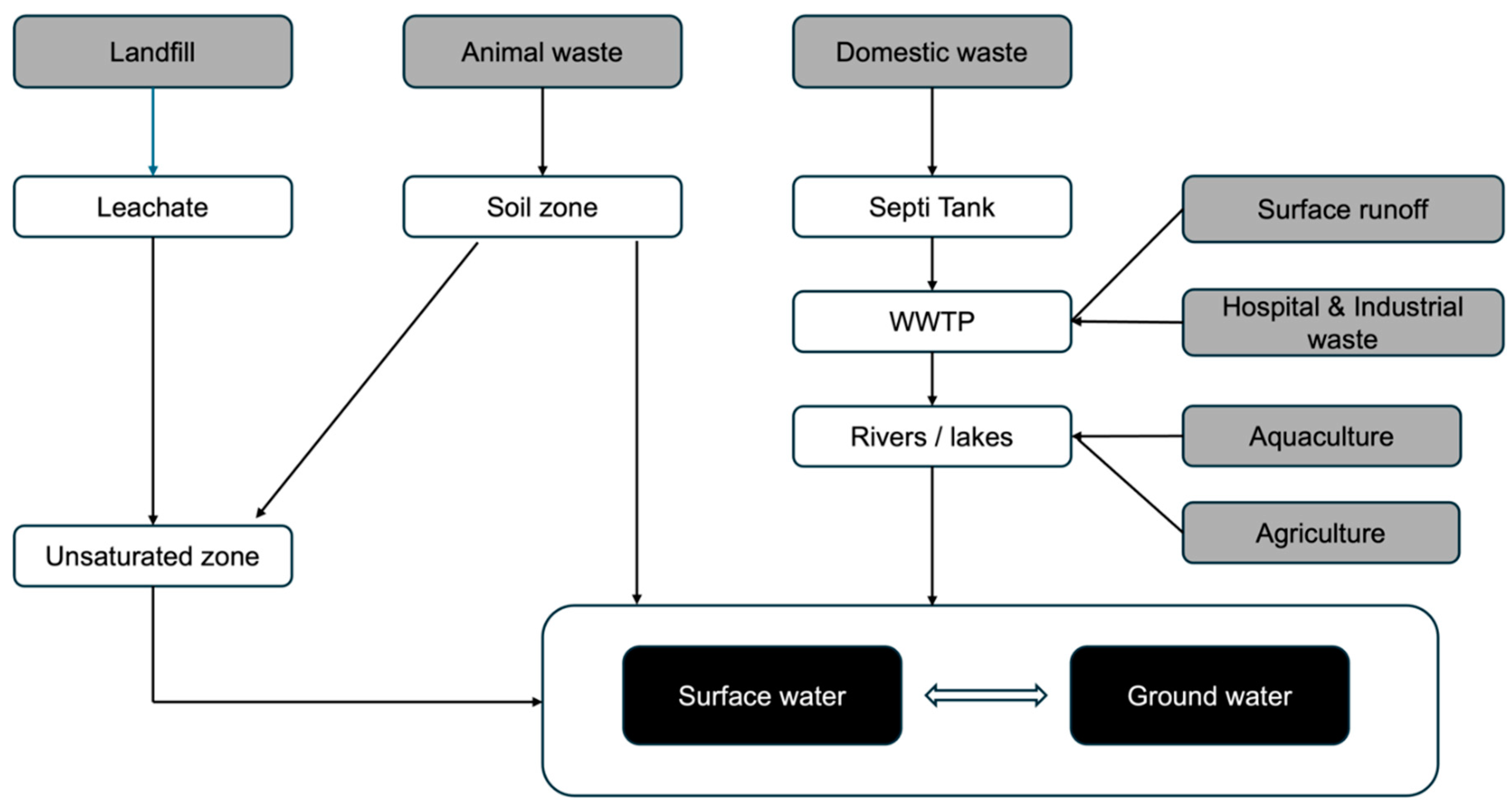
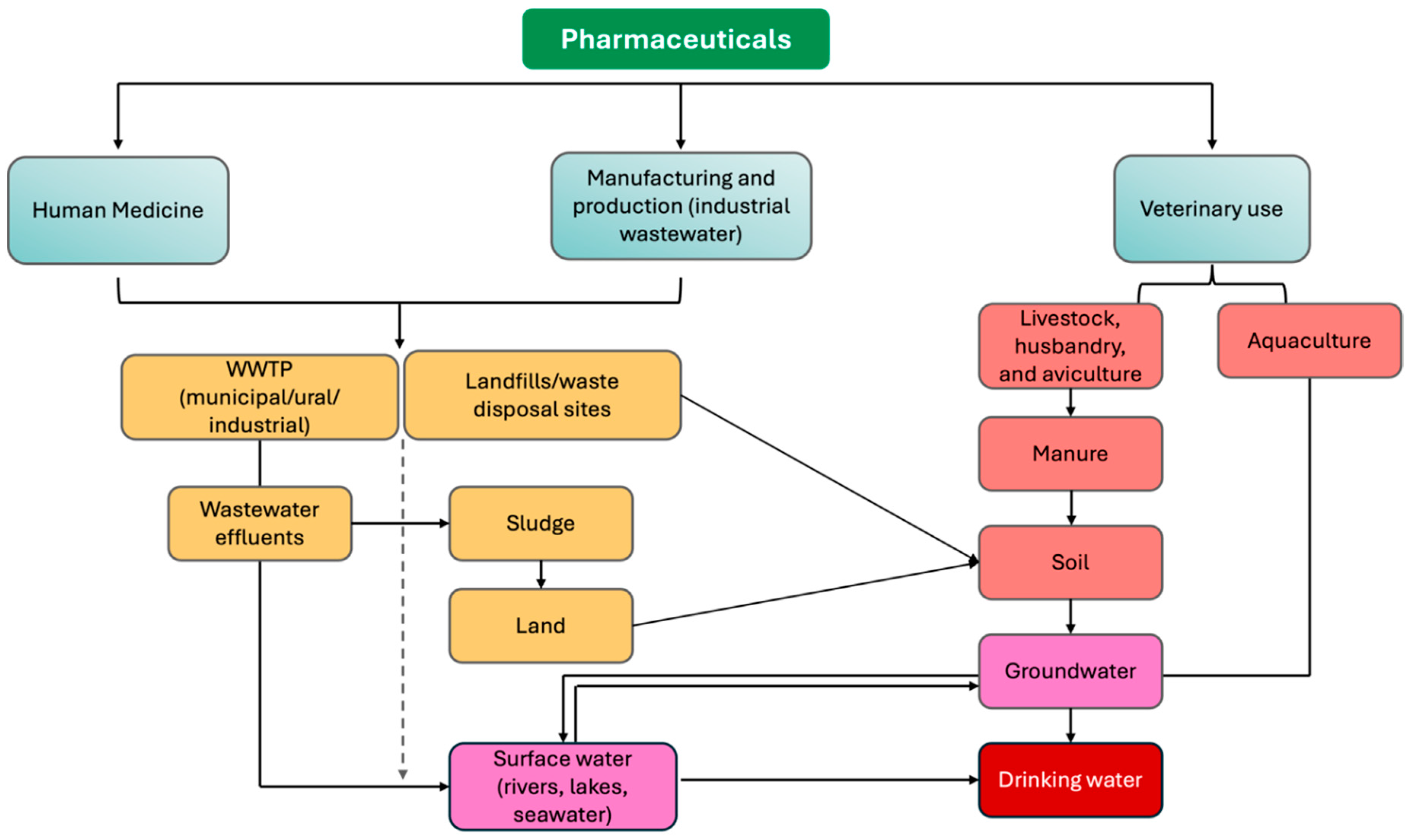
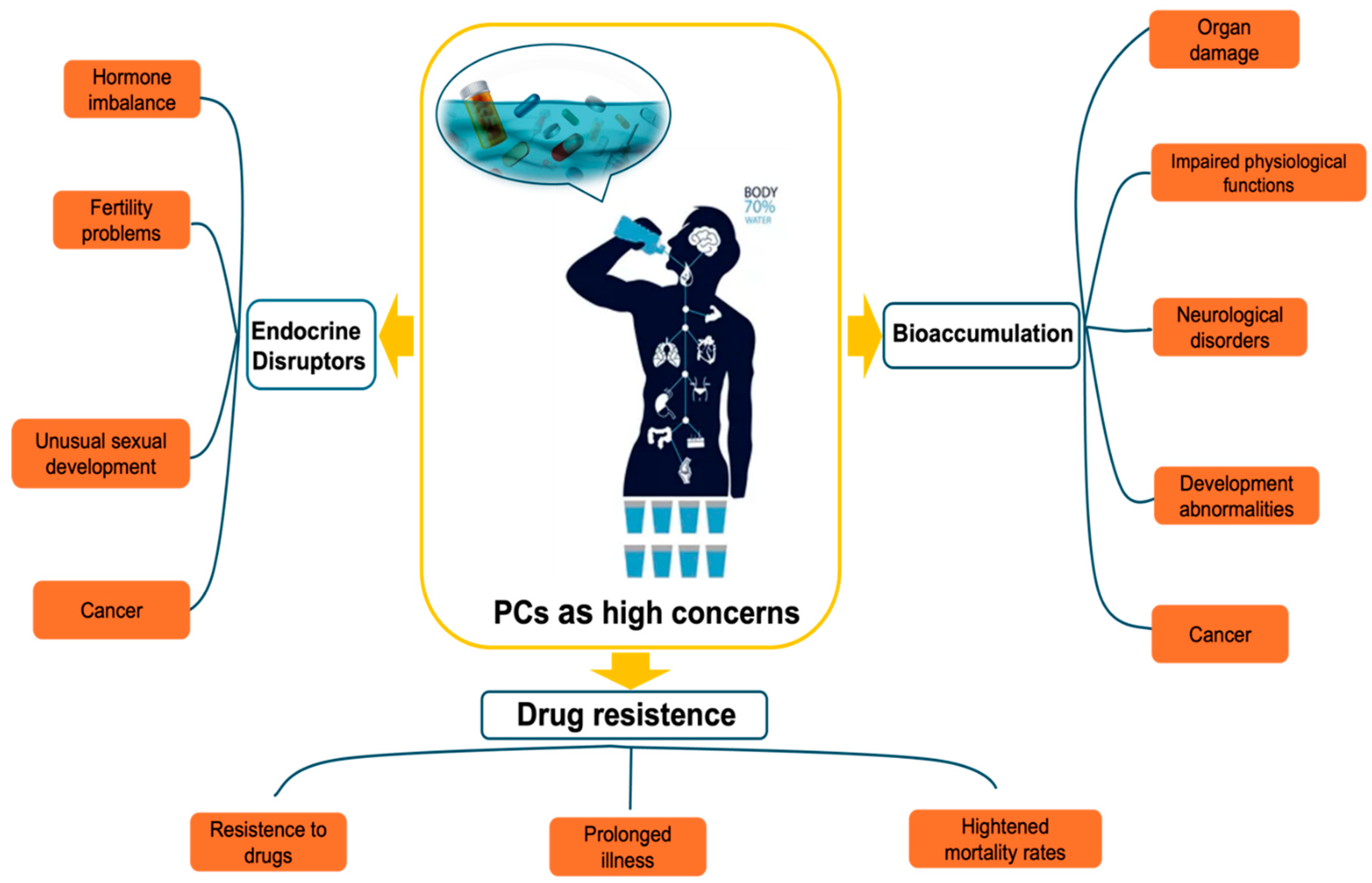
Figure 4.
Schematic representation of a conventional wastewater treatment plant, modified by [138,139].
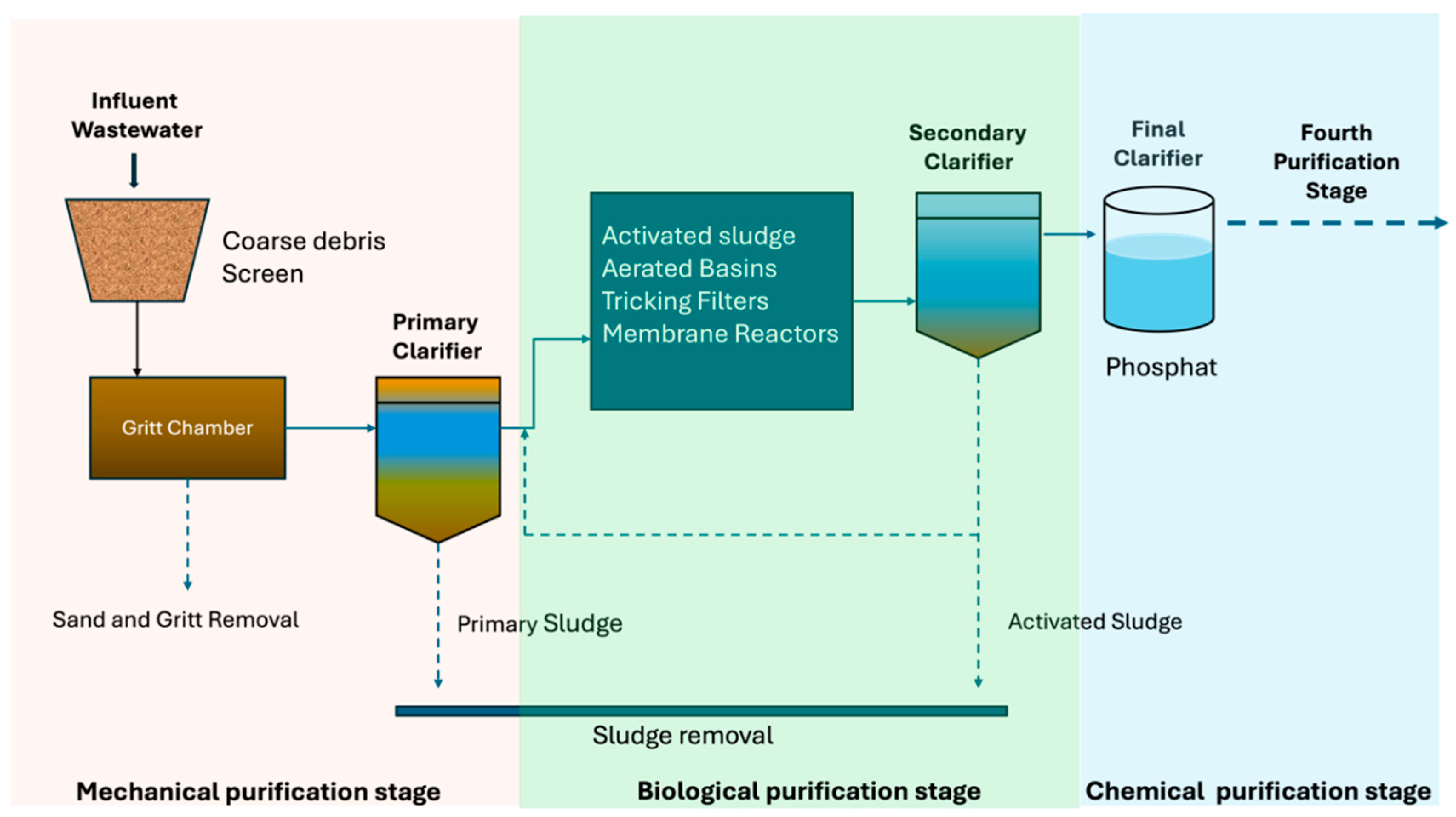
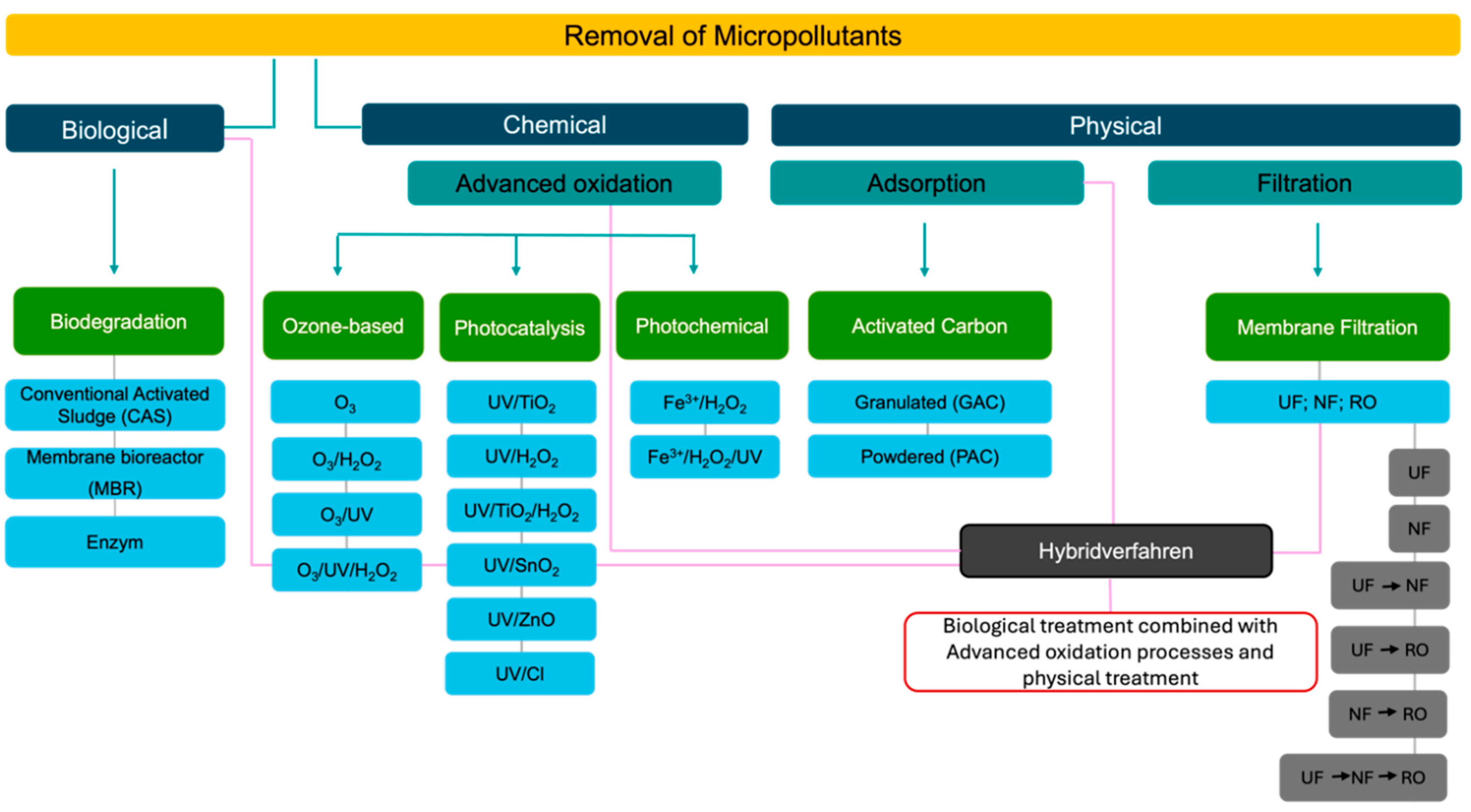
Figure 6.
Traditional and advanced biological treatment methods for wastewater treatment plants contaminated with pharmaceutical compounds, modified by [167,168].
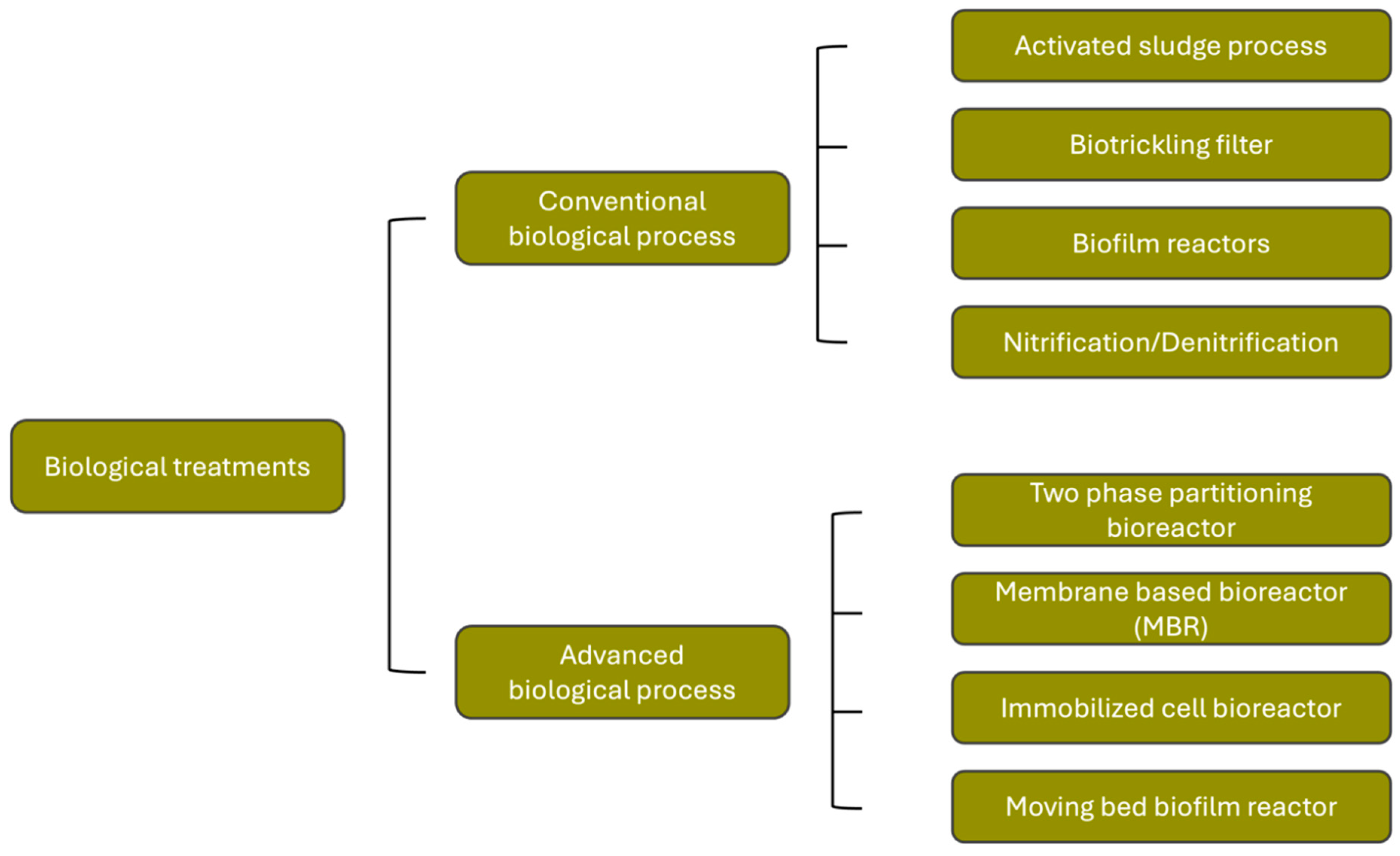

| Categories | Key Subcategories | Primary Sources | |
|---|---|---|---|
| Pharmaceuticals | NSAIDs, lipid regulators, antibiotics, β-blockers, contrast media, and anticonvulsants | Domestic sewage (from human excretion), Effluents from hospitals, Waste from animal farming and aquaculture |
|
| Personal care products | Fragrances, disinfectants, UV filters, and insect repellents | Household sewage (from bathing, shaving, and spraying) | |
| Endocrine disrupting chemicals | Estrogens | Human excreta-derived domestic wastewater Livestock production and aquaculture activities |
|
| Pesticides | Insecticides, herbicides and fungicides | Domestic wastewater originating from inadequate cleaning practices and garden runoff | |
| Industrial chemicals | Plasticizers, fire retardants | Domestic wastewater generated through the leaching of materials | |
| Microplastics | Microfibers, plastic pellets, synthetic fibers | Domestic wastewater resulting from urban runoff |
| Pharmaceutical Categories | Pharmaceutical pollutants | Chemical formulas | Mass (gmol-1) |
pKa | Log Kow | Ionization State at pH 7 |
|---|---|---|---|---|---|---|
| Analgesics and Anti-inflammatories | Aspirin | C9H8O4 | 280 | 3.5 | 1.2 | Negative |
| Diclofenac | C14H11Cl2NO2 | 296.2 | 4.91 | 4.51 | Negative | |
| Ibuprofen | C13H18O2 | 206.3 | 4.15 | 4.51 | Negative | |
| Paracetamol | C8H9NO2 | 151.2 | 9.38 | 0.46 | Neutral | |
| Naproxen | C14H14O3 | 230.3 | 4.15 | 3.18 | Negative | |
| Antibiotics | Sulfamethoxazole | C10H11N3O3S | 253.279 | 5.6- 5.7 | 0.89 | Negative |
| Erythromycin | C37H67NO13 | 733.93 | 8.88 | 2-48 | Neutral | |
| Trimethoprim | C14H18N4O3 | 290.32 | 7.12 | 0.73 | Neutral | |
| Anticonvulsants | primidone | C12H14N2O2 | 218 | -1;12.2 | 0.91 | Negative |
| Carbamazepine | C15H12N2O | 236.27 | 13 | 2.45 | Neutral | |
| ß-blockers | Propranolol | C16H21NO2 | 259.34 | 9.6 | 3.48 | Neutral |
| Metoprolol | C15H25NO3 | 276.37 | 9.49 | 1.88 | Positive | |
| Contrast media | Iopromide | C18H24I3N3O8 | 790.0 | 2;13 | -2.10 | Neutral |
| Iopamidol | C17H22I3N3O8 | 777.1 | 10.7 | -2.42 | Neutral | |
| Iohexol | C19H26I3N3O9 | 821.1 | 11.7 | -3.05 | Neutral | |
| Blood lipid regulators | Clofibric acid | C10H11ClO3 | 214.65 | 3.35 | 2.57 | Negative |
| Gemfibrozil | C15H22O3 | 250.34 | 4.45 | 4.77 | Negative | |
| Bezafibrate | C19H20ClNO4 | 361.82 | 3.44 | 4.25 | Negative | |
| Pravastatin | C23H36O7 | 24.53 | 4.2 | 3.1 | Negative |
Table 3.
Micropollutant concentrations across various water types and countries.
| Water Type | Micropollutants | Countries | Concentration [ng/L] | References |
|---|---|---|---|---|
| Surface Water |
Caffeine Diclofenac Carbamazepine Ibuprofen Naproxen Bisphenol A |
Germany Denmark Korea China UK Sweden Korea China USA Korea Germany Korea China Germany Sweden Korea China Europe USA Korea |
65 – 6,798 65 - 382 268.7 865 20 – 91 680 8,8 – 127 < 147 6.8 5 - 36 60 – 152 11 - 38 1417000 70 90 – 250 20 – 483 < 118 10 81 4.5 - 61 |
[105] [106] [107] [108] [109,110] [110] [111] [112] [113] [107] [114] [107] [115] [114] [116] [107] [115] [117] [117] [118] |
| Ground Water |
Caffeine Ibuprofen Carbamazepine Atrazine Bisphenol A |
USA Germany China Italy USA Europe Europe USA Europe Europe USA |
290 102 42.5 84 - 683 3,110 3 - 395 12 - 390 42 8 – 253 79 – 2299 4.1 – 1990 |
[119] [119] [119] [120] [121] [115] [105] [122] [105] [105] [123] |
| Drinking Water | Caffeine Diclofenac Carbamazepine Ibuprofen Naproxen Metoprolol Bisphenol A |
Spain Sweden USA Korea Turkey Germany Japan Spain Sweden France Japan France Japan France Germany France France Germany |
9.10 5.50 52.3 34.3 - 95.5 3390 611 16 25 8 56 25 41,6 6 14 244 6 1 72 |
[124] [125] [119] [126] [127,128] [128] [129] [130] [125] [131] [129] [131] [129] [131] [128] [131] [131] [128] |
| WWTP Effluent | Caffeine Diclofenac Carbamazepine Ibuprofen Atrazine Bisphenol A |
Europe Korea Europe Korea Europe Korea China Europe Korea Europe Europe China |
3002 60 174 49 4609 74 55 2129 75 36.6 200 623.6 |
[132] [133] [132] [133] [132] [133] [132] [132] [133] [132] [134] [134] |
Table 4.
Advantages and disadvantages of various treatment processes for pharmaceutical removal.
| Treatment Processes | Advantages | Disadvantages | References |
|---|---|---|---|
| Conventional biological treatment |
- Reduced initial investment - Versatile and straightforward technology - Environmentally sustainable |
- Inefficient removal of low-biodegradable pharmaceutical contaminants - Generation of toxic metabolites - Inability to target specific pharmaceutical contaminants - High sludge production |
[152,153,154] |
| Advanced biological treatment |
- Focused removal of contaminants - High adaptability to diverse wastewater characteristics - Space-efficient design - Improved removal of pharmaceutical contaminants - Effective operation at elevated suspended solids concentrations |
- High energy and initial investment costs - Membrane fouling issues - Challenges in degrading persistent PCs - Necessitate effective strategies for managing microbial activity |
[155,156,157] |
| Advanced Oxidation Processes (AOPs) | - Environmental compatibility - Synergy with other processes (biological or physical treatments) - Rapid processing and high efficiency - Effective in removing a broad spectrum of organic compounds |
- Generation of toxic byproducts - High energy and chemical requirements - Limited scalability due to cost and technical constraints - Need for specialized equipment and expertise |
[158,159,160] |
| Adsorptive treatment | - Low operational costs - Simple operation - Flexibility in using a wide range of adsorbents for specific requirements - Effluent with low dissolved solids |
- Adsorbent saturation - Gradual capacity decline after several treatment cycles - Column blockage - Limited selectivity - Challenges in regeneration and production of secondary waste |
[161,162,163] |
| Membrane technology | - High removal efficiency - Selective separation - Compact design, requiring less space - Versatility (able to treat a wide range of water matrices) |
- High installation and material costs - High energy consumption - Membrane fouling issues - Frequent membrane cleaning required - Necessitates brine disposal and toxicity assessment |
[159,164,165] |
Table 5.
Removal efficiency of selected pharmaceuticals by activated carbon from various precursors.
Table 5.
Removal efficiency of selected pharmaceuticals by activated carbon from various precursors.
| Pharmaceuticals | Water type | Concentration (mg/L) | AC | Removal efficiencies(%) | References |
|---|---|---|---|---|---|
| Diclofenac | Various | 10-30 | AC from cocoa pod husks | 76.0-93.6 | [210] |
| Carbamazepine | Wastewater | 2 | PAC | 93 | [211] |
| Naproxen | Wastewater | 1-30 | PAC | 67.2 – 89.2 | [212] |
| Sulfamethoxazole | Distilled | 50-500 | AC | 90 | [213] |
| Penicillin G | Distilled | 50-1000 | AC | 12.0 -78.3 | [214] |
| Atenolol | Various | 5-900 | GAC | 88 | [215] |
Table 6.
An overview of membrane processes using organic ultrafiltration membranes for micropollutant removal.
Table 6.
An overview of membrane processes using organic ultrafiltration membranes for micropollutant removal.
| MembraneProcesses | Matrix | Target MP (PPCPs)/ initial concentration | Removal efficiencies(%) | References |
|---|---|---|---|---|
| UF (10,000 Da) | Two natural water sources (drinking water source and MBR effluent) and lab-scale water (control sample) | 22 EDCs and PCs | [232] | |
| UF (2000-20,000 Da) | Secondary effluent spiked with various compounds | 11 contaminants: Acetaminophen, metoprolol, caffeine, antipyrine, sulfamethoxazole, flumequine, ketorolac, atrazine, isoproturon, hydroxybiphenyl, diclofenac |
<50%, except for hydroxybiphenyl | [233] |
| UF (8000 Da) | Synthetic (model) water and natural freshwater sources | 52 EDCs/PPCPs | Up to 80% removal efficiency for hydrophobic compounds | [236] |
| UF (100 kDa) | Synthetic (model) water | Estradiol and ibuprofen | 25% ibuprofen, 80% estradiol | [234] |
Table 7.
Rejection of selected pharmaceuticals by polymeric NF membranes.
| PCs | pH | Membrane Name | Materials | MWCO (Da) | Removal efficiencies (%) |
References |
|---|---|---|---|---|---|---|
| PARA* | 6.5 | NF270 | Polyamide | 200-300 | 44 | [239] |
| PARA IBU* PARA IBU |
7 6 - 7 |
NF 200 NF 90 |
Aromatic polyamide | ~ 300 ~ 200 |
22 89 75 96 |
[237] |
| PARA IBU DIC* PARA IBU DIC |
7.4 - 7.6 | NF 270 NF 90 |
Thin aromatic or semi-aromatic polyamide Polyamide |
200-300 ~200 |
0 99 95 99 99 90 |
[240,241] |
| PARA | 7 | NF 270 NF 90 |
Polypiperazine with polymeric active layer polyamide supported by a Polysulfone | 220 102 |
31 102 |
[241] |
| DIC IBU |
8 8 |
FM NP010 |
Hydrophilic Polyethersulfone | 1000 | 61 55 |
[242] |
| PARA DIC IBU |
12 3 6 - 7 |
NF 50 | Sulfonated Polyethersulfone | 1000 | 36.16 99.74 80.54 |
[224] |
*PARA: Paracetamol (151.16 g/mol); *DIC: Diclofenac (206.29 g/mol); *IBU: Ibuprofen (294,18 g/mol).
Table 8.
Rejection of selected pharmaceuticals by inorganic membranes.
| Membranes | MWCO (Da) | PCs | Removal efficiencies (%) | References |
|---|---|---|---|---|
| TiO2 | 200 | 41 organic compounds (PCs e.g. IBU, DIC and CARBA*) | 95-100 | [245] |
| LC1/LC2* | 630/440 | PCs e.g. SUL* and CBZ | 50-80 | [246] |
| TiO2 (UF-Membrane) |
3,0 nm | DIC and IBU | 32 - 47 | [135] |
| Al2O3/ LBL Coating with Polyelectrolytes (polystyrene sulfonic acid) |
~ 200 | IBU, DIC, SUL, Clofibric Acid | 56 % für SUL, up to 84 % für DIC |
[247] |
*CARBA: Carbamazepine; *SUL: Sulfamethoxazole; *LC1 and LC2 manufactured with active layers of TiO2/ZrO2.
Table 9.
Ozonation-based removal of selected pharmaceuticals.
| Applied treatment (concentration and duration) | Pharmaceuticals | Elimination efficiencies (%) | References |
|---|---|---|---|
| O3 (5 mg/L, 15 min) | Carbamazepine Diclofenac Metoprolol Trimethoprim |
>90 >90 80-90 >90 |
[8] |
| O3 (n/a, n/a) * |
Ibuprofen Diclofenac Carbamazepine |
83 99 80 |
[257] |
| O3 (33 mg/L, 20 min) | Tetracycline | 95 | [258] |
*n/a: not available.
Table 10.
The most widely used types of advanced oxidation processes for micropollutant removal.
| AOPs-Type | Micropollutants | Removal efficiencies of PCs (%) | References |
|---|---|---|---|
| Peroxone | Pharmaceuticals, pesticides andbeta-blockers | 97-100 | [266] |
| UV/H2O2 | anticancer drug fluorouracil (5-FU) | >99 | [260] |
| Photo-Fenton | pharmaceuticals, corrosion inhibitors and biocides/pesticides | 97- 98 | [264] |
| Electrochemical Oxidation | antibiotics e.g. Ofloxacin | ~ 90 | [267] |
| TiO2 -solar photocatalysis | Pharmaceuticals, Diclofenac | ~90 | [263] |
Disclaimer/Publisher’s Note: The statements, opinions and data contained in all publications are solely those of the individual author(s) and contributor(s) and not of MDPI and/or the editor(s). MDPI and/or the editor(s) disclaim responsibility for any injury to people or property resulting from any ideas, methods, instructions or products referred to in the content. |
© 2025 by the authors. Licensee MDPI, Basel, Switzerland. This article is an open access article distributed under the terms and conditions of the Creative Commons Attribution (CC BY) license (http://creativecommons.org/licenses/by/4.0/).
Copyright: This open access article is published under a Creative Commons CC BY 4.0 license, which permit the free download, distribution, and reuse, provided that the author and preprint are cited in any reuse.