

Submitted:
15 December 2024
Posted:
16 December 2024
You are already at the latest version
Abstract
This study evaluates the performance of various structure prediction tools and molecular docking platforms for therapeutic peptides targeting coronary artery disease (CAD). Structure prediction tools, including AlphaFold 3, I-TASSER, and PEP-FOLD 4, were employed to generate accurate peptide conformations. These methods, ranging from deep learning-based (AlphaFold) to template-based (I-TASSER) and fragment-based (PEP-FOLD), were selected for their proven capabilities in predicting reliable structures. Molecular docking was conducted using four platforms (HADDOCK 2.4, HPEPDOCK 2.0, ClusPro 2.0, and HawDock 2.0) to assess binding affinities and interactions. A 100 ns molecular dynamics (MD) simulation was performed to evaluate the stability of the peptide-receptor complexes, along with MM/PBSA calculations to determine binding free energies. The results demonstrated that Apelin, a therapeutic peptide, exhibited superior binding affinities and stability across all platforms, making it a promising candidate for CAD therapy. Apelin’s interactions with key receptors involved in cardiovascular health were notably stronger and more stable compared to other peptides tested. These findings underscore the importance of integrating advanced computational tools for peptide design and evaluation, offering valuable insights for future therapeutic applications in CAD. Future work should focus on in vivo validation and combination therapies to fully explore the clinical potential of these therapeutic peptides.
Keywords:
apelin
; coronary artery disease
; molecular docking
; molecular dynamics
; structure prediction
; therapeutic peptides
1. Introduction
Coronary Artery Disease (CAD) remains one of the leading causes of mortality worldwide, characterized by the narrowing or blockage of coronary arteries due to atherosclerosis [1,2]. This condition results in reduced blood flow to the heart, leading to angina, myocardial infarction, and heart failure [3]. Current treatment options for CAD include lifestyle modifications, pharmacological interventions, and invasive procedures such as angioplasty and coronary artery bypass grafting. However, these treatments often address symptoms rather than the underlying molecular mechanisms driving the disease [4,5]. Consequently, there is an urgent need to develop novel therapeutics that can effectively target key pathways involved in CAD progression. Peptide-based therapeutics have emerged as a promising class of drugs due to their high specificity, low immunogenicity, and ability to modulate protein-protein interactions [6,7]. Therapeutic peptides have shown potential in targeting critical pathways associated with CAD, including inflammation, endothelial dysfunction, oxidative stress, and lipid metabolism [8,9]. Peptides such as glucagon-like peptide-1 (GLP-1) analogs, Nesiritide, and Apelin are either approved for clinical use or undergoing trials for CAD treatment, demonstrating their relevance as effective therapeutic agents [10,11]. Despite this promise, the design and optimization of peptide therapeutics remain challenging due to the need for accurate structural modeling and interaction prediction with specific target receptors [12,13].
Computational tools have revolutionized drug discovery by enabling in silico design and evaluation of therapeutic candidates [14,15]. For peptides, two critical steps are structure prediction and molecular docking. Structure prediction determines peptides' three-dimensional (3D) conformation, which is essential for understanding their functional properties and interaction mechanisms. Molecular docking simulates the binding of peptides to target receptors, providing insights into binding affinity, specificity, and potential interaction sites [16,17,18]. The accuracy and reliability of these tools directly impact the efficiency of peptide drug development. To address these challenges, this study aimed to systematically evaluate web-based computational tools for peptide structure prediction and molecular docking, focusing on their application to therapeutic peptides targeting CAD. The structure prediction tools included AlphaFold 3, I-TASSER, and PEP-FOLD 4, representing a spectrum of methodologies from deep learning-based predictions (AlphaFold) to template-based modeling (I-TASSER) and fragment-based de novo predictions (PEP-FOLD). These tools were selected for their availability, accuracy, and proven capabilities in predicting reliable peptide conformations. For molecular docking, four web-based platforms were assessed: HADDOCK 2.4, HPEPDOCK 2.0, ClusPro 2.0, and HawDock 2.0. These tools encompassed a range of docking methodologies, including rigid-body docking, flexible docking, and physics-based scoring functions. Each tool was evaluated for its usability, computational efficiency, and ability to predict accurate peptide-receptor binding modes. By focusing on tools available in web-based formats, the study ensured accessibility and relevance for researchers without requiring extensive computational resources.
The study applied these tools to a set of clinically relevant therapeutic peptides, including FX06, Liraglutide, Exenatide, Nesiritide, Apelin, GLP-1, and Atrial Natriuretic Peptide (ANP). These peptides target receptors implicated in CAD pathophysiology, such as angiotensin II type 1 receptor (AT1R), glucagon-like peptide-1 receptor (GLP-1R), and interleukin-6 receptor (IL-6R). Target receptors were selected based on their direct involvement in vascular remodeling, inflammatory response, and cardiac function pathways. Molecular dynamics (MD) simulations were performed using GROMACS to validate docking results and ensure realistic interaction modeling. MD simulations accounted for the dynamic nature of peptide-receptor complexes under physiological conditions, providing a robust framework for evaluating therapeutic peptides' stability and binding interactions. This study aimed to provide a comprehensive framework for peptide-based drug design targeting CAD by systematically comparing these tools and integrating MD validation. The findings offered valuable insights into the strengths and limitations of available computational platforms, contributing to optimizing peptide therapeutics for cardiovascular diseases and advancing their translation from bench to bedside.
2. Results
2.1. Evaluation of Structure Prediction Tools
The performance of three widely used structure prediction tools (AlphaFold 3, I-TASSER, and PEP-FOLD 4) was systematically evaluated for their ability to generate accurate 3D models of therapeutic peptides. The assessment focused on Z-scores, Ramachandran plot analyses, overall model quality, and local model quality to determine the most reliable tool for peptide structure prediction (Table 1). Among the tools, AlphaFold 3 consistently demonstrated superior performance, producing models with the most favorable Z-scores and minimal outliers in the Ramachandran plots, making it the optimal choice for predicting peptide structures. The complete results can be seen in Supplementary Data S1.
The Z-score, a critical metric for assessing the structural reliability and statistical quality of predicted models, highlighted clear distinctions between the tools [19,20]. Apelin, used as the first test case, exhibited a Z-score of -4.21 when predicted by AlphaFold 3, indicating a high-quality model. In comparison, the Z-score for I-TASSER was less favorable at -2.06, while PEP-FOLD 4 produced a significantly poorer Z-score of -1.15. This marked difference underscores AlphaFold 3's capability to generate statistically robust and structurally accurate models. This trend was observed across all tested peptides. For example, FX06, another therapeutic peptide, had a Z-score of -4.72 with AlphaFold 3, outperforming I-TASSER (-4.46) and PEP-FOLD 4, which generated a much less favorable Z-score of 0.11. Similarly, for GLP-1, AlphaFold 3 yielded a Z-score of -0.95, slightly better than I-TASSER (-0.91) and considerably better than PEP-FOLD 4 (-0.72). These results establish AlphaFold 3 as the most reliable tool in terms of Z-score evaluation, especially for peptides with complex secondary and tertiary structures. Ramachandran plot validation further demonstrated AlphaFold 3’s superior structural accuracy. For all peptides, the models generated by AlphaFold 3 exhibited the fewest outliers in the disallowed regions, indicating proper backbone dihedral angles and minimal steric clashes. In the case of Apelin, AlphaFold 3 achieved an optimal distribution of residues in the favored and allowed regions, with only a negligible number of residues in disallowed regions. In contrast, I-TASSER showed moderate accuracy, with more outliers than AlphaFold 3, while PEP-FOLD 4 consistently had the highest number of residues in disallowed regions, reflecting inferior structural predictions. This pattern held true for other peptides, such as Liraglutide and Nesiritide, where AlphaFold 3 produced models with superior backbone geometry and minimized steric hindrance. The Ramachandran plots generated by I-TASSER, while moderately accurate, revealed slightly higher outliers, particularly in loop regions. In contrast, PEP-FOLD 4 models suffered from significant deviations, particularly in regions with high flexibility.
AlphaFold 3 also excelled in overall and local model quality metrics. For peptides like ANP and Exenatide, AlphaFold 3's predictions aligned more closely with experimental structures, displaying lower deviations in both global and localized structural features. I-TASSER provided moderate results, often approximating the structural integrity observed in AlphaFold 3 models. However, PEP-FOLD 4 consistently underperformed, with inaccuracies in local model quality, particularly in active site regions or areas involving intricate secondary structures. While I-TASSER demonstrated acceptable performance for simpler peptides, its accuracy declined for more structurally complex or larger peptides, such as FX06 and Apelin, where it struggled to maintain global structural fidelity. PEP-FOLD 4, optimized for generating de novo structures, was the least reliable, showing consistent issues with model quality, particularly in terms of backbone geometry and residue orientations. In contrast, AlphaFold 3 consistently delivered high-quality results across peptides of varying complexity, reaffirming its utility in structural biology and peptide-based therapeutic research.
2.2. Evaluation of Molecular Docking Tools
Molecular docking is an essential computational tool for exploring peptide-receptor interactions, particularly in CAD research [21]. The results of docking analyses across four prominent platforms (HADDOCK 2.4, HPEPDOCK 2.0, ClusPro 2.0, and HawkDock 2.0) highlight significant variations in binding affinity scores (presented as negative binding energies, where lower values indicate stronger binding). These docking tools were evaluated for their performance in simulating the interaction of therapeutic peptides with CAD-related receptors, and their comparative performance underscores differences in algorithmic approaches, accuracy, and usability. HawkDock 2.0 consistently provided the most favorable binding scores for a majority of peptide-receptor complexes. For example, in the interaction of atrial natriuretic peptide (ANP) with the receptors NPY1R and VEGFR2, HawkDock achieved binding scores of -20.1 and -20.9 kcal/mol, respectively. These values indicate a strong binding affinity, suggesting that HawkDock's advanced scoring functions and energy minimization steps accurately simulate peptide-receptor interactions. The Molecular Mechanics Generalized Born Surface Area (MM/GBSA) approach employed by HawkDock is particularly advantageous, as it factors in solvent effects and provides a more accurate representation of the binding free energy [22,23], making it a superior choice for CAD-related docking studies. The method’s robustness in handling the complex interactions between therapeutic peptides and CAD receptors not only predicts binding affinities but also facilitates the identification of key interactions that are crucial for therapeutic efficacy. ClusPro 2.0 demonstrated moderate to strong binding predictions in many cases but fell short of HawkDock in key receptor interactions. For instance, ClusPro produced binding scores of -9.5 and -10.4 kcal/mol for the ANP_NPY1R and Apelin_VEGFR2 complexes, noticeably weaker than HawkDock’s results. Despite its lower performance in some instances, ClusPro excelled in specific peptide-receptor pairs, such as Apelin_AT1R (-15.6 kcal/mol) and Exenatide_VEGFR2 (-12.9 kcal/mol). These successes highlight its utility for particular interactions where its scoring functions align well with experimental findings. However, for broader applications across different receptor targets, ClusPro's performance is less consistent compared to HawkDock, making it a supplementary tool rather than the primary choice for CAD-related docking studies.
Figure 1.
Comparison of molecular docking simulation results from HADDOCK 2.4, HPEPDOCK 2.0, ClusPro 2.0, and HawDock 2.0, showing the binding affinity (ΔG, kcal/mol) of seven therapeutic peptides interacting with CAD-related receptors.
Figure 1.
Comparison of molecular docking simulation results from HADDOCK 2.4, HPEPDOCK 2.0, ClusPro 2.0, and HawDock 2.0, showing the binding affinity (ΔG, kcal/mol) of seven therapeutic peptides interacting with CAD-related receptors.
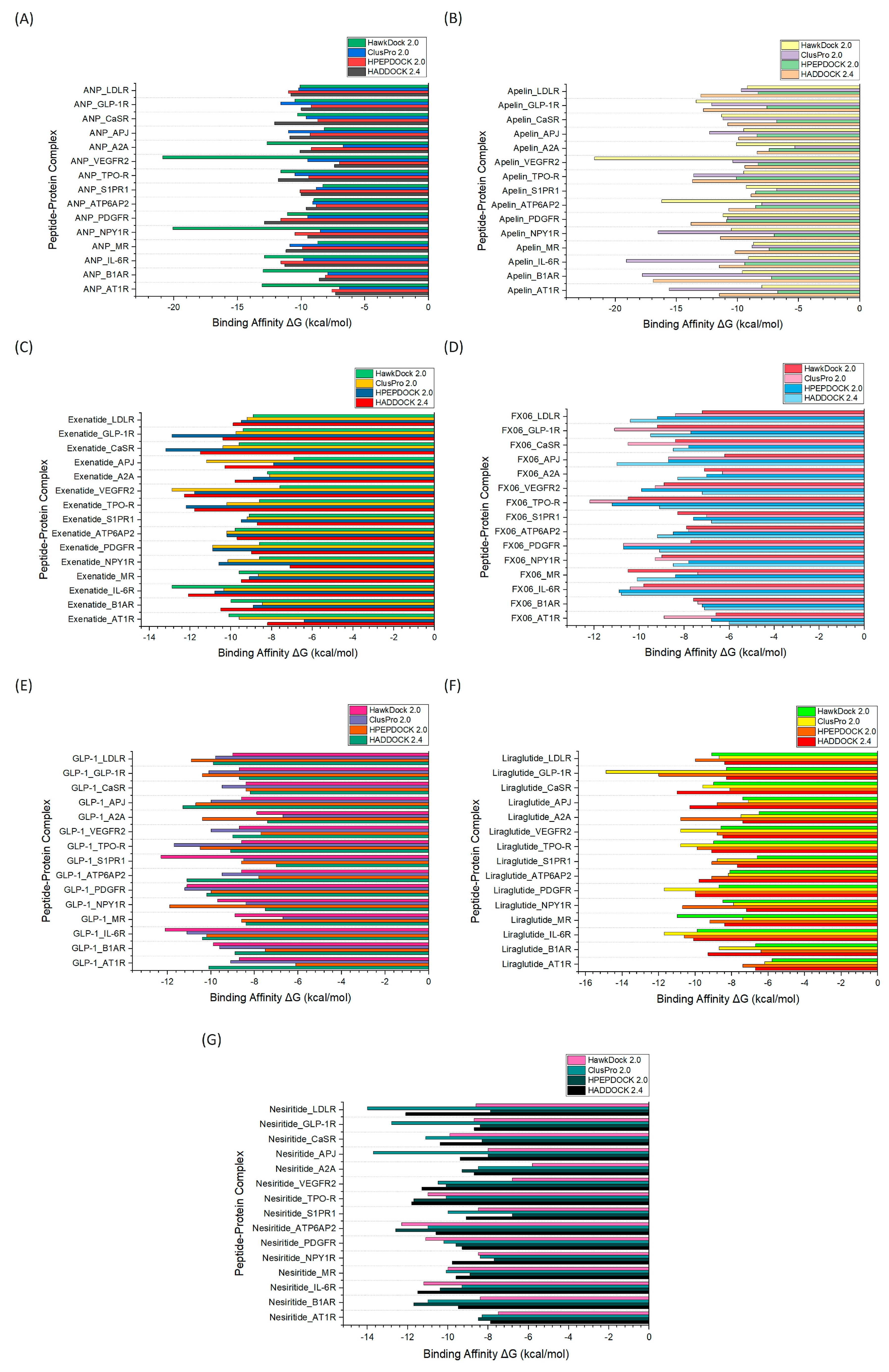
HADDOCK 2.4 was competitive for a limited number of interactions, particularly in peptides targeting the interleukin-6 receptor (IL-6R). For example, HADDOCK provided a binding score of -12.1 kcal/mol for Exenatide_IL-6R, closely aligning with HawkDock (-12.9 kcal/mol). This performance demonstrates its capability to handle challenging peptide-receptor interactions with reasonable accuracy. However, its performance was inconsistent across other receptor targets, often yielding weaker binding scores compared to the other tools. HADDOCK's approach to integrating experimental restraints through HADDOCK’s scoring system can be advantageous for certain applications, but its variable performance across different receptor-peptide combinations limits its overall utility for CAD docking studies. HPEPDOCK 2.0 generally delivered the weakest binding scores among the four platforms. While it showed some alignment with other tools for certain complexes, such as GLP-1_PDGFR (-10.0 kcal/mol), its overall reliability in predicting strong peptide-receptor binding was lower. For example, HPEPDOCK underperformed in Apelin_AT1R (-6.7 kcal/mol) and Exenatide_NPY1R (-10.6 kcal/mol) compared to HawkDock. The tool’s more straightforward scoring functions and less sophisticated energy models may contribute to its lower predictive accuracy. It appears to be less equipped to handle the intricacies of CAD-related interactions, making it a less suitable choice for detailed peptide docking studies focused on CAD.
HawkDock 2.0 emerges as the most favorable platform for performing molecular docking of therapeutic peptides with CAD-related receptors. This superiority is attributed to its advanced MM/GBSA methodology, which provides a robust and detailed calculation of binding free energy. HawkDock’s consistently strong performance across diverse peptide-receptor complexes, including challenging targets like NPY1R and VEGFR2, makes it a reliable choice for CAD-focused docking studies. The platform’s ability to accurately model solvent effects and predict binding affinities ensures that it captures not only the strength of interactions but also the quality of the binding site complementarity, making it an ideal tool for CAD therapeutic development. Furthermore, HawkDock’s capability to handle a wide range of peptide-receptor interactions with its advanced scoring functions allows for better prediction of biologically relevant binding affinities. Its integration of advanced computational techniques ensures high sensitivity and specificity in predicting the binding patterns of therapeutic peptides. This makes HawkDock particularly valuable for drug discovery and therapeutic peptide design in CAD, where precise prediction of binding interactions is crucial for developing effective treatments. The tool’s reliable performance across various CAD-related receptor targets provides a significant advantage in the preclinical evaluation of potential therapeutic peptides, enhancing the efficiency of the drug development pipeline.
Table 2 highlights the best binding affinity values for peptides functioning as antagonists. Among the peptides tested, Apelin demonstrated consistently strong binding to multiple receptors, including AT1R (-15.6 kcal/mol), β1AR (-17.8 kcal/mol), and IL-6R (-19.1 kcal/mol), as evaluated using the ClusPro 2.0 platform. Notably, Apelin also exhibited high affinity for VEGFR2 (-21.7 kcal/mol) using HawkDock 2.0, which is the strongest binding affinity observed in this study. These findings suggest that Apelin could act as a potent antagonist against VEGFR2, a receptor integral to angiogenesis and vascular proliferation, highlighting its potential role in anti-angiogenic therapies. Additionally, ANP displayed remarkable affinity for NPY1R (-20.1 kcal/mol) using HawkDock 2.0, demonstrating its potential as a strong antagonist for receptors associated with metabolic and cardiovascular regulation. Liraglutide, on the other hand, exhibited moderate binding to MR (-11.0 kcal/mol) on the same platform, indicating a more selective antagonistic role.
Table 3 presents the best binding affinities for peptides functioning as agonists. Apelin again emerged as a strong candidate, demonstrating notable affinity for GLP-1R (-13.4 kcal/mol) on HawkDock 2.0 and APJ (-12.3 kcal/mol) on ClusPro 2.0. The APJ receptor is well-established for its role in cardiovascular homeostasis, further supporting Apelin’s relevance in CAD therapy. Exenatide exhibited high binding affinity to CaSR (-13.2 kcal/mol) using HADDOCK 2.4, suggesting its potential role in modulating calcium signaling for bone health and other metabolic processes. For LDLR, ANP showed a binding affinity of -11.0 kcal/mol on HPEPDOCK 2.0, reinforcing its application in lipid metabolism regulation. Furthermore, ANP displayed strong agonistic potential with A2A (-12.7 kcal/mol) using HawkDock 2.0, suggesting applications in neurovascular therapies. However, among all peptides studied, Apelin showed the most favorable profile due to its robust affinity for multiple cardiovascular-related receptors.
The consistent and high-affinity interactions of Apelin with key receptors, such as β1AR, AT1R, and APJ, highlight its unique potential in managing coronary artery disease (CAD). These receptors are central to cardiovascular regulation, including blood pressure control, vascular remodeling, and myocardial function. Apelin's dual role as an antagonist (e.g., AT1R and VEGFR2) and agonist (e.g., APJ) further enhances its therapeutic flexibility, allowing for modulation of both vasoconstrictive and vasodilatory pathways. In particular, the strong binding affinity of Apelin to VEGFR2 (-21.7 kcal/mol) positions it as a promising agent in anti-angiogenic therapies, which are crucial for reducing excessive vascular proliferation in CAD. Similarly, its interactions with AT1R and β1AR suggest its potential to mitigate hypertension and improve cardiac output, both of which are critical for CAD management. The complete molecular docking simulation results and molecular interactions can be seen in Supplementary Data S2 and Supplementary Data S3, respectively.
2.3. Molecular Dynamics (MD) Simulation
The results from the MD simulations provide a detailed view of the interactions between therapeutic peptides and their respective target receptors. These simulations were crucial in assessing the structural stability and binding affinities of different therapeutic peptides, with a focus on Apelin as the most favorable candidate for CAD. Apelin consistently shows the lowest RMSD values across all its complexes with target receptors, ranging from 2.011 to 2.232 Å. These lower RMSD values indicate that Apelin binds more stably to its receptors, experiencing minimal structural deviations during the simulation period. For example, the Apelin_AT1R complex has an RMSD of 2.124 Å, suggesting a stable binding conformation throughout the simulation. In contrast, Liraglutide exhibits a higher RMSD (2.987 Å), indicating more significant conformational changes, which might compromise its binding efficiency and suitability for CAD treatment. The RMSF values offer insights into the flexibility of residues within the binding interface. Apelin complexes display lower RMSF values (1.511 to 1.867 Å), reflecting a more rigid and stable binding environment. For instance, Apelin_VEGFR2 shows the lowest RMSF of 1.511 Å, highlighting its optimal binding flexibility with minimal fluctuations. In comparison, complexes involving ANP and Exenatide demonstrate higher RMSF values (up to 2.708 Å), indicating greater fluctuations and suggesting potentially weaker interactions with their respective receptors.

Table 4.
Molecular dynamics (MD) simulation results of the 15 best therapeutic peptide-protein complexes for CAD.
Table 4.
Molecular dynamics (MD) simulation results of the 15 best therapeutic peptide-protein complexes for CAD.
| Therapeutic Peptide-Protein Complex | Average RMSD (Å) | Average RMSF (Å) | Average RoG (Å) | Number of hydrogen bonds between the two proteins |
| Apelin_AT1R | 2.124 | 1.821 | 2.352 | 8 |
| Apelin_ β1AR | 2.267 | 1.744 | 2.342 | 10 |
| Apelin_ IL-6R | 2.011 | 1.637 | 2.346 | 9 |
| Liraglutide_MR | 2.987 | 2.378 | 2.632 | 5 |
| ANP_ NPY1R | 2.824 | 2.412 | 2.639 | 6 |
| Apelin_ PDGFR | 2.357 | 2.004 | 2.499 | 7 |
| Apelin_ ATP6AP2 | 2.139 | 1.904 | 2.519 | 8 |
| ANP_ S1PR1 | 2.902 | 2.554 | 2.652 | 4 |
| FX06_ TPO-R | 2.706 | 2.228 | 2.629 | 5 |
| Apelin_VEGFR2 | 2.008 | 1.511 | 2.326 | 11 |
| ANP_ A2A | 2.675 | 2.425 | 2.653 | 6 |
| Apelin_APJ | 2.232 | 1.867 | 2.446 | 10 |
| Exenatide_CaSR | 3.012 | 2.708 | 2.691 | 4 |
| Apelin_GLP-1R | 2.356 | 1.912 | 2.487 | 9 |
| ANP_LDLR | 2.899 | 2.509 | 2.624 | 5 |
RoG values provide information about the compactness of the peptide-receptor complex. Apelin consistently presents a lower RoG (ranging from 2.326 to 2.519 Å) across its complexes, which implies a more compact and stable structure. The lower RoG indicates that Apelin maintains a stable conformation with minimal expansion upon binding. On the other hand, complexes involving FX06 and Exenatide show higher RoG values (up to 2.691 Å), which could imply less stability and more solvent accessibility in the binding pocket. Apelin complexes also exhibit a higher number of hydrogen bonds between the peptide and its receptor, ranging from 8 to 11 hydrogen bonds. This increased number of hydrogen bonds significantly contributes to the binding stability of Apelin. For example, Apelin_VEGFR2 forms 11 hydrogen bonds, which enhance its binding affinity. In contrast, complexes such as ANP_S1PR1 and Exenatide_CaSR have fewer hydrogen bonds (4-6), leading to less stable interactions and possibly weaker binding affinities. Among all therapeutic peptides studied, Apelin emerges as the most favorable candidate for CAD treatment. Its consistently low RMSD, RMSF, and RoG values, along with a higher number of hydrogen bonds, underscore its superior binding stability and affinity across different target receptors. Apelin's binding conformation appears more favorable, maintaining a stable and compact structure essential for effective therapeutic action in CAD. The significant binding affinity of Apelin across various receptors like AT1R, β1AR, IL-6R, and VEGFR2, as evidenced by its lowest ΔGbinding values in both MM/PBSA calculations and MD simulations, further cements its potential as a leading therapeutic peptide for CAD.
2.4. Molecular Mechanics/Poisson–Boltzmann Surface Area (MM/PBSA) Calculations
The MM/PBSA calculations provided quantitative insights into the binding free energy (ΔGbinding) of therapeutic peptides with their target proteins. More negative ΔGbinding values reflect stronger binding and greater thermodynamic stability of the peptide-protein complexes. Among the tested therapeutic peptides, Apelin displayed the most favorable binding affinity values with ΔGbinding ranging from -81.69 to -199.17 kcal/mol. Notably, its interaction with VEGFR2 yielded the most negative ΔGbinding (-199.17 kcal/mol), indicating an exceptionally stable complex. VEGFR2 plays a central role in angiogenesis, and inhibiting its activity can reduce excessive vascular proliferation, which is critical in the pathogenesis of CAD. Apelin also showed robust binding to AT1R (-140.54 kcal/mol) and β1AR (-156.53 kcal/mol), two key receptors involved in blood pressure regulation and myocardial function. These interactions suggest Apelin’s ability to modulate vasoconstriction and improve cardiac output, both of which are pivotal in CAD management. Furthermore, its binding to APJ (-171.62 kcal/mol) highlights its role in supporting cardiovascular homeostasis through vasodilatory and cardioprotective pathways. The ΔGbinding of Apelin with GLP-1R (-96.70 kcal/mol) and IL-6R (-163.66 kcal/mol) also indicates its potential to mitigate inflammation and improve glucose metabolism, further reinforcing its utility in addressing comorbidities often associated with CAD.
Table 5.
MM/PBSA calculation results for binding free energies of the best complexes of therapeutic peptide-protein.
Table 5.
MM/PBSA calculation results for binding free energies of the best complexes of therapeutic peptide-protein.
| Therapeutic Peptide-Protein Complex |
MM/PBSA Calculation Results ΔGbinding (kcal/mol) |
| Apelin_AT1R | -140.54 |
| Apelin_ β1AR | -156.53 |
| Apelin_ IL-6R | -163.66 |
| Liraglutide_MR | -50.27 |
| ANP_ NPY1R | -80.38 |
| Apelin_ PDGFR | -81.69 |
| Apelin_ ATP6AP2 | -103.43 |
| ANP_ S1PR1 | -54.57 |
| FX06_ TPO-R | -60.90 |
| Apelin_VEGFR2 | -199.17 |
| ANP_ A2A | -87.74 |
| Apelin_APJ | -171.62 |
| Exenatide_CaSR | -49.35 |
| Apelin_GLP-1R | -96.70 |
| ANP_LDLR | -49.26 |
While other therapeutic peptides such as ANP and Liraglutide demonstrated moderate binding affinities, their ΔGbinding values were significantly less favorable compared to Apelin. For example, ANP exhibited a binding energy of -80.38 kcal/mol with NPY1R and -87.74 kcal/mol with A2A, suggesting potential in regulating metabolism and vascular tone. Similarly, Liraglutide showed a relatively weak binding affinity of -50.27 kcal/mol with MR, indicating limited scope in CAD treatment. The MM/PBSA calculations emphasize Apelin’s superior binding performance across receptors critical to cardiovascular health. Its strong interaction with VEGFR2 suggests a significant role in anti-angiogenic therapy, targeting vascular remodeling and preventing atherosclerotic plaque formation in CAD patients. Meanwhile, its binding to AT1R and β1AR points to potential antihypertensive effects, enhancing myocardial efficiency and reducing the workload on the heart. The binding of Apelin to APJ and GLP-1R further underscores its versatility, as these receptors contribute to cardioprotection, glucose homeostasis, and inflammatory regulation, key factors in the systemic management of CAD.
3. Discussion
In the context of therapeutic peptide design, the integration of state-of-the-art computational tools like AlphaFold 3 and HawDock 2.0 offers a significant advantage. AlphaFold 3 has emerged as the best tool for accurate 3D structure prediction of therapeutic peptides. Its deep learning-based approach has revolutionized the field by providing high-fidelity models of peptide structures, facilitating a deeper understanding of their binding interactions and conformational flexibility. For therapeutic peptides targeting CAD, AlphaFold 3 can predict precise binding sites and conformations [24], which is critical for understanding their interaction with cardiovascular receptors like AT1R and β1AR. On the other hand, HawDock 2.0 excels in molecular docking simulations, providing robust performance in predicting peptide-receptor binding affinities and interactions. Its integration with MM/GBSA calculations enhances the accuracy of binding free energy predictions, which is crucial for evaluating the therapeutic potential of peptides for CAD. The advanced docking capabilities of HawDock 2.0 enable detailed analysis of the interaction dynamics between peptides and their target receptors, offering valuable insights into the stability and affinity of these complexes [22,25]. This combination of AlphaFold 3 for structure prediction and HawDock 2.0 for docking simulations significantly improves the reliability and applicability of computational methods in peptide-based drug discovery for CAD, paving the way for more precise therapeutic developments.
The results from molecular docking platform evaluation highlight Apelin as the most favorable therapeutic peptide across different docking platforms. With binding affinities ranging from -15.6 to -21.7 kcal/mol across various target receptors, Apelin consistently demonstrates superior binding strength compared to other therapeutic peptides. The binding affinities for Apelin with AT1R, β1AR, IL-6R, PDGFR, ATP6AP2, and VEGFR2 underscore its potential as a strong candidate for CAD therapy. These findings align with previous research, where Apelin has been shown to exhibit significant vasodilatory effects and anti-inflammatory properties, which are critical in managing cardiovascular health [26,27,28]. Additionally, Apelin’s high binding affinity is indicative of its strong interaction potential with its target receptors, suggesting it could modulate these pathways effectively to manage CAD. This is consistent with experimental data showing Apelin's ability to enhance endothelial function and reduce hypertension [29]. The alignment of Apelin’s pharmacological action with its binding affinities for these receptors implies that it could be beneficial in preventing and treating cardiovascular diseases by reducing oxidative stress and inflammation. MD simulations offer valuable insights into the dynamic properties of therapeutic peptide-receptor complexes. The RMSD, RMSF, RoG, and hydrogen bonding data reveal the conformational flexibility and stability of these complexes during simulation. Apelin consistently exhibits the lowest RMSD values (2.124 to 2.356 Å) across all complexes, indicating a stable and well-maintained conformation throughout the simulation. This stability is crucial for drug efficacy, as it suggests that Apelin can maintain its binding structure without significant deviations over time [30,31]. The lower RMSF values observed for Apelin (1.511 to 1.867 Å) also indicate less fluctuation within its binding site compared to other peptides, which is indicative of a more rigid binding configuration and better stability. These results are consistent with findings from molecular dynamics studies of peptide-receptor interactions, where peptides with lower RMSF are considered to form more stable complexes, thereby enhancing their therapeutic potential [32,33]. Moreover, the higher number of hydrogen bonds formed by Apelin with its receptors suggests more robust and stable interactions. Hydrogen bonds play a significant role in maintaining the structural integrity of protein-ligand complexes, and a higher number of such bonds enhances the binding affinity and stability of the therapeutic complex [34,35].
Comparing Apelin with other therapeutic peptides such as Liraglutide, ANP, and Exenatide, it becomes evident that Apelin not only shows superior binding affinity but also maintains greater stability in its complexes. For instance, Liraglutide and Exenatide, while effective for diabetes [36,37], exhibit lower binding energies and weaker receptor interactions in the context of CAD. This comparison highlights the specific therapeutic advantages of Apelin in the management of CAD. Previous studies have shown that Apelin modulates multiple signaling pathways, such as the renin-angiotensin system (RAS) and insulin signaling pathways [38,39], which are crucial for cardiovascular health. Its dual action on these pathways likely contributes to its enhanced therapeutic profile compared to other peptides, which typically target only one signaling pathway. For instance, Apelin has been shown to upregulate endothelial nitric oxide synthase (eNOS), leading to vasodilation and improved blood flow, which is beneficial in managing hypertension and heart failure [40,41].
4. Limitations, Clinical Implications, and Future Works
4.1. Limitations
This study, while providing valuable insights into the therapeutic potential of Apelin and other peptides for CAD, is not without its limitations. One primary limitation is the reliance on computational models for evaluating peptide-receptor interactions. Molecular docking and molecular dynamics simulations provide a detailed view of binding affinities and stability, but they do not account for the complex biological environment and the dynamic cellular conditions where these peptides would function in vivo. In particular, the study assumes static conformations of receptors and peptides during simulations, which may not accurately represent their behavior in a cellular milieu where conformational flexibility and dynamic interactions are crucial for therapeutic efficacy. Furthermore, the MM/PBSA calculations, although useful for estimating binding free energies, do not include solvation effects that could influence binding affinities in physiological conditions. Experimental validations such as surface plasmon resonance (SPR), bio-layer interferometry (BLI), or other biochemical assays are necessary to corroborate these computational findings. These methods would provide a more comprehensive understanding of the binding kinetics and thermodynamics, thereby validating the computational predictions made in this study. Another limitation is the study’s exclusion of in vivo models. While the molecular dynamics simulations and docking studies offer valuable theoretical insights, they do not replicate the complex biological systems present in animal models or humans. Thus, translating these findings into clinical applications requires subsequent in vivo studies to validate the therapeutic efficacy of Apelin and other peptides for CAD. In vivo experiments can help overcome the limitations of in vitro models, which often fail to recapitulate the physiological context, such as tissue-specific metabolism and cellular interactions within the cardiovascular system.
4.2. Clinical Implications
Despite these limitations, the findings of this study have significant clinical implications for the management of CAD. Apelin, with its superior binding affinities and dynamic stability, emerges as a promising therapeutic peptide for CAD, potentially offering a novel treatment strategy. The study's identification of Apelin’s interaction with multiple receptors involved in cardiovascular homeostasis positions it as a candidate for future clinical development. Its role in modulating the renin-angiotensin system, enhancing nitric oxide production, and reducing oxidative stress can provide therapeutic benefits beyond conventional treatments such as statins and ACE inhibitors [42,43]. Moreover, Apelin’s demonstrated efficacy in modulating inflammation and promoting vasodilation aligns well with the pathophysiology of CAD, providing a new avenue for treatment [8]. The results from this study suggest that Apelin could be beneficial in not only managing but potentially preventing CAD in patients with risk factors such as hypertension and diabetes. The multifaceted role of Apelin in cardiovascular health may also help in managing comorbid conditions, thereby improving overall cardiovascular outcomes. Additionally, the study’s findings could facilitate the design of personalized therapies. Apelin’s high binding affinity and stability profiles suggest that patients with specific receptor profiles could benefit most from Apelin-based therapies. Developing predictive biomarkers to identify such patients could lead to more targeted and individualized treatment regimens, maximizing therapeutic outcomes while minimizing side effects [44].
4.3. Future Works
To build on the findings of this study, several avenues for future research can be pursued. First, experimental validation is crucial to confirm the binding affinities and dynamics observed in this study. In vitro and in vivo assays, such as SPR, BLI, and animal models, are needed to test Apelin’s efficacy and safety in a biological context. Such experiments would not only validate the computational predictions but also provide insights into the pharmacokinetics and pharmacodynamics of Apelin in vivo. Second, there is a need for further structural modifications of Apelin to improve its stability, bioavailability, and receptor specificity. Peptide engineering strategies such as cyclization, lipidation, or PEGylation could enhance Apelin’s therapeutic profile. Developing a stable, bioavailable form of Apelin that can be effectively administered would be a key step towards clinical application. Additionally, exploring combination therapies where Apelin is used alongside existing CAD treatments could provide synergistic benefits. For example, combining Apelin with anti-inflammatory drugs, anticoagulants, or statins could enhance therapeutic outcomes and broaden its clinical utility. Furthermore, understanding the molecular mechanisms by which Apelin interacts with different cardiovascular receptors could lead to the discovery of new therapeutic targets. Investigating Apelin’s downstream signaling pathways in detail would be essential for fully exploiting its therapeutic potential. Molecular and cellular studies to elucidate Apelin’s impact on endothelial function, vascular tone, and inflammation are warranted to develop a comprehensive understanding of its role in cardiovascular health. Lastly, the integration of artificial intelligence (AI) and machine learning (ML) into peptide-based drug discovery could accelerate the development of Apelin and other therapeutic peptides. Machine learning models can predict peptide-receptor interactions with high accuracy, which could complement experimental and computational studies. AI can also aid in identifying potential biomarkers that predict patient response to Apelin therapy, thus enabling a more personalized approach to CAD treatment [45,46,47].
5. Materials and Methods
This study utilized a range of materials, including therapeutic peptides, receptor structures, and computational tools, to facilitate a comprehensive evaluation of peptide structure prediction and molecular docking and MD methodologies.
5.1. Therapeutic Peptides
The study focused on seven peptides with clinical relevance in CAD, specifically those currently in clinical use or undergoing phase trials. These peptides included FX06, Liraglutide, Exenatide, Nesiritide, Apelin, GLP-1, and Atrial Natriuretic Peptide (ANP). They were chosen based on their established or investigational roles in modulating key pathophysiological processes of CAD, such as reducing vascular inflammation, improving endothelial function, regulating cardiac remodeling, and controlling blood pressure. The selection ensured a diverse representation of mechanisms of action, including antagonistic and agonistic activities targeting critical receptors in CAD-related pathways. The amino acid sequences of these peptides were retrieved from reliable public databases, such as UniProt [48] and the Therapeutic Target Database (TTD) [49], ensuring the integrity, accuracy, and reliability of the input data required for structural modeling and subsequent computational studies. These therapeutic peptides served as the foundation for evaluating the performance of peptide structure prediction and docking tools in this research. Table 1 summarizes the therapeutic peptides used in this study, their amino acid sequences, and the binding sites identified for receptor interactions.
Table 6.
The therapeutic peptides for CAD are either in current use or undergoing clinical trials, as well as their sequences and key binding sites (residue positions).
Table 6.
The therapeutic peptides for CAD are either in current use or undergoing clinical trials, as well as their sequences and key binding sites (residue positions).
| Therapeutic Peptide | Sequence |
Binding Site (Position of Residues) |
| ANP | SLRRSSCFGGRMDRIGAQSGLGCNSFRY | 4, 5, 6, 7, 8, 10, 11, 12, 14, 15, 23, 24, 26 |
| Apelin | MNLRLCVQALLLLWLSLTAVCGGSLMPLPD | 10, 11, 14, 15, 25, 26, 27, 28, 29 |
| Exenatide | HGEGTFTSDLSKQMEEEAVRLFIEWLKNGG | 14, 17, 18, 21 |
| FX06 | MKHLLLLLLCVFLVKSQGVNDNEEGFFS | 13, 17, 19, 24 |
| GLP-1 | HAEGTFTTSDVSYSSTLEGQAAKEFIAWLV | 1, 3, 4, 5, 6, 10, 11, 14 |
| Liraglutide | HAEGTFTSDVSSYLEGQAAKEEFIAWLVRG | 1, 2, 3, 10, 13, 14 |
| Nesiritide | SPKMVQGSGCFGRKMDRISSSSGLGCKVLR | 4, 5, 6, 15, 19, 29, 32 |
5.2. Target Receptor Structures
The receptors selected for the docking studies were carefully chosen based on their direct involvement in the pathophysiology of CAD. These receptors play pivotal roles in vascular remodeling, inflammation, blood pressure regulation, and other critical processes that contribute to the progression of CAD. Among the selected receptors were the Angiotensin II type 1 receptor (AT1R), Glucagon-like peptide-1 receptor (GLP-1R), Interleukin-6 receptor (IL-6R), and several other receptors implicated in smooth muscle proliferation, endothelial function, and inflammation (Table 2). To ensure accurate docking results, high-resolution protein structures of these receptors were retrieved from the Protein Data Bank (PDB), prioritizing structures obtained via X-ray crystallography or cryo-electron microscopy (cryo-EM). In the context of CAD, some of the receptors selected function as antagonists, aiming to block detrimental pathways (such as vasoconstriction and inflammation). In contrast, others are agonists, promoting beneficial effects such as vasodilation and improved cardiac function. These receptor structures provided the foundation for assessing the effectiveness of therapeutic peptides targeting CAD in this study. The binding sites of these selected receptors were further analyzed using CASTp 3.0 [50], a tool that provided insights into the structural features and potential interaction sites, facilitating a more precise assessment of therapeutic peptide efficacy in targeting CAD-related pathways. The complete therapeutic peptides and receptors dataset can be seen in Supplementary Data S4.
Table 7.
Structural information and binding site residues of receptors targeted in docking studies for therapeutic peptides in CAD pathophysiology.
Table 7.
Structural information and binding site residues of receptors targeted in docking studies for therapeutic peptides in CAD pathophysiology.
| Receptor | PDB ID |
Binding Site (Position of Residues) |
Note |
| Therapeutic Peptide Role: Antagonist | |||
| Angiotensin II Type 1 Receptor (AT1R) | 4YAY [51] | 35, 84, 88, 105, 108, 109, 112, 163, 167, 182, 288, 292 | To reduce vasoconstriction and blood pressure |
| Beta-adrenergic Receptor (β1AR) | 7BTS [52] | 884, 899, 940, 942, 943, 955, 966, 970, 1004, 1005, 1006, 1007, 1009, 1015, 1022, 1032, 1033, 1034, 1035, 1038, 1057, 1121, 1123, 1138, 1209, 1212, 1215, 1218, 1221, 1222, 1228, 1232, 1234, 1321, 1340, 1344, 1349, 1350, 1363, 1364, 1379, 1384 | To reduce heart rate and workload on the hear |
| Interleukin-6 Receptor (IL-6R) | 1N26 [53] | 46, 69, 72, 90, 91, 92, 122, 123, 124 | To reduce inflammation and immune response |
| Mineralocorticoid Receptor (MR) | 1Y9R [54] | 769, 770, 772, 773, 776, 807, 810, 814, 817, 845, 941, 942, 945, 954 | To prevent sodium retention and reduce blood pressure |
| Neuropeptide Y Receptor Y1 (NPY1R) | 7VGX [55] | 117, 120, 121, 124, 173, 200, 212, 215, 219, 220, 280, 282, 283, 284, 286, 287, 294, 298, 299, 302 | To reduce vasoconstriction and sympathetic nervous system activity |
| Platelet-Derived Growth Factor Receptor Alpha (PDGFR) | 6JOL [56] | 625, 627, 644, 648, 658, 674, 676, 677, 814, 815, 816, 825, 835, 836, 837 | To inhibit smooth muscle proliferation and plaque formation |
| Renin Receptor (ATP6AP2) | 3LC8 [57] | 82, 155, 210, 230, 287, 306, 310, 363, 366, 367, 368, 370 | To inhibit renin activity and reduce blood pressure |
| Sphingosine-1-Phosphate Receptor 1 (S1PR1) | 7TD3 [58] | 29, 34, 46, 53, 98, 110, 121, 175, 210, 276, 297 | To inhibit smooth muscle proliferation and vascular inflammation |
| Thrombopoietin Receptor (TPO-R) | 8G04 [59] | 288, 290, 291, 292, 300, 302, 303, 304, 349, 390, 473, 475, 476, 477 | To reduce platelet activation and prevent thrombosis |
| Vascular Endothelial Growth Factor Receptor 2 (VEGFR2) | 4ASD [60] | 840, 848, 866, 868, 885, 889, 899, 916, 917, 918, 919, 922, 1019, 1026, 1035, 1044, 1045, 1046, 1047 | To inhibit angiogenesis and reduce plaque formation |
| Therapeutic Peptide Role: Agonist | |||
| Adenosine A2A Receptor | 8FYN [61] | 85, 168, 169, 177, 246, 249, 250, 253, 264, 267, 270, 274 | To promote vasodilation and reduce inflammation |
| Apelin Receptor (APJ) | 5VBL [30] | 20, 21, 22, 23, 110, 114, 160, 163, 164, 175, 183, 198, 201, 202, 268, 271, 291, 1006, 1009, 1039, 1042 | To improve cardiovascular function |
| Calcium-Sensing Receptor (CaSR) | 7M3F [62] | 20, 21, 22, 23, 24, 41, 54, 57, 59, 60, 98, 101, 106, 109, 112, 116, 117, 119, 132, 350 | To promote vasodilation and calcium homeostasis |
| Glucagon-Like Peptide-1 Receptor (GLP-1R) | 7RTB [63] | 29, 42, 65, 75, 85, 96, 120, 137, 144, 152, 190, 197, 214, 233, 298, 372, 391 | To improve glucose metabolism and reduce CAD risk |
| Low-Density Lipoprotein Receptor (LDLR) | 2FCW [64] | 86, 87, 88, 89, 90, 98, 105, 108, 110, 112, 118, 119, 129, 133, 135, 137, 142, 144, 147, 149, 151, 153, 157, 158 | To enhance LDL clearance and reduce cholesterol levels |
5.3. Computational Tools
Three advanced, web-based tools were utilized to predict the 3D structures of the selected peptides: AlphaFold 3, I-TASSER, and PEP-FOLD 4. Each tool offered unique approaches suited to different peptide characteristics, ensuring accurate and reliable structure predictions. AlphaFold 3 leverages cutting-edge deep learning algorithms to predict highly accurate peptide and protein structures [24]. By analyzing sequence data and applying evolutionary insights, AlphaFold 3 generates predictions with remarkable precision, even without experimental structural data. This tool is particularly valuable for predicting peptide conformations, as it can model both small and large peptides with a high degree of accuracy, making it an essential resource in structural biology [65]. I-TASSER combines template-based modeling with ab initio methods, providing robust peptide predictions, especially when experimental data is limited. This hybrid approach allows I-TASSER to build reliable models by identifying homologous templates from existing databases and using them to predict the peptide’s 3D structure. For sequences that are less homologous to known structures, I-TASSER employs ab initio strategies to explore alternative folding pathways, ensuring comprehensive structural coverage and enhancing its reliability for peptide prediction [66,67]. PEP-FOLD 4, specifically designed for short peptides, utilizes a fragment-based approach that assembles small segments of known peptide structures to generate potential conformations [68]. This method provides accurate 3D models by focusing on the local backbone geometry, which is crucial when working with therapeutic peptides that typically consist of fewer than 50 amino acids. PEP-FOLD 4 is particularly valuable for peptides involved in receptor binding and drug design, as it ensures reliable conformational predictions for short peptides [69,70].
For molecular docking, four well-established web-based platforms were selected: HADDOCK 2.4, HPEPDOCK 2.0, ClusPro 2.0, and HawDock 2.0. These platforms were chosen based on their proven capabilities to model peptide-receptor interactions, each offering unique approaches to docking, ranging from rigid-body to flexible docking techniques. The primary reason for selecting these platforms is their web-based availability, which ensures accessibility without the need for complex installations. Additionally, their ease of use simplifies the docking process, making them suitable for researchers at varying levels of expertise. Furthermore, these platforms provide advanced features such as the ability to specify active binding sites, enhancing the precision of docking simulations, and enabling the generation of more reliable interaction models. HADDOCK 2.4 integrates experimental data such as mutagenesis or NMR data to guide the docking process, improving the accuracy of peptide-receptor interaction predictions. Using such data, HADDOCK can generate more reliable models that better reflect the binding dynamics of peptides to their target receptors [71]. HPEPDOCK 2.0 is optimized for docking peptides to large protein structures, offering a fast and efficient algorithm designed for high-throughput applications. This tool is particularly effective when working with large receptor structures, as it efficiently handles the complexity of peptide-protein interactions [72]. ClusPro 2.0 focuses on generating multiple binding poses, allowing for a more comprehensive analysis of peptide-receptor interactions. By considering the peptide's and receptor's flexibility, ClusPro provides a broader range of possible binding orientations, which helps identify the most stable and relevant binding conformations [73]. HawDock 2.0 stands out for its ability to leverage sequence-based approaches to improve docking precision, particularly for peptide-protein complexes. By integrating evolutionary information and structural features, HawDock delivers refined docking results, making it highly effective for studying complex interactions [74]. These docking platforms offer a range of strategies for evaluating peptide-receptor interactions, from rigid-body docking, where the peptide and receptor are treated as fixed entities, to flexible docking, which allows for conformational changes in both the peptide and receptor during the docking process.
5.4. Computing Power
The MD simulations were conducted on a high-performance workstation with the following specifications: an Intel® Core™ i9-12900KF CPU (3.90 GHz, 16 cores), an NVIDIA GeForce RTX 4090 GPU with 24GB GDDR6X memory, 64GB DDR5 RAM, an 8TB HDD for storage, and running the Ubuntu operating system.
5.5. 3D Structure Modeling
The structure prediction pipeline employed in this study followed a systematic approach to ensure the generation of reliable peptide models for subsequent docking studies. The process involved several key steps, starting with sequence preparation and ending with the validation and comparison of the predicted structures.
- Sequence Preparation: The first step in the structure modeling pipeline involved formatting the amino acid sequences of the therapeutic peptides according to the requirements of each structure prediction tool. The sequences were thoroughly checked for completeness and alignment with available experimental data.
- Prediction with AlphaFold 3: The next step in the pipeline involved using AlphaFold 3, a deep learning-based tool that predicts high-resolution atomic structures. Peptide sequences were input into AlphaFold 3's web interface, where the tool utilized deep neural networks to generate 3D structures. The accuracy of the predicted structures was assessed based on per-residue confidence scores (pLDDT), which indicate how reliable the predictions are.
- Modeling with I-TASSER: The sequences were also modeled using I-TASSER, a tool that combines template-based modeling with ab initio simulations for additional structural insights. Peptide sequences were aligned against a template library to identify structurally similar proteins. The tool's threading algorithms generated initial models, which were then refined through iterative ab initio simulations. The quality of the resulting models was assessed using the C-score and TM-score, with higher values indicating better model quality.
- De Novo Prediction with PEP-FOLD 4: To complement the results from AlphaFold 3 and I-TASSER, PEP-FOLD 4 was used for de novo prediction of peptide structures. PEP-FOLD 4 generated conformational ensembles for each peptide using fragment libraries and performing energy minimization.
- Structural Optimization: All models underwent a structural optimization process once the initial structures were predicted. This involved energy minimization using molecular mechanics force fields such as AMBER or OPLS to remove steric clashes and improve the overall stability of the structures.
- Validation of Structures: Several validation tools were used to ensure the quality and reliability of the predicted structures. Stereochemical analysis was conducted using Ramachandran plots generated by PROCHECK [75] to assess the backbone dihedral angles. Additionally, MolProbity [76] was used to identify potential structural outliers and errors in the predicted models. Any structures showing significant deviations were refined using visualization and editing tools such as PyMOL [77] and Chimera [78].
- Comparison Across Tools: Finally, the structures predicted by AlphaFold 3, I-TASSER, and PEP-FOLD 4 were compared to identify the most reliable confirmations. Key parameters such as secondary structure elements, folding patterns, and overall energy were analyzed. Based on these comparisons, the best model for each therapeutic peptide was then selected for use in the subsequent molecular docking simulations.
5.6. Peptide-Protein Docking Simulation
Peptide-protein docking simulations are crucial for understanding the interaction between therapeutic peptides and their target receptors, which is an essential step in developing peptide-based therapeutics. These simulations help predict peptides' binding mode, affinity, and specificity when interacting with proteins. Receptor structures were retrieved from the PDB, and missing residues were analyzed and refined using Swiss-PdbViewer [79]. The peptides were energy-minimized to resolve steric clashes and ensure stable conformations. The final optimized receptor and peptide structures were prepared for docking simulations to predict peptide-receptor interactions. Docking simulations were performed using a variety of web-based platforms, including HADDOCK 2.4, HPEPDOCK 2.0, ClusPro 2.0, and HawDock 2.0. These tools utilized flexible docking, allowing for conformational changes in the peptide and receptor during the docking process. The simulations generated various binding poses, each with an associated docking score that reflects the strength of the interaction between the peptide and the receptor. Once the docking simulations were completed, the resulting binding poses were ranked based on their docking scores. These scores were calculated by considering multiple factors, including hydrogen bonds, electrostatic interactions, van der Waals forces, and solvation energy. To ensure consistency in comparing docking scores across the different platforms, the PRODIGY (PROtein binDIng enerGY prediction) [80,81] tool was employed. PRODIGY standardizes docking score annotations, allowing for the normalization and direct comparison of scores derived from various docking tools. This process facilitated the ranking of binding poses, where higher docking scores indicated stronger binding interactions. The top-ranked binding poses underwent rigorous validation involving visual inspection with molecular visualization tools. Key interaction details, such as hydrogen bonds, hydrophobic interactions, and critical binding residues, were thoroughly analyzed. Following this comprehensive evaluation, the most stable and energetically favorable peptide-receptor complexes were selected for subsequent MD simulations to assess their dynamic behavior and stability in a biologically relevant environment.
5.7. Molecular Dynamics (MD) Simulation
The MD simulations were employed to examine the dynamics and stability of protein-peptide complexes, specifically targeting therapeutic peptides in clinical use for CAD trials. The simulations were conducted using GROMACS 2022.5 [82], a widely used software for its precision in modeling biomolecular systems. The Optimized Potentials for Liquid Simulations (OPLS-AA/L) force field [83] was applied to model the molecular interactions within the complexes accurately. Simulation box dimensions were set using default cubic parameters to accommodate the biomolecular complexes appropriately. The system was prepared by adding water molecules with the Single Point Charge Extended (SPCE) model and incorporating counterions to ensure system neutrality [84]. Energy minimization was performed using the steepest-descent method to resolve steric clashes and stabilize the system. The equilibration process was executed in two phases: phase 1, in the NVT ensemble, regulated temperature fluctuations, while phase 2, in the NPT ensemble, maintained constant pressure and temperature [85]. After equilibration, production MD simulations were run over 100 nanoseconds to observe the protein-peptide complex dynamics. During the simulations, key parameters such as Root Mean Square Deviation (RMSD), Root Mean Square Fluctuation (RMSF), Radius of Gyration (RoG), potential energy, and intermolecular hydrogen bonding interactions were monitored to evaluate complex stability and conformational dynamics. Visualization and analysis of critical residues and intermolecular interactions were performed using PyMOL and UCSF Chimera. These analyses provided insights into therapeutic peptides' binding mechanisms and stability targeting CAD receptors, offering valuable data for their clinical application and trials.
5.8. Molecular Mechanics/Poisson–Boltzmann Surface Area (MM/PBSA) Calculations
The Molecular Mechanics/Poisson-Boltzmann Surface Area (MM/PBSA) method, integrated with MD simulations, assessed peptide-protein interactions, focusing on therapeutic peptides targeting CAD. MD simulations provided a range of conformations, and representative snapshots were selected for detailed energy analysis. These snapshots underwent energy calculations, including gas-phase energy, solvation energy estimation using a continuum solvent model, and entropy computations [86]. The results were used to determine the binding free energy of the protein-peptide complex. For this analysis, the gmx_MMPBSA module within the GROMACS simulation package was employed to efficiently compute the binding free energies [87,88]. The MM/PBSA method is recognized for its accuracy in predicting the binding free energy of peptide-protein interactions, making it an essential tool for evaluating the energetics of biomolecular complexes [89]. The binding free energy was calculated using the following equation:
ΔG_binding = ΔG_complex - ΔG_peptide - ΔG_protein
Where:
ΔG_binding: the binding free energy associated with forming the peptide-protein complex.
ΔG_complex: the free energy of the fully solvated peptide-protein complex.
ΔG_peptide: the free energy of peptide in its solvated state when unbound.
ΔG_protein: the free energy of protein in its solvated state when unbound.
This calculation provided valuable insights into the energetic changes during peptide-protein complex formation. It offered a deeper understanding of the stability and strength of these interactions, which is critical for evaluating the therapeutic potential of peptides in CAD treatment.
5.9. Statistical Analysis
Statistical analysis was conducted in this study to examine the relationships among the parameters obtained from molecular docking and molecular dynamics simulations. The data from these computational experiments were rigorously analyzed and interpreted using OriginLab Pro 2022 [90]. This approach facilitated the identification of correlations, trends, and patterns within the dataset, providing meaningful insights into the interrelationships between the different variables and parameters.
6. Conclusions
In conclusion, this study underscores the potential of therapeutic peptides, particularly Apelin, in targeting cardiovascular disease through their interaction with specific receptors. Utilizing advanced computational methods such as AlphaFold 3 for 3D structure prediction and HawDock 2.0 for molecular docking simulations, the findings reveal Apelin’s exceptional binding affinities and stability, making it a promising candidate for CAD therapy. Apelin demonstrates superior binding strengths with key receptors involved in cardiovascular health, alongside its ability to modulate multiple signaling pathways, which are crucial for managing hypertension and heart failure. The study highlights the importance of these computational tools in enhancing our understanding of peptide-receptor interactions and the therapeutic potential of peptides. Future research should explore Apelin’s pharmacokinetics, pharmacodynamics, and potential combination therapies in clinical settings to fully realize its therapeutic benefits and refine personalized treatment strategies for CAD.
Supplementary Materials
The following supporting information can be downloaded at the website of this paper posted on Preprints.org. Supplementary Data S1: Evaluation of structure prediction tools; Supplementary Data S2: Complete molecular docking results from HADDOCK 2.4, HPEPDOCK 2.0, ClusPro 2.0, and HawDock 2.0; Supplementary Data S3: Molecular interactions of best peptide-protein complexes; Supplementary Data S4: Therapeutic peptides and receptors dataset.
Author Contributions
Conceptualization, Nasser Alotaiq and Doni Dermawan; Data curation, Nasser Alotaiq; Formal analysis, Doni Dermawan; Funding acquisition, Nasser Alotaiq; Investigation, Doni Dermawan; Methodology, Nasser Alotaiq and Doni Dermawan; Project administration, Nasser Alotaiq; Resources, Nasser Alotaiq; Software, Doni Dermawan; Supervision, Nasser Alotaiq; Validation, Nasser Alotaiq and Doni Dermawan; Visualization, Doni Dermawan; Writing – original draft, Nasser Alotaiq and Doni Dermawan; Writing – review & editing, Nasser Alotaiq and Doni Dermawan.
Funding
This work was supported and funded by the Deanship of Scientific Research at Imam Mohammad Ibn Saud Islamic University (IMSIU) (grant number IMSIU-RG23154).
Institutional Review Board Statement
Not applicable.
Informed Consent Statement
Not applicable.
Data Availability Statement
The original contributions presented in this study are included in the article/supplementary material. Further inquiries can be directed to the corresponding author(s).
Conflicts of Interest
The authors declare no conflicts of interest.
References
- Młynarska, E.; Czarnik, W.; Fularski, P.; Hajdys, J.; Majchrowicz, G.; Stabrawa, M.; Rysz, J.; Franczyk, B. , From Atherosclerotic Plaque to Myocardial Infarction—The Leading Cause of Coronary Artery Occlusion. Int. J. Mol. Sci. 2024, 25, 1–27. [Google Scholar] [CrossRef]
- Andreassi, M. G. , Coronary atherosclerosis and somatic mutations: an overview of the contributive factors for oxidative DNA damage. Mutat. Res. /Rev. Mutat. Res. 2003, 543, 67–86. [Google Scholar] [CrossRef] [PubMed]
- Bansal, A.; Hiwale, K. , Updates in the Management of Coronary Artery Disease: A Review Article. Cureus 2023, 15, e50644. [Google Scholar] [CrossRef]
- Kodeboina, M.; Piayda, K.; Jenniskens, I.; Vyas, P.; Chen, S.; Pesigan, R. J.; Ferko, N.; Patel, B. P.; Dobrin, A.; Habib, J.; Franke, J. , Challenges and Burdens in the Coronary Artery Disease Care Pathway for Patients Undergoing Percutaneous Coronary Intervention: A Contemporary Narrative Review. Int J Env. Res Public Health 2023, 20. [Google Scholar] [CrossRef]
- Libby, P.; Theroux, P. , Pathophysiology of Coronary Artery Disease. Circulation 2005, 111, 3481–3488. [Google Scholar] [CrossRef]
- Rossino, G.; Marchese, E.; Galli, G.; Verde, F.; Finizio, M.; Serra, M.; Linciano, P.; Collina, S. , Peptides as Therapeutic Agents: Challenges and Opportunities in the Green Transition Era. Molecules 2023, 28. [Google Scholar] [CrossRef] [PubMed]
- Wang, L.; Wang, N.; Zhang, W.; Cheng, X.; Yan, Z.; Shao, G.; Wang, X.; Wang, R.; Fu, C. , Therapeutic peptides: current applications and future directions. Signal Transduct. Target. Ther. 2022, 7, 48. [Google Scholar] [CrossRef] [PubMed]
- Aslan, A.; Ari Yuka, S. , Therapeutic peptides for coronary artery diseases: in silico methods and current perspectives. Amino Acids 2024, 56, 37. [Google Scholar] [CrossRef]
- Alotaiq, N.; Dermawan, D.; Elwali, N. E. , Leveraging Therapeutic Proteins and Peptides from Lumbricus Earthworms: Targeting SOCS2 E3 Ligase for Cardiovascular Therapy through Molecular Dynamics Simulations. Int. J. Mol. Sci. 2024, 25, 10818. [Google Scholar] [CrossRef]
- Müller, T. D.; Finan, B.; Bloom, S. R.; D'Alessio, D.; Drucker, D. J.; Flatt, P. R.; Fritsche, A.; Gribble, F.; Grill, H. J.; Habener, J. F.; Holst, J. J.; Langhans, W.; Meier, J. J.; Nauck, M. A.; Perez-Tilve, D.; Pocai, A.; Reimann, F.; Sandoval, D. A.; Schwartz, T. W.; Seeley, R. J.; Stemmer, K.; Tang-Christensen, M.; Woods, S. C.; DiMarchi, R. D.; Tschöp, M. H. , Glucagon-like peptide 1 (GLP-1). Mol Metab 2019, 30, 72–130. [Google Scholar]
- Fernandez Rico, C.; Konate, K.; Josse, E.; Nargeot, J.; Barrère-Lemaire, S.; Boisguérin, P. , Therapeutic Peptides to Treat Myocardial Ischemia-Reperfusion Injury. Front Cardiovasc Med 2022, 9, 792885. [Google Scholar] [CrossRef] [PubMed]
- Kazmirchuk, T. D. D.; Bradbury-Jost, C.; Withey, T. A.; Gessese, T.; Azad, T.; Samanfar, B.; Dehne, F.; Golshani, A. , Peptides of a Feather: How Computation Is Taking Peptide Therapeutics under Its Wing. Genes 2023, 14. [Google Scholar] [CrossRef] [PubMed]
- Charih, F.; Biggar, K. K.; Green, J. R. , Assessing sequence-based protein-protein interaction predictors for use in therapeutic peptide engineering. Sci Rep 2022, 12, 9610. [Google Scholar] [CrossRef]
- Musliha, A.; Dermawan, D.; Rahayu, P.; Tjandrawinata, R. R. , Unraveling modulation effects on albumin synthesis and inflammation by Striatin, a bioactive protein fraction isolated from Channa striata: In silico proteomics and in vitro approaches. Heliyon 2024, 10, e38386. [Google Scholar] [CrossRef] [PubMed]
- Rahayu, P.; Dermawan, D.; Nailufar, F.; Sulistyaningrum, E.; Tjandrawinata, R. R. , Unlocking the wound-healing potential: An integrative in silico proteomics and in vivo analysis of Tacorin, a bioactive protein fraction from Ananas comosus (L.) Merr. Stem. Biochim. Et Biophys. Acta (BBA) - Proteins Proteom. 2025, 1873, 141060. [Google Scholar] [CrossRef]
- Wang, Q.; Hu, X.; Wei, Z.; Lu, H.; Liu, H. , Reinforcement learning-driven exploration of peptide space: accelerating generation of drug-like peptides. Brief. Bioinform. 2024, 25. [Google Scholar] [CrossRef] [PubMed]
- Motmaen, A.; Dauparas, J.; Baek, M.; Abedi, M.; Baker, D.; Bradley, P. , Peptide-binding specificity prediction using fine-tuned protein structure prediction networks. Proc. Natl. Acad. Sci. United States Am. 2023, 120, e2216697120. [Google Scholar] [CrossRef]
- Saini, R. S.; Binduhayyim, R. I. H.; Gurumurthy, V.; Alshadidi, A. A. F.; Aldosari, L. I. N.; Okshah, A.; Kuruniyan, M. S.; Dermawan, D.; Avetisyan, A.; Mosaddad, S. A.; Heboyan, A. , Dental biomaterials redefined: molecular docking and dynamics-driven dental resin composite optimization. BMC Oral Health 2024, 24, 557. [Google Scholar] [CrossRef]
- Benkert, P.; Biasini, M.; Schwede, T. , Toward the estimation of the absolute quality of individual protein structure models. Bioinformatics 2011, 27, 343–50. [Google Scholar] [CrossRef] [PubMed]
- Wodak, S. J.; Vajda, S.; Lensink, M. F.; Kozakov, D.; Bates, P. A. , Critical Assessment of Methods for Predicting the 3D Structure of Proteins and Protein Complexes. Annu Rev Biophys 2023, 52, 183–206. [Google Scholar] [CrossRef] [PubMed]
- Alotaiq, N.; Dermawan, D. , Advancements in Virtual Bioequivalence: A Systematic Review of Computational Methods and Regulatory Perspectives in the Pharmaceutical Industry. Pharmaceutics 2024, 16, 1414. [Google Scholar] [CrossRef]
- Chu, L. S.; Ruffolo, J. A.; Harmalkar, A.; Gray, J. J. , Flexible protein-protein docking with a multitrack iterative transformer. Protein Sci 2024, 33, e4862. [Google Scholar] [CrossRef]
- Hou, T.; Qiao, X.; Zhang, W.; Xu, X. , Empirical Aqueous Solvation Models Based on Accessible Surface Areas with Implicit Electrostatics. J. Phys. Chem. B 2002, 106, 11295–11304. [Google Scholar] [CrossRef]
- Jumper, J.; Evans, R.; Pritzel, A.; Green, T.; Figurnov, M.; Ronneberger, O.; Tunyasuvunakool, K.; Bates, R.; Žídek, A.; Potapenko, A.; Bridgland, A.; Meyer, C.; Kohl, S. A. A.; Ballard, A. J.; Cowie, A.; Romera-Paredes, B.; Nikolov, S.; Jain, R.; Adler, J.; Back, T.; Petersen, S.; Reiman, D.; Clancy, E.; Zielinski, M.; Steinegger, M.; Pacholska, M.; Berghammer, T.; Bodenstein, S.; Silver, D.; Vinyals, O.; Senior, A. W.; Kavukcuoglu, K.; Kohli, P.; Hassabis, D. , Highly accurate protein structure prediction with AlphaFold. Nature 2021, 596, 583–589. [Google Scholar] [CrossRef] [PubMed]
- Feng, T.; Chen, F.; Kang, Y.; Sun, H.; Liu, H.; Li, D.; Zhu, F.; Hou, T. , HawkRank: a new scoring function for protein-protein docking based on weighted energy terms. J Cheminform 2017, 9, 66. [Google Scholar] [CrossRef]
- Mughal, A.; O'Rourke, S. T. , Vascular effects of apelin: Mechanisms and therapeutic potential. Pharmacol Ther 2018, 190, 139–147. [Google Scholar] [CrossRef]
- Chapman, F. A.; Maguire, J. J.; Newby, D. E.; Davenport, A. P.; Dhaun, N. , Targeting the apelin system for the treatment of cardiovascular diseases. Cardiovasc Res 2023, 119, 2683–2696. [Google Scholar] [CrossRef]
- Liu, W.; Yan, J.; Pan, W.; Tang, M. , Apelin/Elabela-APJ: a novel therapeutic target in the cardiovascular system. Ann. Transl. Med. 2020, 8, 243. [Google Scholar] [CrossRef] [PubMed]
- Andersen, C. U.; Hilberg, O.; Mellemkjær, S.; Nielsen-Kudsk, J. E.; Simonsen, U. , Apelin and pulmonary hypertension. Pulm Circ 2011, 1, 334–46. [Google Scholar] [CrossRef] [PubMed]
- Ma, Y.; Yue, Y.; Ma, Y.; Zhang, Q.; Zhou, Q.; Song, Y.; Shen, Y.; Li, X.; Ma, X.; Li, C.; Hanson, M. A.; Han, G. W.; Sickmier, E. A.; Swaminath, G.; Zhao, S.; Stevens, R. C.; Hu, L. A.; Zhong, W.; Zhang, M.; Xu, F. , Structural Basis for Apelin Control of the Human Apelin Receptor. Structure 2017, 25, 858–866.e4. [Google Scholar] [CrossRef]
- Narayanan, S.; Harris, D. L.; Maitra, R.; Runyon, S. P. , Regulation of the Apelinergic System and Its Potential in Cardiovascular Disease: Peptides and Small Molecules as Tools for Discovery. J Med Chem 2015, 58, 7913–27. [Google Scholar] [CrossRef] [PubMed]
- Dermawan, D.; Alotaiq, N. Targeting Cardiovascular Disease Receptors with Antimicrobial Peptides (AMPs): Molecular Docking and Dynamics Insights. In Preprints, Preprints: 2024.
- Xin, X.-Y.; Ruan, C.-H.; Liu, Y.-H.; Jin, H.-N.; Park, S.-K.; Hur, S.-J.; Li, X.-Z.; Choi, S.-H. , Identification of novel antioxidant and anti-inflammatory peptides from bovine hemoglobin by computer simulation of enzymolysis, molecular docking and molecular dynamics. Curr. Res. Food Sci. 2024, 9, 100931. [Google Scholar] [CrossRef]
- Wang, D. D.; Ou-Yang, L.; Xie, H.; Zhu, M.; Yan, H. , Predicting the impacts of mutations on protein-ligand binding affinity based on molecular dynamics simulations and machine learning methods. Comput Struct Biotechnol J 2020, 18, 439–454. [Google Scholar] [CrossRef]
- Williams, M.; Ladbury, J. , Hydrogen Bonds in Protein-Ligand Complexes. 2005; pp 137-161.
- Buse, J. B.; Rosenstock, J.; Sesti, G.; Schmidt, W. E.; Montanya, E.; Brett, J. H.; Zychma, M.; Blonde, L. , Liraglutide once a day versus exenatide twice a day for type 2 diabetes: a 26-week randomised, parallel-group, multinational, open-label trial (LEAD-6). Lancet 2009, 374, 39–47. [Google Scholar] [CrossRef] [PubMed]
- Buse, J. B.; Sesti, G.; Schmidt, W. E.; Montanya, E.; Chang, C. T.; Xu, Y.; Blonde, L.; Rosenstock, J. , Switching to once-daily liraglutide from twice-daily exenatide further improves glycemic control in patients with type 2 diabetes using oral agents. Diabetes Care 2010, 33, 1300–3. [Google Scholar] [CrossRef] [PubMed]
- Rossin, D.; Vanni, R.; Lo Iacono, M.; Cristallini, C.; Giachino, C.; Rastaldo, R. , APJ as Promising Therapeutic Target of Peptide Analogues in Myocardial Infarction- and Hypertension-Induced Heart Failure. Pharmaceutics 2023, 15. [Google Scholar] [CrossRef]
- Zhong, J.-C.; Zhang, Z.-Z.; Wang, W.; McKinnie, S. M. K.; Vederas, J. C.; Oudit, G. Y. , Targeting the apelin pathway as a novel therapeutic approach for cardiovascular diseases. Biochim. Et Biophys. Acta (BBA) - Mol. Basis Dis. 2017, 1863, 1942–1950. [Google Scholar] [CrossRef] [PubMed]
- Gao, S.; Chen, H. , Therapeutic potential of apelin and Elabela in cardiovascular disease. Biomed. Pharmacother. 2023, 166, 115268. [Google Scholar] [CrossRef] [PubMed]
- Zhong, J.-C.; Yu, X.-Y.; Huang, Y.; Yung, L.-M.; Lau, C.-W.; Lin, S.-G. , Apelin modulates aortic vascular tone via endothelial nitric oxide synthase phosphorylation pathway in diabetic mice. Cardiovasc. Res. 2007, 74, 388–395. [Google Scholar] [CrossRef]
- Ababei, D. C.; Bild, V.; Macadan, I.; Vasincu, A.; Rusu, R. N.; Blaj, M.; Stanciu, G. D.; Lefter, R. M.; Bild, W. , Therapeutic Implications of Renin-Angiotensin System Modulators in Alzheimer's Dementia. Pharmaceutics 2023, 15. [Google Scholar] [CrossRef] [PubMed]
- Koumallos, N.; Sigala, E.; Milas, T.; Baikoussis, N. G.; Aragiannis, D.; Sideris, S.; Tsioufis, K. , Angiotensin Regulation of Vascular Homeostasis: Exploring the Role of ROS and RAS Blockers. Int J Mol Sci 2023, 24. [Google Scholar] [CrossRef] [PubMed]
- Wang, R. C.; Wang, Z. , Precision Medicine: Disease Subtyping and Tailored Treatment. Cancers (Basel) 2023, 15. [Google Scholar] [CrossRef]
- Yin, S.; Mi, X.; Shukla, D. , Leveraging Machine Learning Models for Peptide-Protein Interaction Prediction. ArXiv 2024. [Google Scholar] [CrossRef] [PubMed]
- Nissan, N.; Allen, M. C.; Sabatino, D.; Biggar, K. K. , Future Perspective: Harnessing the Power of Artificial Intelligence in the Generation of New Peptide Drugs. Biomolecules 2024, 14. [Google Scholar] [CrossRef]
- Hashemi, S.; Vosough, P.; Taghizadeh, S.; Savardashtaki, A. , Therapeutic peptide development revolutionized: Harnessing the power of artificial intelligence for drug discovery. Heliyon 2024, 10, e40265. [Google Scholar] [CrossRef]
- The UniProt Consortium, UniProt: the universal protein knowledgebase. Nucleic Acids Res. 2017, 45, D158–D169. [CrossRef]
- Chen, X.; Ji, Z. L.; Chen, Y. Z. , TTD: Therapeutic Target Database. Nucleic Acids Res 2002, 30, 412–5. [Google Scholar] [CrossRef] [PubMed]
- Tian, W.; Chen, C.; Lei, X.; Zhao, J.; Liang, J. , CASTp 3.0: computed atlas of surface topography of proteins. Nucleic Acids Res 2018, 46, 363–367. [Google Scholar] [CrossRef]
- Zhang, H.; Unal, H.; Gati, C.; Han, Gye W. ; Liu, W.; Zatsepin, Nadia A.; James, D.; Wang, D.; Nelson, G.; Weierstall, U.; Sawaya, Michael R.; Xu, Q.; Messerschmidt, M.; Williams, Garth J.; Boutet, S.; Yefanov, Oleksandr M.; White, Thomas A.; Wang, C.; Ishchenko, A.; Tirupula, Kalyan C.; Desnoyer, R.; Coe, J.; Conrad, Chelsie E.; Fromme, P.; Stevens, Raymond C.; Katritch, V.; Karnik, Sadashiva S.; Cherezov, V., Structure of the Angiotensin Receptor Revealed by Serial Femtosecond Crystallography. Cell 2015, 161, 833–844. [Google Scholar] [PubMed]
- Xu, X.; Kaindl, J.; Clark, M. J.; Hübner, H.; Hirata, K.; Sunahara, R. K.; Gmeiner, P.; Kobilka, B. K.; Liu, X. , Binding pathway determines norepinephrine selectivity for the human β1AR over β2AR. Cell Res. 2021, 31, 569–579. [Google Scholar] [CrossRef] [PubMed]
- Varghese, J. N.; Moritz, R. L.; Lou, M. Z.; van Donkelaar, A.; Ji, H.; Ivancic, N.; Branson, K. M.; Hall, N. E.; Simpson, R. J. , Structure of the extracellular domains of the human interleukin-6 receptor α-chain. Proc. Natl. Acad. Sci. 2002, 99, 15959–15964. [Google Scholar] [CrossRef]
- Fagart, J.; Huyet, J.; Pinon, G. M.; Rochel, M.; Mayer, C.; Rafestin-Oblin, M.-E. , Crystal structure of a mutant mineralocorticoid receptor responsible for hypertension. Nat. Struct. Mol. Biol. 2005, 12, 554–555. [Google Scholar] [CrossRef] [PubMed]
- Park, C.; Kim, J.; Ko, S.-B.; Choi, Y. K.; Jeong, H.; Woo, H.; Kang, H.; Bang, I.; Kim, S. A.; Yoon, T.-Y.; Seok, C.; Im, W.; Choi, H.-J. , Structural basis of neuropeptide Y signaling through Y1 receptor. Nat. Commun. 2022, 13, 853. [Google Scholar] [CrossRef] [PubMed]
- Madej, T.; Lanczycki, C. J.; Zhang, D.; Thiessen, P. A.; Geer, R. C.; Marchler-Bauer, A.; Bryant, S. H. , MMDB and VAST+: tracking structural similarities between macromolecular complexes. Nucleic Acids Res 2014, (Database issue), D297–303. [Google Scholar] [CrossRef]
- Zhang, Y.; Gao, X.; Michael Garavito, R. , Structural analysis of the intracellular domain of (pro)renin receptor fused to maltose-binding protein. Biochem. Biophys. Res. Commun. 2011, 407, 674–679. [Google Scholar] [CrossRef] [PubMed]
- Liu, S.; Paknejad, N.; Zhu, L.; Kihara, Y.; Ray, M.; Chun, J.; Liu, W.; Hite, R. K.; Huang, X.-Y. , Differential activation mechanisms of lipid GPCRs by lysophosphatidic acid and sphingosine 1-phosphate. Nat. Commun. 2022, 13, 731. [Google Scholar] [CrossRef] [PubMed]
- Tsutsumi, N.; Masoumi, Z.; James, S. C.; Tucker, J. A.; Winkelmann, H.; Grey, W.; Picton, L. K.; Moss, L.; Wilson, S. C.; Caveney, N. A.; Jude, K. M.; Gati, C.; Piehler, J.; Hitchcock, I. S.; Garcia, K. C. , Structure of the thrombopoietin-MPL receptor complex is a blueprint for biasing hematopoiesis. Cell 2023, 186, 4189–4203.e22. [Google Scholar] [CrossRef] [PubMed]
- McTigue, M.; Murray, B. W.; Chen, J. H.; Deng, Y.-L.; Solowiej, J.; Kania, R. S. , Molecular conformations, interactions, and properties associated with drug efficiency and clinical performance among VEGFR TK inhibitors. Proc. Natl. Acad. Sci. 2012, 109, 18281–18289. [Google Scholar] [CrossRef]
- Martynowycz, M. W.; Shiriaeva, A.; Clabbers, M. T. B.; Nicolas, W. J.; Weaver, S. J.; Hattne, J.; Gonen, T. , A robust approach for MicroED sample preparation of lipidic cubic phase embedded membrane protein crystals. Nat. Commun. 2023, 14, 1086. [Google Scholar] [CrossRef]
- Gao, Y.; Robertson, M. J.; Rahman, S. N.; Seven, A. B.; Zhang, C.; Meyerowitz, J. G.; Panova, O.; Hannan, F. M.; Thakker, R. V.; Bräuner-Osborne, H.; Mathiesen, J. M.; Skiniotis, G. , Asymmetric activation of the calcium-sensing receptor homodimer. Nature 2021, 595, 455–459. [Google Scholar] [CrossRef]
- Johnson, R. M.; Zhang, X.; Piper, S. J.; Nettleton, T. J.; Vandekolk, T. H.; Langmead, C. J.; Danev, R.; Sexton, P. M.; Wootten, D. , Cryo-EM structure of the dual incretin receptor agonist, peptide-19, in complex with the glucagon-like peptide-1 receptor. Biochem. Biophys. Res. Commun. 2021, 578, 84–90. [Google Scholar] [CrossRef]
- Fisher, C.; Beglova, N.; Blacklow, S. C. , Structure of an LDLR-RAP Complex Reveals a General Mode for Ligand Recognition by Lipoprotein Receptors. Mol. Cell 2006, 22, 277–283. [Google Scholar] [CrossRef]
- Desai, D.; Kantliwala, S. V.; Vybhavi, J.; Ravi, R.; Patel, H.; Patel, J. , Review of AlphaFold 3: Transformative Advances in Drug Design and Therapeutics. Cureus 2024, 16, e63646. [Google Scholar] [CrossRef] [PubMed]
- Yang, J.; Zhang, Y. , Protein Structure and Function Prediction Using I-TASSER. 2015; Vol. 52, pp 5.8.1-5.8.15.
- Zhang, Y. , Interplay of I-TASSER and QUARK for template-based and ab initio protein structure prediction in CASP10. Proteins 2014, 82. [Google Scholar] [CrossRef] [PubMed]
- Rey, J.; Murail, S.; de Vries, S.; Derreumaux, P.; Tuffery, P. , PEP-FOLD4: a pH-dependent force field for peptide structure prediction in aqueous solution. Nucleic Acids Res 2023, 51, W432–w437. [Google Scholar] [CrossRef] [PubMed]
- Maupetit, J.; Tuffery, P. , PEP-FOLD: An online resource for de novo peptide structure prediction. Nucleic Acids Res. 2009, 37, W498–W503. [Google Scholar] [CrossRef] [PubMed]
- Shen, Y.; Maupetit, J.; Tuffery, P. , Improved PEP-FOLD Approach for Peptide and Miniprotein Structure Prediction. J. Chem. Theory Comput. 2014, 10, 4745–4758. [Google Scholar] [CrossRef]
- Honorato, R.; Trellet, M.; Jimenez-Garcia, B.; Schaarschmidt, J.; Giulini, M.; Reys, V.; Koukos, P.; Rodrigues, J.; Karaca, E.; Zundert, G.; Roel-Touris, J.; van Noort, C.; Jandova, Z.; Melquiond, A.; Bonvin, A. , The HADDOCK2.4 web server for integrative modeling of biomolecular complexes. Nat. Protoc. 2024, 19. [Google Scholar] [CrossRef] [PubMed]
- Zhou, P.; Jin, B.; Li, H.; Huang, S. Y. , HPEPDOCK: a web server for blind peptide-protein docking based on a hierarchical algorithm. Nucleic Acids Res 2018, 46, W443–w450. [Google Scholar] [CrossRef]
- Kozakov, D.; Hall, D. R.; Xia, B.; Porter, K. A.; Padhorny, D.; Yueh, C.; Beglov, D.; Vajda, S. , The ClusPro web server for protein-protein docking. Nat Protoc 2017, 12, 255–278. [Google Scholar] [CrossRef] [PubMed]
- Weng, G.; Wang, E.; Wang, Z.; Liu, H.; Zhu, F.; Li, D.; Hou, T. , HawkDock: a web server to predict and analyze the protein-protein complex based on computational docking and MM/GBSA. Nucleic Acids Res 2019, 47, W322–w330. [Google Scholar] [CrossRef] [PubMed]
- Laskowski, R. A.; MacArthur, M. W.; Moss, D. S.; Thornton, J. M. , PROCHECK: a program to check the stereochemical quality of protein structures. J. Appl. Crystallogr. 1993, 26, 283–291. [Google Scholar] [CrossRef]
- Williams, C. J.; Headd, J. J.; Moriarty, N. W.; Prisant, M. G.; Videau, L. L.; Deis, L. N.; Verma, V.; Keedy, D. A.; Hintze, B. J.; Chen, V. B.; Jain, S.; Lewis, S. M.; Arendall, W. B., 3rd; Snoeyink, J.; Adams, P. D.; Lovell, S. C.; Richardson, J. S.; Richardson, D. C. , MolProbity: More and better reference data for improved all-atom structure validation. Protein Sci 2018, 27, 293–315. [Google Scholar] [CrossRef]
- Schrödinger<i> The PyMOL Molecular Graphics System</i>, 2. Schrödinger The PyMOL Molecular Graphics System, 2.4; 2020.
- Pettersen, E. F.; Goddard, T. D.; Huang, C. C.; Couch, G. S.; Greenblatt, D. M.; Meng, E. C.; Ferrin, T. E. , UCSF Chimera--a visualization system for exploratory research and analysis. J Comput Chem 2004, 25, 1605–1612. [Google Scholar] [CrossRef]
- Johansson, M.; Zoete, V.; Michielin, O.; Guex, N. , Defining and searching for structural motifs using DeepView/Swiss-PDBViewer. BMC Bioinform. 2012, 13, 173. [Google Scholar] [CrossRef] [PubMed]
- Xue, L. C.; Rodrigues, J. P.; Kastritis, P. L.; Bonvin, A. M.; Vangone, A. , PRODIGY: a web server for predicting the binding affinity of protein–protein complexes. Bioinformatics 2016, 32, 3676–3678. [Google Scholar] [CrossRef] [PubMed]
- Vangone, A.; Bonvin, A. , PRODIGY: A Contact-based Predictor of Binding Affinity in Protein-protein Complexes. BIO-PROTOCOL.
- Pronk, S.; Páll, S.; Schulz, R.; Larsson, P.; Bjelkmar, P.; Apostolov, R.; Shirts, M. R.; Smith, J. C.; Kasson, P. M.; van der Spoel, D.; Hess, B.; Lindahl, E. , GROMACS 4.5: a high-throughput and highly parallel open source molecular simulation toolkit. Bioinformatics 2013, 29, 845–854. [Google Scholar] [CrossRef]
- Robertson, M. J.; Tirado-Rives, J.; Jorgensen, W. L. , Improved Peptide and Protein Torsional Energetics with the OPLSAA Force Field. J Chem Theory Comput 2015, 11, 3499–509. [Google Scholar] [CrossRef]
- Yuet, P.; Blankschtein, D. , Molecular Dynamics Simulation Study of Water Surfaces: Comparison of Flexible Water Models. J. Phys. Chem.. B 2010, 114, 13786–13795. [Google Scholar] [CrossRef] [PubMed]
- Doni Dermawan, F. A. , Nasr Eldin Elwali, Nasser Alotaiq, Therapeutic potential of earthworm-derived proteins: Targeting NEDD4 for cardiovascular disease intervention. Issue: 1: 2024; Vol. Volume: 15, p 216-232.
- Tian, S.; Sun, H.; Pan, P.; Li, D.; Zhen, X.; Li, Y.; Hou, T. , Assessing an ensemble docking-based virtual screening strategy for kinase targets by considering protein flexibility. J Chem Inf Model 2014, 54, 2664–2679. [Google Scholar] [CrossRef]
- Valdés-Tresanco, M. S.; Valdés-Tresanco, M. E.; Valiente, P. A.; Moreno, E. , gmx_MMPBSA: A New Tool to Perform End-State Free Energy Calculations with GROMACS. J. Chem. Theory Comput. 2021, 17, 6281–6291. [Google Scholar] [CrossRef]
- Miller, B. R., 3rd; McGee, T. D., Jr.; Swails, J. M.; Homeyer, N.; Gohlke, H.; Roitberg, A. E. , MMPBSA.py: An Efficient Program for End-State Free Energy Calculations. J. Chem. Theory Comput. 2012, 8, 3314–3321. [Google Scholar] [CrossRef] [PubMed]
- Panday, S. K.; Alexov, E. , Protein-Protein Binding Free Energy Predictions with the MM/PBSA Approach Complemented with the Gaussian-Based Method for Entropy Estimation. ACS Omega 2022, 7, 11057–11067. [Google Scholar] [CrossRef] [PubMed]
- OriginLab Origin(Pro), 2022; OriginLab Corporation: Northampton, MA, USA, 2022.
Table 1.
Comparison of peptide (Apelin) structure prediction metrics across AlphaFold 3, I-TASSER, and PEP-FOLD 4.
Table 1.
Comparison of peptide (Apelin) structure prediction metrics across AlphaFold 3, I-TASSER, and PEP-FOLD 4.
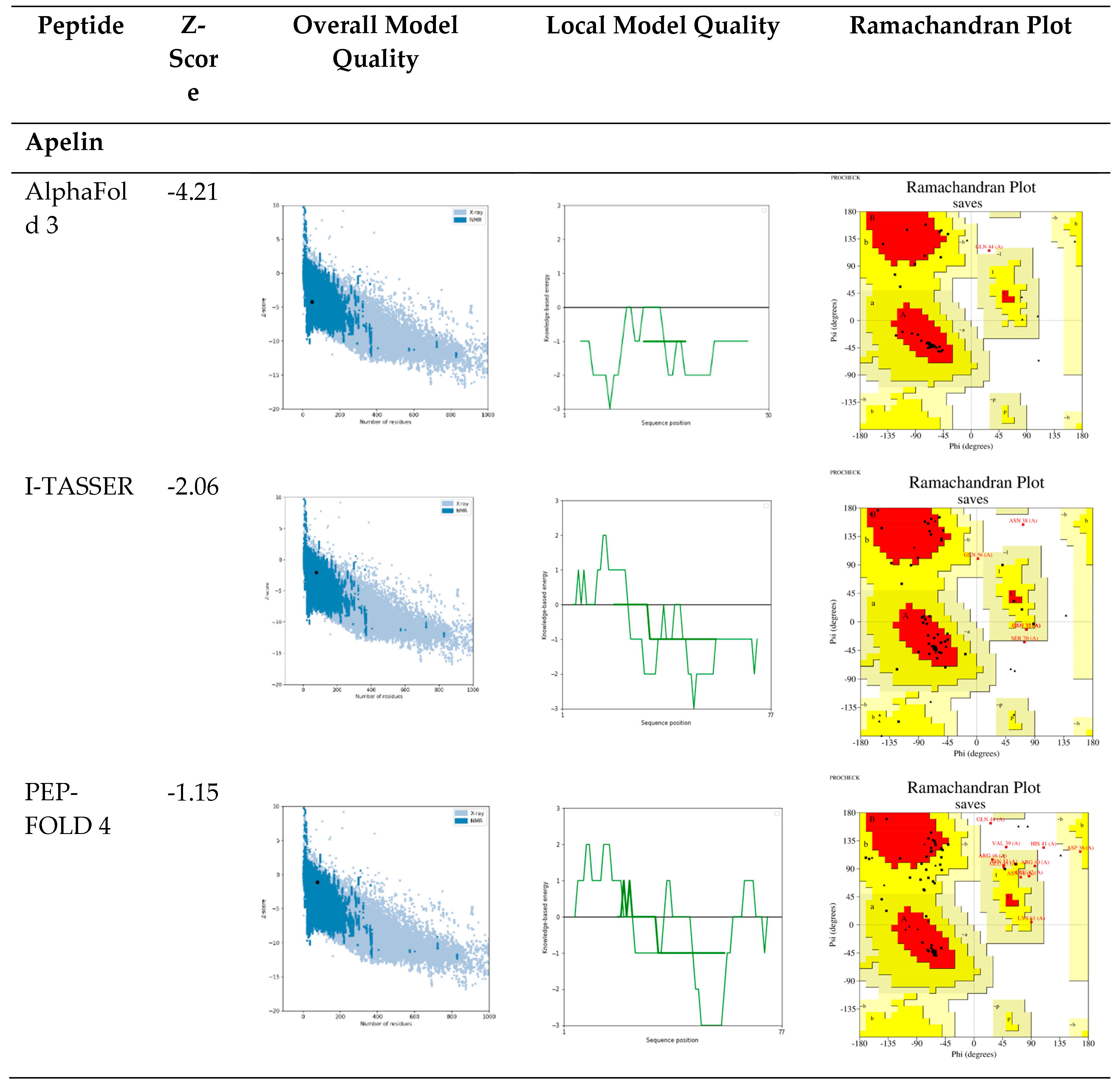 |
Table 2.
The best binding affinity results of therapeutic peptides as antagonists against target receptors across docking platforms.
Table 2.
The best binding affinity results of therapeutic peptides as antagonists against target receptors across docking platforms.
| Receptor | Therapeutic Peptide | Docking Platform | Binding Affinity (kcal/mol) |
|---|---|---|---|
| AT1R | Apelin | ClusPro 2.0 | -15.6 |
| β1AR | Apelin | ClusPro 2.0 | -17.8 |
| IL-6R | Apelin | ClusPro 2.0 | -19.1 |
| MR | Liraglutide | HawkDock 2.0 | -11.0 |
| NPY1R | ANP | HawkDock 2.0 | -20.1 |
| PDGFR | Apelin | ClusPro 2.0 | -13.8 |
| ATP6AP2 | Apelin | HawkDock 2.0 | -16.2 |
| S1PR1 | ANP | HADDOCK 2.4 | -10.0 |
| TPO-R | FX06 | ClusPro 2.0 | -12.2 |
| VEGFR2 | Apelin | HawkDock 2.0 | -21.7 |
Table 3.
The best binding affinity results of therapeutic peptides as agonists against target receptors across docking platforms.
Table 3.
The best binding affinity results of therapeutic peptides as agonists against target receptors across docking platforms.
| Receptor | Therapeutic Peptide | Docking Platform | Binding Affinity (kcal/mol) |
| A2A | ANP | HawkDock 2.0 | -12.7 |
| APJ | Apelin | ClusPro 2.0 | -12.3 |
| CaSR | Exenatide | HADDOCK 2.4 | -13.2 |
| GLP-1R | Apelin | HawkDock 2.0 | -13.4 |
| LDLR | ANP | HPEPDOCK 2.0 | -11.0 |
Disclaimer/Publisher’s Note: The statements, opinions and data contained in all publications are solely those of the individual author(s) and contributor(s) and not of MDPI and/or the editor(s). MDPI and/or the editor(s) disclaim responsibility for any injury to people or property resulting from any ideas, methods, instructions or products referred to in the content. |
© 2024 by the authors. Licensee MDPI, Basel, Switzerland. This article is an open access article distributed under the terms and conditions of the Creative Commons Attribution (CC BY) license (http://creativecommons.org/licenses/by/4.0/).
Copyright: This open access article is published under a Creative Commons CC BY 4.0 license, which permit the free download, distribution, and reuse, provided that the author and preprint are cited in any reuse.