

Submitted:
05 May 2023
Posted:
06 May 2023
You are already at the latest version
Abstract
Cause-Related Marketing (CRM) has emerged as a new concept that links CSR activities to marketing, enabling corporations to pursue both building company-consumer partnership and gaining sustainable mutual benefits that are elicited from the partnership. Among various cause-related marketing activities, on-line cause-related advertising is the most commonly used one. The purpose of this study is to examine the effects of on-line cause-related advertising and moderating role of ethical consumption propensity. In particular, this study intends to contribute to successful development of on-line cause-related advertising strategy by focusing on the relationship between the four factors: customers' perception of on-line cause-related advertising, brand-consumer relationship, brand attachment and loyalty. The results of this study are as follows: First, customers' perception of on-line cause-related advertising was related positively to consumer-brand- relationship. Second, brand-consumer relationship was related positively to brand attachment and customer loyalty. Third, brand attachment was related positively to customer loyalty. Furthermore, from the consumer’s psychological viewpoint, ethical consumption propensity had a significant moderating effect to between customers' perception of cause-related advertising and brand-consumer relationship as well as brand attachment. The results of this study may contribute to the existing literature as an new empirical attempt to examine the effect of the on-line cause-related advertising.
Keywords:
Online Cause-related Advertising
; Consumer-Brand Relationship
; Brand Attachment
; Brand Affinity
; Ethical Consumption Propensity
1. Introduction
The environment surrounding companies has become more complex due to the development of technologies such as mass media and the resulting diversification of consumer needs. In particular, consumers expect ethical corporate activities and tend to maintain a continuous relationship with companies that can sustain their ethical consumption [1,2,3]. In other words, the criteria for consumers to select products have been expanded to include general corporate activities and corporate social responsibility activities [4]. Therefore, companies had no choice but to carry out various marketing strategies such as cause marketing to strengthen competitiveness and improve market performance. This kind of socially responsible marketing may be understood as a way to demonstrate that the company pursues ethical values, create long-term outlook for the company as a trustworthy company, and eventually make it more competitive in the market. Quite a few studies have shown that corporate ethics and ethical management in the form of fair-trade practices and eco-friendly corporate strategies have proven effective in improving the company's good image, which leads to increasing customers’ trust as well as strengthening customers’ loyalty [5,6,7].
General corporate activities operate under a management-oriented paradigm that maximizes shareholder interests. However, in recent years, corporate social responsibility (ESG), such as cause marketing, has been used as an important management paradigm for long-term management [8]. Cause marketing, defined as "profit motivated giving" that links sales to charitable donations, allows companies to pursue both social and financial outcomes resulting in an increase in consumers' positive perceptions [1,2,10].
Kotler [9] emphasized that the purpose of the company rests on achieving socio-cultural transformation that creates social value along with profit-seeking and customer satisfaction. In other words, companies are gradually expanding the area of social responsibility activities such as cause marketing to increase the value of their companies [3,4]. Barone, Miyazaki, and Taylor [11] referred to the realm of the marketing activities that are strategically linked to social issues for corporate interests such as Cause marketing. Cause marketing is an activity that increases the value of a company by sponsoring a public interest organization or directly using a part of the profits obtained from consumers' product purchases for the public good [8]. These cause marketing activities reach consumers through advertisements, which is called cause-related advertisement. Cause-related advertisement refers to advertisements of various public campaigns and these advertisements typically include a message that a portion of corporate profits is allocated for the public interest [11,12,13]. In particular, as cause-related advertisement have recently spread through social media such as YouTube, and consumers’ interest in this kind of public advertising is growing fast.
Consumers tend to choose the products of companies who fulfill their social responsibilities if the companies have the same price or quality [2,11,12,14]. In addition, even in the face of a corporate crisis, corporate social responsibility activities form a positive corporate reputation, which plays a key role in overcoming the crisis and restoring trust [5]. In other words, corporate social responsibility is viewed as a relationship in which the goals of public interest activities and profit-seeking must be achieved at the same time to improve corporate value. Until recently, studies related to cause marketing have been focused on the suitability of companies for cause marketing activities [15,16], consumer sincerity [17,18,19]. Recently, research has been conducted mainly on the discriminatory impact of emotional appeal methods on consumer attitudes on cause marketing [20,21], donation intention [22], and purchase intention [23]. However, it is difficult to find a study that investigated the effect of cause marketing on consumers' responses to specific cause marketing campaigns.
The purpose of this study is as follows: First, it aims to test the role of consumers' perceptions of cause-related advertisement on corporate affinity, and seeks to confirm whether consumer- brand relationships and brand attachment mediate this relationship. This conceptual scheme will be useful in understanding the causal relationship between cause-related advertisements and corporate affinity depending upon changes in consumers' attitudes toward brands. Second, this study seeks to test whether consumers’ ethical consumption propensity exerts a moderating effect between the perception of cause-related advertisement and consumer brand relationships as well as brand attachment. The results can provide academic and practical implications for cause-related advertisement.
Novelty of this study may be attributed to the following two aspects. Firstly, previous literature has mostly addressed the importance of benefits stemming from cause-relating advertising strategies [6,11]. However, it is difficult to find previous studies that tried to find the determinants of corporate cause-related advertising's effectiveness from the perspective of brand specific evaluations. [7,24]. To bridge this gap in the literature, this study incorporated consumer-brand relationship and brand attachment to measure the effectiveness of company initiated cause-related advertisements. Secondly, most of the previous studies have mainly concentrated on revealing the effectiveness of cause-related advertisement based on the characteristics of products and public interest as main predictors, but not enough studies have been done to verify the effectiveness of cause-related advertisement focused on consumer’s ethical propensity. To fill this void in the literature, this study conducted an experimental survey to measure consumer reactions to cause-related advertisement incorporating ethical consumption propensity as a moderating variable affecting brand evaluations.
2. Literature Review
2.1. Cause-related advertising
Consumers tend to choose the products of companies that fulfill their social responsibilities well if they are perceived to have the same price or quality [1,2,10,25]. In addition, even in the face of a corporate crisis, corporate social responsibility activities form a positive corporate reputation, which plays a key role in overcoming the crisis and restoring trust [2,5]. In other words, corporate social responsibility is viewed as a relationship in which the goals of public activities and profit-seeking must be achieved at the same time as an effective investment to improve corporate value. a previous study on the influence of such cause--related marketing on consumers' positive attitudes toward companies.
According to the basic tenets of social exchange theory, social life is based on social exchanges involving interactions between individuals or corporate actors in dyads, groups, organizations or networks. The key contributors of the theory include sociologists such as George Homan [26], Richard M. Emerson [27], and Peter Blau [28]. The theories that have evolved out of this theory have addressed the social structures or networks resulting from continuous exchanges, and how these structures enable actors to exercise influence. Other social processes addressed by the theory include trust, fairness, interpersonal commitment, coalition formation, procedural justice, and collective action.
If we apply social exchange theory to the current research topic, cause-related advertising may be viewed as a cost incurred by companies for the public good, while consumers may perceive it as a something beneficial to themselves and the society. With this exchange established, consumers may decide to form a reciprocal brand relationship with the companies.
Many of previous research addressed the issue concerning the effects of cause-related advertising [1,2,6,10,11,13]. They reported that the effect of cause-related advertising depends on the context of corporate-consumer communication and the goals of the advertising [3,4,7,24]. And they related to this have addressed the effectiveness of cause-related advertisement with major focus on the characteristics of products and public interest.
Furthermore, some scholars in the past criticized that cause marketing practices may deceptively mislead consumers to believe the companies which engage in socially responsible practices are trustworthy, and thus credible. In response to this criticism, some scholars have started paying attention to the corporate authenticity as an important barometer of the companies socially responsible practices. For instance, they argued that companies should try to gain customers’ perceived authenticity as part of managing their brand image on social media [29]. And another research reported that what customers really want from the companies is not so much product-related brand image as authentic corporate image, which has much more pervasive power to convince the customers [30].
2.2 Consumer-Brand Relationship
In the past, many scholars have offered diverse conceptual components of relationship marketing. They may be summed up by three perspectives: 1) transactional relationship, 2) brand-based relationship, and 3) public-organization relationship.
Relationship marketing is key to maintaining satisfaction with transactions by increasing the quality of brand relationships, which helps to form long-term sustainable relationships with each other [9,31,32,33,34]. Fournier [35] suggested the concept of a consumer-brand relationship, positing that the brand plays a role as a practical relationship partner and assigns a meaning in everyday life. Successful consumer-brand relationship changes according to the consumer's perception of the brand [31,32,34]. Lee et al. [36] asserted that brands are not only targets for consumers to form attitudes toward but also subjects that can establish an equal relationship with consumers. Papadatos [37] explained the relationship between consumer and brand as the relationship between leader (brand) and follower (consumer), based on the concept of public-organization relationship. In addition, Kim et al. [41] defined the public-organization relationship as the product of the cognitive, emotional, and behavioral perspectives that occur because of interaction between the organization and the public. Hon and Grunig [42] suggested mutual control, honesty, creditworthiness, competence, exchange relationships, faithfulness, a mutual coexistence relationship, and satisfaction as consumer-brand relationship elements. In addition, Lee [40] revealed that four factors are key elements of a relationship building: trust, commitment, community relationship, and reputation. Lee et al. [41] further confirmed reliability, mutual control, satisfaction, and fidelity as important factors affecting public-organization relations, while Jung et al. [39] proposed reliability, relationship satisfaction, community involvement, and exchange relations as core elements of brand relationships. Based on the various definitions and conceptualizations of the brand relationship discussed so far, this study concluded that brand relationship with a socially responsible company should contain three basics elements: 1) trust-based belief, 2) intimate relationship, and 3) approval or favorability towards the corporate brand. According to this view, we conceptually defined brand relationship as a socially embedded relationship that is composed of three elements: bonding, trust, and preference. For this study, to conceptualize on the brand attachment, we adopted views of Han and Yeom [23] and Kim and Woo [24] by conceptually defining brand attachment as a concept that displays one’s happiness derived from a brand, containing feelings of affection, interest, fascination.
2.3. Brand Attachment
Emotional attachment is an important factor in explaining the relationship between consumers and brands, and brand attachment is a prototypical concept of emotional attachment. Attachment, according to Ball and Tasaki [43] is the degree to which an individual wish to own or maintain a self-concept about an object he owns. Sung et al. [44] defined brand attachment as a state of forming emotional bonds and it makes people perceive people or objects as close to them. They maintained that brand attachment has three characteristics. First, the brand must have the characteristic of reliability because it should satisfy consumers' needs at any time when needed. Second, because it is an emotional component of consumers, it is distinguished from the emotional bond that exists between brands and consumers. Third, it is characterized by an expression of interest that consumers have in the brand. Due to these characteristics, only positive associations with companies arising from corporate marketing activities will influence the formation of brand attachment [45,46]. Brand attachment is similar to brand attitude in that it is an overall evaluation of the brand, but there is a difference in that it includes affection for relationship ties. Lee et al. [47] contended that brand attachment has a positive effect on the value of the branded products. Thomson et al. [48] approached brand attachment having three dimensions: affection, passion, and connection. Furthermore, Sung et al. [44] confirmed that it is composed of two sub-factors: love and interest. On the other hand, Han and Yeom [49], Kim and Yu [50] presented brand attachment as a single factor composed of happiness, pleasure, and comfort. For this study, to conceptualize on the brand attachment, we adopted views of Han and Yeom [23] and Kim and Woo [24] by conceptually defining brand attachment as a concept that displays one’s happiness derived from a brand, containing feelings of affection, interest, fascination.
2.4. Brand Affinity
Affinity is the driving force behind a company's long-term revenue generation and one of the key success factors for a company to excel in the rapidly changing brand competition [51]. In addition. it was argued that corporate affinity is determined by the strength of the consumer's relationship with the company [52]. Park et al. [53] defined corporate affinity as the degree of immersion to repeatedly purchase corporate brands that consumers prefer despite various marketing efforts of competitors. Previous studies on brand affinity have been mainly dealt with from the perspective of customer satisfaction, but many studies have recently appeared to explain the process of affinity formation using determinants such as trust and immersion from the perspective of relationship marketing [54].
As such, the concept of affinity has been defined from various perspectives, and the affinity defined by marketing researchers is mainly divided into three types: behavioral, attitudinal, and integrated approaches [54]. First, according to the behavioral approach, "affinity" is defined as a behavioral tendency that consumers repeatedly purchase for a certain period of time from a specific store. However, behavioral affinity has limitations in that researchers have a high degree of subjective interpretations and difficulty explaining causes and changes, and affinity does not always appear as repetitive purchases [55]. Second, according to the attitude approach, it is divided into two categories: preference and psychological commitment. It was claimed that corporate affinity leads to future purchase intentions when people have a positive attitude toward businesses [51,54]. Friendly attitude, purchase intention, and positive word of mouth toward others are all indicators of attitude affinity. Third, according to an integrated approach that synthesizes behavioral and attitudinal approaches, affinity is defined as a favorable attitude among consumers and repetitive purchasing behavior. Corporate affinity includes the idea that one dimension of repetitive purchase behavior or favorable attitude is not enough and that both favorable attitude and repetitive purchase behavior must be satisfied [53,56].
2.5. Ethical Consumption Propensity
Ethical consumption began to be explored in earnest as the concept of "humanitarian consumption" by many researchers in the past. Doane [57] defined ethical consumption as an act of purchasing by judging ethical issues as an important purchase factor when purchasing a product, and Langen [58] defined ethical consumption as an act of purchasing based on individual consumer’s interest in ethical issues related to individual responsibility. On the other hand, Huh [56] defined it as a conscious consumption choice made based on personal and moral beliefs and a purchase choice that considers health, society, and the natural environment. Based on the various definitions of ethical consumption introduced above, this study adopted the definition of Langgen [34] to define it as “the tendency of people to purchase based on individual consumer’s interest in ethical issues related to individual responsibility.
In previous studies on ethical consumption, ethical consumption propensity consisted of consumer effectiveness, interest in ethics, and altruism. First, consumer effectiveness is defined as the belief that consumers' personal efforts in solving social problems can influence social change [57]. In particular, consumer effectiveness has the greatest influence on socio-conscious consumption, environmental-conscious consumption, and ecologically conscious consumption behavior. Second, interest in ethical issues is defined as the degree to which consumers are interested in social and ethical issues such as environmental problems and resource utilization. In the past, consumers chose products based on economic value, but today, consumers' attitudes and behaviors toward choices are changing depending on their ethical and moral interests [62,63,64]. Third, altruism is defined as the behavior and consciousness of voluntarily trying to help others without expecting compensation. Ko [62] suggested that altruism is the most basic determinant of ethical consumption. Stem et al. [63] further proposed a measurement model for motivation to induce eco-friendly behavior, suggesting that self-centered values, social altruistic values, and ecological values can induce eco-friendly consumer behavior. This altruism is one of the key factors that explain ethical consumption behavior as a tendency to protect others from danger and consider the welfare of others rather than oneself. However, until now, it is difficult to find previous research that addressed the effect of cause-related advertisement in connection with ethical consumption propensity. Based on the various definitions of ethical consumption introduced above, this study adopted the definition of Langgen [34] to define it as “the tendency of people to purchase based on individual consumer’s interest in ethical issues related to individual responsibility.
3. Research Model and Hypothesis
3.1. Research model
The purpose of this study is to verify the effect of consumer perception of cause-related advertisement on corporate affinity through consumer-brand relationships and brand attachment. In addition, the ethical consumption propensity was set as a moderating variable to confirm whether it moderates the relationship between perception of cause-related advertisement and consumer-brand relationship as well as brand attachment. For the purpose of this study, a research model was constructed, as shown in Figure 1 based on previous research findings.
3.2. Hypotheses
The perusal of previous studies on the relationship between corporate awareness of cause-related advertisement and consumer-brand relationships reveals a few studies. For instance, Brown and Dacin [24] argued that company’s sustained social contribution activities induce consumers to have a favorable attitude toward corporate brands or products. Yoon and Cho [64] compared ESG activities with traditional corporate advertisements and found that ESG activities have a relatively more positive effect on brand attitude and corporate image than general corporate advertisements. Kim [65] said that the message of corporate social responsibility activities has a greater impact on building good consumer-brand relationship than the advertisement message of general corporate capabilities. Consumers who perceive a specific company's social responsibility form a positive relationship with the company's brand and product [66]. In addition, Ji [67] suggested that corporate social responsibility activities have a significant positive(+) effect on the formation of corporate-brand relationship quality and that measures should be faithfully implemented to increase the value of corporate brand assets. Based on the previous research results observed so far, is expected that cause-related advertisements of companies would have a significant effect on improving the consumer-brand relationship. Thus, the following hypothesis was proposed.
H1. Perception of corporate cause-related advertisement will have a positive(+) effect on the consumer-brand relationship. It was proven that the perception of corporate social responsibility activities affects consumers' feelings for the company and brand and affects the evaluation of products and services [24]. In other words, previous studies report that the biggest function of corporate social responsibility activities is the creation of a positive corporate image and the formation of a positive brand attitude that differentiates the company from others. For instance, Bhattacharya and Sen [68] posited that ESG activities directly affect psychological effects such as cognition, attribution, attitude, and attachment. In addition, Mohr and Webb [69] argued that corporate social responsibility has a positive effect on consumers' brand and attitude. As a result of reviewing previous studies, consumers' perception of corporate cause-related advertisement is expected to have a positive effect on the attachment between consumers and brands. This is based on the rationale that those who perceive positively the cause-related ads would be more likely to feel attached to the companies which perform socially responsible acts. This relationship was previously confirmed by Battacharya and Sen [68] who verified that CSR directly impacts consumer’s attitude and attachment. Hence the following hypothesis was established.
H2. Perception of cause-related advertisement will have a positive(+) effect on brand attachment.
Aaker and Schmitt [25] stated in a study on the relationship between consumer-brand relationships and brand attachment that developing brand identity is the foundation for the formation of love such as brand attachment. Fournier [35] presented a consumer-brand relationship theory related to the degree of solidarity and interaction between consumers and brands and argued that the continuity of the consumer-brand relationship had a positive effect on brand attachment. Furthermore, in a study of a cosmetic brand, Kim and Jung [70] stated that the formation of a long-term relationship between a brand and consumers affects brand attachment and brand affinity. In addition, Franz-Rudolf et al. [71] found that positive consumer-brand relationships affect brand attachment through brand knowledge. Similarly, Lee et al. [72] argued that positive attitudes have a positive(+) effect on attachment. Based on the results of these previous studies, the consumer-brand relationship is expected to form consumers' brand attachment, thus the following hypothesis was proposed in this study.
H3. The consumer-brand relationship will have a positive (+) effect on brand attachment.
Among the previous studies on the relationship between consumer-brand relationships and corporate affinity, Holbrook [73] argues that brand trust has a positive effect on brand affinity both behaviorally and psychologically. This suggests that brand trust can be a strong factor that can directly influence brand affinity. It was also argued that brand commitment has a positive effect on brand affinity, allows companies to form attachment and unity with consumers, and maintains continuous relationships to increase brand love [74]. Through a study of the characteristics of the brand community, Kang and Jeon [75] also found that relationship commitment to community has a positive effect on affinity. In a study related to cosmetics, Kim and Jung [70] contended that the consumer-brand relationship has a positive effect on brand love, and similarly Kim [76] found that the formation of a positive image for a brand has a significant effect on brand love. Based on the results of these previous studies, the consumer-brand relationship is expected to form a corporate affinity, thus the following hypothesis was established in this study.
H4. The consumer-brand relationship will have a positive (+) effect on corporate affinity.
To examine previous studies on the relationship between brand attachment and corporate brand affinity, Choi [77] maintained that shopping consumers' brand attachment has a positive effect on brand love. According to Holbrook [73], the closer the relationship between the consumer and the brand, the more positive effect the brand attachment has on brand affinity. In addition, Dick and Basu [55] found that the atmosphere or positive attachment to the brand affects brand affinity. According to Park et al. [53], consumers who have a relationship with the company to the extent that they perceive themselves equally form a brand attachment relationship, which affects their affinity. In addition, Yoo and Ha [78] posited that brand attachment is a key leading indicator of store affinity for family restaurant customers. In addition, the same result was supported by many previous studies on luxury brands and convergence brands [79,80]. Based on the results of these previous studies, brand attachment is expected to affect corporate brand affinity, thus the following hypothesis was established.
H5. Brand attachment will have a positive(+) effect on corporate brand affinity.
There have been a few studies on how ethical consumption propensity plays a role in the relationship between cause-related advertisements, the consumer-brand relationship, and brand attachment. They have reported that consumers prefer brands or companies that exhibit the image or values they pursue. And consequently, choose the products of socially desirable companies.
For instance, Kim [66] suggested that consumers who value ethical management have a positive effect on the message in support of social responsibility. In addition, Bhattacharya and Sen [68] reported that the effect of social responsibility activities will vary depending on the degree of consumer interest in corporate social responsibility activities and that the more solid the support for social ethical issues, the more positive the evaluation of the company becomes. Furthermore, consumers who positively evaluate corporate social responsibility activities have more positive attitude toward companies and brands than consumers who do not [69]. In addition, consumers who are interested in ethical and moral issues have developed their ability to understand the social and ethical values reflected in products, which will be considered important in consumption decisions such as product purchases [81]. Based on these previous findings, cause-related advertisement would have different effects on consumer-brand relationships and brand attachment depending on consumers' ethical consumption propensities. the following hypothesis was derived.
H6. Ethical consumption propensity will positively moderate the relationship between the perception of cause-related advertisement and the consumer-brand relationship.
H7. Ethical consumption propensity will positively moderate the relationship between the perception of cause-related advertisement and brand attachment.
4. Research Methods
4.1. Measures of constructs
The research variables, questionnaire items, and related prior studies used in this study are shown in Table 1. Each of items used a Likert 5-point scale (1 = strongly disagree. 2= disagree. 3= neither. 4= agree. 5 = strongly agree). The structural equation model was tested using AMOS 21.0 to test the hypothesis of the causal relationship between the variables used in this study.
4.2. Research Design
To determine the types and message contents of cause-related advertisement to be used in this study, a pretest was conducted on four cause-related advertisements from the same company (a domestic life insurance company). Two advertisements that with highest scores for ‘Does ad content convey a message of public interest?’ question was selected by 100 participants who watched during a pilot test session. The reason we used two stimuli is based on the rationale that just one stimulus oriented to one creative appeal (rational or emotional) might lead to biased response. For this reason, through a pilot test, we presented two stimuli that are contrasting in terms of creative appeal such that one stimulus is rational while the other is affective in nature of message narration. Pilot test allowed the researcher to pick the two stimuli that score highest among the 4 candidate stimuli. Manipulation check was performed to determine whether participants perceived two ads as either rational or affective. The result showed that the “Family Deserves Happiness” ad received highest affection score on an Affective-Rational scale (8.95 out of 10) out of the four ads, whereas “Thank God” ad received the highest rationality score (9.2 out of 10), thus confirming the validity of using the two ads for the experimentation purpose.
The two ads finally used for the survey is shown in figure 1. During the main survey session, the participants were shown the ad stimuli on the classroom screen for 5 minutes with accompanied narration and then asked to answer the survey questions. The data actually used for analysis came from a combined average score obtained from the two stimuli ads. Figure 2 shows the two stimuli ads used for this study.
In order to test the research hypotheses of this study, undergraduate students attending universities located in Seoul and Gyeonggi-do were selected as target samples. The reason for selecting university students as a sample was because of their low level of involvement with life insurance companies, which ensures that they do not have predisposed prejudice for the life insurance as a product of high purchase potential. Another reason is that university students aged in so-called generation MZ would be highly sensitive to the issue of corporate social responsibility because of increased emphasis on taking classes dealing with company’s social responsibilities required in university curriculum, such as corporate ethics.
The survey was conducted using the self-administered survey method, and the survey administrators were asked to fully explain the purpose of the survey and then respond to any in-class questions. The self-administered survey method was adopted as the data collection method. The survey administration took place during the months of June and July of the year 2022. The composition of the scale items was reviewed by experts (doctoral students) in advance to obtain a reliable response. A total of 344 questionnaires were distributed, of which 324 copies were used for analysis, excluding insincere and non-response questionnaires.
5. Results
5.1. Demographic characteristics of the sample
This study is an experimental study on how corporate cause-related advertisement affect corporate affinity, and participants directly answered their attitudes toward companies through a survey method after watching cause-related advertisements developed by companies. Table 2 shows the demographic information of 324 copies obtained through the survey.
5.2. Reliability and Validity
Reliability and validity of the measurement were verified before verifying the hypothesis established in this study. Feasibility was measured by using the factor analysis method of principal component analysis by the varimax rotation method, and reliability was measured by the Cronbach alpha coefficient. First, as a result of factor analysis, all variables were derived as factors with an eigenvalue of 1 or more, and the factor loading value of the measures constituting each factor was 0.6 or higher, which met the general standard (0.5 or more) for construct validity. The measures comprising consumer-brand relationship were divided into three parts of Preference (5 items), Trust (3 items), and Bonding (3 items).
As a result of testing the internal consistency of the items that have been validated, the Cronbach alpha value was higher than 0.8, so it is judged that the internal consistency of the measurement was secured.
In this study, item parceling method was used, and among the various item parceling methods, the factor-parceling approach was used to allocate questions based on the factor load size and bind questions [82,83]. Based on this logic, the study measures comprising consumer-brand relationship were divided into three parts of Preference (5 items), Trust (3 items), and Bonding (3 items). And 2 items (each from Affinity and Preference, respectively) were removed based on factor loadings) to improve the fit index of the model through confirmatory factor analysis.
In addition, as a result of as a result of Harman's single factor test based on principal component analysis to analyze the common method bias due to self-administered surveys, the explanatory power of the first factor, which occupies the most explanatory power, did not account for more than half of the total explanatory power. Therefore, the distortion caused by the common method bias was proven not substantial [84].
The results of the validity and reliability analysis of the measures in this study are shown in Table 3.
Next, through correlation analysis, the validity of discriminatory validity, which is the degree to which the concept of the latent variable is distinguished from the concept of other latent variables, was tested, as shown in Table 4. Since the AVE values of the latent variables obtained in this study show appropriate values such that the square root of AVE is all larger than the associated correlation coefficients. Therefore, the discriminatory validity of the measures used in this study was secured.
In addition, although the Fornell-Larcker [85] criterion was used, the limitations of increasing sensitivity when used with the results of variance-based structural equation modeling were supplemented with HTMT analysis results (See Table 5). The HTMT analysis, which measured the similarity between latent variables, showed less than 0.85, securing discriminant validity [86].
5.3. CFA (Confirmatory Factor Analysis)
As a result of running explanatory factor analysis, it was found that the ‘brand relationship’ was divided into three factors of ‘Trust”, “Bonding’ and ‘Preference’. The three factors all met reliability cut-off scores with .915, .933, and .942 respectively.
Based on the results of exploratory factor analysis, confirmatory factor analysis was conducted for each factor. The reason we performed CFA is to determine whether the measurement items adopted for this study are structurally fit with statistical construct validity. The result shows that two items (one from Affinity and Preference, respectively) were removed based on thee factor loadings) to improve the fit index of the model through confirmatory factor analysis, and confirmation factor analysis was conducted through secondary factor analysis. The results of the CFA are presented in Table 6.
5.4. Structural equation model and hypothesis testing
The output of evaluating the structural equation model, x2=173.208, df =60, x2/df = 2.887, GFI=.919, AGFI=.877, NFI=.941, CFI=.961, IFI=.961, TLI=.949, RMR=.065, and RMSEA=.076 were derived. Since almost all indices, including the absolute fitness index, and the incremental fitness index, are above the standard, the research model can be judged to satisfy validity requirement. The results of hypothesis tests are shown in Table 7.
Pairwise parameter comparisons analysis was performed using Amos 21.0 to verify whether consumers' ethical consumption propensity had a moderating effect on the relationship between the perception of cause-related advertisement and consumer-brand relationships as well as brand attachment. Based on the average values of the five items related to ethical consumption propensity, comparative analysis by group was performed for the first and fourth quartile groups. It was divided into a group with a high ethical consumption propensity (n=90) and a group with a low ethical consumption propensity (n=93).
Table 8 shows the results of reviewing the Critical Ratios for Differences between Parameters values for analyzing the cross z-value value between the path coefficients of each group for each classified ethical consumption propensity group. Since the absolute values of 2.473 of the z value is greater than 1.96, there is a moderating effect of ethical consumption propensity in affecting the consumer-brand relationship. However, since the z-values of .848 is less than 1.96, so moderating effect was not supported for the brand attachment.
6. Discussions and Implications
6.1. Discusions
The summary of the empirical analysis and research results of this study is as follows. First, it was found that consumer perception of cause-related advertisement had a significant effect on the quality of brand relations (Estimate=.285, C.R.=5.125). In other words, consumers' perception of cause-related advertisement improves their relationship with the brand. This can be said to be a result of improving consumer-brand relationships just by increasing consumer awareness of the message of cause-related advertisement. Therefore, the H1 set in this study was adopted. Second, it was found that consumer perception of corporate cause-related advertisement did not have a significant effect on brand attachment (Estimate=.070, C.R.=1.222). In other words, even if consumers perceive corporate cause-related advertisement, it does not directly affect brand attachment. This can be speculated that even consumers who recognize the message of corporate cause-related advertisement they may need to have personal experience to perceive brand attachment. Brand attachment should have a higher level of consumer experience, but the direct effect through recognition of advertisements was found to be insufficient. Therefore, H2 set in this study was rejected. Third, consumer brand relationship was found to have a significant positive (+) effect on brand attachment (Estimate=.865, C.R.=12.182) and corporate brand affinity (Estimate=.865, C.R.=12.182). In other words, customers with positive relationships such as consumer trust, bonding, and preference with the brand will become attached to the brand and will also form a high affinity for the company. This result demonstrates that improving brand relationships through recognition of cause-related advertisement messages can have a significant effect on brand attachment or corporate affinity without actually experiencing the brand, and both H3 and H4 are adopted. Fourth, it was found that brand attachment had a significant positive (+) effect on corporate affinity (Estimate=.194, C.R.=3.072). In other words, consumers who have formed an attachment to the brand also have a high liking for the company. Thus, H5 was adopted. Finally, when the difference in brand relationship and brand attachment between high and low ethical consumption groups was examined, it was discovered that consumers' ethical tendencies had a moderating effect when the perception of cause-related advertisements affects brand relationships. However, in the case of brand attachment, it was found that consumers' ethical tendencies did not show a significant moderating effect.
6.2. Implications
This study contributes to the current literature in two respects. First, this study attempted to find the determinants of corporate cause-related advertising's effectiveness from the perspective of brand specific evaluations by adopting consumer-brand relationship and brand attachment. Second, this study conducted an experimental survey to measure consumer reactions to cause-related advertisement incorporating ethical consumption propensity.
This study aimed to verify the impact of cause-related advertisement on consumer-brand relationships, brand attachment, and corporate affinity, and based on the analysis results, academic and practical implications are presented as follows. First, it is meaningful to confirm that consumer perception of corporate social responsibility activities directly affects brand relations, but it also affects corporate affinity through brand relationship that is a composite concept of brand trust, bonding, and preference. Existing studies have shown that corporate cause-related advertisement affect the corporate image by influencing consumer perceptions of corporate social responsibility, but this study suggests that corporate cause-related advertisement alone can improve brand relationships. This result confirms that corporate social responsibility activities or cause-related advertisement form a favorable and positive corporate image, resulting in a positive relationship with the company's product or service brand, repurchase or repurchase of the company's products, and positive word of mouth. This finding finds an empirical support from a previous study which reported that cause marketing had a significant impact on consumer-brand relationships [2].
Second, the study result is of academic interest because it tested the structural relationship between brand relationship and brand attachment that was tested on cause-related advertisement. While most previous studies have approached the effect of corporate cause-related advertising at the corporate image level, this study expanded the scope of corporate cause-related advertising by testing the relationship through the intermediary mechanism such as consumer-brand relationship and brand attachment. The results of this study demonstrate the importance of considering such variables in future studies on the effectiveness of cause-related advertising strategies. The study results on the relationship between cause-related advertising, brand relationship, brand attachment, and corporate affinity are partially supported by previous studies on luxury brands and non-profit companies [26,80].
Second, it was found that corporate social responsibility activities or cause-related advertisement plays a decisive role in forming a favorable corporate image by empirically confirming the impact of corporate cause-related advertisement on brand relationship, brand attachment, and corporate affinity. Since it affects corporate affinity, which embraces brand attachment, repurchase behavior, and positive word-of-mouth, it is meaningful that effective cause-related ads can improve consumer relations to eventually enhance corporate loyalty. Therefore, companies may take this result into account when they formulate a loyalty enhancement program.
Third, it was found that brand attachment had a significant effect on the customer's corporate affinity, which illustrates the importance of managing customer sense of attachment felt by customers buying corporate brands. In addition, the formation of an amicable image with brands through attachment to corporate brands can increase corporate love and loyalty. Therefore, in order to create highly loyal customers, companies will need to create a favorable image through continuous influx of socially responsible ads.
Finally, the result confirmed the role of consumers' ethical dispositions in the effect of cause-related advertisement perception on brand relationship. All consumption processes reflect the tendencies of buyers, and in order to increase the effect of cause-related advertisement, consumers' ethical propensity needs to be activated in favor of socially responsible companies. This implies that cause-related ads should target ethical consumers who would be receptive to such ads. Therefore, it will be very important for companies to segment the market according to consumers' ethical consumption tendencies when launching cause-related advertising. Despite these implications, this study has the following limitations. First, the bias in sample selection could not be eliminated. Although this study relied on experimental method to collect data, there still remains a research limitation in that most of the study participants are undergraduate students enrolled in 1st year or 2nd year enrollment at two universities, which may pose a problem with generalizing the result. To overcome this limitation, future studies need to replicate this study using a broader range of participants including not only university students but also different occupational categories. Second, since the study selected stimuli materials for cause-related ads from a set of ads previously executed by a company, it is not possible for researcher to manipulate or modify the elements of the ad to determine specific effects of that manipulation. Future research may attempt to create a cause-related ad to capture more detailed implications stemming from many creative elements such as model used, campaign theme, and illustrations, etc. Other potential recommendation for future study is to adopt socio-psychological parameters as antecedent factor causing brand specific evaluations. For instance, use of an individual’s social values, altruism, or consumer citizenship may help researchers better understand the effects of cause-related ads from the socio-psychological perspectives.
Appendix A. Items Used for the Survey Questionnaire
-
Perception of Cause-Related Ads (5 Items)
- I have a good appreciation of cause-related ads.
- I understand the messages conveyed by cause-relate ads
- I appreciate the public consciousness appeal of cause-related ads
- I appreciate the public publc issues raised by cause-related ads
- I appreciate the emotional appeal of cause-related ads
-
Brand Trust (3 Items)
- I believe in the corporate brand implementing cause-related ads
- I take interest in the corporate brand implementing cause-related ads
- I have a faith in the corporate brand implementing cause-related ads
-
Brand Bonding (3 Items)
- I feel intimate about the corporate brand implementing cause-related ads
- I tend to bond with the corporate brand implementing cause-related ads
- I feel pleasant with the corporate brand c
-
Brand Preference (5 Items)
- I want to buy products from a company implementing cause-related ads
- I favor products from a company implementing cause-related ads
- I prefer a company that contributes to public interests.
- I prefer a company that offers good benefits to consumers
- I favor buying products from a company that is socially responsible
-
Brand Attachment (3 Items)
- I have affection for the corporate brand executing cause-related ads
- I feel fascinated by the corporate brand implementing cause-related ads
- I tend to identify well with the corporate brand implementing cause-related ads
-
Brand Affinity (3 Items)
- I intend to continue relationship with the corporate brand
- I feel a certain level of love for the corporate brand
- I intend to make positive word-of-mouth for the corporate brand
-
Ethical Propensity (5 Items)
- I take interests in ethical issues
- I take interests in environmental issues
- I take interests incorporate fairness
- I am interested in taking part in ethical issues
- I have good knowledge of ethical issues
References
- Hajjat, F. M. Using Marketing for Good: An Eexperiential Project on Cause marketing in a Principles Course, Journal of Education for Business 2021, 96, 461-467.
- Tanford, S.; Kim, M.; Kim, E. J. Priming Social Media and Framing Cause marketing to Promote Sustainable Hotel Choice, Journal of Sustainable Tourism 2020, 28, 1762–1781. [CrossRef]
- Rego, M.; Hamilton, M. A.; Rogers, D. Measuring the Impact of Cause marketing: A Meta-Analysis of Nonprofit and For-profit Alliance Campaigns, Journal of Nonprofit & Public Sector Marketing 2021, 33, 434–456. [CrossRef]
- Xu, G. Y.; Liu, H.; Duan, H. W. Cause marketing Strategy in a Supply Chain: A Theoretical Analysis and a Case Study, Advances in Production Engineering & Management 2022, 17, 479–493. [CrossRef]
- Klein, J.; Dawar, N. Corporate Social Responsibility and Consumers’ Attributions and Brand Evaluations in a Product-Harm Crisis, International Journal of Research in Marketing 2004, 21, 203–217.
- Kim, J. K.; Kim, J. H. Effects of Cause-related Marketing on Consumer Response, The Korean Journal of Advertising 2001, 12, 31–52.
- Du, S.; Bhattacharya, C. B.; Sen S. Convergence of Interests: Cultivating Consumer Trust through Corporate Social Initiatives, Advances in Consumer Research 2007, 34, 687–692.
- Sen, S.; Bhattacharya, C. B.; Korschun, D. The Role of Corporate Social Responsibility in Strengthening Multiple Stakeholder Relationships, Journal of the Academy of Marketing Science 2006, 34, 158–166.
- Kotler, P. Marketing Management (Millennium ed.), Prentice Hall International, 2010.
- Howie, K. M.; Yang, L.; Vitell, S. J.; Bush, V.; Vorhies, D. Consumer Participation in Cause marketing: An Examination of Effort Demands and Defensive Denial, Journal of Business Ethics 2018, 147, 679 – 692.
- Barone, M. J.; Miyazaki, A. D.; Taylor K. A. The Influence of Cause-related Marketing on Consumer Choice: Does One Good Turn Deserve Another?, Journal of the Academy of Marketing Science 2000, 28, 248–262.
- Sindhu, S. Cause marketing; an Interpretive Structural Model Approach, Journal of Nonprofit & Public Sector Marketing 2022, 34 (1), 102-128.
- Gao, Y.; Wu, L.; Shin, J.; Mattila, A. S. Visual Design, Message Content, and Benefit Type: The Case of a Cause marketing Campaign, Journal of Hospitality & Tourism Research 2020, 44, 761–779.
- Choi, J.; Seo, S. When a Stigmatized Brand is Doing Good: The Role of Complementary Fit and Brand Equity in Cause marketing, International Journal of Contemporary Hospitality Management 2019, 31, 3447-3464.
- Um J. Y.; Jang J. O. Content Analysis of Korean Cause-related marketing Research: Focusing on Content Analysis of Papers Published from 2000 to 2012, Studies of Corporate Business 2013, 20, 155–174.
- Gu J. O.; Lee H. B. The Effect of Cause-related Marketing Activities on Purchase Intention: Focusing on the Mediating Role of Corporate Legitimacy, Journal of the Korean Business Society 2015, 28, 3211–3233.
- Choi J. Y.; Choi Y. S. A Study on the Impact of Cause-related Marketing (CRM) Messages on Product Evaluation: Journal of Consumer Studies 2011, 22, 115–13.
- Yoon J. H. Effect of Cause-Related Advertising Frame on Authenticity and Corporate Attitude. Ph.D. thesis, graduate school of Geumo-gong University 2014.
- Jung E. H. The Influence of Moral Identity on the Attitude of Everland in Cause-related Marketing: Focusing on the Mediating Role of Pride. Master's thesis, Hongik University Graduate School, Seoul 2014.
- Shin H. C. A Study on the Effectiveness of Cause marketing of Restaurant Enterprises, Research on Tourism Management 2018, 86, 541–559.
- Yoo G. H.; Song J. D. A Study on the Effect of the Prominence and Symbolism of Public Interest Attributes on Brand Attitude and Purchase Intention in Cause-related Marketing, Customer Satisfaction Management Research 2018, 20, 127–151.
- Shin H. B. The Effect of How Much Contribution of Cause-related Goods is Revealed on Purchase Intention: Focusing on the Moderating Effect of One's Level of Food and Consumption Tendency. Master's thesis, Sungkyunkwan University Graduate School, Seoul 2019.
- Park J. G.; Lee Y. H.; Yoo W. S.; Hyun H. W. A Corporate Credit Interest-linked Marketing is a Consumer's Evaluation and Purchase Intention, Journal of Commodity Studies 2017, 35, 1–11.
- Brown, T. J.; Dacin, P. A. The Company and the Product: Corporate Associations and Consumer Product Responses, Journal of Marketing 1997, 61(January), 68-84.
- Aaker, D.; Schmitt, B. The Influence of Culture on the Self-Expressive Use of Brands, Working Paper, 274, UCLA Anderson Graduate School of Management, 1997.
- Homans, G. C. Social behavior as exchange, American Journal of Sociology 1958, 63, 597–606.
- Emerson, R. Power-dependence relations, American Sociological Review 1962, 27, 31–41.
- Blau, P. M. Exchange and power in social life, New York: Wiley, 1964.
- Lichtenstein, D. R.; Drumwright, M. E.; Braig, B. M. The Effect of Corporate Social Responsibility on Customer Donations to Corporate-Supported Nonprofits, Journal of Marketing 2004, 68(October), 16-33.
- Jang, S.H. Corporate Authenticity Management and Its Benefits, I. 2009.
- Giertz, J. N.; Hollebeek, L. D.; Weiger, W. H.; Hammerschmidt, M. The invisible leash: when human brands hijack corporate brands' consumer relationships, Journal of Service Management 2022, 33, 485-495.
- Polat, A. S.; Çetinsöz, B. C. The Mediating Role of Brand Love in the Relationship Between Consumer-Based Brand Equity and Brand Loyalty: a Research on Starbucks, Journal of Tourism & Services 2021, 12, 150-167.
- Quezado, T.C.C.; Fortes, N.; Cavalcante, W.Q.F. The Influence of Corporate Social Responsibility and Business Ethics on Brand Fidelity: The Importance of Brand Love and Brand Attitude. Sustainability 2022, 14, 2962.
- Lin, Y.; Choe, Y.; Impact of Luxury Hotel Customer Experience on Brand Love and Customer Citizenship Behavior, Sustainability 2022, 14, 13899.
- Fournier, S. Consumers and Their Brands: Developing Relationship Theory in Consumer Research, Journal of Consumer Research 1998, 24, 343–373.
- Lee, H. S.; Choi, J. I.; Lim, J. H. Its Role in the Consumer-Brand Relationship: Brand`s Attitude toward Consumer`s Purchasing Behavior, Journal of Consumer Studies 2004, 15, 85–108. Aker, D.; Schmitt, B. The Influence of Culture on the Self-Expressive Use of Brands, Working Paper, 274, UCLA Anderson Graduate School of Management, 1997.
- Papadatos, C. The Art of Storytelling: How Loyalty Marketers can Build Emotional Connections to Their Brands, Journal of Consumer Marketing 2006, 23, 382–384.
- Kim, H. S.; Lee, H. W. A Study on the OPR Measurement Scale Reflecting Korean Culture, Korean Journal of Advertising 2008, 10, 99–139.
- Hon, L. C.; Grunig, J. E. Guidelines for Measuring Relationships in Public Relations, Gainesville, FL: The Institute for Public Relations, 1999.
- Lee, D. G. The Effects of Organization-Public Relationships on the fire authorities Image, Korean policy sciences review 2005, 9, 47-64.
- Lee, S. B.; Shin, S. H.; Choi, W. S. The Effects of Civil Relationships on City Image, Korean Journal of Advertising 2004, 5, 7–31.
- Jung, S. K.; Seo, H. S.; Byun, J. W. The Effects of the Travel Agent Website User`s Organization-Public Relationship on the Customer Satisfaction and Loyalty, International Journal of Tourism and Hospitality Research 2007, 21, 19–37.
- Ball, A. D.; Tasaki L. H. The Role and Measurement of Attachment in Consumer Behavior, Journal of Consumer Psychology 1992, 1, 155–172.
- Sung, Y. S.; Han, M. K.; Park, E. A. Influence of Brand Personality on Brand Attachment, Korean Journal of Consumer and Advertising Psychology 2004, 5, 15–34.
- Margarida A. H.; Sousa, B.; Carvalho, A.; Santos, V.; Lopes D., Á.; Valeri, M. Encouraging brand attachment on consumer behaviour: Pet-friendly tourism segment, Journal of Tourism, Heritage & Services Marketing 2022, 8, 16-24.
- Lee, C. H.; Kim, H. R. Positive and negative switching barriers: promoting hotel customer citizenship behaviour through brand attachment, International Journal of Contemporary Hospitality Management 2022, 34, 4288-4311.
- Lee, S. H; Kim, M. Y. The Effects of Corporate Social Responsibility on Brand Attachment and Brand Equity, The Research Journal of the Costume Culture 2006, 14, 684–697.
- Thomson, D.; MacInnis, J.; Park, C. W. The Ties That Bind: Measuring the Strength of Consumers’ Attachments to Brands, Journal of Consumer Psychology 2005, 15, 77–91.
- Han, S. S.; Yeom, S. W. A Preliminary Study on the Formative Path of Brand Attachment: With Focus on the Developing a Hypothetical Path Model, Korean Journal of Advertising 2006, 8, 167–200.
- Kim, Y. K.; Yu J. P. An Exploratory Study on Influence Factor of Service Brand Attachment, Journal of the Korea Service Management Society 2007, 8, 185–218.
- Garbarino, E.; Johnson, M. S. The Different Roles of Satisfaction, Trust, and Commitment in Customer Relationships, Journal of Marketing 1999, 63, 70–87.
- Caruana, A. Service Loyalty: The Effects of Service Quality and the Mediating Role of Customer Satisfaction, European Journal of Marketing 2002, 36, 811-828.
- Park, G. j.; Jung, K. H.; Park, S. Y. The Effect of Channel Equity on Private Brand Image and Purchase Intent, Korea Research Academy of Distribution and Management Review 2011, 14, 27–50.
- Bowen, J. T.; Chen S. L. The Relationship Between Customer Loyalty and Customer Satisfaction, International Journal of Contemporary Hospitality Management 2001, 13, 213–217.
- Dick, A.; Basu, K. Customer Loyalty: Towards an Integrated Framework, Journal of the Academy of Marketing Science 1994, 22, 99–113.
- Huh, E. J. Determinants of Consumer's Attitude and Purchase Intention on the Ethical Products, Journal of Consumer Studies 2011, 22, 89–111.
- Doane, D. Taking Flight: The Rapid Growth of Ethical Consumerism, New Economics Foundation: London. 2001.
- Langen, N. Are Ethical Consumption and Charitable Giving Substitutes or not? Insights into Consumers’ Coffee Choice, Food quality and preference 2011, 22, 412-421.
- Toms M. M.; Romont, A. I.; Scridon, M. A. Is Sustainable Consumption Translated into Ethical Consumer Behavior?, Sustainability 2021, 13, 3466.
- Lu, D.; Liu, Y.; Zhang, H.; Ivan, K. W. L. The Ethical Judgment and Moral Reaction to the Product-Harm Crisis: Theoretical Model and Empirical Research, Sustainability 2016, 8, 626.
- Oh, J.; Yoon, S. Theory-based Approach to Factors Affecting Ethical Consumption, International Journal of Consumer Studies 2014, 38, 278–288.
- Ko, A. R. Ethical Consumer Behavior in Korea: Current Status and Future Prospects, Journal of The Korean Society of clothing and Textiles 2009, 6, 54–62.
- Stem, P. C.; Dietz, T.; Kalof, L. Value Orientations, Gender, and Environmental Concern, Environment and Behavior 1993, 25, 322–348.
- Yoon, G.; Jo, J. S. Effects of Corporate Social Responsibility on Multiple Stakeholder Relationships, The Korean Journal of Advertising 2007, 18, 241–255.
- Kim, J. H. Influence of Consistency and Distinction Attribution of Corporate's Cause-related Behavior on Attitude toward Corporate”, Korean Journal of Consumer and Advertising Psychology 2005, 6, 27–44.
- Murray, K.; Vogel, C. Using a Hierarchy-of-Effects Approach to Gauge the Effectiveness of Corporate Social Responsibility to Generate Goodwill Toward the Firm: Financial versus Nonfinancial Impacts, Journal of Business Research 1997, 38, 141–159.
- Ji, S. G. The Impact of Corporate Social Responsibility on Brand Equity, The Korean Academic Association of Business Administration 2010, 23, 2251–2269.
- Bhattacharya, C. B.; Sen S. Doing Better at Doing Good: When, Why and How Consumers Respond to Corporate Social Initiatives, California Management Review 2004, 47, 9–25.
- Mohr, A.; Webb, D. J. The Effects of Corporate Social Responsibility and Price on Consumer Responses, The Journal of Consumer Affairs 2005, 39, 121–147.
- Kim, S. E.; Jeong, M. S. The Effects of Perceived Internet Fashion Shopping Mall Characteristics on Positive Shopping Emotion and Relationship Quality, The Research Journal of the Costume Culture 2009, 22, 73–85.
- Franz-Rudolf, E.; Tobias, L.; Bernd, H. S.; Patrick, G. “Are Brands Forever? How Brand Knowledge and Relationships Affect Current and Future Purchases, Journal of Product & Brand Management 2006, 15, 98–105.
- Lee, I. S.; Lee, K. H.; Choi, J. W.; Yang, S. H.; Lim, S. T. S.; Jeon, W.; Kim, J. W.; Hong, S. J. Theoretical Integration of User Satisfaction and Emotional Attachment, Korean Management Review 2008, 37, 1171–1203.
- Holbrook, M. B. The Chain of Effects from Brand Trust and Brand Affect to Brand Performance: The Role of Brand Loyalty, Journal of Marketing 2001, 65, 81–93.
- Chatterjee, P. Online Review: Do Consumers Use Them, Advances In Consumer Research 2005, 28, 129–133.
- Kang, J. H.; Joen, I. K. The Effect of Online-Sports Brand Community Characteristics on Commitment, Brand Attitude and Brand Loyalty, Journal of Korean Society for Sports Management 2009, 14, 117–131.
- Kim, G. S. A Study on Satisfaction and Purchasing Behavior of Korean Herbal Cosmetics of City Female Consumers, Journal of Korean Beauty Society 2008, 14, 1443–1459.
- Choi, S. M. The Effect of Shopping Tourists’ Emotional Consumption Tendencies on Luxury Brand Attachment and Loyalty: A Moderating Effect of Brand Benefit, Korean Journal of Industry and Innovation 2008, 27, 197–219.
- Yoo, K. S.; Ha, D. H. The Relationship among Relational Benefits, Brand Attachment, and Brand Loyalty in the Family Restaurant, Korean Journal of Tourism Research 2011, 26, 363–381.
- Kim, H. R.; Hong, S. M.; Lee, M. K. Consumer Evaluations of Convergence Products, Korean Journal of Marketing 2005, 7, 1–20.
- Ahn, K. H.; Lee, J. E.; Jeon, J. E. The Effects of Luxury Brand-Self Identification on Brand Attachment and Brand Commitment-The Moderating Role of Regulatory Focus, Korean Journal of Marketing 2009, 4, 1–33.
- Hofmann, W.; Schmeichel, B. J.; Baddeley, A. D. Executive Functions and Self-Regulation, Trends in Cognitive Sciences 2012, 16, 174–180.
- Matsunaga, M. Item Parceling in Structural Equation Modeling: A Primer, Communication Methods and Measures 2008, 2, 260–293.
- Rogers, W. M.; Schmitt, N. Parameter Recovery and Model Fit Using Multidimensional Composites: A Comparison of Four Empirical Parceling Algorithms, Multivariate Behavioral Research 2004, 39, 379–412.
- Podsakoff, P. M.; MacKenzie, S. B.; Lee, J. Y. Common Method Biases in Behavioral Research: A Critical Review of the Literature and Recommended Remedies, Journal of Applied Psychology 2003, 88, 879–903.
- Fornell, C.; Larcker, D. F. Evaluating Structural Equation Models with Unobservable Variables and Measurement Error, Journal of marketing research 1981, 18, 39–50.
- Henseler, J.; Ringle, C. M.; Sarstedt, M. a New Criterion for Assessing Discriminant Validity in Variance-based Structural Equation Modeling, Journal of the academy of marketing science 2015, 43, 115–135.. [CrossRef]
- Kim, N. On the Maximum Likelihood Estimation for a Normal Distribution under Random Censoring, Communications for Statistical Applications and Methods 2018, 25, 647–658. [CrossRef]
Figure 1.
Research Model.
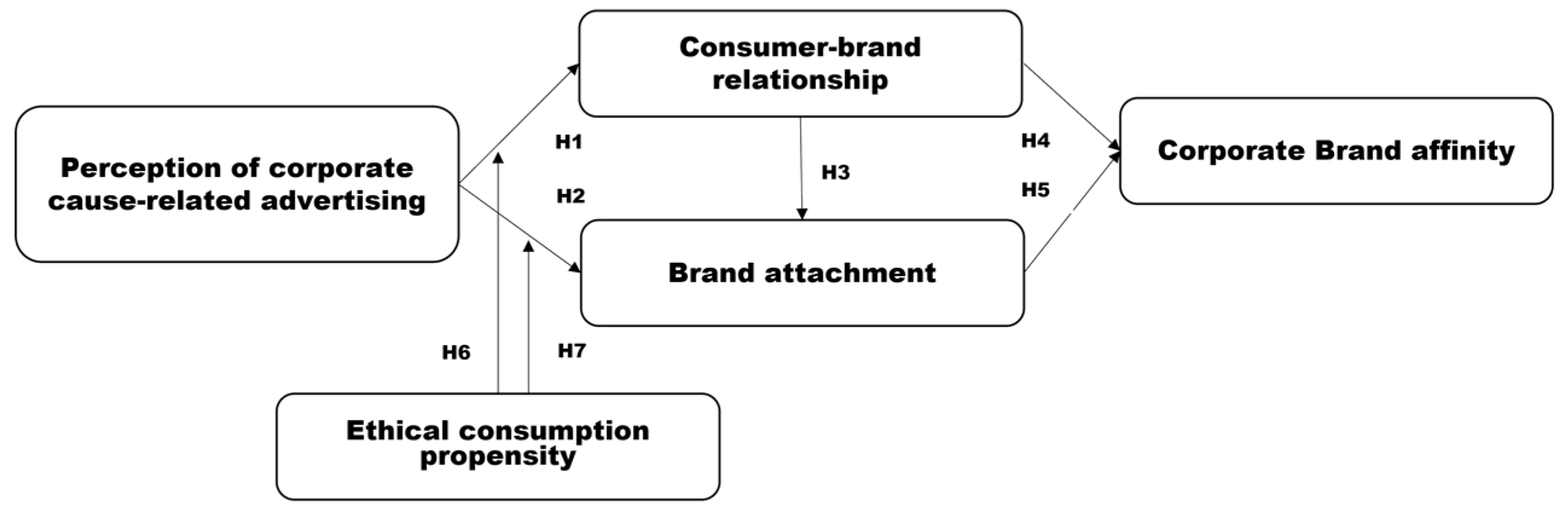
Figure 2.
Samples of the ads stimuli used for the survey
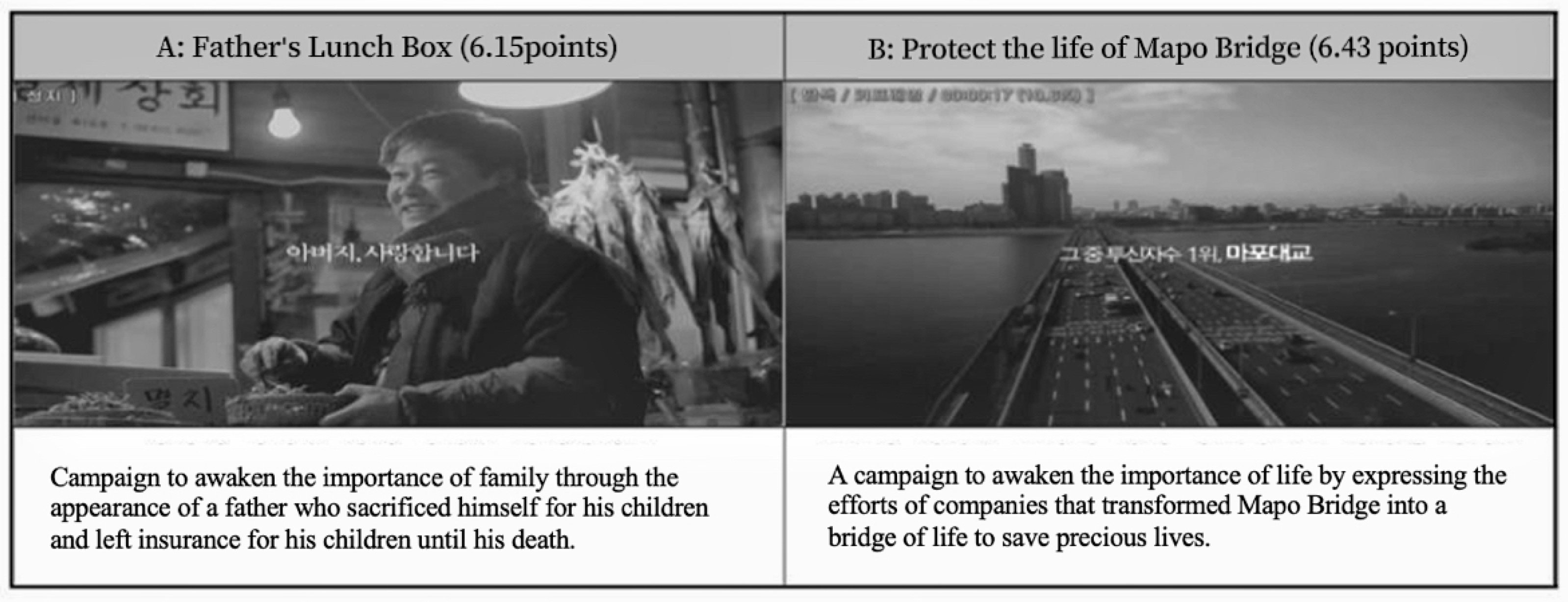
Figure 3.
Results of research analysis. * Numbers represent coefficient estimates and parenthesized numbers represent C.R. values.
Figure 3.
Results of research analysis. * Numbers represent coefficient estimates and parenthesized numbers represent C.R. values.
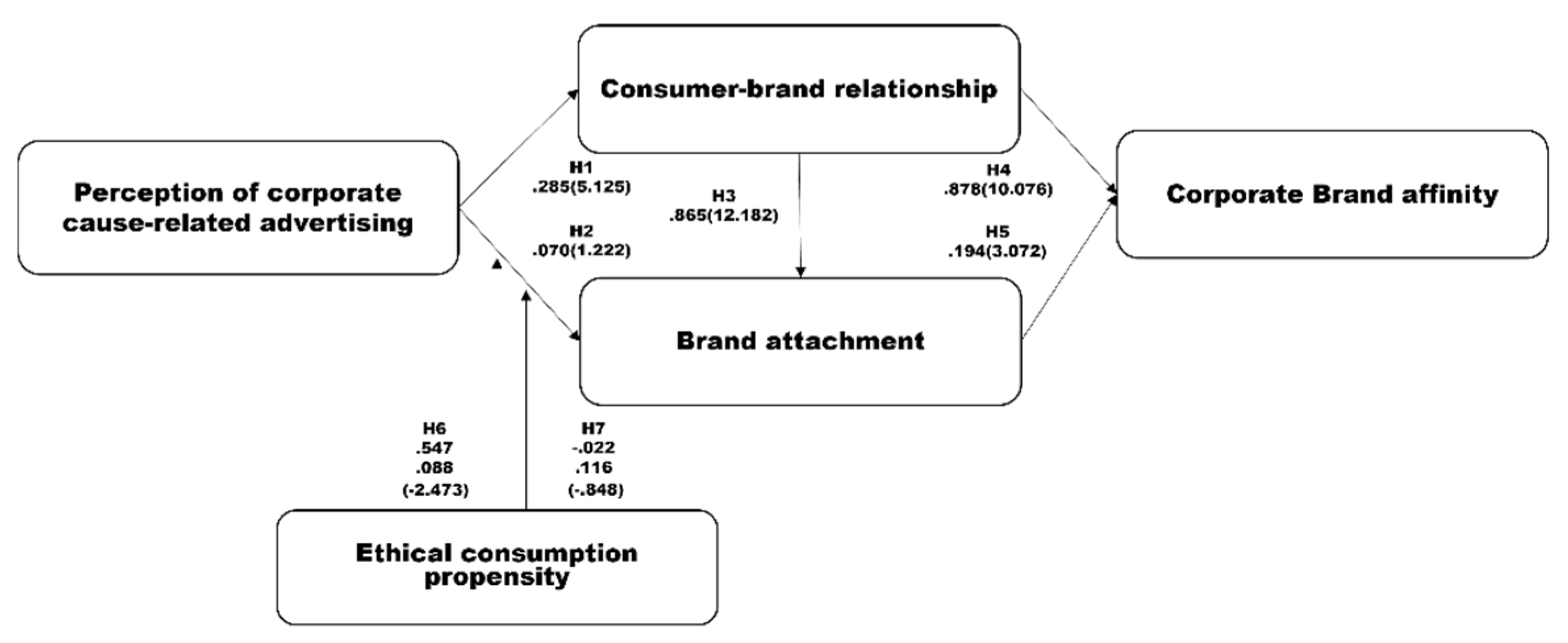

Table 1.
Scale items used in the study.
| Ind. variables | Item | Scale items | Source |
|---|---|---|---|
| Perception of cause-related advertisement | The degree of understanding of advertising, the degree of understanding of advertising messages, the degree of understanding of advertising’s public consciousness, and the degree of public awareness of overall ad | Lichenstein et al. (2004), Kim & Kim (2001) | |
| Consumer brand relationship | Trust | The degree of brand trust, the degree of brand belief, and the degree of understanding of the brand | Kim & Lee (2008), Lee (2005) |
| Bonding | Intimacy of the brand’s experience, the degree of bond with the brand, the degree of pleasant feelings toward the brand | ||
| Preference | The degree of approval for brand purchase, the degree of favorability for the brand, the degree of assessing the brands’ contribution to the public interest, the degree of contribution of the brand’s consumer benefits, and the degree of consumer’s favorability for brand purchase | ||
| Brand attachment | The degree of affection for the brand, the degree of interest in the brand, the degree of brand fascination, the degree of brand-self-identity, the degree of brand affection, the degree of brand need | Han & Um (2006), Kim & Woo (2007) | |
| Corporate brand affinity | The degree of intention to continue the transaction relationship, the degree of love for the company, and the intention for positive word of mouth | Lee et al. (2006), Bowen & Chen (2001) | |
| Ethical consumption propensity | Degree of interest in ethical issues, degree of interest in environmental issues, degree of interest in corporate fairness, degree of participation in ethical issues, degree of knowledge of ethical issues | Heo (2011), Oh & Yoon (2014) | |
Table 2.
Demographic characteristics of the sample
| Characteristics | Number | % | |
|---|---|---|---|
| Gender | Man | 94 | 29.0 |
| Woman | 230 | 71.0 | |
| Sum | 324 | 100 | |
|
Previous participation in social activities |
Yes. | 124 | 38.3 |
| No. | 200 | 61.7 | |
| Sum | 324 | 100 | |
| Age | Under 20 | 287 | 88.6 |
| 20 ~ 30 | 13 | 4.0 | |
| 31 ~ 40 | 9 | 2.8 | |
| Over 40 | 15 | 4.6 | |
| Sum | 324 | 100 | |
| Marriage whether | Married | 40 | 12.3 |
| Single | 284 | 87.7 | |
| Sum | 324 | 100 | |
Table 3.
Factor Loadings and Reliability of Constructs.
| Factor | Items | Affinity | Preference | Ethical Propensity | Trust | Bonding | Attachment |
|---|---|---|---|---|---|---|---|
| Affinity | Affinity2 Affinity5 Affinity3 Affinty4 Affinity1 Affinity6 |
.829 .814 .811 .790 .762 .680 |
.282 .189 .230 .002 .344 .236 |
.058 .158 .066 .082 .119 .041 |
.153 .182 .260 .217 .032 .229 |
.150 .157 .155 .244 .187 -.080 |
.100 .173 .136 .137 .123 .175 |
| Preference | Peference1 Preference 2 Relation3 Relation4 Preference 5 |
.221 .200 .285 .320 .252 |
.855 .853 .822 .702 .642 |
.121 .081 .106 .067 .098 |
.212 .178 .215 .300 .068 |
.153 .169 .206 .229 .558 |
.151 .173 .182 .174 .163 |
| Ethical Propensity | Propensity2 Propensity 4 Propensity 3 Propensity 1 Propensity5 |
.074 .098 .070 .063 .049 |
.026 .061 .063 .050 .132 |
.842 .841 .838 .815 .768 |
.011 .029 .036 -.015 .174 |
.033 .154 .073 -.019 -.011 |
-.018 .124 .132 .054 -.089 |
| Trust | Trust10 Trust11 Trust9 |
.313 .289 .278 |
.226 .237 .338 |
.088 .079 .073 |
.823 .777 .748 |
.200 .146 .228 |
.100 .244 .167 |
| Bonding | Bonding7 Bonding8 Bonding6 |
.210 .332 .291 |
.495 .320 .480 |
.077 .113 .111 |
.268 .360 .287 |
.712 .683 .654 |
.175 .162 .191 |
| Attachment | Favorite3 Favorite2 Favorite1 |
.320 .392 .276 |
.326 .247 .525 |
.123 .047 .102 |
.211 .384 .153 |
.203 .159 .168 |
.740 .657 .647 |
| Eigen value | 4.867 | 4.652 | 3.552 | 2.815 | 2.270 | 1.898 | |
| Cumulative variance ratio | 19.470 | 38.078 | 52.284 | 63.546 | 72.626 | 80.218 | |
| Cronbach Alpha | .924 | .942 | .884 | .915 | .933 | .886 | |
| CR | .702 | .756 | .851 | .794 | .859 | .788 | |
| AVE | .434 | .646 | .707 | .526 | .552 | .699 | |
Table 4.
Correlations of the latent variables.
| Perception | Preference | Trust | Bonding | Attach | Affinity | |
|---|---|---|---|---|---|---|
| Perception | .659 | |||||
| Preference | .227** | .804 | ||||
| Trust | .240** | .792** | .841 | |||
| Bonding | .205** | .624** | .661** | .725 | ||
| Attach | .226** | .591** | .609** | .610** | .743 | |
| Affinity | .224** | .701** | .686** | .656** | .655** | .836 |
Note: Diagonal numbers indicate AVE square rooted, * is significant at .05 level ** significant at .01 level
Table 5.
HTMT results.
| Perception | Preference | Trust | Bonding | Attach | Affinity | |
|---|---|---|---|---|---|---|
| Perception | - | |||||
| Preference | .79 | - | ||||
| Trust | .81 | .80 | - | |||
| Bonding | .75 | .84 | .82 | - | ||
| Attach | .78 | .83 | .75 | .82 | - | |
| Affinity | .70 | .79 | .73 | .72 | .83 | - |
Table 6.
Results of confirmatory factor analysis
| Item | FL | SL | SE | t | Model-Fit |
|---|---|---|---|---|---|
| Perception2 Perception 3 Perception 4 |
.779 .923 1.000 |
.685 .871 .812 |
.060 .055 |
12.783 16.749 |
X2=172.880, df=59 .155 GFI=.919, AGFI=.875, NFI=.941, CFI=.960, IFI=.961, TLI=.947, SRMR=.069, RMSEA=.077 |
| Relation-Trust Relation-Boding Relation-Preference |
1.000 .957 .906 |
.921 .845 .817 |
.059 .044 |
16.438 20.752 |
|
| Affinity2 Affinity4 Affinity5 Affinity6 |
.892 .863 1.000 .948 |
.858 .794 .933 .916 |
.046 .05 .061 |
19.679 17.869 15.42 |
|
| Attachment3 Attachment 2 Attachment 1 |
.917 1.000 .850 |
.874 .922 .796 |
.049 .047 |
18.848 18.431 |
FL = Factor Loading, SL = Standard Loading, SE = Standard Error.
Table 7.
Summary of path analysis.
| Hypo | Path | Estimate | S.E | C.R. | P | Test |
|---|---|---|---|---|---|---|
| H1 | Cause-related ad perception→Consumer brand relationship | .285 | .056 | 5.125 | .000 | Adoption |
| H2 | Cause-related ad perception→Brand Attachment | .070 | .058 | 1.222 | .207 | Rejected |
| H3 | Consumer brand relationship→Brand attachment | .865 | .071 | 12.182 | .000 | Adoption |
| H4 | Consumer brand relationship→Corp brand affinity | .878 | .087 | 10.076 | .000 | Adoption |
| H5 | Brand attachment→Corporate brand affinity | .194 | .063 | 3.072 | .002 | Adoption |
Table 8.
Summary of path analysis.
| Path | Group | Estimate | S.E | C.R. | P | z-value |
|---|---|---|---|---|---|---|
| Perception of cause-related ad– Consumer brand relationship | High group | .547 | .169 | 3.233* | .001 | -2.473 |
| Low group | .088 | .076 | 1.163 | .245 | ||
| Perception of cause-related ad – Brand attachment | High group | -.022 | .123 | -.175 | .861 | .848 |
| Low group | .116 | .106 | 1.099 | .272 |
Note: * z value is significant at | 1.96 | and above.
Disclaimer/Publisher’s Note: The statements, opinions and data contained in all publications are solely those of the individual author(s) and contributor(s) and not of MDPI and/or the editor(s). MDPI and/or the editor(s) disclaim responsibility for any injury to people or property resulting from any ideas, methods, instructions or products referred to in the content. |
© 2023 by the authors. Licensee MDPI, Basel, Switzerland. This article is an open access article distributed under the terms and conditions of the Creative Commons Attribution (CC BY) license (http://creativecommons.org/licenses/by/4.0/).
Copyright: This open access article is published under a Creative Commons CC BY 4.0 license, which permit the free download, distribution, and reuse, provided that the author and preprint are cited in any reuse.


