

Submitted:
02 November 2026
Posted:
04 November 2026
Read the latest preprint version here
Abstract
The proton is modelled as a stable four-dimensional vortex of the Dynamic Quantum Vacuum (DQV). Its mass arises from the depletion of vacuum energy density in the vortex core, while its energy corresponds to the vortex frequency. When accelerated in the LHC to near-light velocities, the proton vortex absorbs DQV energy, increasing its frequency and relativistic mass. This increase reflects absorbed vacuum energy, not internal constituents. High-energy collisions are therefore not interpreted as fragmentation into quarks and gluons, but as disintegration of the vortex, with observed products being transient excitations of DQV that rapidly return to the vacuum reservoir. This provides an observer-invariant, dynamic origin of relativistic effects. Variable DQV energy density carries both inertial and gravitational mass, particles are vortices and electromagnetic phenomena are excitations of DQV. The vortex model extends to galaxies, solving flat rotation curves without dark matter. Dark energy is identified as the intrinsic energy of DQV itself, representing a framework for Einstein's theory of everything.
Keywords:
dynamic quantum vacuum
; proton vortex
; LHC physics
1. Introduction
Mathematical description of DQV model is 4-dimensional Euclidean space with 4 spatial coordinates: x, y, z, iμ: , imaginary 4th coordinate that is orthogonal to x, y, and z. . In this model time is an emergent physical quantity that enters existence in the process of measurement. From the micro to the macrocosms motion occur in this time-invariant space. Light propagates in space. When a photon moves through space from point A to point B, advancing from one Planck length to the next, its motion generates a numerical order in which Planck time constitutes the fundamental unit of motion, corresponding to the transition from one Planck distance to the next. The sum of these Planck times yields duration, as shown in the equation below:
Duration is a man-made physical quantity. itself is time-invariant. There is neither a physical past nor a physical future. A proton is a 4D vortex of DQV. Energy of the proton is
where is rest vortex frequency . Relativistic proton in LHC has following energy:
The increase of the energy is due to the absorption of the DQV energy at high proton’s velocities through the DQV which increases its frequency. Proton at rest has a mass and decreases the energy density of DQV in its center by Eq. (4).
Relativistic proton additionally decreases the energy density of DQV:
Using Eq. (5) Lorentz factor is as follows:
Rest vortex frequency is:
Relativistic vortex frequency is:
where is increased difference in energy density because of motion.
Out of Eq. (9) follows:
Combining Eq. (3) and Eq. (10) we get relativistic vortex frequency expressed by the difference of DQV energy density in the centre and outside the vortex:
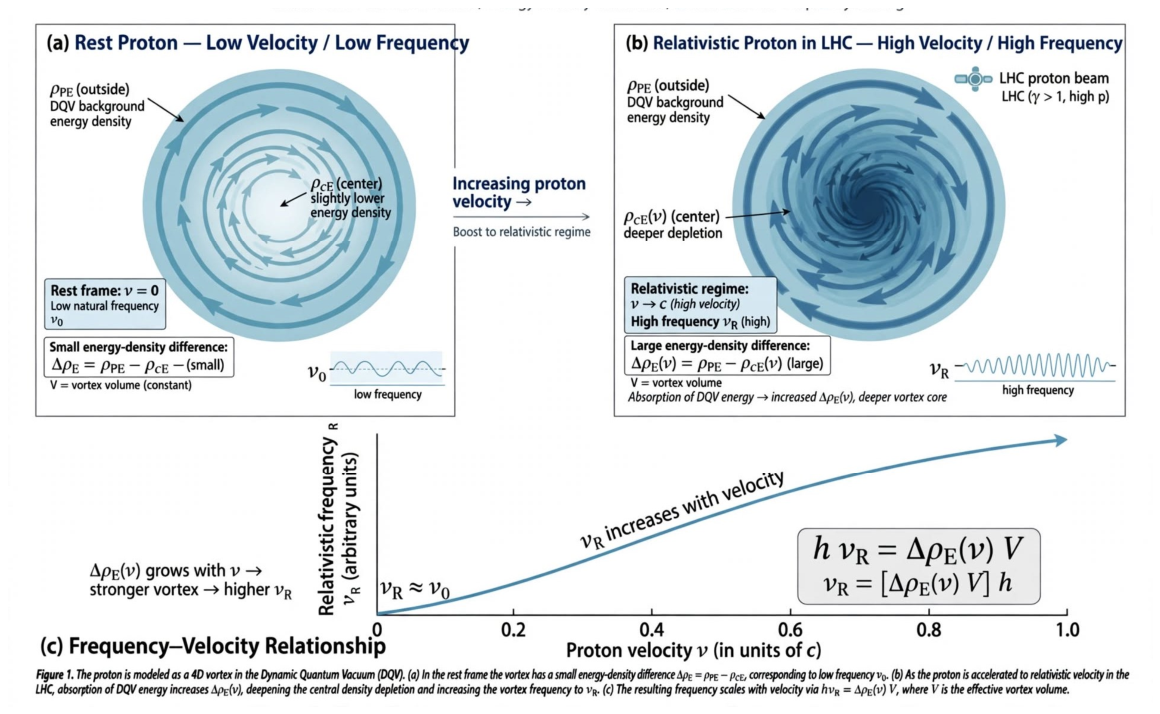
When proton vortex is accelerated in LHC, it increases its frequency and absorbs the energy of DQV in the vortex. Higher the velocity, higher is and bigger is relativistic frequency , see Figure 1:
2. Relativistic Mass of Proton: DQV Model vs SR Model
Relativistic proton in LHC increases its rest mass by 7462 times which is the Lorentz factor, see Eq. (12):
In Standard model, relativistic mass is:
Combining Eq. (12) and Eq. (13), in DQV model, relativistic mass is:
is local property of DQV, same for all observers. In Eq. (12) Lorentz factor is expressed not by velocity but by the difference of energy density of DQV. In the standard formulation of Special Relativity, the Lorentz factor is expressed as a kinematic function of velocity: . In the DQV model, the Lorentz factor has a dynamic origin in the variable energy density of the superfluid quantum space. Let denote the energy density of DQV at a given point P in the absence of the particle, and the energy density in the center of the particle vortex. The diminished energy density generated by the particle is: . Following the principle that every physical object diminishes the energy density of DQV exactly by the amount of its energy , the total energy of a moving proton vortex is , where is the effective volume of the vortex. The Lorentz factor is therefore expressed not by velocity, but by the difference of DQV energy density.
In this framework, is not an apparent mass due to relative motion with respect to an observer. It is a real, physical mass generated by the interaction of the proton vortex with the DQV. The increase of proton mass and correspondent energy corresponds to the additional DQV energy absorbed and stored in the proton vortex.
Since and are local properties of the DQV at the position of the particle, is observer-invariant. value is identical for all observers. In the DQV model, inertial systems are replaced by the variable energy density of DQV and the relativity principle is generalized to all observers.
In the Standard Model, a high-energy proton-proton collision is interpreted as the disintegration of the proton into its constitutive elements - quarks and gluons - which subsequently hadronize into observable particles.
In the DQV model, the proton is a stable vortex of the superfluid quantum space. Upon collision at energies such as those reached at the LHC, the vortex structure becomes unstable and disintegrates. The fragments, phenomenologically observed as secondary particles or “sparkles” in detectors, are transient excitations of the DQV that immediately dissipate and return to the DQV energy reservoir. They do not represent liberated constituents of the proton.
From an epistemological perspective, the DQV model does not predict the proton to be a composite system possessing constitutive elements. The proton is a fundamental, non-composite vortex structure of DQV, and its mass, charge and spin are properties of the vortex dynamics itself, not the result of an internal composition.
In Standard Model, collided proton falls apart in quarks and gluons, in DQV model, collided proton vortex falls apart and the “sparkles” turn immediately back into the DQV energy reservoir. In DQV model epistemology does not predict proton is a system that has constitutive elements.
This epistemological perspective of the DQV model on the relativistic proton and its decay is revolutionary and offers several advantages.
First, it replaces an observer-dependent, kinematic interpretation of relativistic phenomena with an observer-invariant, dynamic one. The relativistic mass and the Lorentz factor γ, given by Eq. (12), are not apparent effects of relative motion, but real physical quantities determined by the local diminished energy density of the DQV, and therefore identical for all observers.
Second, it provides a unified physical mechanism for both mass increase and stability loss. The increase of with energy corresponds to the increased circulation and energy storage of the vortex in the DQV, while its eventual disintegration at LHC energies is a natural consequence of exceeding the maximal sustainable i.e., the maximal local depletion of the DQV reservoir.
Third, it offers ontological parsimony. The DQV model does not require the proton to be a composite system of point-like constitutive elements requiring additional mechanisms such as color confinement. The proton is a fundamental vortex structure whose properties are intrinsic to the vortex dynamics. The observed collision products are not liberated constituents, but transient excitations of the DQV that return to the vacuum energy reservoir, thereby eliminating the conceptual difficulties associated with permanently confined quarks and gluons.
While the DQV model agrees with the Standard Model’s principle that unstable elements can form stable systems, it introduces a more stringent constraint: the lifetime of a system composed of unstable elements cannot be longer than the shortest lifetime among its constituent elements. Let system S be composed out of n elements with lifetimes :
then the lifetime of the system is bound by:
Consequently, the proton lifetime is constrained by the lifetime of the up quark and that of the gluons; the latter being zero, the proton itself cannot be assigned a finite, non-zero lifetime in this constituent picture. The proton possesses no constitutive parts; it is a vortex excitation of the fundamental quantum vacuum (DQV) field. The particles observed in the LHC are quasi-particles that do not exist in the physical universe; they are man-made, transient excitations produced by high-energy collisions.
3. DQV and Higgs Field
In the Standard Model, the rest mass of elementary particles is attributed to the Higgs mechanism through spontaneous symmetry breaking and coupling to the Higgs field. While this mechanism provides a value for , it does not offer a physical explanation for the increase to relativistic mass , which remains a kinematic effect defined by the Lorentz factor . The connection between rest mass and relativistic mass therefore remains conceptually disjoint: one is dynamical, the other is kinematical and observer-dependent.
In the DQV vortex model, the proton mass does not require the Higgs mechanism. Both rest mass and relativistic mass have a common physical origin in the interaction of the vortex with the DQV.
The rest mass corresponds to the baseline diminished energy density, see Eq. (2), the relativistic mass corresponds to the total diminished energy density, including the kinetic contribution, as defined in Eq. (14). Thus, rest mass and relativistic mass are two states of the same physical process - the degree of DQV energy depletion generated by the vortex. Their relationship is continuous and observer-invariant, determined solely by the local variable energy density $\rho_{PE}$ and the vortex state. The DQV model therefore has no difficulty in connecting rest mass and relativistic mass, as both are manifestations of the same vortex-DQV interaction.
In DQV model, rest mass , and inertial mass is:
The inertial mass , i.e., the resistance of a physical object to acceleration, has a different physical origin. It is generated by the diminished energy density of the DQV that the rest mass itself induces in its local area. Diminished energy density of the DQV also generates gravitational mass .
In the Standard Model, inertial mass is postulated to be identical to rest mass. From the perspective of DQV, this identification represents a deep epistemological misunderstanding. It conflates two distinct physical entities: rest mass as an intrinsic property of the vortex, and inertial mass as its dynamical interaction with the DQV.
Initially, the Higgs mechanism was proposed to explain the origin of inertial mass of massive particles, based on the premise that there must be a field that slows down some particles. First reference: “An object moving in the medium (marble, swimmer, snowshoe) is the object node to be mapped to a massive particle. The drag force resultant from the medium is an object node mapped to the Higgs mechanism (resultant from the Higgs field). The impedance to motion from the drag force is the predicate relationship analogous to the Higgs mechanism imparting an inertial mass” [3]. Second reference: “Higgs proposed that the vacuum contains an omnipresent field that can slow down some (otherwise massless) elementary particles—like a vat of molasses slowing down a high-speed bullet. Such particles would behave like massive particles traveling at less than light speed. Other particles—such as the photons of light—are immune to the field: They do not slow down and remain massless” [4]. Third reference Prof. Don Lincoln video [5].
The interpretation of the Higgs field as a viscous medium that slows down particles and thereby endows them with inertial mass is physically untenable. This representation conflates velocity-dependent drag with velocity-independent inertia and is incompatible with both special relativity and Newtonian mechanics. Today the official CERN statemen is that that Higgs field give mass to the all-elementary particles that have mass: “The Higgs field was proposed in 1964 as a new kind of field that fills the entire Universe and gives mass to all elementary particles. Particles get their mass by interacting with the Higgs field; they do not have a mass of their own” [6]. This view is in perfect accordance with DQV model, where particles are vortexes of fundamental field of the universe - DQV. In DQV, the omnipresent superfluid quantum vacuum is the fundamental field, and its local energy density diminution in the vortex core determines the inertial mass and also gravitational mass , they have the same origin (Eq. 15). The Higgs field can thus be reinterpreted as the dynamic quantum vacuum itself, whose quantized vortex excitations constitute elementary particles. In this picture, energy, mass and space emerge from the same fundamental substratum. The DQV model represents a pathway toward Einstein’s dream of a theory of everything.
4. Muon Decay in DQV Model
In Standard model the moun decay when approaching the Earth is as follows:
where denotes the velocity of the muon with respect to the Earth’s surface. The observed prolongation of the muon lifetime is a consequence of the fact that the observer at rest on the Earth’s surface measures the decay process from a different inertial reference system. This view lacks epistemological stability, as the decay rate is rendered dependent on the observer’s position, and so possesses no consistent internal physical logic. In the DQV model, the prolongation of muon decay is attributed to the muon entering regions of lower DQV energy density. This effect is a direct technical consequence of the variation in DQV energy density and is observer-invariant, see Eq. (18) where is expressed by Eq. (12).
In the DQV model, the variable energy density of DQV is the carrier of both inertial and gravitational mass. Particles are understood as vortices of DQV, while electromagnetic phenomena correspond to excitations of DQV. The vortex model extends to galactic scales, where it provides a solution to the flat rotation curve problem; consequently, the DQV model does not require dark matter [7]. Dark energy is identified as the intrinsic energy of DQV itself. DQV model represents a theoretical framework for Einstein’s theory of everything.
5. Conclusions
The proton is not a composite system. It is a fundamental, stable vortex of the Dynamic Quantum Vacuum. Relativistic mass increase in the LHC is not a kinematic effect of the observer. It is a real, physical increase of energy stored in the vortex, determined by the local diminished energy density of DQV and therefore observer-invariant. What is observed as particle production in high-energy collisions is not liberation of internal constituents, but the disintegration of the kinetic vacuum energy flux carried by the vortex. Products with lifetimes of to s have no stable existence in physical reality and are best understood as transient excitations of DQV. In this picture, rest mass, inertial mass and gravitational mass share a common origin in DQV, the Higgs field is reinterpreted as DQV itself, dark matter becomes unnecessary, and dark energy is the energy of DQV. DQV thus provides a unified, ontologically parsimonious framework for Einstein’s theory of everything.
References
- Fiscaletti, D.; Sorli, A. Perspectives of the Numerical Order of Material Changes in Timeless Approaches in Physics. Found. Phys. 2015, 45, 105–133. [Google Scholar] [CrossRef]
- Fiscaletti, D.; Sorli, A. Region of instability of matter as an alternative to gravitational collapse inside black holes. Ann. Phys. 2026, 489, 170430. [Google Scholar] [CrossRef]
- Bagge, S.; Johansson, A. Molasses or crowds: making sense of the Higgs boson with two popular analogies. Phys. Educ. 2013, 48(5), 670. Available online: https://iopscience.iop.org/article/10.1088/0031-9120/48/5/670.
- Symmetry Magazine. Higgs boson - Explain it in 60 seconds. In Fermilab / SLAC publication; 2006, August 1; updated 2012. [Google Scholar]
- Lincoln, Don. The Higgs field explained. 2013. Available online: https://www.youtube.com/watch?v=joTKd5j3mzk.
- CERN. The Higgs boson; European Organization for Nuclear Research: Geneva, Switzerland, 2026; Available online: https://home.cern/science/physics/higgs-boson.
- Šorli, A. S. Dynamic Quantum Vacuum Vortex Origin of Mercury Precession, Pioneer Anomaly and Spiral Galactic Rotation Curves. Preprints 2026, 2026101950. [Google Scholar] [CrossRef]
Figure 1.
Proton as 4D vortex of Dynamic Quantum Vacuum (DQV).
Disclaimer/Publisher’s Note: The statements, opinions and data contained in all publications are solely those of the individual author(s) and contributor(s) and not of MDPI and/or the editor(s). MDPI and/or the editor(s) disclaim responsibility for any injury to people or property resulting from any ideas, methods, instructions or products referred to in the content. |
© 2026 by the authors. Licensee MDPI, Basel, Switzerland. This article is an open access article distributed under the terms and conditions of the Creative Commons Attribution (CC BY) license (http://creativecommons.org/licenses/by/4.0/).
Copyright: This open access article is published under a Creative Commons CC BY 4.0 license, which permit the free download, distribution, and reuse, provided that the author and preprint are cited in any reuse.