

Submitted:
08 October 2026
Posted:
09 October 2026
You are already at the latest version
Abstract
This study examined associations between social relationships, depressive symptoms, and self-rated health (SRH) among adults living alone in South Korea. Data from 44,168 adults living alone who participated in the 2025 Korea Community Health Survey were analyzed using complex-samples logistic regression. Social relationships included contact frequency with family members or relatives, neighbors, and friends and neighborhood trust. Depressive symptoms were defined as a Patient Health Questionnaire-9 score ≥ 10. The weighted prevalence of depressive symptoms was 6.9%, and that of poor SRH was 22.5%. Compared with contact four or more times per week, family or relative contact less than once per month was associated with depressive symptoms (aOR = 1.50, 95% CI: 1.31–1.72) and poor SRH (aOR = 1.28, 95% CI: 1.17–1.41). Corresponding associations for infrequent friend contact were stronger (aOR = 2.02, 95% CI: 1.75–2.34; aOR = 1.77, 95% CI: 1.63–1.93, respectively). Lack of neighborhood trust was also associated with both outcomes. These findings suggest that specific social relationships, particularly friendships, are relevant to mental and perceived health among adults living alone.
Keywords:
living alone
; social relationships
; depressive symptoms
; self-rated health
; neighborhood trust
; Korea community health survey
1. Introduction
The rapid increase in the number of people living alone represents a major demographic and social transition with important implications for public health. Changes in family structure, population aging, delayed marriage, divorce, and greater diversity in living arrangements have contributed to the expansion of single-person households in South Korea [1,2]. Although living alone does not necessarily imply social isolation or poor health, individuals living alone may have fewer opportunities for routine interpersonal interaction within the household and may depend more heavily on relationships with family members, relatives, friends, and neighbors for emotional and practical support [3,4,5]. Consequently, understanding the health of adults living alone requires attention not only to household composition but also to the social relationships maintained outside the household.
Living alone has been associated with mental health disparities in previous Korean studies. Population-based research has reported a higher prevalence of depression among individuals living alone than among those living with a spouse or other household members [6]. Research focusing specifically on Korean single-person households has also demonstrated an association between social isolation and depression and suggested that the magnitude of this association may differ across age groups [7]. More recent longitudinal evidence has further emphasized that single-person households are heterogeneous and that psychosocial and socioeconomic deprivation may be associated with different trajectories of depressive symptoms across the life course [8].
Importantly, however, living alone and being socially isolated are conceptually distinct [3,9]. An individual may live alone while maintaining frequent and meaningful interactions with family members, friends, and neighbors, whereas another person may live with others but have limited supportive social relationships. Social relationships have been consistently linked to physical and mental health, and both the structural and functional dimensions of social connections may contribute to health through emotional support, access to resources, behavioral regulation, and physiological pathways [4,5,10,11,12]. Korean research using Community Health Survey data has also shown that contact with relatives, neighbors, and friends is associated with depressive symptoms among older adults [13]. More recent KCHS research found that social networks moderated the association between living alone and depressive symptoms among older Korean adults [14].
Social relationships also extend beyond direct interpersonal contact. Neighborhood trust and reciprocity represent broader dimensions of social connectedness and social capital [15,16]. Social capital has been associated with mental health in previous research, although its effects may differ according to the dimensions of social capital examined [17,18]. Korean research using Community Health Survey data has similarly demonstrated associations between perceived neighborhood environments, including neighborhood trust, and depressive mood [19]. Together, these findings suggest that the social environment surrounding an individual may be relevant to psychological well-being and that different forms of social relationships should be considered separately rather than combined indiscriminately into a single indicator.
Depressive symptoms are particularly relevant to the health of adults living alone. The Patient Health Questionnaire-9 (PHQ-9) is a widely used measure of depressive symptom severity [21] and has demonstrated acceptable reliability and validity in Korean populations [22,23,24]. A score of 10 or higher is commonly used as a threshold indicating clinically relevant depressive symptoms [21,25]. Previous Korean studies have identified socioeconomic disadvantage, health problems, limited social interaction, and insufficient social resources as factors associated with depressive symptoms among people living alone [7,8,14]. These findings indicate that depressive symptoms among adults living alone should be understood within a broader context encompassing both individual characteristics and interpersonal and community resources.
Mental health, however, represents only one dimension of health among individuals living alone. Self-rated health (SRH) provides an individual's overall subjective assessment of health and has been widely used as an indicator of general health status [25,26,27]. Previous research has demonstrated that SRH predicts subsequent morbidity and mortality even after consideration of objective health indicators [26,27]. Social relationships may also contribute to SRH[20]. Korean research has shown that individuals with smaller or more restricted social networks tend to report poorer self-rated health [29,30]. Among older adults living alone, social engagement has also been associated with self-rated health [31]. Thus, examining depressive symptoms together with self-rated health may provide a broader understanding of health vulnerability among adults living alone.
Despite growing interest in single-person households, several gaps remain in the existing literature. First, a substantial proportion of Korean research on social relationships and health has focused on older adults [13,14,29,30,31], although single-person households comprise young, middle-aged, and older adults. Previous research has indicated that associations between social isolation and depression may differ across age groups [7,8]. Second, previous studies have frequently focused on depressive symptoms as the principal health outcome, whereas fewer population-based studies have simultaneously examined psychological health and overall perceived health among adults living alone. Third, social relationships are multidimensional. Relationships with family members or relatives, neighbors, and friends, as well as trust within the neighborhood, may represent distinct social resources and may therefore show different associations with health [13,29,30].
Accordingly, the present study used data from the 2025 Korea Community Health Survey (KCHS) [32,33] to examine social relationships, depressive symptoms, and self-rated health among adults living alone in South Korea. Rather than defining living alone itself as social isolation, this study conceptualized social connectedness through specific indicators of interpersonal and community relationships, including contact with family members or relatives, neighbors, and friends and perceived neighborhood trust. The objectives of this study were to (1) describe the sociodemographic, social relationship, depressive symptom, and self-rated health characteristics of adults living alone; (2) examine the distributions of social relationship indicators, depressive symptoms, and self-rated health; and (3) determine whether specific social relationship indicators were independently associated with depressive symptoms and self-rated health after adjustment for relevant sociodemographic and health-related characteristics.
2. Materials and Methods
2.1. Study Design and Data Source
This study was a cross-sectional secondary analysis of data from the 2025 Korea Community Health Survey (KCHS). The KCHS is a nationwide population-based survey conducted annually by the Korea Disease Control and Prevention Agency (KDCA) in collaboration with local governments and public health centers to generate standardized community-level health indicators among Korean adults. The survey collects comprehensive information on sociodemographic characteristics, health behaviors, physical and mental health, healthcare utilization, and social and environmental factors. The 2025 KCHS employed a complex sampling design to obtain representative estimates of community-dwelling adults in South Korea. A total of 231,615 respondents were included in the original dataset used for the present study. Sampling design variables, including strata, clusters, and sampling weights, were incorporated into the statistical analyses to account for the complex survey design and to obtain appropriate population estimates and standard errors. For the present study, the analysis was restricted to adults living in one-person households. One-person household status was determined based on the number of household members recorded in the KCHS dataset. Social relationship indicators, depressive symptoms assessed using the Patient Health Questionnaire-9 (PHQ-9), and self-rated health were examined as the principal study variables. The overall study design and participant selection process are summarized in Figure 1.
2.2. Study Population
The original 2025 KCHS dataset included 231,615 participants. Among them, 46,426 participants were identified as adults living in one-person households and were considered eligible for the present study. Participants with incomplete PHQ-9 data (n=121) were excluded, leaving 46,305 participants with complete PHQ-9 data. An additional 1,659 participants with incomplete social relationship data were excluded, resulting in 44,646 participants with complete information on depressive symptoms and social relationship indicators. One participant with missing self-rated health data was subsequently excluded. Finally, 477 participants with missing or invalid covariate data were excluded. The final analytic sample therefore consisted of 44,168 adults living alone. The participant selection process is presented in Figure 1.
2.3. Measures
2.3.1. Study Variables
Social relationships were assessed using four indicators included in the 2025 Korea Community Health Survey (KCHS): frequency of contact with relatives or family members, frequency of contact with neighbors, frequency of contact with friends, and perceived trust among neighbors. These indicators were analyzed separately to reflect different dimensions and sources of social connectedness among adults living alone. Frequency of contact with relatives or family members, neighbors, and friends was assessed using separate questions regarding how often participants communicated or interacted with individuals in each relationship category. Responses were categorized according to the frequency of contact, with lower levels of contact representing weaker interpersonal connections. Neighborhood trust was assessed using an item measuring whether participants perceived people in their neighborhood as trustworthy. Rather than defining individuals living alone as socially isolated, the present study examined social relationships using multiple indicators. This distinction was particularly important because living alone represents a household arrangement and does not necessarily indicate an absence of meaningful interpersonal relationships. Accordingly, the three contact-frequency indicators were used to assess interpersonal connectedness across different relationship domains, whereas neighborhood trust was used to capture the perceived relational quality of the local social environment. For regression analyses, the four social relationship indicators were entered simultaneously as distinct predictors according to the predefined KCHS response categories, with the category representing the highest level of social contact or trust serving as the reference category. This approach allowed the associations of reduced social contact across family, neighbor, and friend relationships with depressive symptoms and self-rated health to be examined independently.
2.3.2. Depressive Symptoms
Depressive symptoms were assessed using the Patient Health Questionnaire-9 (PHQ-9) included in the mental health section of the 2025 Korea Community Health Survey (KCHS). The PHQ-9 consists of nine items assessing depressive symptoms experienced during the previous two weeks, including loss of interest or pleasure, depressed mood or hopelessness, sleep disturbance, fatigue or low energy, changes in appetite, negative self-perception, difficulty concentrating, psychomotor changes, and thoughts of death or self-harm. Each item was rated on a four-point scale ranging from 0 (not at all) to 3 (nearly every day). Item scores were summed to obtain a total score ranging from 0 to 27, with higher scores indicating greater severity of depressive symptoms. For the present study, a total PHQ-9 score of 10 or higher was used to define clinically relevant depressive symptoms, whereas scores below 10 were classified as not meeting this threshold. The dichotomized PHQ-9 variable was used as the primary depressive-symptom outcome in the complex-sample logistic regression analyses. Participants with missing or invalid responses to the PHQ-9 items were excluded according to the predefined data-cleaning procedure.
2.3.3. Self-Rated Health
Self-rated health was assessed using the general health-status item included in the 2025 Korea Community Health Survey (KCHS). Participants were asked to rate their overall health on a five-point scale: very good, good, fair, poor, or very poor. For the present analysis, self-rated health was dichotomized into poor self-rated health and non-poor self-rated health. Participants who reported their health as poor or very poor were classified as having poor self-rated health, whereas those who reported very good, good, or fair health were classified as having non-poor self-rated health. Poor self-rated health was coded as the adverse outcome for the complex-sample logistic regression analyses. Accordingly, an odds ratio greater than 1.00 indicated higher odds of reporting poor self-rated health, whereas an odds ratio below 1.00 indicated lower odds of reporting poor self-rated health. Participants with missing or invalid responses to the self-rated health item were excluded according to the predefined data-cleaning criteria.
2.3.4. Covariates
Potential confounding variables were selected based on their conceptual relevance to social relationships, depressive symptoms, and self-rated health among adults living alone. The covariates included sex, age group, educational attainment, marital status, economic activity, annual household income, and average daily sleep duration. Sex was categorized as male or female. Age was categorized into 19–39 years, 40–64 years, and ≥65 years. Educational attainment was classified into eight categories: no formal education, Seodang/Han-hak, elementary school, middle school, high school, 2- or 3-year college, 4-year university, and graduate school or higher. Marital status was classified as married with spouse present, married with spouse absent, widowed, divorced, or never married. Economic activity was categorized as yes or no. Annual household income was divided into quartiles (Q1–Q4), with Q1 representing the lowest and Q4 the highest income group. Average daily sleep duration was categorized as <7 h, 7 to <9 h, and ≥9 h per day. These covariates were included in the multivariable models to account for potential confounding in the associations of social relationship indicators with depressive symptoms and poor self-rated health.
2.4. Statistical Analysis
All statistical analyses were conducted using IBM SPSS Statistics with procedures for complex survey data. The stratification variable, primary sampling unit, and individual sampling weight provided by the 2025 Korea Community Health Survey were incorporated into all analyses to account for the complex sampling design. Unweighted frequencies and weighted percentages with 95% confidence intervals (CIs) were calculated to describe the general characteristics of the study population.
The distributions of the four social relationship indicators—contact with family members or relatives, contact with neighbors, contact with friends, and neighborhood trust—were examined using unweighted frequencies and weighted percentages with 95% CIs. The weighted prevalence of clinically relevant depressive symptoms (PHQ-9 ≥ 10) and poor self-rated health was also estimated.
Complex-samples logistic regression analyses were performed to examine the associations of social relationship indicators with depressive symptoms and poor self-rated health. For each outcome, Model 1 simultaneously included the four social relationship indicators. Model 2 additionally adjusted for economic activity, annual household income, average daily sleep duration, sex, age group, educational attainment, and marital status. Contact four or more times per week was used as the reference category for each contact-frequency variable, and participants reporting neighborhood trust served as the reference category for neighborhood trust. Results are presented as odds ratios (ORs) and adjusted odds ratios (aORs) with 95% CIs. Statistical significance was determined using a two-sided p value < 0.05.
2.5. Ethical Considerations
This study was based on a secondary analysis of publicly available, de-identified data from the 2025 Korea Community Health Survey (KCHS). The KCHS data released by the Korea Disease Control and Prevention Agency (KDCA) for research purposes contain no personally identifiable information. The present study did not involve direct contact with participants or the collection of additional personal information. According to the KDCA, the KCHS has not been subject to Institutional Review Board (IRB) review since 2017 because it is not classified as human subjects research under the Enforcement Rule of the Bioethics and Safety Act. Accordingly, no additional informed consent was obtained from participants for the present secondary analysis.
3. Results
3.1. General Characteristics of the Study Population
A total of 44,168 adults living alone were included in the final analysis. After applying the complex sampling weights, 49.7% of participants were men and 50.3% were women. By age group, 30.8% were aged 19–39 years, 34.2% were aged 40–64 years, and 34.9% were aged 65 years or older. Regarding educational attainment, 29.0% had completed a four-year university education, followed by high school education (27.3%). Never-married individuals accounted for 44.3% of the study population, while 26.0% were widowed. A total of 62.1% were economically active. Regarding annual household income, 37.8% were classified in the third quartile and 25.1% in the highest quartile. In terms of average daily sleep duration, 51.6% reported sleeping less than 7 h, 45.1% reported 7 to <9 h, and 3.3% reported 9 h or more per day (Table 1).
3.2. Distribution of Social Relationships, Depressive Symptoms, and Self-Rated Health
The distributions of social relationship indicators, depressive symptoms, and self-rated health are presented in Table 2. Regarding family/relative contact, 25.6% of participants reported contact four or more times per week, whereas 17.4% reported contact less than once per month. In contrast, infrequent contact with neighbors was relatively common, with 55.8% reporting contact less than once per month and 18.0% reporting contact four or more times per week. For contact with friends, 25.3% reported contact four or more times per week, while 20.8% reported contact less than once per month. More than half of the participants (56.0%) reported trusting people in their neighborhood, whereas 44.0% reported no neighborhood trust. The weighted prevalence of clinically relevant depressive symptoms (PHQ-9 ≥ 10) was 6.9% (95% CI: 6.6–7.2), and the weighted prevalence of poor self-rated health was 22.5% (95% CI: 22.0–23.0) (Table 2).
3.3. Associations Between Social Relationships and Depressive Symptoms
In Model 1, family/relative contact, friend contact, and neighborhood trust were significantly associated with depressive symptoms, whereas neighbor contact was not significant overall. Compared with participants who had contact with family members or relatives four or more times per week, those reporting contact less than once per month had higher odds of depressive symptoms (OR = 1.51, 95% CI: 1.33–1.72). Participants who had contact with friends less than once per month also had substantially higher odds of depressive symptoms (OR = 2.63, 95% CI: 2.30–3.00). In addition, participants without neighborhood trust had higher odds of depressive symptoms than those reporting neighborhood trust (OR = 1.68, 95% CI: 1.53–1.85). After adjustment for economic activity, annual household income, average daily sleep duration, sex, age group, educational attainment, and marital status (Model 2), family/relative contact less than once per month remained associated with higher odds of depressive symptoms (aOR = 1.50, 95% CI: 1.31–1.72). Neighbor contact less than once per month was associated with higher odds of depressive symptoms (aOR = 1.45, 95% CI: 1.27–1.67). Participants reporting friend contact less than once per month had approximately twice the odds of depressive symptoms compared with those reporting contact four or more times per week (aOR = 2.02, 95% CI: 1.75–2.34). Lack of neighborhood trust was also associated with higher odds of depressive symptoms (aOR = 1.62, 95% CI: 1.47–1.80). Unlike Model 1, the overall association between neighbor contact and depressive symptoms was statistically significant after adjustment (p < 0.001) (Table 3).
3.4. Associations Between Social Relationships and Poor Self-Rated Health
In Model 1, family/relative contact, neighbor contact, friend contact, and neighborhood trust were significantly associated with poor self-rated health. Compared with participants who had contact with family members or relatives four or more times per week, those reporting contact less than once per month had higher odds of poor self-rated health (OR = 1.40, 95% CI: 1.29–1.52). Participants reporting friend contact less than once per month had substantially higher odds of poor self-rated health (OR = 3.47, 95% CI: 3.22–3.76). Participants without neighborhood trust also had higher odds of poor self-rated health (OR = 1.21, 95% CI: 1.14–1.28). After adjustment for economic activity, annual household income, average daily sleep duration, sex, age group, educational attainment, and marital status (Model 2), family/relative contact less than once per month remained associated with higher odds of poor self-rated health (aOR = 1.28, 95% CI: 1.17–1.41). Infrequent friend contact showed a stronger association, with participants reporting contact less than once per month having higher odds of poor self-rated health than those reporting contact four or more times per week (aOR = 1.77, 95% CI: 1.63–1.93). Lack of neighborhood trust was also associated with higher odds of poor self-rated health (aOR = 1.36, 95% CI: 1.27–1.45). In contrast, the overall association between neighbor contact and poor self-rated health was no longer statistically significant after adjustment (p = 0.505) (Table 4).
4. Discussion
This study examined the associations of specific social relationship indicators with depressive symptoms and self-rated health among 44,168 adults living alone using nationally representative data from the 2025 Korea Community Health Survey. Three principal findings emerged. First, infrequent contact with family members or relatives was independently associated with both depressive symptoms and poor self-rated health. Second, infrequent contact with friends showed particularly consistent associations with both outcomes, with participants reporting friend contact less than once per month having approximately twice the odds of depressive symptoms and 1.77 times the odds of poor self-rated health compared with those reporting contact four or more times per week. Third, lack of neighborhood trust was independently associated with both depressive symptoms and poor self-rated health. In contrast, the association between neighbor contact and health differed according to the outcome: neighbor contact was associated with depressive symptoms after multivariable adjustment, whereas its association with poor self-rated health was attenuated and was no longer statistically significant.
The association between infrequent social contact and depressive symptoms is broadly consistent with previous research demonstrating that social relationships are important correlates of mental health [3,4,5,9,12,35,41]. Social relationships may provide emotional support, opportunities for communication, practical assistance, and a sense of belonging, whereas restricted or unsatisfactory relationships may increase vulnerability to psychological distress [4,5,39,40]. Longitudinal evidence has also shown that the quality of social relationships is associated with subsequent depression, although structural isolation and relationship quality may not have identical effects [35]. These findings reinforce the importance of distinguishing specific dimensions of social connectedness rather than treating living alone itself as equivalent to social isolation.
The present findings are also consistent with Korean population-based evidence. Yang et al. [13], using data from 62,845 adults aged 65 years or older in the 2015 KCHS, reported that less frequent social contact was associated with depressive symptoms and identified contact with neighbors as an important component of social relationships among older Koreans. Hwang and Ki [7] similarly reported an association between social isolation and depression among Korean adults living alone, while more recent research has emphasized heterogeneity in depressive symptom trajectories according to psychosocial and socioeconomic deprivation among single-person households [8]. Taken together with the present findings, these studies suggest that the mental health of people living alone is related not simply to residential status but also to the social connections available outside the household.
A notable finding of the present study was the comparatively strong and consistent association of friend contact with both outcomes. After adjustment for sociodemographic and health-related covariates, participants who contacted friends less than once per month had approximately twice the odds of depressive symptoms compared with those contacting friends four or more times per week. Infrequent friend contact was also associated with substantially higher odds of poor self-rated health. Previous studies have shown that different types of social ties may have different implications for health and that restricted social networks are associated with less favorable physical and mental health [29,34]. Sohn et al. [29], for example, identified five social network types among older Korean adults and found that restricted networks were associated with poorer subjective mental and physical health, whereas more diverse or family-oriented networks were associated with more favorable subjective mental health.
The relatively strong association observed for friend contact may reflect the distinctive characteristics of friendship ties. Unlike many family relationships, friendships are generally maintained voluntarily and may therefore represent companionship, emotional intimacy, shared interests, and active social participation. Social ties can influence health through several mechanisms, including emotional and instrumental support, behavioral regulation, access to information and resources, and psychological processes related to identity and belonging [4,11,39,40]. However, the present cross-sectional data cannot determine whether infrequent friend contact contributes to depressive symptoms and poor perceived health or whether individuals experiencing depression or poor health subsequently reduce their interactions with friends. This possibility of reverse causation should be considered when interpreting the findings.
Family or relative contact also remained independently associated with both outcomes. Participants reporting family or relative contact less than once per month had 50% higher adjusted odds of depressive symptoms and 28% higher adjusted odds of poor self-rated health than those reporting contact four or more times per week. Family ties may provide emotional security and practical assistance and may be particularly relevant to adults who do not have another household member available for everyday support [3,4,5,45]. Nevertheless, the associations were not strictly dose–response across every contact-frequency category. This suggests that the health relevance of family relationships may depend not only on the frequency of contact but also on relationship quality, perceived support, conflict, and the individual's expectations regarding family relationships. The present KCHS indicators measure contact frequency and therefore cannot fully capture these qualitative dimensions.
The findings regarding neighbor contact warrant particular attention. In Model 1, neighbor contact was not significantly associated with depressive symptoms overall, but after adjustment for socioeconomic and demographic characteristics, the overall association became statistically significant. Participants with neighbor contact less than once per month had higher adjusted odds of depressive symptoms than those with contact four or more times per week. This result is compatible with the findings of Yang et al. [13], who reported that contact with neighbors was particularly relevant to depressive symptoms among older Koreans. For individuals living alone, neighbors may constitute an accessible source of everyday interaction outside the household. However, because our study included adults across the full adult age range rather than only older adults, the meaning and importance of neighborhood contact may differ substantially according to age, employment, mobility, and lifestyle.
In contrast, neighbor contact was not independently associated with poor self-rated health after adjustment. This difference between the two outcomes suggests that the role of neighbor contact may be more closely related to psychological or social well-being than to an individual's global evaluation of physical and general health. Self-rated health represents a broad assessment incorporating physical functioning, chronic conditions, symptoms, psychological well-being, and social circumstances [26,27,28]. Consequently, its association with a specific form of social contact may be more susceptible to attenuation after socioeconomic and demographic factors are taken into account. This finding also demonstrates why separate examination of different relationship domains is informative: contact with family members, friends, and neighbors should not necessarily be interpreted as interchangeable indicators of a single underlying construct.
Neighborhood trust showed a different pattern from contact frequency. Participants who did not trust people in their neighborhood had 62% higher adjusted odds of depressive symptoms and 36% higher adjusted odds of poor self-rated health compared with those reporting neighborhood trust. Neighborhood trust can be considered a component of social capital reflecting perceptions of cohesion, reciprocity, and reliability within the local social environment [15,16,17,18]. Previous studies have linked social capital and neighborhood social environments to mental and general health [17,18,19,46,47]. The present findings extend this literature by showing that neighborhood trust remains associated with both psychological and perceived general health specifically among adults living alone.
The findings for self-rated health are also consistent with previous Korean social network research. Sohn et al. [29] reported that restricted social network types were associated with poorer subjective physical and mental health among older Korean adults. Youm et al. [30] similarly examined social network characteristics in relation to self-rated health in later life. Together with the present results, this evidence suggests that the health implications of social relationships extend beyond depressive symptoms and may be reflected in individuals' broader perceptions of their health. Because self-rated health is itself associated with subsequent health outcomes and mortality [26,27,28], the observed associations may have relevance for identifying socially vulnerable adults living alone.
Several features of this study strengthen its contribution. First, the analysis used a large nationwide sample of 44,168 adults living alone and incorporated the stratification, clustering, and individual sampling weights of the KCHS. Second, rather than operationalizing social connectedness as a single global measure, the study separately examined contact with family members or relatives, neighbors, and friends, as well as neighborhood trust. This approach revealed different patterns according to relationship type and outcome. Third, depressive symptoms and self-rated health were examined simultaneously as distinct outcomes, allowing comparison between psychological health and broader perceived health. Finally, the study included adults across a wide age range, thereby extending previous Korean research that has frequently focused on older populations [13,14,29,30,31].
Several limitations should also be considered. First, because the KCHS is cross-sectional, temporal or causal relationships cannot be established. Depression and poor health may reduce social participation and interpersonal contact, producing reverse causation. Second, social relationships were assessed primarily through frequency of contact. Contact frequency does not necessarily represent relationship quality, emotional closeness, perceived support, loneliness, or satisfaction with social relationships. Previous longitudinal research has demonstrated that qualitative dimensions of relationships may have important implications for depression [35]. Third, all principal variables were self-reported and may therefore be affected by recall or reporting bias. Fourth, although the analyses adjusted for several important sociodemographic and health-related covariates, residual confounding by factors not included in the models cannot be excluded. Fifth, although the large sample permits population-level estimates, the associations may vary by age, sex, socioeconomic position, or other characteristics. Future studies should therefore investigate potential effect modification and use longitudinal designs to clarify the direction of the observed associations.
From a public health perspective, these findings suggest that adults living alone should not be viewed as a homogeneous socially isolated population. The frequency and type of relationships maintained outside the household appear to be important. In particular, the consistent associations observed for friend contact, family or relative contact, and neighborhood trust suggest that assessments of social vulnerability among adults living alone may benefit from considering multiple relationship domains. Community-based programs that provide opportunities for meaningful interaction and facilitate supportive social connections may be relevant to mental and perceived health, although intervention studies are required before causal benefits can be established [40,42,47].
5. Conclusions
In this large national survey of adults living alone in South Korea, social relationships were significantly associated with depressive symptoms and self-rated health. Infrequent contact with friends showed particularly consistent associations with both depressive symptoms and poor self-rated health, while infrequent family/relative contact and lack of neighborhood trust were also associated with both outcomes. These findings highlight the importance of considering the type and frequency of social relationships when developing health promotion and mental health strategies for adults living alone. Community-based initiatives that facilitate meaningful social interaction and strengthen connections with family, friends, and local communities may contribute to supporting the mental and perceived health of adults living alone. Further longitudinal and intervention studies are needed to clarify the direction of these associations and evaluate the potential health effects of strengthening social relationships.
Author Contributions
Conceptualization, M.S.K.; methodology, M.S.K.; software, M.S.K.; validation, M.S.K.; formal analysis, M.S.K.; investigation, M.S.K.; resources, M.S.K.; data curation, M.S.K.; writing—original draft preparation, M.S.K.; writing—review and editing, M.S.K.; visualization, M.S.K.; supervision, M.S.K.; project administration, M.S.K. The author has read and agreed to the published version of the manuscript.
Funding
This research received no external funding.
Institutional Review Board Statement
Not applicable. This study involved secondary analysis of publicly available, de-identified data from the Korea Community Health Survey. According to the Korea Disease Control and Prevention Agency, the KCHS has not been subject to IRB review since 2017 because it is not classified as human subjects research under the Enforcement Rule of the Bioethics and Safety Act.
Informed Consent Statement
Not applicable. This study involved secondary analysis of publicly available, de-identified data from the Korea Community Health Survey and involved no direct contact with participants.
Data Availability Statement
The data analyzed in this study were obtained from the Korea Community Health Survey conducted by the Korea Disease Control and Prevention Agency. The data are available through the official KCHS data access procedures, subject to the applicable data-use requirements.
Conflicts of Interest
The author declares no conflicts of interest.
References
- Statistics Korea. 2025 Statistics of One-Person Households; Statistics Korea: Daejeon, Republic of Korea, 2025. [Google Scholar]
- Kang, E.N. Single-Person Households in South Korea and Their Policy Implications. Health Welf. Policy Forum 2016, 234, 47–56. [Google Scholar]
- House, J.S.; Landis, K.R.; Umberson, D. Social relationships and health. Science 1988, 241, 540–545. [Google Scholar] [CrossRef]
- Berkman, L.F.; Glass, T.; Brissette, I.; Seeman, T.E. From social integration to health: Durkheim in the new millennium. Soc. Sci. Med. 2000, 51, 843–857. [Google Scholar] [CrossRef]
- Kawachi, I.; Berkman, L.F. Social ties and mental health. J. Urban Health 2001, 78, 458–467. [Google Scholar] [CrossRef]
- Shin, C.; Kim, Y.; Park, S.; Yoon, S.; Ko, Y.H.; Kim, Y.K.; Kim, S.H.; Jeon, S.W.; Han, C. Prevalence and associated factors of depression in general population of Korea: Results from the Korea National Health and Nutrition Examination Survey, 2014. J. Korean Med. Sci. 2017, 32, 1861–1869. [Google Scholar] [CrossRef]
- Hwang, M.; Ki, M. Association between social isolation and depression among Korean living alone. Public Health Wkly. Rep. 2024, 17, 383–403. [Google Scholar] [CrossRef]
- Kwon, T. Multidimensional deprivation and depressive symptom trajectories among single-person households in South Korea: An age-stratified longitudinal study. BMC Public Health 2026, 26, 2383. [Google Scholar] [CrossRef]
- Cornwell, E.Y.; Waite, L.J. Social disconnectedness, perceived isolation, and health among older adults. J. Health Soc. Behav. 2009, 50, 31–48. [Google Scholar] [CrossRef]
- Holt-Lunstad, J.; Smith, T.B.; Layton, J.B. Social relationships and mortality risk: A meta-analytic review. PLoS Med. 2010, 7, e1000316. [Google Scholar] [CrossRef]
- Uchino, B.N. Social support and health: A review of physiological processes potentially underlying links to disease outcomes. J. Behav. Med. 2006, 29, 377–387. [Google Scholar] [CrossRef]
- Cacioppo, J.T.; Hawkley, L.C. Perceived social isolation and cognition. Trends Cogn. Sci. 2009, 13, 447–454. [Google Scholar] [CrossRef]
- Yang, J.; Park, E.C.; Lee, S.A.; Lee, J.E.; Choi, D.W.; Chae, W.; Jang, S.I. The association between social contacts and depressive symptoms among elderly Koreans. Psychiatry Investig. 2018, 15, 861–868. [Google Scholar] [CrossRef]
- Cho, Y.H.; Lee, J. The Moderating Influence of Social Networking on the Relationship Between Single Household Status and Depression in Elderly Individuals. J. Korean Public Health Nurs. 2025, 39, 249–259. [Google Scholar] [CrossRef]
- Putnam, R.D. Bowling Alone: The Collapse and Revival of American Community; Simon & Schuster: New York, NY, USA, 2000. [Google Scholar]
- Kawachi, I.; Subramanian, S.V.; Kim, D. (Eds.) Social Capital and Health; Springer: New York, NY, USA, 2008. [Google Scholar]
- Ehsan, A.M.; De Silva, M.J. Social capital and common mental disorder: A systematic review. J. Epidemiol. Community Health 2015, 69, 1021–1028. [Google Scholar] [CrossRef]
- De Silva, M.J.; McKenzie, K.; Harpham, T.; Huttly, S.R.A. Social capital and mental illness: A systematic review. J. Epidemiol. Community Health 2005, 59, 619–627. [Google Scholar] [CrossRef]
- Yim, D.-H.; Kwon, Y. Does Young Adults’ Neighborhood Environment Affect Their Depressive Mood? Insights from the 2019 Korean Community Health Survey. Int. J. Environ. Res. Public Health 2021, 18, 1269. [Google Scholar] [CrossRef]
- Kim, D.; Kawachi, I. A multilevel analysis of key forms of community- and individual-level social capital as predictors of self-rated health in the United States. J. Urban Health 2006, 83, 813–826. [Google Scholar] [CrossRef]
- Kroenke, K.; Spitzer, R.L.; Williams, J.B.W. The PHQ-9: Validity of a brief depression severity measure. J. Gen. Intern. Med. 2001, 16, 606–613. [Google Scholar] [CrossRef]
- Park, S.J.; Choi, H.R.; Choi, J.H.; Kim, K.W.; Hong, J.P. Reliability and validity of the Korean version of the Patient Health Questionnaire-9 (PHQ-9). Anxiety Mood 2010, 6, 119–124. [Google Scholar]
- Han, C.; Jo, S.A.; Kwak, J.H.; Pae, C.U.; Steffens, D.; Jo, I.; Park, M.H. Validation of the Patient Health Questionnaire-9 Korean version in the elderly population: The Ansan Geriatric Study. Compr. Psychiatry 2008, 49, 218–223. [Google Scholar] [CrossRef]
- Spitzer, R.L.; Kroenke, K.; Williams, J.B.W. Patient Health Questionnaire Primary Care Study Group. Validation and utility of a self-report version of PRIME-MD: The PHQ Primary Care Study. JAMA 1999, 282, 1737–1744. [Google Scholar] [CrossRef]
- Manea, L.; Gilbody, S.; McMillan, D. Optimal cut-off score for diagnosing depression with the Patient Health Questionnaire (PHQ-9): A meta-analysis. CMAJ 2012, 184, E191–E196. [Google Scholar] [CrossRef]
- Idler, E.L.; Benyamini, Y. Self-rated health and mortality: A review of twenty-seven community studies. J. Health Soc. Behav. 1997, 38, 21–37. [Google Scholar] [CrossRef]
- DeSalvo, K.B.; Bloser, N.; Reynolds, K.; He, J.; Muntner, P. Mortality prediction with a single general self-rated health question: A meta-analysis. J. Gen. Intern. Med. 2006, 21, 267–275. [Google Scholar] [CrossRef]
- Jylhä, M. What is self-rated health and why does it predict mortality? Towards a unified conceptual model. Soc. Sci. Med. 2009, 69, 307–316. [Google Scholar] [CrossRef]
- Sohn, S.Y.; Joo, W.T.; Kim, W.J.; Kim, S.J.; Youm, Y.; Kim, H.C.; Park, Y.R.; Lee, E. Social network types among older Korean adults: Associations with subjective health. Soc. Sci. Med. 2017, 173, 88–95. [Google Scholar] [CrossRef]
- Youm, Y.; Laumann, E.O.; Ferraro, K.F.; Waite, L.J.; Kim, H.C.; Park, Y.R.; Chu, S.H.; Joo, W.T.; Lee, J.A. Social network properties and self-rated health in later life: Comparisons from the Korean Social Life, Health, and Aging Project and the National Social Life, Health and Aging Project. BMC Geriatr. 2014, 14, 102. [Google Scholar] [CrossRef]
- Ryu, D. The impact of physical functionality and activity level on the self-rated health status of older adults living alone: An analysis of the mediating effect of social engagement. Geriatr. Nurs. 2025, 63, 464–469. [Google Scholar] [CrossRef]
- Korea Disease Control and Prevention Agency. 2025 Korea Community Health Survey Questionnaire; KDCA: Cheongju, Republic of Korea, 2025. [Google Scholar]
- Kang, Y.W.; Ko, Y.S.; Kim, Y.J.; Sung, K.M.; Kim, H.J.; Choi, H.Y.; Sung, C.; Jeong, E. Korea Community Health Survey data profiles. Osong Public Health Res. Perspect. 2015, 6, 211–217. [Google Scholar] [CrossRef]
- Park, S.; Smith, J.; Dunkle, R.E. Social network types and well-being among South Korean older adults. Aging Ment. Health 2014, 18, 72–80. [Google Scholar] [CrossRef]
- Teo, A.R.; Choi, H.; Valenstein, M. Social relationships and depression: Ten-year follow-up from a nationally representative study. PLoS ONE 2013, 8, e62396. [Google Scholar] [CrossRef]
- Luo, Y.; Hawkley, L.C.; Waite, L.J.; Cacioppo, J.T. Loneliness, health, and mortality in old age: A national longitudinal study. Soc. Sci. Med. 2012, 74, 907–914. [Google Scholar] [CrossRef]
- Courtin, E.; Knapp, M. Social isolation, loneliness and health in old age: A scoping review. Health Soc. Care Community 2017, 25, 799–812. [Google Scholar] [CrossRef]
- Holt-Lunstad, J.; Smith, T.B.; Baker, M.; Harris, T.; Stephenson, D. Loneliness and social isolation as risk factors for mortality: A meta-analytic review. Perspect. Psychol. Sci. 2015, 10, 227–237. [Google Scholar] [CrossRef]
- Cohen, S. Social relationships and health. Am. Psychol. 2004, 59, 676–684. [Google Scholar] [CrossRef]
- Thoits, P.A. Mechanisms linking social ties and support to physical and mental health. J. Health Soc. Behav. 2011, 52, 145–161. [Google Scholar] [CrossRef]
- Santini, Z.I.; Koyanagi, A.; Tyrovolas, S.; Mason, C.; Haro, J.M. The association between social relationships and depression: A systematic review. J. Affect. Disord. 2015, 175, 53–65. [Google Scholar] [CrossRef]
- Cruwys, T.; Haslam, S.A.; Dingle, G.A.; Haslam, C.; Jetten, J. Depression and social identity: An integrative review. Pers. Soc. Psychol. Rev. 2014, 18, 215–238. [Google Scholar] [CrossRef]
- Leigh-Hunt, N.; Bagguley, D.; Bash, K.; Turner, V.; Turnbull, S.; Valtorta, N.; Caan, W. An overview of systematic reviews on the public health consequences of social isolation and loneliness. Public Health 2017, 152, 157–171. [Google Scholar] [CrossRef]
- Valtorta, N.K.; Kanaan, M.; Gilbody, S.; Ronzi, S.; Hanratty, B. Loneliness and social isolation as risk factors for coronary heart disease and stroke: Systematic review and meta-analysis of longitudinal observational studies. Heart 2016, 102, 1009–1016. [Google Scholar] [CrossRef]
- Shor, E.; Roelfs, D.J.; Yogev, T. The strength of family ties: A meta-analysis and meta-regression of self-reported social support and mortality. Soc. Netw. 2013, 35, 626–638. [Google Scholar] [CrossRef]
- Choi, Y.J.; Matz-Costa, C. Perceived neighborhood safety, social cohesion, and psychological health of older adults. Gerontologist 2018, 58, 196–206. [Google Scholar] [CrossRef]
- World Health Organization. Social Isolation and Loneliness among Older People: Advocacy Brief; World Health Organization: Geneva, Switzerland, 2021. [Google Scholar]
Figure 1.
Study flow.
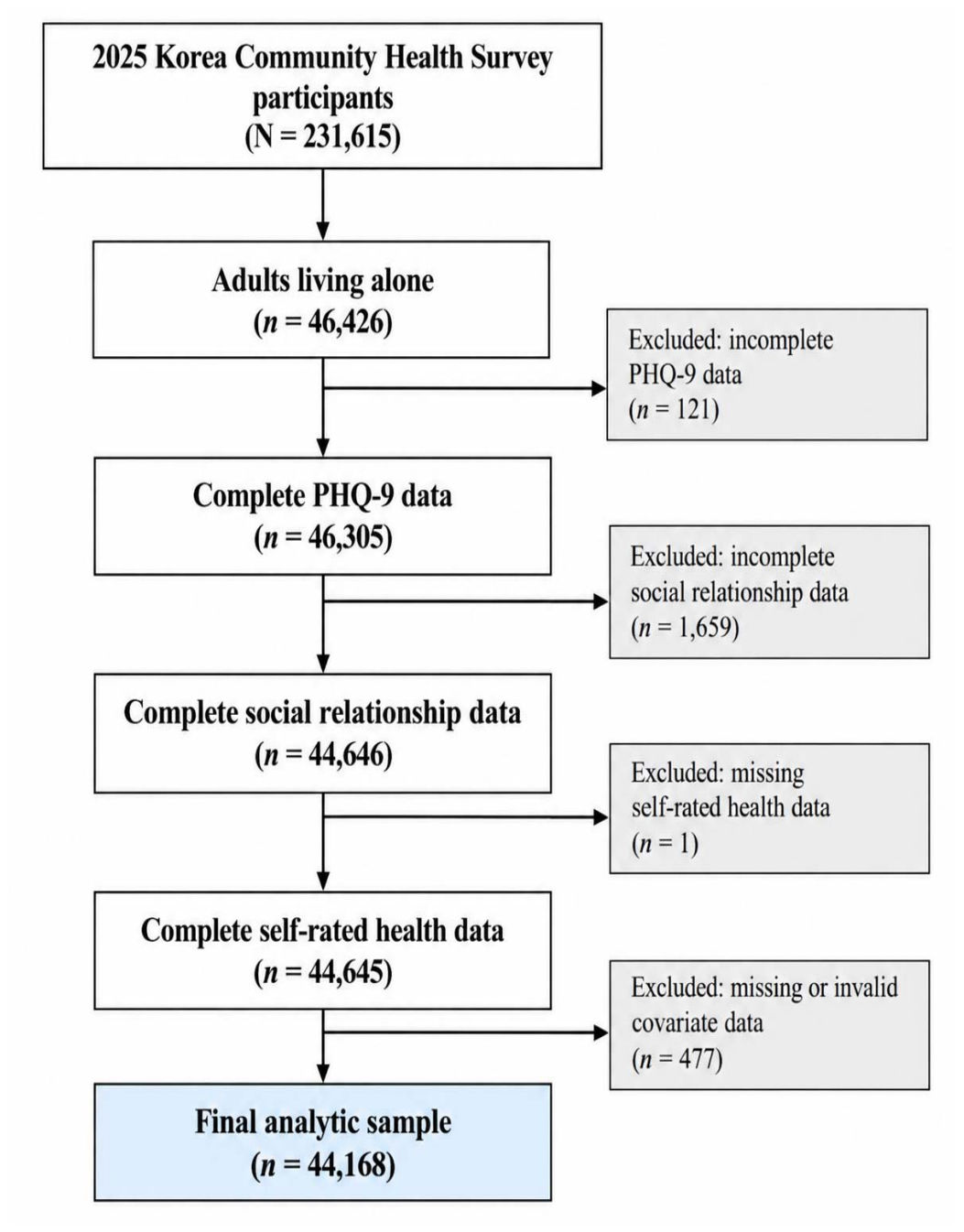

Table 1.
General Characteristics.
| Characteristics | Category | Unweighted n | Weighted % (95% CI) |
| Sex | Male | 18,205 | 49.7 (49.1–50.3) |
| Female | 25,963 | 50.3 (49.7–50.9) | |
| Age group, years | 19–39 | 7,105 | 30.8 (30.1–31.5) |
| 40–64 | 13,577 | 34.2 (33.7–34.8) | |
| ≥65 | 23,486 | 34.9 (34.4–35.5) | |
| Education | No formal education | 4,723 | 4.7 (4.5–4.9) |
| Seodang/Han-hak | 61 | 0.1 (0.0–0.1) | |
| Elementary school | 10,098 | 13.6 (13.2–13.9) | |
| Middle school | 5,212 | 9.7 (9.4–10.0) | |
| High school | 10,958 | 27.3 (26.7–27.8) | |
| 2-/3-year college | 3,482 | 11.1 (10.8–11.5) | |
| 4-year university | 8,217 | 29.0 (28.4–29.6) | |
| Graduate school or higher | 1,417 | 4.5 (4.3–4.8) | |
| Marital status | Married, spouse present | 2,361 | 5.1 (4.8–5.3) |
| Married, spouse absent | 3,738 | 6.4 (6.1–6.6) | |
| Widowed | 18,602 | 26.0 (25.5–26.5) | |
| Divorced | 7,687 | 18.3 (17.8–18.7) | |
| Never married | 11,780 | 44.3 (43.6–44.9) | |
| Economic activity | Yes | 25,486 | 62.1 (61.5–62.7) |
| No | 18,682 | 37.9 (37.3–38.5) | |
| Annual household income | Q1 (lowest) | 11,254 | 16.1 (15.6–16.5) |
| Q2 | 10,965 | 21.0 (20.5–21.4) | |
| Q3 | 14,107 | 37.8 (37.2–38.4) | |
| Q4 (highest) | 7,842 | 25.1 (24.6–25.7) | |
| Average daily sleep duration | <7 h | 23,468 | 51.6 (51.0–52.2) |
| 7–<9 h | 19,011 | 45.1 (44.5–45.7) | |
| ≥9 h | 1,689 | 3.3 (3.1–3.5) |
Table 2.
Social Relationships, Depressive Symptoms, and Self-Rated Health.
| Variable | Category | Unweighted n | Weighted % (95% CI) |
| Family/relative contact | <1/month | 6,711 | 17.4 (16.9–17.9) |
| 1/month | 4,689 | 12.5 (12.1–12.9) | |
| 2–3/month | 5,455 | 13.6 (13.2–14.1) | |
| 1/week | 5,843 | 14.0 (13.6–14.4) | |
| 2–3/week | 7,718 | 16.9 (16.5–17.4) | |
| ≥4/week | 13,752 | 25.6 (25.1–26.1) | |
| Neighbor contact | <1/month | 16,177 | 55.8 (55.2–56.4) |
| 1/month | 2,323 | 6.1 (5.8–6.4) | |
| 2–3/month | 2,185 | 5.2 (4.9–5.4) | |
| 1/week | 2,963 | 5.9 (5.6–6.1) | |
| 2–3/week | 5,506 | 9.1 (8.8–9.5) | |
| ≥4/week | 15,014 | 18.0 (17.6–18.4) | |
| Friend contact | <1/month | 11,194 | 20.8 (20.4–21.3) |
| 1/month | 4,763 | 12.1 (11.7–12.5) | |
| 2–3/month | 4,886 | 13.0 (12.6–13.4) | |
| 1/week | 4,519 | 11.5 (11.1–11.9) | |
| 2–3/week | 7,184 | 17.4 (16.9–17.8) | |
| ≥4/week | 11,622 | 25.3 (24.7–25.8) | |
| Neighborhood trust | No | 14,808 | 44.0 (43.4–44.6) |
| Yes | 29,360 | 56.0 (55.4–56.6) | |
| Depressive symptoms | PHQ-9 <10 | 41,234 | 93.1 (92.8–93.4) |
| PHQ-9 ≥10 | 2,934 | 6.9 (6.6–7.2) | |
| Self-rated health | Non-poor | 30,796 | 77.5 (77.0–78.0) |
| Poor | 13,372 | 22.5 (22.0–23.0) |
Table 3.
Associations Between Social Relationships and Depressive Symptoms.
| Social relationship | Category | Model 1 OR (95% CI) | Model 2 aOR (95% CI) |
| Family/relative contact | <1/month | 1.51 (1.33–1.72) | 1.50 (1.31–1.72) |
| 1/month | 0.86 (0.73–1.02) | 0.96 (0.81–1.14) | |
| 2–3/month | 0.93 (0.79–1.10) | 1.06 (0.89–1.25) | |
| 1/week | 0.83 (0.70–0.98) | 0.90 (0.76–1.08) | |
| 2–3/week | 0.77 (0.65–0.90) | 0.80 (0.68–0.95) | |
| ≥4/week | 1.00 (Reference) | 1.00 (Reference) | |
| Neighbor contact | <1/month | 1.11 (0.97–1.26) | 1.45 (1.27–1.67) |
| 1/month | 1.02 (0.81–1.28) | 1.22 (0.96–1.55) | |
| 2–3/month | 0.88 (0.69–1.13) | 1.05 (0.82–1.36) | |
| 1/week | 1.10 (0.90–1.36) | 1.27 (1.03–1.58) | |
| 2–3/week | 1.07 (0.90–1.28) | 1.17 (0.98–1.40) | |
| ≥4/week | 1.00 (Reference) | 1.00 (Reference) | |
| Friend contact | <1/month | 2.63 (2.30–3.00) | 2.02 (1.75–2.34) |
| 1/month | 1.22 (1.02–1.45) | 1.29 (1.07–1.55) | |
| 2–3/month | 1.03 (0.85–1.25) | 1.13 (0.92–1.38) | |
| 1/week | 0.95 (0.78–1.16) | 1.03 (0.84–1.26) | |
| 2–3/week | 0.89 (0.74–1.06) | 0.90 (0.75–1.09) | |
| ≥4/week | 1.00 (Reference) | 1.00 (Reference) | |
| Neighborhood trust | No | 1.68 (1.53–1.85) | 1.62 (1.47–1.80) |
| Yes | 1.00 (Reference) | 1.00 (Reference) |
Table 4.
Associations Between Social Relationships and Poor Self-Rated Health.
| Social relationship | Category | Model 1 OR (95% CI) | Model 2 aOR (95% CI) |
| Family/relative contact | <1/month | 1.40 (1.29–1.52) | 1.28 (1.17–1.41) |
| 1/month | 0.80 (0.73–0.89) | 0.91 (0.81–1.02) | |
| 2–3/month | 0.86 (0.78–0.94) | 1.01 (0.91–1.12) | |
| 1/week | 0.85 (0.77–0.93) | 0.90 (0.82–1.00) | |
| 2–3/week | 0.85 (0.78–0.92) | 0.91 (0.83–0.99) | |
| ≥4/week | 1.00 (Reference) | 1.00 (Reference) | |
| Neighbor contact | <1/month | 0.37 (0.35–0.40) | 0.95 (0.87–1.04) |
| 1/month | 0.52 (0.45–0.59) | 0.91 (0.79–1.05) | |
| 2–3/month | 0.54 (0.47–0.61) | 0.91 (0.79–1.05) | |
| 1/week | 0.66 (0.59–0.74) | 1.00 (0.88–1.14) | |
| 2–3/week | 0.78 (0.72–0.86) | 1.01 (0.92–1.11) | |
| ≥4/week | 1.00 (Reference) | 1.00 (Reference) | |
| Friend contact | <1/month | 3.47 (3.22–3.76) | 1.77 (1.63–1.93) |
| 1/month | 1.37 (1.24–1.52) | 1.24 (1.11–1.39) | |
| 2–3/month | 1.08 (0.97–1.19) | 1.09 (0.97–1.22) | |
| 1/week | 1.09 (0.98–1.21) | 1.07 (0.95–1.20) | |
| 2–3/week | 1.03 (0.94–1.12) | 0.97 (0.88–1.08) | |
| ≥4/week | 1.00 (Reference) | 1.00 (Reference) | |
| Neighborhood trust | No | 1.21 (1.14–1.28) | 1.36 (1.27–1.45) |
| Yes | 1.00 (Reference) | 1.00 (Reference) |
Disclaimer/Publisher’s Note: The statements, opinions and data contained in all publications are solely those of the individual author(s) and contributor(s) and not of MDPI and/or the editor(s). MDPI and/or the editor(s) disclaim responsibility for any injury to people or property resulting from any ideas, methods, instructions or products referred to in the content. |
© 2026 by the author. Licensee MDPI, Basel, Switzerland. This article is an open access article distributed under the terms and conditions of the Creative Commons Attribution (CC BY) license.
Copyright: This open access article is published under a Creative Commons CC BY 4.0 license, which permit the free download, distribution, and reuse, provided that the author and preprint are cited in any reuse.