
Submitted:
14 October 2026
Posted:
14 October 2026
You are already at the latest version
Abstract
Building on the generalized microon gas model and its equations of motion proposed in our previous work, this paper derives the four fundamental laws governing material interactions, namely Newton's law of universal gravitation, Coulomb's law, Faraday's law of electromagnetic induction, and the Biot–Savart law. Within this theoretical framework, the origins of mass and electric charge, as well as the fundamental nature of material interactions, are revealed, and the four fundamental interactions—strong, weak, electromagnetic, and gravitational—are unified under a single equation. As applications of the theory, we explain the origin of the anomalous rotational velocities of stars in galactic outskirts, analyze the mechanisms underlying nuclear decay and stability, derive an analytical formula for the β-stability line, and discuss the physical basis of the mass–velocity relation.
Keywords:
Grand-unified theory
; Newtonian law of universal gravitation
; Coulomb’s law
; origin of electric charge
; nature of mass
; dark matter
; β-stability line
; mass–velocity formula
1. Introduction
Unifying the four fundamental forces of nature gravity, electromagnetism, the strong force, and the weak force represents the ultimate goal of physics [1]. Over the years, extensive research and exploration have been conducted in this direction [2,3,4,5,6,7], yet a unified theory that is both widely accepted and fully verified by experiment has not been established. We argue that the key reason for this predicament lies in the fact that the fundamental laws describing material interactions including Newton’s law of universal gravitation, Coulomb’s law, Faraday’s law of electromagnetic induction, and the Biot–Savart law are all empirical laws derived from experiment. To date, while each of these laws holds valid in its own domain, their intrinsic interconnections have not been revealed within a single framework of first principles. Deriving these laws is a prerequisite for constructing a grand unified theory; only by clarifying the physical origins of these laws can we uncover the essential nature of material interactions and ultimately achieve the unification of the fundamental forces.
Human understanding of force dates back to ancient times. As early as the 4th century BC, Aristotle posited that force maintains motion. Shortly thereafter, Archimedes discovered the law of buoyancy. In 1687, Isaac Newton formulated the law of universal gravitation in Philosophi? Naturalis Principia Mathematica [8], establishing a unified description of gravitational interactions between celestial bodies and terrestrial objects. Electrical properties of matter and their associated interactions had been recognized since antiquity; however, it was not until the formulation of Coulomb’s law [9] in 1785 that these interactions received a quantitative description. Maxwell subsequently formulated his equations [10] by synthesizing Faraday’s law of electromagnetic induction with Amp re’s law, thereby unifying electricity and magnetism. With the development of particle physics during the twentieth century, the strong and weak forces were gradually identified as additional fundamental interactions governing microscopic physical processes. The strong force is generally understood to bind nucleons within atomic nuclei, whereas the weak force governs radioactive decay processes. In 1935, Hideki Yukawa proposed meson theory and the Yukawa potential [2], suggesting that strong forces arise through meson exchange between nucleons. This framework later became one of the foundations of modern nuclear and particle physics. During the 1960s, the electroweak theory developed by Sheldon Glashow, Abdus Salam, and Steven Weinberg successfully unified electromagnetic and weak forces within a common gauge-theory framework [?]. Human understanding of force dates back to ancient times. As early as the 4th century BC, Aristotle posited that force maintains motion. Shortly thereafter, Archimedes discovered the law of buoyancy. In 1687, Isaac Newton formulated the law of universal gravitation in Philosophi? Naturalis Principia Mathematica [8], establishing a unified description of gravitational interactions between celestial bodies and terrestrial objects. Electrical properties of matter and their associated interactions had been recognized since antiquity; however, it was not until the formulation of Coulomb’s law [9] in 1785 that these interactions received a quantitative description. Maxwell subsequently formulated his equations [10] by synthesizing Faraday’s law of electromagnetic induction with Amp re’s law, thereby unifying electricity and magnetism. With the development of particle physics during the twentieth century, the strong and weak forces were gradually identified as additional fundamental interactions governing microscopic physical processes. The strong force is generally understood to bind nucleons within atomic nuclei, whereas the weak force governs radioactive decay processes. In 1935, Hideki Yukawa proposed meson theory and the Yukawa potential [2], suggesting that strong forces arise through meson exchange between nucleons. This framework later became one of the foundations of modern nuclear and particle physics. During the 1960s, the electroweak theory developed by Sheldon Glashow, Abdus Salam, and Steven Weinberg successfully unified electromagnetic and weak forces within a common gauge-theory framework [11].
Despite substantial theoretical and experimental progress over the past century, several fundamental problems remain unresolved. In particular, a fully consistent reconciliation between general relativity and quantum mechanics has yet to be achieved, and a quantitative description of strong and weak forces remains an open problem. Newton’s law of universal gravitation and Coulomb’s law successfully describe the observed interactions between physical systems, yet the underlying dynamical origins of these interactions remain incompletely understood. Correspondingly, the physical origins of fundamental quantities such as mass and electric charge also remain open questions. Experimental observations indicate that the strong force exceeds gravitation in strength by approximately , suggesting the existence of fundamentally different underlying interaction mechanisms across physical scales. Understanding the origin of this vast disparity may therefore provide important insight into the nature of gravitation itself. The incomplete understanding of gravitation has also motivated the introduction of dark matter in order to explain the anomalous rotational velocities observed in galactic outskirts. Although extensive observational efforts have been carried out over several decades, the physical nature of dark matter remains uncertain and continues to represent one of the major unresolved problems in modern astrophysics [12]. In nuclear physics, the physical mechanisms governing nuclear decay and stability are likewise not yet fully understood. Although empirical and semi-empirical relations have been developed to characterize nuclear stability, the physical origin of the -stability line remains unclear [13,14]. Since Einstein introduced the mass–velocity relation in the early twentieth century, its validity has been extensively supported by experimental evidence. However, the physical origin of the increase in mass with increasing velocity remains incompletely understood.
In this paper, we apply the previously proposed theoretical model to deduce the fundamental laws governing matter–matter interactions and to elucidate the physical origins of mass and electric charge, thereby realizing a unification of the four fundamental forces. As concrete applications, we use the model to interpret the anomalous stellar velocity distribution in galactic outskirts, derive an analytical expression for the -stability line, and examine the underlying physical meaning of the mass–velocity formula.
2. Generalized Microon Gas Model and Equation of Motion
In Ref. [15], the author proposed the generalized Microon gas model and the Microon’s equations of motion. Within that framework, all physical systems are composed of extremely small fundamental entities referred to as Microons. Collections of Microons that remain dynamically associated during motion are defined as matter systems. Structures across a wide range of physical scales including galaxies, stars, planets, molecules, atoms, and protons are interpreted as distinct manifestations of matter systems. When multiple matter systems coexist, the physical properties at a given spatial location are jointly determined by the collective dynamical states of the Microons constituting these systems. As matter systems approach or separate from one another, the motion states and system affiliations of the constituent Microons remain preserved, implying the existence of correlation and memory effects within the Microon ensemble. Consequently, in addition to the conventional properties of classical fluids, the proposed Microon medium is assumed to exhibit superposition and collective rigidity. A Microon system possessing these characteristics is referred to here as a generalized Microon gas. The motion of objects or individual Microons is governed by the following equation of motion:
where denotes the velocity of an object or Microon. represents the vector sum of the velocities of all Microons within a local volume element. denotes the total energy of all Microons contained within that volume element, that is, . The quantity represents the vector sum of the negative vorticities associated with all moving Microons, that is, . is the density of Microons, and p denotes the effective pressure exerted by surrounding Microons.
The first term on the right-hand side of Eq. (1), , represents the variable-speed force arising from local variations in Microon velocity. The second term, , corresponds to an energy-gradient force associated with spatial variations in the Microon energy distribution. The third term, , represents vorticity force, also referred to within the present framework as a generalized magnetic force, generated by the combined effects of Microon vorticity and object motion. The fourth term, , denotes a pressure-gradient force originating from collisions among Microons.
Because all matter systems consist of Microons, the origin and interactions of matter systems can be reduced to the study of Microon dynamics. As the smallest unit that constitutes matter, Microons exhibit a dual role: individually, their motion is governed by Eq. (1); collectively, they generate the energy, vorticity and pressure fields of space, and participate in the interaction between matter systems. Microons are extremely tiny. In addition to forming large-scale matter systems, Microons also assemble into microscopic particles with remarkably small dimensions, which are defined herein as secondary Microons. Although secondary Microons are substantially larger than primary Microons, they remain considerably smaller than conventional elementary particles such as protons and electrons. This hierarchical organization of Microon structures plays a crucial role in the emergence of a wide range of physical phenomena.
3. Equation of State for the Microon Gas
Like classical gases, the generalized Microon gas is assumed to possess an effective pressure. Each secondary Microon attracts large numbers of surrounding first-order Microons, thereby generating an associated pressure field. The effective pressure acting on a secondary Microon is interpreted as arising from repulsive pressure-gradient forces generated by neighboring secondary Microons. Consider a Microon over an infinitesimal time interval during which a collision with another Microon occurs, leading to a change in its direction of motion, as illustrated in Figure 1. During this process, the Microon experiences a pressure field generated by the neighboring particle, which is . At the beginning of the collision, the Microon moves with its free velocity of . As the distance from another Microon decreases, the repulsive pressure-gradient force progressively reduces the Microon velocity. At the point of closest approach, the velocity becomes zero, corresponding to the maximum repulsive force, as illustrated in Figure 1 at the position where and . Subsequently, the Microon reverses its direction of motion, while its velocity increases and the pressure decreases progressively. The collision process is completed when the pressure returns to the background value ().
When two Microons undergo a collision, the motion of one Microon under the influence of the other satisfies:
where denotes the density associated with a single Microon, while and p represent the energy potential and effective pressure generated by the neighboring Microon, respectively. In polar coordinates, we obtain: and substitution of the corresponding boundary conditions yields: . This relation represents the average effective pressure experienced by a secondary Microon during a single collision process with another Microon. For multiple collisions, the corresponding effective pressure acting on the Microon becomes:
Here, denotes the energy potential associated with a secondary Microon and generated by the generalized gravitational force; represents the density of the secondary Microon; f is the number of degrees of freedom associated with Microon motion; and denotes the Microon velocity under the corresponding average effective pressure. The first term, , represents the gravitational-pressure contribution arising from the generalized gravitational force of the secondary Microon. This term is assumed to be spatially uniform, such that
Equation (4) is referred to here as the density-energy equilibrium principle, which represents a ubiquitous phenomenon in nature. The second term, , corresponds to the background-pressure contribution generated by collisions among first-order Microons and is likewise assumed to be approximately uniform, namely, . The third term, , represents the free-motion contribution, whereas the fourth term, , corresponds to the pressure-reduction contribution. Equation (3) therefore represents the equation of state governing the effective pressure experienced by secondary Microons due to interactions with surrounding Microons.
It follows that the pressure experienced by large-scale particles originates from the pressure of small-scale particles surrounding other particles. In other words, the pressure generated by collisions of large-scale particles represents the manifestation and transmission of the pressure of small-scale particles.
4. Structure of Matter Systems, Equilibrium Conditions, and Fundamental Physical Laws
Stable matter systems are proposed to correspond to specific equilibrium configurations of interacting forces, analogous to the hydrostatic and geostrophic equilibria observed in the Earth’s atmosphere. Different structural configurations of matter systems give rise to distinct equilibrium relations and corresponding equations of motion. Solving these equations yields the spatial distributions of the Microon velocity and energy fields, from which the associated physical interaction laws may be derived. Table 1 summarizes the structures of matter systems, the corresponding equilibrium conditions, the governing equations, and the resulting physical laws.
Within this framework, the fundamental law of gravitation is associated with the spatial structure of a generalized elementary particle. The generalized elementary particle represents an equilibrium state arising during matter formation, in which Microons undergo continuous inward nesting under the influence of a background vorticity field. This process progressively increases the central vorticity and confines large numbers of Microons within the inner region. At a specific stage of the nesting process, a spherical Microon configuration emerges in which three mutually orthogonal and dynamically independent rotational components share a common centre and rotate with the same angular velocity. This sphere constitutes an equal-energy surface and is therefore identified as the surface of a generalized elementary particle, with characteristic radius of and energy of . denotes the equatorial velocity, corresponding to the maximum velocity on one of the rotational surfaces, as illustrated in Figure 2. Starting from this energy boundary surface and extending outwards, Microons with identical velocities are constrained on identical spherical surfaces and attain an equilibrium state. This leads to an inverse-square dependence of the energy gradient and an expression for gravitational mass. Gravitational mass arises from the motion of Microons surrounding the spherical structure and characterizes the ability of a generalized elementary particle to attract other material bodies. Substituting this expression into the governing equation yields the general form of the fundamental law of universal gravitation. The resulting fundamental gravitational interaction is an extremely powerful force.
The generalized Coulomb law is a description of the characteristics of a new equilibrium configuration formed by the fundamental gravitational attraction of a generalized elementary particle toward surrounding secondary Microons. Analogous to objects within Earth’s atmosphere subject to gravitational force and atmospheric buoyancy, the motion direction of an object is determined by its density. Similar to Earth’s atmosphere, the secondary Microon atmosphere surrounding elementary particles satisfies hydrostatic equilibrium, whereby density declines with increasing radial distance. Unlike conventional atmospheric systems, however, secondary Microons obey the density-energy balance principle, such that energy rises with growing distance. This effect generates an outward repulsive force and the corresponding repulsive mass. The difference between repulsive mass and gravitational mass is interpreted as the electric charge of elementary particles. Solving the corresponding equations yields the expression for generalized charge together with the generalized Coulomb law. The generalized Coulomb force provides a unified formulation of the Coulomb and weak forces. The weak force is interpreted as the short-range manifestation of the Coulomb force, implying a common physical origin for both forces.
When a beam of high-velocity Microons undergoes rotational motion along a closed ring orbit under the influence of a background vorticity field or gravitational force, the surrounding Microons are driven into collective rotation until a dynamical equilibrium is established. The resulting energy-gradient force is referred to here as the orbital force and is characterized by a two-dimensional planar structure. The orbital forces are classified into inner and outer orbital forces, corresponding to distinct Microon energy distributions. On galactic scales, the outer orbital force is proposed to provide the dominant dynamical contribution responsible for sustaining the rotational motion of stars in galactic outskirts. On nuclear scales, the orbital force is interpreted as the origin of the nuclear interaction.
When a large number of charged particles combine to form a neutral composite particle, the Coulomb interaction is markedly reduced and becomes negligible at sufficiently large distances from the particle centre. Under these conditions, the secondary Microons in the surrounding region are of the same type and possess a uniform velocity and density distribution. Consequently, the surrounding Microon medium evolves toward a new dynamic equilibrium under the influence of the composite particle. Based on the boundary energy of Coulomb interactions outside the composite particle, an inverse-square distribution of energy gradient forms extending outward (equivalent to the Microon pressure gradient field). This gravitational force corresponds to the classical universal gravitation, namely the inter-body force measured experimentally via apparatus such as torsion balances.
Faraday’s law of electromagnetic induction describes the relationship between the temporal variation of Microon motion vortices and the spatial vorticity of the Microon pressure gradient force. The electromagnetic induction intensity is correspondingly interpreted as the negative vorticity generated by moving Microons. Biot–Savart law is interpreted as describing an equilibrium state in which negatively charged secondary Microons undergo high-velocity motion under the influence of an external electric field. The combined translational and rotational motion of Microons generates a surrounding vorticity distribution, corresponding to the emergence of magnetic fields generated by electric currents.
5. Derivation of Fundamental Physical Laws or Relations
5.1. Derivation of the Fundamental Law of Universal Gravitation
Generalized elementary particles are proposed to constitute the origin of the fundamental gravitational force. The dynamical state of surrounding Microons, like that of Microons on the shell surface, reaches an equilibrium state under the action of Eq. (1). Within this equilibrium state, Microons possessing the same velocity (or kinetic energy) are confined to common spherical surfaces and undergo two-dimensional free motion, as illustrated in Figure 3. Consider a Microon over an infinitesimal time interval () during which multiple collisions occur with neighboring Microons, leading to continual changes in its direction of motion. Because the duration of each collision is assumed to be extremely short, the corresponding mean free path remains comparatively large. Let denote the free velocity of the Microon, and consider a local volume element in space. According to statistical mechanics, the average energy of Microons within the volume element is given by , where f denotes the number of degrees of freedom associated with Microon motion. On a spherical surface, the motion is effectively two-dimensional, such that . Because collisions continuously randomize the directions of motion of Microons on the spherical surface, the net vorticity approaches zero, namely . The statistical isotropy of collisions leads to an approximately uniform pressure distribution, namely . Under these conditions, the motion of Microons is governed predominantly by the energy-gradient force, and Eq. (1) reduces to:
That is, the energy-gradient force is balanced by the centrifugal force associated with Microon motion. In polar coordinates, Eq. (5) therefore becomes:
where r denotes the radial distance between the Microon and the center of the generalized elementary particle. Solving Eq. (6) yields:
where is a constant. Eq. (7) indicates that the Microon velocity, and correspondingly its kinetic energy, increases continuously as the radial distance decreases. At the surface of the generalized elementary particle, the following relation is obtained:
Here, k denotes the generalized gravitational constant, and is defined as the gravitational mass, characterizing the ability of a generalized elementary particle to attract surrounding particles. The corresponding energy-gradient field generated by the gravitational mass, referred to here as the gravitational field, is given by:
where denotes the kinetic energy associated with the spherical surface at radial distance r, referred to within the present framework as the energy potential, and is the unit radial vector. The gravitational force exerted by an object with gravitational mass on another object with gravitational mass is therefore expressed as:
This relation represents the generalized form of the fundamental law of universal gravitation.
5.2. Derivation of the Generalized Coulomb Law
The fundamental gravitational force originating from primary Microons within generalized elementary particles is exceedingly intense, drawing abundant secondary Microons, thereby establishing a new equilibrium configuration. For secondary Microons with gravitational density of , the equilibrium condition satisfies
Here, , where denotes the energy distribution of primary Microons outside generalized elementary particles, referred to as the gravitational energy potential. represents the energy potential associated with the secondary Microon. According to the fundamental law of universal gravitation,
Analogous to the primary Microons surrounding generalized elementary particles, secondary Microons are also confined to a two-dimensional spherical surface, possessing two degrees of freedom. According to the equation of state for secondary Microons, only two terms contribute to the pressure-gradient force: the free-motion contribution and the pressure-reduction contribution, which can be written as:
Here, the free velocities of the Microons are assumed to be identical, such that remains constant. Equation (15) represents the hydrostatic equilibrium relation for the generalized Microon gas. Substituting Eq. (13) into Eq. (15) and expressing the relation in polar coordinates yields:
Solving Eq. (17) gives:
Here, denotes the shell radius of the generalized elementary particle, and represents the density of the secondary Microons at . According to the density-energy-potential equilibrium principle for secondary Microons, the quantity remains constant, where denotes the energy potential of the secondary Microon at . It therefore follows that
The resulting total energy-potential distribution and corresponding energy-gradient force are given by
Defining , where is referred to here as the repulsive mass generated by the energy distribution of secondary Microons, Eq. (21) becomes:
Generalized elementary particles are likewise assumed to satisfy the density energy (potential) equilibrium principle:
where denotes the gravitational density of the generalized elementary particle at radius . Substituting Eq. (23) into Eq. (21) yields
Defining as the generalized electric charge, Eq. (24) becomes
which is referred to here as the generalized electric field. At distances far from the core region, namely for , the relation reduces to:
Let . Here, q denotes the classical electric charge. Equation (26) therefore reduces to , which corresponds to the expression for the electric field. The electric field is interpreted as an energy-gradient field generated by collective Microon motion. The electric properties of generalized elementary particles originate from the difference between their gravitational density and the surrounding environmental density. When the gravitational density exceeds (falls below) the environmental density, the generalized elementary particle exhibits positive (negative) electric charge. The classical electric charge corresponds to the long-range manifestation of the generalized electric charge and is defined as the difference between the repulsive mass and the gravitational mass. Eq. (20) is referred to here as the energy-potential function. Figure 4 illustrates the corresponding energy-potential distributions associated with positive and negative charges.
The interaction exerted by a generalized elementary particle with gravitational mass of and gravitational density of on another generalized elementary particle with gravitational mass of , gravitational density of and force-induced mass of is given by:
where and denote the energy field and pressure field associated with the first particle respectively. These fields satisfy the equilibrium condition described by Eq. (11). Substituting this relation together with Eqs. (23) and (24) into Eq. (28) yields:
where and represent the generalized electric charges of the two particles. Eq. (29) represents the generalized form of the Coulomb force and provides a unified expression for both the weak force and the Coulomb force. In the long-range limit, namely for , Eq. (29) reduces to:
where and denote the electric charges of the two particles, as determined by Eq. (27). It is therefore evident that the classical Coulomb law represents the long-range approximation of the generalized Coulomb law. It should be noted that, within the same medium, the asymptotic density and energy of secondary Microons are assumed to be identical, irrespective of whether they are protons, neutrons or electrons. Consequently, the electric charge of an elementary particle is determined solely by its gravitational density and energy.
5.3. Relationship Between Gravitational and Inertial Mass and the Conversion Between Mass and Charge
Mass and electric charge are two fundamental physical quantities that occupy central roles in modern physics. When deriving the fundamental law of universal gravitation, we introduced the concept of gravitational mass. In what follows, we provide a further description of inertial mass. Within the proposed model, the formation of generalized elementary particles begins with the emergence of vorticity ring orbits generated by the background vorticity field. These orbital structures progressively nest inward, giving rise to a strong central vorticity field capable of confining large numbers of Microons. The confined Microons subsequently form compact central particles. Under the fundamental gravitational effect of this particle, multiple gravitational orbits and additional particles form outwardly. These gravitational orbits cannot expand indefinitely. The generalized elementary particle attains a stable state when the gravitational orbit coincides with the innermost vorticity orbit. At this stage, three mutually perpendicular and dynamically independent rotational surfaces of Microon motion are formed, each rotating about a common center with identical angular velocity. One rotational surface originates from the vorticity ring orbit, whereas the remaining two arise from gravitational ring orbits. Whether this triple rotational structure bears a deeper connection to the quark model of the proton remains an open question deserving further investigation. The fundamental gravitational force and generalized Coulomb force are further proposed to emerge outward from these rotational surfaces. Inertial mass is the quantity of matter contained in a body; it equals the sum of the mass of the large-scale particle and the gravitational masses of the small-scale particles contained within it. On the surface of a generalized elementary particle, the following relation holds:
Here, denotes the energy associated with Microon motion on the particle surface, is the radius of the generalized elementary particle, and represent the inertial mass and gravitational mass of the particle, respectively, and and denote the gravitational constants associated with the two characteristic particle scales. The above relation suggests that inertial mass and gravitational mass satisfy a certain proportional relationship . Gravitational mass characterizes the effective ability of a matter system to participate in long-range interactions; inertial mass is the capacity to maintain a state of motion. The inertial mass of small-scale particles plays an important role in the formation of large-scale gravitational mass. Without the inertial mass of small-scale particles, there would be no gravitational mass of large-scale particles. Gravitational mass is the transmission and manifestation of the inertial mass of small-scale particles at large scales. The range of action for small-scale particles is limited, and they do not participate in long-range material interactions. We therefore infer that the interaction force between celestial bodies arises from the large-scale motion of Microons.
As can be seen from the preceding analysis, the electric charge of a particle admits three equivalent formulations: a mass-based expression, an energy-based expression, and a density-based expression. All three formulations indicate that mass and electric charge share the same nature and dimensionality; nevertheless, they are currently treated within separate theoretical frameworks. In order to integrate the present framework with existing theoretical systems for practical applications, a conversion between mass and electric charge is required. Analysis of nuclear structure, nuclear stability, and charge-radius data suggests a possible correspondence between the mass of 82 electrons and the charge of an electron. Interestingly, the number 82 also corresponds to the largest proton magic number in nuclear structure theory, potentially indicating a deeper underlying connection. A detailed discussion of this issue, however, lies beyond the scope of the present work. Within the proposed framework, the conversion relation between mass and electric charge is given by:
Here, and denote the electric charge and inertial mass of the electron, respectively. Direct calculation yields , which provides the conversion relation between kilograms and coulombs, namely . Within the proposed framework, this relation further leads to a modified gravitational constant:
5.4. Orbital Force and the Nuclear Force
When a beam of rapidly moving Microons undergoes rotational motion under the influence of a background vorticity field (or fundamental gravitational force) and forms a closed ring orbit, the surrounding Microons are driven into collective rotational motion until a dynamical equilibrium configuration is established. The resulting energy-gradient force is referred to here as the orbital force.
Within the inner region of the ring orbit, the effective pressure is assumed to remain approximately uniform, analogous to the pressure distribution within the eye of a typhoon, such that . Equation (1) therefore reduces to: . In polar coordinates, . Solving the corresponding relation yields the velocity distribution , where denotes the angular velocity of rotation, represents the rotational velocity of the Microon beam, and R is the characteristic orbital radius. The corresponding energy-gradient force is given by:
This interaction is referred to here as the inner orbital force and is directed radially outward.
On the outer side of the ring orbit, the vorticity force is balanced by the pressure-gradient force, such that , and Eq. (1) reduces to . Solving the corresponding relation yields the velocity distribution , and the associated energy-gradient force becomes:
This interaction is referred to here as the outer orbital force and is directed radially inward. The resulting velocity distributions on the inner and outer sides of the orbit are illustrated in Figure 5. The orbital force is fundamentally an energy-gradient force. On interstellar scales, the outer orbital force provides the dominant interaction responsible for sustaining the rotational motion of stars in the outer regions of galaxies. On nuclear scales, the combined action of the inner and outer orbital forces is interpreted as the origin of the nuclear force.
Several observed characteristics of the nuclear force may be qualitatively interpreted within this framework. The first characteristic of the nuclear force is its high strength; it is the strongest among the four fundamental forces. The preceding analysis suggests that the orbital force and the fundamental gravitational force possess comparable magnitudes, whereas the generalized Coulomb force corresponds to the difference between the fundamental gravitational force and the repulsive force and is therefore comparatively weaker. The classical gravitational force, which describes long-range interactions between electrically neutral matter systems, is weaker still. Second, the nuclear force exhibits charge independence. Since the nuclear force is essentially an energy-gradient force and remains unaffected by the Microon pressure-gradient force, it does not depend on nucleon density and, by extension, electric charge.
A third characteristic of the nuclear force is its short-range nature. The atomic nucleus is composed of multiple orbital structures, giving rise to the periodic arrangement of nucleons and the emergence of nuclear magic-number structures. The nuclear force between adjacent orbital structures corresponds to the combined action of the inner and outer orbital forces. According to Eqs. (34) and (36), the resulting interaction is given by
Here, and denote the radii of two adjacent orbital structures. The corresponding energy-potential distribution is illustrated in Figure 6. Between adjacent orbital structures there exists a location at which the net nuclear force vanishes. It follows that the corresponding radius is given by the geometric mean of the two orbital radii, namely , indicating that the gravitationally dominated region is confined to less than half of the interval between neighboring orbital structures, whereas the inner region becomes repulsion dominated. This behaviour is qualitatively consistent with the observed nuclear force.
Another important characteristic of the nuclear force is its saturation property. Experimental observations indicate that atomic nuclei with sufficiently large mass numbers exhibit approximately constant density. A quantitative analysis is presented below. The effective interaction radius of the nucleus corresponds to the location at which the net nuclear force vanishes. The energy distribution between the nuclear center and the vorticity shell is expressed as:
Here, and denote the rotational velocity and orbital radius of Microons on the outermost vorticity ring of atomic nuclei, respectively. According to the principle of density-energy balance, low-value regions of background energy favour particle accumulation and give rise to nuclear shells. Solving the corresponding relation yields . The nuclear density is therefore obtained as , where denotes the angular velocity of Microon rotation generated by the background vorticity field and is a constant independent of nucleon number. The density of atomic nuclei therefore approaches an approximately constant value, providing a possible interpretation for the phenomenological origin of the liquid-drop model. These results suggest that the combined action of the inner and outer orbital forces reproduces several principal characteristics associated with the nuclear interaction. Eq. (37) therefore provides a quantitative relation describing the effective strength of the nuclear interaction.
5.5. Derivation of the Classical Law of Universal Gravitation
When the composite particle is electrically neutral, the corresponding gravitational density and energy are given by and , respectively. The associated charge distribution and electric-field distribution are then expressed as
At sufficiently large distances from the particle center, the kinetic energy and density distributions of Microons gradually approach spatial uniformity, and the particle correspondingly loses its electric charge. A characteristic boundary distance () therefore emerges. For , the interaction acting on Microons follows the distribution associated with the Coulomb force. For , both Q and vanish, while the vorticity force likewise approaches zero. Under these conditions, the Microon dynamics satisfy:
Here, denotes the total energy of the secondary Microon, where represents the tangential velocity associated with Microon motion around the center of the composite particle, is the radial velocity component, and f denotes the degrees of freedom of the Microon. For motion constrained to a spherical surface, . Under these conditions, the effective pressure experienced by the Microon is determined primarily by the radial velocity component, namely . The corresponding equilibrium condition follows:
Equation (42) therefore reduces to . Since the total energy potential is uniformly distributed, we have: . This yields an equivalent form of the equation:
It can be seen that classical universal gravitation essentially arises from the pressure-gradient force of secondary Microons. In polar coordinates, Eq. (43) becomes . Solving the corresponding relation yields , where the constant is determined from the boundary conditions. At , the Microon experiences both the repulsive Coulomb force and the attractive classical gravitational force. Equilibrium between the two forces therefore requires
Here, denotes the inertial mass of the particle, while represents the corresponding equivalent mass, defined as . Since , it follows that , and . The mutual gravitational force between the two particles is given by
Defining , yields: , where and denote the inertial masses of the two particles. The above equation corresponds to the classical expression of Newton’s law of universal gravitation. Since , the classical gravitational constant . In terms of order of magnitude, and . The gravitational constant in vacuum derived previously is , from which one obtains the estimate , in agreement with the observed value at the order-of-magnitude level. These results suggest that the fundamental gravitational interaction is far stronger than classical Newtonian gravity. This extreme relative weakness arises from the vanishing electric charge of neutral particles and the large disparity between shell radii and boundary radii.
5.6. Derivation of Faraday’s Law of Electromagnetic Induction
Within Eq. (1), the variable-speed force is a critically important force. Motion of a generalized elementary particle necessarily perturbs the surrounding velocity field, thereby modifying the energy distribution of Microons in space. Such variations constitute the physical origin of electromagnetic-wave propagation. The variable-speed force is assumed to remain in dynamical equilibrium with the time-varying pressure-gradient force. Consequently, spatial variations in the Microon pressure field are accompanied by corresponding local variations in the Microon velocity field, such that
Taking the curl of the above equation yields:
The magnetic induction field is interpreted as the reverse vorticity field generated by Microon motion, namely . Variations in the magnetic field are assumed to induce corresponding pressure variations in the Microon medium, which are accompanied by changes in the electric field. Accordingly, . Substituting this relation into Eq. (47) yields
Equation (48) corresponds to the general form of Faraday’s law of electromagnetic induction.
5.7. Derivation of the Biot–Savart Law
The conventional description of electrical conduction attributes electric current in conductors to the directed motion of free electrons under an applied electric field. However, both experimental observations and theoretical analyses indicate that the drift velocity of electrons in conductors is typically of the order of , whereas electrical signals propagate through the conductor at speeds approaching that of light. This trend is interpreted as evidence that charge transport may involve additional microscopic carriers beyond the conventional electron picture. Building on the preceding analysis of the origin of electric charge in matter, we propose that negatively charged secondary Microons serve as the real charge carriers of electric current. Their low density and high energy allow them to be readily accelerated to high velocities under an applied electric field. Free Microons undergo directed motion under external electric excitation and subsequently form rotating orbital rings. According to the preceding analysis of orbital forces, the rotational motion of secondary Microons induces collective motion of the surrounding primary Microons, the resulting dynamics satisfy . Solving the relation yields the velocity distribution of Microons within the plane of rotation:
Here, denotes the rotational velocity of the secondary Microon, which also corresponds to its directed velocity. stands for the gyroradius and also the gravitational radius for particle formation, and r is the distance from the observation point to the center of rotation, as illustrated in Figure 7. The corresponding magnetic field is given by
According to Eq. (27), the electric charge associated with a generalized elementary particle is given by .
For conducting media, the background Microon population is characterized by a high density and comparatively low energy, such that , thus follows:
Substituting Eq. (52) into Eq. (50) gives:
Equation (53) describes the electromagnetic induction intensity produced by a rotating Microon. For multiple Microons, consider an infinitesimal element containing a total electric charge , such that . Substituting this relation into Eq. (53) yields:
Equation (54) represents the general form of the Biot–Savart law. Here, and , from which it follows that
where and denote the vacuum permeability and vacuum permittivity, respectively. According to Maxwell’s equations, , suggesting that the maximum characteristic velocity associated with particle mass formation is equal to the speed of light.
6. Applications of the Theory
6.1. Stellar Rotation Velocities at Galactic Edges and Dark Matter
In 1932, Jan Oort found that stars near the outskirts of the Milky Way appeared to move faster than expected from the distribution of visible matter [16]. Later, in 1959, Franz Kahn and Lodewijk Woltjer estimated, from the relative velocity and separation between the Milky Way and the Andromeda Galaxy, that the mass of unseen matter within the Local Group exceeded that of visible matter by approximately an order of magnitude [17]. In 1980, Vera Rubin and collaborators further showed that the rotational velocities of stars in the outer regions of more than 100 galaxies remain approximately constant over large radial distances [18]. These observations indicate that high rotational velocities in galactic outskirts are a widespread phenomenon in the Universe. Within the framework of classical gravitation alone, the gravitation generated by the galactic core is generally insufficient to sustain such high rotational velocities. This discrepancy motivated the introduction of the dark-matter hypothesis, according to which galaxies are embedded within massive, non-luminous matter distributions. Despite extensive observational efforts, dark matter has not yet been detected directly, and both its physical nature and its role in galactic dynamics remain open questions. Within the proposed framework, the additional force required to account for galactic rotation is attributed to the orbital force generated by the hierarchical nesting process during galaxy formation, as illustrated in Figure 8a. Stellar motion satisfies the equation below:
The first term on the right-hand side represents the gravitational force from the galactic center and the second term corresponds to the orbital force. Here, G denotes the gravitational constant, r is the distance between the star and the galactic center, v is the stellar rotational velocity, and M represents the mass of the galactic core. The quantities and denote the characteristic velocity and orbital radius of the Microon beam, respectively. Both and are assumed to be large, implying that the orbital force dominates over classical gravitation in the outer regions of galaxies. Under these conditions, Eq. (56) reduces to . Because the galactic orbital structures consist of the same class of secondary Microons with similar characteristic velocities (), and r are close, so v and are approximately equal, which makes the resulting stellar rotational velocities tend to remain approximately identical in galactic outskirts. Because the orbital force is extremely strong, stars can maintain high rotational velocities even in the absence of a dominant central mass concentration. Hollow galaxies reported in astronomical observations may represent a typical manifestation of this behaviour. Therefore, the dynamical effect attributed to dark matter is nothing other than the orbital force generated by large-scale circulating Microon rings. Although such structures do not emit electromagnetic radiation, they contribute significantly to the maintenance of galactic rotation.
The same mechanism is further proposed to contribute to the formation of ring structures such as those observed around Saturn. Microon orbital structures surrounding Saturn generate interior repulsive regions incapable of sustaining stable orbital motion, thereby producing low-density gaps, whereas denser material distributions preferentially accumulate outside the corresponding orbital boundaries. By analogy, cosmic voids form within the inner regions of large-scale Microon orbital structures, whereas stellar overdensities preferentially emerge outside the corresponding orbital boundaries. A representative example is the void structure associated with the Milky Way, as illustrated in Figure 8b. The filamentary structures widely observed throughout the Universe may likewise be closely associated with the three-dimensional geometry of these orbital configurations.
6.2. The Mechanism of Nuclear Decay and the Theoretical Derivation of the -Stability Line Formula
The -stability line provides an important criterion for nuclear stability and occupies a central role in nuclear physics. Although numerous studies have investigated its origin and analytical form from different theoretical perspectives [19,20,21], the underlying physical mechanism responsible for the -stability relation remains incompletely understood. In the following, the generalized Microon framework is applied to analyze nuclear stability and derive an analytical expression for the -stability relation. Orbital forces are assumed to give rise to the shell structure of atomic nuclei. During nuclear formation, nucleons progressively occupy shells from the inner regions outward. Consequently, the inner nuclear shells are assumed to remain dynamically stable, whereas nuclear decay predominantly occurs in the outermost shell region. According to the generalized Coulomb relation, the electric charge associated with a nucleon is given by:
where denotes the mass-charge conversion coefficient; and represent the gravitational mass and gravitational density of the nucleon, respectively; is the shell radius; and denotes the asymptotic density of secondary Microons. For a neutron, , the corresponding electric charge becomes:
where denotes the neutron mass. The electric charge of a neutron inside the nucleus is therefore not zero, but negative. Neutrons behave as neutral particles only at sufficiently large distances. As a consequence, most neutrons are proposed to combine with positively charged protons to form nucleon pairs, referred to here as bound neutrons. The remaining neutrons occupy the outermost nuclear shell and are referred to as independent neutrons, and their number is given by , where A and Z denote the total nucleon number and proton number of the nucleus, respectively. The electric charge associated with the outermost nuclear shell can therefore be expressed as:
Here, denotes the electric charge of the proton and serves as an important indicator of nuclear stability.
When , the outer shell of the nucleus is positively charged, favoring decay and decay processes. Conversely, when , the outer shell becomes negatively charged, making decay more likely to occur. The nucleus is stable only when the outer shell is electrically neutral, that is, , as illustrated in Figure 9. When , the resulting solution curve corresponds to the -stability line. Because and , Eq. (59) reduces to:
According to the outer-shell model of the atomic nucleus, the following relation can be obtained: , where denotes the central mass of the nucleon cluster. Substituting this relation into Eq. (60) yields:
where . Direct calculation yields: , and Eq. (61) becomes:
This represents the general form of the -stability relation.
6.3. Discussion of the Mass–Velocity Relation
Einstein derived the mass–velocity relation from the Lorentz transformations together with the postulate of the invariance of the speed of light:
where is the rest mass of the particle, v is its velocity, and c denotes the speed of light in vacuum. Although the validity of this relation has been extensively confirmed experimentally, the physical origin of the apparent mass variation remains incompletely understood. Here, we examine the underlying mechanism of this relation within the framework of the generalized Microon gas model and the generalized Coulomb law. Electrostatic fields and electric fields in laboratory circuits are, in essence, generated by electrons. For simplicity, the following analysis is restricted to the interaction between negatively charged particles and moving particles. At sufficiently large distances, charged particles obey Coulomb’s law, and the corresponding electric field strength is given by
where . For negatively charged particles, , therefore . The corresponding Microon density distribution surrounding the particle can be expressed as . Because , one obtains . Substituting this relation into Eq. (64) yields:
A charged particle in this electric field satisfies:
Considering only radial motion, substituting Eq. (65) into Eq. (66) yields:
Integrating both sides yields:
where is a constant. When the particle reaches the position where , its velocity attains the maximum value, , yielding:
Substituting Eq. (69) into Eq. (68) yields:
The maximum attainable velocity therefore corresponds to the free motion velocity of Microons, which is identified with the speed of light, yielding:
Substituting Eq. (72) into Eq. (66) yields:
An equivalent form is given by:
According to the definition of electric charge, one obtains:
These results suggest that the electric charge of a particle moving in an electric field varies with its velocity. Moving the velocity change to the right-hand side of the equation yields the equivalent mass–velocity form, as shown in Eq. (74). However, this does not represent the underlying physical mechanism. In reality, it is the electric charge, rather than the mass, that varies. Mass represents the amount of matter in a system and does not change with its state of motion or its position in a coordinate system. By contrast, electric charge is proposed to arise from the difference between particle density and background density, and thus depends on the relative positions of particles.
7. Conclusions and Discussion
Through the derivation of physical laws and the introduction of physical quantities such as mass and electric charge, we have achieved the unification of the four fundamental interactions. As shown in Figure 10, the fundamental gravitational force and orbital force are essentially energy-gradient forces arising from the motion of microons. The generalized Coulomb force (Coulomb force, weak force) is the composite of the fundamental gravitational force, the energy-gradient force of secondary microons, and the pressure-gradient force. Within atomic nuclei, the fundamental gravitational force and orbital force constitute the basic forces that bind nucleons together, collectively referred to as the strong nuclear force. The weak force and the Coulomb force are manifestations of the same interaction. Nuclear and atomic stability follow the same mechanism governed by the sign of the generalized charge: a neutral generalized charge corresponds to a stable nucleus (or atom), giving rise to the proton–neutron distribution that forms the -stability line. The generalized Coulomb law contains a decay factor , which causes the weak force at short distances to be weaker than the classical Coulomb force. The weakness of classical gravitational interaction arises because, at large distances from the center, the vanishing generalized Coulomb attraction on neutral particles serves as the initial boundary condition from which a new equilibrium is established.
The present work is developed within the framework of Newtonian mechanics and differs from modern physical theories, including quantum mechanics and relativity. This theory assumes that material interactions arise from the energy-gradient and pressure-gradient fields generated by the extended motion of abundant microons surrounding generalized elementary particles, rather than from intermediate particle exchange or spacetime curvature. Analytical expressions for various interaction forces are derived based on diverse equilibrium relations. The core characteristics of the nuclear force are well explained, including ultra-high strength, charge independence, short-range behavior, and saturation. Furthermore, the role of the generalized Coulomb force (weak force) in particle decay is elaborated.
Due to page limitations, only three typical applications are demonstrated in this study: the interpretation of the anomalous rotation velocities of stars at galactic edges, the derivation of the -stability line formula previously obtained from the liquid-drop model and statistical methods, and the exploration of the underlying mechanism of the mass–velocity relation. In a separate paper, we apply the present theory to astrophysics and present numerous instances where theoretical predictions are corroborated by observations. For example, we derive the Titius–Bode law describing the distribution of planetary orbits, explain the origins of planetary axial tilts and the density distributions of various celestial bodies (including Ceres and Pluto), and obtain calculation results that agree with measurements to a high degree of accuracy. This provides an additional perspective supporting the plausibility of the proposed theory.
This study aims to provide an alternative perspective and analytical method for resolving unresolved physical puzzles, without denying the rationality of existing mainstream theories. It is expected that the proposed framework can complement conventional physical systems and jointly promote the exploration of natural laws through different approaches.
References
- Yang, J. M.; Wang, F. Einstein’s unrealized dream: Unification of physical laws. Chin. Sci. Bull. (in Chinese). 2016, 61, 399. [Google Scholar] [CrossRef]
- Yukawa, H. Proc. Phys.-Math. Soc. Jpn. 1935, 17, 48.
- Yang, C. N.; Mills, R. L. Conservation of Isotopic Spin and Isotopic Gauge Invariance. Phys. Rev. 1954, 96, 191. [Google Scholar] [CrossRef]
- Weinberg, S.; Salam, A.; Glashow, S. L. Nobel Lectures. Rev. Mod. Phys. 1980, 52, 515. [Google Scholar]
- Wilson, K. G. Confinement of quarks. Phys. Rev. D. 1974, 10, 2445. [Google Scholar] [CrossRef]
- Li, T. J. Grand unified theories and proton decay. Chin. Sci. Bull. (in Chinese). 2018, 63, 2474. [Google Scholar] [CrossRef]
- Wang, K.; Tsao, H. Relationship between Nuclear Force and Gravitational Force. Nature 1945, 155, 512. [Google Scholar] [CrossRef]
- Newton, I. Philosophiae Naturalis Principia Mathematica; Royal Society, London, 1687. [Google Scholar]
- Coulomb, C. A. Mem. De l’Acad Mie R. Des. Sci. 1784, 229.
- J. C. Maxwell, A Treatise on Electricity and Magnetism; Oxford University Press: Oxford, 1892; 3rd ed., Vol. I.
- Bilenky, S. M.; Hosek, J. Glashow–Weinberg–Salam theory of electroweak interactions and the neutral currents. Phys. Rep. 1982, 90, 73. [Google Scholar] [CrossRef]
- Priscilla, P. On top of Dark Matter. Phys. J. 2020, 19(8/9), 51. [Google Scholar]
- Lutostansky, Y. S.; Tikhonov, V. N. Special features of the structure of the beta-stability line for nuclei. Phys. At. Nucl. 2017, 80, 623. [Google Scholar] [CrossRef]
- Ye, Y.; Yang, X.; Sakurai, H.; et al. Physics of exotic nuclei. Nat. Rev. Phys. 2025, 7, 21. [Google Scholar] [CrossRef]
- Ye, G. X. Grand Unified Theory I: Basic concept, hypothesis and grand unified equation. J. Shenyang Norm. Univ. (Nat. Sci. Ed.) (in Chinese). 2011, 29(3), 387. [Google Scholar]
- Oort, J. H. The force exerted by the stellar system in the direction perpendicular to the galactic plane and some related problems. Bull. Astron. Inst. Neth. 1932, 6, 249. [Google Scholar]
- Kahn, F. D.; Woltjer, L. Intergalactic matter and the galaxy. Astrophys. J. 1959, 130, 705. [Google Scholar] [CrossRef]
- Rubin, V. C.; Ford, W. K., Jr.; Thonnard, N. Rotational properties of 21 SC galaxies with a large range of luminosities and radii, from NGC 4605/R=4 kpc to UGC 2885/R=122 kpc. Astrophys. J. 1980, 238, 471. [Google Scholar] [CrossRef]
- Yu, C. F.; et al. Analytic researches on the β-stable line of nuclei. J. Zhejiang Univ. (Sci. Ed.) (in Chinese). 2010, 37(4), 416. [Google Scholar]
- Kolomietz, V. M.; Sanzhur, A. I. New derivation of the symmetry energy for nuclei beyond the β-stability Line. Phys. Rev. C 2010, 81, 024324. [Google Scholar] [CrossRef]
- Kolomietz, V. M.; Lukyanov, S. V.; Sanzhur, A. I. Nucleon distribution in nuclei beyond β-stability line. Phys. Rev. C 2012, 85, 034309. [Google Scholar] [CrossRef]
- Lu, X. T. Nuclear Physics; Atomic Energy Press: Beijing, 2000; p. 47. [Google Scholar]
Figure 1.
Schematic illustration of The motion state of one particle before and after the collision of two particles.
Figure 1.
Schematic illustration of The motion state of one particle before and after the collision of two particles.
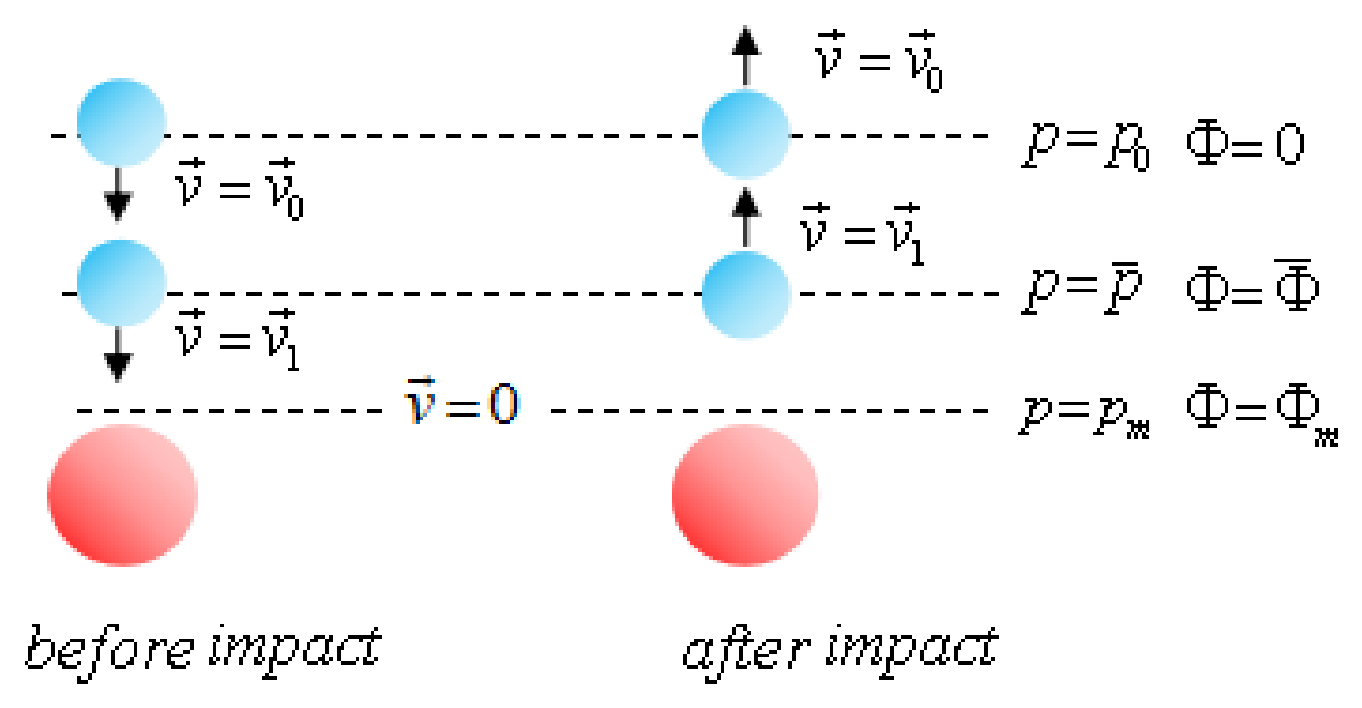
Figure 2.
The three-dimensional structure of generalized fundamental particles
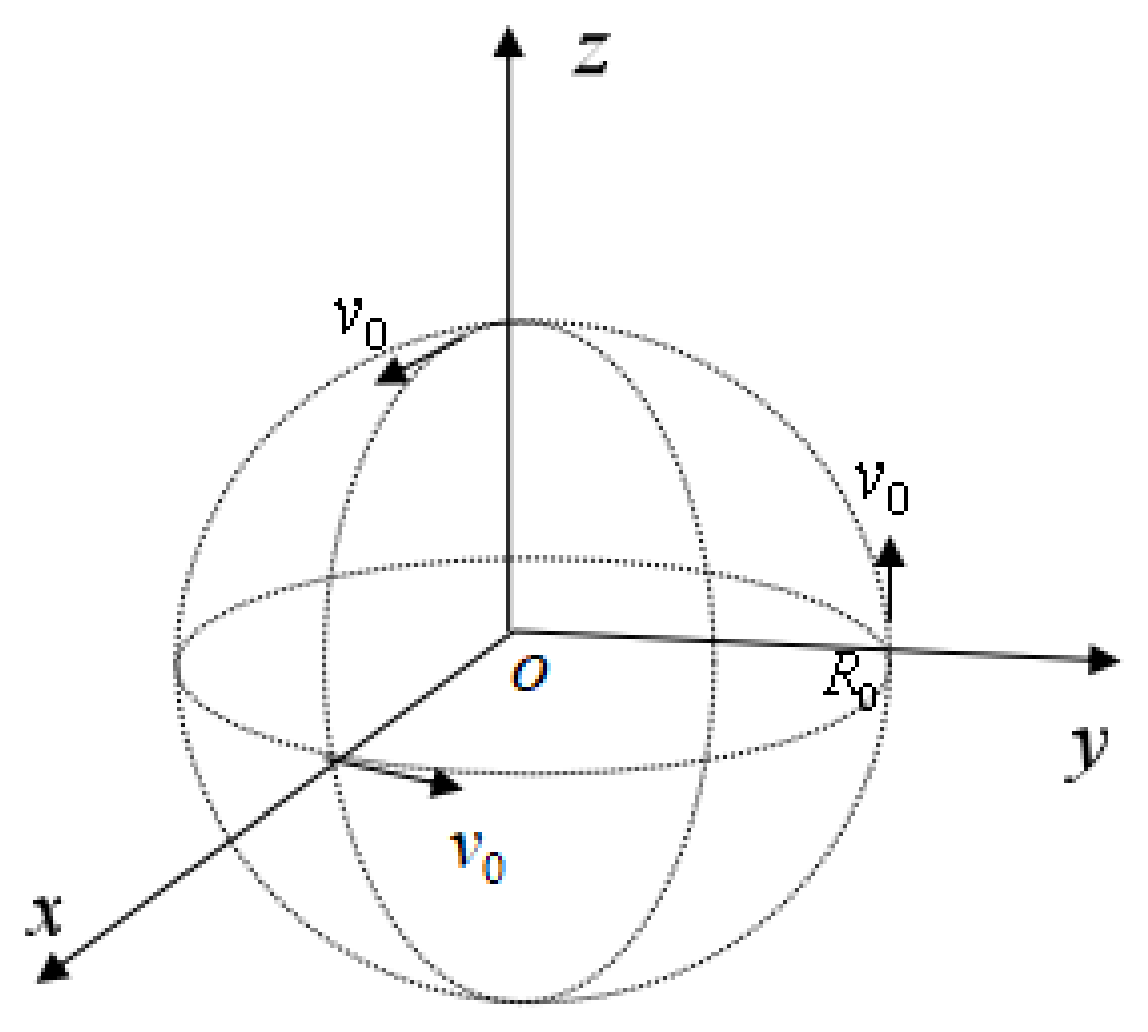
Figure 3.
Force analysis of Microons orbiting on spherical shells around a generalized elementary particle.
Figure 3.
Force analysis of Microons orbiting on spherical shells around a generalized elementary particle.
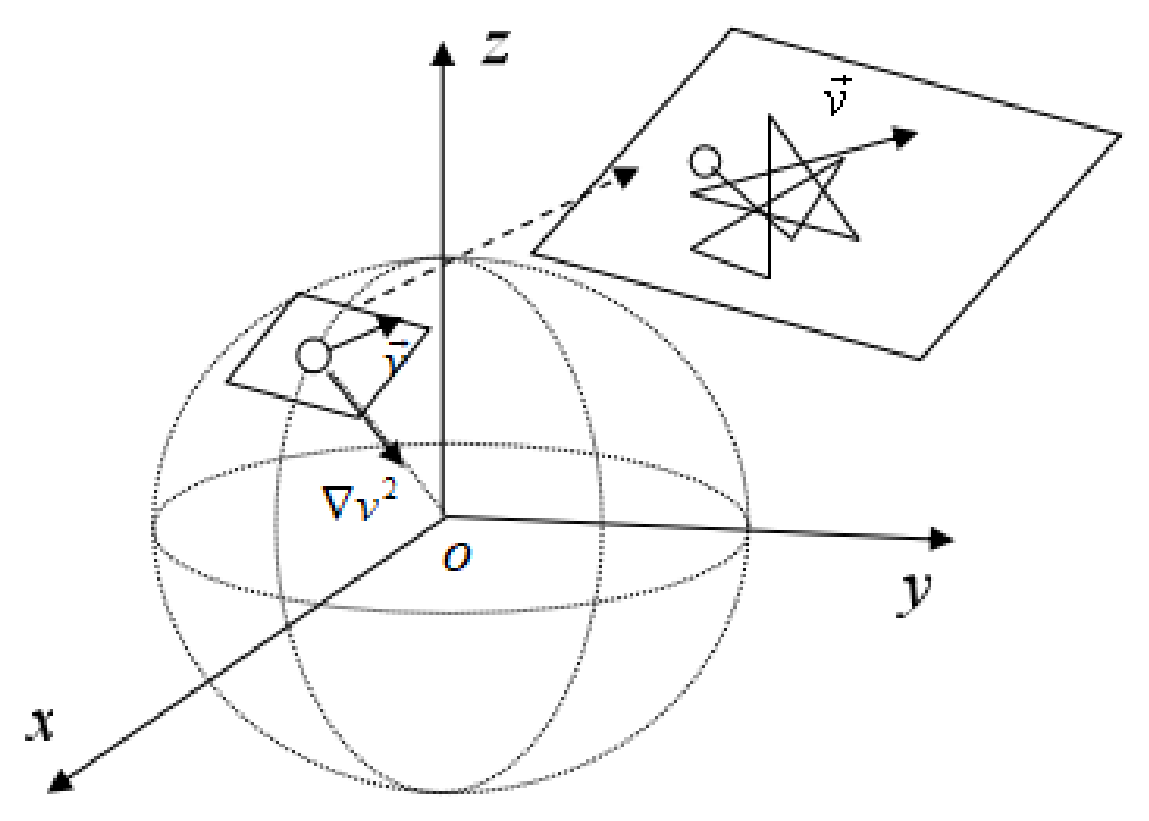
Figure 4.
Energy-potential distributions for positive and negative charges.
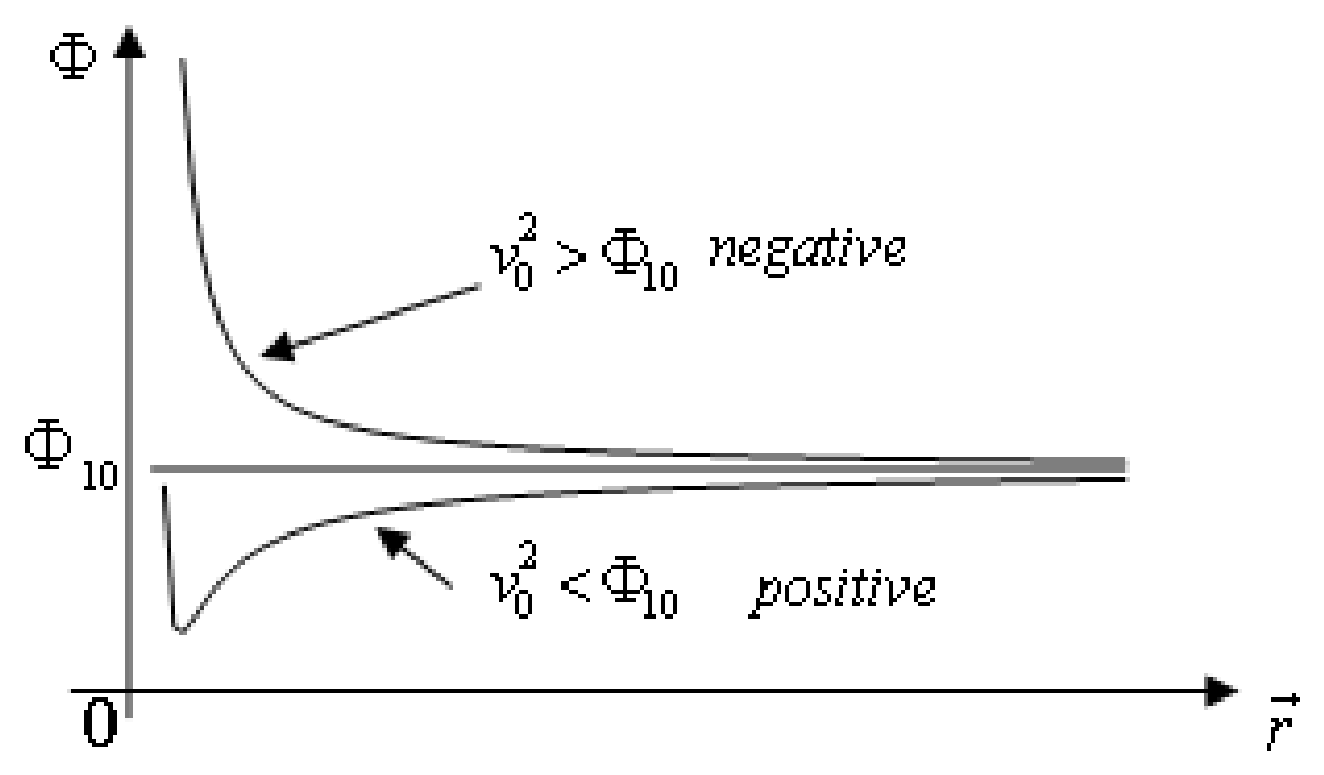
Figure 5.
Dynamical structure on the inner and outer sides of a Microon orbit. Here, v0 is the velocity of Microons along the orbit, and Rn represent the orbital radii.
Figure 5.
Dynamical structure on the inner and outer sides of a Microon orbit. Here, v0 is the velocity of Microons along the orbit, and Rn represent the orbital radii.
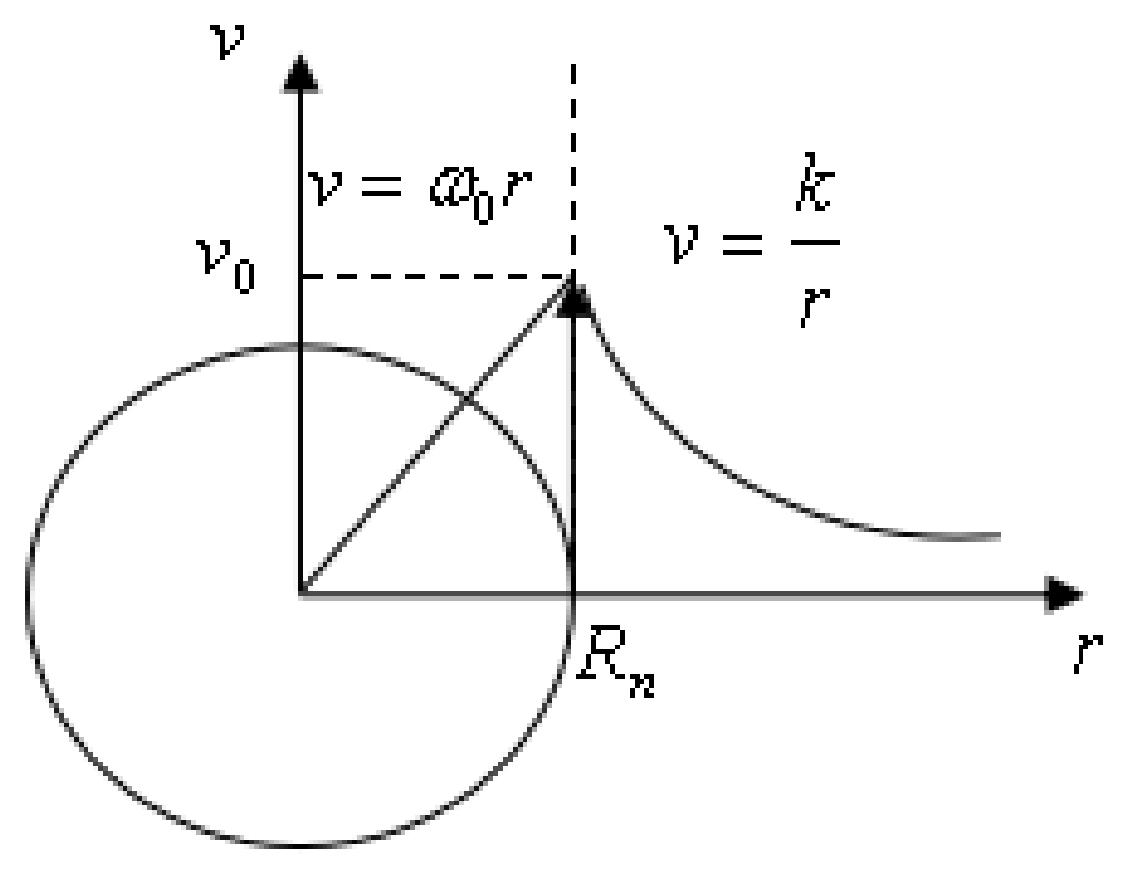
Figure 6.
Energy distribution of Microons between multiple orbital structures. Here, O denotes the center of the atomic nucleus; Rn-1, Rn, and Rn+1 represent the orbital radii; rn-1 and rn indicate the locations where the net interaction vanishes; G denotes the gravitationally dominated region, and A represents the repulsion-dominated region.
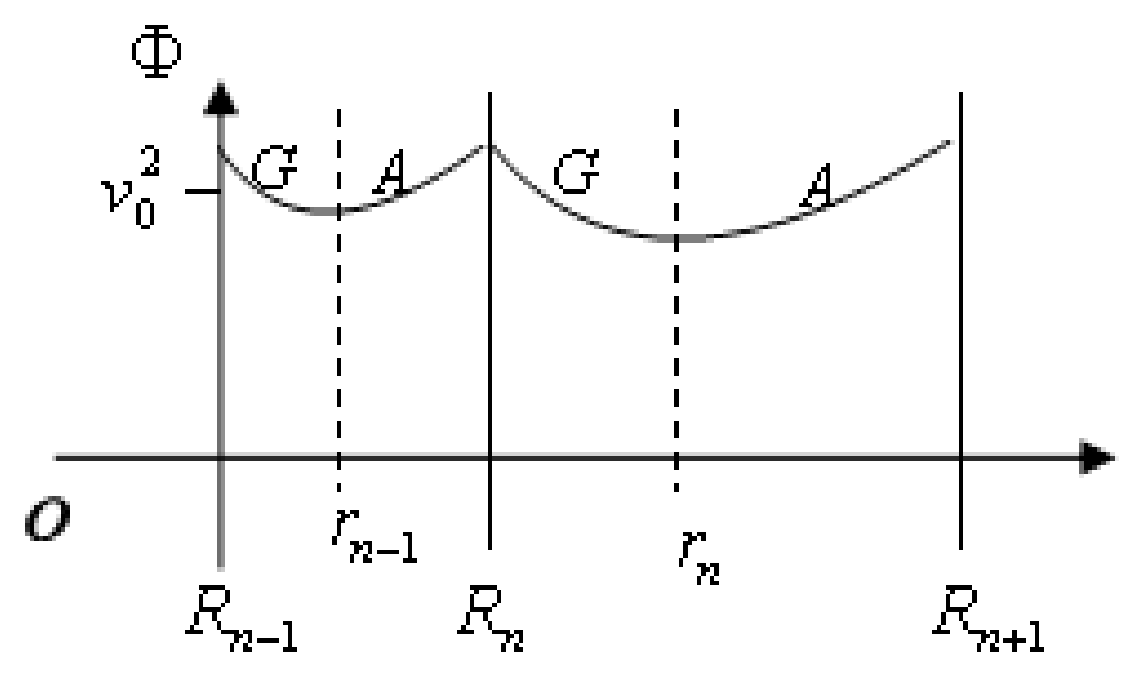
Figure 7.
Schematic diagram for Biot–Savart law derivation.
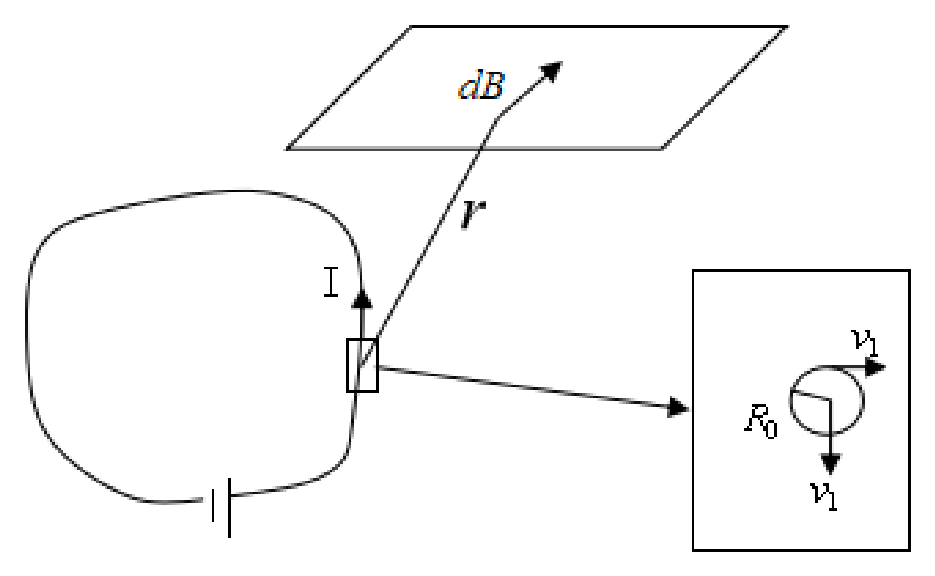
Figure 8.
Proposed role of orbital forces in galactic structure. The dashed curves represent Microon orbital trajectories, M denotes the mass of the galactic center, and represents the orbital force. (a) illustrates the force analysis on stars in galactic outskirts, whereas (b) shows the relative spatial positions of the void structure and stellar overdensities within the Milky Way.
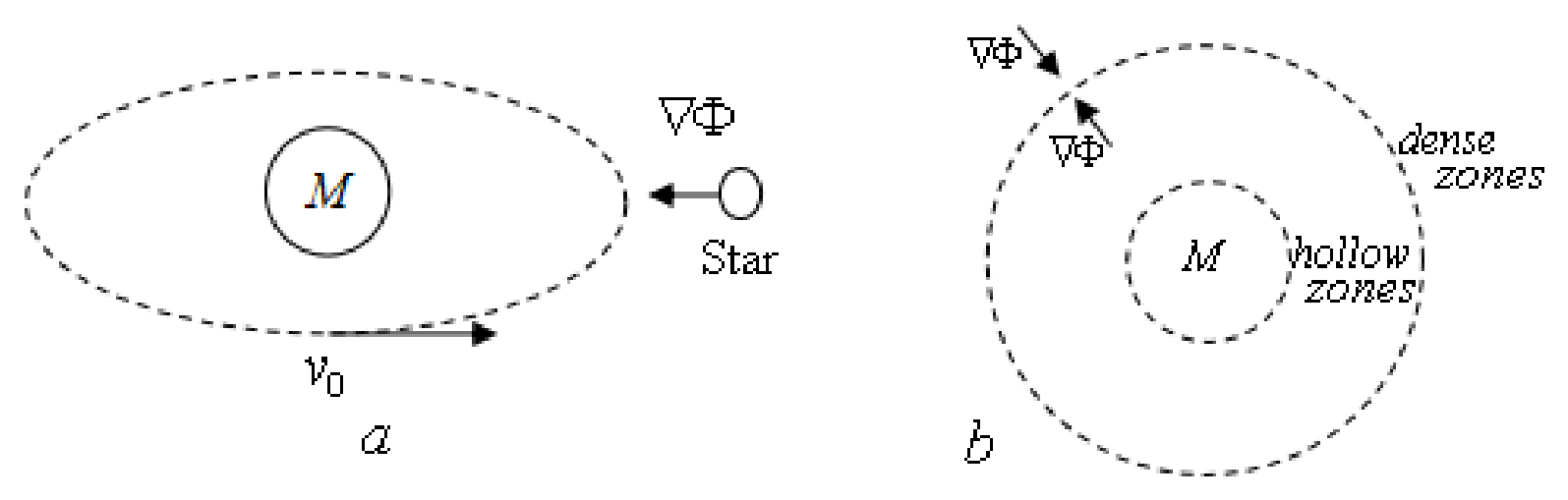
Figure 9.
Distribution of the -stability line in the Z-N plane [22], Nuclear shell charge and stability condition.
Figure 9.
Distribution of the -stability line in the Z-N plane [22], Nuclear shell charge and stability condition.
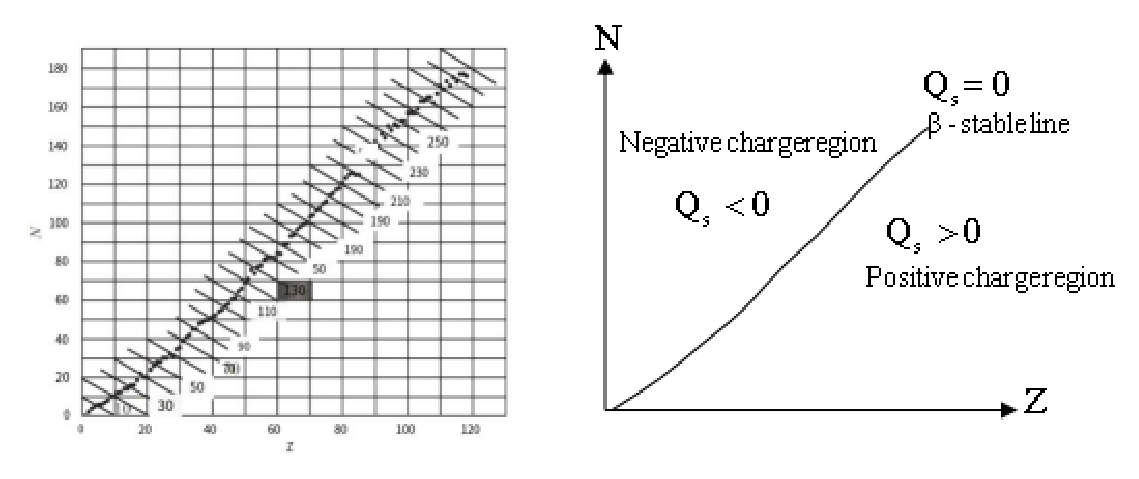
Figure 10.
Schematic diagram of the relationships among various forces in the generalized Microon gas model.
Figure 10.
Schematic diagram of the relationships among various forces in the generalized Microon gas model.
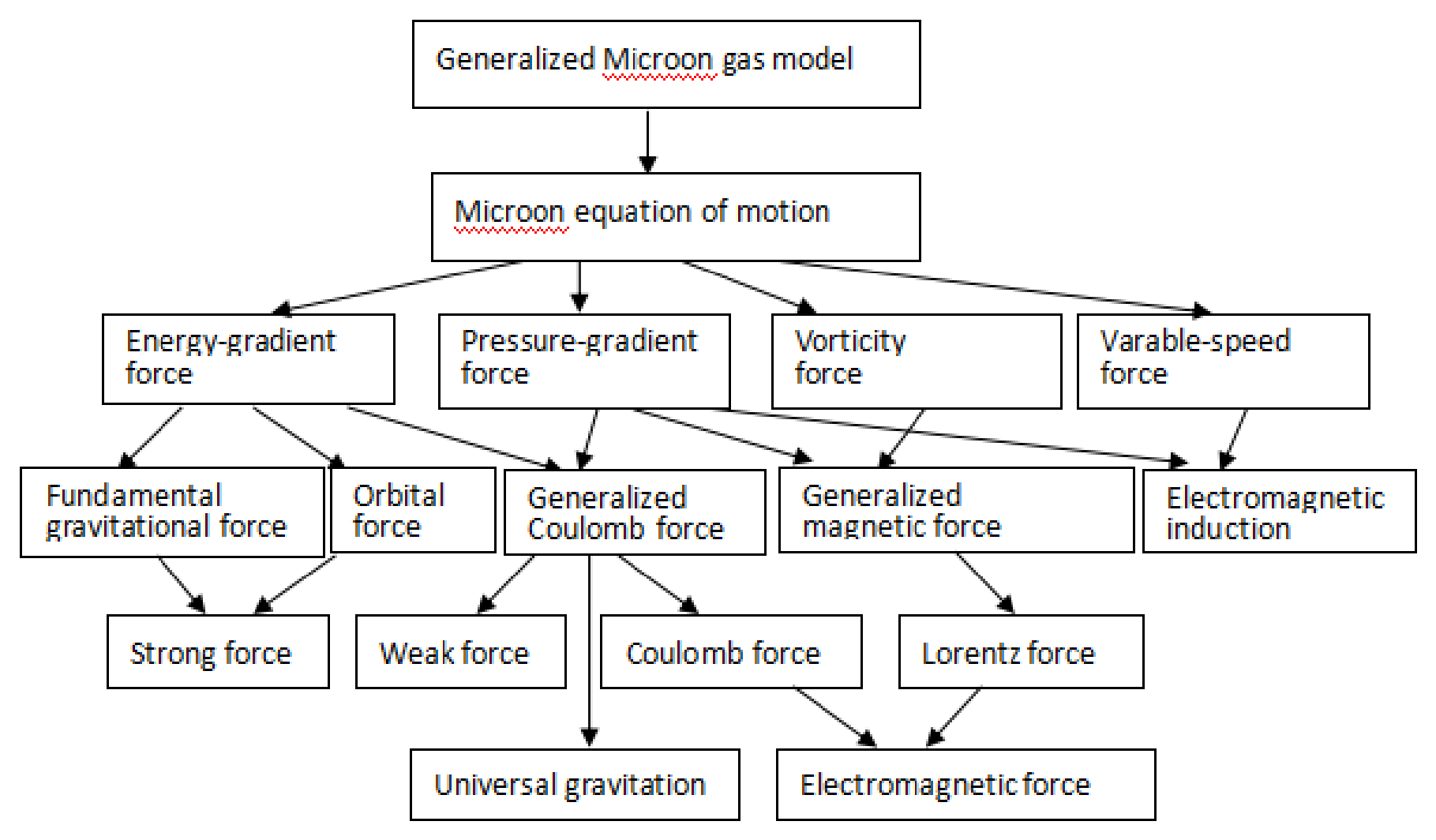

Table 1.
Structures, equilibrium conditions, equations and corresponding physical laws for different types of matter systems within the generalized Microon framework.
Table 1.
Structures, equilibrium conditions, equations and corresponding physical laws for different types of matter systems within the generalized Microon framework.
| Structure of matter system | Equilibrium condition | Microon equation of motion | Derived physical law or relation |
|---|---|---|---|
| Spherical structure of the generalized elementary particle | the fundamental law of gravitation | ||
| Equilibrium configuration formed by generalized elementary particles and surrounding secondary Microons | Generalized Coulomb’s law | ||
| Planar rotational structure of a Microon beam (inner) | Inner orbital force relation | ||
| Planar rotational structure of a Microon beam (outer) | Outer orbital force relation | ||
| Spherical structure of neutral composite particles | Classical law of universal gravitation | ||
| Arbitrary spatial region | Faraday’s law of electromagnetic induction | ||
| Planar rotational motion of Microons | Biot-Savart Law |
Disclaimer/Publisher’s Note: The statements, opinions and data contained in all publications are solely those of the individual author(s) and contributor(s) and not of MDPI and/or the editor(s). MDPI and/or the editor(s) disclaim responsibility for any injury to people or property resulting from any ideas, methods, instructions or products referred to in the content. |
© 2026 by the authors. Licensee MDPI, Basel, Switzerland. This article is an open access article distributed under the terms and conditions of the Creative Commons Attribution (CC BY) license (http://creativecommons.org/licenses/by/4.0/).
Copyright: This open access article is published under a Creative Commons CC BY 4.0 license, which permit the free download, distribution, and reuse, provided that the author and preprint are cited in any reuse.