

Submitted:
06 October 2026
Posted:
08 October 2026
You are already at the latest version
Abstract
This paper applies the systematic literature review (SLR) method to examine the effects of energy shocks on financial markets in the academic literature. Following the PRISMA 2020 guidelines, the study uses the Scopus database to identify relevant articles published between 2022 and 2026. From 710 initial records, 109 articles were selected after applying predefined eligibility and screening criteria. The literature covers stock, foreign exchange, bond and green financial markets, as well as multi-market and broader macro-financial effects. The findings show that energy shocks affect financial markets through heterogeneous, asymmetric and time-varying mechanisms. Their effects depend on the type of shock, market characteristics, country-specific factors and prevailing economic conditions. Supply, demand and risk shocks generate different responses, while spillovers tend to increase during periods of uncertainty and financial stress. The review highlights the importance of energy shocks as a source of financial market volatility and their influence on financial conditions through economic activity, inflation, credit conditions and expectations.
Keywords:
energy shocks
; financial-market volatility
; SLR method
1. Introduction
Energy markets are central to the global economy, and changes in energy prices can affect production costs, inflation, economic activity, corporate profitability and investor expectations (Brown & Yücel, 2002). Due to the fact energy is an important input for production and consumption, unexpected changes in energy prices can have effects beyond the energy sector. Consequently, energy shocks can influence asset prices, volatility and financial risk across countries and markets. These effects can occur through changes in economic conditions, inflation expectations, corporate earnings and investor sentiment (Kilian, 2008).
However, these effects are not uniform. They depend on the source of the shock, such as changes in energy supply, demand or risk conditions, as well as on country characteristics, market structures and prevailing economic conditions. Energy exporters and importers, for example, may respond differently to changes in energy prices. The effects can also vary across financial markets and sectors depending on their exposure to energy prices and broader economic conditions. In addition, energy shocks may produce different effects depending on whether they occur during periods of economic stability or financial stress.
Recent events, particularly the COVID-19 pandemic and the Russia-Ukraine war, have further highlighted the importance of the relationship between energy and financial markets. These events generated substantial energy-price movements, increased uncertainty and financial-market volatility. They also demonstrated how energy-market disruptions can interact with inflation, economic activity and investor expectations. As a result, a growing body of research has examined how different types of energy shocks are transmitted to financial markets.
Although many individual studies have examined this relationship, the recent literature covers diverse markets, countries and methodologies. Research considers stock, foreign exchange, bond and green financial markets, as well as broader financial and macroeconomic effects. Some studies focus on individual countries or regions, while others examine international spillovers and interactions between several markets. A systematic synthesis is therefore useful for identifying common patterns and differences across the literature.
This paper systematically reviews research on the effects of energy shocks on financial markets. It examines the main effects across market categories, differences across countries and regions, and changes during periods of financial stress and uncertainty. The review therefore provides an overview of the recent evidence and identifies the main patterns in the relationship between energy shocks and financial markets.
2. Methodology and Data
This paper uses a systematic literature review (SLR) methodology to identify, organize, and synthesize existing academic literature related to the relationship between energy shocks and financial markets. This study implements a predefined procedure to identify and select relevant records, with the aim to reduce the potential for bias study selection and provide a transparent overview of the existing body of research. The review process follows the PRISMA 2020 guidelines (Page, McKenzie, et al., 2021a; Page, Moher, et al., 2021), which provide a structured format for reporting the identification, screening, eligibility assessment, and inclusion of studies in systematic reviews. These guidelines also facilitate the transparency and reproducibility of the literature selection process by allowing the number of records identified, excluded, screened, and ultimately included in the review to be clearly documented (Page, McKenzie, et al., 2021b).
The search for the relevant literature was carried out with the use of the Scopus database. Scopus was chosen since it offers broad coverage of peer-reviewed academic publications in many different fields, such as economics, finance, energy economics and other related areas, while the search was carried out on May 20, 2026. The database gives access to a large amount of international research that is pertinent to the subject and allows the identification of studies which have been published in journals dealing with various aspects of energy markets and financial markets. The search strategy was developed with the aim of finding studies that observe the relationship between different types of energy shocks and developments in financial markets. In order to ensure adequate coverage of the relevant literature, the search included a number of alternative terms relating to the concepts in question. The strategy for conducting the search made use of Boolean operators, namely OR and AND, to combine the keywords that had been identified. Within each group of concepts, the OR operator was applied in order to include studies which used different terms to describe energy shocks and financial markets. On the other hand, the AND operator was used to join the two main groups of concepts and make sure that the records retrieved dealt with both an energy-related shock and a financial-market aspect. Moreover, the truncation symbol (*) was employed in order to include different endings and grammatical variations of the selected terms. This method was designed to widen the search and decrease the chance of excluding relevant studies due to variations in terminology or word forms. The final search string as used in Scopus was:
(“energy shock” OR “energy price shock” OR “oil shock*” OR “oil price shock*” OR “natural gas shock*” OR “gas price shock*” OR “electricity price shock*”) AND (“financial market*” OR “stock market*” OR “equity market*” OR “asset price*” OR “bond market*” OR “foreign exchange market*” OR “currency market*”)
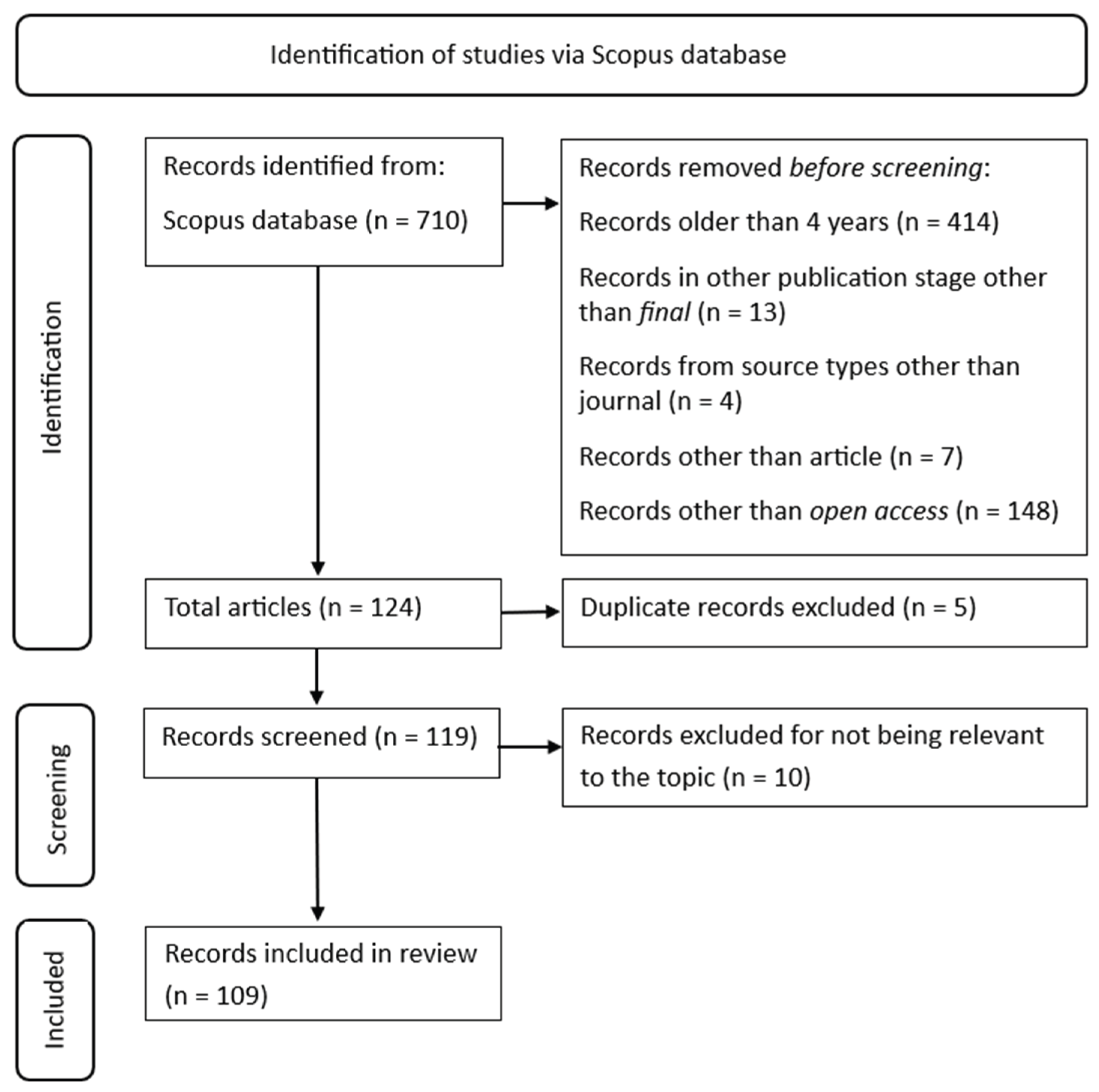
After carrying out the search strategy, the search returned 710 records in the Scopus database. Before the screening process began, the records obtained were assessed based on predefined eligibility criteria. These criteria were set up in order to make certain that the final sample included only studies which were sufficiently recent, formally published, relevant with regard to their publication type, and available for analysis. Firstly, 414 records that had been published outside the designated publication period were discarded. The publication period in question was limited to 2022 to 2026. The reason for choosing 2022 as the starting year was that major changes took place in global energy markets and financial conditions after the Russian invasion of Ukraine in 2022. Moreover, 13 records which were at a publication stage other than the final stage were eliminated. Also, 4 records that came from source types other than journals were excluded, as well as 7 records that were classified as types other than articles. Lastly, 148 records that were not open access were taken out of the dataset. As a result of applying these eligibility criteria, 124 articles were left for the next stage of the review, as it can be seen in Figure 1 which represents the process of selection.
The following stage of the selection procedure was the identification and elimination of duplicate records; 5 duplicate records were discarded, which left 119 records to be screened. At this point, the document available for each record was evaluated in order to judge its relevance to the research topic. More specifically, the records were looked at in terms of their concern with energy shocks and financial markets. Any studies that did not deal with the main subject of the review were excluded from further consideration. Because of this screening process, 10 records were excluded since they were not sufficiently relevant to the research topic.
After the screening had been carried out, 109 articles were left and formed the basis for the final systematic literature review. They provide the evidence upon which the later analysis and synthesis of the literature relating to energy shocks and financial markets were based.
3. Results
The reviewed literature shows that energy shocks affect financial markets through heterogeneous, asymmetric and time-varying mechanisms. In particular, the magnitude and direction of the effects depend on the type of energy shock, the characteristics of the economy and financial market, and the prevailing market regime. Moreover, across the literature, supply, demand and risk shocks produce different responses, while the effects generally intensify during periods of financial stress, such as the Global Financial Crisis, COVID-19 and the Russia-Ukraine war. Against this background, the following subchapters present the analysis of papers according to various market forms.
3.1. Stock Markets
Studies covering multiple countries generally find that oil shocks significantly affect equity markets, although the direction and magnitude differ across economies. More specifically, Sadraoui et al. (2025) identify stronger and more persistent effects of positive oil shocks, while Mishra et al. (2026) show that supply and risk shocks generally reduce stock returns, whereas demand shocks tend to increase them. In addition, Prodromou and Demirer (2022) find that supply shocks increase the cost of equity, particularly in emerging and oil-importing economies. The importance of country characteristics is further highlighted by Enilov et al. (2023), Mensi et al. (2025), Kielmann et al. (2022), Marathe et al. (2025) and Bonga-Bonga (2025), who demonstrate that oil-stock connectedness varies with economic development, resource dependence and market conditions. Furthermore, Ahmed et al. (2025) and Hanif et al. (2024) show that geopolitical and oil-risk shocks generate stronger effects during extreme market conditions. Similarly, in Islamic markets, Aslam and Newaz (2025) find that Islamic indices are often more resilient than conventional indices. More broadly, the evidence from emerging regions is also heterogeneous. Alzate-Ortega et al. (2024) identify supply shocks as the main source of spillovers to emerging-market equities, while Gaytan et al. (2023), Jreisat (2023) and Umoru et al. (2023) find substantial nonlinear and asymmetric effects in Latin American and African markets. Likewise, Abdelaziz Eissa et al. (2026) show considerable differences among Middle Eastern and African markets. Overall, the cross-country literature indicates that oil shocks do not generate a uniform equity market response.
Observing Europe, studies generally indicate a negative relationship between higher oil prices and equity performance, although the effects vary across countries, periods and types of shocks. Audi et al. (2025) find that higher oil prices depress aggregate European equities, while Castro et al. (2023) show that the effects of oil shocks on Euro STOXX 50 returns are time-varying and heterogeneous. This heterogeneity is also evident at the country level. Stojkov et al. (2023) identify asymmetric effects across EU oil-importing countries, while Katsampoxakis et al. (2022) find that oil-stock relationships changed substantially during COVID-19. Furthermore, Castro and Jiménez-Rodríguez (2024) show that including oil inventories changes the effect of oil-specific demand shocks. Similarly, Zivkov et al. (2024) find that extreme oil-related risk differs across Central and Eastern European markets. In addition, Rehman et al. (2023) identify long-run asymmetry in several developed-market energy stocks, while Vardari and Sood (2026) show that oil and electricity effects become stronger during high-volatility periods.
In North America, the evidence highlights sectoral heterogeneity and the importance of market uncertainty. Wei et al. (2023) show that supply, demand and speculative shocks all affect US and Chinese equities, while Managi et al. (2022) find that oil-stock connectedness increased sharply during COVID-19. At the sectoral level, Ozcelebi et al. (2025) identify oil-risk shocks as important transmitters of volatility to US sectors, while Bakić (2024) finds particularly strong effects for oil-dependent automobile companies. At the same time, Salisu et al. (2024) show that oil shocks improve volatility forecasts for most US states, while Cadena-Silva et al. (2025) find particularly strong volatility effects in Canada, Japan and the UK. Similarly, Tan and Dai (2024) find substantial oil-shock effects on the Canadian market, especially in the energy sector. Thus, North American evidence suggests that energy shocks are transmitted through both aggregate uncertainty and sector-specific exposure.
Likewise, the GCC literature generally finds a strong relationship between oil prices and stock markets. Ebadi and Razaq (2024) find stronger long-run effects of positive oil shocks, while Refai et al. (2022) show that oil shocks affect most GCC markets, particularly during COVID-19. Moreover, BenSaïda et al. (2024) and Ziadat and AlKhouri (2022) demonstrate that spillovers increase substantially during turbulent periods. Nevertheless, country differences remain important. Taha and Tuna (2023) find positive effects of oil shocks on Saudi Arabia but negative effects on Turkey, while Alharbi (2023) identifies oil shocks as an important determinant of Saudi stock returns. Similarly, Banerjee et al. (2023) find a positive long-run relationship between oil prices and Abu Dhabi equities. More recently, Al-Mohamad et al. (2026) indicate that extreme oil shocks have stronger and more persistent effects than shocks originating from other major assets.
Regarding Asia, markets show considerable asymmetry and sectoral heterogeneity. Akçağlayan and Tuzcu (2023) find that oil-price increases reduce Turkish stock returns, while İmamoğlu (2026) reports different responses for Turkey and Kazakhstan. In India, for example, Gopal et al. (2025) identify asymmetric effects across several sectors, while Agnihotri and Chauhan (2022) find that only extreme oil-price movements transmit risk to the Nifty 500. Similar heterogeneity is observed in Pakistan, Indonesia, Thailand and China. Ali et al. (2022) identify sector-specific asymmetric effects in Pakistan, while Tri Wahyudi and Rahmawati (2025) show that oil shocks affect Indonesian sectors differently. Furthermore, Tran Trong Huynh and Bui Thanh Khoa (2026) identify significant effects of oil prices and exchange rates on Thai equities. Finally, Huang and Gao (2026) show that policy uncertainty changes the oil-stock relationship in Chinese industries.
In Latin America and Africa, the evidence emphasizes nonlinear and asymmetric transmission. Gaytan et al. (2023) find that oil-price pass-through differs across frequencies, while Jreisat (2023) identifies substantial changes during COVID-19 and the Russia-Ukraine war. Meanwhile, Umoru et al. (2023) report that positive oil shocks reduce stock returns across five African markets, while exchange-rate effects are also asymmetric. For Jordan, S. A. Ziadat and Khasawneh (2025) find that oil-related spillovers intensify during COVID-19, with oil-demand shocks particularly important for sectoral volatility. Taken together, these studies indicate that crisis conditions and exchange-rate movements significantly influence the transmission of energy shocks to emerging equity markets.
3.2. Foreign Exchange and Bond Markets
The relatively small foreign exchange (FX) literature indicates that energy shocks affect exchange rates mainly through commodity export revenues, risk premia and global uncertainty. For instance, Guyot et al. (2026) show that global risk sentiment and currency risk premia are more important for short-run JPY/USD movements than interest-rate differentials. Fokin et al. (2024) find that the oil-rouble relationship is time-varying and weakened substantially under sanctions and capital controls. For commodity-exporting currencies, Sokhanvar (2023) and Sokhanvar and Lee (2023) find that energy price increases during the Russia-Ukraine war were associated with appreciation of the Australian and Canadian dollars. Moreover, Ben Salem et al. (2024) show that oil-FX spillovers intensify at the beginning of crises, while Lytvyn et al. (2026) find that emerging economies are particularly vulnerable to currency crises during major global shocks.
With regard to bond markets, Kwon (2025) finds that oil supply shocks reduce emerging-market corporate bond returns, whereas demand-driven oil price increases initially support returns. Similarly, Gupta et al. (2023) show that oil supply, demand and risk shocks predict the US Treasury yield curve in a nonlinear, quantile-dependent manner. Furthermore, S. A. Ziadat et al. (2023) demonstrate that oil shocks alter stock-bond correlations, particularly during recessions. Thus, energy shocks influence bond markets through both expected economic conditions and changing risk perceptions.
3.3. Green Financial Markets
The green bond literature indicates that these markets remain connected to conventional energy markets. In particular, Wei et al. (2023) find that oil supply and demand shocks increase green bond prices, while Wang et al. (2023) report a positive long-run effect of oil prices on Chinese green bonds. Likewise, Rehman et al. (2023) find that oil supply, demand and risk shocks predict green bond returns across nine indices. However, the relationship changes during periods of extreme stress. Wei et al. (2024) show that general financial volatility becomes more important than oil shocks after COVID-19, while Azhgaliyeva et al. (2022) find that oil supply and demand shocks increase the probability of corporate green bond issuance.
At the same time, green equities remain exposed to energy market conditions. Hanif et al. (2023) find substantial oil-to-green-stock spillovers, particularly over medium and long horizons and during crises. Similarly, Elsayed et al., (2024) show that green bonds mainly provide diversification, while clean-energy and ESG assets can offer stronger hedging or safe-haven characteristics under specific conditions.
Furthermore, Attarzadeh and Balcilar (2022) identify bidirectional oil-clean-energy spillovers, while Dam et al. (2025) show that clean-energy stocks can act as net transmitters of connectedness. Tiwari et al. (2026) find that brown assets benefit more from oil price increases, whereas green assets perform relatively better after sharp oil price declines, although they do not provide a safe haven during general market stress. Finally, Shaikh et al. (2026) show that Indian green equities respond immediately to oil shocks but retain long-term value.
3.4. Studies Covering Multiple Markets
Multi-market studies demonstrate that energy shocks can propagate throughout the financial system. For example, Farkhondeh Rouz et al. (2025) find strong spillovers among Iran’s oil, FX, banking, money and equity markets, while Thuy Tien (2022) identifies simultaneous effects on Vietnamese stocks and the exchange rate. In addition, Lam et al. (2025) show that oil, exchange rates, US equities and Treasury yields are interconnected with both low- and high-carbon stocks.
Similarly, Zeng et al. (2022) identify strong oil-Chinese stock-FX spillovers, and Ullah et al. (2024) find significant transmission to cryptocurrencies, equities, bonds, metals and currencies. Moreover, Tabash et al. (2022) and Wawire et al. (2026) demonstrate that oil shocks can move between equity and currency markets, while Bagchi and Paul (2023) identify structural breaks across G7 stock and FX markets during the Russia-Ukraine shock.
Furthermore, Morshed (2025) identifies oil demand shocks as particularly important for Saudi and UAE equity, CDS and interbank markets, with liquidity acting as a major transmission channel. Finally, Qamruzzaman et al. (2026) show that climate-policy uncertainty increases connectedness among European electricity, oil, gas, carbon, equity and cryptocurrency markets. Overall, these studies demonstrate that energy shocks operate increasingly through interconnected financial market networks rather than isolated asset classes.
3.5. Alternative Research Streams
The financial stress literature confirms that the source of an oil shock determines its consequences. For instance, Apostolakis (2026) finds that demand shocks reduce financial stress more strongly than risk shocks increase it. Similarly, Dagher and Hasanov (2023) find that demand-driven oil price increases reduce financial stress, while supply shocks increase it. In contrast, Ahmed et al. (2025) show that oil market volatility, demand and risk shocks increase financial stress, whereas positive supply shocks reduce it. Moreover, Sengupta et al. (2023) and Elsayed et al. (2024) show that these relationships are strongly influenced by crisis periods and time horizons.
Beyond financial stress, Balcilar et al. (2024) show that commodity market connectedness is time-varying and particularly strong during financial crises. Furthermore, Esmaeilpour Moghadam et al. (2026) find substantial connectedness among crude oil, refined products, natural gas and carbon futures, with crude oil acting as the main net transmitter. Similarly, Zhang and Zeng (2023) identify significant oil-metal risk spillovers, particularly to copper, while Yaya et al. (2022) show that precious metals can provide hedging benefits against oil supply and demand shocks.
Finally, the remaining studies demonstrate that energy shocks also operate through the broader macro-financial environment. Jawadi et al. (2023) find nonlinear and asymmetric effects on euro-area growth, inflation, investment, consumption and confidence. In addition, Degl’Innocenti et al. (2025) show that oil-exposed firms face reduced supplier credit and higher bank loan spreads. Meanwhile, Lin and Li (2025) find that energy price turbulence can temporarily destabilize inflation expectations in Sweden, while Yu et al. (2026) show that high energy price volatility increases financial risk in Chinese provinces beyond a threshold.
Observed together, these findings complement the financial-market evidence by showing that energy shocks can influence markets indirectly through economic activity, inflation, credit conditions and expectations.
4. Discussion
The systematic literature review shows that the relationship between energy shocks and financial markets is complex and highly context-dependent. While the literature as a whole suggests that disturbances in energy markets do affect financial markets, the direction, size and duration of these effects differ depending on the type of shock, the characteristics of the financial market and the wider economic environment. The evidence therefore does not support a simple relationship in which a rise in energy prices always leads to a negative reaction in financial markets.
A key conclusion drawn from the literature is that energy shocks should not be treated as a single, uniform type of disturbance. The varying results found in different studies can partly be explained by the different origins of the shocks. For example, a rise in oil prices due to stronger global demand may have different effects from a rise caused by a disruption in supply or a geopolitical event. In the first case the increase might coincide with higher economic activity and higher expectations regarding corporate earnings, while in the second case it might lead to higher production costs, greater inflationary pressure and higher economic uncertainty. This distinction helps to explain why the literature reports both positive and negative relationships between energy prices and financial market performance. Rather than suggesting that the literature is fundamentally inconsistent, these differing findings indicate that the financial effects of an energy shock depend on the economic mechanism that causes the shock. It is therefore important to identify the source of an energy shock if its possible financial consequences are to be understood.
The effects also vary from country to country and from sector to sector. Economies that export oil and those that import it are affected through different economic channels, while sectors involved in energy production may benefit from higher energy prices, whereas energy-intensive sectors may face higher costs. It follows that broad financial market indices can mask considerable differences at both sectoral and national levels.
Another key finding is that asymmetric and nonlinear relationships are common. The evidence shows that positive and negative energy shocks do not always result in effects of the same magnitude or in opposite directions. Furthermore, the relationships can vary considerably depending on market conditions. Effects that seem relatively small under ordinary circumstances can become much stronger during periods of high volatility or financial stress. The relationship between energy shocks and financial markets should therefore be viewed as state-dependent rather than constant. Studies based on quantiles and regime-dependent analyses are especially relevant here, since they demonstrate that the response observed under average market conditions does not necessarily reflect the response that occurs during extreme market movements.
The literature on volatility spill overs and connectedness also shows that energy and financial markets should not be examined in isolation. Shocks can be transmitted between energy markets, equity markets, the foreign exchange market, bond markets and other financial assets, and the intensity and direction of these spill overs vary over time. It is particularly important that connectedness tends to increase during periods of market stress. This implies that when markets are already under pressure an energy shock may become more significant from a financial perspective. At the same time, because connectedness is greater, the financial effects of an energy shock may extend beyond those companies or commodities that are directly affected. This finding reinforces the growing use of time-varying, quantile and frequency-based methods in the literature. These methods are better suited to capturing relationships that change across time and market conditions than conventional models based on a single average relationship.
5. Conclusions
The findings of this study suggest that energy shocks affect financial markets through a dynamic, asymmetric and state-dependent process. Their effects depend on the source and direction of the shock, the economic structure of the affected country, the financial asset considered and prevailing market conditions. The differences observed across individual studies can therefore largely be understood in terms of this heterogeneity rather than as evidence of a single stable relationship.
The literature has consequently moved beyond the simple question of whether energy prices affect financial markets towards a more nuanced understanding of when, how and under what conditions energy shocks are transmitted to financial assets. This represents the central synthesis of the reviewed evidence and highlights the importance of considering the broader economic and financial environment when analyzing energy-related financial risk.
The energy transition also represents an important emerging research area. As renewable energy, green financial assets and climate-related policies become increasingly important, the traditional relationship between oil prices and financial markets may evolve. Greater attention to clean energy assets and the interaction between conventional and emerging energy markets could therefore provide further insight into the changing relationship between energy and financial markets.
Several limitations of this review should also be acknowledged. Firstly, the analysis is based exclusively on studies identified through the Scopus database and therefore may not capture relevant research published in other databases or sources. Secondly, the review focuses on literature published between 2022 and 2026, which provides a recent perspective but limits the extent to which longer-term developments can be assessed. Thirdly, the substantial differences in methodologies, data periods, countries, variables and definitions of energy shocks across the reviewed studies make direct comparison of their findings difficult. Finally, the relatively recent nature of the literature means that some effects associated with major events and the ongoing energy transition may not yet be fully observable.
These limitations also point to several directions for future research. The existing literature remains strongly focused on oil and equity markets, suggesting a need for greater attention to natural gas, electricity and other energy markets, as well as bonds, credit, foreign exchange and other financial assets. Moreover, future studies should place greater emphasis on identifying the origin of energy shocks rather than treating all energy price changes as equivalent. In addition, further research should distinguish between structural relationships and effects that are specific to crisis periods, and examine the roles of inflation, monetary policy and financial conditions as transmission channels. Finally, greater attention to renewable energy markets, green financial assets and the interaction between conventional and emerging energy markets could provide a more comprehensive understanding of energy-related financial risk in an increasingly interconnected energy system.
Author Contributions
Conceptualization, Kornelia Przedworska and Dario Maradin; methodology, Ana Malnar; software, Kornelia Przedworska; validation, Kornelia Przedworska and Dario Maradin; formal analysis, Kornelia Przedworska; investigation, Ana Malnar; resources, Dario Maradin; data curation, Kornelia Przedworska; writing—original draft preparation, Ana Malnar; writing— Ana Malnar,; visualization, Saša Čegar supervision, Saša Čegar; project administration, Dario Maradin; funding acquisition, Dario Maradin. All authors have read and agreed to the published version of the manuscript.
Funding
This research received no external funding.
Institutional Review Board Statement
Not applicable.
Informed Consent Statement
Not applicable.
Data Availability Statement
Data available at Scopus database official site.
Acknowledgments
This paper has been written within the scope of the project „Steering the Energy Rapids: Balancing Energy Sustainability and Security” (uniri-iz-25-281), funded by European Union—NextGenerationEU via the Croatian National Recovery and Resilience Plan 2021-2026, in conjunction with the University of Rijeka, Faculty of Economics and Business Programme Financing. The views and opinions expressed are solely those of the authors and do not necessarily reflect the official position of the European Union or the European Commission. Neither the European Union nor the European Commission can be held responsible for them.
Conflicts of Interest
The authors declare no conflicts of interest. The funders had no role in the design of the study; in the collection, analyses, or interpretation of data; in the writing of the manuscript; or in the decision to publish the results.
References
- Abdelaziz Eissa, M.; Al Refai, H.; Chortareas, G. Stock-market responses, oil-price dynamics, and geopolitical risk in the MEA region. Applied Economics 2026, 58(43). [Google Scholar] [CrossRef]
- Agnihotri, S.; Chauhan, K. Modeling tail risk in Indian commodity markets using conditional EVT-VaR and their relation to the stock market. Investment Management and Financial Innovations 2022, 19(3). [Google Scholar] [CrossRef]
- Ahmed, F.; Sohag, K.; Islam, M. M.; Hassan, M. K. Navigating turbulence: How do geopolitical risks and oil price shocks shape global equity markets? A GVAR approach. Borsa Istanbul Review 2025, 25(3). [Google Scholar] [CrossRef]
- Ahmed, F.; Sohag, K.; Mariev, O.; Islam, M. M. Financial stability in G-20 economies: Asymmetric effects of institutional quality, economic policy uncertainty, and oil price shocks. Sustainable Futures 2025, 10. [Google Scholar] [CrossRef]
- Akçağlayan, A.; Tuzcu, S. E. The Asymmetric Impacts of Oil Prices and Selected Macroeconomic Variables on Stock Markets: The Case of Turkey. Sosyoekonomi 2023, 31(55). [Google Scholar] [CrossRef]
- Alharbi, A. M. H. Oil Shocks, Monetary Policy, and Stock Returns: A Case of Oil-based Economy. International Journal of Energy Economics and Policy 2023, 13(6). [Google Scholar] [CrossRef]
- Ali, S. R. M.; Mensi, W.; Anik, K. I.; Rahman, M.; Kang, S. H. The impacts of COVID-19 crisis on spillovers between the oil and stock markets: Evidence from the largest oil importers and exporters. Economic Analysis and Policy 2022, 73. [Google Scholar] [CrossRef]
- Al-Mohamad, S.; Jreisat, A.; Chehade, I.; El-Kanj, N.; Hoti, A. Impact of Oil Price Shocks on GCC Stock Markets: Tail-Driven MTNARDL Evidence. Emerging Science Journal 2026, 10(1). [Google Scholar] [CrossRef]
- Alzate-Ortega, A.; Garzón, N.; Molina-Muñoz, J. Volatility Spillovers in Emerging Markets: Oil Shocks, Energy, Stocks, and Gold. Energies 2024, 17(2). [Google Scholar] [CrossRef]
- Apostolakis, G. N. Asymmetric effects of oil price fluctuations on financial stress. Energy Strategy Reviews 2026, 64. [Google Scholar] [CrossRef]
- Aslam, A.; Newaz, M. K. Shielding against oil shocks: Contagion dynamics in Islamic versus conventional markets. Borsa Istanbul Review 2025, 25(6). [Google Scholar] [CrossRef]
- Attarzadeh, A.; Balcilar, M. On the Dynamic Connectedness of the Stock, Oil, Clean Energy, and Technology Markets. Energies 2022, 15(5). [Google Scholar] [CrossRef]
- Audi, M.; Poulin, M.; Ahmad, K.; Ali, A. Quantile Analysis of Oil Price Shocks and Stock Market Performance: A European Perspective. International Journal of Energy Economics and Policy 2025, 15(2). [Google Scholar] [CrossRef]
- Azhgaliyeva, D.; Kapsalyamova, Z.; Mishra, R. Oil price shocks and green bonds: An empirical evidence. Energy Economics 2022, 112. [Google Scholar] [CrossRef]
- Bagchi, B.; Paul, B. Effects of Crude Oil Price Shocks on Stock Markets and Currency Exchange Rates in the Context of Russia-Ukraine Conflict: Evidence from G7 Countries. Journal of Risk and Financial Management 2023, 16(2). [Google Scholar] [CrossRef]
- Bakić, S. ASSESSING THE SPILLOVER OF SHOCKS FROM THE OIL MARKET TO THE STOCK MARKET OF DIFFERENT INDUSTRY SECTORS IN AMERICA—A QUANTILE REGRESSION APPROACH. Serbian Journal of Management 2024, 19(1). [Google Scholar] [CrossRef]
- Balcilar, M.; Usman, O.; Agan, B. On the connectedness of commodity markets: A critical and selective survey of empirical studies and bibliometric analysis. Journal of Economic Surveys 2024, 38(1). [Google Scholar] [CrossRef]
- Banerjee, R.; Majumdar, S.; Mohammed, Z. Oil Price Changes and Stock Market Performance in UAE: Evidence of Cointegration Persists in Economic Diversification era. International Journal of Energy Economics and Policy 2023, 13(1). [Google Scholar] [CrossRef]
- Ben Salem, L.; Zayati, M.; Nouira, R.; Rault, C. Volatility spillover between oil prices and main exchange rates: Evidence from a DCC-GARCH-connectedness approach. Resources Policy 2024, 91. [Google Scholar] [CrossRef]
- BenSaïda, A.; Uddin, G. S.; Yahya, M. Spillovers between oil and the GCC stock markets: Fresh evidence from a regime-switching approach. Energy Strategy Reviews 2024, 56. [Google Scholar] [CrossRef]
- Bonga-Bonga, L. Exploring the sensitivity of BRICS stock markets to oil price shocks: a quantile-on-quantile perspective. Journal of Economics and Finance 2025, 49(4). [Google Scholar] [CrossRef]
- Brown, S. P. A.; Yücel, M. K. Energy prices and aggregate economic activity: An interpretative survey. Quarterly Review of Economics and Finance 2002, 42(2). [Google Scholar] [CrossRef]
- Cadena-Silva, J. P.; Sanz Lara, J. Á.; Rodríguez Fernández, J. M. Stock market volatility and oil shocks: A study of G7 economies. International Review of Financial Analysis 2025, 103. [Google Scholar] [CrossRef]
- Castro, C.; Jiménez-Rodríguez, R. The impact of oil shocks on the stock market. Global Finance Journal 2024, 60. [Google Scholar] [CrossRef]
- Castro, C.; Jiménez-Rodríguez, R.; Kizys, R. Time-Varying Relation between Oil Shocks and European Stock Market Returns. Journal of Risk and Financial Management 2023, 16(3). [Google Scholar] [CrossRef]
- Dagher, L.; Hasanov, F. J. Oil market shocks and financial instability in Asian countries. International Review of Economics and Finance 2023, 84. [Google Scholar] [CrossRef]
- Dam, M. M.; Altıntaş, H.; Tiwari, A. K. Novel approaches to model decomposed oil shocks, geopolitical risk, clean and fossil fuel stocks. Borsa Istanbul Review 2025, 25(3). [Google Scholar] [CrossRef]
- Degl’Innocenti, M.; Santilli, G.; Sclip, A.; Zhou, S. Commodity price risk, supply chain, and lending. Energy Economics 2025, 150. [Google Scholar] [CrossRef]
- Ebadi, E.; Razaq, Y. A. Reinvestigating the Oil Dependency of the GCC Countries’ Stock Market: A Regime-Switching Cointegration Approach. International Journal of Energy Economics and Policy 2024, 14(3). [Google Scholar] [CrossRef]
- Elsayed, A. H.; Downing, G.; Lau, C. K. M.; Sheng, X. Exploring the role of oil shocks on the financial stability of Gulf Cooperation Council countries. International Journal of Finance and Economics 2024, 29(2). [Google Scholar] [CrossRef]
- Elsayed, A. H.; Khalfaoui, R.; Nasreen, S.; Gabauer, D. The impact of oil shocks on green, clean, and socially responsible markets. Energy Economics 2024, 136. [Google Scholar] [CrossRef]
- Enilov, M.; Fazio, G.; Ghoshray, A. Global connectivity between commodity prices and national stock markets: A time-varying MIDAS analysis. International Journal of Finance and Economics 2023, 28(3). [Google Scholar] [CrossRef]
- Esmaeilpour Moghadam, H.; Karami, A.; Sharifbagheri, E.; Seyedi, S. M. Dynamic connectedness and transmission mechanisms of oil price shocks in the energy commodity and stock markets: evidence from SVAR and TVP-VAR approaches. Energy Nexus 2026, 23. [Google Scholar] [CrossRef]
- Farkhondeh Rouz, O.; Sioofy Khoojine, A.; Xiao, L. Systemic risk spillover dynamics and causality structures in composite stress networks. Journal of Physics: Complexity 2025, 6(4). [Google Scholar] [CrossRef]
- Fokin, N. D.; Malikova, E. V.; Polbin, A. V. Time-varying parameters error correction model for real ruble exchange rate and oil prices: What has changed due to capital control and sanctions? Russian Journal of Economics 2024, 10(1). [Google Scholar] [CrossRef]
- Gaytan, J. C. T.; Rafiuddin, A.; Sisodia, G. S.; Ahmed, G.; Paramaiah, C. Pass-through Effects of Oil Prices on LATAM Emerging Stocks before and during COVID-19: An Evidence from a Wavelet-VAR Analysis. International Journal of Energy Economics and Policy 2023, 13(1). [Google Scholar] [CrossRef]
- Gopal, S.; Naveen Kumara, R.; R. V, N. Crude complexities: sectoral asymmetries in the Indian stock market response to oil price changes. Cogent Economics and Finance 2025, 13(1). [Google Scholar] [CrossRef]
- Gupta, R.; Shahzad, S. J. H.; Sheng, X.; Subramaniam, S. The role of oil and risk shocks in the high-frequency movements of the term structure of interest rates: Evidence from the U.S. Treasury market. International Journal of Finance and Economics 2023, 28(2). [Google Scholar] [CrossRef]
- Guyot, O.; Montgomery, H. A.; Yang, P. Risk Premiums, Market Volatility, and Exchange Rate Dynamics: Evidence from the Yen Carry Trade. Risks 2026, 14(3). [Google Scholar] [CrossRef]
- Hanif, W.; Hadhri, S.; El Khoury, R. Quantile spillovers and connectedness between oil shocks and stock markets of the largest oil producers and consumers. Journal of Commodity Markets 2024, 34. [Google Scholar] [CrossRef]
- Hanif, W.; Teplova, T.; Rodina, V.; Alomari, M.; Mensi, W. Volatility spillovers and frequency dependence between oil price shocks and green stock markets. Resources Policy 2023, 85. [Google Scholar] [CrossRef]
- Huang, X.; Gao, Y. The Impact of EPU on the Relation Between International Oil Price Shocks and the Chinese Stock Market: Industry and Transnational Perspectives. International Journal of Financial Studies 2026, 14(2). [Google Scholar] [CrossRef]
- İmamoğlu, Ö. Asymmetric Effects of Oil Price Shocks on Stock Markets: A NARDL Analysis for Türkiye and Kazakhstan. Economies 2026, 14(4). [Google Scholar] [CrossRef]
- Jawadi, F.; Cheffou, A. I.; Bu, R. Revisiting the linkages between oil prices and macroeconomy for the euro area: Does energy inflation still matter? Energy Economics 2023, 127. [Google Scholar] [CrossRef]
- Jreisat, A. Dynamics of oil price shocks in Latin American stock markets during global turbulence: A nonlinear autoregressive distributed lag analysis. Investment Management and Financial Innovations 2023, 20(4). [Google Scholar] [CrossRef]
- Katsampoxakis, I.; Christopoulos, A.; Kalantonis, P.; Nastas, V. Crude Oil Price Shocks and European Stock Markets during the COVID-19 Period. Energies 2022, 15(11). [Google Scholar] [CrossRef]
- Kielmann, J.; Manner, H.; Min, A. Stock market returns and oil price shocks: A CoVaR analysis based on dynamic vine copula models. Empirical Economics 2022, 62(4). [Google Scholar] [CrossRef]
- Kilian, L. The economic effects of energy price shocks. Journal of Economic Literature 2008, 46(4). [Google Scholar] [CrossRef]
- Kwon, D. Oil Shocks, US Uncertainty, and Emerging Corporate Bond Markets. Journal of Risk and Financial Management 2025, 18(1). [Google Scholar] [CrossRef]
- Lam, E. Y. M.; Tse, Y.; Fung, J. K. W. Carbon Intensity, Volatility Spillovers, and Market Connectedness in Hong Kong Stocks. Journal of Risk and Financial Management 2025, 18(7). [Google Scholar] [CrossRef]
- Lin, X.; Li, X. A study on anchoring Swedish inflation expectations in times of turbulence. Energy Economics 2025, 144. [Google Scholar] [CrossRef]
- Lytvyn, O.; Chugaiev, O.; Reznikova, N.; Onyshchenko, A.; Ostapenko, O.; Pravdyvets, O. The Effects of Currency Crisis—How the Russian–Ukrainian War Changed the Global Financial Landscape. Journal of Risk and Financial Management 2026, 19(8). [Google Scholar] [CrossRef]
- Managi, S.; Yousfi, M.; Ben Zaied, Y.; Ben Mabrouk, N.; Ben Lahouel, B. Oil price, US stock market and the US business conditions in the era of COVID-19 pandemic outbreak. Economic Analysis and Policy 2022, 73. [Google Scholar] [CrossRef]
- Marathe, S. R.; Bandekar, B. N.; Pandhre, S. S.; Parab, S.; Popkar, S. Oil price shocks, market efficiency, and volatility spillovers: Evidence from BRICS countries. Investment Management and Financial Innovations 2025, 22(3). [Google Scholar] [CrossRef]
- Mensi, W.; Gubareva, M.; Teplova, T. Risk transmission between oil price shocks and major equity indices across bull and bear markets over various time horizons. North American Journal of Economics and Finance 2025, 79. [Google Scholar] [CrossRef]
- Mishra, S.; Bhattacherjee, P.; Mohanty, S. K. Oil shocks aren’t all alike: do stock markets know the difference? North American Journal of Economics and Finance 2026, 86. [Google Scholar] [CrossRef]
- Morshed, A. Graph Neural Networks and Explainable Spillovers: Global Monetary and Oil Shocks in GCC Financial Markets. Economies 2025, 13(11). [Google Scholar] [CrossRef]
- Ozcelebi, O.; Pérez-Montiel, J.; Kang, S. H. Extreme time–frequency connectedness between oil shocks and sectoral markets in the United States. Financial Innovation 2025, 11(1). [Google Scholar] [CrossRef]
- Page, M. J.; McKenzie, J. E.; Bossuyt, P. M.; Boutron, I.; Hoffmann, T. C.; Mulrow, C. D.; Shamseer, L.; Tetzlaff, J. M.; Akl, E. A.; Brennan, S. E.; Chou, R.; Glanville, J.; Grimshaw, J. M.; Hróbjartsson, A.; Lalu, M. M.; Li, T.; Loder, E. W.; Mayo-Wilson, E.; McDonald, S.; …; Moher, D. The PRISMA 2020 statement: an updated guideline for reporting systematic reviews. Systematic Reviews 2021a, 10(1). [Google Scholar] [CrossRef]
- Page, M. J.; McKenzie, J. E.; Bossuyt, P. M.; Boutron, I.; Hoffmann, T. C.; Mulrow, C. D.; Shamseer, L.; Tetzlaff, J. M.; Akl, E. A.; Brennan, S. E.; Chou, R.; Glanville, J.; Grimshaw, J. M.; Hróbjartsson, A.; Lalu, M. M.; Li, T.; Loder, E. W.; Mayo-Wilson, E.; McDonald, S.; …; Moher, D. The PRISMA 2020 statement: An updated guideline for reporting systematic reviews. BMJ 2021b, Vol. 372. [Google Scholar] [CrossRef]
- Page, M. J.; Moher, D.; Bossuyt, P. M.; Boutron, I.; Hoffmann, T. C.; Mulrow, C. D.; Shamseer, L.; Tetzlaff, J. M.; Akl, E. A.; Brennan, S. E.; Chou, R.; Glanville, J.; Grimshaw, J. M.; Hróbjartsson, A.; Lalu, M. M.; Li, T.; Loder, E. W.; Mayo-Wilson, E.; Mcdonald, S.; …; Mckenzie, J. E. PRISMA 2020 explanation and elaboration: Updated guidance and exemplars for reporting systematic reviews. The BMJ 2021, Vol. 372. [Google Scholar] [CrossRef]
- Prodromou, T.; Demirer, R. Oil price shocks and cost of capital: Does market liquidity play a role? Energy Economics 2022, 115. [Google Scholar] [CrossRef]
- Qamruzzaman, M.; Alomair, A.; Alomair, M.; Kor, S. Time-varying, frequency-domain, and quantile spillovers across energy and financial markets under climate policy uncertainty: evidence from TVP-VAR-SV, BK, and QVAR models. Quality and Quantity 2026, 60(3). [Google Scholar] [CrossRef]
- Al Refai, H.; Zeitun, R.; Eissa, M. A. A. Impact of global health crisis and oil price shocks on stock markets in the GCC. Finance Research Letters 2022, 45. [Google Scholar] [CrossRef]
- Rehman, M. U.; Raheem, I. D.; Zeitun, R.; Vo, X. V.; Ahmad, N. Do oil shocks affect the green bond market? Energy Economics 2023, 117. [Google Scholar] [CrossRef]
- Sadraoui, T.; Neffati, M.; Achour, W. UNRAVELING THE ASYMMETRIC DYNAMICS OF OIL PRICE SHOCKS AND MARKET VOLATILITY ON STOCK RETURNS: EVIDENCE FROM NARDL PANEL APPROACH. ECONOMICS—Innovative and Economics Research Journal 2025, 13(3). [Google Scholar] [CrossRef]
- Salisu, A. A.; Gupta, R.; Cepni, O.; Caraiani, P. Oil shocks and state-level stock market volatility of the United States: a GARCH-MIDAS approach. Review of Quantitative Finance and Accounting 2024, 63(4). [Google Scholar] [CrossRef]
- Sengupta, A.; Maitra, D.; Dash, S. R.; Brooks, R. Do Oil Shocks Affect Financial Stress? Evidence from Oil-Exporting and -Importing Countries. American Business Review 2023, 26(2). [Google Scholar] [CrossRef]
- Shaikh, Z. H.; Gupta, R.; Sahoo, B. P. Are Carbon-Efficient Equities Insulated from Oil Shocks? Evidence from an Indian VARX Model with Exogenous Currency Controls. Journal of Risk and Financial Management 2026, 19(8). [Google Scholar] [CrossRef]
- Sokhanvar, A. Impacts of Ongoing Global Geopolitical and Economic Turbulences on Exchange Rates: A Case Study of the Australian Dollar. Ekonomicky Casopis 2023, 71(67). [Google Scholar] [CrossRef]
- Sokhanvar, A.; Lee, C. C. How do energy price hikes affect exchange rates during the war in Ukraine? Empirical Economics 2023, 64(5). [Google Scholar] [CrossRef]
- Stojkov, S.; Beker Pucar, E.; Glavaški, O.; Beljić, M. Oil Price Spillover Effects to the Stock Market Sentiment: The Case of Higher vs. Lower Oil Import EU Countries. Economies 2023, 11(11). [Google Scholar] [CrossRef]
- Tabash, M. I.; Asad, M.; Khan, A. A.; Sheikh, U. A.; Babar, Z. Role of 2008 financial contagion in effecting the mediating role of stock market indices between the exchange rates and oil prices: Application of the unrestricted VAR. Cogent Economics and Finance 2022, 10(1). [Google Scholar] [CrossRef]
- Taha, A.; Tuna, G. Oil Price and Composite Risk Exposure within International Capital Asset Pricing Model: A Case of Saudi Arabia and Turkey. Energies 2023, 16(7). [Google Scholar] [CrossRef]
- Tan, R.; Dai, W. Oil Price Shocks and the Canadian Stock Market. Journal of Risk and Financial Management 2024, 17(11). [Google Scholar] [CrossRef]
- Thuy Tien, H. Oil price shocks and Vietnam’s macroeconomic fundamentals: quantile-on-quantile approach. Cogent Economics and Finance 2022, 10(1). [Google Scholar] [CrossRef]
- Tiwari, C. K.; Bhat, M. A.; Khan, S. T.; Siksnelyte-Butkiene, I.; Sohail, H. M. Green Versus Brown Assets Under Stress: Who Hedges Energy and Market Risk? Journal of Risk and Financial Management 2026, 19(8). [Google Scholar] [CrossRef]
- Huynh, Tran Trong; Khoa, Bui Thanh. Climate Policy Uncertainty, Energy Price Shocks, and Sustainable Stock-Market Volatility: Evidence from Thailand. Evergreen 2026, 13(2). [Google Scholar] [CrossRef]
- Tri Wahyudi, S.; Rahmawati, A. Examining the link between world oil price volatility and sectoral stock performance in Indonesia. Cogent Economics and Finance 2025, 13(1). [Google Scholar] [CrossRef]
- Ullah, M.; Sohag, K.; Nawaz, F.; Mariev, O.; Kayani, U.; Mayburov, I.; Doroshenko, S. Impact of Oil Price Shocks on Crypto and Conventional Financial Assets during Financial Crises: Evidence from the Russian Financial Market. International Journal of Energy Economics and Policy 2024, 14(4). [Google Scholar] [CrossRef]
- Umoru, D.; Effiong, S. E.; Umar, S. S.; Okpara, E.; Ugbaka, M. A.; Otu, C. A.; Ofie, F. E.; Tizhe, A. N.; Ekeoba, A. A. REACTIONS OF STOCK RETURNS TO ASYMMETRIC CHANGES IN EXCHANGE RATES AND OIL PRICES. Corporate Governance and Organizational Behavior Review 2023, 7(3). [Google Scholar] [CrossRef]
- Vardari, L.; Sood, K. State-Dependent Transmission of Oil and Electricity Shocks to Equity Markets: Evidence from Emerging and Transitional Economies. Journal Of Economic Sciences: Theory And Practice 2026, 83(1). [Google Scholar] [CrossRef]
- Wang, K. H.; Su, C. W.; Umar, M.; Lobonţ, O. R. OIL PRICE SHOCKS, ECONOMIC POLICY UNCERTAINTY, AND GREEN FINANCE: A CASE OF CHINA. Technological and Economic Development of Economy 2023, 29(2). [Google Scholar] [CrossRef]
- Wawire, A. K.; Simiyu, C. N.; Laiboni, M.; Ochenge, R. Understanding Volatility Transmission from Global Commodity Shocks to Frontier Financial Markets: Machine Learning, Nonlinearities, and State Dependence in Kenya. Journal of Risk and Financial Management 2026, 19(5). [Google Scholar] [CrossRef]
- Wei, Y.; Shi, C.; Zhou, C.; Wang, Q.; Liu, Y.; Wang, Y. Market volatilities vs oil shocks: Which dominate the relative performance of green bonds? Energy Economics 2024, 136. [Google Scholar] [CrossRef]
- Wei, Y.; Yu, B.; Guo, X.; Zhang, C. The impact of oil price shocks on the U.S. and Chinese stock markets: A quantitative structural analysis. Energy Reports 2023, 10. [Google Scholar] [CrossRef]
- Yaya, O. O. S.; Ogbonna, A. E.; Adesina, O. A.; Alobaloke, K. A.; Vo, X. V. Time-variation between metal commodities and oil, and the impact of oil shocks: GARCH-MIDAS and DCC-MIDAS analyses. Resources Policy 2022, 79. [Google Scholar] [CrossRef]
- Yu, R.; Dou, Y.; Adam, N. A.; Shakaraliyeva, Z.; Hakimova, Y.; Huseynova, A. Economic performance and financial risk analysis of energy systems under uncertainty. Energy Strategy Reviews 2026, 66. [Google Scholar] [CrossRef]
- Zeng, H.; Ahmed, A. D.; Lu, R.; Dai, N. Dependence and spillover among oil market, China’s stock market and exchange rate: new evidence from the Vine-Copula-CoVaR and VAR-BEKK-GARCH frameworks. Heliyon 2022, 8(11). [Google Scholar] [CrossRef]
- Zhang, T.; Zeng, S. Dynamic comovement and extreme risk spillovers between international crude oil and China’s non-ferrous metal futures market. Resources Policy 2023, 80. [Google Scholar] [CrossRef]
- Ziadat, S. A.; Al Rababa’a, A. R. A.; Rehman, M.; McMillan, D. G. Oil price shocks and stock–bond correlation. North American Journal of Economics and Finance 2023, 68. [Google Scholar] [CrossRef]
- Ziadat, S. A.; Khasawneh, M. Ripples of Oil Shocks: How Jordan’s Sectors React. Journal of Risk and Financial Management 2025, 18(4). [Google Scholar] [CrossRef]
- Ziadat, S.; AlKhouri, R. Revisiting volatility spillovers in the Gulf Cooperation Council. Cogent Economics and Finance 2022, 10(1). [Google Scholar] [CrossRef]
- Zivkov, D.; Kuzman, B.; Papic-Blagojevic, N. Multiscale non-linear tale risk spillover effect from oil to stocks—The case of East European emerging markets. E a M: Ekonomie a Management 2024, 27(3). [Google Scholar] [CrossRef]
Figure 1.
PRISMA flow diagram. Source: Author’s calculations.
Disclaimer/Publisher’s Note: The statements, opinions and data contained in all publications are solely those of the individual author(s) and contributor(s) and not of MDPI and/or the editor(s). MDPI and/or the editor(s) disclaim responsibility for any injury to people or property resulting from any ideas, methods, instructions or products referred to in the content. |
© 2026 by the authors. Licensee MDPI, Basel, Switzerland. This article is an open access article distributed under the terms and conditions of the Creative Commons Attribution (CC BY) license (http://creativecommons.org/licenses/by/4.0/).
Copyright: This open access article is published under a Creative Commons CC BY 4.0 license, which permit the free download, distribution, and reuse, provided that the author and preprint are cited in any reuse.