

Submitted:
02 October 2026
Posted:
05 October 2026
You are already at the latest version
Abstract
Rural development in the Global South requires governance frameworks that bridge the sectoral divides between community-based rural institutions amid compounding socio-economic and climate pressures. Community forestry (CF) and agricultural cooperatives (AC) are two such foundational institutions that operate in institutional silos despite their functional interdependence. Focusing on Nepal through Ostrom’s polycentric governance theory, this study explores:(1) How can the governance structures of CF and AC be analysed through a polycentric lens? (2) What institutional, legal, economic, and socio-cultural factors enable or constrain their collaboration? (3) What models effectively integrate them to strengthen rural resilience? A narrative synthesis of 107 peer-reviewed and grey literature sources (screened from 886 records, spanning 1990-2026) reveals a critical governance paradox: the robust legal foundations for legal collaboration exist, yet a compound governance deficit-fragmented vertical linkages, elite capture, and capacity constraints-prevents operational integration. Building on this diagnostic framework, the study develops a novel conceptualization demonstrating that CF-AC integration improves co-managed resource management, enhances livelihood diversification and climate resilience, and promotes inclusive decision-making. To operationalize these synergies, policymakers should develop integrated governance frameworks that incentivize collaboration through financial support and capacity-building, driving both ecological conservation and agricultural productivity. This study makes three core contributions: (1) theoretically extending polycentric governance to the underexplored CF-AC nexus; (2) analytically combining Ostrom’s design principles with cross-scale analysis to diagnose barriers; and (3) practically proposing three implementable governance models that preserve institutional autonomy, offering transferable insights for developing countries facing coupled socio-ecological challenges.
Keywords:
polycentric governance
; institutional integration
; cross-sectoral governance
; Ostrom’s design prin-ciples
; climate resilience
1. Introduction
Growing socio-economic inequalities and climate risks call for integrated governance of forest and agricultural systems, particularly in rural areas of the Global South where millions depend on these systems for survival [1]. Climate change is fundamentally reshaping the biophysical and institutional conditions under which rural communities manage natural resources, demanding more flexible and adaptive governance arrangements [2]. Food, fuel, income, and the ecosystem services that support rural livelihoods are provided by both forests and agricultural systems in this region [3,4], while approximately 20% of the global population relies on forest resources [5]. In the Himalayas, household dependence on forest products is even greater, with an estimated 60% relying on these resources alongside subsistence farming [6]. Despite this biological and socio-economic linkage, forest and agricultural governance systems are usually institutionalized in silos [7,8]. This institutional fragmentation is not confined to developing countries; rather, the European Union’s advanced regulatory framework, integrating biodiversity requirements into agricultural policy, has proven difficult due to entrenched sectoral boundaries, limited administrative capacity, and the persistence of competing institutional interests [9]. This isolation systematically limits their combined potential to create resilient livelihoods and landscapes. Collaborative management provides a way to overcome this fragmentation [10,11], building on decades of research showing that well-designed local institutions can overcome collective action problems through nested institutional structure [12]. The challenge is determining how community-based institutions with overlapping memberships, shared landscapes, and convergent sustainability goals can generate synergistic outcomes. This study addresses this question by examining the potential for collaborative governance between Community Forestry (CF) and Agricultural Cooperatives (AC) through a diagnostic and design-oriented application of polycentric governance theory.
Agroecology has gained significant visibility and traction as a multidimensional framework encompassing scientific discipline, agricultural practice, and social movement, for transforming food systems [13,14]. Its core principles and elements such as recycling nutrients, optimizing biodiversity, and strengthening social equity provide the normative foundation for understanding how community-based institutions like CF and AC can operationalize sustainable transitions at the landscape scale.
CF and AC represent two community-based institutions anchoring rural resource governance in many developing countries where both are established tools for sustainable resource management, poverty reduction, and social empowerment [15,16]. They share common institutional principles such as democratic membership, collective decision-making, and locally negotiated rules, which position them as natural partners, especially in the mosaic landscape. These institutions have a wide global presence: nearly 1.6 billion people depend on community-managed forests for subsistence [17], while approximately 1.2 million cooperatives serve hundreds of millions of households. Yet in practice they rarely coordinate, forgoing potential synergies despite overlapping memberships, shared landscapes, and convergent sustainability goals. This institutional fragmentation persists even where cross-sectoral integration has enhanced both conservation and livelihood outcomes in comparable developing contexts [18].
Nepal offers a compelling case study of this unrealized synergy between forest and farm governance in a rapidly changing context. CF program in Nepal is one of the world’s most extensive experiments in decentralized forest governance, transferring management rights of forest areas to local communities. This program has become a global exemplar of successful decentralized governance, with documented improvements in forest condition and household welfare [19]. Currently, more than 23,000 CF user groups engage over three million households. Cooperatives have constitutional recognition as one of the three pillars of the national economy, operating alongside more than 7,000 AC that supply smallholders with credit and services where formal banking is largely absent [20,21]. Agriculture’s share of GDP declined from 49% (1990) to 23% (2020) as migration, remittances, and labour-market shifts reshaped the rural economy [22,23,24], accompanied by rapid farmland abandonment across the mid-hills [25,26,27,28]. These trends mirror broader patterns of rural transformation across the Himalayas, where labour migration and economic restructuring are fundamentally altering land-use dynamics and institutional viability [29].
Recent research documents that out-migration and livelihood diversification have significantly eroded active engagement in community forestry, with forest dependence declining sharply as households shift to remittance-based economies [30]. The socio-economic changes have been compounded by the federal restructuring of Nepal after 2015, which has added a new layer of jurisdictional complexity, increasing the vulnerabilities of both CF and AC in terms of multi-level coordination. Rural aging, out-migration, and urbanization have reduced youth participation in CF, leaving elderly and women members to manage forests with limited resources and authority [31,32,33,34], while AC, face complex regulations, inconsistent funding, and weak local implementation [35]. Federalism has also fragmented authority across municipalities, provincial, and central agencies over forest and farm funding. Crucially, these pressures do not operate in isolation. They interact to produce a compound governance deficit in which fragmented vertical linkages weaken accountability, which in turn enables elite capture, which further degrades collective-choice capacity, a self-reinforcing cycle that neither institution can break independently. Such institutional complexity is a common symbol of decentralized reform in developing countries, where overlapping mandates often create coordination challenges rather than improved governance [36].
The above discussion further reinforces the urgency for cross-sectoral integration. In May 2026, the government merged the agriculture and forestry ministries into a single Ministry of Agriculture, Forests and Environment. This administrative consolidation addresses this gap at the central level. A critical question remains: how can the integration be effectively operationalized among autonomous, community-level entities? A parallel “top-down” merger of all the forestry and farm sectors is probably not the answer. Existing legislation allows for inter-institutional partnership: the Cooperative Act (2017) enables cooperatives to operate across agriculture, forestry, and enterprise, while the Forest Act recognizes Community Forest User Groups (CFUGs) as autonomous legal entities authorized to form partnerships, and the Cooperative Act, 2017 enables cooperatives to operate across agriculture, forestry, and enterprise [37,38]. CF and AC both clearly allow cross-sectoral collaboration, establishing that the barrier to collaboration is not legal prohibition. Despite these legal provisions, CF and AC are still studied and governed as separate domains, and the conditions under which they might collaborate have received little analytical research. In the developing world, two of the most important rural institutions are common, share a geographic area, and share livelihood goals; still, policy frameworks and even academic research have been insufficient to explore how their governance systems can be integrated. This paradox-robust legal permissiveness coexisting with operational non-collaboration is precisely the phenomenon that Polycentric governance theory is equipped to diagnose and address.
Since there are a number of competing frameworks, the choice of polycentric governance as the analytical lens must be justified. The Collaborative Governance framework [39] provides insights into process dynamics of cross-sector partnerships, but it is less helpful to understanding nested, multi-level structural relationships in Nepal’s federalised governance structure. The Institutional Analysis and Development framework [40] offers a strong general-purpose tool to analyse institutions, but it does not explicitly highlight the question of how the semi-autonomous decision-making centres coordinate across scales and still maintain their local autonomy, which is the central question of the CF-AC nexus as analysed in this article. Social-Ecological Systems thinking [41] is pertinent but developed mainly based on a resource system, rather than the interlinkage between two different institutional domains across the sectors. Polycentric governance theory emerged from Elinor Ostrom’s work and views complex resource systems as being managed by many decentralized, semi-autonomous decision-making centres which regulate themselves through their rules. The theory is important for the CF-AC because it connects grassroots institutions to higher level authorities, has evaluative metrics for assessing the internal governance of community institutions, and has been shown to have good analytical power for common-pool resource management in decentralized settings in developing countries, where overlapping and locally adaptive institutions are more successful than pure centralized institutional structures [42].
Moreover, polycentric systems have better resilience and adaptability characteristics in uncertain and unpredictable environments and under environmental change [43], which is pertinent in the context of the accelerating climate stresses documented in the region. Applying polycentric theory requires the conceptual distinction developed in Section 2: because CF are shared, subtractable resources whereas AC farmland is privately owned. Ostrom’s design principles are applied not to farmland but to the collective goods cooperatives manage, such as credit, processing, market access, and risk-pooling, while the broader polycentric lens captures how the two institutions interact across scales [44,45]. The broader polycentric framework handles the complementary task of mapping how CF and AC interact horizontally and vertically with local, provincial, and national authorities, so the two lenses together capture both internal governance and cross-scale collaboration. Recent studies show that Polycentric governance systems are more effective in managing complex natural resource systems across multiple scales [46]. The institutional properties, such as membership bases, resource pools, and accountability mechanisms, are properties directly related to the integration problem above. The recent merger of ministries is related to the need for coordination and is meant to collaborate and co-manage farm, forest, and livestock into one. However, ministerial merger represents an administrative centralization, whereas polycentric theory advocates for coordination through networked, multi-level arrangements that preserve local institutional autonomy. This is a fundamental conceptual distinction that this study foregrounds. It shows how overlapping jurisdictions, shared norms, and nested governance can enable separate institutions to be coordinated without losing their identities and to gain the benefits of integration.
Against this background, this article explores the following research questions: (1) How can the governance structures of CF and AC be analysed from a polycentric perspective? (2) What factors (institutional, legal, economic and socio-cultural) foster or impede inter-institutional cooperation? (3) What governance models can enhance livelihood diversification, ecological sustainability, and climate resilience in rural Nepal? In addressing these questions, this study makes three distinct contributions: theoretically, the study extends polycentric governance to the underexplored CF-AC nexus [12,47,48], analytically, it combines Ostrom’s design principles with a cross-scale polycentric perspective to identify barriers to collaboration [12,42,47], and practically, it proposes actionable collaborative frameworks for operationalizing integration while preserving institutional autonomy. Crucially, the proposed models explicitly integrate climate resilience functions, linking institutional collaboration to adaptive capacity through joint monitoring, diversified livelihood portfolios, and access to climate finance mechanisms. Together, these contributions move the discourse from simply recognizing forest-agriculture interdependence towards designing and implementing functional governance mechanisms.
2. Theoretical Framework
Several theories and frameworks shed light on some aspects of the CF-AC nexus, but the polycentric governance theory provides the most comprehensive structural view. Collaborative Governance theory [39] helps to explain the processes involved in cross-sector partnerships; however, it is less useful for analysing the multi-level, nested nature of Nepal’s federalized governance system, where authority is established at a variety of levels. The Institutional Analysis and Development framework [40] is a very general-purpose tool for institutional analysis within a single decision arena, but it doesn’t explicitly highlight the question of how semi-autonomous decision-making centres coordinate across scales, while maintaining local autonomy, which is the central analytical challenge in the CF-AC nexus. Social-Ecological Systems is applicable; however, mainly used to analyse a single resource system rather than the interaction between two separate institutional sectors managing complementary resources. In contrast, polycentric governance theory is explicitly developed to study the interaction of various overlapping governing bodies over space and institutions to manage complex and interconnected resource systems [46].
2.1. Polycentric Governance and Integration
Polycentric Governance Theory, as developed by Elinor Ostrom [12], describes systems with multiple, independent decision-making centres that interact and coordinate under a shared set of rules, primarily through mutual adjustment rather than central command [47]. The approach has often been associated with the observation that neither pure centralization nor pure decentralization reliably sustains shared resources, whereas arrangements that distribute authority across overlapping, locally adaptive units have proven more durable, especially for common-pool resources in developing-country settings [42]. This is particularly salient in Nepal’s post-federal context, where the 2015 Constitution deliberately fragmented authority across three tiers of government, creating the overlapping jurisdictions that polycentric theory is designed to analyse. In the agriculture sector, similar dynamics apply: agricultural cooperatives, extension services, and farmer organizations operate across multiple scales with overlapping jurisdictions, yet coordination between tiers frequently fails due to the absence of robust nested linkages [49]. The concept includes two aspects: the positive dimension, which recognizes that jurisdiction over collective problems is often fragmented across independent actors requiring coordination, and the normative dimension, which affirms the desirability of self-governance at the lowest feasible level through democratic inclusion [50]. This explains why polycentric systems can both describe existing arrangements and guide preferred reforms. Crucially, polycentric governance provides a middle path between the extremes of forced administrative merger and uncoordinated institutional isolation, precisely the tension that Nepal’s 2026 ministerial consolidation creates. The merger centralizes authority at the apex, but without addressing local-level coordination, it risks reproducing top-down governance failures. Polycentric theory offers a conceptual alternative: nested, networked coordination that preserves institutional autonomy while enabling cross-sectoral synergy.
This study is centred on the four features of these systems: (1) Authority follows ‘subsidiarity’ where decisions are made at the lowest capable level with higher levels intervening only when units need to coordinate [51,52], (2) the centres are ‘nested’, connecting local institutions to provincial, and national bodies [53], (3) their overlapping roles creating functional redundancy, enabling institutions to monitor, learn from, and back up one another though as network analysis demonstrates, such overlap can also create opportunities for power concentration among well-connected actors [54], and (4) the system is ‘adaptive’, evolving in response to ecological, social, and political change [42]. This adaptability feature is particularly advantageous in Nepal, where federal restructuring, out-migration, and climate variability keep reshaping institutional arrangements. In practice, this means institutions must remain flexible if they are to remain effective. Recent empirical work on rural polycentric governance in China demonstrates how these features operate in practice, showing how institutional support, market embedding, and local agency interact to transform rural operation from traditional collective models toward collaborative, market-embedded arrangements [55]. Such empirical validation reinforces the applicability of polycentric governance to diverse rural contexts beyond the commons management cases that originally defined the theory.
Both CF and AC already function as a nested, polycentric arrangement, showing these features are not just abstract theory in Nepal. Under the REDD+ program, forest user groups set local rules for forest product utilization, patrolling, and revenue sharing while operating within national policy and linking upward through sub-national and national federations [56]. Similarly, agricultural cooperatives operate within a multi-tiered structure connecting local primary cooperatives to district cooperative unions, provincial cooperative federations, and the national Department of Cooperatives, though vertical coordination in this hierarchy has been weakened by capacity gaps at the local level and competing priorities across government tiers. Therefore, the framework here describes a logic of governance that Nepal’s forestry and agriculture sectors partly exemplify, and this renders it suitable for examining how CF and AC can collaborate while retaining their distinct identities, resources, and accountability structures.
2.2. Analytical Framework
This study employs a dual-level analytical structure combining Ostrom’s design principles at the micro-level with a cross-scale polycentric lens to diagnose governance gaps and institutional solutions. At the first level, Ostrom’s design principles act as a diagnostic checklist for assessing internal governance robustness.
The principles for managing shared resources- clear boundaries, a fair balance of costs and benefits, collective decision-making, monitoring, graduated sanctions, conflict resolution, recognition of rights, and nested enterprises- were originally developed through comparative analysis of community-managed irrigation, fisheries, and forest systems worldwide [12,57]. These principles have since been validated across hundreds of cases as reliable indicators of institutional durability [58,59]. CF fit this definition directly: forest areas are collectively held by user groups, individual harvests reduce the available stock, and only registered members may access forest products [7]. Applying these principles within the CF context is consequently both appropriate and well supported by prior research. Similarly, adopting the same principles to AC requires an important conceptual distinction that this study makes explicit. While AC are more focused in business enterprises and the farmland they cultivate is privately owned, they also manage shared goods and services such as pooled land, credit pools, processing facilities, and marketing infrastructure that exhibit the core characteristics Ostrom identified. These shared goods face the same collective-action problems such as free-riding, overexploitation, and the need for credible monitoring and sanctioning to sustain AC. This study, therefore, applies the design principles to these collective goods in the AC, not to the privately owned farmland, respecting the fundamental distinction in ownership while enabling a principled comparison of how each institution governs its shared resources. The AC also faces the same problems of member cooperation, mutual monitoring, fair sharing, and penalizing misuse as studied by Ostrom [60]. This application is not without limitations, as AC shared goods are more substitutable and contractible than classic common-pool resources; however, for the diagnostic purpose of identifying governance vulnerabilities that would impede cross-institutional collaboration, the design principles provide a rigorous, comparable metric.
A system-level analysis around the institutions was the second level of the framework considered here. The Polycentric framework has a broad focus on institutional interactions, not on the internal workings of each institution. It poses questions about the potential for relationship-building between CF and AC on one side and between CF and local governments, provincial agencies, and national federations. These two levels constitute the analytical architecture of the study, with the former being defined as Ostrom’s design principles, which help explain governance strengths and weaknesses in CF and AC (Section 4.2), and the latter as the polycentric lens which helps to create and compare alternative governance configurations (Section 4.3). Together, these two levels constitute the analytical architecture of the study, enabling a systematic assessment of both internal institutional robustness and cross-scale collaborative potential.
3. Methodology
3.1. Research Approach
This study adopts narrative synthesis as its core method to bring together knowledge on the potential synergies between CF and AC through the lens of polycentric governance. Narrative synthesis is an established interpretive method for combining evidence from a diverse, interdisciplinary literature [61].
The approach suits this study for three reasons. (1) The evidence base is heterogeneous, extending across forest governance, cooperative economics, development studies, and policy analysis- fields that rely on case studies, theoretical work, and grey literature that use different methods. This kind of material cannot be accommodated by a meta-analysis, because there is no single intervention or effect size to quantify. (2) The research questions are interpretive and theory-building in nature, including how the governance of the CF and AC can be analysed through a polycentric lens, what conditions enable or constrain their collaboration, and what integrated models might look like. Meta-analysis is specifically designed for quantitatively synthesizing comparable effects; however, this study addresses questions of institutional mechanisms, relationships, and governance design. Narrative synthesis is a widely accepted tool in scientific research for this kind of question. (3) The goal is to develop a conceptual framework and propose governance models.
To ensure systematic transparency, the synthesis followed a structured three-phase analytical protocol derived from [61] and adapted for governance-oriented narrative synthesis. The method is paired with a transparent and documented search, so that the selection of evidence and the basis for interpretation can be followed and replicated. In keeping with its conceptual aim, this study does not include formal quality appraisal or quantitative pooling; conclusions are therefore analytical and propositional- offered as a framework and a set of models to be tested in future empirical research.
3.2. Literature Search and Selection
A structured search was conducted in July 2026 across five academic databases (ScienceDirect, Scopus, Web of Science, Wiley Online Library, and Oxford Academic) and grey-literature sources, including government reports and publications from FAO, IFAD, ICIMOD, the World Bank, and relevant NGOs. Search strings combined keywords including “community forests,” “community forest user groups”, “agriculture cooperatives”, “polycentric governance”, “forest agriculture synergies”, “effectiveness”, and their possible synonyms using the Boolean operators “AND” and “OR”. The search was structured across three thematic blocks: (i) CF governance and institutional analysis; (ii) AC governance and collective action; and (iii) cross-sectoral governance, polycentricity, and forest-agriculture linkages. The search covered the period 1990 to 2026.
A PRISMA-style screening flow was followed: (i) initial database search identified 886 records; (ii) duplicate removal reduced the set to 624 unique records; (iii) title and abstract screening against inclusion criteria generated 198 potentially relevant records; (iv) full-text assessment against all criteria resulted in 107 included sources. Duplicate records were removed before eligibility assessment, and studies were included if they met the following criteria: (1) addressed community-based resource management, institutional interaction, or socio-ecological outcomes; (2) examined the challenges facing CF or AC; (3) took the form of empirical case studies, theoretical analyses, or policy reports; or (4) addressed governance, sustainability, or socio-economic outcomes. Similarly, studies were excluded if they met any of the following conditions: (1) were purely technical agronomic or silvicultural work without governance relevance; (2) lacked analytical or conceptual engagement with governance; or (3) were non-English, duplicates, or unrelated to community-based resource management. To complement a global view, there was a mix of information on CF and AC from selected countries in Asia, Africa, Latin America and Europe, as well as the core focus on Nepal. To address these issues, grey literature, such as government reports, policy documents and publications from international organizations, was included for three reasons: (i) Nepal’s cooperative sector is rarely represented in peer-reviewed journals, with the majority of institutional information contained in government statistics and policy documents; (ii) the merger of the ministerial responsibilities in 2026 and its governance implications are largely reported in policy sources, rather than academic journal articles; and (iii) the comparative analysis of CF and AC governance structures draws heavily on legislative texts and institutional reports that provide a legal permissiveness core to the study’s diagnostic argument.
A flexible interpretive approach was essential because this study’s sources span policy analyses, theoretical contributions, and a smaller body of empirical case studies as well [62,63,64]. This approach allowed the construction of a comprehensive reading of how CF and AC operate under a polycentric governance framework. To ensure authenticity and contextual accuracy, relevant policies, rules, and regulations were gathered from official government websites.
3.3. Analysis
The analysis was conducted in three sequential phases following established narrative-synthesis guidance [61]. Each phase employed a structured coding framework and documentation protocol, as detailed below. For institutional mapping and baseline framework, organizational structures, governance mechanisms, legal frameworks, membership rules, and socio-economic functions of CFs and ACs are created to establish a comparative baseline. A structured template, derived from Ostrom’s eight design principles and supplemented by polycentric governance features (subsidiarity, nesting, overlap, and adaptability), was used to code evidence from each source. This generated a matrix of institutional properties, enabling systematic identification of institutional strengths and weaknesses before cross-institutional comparison.
After the construction of the baseline framework, thematic synthesis for convergence and divergence was carried out. Evidence across livelihood security, equity and inclusion, ecological sustainability, adaptive capacity, and climate resilience was synthesized to identify areas of convergence and divergence. Evidence converging across peer-reviewed studies, grey literature, and policy documents was treated as robust, whereas divergent findings were explicitly documented as areas of uncertainty requiring further empirical investigation. The synthesis identified shared governance weaknesses across both institutions, conceptualized as a “compound governance deficit.”
Finally, a polycentric lens integrating Ostrom’s design principles with a broader multi-scale framework to identify structural opportunities and constraints for cross-institutional collaboration was applied to polycentric diagnosis. Diagnostic findings were interpreted into three governance models addressing specific gaps. Each model was assessed against five core polycentric characteristics (multiplicity, autonomy, coordination, conflict resolution, and accountability) to identify trade-offs and feasibility conditions. This design-oriented step extends the analysis beyond descriptive synthesis toward governance-model development.
4. Results and Discussion
4.1. CF and AC Governance: Global Context and Nepal
Over the last four decades, community-based natural resource management has emerged as a dominant paradigm in global forest governance, driven by the recognition that centralized state management systematically ignores local ecological knowledge, socio-economic conditions, and the livelihoods of local communities [65,66]. CF now operates in over 60 countries worldwide, covering about 15% of the world’s forests [67] under diverse forms of community management. CF has been implemented as both a conservation strategy and a livelihood intervention in the Global South. This model exhibits considerable diversity across different arrangements. Ranging from joint forest management in India, to forest concessions in Guatemala and Mexico, to CF enterprises in British Columbia and Indigenous-led stewardship in Australia [68,69], CF programs share a common institutional foundation: democratic membership structures, collective decision-making arenas, and the devolution of use rights over shared forest resources to local communities.
According to the UN International Year of Cooperatives (2025), the global cooperative movement now encompasses an estimated 3 million cooperatives serving more than 1 billion members across 100 countries. AC provide essential services including credit, input supply, collective marketing, processing, and risk-pooling where formal financial institutions and private markets fail to reach smallholders [70]. AC serve as critical intermediaries between smallholder farmers and increasingly globalized value chains in the developing countries of Africa, South and Southeast Asia, and Latin America, providing the institutional infrastructure for market participation that individual households cannot achieve individually [71,72]. Agricultural cooperatives are owned and democratically controlled by their members and set on internationally recognized principles such as voluntary and open membership, member economic participation, autonomy, education, cooperation among cooperatives, and concern for community that align closely with democratic norms [73].
Despite shared institutional foundations of AC and CF, their global reach, and overlapping functional domains, these institutions have developed largely as separate institutional systems, governed through distinct legal frameworks, administered by different bureaucratic hierarchies, and studied by separate academic communities. This sectoral divide demonstrates across regions at the operational level. Overview, country-wise key statistics, and main challenges of CF and AC across 15 representative countries are analyzed and presented as Supplementary material in this article. Overall, CF operate under forestry legislation, whereas AC register under cooperative or agricultural development laws, operates with minimal formal coordination between them in East Africa [74]. In Southeast Asia, where both institutions are widespread, Indonesia alone has over 11,000 social forestry permits and over 143,000 farmer cooperatives; the two systems are administered by separate ministries with distinct funding streams, technical support systems, and regulatory requirements [75]. In Latin America, CF enterprises in Mexico’s ejidos and Guatemala’s CF exhibit similar isolation where enterprises operate alongside but largely independently of AC, despite shared membership and overlapping landscapes [76,77]. This institutional fragmentation endures despite growing evidence that integrated landscape approaches, managing forests and farms as connected socio-ecological systems, produce superior outcomes for both conservation and livelihoods compared to single-sector interventions [18,48].
The consequences of sectoral divide for rural farm and forest communities are significant. Communities miss potential synergies where CF and AC operate in isolation. AC are unable to access forest-based resources and ecosystem services to diversify the livelihoods of their members, and CF lack the financial services, market linkages, and technical support that cooperatives provide [78]. This division also limits adaptive capacity and resilience to climate change, as single-sector institutions are less able to respond to the interconnected ecological and economic stresses affecting rural communities [2,43]. Cross-sectoral governance approaches that bridge the forestry-agriculture divide, recognizing that sustainable development in rural landscapes requires institutions capable of managing the interdependencies between forests, farms, and livelihoods, are increasingly advocated in recent research [48]. However, the institutional mechanisms through which such integration might be achieved, and the governance conditions under which it can succeed, remain insufficiently theorized and empirically underdeveloped. This study addresses the gap through the lens of polycentric governance theory.
A lower-middle-income country like Nepal, transitioning from a traditional agrarian economy, exemplifies both the potential and the unrealized promise of cross-institutional integration between CF and AC. Their comparative overview, including historical development, governance, policy and legal framework, current scale, coverage and status, key achievements and primary focus, is illustrated in Figure 3. The country’s CF program transfers management authority over approximately 2.27 million hectares, roughly 40% of the national forest area, to over 23,000 CFUGs engaging over 3.19 million households [79]. The program is widely credited with reversing decades of deforestation, increasing national forest cover from approximately 26% in 1990 to 44.7% by 2023, while simultaneously improving rural livelihoods through access to forest products, revenue sharing, and community-managed enterprises [80]. This program has become a global reference case for successful decentralization, which shows that appropriately designed local institutions can manage common-pool resources sustainably alongside generating livelihood benefits for marginalized communities [30,81]. These outcomes build on six decades of forest restoration efforts in Nepal, which have generated valuable lessons about institutional design, community engagement, and adaptive management [82]. As outlined above, the economic reorganizations have direct consequences for institutional viability. The traditional membership rationale for both CF and AC becomes undermined at the same time as the role of agriculture in the household income decreases and remittances become a substitute for farm income. This leads to a compounded vulnerability: CF are losing their participation due to a decrease in forest dependency, while AC are losing agricultural loan demand at a time when it is crucial to their business model. Both institutions are thus having concurrent and interrelated membership remains as an intractable problem for the individual sectors. The interlinked fragility highlights the need not just for synergy, but structural cross-sectoral integration for institutional survival.
ACs in Nepal, with a roughly 70-year history, have followed a comparably long but distinctly different institutional trajectory characterized by a shift from state-controlled resettlement tools to politically linked saving-dominated entities. This sector has expanded substantially in recent decades, with around 7,230 registered ACs (overall around 31,000-35,000 cooperatives) engaging an estimated 2.8 million members as of 2024 [83]. ACs also serve a critical financial intermediation function in rural Nepal. They mobilize member savings, extend agricultural credit, supply inputs, and provide collective marketing services where the formal banking system remains limited [20,21]. Though the Constitution of Nepal recognizes cooperatives as one of the three pillars of the national economy, alongside the private and public sectors, these institutions have struggled with governance challenges, including elite capture, inadequate capitalization, political interference, and inconsistent regulatory enforcement [84]. The sector’s contribution to agricultural transformation has been limited, with many AC functioning primarily as credit institutions rather than focusing on member-driven collective action, where farmers pool resources to lower input costs, share risks, and gain market power [85].
Nepal offers a compelling case study of this unrealized synergy between forest and farm governance in a rapidly changing context. The governance structure of both institutions has a multi-tiered, connecting local, provincial, and national levels, but these structures were not formally coordinated before 2026 and are managed through different bureaus with weak inter-sectoral coordination. It is noteworthy to mention that Nepal has now addressed this divide at the apex: in 2026, the government merged the Ministry of Agriculture and Livestock and the Ministry of Forest and Environment into a single Ministry of Agriculture, Forests and Environment as part of broader administrative consolidation. The ministerial merger represents an administrative centralization that does not, by itself, resolve the operational governance deficits diagnosed in this study. While it eliminates the bureaucratic boundary separating sectoral policy streams at the apex, it leaves unanswered the question of how integration reaches autonomous community-level entities. This is precisely where polycentric governance theory provides analytical and practical guidance: the merger creates a policy window, but realizing its potential requires deliberate institutional design that coordinates across scales without undermining local autonomy.
The 2015 constitution transferred substantial powers to sub-national authorities, but also introduced overlapping mandates, which dilute accountability and complicate cross-sectoral coordination [35]. In forestry, provincial and central departments of Forests sometimes claim overlapping jurisdiction, while in agriculture, municipalities compete with central agencies for funding authority [86]. Municipalities are tasked with cooperative oversight yet often lack the technical capacity and financial resources to execute effectively. In the agriculture sector, central agencies continue to control major subsidy programs that were previously administered at lower levels [87]. Nepal’s new federal structure confirms that this lack of inter-governmental coordination, combined with a poor understanding of institutional management at the local level, has severely compromised agricultural extension service delivery and governance, which are Empirical assessed recently [49]. These jurisdictional ambiguities have intensified pre-existing challenges, including accelerating rural out-migration, declining youth participation, and the economic restructuring that has seen agriculture’s share of GDP fall from 49% in 1990 to approximately 23% by 2020 [22,23]. The result is a governance situation where two institutions with overlapping memberships, shared territories, and convergent sustainability goals operate through parallel administrative structures with insufficient means for coordination, collaboration, or mutual learning. This is a structural condition that polycentric governance theory is well-equipped to address.
4.2. Internal Governance Compared: Design Principles Diagnosis
Ostrom’s design principles provide a framework for how communities collectively govern shared resources in a sustainable way, and also provide a systematic framework for diagnosing internal governance. The principles- clear boundaries, proportional equivalence between benefits and costs, collective-choice arrangements, monitoring, graduated sanctions, conflict-resolution mechanisms, recognition of organizational rights, and nested enterprises were originally developed through comparative analysis of community-managed irrigation, fisheries, and forest systems worldwide, and have since been validated across hundreds of case studies as reliable indicators of institutional durability [58,59], including through Asia-specific governance quality assessments for community-based forest management systems [88]. This study applies them to Nepal’s CF and AC, which allows a structured comparison of how each institution manages its core governance functions, and where the specific weaknesses lie that cross-institutional collaboration must address. As established in Section 2.2, Ostrom’s design principles are applied to both CF and AC through a dual-lens approach: directly to CF’s Forest resources and to AC’s shared collective goods (credit pools, processing facilities, marketing infrastructure) rather than to privately owned farmland. This conceptual distinction is essential for valid comparison.
Table 1 applies this dual-diagnostic lens to both institutions in the Nepalese context, drawing on the legal frameworks, governance structures, and institutional challenges described in Section 4.1. This comparison uncovers a noteworthy pattern: both institutions demonstrate moderate institutional robustness for those principles that formal legal frameworks can mandate- clear boundaries, collective-choice arenas, and recognition of rights. They exhibit notable weaknesses for principles- monitoring, graduated sanctions, conflict resolution, and nested linkage. It reflects a broader dynamic in Nepal’s post-federalism governance landscape, where legal decentralization has been more successful at devolving formal authority than at building the institutional capacity, accountability mechanisms, and fiscal autonomy that local institutions need to exercise that authority effectively [16,35]. Locally perceived social factors- leadership quality, community cohesion, and trust, alongside biophysical conditions such as forest accessibility and degradation status- have been shown to significantly shape the effectiveness of community forest management implementation, often outweighing the influence of formal legal provisions [89].
The design principles diagnosis further reveals three analytically significant findings. First, both institutions demonstrate institutional strength on principles amenable to legal prescription- clear boundaries, collective-choice arenas, and formal recognition of rights- indicating that Nepal’s legal frameworks have been reasonably effective in establishing the foundational architecture for community-based governance. The Forest Act and Cooperative Act both establish the legal conditions under which these institutions can function as autonomous, democratic bodies, and both have been operationalized with sufficient regularity that their core governance structures are broadly established across the country.
Second, both institutions exhibit systemic weakness on principles that require ongoing institutional practice, adequate resources, and genuine political independence, monitoring, graduated sanctions, conflict resolution, and nested linkage. These are not principles that legislation alone can establish; they depend on operational capacity, social trust, and the willingness of both internal leaders and external authorities to enforce accountability. In Nepal, these principles have been undermined by converging pressures: federalism-induced jurisdictional fragmentation, weakening nested linkages; rural out-migration eroding monitoring capacity as active members leave; and elite capture compromising both monitoring and sanctioning when powerful members dominate decision-making.
Third, the pattern of shared weaknesses across both institutions identifies specific governance gaps that cross-institutional collaboration must address. If both CF and AC struggle with monitoring, sanctioning, conflict resolution, and nested coordination independently, then a well-designed collaborative framework- one establishing shared monitoring protocols, neutral dispute resolution, and coordinated vertical linkages- could simultaneously address the governance weaknesses of both institutions. This is the core proposition that the governance models in Section 4.4 seek to operationalize, and the design principles diagnosis provides the empirical basis for prioritizing. Importantly, the analysis further confirms that the obstacles to CF-AC integration are not primarily legal, as both institutions are already legally empowered to collaborate. It is the operational and institutional issues, residing in the governance practices and capacity gaps, that the design principles expose. Thus, in response to RQ1, CF and AC emerge as institutionally distinct but structurally compatible governance systems, holding strong formal foundations but showing operational weaknesses in accountability, conflict resolution, and nested coordination. The enabling factors and constraining barriers that shape these operational realities are examined in detail in the following section
4.3. Enabling and Constraining Factors: A Polycentric Diagnosis
The design principles diagnosis presented in Section 4.2 reveals governance weaknesses that independently constrain CF and AC. Based on this diagnosis, the present section evaluates the institutional, legal, economic, and socio-political conditions determining their collaborative potential. Rather than presenting enabling and constraining factors as separate lists, the analysis applies Ostrom’s polycentric framework to diagnose the institutional readiness of Nepal’s rural governance landscape for cross-sectoral integration.
4.3.1. Institutional and Legal Permissiveness
The first analytical question concerns whether the lawful conditions for polycentric collaboration exist. The evidence indicates that Nepal’s legal and institutional architecture creates a permissive framework for CF-AC integration, though it does not mandate it- a critical distinction that shapes the governance models proposed in Section 4.4.
- Legal permissiveness: Autonomy without coordination;
Nepal’s constitutional and legislative framework formally recognizes cooperatives as autonomous, democratically governed entities. The Constitution of Nepal, 2015 (Article 232) establishes cooperatives as one of three pillars of the national economy alongside the public and private sectors and articulates “cooperation, co-existence, and coordination” as foundational principles governing intergovernmental relations [96]. The Forest Act recognizes CF as autonomous legal entities empowered to engage in forest-based enterprises independently or in partnership with cooperatives, the private sector, or local organizations. The Cooperative Act enables cooperatives to operate across agriculture, forestry, and eco-tourism sectors and to partner with local governments and non-governmental organizations [38].
These instruments collectively establish that the constraint on CF-AC collaboration is not legal permissiveness but institutional practice and political will. Both institutions are already legally empowered to collaborate; neither the Forest Act nor the Cooperative Act requires fundamental legislative reform to enable partnership. What is absent is the institutional mechanism, the specific rules, arenas, and capacity through which existing legal provisions translate into collaborative practice. This distinction matters because the governance models in Section 4.4 require no fundamental legal reform, only the activation of existing provisions through deliberate institutional design.
However, Nepal’s experience, consistent with comparative evidence from other federalizing developing countries, demonstrates that legal devolution alone does not automatically produce enhanced local capacity or improved governance outcomes [36,97]. Cross-sectoral legal provisions remain dormant without dedicated coordination mechanisms, bridging institutions, and institutional champions who operate across sectoral bureaucracies [98,99]. The legal framework creates conditions for collaboration; translating these conditions into practice requires governance architecture that neither law has established.
- 2.
- Common democratic architecture: Parallel norms, uneven practice;
Both institutions are based on norms of democratic participation, collective decision-making, and benefit sharing, which are well entrenched in socio-cultural practices of collective action in rural Nepalese communities, and which predate both formal institutions. Each CF is governed by a one-household, two-vote system: management plans are determined at general assemblies, budgets are approved at general assemblies, and executive committees are elected at general assemblies. Cooperatives follow the one-member-one-vote rule: general meetings make cooperative policy and form boards of directors.
From a polycentric governance perspective, this shared democratic structure is analytically significant for two reasons. First, it satisfies Ostrom’s requirement for collective-choice arrangements, the principle that individuals affected by resource-management rules should participate in modifying those rules [12]. Both institutions possess functioning, if imperfect, arenas for collective decision-making, meaning that cross-sectoral collaboration does not require creating new democratic practices from scratch but rather extending and adapting those already employed. Second, institutions sharing democratic norms and collective-action traditions exhibit lower transaction costs when forming partnerships, because members already understand participatory processes, negotiation norms, and the logic of mutual accountability [46,47]. In comparative polycentric governance research, this “institutional complementarity” has been identified as a critical enabler of cross-sector coordination, because shared normative foundations reduce the coordination costs that otherwise prevent semi-autonomous decision-making centers from collaborating [51].
However, the gap between a democratic design and its practice is quite large, creating challenges to the viability of collaborative governance. In AC, governance participation remains low: electoral participation is limited, information access is skewed toward elite members, and communication barriers systematically restrict engagement by older, more distant, and less asset-endowed members [100]. In CF, active member participation has been reduced due to out-migration creating management authorities for aging populations, while women’s formal representation frequently translates into tokenistic rather than functional participation [6,101]. These are not peripheral governance defects; they compromise the collective-choice arrangements and proportionality of costs and benefits that is essential to institutional durability. If each institution’s democratic foundations are shallow, the joint CF-AC planning committees risk reproducing the same patterns of exclusion and superficial participation. These committees are, after all, the collaborative mechanism most naturally aligned with existing practice.
- 3.
- Polycentric precedents: existing arrangements, imperfect realization;
Nepal’s institutional landscape includes functioning examples of the polycentric arrangements that underpin CF-AC collaboration, confirming that the conceptual framework is not imported wholesale but rather describes a governance logic that it was already embodying in the sector, partially. CF operate under the REDD+ program as semi-autonomous decision-making units within national frameworks, formulating local rules for forest use and revenue distribution as they operate in a multi-level coordination structure. This is an operationalization of the nested enterprises principle that Ostrom identified as a hallmark of durable polycentric systems [42]. The FECOFUN provides horizontal coordination linking CF across municipalities, districts, and provinces, demonstrating self-organization into higher-order structures without loss of autonomy [35]. The Cooperative Act enables cooperatives to form unions providing technical support and policy advocacy at provincial and national levels and at the central level. Nepal Cooperative Federation is the apex body of all kinds of cooperatives, and Nepal Agricultural Cooperative Central Federation Limited acts as an umbrella organization for agriculture cooperatives
- 4.
- Federal multi-level governance: Structural precondition for subsidiarity.
Nepal’s federal system assigns agriculture, forestry, and environment as concurrent powers across federal, provincial, and local tiers, meaning no single level of government holds exclusive control over either sector. This concurrent arrangement, while generating fragmentation, simultaneously creates structural preconditions for polycentric governance: multiple entry points for cross-sectoral collaboration, overlapping jurisdictions that generate functional redundancy, and bridging institutions with convening authority.
The local municipality is at the most strategic place in this structure. The Local Government Operation Act (2017) empowers municipalities to develop local development plans that bring together various sectors in the local community, including agriculture, forestry, environment and cooperative development. The administrative structure within which they can coordinate CF-AC planning and resource allocation and enterprise development on this level. The research on collaborative governance highlights the need for bridging institutions that facilitate the coordination of separate decision-making centres in a fragmented institutional landscape if there is to be any success in achieving coordination, in terms of negotiating the rules, sharing resources, and establishing accountability mechanisms that enable joint action [39,51,102].
The 2026 ministerial merger, despite its centralizing tendencies, creates an additional enabling condition at the apex level, consolidating agriculture and forestry under a single Ministry of Agriculture, Forests and Environment. The merger eliminates the bureaucratic boundary that previously separated sectoral policy streams. Comparative evidence from other federal systems suggests that ministerial consolidation, when accompanied by integrated programming and unified funding mechanisms, can reduce coordination costs between previously separate sectors [103]. The extent to which this potential is realized centres on the policy choices adopted by the new ministry; however, the institutional preconditions for top-down facilitation of local-level collaboration exist where they previously didn’t.
The analysis of enabling conditions reveals a distinctive pattern. The legitimate architecture for polycentric collaboration is robust: legal permissiveness exists, democratic norms are shared, polycentric precedents are operational, and the federal structure provides multiple entry points for cross-sectoral coordination. These are not trivial preconditions. They distinguish Nepal from contexts where collaboration is either legally prohibited or institutionally inconceivable.
However, the evidence is consistent: there is a disconnect between formal and operational architecture. The law does not mandate but encourages. Democratic norms are set, but unevenly followed. There are precedents that are polycentric, but not fully realised. Federalism brings about the fragmentation discussed in the next sub-section as well as offering numerous entry points. This is a kind of pattern that is predicted by Ostrom’s framework to need deliberate institutional design intervention, strong formal foundations, and weak operational capacity. Legal and democratic conditions are a necessary but not sufficient precondition; the governing mechanism that connects the permissive conditions to coordinated practice is missing.
The constraining factors that define this practice gap are governance fragmentation, elite capture, asymmetric participation, competing mandates, and capacity deficits, which are examined in the following subsection. Where the present analysis identifies the permissive foundation, the next section diagnoses the specific polycentric governance failures that prevent that foundation from supporting collaborative outcomes.
4.3.2. The Polycentric Diagnosis: Key Gaps in Governance Capacity
The previous section demonstrates that Nepal’s legal and institutional architecture provides a permissive foundation for CF-AC collaboration. The present subsection diagnoses why, despite this foundation, integration has not materialized. Instead of treating barriers as a descriptive catalogue, the analysis applies Ostrom’s design principles and the broader polycentric framework to identify the specific governance failures that must be addressed for collaboration to succeed. The findings show five conceptually distinct but empirically interrelated gaps, each corresponding to the weaknesses identified in the design-principles diagnosis of Section 4.2.
- Fragmentation of Nested Linkages: The Vertical Coordination Deficit;
Ostrom’s principle of multi-layered institutions requires that local institutions be connected vertically through predictable coordination pathways while retaining operational autonomy. This pattern in Indonesia’s forest governance is termed ‘policy layering’, where successive decentralization reforms added new institutional layers atop centralized structures, changes in policy paradigm without significant changes in implementation [104]. Nepal’s post-2015 federal restructuring fundamentally erodes this principle through overlapping jurisdictions that diffuse accountability and prevent any single authority from enabling cross-sectoral collaboration. The federal government often promulgates policy directives instead of developing coordination mechanisms through consultation with subnational authorities, undermining the self-organizing dynamics that polycentric governance requires [105,106]. This top-down imposition contradicts the subsidiarity principle that higher authorities should support rather than supplant local coordination, reproducing hierarchical arrangements less adaptive for common-pool resource management.
Without functioning vertical linkages, CFUGs and cooperatives cannot access the policy frameworks, funding mechanisms, and technical support that higher-level coordination is designed to provide. The 2026 ministerial merger eliminates the bureaucratic boundary separating sectoral policy streams, but its effectiveness depends on whether the new ministry strengthens subnational coordination capacity or replicates existing top-down structure.
- 2.
- Weakened Accountability: Elite Capture in Monitoring and Sanctioning;
Ostrom’s principles of monitoring and graduated sanctions are mutually reinforcing. Monitoring identifies rule violations while sanctions make monitoring consequential, together forming the accountability framework that protects resource institutions from being captured by self-interested actors. These principles are consistently undermined by elite domination, creating an accountability gap that directly risks collaborative governance [107]. In CF, wealthier households disproportionately influence decisions, access greater amounts of forest products, and dominate executive committees. Such a trend is particularly evident in the Terai where high-value timber creates strong appropriation incentives [108]. In AC, leadership concentrates among older, wealthier farmers, with literacy, assets, and closeness to cooperative offices determining inclusion in governance, while more distant and less asset-endowed members face structural exclusion [100].
The gender dimensions exacerbate this deficit as women constitute 59% of cooperative household-level representatives compared to 37% male, yet households appear to allocate representation to lower-status members [20], entrusting cooperative membership to women while men engage in higher-value activities. This formal inclusion fails to convert into substantive decision-making power. In CF, despite formal 33% minimum quotas, women frequently occupy subordinate positions, with participation mediated through male household members. Critically, joint land ownership has been shown to enhance women’s socio-economic empowerment, suggesting that tenure security is a foundational prerequisite for meaningful governance participation [109]. Dalit and Janajati communities face additional barriers from caste-based discrimination and social exclusion [16]. Critically, elite capture intensifies when new institutional arrangements lack explicit safeguards, as elites are better positioned to exploit emerging opportunities [110].
Structurally significant implications exist for collaboration between CF and AC, as shared monitoring and sanctioning systems may exacerbate these weaknesses when these mechanisms are weak within individual institutions. Joint planning committees, shared monitoring protocols and coordinated benefit sharing mechanisms will be captured by the same elites unless they are explicitly designed with structural safeguards, transparent benefit sharing rules, independent oversight mechanisms, and substantive and implacable provisions for women, indigenous peoples and marginalized groups to participate. Mutual accountability could be established among CF and AC, between CF and their respective institutions, and between cooperatives and their respective institutions through across-institutional monitoring. However, this outcome cannot be assumed, even if CF monitor cooperative resource use and cooperatives monitor CF enterprise activities.
- 3.
- Asymmetric participation and competing mandates: The collective-choice gap;
Ostrom’s principle of collective-choice arrangements requires that individuals affected by resource-management rules participate in modifying those rules, with costs and benefits proportionally distributed among participants. Two well-documented empirical patterns undermine this principle in both institutions, creating a collective-choice gap that constrains collaborative design.
The first dynamic is asymmetric participation in these institutions while, AC has attracted members, particularly young-aged participate through immediate financial returns and credit pathways. CF faces a more severe participation decline as out-migration has fundamentally weakened engagement, forest dependence has declined sharply as households shift to remittance-based economies, and the long-term focus on forest regeneration offers no immediate economic rewards comparable to cooperative membership [30]. The change in forest use pattern across the middle hills highlights that changing livelihood strategies are fundamentally altering household-forest relationships, reducing the traditional basis for CF participation [111]. These asymmetries are intensified by structural differences in membership design, as cooperative membership is functionally defined and geographically flexible, while CF membership is bounded by nearby residents to forest areas and by multiple institutional memberships that dilute commitment.
The second dynamic is divergent institutional objectives and timeframes specifically in case of AC have largely abandoned their stated mandate of commercialization in favour of financial intermediation while CF remains oriented toward ecological sustainability, fundamentally misaligned. If participation in each institution is shallow, asymmetric, and influenced by different interests, joint governance arenas will struggle to produce legitimate, enforceable collaborative rules. The economic rationale for CF-AC integration must therefore extend beyond agricultural production to encompass financial services, ecosystem services, non-timber forest product value chains, ecotourism, and climate finance. These comprise a broader set of complementary functions that neither institution offers independently, yet both are capable of contributing.
- 4.
- Capacity and resource deficits: The operational sustainability gap.
Polycentric governance systems derive their adaptive capacity from the operational effectiveness of multiple decision-making centres; when these centres lack the resources to perform their governance functions, the system’s capacity for coordination and adaptive management collapses [43]. Both CF and AC in Nepal exhibit severe capacity deficits that directly constrain collaborative potential, a situation that was further compounded by the COVID-19 pandemic, which disrupted forest management operations, reduced community participation, and strained the already limited financial resources of CF [112]. Comparative evidence from agricultural conservation schemes similarly identifies administrative burdens, farm-level costs, and limited reliability of existing measures as major barriers to farmer engagement [113], suggesting that transaction costs and implementation capacity are universal constraints in cross-sectoral rural governance. CF lacks technical expertise for enterprise development, relying heavily on external NGO support for monitoring and forest inventory, and AC suffers from inadequate capitalization and limited access to commercial credit, as banks are unwilling to give agricultural product loans due to the risk involved, leaving cooperatives as the primary credit source, yet member savings remain insufficient for large-scale investments. Both institutions depend on short-term, project-based donor funding that undermines institutional autonomy and long-term planning. The diagnostic results above are not stand-alone obstacles. They are a compound governance gap in which each makes the next one more challenging. The fragmentation of the federal system deprives local institutions of fiscal and policy resources to grow their capacity to operate. Capacity gaps and ineffective nested linkages, in turn, leave gaps in oversight and monitoring, allowing elites to capture these systems and undermine them. The lack of accountability further reduces trust and increases asymmetric participation, ultimately lowering the quality of collective-choice mechanisms and further institutionalizing competing demands.
This compound structure carries a practical analytical implication. Isolated involvements such as separate legal reform, discrete capacity-building training, or targeted funding will fail if one side of the deficit is addressed while leaving the others unsolved. Overcoming these barriers requires an integrated governance design that simultaneously restores vertical coordination, establishes mutual accountability, aligns institutional incentives, and secures operational financing. This is the precise design challenge addressed by the three polycentric governance models proposed in Section 4.4. These models are evaluated not merely on their theoretical alignment with Ostrom’s principles, but on their practical capacity to resolve this compound deficit while preserving the autonomy and democratic character of both CF and AC.
4.4. Proposed Polycentric Governance Models
The diagnostic analysis in Section 4.3 demonstrated that, while the legal and democratic preconditions for CF-AC collaboration exist, a compound governance deficit comprising fragmented nested linkages, weakened accountability, and severe capacity constraints prevents integration.
Overcoming this deficit requires deliberate institutional design rather than relying on natural cooperation. Drawing on Ostrom’s polycentric governance theory, decentralization scholarship, and empirical insights from natural resource governance in Nepal and comparable contexts [114,115,116], this section proposes three local-level governance models as illustrated in Figure 4. These models are not arbitrary configurations as they represent structural responses to the specific governance gaps identified in Section 4.3.2, offering varying degrees of institutional integration, vertical coordination, and polycentric complexity.This progression from fragmented sectoral governance toward integrated multi-functional rural development similar with the ‘production-living-ecological’ function transformation documented by [117], who observed a three-stage evolution in rural China from traditional single-sector agriculture toward integrated production-ecological systems driven by multi-actor networks including government, cooperatives, and villagers
4.4.1. Model 1: Dual Institution Collaboration (Horizontal Self-Governance)
Model 1 envisions direct, horizontal collaboration between CF and AC without the formal integration of local government or line agencies. This minimalist polycentric configuration relies entirely on the self-governing capacity of the two community-based institutions. Its primary strength lies in its strict adherence to the principles of local autonomy and subsidiarity, empowering communities to negotiate resource-sharing and joint enterprises without bureaucratic interference. By limiting the number of decision-making centers, it theoretically reduces transaction costs and enables rapid, context-specific decision-making, aligning closely with Ostrom’s emphasis on self-organization. However, evaluated against the diagnostic deficits identified in Section 4.3.2, Model 1 is structurally vulnerable in the current Nepalese context. This proposed framework lacks vertical linkages to higher-level authorities, so it fails to resolve the operational capacity and resource deficits identified in Section 4.3.2. Without municipal and departmental support, resource mobilization remains heavily dependent on the financial fragility of the institutions themselves or on short-term external donor funding. Furthermore, Model 1 draws solely on internal accountability mechanisms that are already compromised by elite capture (Section 4.3.2), and it risks amplifying existing power asymmetries. In the absence of an external arbiter, disputes over benefit-sharing or resource use lack a neutral conflict-resolution mechanism. Consequently, ground reality suggests this model is only feasible in communities with exceptionally high social capital, equitable resource distribution, and low elite dominance, making it an unreliable blueprint for widespread scaling.
To be viable, Model 1 requires specific enabling conditions that are currently absent in most contexts: (a) pre-existing high levels of inter-household trust and low elite dominance; (b) access to external technical support through NGOs or extension services; and (c) a shared economic incentive strong enough to overcome transaction costs of coordination. Where these conditions exist, typically in smaller, more homogeneous communities with existing cooperative traditions, this Model can serve as a low-cost, community-driven entry point for CF-AC collaboration. However, it should not be presented as a generalizable solution without these preconditions.
4.4.2. Model 2: Triple Institution Collaboration (Municipality + AC + CF)
Model 2 introduces the local government (municipality) as a bridging institution, creating a triple-tier governance structure (Municipality + AC + CF). This configuration directly addresses the vertical coordination deficit (Section 4.3.2) and operational capacity gaps (Section 4.3.2) identified in the diagnostic analysis. This model leverages the municipality’s constitutional mandate for integrated local development and its fiscal transfer mechanisms, and it provides the resource mobilization and administrative backing that purely horizontal collaboration lacks.The need for such bridging mechanisms is supported by [118], whose analysis of integrated urban development in the European Union demonstrates that successful cross-sectoral governance requires deliberate institutional designs for ‘New Local Governance’ that connect multiple administrative levels and policy sectors. Their study of Spanish municipalities reveals that integrated approaches fail without explicit mechanisms for multilevel coordination, a finding that directly justifies the municipal bridging role in Model 2. Crucially, the municipality acts as an external arbiter, supplying the neutral conflict-resolution and oversight mechanisms (Ostrom’s principles of monitoring and conflict resolution) necessary to mitigate the elite capture and internal accountability failures that compromise. In this arrangement, the municipality performs the essential polycentric function of a bridging organization [51]. It creates a forum where separate decision-making centers can negotiate shared rules and pool resources. This addresses three of the four compound governance gaps identified in Section 4.3.2: (i) the vertical coordination deficit, through municipal convening authority and access to fiscal transfers; (ii) the accountability gap, through external municipal oversight of joint monitoring protocols; and (iii) the capacity deficit, through municipal technical support and access to provincial/national funding streams. Only the asymmetric participation gap remains unaddressed, requiring explicit procedural safeguards within the joint planning committee design.
To operationalize Model 2 and prevent the municipal capture risk identified above, three concrete institutional mechanisms are proposed:
- Joint CF-AC Planning Committee;
Annual mandatory forum of fixed membership (3-5 persons from the CFUG executive committee, AC board and municipal agriculture forestry ward). The legally-embedded scope of work includes the following activities: (1) co-defining collaborative projects (agroforestry, fodder production, ecotourism, climate adaptation); (2) negotiating shared monitoring indicators; and (3) negotiating benefit-sharing plans. Consensus is the rule, and a vote by the municipal body is the exception; if there is no consensus, thus maintaining the principle of subsidiarity and still gets results.
- 2.
- Municipal Escalation and Arbitration Pathway;
A process to escalate a non-resolved issue that is formal, time-constrained, and structured. The chair of the municipal ward and two members of the community, appointed independently by the community (one from CF, one from AC), serve as arbitrators. This neutral approach can solve the conflict resolution problem identified in Table 1 while keeping the communities’ autonomy in their daily management.
- 3.
- Shared Monitoring and Benefit-Tracking Protocol.
A simple set of indicators, jointly developed, monitored quarterly by the Joint CF-AC Planning Committee, and reported publicly during their general assembly. Mandatory public disclosure brings transparency and minimizes the risk of elite capture.
Despite its structural advantages, Model 2 introduces specific vulnerabilities that reflect the ground realities of Nepal’s ongoing federal transition. The primary risk involves the erosion of community autonomy. Municipal lapse may shift from facilitation to directive control, and it breaks the subsidiarity principle, risking subordinating community resource priorities to local political agendas. Empirical evidence from Nepal’s decentralization reforms indicates that local governments are susceptible to political backing, bureaucratic bottlenecks, and uneven resource allocation driven by ward-level political associations rather than practical need [86,87]. Furthermore, municipal budgets remain heavily dependent on federal conditional grants. The fiscal centralization diagnosed in Section 4.3.2 therefore means that the municipality’s capacity to fund CF-AC initiatives on a sustained basis could fluctuate. Accordingly, Model 2’s practicality depends on a delicate institutional balance: the municipality must act as an enabling convener that strengthens community capacity, rather than a hierarchical authority that reproduces top-down governance. This tension between state facilitation and community autonomy mirrors the paradox identified by [119] in their study of state-led Community Land Trusts in Belgium, who found that while local authorities can catalyze commons-based governance by providing land access and democratic processes, their involvement risks introducing market mechanisms that undermine long-term affordability.
4.4.3. Model 3: Quadruple Institution Collaboration (DFO + Municipality + AC + CF)
Model 3 introduces the Divisional Forest Office (DFO), which represents federal and provincial forestry line agencies. Together with the municipality, AC, and CF, this arrangement creates a maximalist polycentric configuration. Theoretically, this model offers the highest degree of functional redundancy and multi-scale integration. By incorporating the DFO, it directly resolves the technical capacity and operational sustainability deficits (Section 4.3.2) that constrain Models 1 and 2. The DFO provides specialized silvicultural expertise, regulatory oversight, and access to provincial and federal forestry budgets, which complement the municipality’s cross-sectoral convening power and the community institutions’ local operational capacity. This multi-layered structure is designed to manage complex, overlapping socio-ecological challenges by ensuring that technical, administrative, and community resources are fully aligned.
All four compound governance weaknesses are addressed by Model 3: capacity through DFO technical competence and municipal fiscal channels; participation through numerous community access points; accountability through multi-level monitoring; and vertical coordination through municipal and DFO links. But it also bears the greatest risk of power imbalance and bureaucratic turf battles. The risks can be reduced by making Model 3 more stringent than Model 2 in terms of the protocols used for subsidiarity. (a) Defined spheres of authority: A memorandum of understanding (MoU) among all four parties establishes that CF and AC have autonomous decision making with respect to internal affairs, with DFO having a regulatory and technical role and providing technical and regulatory support only upon joint request, and the municipality providing facilitative support but not dictating decisions, and DFO and municipal representatives on the Joint CF-AC Planning Committee having advisory votes, and CF and AC having decision making authority over operational matters. (b) Technical support, without management: DFO participation is limited to the agroforestry design, regulatory compliance of forest-based enterprises, access to provincial forestry budgets, but no management of CF resources. (c) Conflict-resolution hierarchy: Disputes are resolved at the lowest possible level: first at internal CF/AC, then at municipal arbitration and, as a final resort, DFO / provincial review, thus ensuring subsidiarity and accountability at multiple levels.
However, evaluated against the ground realities of Nepal’s federal transition, Model 3 severely risks exacerbating the jurisdictional fragmentation and accountability diffusion diagnosed in Section 4.3.2. The constitutional mandate over forest governance is currently highly contested between local governments (municipalities) and federal/provincial line agencies (DFOs). Forcing both state apparatuses into a single collaborative arena without strictly defined rules of subsidiarity invites bureaucratic turf wars, coordination fatigue, and prohibitive transaction costs. Furthermore, the inclusion of two state authorities creates a profound power asymmetry relative to the community institutions. This structural imbalance risks breaching Ostrom’s principle of institutional autonomy. As a result, CF and AC may be reduced to subordinate implementing agents rather than co-governing partners. Model 3 is the most comprehensive in scope, and its viability depends entirely on the establishment of formalized, legally binding conflict-resolution mechanisms to prevent administrative paralysis and state capture of community resources.
4.4.4. Comparative Analysis and Synthesis
Evaluating the three proposed models against Ostrom’s five core characteristics of polycentric governance reveals a distinct trade-off between local autonomy, operational stability, and polycentric complexity. Table 2 summarizes this comparative analysis, highlighting how each configuration responds to the compound governance deficit diagnosed in Section 4.3.
There is no one model that is the best fit for all; each model is addressing certain governance gaps while creating unique vulnerabilities in the system. The models are not mutually exclusive alternatives, but rather a continuum of polycentric complexity. Thus, a key element of an optimal governance pathway is hybridity, and an adaptation to the context, with Model 2 offering a basis for CF and AC collaboration in most contexts at the municipal level, Model 1 is most suited to low-risk, grassroots resource sharing initiatives in communities with robust social capital, and selected components of Model 3 (such as DFO technical support and regulatory oversight) can be applied for high-stakes activities like REDD+, large-scale ecosystem restoration and carbon finance projects that require technical verification. This context- and phase-sensitive process does not assume a fixed institutional structure for the integration of governance but instead takes a flexible and adaptive stance to address Nepal’s socio-ecological and political context.
4.5. Potential Synergistic Outcomes of Collaboration
4.5.1. Ecological Sustainability and Landscape Resilience
Integrating CF and AC through polycentric governance transforms isolated conservation efforts into landscape-scale resilience. Collaborative governance enables agroforestry practices and integrated land-use planning that optimize ecological stability. Nature-based solution that enhances climate resilience through ecosystem services including water regulation, carbon sequestration, and biodiversity conservation which implementation requires overcoming financial, regulatory, technical, and social barriers [120]. CF-AC integration similarly depends on multi-stakeholder governance mechanisms to translate ecological functions into socio-economic outcomes across scales. Integrating ecosystem services into landscape planning and decision-making requires participatory planning that engage multiple stakeholders [121]. Land-use changes in arid regions create significant spatial disparities between carbon emissions and landscape ecological risk exhibit ‘high carbon-low risk’ clustering while other areas face compounded challenges [122] highlighting single-sector governance approaches fail to address these coupled dynamics engaging smallholder farmers in assisted natural regeneration represents another effective mechanism for integrating forest conservation with agricultural livelihoods across tropical and subtropical landscapes [123]. Ecosystem services such as water regulation and carbon sequestration from forest areas directly benefit agricultural activities [124]. Shared monitoring protocols (as proposed in Model 2) can improve climate resilience. They can also decrease the overuse of chemicals in agriculture. Institutions achieve these outcomes by sharing knowledge and resources [125,126]. In the Middle Hills, CF collaborating with AC has promoted cardamom-based agroforestry. This agroforestry enhances biodiversity while providing stable cash income [127].
From a climate resilience perspective, CF-AC integration offers specific adaptation co-benefits: (1) diversified livelihood portfolios reduce vulnerability to climate shocks; (2) forest carbon sequestration provides mitigation co-benefits that can be channeled through AC’s financial infrastructure; (3) shared early warning systems and risk-pooling mechanisms enhance community adaptive capacity. These climate functions are not incidental but central to the value proposition of cross-sectoral collaboration.
4.5.2. Economic Diversification and Operational Viability
Collaboration directly addresses the operational sustainability gap identified in Section 4.3.2, combining resources, knowledge, and market access. By linking the financial intermediation capacity of AC with the ecological assets of CF, institutions can transition from subsistence resource extraction to commercialized, sustainable value chains [128]. Cooperatives can provide financial services like credit and insurance to support forestry enterprises, while CF supply the raw materials [78]. For example, in Dolakha District, a CF partnering with dairy cooperatives developed forest-based fodder resources, which supported livestock enterprises and boosted household incomes [129]. Similarly, incentive-based co-management of the Barandabhar Corridor Forest in Chitwan demonstrates how collaborative governance can simultaneously. It does so by aligning conservation incentives with community economic benefits [130]. Additionally, AC supports CF in developing community-based ecotourism, where profits from these enterprises are reinvested in forest management and livelihood programs [131].
Crucially, this economic synergy generates the independent revenue streams required to sustain the polycentric governance models. These reduce reliance on short-term donor funding. From a climate finance perspective, these revenue streams can be further augmented through Payment for Ecosystem Services schemes, carbon credit markets, and green climate fund mechanisms, financial instruments that require the multi-stakeholder governance structures that CF-AC integration provides. Climate finance, in particular, demands the transparent monitoring, community participation, and multi-level coordination that the proposed models institutionalize.
4.5.3. Social Equity and Institutional Legitimacy
The integration of these institutions strengthens social equity and enhances the democratic legitimacy of local governance. Both institutions depend on active participation. Collaborative arenas expand the scope for inclusive decision-making, potentially empowering marginalized groups by giving them a stake in a broader portfolio of community assets. Shared benefit-sharing mechanisms reinforce the culture of working collectively. These mechanisms foster social cohesion. They also minimize inter-group conflict. For instance, in the Terai region, CF that collaborate with women-led cooperatives have promoted traditional herbal medicine cultivation, preserved cultural practices, and created income opportunities [132].
However, socio-cultural dynamics are subject to the elite capture risks diagnosed in Section 4.3.2. If explicit structural safeguards are absent, power imbalances may exclude women, Dalits, or marginalized groups despite formal inclusiveness. Therefore, the proposed polycentric models must operationalize substantive participation. This ensures that collaborative governance does not merely replicate existing patriarchal and caste-based hierarchies. Instead, it actively dismantles them through enforceable inclusion mandates and independent oversight.
4.5.4. Cross-Cutting Resilience: Climate, Gender, and Youth
Beyond sectoral outcomes, CF-AC collaboration generates cross-cutting resilience, particularly regarding climate adaptation, women’s empowerment, and youth retention. The groecological systems enhance dietary diversity and nutritional resilience under climate stress, a critical co-benefit of the landscape-scale diversification that CF-AC integration enables [133]. By diversifying livelihood options through integrated landscape management, communities enhance their adaptive capacity. The ethno-cultural land-use practices and socio-ecological memory are critical mediators of resilience, attributed to greater cultivated diversity and traditional drought knowledge [134]. For instance, in Lamjung District, a CF that works with youth cooperatives has piloted biogas plants and climate-smart agriculture practices. This practice supports reduced deforestation while supporting local energy needs. Furthermore, collaborative enterprises create new economic niches that incentivize youth participation, directly reducing the out-migration trends that currently threaten institutional viability [30].
This resonates with Ostrom’s concept of polycentric governance, where multiple, overlapping decision-making centers respond to diverse local necessities. However, achieving these cross-cutting goals requires overcoming coordination costs and participation fatigue. If dedicated resources and structural changes within the collaborative framework are absent, goals such as women’s empowerment or youth engagement will remain symbolic. Ultimately, the synergistic outcomes of CF-AC integration are not automatic; they are strictly contingent upon the rigorous application of the polycentric design principles and institutional safeguards outlined in this study.
5. Conclusions and Future Prospects
This study explores a fundamental governance question: how can two foundational community-based institutions, community forestry (CF) and agricultural cooperatives (AC), with overlapping memberships, shared landscapes, and convergent sustainability goals, be effectively integrated to achieve synergistic outcomes? By examining the forestry-agriculture nexus through the lens of Ostrom’s polycentric governance theory, this research delivers the first focused application of this framework to the CF-AC divide, offering fresh insights for both theory and real-world practice.
Our synthesis reveals a striking contradiction at the heart of Nepal’s rural governance landscape. While the legal and democratic foundations for CF-AC collaboration are robustly established, a mix of systemic flaws, characterized by fragmented nested linkages, elite capture, asymmetric participation, and severe capacity constraints, has prevented integration from materializing. Thus, CF and AC emerge as institutionally distinct but structurally compatible systems whose principal barriers to collaboration are operational and institutional rather than fundamentally legal. Decentralization has not automatically produced coordination; instead, the post-2015 federal restructuring has created overlapping jurisdictions and unclear accountability, while out-migration and agricultural decline have steadily eroded the participation trajectories in both institutions. Consequently, the two institutions have retreated further into separate sectoral silos, missing out on the precise synergies required to build rural resilience and further strengthen rural communities.
Addressing this challenge requires a deliberate shift from working side-by-side to nested collaboration, guided by three foundational principles. First, the transition must move from sectoral silos to joint platforms for cross-sectoral planning, utilizing municipal convening power to bridge vertical coordination gaps. Second, it must transition from donor-driven, short-term projects to long-term, locally led initiatives financed through climate finance, carbon credits, and PES mechanisms that build institutional autonomy. Third, it must move from hierarchical state-community relations toward the nested polycentric arrangements built into our theoretical framework, which preserve local autonomy while maintaining accountability at higher levels.
The 2026 merger of the agriculture and forestry ministries into a single Ministry of Agriculture, Forests and Environment demonstrates that Nepal is willing to tackle the forest-agriculture divide, but at the national level, and perhaps through consolidation rather than coordination. Whether that intent reaches the CFUGs and cooperatives that actually manage the resources depends on choices still to be made locally. Our evaluation of the three proposed governance models indicates that the municipal-coordinated triple collaborative model offers the most feasible and practical balance between local autonomy and resource mobilization for the current context. However, the optimal pathway forward is not rigid adherence to a single blueprint. Instead, we advocate for adaptive, context-specific hybrid approaches, utilizing the dual institutional collaborative model for grassroots resource sharing, the municipal-coordinated triple collaborative model as the structural baseline, and quandrauple institutional collaborative model elements for complex technical projects.
These empirical insights yield three critical policy priorities:
- Institutional execution;
Rather than enacting sweeping legal revisions, policymakers should activate existing mandates within the Forest Act, Cooperative Act, and local governance framework by establishing concrete protocols for cross-sector planning, resource allocation, mutual oversight, and dispute resolution.
- 2.
- Financing mechanism;
Funding strategies must favor long-term capacity building and self-sustaining economic models, such as climate finance frameworks and Payment for Ecosystem Services, thereby insulating local entities from persistent reliance on donor aid.
- 3.
- Structural Inclusivity.
Governance frameworks must embed deliberate equity controls that guarantee genuine decision-making authority for women, Indigenous groups, and marginalized stakeholders, directly mitigating the elite capture that currently limits both sectors.
To ensure successful adoption, shifting toward integrated management requires an iterative strategy rather than rigid, top-down enforcement. Implementing municipal-level pilot programs where local forestry groups and cooperatives overlap can serve as empirical testbeds to refine administrative processes and establish community trust. Once validated, these frameworks can be scaled via provincial support channels with embedded monitoring metrics to track ecosystem health, socioeconomic gains, and institutional fairness.
While this analysis offers an initial framework, moving from theory to measurable impact requires rigorous testing across five core research avenues: (i) longitudinal pilot studies should test the proposed governance models across diverse agroecological zones. (ii) Cost-benefit analyses using quasi-experimental methods (e.g., difference-in-differences, propensity score matching) are essential to quantify the economic returns and distributional effects of CF-AC integration. (iii) GIS-based spatial analysis and social network analysis should map the overlap between CFUG territories, AC membership zones, and institutional linkages to identify where and under what conditions integration is most feasible. (iv) Comparative research across similar developing countries and other sectoral divides would test the transferability of the polycentric framework. And (v) Further theoretical work must interrogate the tension between polycentric governance and federal systems, specifically examining contested authority, duplicate mandates, and the precise conditions under which bridging organizations safeguard local control rather than undermine it.
At its core, this study demonstrates that uniting community forestry and agricultural cooperatives does not require fusing them into a single entity. Instead, it calls for structured partnerships that balance local independence with collective accountability. By creating shared platforms, aligning economic incentives, and enforcing representation, Nepal can turn its local bodies into sturdy drivers of rural resilience. Ultimately, this work shifts the conversation from simply arguing why forestry and agriculture must work together to detailing how that cooperation can actually be designed. Given that institutional fragmentation is a global challenge, the insights developed here offer testable hypotheses and practical lessons for resource management across the global South.
Acknowledgments
This project was supported by the Key Research and Development Program of Shaanxi Province (Program No. 2024SF-ZDCYL-05-07) and the Inter-governmental international scientific and technological innovation cooperation special project of National Key Research and Development Program of China (Grant Nos. 2023YFE0112803-2). The authors would like to thank Govinda Dahal (General Secretary of Nepal Foresters’ Association), Namaraj Ghimire (Registrar of Department of Cooperatives, Nepal), Yagya Nath Dahal (Ministry of Forests and Environment, Nepal), and all of the individuals who provided helpful suggestions and critical comments on this work. .
Abbreviations
The following abbreviations are used in this manuscript:
| CF | Community Forestry/Forests |
| AC | Agriculture/Agricultural Cooperatives |
| CFUGs | Community Forest User Groups |
| FECOFUN | Linear dichroism |
| DFO | Division Forest Offic |
| GIS | Geographic Information System |
| REDD+ | Reducing Emissions from Deforestation and Forest Degradation |
References
- IPCC. Impacts, Adaptation, and Vulnerability. Contribution of Working Group II to the Sixth Assessment Report of the Intergovernmental Panel on Climate Change; 2022; p. 1125. [Google Scholar]
- Chaffin, B.C.; Gosnell, H.; Cosens, B.A. A decade of adaptive governance scholarship: synthesis and future directions. Ecol. Soc. 2014, 19. [Google Scholar] [CrossRef]
- Mekouar, M.A. 15. Food and Agriculture Organization of the United Nations (FAO). Yearb. Int. Environ. Law 2020, 31, 326–340. [Google Scholar] [CrossRef]
- Chazdon, R.L.; Brancalion, P.H.; Laestadius, L.; Bennett-Curry, A.; Buckingham, K.; Kumar, C.; Moll-Rocek, J.; Vieira, I.C.G.; Wilson, S.J. When is a forest a forest? Forest concepts and definitions in the era of forest and landscape restoration. Ambio 2016, 45, 538–550. [Google Scholar] [CrossRef]
- Cheng, S.H.; MacLeod, K.; Ahlroth, S.; Onder, S.; Perge, E.; Shyamsundar, P.; Rana, P.; Garside, R.; Kristjanson, P.; McKinnon, M.C. A systematic map of evidence on the contribution of forests to poverty alleviation. Environ. Evid. 2019, 8, 1–22. [Google Scholar] [CrossRef]
- Pandey, H.P.; Pokhrel, N.P. Formation trend analysis and gender inclusion in community forests of Nepal. Trees For. People. 2021, 5, 100106. [Google Scholar] [CrossRef]
- Agrawal, A. Common property institutions and sustainable governance of resources. World Devel 2001, 29, 1649–1672. [Google Scholar] [CrossRef]
- Sunderland, T.; Abdoulaye, R.; Ahammad, R.; Asaha, S.; Baudron, F.; Deakin, E.; Duriaux, J.-Y.; Eddy, I.; Foli, S.; Gumbo, D. A methodological approach for assessing cross-site landscape change: Understanding socio-ecological systems. Policy Econ. 2017, 84, 83–91. [Google Scholar] [CrossRef]
- Pečurlić, L.; Erjavec, E.; Sudarić, T.; Šumrada, T. Failure or success? Biodiversity policy integration into the agricultural policy of the new EU Member States–the Croatian experience. Earth Syst. Gov. 2025, 26, 100284. [Google Scholar] [CrossRef]
- Adhikari, S.; Kingi, T.; Ganesh, S. Incentives for community participation in the governance and management of common property resources: the case of community forest management in Nepal. For. Policy Econ. 2014, 44, 1–9. [Google Scholar] [CrossRef]
- Arts, B.; Brockhaus, M.; Giessen, L.; McDermott, C.L. The performance of global forest governance: Three contrasting perspectives. For. Policy Econ. 2024, 161, 103165. [Google Scholar] [CrossRef]
- Ostrom, E. Governing the commons: The evolution of institutions for collective action; Cambridge university press, 1990. [Google Scholar]
- Wezel, A.; Herren, B.G.; Kerr, R.B.; Barrios, E.; Gonçalves, A.L.R.; Sinclair, F. Agroecological principles and elements and their implications for transitioning to sustainable food systems. A review: Agroecological principles and elements and their implications for transitioning to sustainable food systems. A review. Agron. Sustain. Dev. 2020, 40, 40. [Google Scholar] [CrossRef]
- Gliessman, S. Transforming food systems with agroecology. 2016, 40, 187–189. [Google Scholar] [CrossRef]
- Altman, M. Cooperative organizations as an engine of equitable rural economic development. J. Co.-Oper. Organ. Manag. 2015, 3, 14–23. [Google Scholar] [CrossRef]
- Cook, N.J.; Andersson, K.P.; Benedum, M.E.; Grillos, T.; Karna, B.K.; Khatri, D.B.; Poudel, D.P. Effects of forestry decentralization on rural inequality in Nepal. Nat. Sustain. 2026, 9, 385–394. [Google Scholar] [CrossRef]
- Lewis, S.L.; Edwards, D.P.; Galbraith, D. Increasing human dominance of tropical forests. Science 2015, 349, 827–832. [Google Scholar] [CrossRef]
- Reed, J.; Van Vianen, J.; Deakin, E.L.; Barlow, J.; Sunderland, T. Integrated landscape approaches to managing social and environmental issues in the tropics: learning from the past to guide the future. Glob. Change Biol. 2016, 22, 2540–2554. [Google Scholar] [CrossRef]
- Pullin, A.S.; Bowler, D.E.; Healey, J.R.; Buyung-Ali, L.M.; Jones, J.P.; Knight, T.A. Does community forest management provide global environmental benefits and improve local welfare? Front. Ecol. Environ. 2012. [Google Scholar] [CrossRef]
- Dhakal, D.; Mueser, P. Agricultural cooperatives and the failure to achieve commercialization of agriculture in Nepal: A case study of the Chitwan district. Res. Glob. 2023, 7, 100165. [Google Scholar] [CrossRef]
- Bharadwaj, B. Roles of cooperatives in poverty reduction: A case of Nepal. Adm. Manag. Rev. 2012, 24, 120–139. [Google Scholar]
- Rigg, J. Land, farming, livelihoods, and poverty: rethinking the links in the rural South. World Dev. 2006, 34, 180–202. [Google Scholar] [CrossRef]
- Fox, J. Community forestry, labor migration and agrarian change in a Nepali village: 1980 to 2010. J. Peasant Stud. 2018, 45, 610–629. [Google Scholar] [CrossRef]
- Pain, A.; Marquardt, K.; Khatri, D. Secondary Forests and agrarian transitions: insights from Nepal and Peru. Hum. Ecol. 2021, 49, 249–258. [Google Scholar] [CrossRef]
- Paudel, B.; Zhang, Y.; Yan, J.; Rai, R.; Li, L. Farmers' perceptions of agricultural land use changes in Nepal and their major drivers. J. Environ. Manag. 2019, 235, 432–441. [Google Scholar] [CrossRef]
- Kc, B.; Race, D. Outmigration and land-use change: A case study from the middle hills of Nepal. Land 2019, 9, 2. [Google Scholar] [CrossRef]
- McGunnigle, N.; Bardsley, D.; Nuberg, I.; Cedamon, E.; Pandit, B.H. The succession of farmers’ perceptions of transitioning landscapes–a case study of agroforestry in the Middle Hills of Nepal. Hum. Ecol. 2023, 51, 699–717. [Google Scholar] [CrossRef]
- Ojha, R.B.; Atreya, K.; Kristiansen, P.; Devkota, D.; Wilson, B. A systematic review and gap analysis of drivers, impacts, and restoration options for abandoned croplands in Nepal. Land Use Policy 2022, 120, 106237. [Google Scholar] [CrossRef]
- Bhandari, P.; Ghimire, D. Rural agricultural change and individual out-migration. Rural Sociol. 2016, 81, 572–600. [Google Scholar] [CrossRef]
- Cook, N.J.; Khatri, D.B.; Poudel, D.P.; Paudel, G.; Acharya, S. Dropping out of environmental governance: Why Nepal’s community-based forestry program is losing participants. 2025. [Google Scholar] [CrossRef]
- Chhetri, B.B.K.; Johnsen, F.H.; Konoshima, M.; Yoshimoto, A. Community forestry in the hills of Nepal: Determinants of user participation in forest management. For. Policy Econ. 2013, 30, 6–13. [Google Scholar] [CrossRef]
- Leder, S.; Upadhyaya, R.; van der Geest, K.; Adhikari, Y.; Büttner, M. Rural out-migration and water governance: Gender and social relations mediate and sustain irrigation systems in Nepal. World Dev. 2024, 177, 106544. [Google Scholar] [CrossRef]
- Gilani, H.R.; Yoshida, T.; Innes, J.L. A Collaborative Forest Management user group's perceptions and expectations on REDD+ in Nepal. For. Policy Econ. 2017, 80, 27–33. [Google Scholar] [CrossRef]
- Bhattarai, S.; Poudel, A.; Puri, L.; Adhikari, B. Community Forestry at a Crossroads: Amidst Socio-Economic Shifts in Nepal’s Mid-Hills. Small-Scale For. 2025, 24, 449–467. [Google Scholar] [CrossRef]
- Rutt, R.L.; Chhetri, B.B.K.; Pokharel, R.; Rayamajhi, S.; Tiwari, K.; Treue, T. The scientific framing of forestry decentralization in Nepal. For. Policy Econ. 2015, 60, 50–61. [Google Scholar] [CrossRef]
- Ribot, J.C.; Agrawal, A.; Larson, A.M. Recentralizing while decentralizing: how national governments reappropriate forest resources. World Devel 2006, 34, 1864–1886. [Google Scholar] [CrossRef]
- MoAFE. Forest Act. 2019. [Google Scholar] [CrossRef]
- MoLMCFAGA. Cooperatives Act. 2017. [Google Scholar] [CrossRef]
- Ansell, C.; Gash, A. Collaborative governance in theory and practice. J. Public Adm. Res. Theory 2008, 18, 543–571. [Google Scholar] [CrossRef]
- Ostrom, E. Background on the institutional analysis and development framework. Policy Stud. J. 2011, 39, 7–27. [Google Scholar] [CrossRef]
- Ostrom, E. A general framework for analyzing sustainability of social-ecological systems. Science 2009, 325, 419–422. [Google Scholar] [CrossRef]
- Nagendra, H.; Ostrom, E. Polycentric governance of multifunctional forested landscapes. Int. J. Commons 2012, 6, 104–133. [Google Scholar] [CrossRef]
- Folke, C.; Hahn, T.; Olsson, P.; Norberg, J. Adaptive governance of social-ecological systems. Annu. Rev. Environ. Resour. 2005, 30, 441–473. [Google Scholar] [CrossRef]
- Grashuis, J. Robust Collective Action by Farm Producers: Analyzing Co-Operatives as Common Property Institutions. Int. J. Commons 2025, 19, 51–66. [Google Scholar] [CrossRef]
- Tortia, E.C. Capital as common-pool resource: Horizon problem, financial sustainability and reserves in worker cooperatives. J. Co.-Oper. Organ. Manag. 2021, 9, 100137. [Google Scholar] [CrossRef]
- Carlisle, K.; Gruby, R.L. Polycentric systems of governance: A theoretical model for the commons. Policy Stud. J. 2019, 47, 927–952. [Google Scholar] [CrossRef]
- Ostrom, E. Beyond markets and states: polycentric governance of complex economic systems. Am. Econ. Rev. 2010, 100, 641–672. [Google Scholar] [CrossRef]
- Sayer, J.; Sunderland, T.; Ghazoul, J.; Pfund, J.-L.; Sheil, D.; Meijaard, E.; Venter, M.; Boedhihartono, A.K.; Day, M.; Garcia, C. Ten principles for a landscape approach to reconciling agriculture, conservation, and other competing land uses. Proc. Natl. Acad. Sci. 2013, 110, 8349–8356. [Google Scholar] [CrossRef]
- Dahal, H.; Karki, M.; Jackson, T.; Panday, D. New state structure and agriculture governance: A case of service delivery to local farmers in the eastern gangetic plains of Nepal. Agronomy 2020, 10, 1874. [Google Scholar] [CrossRef]
- Thiel, A. Polycentric Governing and Polycentric Governance. In Polycentrism: How Governing Works Today; Gadinger, F., Scholte, J.A., Eds.; Oxford University Press, 2023; p. 0. [Google Scholar]
- Berardo, R.; Lubell, M. Understanding what shapes a polycentric governance system. Public Adm. Rev. 2016, 76, 738–751. [Google Scholar] [CrossRef]
- Marshall, G.R. Polycentricity, subsidiarity and adaptive efficiency. In Proceedings of the Workshop on Polycentricity, 2015. [Google Scholar]
- McGinnis, M.D.; Ostrom, E. Social-ecological system framework: initial changes and continuing challenges. Ecol. Soc. 2014, 19. [Google Scholar] [CrossRef]
- González, O.L.; Rodríguez, R.M.; Fernández, J.I.P. Actor networks and development of cultural tourist destinations. In Handbook of research on cultural tourism and sustainability; IGI Global Scientific Publishing, 2022; pp. 209–230. [Google Scholar]
- Pu, L.; Yuan, Z.; Zhang, X.; Ge, D. How Polycentric Governance Shapes Rural Operation: Evidence from Huashu Village in Nanjing, China. Land 2026, 15, 1495. [Google Scholar] [CrossRef]
- Ojha, H.; Persha, L.; Chhatre, A. Community forestry in Nepal: a policy innovation for local livelihoods. Int. Food Policy Res. Inst. 2009, 913. [Google Scholar]
- Li, J.; Hu, Z.; Liu, D.; Jin, L. Different Paths Lead to the Same Success: Examining Design Principles in Grassland Collective Governance in China. Land 2024, 13, 2057. [Google Scholar] [CrossRef]
- Baggio, J.A.; Barnett, A.J.; Perez-Ibarra, I.; Brady, U.; Ratajczyk, E.; Rollins, N.; Rubiños, C.; Shin, H.C.; Yu, D.J.; Aggarwal, R. Explaining success and failure in the commons: the configural nature of Ostrom's institutional design principles. Int. J. Commons 2016, 10. [Google Scholar] [CrossRef]
- Cox, M.; Arnold, G.; Tomás, S.V. A review of design principles for community-based natural resource management. Ecol. Soc. 2010, 15. [Google Scholar] [CrossRef]
- Grashuis, J. Determinants of collective action by farm producers: a meta-analysis of the likelihood of co-operative membership. J. Rural Stud. 2025, 117, 103639. [Google Scholar] [CrossRef]
- Popay, J.; Roberts, H.; Sowden, A.; Petticrew, M.; Arai, L.; Rodgers, M.; Britten, N.; Roen, K.; Duffy, S. Guidance on the conduct of narrative synthesis in systematic reviews. A Product. From ESRC Methods Programme Version 2006, 1, b92. [Google Scholar]
- Dewanti, E. How a farming village cooperative safeguards Indonesia’s forests. Available online: (accessed on.
- Jones, Z. How Maasai beekeepers are restoring lands and livelihoods. Available online: (accessed on.
- Harit, S.; Nidhi, V. From Margins to Progress: Unleashing the Potential of India's Tribal Communities for Sustainable Development. Jus Corpus LJ 2023, 4, 128. [Google Scholar]
- Agrawal, A.; Angelsen, A. Using community forest management to achieve REDD+ goals. 2009. [Google Scholar]
- Borrini, G.; Jaireth, H. Sharing power: learning-by-doing in co-management of natural resources throughout the world; Earthscan, 2007. [Google Scholar]
- Arts, B. Forest Governance: Hydra or Chloris? Cambridge University Press, 2021. [Google Scholar]
- Cifuentes, S.X.U.; Mejía, F.M.Z.; Cotzojay, P.A.P.; Bieng, M.A.N. Thirty years of community forest management in the maya biosphere reserve: A review of its successes and challenges for conservation and governance of tropical forest socio-ecological systems. Trees For. People. 2025, 100949. [Google Scholar]
- Goolmeer, T.; Skroblin, A.; Grant, C.; Van Leeuwen, S.; Archer, R.; Gore-Birch, C.; Wintle, B.A. Recognizing culturally significant species and Indigenous-led management is key to meeting international biodiversity obligations. Conserv. Lett. 2022, 15, e12899. [Google Scholar] [CrossRef]
- Bijman, J.; Wijers, G. Exploring the inclusiveness of producer cooperatives. Curr. Opin. Environ. Sustain. 2019, 41, 74–79. [Google Scholar] [CrossRef]
- Francesconi, G.N.; Heerink, N. Ethiopian agricultural cooperatives in an era of global commodity exchange: does organisational form matter? J. Afr. Econ. 2011, 20, 153–177. [Google Scholar] [CrossRef]
- Markelova, H.; Meinzen-Dick, R.; Hellin, J.; Dohrn, S. Collective action for smallholder market access. Food Pol. 2009, 34, 1–7. [Google Scholar] [CrossRef]
- Osten, F.L.V.D.; Martins, T.S.; Dong, H.; Bailey, A.R. What does the 7th cooperative principle (concern for community) really mean? Manag. Rev. Q. 2025, 75, 1813–1838. [Google Scholar] [CrossRef]
- Ayana, A.N.; Vandenabeele, N.; Arts, B. Performance of participatory forest management in Ethiopia: institutional arrangement versus local practices. Crit. Policy Stud. 2017, 11, 19–38. [Google Scholar] [CrossRef]
- Affianto, A.; Awang, S.A.; Riyanto, S.; Laraswati, D.; Subrata, M.A.R.; Widayanti, W.T.; Atmojo, T.; Rochimah, A.H.; Urbani, A.N. One decade of social forestry implementation as a national program in Indonesia. In Proceedings of the BIO Web of Conferences, 2026; p. 02001. [Google Scholar]
- Barsimantov, J.; Racelis, A.; Biedenweg, K.; DiGiano, M. When collective action and tenure allocations collide: Outcomes from community forests in Quintana Roo, Mexico and Petén, Guatemala. Land Use Policy 2011, 28, 343–352. [Google Scholar] [CrossRef]
- Nelson, T.; Nelson, D.; Huybrechts, B.; Dufays, F.; O'shea, N.; Trasciani, G. Emergent identity formation and the co-operative: theory building in relation to alternative organizational forms. In Entrepreneurial identity and identity work; Routledge, 2019; pp. 110–134. [Google Scholar]
- Zenteno, M.; Zuidema, P.A.; de Jong, W.; Boot, R.G. Livelihood strategies and forest dependence: New insights from Bolivian forest communities. For. Policy Econ. 2013, 26, 12–21. [Google Scholar] [CrossRef]
- Bhusal, P.; Parajuli, R.; Sills, E.O.; Song, C.; Frey, G.E. Community-based forest management in changing contexts: Forest users' perspectives on the future of community forestry in Nepal. For. Policy Econ. 2026, 190, 103868. [Google Scholar] [CrossRef]
- Karki, R.; Shrestha, K.K.; Ojha, H.; Paudel, N.; Khatri, D.B.; Nuberg, I.; Adhikary, A. From forests to food security: Pathways in Nepal’s community forestry. Small-Scale For. 2018, 17, 89–104. [Google Scholar] [CrossRef]
- Ojha, H.; Persha, L.; Chhatre, A. Community forestry in Nepal: a policy innovation for local livelihoods. IFPRI Res. Rep. 2009, 913, 1–29. [Google Scholar]
- Laudari, H.K.; Aryal, K.; Maraseni, T.; Pariyar, S.; Pant, B.; Bhattarai, S.; Kaini, T.R.; Karki, G.; Marahattha, A. Sixty-five years of forest restoration in Nepal: Lessons learned and way forward. Land Use Policy 2022, 115, 106033. [Google Scholar] [CrossRef]
- MoLMCFAGA. Cooperative Sector Reform Task Force Report on Detail Cooperative Statistics. 2023. [Google Scholar]
- Dhakal, D.; O’Brien, D.; Mueser, P. Government policy and performance of agricultural cooperatives: A case study in Chitwan District, Nepal. Sustainability 2021, 13, 12282. [Google Scholar] [CrossRef]
- Candemir, A.; Duvaleix, S.; Latruffe, L. Agricultural cooperatives and farm sustainability–A literature review. J. Econ. Surv. 2021, 35, 1118–1144. [Google Scholar] [CrossRef]
- Vij, S. Polycentric disaster governance in a federalising Nepal: interplay between people, bureaucracy and political leadership. Pol. Sci. 2023, 56, 755–776. [Google Scholar] [CrossRef]
- Acharya, K.K. The capacity of local governments in Nepal: from government to governance and governability? Asia Pac. J. Public Adm. 2018, 40, 186–197. [Google Scholar] [CrossRef]
- Maraseni, T.N.; Bhattarai, N.; Karky, B.S.; Cadman, T.; Timalsina, N.; Bhandari, T.S.; Apan, A.; Ma, H.O.; Rawat, R.; Verma, N. An assessment of governance quality for community-based forest management systems in Asia: Prioritisation of governance indicators at various scales. Land Use Policy 2019, 81, 750–761. [Google Scholar] [CrossRef]
- Puri, L.; Nuberg, I.; Ostendorf, B.; Cedamon, E. Locally Perceived Social and Biophysical Factors Shaping the Effective Implementation of Community Forest Management Operations in Nepal: L. Puri et al. Small-Scale For. 2020, 19, 291–317. [Google Scholar]
- Thoms, C.A. Community control of resources and the challenge of improving local livelihoods: A critical examination of community forestry in Nepal. Geoforum 2008, 39, 1452–1465. [Google Scholar] [CrossRef]
- Newton, P.; Schaap, B.; Fournier, M.; Cornwall, M.; Rosenbach, D.W.; DeBoer, J.; Whittemore, J.; Stock, R.; Yoders, M.; Brodnig, G. Community forest management and REDD+. Policy Econ. 2015, 56, 27–37. [Google Scholar] [CrossRef]
- Pokharel, R.K.; Neupane, P.R.; Tiwari, K.R.; Köhl, M. Assessing the sustainability in community based forestry: A case from Nepal. For. Policy Econ. 2015, 58, 75–84. [Google Scholar] [CrossRef]
- Chhetri, B.B.K.; Larsen, H.O.; Smith-Hall, C. Law enforcement in community forestry: Consequences for the poor. Small-Scale For. 2012, 11, 435–452. [Google Scholar] [CrossRef]
- Baral, S.; Shrestha, K.K.; Tiwari, S. Persistence of women’s exclusion in Nepal’s community forestry practice. Geoforum 2024, 155, 104092. [Google Scholar] [CrossRef]
- Tiwari, L. Cooperative movement in Nepal: Issues and solutions. Spectr. Humanit. Soc. Sci. 2025, 1, 103–112. [Google Scholar] [CrossRef]
- Nepal-constitution. Constitution of Nepal. 2015.
- Khatri, D.B.; Nightingale, A.J.; Ojha, H.; Maskey, G.; Lama ‘Tsumpa’, P.N. Multi-scale politics in climate change: the mismatch of authority and capability in federalizing Nepal. Clim. Policy 2022, 22, 1084–1096. [Google Scholar] [CrossRef]
- Bryson, J.M.; Crosby, B.C.; Stone, M.M. Designing and implementing cross-sector collaborations: Needed and challenging. Public Admin. Rev. 2015, 75, 647–663. [Google Scholar] [CrossRef]
- Marín-González, F.; Moganadas, S.R.; Paredes-Chacín, A.J.; Yeo, S.F.; Subramaniam, S. Sustainable local development: consolidated framework for cross-sectoral cooperation via a systematic approach. Sustainability 2022, 14, 6601. [Google Scholar] [CrossRef]
- Miller, S.; Mullally, C. Investigating the inclusive-performance tradeoff in agricultural cooperatives: Evidence from Nepal. World Devel 2022, 159, 106017. [Google Scholar] [CrossRef]
- Adhikari, R.; Santika, T. Rural outmigration and its double-edged effects on community forestry ecology and governance. Environ. Manag. 2026, 76, 260. [Google Scholar] [CrossRef]
- Emerson, K.; Nabatchi, T. Collaborative governance regimes; Georgetown University Press: Washington, DC, 2015; Volume 280. [Google Scholar]
- Fenna, A.; Jodoin, S.; Setzer, J. Climate governance and federalism: a forum of federations comparative policy analysis; Cambridge University Press, 2023. [Google Scholar]
- Sahide, M.A.K.; Nurrochmat, D.R.; Giessen, L. The regime complex for tropical rainforest transformation: Analysing the relevance of multiple global and regional land use regimes in Indonesia. Land Use Policy 2015, 47, 408–425. [Google Scholar] [CrossRef]
- Acharya, K.K.; Kandel, R.; Upadhyay, P. Structural barriers to intergovernmental relationships in Nepal. Dhaulagiri J. Sociol. Anthropol. 2024, 18, 46–59. [Google Scholar] [CrossRef]
- Pokharel, A.P. Federalism in Nepal: Legal Framework, Comparative Insights, and Implementation Challenges. Acad. Res. J. 2026, 5, 121–132. [Google Scholar] [CrossRef]
- Ratinger, T.; Čamská, K.; Pražan, J.; Bavorová, M.; Vančurová, I. From elite-driven to community-based governance mechanisms for the delivery of public goods from land management. Land Use Policy 2021, 107, 104560. [Google Scholar] [CrossRef]
- Iversen, V.; Chhetry, B.; Francis, P.; Gurung, M.; Kafle, G.; Pain, A.; Seeley, J. High value forests, hidden economies and elite capture: Evidence from forest user groups in Nepal's Terai. Ecol. Econ. 2006, 58, 93–107. [Google Scholar] [CrossRef]
- Ghimire, P.R.; Devkota, N.; Maraseni, T.; Khanal, G.; Deuja, J.; Khadka, U. Does joint land ownership empower rural women socio-economically? Evidence from Eastern Nepal. Land Use Policy 2024, 138, 107052. [Google Scholar] [CrossRef]
- Persha, L.; Andersson, K. Elite capture risk and mitigation in decentralized forest governance regimes. Glob. Environ. Change 2014, 24, 265–276. [Google Scholar] [CrossRef]
- KC, B.; Race, D.; Fisher, R.; Jackson, W. Changing rural livelihoods and forest use transition in the middle hills of Nepal. Small-Scale For. 2021, 20, 479–501. [Google Scholar] [CrossRef]
- Maraseni, T.; Poudyal, B.H.; Aryal, K.; Laudari, H.K. Impact of COVID-19 in the forestry sector: A case of lowland region of Nepal. Land Use Policy 2022, 120, 106280. [Google Scholar] [CrossRef]
- Hoops, L.; Preissel, S.; Braitsch, R.; Weißhuhn, P.; Schuler, J.; Stein-Bachinger, K.; Zander, P.; Glemnitz, M. Bridging Agriculture and Insect Conservation: Farmer Motivations, Barriers, and the Intermediary Role of German Biosphere Reserves. Land 2026, 15, 1648. [Google Scholar] [CrossRef]
- Gautam, D.; Sharma, G.; Sigdel, R.; Basyal, C.R.; Mainali, S. The Implication of REDD+ in Community Forestry (CF) Governance and Local Livelihood: A Case from Nepal. Contemp. Res. An. Interdiscip. Acad. J. 2021, 5, 24–34. [Google Scholar] [CrossRef]
- Khadka, C.; Vacik, H. Comparing a top-down and bottom-up approach in the identification of criteria and indicators for sustainable community forest management in Nepal. Forestry 2012, 85, 145–158. [Google Scholar] [CrossRef]
- Li, Q.; Wang, W.; Yu, L.; Feng, Z.; Cui, Y.; Meng, Y. Unlocking fit-for-purpose institutional configurations for efficient collaboration: Evidence from China’s comprehensive land consolidation. Land Use Policy 2026, 164, 107969. [Google Scholar] [CrossRef]
- Xing, D.; Cai, T.; Li, X.; Dong, S.; Hu, H.; Lei, Y.; Cao, Y.; Wu, R. The Process, Mechanism, and Effects of Rural “Production-Living-Ecological” Functions Transformation: A Case Study of Caiwu Village in Yuanyang County, China. Land 2025, 14, 1891. [Google Scholar] [CrossRef]
- Ángeles Huete Garcia, M.; Merinero Rodríguez, R.; Muñoz Moreno, R. Urban Regeneration Policy from the Integrated Urban Development Model in the European Union: an Analytical Approach Based on the Study of Spanish Cities. Local Gov. Stud. 2016, 42, 267–286. [Google Scholar] [CrossRef]
- Katsigianni, X.; Oubaidah, R.; Van den Broeck, P.; Paidakaki, A.; Faka, A. State-Led Commons? Rethinking Housing Affordability Through Community Land Trusts. Land 2025, 14, 1739. [Google Scholar] [CrossRef]
- Miletić, M.; Lakićević, M. Nature-Based Solutions for Climate-Resilient Cities: A Comprehensive State-of-the-Art Review of Landscape Architecture and Urban Adaptation Strategies. Land 2026, 15, 1736. [Google Scholar] [CrossRef]
- Albert, C.; Aronson, J.; Fürst, C.; Opdam, P. Integrating ecosystem services in landscape planning: requirements, approaches, and impacts. Landsc. Ecol. 2014, 29, 1277–1285. [Google Scholar] [CrossRef]
- Nie, X.; Wang, C.; Li, K.; Huang, W. Grid-Based Analysis of the Spatial Relationships and Driving Factors of Land-Use Carbon Emissions and Landscape Ecological Risk: A Case Study of the Hexi Corridor, China. Land 2026, 15, 669. [Google Scholar] [CrossRef]
- Chazdon, R.L. The Case for Engaging Smallholder Farmers in Assisted Natural Regeneration of Trees and Forests Across the Global Tropics and Subtropics. Small-Scale For. 2026, 25, 273–282. [Google Scholar] [CrossRef]
- Zhang, D. Payments for forest-based environmental services: a close look. For. Policy Econ. 2016, 72, 78–84. [Google Scholar] [CrossRef]
- Rai, A.; Devkota, N.; Bhandari, U.; Paudel, U.R. Land Management for Agricultural Entrepreneurship Development: Farmers' Perspective from Udayapur, Nepal. Asian J. Agric. Rural Dev. 2020, 10, 612–627. [Google Scholar] [CrossRef]
- Poudel, S.; Funakawa, S.; Shinjo, H.; Mishra, B. Understanding households’ livelihood vulnerability to climate change in the Lamjung district of Nepal. Environ. Dev. Sustain. 2020, 22, 8159–8182. [Google Scholar] [CrossRef]
- Atreya, K.; Subedi, B.P.; Ghimire, P.L.; Khanal, S.C.; Charmakar, S.; Adhikari, R. Agroforestry for mountain development: Prospects, challenges and ways forward in Nepal. Arch. Agric. Environ. Sci. 2021, 6, 87–99. [Google Scholar] [CrossRef]
- Subedi, Y.R.; Kristiansen, P.; Cacho, O.; Ojha, R.B. Agricultural land abandonment in the hill agro-ecological region of Nepal: Analysis of extent, drivers and impact of change. Environ. Manag. 2021, 67, 1100–1118. [Google Scholar] [CrossRef]
- Gilmour, D.; Pradhan, U.; Malla, Y.; Bartlett, T.; Finlayson, R.; Shah, R. Enhancing livelihoods and food security from agroforestry and community forestry systems in Nepal: current status, trends, and future directions. In Bogor, Indonesia: World Agroforestry Centre (ICRAF) Southeast Asia Regional Program; 2014. [Google Scholar]
- Kuikel, J.C.; Thapa, K.; Paudel, P.; Acharya, R.P.; Kunwar, R.M.; Maraseni, T. Incentive-Based Co-management of Forest Conservation and Livelihood Resilience: Evidence from Barandabhar Corridor Forest, Chitwan, Nepal. Small-Scale For. 2026, 25, 333–354. [Google Scholar] [CrossRef]
- Thing, S.J.; Poudel, B.S. Buffer zone community forestry in Nepal: Examining tenure and management outcomes. J. For. Livelihood 2017, 15, 57–70. [Google Scholar] [CrossRef]
- Bampton, J.F.; Ebregt, A.; Banjade, M.R. Collaborative forest management in Nepal’s Terai: policy, practice and contestation. J. For. Livelihood 2007, 6, 30–43. [Google Scholar]
- Bezner Kerr, R.; Madsen, S.; Stüber, M.; Liebert, J.; Enloe, S.; Borghino, N.; Parros, P.; Mutyambai, D.M.; Prudhon, M.; Wezel, A. Can agroecology improve food security and nutrition? A review. Glob. Food Secur. 2021, 29, 100540. [Google Scholar] [CrossRef]
- Montalba, R.; Nicholls, C.; Spirito, F.; Vieli, L.; Altieri, M. Social–Ecological Memory, Agroecological Diversity and Resilience: A Comparative Analysis After a 10-Year Megadrought Affecting Mapuche and Non-Mapuche Farming Systems in Chile. Land 2026, 15, 565. [Google Scholar] [CrossRef]
Figure 1.
Polycentric governance framework for co-managing community forestry and agricultural cooperatives in Nepal. Illustration of the key features of polycentric governance and their application to collaboration among different centres across multiple levels.
Figure 1.
Polycentric governance framework for co-managing community forestry and agricultural cooperatives in Nepal. Illustration of the key features of polycentric governance and their application to collaboration among different centres across multiple levels.
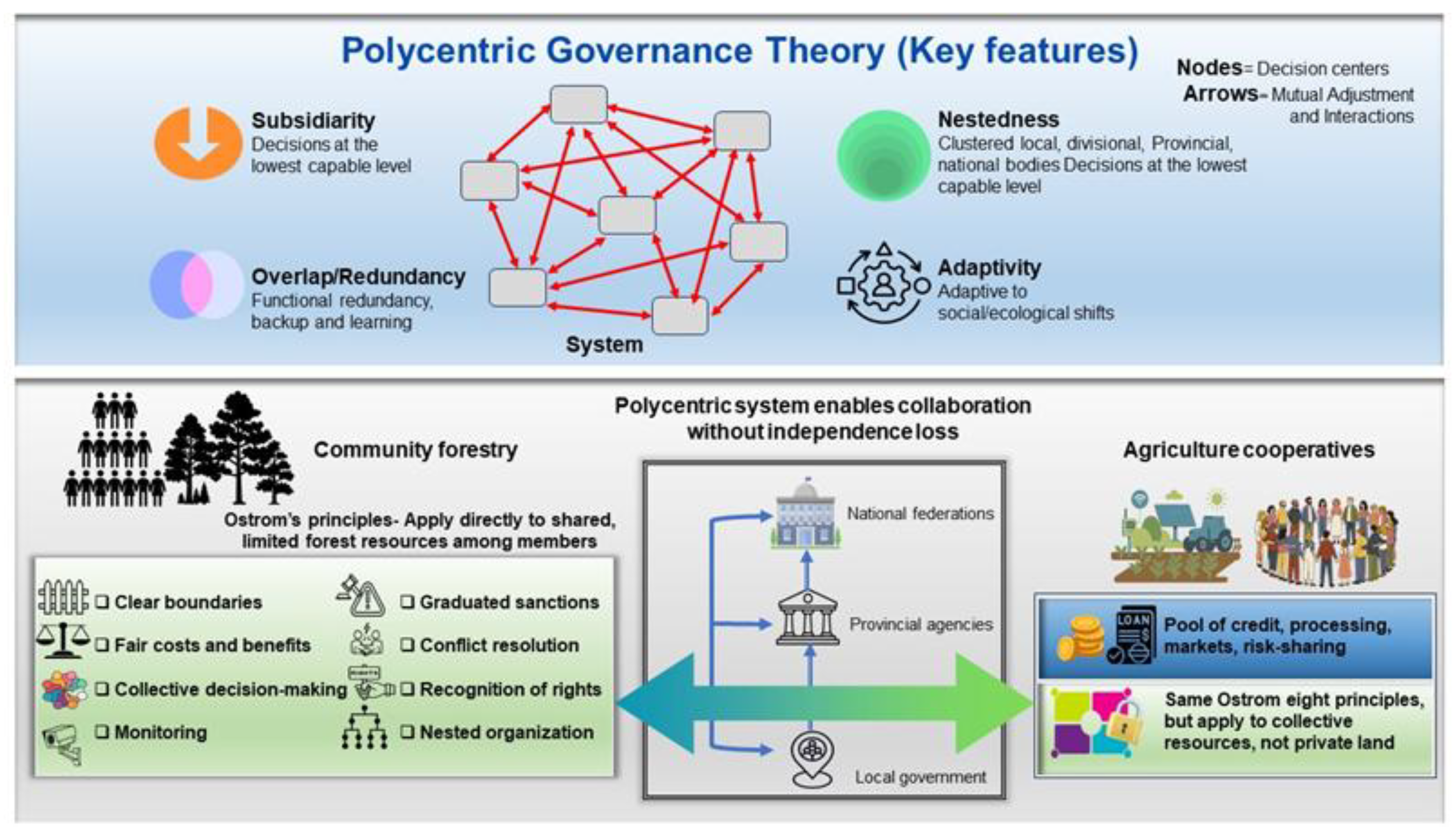
Figure 2.
Research approach and analytical framework for the narrative synthesis of the community forestry-agricultural cooperative nexus.
Figure 2.
Research approach and analytical framework for the narrative synthesis of the community forestry-agricultural cooperative nexus.
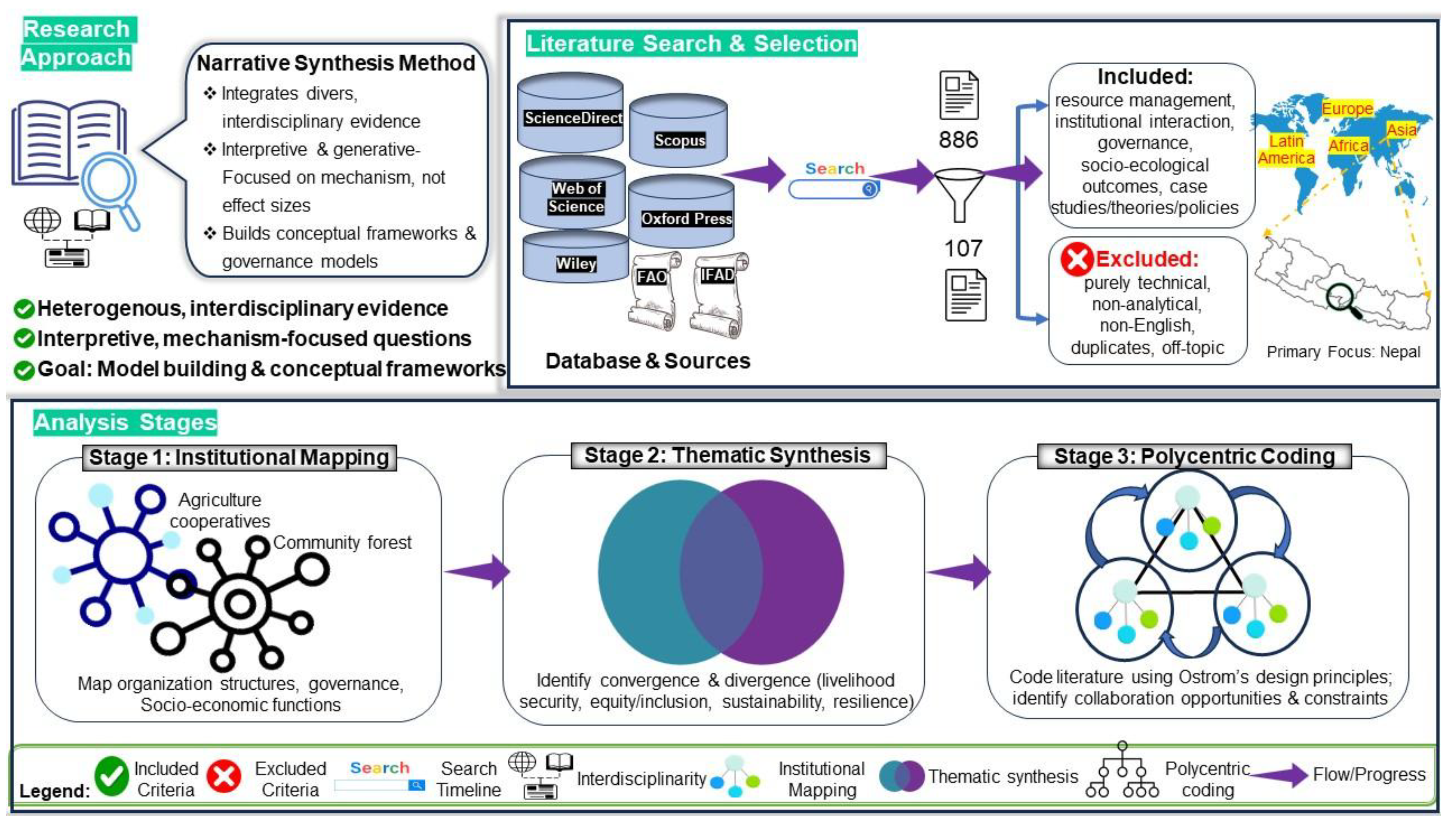
Figure 3.
Overview of community forestry and agriculture cooperatives in Nepal, including historical development, governance, policy and legal framework, current scale, coverage and status, key achievements and primary focus.
Figure 3.
Overview of community forestry and agriculture cooperatives in Nepal, including historical development, governance, policy and legal framework, current scale, coverage and status, key achievements and primary focus.
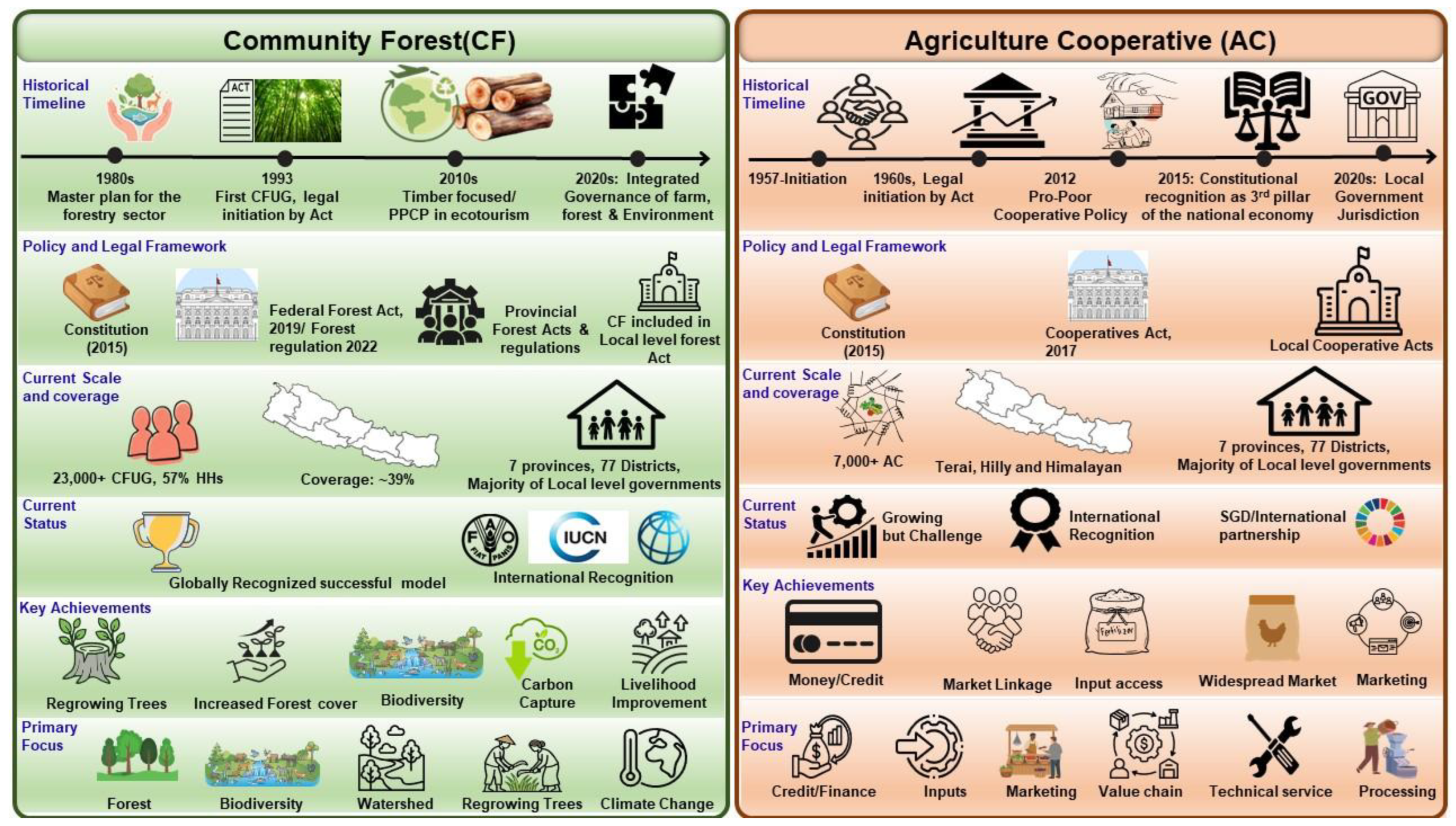
Figure 4.
Proposed local-level governance model of agriculture cooperative and community forestry in Nepal.
Figure 4.
Proposed local-level governance model of agriculture cooperative and community forestry in Nepal.
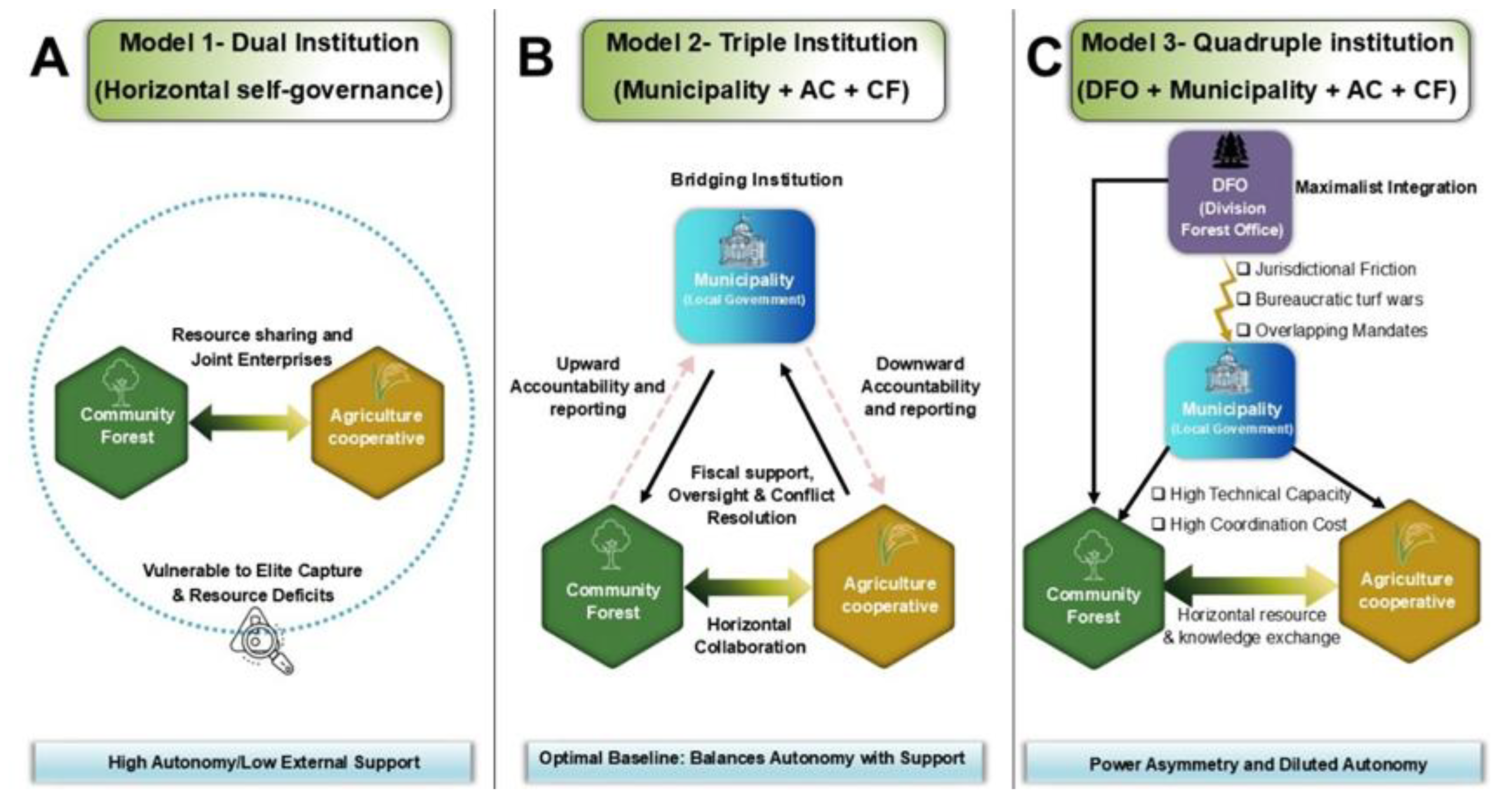

Table 1.
Comparison of community forests and agricultural cooperatives using Ostrom’s design principles.
Table 1.
Comparison of community forests and agricultural cooperatives using Ostrom’s design principles.
| Design principle | Community forests | Agricultural Cooperatives | Collaboration opportunity |
|---|---|---|---|
| Clear boundaries | Forest area and user-group membership are legally defined under the Forest Act; territorial boundaries established through demarcation processes with community participation as mentioned in the statute and forest management plan; membership restricted to resident households within defined administrative areas. | Membership and shared assets are defined by cooperative bylaws registered under the Cooperative Act; boundaries are geographically anchored as members may operate across wider areas as defined by statute; asset boundaries sometimes remain in municipality/ward due to mixed membership in multipurpose cooperatives [38]. | Joint boundary-setting for shared ventures (e.g., agroforestry plots, commercial production of fodder in degraded forest land, shared processing facilities, enterprises); creating defined zones of collaborative activity |
| Proportional costs and benefits | Labor contributions (e.g., forest patrolling, planting, cleaning) and harvest rights are broadly tied to member participation and contribution; revenue-sharing mechanism to community development, forest management, and household distribution, though implementation varies significantly across CF [90]. | One-member-one-vote in principle ensures equal decision-making authority; however, benefit shares can skew toward larger contributors; elite members may capture disproportionate benefits from collective enterprises [84]. | Shared rules for allocating benefits from joint enterprises (e.g., agroforestry revenue, ecotourism income, shared resource management) would need to reconcile CF’s contribution-based allocation with AC’s one-member-one-vote principle, requiring negotiated hybrid formulas. |
| Collective-choice arrangements | General assemblies of all member households set forest management plans, approve annual budgets, elect executive committees, and establish rules for forest use; CFUG statute & management plans approved for five- to ten-year cycles with annual reviews; participatory planning processes well-established in most CF [35]. | General assemblies set cooperative rules and prepare statute, approve financial statements, elect boards of directors, and establish operational policies; democratic governance norm well-established but practice varies; in some cooperatives, general meetings are poorly attended and decisions dominated by active board members [20]. |
without requiring merger of governance structures, a joint CF-AC planning committee would extend both institutions’ existing collective-choice practice, providing a formal arena for cross-sectoral coordination |
| Monitoring | Committees monitor forest harvest, patrol against illegal extraction, and track forest condition through biodiversity assessments and forest inventory; monitoring capacity has improved with training and REDD+ requirements; however, it remains variable across CF; some groups rely heavily on external NGO support for technical monitoring [91,92] | Cooperative boards monitor loan repayment, asset utilization, and financial transactions; internal audit committees review accounts; however, monitoring capacity is frequently undermined by inadequate accounting expertise, limited access to digital financial systems, and reluctance to enforce penalties against influential members [83,85]. |
It requires development of shared monitoring protocols and indicators, Cross-institutional monitoring for shared resources (e.g., joint enterprises, shared infrastructure) would reduce free-riding and free-loading by creating mutual accountability between CF and AC |
| Graduated sanctions | Rule violations (e.g., illegal harvesting, unauthorized grazing) are handled through CF statute with escalating penalties: warnings, fines, suspension of harvesting rights, and in serious cases, expulsion from the group; enforcement varies with leadership quality and community cohesion [93] | Repayment defaults and rule violations are handled through cooperative statute with similar escalation: reminders, fines, suspension of services, and in extreme cases, membership termination; however, enforcement is frequently weakened by social pressure, political connections of defaulting members, and fear of member attrition [84] | Shared, transparent sanctioning norms for joint projects would require harmonizing two distinct sanctioning cultures and establishing clear protocols for violations affecting both institutions; neutral oversight would be essential. |
| Conflict-resolution mechanisms | Dispute resolution is first internal to the CF, mediated by executive committees and general assemblies; external arbitration through the Division Forest Office exists but is under-resourced and often inaccessible; community-level mediation through traditional mechanisms remains important but lacks formal integration with the legal framework [35,90] | Dispute resolution is primarily internal, managed by boards and general meetings; the Cooperative Dispute Resolution Commission provides external arbitration, however, has limited reach and capacity; many disputes, particularly those involving elite capture or financial irregularities, remain unresolved or escalate to formal courts [83] | A neutral third party (e.g., municipality, as proposed in Model 2, Section 4.4.2) to arbitrate CF-AC disputes would address the weakness both institutions share in external dispute resolution, while maintaining the autonomy of internal governance mechanisms. |
| Recognition of rights | CFUG legal status is recognized under the Forest Act; groups have legal standing to enter contracts, manage finances, and engage in enterprises; however, recognition of customary rights by indigenous and Dalit communities remains incomplete, and participation rights are not always equitably exercised across social groups [94] | Cooperative legal status is recognized under the Cooperative Act; cooperatives have legal standing as autonomous economic organizations; however, the practical exercise of this autonomy is constrained by regulatory requirements, dependence on government support, and in some cases, political interference that compromises organizational independence [95] |
The 2026 ministerial merger creates a policy window for formalizing collaborative arrangements; Both institutions are already legally free to partner; the constraint is institutional practice and political interest, not legal permissiveness; |
|
Nested enterprises |
CFUGs are linked upward to provincial forest directorates, division forest offices, and (before 2026) the national Ministry of Forests and Environment; nested linkage extends through the Federation of Community Forest Users Nepal (FECOFUN) and district-level coordination committees; the quality of vertical coordination varies significantly by district and province [35] | Cooperatives are linked upward to municipal ward offices, district cooperative offices, the Department of Cooperatives, and provincial cooperative divisions; nested linkage extends through cooperative unions and federations; vertical coordination is frequently weakened by capacity gaps at the municipal level and competing priorities across government tiers [83] | The single post-2026 Ministry of Agriculture, Forests and Environment creates a natural apex institution for coordinating both nested structures; however, this top-down coordination must be complemented by horizontal linkages at the local level where CF and cooperatives actually operate. |
Table 2.
Comparative analysis of proposed governance models of AC and CF in Nepal against Ostrom’s five core characteristics of polycentric governance.
Table 2.
Comparative analysis of proposed governance models of AC and CF in Nepal against Ostrom’s five core characteristics of polycentric governance.
| Frameworks | Model 1: Dual Institution (AC + CF) | Model 2: Triple Institution (Municipality + AC + CF) | Model 3: Quadruple Institution (DFO + Municipality + AC + CF) |
|---|---|---|---|
|
Multiplicity of Centers of Decision-Making |
Limited: Only two centers; strong local focus but risks isolation from higher-level support. | Moderate: Three centers; improves vertical and horizontal linkages and checks and balances. | Broadest: Multiple scales represented; highest resilience potential but risks coordination fatigue. |
|
Autonomy of Decision-Making Units |
High (Theoretical): Aligns with self-governance but is practically undermined by financial fragility and elite capture. | Moderate: External support stabilizes operations, but municipal influence may constrain community priorities. | Diluted: Government agencies may dominate decision-making, limiting genuine community influence. |
|
Coordination and Cooperation Among Units |
Simple: Limited to horizontal exchange; constrained by lack of shared resources and technical capacity. | Bridging: Municipal facilitation enhances cross-sector resource pooling; risks bureaucratic bottlenecks. | Holistic: Strongest potential for integrated land-use planning, but overlapping state mandates trigger conflict. |
|
Conflict-Resolution Mechanisms |
Weak: Disputes lack neutral internal arbitration, heightening risks of elite dominance. | Moderate: Municipality provides an arbitration role; effectiveness depends on political impartiality. | Complex: Multiple agencies can mediate, but overlapping jurisdictions complicate formal resolution. |
|
Accountability and Mutual Monitoring |
Internal only: High risk of elite capture and weak transparency in shared resource management. | Mixed: Municipal oversight strengthens accountability; risks political favoritism in resource allocation. | Distributed: Strongest monitoring potential with multiple state and community agencies involved. |
Disclaimer/Publisher’s Note: The statements, opinions and data contained in all publications are solely those of the individual author(s) and contributor(s) and not of MDPI and/or the editor(s). MDPI and/or the editor(s) disclaim responsibility for any injury to people or property resulting from any ideas, methods, instructions or products referred to in the content. |
© 2026 by the authors. Licensee MDPI, Basel, Switzerland. This article is an open access article distributed under the terms and conditions of the Creative Commons Attribution (CC BY) license (http://creativecommons.org/licenses/by/4.0/).
Copyright: This open access article is published under a Creative Commons CC BY 4.0 license, which permit the free download, distribution, and reuse, provided that the author and preprint are cited in any reuse.