

Submitted:
29 September 2026
Posted:
30 September 2026
You are already at the latest version
Abstract
Emerging and re-emerging zoonotic viruses transmitted by arthropods such as ticks, biting midges, and mosquitoes pose increasing public health concerns in Europe. Among these, Crimean-Congo haemorrhagic fever virus (CCHFV) stands out due to its high case fatality and expanding geographic range. In Portugal, growing ecological and climatic shifts, along with human and animal migration, create favourable conditions for the virus emergence. This review provides an overview of CCHFV epidemiology in Portugal, exploring the relevance of applying the Stockholm paradigm and the DAMA (Document, Assess, Monitor, Act) protocol as proactive tools for preparedness and mitigation. By incorporating ecological and evolutionary principles, these frameworks enable the anticipation of disease emergence and inform on targeted surveillance and response strategies. The integration of interdisciplinary approaches and early warning systems is crucial for strengthening One Health preparedness and ensuring timely action against CCHFV and other emerging vector-borne diseases in response to changing environmental conditions.
Keywords:
Crimean-Congo haemorrhagic fever virus
; DAMA protocol
; one health
; Portugal
; stockholm paradigm
1. Introduction
Crimean-Congo haemorrhagic fever virus (CCHFV) is an emerging pathogen belonging to the family Nairoviridae and the genus Orthonairovirus [1]. With an estimated 10,000 to 15,000 human cases occurring annually worldwide, the disease may range from asymptomatic infection or a mild febrile illness to severe haemorrhagic disease with multiorgan failure, with a case-fatality reaching up to 40% [1,2]. Due to its epidemic potential, its high case-fatality, and its difficult prevention and treatment, the World Health Organisation (WHO) considers Crimean-Congo haemorrhagic fever (CCHF) a priority disease for research and development within its list of infectious agents with epidemic or pandemic potential [3].
Tick bites and direct contact with infectious body fluids from infected animal hosts or human patients are the most common transmission routes of the virus [4]. However, there is growing evidence suggesting that sexual transmission may also occur, although it remains less well understood [5,6]. While the virus can infect a broad range of animal species, it typically causes clinical disease only in humans [3,4]. In most animal hosts, the infection remains asymptomatic, posing a challenge for early detection and control in animal reservoirs [7].
CCHFV infection phases comprise incubation, pre-haemorrhagic phase, haemorrhagic phase and convalescent period [7,8]. Following a tick bite, the incubation time ranges from 1 to 5 days [8]. In contrast, the incubation period followed by contact with infected blood or tissues is usually 5 to 7 days, with a maximum of 13 days [8]. The onset of disease is usually sudden and characterised by high fever, chills, headache, and abdominal pain [7,9]. The haemorrhagic phase lasts 3 to 5 days [7]. The report of petechial rash on the skin, conjunctiva, and other mucous membranes, which progresses to large cutaneous ecchymoses and bleeding from the gastrointestinal, respiratory, uterine, and urinary tracts is common [8]. Additionally, hepatomegaly, splenomegaly, and cerebral haemorrhage may occur [7,8]. Fatal cases may result from haemorrhage, multi-organ failure and shock [8]. Finally, the convalescent period lasts approximately 10 to 20 days after the disease has been resolved [7]. However, patients who have survived may reach full recovery after up to 1 year [8].
The WHO establishes the following tests as indicated for the diagnosis of this infection: (a) virus isolation in cell cultures, (b) enzyme-linked immunosorbent assay (ELISA), (c) antigen detection, (d) seroneutralization, and (e) the reverse transcription polymerase chain reaction (RT PCR) [7], which is considered the method of choice for a rapid detection [10]. Given its high virulence and transmission risk, the diagnosis of CCHFV through viral culture must be conducted in high-containment laboratories at level 4 (BSL-4) or at level 3 (BSL-3). In contrast, alternative methods, such as RT-PCR and ELISA, can be performed in BSL-3 laboratories [2,7].
Ribavirin is recommended by the WHO as a treatment for CCHFV infection, although there is controversy regarding its efficacy. Another antiviral, favipiravir, is being proposed as a possible treatment, but its efficacy is under study [7]. Considering this, rather than treating the cause of the disease, it is crucial to consider and invest in supportive therapy aimed at treating the patient's symptoms and maintaining vital functions. Currently, there is no effective vaccine against CCHF [7] approved for use in humans.
Historically concentrated in Africa, Asia, and parts of eastern and southern Europe, CCHFV has been progressively expanding into new areas, raising awareness about its potential establishment in previously unaffected regions of Europe [6]. Climate changes in recent decades have led to an increase in the distribution of CCHFV [11], which is now considered the primary factor behind the observed expansion of CCHFV vectors, such as Hyalomma spp., particularly H. marginatum, its primary vector [6].
In face of climate change, globalisation, and urbanisation, it is not possible to prevent pathogens from reaching human population or human communities [12]. Management of emerging infectious disease risk relies on identifying targets for control measures before the onset of a crisis [13]. Proactive surveillance and preparedness strategies can mitigate the socio-economic impact and enhance readiness for future emergence events [12]. This is the central pillar of the Documenting-Assessment-Monitoring-Action (DAMA) protocol, originally articulated in the context of zoonotic diseases, focusing on the early detection of pathogens through the evaluation of diverse clusters of mammalian and arthropod hosts [14].
Previously, a study in Portugal on the seroprevalence of CCHFV among sheep confirmed positive animals [1]. Following the report of a fatal human case [15], other studies conducted by Portuguese research groups have also reported seropositive animals in southern and northeastern Portugal [16,17]. Additionally, a couple of other studies conducted across the Iberian Peninsula have reported seropositivity in wild boar and red deer samples from Portugal [3,18]. However, beyond these isolated efforts, there is limited data on the presence and circulation of the virus in this country. Despite growing evidence of the virus presence in Iberia, there is a lack of comprehensive information on its surveillance and preventive strategies in Portugal. By applying the Stockholm paradigm and the DAMA protocol, this review presents an innovative, predictive framework for identifying potential hotspots, guiding surveillance efforts, and informing public health interventions, thereby aiming to transition from a reactive to a proactive preparedness approach.
2. Epidemiology
First described as an outbreak pathogen in 1944 in the Crimean Peninsula of the Soviet Union, it caused a febrile illness associated with shock and bleeding, was found to be similar to an agent isolated in the Belgian Congo in 1956, and was later designated as CCHFV [19]. Since the beginning of the 21st century, CCHF has been reported in a wide range of countries, including India, Iran, Turkey, and some Balkan states [20]. In southeastern Europe, viral detection and/or confirmed cases of the disease have also been reported [20]. Exposure to CCHFV in the Iberian Peninsula was first documented in humans in Portugal in 1985, although the first confirmed clinical case was reported in Spain in 2016 [3].
The primary vectors of CCHFV are Hyalomma spp. ticks and their distribution are correlated with the global distribution of CCHF [9]. Despite the limited evidence about the active CCHFV circulation associated with non-Hyalomma ticks, CCHFV has also been reported in ticks of the genera Amblyomma, Rhipicephalus (Boophilus), Dermacentor, Haemaphysalis, and Rhipicephalus [6,21]. Although these species have been detected harbouring CCHFV in the field or experimentally infected in the laboratory setting, there is limited evidence supporting their role in natural virus transmission or maintenance. Confirmed transmission was observed in ticks of the genus Hyalomma [21]. Hyalomma spp. become infected when feeding on viremic hosts, particularly small mammals, which sustain longer viremia, and once infected, the virus replicates within the tick, with a potential to be transmitted vertically or through co-feeding, which increases the likelihood of spread among ticks sharing the same host [22,23].
Good indicators of CCHFV occurrence in specific areas include the presence of antibodies to CCHFV in animal populations [6]. CCHFV is often spread from apparently healthy livestock that have been bitten by ticks of the genus Hyalomma and is transmitted to humans [24]. High-risk individuals include livestock handlers, slaughterhouse workers, agricultural labourers, healthcare workers caring for infected patients and relatives who are in close contact with them [24].
In Europe, between 2013 and October 2025, human cases have been detected in Bulgaria (n = 41 cases), Spain (n = 21 cases), Greece (n = 3 cases), Portugal (n = 1 case) and the United Kingdom (n = 1 case). Moreover, from these cases, seven deaths were registered in Bulgaria, six deaths were recorded in Spain, and one occurred in Greece [6,25,26]. In 2026, since the beginning of the year until middle September, Spain has registered four cases, of which two deaths [27]. Several spanish human cases were confirmed near the Portuguese border, including in the Salamanca region, approximately 100 km away [16], underscoring the importance of cross-border epidemiological surveillance.
CCHFV circulates in many countries of Southeastern Europe, Southern Asia, and Africa. Historically, its strains have been phylogenetically grouped into six genotypes, geographically structured. Genotype I circulates predominantly in West Africa, genotype II in Central Africa, genotype III in South and West Africa, genotype IV in Asia and the Middle East, genotype V in South and Eastern Europe, and genotype VI corresponds to the European AP92 group [28].
In the Iberian Peninsula, for instance, CCHFV detected in patients from Spain have been described to belong to African genotype III, European genotype V, and the Asian genotype IV [29]. In Portugal, CCHFV genotype III was identified in the fatal case reported in 2024 [15]. These findings highlight that the virus diversity in the region includes African, Asian, and European lineages, indicating multiple sources of introduction and not solely Africa.
The dispersal of Hyalomma spp. to new areas of Europe has been driven by the passive transport of immature stages by migratory birds, which play an essential role in the introduction and spread of these vectors along their migratory routes, contributing to the geographic expansion of CCHFV [6,30].
Migratory routes and seasonal patterns influence the distribution of CCHFV vectors. European-breeding birds migrate biannually (spring and autumn) along the Intra-Palearctic and Afro-Palearctic flyways [31]. In spring, Hyalomma spp., including ticks from H. marginatum complex, have shown decreasing prevalence on migratory birds with increasing latitude, possibly reflecting their geographic distributions and southern attachment opportunities, while nymph detachment reduces prevalence further north. Higher infestation has been higher in intra-Palearctic migrants, likely due to greater tick abundance and frequent stopovers in Mediterranean and southern European regions, whereas Afro-Palearctic migrants spend less time in these areas, losing engorged nymphs during long flights, resulting in lower infestation [31]. Furthermore, wind patterns can influence bird migration and tick distribution by affecting host movement and habitat structure [32,33].
In parallel, climate variability has been shown to influence the distribution of ticks and tick-borne pathogens [24]. For example, according to estimates by Estrada-Peña et al. [34], regions where the cumulative temperatures (i.e. the annual sum of daily temperatures) range between 3000–4000°C and the water vapour deficit remains below 15 hPa are favourable for the distribution of H. marginatum. Moreover, areas with established populations of this tick species experience average cumulative temperatures between September and December of 800°C, whereas regions with mean cumulative temperatures below 400°C do not support established populations [35]. These findings suggest that warmer autumns facilitate the moulting of engorged nymphs into adults. Since adult ticks are more cold-resistant than nymphs, higher autumn temperatures are associated with reduced winter mortality [6]. Given current epidemiological trends of CCHFV, a proactive and integrated approach is crucial for anticipating and mitigating future risks.
3. Proactive Approach: Insights from the Stockholm Paradigm and DAMA Protocol
The Stockholm paradigm posits that most emerging diseases originate not from changes in pathogens but from increased opportunities for contact between pathogens, hosts, and environments, which can be driven by climate change, antropogenic factors, and ecological disturbance, highlighting how understanding pathogen–host relationships can help us anticipate and mitigate outbreaks proactively [12].
The Stockholm paradigm is grounded in two Darwinian principles: (1) pathogen evolution is local and limited to hosts it currently infects (realised fitness space), retaining, however, the ability to infect other suitable hosts (fundamental fitness space) through ecological fitting; and (2) evolution is conservative, meaning that pathogens can exploit similar traits across unrelated hosts, taking into consideration that environmental changes can expose them to new compatible hosts [13]. Considering that pathogens use conserved traits, we can predict their emergence.
Public health efforts often focus mainly on symptomatic cases, but pathogens usually circulate more widely, even in unrelated species [13]. Therefore, to truly understand a disease, anticipate the arrival of disease-causing organisms, and mitigate their impacts on society, we must study the full distribution of pathogens and their behaviour once they have become established [12,13].
The DAMA protocol is the practical application of the Stockholm paradigm to the problem of emerging infectious diseases, recognising that their risk space is ample but non-random because of phylogenetic conservatism [36]. It is primarily designed to anticipate the emergence of an infectious disease before it occurs, or when it does, to be better prepared to mitigate its spread among potentially susceptible hosts [36].
Despite the globalisation of emerging infectious disease threats, effective preparedness must be achieved locally [12]. First, it is crucial to document at the local level which pathogens exist, where they occur, and which hosts they infect [13,37]. Assessing the risk posed by these pathogens goes beyond merely listing them, requiring the analysis of species-specific ecological, behavioural, and geographic data within a phylogenetic framework. This approach helps to identify evolutionary patterns and potential host–pathogen associations, offering predictive insights into which lineages are more likely to give rise to future threats [37,38]. Phylogenetic analysis thus allows prioritisation of pathogens not just by current impact, but by their evolutionary potential for adaptation, emergence, or spread. Continuous monitoring of these pathogens is essential to detect changes in their geographic distribution, host range, or transmission dynamics [39]. Finally, coordinated and timely action by local communities, governments, and relevant organisations is vital to mitigate emerging threats effectively [12,37].
Although the Stockholm paradigm and DAMA protocol are ideally meant to be implemented prior to the emergence of human cases, in the specific context of CCHF, Portugal recorded its first fatality due to CCHF, which highlights the urgent need to enhance national preparedness. With no further cases currently reported, the country now has a crucial opportunity to apply the Stockholm paradigm and DAMA protocol to enhance preparedness and prevent future outbreaks.
4. DAMA Protocol for CCHFV Preparedness in Portugal
Considering the recent emergence of CCHFV in Iberian Peninsula, there is an evident need for science-based, proactive preparedness strategies. Portugal, although it has only recently reported its first human fatality, shares similar risk factors for CCHFV infection with Spain, including favourable climate conditions, the widespread presence of tick vectors, and the country's geographic location along migratory bird routes from CCHFV-endemic areas [15].
Taking this into account and given the lack of published research on CCHFV in Portugal, we will, to the possible extent, also rely on Spanish research data and adapt relevant findings from Spain to address each stage of the DAMA protocol in the context of CCHFV in Portugal, enhancing our understanding of the virus's potential spread, monitor risk factors, and take proactive steps to mitigate its impact within Portugal.
4.1. Documenting
4.1.1. Vectors
4.1.1.1. Distribution of Vectors
Hyalomma ticks can become infected with CCHFV when feeding on infected hosts [22] and, once infected, are able to transmit the virus to new hosts during subsequent blood meals [23]. Like other hard ticks, each stage of Hyalomma feeds on blood before moulting or laying eggs [40]. Most species follow a three-host life cycle, except H. marginatum, which is a two-host tick, with larvae and nymphs feeding on the same host [40]. Immature stages prefer birds, rodents, and lagomorphs, while adults target large ungulates, and occasionally lagomorphs and suids [22]. Since small mammals maintain viremia for longer, their infestation by immature ticks may impact CCHFV circulation [6] (Figure 1). Moreover, host mobility, together with extended periods of viremia, may result in long-distance movement while still infectious, thereby contributing to the geographic expansion of infested ticks and the dissemination of CCHFV.
Following acquisition during blood feeding, CCHFV initially replicates in the intestinal epithelium of ticks. The virus subsequently disseminates to the salivary glands and reproductive organs, enabling both horizontal transmission to new hosts (including via co-feeding) and vertical transmission [23].
In Europe, H. marginatum tick complex (H. marginatum sensu stricto, Hyalomma glabrum, Hyalomma isaaci, Hyalomma rufipes, and Hyalomma turanicum) is endemic to southern and eastern regions, including several Mediterranean countries where the CCHFV was detected [41]. Hyalomma marginatum s.s. is mainly found in Southern Europe, North Africa, and parts of Asia [41]. Beyond its well-known role in CCHFV transmission, H. marginatum contributes to the circulation of several other tick-borne pathogens, including agents of spotted fever in humans, bovine pathogens such as Anaplasma spp. and Theileria annulata, and equine agents like Babesia caballi and Theileria equi [6,42]. Hyalomma lusitanicum has also been identified as a vector of CCHFV and, along with H. marginatum, predominates in the Iberian Peninsula [43]. It is additionally capable of transmitting other pathogens of veterinary and public health relevance, including species of the genera Anaplasma, Babesia, Borrelia, Coxiella, and Theileria [6,40]. Moreover, H. lusitanicum has been found to harbour Rickettsia aeschlimannii and other Rickettsia spp., suggesting a potential role in their transmission, although its vector competence has not yet been fully clarified [44,45].
Evidence of H. marginatum s.s. and H. lusitanicum has been documented in Portugal [46]. According to the National Institute of Health Ricardo Jorge (INSA) [46], the distribution of H. marginatum s.s. has already been reported in a wide range of regions of the country, while H. lusitanicum is more homogeneous in the southern and central region of mainland Portugal (Figure 2).
In Portugal, the REVIVE (Vector Surveillance Network) program is a collaborative initiative involving institutions from the Ministry of Health, aimed at monitoring vectors and assessing the associated risk. The annual relative proportion of H. marginatum and H. lusitanicum among all ticks collected within the REVIVE programme between 2018 and 2024 is presented in Figure 3. Throughout this period, H. marginatum represented a higher proportion of the collected ticks than H. lusitanicum.
Additionally, between 2011 and 2015, H. marginatum was the third most frequently reported tick species found attached to humans (13.2%, n = 133), following Ixodes ricinus (34.5%, n = 348) and Rhipicephalus sanguineus (34.0%, n = 343) [47]. These findings indicate that this competent vector is not only present but is also known to parasitise humans.
4.1.1.2. Pathogen Prevalence in Vectors
In addition to documenting the distribution of tick vectors, the REVIVE program also aims to assess the presence of CCHFV within these vectors. In Portugal, INSA conducts research on CCHFV in Hyalomma ticks as part of the annual REVIVE program. Following the identification of two CCHFV-seropositive human cases in Cuba, Portugal, in 1985, systematic tick surveillance programs were implemented in Alentejo, Portugal, between 1987 and 1994. However, no positive ticks were identified [46].
Furthermore, since 2019, systematic Hyalomma surveillance across the country has been carried out within the scope of REVIVE programs, aiming to detect CCHFV [48]. Between 2019 and 2021, all ticks of the genus Hyalomma collected within the scope of the REVIVE program (n = 24) were tested for the presence of the CCHFV, with negative results [48]. In 2022 (n = 39) and 2023 (n = 38) all collected Hyalomma ticks were negative for CCHFV [49,50].
In 2024, following the first human fatality, entomological investigations were conducted to collect ticks in the district of Bragança, where the case resided, in collaboration with the health authorities and INSA, as well as a study on the possible detection of ticks infected with the virus [51]. Research on CCHFV was conducted using 45 adult H. lusitanicum, 76 adult H. marginatum, and three nymphs of Hyalomma spp. (which could not be identified to the species level). The presence of the virus was not detected in any of them [51]. Similarly, in 2025, 143 Hyalomma spp. specimens were analysed, including 53 H. lusitanicum and 90 H. marginatum, and none tested positive for CCHFV [46].
Although sampling intensity has increased substantially in recent years, the relatively small number of ticks analysed during the earlier surveillance years may have limited the detection of low CCHFV infection prevalences and the representativeness of the samples regarding the spatial distribution of Hyalomma in Portugal. Furthermore, there remains a scarcity of complementary published studies evaluating CCHFV circulation in these vectors within the country.
Data from Spain, where ecological and faunal similarities with Portugal are assumed, offer valuable insights into local CCHFV circulation. Viral RNA has been widely detected in ticks feeding on wild ungulates. Moraga-Fernández et al. [20] reported the presence of viral RNA in 21% of 613 ticks collected in southwestern Spain, with infection values of 20.2% in H. lusitanicum and 41.7% in D. marginatus. The vast majority of infected ticks were collected from deer. Cuadrado-Matías et al. [43] identified CCHFV-positive ticks in northwest Spain, including I. ricinus (13.8%), D. marginatus (16.7%), and R. sanguineus s.l. (11.1%). A large-scale study by Sánchez-Seco et al. [52] found that 2.9% of surveyed wild animals carried infected ticks, and 3.2% of 3,959 tick pools tested positive for CCHFV RNA, confirming the presence of the virus in seven municipalities across four provinces, specifically Cáceres, Madrid, Toledo, and Ávila. In a separate study, Negredo et al. [53] found that 2.8% of ticks collected between 2011 and 2015 were infected, with all positive samples originating from the province of Cáceres.
Despite these findings, it is essential to note that the mere detection of viral RNA does not necessarily confirm active infection or vector competence. Therefore, while these data support the circulation of CCHFV in local ecosystems, the role of tick species other than Hyalomma in the virus’ transmission cycle remains uncertain. In these cases, the detected viral RNA may reflect the presence of the virus in bloodmeal, particularly in species not typically associated with CCHFV transmission. Further experimental studies are required to determine their capacity to acquire, maintain, and transmit the virus.
4.1.2. Hosts and Reservoirs
Migratory birds act as important carriers that facilitate the spread and introduction of Hyalomma ticks into new areas [6]. In Spain, Palomar et al. [54] collected 149 H. marginatum ticks from migratory birds, although none of these ticks were CCHFV-positive, suggesting that the risk of CCHFV-infected ticks attached to migratory birds reaching the North of Spain is low. Similarly, England et al. [55] recovered 12 Hyalomma ticks from five of 228 migratory birds trapped in Spring 2012 in south Spain along the East Atlantic flyway, all testing negative for CCHFV. Collectively, these findings highlight the evidence of cross-border circulation between the two countries, reinforcing the need for integrated surveillance strategies throughout the Iberian Peninsula. To ensure monitoring practicality and cost-effectiveness, efforts should focus on avian host species that are both commonly observed and exhibit higher Hyalomma prevalence or infestation intensity, such as the song thrush (Turdus philomelos), whinchat (Saxicola rubetra), and sedge warbler (Acrocephalus schoenobaenus) [31]. In addition, future studies could investigate a possible correlation between migratory routes and stopover sites in the Iberian Peninsula and the occurrence of CCHFV cases in the region.
Bird and other animal species previously reported as being hosts of Hyalomma spp. in Portugal are listed in Table 1 and Table 2, respectively.
Previously, sheep have been described as hosts of CCHFV in southern Portugal [1]. The highest prevalence was observed in the southern region of Alentejo, reaching 0.7%, suggesting a focal circulation of the virus in that area. Nevertheless, recent evidence of CCHFV seroprevalence among animal populations has emerged from central Portugal [16,18], including seropositive ruminants and red deer in Castelo Branco and Guarda [16].
Wild boars are also considered important reservoirs [3]. Although research on CCHFV in wild ungulates within Portugal is still scarce, Baz-Flores et al. [3] detected seropositive wild boars in the north, east-central, and southern regions of the country. The highest seroprevalence was reported near the Spanish border, specifically near the province of Cáceres, where H. lusitanicum ticks infected with CCHFV were detected in 2010 [3]. This finding suggests the likelihood of transboundary migration of infected hosts or vectors between Portugal and Spain.
The seroprevalence of CCHFV antibodies among domestic and wild animals in Portugal, based on data available up to 2025, is shown in Table 3.
In Spain, both domestic and wild animals have been shown to have significant exposure to CCHFV. Seropositivity was detected in cattle, sheep, goats, and pigs, as well as in wild ruminants, hares, rabbits, red deer, and wild boars [7,18,65,66,67,68,69]. Cattle, sheep, and goats presented an overall positivity of 16% in some Spanish surveyed regions [7]. Red deer are considered important indicators of CCHFV risk due to their high seroprevalence values, particularly in central and southern Spain [67]. Among suid hosts, wild boars have shown high levels of exposure, with reported seroprevalence rates reaching 39.7%, whereas Iberian pigs have shown a prevalence of 2.8% [7,69].
Further studies confirmed substantial seroprevalence among various wild ungulates. In southern Catalonia, Espunyes et al. [65] detected antibodies against CCHFV in Iberian ibexes (Capra pyrenaica) (1.13%, n = 66), roe deer (Capreolus capreolus) (0.19 %, n = 1), and wild boars (Sus scrofa) (0.94% of the total samples, n = 5). Carrera-Faja et al. [67] observed 100% seropositivity in Iberian ibexes and fluctuating seroprevalence in wild boars across hunting seasons, ranging from 66.7% in 2016–2017 to 4.2% in 2021–2022. In northeastern Spain, Cuadrado-Matías et al. [66] reported that 50 out of 82 deer populations were seropositive, with some populations reaching a prevalence of 88%. In the Basque Country, Cevidanes et al. [68] found CCHFV antibodies in wild boars, red deer, and roe deer, with an overall prevalence of 2.5%, and a notably high value of 22.2% in red deer. These are some examples of results suggesting the virus’ persistence in wild host populations, particularly in southwestern and northeastern regions of the Iberian Peninsula.
4.1.3. Geographical Distribution of CCHFV
In Portugal, the geographic distribution of CCHFV appears to be focal in southern areas and is known to be expanding. Mesquita et al. [1] suggested the presence of localised foci of CCHFV circulation in southern Portugal. However, as previously mentioned, a potential northward spread of the virus to central and northern Portugal is also considered.
Based on the currently available data, CCHFV is widespread in Spain. Seropositive animals and infected ticks have been documented in several communities, including Extremadura, Castilla-La Mancha, Castilla y León, Andalusia, and Madrid [7,70].
Given the geographical continuity between Portugal and Spain, the distribution in Spain is also important to consider when evaluating the potential spread of CCHFV within Portugal. Selected studies providing evidence of CCHFV circulation in different regions of Spain are summarised in Table 4, where findings of relevance to understanding the potential distribution of CCHFV in Portugal are also highlighted.
As highlighted in Table 4, Moraga-Fernández et al. [20] confirmed a wide spatial distribution in southwestern Spain, along with high tick infection rates and notable genetic variability among viral strains, which may increase the risk of novel variant emergence [20]. Although it is not yet well understood whether genomic diversity contributes to variations in CCHFV pathogenicity [71], the emergence of novel variants remains a concern, as differences in virulence, transmissibility, and antigenic properties among strains may influence disease severity, and reduce diagnostic accuracy. Further research is needed to better understand the role of genetic variation in viral amplification, transmission dynamics in vertebrate and tick hosts, and its impact on CCHFV evolution and pathogenicity [71].
Regarding the distribution of CCHF human cases, according to the epidemiological report on the CCHFV occurrence in Spain [72] and data published by European Centre for Disease Prevention and Control (ECDC) up to 18 September 2026 [27], indicate that human cases were reported in several provinces of Spain between 2016 and 2026 (Figure 4). The geographic distribution of these cases, together with available CCHFV-related data from humans and animals in Portugal, is presented in Figure 4.
The detection of CCHFV antibodies of blood donors from Castile and León, with seroprevalence ranging from 0.58% to 1.16% [74], is comparable to that reported by Filipe et al. [73] in Cuba, southern Portugal in the 1980s. Together with the evidence of CCHFV circulation described above, these findings highlight the need to broaden CCHFV surveillance in Portugal to better characterise its spatial distribution, in particular, by complementing Hyalomma tick surveillance with seroprevalence studies in a wider range of wild and domestic animal species, as well as in humans, such as blood donors.
4.1.4. Climatic Factors
Habitats characterised by hot and dry summers and cold, rainy winters are optimal environments for ticks [24]. Higher temperatures may prolong the active season of ticks and also enhance the survival of eggs, questing stages, detached moulting stages, and ovipositing females in the environment [75]. Environmental factors have an impact in the survival, reproduction, and distribution of Hyalomma ticks, the primary vectors of CCHFV. Several climatic variables, including temperature, rainfall, evapotranspiration, and water vapour deficit, directly influence habitat conditions and impact tick life cycle and tick population dynamics [35]. According to Gillingham et al. [35], air temperatures between 1st September and 31st December are particularly important for H. marginatum to establish populations. On a broader temporal scale, annual cumulative temperatures around an optimum of 3000–4000 °C are associated with the core distribution zones of H. marginatum. In addition to temperature, a low water vapour deficit (below 15 hPa) appears to support tick survival by reducing desiccation stress, particularly during moulting and questing [35]. These factors collectively limit H. marginatum’s current distribution to latitudes below 47° N [34,35]. Host availability is crucial for maintaining tick populations. The recent increase in wild ungulate populations, such as deer and wild boars, in Spain has created more favourable conditions for H. lusitanicum, another important vector species, thereby enhancing local transmission risk [66].
The Iberian Peninsula is characterised by favourabe environmental conditions for Hyalomma ticks and CCHFV [76]. Using serological data from red deer as a proxy for exposure to infected ticks, Cuadrado-Matías et al. [18] identified southwestern Spain as the area with the highest probability of exposure to CCHFV. However, risk modelling conducted by Fanelli et al. [76] using a Bayesian additive regression trees (BART) approach predicted a broader risk area, extending to the eastern coastal regions of Spain. Interestingly, in the Ports de Tortosa and Beseit Natural Park in northeastern Spain, climatic factors such as temperature and water vapour pressure deficit were not significantly associated with CCHFV dynamics [67], suggesting that other ecological or host-related factors may influence local virus circulation in these areas.
Climate projections for the coming decades suggest potential changes in CCHFV risk areas. With ongoing climate change, predictive models that integrate data on Hyalomma spp. habitat suitability, host distribution, and temperature trends suggest a continued northward expansion of CCHFV into Central and Northern Europe, indicating a moderate risk of virus introduction in countries such as Italy, Germany, and France [77]. However, given the adaptability of Hyalomma ticks and their hosts, as well as the complexity of local ecological interactions, continuous surveillance and ecological modelling are essential to anticipate future shifts in virus distribution across Europe. Further studies investigating the influence of environmental and climatic factors recorded in Portugal on the occurrence, distribution, and survival of CCHFV vectors and hosts would be valuable to support the development of effective risk prediction models and maps.
In Portugal, according to the REVIVE program, in 2025, the relative abundance of H. marginatum and H. lusitanicum ticks was higher between April and August [46]. This is may be because these ticks exhibit a peak of activity in the spring and summer months, although they can be captured practically all year round (February to December) [51].
Considering the known history of human cases infected with CCHFV in Portugal and Spain, all infections that occurred between 2016 and 2025 occurred between April and August [15,72], which coincides with the periods of high relative abundance of ticks [51]. Furthermore, we suggest that warmer temperatures can influence human activities, such as engaging in more outdoor activities, and lead to increased exposure to the virus and its vectors, as well as greater contact with its hosts. This is important to alert communities to the risk factors associated with the infection and inform them of the precautions to take during these months when engaging in outdoor activities and interacting with outdoor animals.
4.1.5. Risk Factors
The possibility of human contact with CCHFV reservoirs and vectors is considerable, particularly in rural areas. Human cases reported in Spain between 2015 and 2024 were associated with exposure risk factors such as farming, hunting, rural outdoor activities, gardening, and professional contact with animals or tick-infested environments [7]. Seropositive individuals were frequently from rural regions [74], indicating that occupation and lifestyle significantly influence exposure risk. Given the ecological continuity between Spain and Portugal, similar risk profiles likely apply to the Portuguese population living in rural or livestock-associated contexts.
In Portugal, the transmission pathway of the fatal case due to CCHF was attributed to a tick bite [15]. In contrast, evidence from Spain suggest that infection may not always be directly associated with tick bites. Negredo et al. [78] reported two cases of autochthonous cases in Spain. One of them was a 62-year-old man from whom a tick was reportedly retrieved as soon as he returned home after a rural walk in a small village of Ávila, four days before admission to the hospital. The second case involved a nurse who assisted with the endotracheal intubation and placement of venous catheters in this patient. The hypothesis was that she became infected after being in direct contact with the patient’s blood derived from a profuse bleeding during the insertion of the catheters [78]. Moreover, in a study on specific CCHFV antibody detection in blood donors in Castile-León, Monsalve Arteaga et al. [74] reported a seroprevalence of CCHFV between 0.58% and 1.16%. In this study, none of the three individuals who tested positive for anti-CCHFV IgG antibodies reported a known history of tick bites. However, two of them had frequent contact with livestock, either professionally or recreationally, while the third engaged in outdoor activities such as trekking and mountain biking, which may involve indirect or unnoticed exposure to infected ticks or animal reservoirs. These findings suggest that transmission dynamics may also include unnoticed tick bites or indirect exposure through contact with infected animals, patients or contaminated environments.
More recently, a serological screening for CCHFV in humans conducted in Spain detected an IgG seroprevalence of 0.6% (n = 658) among CCHF asymptomatic individuals at a hospital serving the Salamanca region, including the Béjar area. Notably, none of the IgG-positive individuals recalled having a history of CCHF or known contact with confirmed cases, and only one reported contact with animals. Furthermore, no significant associations were found between seropositivity and variables such as sex or age [79]. Taken together, these findings underscore the potential for underrecognised or non-classical CCHFV exposure pathways in endemic regions.
4.1.2. Assessing
As previoulsy mentioned, asessing pathogen risk involves combining ecological, behavioural, and geographic information with phylogenetic analysis to pinpoint lineages that may emerge or spread in the future [37,38]. CCHFV shows remarkable genetic diversity, with phylogenetic analysis of the S-segment, the most conserved followed by L and M segments, classifying viral strains into seven distinct lineages (Asia 1–2, Africa 1–3, Europe 1–2) [80,81]. Recently, the Europe 2 genotype (AP-92-like, Genotype VI) was reclassified as a distinct virus, Aigai virus, by the International Committee on Taxonomy of Viruses (ICTV) [81,82,83].
Each lineage encompasses strains with varying degrees of pathogenic potential, many of which have been implicated in human disease [84]. In the case of CCHFV occurring in the Iberian Peninsula, several Spanish studies assessed the phylogeny of this pathogen. For instance, based on the virus S segment, a sequence homology close to the genotype Africa III, originally linked to Western Africa, was detected in H. lusitanicum ticks in Spain in 2010 [20]. Additionally, results of Bayesian analyses suggest that the Cáceres 2014 strain diverged from African clade III viruses approximately five decades ago, implying a long-standing silent circulation of the virus in the Iberian Peninsula [70]. According to previous studies, birds may have been involved in the transmission of the African genotype III virus in Spain. On the other hand, the introduction of European and Asian strains, namely genotype V and/or IV, may be related to the importation of domestic animals such as pigs imported from Eastern countries [79]. Furthermore, multiple strains of CCHFV were recently detected in ticks in Spain, even within the same geographical area inside the country [20,52,79].
Also in Spain, several genotypes associated with clinical human infections have been identified. The genotypes III, IV and V of CCHFV were detected in Spain from patients in 2016 and 2018 [79]. More recently, Febrer-Sendra et al. [80] also identified the genotype III and genotype V among patients in Spain with CCHF notified in 2020 and 2021. From a clinical perspective, it should be noted that, in Spain, strains belonging to the genotypes III and IV have been associated with higher rates of mortality than strains of genotype V [80].
Portugal currently lacks detailed genetic data on circulating CCHFV strains. However, the historical detection of antibodies in human populations near the Spanish border [73] supports the notion that the virus may have been silently circulating in the region for decades [70]. Given the proximity and shared ecological conditions with Spain, it is plausible that similar genotypes may also be present in Portugal.
4.3. Monitoring
4.1.3. How to Monitor Silent Hosts?
Monitoring silent hosts, animals that carry and may spread CCHFV without exhibiting clinical signs, is essential for understanding the virus’ ecology and anticipating human cases. Animals play a key role in maintaining the virus by serving as hosts for ticks, developing subclinical infections with low-level viraemia lasting up to 14 days [85]. From a practical perspective, surveillance strategies and studies investigating the role of specific animal species in the epidemiology of CCHFV may include: (i) serological screening to assess past exposure, (ii) molecular detection and characterisation of CCHFV in these species and their associated feeding ticks, and (iii) longitudinal and spatial monitoring to track virus circulation over time and across regions [86].
Serology is the primary tool for CCHFV surveillance in animals, as RT-PCR is limited by the short viraemia period that restricts viral detection [85]. Serology effectively identifies past CCHFV exposure, but interpretation can be affected by animal movements, which may disconnect the location of sampling from the site of exposure, as well as maternal antibodies, and cross-reactivity with other nairoviruses [85] requiring consideration of animal history and antibody specificity.
In Portugal, Mesquita et al. [1] tested sheep serum samples for anti-CCHFV IgG antibodies using a double-antigen multispecies enzyme-linked immunosorbent assay (ID Screen CCHF Double Antigen Multispecies, ID.Vet), similarly with Baptista et al. [17], who tested serum samples of rabbits. Recently, Santos et al. [16] employed the same ELISA method to investigate CCHFV seroprevalence in both domestic and wild ruminants. To confirm the accuracy of the results, the ELISA findings were validated using an indirect fluorescent antibody test (IFAT), thereby strengthening the reliability and specificity of the serological data and providing robust evidence of CCHFV circulation in local livestock populations. Additionally, these authors investigated the presence of CCHFV RNA in blood samples from cattle and red deer. However, all samples tested negative, suggesting that the viraemic phase had already passed and that infections had occurred some time earlier [16].
Despite its robustness and ease of use across multiple species, no further large-scale serological surveys have been conducted in Portugal, either in domestic or wild animals. In this regard, serological and molecular tools have been widely applied in Spain, particularly in wildlife. Several Spanish studies have employed the ELISA method to assess the presence of CCHFV antibodies in wild ungulates such as wild boars and red deer, which are key hosts in the natural transmission cycle [3,18,65,66,67,68,87]. In addition, Frías et al. [69] employed a more rigorous approach by utilising both a commercial ELISA and an in-house indirect ELISA based on the Kosovo Hoti strain (genotype V). Only samples reactive in both tests were considered seropositive. These authors also incorporated molecular testing, extracting RNA from 462 serum samples and performing RT-qPCR targeting a conserved region of the S-segment common to all known CCHFV genotypes. Considering the studies available in Portugal, further research focusing on the monitoring of CCHFV hosts is recommended, highlighting the importance of implementing more comprehensive and large-scale surveillance efforts.
Tick-based surveillance is another critical component of monitoring silent host systems, as ticks act both as vectors and reservoirs of the virus. Regarding the detection of CCHFV among infected ticks, in Portugal, the research on CCHFV-RNA detection among Hyalomma ticks is carried out by the Centre for Studies of Vectors and Infectious Diseases (CEVDI)/INSA through RT-PCR [51].
Tick surveillance in Spain is characterized by a comprehensive approach. Cuadrado-Matías et al. [43] applied a nested RT-PCR for viral RNA detection in ticks, while Castro-Scholten et al. [87] used a multiplex RT-qPCR protocol. Other studies, including those by Moraga-Fernández et al. [20] and Negredo et al. [53], have employed in-house nested RT-PCR assays specifically designed to amplify fragments of the S genome segment, the most stable and commonly targeted region of the virus.
Although more challenging than collecting ticks from animal hosts, surveillance should prioritise questing ticks (those actively seeking hosts) [85]. Moreover, while vector competence must be evaluated and confirmed, the presence of virus in non-Hyalomma ticks should also be assessed to determine their potential role in CCHFV transmission.
3.3.2. Areas of Monitoring Focus in Portugal
In Portugal, current data suggest that CCHFV may circulate more broadly than previously assumed. Although Mesquita et al. [1] had proposed that CCHFV might exist focally in the southern regions of the country, the occurrence of the first fatal human case of CCHF in a rural area in northern Portugal [15] supports the hypothesis that both the virus and its vectors may be broadly distributed, spanning from south to north. Namely, Santos et al. [16] pointed out CCHFV seroprevalence among cattle in Castelo Branco and Guarda, while seropositive sheep and wild ruminants were identified in Castelo Branco. Moreover, the predictive model developed by Baz-Flores et al. [3] identified CCHFV high-risk exposure hotspots not only in southern Portugal, reaching densely populated areas near Lisbon, but also in the northwest, exceeding the northern limits of risk areas predicted for Spain. These projections imply that risk is not geographically confined, but rather potentially underestimated, particularly in northern and central Portugal.
4.4. Action
Currently, in the absence of a human vaccine against CCHFV, preventing tick bites is the most immediate way to reduce the risk of infection, especially in high-risk populations [3] (3). However, control of Hyalomma ticks remains a challenge, requiring an integrated approach. Although acaricides are commonly used, their long-term effectiveness is limited by the development of resistance and environmental concerns [88]. Alternative strategies, such as biological control, genetic methods (e.g., use of irradiation to create sterile male H. marginatum that compete with wild males, helping to lower tick populations by reducing reproduction), ecological interventions (e.g., management of host populations), and anti-tick vaccines are promising [88]. For example, in Spain, areas where deer and wild boar had been excluded for over a decade exhibited significantly lower H. lusitanicum populations. Additionally, theoretical models suggest that decreasing the density of hares, which are hosts for the immature stages of H. marginatum, can lead to a decline in adult tick populations over time [88]. Moreover, a study by Contreras et al. [89] demonstrated that vaccinating deer over a three-year period led to an antibody response and a significant reduction in infestations by several tick species, including H. marginatum and H. lusitanicum, suggesting the potential effectiveness of the Q38 Subolesin/Akirin chimera in wildlife. Subolesin (SUB) and Akirin (AKR) are orthologous proteins in ticks and insects that function as transcriptional regulators involved in signal transduction and innate immune responses. Due to its conserved protective epitopes across multiple vector species, the recombinant SUB/AKR chimera Q38, is a promising universal antigen for controlling various arthropod ectoparasites and the pathogens they transmit [89].
In hospital settings, preparedness should focus on strengthening diagnostic capacity and ensuring biosafety protocols are in place for managing suspected cases. It is important to raise awareness among general practitioners before hospital admission to ensure early recognition of symptoms. Moreover, adherence to strict infection control protocols, including the use of Personal Protective Equipment (PPE), is essential to limit nosocomial transmission [7,90]. Rapid diagnostic methods, such as RT-PCR, should be prioritised for early and accurate diagnosis [91]. Furthermore, healthcare facilities must have prompt access to blood bank products to manage severe cases effectively, be equipped with isolation units, and intensive care units [91,92,93].
Treatment guidelines should include supportive care, particularly for clotting abnormalities, with future research focusing on antiviral treatments, such as ribavirin. Prophylaxis efforts should include ongoing vaccine development [93].
In the first instance, the first fatal Portuguese case was presumptively misdiagnosed with Mediterranean spotted fever, and only after death, a day-9 serum from the patient was sent to the reference laboratory to test it, once the cause of death was unclear. The sample sent was then found to be positive for CCHFV [15]. Considering the current treatment options for these cases, little more than symptomatic treatment could have been done to manage the patient's condition. However, as there were still no records of CCHF cases in Portugal, CCHFV was not included in the list of differential diagnoses considered by the medical team, and the diagnosis was therefore already delayed. This may not have significant implications for treatment. However, cases of misdiagnosis can lead to a neglect of safety measures by healthcare professionals involved in the patient's care, which may increase the risk of nosocomial infections. This highlights the importance of including CCHF in the differential diagnosis for cases with suspected tick bites and/or cases in the context of fevers associated with haemorrhages and petechiae, considering the patient's travel history, exposure to tick bites, and contact with livestock.
Effective preparedness of laboratories and hospitals is equally critical for the timely diagnosis, clinical management, and containment of CCHF. In Europe, a study by Fernandez García et al. [94] evaluated the diagnostic and biosafety capacities of a network of 31 public health laboratories. While the laboratories surveyed had adequate diagnostic capabilities for the current epidemiological context, the study highlighted the importance of establishing rapid and reliable protocols for CCHFV laboratory diagnosis, including clear guidelines for sample storage, processing, and transportation [94].
Training public health authorities to communicate effectively about CCHF requires international collaboration and a cross-sectoral One Health approach. Additionally, integrating a One Health strategy, which links human, animal, and environmental health, enhances early warning systems and coordinated responses, improving preparedness and outbreak control [93]. Public health authorities should be trained to recognise, diagnose, and report CCHF cases early, using clear and accessible language to inform the public about risks and prevention.
To prepare for a CCHF outbreak, several strategies must be implemented across various sectors. Education campaigns should focus on risk reduction and infection control, while surveillance systems play a crucial role in early detection and public health decision-making [93]. Social behaviours, such as avoiding contact with sick individuals, using protective clothing when handling animals or their tissues, and taking measures to prevent tick bites, are essential [93].
Health authorities should develop multisectoral tick surveillance systems that integrate human, animal, and environmental health. Establishing a network of veterinarians, physicians, and epidemiologists is key to collecting baseline virus data, which can then be analyzed by experts to create risk assessments [85]. These assessments enable targeted interventions through national One Health networks. Additionally, developing a trained One Health workforce is essential to sustain these efforts, guided by the Tripartite Guide’s recommendations on stakeholder engagement, surveillance review, workforce training, and national strategy development [85]. Moreover, health authorities should promote the conduct of simulation exercises [95] and multisectoral risk assessments, which together play a vital role in enhancing preparedness and response efforts, while ensuring effective communication and coordination among stakeholders [96,97]. Furthermore, involving communities, particularly in rural areas, and ensuring that vulnerable populations receive timely information is crucial [95].
Implementing adequate monitoring controls for CCHF involves establishing robust surveillance systems that act as early warning mechanisms and provide essential data for public health decision-making [93]. Citizen science initiatives can act as valuable complementary tools by enabling the detection of Hyalomma spp. and actively involving the public in surveillance activities [6]. Moreover, monitoring systems should include targeted sampling of carriers such as migratory birds [6], natural hosts, and sentinel animals used for early detection. This should be complemented by molecular screening of ticks for CCHFV and longitudinal studies to assess tick moulting and overwintering success [6].
Although there are challenges, such as insufficient monitoring systems and limited diagnostic resources, establishing dedicated CCHF surveillance programs is crucial for effective disease control. These programs track case frequencies, assess the risk of human transmission, and evaluate the effectiveness of existing control measures. National monitoring systems should be coordinated with regional WHO offices, cooperating institutions, and laboratories. Sentinel surveillance, which focuses on specific risk areas, has shown promise in predicting potential outbreaks and serves as a key component of early warning systems [93]. To support these efforts, we propose the implementation of a Strategic Toolkit for Assessing CCHF Risks, which would integrate epidemiological data, vector distribution models, climatic indicators, and surveillance protocols into a unified framework. Such a toolkit could strengthen international collaboration and enhance the early detection, assessment, and management of CCHF cases across regions [93].
5. Conclusions
CCHF poses an increasing threat to public health in Europe. In the context of climate change, intensified human-animal interactions, and globalisation, the application of the Stockholm paradigm and the DAMA protocol offers a promising approach to anticipate, detect, and mitigate the risk of emerging zoonotic diseases, such as CCHF. The suggested frameworks provide an innovative and One Health foundation for proactive surveillance, interdisciplinary collaboration, and adaptive responses. Through their application, it becomes possible to develop and implement cost-effective monitoring strategies, enhance the resilience of surveillance systems, and strengthen public health preparedness across the European Union. Our recommendations include the need to promote more comprehensive and systematic vector and host surveillance programs. However, these efforts should be strategic and targeted, focusing on key vectors, reservoir hosts, and high-risk geographic areas, rather than indiscriminate large-scale testing across all species and locations. Additionally, it would be important to develop spatial risk models and to assess the genetic variability within each region to identify potential differences in pathogenicity levels. In terms of community and healthcare sector preparedness, as current treatment options remain limited and a vaccine is not yet available, it is essential to implement awareness and education campaigns among healthcare professionals, authorities, and the general public.
Author Contributions
Conceptualization, M.A.R.; writing—original draft preparation, M.A.R.; writing—review and editing, P.L., L.C., B.R., M.C.F., A.C.; supervision, P.L., L.C., B.R., M.C.F., A.C.. All authors have read and agreed to the published version of the manuscript.
Funding
This research received no external funding.
Institutional Review Board Statement
Not applicable.
Informed Consent Statement
Not applicable.
Data Availability Statement
The data presented in this study are available from the corresponding author upon reasonable request.
Acknowledgments
During the preparation of this manuscript/study, the authors used ChatGPT™ and Grammarly™ for the purposes of enhancing the fluency and correctness of the English writing. The authors have reviewed and edited the output and take full responsibility for the content of this publication. The views and opinions expressed in this paper are those of the authors and do not reflect the official policy or position of the Nederlandse Voedsel-en Warenautoriteit (NVWA) nor the Dutch Government.
Conflicts of Interest
The authors declare no conflicts of interest.
References
- Mesquita, J. R., Cruz, R., Esteves, F., Santos, C., Pousa, H., Coelho, C., ... & Barradas, P. F. Crimean-Congo hemorrhagic fever virus circulating among sheep of Portugal: a nationwide serosurvey assessment. Trop. Anim. Health Prod., 2022;54(4), 237. [CrossRef]
- Frank MG, Weaver G, Raabe V. Crimean-Congo Hemorrhagic Fever Virus for Clinicians—Epidemiology, Clinical Manifestations, and Prevention. Emerg Infect Dis. 2024; 30(5):854-863. [CrossRef]
- Baz-Flores, S., Herraiz, C., Peralbo-Moreno, A., Barral, M., Arnal, M. C., Balseiro, A., ... & Ruiz-Fons, F.. Mapping the risk of exposure to Crimean-Congo haemorrhagic fever virus in the Iberian Peninsula using Eurasian wild boar (Sus scrofa) as a model. Ticks Tick Borne Dis. 2024;15(1), 102281. [CrossRef]
- Baz-Flores, S., Jiménez-Martín, D., Peralbo-Moreno, A., Herraiz, C., Cano-Terriza, D., Cuadrado-Matías, R., ... & Ruiz-Fons, F.. Animal exposure model for mapping Crimean-Congo hemorrhagic fever virus emergence risk. Emerg. Infect. Dis. 2024;30(4), 672. [CrossRef]
- Ergonul, O., & Battal, I. Potential sexual transmission of Crimean-Congo hemorrhagic fever infection. Jpn. J. Infect. Dis. 2014;67(2), 137-138. [CrossRef]
- Alves Rodrigues, M.; Lesiczka, P.; Fontes, M.d.C.; Cardoso, L.; Coelho, A.C. The Expanding Threat of Crimean-Congo Haemorrhagic Fever Virus: Role of Migratory Birds and Climate Change as Drivers of Hyalomma spp. Dispersal in Europe. Birds 2025;6, 31. [CrossRef]
- Eslava, M., Carlos, S., & Reina, G. Crimean-Congo Hemorrhagic Fever Virus: An Emerging Threat in Europe with a Focus on Epidemiology in Spain. Pathogens 2024;13(9), 770. [CrossRef]
- Dreshaj, S., Ahmeti, S., Ramadani, N., Dreshaj, G., Humolli, I., & Dedushaj, I. Current situation of Crimean-Congo hemorrhagic fever in Southeastern Europe and neighboring countries: a public health risk for the European Union?. Travel Med. Infect. Dis. 2016;14(2), 81-91. [CrossRef]
- Duygu, F., Sari, T., Kaya, T., Tavsan, O., & Naci, M. The relationship between crimean-congo hemorrhagic fever and climate: Does climate affect the number of patients?. Acta Clin. Croat. 2018;57(3), 443.
- Hawman, D. W., & Feldmann, H. Crimean–Congo haemorrhagic fever virus. Nat. Rev. Microbiol. 2023;21(7), 463-477. [CrossRef]
- Moroșan, Ș., Cozma, A. P., Dascălu, M. A., & Crivei, L. A. Impact of recent and future climate change on vectorborne diseases: viruses analyses. Sci Pap Ser D Vet Med. 2023; 66(4):5–9. [CrossRef]
- Brooks, D. R., Hoberg, E. P., Boeger, W. A., Gardner, S. L., Araujo, S. B. L., Bajer, K., Botero-Cañola, S., Byrd, B., Foldvari, G., Cook, J. A., Dunnum, J., Durashinhan, A. T., Garamszegi, L. Z., Herczeg, D., Juarrero, A., Jakab, F., Kemenesi, G., Kurucz, K., Leon-Regagnon, V., ... Trivellone, V. Before The Pandemic Ends: Making Sure This Never Happens Again. World Complexity Sci Acad J. 2020;1(1):7–15. [CrossRef]
- Molnár, O.; Hoberg, E.; Trivellone, V.; Földvári, G.; Brooks, D.R. The 3P Framework: A Comprehensive Approach to Coping with the Emerging Infectious Disease Crisis. J. Parasite Biodivers. 2022;23, 1–14. [CrossRef]
- Janik, K., Panassiti, B., Kerschbamer, C., Burmeister, J., & Trivellone, V. Phylogenetic triage and risk assessment: how to predict emerging phytoplasma diseases. Biology 2023;12(5), 732. [CrossRef]
- Zé-Zé L, Nunes C, Sousa M, de Sousa R, Gomes C, Santos AS, et al. Fatal case of Crimean-Congo hemorrhagic fever, Portugal, 2024. Emerg Infect Dis. 2025;31(1):139. [CrossRef]
- dos Santos, F.A., Duarte, M.D., Caçote, A. et al. Evidence of Crimean–Congo hemorrhagic fever virus in livestock and wildlife in Northeastern Portugal. Sci Rep 2025;15, 25142 . [CrossRef]
- Baptista, C.; Santos, N.; Vial, L.; Jori, F. Crimean-Congo Hemorrhagic Fever Virus Circulation in Wild European Rabbits, Portugal, 2018–2023. Emerg. Infect. Dis. 2025, 31, 2048. http://doi.org/10.3201/eid3110.250184.
- Cuadrado-Matías R, Cardoso B, Sas MA, García-Bocanegra I, Schuster I, González-Barrio D, et al. Red deer reveal spatial risks of Crimean-Congo haemorrhagic fever virus infection. Transbound Emerg Dis. 2022;69(4):e630-e645. [CrossRef]
- Chanda, M. M., Kharkwal, P., Dhuria, M., Prajapathi, A., Yogisharadhya, R., Shome, B. R., & Shivachandra, S. B. Quantifying the influence of climate, host and change in land-use patterns on occurrence of Crimean Congo Hemorrhagic Fever (CCHF) and development of spatial risk map for India. One Health 2023;17:100609. [CrossRef]
- Moraga-Fernández, A., Ruiz-Fons, F., Habela, M. A., Royo-Hernández, L., Calero-Bernal, R., Gortazar, C., ... & Fernández de Mera, I. G.. Detection of new Crimean–Congo haemorrhagic fever virus genotypes in ticks feeding on deer and wild boar, Spain. Transbound. Emerg. Dis., 2021;68(3), 993-1000. [CrossRef]
- Nasirian, H. Ticks infected with Crimean-Congo hemorrhagic fever virus (CCHFV): A decision approach systematic review and meta-analysis regarding their role as vectors. Travel Med. Infect. Dis. 2022;47, 102309. [CrossRef]
- Spengler, J. R., & Estrada-Peña, A. Host preferences support the prominent role of Hyalomma ticks in the ecology of Crimean-Congo hemorrhagic fever. PLoS Negl Trop Dis. 2018;12(2):e0006248. [CrossRef]
- Fillâtre, P., Revest, M., & Tattevin, E. P. (2019). Crimean-Congo hemorrhagic fever: An update. Med Mal Infect. 2019;49(8):574-85. [CrossRef]
- Harris, J., Munasinghe, T., Tubbs, H., & Anyamba, A. (2022, May). Predicting Crimean-Congo Hemorrhagic Fever Outbreaks via Multivariate Time-Series Classification of Climate Data. In Proceedings of the 6th International Conference on Medical and Health Informatics (pp. 215-218). [CrossRef]
- European Centre for Disease Prevention and Control. Historical data on local transmission of Crimean-Congo haemorrhagic fever in the EU/EEA. Available online: https://www.ecdc.europa.eu/en/infectious-disease-topics/crimean-congo-haemorrhagic-fever/surveillance-and-updates/local-transmission-eueea-previous-years (accessed on 6 march 2025).
- European Centre for Disease Prevention and Control. Seasonal surveillance of Crimean-Congo haemorrhagic fever (CCHF) in the EU/EEA, weekly report. Week 41, 2025. Available online: https://cchf-weekly.ecdc.europa.eu/archive/cchf-2025.html#:~:text=Since%20the%20beginning%20of%202025%20and%20as%20of,cases%20of%20CCHF%20have%20been%20reported%20to%20ECDC accessed on 2 march 2026).
- European Centre for Disease Prevention and Control. Seasonal surveillance of Crimean-Congo haemorrhagic fever (CCHF) in the EU/EEA, weekly report: Week 38, 2026. https://www.ecdc.europa.eu/en/crimean-congo-haemorrhagic-fever/surveillance-and-updates/seasonal accessed on 19 september 2026).
- Sas, M.A.; Vina-Rodriguez, A.; Mertens, M.; Eiden, M.; Emmerich, P.; Chaintoutis, S.C.; et al. A one-step multiplex real-time RT-PCR for the universal detection of all currently known CCHFV genotypes. J. Virol. Methods 2018, 255, 38–43. [CrossRef]
- Juanes, H.M.L.; Carbonell, C.; Sendra, B.F.; López-Bernus, A.; Bahamonde, A.; Orfao, A.; et al. Crimean-Congo Hemorrhagic Fever, Spain, 2013–2021. Emerg. Infect. Dis. 2023, 29, 252. [CrossRef]
- Capek, M.; Literak, I.; Kocianova, E.; Sychra, O.; Najer, T.; Trnka, A.; Kverek, P. Ticks of the Hyalomma marginatum complex transported by migratory birds into Central Europe. Ticks Tick-Borne Dis. 2014;5, 489–493. [CrossRef]
- Zhou, R., Gao, P., Cecere, J. G., Rubolini, D., Koopmans, M., Mancuso, E., ... & Krafft, T. . A systematic review of the occurrence of Hyalomma ticks associated with birds migrating between Africa and the Northern Hemisphere. Parasites Vectors. 2026;19;73. [CrossRef]
- Zhao, X., Bai, Q., Zhang, S., Melville, D. S., Liu, N., Fang, Y., ... & Ma, Z. Effects of wind and temperature on the migration decisions of a short-distance migratory shorebird during the annual life cycle. Avian Res., 2026; 100338. [CrossRef]
- Sajid, M.S.; Zahra, H.T.; Tahir, U.B.; Islam, S.; Iqbal, M.M. Future Projections: Anticipating Climate-Driven Challenges in Tick Research. In: Ticks in a Changing Climate; Rizwan, H.M.; Sajid, M.S., Eds.; Springer: Cham, Switzerland, 2026; Biometeorology, Volume 7. [CrossRef]
- Estrada-Peña, A.; Martínez Avilés, M.; Muñoz Reoyo, M.J. A population model to describe the distribution and seasonal dynamics of the tick Hyalomma marginatum in the Mediterranean Basin. Transbound. Emerg. Dis. 2011;58, 213–223. [CrossRef]
- Gillingham, E. L., Medlock, J. M., Macintyre, H., & Phalkey, R. Modelling the current and future temperature suitability of the UK for the vector Hyalomma marginatum (Acari: Ixodidae). Ticks and Tick-borne Dis. 2023;14(2), 102112. [CrossRef]
- Agosta, S.J. The Stockholm Paradigm Explains the Dynamics of Darwin’s Entangled Bank, Including Emerging Infectious Disease. J. Parasite Biodivers. 2022;27, 1–17. [CrossRef]
- Brooks, D. R., Hoberg, E. P., Boeger, W. A., Gardner, S. L., Galbreath, K. E., Herczeg, D., ... & Dursahinhan, A. T. Finding them before they find us: informatics, parasites, and environments in accelerating climate change. Comparative Parasitology 2014;81(2), 155-164. [CrossRef]
- Hoberg, E.P.; Boeger, W.A.; Molnár, O.; Gábor, F.; Gardner, S.; Juarrero, A.; Kharchenko, V.A.; Ortiz, E.; Trivellone, V.; Brooks, D.R. The DAMA Protocol, an Introduction: Finding Pathogens before They Find Us. J. Parasite Biodivers. 2022;21, 1–20. [CrossRef]
- Brooks DR, Hoberg EP, Boeger WA, Trivellone V. Emerging infectious disease: an underappreciated area of strategic concern for food security. Transbound Emerg Dis. 2022;69(2):254-67. [CrossRef]
- Bonnet SI, Bertagnoli S, Falchi A, Figoni J, Fite J, Hoch T, et al. An update of evidence for pathogen transmission by ticks of the genus Hyalomma. Pathogens 2023;12(4):513. [CrossRef]
- Lesiczka PM, Daněk O, Modrý D, Hrazdilová K, Votýpka J, Zurek L. A new report of adult Hyalomma marginatum and Hyalomma rufipes in the Czech Republic. Ticks Tick Borne Dis. 2022;13(2):101894. [CrossRef]
- Celina SS, Černý J, Samy AM. Mapping the potential distribution of the principal vector of Crimean-Congo haemorrhagic fever virus Hyalomma marginatum in the Old World. PLoS Negl Trop Dis. 2023;17(11):e0010855. [CrossRef]
- Cuadrado-Matías R, Moraga-Fernández A, Peralbo-Moreno A, Negredo AI, Sánchez-Seco MP, Ruiz-Fons F. Crimean–Congo haemorrhagic fever virus in questing non-Hyalomma spp. ticks in Northwest Spain, 2021. Zoonoses Public Health. 2024;71(5):578-83. [CrossRef]
- Blanda V, Torina A, La Russa F, et al. A retrospective study of the characterization of Rickettsia species in ticks collected from humans. Ticks Tick Borne Dis. 2017;8(4):610-614. [CrossRef]
- González, J.; Sánchez, M.; Olmeda, Á. S.; Métras, R. Hyalomma lusitanicum. Trends Parasitol. 2026, 42(2), 140–141. [CrossRef]
- Ministério da Saúde, Instituto Nacional de Saúde Doutor Ricardo Jorge, IP. REVIVE 2025 - Culicídeos, Ixodídeos e Flebótomos: Rede de Vigilância de Vetores / Centro de Estudos de Vetores e Doenças Infeciosas Doutor Francisco Cambournac. Lisboa: Instituto Nacional de Saúde Doutor Ricardo Jorge, IP; 2026. 54-55 pp.
- Silva MMS, Carvalho ILD, Santos AS, Núncio MS, Sousa RD. Ixodídeos removidos de humanos e agentes infeciosos detetados no âmbito da Rede de Vigilância de Vetores (REVIVE), 2011-2015. Boletim Epidemiol Observações 2017;6(18):10-3.
- Alves MJ, Santos AS, Osório H, Sousa RD, Zé-Zé L, Lopes de Carvalho I, et al. A importância da monitorização da Rede de Vigilância de Vetores REVIVE: de novos mosquitos e velhas carraças a novas ameaças em saúde pública (2011-2020). Boletim Epidemiol Observações 2021;10(29):37-46.
- Ministério da Saúde. Instituto Nacional de Saúde Doutor Ricardo Jorge, IP REVIVE 2022 - Culicídeos e Ixodídeos : Rede de Vigilância de Vetores / Centro de Estudos de Vetores e Doenças Infeciosas Doutor Francisco Cambournac. - Lisboa : Instituto Nacional de Saúde Doutor Ricardo Jorge, IP, 2023. 63 p. : il.
- Ministério da Saúde. Instituto Nacional de Saúde Doutor Ricardo Jorge, IP REVIVE 2023 - Culicídeos,Ixodídeos e Flebótomos: Rede de Vigilância de Vetores / Centro de Estudos de Vetores e Doenças Infeciosas Doutor Francisco Cambournac. - Lisboa : Instituto Nacional de Saúde Doutor Ricardo Jorge, IP, 2024, 82 p. : il.
- Ministério da Saúde. Instituto Nacional de Saúde Doutor Ricardo Jorge, IP REVIVE 2024 - Culicídeos,Ixodídeos e Flebó-tomos: Rede de Vigilância de Vetores / Centro de Estudos de Vetores e Doenças Infeciosas Doutor Francisco Cambournac. - Lisboa : Instituto Nacional de Saúde Doutor Ricardo Jorge, IP, 2024, 77 p. : il.
- Sánchez-Seco MP, Sierra MJ, Estrada-Peña A, Valcárcel F, Molina R, de Arellano ER, et al. Widespread detection of multiple strains of Crimean-Congo hemorrhagic fever virus in ticks, Spain. Emerg Infect Dis. 2022; 28(2):394. [CrossRef]
- Negredo A, Habela MÁ, de Arellano ER, Diez F, Lasala F, López P, et al. Survey of Crimean-Congo hemorrhagic fever enzootic focus, Spain, 2011–2015. Emerg Infect Dis. 2019; 25(6):1177. [CrossRef]
- Palomar AM, Portillo A, Mazuelas D, Roncero L, Arizaga J, Crespo A, et al. Molecular analysis of Crimean-Congo hemorrhagic fever virus and Rickettsia in Hyalomma marginatum ticks removed from patients (Spain) and birds (Spain and Morocco), 2009–2015. Ticks Tick Borne Dis. 2016;7(5):983-7. [CrossRef]
- England ME, Phipps P, Medlock JM, Atkinson PM, Atkinson B, Hewson R, Gale P. Hyalomma ticks on northward migrating birds in southern Spain: Implications for the risk of entry of Crimean-Congo haemorrhagic fever virus to Great Britain. J Vector Ecol. 2016;41(1):128-34. [CrossRef]
- Norte, A.C.; Da Silva, L.P.; Tenreiro, P.J.Q.; Felgueiras, M.S.; Araújo, P.M.; Lopes, P.B.; et al. Patterns of tick infestation and their Borrelia burgdorferi sl infection in wild birds in Portugal. Ticks Tick-Borne Dis. 2015, 6, 743–750. [CrossRef]
- Cortes, H.; Caeiro, V. Ixodidae encontrados no avestruz (Struthio camelus Linnaeus, 1766) em Portugal. Sci. Vet. 2002, 97, 39–40.
- Santos-Silva, M.M.; Beati, L.; Santos, A.S.; De Sousa, R.; Núncio, M.S.; Melo, P.; et al. The hard-tick fauna of mainland Portugal (Acari: Ixodidae): An update on geographical distribution and known associations with hosts and pathogens. Exp. Appl. Acarol. 2011, 55, 85–121. [CrossRef]
- Norte, A.C.; Ramos, J.A.; Gern, L.; Núncio, M.S.; Lopes de Carvalho, I. Birds as reservoirs for Borrelia burgdorferi sl in Western Europe: Circulation of B. turdi and other genospecies in bird–tick cycles in Portugal. Environ. Microbiol. 2013, 15, 386–397. [CrossRef]
- Formosinho, P.; Santos-Silva, M.M.; Santos, A.; Melo, P.; Encarnação, V.; Santos, N.; et al. O vírus West Nile em Portugal–estudos de vigilância epidemiológica. West Nile virus in Portugal–epidemiological surveys.
- Santos-Silva, M.M.; Sousa, R.; Santos, A.S.; Melo, P.; Encarnação, V.; Bacellar, F. Ticks parasitizing wild birds in Portugal: Detection of Rickettsia aeschlimannii, R. helvetica and R. massiliae. Exp. Appl. Acarol. 2006, 39, 331–338. [CrossRef]
- Santos-Silva, M.M.; Melo, P.; Santos, N.; Antunes, S.; Duarte, L.R.; Ferrolho, J.; et al. PCR screening of tick-borne agents in sensitive conservation areas, Southeast Portugal. Mol. Cell. Probes 2017, 31, 42–45. [CrossRef]
- Pereira, A.; Figueira, L.; Nunes, M.; Esteves, A.; Cotão, A.J.; Vieira, M.L.; et al. Multiple Phlebovirus (Bunyaviridae) genetic groups detected in Rhipicephalus, Hyalomma and Dermacentor ticks from southern Portugal. Ticks Tick-Borne Dis. 2017, 8, 45–52. [CrossRef]
- de Carvalho, I.L.; Toledo, A.; Carvalho, C.L.; Barandika, J.F.; Respicio-Kingry, L.B.; Garcia-Amil, C.; et al. Francisella species in ticks and animals, Iberian Peninsula. Ticks Tick-Borne Dis. 2016, 7, 159–165. [CrossRef]
- Espunyes J, Cabezón O, Pailler-García L, Dias-Alves A, Lobato-Bailón L, Marco I, et al. Hotspot of Crimean-Congo hemorrhagic fever virus seropositivity in wildlife, Northeastern Spain. Emerg Infect Dis. 2021;27(9):2480. [CrossRef]
- Cuadrado-Matías R, Baz-Flores S, Peralbo-Moreno A, Herrero-García G, Risalde MA, Barroso P, et al. Determinants of Crimean–Congo haemorrhagic fever virus exposure dynamics in Mediterranean environments. Transbound Emerg Dis. 2022;69(6):3571-3581. [CrossRef]
- Carrera-Faja L, Espunyes J, Cardells J, Aguilar XF, Pailler-García L, Napp S, et al. Dynamics of Crimean-Congo hemorrhagic fever virus in two wild ungulate hosts during a disease-induced population collapse. One Health 2023;17:100622. [CrossRef]
- Cevidanes A, Barandika JF, Aduriz G, Hurtado A, García-Pérez AL, Barral M. Exposure to Crimean-Congo Hemorrhagic Fever Virus in Wild Ungulates in the Basque Country, Northern Iberian Peninsula. Transbound Emerg Dis. 2024;2024(1):8553577. [CrossRef]
- Frías M, Fischer K, Castro-Scholten S, Bost C, Cano-Terriza D, Risalde MÁ, et al. Epidemiologic survey of Crimean-Congo hemorrhagic fever virus in Suids, Spain. Emerg Infect Dis. 2024;30(5):984. [CrossRef]
- Cajimat MN, Rodriguez SE, Schuster IU, Swetnam DM, Ksiazek TG, Habela MA, et al. Genomic characterization of Crimean–Congo hemorrhagic fever virus in Hyalomma tick from Spain, 2014. Vector Borne Zoonotic Dis. 2017;17(10):714-9. [CrossRef]
- Hua BL, Scholte FE, Ohlendorf V, Kopp A, Marklewitz M, Drosten C, et al. A single mutation in Crimean-Congo hemorrhagic fever virus discovered in ticks impairs infectivity in human cells. Elife 2020;9:e50999. [CrossRef]
- Red Nacional de Vigilancia Epidemiológica (RNVE). Informe epidemiológico sobre la situación de la fiebre hemorrágica de Crimea-Congo en España. Años 2016 a 2024. Centro Nacional de Epidemiología. Instituto de Salud Carlos III. CIBERESP. Madrid, 27 de febrero de 2025.
- Filipe AR, Calisher CH, Lazuick J. Antibodies to Congo-Crimean haemorrhagic fever, Dhori, Thogoto and Bhanja viruses in southern Portugal. Acta Virol. 1985;29:324–8.
- Arteaga LM, Bellido JLM, Lista MCV, Santiago MBV, Soto PF, Bas I, et al. Crimean-Congo haemorrhagic fever (CCHF) virus-specific antibody detection in blood donors, Castile-León, Spain, summer 2017 and 2018. Eurosurveillance 2020;25(10):1900507. [CrossRef]
- Bah MT, Grosbois V, Stachurski F, Muñoz F, Duhayon M, Rakotoarivony I, et al. The Crimean-Congo haemorrhagic fever tick vector Hyalomma marginatum in the south of France: Modelling its distribution and determination of factors influencing its establishment in a newly invaded area. Transbound Emerg Dis. 2022;69(5):e2351-e2365. [CrossRef]
- Fanelli A, Schnitzler JC, De Nardi M, Donachie A, Capua I, Lanave G, et al. Epidemic intelligence data of Crimean-Congo haemorrhagic fever, European Region, 2012 to 2022: a new opportunity for risk mapping of neglected diseases. Eurosurveillance 2023;28(16):2200542. [CrossRef]
- Petit, M.J.; Johnson, N.; Mansfield, K.L. Vectorial dynamics underpinning current and future tick-borne virus emergence in Europe. J. Gen. Virol. 2024;105, 002041.
- Negredo A, de la Calle-Prieto F, Palencia-Herrejón E, Mora-Rillo M, Astray-Mochales J, Sánchez-Seco MP, et al. Autochthonous Crimean–Congo Hemorrhagic Fever in Spain. N Engl J Med. 2017;377(2):154-161. [CrossRef]
- Juanes, H. M. L., Alonso-Sardón, M., Vicente, B., Alonso, B. R., López-Bernus, A., Ulerio, J. P., ... & Belhassen-García, M. Screening for Crimean-Congo Haemorrhagic Fever Virus antibodies in humans living in an endemic area of Spain. Enferm. Infecc. Microbiol. Clin. (English ed.), 2025, 43(1), 23-27. [CrossRef]
- Febrer-Sendra B, Fernández-Soto P, García-Bernalt Diego J, Crego-Vicente B, Negredo A, Muñor-Bellido JL, et al. A novel RT-LAMP for the detection of different genotypes of Crimean–Congo Haemorrhagic Fever Virus in patients from Spain. Int J Mol Sci. 2023;24(7):6411. [CrossRef]
- Salehi-Vaziri, M.; Jalai, T.; Tavakoli, M.; Asadi, L.F.; Sajadi, S.M.; Mohammadi, T.; Pouriayevali, M.H. Genetic Variations in Crimean-Congo Hemorrhagic Fever Virus: Challenges for Molecular Diagnostic Assays—A Case Report. Case Rep. Infect. Dis. 2025, 2025, 4600676. [CrossRef]
- European Centre for Disease Prevention and Control. Factsheet for health professionals about Crimean-Congo haemorrhagic fever. Available online: https://www.ecdc.europa.eu/en/crimean-congo-haemorrhagic-fever/facts/factsheet (accessed on 2 march 2026).
- Papa A, Marklewitz M, Paraskevopoulou S, Garrison AR, Alkhovsky SV, Avsic Zupanc T, et al. History and Classification of Aigai virus (Formerly Crimean-Congo Hemorrhagic Fever Virus Genotype VI). J Gen Virol. 2022 Apr;103(4). [CrossRef]
- Shahhosseini N, Wong G, Babuadze G, Camp JV, Ergonul O, Kobinger GP, et al. Crimean-Congo hemorrhagic fever virus in Asia, Africa and Europe. Microorganisms 2021;9(9):1907. [CrossRef]
- Sorvillo, T.E.; Rodriguez, S.E.; Hudson, P.; Carey, M.; Rodriguez, L.L.; Spiropoulou, C.F.; Bird, B.H.; Spengler, J.R.; Bente, D.A. Towards a Sustainable One Health Approach to Crimean–Congo Hemorrhagic Fever Prevention: Focus Areas and Gaps in Knowledge. Trop. Med. Infect. Dis. 2020;5, 113. [CrossRef]
- Sánchez-Sánchez, M.; Caballero-Gómez, J.; Contreras, M.; Moraga-Fernández, A.; Muñoz-Hernández, C.; Fernández-Verón, I.; García-Bocanegra, I. Epidemiological surveillance of Crimean-Congo haemorrhagic fever virus in the Iberian lynx (Lynx pardinus), 2010–2022. Vet. Microbiol. 2025,110722. [CrossRef]
- Castro-Scholten S, Caballero-Gómez J, Bost C, Cano-Terriza D, Jiménez-Martín D, Groschup MH, et al. Absence of Crimean-Congo hemorrhagic fever virus in wild lagomorphs and their ticks in Spanish Mediterranean ecosystems. Vet Microbiol. 2024;298:110217. [CrossRef]
- Bonnet, S. I., Vourc’h, G., Raffetin, A., Falchi, A., Figoni, J., Fite, J., ... & Quillery, E. The control of Hyalomma ticks, vectors of the Crimean–Congo hemorrhagic fever virus: Where are we now and where are we going?. PLoS Negl Trop Dis. 2022;16(11):e0010846. [CrossRef]
- Contreras M, San José C, Estrada-Peña A, Talavera V, Rayas E, León CI, et al. Control of tick infestations in wild roe deer (Capreolus capreolus) vaccinated with the Q38 Subolesin/Akirin chimera. Vaccine 2020;38(41):6450-4. [CrossRef]
- Karanam, S. K., Nagvishnu, K., Uppala, P. K., Edhi, S., & Varri, S. Crimean-Congo hemorrhagic fever: Pathogenesis, transmission and public health challenges. World J Virol. 2025;14(1):100003. [CrossRef]
- Sah, R., Mohanty, A., Mehta, V., Chakraborty, S., Chakraborty, C., & Dhama, K. Crimean-Congo haemorrhagic fever (CCHF) outbreak in Iraq: Currently emerging situation and mitigation strategies–Correspondence. Int. J. Surg. 2022;106:106916. [CrossRef]
- Goswami, T.K.; Singh, D.K.; Saminathan, M.; Verma, A.K.; Dhama, K. An Emerging Threat of Crimean Congo Hemorrhagic Fever: Call for Preparedness. Adv. Anim. Vet. Sci. 2014;2, 8–14. [CrossRef]
- Srivastava, S., Kumar, S., Sharma, P. K., Rustagi, S., Mohanty, A., Donovan, S., ... & Franco-Paredes, C. Control strategies for emerging infectious diseases: Crimean-Congo hemorrhagic fever management. Health Sci Rep. 2024;7(9):e70053. [CrossRef]
- Fernandez-Garcia, M.D.; Negredo, A.; Papa, A.; Donoso-Mantke, O.; Niedrig, M.; Zeller, H.; Tenorio, A.; Franco, L.; Enivd Members. European survey on laboratory preparedness, response and diagnostic capacity for Crimean-Congo haemorrhagic fever, 2012. Eurosurveillance 2014;19, 20844. [CrossRef]
- Kinsman, J., De Vries, D., Cremers, L., & Angrén, J. Synergies in community and institutional public health emergency preparedness for tick-borne diseases in Spain and the Netherlands. Stockholm: European Centre for Disease Prevention and Control 2018. Available from: . [CrossRef]
- Dente, M. G., Riccardo, F., Van Bortel, W., Marrama, L., Mollet, T., Derrough, T., ... & Declich, S. Enhancing preparedness for arbovirus infections with a one health approach: the development and implementation of multisectoral risk assessment exercises. BioMed Res Int. 2020;2020:4832360. [CrossRef]
- Rugarabamu, S., & Neel, G. R. Global Preparedness and Response Strategies for Emerging Viral Hemorrhagic Fevers: Lessons from Past Outbreaks. Epidemiol Public Health. 2023;1(1):1010.
Figure 1.
Lifecycle of Hyalomma ticks and CCHFV transmission cycle. Created with BioRender.com.
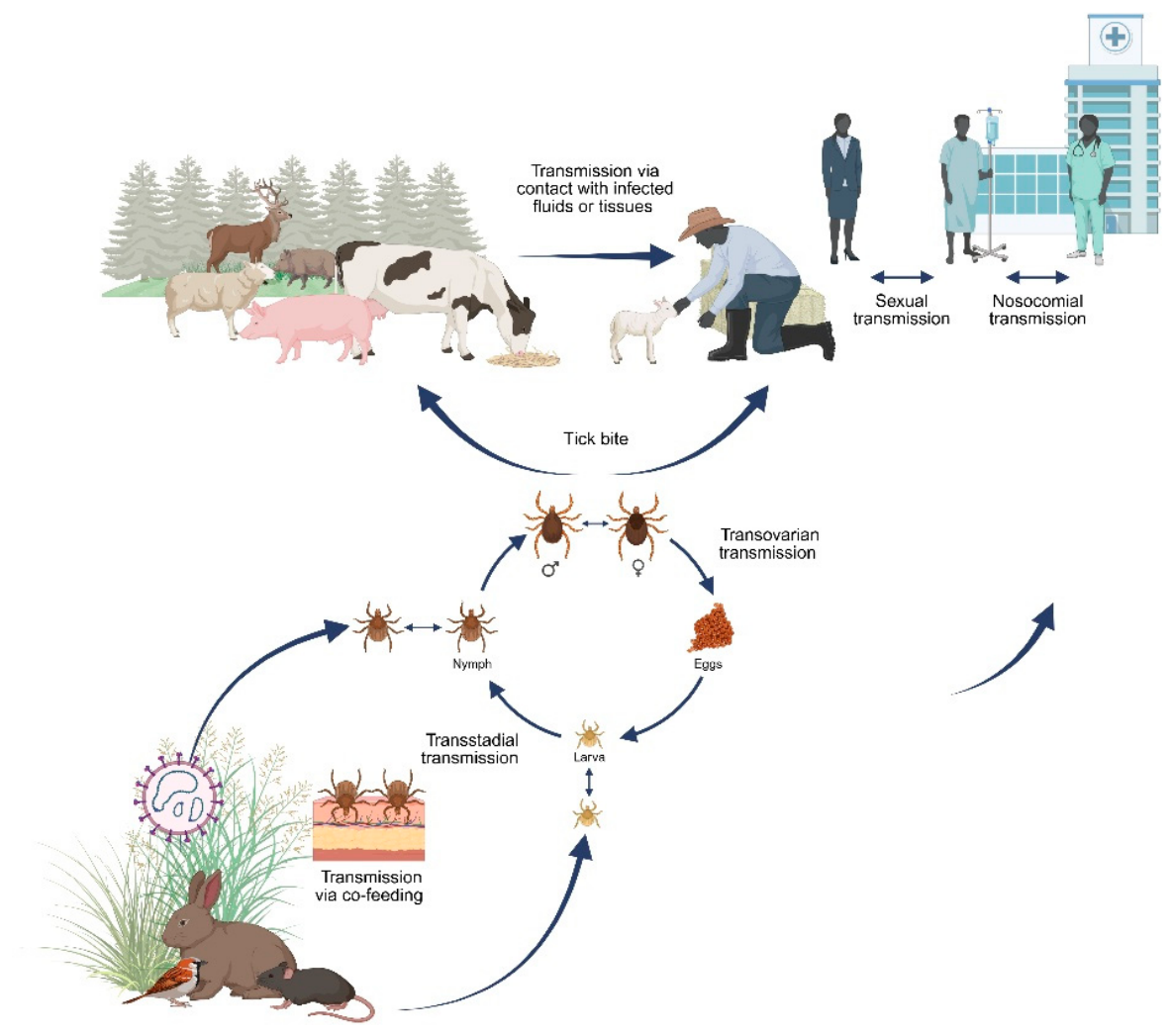
Figure 2.
Distribution by municipalities of Hyalomma marginatum and Hyalomma lusitanicum in Portugal (2011-2025) (adapted from [46]). Created with mapchart.net.
Figure 2.
Distribution by municipalities of Hyalomma marginatum and Hyalomma lusitanicum in Portugal (2011-2025) (adapted from [46]). Created with mapchart.net.
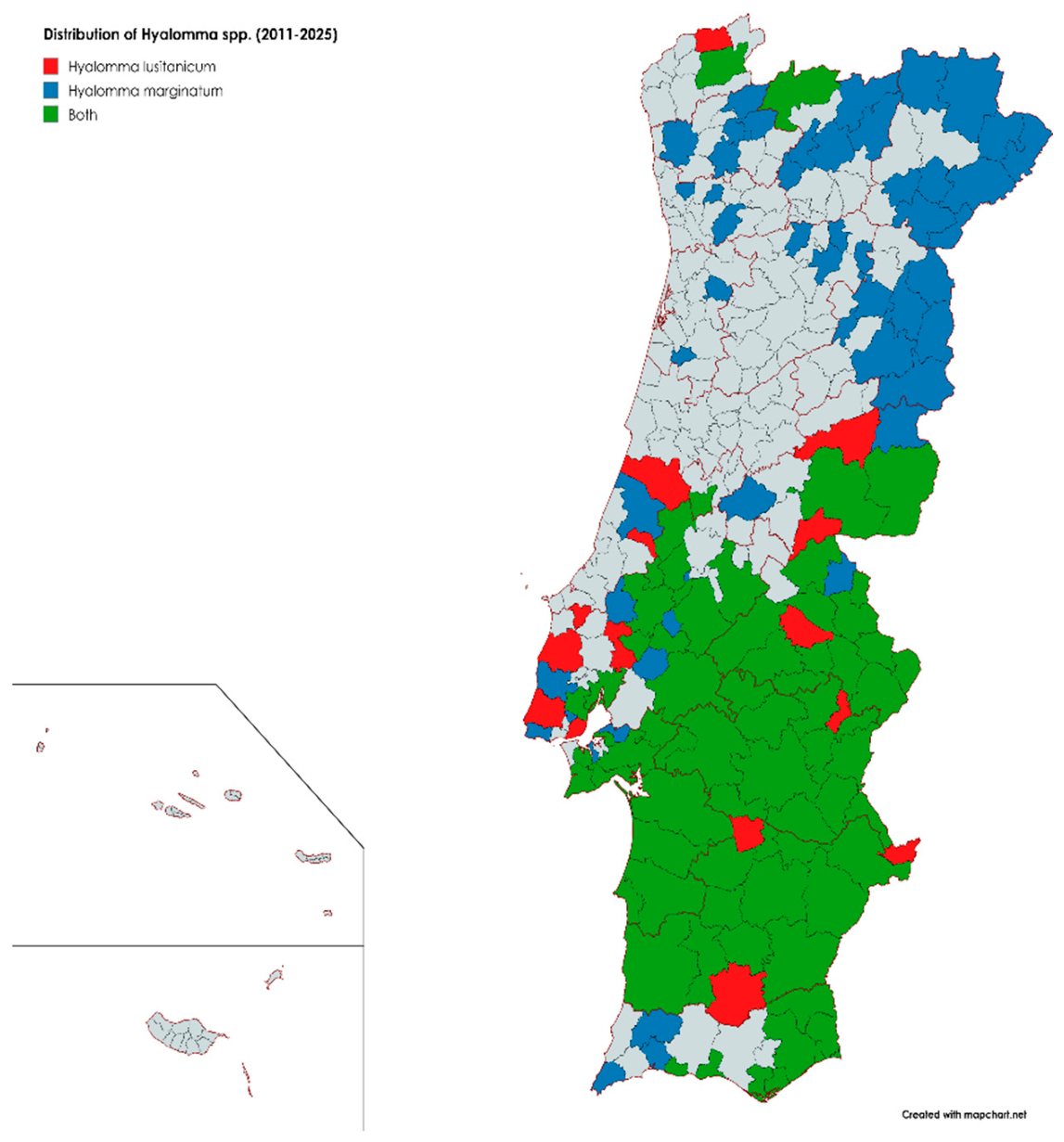
Figure 3.
Annual relative proportion (%) of Hyalomma marginatum and Hyalomma lusitanicum among all ticks collected within the REVIVE (Vector Surveillance Network) programme between 2018 and 2024. Values represent the relative proportion of each species among collected ticks and should not be interpreted as estimates of population-level abundance.
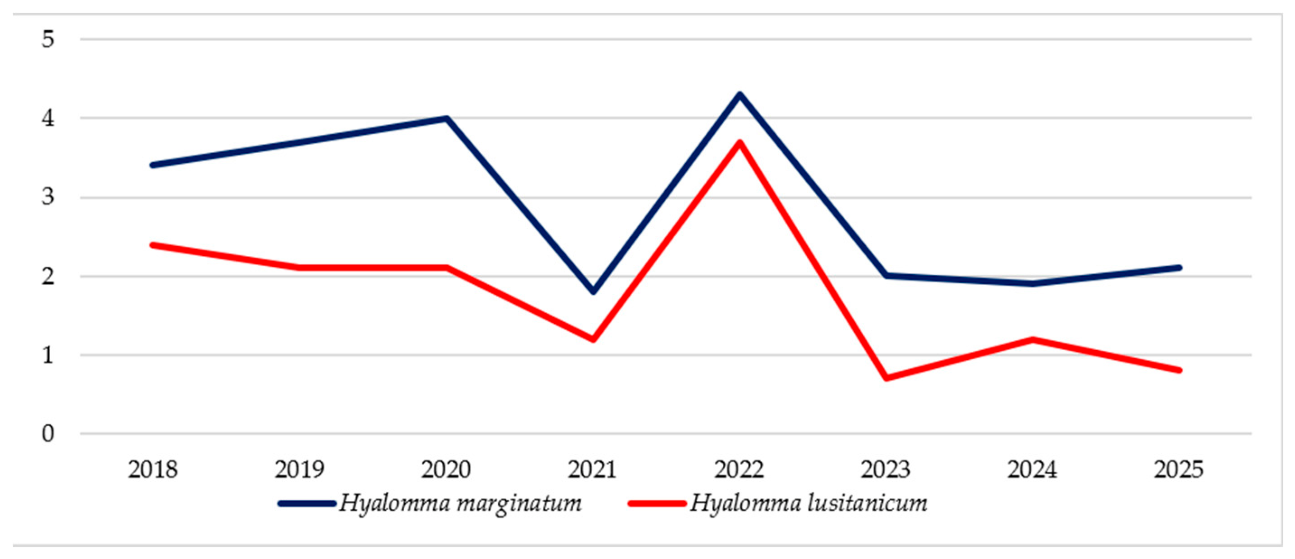
Figure 4.
Distribution of human CCHF cases in Spain (2016-august 2026) and CCHF-related data from humans and animals in Portugal (2022–2024) (adapted from [1,3,15,16,17,18,26,27,72,73]). Created with BioRender.com and mapchart.net.
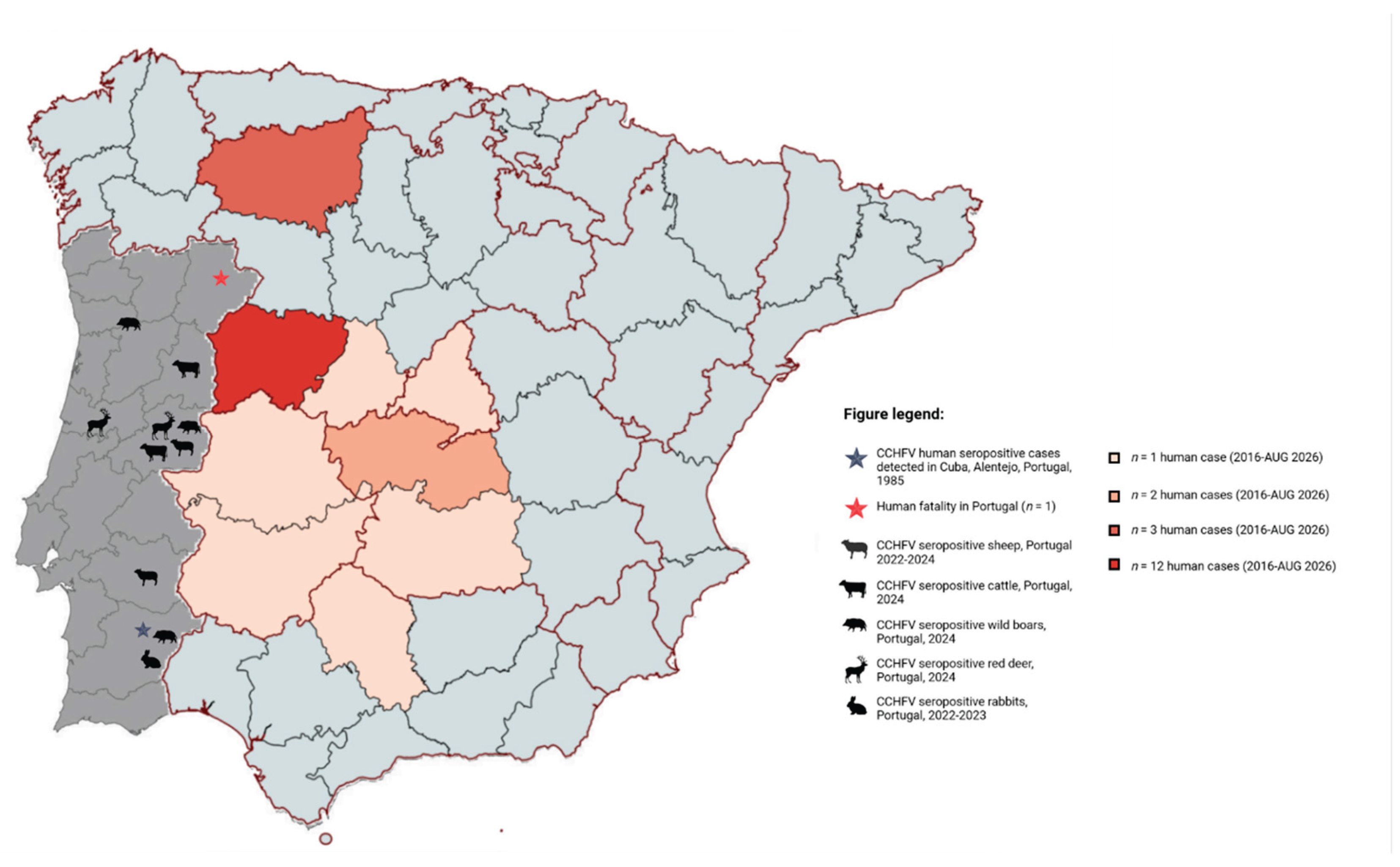

Table 1.
List of documented bird hosts of Hyalomma spp. in Portugal.
| Ticks | Bird Species | Reference |
|---|---|---|
| Hyalomma spp. | Barn swallow (Hirundo rustica) | [56] |
| Common blackbird (Turdus merula) | ||
| Common chaffinch (Fringilla coelebs) | ||
| Common kingfisher (Alcedo atthis) | ||
| Eurasian blackcap (Sylvia atricapilla) | ||
| Eurasian blue tit (Cyanistes caeruleus) | ||
| Eurasian golden oriole (Oriolus oriolus) | ||
| Eurasian nuthatch (Sitta europaea) | ||
| Eurasian reed warbler (Acrocephalus scirpaceus) | ||
| Eurasian wren (Troglodytes troglodytes) | ||
| European goldfinch (Carduelis carduelis) | ||
| European greenfinch (Chloris chloris) | ||
| European pied flycatcher (Ficedula hypoleuca) | ||
| European stonechat (Saxicola rubicola) | ||
| Great tit (Parus major) | ||
| Grey wagtail (Motacilla cinerea) | ||
| House sparrow (Passer domesticus) | ||
| Iberian grey shrike (Lanius meridionalis) | ||
| Nightingale (Luscinia megarhynchos) | ||
| Sedge warbler (Acrocephalus schoenobaenus) | ||
| Woodchat shrike (Lanius senator) | ||
| Woodlark (Lullula arborea) | ||
| H. lusitanicum | Common ostrich (Struthio camelus) | [57,58] |
| Common blackbird (Turdus merula) | [59] | |
| Common wood pigeon (Columba palumbus) | [58] | |
| Eurasian eagle-owl (Bubo bubo) | [58,60] | |
| Hawfinch (Coccothraustes coccothraustes) | [58] | |
| Red-legged partridge (Alectoris rufa) | [58] | |
| H. marginatum | African stonechat (Saxicola torquata) | [60] |
| Barn owl (Tyto alba) | [58,61] | |
| Barn swallow (Hirundo rustica) | [58,61] | |
| Blackbird (Turdus merula) | [58,61] | |
| Black kite (Milvus migrans) | [58,61] | |
| Blue tit (Parus caeruleus) | [61] | |
| Booted eagle (Hieraaetus pennatus) | [58] | |
| Eurasian eagle-owl (Bubo bubo) | [58,60] | |
| Eurasian jay (Garrulus glandarius) | [59] | |
| Eurasian goshawk (Accipiter gentilis) | [58] | |
| Eurasian sparrowhawk (Accipiter gentilis) | [58] | |
| Common buzzard (Buteo buteo) | [58] | |
| Common blackbird (Turdus merula) | [59] | |
| Common kestrel (Falco tinnunculus) | [58] | |
| Common kingfisher (Alcedo atthis) | [58,60,61] | |
| Common linnet (Carduelis chloris) | [58] | |
| Common nightingale (Luscinia megarhynchos) | [60] | |
| Common stonechat (Saxicola torquata) | [58,61] | |
| Great tit (Parus major) | [58,61] | |
| Iberian great grey shrike (Lanius meridionalis) | [58,61] | |
| Lesser kestrel (Falco naumanni) | [58] | |
| Little owl (Athene noctua) | [60,61] | |
| Eagle owl (Bubo bubo) | [61] | |
| Red kite (Milvus milvus) | [58,61] | |
| Reedwarbler (Acrocephalus scirpaceus) | [60,61] | |
| Swainson's hawk (Buteo swainsonii) | [60] | |
| Tawny owl (Strix aluco) | [58] | |
| Tree sparrow (Passer montanus) | [58,61] |
Table 2.
Animal species documented as hosts of Hyalomma lusitanicum and Hyalomma marginatum in Portugal.
Table 2.
Animal species documented as hosts of Hyalomma lusitanicum and Hyalomma marginatum in Portugal.
| Tick | Animal species | Reference |
|---|---|---|
| H. lusitanicum | Beech marten (Martes foina) | [62] |
| Cape hare (Lepus capensis) | [58] | |
| Domestic cattle (Bos taurus) | ||
| Domestic dog (Canis lupus familiaris) | ||
| Domestic goat (Capra hircus) | ||
| Domestic sheep (Ovis aries) | ||
| Domestic pig (Sus scrofa domesticus) | ||
| Egyptian mongoose (Herpestes ichneumon) | ||
| European hedgehog (Erinaceus europaeus) | ||
| European polecat (Mustela putorius) | ||
| European rabbit (Oryctolagus cuniculus) | ||
| European wildcat (Felis silvestris) | ||
| Fallow deer (Dama dama) | ||
| Least weasel (Mustela nivalis) | ||
| Mouflon (Ovis musimon) | ||
| Red deer (Cervus elaphus) | ||
| Red fox (Vulpes vulpes) | ||
| Western roe deer (Capreolus capreolus) | ||
| Wild boar (Sus scrofa ferus) | ||
| H. marginatum | Domestic cattle (Bos taurus) | [58,63] |
| Domestic donkey (Equus asinus) | ||
| Domestic dog (Canis lupus familiaris) | ||
| Domestic goat (Capra hircus) | ||
| Domestic horse (Equus caballus) | [58,60] | |
| Domestic pig (Sus scrofa domesticus) | [58] | |
| Domestic sheep (Ovis aries) | [58] | |
| European rabbit (Oryctolagus cuniculus) | [64] | |
| Fallow deer (Dama dama) | [58] | |
| Least weasel (Mustela nivalis) | ||
| Red deer (Cervus elaphus) | ||
| Wild boar (Sus scrofa ferus) |
Table 3.
Seroprevalence (%) among CCHFV-seropositive domestic and wild animals in Portugal (2006-2025).
Table 3.
Seroprevalence (%) among CCHFV-seropositive domestic and wild animals in Portugal (2006-2025).
| Species | Location | Seroprevalence (%); n/N | 95% CI | Reference |
|---|---|---|---|---|
| Domestic cattle (Bos taurus) | Castelo Branco | 25.0%; 2/8 | NA | [16] |
| Guarda | 61.8%; 34/55 | NA | [16] | |
| Domestic sheep (Ovis aries) | Castelo Branco | 7.14%; 1/14 | NA | [16] |
| Central Portugal | 0.1-10.0%; NA | NA | [18] | |
| Alentejo | 0.4%; 2/459 | 0.04–1.56% | [1] | |
| European rabbit (Oryctolagus cuniculus) | Alentejo | 0.60%; 4/234 | 0.23%–1.53% | [17] |
| Red deer (Cervus elaphus) | Castelo Branco | 60.0%; 6/10 | NA | [16] |
| Central Portugal | 0.1-10.0%; NA | NA | [18] | |
| Wild boar (Sus scrofa) | North | 10,1-30,0%; NA | NA | [3] |
| East-central | 30,1-50,0%; NA | NA | [3] | |
| South | 0,1-10,0%; NA | NA | [3] |
n – Positive samples; N – Total of samples; NA – Not available; CI – Confidence Interval.
Table 4.
Selected evidence of CCHFV circulation across Spain with potential relevance to Portugal.
| Study | Geographic area | Evidence of CCHFV circulation | Hosts/Sample | Main findings | What is the relevance to CCHFV circulation in Portugal? |
|---|---|---|---|---|---|
| Carrera-Faja et al. [67] | Northeastern Spain (Catalonia) |
Seropositivity | Iberian ibex and wild boars | High seroprevalence despite low Hyalomma abundance supporting CCHFV circulation beyond established Hyalomma areas. Ripicephalus bursa was suggested as a possible vector. | Potential CCHFV circulation beyond established main vector-associated areas. |
| Cevidanes et al. [68] | Northern Iberian Peninsula | Seropositivity | Wild boars, red deer, and roe deer | Seropositive animals identified in serum samples collected between 2014 and 2019, suggesting broader and prolonged circulation | Evidence of CCHFV circulation beyond southern Iberia. |
| Cuadrado-Matías et al. [18] | Southwestern Iberian Peninsula/Spain | Seropositivity | Red deer | High seropositivity rates. Region identified as an important CCHFV hotspot | Region geographically close to Portugal. Area of direct relevance to the Portuguese border. |
| Espunyes et al. [65] | Northeastern Spain (Catalonia) |
Seropositivity | Iberian ibex, european rabbits, fallow deer, red deer, roe deer, wild boars, | High seroprevalence in southern Catalonia, near a major African migratory bird stopover. | Migratory birds are a potential pathway for CCHFV dispersal |
| Moraga-Fernández et al. [20] | Southwestern Spain | Viral detection (nested RT-PCR targeting CCHFV S segment) | Wild ungulates/ticks | High tick infection rates and notable genetic variability among viral strains, which may increase the risk of novel variant emergence | Active CCHFV circulation and high viral genetic variability in a region close to Portugal |
Disclaimer/Publisher’s Note: The statements, opinions and data contained in all publications are solely those of the individual author(s) and contributor(s) and not of MDPI and/or the editor(s). MDPI and/or the editor(s) disclaim responsibility for any injury to people or property resulting from any ideas, methods, instructions or products referred to in the content. |
© 2026 by the authors. Licensee MDPI, Basel, Switzerland. This article is an open access article distributed under the terms and conditions of the Creative Commons Attribution (CC BY) license (http://creativecommons.org/licenses/by/4.0/).
Copyright: This open access article is published under a Creative Commons CC BY 4.0 license, which permit the free download, distribution, and reuse, provided that the author and preprint are cited in any reuse.