

Submitted:
27 September 2026
Posted:
29 September 2026
You are already at the latest version
Abstract
The most famous dataset in behavioral science has never been fitted. Pavlov’s Conditioned Reflexes (1927) reports trial-level salivary measurements from named dogs, yet quantitative associative theory has been parameterized on animal data collected after 1960 while the founding tables are cited as illustrations. Here we transcribe every numerical value stated in the prose of Lecture IV, the extinction lecture, into a page-anchored dataset and compare two model classes on it: single-state erasure, in which nonreinforcement degrades the sole learned trace, and inhibitory write, in which the trace persists intact beneath an accumulating inhibitory state. Four structural signatures reported by Pavlov — invariable spontaneous recovery, dis-inhibition by alien stimuli, extinction beyond zero, and temporary versus permanent restoration — are each unattainable within the single-state class and natural under the inhibitory write, and the lecture’s one exactly anchored contrast identifies the inhibitory decay rate: recovery from 3 to 6 drops across 23 unreinforced minutes requires γ ≈ 0.024 min⁻¹. The founding data of conditioning establish that extinction engages a process beyond monotonic loss of the conditioned trace — the second state Pavlov argued for verbally — and bound its decay rate.
Keywords:
extinction
; spontaneous recovery
; disinhibition
; conditioned reflex
; Pavlov
; inhibition
; model comparison
; historical data
Introduction
Every textbook of psychology reproduces a curve attributed to Pavlov1: salivation declining across unreinforced trials, then partially returning after rest. The attribution is accurate — the Anrep translation contains dozens of trial-level tables with named dogs, drop counts per 30 seconds and latencies — and the analysis stopped at reproduction. Quantitative historians have periodically extracted individual curves from Anrep and the Collected Works2; to our knowledge, despite its foundational status, Pavlov’s 1927 trial-level data has not been subjected to formal quantitative model comparison against modern associative frameworks.
Inhibitory-state theory itself is anything but new. Rescorla and Wagner build interference into acquisition and extinction3, Wagner’s SOP architecture gives inhibition explicit dynamics4, and Bouton’s retrieval-context account organizes the recovery phenomena5 — all inspired by these very observations. Those models were parameterized and tested against mid-century and later rodent, rabbit and pigeon data. The step taken here is executing the comparison directly on Pavlov’s own trial-level foundational tables.
We transcribed every numerical value stated in the prose of Lecture IV into a dataset carrying page, experimenter, dog, protocol, measure, value and units, and we ask which of two model classes can generate the reported pattern set. The discrimination proceeds at the level of structural signatures — patterns a class can or cannot produce at any parameter values — supplemented by the one contrast the prose anchors exactly, which identifies the decay rate of the inhibitory state, and by a second rate series recovered from the dissertation record that constrains the same parameter independently.
Results
A page-anchored dataset from Lecture IV
The public-domain Anrep translation1 reports, in prose, the endpoints of the lecture’s own extinction demonstration — a metronome conditioned stimulus of 30 s, unreinforced at 2-min intervals: a rise from 5 to 7 drops at the fifth repetition coinciding with an audience disturbance, a terminal reading of 3 drops with 13-s latency, and, 23 unreinforced minutes later, 6 drops with 5-s latency (pp. 49–59). It reports Babkin’s quassia- and acid-based reflex strengths, including an evident misprint (“52 c.c.” for 5.2) that we flag rather than silently correct; Perelzweig’s secondary extinction driving the unconditioned acid reflex itself from 6 to 3.8 cc (p. 54); and Zavadsky’s dis-inhibition interval contrast — considerable restoration of an extinguished reflex tested 40 s after acid, minimal restoration at 7 min 10 s (pp. 63–64). The dissertation record preserved by Windholz2 adds Babkin’s extinction rates: 15, 20 and 54 min to extinguish at 2-, 4- and 8-min presentation intervals, with Babkin’s conclusion that extinction rate is inversely proportional to the interval. Every value enters the dataset with its provenance.
Two model classes
Single-state erasure (M1): the only learning-dependent variable altered by nonreinforcement is the excitatory trace itself, V → (1 − k)V. The class contains no second state — inhibitory, contextual, retrieval-based or performance-based — written by extinction, and therefore no mechanism by which the response can exceed its terminal value without new reinforcement. Accounts that supplement partial erasure with a second extinction-modified state are, by that addition, two-state models and are taken up in the Discussion. Inhibitory write (M2): the response is R(n) = max(V − I(n), 0) with V constant; each unreinforced trial increments an inhibitory state, I(n+1) = I(n) + a·(Imax − I(n)); the state decays across rest, I(t + τ) = I(t)·exp(−γτ) with γ > 0; alien stimuli suppress I transiently; the unconditioned stimulus discharges it durably. I is unbounded above by the point R = 0, so extinction continues silently past zero. These are model classes rather than fitted molecular laws, and the discrimination below holds at any parameter values.
Four structural signatures exclude the single-state class
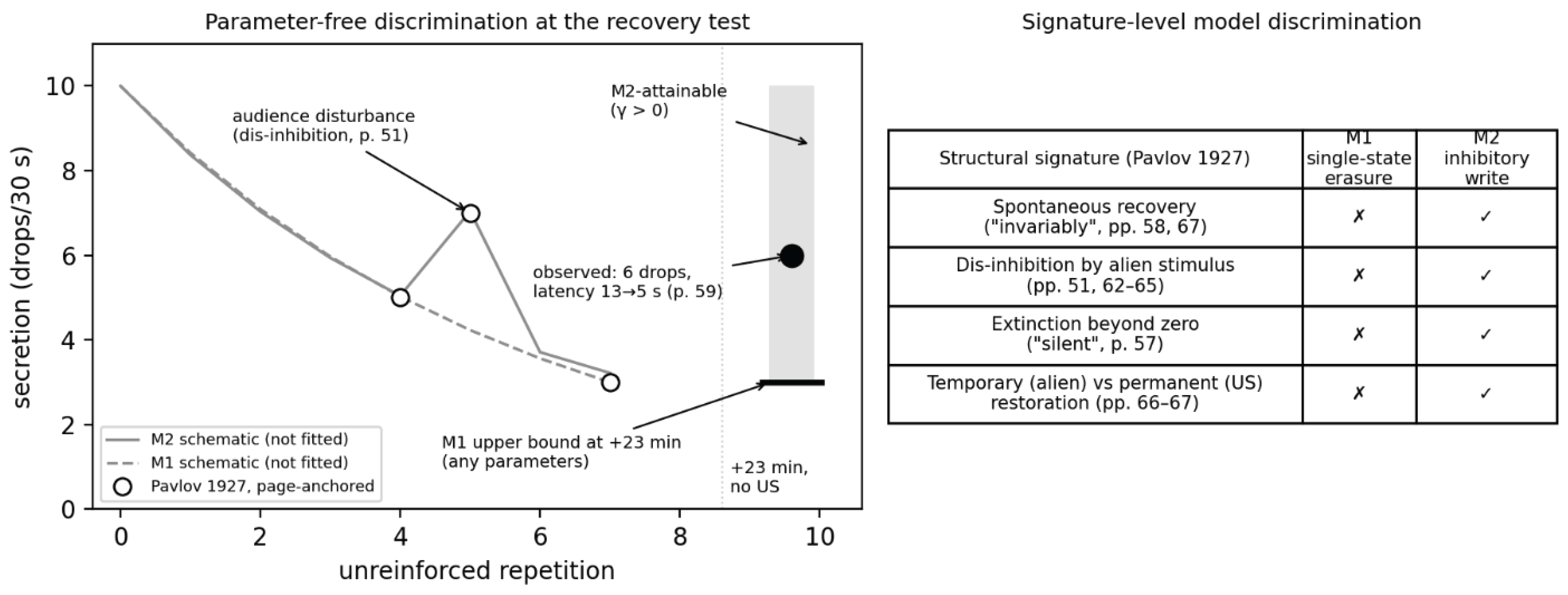
Spontaneous recovery is stated by Pavlov as invariable (pp. 58, 67): extinguished reflexes return toward strength in minutes to hours without any reinforcement. M1 forbids this at any parameters; M2 produces it as decay of I over intact V. Dis-inhibition — an alien stimulus transiently restores an extinguished reflex, from Zavadsky’s timed acid tests to the after-effect of the experimenter entering the room (pp. 62–65), including the within-series rise from 5 to 7 drops when the audience stirred (p. 51) — reveals a masked trace; a destroyed one cannot be transiently revealed. Extinction beyond zero: continued unreinforced repetition after the response reaches zero deepens extinction, measurable afterward as prolonged recovery, and a compound component that never produced a positive response can secondarily extinguish the stronger component (p. 57); a single-state model has no sub-zero state to deepen. Temporary versus permanent restoration (pp. 66–67): restoration by an alien stimulus lasts as long as its after-effect, restoration by the unconditioned stimulus is permanent, and one destroyed variable supports no such pair while a masked trace supports exactly these two — transient suppression of I versus its discharge. Signature score: single-state erasure 0 of 4; inhibitory write 4 of 4 (Figure 1).
Formal statement of the class exclusions
Let the single-state class satisfy: (A1) one learning-dependent state V ≥ 0 with readout R = f(V), f nondecreasing; (A2) nonreinforced presentations do not increase V; (A3) only application of the unconditioned stimulus increases V, and it does not decrease V; (A4) V does not change spontaneously between trials. Proposition 1 (no spontaneous recovery): by A2 and A4, V after extinction never exceeds its terminal value without a US, so R cannot rise from 3 to 6 drops. Proposition 2 (no dis-inhibition): an alien stimulus is not a US, so by A3 it cannot raise V, and R cannot transiently exceed its pre-stimulus value. Proposition 4 (one restoration mode): by A3 every restoration is US-mediated and, by A4, persists; the observed temporary–permanent pair is unattainable. Proposition 3 (no silent extinction) holds for the threshold-free subclass in which R > 0 whenever V > 0; a single-state model with an output threshold attains silent extinction alone while still failing Propositions 1, 2 and 4, so the conjunction of signatures excludes the class in full.
The anchored contrast bounds γ
The demonstration ends at 3 drops with 13-s latency and stands at 6 drops with 5-s latency after 23 unreinforced minutes (p. 59). An erasure model fitted to the same terminal point is bounded at 3 drops at any later time. Under M2 the recovery is arithmetic: with initial magnitude V0, extinction ends at I = V0 − 3 and the observed 6 drops requires (V0 − 3)·exp(−23γ) = V0 − 6, so γ = ln[(V0 − 3)/(V0 − 6)]/23 — a parameter the single-state class does not possess, and one whose existence already bounds V0 > 6. V0 awaits direct anchoring from the demonstration table; across initial magnitudes of 8–15 drops, γ spans 0.013–0.040 min⁻¹ (half-life 17–55 min), with V0 = 10 giving 0.024 min⁻¹. Magnitude and latency move together, two channels concordant with decay of a single inhibitory state (Figure 1).
An interval law supplies a second γ-sensitive series
Babkin’s rates — 15, 20 and 54 min to extinction at 2-, 4- and 8-min intervals2 — depend on how much I decays between presentations and are therefore governed by the same γ as spontaneous recovery. A joint fit of the recovery-derived rate against the interval law is a cross-constraint no single-trace account can formulate; executing it across the complete tables is the analysis this dataset now makes possible.
Discussion
Pavlov ran this model comparison verbally. He considered destruction and rejected it on the invariability of recovery; he considered fatigue and rejected it on the silent extinction of a never-active compound component; he concluded that extinction is a special form of inhibition (pp. 59–60)1. That is structural elimination between model classes — to our knowledge the first in learning theory — conducted in 1927 on the data reanalyzed here. The chronology sharpens it: Tolochinov named ugasanie from experiments begun in 1901, and Babkin systematized extinction, recorded spontaneous restoration as a slow process, and found that any extraneous stimulus — a person entering, a posture change, loud talk nearby — restored the extinguished reflex2. The signatures that reject erasure were present from the paradigm’s first decade.
The result places extinction where modern evidence has independently placed it: a second learned state over an intact original, the reading that renewal, reinstatement and spontaneous recovery impose5,6, with optically induced depotentiation marking by contrast what genuine erasure looks like7. The exclusion is class-level: any account whose only extinction-modified variable is the original trace fails the signature set, whereas accounts that add a second extinction-written state — an inhibitory association, a contextual retrieval dependency5, or a performance gate — inherit the signatures by that addition. The 1927 data establish that a second state exists; they do not, at this phase, discriminate among its implementations. The neuromodulatory gating Pavlov manipulated with audiences and entrances is today formalized as the third factor of three-factor plasticity rules8, and the bookkeeping used here — content writes distinguished from changes in the rules of writing — extends a gated-write architecture developed for developmental imprinting9. One observation is flagged as unmodeled: after repeated extinctions of a conditioned defence reflex, the unconditioned reflex itself fell from 6 to 3.8 cc (p. 54) — inhibition written onto machinery beyond the extinguished association.
Pavlov published exemplars: single dogs, selected demonstrations, no variance, and the paradigm’s earliest protocols were informal by later standards2. The design is therefore signature-level discrimination — which classes can generate the reported pattern set — with quantitative claims confined to the values the prose anchors exactly, and conclusions rest on the Anrep translation pending checks against the Russian originals. The class-level exclusion is complete under this phase: every signature and the anchored contrast derive from prose-stated values. Transcription of the lecture’s twelve printed tables extends the dataset to full curves and converts the discrimination into explicit parameter estimation and model-comparison statistics among two-state variants — including direct anchoring of V0 and the joint γ fit with uncertainty — without reopening the single-state class.
Methods
Source and transcription: The source is the public-domain Anrep translation of Conditioned Reflexes1, available in full at the Classics in the History of Psychology archive. We transcribed every numerical value stated in the prose of Lecture IV into a dataset whose rows carry source, page, experimenter, dog, protocol, measure, value, units and note. Transcription vigilance is part of the method: the archive prints the acid unconditioned reflex as “52 c.c.”, an evident misprint for 5.2 identified by internal consistency and flagged, not silently corrected, in the dataset. Babkin’s interval rates enter from the dissertation record as quoted by Windholz2 with dual provenance. The lecture’s twelve data tables are reproduced in the archive as image files; they are enumerated with page anchors and content descriptions in a companion capture queue for transcription against the printed book. Fidelity of Anrep’s tables to the Russian originals is checkable against the 1951 Complete Works and is recorded as an open verification item.
Models and parameters: M1 and M2 are defined in Results, with the single-state class axiomatized there (A1–A4). The Figure 1 trajectories are explicitly schematic illustrations of class behavior, drawn with V0 = 10, and carry no fitted content; the figure’s quantitative elements are parameter-free — the Proposition-1 bound at the terminal value, the M2-attainable interval, and the observed values. γ is obtained analytically as ln[(V0 − 3)/(V0 − 6)]/23 and reported as a band over plausible V0 pending direct anchoring of the initial magnitude from the demonstration table.
Statistical note: Single-subject exemplar data without variance support model-class discrimination by generability of the reported pattern set rather than parameter estimation with uncertainty. We therefore report signature-level results, quantify only where the prose anchors exact values, and defer estimation to the full-table dataset.
Use of generative artificial intelligence
Generative artificial intelligence (Claude, Anthropic) was used under the author’s direction for drafting assistance, formatting, and reference-verification support. The author reviewed and takes full responsibility for all content.
Ethics
The study reanalyzes published historical data; no new animal procedures were performed.
Data availability
The page-anchored dataset (pavlov_lecture4_data.csv) and the capture queue enumerating the twelve Lecture IV tables (pavlov_capture_queue.csv) accompany this manuscript and will be deposited with the version of record.
Code availability
Analysis code reproducing Figure 1 (pavlov_reanalysis.py) accompanies this manuscript.
Author Contributions
T.R. conceived the study, transcribed and curated the dataset, performed the analyses, and wrote the manuscript.
Funding
This work received no external funding.
Competing interests
The author declares no competing interests.
References
- Pavlov, I. P. Conditioned Reflexes: An Investigation of the Physiological Activity of the Cerebral Cortex (G. V. Anrep, Trans.) (Oxford University Press, 1927). Public-domain text: Classics in the History of Psychology, psychclassics.yorku.ca/Pavlov/.
- Windholz, G. The discovery of the principles of reinforcement, extinction, generalization, and differentiation of conditional reflexes in Pavlov’s laboratories. Pavlovian Journal of Biological Science 24, 35–42 (1989). [CrossRef]
- Rescorla, R. A. & Wagner, A. R. A theory of Pavlovian conditioning: variations in the effectiveness of reinforcement and nonreinforcement. In Black, A. H. & Prokasy, W. F. (eds.) Classical Conditioning II: Current Research and Theory, 64–99 (Appleton-Century-Crofts, 1972).
- Wagner, A. R. SOP: a model of automatic memory processing in animal behavior. In Spear, N. E. & Miller, R. R. (eds.) Information Processing in Animals: Memory Mechanisms (Erlbaum, 1981).
- Bouton, M. E. Context and behavioral processes in extinction. Learning and Memory 11, 485–494 (2004). [CrossRef]
- Rescorla, R. A. Spontaneous recovery. Learning and Memory 11, 501–509 (2004).
- Nabavi, S., Fox, R., Proulx, C. D., Lin, J. Y., Tsien, R. Y. & Malinow, R. Engineering a memory with LTD and LTP. Nature (2014). [CrossRef]
- Frémaux, N. & Gerstner, W. Neuromodulated spike-timing-dependent plasticity, and theory of three-factor learning rules. Frontiers in Neural Circuits 9, 85 (2016).
- Rahman, T. How transient experience produces durable commitment: a recursive execution–encoding architecture for filial imprinting. Hormones and Behavior 185, 105999 (2026). [CrossRef]
Figure 1.
| Model-class discrimination on the Lecture IV data. Left: page-anchored points from the extinction demonstration. Trajectories are schematic class illustrations, not fits; the quantitative content is parameter-free — the single-state class is bounded at its terminal value (3 drops) at the +23-min test under Propositions 1–4, whereas M2 attains any recovery between the terminal value and V0, and Pavlov measured 6 drops with latency falling from 13 s to 5 s. Right: signature-level discrimination; page numbers refer to the Anrep translation1.
Disclaimer/Publisher’s Note: The statements, opinions and data contained in all publications are solely those of the individual author(s) and contributor(s) and not of MDPI and/or the editor(s). MDPI and/or the editor(s) disclaim responsibility for any injury to people or property resulting from any ideas, methods, instructions or products referred to in the content. |
© 2026 by the authors. Licensee MDPI, Basel, Switzerland. This article is an open access article distributed under the terms and conditions of the Creative Commons Attribution (CC BY) license (http://creativecommons.org/licenses/by/4.0/).
Copyright: This open access article is published under a Creative Commons CC BY 4.0 license, which permit the free download, distribution, and reuse, provided that the author and preprint are cited in any reuse.