
Submitted:
28 September 2026
Posted:
29 September 2026
You are already at the latest version
Abstract
A symmetric game acquires an asymmetry as soon as its players can condition their behaviour on an observable but payoff-irrelevant role, such as owner and intruder. Selten's theorem states that no mixed strategy survives as an evolutionarily stable strategy under such role conditioning. We study the dynamical counterpart of this result in the presence of uniform mutation, modelling the two roles as two populations governed by the replicator-mutator dynamic. The system is equivariant under the role swap, its fixed-point subspace carries the role-blind dynamic, and at every symmetric rest point the Jacobian splits into a role-blind block and a transverse block. Without mutation the two spectra are exact mirror images, so the rate at which a symmetric equilibrium attracts in the role-blind game is precisely the rate at which it repels once roles are observed. Mutation shifts both spectra by the same amount. For games whose barycentre is a rest point we prove that the role-conditioned equilibrium is asymptotically stable if and only if the mutation rate exceeds the largest modulus of the real parts of the role-blind spectrum, which for an evolutionarily stable strategy equals its fastest attraction rate. For two-strategy games we obtain closed forms for the threshold, for the critical point, and for the supercritical pitchfork law governing the emerging role conventions, together with a Dulac argument that excludes cycles. For three or more strategies the symmetry-breaking mode can be complex, and an equivariant Hopf bifurcation produces anti-phase role cycles in which the two roles follow the same orbit half a period apart, as we verify for the rock-paper-scissors game. Forced symmetry breaking and finite-population simulations complete the analysis. The results read the emergence of property-like conventions as spontaneous symmetry breaking controlled by the exploration rate.
Keywords:
evolutionary game theory
; replicator-mutator dynamics
; asymmetric games
; spontaneous symmetry breaking
; equivariant bifurcation
; pitchfork bifurcation
; Hopf bifurcation
; Hawk-Dove game
; rock-paper-scissors
; conventions
1. Introduction
Symmetry is the natural starting point of evolutionary game theory. In the classical setting two randomly matched individuals play the same game, draw their strategies from the same set, and are treated by the payoff matrix in exactly the same way, so that nothing distinguishes one contestant from the other except the strategy chosen. Maynard Smith and Parker observed that real contests are rarely so featureless [1]. Contestants typically differ in an observable way, for instance one of them arrived first, and even when the asymmetry has no bearing on payoffs it can be used as a cue to settle the contest by convention. The “bourgeois” rule, escalate if you are the owner and retreat if you are the intruder, is the paradigmatic example [1,2,3]. Selten then proved the theorem that organises the whole subject: if the two contestants always occupy different roles and can condition their behaviour on the role they occupy, then every evolutionarily stable strategy of the role game is pure [4]. A mixed population state that is perfectly stable when players cannot tell owners from intruders becomes unstable the moment they can. Role information breaks the symmetry of the game, and it breaks it in a specific direction: away from mixing and towards conventions.
The dynamical version of Selten’s theorem is equally well known. The role game of a symmetric game is a bimatrix game, and the natural dynamic for a bimatrix game is the two-population replicator dynamic [5,6,7,8]. Eshel and Akin showed that interior rest points of this dynamic are never asymptotically stable [9], and Hofbauer explained why: after a change of velocity the bimatrix replicator dynamic is divergence free, so it preserves volume and cannot have an attracting interior equilibrium; in the two-strategy case it is even Hamiltonian [7,10]. The mixed equilibria that role conditioning destroys statically are thus also unreachable dynamically. What the classical theory does not say is how much of the symmetric structure survives the introduction of roles, in what precise quantitative sense the mixed equilibrium is destabilised, and what a small amount of behavioural noise does to the picture.
Noise, in the form of mutation, is the second ingredient of this paper. The replicator-mutator equation adds to the replicator dynamic a term that redistributes a fraction of the population uniformly over the strategy set [11,12,13,14]. In biological applications the term represents mutation; in learning applications it represents exploration, and the replicator-mutator dynamic is the mean-field limit of reinforcement learning with Boltzmann exploration and of related multi-agent learning schemes [15,16,17]. For the multi-population replicator dynamic, Bauer, Broom and Alonso showed that the same additive mutation term shifts the Jacobian at any rest point by a multiple of the identity, that mutation equilibria exist for every positive mutation rate, that they are unique and asymptotically stable when mutation is large, and that a Nash equilibrium can be approached by asymptotically stable mutation equilibria only if the Jacobian of the unperturbed dynamic has no eigenvalue with positive real part [18]. On the learning side, Hofbauer and Hopkins proved that a mixed equilibrium of a bimatrix game is asymptotically stable under every perturbed best-response dynamic if and only if the game is linearly equivalent to a zero-sum game [19]; related instability results for purified and perturbed mixed equilibria are due to Fudenberg and Kreps, Ellison and Fudenberg, and Echenique and Edlin [20,21,22]. For the one-population rock-paper-scissors game, Mobilia and then Toupo and Strogatz showed that mutation can create a supercritical Hopf bifurcation and stable limit cycles [23,24].
None of these contributions treats the problem as what it is, namely a problem of symmetry. When a symmetric game is played in roles, the resulting dynamic possesses a canonical symmetry that a generic bimatrix game does not have: the role swap, which exchanges the two populations, together with whatever permutations of the strategy set leave the payoff matrix invariant. The role-blind dynamic is exactly the restriction of the role-conditioned dynamic to the fixed-point subspace of the role swap. Selten’s theorem is then the statement that a symmetric equilibrium loses stability in the directions transverse to that subspace, and the question of what replaces it is a question about symmetry-breaking bifurcations. This paper carries out that analysis with uniform mutation as the bifurcation parameter. The mutation kernel is chosen to respect the full symmetry group, so that it is a symmetry-preserving perturbation and the equivariant machinery of Golubitsky, Stewart and Schaeffer applies without modification [25,26,27].
Our results are the following. First, at every rest point on the fixed-point subspace the Jacobian decomposes into a role-blind block and a transverse block, and without mutation the two blocks are exact negatives of one another. The rate at which an evolutionarily stable state attracts in the role-blind game is therefore the rate at which it repels once roles are observed; the strength of an evolutionarily stable strategy is the exact measure of its fragility under role information. Second, for the class of games whose barycentre is a rest point for every mutation rate, which includes all games with a transitive automorphism group and all two-strategy games with a centred mixed equilibrium, the transition is sharp: the symmetric equilibrium of the role-conditioned dynamic is asymptotically stable if and only if the mutation rate exceeds the largest modulus of the real parts of the role-blind spectrum. For an evolutionarily stable state this critical rate is its fastest attraction rate. The bound of Bauer, Broom and Alonso, which is a supremum over the whole state space, becomes an equality at the symmetric point. Third, for all two-strategy games we solve the problem completely: the critical mutation rate and the critical position of the diagonal rest point have closed forms depending only on the mixed equilibrium and on the payoff scale, the threshold always exceeds the role-blind attraction rate unless the mixed equilibrium is centred, the bifurcation is a supercritical pitchfork whose two branches are the role conventions and whose amplitude obeys an exact square-root law, and a Dulac function excludes periodic orbits for every positive mutation rate. Fourth, for three or more strategies the transverse mode can be complex, and the role swap acts as minus the identity on the critical eigenspace, so that the bifurcation is an equivariant Hopf bifurcation whose periodic orbits carry the spatio-temporal symmetry that the two roles follow the same cycle half a period apart. Temporal symmetry breaking of this kind is impossible with two strategies, which yields a clean dichotomy between conventions and anti-phase cycles. Fifth, we quantify what happens when the symmetry is imperfect, when owners value the resource slightly more than intruders or explore slightly differently, and what happens in finite populations, where the broken symmetry is restored on long time scales by rare convention switches whose waiting time grows exponentially with population size.
The stakes of these results extend in three directions. In the theory of conventions the emergence of property-like rules from anonymous interaction has been analysed by Hume, by Sugden, by Young, by Skyrms and by Gintis [28,29,30,31,32,33]. Our analysis phrases that emergence as spontaneous symmetry breaking with an exact control parameter: above the critical exploration rate the symmetric mixed state, in which owners and intruders behave alike and fight with the same frequency, is the unique attractor; below it two mirror-image conventions appear, and small asymmetries in payoffs or in exploration select between them. In the theory of learning the mutation rate is the exploration rate, and the threshold gives the amount of exploration required for two learners in fixed roles to keep converging to the quantal-response-like equilibrium rather than settling on a convention or cycling out of phase [34,35]. In biology the same results describe owner-intruder contests and cyclic dominance in populations of side-blotched lizards and bacteria [36,37].
The paper is organised as follows. Section 2 sets up the model, identifies the symmetry group and proves the two structural lemmas that drive everything else. Section 3 presents the mirror theorem, the critical exploration rate, the complete solution of two-strategy games, the equivariant bifurcation dichotomy with the rock-paper-scissors example, numerical verification, forced symmetry breaking and finite populations. Section 4 discusses the results and Section 5 concludes.
2. Materials and Methods
2.1. Symmetric Games Played in Roles
Let be the payoff matrix of a symmetric two-player game with pure strategies, where is the payoff to a player using strategy against an opponent using strategy . Population states live in the simplex , whose tangent space is , with the vector of ones. We write for the barycentre of and for the diagonal matrix of a vector . The role-blind, or classical, replicator dynamic on is [7,38]
An interior rest point of Equation (1) is an interior Nash equilibrium, characterised by for all . Such a point is an evolutionarily stable state if and only if for every non-zero , and every evolutionarily stable state is an asymptotically stable rest point of Equation (1) [7,39]. We shall mostly need the weaker dynamical property that is a hyperbolic sink, that is, that the Jacobian of Equation (1) restricted to has all eigenvalues in the open left half-plane.
Following Selten, we now suppose that in every contest one player occupies role I and the other role II, that the roles are observable, and that they are payoff-irrelevant: a player using against receives whichever role she occupies [4]. Because behaviour can be conditioned on the role, the relevant object is the bimatrix game in which the role-I player’s payoff matrix is and the role-II player’s payoff matrix is , and the relevant dynamic is the two-population replicator dynamic [5,6,7]. Writing for the distribution of strategies used in role I and for that in role II, the dynamic reads
Two remarks on the modelling choice are in order. First, if every individual is a pair of role-specific behaviours drawn from one population, the state space is the simplex over the pairs and the replicator dynamic acts there; however, the Wright manifold of product distributions is invariant under that dynamic, and on it the dynamic reduces exactly to Equation (2) for the marginals [8,40]. Equation (2) is therefore the description of a single population without linkage between the two role-specific traits as much as the description of two separate populations. Second, it is classical that no interior rest point of Equation (2) is asymptotically stable: with the velocity change the vector field becomes divergence free, so the flow preserves volume [7,9,10]. This is the dynamical form of Selten’s theorem, and the first purpose of the present paper is to state exactly what it costs.
2.2. Uniform Mutation as a Symmetry-Preserving Perturbation
We add to each population a mutation term of the additive form introduced by Hadeler and by Hofbauer for selection-mutation models [11,12] and used by Bauer, Broom and Alonso for multi-population games [18]: at rate individuals abandon their strategy and redraw one uniformly from the available. The role-blind replicator-mutator dynamic is
and the role-conditioned replicator-mutator dynamic is the pair
Three properties of Equations (4) and (5) are immediate and will be used without further comment. The simplex product is forward invariant, and for the vector field points strictly inward on its boundary, so all rest points are interior and at least one exists by Brouwer’s theorem [18]. The mutation term is minus the Euclidean gradient of the convex function , so it adds times the identity to the Jacobian of the mutation-free field at every point [18]; what is not immediate, and what Lemma 3 below provides, is the exact form of the Jacobian at a rest point once the movement of the rest point with is taken into account. Finally, the additive form is the weak-selection limit of the multiplicative replicator-mutator equation of Page and Nowak in which mutation acts on offspring [13,18]; all statements below that concern the sign of eigenvalues at the barycentre hold verbatim for the multiplicative form with background fitness, because the two forms have the same linearisation there up to a positive factor. In the learning interpretation is the ratio of the exploration rate to the selection intensity [16,17], and in Section 3.7 we show that the Wright-Fisher process with selection intensity and mutation probability per birth has Equation (4) as its mean-field limit with .
The choice of a uniform mutation kernel is not a convenience but the heart of the method. A kernel that redistributes towards an arbitrary interior vector instead of would single out some strategies over others and would therefore break the permutation symmetries of the game; a kernel that differs between the two roles would break the role swap. The uniform kernel, applied identically in both roles, preserves every symmetry of the game, and consequently the mutation rate is a symmetry-preserving bifurcation parameter. Section 3.6 examines what happens when this assumption is relaxed.
2.3. The Symmetry Group and Two Structural Lemmas
Let be the group of permutation matrices that leave the payoff matrix invariant, and let be the role swap. The group
acts linearly on and leaves invariant. For a generic payoff matrix is trivial and ; for the rock-paper-scissors game and ; for a pure coordination game with equal payoffs . Throughout, denotes the vector field of Equations (4) and (5) and that of Equation (3).
Lemma 1.
For every the vector field
is -equivariant:
for all
and . The fixed-point subspace of the role swap, , is invariant under the flow, and the restriction of
to
is the role-blind dynamic: . In particular
is a rest point of
if and only if
is a rest point of .
Proof.
Equivariance under is read off from Equations (4) and (5), which are exchanged by . For we have , so ; the average payoff is invariant, and , so each component of the field is permuted in the same way as the state. Invariance of follows from equivariance, since implies that whenever . Setting in Equation (4) gives Equation (3). □
The second lemma is the algebraic core of the paper. It concerns the Jacobian of at a rest point on the fixed-point subspace, viewed as a linear map on the tangent space .
Lemma 2.
Let be a rest point of
with
interior. Write
for the derivative of the role-I field with respect to the role-I state and
for its derivative with respect to the role-II state. Then the Jacobian of
at
has the block form
it commutes with , and its spectrum on
is the union of the spectra of the two operators
where
is exactly the Jacobian of the role-blind dynamic
at
restricted to .
Proof.
Differentiating Equation (4) gives and , which at are the stated and . By equivariance, or by direct computation, and . A block matrix of this form commutes with the swap and acts on as and on as ; since , the spectrum splits as claimed. Finally, by the chain rule the Jacobian of is . □
Lemma 2 says that the question “does role information matter for the stability of ?” has a precise linear-algebraic meaning: it matters if and only if the transverse operator has spectrum in the right half-plane while does not. The transverse operator is not a new object to be computed from scratch; it is the role-blind Jacobian corrected by twice the cross-population block.
2.4. Numerical Methods
All computations were carried out in Python 3.12 with NumPy, SciPy and Matplotlib; the scripts that reproduce every figure and table are provided as Supplementary Materials. Rest points were located by multi-start Newton iteration on a grid of initial conditions (SciPy fsolve with tolerance ) and classified by the eigenvalues of the numerical Jacobian projected onto an orthonormal basis of . Trajectories were integrated with the eighth-order Dormand-Prince scheme (DOP853) at relative tolerance and absolute tolerance . Periods of limit cycles were estimated from the spacing of maxima and refined by minimising over with cubic-spline interpolation; phase shifts between components were estimated by the same minimisation. Finite populations were simulated with a Wright-Fisher process with two role-specific subpopulations of size , selection intensity and per-birth mutation probability , described in Section 3.7.
3. Results
3.1. The Mirror Theorem
The first result makes the mutation block of Lemma 2 explicit at a rest point and shows that it is a pure damping term whose size is measured in the Shahshahani metric on , the Riemannian structure with respect to which the replicator dynamic is a gradient for partnership games [7,41].
Lemma 3.
Let be an interior rest point of the role-blind replicator-mutator dynamic (3) for some , and let
be the projection of
onto
along . Then on
the operator
is self-adjoint and positive definite for , and its spectrum lies in the interval . Consequently every eigenvalue
of
is real and satisfies , and
when .
Proof.
The rest point condition gives . For , Lemma 2 gives . Now , and , because . Hence , which is Equation (9). For , , which is symmetric in and and positive for ; the Rayleigh quotient is a weighted average of the numbers with weights , whence the spectral bounds. If then and for . □
With in hand, the mirror theorem is a one-line consequence of Lemma 2.
Theorem 4 (Mirror theorem).
Let
and let
be an interior Nash equilibrium of . Then
on , so that
and the spectrum of the role-conditioned Jacobian at
is the union of the role-blind spectrum and its negative. In particular, if
is an eigenvalue of the role-blind replicator dynamic at , then
is an eigenvalue of the role-conditioned dynamic at
in a direction transverse to .
Proof.
Lemma 3 with gives , and Lemma 2 gives and . □
Corollary 5 (Dynamical Selten theorem, quantified).
Let
and let
be an interior Nash equilibrium of
that is a hyperbolic sink of the role-blind replicator dynamic, with eigenvalues
on . Then
is a hyperbolic saddle of the role-conditioned dynamic (2) whose unstable manifold has dimension , is transverse to , and along which trajectories separate at the rates . If instead
for all , as for zero-sum games, then
is non-hyperbolic and elliptic in every direction. In no case is
asymptotically stable.
Proof.
By Theorem 4 the eigenvalues of are on and on . If all the stable eigenspace is and the unstable eigenspace is , which is transverse to and has dimension . If all every eigenvalue is purely imaginary. Since the spectrum is symmetric about the imaginary axis in every case, asymptotic stability is impossible, in agreement with the volume-preservation argument of [9,10]. □
Corollary 5 sharpens Selten’s theorem in a way that its static formulation cannot express. An evolutionarily stable state is not merely destabilised by role information; it is destabilised in exactly as many directions as it has, and in each direction the speed of divergence equals the speed of convergence that the same direction had before roles were observed. The “strength” of an evolutionarily stable strategy, its rate of attraction, is precisely the strength of the pull away from it once the population can tell owners from intruders. It is this exact mirroring, rather than the mere non-existence of mixed ESS, that fixes the amount of mutation needed to restore the symmetric equilibrium.
3.2. The Critical Exploration Rate
When mutation is switched on, the two blocks of Lemma 2 are shifted by the same damping operator , and for the cleanest class of games the shift is exactly times the identity. That class is defined by the requirement that the barycentre be a rest point for every , which by Equation (3) is equivalent to being a constant vector, that is, to having equal row sums. It contains every game whose automorphism group acts transitively on the strategies, such as cyclic games and pure coordination games with equal payoffs, and every two-strategy game whose mixed equilibrium is . For such a matrix for some scalar , the line spanned by is -invariant, and we denote by the eigenvalues of the induced map on the quotient space , that is, the eigenvalues of other than the one belonging to , counted with multiplicity.
Theorem 6 (Critical exploration rate).
Let
have equal row sums. Then for every
the point
is a rest point of Equation (3) and
a rest point of Equations (4) and (5), and on the tangent spaces
Consequently the role-conditioned equilibrium
is a hyperbolic sink if and only if
whereas the role-blind equilibrium
is a hyperbolic sink if and only if
(with the convention that this holds for all
when ). In particular, if
is a hyperbolic sink of the role-blind replicator dynamic, then
and
the fastest rate at which the role-blind dynamic attracts to .
Proof.
Since , the replicator term of Equation (3) vanishes at and so does the mutation term, so is a rest point for every , and Lemma 1 lifts this to . By Lemma 3, on . By Lemma 2, at . We claim that the eigenvalues of on are exactly . Indeed, maps into itself because . If is an eigenvector of the quotient map, so that for some scalar , then , since and ; the same computation on generalised eigenvectors shows that the two maps have the same characteristic polynomial, since on is conjugate to the quotient map under the isomorphism . Therefore and have the spectra in Equation (11). Hyperbolic sinks require all real parts negative: for this is and for it is ; the role-conditioned point needs both, which is Equation (12), and Equation (13) follows when all . □
Corollary 7 (Three regimes).
Under the hypotheses of Theorem 6 let
and . Exactly one of the following holds. (i) Attractor type, : the role-blind equilibrium is stable for every , the role-conditioned equilibrium only for ; roles matter, and the interval
of exploration rates is where they matter. (ii) Repeller type,
and : both equilibria become stable at the same value ; role information is irrelevant to stability. (iii) Neutral type, , which includes all zero-sum games: both equilibria are stable for every , and arbitrarily small mutation stabilises both.
Proof.
Immediate from Equation (11). □
Remark 1.
Corollary 7(iii) is the replicator-mutator counterpart of the result of Hofbauer and Hopkins that mixed equilibria of bimatrix games are stable under all perturbed best-response dynamics exactly when the game is linearly equivalent to a zero-sum game [19], and of the observation of Bauer, Broom and Alonso that the mixed equilibrium of matching pennies is an attracting mutation limit [18]. Theorem 6 adds the quantitative statement for games that are not zero-sum: the mixed equilibrium is an attracting mutation limit of the role-conditioned dynamic in the sense of [18] if and only if , and otherwise it is attracting precisely above the explicit level. The general lower bound of [18], Lemma 3.8, is the supremum of the real parts of the Jacobian spectrum over the whole state space; at the barycentre Theorem 6 replaces the supremum by the exact value .
Remark 2.
The equal-row-sum hypothesis is what makes and keeps the rest point fixed as
varies. For a general interior rest point
the transverse operator is , and the critical rate is the smallest
at which its spectral abscissa vanishes. It is still well defined, but it depends on how
moves, and Section 3.3 shows in the two-strategy case that it always exceeds the naive mirror value obtained by freezing
at .
3.3. Two-Strategy Games: The Complete Solution
For every symmetric game is characterised, up to the addition of constants to columns, by the two numbers and . Writing and for the frequencies of strategy 1 in roles I and II, the payoff advantage of strategy 1 against an opponent playing 1 with probability is , where and is the mixed equilibrium when . The game is of anti-coordination type, and is an evolutionarily stable state, when ; it is of coordination type when . Equations (4) and (5) become
and the Hawk-Dove game with resource value and fighting cost , for which , , and , has , , and .
Proposition 8 (Exact threshold for two strategies).
Let
and , and put . For every
the role-blind dynamic has a unique rest point , which is globally asymptotically stable on . The symmetric rest point
of Equation (14) is a hyperbolic sink if and only if , where
and at
the diagonal rest point sits at
Moreover , the attraction rate of
in the role-blind replicator dynamic, with equality if and only if . For the Hawk-Dove game, , which equals
when .
Proof.
Uniqueness and global stability of : assume , the other case being symmetric. The rest points of the role-blind dynamic are the zeros of . On the cubic term is non-negative, since there, and the mutation term is positive, so unless and ; on both terms are non-positive and not simultaneously zero, so . On one computes with , a concave quadratic with and , so and on that interval. Hence has exactly one zero , located in , is positive to its left and negative to its right, and the one-dimensional flow converges to from every interior initial condition. Differentiating gives , so increases strictly and continuously from towards as grows, and tends to as . For the transverse eigenvalue, Lemma 2 gives on the one-dimensional tangent space and , where we abbreviate . Using the rest point condition ,
which is the instance of Lemma 3. The transverse eigenvalue vanishes when
Eliminating between Equation (18) and the rest point condition gives . Substituting , dividing by and expanding, all cubic terms cancel and one is left with the quadratic
whose unique root in is in Equation (16); the other root is negative. A direct check gives and , so lies strictly between and and is therefore reached by the branch at exactly one value of , which we call . Along the branch is continuous, positive at by Theorem 4 (it equals there), negative for large because dominates the bounded term , and vanishes only at ; hence is a hyperbolic sink exactly when . Inserting into Equation (18) and simplifying with and gives and , whence , which is Equation (15). Finally because , with equality only at , that is at . For the Hawk-Dove parametrisation, and . □
Proposition 8 has a striking corollary for the general problem left open in Remark 2. Freezing the rest point at and applying the mirror theorem would predict a threshold equal to the role-blind attraction rate . The true threshold is larger by the factor , which ranges from 1 at a centred equilibrium to 2 as the equilibrium approaches the boundary of the simplex. Mutation pushes the diagonal rest point towards the centre, which increases the cross-population coupling , and the additional damping does not fully compensate. The critical point itself lies strictly between and (Figure 3).
The centred case is fully explicit and provides the reference example for the whole paper.
Proposition 9 (Pitchfork law).
Let , so that ,
and . Then for every
the point
is a rest point of Equation (14), with transverse eigenvalue
and role-blind eigenvalue . For
there are exactly two further interior rest points, exchanged by the role swap, given by
and their Jacobian has eigenvalues
and , so they are hyperbolic sinks. At
the three rest points merge in a supercritical -symmetric pitchfork bifurcation, and for
the symmetric rest point is the unique rest point and is a hyperbolic sink.
Proof.
Set , and note . Equation (14) becomes and . The antisymmetric line is invariant, since on it , and the flow on it is because . Its non-zero rest points exist exactly for and satisfy , which gives Equation (20) with . The cubic coefficient is negative, so the pitchfork is supercritical. The Jacobian at is with and ; inserting gives and , so the eigenvalues are and . That there are no other interior rest points is elementary. Write and , so that the rest point equations read and . If the first equation forces , and symmetrically; if , dividing the two equations gives , that is . On the diagonal the first equation becomes , impossible because the left side is negative; on the anti-diagonal it becomes , which is the branch already found. Hence the rest points are exactly the symmetric point and, for , the two conventions. □
The last result of this subsection shows that in two-strategy games the symmetry can break only statically: no periodic orbit exists for any positive mutation rate, so that the Hopf scenario of the next subsection is a genuinely higher-dimensional phenomenon.
Proposition 10 (No cycles for two strategies).
For every symmetric two-strategy game and every , the role-conditioned replicator-mutator dynamic (14) has no periodic orbit in the open square . Consequently every trajectory converges to a rest point.
Proof.
Take the Dulac function , the classical multiplier that renders the mutation-free bimatrix field divergence free [10]. The divergence of is
because the replicator parts contribute and . By the Bendixson-Dulac criterion there is no periodic orbit in the simply connected open square [42]. The square is forward invariant and the rest points are isolated for , so by the Poincaré-Bendixson theorem every -limit set is a rest point or a cycle of rest points joined by connecting orbits; the latter is excluded by the same integral of the divergence over the region it would bound. □
Remark 3.
For coordination games, , the roles of the two blocks are exchanged: is negative for every , while vanishes at exactly the value given by Equation (18) with replaced by . Hence the threshold is the level of mutation at which the role-blind dynamic loses its bistability and the mixed state becomes the unique attractor, and role conditioning never changes the stability of the diagonal point. This is Corollary 7(ii) for : roles matter for anti-coordination, not for coordination, in agreement with the instability of mixed equilibria of games with strategic complements under a wide class of dynamics [22].
3.4. Equivariant Bifurcations for Three or More Strategies
For the transverse operator acts on a space of dimension , and its critical eigenvalue at may be real or may be a complex pair. The role swap acts as on the antisymmetric subspace , which by Theorem 6 contains the critical eigenspace, and this single fact determines the type of bifurcation.
Theorem 11 (Equivariant dichotomy).
Let
have equal row sums and let
be a hyperbolic sink of the role-blind replicator dynamic, so that
is given by Equation (13). Suppose that the maximum in Equation (13) is attained by a single real eigenvalue or by a single complex-conjugate pair
of , and that the corresponding eigenspace is one- or two-dimensional. Then as
decreases through
the symmetric equilibrium
of the role-conditioned dynamic loses stability along
with transversality coefficient , and generically one of the following occurs.
(a) Real case. The bifurcation is a -symmetric pitchfork. For
on one side of
there is, near , exactly one pair of additional rest points
off , the two role conventions, and no other rest points. If the pitchfork is supercritical the conventions exist for
and are asymptotically stable.
(b) Complex case. The bifurcation is an equivariant Hopf bifurcation. For
on one side of
there is a branch of periodic orbits
of period close to
with the spatio-temporal symmetry
the two roles follow the same cycle half a period apart. If the bifurcation is supercritical the orbits exist for
and are orbitally asymptotically stable. If moreover
acts non-trivially on the critical eigenspace, the orbits carry the corresponding additional spatio-temporal symmetries.
(c) For
only case (a) can occur.
Proof.
By Theorem 6 the eigenvalues of are , so the critical eigenvalue crosses the imaginary axis at with , while all eigenvalues of remain in the left half-plane for . The critical eigenspace lies in , on which acts as . Restricting the -equivariant field to a centre manifold, which can be chosen -invariant, yields a reduced -equivariant bifurcation problem in which the non-trivial group element acts by . In case (a) the reduced problem is one-dimensional and odd in the state variable, so its normal form is with generically; this is the pitchfork, and the two non-trivial branches are exchanged by [25,27]. In case (b) the critical eigenspace is two-dimensional and acts on it in the standard way, with acting as the phase shift by ; the equivariant Hopf theorem [26], Theorem XVI 4.1, then yields a branch of periodic solutions whose isotropy subgroup is the twisted subgroup , which is Equation (22). The role-blind block being stable, no bifurcation takes place inside and the bifurcating solutions cannot lie in it. For (c), is one-dimensional when , and Proposition 10 excludes periodic orbits altogether. □
The dichotomy has a memorable reading. Role information can break the symmetry of a mixed equilibrium in two ways only: statically, by splitting the population into two mirror-image conventions, or temporally, by making the two roles run through the same cycle out of phase. Two-strategy games admit only the first; the second requires at least three strategies and a rotational component in the role-blind dynamic. The rock-paper-scissors game provides the canonical instance.
Proposition 12 (Rock-paper-scissors in roles).
Let
so that
is the unique interior equilibrium and is an evolutionarily stable state if and only if . The non-trivial eigenvalues of
are , and therefore
If , the role-blind equilibrium is stable for every and the role-conditioned equilibrium is stable if and only if , at which value an equivariant Hopf bifurcation with critical frequency and period creates cycles satisfying and, with the cyclic permutation of strategies, the discrete rotating-wave relation . If , the transverse block is stable for every and it is the role-blind block that undergoes a Hopf bifurcation at ; this is the one-population bifurcation analysed by Mobilia and by Toupo and Strogatz [23,24], and role conditioning leaves it untouched. If the game is zero-sum and both equilibria are stable for every .
Proof.
The matrix is circulant with first row , so its eigenvalues are with , : the value for belongs to , and the pair to the two-dimensional space . Theorem 6 gives Equation (24) and the thresholds. For the critical pair of is complex, so Theorem 11(b) applies. The automorphism acts on as rotation by and as rotation by , so acts on the critical eigenspace by rotations and the Hopf problem is -equivariant with acting through a character; the equivariant Hopf theorem yields a branch with the maximal twisted isotropy , , , whose orbits satisfy and , the stated relations. The evolutionary stability claim is the standard fact that on [7]. The remaining cases follow from Corollary 7. □
Whether the Hopf bifurcation of Proposition 12 is supercritical, and whether the pitchforks of Theorem 11(a) are, requires the cubic coefficient of the reduced problem; we determine both numerically in the next subsection and find them supercritical in all cases examined.
3.5. Numerical Verification
Table 1 collects the thresholds predicted by Theorem 6 and Proposition 8 for the games used in this paper, together with the type of symmetry breaking that Theorem 11 predicts below the threshold. Every entry was checked against the eigenvalues of the numerical Jacobian at the symmetric rest point; the agreement is to the number of digits printed.
Figure 1 shows the phase portraits of the Hawk-Dove game with and , for which , on the two sides of the threshold. Below the threshold the symmetric state is a saddle whose unstable manifold is the anti-diagonal direction, exactly as Corollary 5 predicts, and every trajectory off the diagonal converges to one of the two conventions; above the threshold the symmetric state attracts the whole open square. Figure 2a superimposes the numerically continued rest points on the closed form of Proposition 9; the two agree to , the precision of the root finder, at all 81 values of examined. Figure 2b displays the mirror spectra of Theorem 4 and their parallel shift under mutation. Table 2 reports the pointwise checks.
Figure 3 tests Proposition 8 away from the centred case. For Hawk-Dove games with ranging from to the numerically determined threshold, obtained by locating the zero of the transverse eigenvalue along the branch by bisection, coincides with the closed form to six digits (, , , and for , , , and , the curve being symmetric about ), and the same agreement was obtained for anti-coordination games with unequal and , for instance , , where both methods give against a role-blind attraction rate of . The panel also shows the general inequality of Proposition 8: the true threshold lies above the role-blind attraction rate everywhere except at , where the two curves touch. We also verified numerically that the pitchfork is supercritical for , the pair of conventions existing for just below and not just above , and that for the coordination game the transverse eigenvalue is negative for every while the role-blind eigenvalue changes sign at , as stated in Remark 3.
For the rock-paper-scissors game with and , Proposition 12 gives , and . Figure 4 and Table 3 summarise the simulations. Below the threshold, trajectories started near the symmetric state converge to a limit cycle on which the two roles oscillate in anti-phase and the three strategies of each role follow one another with a delay of one third of the period. The squared amplitude of the cycle is proportional to near the threshold and a linear fit over extrapolates to zero at , against the predicted ; the period tends to as . The bifurcation is therefore supercritical. The spatio-temporal symmetries were tested by finding, for the cycle at with period , the time shift that minimises the root-mean-square difference between and and between and : the minimisers are and with residuals below , that is, the relations and of Proposition 12 hold to the accuracy of the integration. Above the threshold the symmetric state attracts, and for the zero-sum game it attracts for mutation rates as small as , as Corollary 7(iii) requires. For the roles of the two blocks are exchanged and only the role-blind block loses stability, again as predicted.
3.6. Forced Symmetry Breaking
The equivariant analysis assumes that the symmetry is exact. In applications it rarely is: owners often value a contested resource more than intruders, and learners in different roles may explore at different rates. Both effects break the role swap while leaving the mathematics of Section 3.3 available as the organising centre, and both are captured by the universal unfolding of the pitchfork [25]: the reduced dynamics on the symmetry-breaking mode becomes
where is the cubic coefficient of Proposition 9, for the centred Hawk-Dove game, and is proportional to the size of the asymmetry. The perfect pitchfork is replaced by a smooth branch that connects the unique high-mutation equilibrium to the convention favoured by the asymmetry, and by a disconnected branch on which the disfavoured convention and the saddle are born together in a saddle-node bifurcation at , the displacement scaling with the universal exponent .
We tested this picture with two perturbations of the Hawk-Dove game , . In the first, role I values the resource at while role II values it at , so that the game becomes a genuinely asymmetric contest in the sense of Maynard Smith and Parker and of Hammerstein [1,3]. In the second, the payoffs are symmetric but role I explores with a bias towards Hawk, its mutation kernel being instead of . Figure 5 shows the rest points as functions of for . In both perturbations the branch connected to the high-mutation equilibrium bends towards the owner-Hawk convention, the bourgeois convention of the biological literature, and the owner-Dove convention survives only below a saddle-node. Locating the saddle-node by bisection on the number of rest points gives , , , and for , , , and , so that the displacement divided by equals , , , and : constant to within a slowly varying correction, confirming the two-thirds law. For the exploration bias the displacements are , , and for , , and , with the same exponent and a larger prefactor: a bias of two percent in what owners explore has an effect on the bifurcation diagram comparable to a payoff premium of about eight percent. In the language of conventions, small asymmetries do not create the conventions, which exist by symmetry breaking alone; they select between them, and they open a window of mutation rates in which only the favoured convention exists.
3.7. Finite Populations
The deterministic dynamic is the large-population limit of stochastic processes, and it is natural to ask which of its symmetry-breaking predictions survive at finite size [43]. We consider a Wright-Fisher process with two role-specific subpopulations of individuals each [44]. In every generation each individual of role I is replaced by an offspring whose parent is drawn from role I with probability proportional to , where is the selection intensity and the current composition of role II; the offspring then mutates with probability to a strategy drawn uniformly at random. Role II is updated in the same way against . The expected change of over one generation is with , so that to first order in and
and in the time unit of generations the drift is the role-conditioned replicator-mutator field with
We simulated the Hawk-Dove game , with and , hence , for which the deterministic conventions are . Figure 6 and Table 4 report the results. For every the process spends most of its time near one of the two conventions and switches between them at random times, so that the stationary distribution is bimodal and symmetric under the role swap. The mean lifetime of a convention, measured as the mean time between crossings of the levels , grows from generations at to at and at ; at no switch occurred in generations. Between and the logarithm of the lifetime grows linearly in with slope per individual, the signature of a large-deviation escape over the saddle on the diagonal. The time-averaged distance from the diagonal is –, below the deterministic value because of sampling noise around the conventions and time spent in transit.
In finite populations, then, the symmetry broken in the deterministic limit is restored in the long run, in the sense that the invariant distribution of the process is invariant under the role swap and the time average of is zero, while the typical state of the population at any moment is a convention. Which of the two conventions is in force is a matter of history, and the length of that history grows exponentially with the population size. The finite-population picture thus reconciles the symmetric prediction of the stochastic model with the broken symmetry of the deterministic one in the same way as a finite ferromagnet reconciles its zero average magnetisation with the ordered states it actually occupies. It also connects the present analysis to the stochastic evolution of conventions in the sense of Young and of Kandori, Mailath and Rob [31,45]: in those models rare mutations drive transitions between conventions and select the risk-dominant one; here, by symmetry, the two conventions are equally stochastically stable, and it is the forced symmetry breaking of Section 3.6 that decides which of them the population inhabits most of the time.
4. Discussion
The results of this paper rest on one observation, that the role game of a symmetric game has more symmetry than a generic bimatrix game, and on one computation, the block decomposition of Lemma 2. Everything else is a consequence. The mirror theorem says that role information does not merely destabilise a mixed evolutionarily stable state, as Selten’s theorem asserts, but destabilises it with a precise exchange rate: every unit of attraction in the role-blind game becomes a unit of repulsion in the role game, direction by direction. Uniform mutation is the natural symmetry-preserving perturbation, and Theorem 6 turns the exchange rate into a threshold: for games whose barycentre is an equilibrium the role-conditioned equilibrium is stable exactly when the exploration rate exceeds the fastest attraction rate of the role-blind equilibrium. The closed forms of Proposition 8 show that away from the barycentre the threshold is larger still, because mutation moves the equilibrium towards the centre and thereby strengthens the cross-population coupling that drives the instability. The equivariant dichotomy of Theorem 11 classifies what appears below the threshold: static conventions when the critical mode is real, anti-phase cycles when it is complex, and never the second in two-strategy games.
These results sit naturally alongside three existing lines of work. Bauer, Broom and Alonso established the general theory of mutation limits for multi-population replicator-mutator dynamics, including the fact that large mutation stabilises a unique equilibrium and that a Nash equilibrium can be a limit of asymptotically stable mutation equilibria only if the mutation-free Jacobian has no eigenvalue with positive real part [18]. For symmetric games in roles, Theorem 4 shows that this necessary condition fails at every mixed evolutionarily stable state, since the transverse spectrum is the negative of a stable spectrum, and Theorem 6 gives the exact mutation rate at which stability sets in; the supremum bound of their Lemma 3.8 becomes an equality at the barycentre. Hofbauer and Hopkins showed that a mixed equilibrium of a bimatrix game is stable under all perturbed best-response dynamics if and only if the game is linearly equivalent to a zero-sum game [19]; Corollary 7(iii) is the replicator-mutator analogue for role games, and the rest of Corollary 7 quantifies the non-zero-sum case. Finally, the Hopf bifurcations found by Mobilia and by Toupo and Strogatz in the one-population rock-paper-scissors game with mutation [23,24] are, in our notation, bifurcations of the role-blind block when . Proposition 12 shows that the role-conditioned game has a second Hopf bifurcation, in the transverse block, that occurs precisely in the complementary regime in which the one-population game is stably mixed, and that its cycles have a symmetry the one-population cycles cannot have: the two roles run through the same cycle half a period apart. Whether the two Hopf bifurcations interact when and are close, producing mode interactions of the type studied in equivariant bifurcation theory [26], is an interesting question that we leave open.
The interpretation in terms of conventions deserves a word. Hume argued that property is a convention that arises from repeated interaction without any promise or contract, and Sugden, Young, Skyrms and Gintis have given that argument an evolutionary form in which the convention “the possessor keeps it” emerges because it coordinates expectations [28,29,30,31,32,33]. The present analysis adds a quantitative dimension. Above the threshold, owners and intruders are indistinguishable in their behaviour, each escalating with the same frequency , and contests are settled by force in a fraction of encounters; this is the symmetric state that Hobbes described as the war of all against all [46]. Below the threshold a convention forms, and in the centred Hawk-Dove game the fraction of encounters that end in a fight drops from to , since at the conventions by Equation (20). Symmetry breaking is therefore efficient in the strict sense that the average payoff rises, and the size of the gain is governed by how far the exploration rate lies below the critical one. The convention that forms is not determined by the symmetric model, and Section 3.6 shows how little asymmetry is needed to determine it: a small premium in what owners value, or a small bias in what they explore, suffices to make the bourgeois convention the only one that exists over a window of exploration rates. This is in keeping with the biological record, in which ownership conventions are common and the anti-bourgeois convention rare [2,47].
In the learning interpretation the mutation rate is an exploration rate and the symmetric mutation equilibrium is the analogue of a quantal response or logit equilibrium [34]. Two learners who always occupy the same roles, a buyer and a seller or a server and a client, and who explore below the critical rate will not learn the mixed equilibrium of their game even if that equilibrium is evolutionarily stable for anonymous players; they will learn a convention, or, with three or more actions and a rotational component in the payoffs, they will cycle out of phase. The cycles are reminiscent of those found for logit dynamics in rock-paper-scissors games by Hommes and Ochea [35] and of the learning cycles and chaos studied by Sato and Crutchfield and by Sato, Akiyama and Farmer [16,48], but the symmetry is specific to role games and is a testable signature: if the two roles of a learning system are observed to follow the same periodic pattern with a half-period lag, the underlying game is, to a good approximation, symmetric. In biology the same signature would distinguish role-driven cycles from the one-population cycles of cyclic dominance observed in side-blotched lizards and in bacterial communities [36,37].
The analysis has limitations that indicate directions for further work. The mutation kernel is uniform and identical in the two roles; a common non-uniform kernel would preserve the role swap and the pitchfork and Hopf scenarios of Theorem 11, but would generally break and with it the rotating-wave structure of Proposition 12, while role-specific kernels break the role swap and lead to the unfolded diagrams of Section 3.6. The two-population dynamic idealises the one-population role game by neglecting linkage between the role-specific traits; on the Wright manifold the two descriptions coincide [8,40], but linkage disequilibrium could shift the threshold. The threshold for equilibria away from the barycentre has been characterised implicitly for general and explicitly only for ; the inequality role-blind attraction rate proved for in Proposition 8 is, we conjecture, general. The criticality of the pitchfork and Hopf bifurcations has been established numerically rather than through the cubic coefficients, which can be computed by centre-manifold reduction for particular games. Payoff-relevant asymmetries have been treated only numerically. Games with more than two roles carry the larger symmetry group , whose isotropy lattice would admit partial conventions in which some roles coordinate and others do not. Finally, the finite-population results are simulations; the exponential dependence of the convention lifetime on invites a large-deviation calculation of the escape rate over the diagonal saddle.
5. Conclusions
When a symmetric game is played in observable roles, its dynamics acquire a canonical symmetry, and the classical results on asymmetric contests become statements about spontaneous symmetry breaking. We have shown that, without mutation, the spectrum of a mixed equilibrium in the role game is the mirror image of its spectrum in the role-blind game, so that the strength of an evolutionarily stable strategy is exactly the strength of its instability under role information. Uniform mutation is a symmetry-preserving perturbation that shifts both spectra by the same amount, and for games whose barycentre is an equilibrium the symmetric state of the role game is stable if and only if the mutation rate exceeds the fastest attraction rate of the role-blind equilibrium. For two-strategy games the critical rate, the critical position of the equilibrium and the branch of conventions are all given in closed form, the bifurcation is a supercritical pitchfork, and cycles are excluded; for three or more strategies the symmetry can also break temporally, through an equivariant Hopf bifurcation whose cycles are followed by the two roles half a period apart, as the rock-paper-scissors game illustrates. Small asymmetries between the roles select between the conventions along the universal unfolding of the pitchfork, and finite populations restore the broken symmetry in the long run through convention switches whose waiting time grows exponentially with population size. The emergence of property-like conventions, long understood as an evolutionary process, is in this light a symmetry-breaking transition with an explicit control parameter: the rate at which players explore.
Supplementary Materials
The following supporting information can be downloaded at the journal’s website: File S1, replication code (Python scripts core.py, hd_analysis.py, rps_analysis.py, rps_sym_check.py, extra_analysis.py, saddle_node.py, finite_pop.py, finite_pop2.py and make_figs.py) together with the numerical output files from which all figures and tables were produced.
Funding
This research received no external funding.
Data Availability Statement
No new empirical data were created or analysed in this study. All numerical results are reproducible from the replication code provided as Supplementary Materials, which will also be deposited in a public repository upon acceptance.
Acknowledgments
During the preparation of this manuscript, the author used Claude (Anthropic, 2026 release) for the purposes of language editing. The author has reviewed and edited the output and takes full responsibility for the content of this publication.
Conflicts of Interest
The author declares no conflicts of interest.
References
- Maynard Smith, J.; Parker, G.A. The logic of asymmetric contests. Anim. Behav. 1976, 24, 159–175. [Google Scholar] [CrossRef]
- Maynard Smith, J. Evolution and the Theory of Games; Cambridge University Press: Cambridge, UK, 1982. [Google Scholar]
- Hammerstein, P. The role of asymmetries in animal contests. Anim. Behav. 1981, 29, 193–205. [Google Scholar] [CrossRef]
- Selten, R. A note on evolutionarily stable strategies in asymmetric animal conflicts. J. Theor. Biol. 1980, 84, 93–101. [Google Scholar] [CrossRef] [PubMed]
- Taylor, P.D. Evolutionarily stable strategies with two types of player. J. Appl. Probab. 1979, 16, 76–83. [Google Scholar] [CrossRef]
- Schuster, P.; Sigmund, K.; Hofbauer, J.; Wolff, R. Selfregulation of behaviour in animal societies. II. Games between two populations without self-interaction. Biol. Cybern. 1981, 40, 9–15. [Google Scholar]
- Hofbauer, J.; Sigmund, K. Evolutionary Games and Population Dynamics; Cambridge University Press: Cambridge, UK, 1998. [Google Scholar]
- Cressman, R. Evolutionary Dynamics and Extensive Form Games; MIT Press: Cambridge, MA, USA, 2003. [Google Scholar]
- Eshel, I.; Akin, E. Coevolutionary instability of mixed Nash solutions. J. Math. Biol. 1983, 18, 123–133. [Google Scholar] [CrossRef] [PubMed]
- Hofbauer, J. Evolutionary dynamics for bimatrix games: A Hamiltonian system? J. Math. Biol. 1996, 34, 675–688. [Google Scholar] [CrossRef]
- Hadeler, K.P. Stable polymorphisms in a selection model with mutation. SIAM J. Appl. Math. 1981, 41, 1–7. [Google Scholar] [CrossRef]
- Hofbauer, J. The selection mutation equation. J. Math. Biol. 1985, 23, 41–53. [Google Scholar] [CrossRef] [PubMed]
- Page, K.M.; Nowak, M.A. Unifying evolutionary dynamics. J. Theor. Biol. 2002, 219, 93–98. [Google Scholar] [CrossRef]
- Komarova, N.L. Replicator–mutator equation, universality property and population dynamics of learning. J. Theor. Biol. 2004, 230, 227–239. [Google Scholar] [CrossRef] [PubMed]
- Börgers, T.; Sarin, R. Learning through reinforcement and replicator dynamics. J. Econ. Theory 1997, 77, 1–14. [Google Scholar] [CrossRef]
- Sato, Y.; Crutchfield, J.P. Coupled replicator equations for the dynamics of learning in multiagent systems. Phys. Rev. E 2003, 67, 015206. [Google Scholar] [CrossRef] [PubMed]
- Tuyls, K.; Verbeeck, K.; Lenaerts, T. A selection-mutation model for Q-learning in multi-agent systems. In Proceedings of the Second International Joint Conference on Autonomous Agents and Multiagent Systems (AAMAS 2003), Melbourne, Australia, 14–18 July 2003; pp. 693–700. [Google Scholar]
- Bauer, J.; Broom, M.; Alonso, E. The stabilization of equilibria in evolutionary game dynamics through mutation: Mutation limits in evolutionary games. Proc. R. Soc. A 2019, 475, 20190355. [Google Scholar] [CrossRef] [PubMed]
- Hofbauer, J.; Hopkins, E. Learning in perturbed asymmetric games. Games Econ. Behav. 2005, 52, 133–152. [Google Scholar] [CrossRef]
- Fudenberg, D.; Kreps, D.M. Learning mixed equilibria. Games Econ. Behav. 1993, 5, 320–367. [Google Scholar] [CrossRef]
- Ellison, G.; Fudenberg, D. Learning purified mixed equilibria. J. Econ. Theory 2000, 90, 84–115. [Google Scholar] [CrossRef]
- Echenique, F.; Edlin, A. Mixed equilibria are unstable in games of strategic complements. J. Econ. Theory 2004, 118, 61–79. [Google Scholar] [CrossRef]
- Mobilia, M. Oscillatory dynamics in rock–paper–scissors games with mutations. J. Theor. Biol. 2010, 264, 1–10. [Google Scholar] [CrossRef] [PubMed]
- Toupo, D.F.P.; Strogatz, S.H. Nonlinear dynamics of the rock–paper–scissors game with mutations. Phys. Rev. E 2015, 91, 052907. [Google Scholar] [CrossRef] [PubMed]
- Golubitsky, M.; Schaeffer, D.G. Singularities and Groups in Bifurcation Theory, Volume I; Applied Mathematical Sciences 51; Springer: New York, NY, USA, 1985. [Google Scholar]
- Golubitsky, M.; Stewart, I.; Schaeffer, D.G. Singularities and Groups in Bifurcation Theory, Volume II; Applied Mathematical Sciences 69; Springer: New York, NY, USA, 1988. [Google Scholar]
- Golubitsky, M.; Stewart, I. The Symmetry Perspective: From Equilibrium to Chaos in Phase Space and Physical Space; Progress in Mathematics 200; Birkhäuser: Basel, Switzerland, 2002. [Google Scholar]
- Hume, D. A Treatise of Human Nature; Norton, D.F., Norton, M.J., Eds.; Oxford University Press: Oxford, UK, 2000. (original work published 1739–1740). [Google Scholar]
- Sugden, R. The Economics of Rights, Co-operation and Welfare; Basil Blackwell: Oxford, UK, 1986. [Google Scholar]
- Sugden, R. Spontaneous order. J. Econ. Perspect. 1989, 3, 85–97. [Google Scholar] [CrossRef]
- Young, H.P. The evolution of conventions. Econometrica 1993, 61, 57–84. [Google Scholar] [CrossRef]
- Skyrms, B. Evolution of the Social Contract; Cambridge University Press: Cambridge, UK, 1996. [Google Scholar]
- Gintis, H. The evolution of private property. J. Econ. Behav. Organ. 2007, 64, 1–16. [Google Scholar] [CrossRef]
- McKelvey, R.D.; Palfrey, T.R. Quantal response equilibria for normal form games. Games Econ. Behav. 1995, 10, 6–38. [Google Scholar] [CrossRef]
- Hommes, C.H.; Ochea, M.I. Multiple equilibria and limit cycles in evolutionary games with logit dynamics. Games Econ. Behav. 2012, 74, 434–441. [Google Scholar] [CrossRef]
- Sinervo, B.; Lively, C.M. The rock–paper–scissors game and the evolution of alternative male strategies. Nature 1996, 380, 240–243. [Google Scholar] [CrossRef]
- Kerr, B.; Riley, M.A.; Feldman, M.W.; Bohannan, B.J.M. Local dispersal promotes biodiversity in a real-life game of rock–paper–scissors. Nature 2002, 418, 171–174. [Google Scholar] [CrossRef] [PubMed]
- Taylor, P.D.; Jonker, L.B. Evolutionarily stable strategies and game dynamics. Math. Biosci. 1978, 40, 145–156. [Google Scholar] [CrossRef]
- Hofbauer, J.; Schuster, P.; Sigmund, K. A note on evolutionary stable strategies and game dynamics. J. Theor. Biol. 1979, 81, 609–612. [Google Scholar] [CrossRef] [PubMed]
- Gaunersdorfer, A.; Hofbauer, J.; Sigmund, K. On the dynamics of asymmetric games. Theor. Popul. Biol. 1991, 39, 345–357. [Google Scholar] [CrossRef]
- Shahshahani, S. A new mathematical framework for the study of linkage and selection. Mem. Am. Math. Soc. 1979, 211. [Google Scholar]
- Perko, L. Differential Equations and Dynamical Systems, 3rd ed.; Texts in Applied Mathematics 7; Springer: New York, NY, USA, 2001. [Google Scholar]
- Traulsen, A.; Claussen, J.C.; Hauert, C. Coevolutionary dynamics: From finite to infinite populations. Phys. Rev. Lett. 2005, 95, 238701. [Google Scholar] [CrossRef] [PubMed]
- Ewens, W.J. Mathematical Population Genetics I: Theoretical Introduction, 2nd ed.; Springer: New York, NY, USA, 2004. [Google Scholar]
- Kandori, M.; Mailath, G.J.; Rob, R. Learning, mutation, and long run equilibria in games. Econometrica 1993, 61, 29–56. [Google Scholar] [CrossRef]
- Hobbes, T. Leviathan; Tuck, R., Ed.; Cambridge University Press: Cambridge, UK, 1996. (original work published 1651). [Google Scholar]
- Mesterton-Gibbons, M. Ecotypic variation in the asymmetric Hawk-Dove game: When is Bourgeois an evolutionarily stable strategy? Evol. Ecol. 1992, 6, 198–222. [Google Scholar] [CrossRef]
- Sato, Y.; Akiyama, E.; Farmer, J.D. Chaos in learning a simple two-person game. Proc. Natl. Acad. Sci. USA 2002, 99, 4748–4751. [Google Scholar] [CrossRef] [PubMed]
Figure 1.
Phase portraits of the role-conditioned replicator-mutator dynamic for the Hawk-Dove game with and , for which . Filled circles are sinks, the open square is a saddle, and the dashed line is the fixed-point subspace . (a) : the symmetric state is a saddle and the flow converges to one of two role conventions exchanged by the role swap. (b) : the symmetric state is the unique attractor.
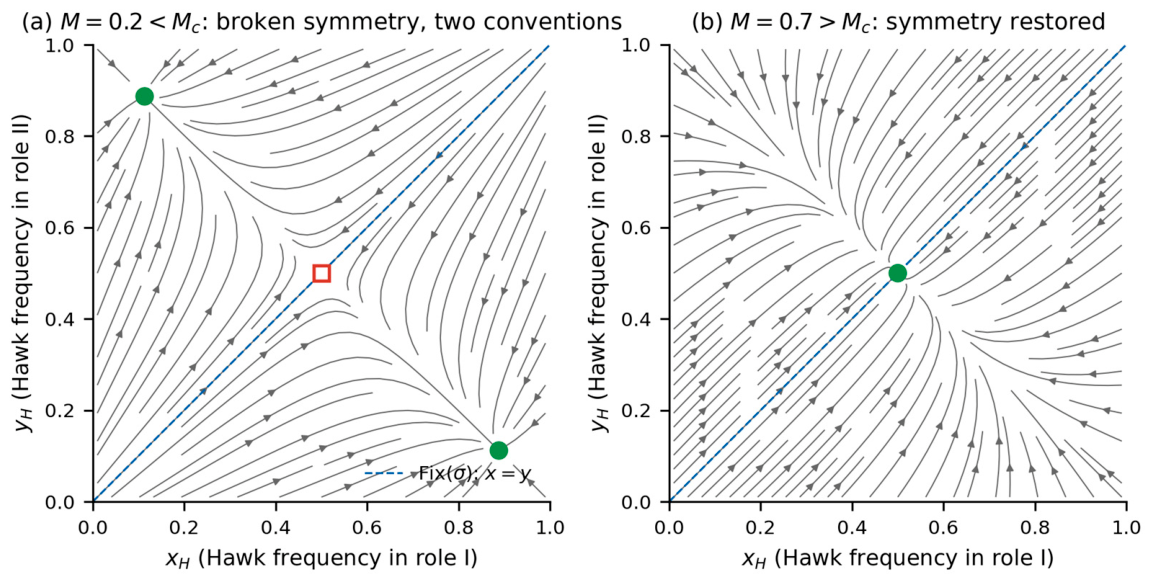
Figure 2.
(a) Rest points of the Hawk-Dove game (, ) as functions of , plotted as the difference between the Hawk frequencies in the two roles: filled circles are numerically determined sinks, open circles saddles, and the solid curve is the closed form of Proposition 9. (b) The two eigenvalues at the symmetric state: the transverse eigenvalue and the role-blind eigenvalue are mirror images at (Theorem 4) and are shifted in parallel by mutation (Theorem 6).
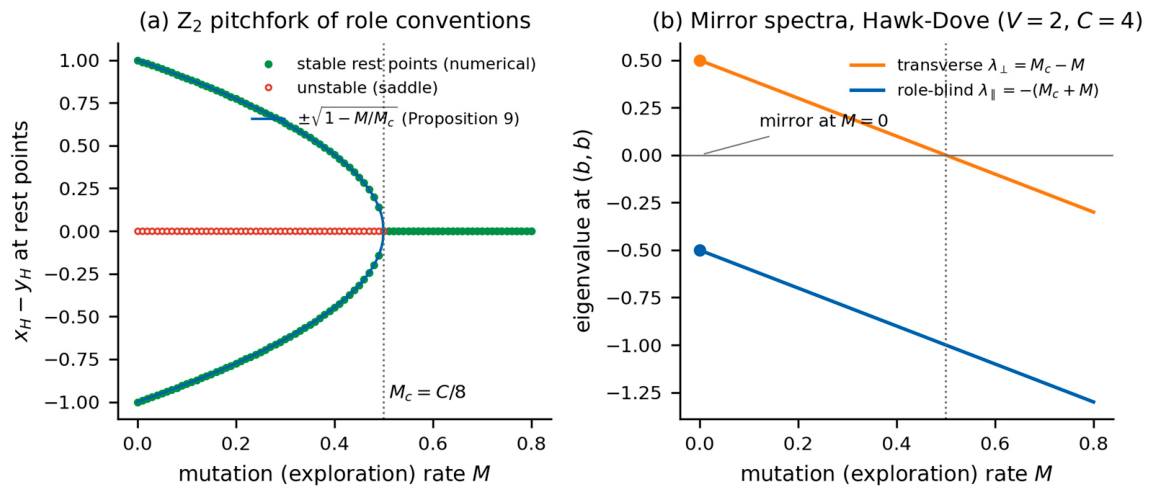
Figure 3.
(a) Critical exploration rate of Proposition 8 for two-strategy anti-coordination games, in units of , as a function of the mixed equilibrium (solid line), compared with the role-blind attraction rate (dashed line) and with thresholds determined numerically for Hawk-Dove games (circles). (b) The position of the diagonal rest point at , Equation (16), lies strictly between and .
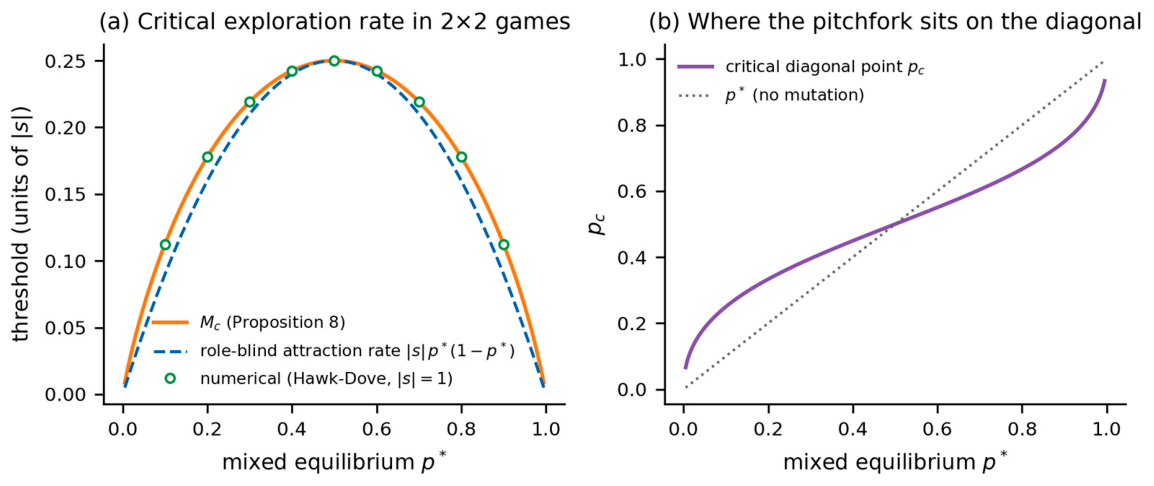
Figure 4.
Rock-paper-scissors in roles with and , for which and . (a) Frequencies of strategy 1 in the two roles at : the roles follow the same cycle half a period apart. (b) The three strategy frequencies in role I: each is the preceding one delayed by one third of the period, a discrete rotating wave. (c) Squared amplitude of on the attracting cycle as a function of , with a linear fit over ; the amplitude vanishes like , the signature of a supercritical Hopf bifurcation.
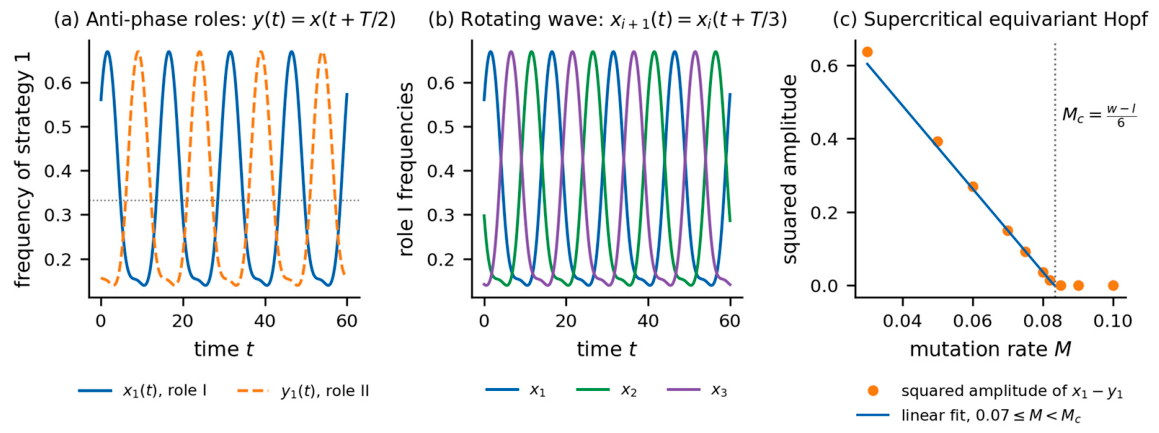
Figure 5.
Forced symmetry breaking in the Hawk-Dove game (, ) when role I values the resource at . Rest points as functions of for (grey), (blue) and (orange); filled circles are sinks and open circles saddles. The pitchfork unfolds: the branch connected to the unique high-mutation equilibrium bends towards the owner-Hawk (bourgeois) convention, while the owner-Dove convention is born in a saddle-node bifurcation at a lower mutation rate.
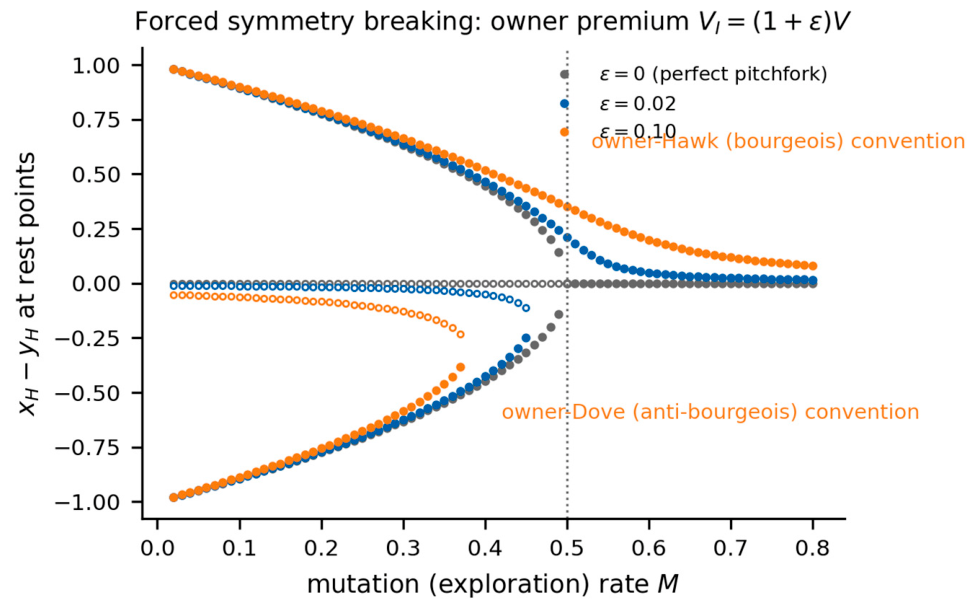
Figure 6.
Wright-Fisher process with two role-specific subpopulations of size for the Hawk-Dove game (, ) with and , so that . (a,b) Difference between the Hawk frequencies in the two roles for and ; dotted lines mark the deterministic conventions . (c) Mean lifetime of a convention between switches, in generations, against on a semi-logarithmic scale.
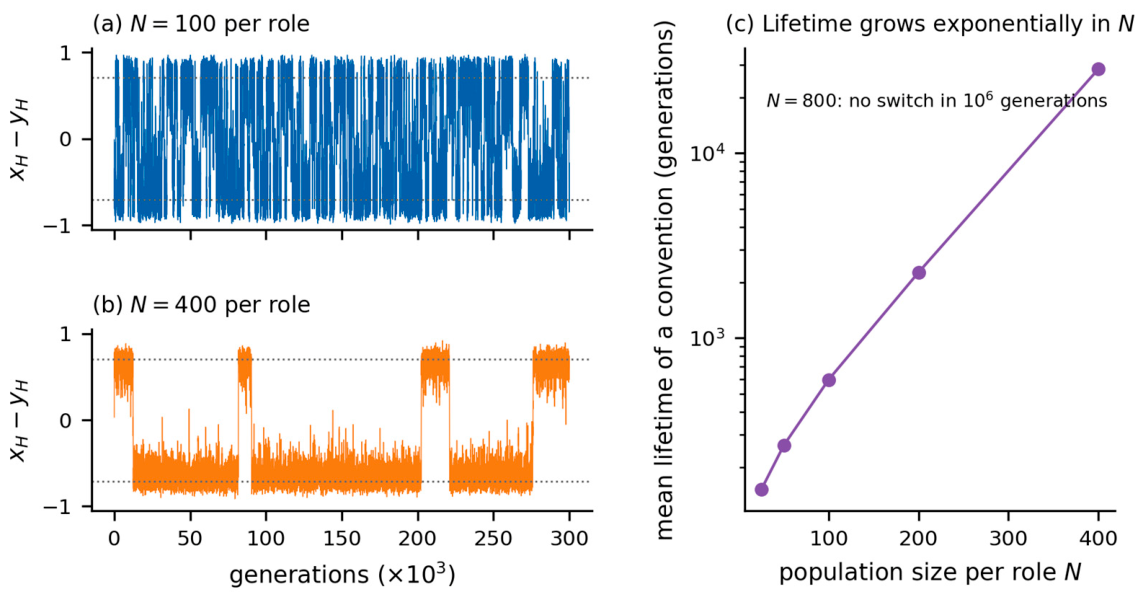

Table 1.
Role-blind and role-conditioned stability thresholds for six symmetric games. and are the smallest mutation rates above which the symmetric state of the role-blind dynamic and the symmetric state of the role-conditioned dynamic are hyperbolic sinks; .
Table 1.
Role-blind and role-conditioned stability thresholds for six symmetric games. and are the smallest mutation rates above which the symmetric state of the role-blind dynamic and the symmetric state of the role-conditioned dynamic are hyperbolic sinks; .
| Game | Role-blind spectrum at | Symmetry breaking below | ||
|---|---|---|---|---|
| pitchfork: two role conventions | ||||
| pitchfork: two role conventions | ||||
| equivariant Hopf: anti-phase role cycles | ||||
| Zero-sum rock-paper-scissors |
Table 2.
Hawk-Dove game with , (): predictions of Proposition 9 against multi-start root finding and numerical Jacobians. The conventions are reported by the Hawk frequency in role I; the second convention is its mirror image.
Table 2.
Hawk-Dove game with , (): predictions of Proposition 9 against multi-start root finding and numerical Jacobians. The conventions are reported by the Hawk frequency in role I; the second convention is its mirror image.
| Convention , predicted | Convention , numerical | Eigenvalues at convention, predicted / numerical | Eigenvalues at symmetric state, predicted / numerical | |
|---|---|---|---|---|
| 0.10 | 0.947214 | 0.947214 | ||
| 0.30 | 0.816228 | 0.816228 | ||
| 0.45 | 0.658114 | 0.658114 | ||
| 0.60 | none | none |
Table 3.
Rock-paper-scissors in roles, , , : squared amplitude of on the attracting cycle, its ratio to , and the period. Above trajectories converge to the symmetric state.
Table 3.
Rock-paper-scissors in roles, , , : squared amplitude of on the attracting cycle, its ratio to , and the period. Above trajectories converge to the symmetric state.
| Squared amplitude | Squared amplitude | Period | |
|---|---|---|---|
| 0.030 | 0.6373 | 11.95 | 17.164 |
| 0.050 | 0.3928 | 11.78 | 15.457 |
| 0.060 | 0.2703 | 11.58 | 14.975 |
| 0.070 | 0.1504 | 11.28 | 14.666 |
| 0.075 | 0.0924 | 11.09 | 14.572 |
| 0.080 | 0.0362 | 10.85 | 14.520 |
| 0.082 | 0.0143 | 10.74 | 14.512 |
| 0.085 | 0 | converges | |
| 0.100 | 0 | converges |
Table 4.
Wright-Fisher process with roles, Hawk-Dove game with , , , (). Switches are crossings between the levels and ; the mean lifetime is the mean time between switches; the deterministic value of is .
Table 4.
Wright-Fisher process with roles, Hawk-Dove game with , , , (). Switches are crossings between the levels and ; the mean lifetime is the mean time between switches; the deterministic value of is .
| per role | Generations simulated | Switches | Mean lifetime (generations) | Mean |
|---|---|---|---|---|
| 25 | 2635 | 152 | 0.643 | |
| 50 | 1520 | 263 | 0.620 | |
| 100 | 670 | 597 | 0.603 | |
| 200 | 441 | 2266 | 0.624 | |
| 400 | 35 | 28,421 | 0.649 | |
| 800 | 0 | no switch observed | 0.662 |
Disclaimer/Publisher’s Note: The statements, opinions and data contained in all publications are solely those of the individual author(s) and contributor(s) and not of MDPI and/or the editor(s). MDPI and/or the editor(s) disclaim responsibility for any injury to people or property resulting from any ideas, methods, instructions or products referred to in the content. |
© 2026 by the author. Licensee MDPI, Basel, Switzerland. This article is an open access article distributed under the terms and conditions of the Creative Commons Attribution (CC BY) license.
Copyright: This open access article is published under a Creative Commons CC BY 4.0 license, which permit the free download, distribution, and reuse, provided that the author and preprint are cited in any reuse.