
Submitted:
05 June 2026
Posted:
09 June 2026
You are already at the latest version
Abstract
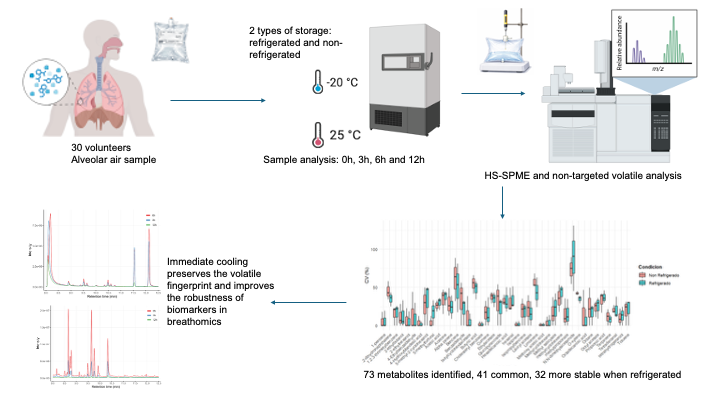
The present study aimed to evaluate the stability of volatile organic compounds (VOCs) in exhaled breath samples under different storage conditions (refrigeration at -20 °C vs. room temperature) and analysis times (0 h, 3 h, 6 h, 12 h). Alveolar exhaled breath samples were collected from 30 volunteers in 500 mL Tedlar® bags, followed by analysis using headspace solid-phase microextraction (HS-SPME) coupled to gas chromatography-mass spectrometry (GC-MS). The results showed the putative identification of 73 metabolites, 41 of which were common to both conditions. Pre-analytical storage of the samples at -20 °C significantly altered (p < 0.05) the stability of 33 of the 41 common VOCs analyzed. Specifically, refrigeration improved stability by reducing the coefficient of variation (CV) in 23 of these metabolites compared to samples kept at room temperature. Highly stable metabolites with a CV < 15% were found. A 90% loss of the analytical signal was observed 12 hours after sample collection, in contrast to the stability maintained in refrigerated samples. These findings highlight the influence of pre-analytical conditions on the integrity of volatile profiles, establishing immediate refrigeration as a fundamental step for the study of potential biomarkers present in breath. These results provide key criteria for the standardization of breathomics protocols.
Keywords:
exhaled breath
; breath biomarkers
; volatilomics
; stability of samples in the gas phase
; clinical metabolomics
Copyright: This open access article is published under a Creative Commons CC BY 4.0 license, which permit the free download, distribution, and reuse, provided that the author and preprint are cited in any reuse.


