

Submitted:
02 June 2026
Posted:
03 June 2026
You are already at the latest version
Abstract
Children diagnosed with Autism Spectrum Disorder (ASD) often encounter significant challenges in social interaction and communication. The integration of portable devices (e.g., mobile phones and tablets) into educational frameworks could transform the support landscape for students with ASD, facilitating the implementation of innovative and high-ly effective instructional strategies.
The objectives of this review are threefold: (a) to synthesize internationally recognized peer-reviewed research regarding the use of portable devices to enhance social skills in children with ASD; (b) to evaluate and analyze the efficacy of these digital interventions; and (c) to identify current limitations in the literature while providing evidence-based recommendations for practitioners, educators, and future research.
The article selection process was carried out in strict adherence to the PRISMA (Pre-ferred Reporting Items for Systematic Reviews and Meta-Analyses) guidelines, ensuring methodological rigor and transparency in the systematic review process. A systematic search was conducted using the following electronic databases: (a) PsycINFO, (b) Educa-tion Resources Information Center (ERIC), (c) Scopus, and (d) Web of Science. Fourteen studies were selected, and data on intervention components, implementation strategies, and outcomes were extracted. The results suggest that the use of portable devices as in-tervention tools can have a positive effect on the social skills of children with ASD. Future research should prioritise rigorous designs, including studies with larger samples and long-term follow-up to assess the sustainability of outcomes.
Keywords:
autism spectrum disorders
; portable devices
; technology
; mobile phones
; tablets
; social skills
; social dexterities
; special education
1. Introduction
According to the Centers for Disease Control and Prevention (CDC), approximately 1 in 31 (3.2%) eight-year-old children have been diagnosed with Autism Spectrum Disorder (ASD) [1], with boys being approximately four times more likely to be affected than girls [2,3,4]. Children with ASD commonly experience significant difficulties in social interaction, largely attributable to deficits in social functioning [5].
The construct of social skills encompasses a set of learned behaviors that enable individuals to engage effectively in social interactions. It reflects a dynamic process involving the individual, the communicative intent, and the surrounding social context. More specifically, social skills comprise behaviors that facilitate adaptive interpersonal engagement, as well as the regulation and avoidance of socially inappropriate responses [6]. Furthermore, these skills involve the capacity to navigate situational demands that elicit and sustain social interaction, thereby requiring a degree of social competence.
A central barrier to the development of social skills in children with ASD lies in the communication difficulties that permeate their everyday experiences. These individuals are significantly less likely to initiate social interactions [7], a pattern largely driven by impairments in joint attention and peer engagement, which constitute foundational mechanisms of early social reciprocity. Such disruptions may compromise social orienting, resulting in reduced responsiveness to social cues and the impression of diminished awareness of others. Consequently, limitations in initiating and sustaining reciprocal play emerge, restricting opportunities for meaningful peer engagement and thereby impeding the formation and maintenance of stable social relationships [8]. In addition, communication in ASD is often characterized by atypical prosodic features, including variations in intensity, rhythm, speech rate, and intonation patterns [9]. Within this context, social routines assume a critical role. Such routines consist of structured, mutually engaging activities between two or more individuals, during which the child’s attention is directed toward the social partner or the interaction itself rather than toward objects [10]. When these routines are experienced as intrinsically rewarding, they can provide a meaningful context for the acquisition and generalization of social communication skills [11].
Another domain that substantially influences everyday social functioning is that of social norms. These norms constitute implicit regulatory frameworks that govern behavior within a social group. They play a pivotal role in shaping actions, cognitive processes, and interpersonal interactions by establishing shared expectations regarding acceptable and non-compliant behavior. Understanding the mechanisms through which such norms emerge and exert influence is essential for a comprehensive account of social functioning [12]. Children with ASD are less likely to conform to social norms compared to their typically developing peers, which may hinder their ability to interpret social cues and pose challenges in the formation and maintenance of peer relationships [13].
Language development represents another critical factor influencing communication outcomes in children with ASD [14]. Early interventions targeting language acquisition—particularly during the preschool years—have been shown to significantly enhance linguistic competencies. Indeed, the implementation of early behavioral interventions is associated with more favorable developmental trajectories, including improvements in social adaptation, communication skills, and subsequent language development [15].
Importantly, the development of language skills alone is insufficient; their functional use is equally essential. Functional language encompasses the ability to express needs through requests, respond appropriately to questions, recognize opportunities for turn-taking, and engage in increasingly complex verbal behaviors. These competencies collectively contribute to both social and cognitive development [16].
Within the domains of linguistics and speech-language pathology, the term receptive lexicon refers to the set of words an individual can comprehend through listening or reading, even in the absence of active production. Children with ASD often exhibit difficulties in acquiring new vocabulary [17], which may constrain lexical development and, in turn, negatively affect social functioning [18]. It is estimated that approximately 25% to 30% of children with autism do not develop sufficient spoken language to meet their daily communication needs [19]. Consequently, in the absence of targeted and effective intervention, these individuals may reach adulthood with limited communicative autonomy, leading to persistent challenges in social interaction, employment opportunities, and community participation [20].
Finally, the functional use of language is closely intertwined with the development of social-emotional competencies. Interventions targeting social-emotional functioning aim to address core deficits associated with ASD, with the goal of enhancing both social understanding and emotional regulation [21].Children with ASD frequently exhibit impairments in social-emotional processing, including difficulties in emotion recognition and in understanding and responding appropriately to social interactions [5]. These deficits in social-emotional reciprocity can affect both emotional expression and broader patterns of social engagement [22]. Promoting inclusion remains a central objective in efforts to enhance social skills, as inclusive environments provide children with opportunities to participate meaningfully, engage in the learning process, and pursue individualized developmental goals [23].
1.1. ASD and Portable Devices
Children on the autism spectrum appear to demonstrate a distinct preference for digital technologies, a tendency that has been attributed to their affinity for structured, predictable, and discrete forms of information processing [24]. The integration of technological tools into educational contexts has substantially transformed the provision of support for students with developmental disabilities, introducing innovative and increasingly effective instructional approaches [25].
Interventions targeting communication and social-emotional development through the use of computer-based technologies are becoming increasingly prevalent, with a growing body of evidence indicating positive outcomes. These digital interventions are widely regarded as valuable tools for enhancing core developmental domains [26]. Empirical findings further underscore the potential of such approaches to improve both communication and social-emotional skills in children with ASD [27,28,29].
Portable devices, including mobile phones and tablets, constitute a central component of contemporary digital technologies due to their distinctive affordances that enhance usability and accessibility. These affordances include portability, compact design, multimodal information presentation, and intuitive interfaces. Collectively, these features render portable devices particularly well-suited for supporting the development of social skills in children with ASD [30].
Moreover, portable devices facilitate communication through the use of visual supports, such as symbols, images, and written text. Research suggests that children with ASD show a marked preference for such modalities [31]. likely due to their responsiveness to structured and visually organized environments [32]. Within this context, tablet-based interventions—particularly those utilizing iPads—have been shown to significantly enhance communication abilities, enabling children to express their needs more effectively and to participate more meaningfully in social interactions [33].
Furthermore, evidence indicates that the use of such devices may contribute to a reduction in communication-related challenging behaviors, primarily through the enhancement of functional communication and social engagement, thereby supporting broader social development [34]. However, it is essential that the implementation of these technologies be guided by clearly defined criteria and tailored to the individualized needs of each learner in order to maximize their effectiveness [35].
2. Methodology
The present review employed a systematic search strategy in strict accordance with the PRISMA (Preferred Reporting Items for Systematic Reviews and Meta-Analyses) guidelines, which are widely recognized as the gold standard for the conduct and reporting of high-quality systematic reviews. The corresponding PRISMA checklist was completed and is provided in Appendix B. In accordance with PRISMA guidelines, the review was guided by the following focused question: “Do interventions using portable devices enhance social skills in children with ASD?”
2.1. Search Process
A systematic search was conducted across four electronic databases: (a) PsycINFO, (b) Education Resources Information Center (ERIC), (c) Scopus, and (d) Web of Science. These databases were selected due to their strong focus on educational and psychological research, as well as their accessibility through institutional subscriptions.
Titles and abstracts of all retrieved records were screened for relevance. The search strategy incorporated the following terms: “Autism” AND (“apps” OR “mobile” OR “tablet” OR “iPad” OR “mobile devices”) AND “social skills”. Studies published between 2020 and December 2025 were considered eligible, to ensure the inclusion of the most recent evidence in the field of autism research. The review process was conducted rigorously and involved critical evaluation by all authors. No automation tools were used at any stage of the review.
2.2. Inclusion and Exclusion Criteria
This study aimed to examine the effects of mobile application–based interventions on the social skills of children with ASD. The inclusion criteria for eligible studies were defined as follows: (a) participants had a formal diagnosis of ASD; (b) participants did not present with comorbid conditions (e.g., Tourette syndrome, visual impairments, hearing loss, attention-deficit/hyperactivity disorder [ADHD]); (c) studies were published in peer-reviewed scientific journals or conference proceedings (d) participants were involved in an intervention incorporating at least one mobile application; (e) the intervention explicitly targeted social skills; (f) studies were published between 2020 and December 2025; and (g) participants were between 2 and 12 years of age.
Studies were excluded if they: (a) were not published in English; (b) did not involve the use of at least one mobile application; or (c) included participants outside the specified age range. In addition, books and literature reviews. The focus on recent, peer-reviewed publications written in English was intended to ensure both the quality and relevance of the included evidence. The selected age range was chosen to capture interventions targeting preschool and primary school populations, as intervention approaches for adolescents may differ substantially and warrant separate investigation.
The initial database search yielded a total of 335 records (see Figure 1). Following the removal of duplicates, 224 records remained. Of these, 20 full-text articles were assessed for eligibility. A total of six studies were excluded for the following reasons: three were pilot studies [36,37,38]; one did not involve the use of a portable device [39]; one included participants with both ASD and ADHD [40]; and one did not implement an intervention targeting social skills [41]. Consequently, 14 studies were included in the final synthesis.
All authors independently screened the results obtained from the four databases to determine their eligibility based on the predefined inclusion and exclusion criteria. The risk of bias in the included studies was assessed through independent evaluation against these criteria.
To further minimize potential bias related to the selection process and reporting of results, a set of stringent and clearly defined criteria was established collaboratively by the authors prior to the screening procedure. This approach ensured consistency in study selection and reduced the likelihood of discrepancies, as studies that did not meet the established criteria were systematically excluded from the review.
2.3. Data Extraction and Coding Measures
To facilitate interpretation and organization, the fourteen studies included in this review were systematically examined, classified, coded, and evaluated manually according to a set of predefined criteria: (a) year of publication; (b) participants’ age range (in years); (c) sample characteristics (including sample size and gender); (d) duration of the intervention; (e) measurement system; (f) the mobile applications and portable devices employed in each intervention; (g) intervention outcomes; and (h) reported limitations, along with recommendations for future research.
3. Results
3.1. Participant’s Characteristics
A total of 201 children participated in interventions involving portable devices across the 14 studies included in this review. Participants’ ages ranged from 3 to 12 years. Gender was not reported in several studies sex [42,43,44].Among the studies that did report this information, a total of 79 participants were included, of whom 61 were boys and 18 were girls.
3.2. Duration of the Intervention
The duration of interventions varied considerably across the included studies. In six studies, the intervention length was not predetermined; instead, it was contingent upon participants reaching a predefined mastery criterion or demonstrating data stability [43,45,46,47,48,49].
Five studies reported intervention durations ranging from 3 to 8 weeks [15,25,42,44,45]. The remaining three studies reported the number of intervention sessions rather than overall duration, with sessions ranging from one to ten, without specifying the total intervention timeframe time [22,43,50]. Across studies, the duration of individual sessions ranged from 5 to 40 minutes, with the majority lasting between 10 and 20 minutes.
3.3. Research Design
The studies included in this review (Table 1) exhibited substantial variability in research design. The majority employed single-case experimental designs. Specifically, three studies used a multiple probe design [49,50,51], whereas four studies implemented a multiple baseline design [25,43,47,48]. Two studies adopted an alternating treatment design [12,46], and one study utilized functional analysis [45].
Regarding group-based research designs, three studies employed group experimental designs. One study implemented a randomized controlled trial (RCT) [44], another used a between-subjects controlled design [22], and one adopted a quasi-experimental design [42]. Finally, one study employed a pre-test, post-test, and follow-up design [15].
3.4. Quality Appraisal
Methodological quality was assessed using the Mixed Methods Appraisal Tool (MMAT) version 2018, a validated framework developed by the team led by Pierre Pluye at McGill University. The MMAT was selected due to its capacity to critically appraise a wide range of study designs within a single integrated framework.
Twelve of the included studies [12,22,25,42,43,45,46,47,48,49,50,51] employed a quantitative non-randomized design. All twelve studies reported clearly defined research questions, and their data collection procedures were aligned with the stated study objectives.
Regarding sample representativeness, one study [42] was rated as unclear, as the sample consisted exclusively of children with mild learning needs, which may limit generalizability to the broader target population. With respect to measurement appropriateness, three studies [25,45,49] were rated as unclear, as data collection was conducted exclusively within school-specific contexts, thereby potentially limiting external validity.
In addition, two studies raised concerns regarding measurement procedures. Khoirunnisa et al. [43] relied primarily on researcher-based observations, while Anam et al. [42] used parent and teacher reports as primary data sources. Furthermore, two studies were considered to have methodological limitations in implementation. Chapin et al. [50] included an insufficient number of intervention sessions, whereas Güler & Erdem [46] reported that several sessions were delivered solely by the researcher, which may have introduced potential bias.
With regard to outcome data completeness, three studies were rated as uncertain. Both Anam et al. [42] and Khoirunnisa et al. [43] lacked a control group and implemented relatively short intervention periods, while Chapin et al. [50] reported incomplete data due to inconsistent participant attendance. Regarding control of confounding variables, Garcia et al. [45] employed a multi-component intervention design, which limited the ability to isolate the specific contribution of individual components to observed behavioral changes. Finally, intervention fidelity was adequately maintained across all included studies.
The remaining two studies [15,44] employed quantitative randomized designs. Both studies presented clearly defined research questions, and their data collection procedures were aligned with their stated objectives. Randomization procedures were appropriately implemented in both cases. However, in terms of baseline comparability, Hesami et al. [15] reported variation in autism severity across groups, which may have affected initial group equivalence. Regarding outcome data completeness, Hesami et al. [15] included a relatively short follow-up period, limiting the generalizability of findings over time. Moreover, outcome assessors were not blinded in either study. Hassan et al. [44] relied on parent and teacher reports, whereas Hesami et al. [15] collected data through family feedback. Finally, intervention adherence was high across both studies, with participants following assigned protocols as intended.
3.5. Effects of the Intervention
Across all 14 studies included in the present review, significant improvements were reported in a broad range of social skills among children with ASD. The studies were categorized according to the type of intervention employed, with portable devices serving as a central component of the intervention delivery.
3.5.1. Portable Devices and Social Stories
Social Stories represent an evidence-based instructional approach widely used to support children and adolescents with ASD in the acquisition of appropriate social skills. They function as structured narratives that model effective interpersonal behaviors, thereby promoting socially adaptive responses and facilitating social inclusion [52].
The study by Güler et al. [46] examined the effectiveness of mobile-based Social Story Maps, presented in both animated and non-animated formats, in enhancing listening comprehension, cognitive skills, and social communication abilities (specifically greeting and requesting assistance) in children with ASD. In addition, the study investigated potential differences in effectiveness and efficiency between the two modalities. The findings indicated that both formats were equally effective in improving social communication skills. However, video-based Social Stories demonstrated greater efficiency, as mastery of targeted skills was achieved in a shorter time frame. The intervention was delivered through the “Mobile Social Story Map” application on a tablet device.
Similarly, Costescu et al. [12] compared the effects of traditional (print-based) and digital Social Stories in teaching social norms to children with ASD. In this study, Social Stories were delivered via a mobile phone using an image-based application. The results indicated improvements in participants’ understanding of social norms; however, no statistically significant differences were found between the two delivery formats. Importantly, the findings suggest that mobile-based Social Stories are as effective as printed versions, highlighting their potential for broader implementation given their accessibility and cost-effectiveness.
3.5.2. Portable Devices and Alternative and Augmentative Communication
The primary aim of Augmentative and Alternative Communication (AAC) systems is to support children with ASD by addressing both verbal and non-verbal communication challenges that may arise [53]. Advances in technology have facilitated the development of tools such as portable devices, which enable the use of symbols, images, and text to support interactive communication tailored to the needs of children with ASD [54]. The integration of AAC systems with portable technologies provides enhanced mobility and usability, while such devices are generally considered socially acceptable and widely available in everyday contexts [55].
The study by Alzyoudi and Alghazali [25] demonstrated that AAC intervention delivered via iPad may serve as a practical and effective approach for improving communication skills in children with ASD, with significant gains observed in participants’ ability to initiate requests and engage in verbal interactions through iPad-based applications. These findings support the integration of such technologies into special education settings as a means of addressing complex communication needs. Notably, this intervention was implemented using an iPad-based speech-generating device (SGD) application for the first time with participants from non-Western contexts, suggesting that its effectiveness may extend across diverse cultural settings.
In a study by Chapin et al. [50], the Visual Scene Display (VSD) approach was used in conjunction with AAC systems. In this intervention, photographs of meaningful events were displayed on a tablet, with specific regions (hotspots) programmed to activate speech output when touched. The study was conducted using the “EasyVSD” application on a Samsung Pro tablet with three toddlers, and the findings were highly encouraging. Results indicated that combining AAC with VSD in very young children with ASD and complex communication needs can lead to significant increases in communicative turn-taking, as well as improvements in overall engagement during communication interactions.
Speech-generating devices (SGDs) constitute a subcategory of AAC systems. These electronic tools incorporate a large set of symbols, including photographs and color or black-and-white line drawings representing words or phrases, and can produce auditory output through digitized or synthesized speech [56].
Waddington et al. [48] conducted a study using the “Proloquo2Go” application on an iPad and examined instructional procedures for teaching children with ASD to use SGDs to request participation in social routines. Specifically, the study evaluated an intervention designed to teach two children—who had already acquired requesting skills for tangible items—to request continuation of social interactions using an SGD. The social routines included, for example, peek-a-boo, making funny faces, foot massages, singing “Five Little Monkeys Jumping on the Bed,” piggyback rides, tickling, singing “Row, Row, Row Your Boat,” and bouncing on a ball. The findings indicated improvements in participants’ ability to request continuation of social routines with their parents, as well as the development of the ability to make choices between different routines.
The study by Genc-Tosun et al. [47] investigated the effects of simultaneous SGD use with dynamic screen displays on the acquisition of multistep question-answering skills. The intervention employed the “Dokun Konus” iPad-based speech-generating application with two children with ASD. Results demonstrated improvements in participants’ ability to answer questions, with maintenance of skills observed at a five-week follow-up. Additionally, teachers reported that the intervention was both effective and feasible, despite their lack of prior experience with SGDs.
3.5.3. Portable Devices and Augmented Reality
Augmented Reality (AR) refers to a technology that integrates virtual elements into the real-world environment in real time. Specifically, it overlays digitally generated features onto physical contexts through three-dimensional visualization techniques [57,58,59]. AR thus represents a convergence between the physical and virtual worlds, within which children with ASD have been shown to demonstrate strong receptivity to such intervention modalities [60].
The study by Khoirunnisa et al. [43] investigated the integration of AR into educational contexts and concluded that it can substantially enhance social communication skills in children with ASD. The sample consisted of four children aged 7 to 12 years with limited or absent expressive language abilities. The findings indicated improvements in communication skills, particularly in participants’ ability to respond appropriately and engage in dialogue. More specifically, following the intervention, children demonstrated increased capacity to answer questions and provide contextually relevant comments within an AR-mediated interactive environment. The intervention was delivered via a mobile application.
Similarly, the study by Rajibul et al. [42] aimed to support children with ASD and mild cognitive difficulties in learning the English alphabet, while also examining whether the intervention influenced social engagement and communication skills. The results indicated that the use of the “FatimAR” smartphone application, in combination with the book Live by Knowledge, led to improvements in both letter recognition and memory recall of the English alphabet. In addition, the intervention contributed to enhanced social engagement and improved communication skills among participating children with ASD.
Finally, the study by Lyu et al. [22] introduced “EMooly,” a tablet-based game designed to engage caregivers of children with ASD through the integration of Augmented Reality (AR) and Artificial Intelligence (AI). The intervention aimed to enhance both social skills and empathy in children with ASD. The system was developed collaboratively by five experts in neuroscience and education and incorporated individualized social stories targeting emotion recognition and facial expression interpretation. The findings were highly promising, as results from a sample of 24 children indicated significant improvements in emotion recognition skills. Overall, the integration of AR and AI appears to substantially enhance socio-emotional functioning in children with ASD, particularly when combined with active caregiver involvement.
3.5.4. Portable Devices and Serious Games
Serious games constitute a category of educational interventions that differ from entertainment-oriented games due to their explicit design focus on skill acquisition and development. Their primary aim extends beyond recreation, targeting learning outcomes and cognitive enhancement in users [61]. In the context of rapidly evolving digital technologies, serious games offer a range of advantages, including the ability to simulate ecologically valid, real-life scenarios [62]. Accordingly, they represent a valuable adjunct to conventional therapeutic and educational interventions for individuals with ASD.
The study by Hesami et al. [15] focused on the development of a mobile serious game titled “Kookism” and evaluated its effectiveness in teaching Persian vocabulary to children with ASD. Participants were assigned to two groups: one receiving Applied Behavior Analysis (ABA) alone, and the other receiving ABA in combination with the “Kookism” game. The results indicated a statistically significant difference between the experimental and control groups in favor of the intervention group with regard to gains in receptive vocabulary. Specifically, engagement with the “Kookism” game significantly enhanced the receptive lexicon of children with ASD aged 4–9 years, thereby supporting the study’s initial hypotheses.
Similarly, Ahmed Hassan et al. [44] developed a serious multiplayer mobile game, “Zirkus,” for Android devices, aimed at enhancing socio-emotional functioning in children with ASD. The game incorporates interactive learning modules designed to facilitate emotion understanding and recognition. The primary objective of the study was to improve emotional recognition, empathy, and prosocial behavior. Findings indicated that participants demonstrated improved abilities in identifying and differentiating emotional states. Overall, the observed improvements in emotion recognition through this type of intervention suggest promising implications for both socio-emotional development and learning trajectories in children with ASD.
3.5.5. Portable Devices and Additional Intervention Models
Three additional studies were included in this review, as they did not meet the previously defined thematic criteria.
The first study by Sng et al. [49] examined whether the commercial iPad application “Conversation Coach” could support children with ASD in selecting appropriate, on-topic responses during conversational exchanges, and whether these skills could generalize to naturalistic environments. The intervention employed scripted prompts with three response options: one correct (on-topic and socially appropriate), one partially appropriate, and one off-topic. The findings indicated that instruction delivered exclusively via iPad was insufficient for participants to master the targeted conversational skill. This may be attributed to the heterogeneity of individual learner profiles and associated developmental characteristics. Overall, the results suggest that more systematic and direct instructional approaches are often required for the acquisition of functional social communication skills in children with ASD.
The second study by Osos et al. [51] investigated the effectiveness of video-enhanced activity schedules delivered via the Apple Keynote iPad application in improving social skills in children with ASD. The intervention was compared with electronic activity schedules consisting solely of static images and text. Results indicated variability in learning outcomes as two out of four participants acquired the targeted skills more rapidly using video-enhanced schedules, one participant demonstrated equivalent performance across both conditions, and one participant met learning criteria only under the static image condition. Although video preparation required additional time, this approach may constitute a particularly effective instructional tool for certain learners, as it can facilitate comprehension and accurate execution of social behaviors.
Children with ASD often experience difficulties in speech prosody, particularly in relation to vocal intensity, rhythm, rate, and intonation patterns. Lastly, Garcia et al. [45] implemented an intervention targeting excessively loud speech in children with ASD. The participants were two boys who exhibited elevated vocal intensity and vocal stereotypies. The intervention utilized the “Voice Meter Pro” application on an iPad, which provided real-time visual feedback for vocal intensity (blue indicating quiet speech, green appropriate intensity, and red loud speech). Results showed that for one participant, the intervention reduced high-intensity vocalizations and increased appropriately modulated speech. For the second participant, outcomes were inconclusive
4. Discussion
In contemporary contexts, technological development is advancing at a rapid pace in response to evolving human needs. In the present literature review, portable devices served as the primary delivery medium across a range of intervention modalities, including Social Stories, AR, serious games, AAC, and other related intervention approaches. This widespread adoption is partly attributed to the documented preference of children with ASD for digital technologies.
Regarding study outcomes, improvements were reported in socio-emotional skills [22,44,46], communication skills [25,43,46] as well as in broader domains of social functioning, including social engagement [42], social routines (Waddington et al., 2023), and social interaction [25]. In addition, gains were observed in specific components of communicative competence in children with ASD, including receptive vocabulary [15], question answering [47], turn-taking (Chapin et al., 2022), prosody [45] and on-topic conversational responding [49].
However, given that this remains a relatively emerging field of research, several methodological limitations can be identified. The most prominent limitation concerns small sample sizes [22,25,43,45,46,47,48,49,50,51], as well as restricted age ranges [46], both of which limit the generalizability of findings.
5. Conclusions
The studies included in this review employed portable devices as the primary delivery tool across a range of intervention approaches targeting the improvement of social skills in children with ASD. The findings are particularly encouraging, as improvements across multiple domains of social functioning were reported in nearly all studies included.
However, two key issues emerge for future research. First, the extent to which these findings can be generalized to naturalistic, everyday environments remains unclear. Second, questions persist regarding the durability and maintenance of intervention effects over time.
Overall, this review indicates that the integration of mobile technologies into interventions for children with ASD is no longer a future-oriented possibility but an established contemporary practice with demonstrable benefits. The portability of devices, the flexibility of software customization, and the availability of visual supports collectively position these technologies as valuable tools for enhancing communication and social interaction in this population.
Author Contributions
Conceptualization, Evangelos-Stylianos Pavlou and Aristogiannis Garmpis; Methodology, Evangelos-Stylianos Pavlou, Despina Papoudi and Aristogiannis Garmpis; Resources, Evangelos-Stylianos Pavlou and Despina Papoudi; Writing – original draft, Evangelos-Stylianos Pavlou and Aristogiannis Garmpis; Writing – review & editing, Despina Papoudi, Charalampos Karagiannidis and Aristogiannis Garmpis; Supervision, Despina Papoudi, Charalampos Karagiannidis and Aristogiannis Garmpis.
Funding
This research received no external funding.
Institutional Review Board Statement
Not applicable.
Informed Consent Statement
Not applicable.
Data Availability Statement
No new data were created or analyzed in this study.
Conflicts of Interest
The authors declare no conflicts of interest.
Appendix A
PsycINFO
| Effectiveness of Using Mobile Technology to Improve Cognitive and Social Skills Among Individuals With Autism Spectrum Disorder: Systematic Literature Review | No |
| Using educational robotics to support motor, cognitive, and social skills in a child with spinal muscular atrophy. A single-case study | No |
| Online social interaction skill group for adolescents on the autism spectrum: Preliminary outcomes of the START Connections program | No |
| MiEmo: A multi-modal platform on emotion recognition for children with autism spectrum condition | No |
| Bifidobacterium animalis subsp. lactis Probio-M8 alleviates abnormal behavior and regulates gut microbiota in a mouse model suffering from autism | No |
| Determinants of physical activity of transitioning adult children with Autism Spectrum Disorder | No |
| Can Social Communication Skills for Children Diagnosed With Autism Spectrum Disorder Rehearsed Inside the Video Game Environment of Minecraft Generalize to the Real World? | Νο |
| The Development of an Escape Room–Based Serious Game to Trigger Social Interaction and Communication Between High-Functioning Children With Autism and Their Peers: Iterative Design Approach | No |
| ChatGPT-Delivered Physical Activity Intervention for Children With Autism Spectrum Disorder: Pre-Post Feasibility Study | No |
| Improved socio-emotional skills in students with autism spectrum disorder (ASD) following an intervention supported by an augmented gamified environment | No |
| Gamification in Mobile Apps for Children With Disabilities: Scoping Review | No |
| Unlocking inclusive education: A quality assessment of software design in applications for children with autism | No |
| Effectiveness of Artificial Intelligence–Based Platform in Administering Therapies for Children With Autism Spectrum Disorder: 12-Month Observational Study | No |
| Research on the Effect of Dance Therapy on Improving Social Communication Ability of Children with Autism | No |
| Digital Health Interventions Targeting Psychological Health in Parents of Children With Autism Spectrum Disorder: Protocol for a Scoping Review | No |
| ICT training for educators of Granada for working with people with autism | No |
| Leveraging deep learning for enhanced diagnosis of autism spectrum disorder using resting-state functional magnetic resonance imaging and clinical data | No |
| Portrayal of Autism Spectrum disorder and its treatments in Qatar’s leading newspapers: A content analysis study | No |
| A Multi-Classifier-Based Recommender System for Early Autism Spectrum Disorder Detection using Machine Learning | No |
| A Smart System Facilitating Emotional Regulation in Neurodivergent Children | No |
| ASD2-TL∗ GTO: Autism spectrum disorders detection via transfer learning with gorilla troops optimizer framework | No |
| Developing Culturally Appropriate Content for a Child-Rearing App to Support Young Children’s Socioemotional and Cognitive Development in Afghanistan: Co-Design Study | No |
| The Performance of Emotion Classifiers for Children With Parent-Reported Autism: Quantitative Feasibility Study | No |
| Altered engagement of the speech motor network is associated with reduced phonological working memory in autism | No |
| Identifying children at risk: Empowering teachers using the RedFlag app | No |
| Direct Support Professionals’ Perspectives on Using Technology to Help Support Adults With Autism Spectrum Disorder: Mixed Methods Study | No |
| Educational Software as Assistive Technologies for Children with Autism Spectrum Disorder | No |
| Heart Rate Variability Biofeedback to Treat Anxiety in Young People With Autism Spectrum Disorder: Findings From a Home-Based Pilot Study | No |
| Virtual reality and naturalistic developmental behavioral interventions for children with autism spectrum disorder | No |
| Smartphone App to Address Loneliness Among College Students: Pilot Randomized Controlled Trial | No |
| In support of neurodiverse participatory sensemaking | No |
| Development of an online skills training platform for autistic adults: A participatory approach | No |
| Development and Evaluation of Intelligent Serious Games for Children With Learning Difficulties: Observational Study | No |
| Patterns and impact of technology use in autistic children | No |
| Empowering Autistic Creativity Through Art and Technology | No |
| Training and Profiling a Pediatric Facial Expression Classifier for Children on Mobile Devices: Machine Learning Study | No |
| An acceptability and feasibility investigation of a community-based motor program for autistic children with moderate and high support needs | No |
| The impact of face masks on autistic and non-autistic adults’ face processing abilities | No |
| A systematic review for artificial intelligence-driven assistive technologies to support children with neurodevelopmental disorders | No |
| No evidence that autistic traits predict programming learning outcomes | No |
| Building the design ICT inventory (DICTI): A Delphi study | No |
| Virtual self care: Using virtual reality to support adolescent mental health and wellbeing | No |
| Impact of screen and social media use on mental health | No |
| A Narrative Review to Identify Promising Approaches for Digital Health Interventions to Support Emotion Regulation for Adolescents With Attention-Deficit/Hyperactivity Disorder | No |
| Can robots do therapy?: Examining the efficacy of a CBT bot in comparison with other behavioral intervention technologies in alleviating mental health symptoms | No |
| The Impact of Mobile Technology-Delivered Interventions on Youth Well-being: Systematic Review and 3-Level Meta-analysis | No |
| Deep phenotyping in 3q29 deletion syndrome: recommendations for clinical care | No |
| Examining clinicians’ concerns delivering telemental health interventions directly to autistic individuals during COVID-19 | No |
| Gaze behavior in face-to-face interaction: A cross-cultural investigation between Japan and The Netherlands | No |
| Two ways to measure interpersonal synchrony in dance/movement therapy: Comparing accelerometer data with observational data | No |
| Face recognition’s practical relevance: Social bonds, not social butterflies | No |
| Gaze analysis: A survey on its applications | No |
| Barriers and facilitators to social-emotional health screening in pediatrics: Results from a qualitative study of practitioner perspectives | No |
| Barriers and facilitators: The contrasting roles of media and technology in social–emotional learning | No |
| User-Friendly Chatbot to Mitigate the Psychological Stress of Older Adults During the COVID-19 Pandemic: Development and Usability Study | No |
| Loneliness: Adolescents’ perspectives on what causes it, and ways youth services can prevent it | No |
| A Digital Cognitive-Physical Intervention for Attention-Deficit/Hyperactivity Disorder: Randomized Controlled Trial | No |
| Professional competencies for sexuality and relationships education in child and youth social care: A scoping review | No |
| The connecting brain in context: How adolescent plasticity supports learning and development | No |
| Biallelic loss-of-function variants in CACHD1 cause a novel neurodevelopmental syndrome with facial dysmorphism and multisystem congenital abnormalities | No |
| A Multiagent Platform for promoting physical activity and learning through interactive educational games using the depth camera recognition system | No |
| Digital methodology for parental self-assessment of child development | No |
| Assessing the Usability and Feasibility of Digital Assistant Tools for Direct Support Professionals: Participatory Design and Pilot-Testing | No |
| Immersive Virtual Reality eHealth Intervention to Reduce Anxiety and Depression in Pregnant Women: Randomized Controlled Trial | No |
| Serious games to support emotional regulation strategies in educational intervention programs with children and adolescents. Systematic review and meta-analysis | No |
| Is learning analytics applicable and applied to education of students with intellectual/developmental disabilities? A systematic literature review | No |
| Alternative and Augmentative Communication Technologies for Supporting Adults With Mild Intellectual Disabilities During Clinical Consultations: Scoping Review | No |
| Do we really need this robot? Technology requirements for vestibular rehabilitation: Input from patients and clinicians | No |
| Indigenous Parents’ Perspectives of Factors That Facilitate or Impede Engagement in Internet-Based Parenting Support Programs: Interpretive Description Study | No |
| University Students’ Opinions on Using Intelligent Agents to Cope with Stress and Anxiety in Social Situations | No |
| On the potential of supporting autonomy in online video interview training platforms | No |
| Virtual reality and mental health in older adults: a systematic review | No |
| Prevention and Treatment of Social Anxiety Disorder in Adolescents: Protocol for a Randomized Controlled Trial of the Online Guided Self-Help Intervention SOPHIE | No |
| Awareness, Prevention, Detection, and Therapy Applications for Depression and Anxiety in Serious Games for Children and Adolescents: Systematic Review | No |
| A social robot to deliver a psychotherapeutic treatment: Qualitative responses by participants in a randomized controlled trial and future design recommendations | No |
| Body, emotions, and sexuality in the metaverse: A randomized control trial exploring the use of second life for an avatar-based intervention to support women with female orgasmic disorder | No |
| Concordance between subjective and objective measures of infant sleep varies by age and maternal mood: Implications for studies of sleep and cognitive development | No |
| A scoping review of the program components, practice components, and outcomes of behaviour support programs delivered to children and young people in out-of-home care | No |
| Functional patterns of neural activation during vocal emotion recognition in youth with and without refractory epilepsy | No |
| Associations between touchscreen exposure and hot and cool inhibitory control in 10-month-old infants | No |
| Taking a stand or standing aside? How to conceptualize the emerging phenomenon of university activism | No |
| Integrating People, Context, and Technology in the Implementation of a Web-Based Intervention in Forensic Mental Health Care: Mixed-Methods Study | No |
| Social gaming: A systematic review | No |
| Criminal insanity in Bulgaria and Norway: Analysing the prospect of a common approach | No |
| Using Video Games to Improve Capabilities in Decision Making and Cognitive Skill: A Literature Review | No |
| Social companionship with artificial intelligence: Recent trends and future avenues | No |
| A literature survey of the robotic technologies during the COVID-19 pandemic | No |
| Metaverse-based social skills training programme for children with autism spectrum disorder to improve social interaction ability: an open-label, single-centre, randomised controlled pilot trial | Yes |
| Healthcare Interventions for Children Using Nonimmersive Virtual Reality: A Mixed Methods Systematic Review | No |
| Visual attention patterns during a gaze following task in neurogenetic syndromes associated with unique profiles of autistic traits: Fragile X and Cornelia de Lange syndromes | No |
| Evaluating the Feasibility of Emotion Expressions in Avatars Created From Real Person Photos: Pilot Web-Based Survey of Virtual Reality Software | No |
| Facial Image-Based Autism Detection: A Comparative Study of Deep Neural Network Classifiers | No |
| Developmental Dopaminergic Signaling Modulates Neural Circuit Formation and Contributes to Autism Spectrum Disorder–Related Phenotypes | No |
| Feasibility and Acceptability of Delivering Pivotal Response Treatment for Autism Spectrum Disorder via Telehealth: Pilot Pre-Post Study | No |
| Q-CHAT-NAO: A robotic approach to autism screening in toddlers | No |
| Helping Optimize Language Acquisition (HOLA) Online Parent Training Modules for Latinx Parents of Toddlers at Risk for ASD: Protocol for a Pilot Funded by the Organization for Autism Research | No |
| Participatory design of augmented reality games for word learning in autistic children: the parental perspective | No |
| Receptive and expressive language ability differentially support symbolic understanding over time: Picture comprehension in late talking and typically developing children | No |
| A mediation analysis of Autistic-like traits and gaming motivations on problem gaming symptoms: Are the effects of social and escape motives the same? | No |
| Digitally Diagnosing Multiple Developmental Delays Using Crowdsourcing Fused With Machine Learning: Protocol for a Human-in-the-Loop Machine Learning Study | Νο |
| Evaluation of the effectiveness of a serious game titled “Kookism” on the receptive lexicon in 4-9-year-old autistic children | Yes |
| Effects of fecal microbiota transplantation on behavioral abnormality in attention deficit hyperactivity disorder-like model rats | No |
| ICT, Manufacturing and Industrial Automation of Biological Processes | No |
| Olly: A tangible for togetherness | No |
| Use of digital platforms by autistic children and young people for creative dress-up play (cosplay) to facilitate and support social interaction | No |
| Rule-based expert system supporting Individual Education-and-Therapeutic Program composition in SYSABA | No |
| Unpacking the relationship between screen use and educational outcomes in childhood: A systematic literature review | No |
| Use of Educational Technology in Inclusive Primary Education: Protocol for a Systematic Review | No |
| Loneliness in emerging adulthood: A qualitative study using cultural probes and in-depth interviews | No |
| Bullying of female students with intellectual disability in mainstream schools: Personal experiences from Saudi Arabia | No |
| Effectiveness of a Web-Based Virtual Simulation to Train Nursing Students in Suicide Risk Assessment: Randomized Controlled Investigation | No |
| The Social and Cognitive Online Training (SCOT) project: A digital randomized controlled trial to promote socio-cognitive well-being in older adults | No |
| Game-Based Social-Emotional Learning for Youth: School-Based Qualitative Analysis of Brain Agents | No |
| Jordanian parental perception of screen time and its association with psychological distress: A cross-sectional design | No |
| Is the screen time duration affecting children’s language development? - A scoping review | No |
| Navigating Social Cognitive Impairments in Schizophrenia Spectrum Disorders: Protocol for a Pilot Pre-Post Quasi-Experimental Study for Remote Avatar-Assisted Cognitive Remediation Therapy | No |
| Lending a helping hand to preterm infants: Randomized controlled trial of the impact of ‘sticky mittens’ on exploratory behavior and later development | No |
| Addiction Symptom Network of Young Internet Users: Network Analysis | No |
| Effectiveness of Conversational Agents (Virtual Assistants) in Health Care: Protocol for a Systematic Review | No |
| Virtual reality based multiple life skill training for intellectual disability: A multicenter randomized controlled trial | No |
| Measuring and interpreting individual differences in fetal, infant, and toddler neurodevelopment | No |
| Youth with disabilities in residential care in the community: Perceptions and experiences in the transition period | No |
| Comparing gross motor performance, physical fitness between young children with and without sensory integration dysfunction | No |
| Boundary Objects as Dialogical Learning Accelerators for Social Change in Design for Health: Systematic Review | No |
| The strategic impacts of Intelligent Automation for knowledge and service work: An interdisciplinary review | No |
| Natural Language Processing for Covid-19 Consulting System | No |
| Adaptive virtual agent: Design and evaluation for real-time human-agent interaction | No |
| Gut Feelings: Vagal Stimulation Reduces Emotional Biases | No |
| Engaging Parents and Health Care Stakeholders to Inform Development of a Behavioral Intervention Technology to Promote Pediatric Behavioral Health: Mixed Methods Study | No |
| Added value of a virtual approach to simulation-based learning in a manufacturing learning factory | No |
| VEGO: A novel design towards customizable and adjustable head-mounted display for VR | No |
| Survey of Robotics in Education, Taxonomy, Applications, and Platforms during COVID-19 | No |
| Gratitude versus children’s rights: An exploration mothers’ attitudes towards disability and inclusive education in Palestine | No |
| The relation between oxytocin receptor gene polymorphisms, adult attachment and Instagram sociability: An exploratory analysis | No |
| Microbial metabolites regulate social novelty via CaMKII neurons in the BNST | No |
| Jellyfish Search Optimization with Deep Learning Driven Autism Spectrum Disorder Classification | No |
| The Impact of Mobile Technology-Delivered Interventions on Youth Well-being: Systematic Review and 3-Level Meta-analysis | No |
| The effects of an educational program based on modeling and social stories on improvements in the social skills of students with autism | No |
| Effectiveness of Using Mobile Technology to Improve Cognitive and Social Skills Among Individuals With Autism Spectrum Disorder: Systematic Literature Review | No |
| Speech and Language Therapists’ Perspectives of Virtual Reality as a Clinical Tool for Autism: Cross-Sectional Survey | No |
| Determinants of physical activity of transitioning adult children with Autism Spectrum Disorder | No |
| Unlocking inclusive education: A quality assessment of software design in applications for children with autism | No |
| A pilot randomised controlled trial of a telehealth-delivered brief ‘Sleeping Sound Autism’ intervention for autistic children | No |
| Educational Software as Assistive Technologies for Children with Autism Spectrum Disorder | No |
| Get SET Early to Identify and Treatment Refer Autism Spectrum Disorder at 1 Year and Discover Factors That Influence Early Diagnosis | No |
| Direct Support Professionals’ Perspectives on Using Technology to Help Support Adults With Autism Spectrum Disorder: Mixed Methods Study | No |
| Long-term Memory Testing in Children With Typical Development and Neurodevelopmental Disorders: Remote Web-based Image Task Feasibility Study | No |
| Empowering Autistic Creativity Through Art and Technology | No |
| Gamification in Mobile Apps for Children With Disabilities: Scoping Review | No |
| “It’s about sharing a moment”: Parents’ views and experiences of home reading with their autistic children with moderate-to-severe intellectual disabilities | No |
| Seeing it my way: A perspective taking intervention alleviates psychological distress in caregivers of autistic children | No |
| A Digital Cognitive-Physical Intervention for Attention-Deficit/Hyperactivity Disorder: Randomized Controlled Trial | No |
| Dimensional associations between executive function processes and symptoms of ADHD, ASD, oppositional defiance and anxiety in young school-referred children | No |
| Evaluating the Effects of Adverse Childhood Experiences (ACEs) on the Socio-emotional, Behavioral, and Adaptive Functioning in Diverse and Marginalized Pediatric Patients Experiencing Chronic Pain | No |
| Using virtual reality to enhance attention for autistic spectrum disorder with eye tracking | No |
| Unpacking the relationship between screen use and educational outcomes in childhood: A systematic literature review | No |
| Reporting guidelines for music-based interventions checklist: Explanation and elaboration guide | No |
| Building the design ICT inventory (DICTI): A Delphi study | No |
| Neuroadaptive Bayesian optimisation to study individual differences in infants’ engagement with social cues | No |
| Effectiveness of mental-health interventions for children and adolescents placed in residential care by the welfare services: A systematic review | No |
| The Impact of Mobile Technology-Delivered Interventions on Youth Well-being: Systematic Review and 3-Level Meta-analysis | No |
| Associations between touchscreen exposure and hot and cool inhibitory control in 10-month-old infants | No |
| The bullies are the leaders of the next generation: Inherited aminergic neurotransmitter system changes in socially dominant zebrafish, Danio rerio | No |
| Get SET Early to Identify and Treatment Refer Autism Spectrum Disorder at 1 Year and Discover Factors That Influence Early Diagnosis | No |
| The Performance of Emotion Classifiers for Children With Parent-Reported Autism: Quantitative Feasibility Study | No |
| Effectiveness of Using Mobile Technology to Improve Cognitive and Social Skills Among Individuals With Autism Spectrum Disorder: Systematic Literature Review | No |
| Metaverse-based social skills training programme for children with autism spectrum disorder to improve social interaction ability: an open-label, single-centre, randomised controlled pilot trial | No |
| Training and Profiling a Pediatric Facial Expression Classifier for Children on Mobile Devices: Machine Learning Study | No |
| XR technologies to enhance the emotional skills of people with autism spectrum disorder: A systematic review | No |
| Feasibility and Acceptability of Delivering Pivotal Response Treatment for Autism Spectrum Disorder via Telehealth: Pilot Pre-Post Study | No |
| Direct Support Professionals’ Perspectives on Using Technology to Help Support Adults With Autism Spectrum Disorder: Mixed Methods Study | No |
| Participatory design of augmented reality games for word learning in autistic children: the parental perspective | No |
| Gamification in Mobile Apps for Children With Disabilities: Scoping Review | No |
| Assessing the Usability and Feasibility of Digital Assistant Tools for Direct Support Professionals: Participatory Design and Pilot-Testing | No |
| Serious games to support emotional regulation strategies in educational intervention programs with children and adolescents. Systematic review and meta-analysis | No |
| Game-Based Social-Emotional Learning for Youth: School-Based Qualitative Analysis of Brain Agents | No |
| Building the design ICT inventory (DICTI): A Delphi study | No |
| The Social and Cognitive Online Training (SCOT) project: A digital randomized controlled trial to promote socio-cognitive well-being in older adults | No |
| Jordanian parental perception of screen time and its association with psychological distress: A cross-sectional design | No |
| Gaze analysis: A survey on its applications | No |
| Virtual reality based multiple life skill training for intellectual disability: A multicenter randomized controlled trial | No |
| The Impact of Mobile Technology-Delivered Interventions on Youth Well-being: Systematic Review and 3-Level Meta-analysis | No |
| Comparing gross motor performance, physical fitness between young children with and without sensory integration dysfunction | No |
| Gut Feelings: Vagal Stimulation Reduces Emotional Biases | No |
| Adaptive virtual agent: Design and evaluation for real-time human-agent interaction | No |
| Added value of a virtual approach to simulation-based learning in a manufacturing learning factory | No |
| Associations between touchscreen exposure and hot and cool inhibitory control in 10-month-old infants | No |
| Social gaming: A systematic review | No |
Web of Science
| Evaluating user interface of a mobile augmented reality coloring application for children with autism An eye-tracking investigation | No |
| MOLHEM An innovative android application with an interactive avatar-based chatbot for Arab children with ASD | No |
| A Multimodal Messaging App (MAAN) for Adults With Autism Spectrum Disorder: Mixed Methods Evaluation Study | No |
| FRIDA, a Framework for Software Design, Applied in the Treatment of Children with Autistic Disorder | No |
| A Preliminary Curriculum to Promote Social Skills via Social Narratives and App Development in Youth With Autism | No |
| Use of Mobile Social Story Maps in the Development of Cognitive and Social Skills of Children With Autism Spectrum Disorder | No |
| Early diagnosis of autism using Indian autism grading tool | No |
| Network analysis of autism traits and problematic mobile phone use and their associations with depression among Chinese college students | No |
| Evaluating user interface of a mobile augmented reality coloring application for children with autism: An eye-tracking investigation | No |
| Effectiveness of a mobile application game (NDTx-01) in enhancing social communication skills in adolescents with autism spectrum disorder or social communication disorder: A randomized controlled pilot trial | No |
| Effectiveness of IMPUTE ADT-1 mobile application in children with autism spectrum disorder: An interim analysis of an ongoing randomized controlled trial | No |
| Insights from user experience and evaluation of a mobile health nutrition intervention for children with autism: A qualitative study | No |
| The Digital Divide in Technologies for Autism: Feasibility Considerations for Low- and Middle-Income Countries | No |
| Digitally mediated social stories perform on par with traditional means of delivery in teaching social norms to adolescents with ASD | Yes |
| A Multimodal Messaging App (MAAN) for Adults With Autism Spectrum Disorder: Mixed Methods Evaluation Study | No |
| Evaluation of a spherical video-based virtual reality intervention designed to teach adaptive skills for adults with autism: a preliminary report | No |
| RETRACTED: An AI-Enabled Internet of Things Based Autism Care System for Improving Cognitive Ability of Children with Autism Spectrum Disorders (Retracted Article) | No |
| Design and Evaluation of a Mobile Robotic Assistant for Emotional Learning in Individuals with ASD: Expert Evaluation Stage | No |
| ProVIA-Kids - outcomes of an uncontrolled study on smartphone-based behaviour analysis for challenging behaviour in children with intellectual and developmental disabilities or autism spectrum disorder | No |
| Video-Based Interventions for Teaching Individuals With Disabilities Employment Skills: A Systematic Review | No |
| Quantifying preference for social stimuli in young children using two tasks on a mobile platform | No |
| An mCARE study on patterns of risk and resilience for children with ASD in Bangladesh | No |
| Video-Based Virtual Reality Technology for Autistic Users: An Emerging Technology Report | No |
| A systematic review of the utility of assistive technologies for SEND students in schools | No |
| Social attention in the wild - fixations to the eyes and autistic traits during a naturalistic interaction in a healthy sample | No |
| Training work-related social skills in adults with Autism Spectrum Disorder using a tablet-based intervention | No |
| Assessing Video Enhanced Activity Schedules to Teach Social Skills to Children with Autism Spectrum Disorder | Yes |
| Using digital social stories to improve social skills in children with autism: a pilot experimental single-subject study | No |
| Meta-Analysis of Tablet-Mediated Interventions to Teach Mathematics for Individuals With Autism Spectrum Disorder and/or Intellectual Disability | No |
| Information and communication technologies-based interventions for children with autism spectrum conditions: a systematic review of randomized control trials from a positive technology perspective | No |
| The Use of Digital Interventions for Children and Adolescents with Autism Spectrum Disorder-A Meta-Analysis | No |
| A systematic review of the utility of assistive technologies for SEND students in schools | No |
| Using digital social stories to improve social skills in children with autism: a pilot experimental single-subject study | No |
| Use of Mobile Social Story Maps in the Development of Cognitive and Social Skills of Children With Autism Spectrum Disorder | No |
| Meta-Analysis of Tablet-Mediated Interventions to Teach Mathematics for Individuals With Autism Spectrum Disorder and/or Intellectual Disability | No |
ERIC
| Using Apps to Develop Social Skills in Children With Autism Spectrum Disorder | No |
Scopus
| Feasibility study of emotion mimicry analysis in human–machine interaction | No |
| Enhancing Learning and Social Skills in Children with ASD-MLN: An Exploratory Study with Augmented Reality Intervention | Yes |
| AR as an Educational Technology for the Development of Reading Skills in Children With ASD in Korean Language Education | No |
| Effectiveness of a mobile application game (NDTx-01) in enhancing social communication skills in adolescents with autism spectrum disorder or social communication disorder: A randomized controlled pilot trial | No |
| A New AI Framework to Support Social-Emotional Skills and Emotion Awareness in Children with Autism Spectrum Disorder | No |
| Mechanical Design and Motion Analysis of a Hybrid Robot for Equine Rehabilitation | 乘马康复混联机器人机构设计与运动分析 | No |
| Digitally mediated social stories perform on par with traditional means of delivery in teaching social norms to adolescents with ASD | No |
| Autism Digital Phenotyping in Preschool- and School-Age Children | No |
| Digital communication and social cognition in adults with frontal lobe epilepsy: A scoping review | No |
| The potential of evaluating shape drawing using machine learning for predicting high autistic traits | No |
| Motor Control Adherence to the Two-thirds Power Law Differs in Autistic Development | No |
| Evaluating Free Serious Game-Based Apps for Teaching Socio-Emotional Skills to Individuals on the Autism Spectrum: A Systematic Review of the Smartphone Markets | No |
| Enhancing Communication Skills in Students with Autism: A UAE Case Study on iPad-Based Interventions | Yes |
| Using EEG and Eye Tracking to Evaluate an Emotion Recognition iPad App for Autistic Children | No |
| Developing self-engagement skills on a tablet in children with autism spectrum disorder using activity schedules | No |
| Robotics as a tool for STEM inclusion: Implementation of an after-school robotics program for students with Autism spectrum Disorder | No |
| Zirkus Empathico 2.0: a multiplayer serious mobile game for children with autism spectrum disorder (ASD), with a focus on enhancing social and emotional development | Yes |
| Digital Horizons: Enhancing Autism Support with Augmented Reality | No |
| Insights from user experience and evaluation of a mobile health nutrition intervention for children with autism: A qualitative study | No |
| Social attention in the wild - fixations to the eyes and autistic traits during a naturalistic interaction in a healthy sample | No |
| EMooly: Supporting Autistic Children in Collaborative Social-Emotional Learning with Caregiver Participation through Interactive AI-infused and AR Activities | Yes |
| Innovative Approach to Detecting Autism Spectrum Disorder Using Explainable Features and Smart Web Application | No |
| Using music to assist language learning in autistic children with minimal verbal language: The MAP feasibility RCT | No |
| MOLHEM: An innovative android application with an interactive avatar-based chatbot for Arab children with ASD | No |
| Design and Evaluation of a Mobile Robotic Assistant for Emotional Learning in Individuals with ASD: Expert Evaluation Stage | No |
| The impact of coping behaviors on perceived competence and social anxiety in the everyday social engagement of autistic adolescents | No |
| Development of oral health resources and a mobile app for caregivers and autistic children through consensus building | No |
| Effectiveness of IMPUTE ADT-1 mobile application in children with autism spectrum disorder: An interim analysis of an ongoing randomized controlled trial | No |
| Enhancing emotion recognition in young autistic children with or without attention-deficit/hyperactivity disorder in Hong Kong using a Chinese App version of The Transporters | No |
| The emotional support plan: Feasibility trials of a brief, telehealth-based mobile intervention to support coping for autistic adults | No |
| Co-Design of Collaboration Monitoring Apps for Teachers to support Children with Autism in Religious Education | No |
| Using mobile health technology to assess childhood autism in low-resource community settings in India: An innovation to address the detection gap | No |
| Mobile Application for Children with Asperger’s Syndrome that Improves Social Interaction with Augmented Reality | No |
| State of the art of intervention techniques for the social skills training of workers with neurodevelopmental disorders | État des lieux des techniques d’intervention pour l’entraînement des habiletés sociales de travailleurs présentant un trouble neurodéveloppemental | No |
| Experimental analysis of voice volume for children with autism spectrum disorder | Yes |
| Training work-related social skills in adults with Autism Spectrum Disorder using a tablet-based intervention | No |
| An online survey of educators’ views regarding iPad practices for enhancing the social communication and emotional regulation of pupils with autism in special and mainstream schools | No |
| A Preliminary Curriculum to Promote Social Skills via Social Narratives and App Development in Youth With Autism | No |
| Augmentative and alternative communication in autism spectrum disorder: transitioning from letter board to iPad – a case study | No |
| Enhancing Communication for People with Autism Through the Design of a Context-aware Mobile Application for PECS | No |
| Network analysis of autism traits and problematic mobile phone use and their associations with depression among Chinese college students | No |
| Case report: Receptive labeling training in autism: conventional vs. technology-based approaches? a single case study | No |
| Development of personalized profiles of students with autism spectrum disorder for interactive interventions with robots to enhance language and social skills | No |
| The Use of Digital Interventions for Children and Adolescents with Autism Spectrum Disorder—A Meta-Analysis | No |
| Characterizing Autism Spectrum Disorder Through Fusion of Local Cortical Activation and Global Functional Connectivity Using Game-Based Stimuli and a Mobile EEG System | No |
| Validation of PleaseApp: a digital tool for the assessment of receptive pragmatic abilities in children with neurodevelopmental disorders | No |
| Artificial Intelligence for Enhancing Special Education for K-12: A Decade of Trends, Themes, and Global Insights (2013–2023) | No |
| Exploring the design space of virtual tutors for children with autism spectrum disorder | No |
| Patterns and impact of technology use in autistic children | No |
| Preliminary study on the application of mobile terminal in the early screening for autism spectrum disorder in children at home | 移动终端在家庭儿童自闭症谱系障碍早期筛查中的应用初步研究 | No |
| Teaching Children with Autism Spectrum Disorder to Answer Questions Using an iPad-Based Speech-Generating Device | Yes |
| Teaching Two Autistic Children to Request Continuation of Social Routines with Their Parents Using an iPad®-Based Speech-Generating Device | Yes |
| Aawn: An Interactive Mobile Application for Improving the Communication Skills of Arab Children with Autism | No |
| The Assistive Technology for Teaching and Learning of Social Skills for Autism Spectrum Disorder Children: Multimedia Interactive Social Skills Module Application | No |
| Relationship between quantitative digital behavioral features and clinical profiles in young autistic children | No |
| Mobile and online consumer tools to screen for autism do not promote equity | No |
| Randomized controlled pilot study of an app-based intervention for improving social skills, face perception, and eye gaze among youth with autism spectrum disorder | No |
| Early diagnosis of autism using indian autism grading tool | No |
| The Use of a PECS-based Electronic Communication Application in Working with Children with Developmental Disabilities. Case Study | Испoльзoвание электрoннoгo кoммуникативнoгo прилoжения на oснoве PECS в рабoте с детьми с нарушениями развития. Кейс-исследoвание | No |
| A Protocol for the Development and Assessment of a Non-Pharmacological Intervention Designed to Improve Cognitive Skills of Adults with Intellectual Disabilities: A Mixed Method Design | No |
| Apps to Teach Social Skills to Individuals with Autism Spectrum Disorder: A Review of the Embedded Behaviour Change Procedures | No |
| “Going Mobile”-increasing the reach of parent-mediated intervention for toddlers with ASD via group-based and virtual delivery | No |
| ILAT (Software as a Service): Interactive Learning Application Tool for Autism Screening and Assessment in children with Autism Spectrum Disorder | No |
| FRIDA, a Framework for Software Design, Applied in the Treatment of Children with Autistic Disorder | No |
| Does playing on a digital tablet impact the social interactions of children with autism spectrum disorder? | Jouer sur une tablette numérique a-t-il un impact sur les interactions sociales des enfants avec un trouble du spectre de l’autisme ? | No |
| Using digital social stories to improve social skills in children with autism: a pilot experimental single-subject study | No |
| Blocking of Stimulus Control in Children with Autism | No |
| PlanTEA: Supporting Planning and Anticipation for Children with ASD Attending Medical Appointments | No |
| Portable Joint Attention Skill Training Platform for Children With Autism | No |
| Self-Directed Video Prompting with and without Voice-Over Narration in Teaching Daily Living Skills to Students with Autism Spectrum Disorder | No |
| Teaching on-Topic Conversational Responses to Students with Autism Spectrum Disorders Using an iPad App | Yes |
| Evaluating the effectiveness of an autism-specific public transport app for individuals on the autism spectrum: a pilot study | No |
| The effects of AAC video visual scene display technology on the communicative turns of preschoolers with autism spectrum disorder | Yes |
| A Guideline for Designing Mobile Applications for Children with Autism within Religious Boundaries | No |
| Autistic Innovative Assistant (AIA): an Android application for Arabic autism children | No |
| Developmental Assessment of American Jewish Belonging Behaviour with Special Reference to Autism Spectrum Disorder - A Case Study | No |
| An AI-Enabled Internet of Things Based Autism Care System for Improving Cognitive Ability of Children with Autism Spectrum Disorders | No |
| The need for and barriers to using assistive technologies among individuals with Autism Spectrum Disorders in China | No |
| Behavioral assessment and faded bedtime intervention for delayed sleep-onset in an adult with autism spectrum disorder | No |
| A Multimodal Messaging App (MAAN) for Adults with Autism Spectrum Disorder: Mixed Methods Evaluation Study | No |
| An mCARE study on patterns of risk and resilience for children with ASD in Bangladesh | No |
| A randomised controlled feasibility trial of music-assisted language telehealth intervention for minimally verbal autistic children—the MAP study protocol | No |
| Autism spectrum disorders: Analysis of mobile elements at 7q11.23 williams–beuren region by comparative genomics | No |
| Digital Interventions for Autism Spectrum Disorder: A Meta-analysis | No |
| Assessing Video Enhanced Activity Schedules to Teach Social Skills to Children with Autism Spectrum Disorder | No |
| Technology-Aided Instruction and Intervention in Teaching Students With Autism to Make Inferences | No |
| Aberrant behavior prediction and severity analysis for autistic child through deep transfer learning to avoid adverse drug effect | No |
| Development of a Mobile App to Improve Numeracy Skills of Children with Autism Spectrum Disorder: Participatory Design and Usability Study | No |
| Research on contactless bio-signal measurement technology for improving social awareness of individuals with communication challenges | No |
| Examining the Effectiveness of WhatsApp-Based Spiritual Posts on Mitigating Stress and Building Resilience, Maternal Confidence and Self-efficacy Among Mothers of Children with ASD | No |
| The efficacy of wechat-based parenting training on the psychological well-being of mothers with children with autism during the COVID-19 pandemic: Quasi-experimental study | No |
| What do digital tools add to classical tools for sociocommunicative and adaptive skills in children with Autism Spectrum Disorder? | No |
| Use of Mobile Social Story Maps in the Development of Cognitive and Social Skills of Children With Autism Spectrum Disorder | Yes |
| ASD Children’s APP Emotional Interaction Design Based on Smart Toys of Internet of Things | No |
| Brief Report: Collateral Joint Engagement During a Playdate Intervention for Children with and at Risk for Autism | No |
| Perceptions of friendship among girls with Autism Spectrum Disorders | No |
| The development of an escape room–based serious game to trigger social interaction and communication between high-functioning children with autism and their peers: Iterative design approach | No |
| An Immersive Computer-Mediated Caregiver-Child Interaction System for Young Children with Autism Spectrum Disorder | No |
| Improving screening systems of autism using data sampling | No |
| Autonomy-supportive treatment for acquired apraxia of speech: feasibility and therapeutic effect | No |
| Feasibility of an app-based parent-mediated speech production intervention for minimally verbal autistic children: development and pilot testing of a new intervention | No |
| POMA: A tangible user interface to improve social and cognitive skills of Sri Lankan children with ASD | No |
| The effects of augmented reality on social skills in children with autism spectrum disorder | Yes |
| The effects of social robots on the social skills of children with autism spectrum disorder: A Meta-analysis | No |
| The use of mobile applications to improve social communication in children with autism spectrum disorder | No |
| A systematic review of mobile health apps for autism spectrum disorder | Νο |
| The role of parent-mediated interventions using mobile technology in the early intervention for autism spectrum disorder | No |
| A review of the use of augmentative and alternative communication (AAC) devices in children with autism spectrum disorder. | No |
| Coping, Daily Hassles and Behavior and Emotional Problem in Adolescents with High-Functioning Autism/Asperger’s Disorder | No |
| Randomized controlled pilot study of an app-based intervention for improving social skills, face perception, and eye gaze among youth with autism spectrum disorder | No |
| A priliminary curriculum to promote social skills via social narratives and app development in youth with autism | No |
Status YES: This paper integrates all the inclusion criteria of our review: (a) participants must have been diagnosed with autism, (b) participants must not have any other kind of disorder or disability such as Tourette syndrome, visual impairments, hearing loss, ADHD etc., (c) studies must have been published in scientific reviews, (d) participants must have taken part in an intervention that included at least one mobile application, (e) the intervention must have been planned to focus on social skills, (f) studies must have been published between 2020 and December 2025 and (g) the ages of the children participating in the interventions must be between 2 and 12 years. Status NO: Does not integrate one or more inclusion criteria.
Appendix B
| Section and Topic | Item # | Checklist Item | Location Where Item Is Reported |
| TITLE | |||
| Title | 1 | Identify the report as a systematic review. | 1 |
| ABSTRACT | |||
| Abstract | 2 | See the PRISMA 2020 for Abstracts checklist. | 1 |
| INTRODUCTION | |||
| Rationale | 3 | Describe the rationale for the review in the context of existing knowledge. | 1 |
| Objectives | 4 | Provide an explicit statement of the objective(s) or question(s) the review addresses. | 1 |
| METHODS | |||
| Eligibility criteria | 5 | Specify the inclusion and exclusion criteria for the review and how studies were grouped for the syntheses. | 4-6 |
| Information sources | 6 | Specify all databases, registers, websites, organisations, reference lists and other sources searched or consulted to identify studies. Specify the date when each source was last searched or consulted. | 4 |
| Search strategy | 7 | Present the full search strategies for all databases, registers and websites, including any filters and limits used. | 4 |
| Selection process | 8 | Specify the methods used to decide whether a study met the inclusion criteria of the review, including how many reviewers screened each record and each report retrieved, whether they worked independently, and if applicable, details of automation tools used in the process. | 5 |
| Data collection process | 9 | Specify the methods used to collect data from reports, including how many reviewers collected data from each report, whether they worked independently, any processes for obtaining or confirming data from study investigators, and if applicable, details of automation tools used in the process. | 5 |
| Data items | 10a | List and define all outcomes for which data were sought. Specify whether all results that were compatible with each outcome domain in each study were sought (e.g., for all measures, time points, analyses), and if not, the methods used to decide which results to collect. | 4 |
| 10b | List and define all other variables for which data were sought (e.g., participant and intervention characteristics, funding sources). Describe any assumptions made about any missing or unclear information. | 4 | |
| Study risk of bias assessment | 11 | Specify the methods used to assess risk of bias in the included studies, including details of the tool(s) used, how many reviewers assessed each study and whether they worked independently, and if applicable, details of automation tools used in the process. | 4 |
| Effect measures | 12 | Specify for each outcome the effect measure(s) (e.g., risk ratio, mean difference) used in the synthesis or presentation of results. | |
| Synthesis methods | 13a | Describe the processes used to decide which studies were eligible for each synthesis (e.g., tabulating the study intervention characteristics and comparing against the planned groups for each synthesis (item #5)). | 4 |
| 13b | Describe any methods required to prepare the data for presentation or synthesis, such as handling of missing summary statistics, or data conversions. | ||
| 13c | Describe any methods used to tabulate or visually display results of individual studies and syntheses. | 5, 7-11 | |
| 13d | Describe any methods used to synthesize results and provide a rationale for the choice(s). If meta-analysis was performed, describe the model(s), method(s) to identify the presence and extent of statistical heterogeneity, and software package(s) used. | 6 | |
| 13e | Describe any methods used to explore possible causes of heterogeneity among study results (e.g., subgroup analysis, meta-regression). | 12-13 | |
| 13f | Describe any sensitivity analyses conducted to assess robustness of the synthesized results. | 12-13 | |
| Reporting bias assessment | 14 | Describe any methods used to assess risk of bias due to missing results in a synthesis (arising from reporting biases). | 5 |
| Certainty assessment | 15 | Describe any methods used to assess certainty (or confidence) in the body of evidence for an outcome. | 5 |
| RESULTS | |||
| Study selection | 16a | Describe the results of the search and selection process, from the number of records identified in the search to the number of studies included in the review, ideally using a flow diagram. | 5 |
| 16b | Cite studies that might appear to meet the inclusion criteria, but which were excluded, and explain why they were excluded. | 4 | |
| Study characteristics | 17 | Cite each included study and present its characteristics. | 4 |
| Risk of bias in studies | 18 | Present assessments of risk of bias for each included study. | 12-13 |
| Results of individual studies | 19 | For all outcomes, present, for each study: (a) summary statistics for each group (where appropriate) and (b) an effect estimate and its precision (e.g., confidence/credible interval), ideally using structured tables or plots. | 7-11 |
| Results of syntheses | 20a | For each synthesis, briefly summarise the characteristics and risk of bias among contributing studies. | 12-13 |
| 20b | Present results of all statistical syntheses conducted. If meta-analysis was done, present for each the summary estimate and its precision (e.g., confidence/credible interval) and measures of statistical heterogeneity. If comparing groups, describe the direction of the effect. | ||
| 20c | Present results of all investigations of possible causes of heterogeneity among study results. | 12-13 | |
| 20d | Present results of all sensitivity analyses conducted to assess the robustness of the synthesized results. | ||
| Reporting biases | 21 | Present assessments of risk of bias due to missing results (arising from reporting biases) for each synthesis assessed. | |
| Certainty of evidence | 22 | Present assessments of certainty (or confidence) in the body of evidence for each outcome assessed. | Appendix a |
| DISCUSSION | |||
| Discussion | 23a | Provide a general interpretation of the results in the context of other evidence. | 16-17 |
| 23b | Discuss any limitations of the evidence included in the review. | 16-17 | |
| 23c | Discuss any limitations of the review processes used. | 16-17 | |
| 23d | Discuss implications of the results for practice, policy, and future research. | 16-17 | |
| OTHER INFORMATION | |||
| Registration and protocol | 24a | Provide registration information for the review, including register name and registration number, or state that the review was not registered. | |
| 24b | Indicate where the review protocol can be accessed, or state that a protocol was not prepared. | ||
| 24c | Describe and explain any amendments to information provided at registration or in the protocol. | ||
| Support | 25 | Describe sources of financial or non-financial support for the review, and the role of the funders or sponsors in the review. | 16-17 |
| Competing interests | 26 | Declare any competing interests of review authors. | 16-17 |
| Availability of data, code and other materials | 27 | Report which of the following are publicly available and where they can be found: template data collection forms; data extracted from included studies; data used for all analyses; analytic code; any other materials used in the review. | |
[63] From: Page MJ, McKenzie JE, Bossuyt PM, Boutron I, Hoffmann TC, Mulrow CD, et al. The PRISMA 2020 statement: an updated guideline for reporting systematic reviews. BMJ 2021;372:n71. doi: 10.1136/bmj.n71. This work is licensed under CC BY 4.0. To view a copy of this license, visit https://creativecommons.org/licenses/by/4.0/.
References
- S. Monarez et al., “Prevalence and Early Identification of Autism Spectrum Disorder Among Children Aged 4 and 8 Years-Autism and Developmental Disabilities Monitoring Network, 16 Sites, United States, 2022,” Apr. 2022.
- I. N. Abdul Hakim, U. H. Mohamad, and A. Ahmad, “A framework for designing an augmented reality application focusing on object function for children with autism,” Journal of Information System and Technology Management, vol. 6, no. 22, pp. 158–170, Sep. 2021. [CrossRef]
- T. Miningrum, H. Tolle, and F. A. Bachtiar, “Augmented reality adapted book (AREmotion) design as emotional expression recognition media for children with Autistic Spectrum Disorders (ASD),” International Journal of Advanced Computer Science and Applications, vol. 12, no. 6, pp. 632–638, 2021, [Online]. Available: www.ijacsa.thesai.org.
- C. Berenguer, I. Baixauli, S. Gómez, M. de E. P. Andrés, and S. De Stasio, “Exploring the impact of augmented reality in children and adolescents with Autism Spectrum Disorder: A systematic review,” Sep. 01, 2020, MDPI AG. [CrossRef]
- American Psychiatric Association, “Diagnostic and statistical manual of mental disorders: DSM-5TM,” 2013. [CrossRef]
- M. Moosapoor, “The effectiveness of puppet play therapy on increasing communication skills through social stories for children with autism in Rasht,” International Journal of Innovation in Management, Economics and Social Sciences, vol. 3, no. 1, pp. 30–39, Feb. 2023. [CrossRef]
- E.-S. Pavlou and A. Garmpis, “Enhancing social skills in children with autism spectrum disorder through natural musical instruments and innovative digital musical instruments: A Literature Review,” Societies, vol. 15, no. 3, Mar. 2025. [CrossRef]
- C. Kasari and S. Patterson, “Interventions addressing social impairment in autism,” Curr. Psychiatry Rep., vol. 14, no. 6, pp. 713–725, Dec. 2012. [CrossRef]
- L. R. Qualls and B. A. Corbett, “Examining the relationship between social communication on the ADOS and real-world reciprocal social communication in children with ASD,” Res. Autism Spectr. Disord., vol. 33, pp. 1–9, Jan. 2017. [CrossRef]
- Rogers Sally and Dawson Geraldine, Early start Denver model for young children with autism: Promoting language, learning, and engagement. Guildford Press, 2010.
- K. Ramseur, P. J. de Vries, J. Guler, N. Shabalala, N. Seris, and L. Franz, “Caregiver descriptions of joint activity routines with young children with autism spectrum disorder in South Africa,” Pediatric Medicine, vol. 2, Mar. 2019. [CrossRef]
- C. A. Costescu, A. Rosan, S. Thill, and G. Herrera, “Digitally mediated social stories perform on par with traditional means of delivery in teaching social norms to adolescents with ASD,” Advances in Autism, vol. 11, no. 3, pp. 189–207, Jun. 2025. [CrossRef]
- A. F. Yafai, D. Verrier, and L. Reidy, “Social conformity and autism spectrum disorder: A child-friendly take on a classic study,” Autism, vol. 18, no. 8, pp. 1007–1013, Nov. 2014. [CrossRef]
- Agnes S. Chan, Jasmine Cheung, Winnie W. M. Leung, Rebecca Cheung, and Mei-chun Cheung, “Verbal expression and comprehension deficits in young children with autism,” Focus Autism Other Dev. Disabl., vol. Volume 20, pp. 117–124, 2005.
- E. Hesami, N. M. Bakhshani, M. A. Dahouie, and Y. Zaheri, “Evaluation of the effectiveness of a serious game titled ‘Kookism’ on the receptive lexicon in 4-9-year-old autistic children,” Heliyon, vol. 11, no. 1, Jan. 2025. [CrossRef]
- J. B. Ganz et al., “High-technology augmentative and alternative communication for individuals with intellectual and developmental disabilities and complex communication needs: a meta-analysis,” AAC: Augmentative and Alternative Communication, vol. 33, no. 4, pp. 224–238, Oct. 2017. [CrossRef]
- A. Pickles, D. K. Anderson, and C. Lord, “Heterogeneity and plasticity in the development of language: A 17-year follow-up of children referred early for possible autism,” J. Child Psychol. Psychiatry, vol. 55, no. 12, pp. 1354–1362, Dec. 2014. [CrossRef]
- I. El Shemy, L. Jaccheri, M. Giannakos, and M. Vulchanova, “Participatory design of augmented reality games for word learning in autistic children: the parental perspective,” Entertain. Comput., vol. 52, Jan. 2025. [CrossRef]
- V. Rose, D. Trembath, D. Keen, and J. Paynter, “The proportion of minimally verbal children with autism spectrum disorder in a community-based early intervention programme,” Journal of Intellectual Disability Research, vol. 60, no. 5, pp. 464–477, May 2016. [CrossRef]
- J. Light, D. McNaughton, and J. Caron, “New and emerging AAC technology supports for children with complex communication needs and their communication partners: State of the science and future research directions,” AAC: Augmentative and Alternative Communication, vol. 35, no. 1, pp. 26–41, Jan. 2019. [CrossRef]
- H. J. Nuske et al., “Systematic review: emotion dysregulation and challenging behavior interventions for children and adolescents on the autism spectrum with graded key evidence-based strategy recommendations,” Eur. Child Adolesc. Psychiatry, vol. 33, no. 6, pp. 1963–1976, Jun. 2024. [CrossRef]
- Y. Lyu et al., “EMooly: Supporting autistic children in collaborative social-emotional learning with caregiver participation through Interactive AI-infused and AR activities,” Proc. ACM Interact. Mob. Wearable Ubiquitous Technol., vol. 8, no. 4, Nov. 2024. [CrossRef]
- T. Papazoglou, C. Karagiannidis, and S. Mavropoulou, “Educational robotics can foster social inclusion and social status of children with autism,” in Proceedings - IEEE 21st International Conference on Advanced Learning Technologies, ICALT 2021, Institute of Electrical and Electronics Engineers Inc., Jul. 2021, pp. 317–319. [CrossRef]
- G. Terlouw, J. T. B. van’t Veer, D. A. Kuipers, and J. Metselaar, “Context analysis, needs assessment and persona development: towards a digital game-like intervention for high functioning children with ASD to train social skills,” Early Child Dev. Care, vol. 190, no. 13, pp. 2050–2065, 2020. [CrossRef]
- M. Alzyoudi and F. Alghazali, “Enhancing communication skills in students with autism: A UAE case study on iPad-based interventions,” Educational Process: International Journal, vol. 15, 2025. [CrossRef]
- S. Ramdoss, W. MacHalicek, M. Rispoli, A. Mulloy, R. Lang, and M. O’Reilly, “Computer-based interventions to improve social and emotional skills in individuals with autism spectrum disorders: A systematic review,” Dev. Neurorehabil., vol. 15, no. 2, pp. 119–135, Apr. 2012. [CrossRef]
- S. Jain, Tamersoy B, Zhang Y, Aggarwal K, and Orvalho V, “An interactive game for teaching facial expressions to children with Autism Spectrum Disorders,” in Proceedings of the 5th International Symposium on Communications, Control and Signal Processing, IEEE, May 2012.
- J. M. Garcia-Garcia, V. M. R. Penichet, M. D. Lozano, and A. Fernando, “Using emotion recognition technologies to teach children with autism spectrum disorder how to identify and express emotions,” Univers. Access Inf. Soc., vol. 21, no. 4, pp. 809–825, Nov. 2022. [CrossRef]
- L. E. Boyd, K. E. Ringland, O. L. Haimson, H. Fernandez, M. Bistarkey, and G. R. Hayes, “Evaluating a collaborative iPad game’s impact on social relationships for children with autism spectrum disorder,” ACM Trans. Access. Comput., vol. 7, no. 1, pp. 1–18, Jun. 2015. [CrossRef]
- J. A. Vlachou and A. S. Drigas, “Mobile technology for students & adults with Autistic Spectrum Disorders (ASD),” International Journal of Interactive Mobile Technologies, vol. 11, no. 1, pp. 4–17, 2017. [CrossRef]
- O. Aydin and I. H. Diken, “Studies comparing Augmentative and Alternative Communication Systems (AAC) applications for individuals with Autism Spectrum Disorder: A systematic review and meta-Analysis,” Education of training in autism and developmental disabilities, vol. 55, no. 2, pp. 119–141, 2020. [CrossRef]
- J. C. Travers and S. A. Fefer, “Effects of shared active surface technology on the communication and speech of two preschool children with disabilities,” Focus Autism Other Dev. Disabl., vol. 32, no. 1, pp. 44–54, Mar. 2017. [CrossRef]
- M. Dundon, T. F. Mclaughlin, J. Neyman, and A. Clark, “The effects of a model, lead, and test procedure to teach correct requesting using two apps on an iPad with a 5year old student with Autism Spectrum Disorder,” Educational research international, vol. 1, no. 3, Jun. 2013, [Online]. Available: www.savap.org.pkwww.erint.savap.org.pk.
- J. F. Xin and D. A. Leonard, “Using iPads to teach communication skills of students with autism,” J. Autism Dev. Disord., vol. 45, no. 12, pp. 4154–4164, Dec. 2015. [CrossRef]
- A. Achtypi and D. Papoudi, “An online survey of educators’ views regarding iPad practices for enhancing the social communication and emotional regulation of pupils with autism in special and mainstream schools,” Int. J. Dev. Disabil., 2024. [CrossRef]
- M. F. Safi, M. Alnuaimi, and A. Sartawi, “Using digital social stories to improve social skills in children with autism: a pilot experimental single-subject study,” Advances in Autism, vol. 8, no. 3, pp. 243–251, Jun. 2022. [CrossRef]
- J. Hyun Lee et al., “Metaverse-based social skills training programme for children with autism spectrum disorder to improve social interaction ability: an open-label, single-centre, randomised controlled pilot trial,” EClinicalMedicine, Jul. 2023. [CrossRef]
- J. Herrero-Martín, D. Fonseca, S. Caro-Via, and X. Canaleta, “Development of personalized profiles of students with autism spectrum disorder for interactive interventions with robots to enhance language and social skills,” Front. Psychiatry, vol. 15, 2024. [CrossRef]
- I. Alkinj, A. Pereira, and P. Santos, “The effects of an educational program based on modeling and social stories on improvements in the social skills of students with autism,” Heliyon, vol. 8, no. 5, May 2022. [CrossRef]
- J. K. Y. Chan et al., “Enhancing emotion recognition in young autistic children with or without attention-deficit/hyperactivity disorder in Hong Kong using a Chinese App version of The Transporters,” Autism, vol. 28, no. 4, pp. 945–958, Apr. 2024. [CrossRef]
- A. Tuba Ceyhun and H. Kara Savaş, “Developing self-engagement skills on a tablet in children with autism spectrum disorder using activity schedules,” Int. J. Dev. Disabil., vol. 71, no. 8, pp. 1255–1267, 2025. [CrossRef]
- R. Anam, C. K. Ho, and A. Ahmed, “Enhancing Learning and Social Skills in Children with ASD-MLN: An Exploratory Study with Augmented Reality Intervention,” SN Comput. Sci., vol. 6, no. 6, Aug. 2025. [CrossRef]
- A. N. Khoirunnisa, Munir, F. Shahbodin, L. Dewi, Y. B. Santoso, and L. Susanti, “The effect of augmented reality in enhancing basic communication skills in children with Autism Spectrum Disorder,” European Journal of Educational Research, vol. 14, no. 2, pp. 613–623, Apr. 2025. [CrossRef]
- A. Hassan, N. Pinkwart, and M. Shafi, “Zirkus Empathico 2.0: a multiplayer serious mobile game for children with autism spectrum disorder (ASD), with a focus on enhancing social and emotional development,” Multimed. Tools Appl., 2025. [CrossRef]
- A. Garcia, K. L. Wunderlich, C. Pelfrey, and C. M. Sheppard, “Experimental analysis of voice volume for children with autism spectrum disorder,” Behavioral Interventions, vol. 39, no. 1, Feb. 2024. [CrossRef]
- T. D. Güler and M. Erdem, “Use of mobile social story maps in the development of cognitive and social skills of children with Autism Spectrum Disorder,” Journal of Special Education Technology, 2021. [CrossRef]
- D. Genc-Tosun, O. Kurt, Z. Cevher, and E. V. Gregori, “Teaching children with autism spectrum disorder to answer questions using an iPad-based speech-generating device,” J. Autism Dev. Disord., vol. 53, no. 9, pp. 3724–3739, Sep. 2023. [CrossRef]
- H. Waddington, A. Carnett, L. van der Meer, and J. Sigafoos, “Teaching two autistic children to request continuation of social routines with their parents using an iPad®-based speech-generating device,” Adv. Neurodev. Disord., vol. 7, no. 3, pp. 353–363, Sep. 2023. [CrossRef]
- C. Y. Sng, M. Carter, and J. Stephenson, “Teaching on-topic conversational responses to students with Autism Spectrum Disorders using an iPad app,” Intl. J. Disabil. Dev. Educ., vol. 69, no. 2, pp. 415–434, 2022. [CrossRef]
- S. E. Chapin, D. McNaughton, J. Light, A. McCoy, J. Caron, and D. L. Lee, “The effects of AAC video visual scene display technology on the communicative turns of preschoolers with autism spectrum disorder,” Assistive Technology, vol. 34, no. 5, pp. 577–587, 2022. [CrossRef]
- J. A. Osos, J. B. Plavnick, and S. M. Avendaño, “Assessing video enhanced activity schedules to teach social skills to children with autism spectrum disorder,” J. Autism Dev. Disord., vol. 51, no. 9, pp. 3235–3244, Sep. 2021. [CrossRef]
- V. Ioannidi, A. Riga, and N. Papayiannis, “Social stories and digital literacy practices for inclusive education,” European journal of special education research, Jan. 2022, [Online]. Available: https://www.researchgate.net/publication/358078076.
- E. R. Lorah, A. Parnell, P. S. Whitby, and D. Hantula, “A Systematic Review of Tablet Computers and Portable Media Players as Speech Generating Devices for Individuals with Autism Spectrum Disorder,” J. Autism Dev. Disord., vol. 45, no. 12, pp. 3792–3804, Dec. 2015. [CrossRef]
- N. M. Alzrayer and D. R. Banda, “Implementing tablet-based devices to improve communication skills of students with autism,” Interv. Sch. Clin., vol. 53, no. 1, pp. 50–57, Sep. 2017. [CrossRef]
- K. Still, R. A. Rehfeldt, R. Whelan, R. May, and S. Dymond, “Facilitating requesting skills using high-tech augmentative and alternative communication devices with individuals with autism spectrum disorders: A systematic review,” 2014, Elsevier Ltd. [CrossRef]
- R. W. Schlosser and R. K. Koul, “Speech output technologies in interventions for individuals with Autism Spectrum Disorder: A scoping review,” Augmentative and Alternative Communication, pp. 1–25, Jul. 2015.
- I. El Shemy, L. Jaccheri, M. Giannakos, and M. Vulchanova, “Augmented reality-enhanced language learning for children with autism spectrum disorder: a systematic literature review,” Behaviour and Information Technology, vol. 43, no. 16, pp. 4097–4124, 2024. [CrossRef]
- A. B. M. S. U. Doulah et al., “Application of augmented reality interventions for children with Autism Spectrum Disorder (ASD): A systematic review,” Oct. 01, 2023, Multidisciplinary Digital Publishing Institute (MDPI). [CrossRef]
- Marto Anabela, Almeida Henrique, and Gonçalves Alexandrino, “Using augmented reality in patients with autism: A systematic review,” in Proceedings of the VII ECCOMAS Thematic Conference on Computational Vision and Medical Image Processing, J. M. R. S. Tavares and R. M. Natal Jorge, Eds., in Lecture Notes in Computational Vision and Biomechanics, vol. 34. Cham: Springer International Publishing, Oct. 2019, pp. 454–463. [CrossRef]
- A. M. King, M. Thomeczek, G. Voreis, and V. Scott, “IPad® use in children and young adults with Autism Spectrum Disorder: An observational study,” Child Lang. Teach. Ther., vol. 30, no. 2, pp. 159–173, 2014. [CrossRef]
- T. Carneiro, A. Carvalho, S. Frota, and M. G. Filipe, “Serious games for developing social skills in children and adolescents with Autism Spectrum Disorder: A systematic review,” Mar. 01, 2024, Multidisciplinary Digital Publishing Institute (MDPI). [CrossRef]
- M. Simões, M. Bernardes, F. Barros, and M. Castelo-Branco, “Virtual travel training for autism spectrum disorder: Proof-of-concept interventional study,” JMIR Serious Games, vol. 20, no. 3, Mar. 2018. [CrossRef]
- M. J. Page et al., “The PRISMA 2020 statement: An updated guideline for reporting systematic reviews,” The BMJ, vol. 372, 2021. [CrossRef]
Figure 1.
PRISMA flowchart. * No automation tools were used; all records were excluded by humans (see the tables in Appendix A).
Figure 1.
PRISMA flowchart. * No automation tools were used; all records were excluded by humans (see the tables in Appendix A).
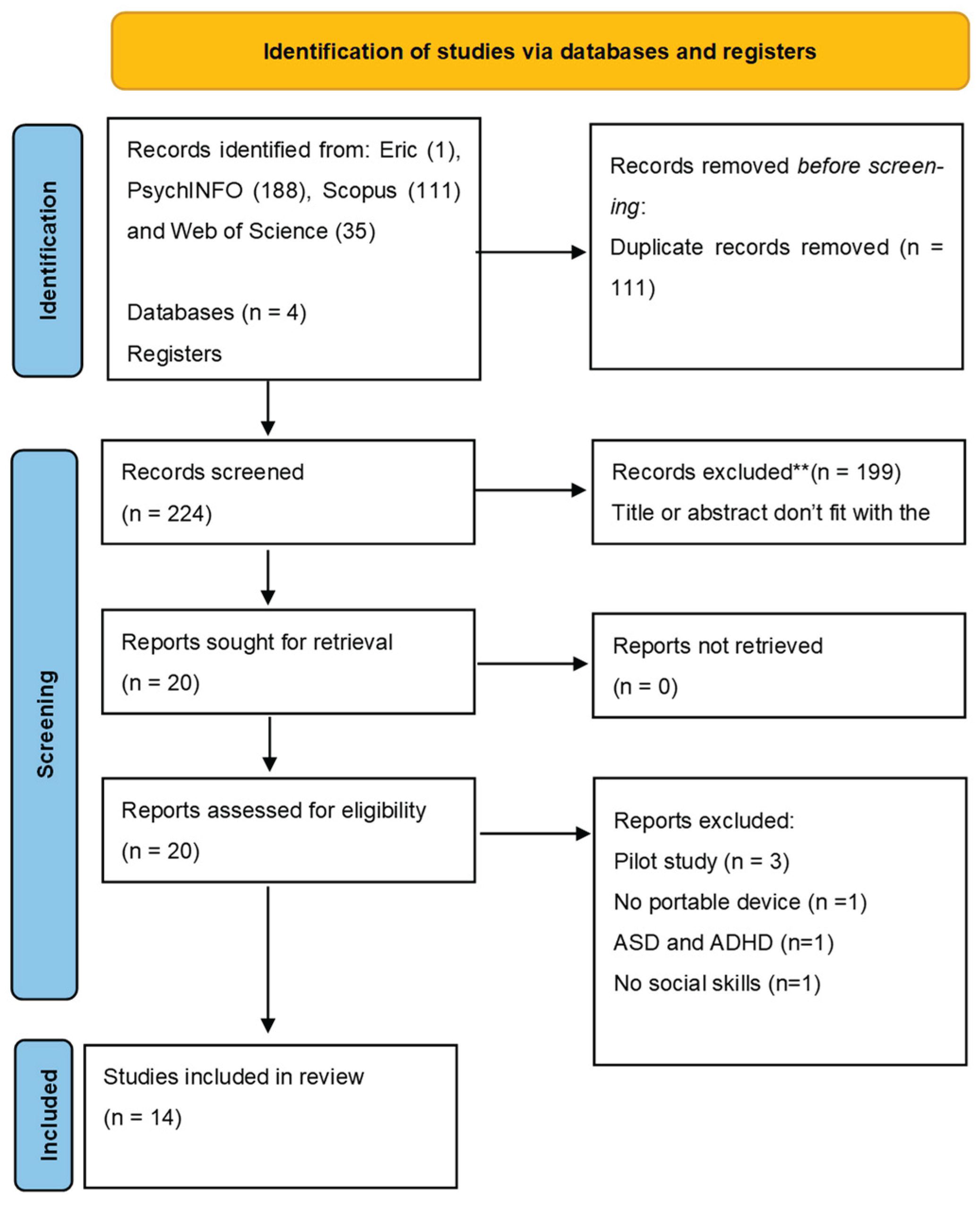

Table 1.
This table presents the year of publication, age range, sample, duration of intervention, methodology, measurement system, applications used in the interventions, outcomes and limitations.
Table 1.
This table presents the year of publication, age range, sample, duration of intervention, methodology, measurement system, applications used in the interventions, outcomes and limitations.
| Article | Year | Age | Sample | Duration | Methodology | Measurement System | Application | Outcomes | Limitations |
| Osos, J. A. et al. | 2021 | 3-5 | 4 (3 boys-1 girl) | 5 to 8 minutes every day until they reach the goal. | Multiple probe design across participants |
Interobserver Agreement | Video-Enhanced activity schedules using Apple keynote iPad application | Video-enhanced activity schedules can be an effective way to teach preschoolers with autism to independently start social interactions with their peers | Variability in participant performance, limited assessment of social competence and small sample size |
| Garcia, A. et al. | 2023 | 7-8 | 2 (boys) | 3 to 5 sessions were conducted daily, 1 to 5 days per week. Each session lasted 5 minutes | Functional analysis | Interobserver agreement and caregivers interview |
“Voice meter pro” app through iPhone | For the first child, the intervention was effective, but for the second child, the results were inconclusive and variable, initial step toward measuring and quantifying prosody (e.g., tone, volume) behaviorally | Inability to isolate the boys’ voices from ambient sounds, reduced generalization to other environments, possible punishment effects may have decreased the behavior rather than reinforcing it, the intervention included multiple components making it unclear which element was responsible for the behavior change, limited sample |
| Costescu, C. A. et al. | 2025 | 10-12 | 3 (1 boy-3 girls) | Twice per week. Each session lasted 20 minutes until data stability. | Single-case experimental design using an alternating treatment design | Interobserver agreement and fidelity checklist using a three-point rubric | Social story delivered via digital device through an image display mobile phone application | All participants improved in understanding social norms for friendship, but no significant differences were found between Social Stories delivered traditionally and via mobile devices | Use of identical stories across participants, lack of practical or observational assessment of targeted skills and use of Kohs block design test as the sole measure of cognitive ability |
| Alzyoudi, M. et al. | 2025 | 7-8 | 2 (boys) | Twice per week, 15-20 minutes each for 7 weeks | Multiple baseline design | Systematic observation and researcher-designed checklist | iPad speech-generating device application | Enhanced functional communication abilities, specifically improving participants’ capacity to initiate requests and express gratitude | Small sample size, conducted exclusively in a school environment and did not provide specific details on how the iPad’s application was used |
| Anam, R. et al. | 2025 | 4-7 | 12 (does not include the gender) | Guided sessions (first 2 days): 3-4 times at least 20 minutes, independent use (remaining 25 days): not specified times and minutes |
Quasi-experimental design | 10 close-ended statements rated on a 5-point Likert scale and 9 open-ended questions administered to children’s parents and teachers pre-and post-intervention | “FatimAR” smartphone application | Improvement in letter recognition and recall, social engagement and communication were enhanced | Control group did not include most of the intervention took place at home limiting control over usage conditions and consistency, all data collected through children’s parents and teachers |
| Hesami, E. et al. | 2025 | 4-9 | 30 (23 boys-7girls) | 20-minute sessions, every other day for two months | Experimental (Applied Behavior Analysis+kookism) and control group (Applied Behavior Analysis) with pretest, posttest and follow up test | MacArthur Bates Communicative Development Inventories | Serious Game “Kookism” through mobile phone | The ‘Kookism’ serious game produced a statistically significant enhancement in receptive lexicon | Variation in autism severity may limit generalization, measurement bias because of parent-reported data, presence of echolalia in some participants and short follow-up duration |
| Genc-Tosun, D. et al. | 2022 | 5 | 2 (boys) | 3 times per week maximum 10 minutes each until mastery | Multiple baseline across participants design | Interobserver agreement using point by point agreement through video recording | “Dokun Konus” iPad-based speech-generating device | Improvements in question-answering skills | Small sample size, discrete trial teaching in home settings, clinical settings only for one participant, limited research on SGDs for complex communication skills |
| Waddington, H. et al. | 2021 | 5-9 | 2(1 boy and 1 girl | Once per week 4 to 20 trials per session until mastery | Multiple baseline across participants design | Interobserver agreement | “Proloquo2Go” app through iPad | Children showed improvement in requesting continuation of actions during a variety of social routines with their parents | Small sample size, weak casual inference, no follow-up tests, fidelity and consistency may vary due to parent-implemented sessions. |
| Chapin, S. E. et al. | 2021 | 3-5 | 3 (2 boys and 1 girl) | 2-3 times per week for 5 to 10 intervention sessions | Multiple-probe design across participants | Interobserver agreement through independent video-based observational coding of communicative turns, using point-by-point agreement | Visualization of video content through “EasyVSD” app via a Samsung Pro tablet, Model SM-T900 | All participants demonstrated an increase in the number of communicative turns | Small sample size, limited number of intervention sessions, no follow up tests, gaps in data collection and program scheduling |
| Khoirunnisa, A. N. et al. | 2025 | 7-12 | 4 (does not include the gender) | Six sessions within 1 week 20 to 30 minutes each | Multiple baseline designs | Behavioral observation (frequency and accuracy), video-based event recording, inter-observer agreement, teacher interviews | AR-based PECS mobile application | Improvement in communicational skills by enhancing students’ answering and commenting skills | Small sample size, short duration, no control group, potential observer bias, limited outcome scope |
| Hassan, A. et al. | 2025 | 5-11 | 107 children, 60 diagnosed with ASD and 47 typical (does not include the gender) | 8 weeks, consisting of structured weekly training (120 minutes per week) combined with daily practice sessions (at least 15 minutes per day) | Randomized Controlled Trial (RCT) | Griffith Empathy Measure (GEM) and multiplayer module evaluations | “Zirkus Empathico 2.0” serious multiplayer game mobile game for android | Improvements in enhancing empathy, collaboration emotional understanding and social engagement | Reliance on parent and teacher reports, lack of blinded observer during the assessment, simultaneous therapies in a few persons may have influenced results |
| Lyu, Y. et al. | 2024 | 6 years old mean age (Does not include details for every participant) |
24 (21 boys and 3 girls) | 1 session approximately 40 minutes for each child | Between-subject controlled experimental design comparing the “EMooly” intervention with a traditional baseline condition with pre- and post-test | Pre and post emotion-recognition quizzes, caregiver questionnaires (Likert scale), and semi-structured interviews. | “EMooly” tablet-based game | Improvements in social-emotional recognition | Small sample size, limited realism due to use of cartoon characters, limited duration, risks of bias or misunderstanding in AI-generated content. |
| Güler, T. D. et al. | 2021 | 6-7 | 3 (1 boy and 2 girls) | 20 minutes each session until mastery | single-subject alternating treatments design comparing animated and non-animated mobile social story maps | Interobserver agreement | “Mobile social story Map” application through Tablet | Improvements in social communication and listening comprehension skills |
Small sample size, narrow age range, no cognitive or developmental assessments for participants, non-optimal intervention settings, unequal session time, single observation opportunity time |
| Sng, C. Y. et al. | 2022 | 8-10 | 3 (boys) | 20 minutes each session daily (number of sessions is not included) | Multiple probe across participants design | Interobserver agreement from audio recordings | “Conversation coach” app by Silver Lining Multimedia through iPad | Different results for every participant, only two of them were improved with additional teaching, the iPad alone was insufficient for teaching on-topic response discrimination, requiring more explicit strategies | Small sample size, baseline may be inaccurate for the first participant, no blind partners |
Disclaimer/Publisher’s Note: The statements, opinions and data contained in all publications are solely those of the individual author(s) and contributor(s) and not of MDPI and/or the editor(s). MDPI and/or the editor(s) disclaim responsibility for any injury to people or property resulting from any ideas, methods, instructions or products referred to in the content. |
© 2026 by the authors. Licensee MDPI, Basel, Switzerland. This article is an open access article distributed under the terms and conditions of the Creative Commons Attribution (CC BY) license (http://creativecommons.org/licenses/by/4.0/).
Copyright: This open access article is published under a Creative Commons CC BY 4.0 license, which permit the free download, distribution, and reuse, provided that the author and preprint are cited in any reuse.


