

Submitted:
02 June 2026
Posted:
03 June 2026
You are already at the latest version
Abstract
This article examines social vulnerability (SV) as a necessary component of landslide risk assessment in the urban area of Quito, Ecuador. Landslide susceptibility identifies where slope instability is more likely, but it does not explain which populations have fewer resources to anticipate, cope with, or recover from such events. Using 2010 census-tract data, principal component analysis (PCA) was applied to derive interpretable factors of SV. The most robust factor—structural socioeconomic precariousness—combines precarious occupational conditions, lack of access to social security or private insurance, and limited access to new technologies. This factor was combined with a previously developed landslide susceptibility map (LSM) based on events recorded between 2005 and 2017 and aggregated to census tracts. The Comparative Environmental Risk Index (CERI) was then used to interpret whether socially vulnerable groups are disproportionately located in areas of higher landslide susceptibility. Results reveal a comparatively safer and socially advantaged populations axis from the center-north toward the eastern valleys, while high-risk and socially vulnerable areas concentrate in the south and selected peripheral zones. The study provides a historical and methodological baseline and contributes a quantitative, spatial, urban approach to landslide risk inequity in an Andean city.
Keywords:
social vulnerability
; landslide risk
; Comparative Environmental Risk Index
; spatial inequity
; Quito
; Andean cities
1. Introduction
1.1. Social Vulnerability and Landslide Risk in Urban Quito
Latin America has a strong tradition of disaster risk and vulnerability studies, including the foundational contributions of LA RED since the 1990s and subsequent work on the social construction of risk [1,2,3]. This article does not claim that vulnerability research is absent from the region. Rather, it addresses a narrower gap: the limited application of quantitative, spatial and census-based social vulnerability analysis to landslide risk [4,5,6,7,8]. This is particularly relevant in landslide-prone Andean urban contexts such as Quito.
The reference to LA RED is particularly important because it situates the article within a Latin American tradition that understands risk as historically produced rather than as a purely natural condition [1,2,3]. This perspective helps explain why two places with similar susceptibility may experience different consequences: the distribution of land, infrastructure, services, livelihoods and institutional support conditions the production of risk [4,5]. The present article keeps that conceptual premise, but translates it into a spatial quantitative exercise that can be combined with susceptibility mapping [6,7,8].
For Andean cities, this translation is relevant because urban growth frequently takes place in steep and fragmented terrain. The problem is not simply that slopes are occupied, but that different social groups occupy them under unequal conditions [9,10,11,12,13]. Some households can pay for geotechnical studies, retaining structures, drainage works or safer housing alternatives. Others remain in exposed locations because land markets, informality and limited income restrict their choices. This is the reason why an urban landslide risk map requires both a physical-susceptibility layer and a social-vulnerability layer [7,8].
Andean cities are exposed to multiple hazards associated with steep topography, seismicity, intense rainfall, rapid urban expansion, and the occupation of slopes and gullies [9,10,11,12,13]. In Quito, landslide risk is not only a function of terrain or rainfall. It is also shaped by social conditions that influence the capacity of households to access information, insurance, secure livelihoods, mitigation works, and post-disaster recovery mechanisms [6,9,14]. For this reason, social vulnerability is treated here as an essential component of landslide risk reduction (LRR), rather than as a secondary descriptive variable [4,5,6,7,8].
The study focuses explicitly on the urban area of Quito. This delimitation is methodological and empirical: it is the area where census tracts and the previously developed landslide susceptibility map overlap, allowing both dimensions to be analyzed using comparable spatial units [11,14,15,16]. The article therefore offers an urban-scale diagnosis of landslide risk that can support later downscaling to neighborhood-level research and planning interventions.
The temporal scope of the article is also explicit. The manuscript derives from doctoral research originally developed as a thesis chapter between 2021 and 2023. Consequently, the 2010 census and the 2005-2017 LS model are used as a historically consistent baseline for testing the integration of SV, LS and the Comparative Environmental Risk Index (CERI) in urban Quito. The article should therefore not be read as a 2026 operational diagnosis, but as a replicable baseline that can later be updated and compared with the 2022 census and improved landslide inventories.
1.2. Urbanization and Risk Context
Quito expanded significantly during the second half of the twentieth century, especially after the oil boom of the 1970s [17,18,19]. As the national capital and a major economic and administrative center, the city attracted internal migration and generated sustained demand for housing. Formal and informal urbanization progressively occupied flat areas, slopes, gullies and peripheral lands, producing differentiated patterns of exposure and vulnerability [17,18]. Previous urban studies of Quito have also documented the role of land markets, metropolitan growth and socio-spatial differentiation in shaping unequal access to urban land and services [22,23,24].
From the late twentieth century onward, land-price dynamics and real-estate expansion also pushed higher-income groups toward northern slopes and surrounding valleys [18,23]. As a result, landslide-prone areas in Quito are not occupied exclusively by low-income households. However, the capacity to avoid, mitigate or transfer risk is highly unequal. High-income households may access engineering works, insurance or relocation options, while low-income households are more likely to be constrained by affordability and land-market exclusion.
Local risk-related land-use regulations have evolved since the 2000s, including setback rules, density controls, risk overlays and more recent provisions in the land-use and management plan of the Metropolitan District of Quito (DMQ) [20,21]. Nevertheless, the socio-economic dimension of landslide risk remains insufficiently integrated into territorial planning. This article addresses that gap by combining social vulnerability with landslide susceptibility in the urban area of Quito.
1.3. Theoretical Background
1.3.1. Key Definitions
In this article, landslide risk is operationalized as the spatial combination of landslide susceptibility (LS) and social vulnerability (SV). Strictly speaking, landslide susceptibility expresses the spatial likelihood or predisposition of an area to landsliding, whereas hazard assessment would also require information on temporal probability, frequency, magnitude, or intensity [25,26]. Therefore, LS is used here as a hazard-related spatial input, while SV describes the social conditions that may increase the probability of harm and reduce the capacity to anticipate, cope with, or recover from landslide events [6,14,16]. This operationalization follows a pragmatic risk-assessment logic suitable for spatial planning, while recognizing that exposure and physical vulnerability are distinct analytical dimensions that can be developed in future work [25,26,27].
The physical condition of housing is included only insofar as it is available in the census and expresses socio-economic conditions related to dwelling quality. This does not replace detailed physical vulnerability assessment, such as building fragility functions, structural vulnerability curves, or exposure models of elements at risk [25,27]. Instead, the article uses secondary census data to construct an urban-scale social-vulnerability layer that can be combined with LS for planning-oriented risk interpretation [6,14,15].
Landslides in Quito are understood primarily as recurrent, shallow, extensive risk events affecting households, streets, slopes, and local urban infrastructure, often during rainy seasons. Although catastrophic—intensive—landslides may occur in Latin American cities, the cumulative effect of frequent small and medium events is also relevant for urban policy. This interpretation is consistent with the concept of extensive disaster risk, which refers to low-severity, high-frequency events, often associated with localized hazards such as recurring landslides, floods, storms, or droughts [28]. It also resonates with the argument that small disasters can reveal important institutional and social learning challenges that are often overlooked when attention is concentrated only on catastrophic events [29]. This justifies an approach that identifies where socially vulnerable populations coincide with higher landslide susceptibility.
1.3.2. A Brief Review of Social Vulnerability Analysis
Social vulnerability has been approached through different theoretical and methodological traditions. Latin American scholarship, particularly LA RED, has emphasized that disasters are socially constructed and rooted in historical, political, and territorial processes [1,2,3]. Other strands of literature have developed quantitative, indicator-based approaches, including the Social Vulnerability Index (SoVI) proposed by Cutter, Boruff, and Shirley [6], which uses census indicators and statistical reduction techniques to map vulnerability across spatial units. Subsequent applications have adapted this approach to different hazards, spatial scales, and territorial contexts, including multi-hazard risk zoning, landslide-related vulnerability, geophysical hazards in developing countries, national vulnerability assessments, and Latin American urban applications [30,31,32,33,34,35,36].
The brief review showed that the selected SV applications generally conceptualize vulnerability as a multidimensional condition rather than as a single demographic attribute. They distinguish between dimensions such as susceptibility, resources, coping capacity, adaptation, and resilience, or combine social indicators with built-environment, climate-related, and hazard-related variables. This reinforces the need to adapt indicator frameworks to the local context of Quito rather than transferring them mechanically from other cases [40,54,55].
This article is positioned within the quantitative, spatial, and indicator-based strand of SV research. The literature review was therefore intentionally limited to studies that use secondary data, household or census indicators, GIS mapping, Principal Component Analysis (PCA), factor analysis, or composite indices [6,14,15,30,34,35,36]. Qualitative, ethnographic, governance-oriented, and perception-based studies are highly relevant to vulnerability research, but they were treated as outside the methodological scope of this article. This criterion explains the composition of the reviewed studies and the emphasis on PCA-compatible indicators.
The exclusion of qualitative and governance-oriented studies should therefore be understood as a methodological delimitation rather than a theoretical dismissal. Community perceptions, social organization, political mediation, and informal land practices are central to vulnerability, but they cannot be consistently measured for all census tracts using the available secondary data. By narrowing the review to quantitative studies, the article selects the literature most directly comparable with its own empirical design.
This decision also affects how the results should be read. PCA does not capture the entire social production of vulnerability; it identifies statistical patterns among available indicators. Its value lies in producing a replicable spatial layer that can be used with other georeferenced information. Its limitation is that it must be complemented with qualitative evidence before designing neighborhood-specific interventions [16,30].
The main contribution of the article is not to propose a new general theory of social vulnerability. Instead, it adapts a quantitative SV framework to the urban area of Quito and combines it with LS and CERI in order to reveal spatial inequities in landslide risk.
1.3.3. Some Social Vulnerability Approaches and Parameters
A focused review of 20 quantitative and indicator-based studies was conducted to identify how social vulnerability has been measured, mapped, and combined with hazard or exposure information. Most of these studies are influenced by or comparable to the SoVI tradition, although they vary in hazard type, spatial scale, data source, and aggregation unit [6,14,15,30,31,32,33,34,35,36]. The full comparative review matrix is provided in Appendix A.
In the brief review, each study was also compared by hazard type, objective, method, context, unit of observation and data source. This comparison was important because the same indicator may have a different meaning depending on whether the unit of analysis is a household, a census tract, a municipality or a region, and whether the data come from a census, survey or administrative source [30,31,34,36,56].
The review informed three methodological decisions for Quito. First, the analysis should rely on spatial units for which census data are available and comparable. Second, indicators should be selected according to both international literature and local relevance. Third, the final index should privilege interpretability, because the output is intended to inform landslide risk reduction and land-use planning rather than only statistical description [15,30,32,37].
In this sense, the review was not used as a mechanical checklist of universal indicators. Rather, it provided a methodological reference for selecting variables that could be theoretically justified, statistically processed, and interpreted within Quito’s urban context. This is important because recent reviews of social vulnerability and resilience frameworks have noted that many applications transfer existing indicator frameworks with insufficient adaptation to local social, cultural, and institutional contexts [30].
1.3.4. Relevant Indicators in Social Vulnerability Analyses
The reviewed literature shows recurrent indicator families related to education, age structure, gender, ethnicity, household composition, employment, income proxies, social security, housing tenure, services, accessibility, and built-environment conditions [6,14,15,30,31,32,33,34,35,36,37,38,39,40]. For Quito, these themes were adapted to the available 2010 census data and municipal information. The full list of indicators found in the literature is provided in Appendix B, and the complete set of 50 indicators initially selected for the PCA is provided in Appendix C.
Only indicators compatible with the quantitative and spatial design of the article were retained. This means that the analysis privileges variables available for all urban census tracts, even when other relevant dimensions of vulnerability, such as risk perception, community organization, or informal governance, would require primary data. These limitations are addressed in the discussion and constitute an agenda for subsequent neighborhood-scale research.
The indicator selection process therefore balanced three demands: theoretical relevance, data availability, and interpretability for planning. Variables that are common in the international literature but unavailable at the CT level could not be used. Conversely, locally meaningful variables were retained when they helped approximate income, social protection, dwelling quality, or access to information. This is why the final input set includes both conventional SV indicators and context-specific proxies such as insurance access, electricity bill value, and occupational-group composition. In the Ecuadorian context, access to technologies, service conditions and household-consumption proxies are also relevant for approximating socio-economic stratification when direct income data are unavailable or limited [41,42].
The indicator review also emphasized that aggregation procedures must preserve the meaning of each variable. Some indicators can be directly calculated at the CT level, whereas others are meaningful only at household, municipal or regional scales. Variables located at the boundary between social and physical vulnerability - such as dwelling materials, conservation state, overcrowding and basic services - were therefore interpreted as social proxies of household resources and living conditions, not as substitutes for a structural fragility model [37,56,57].
The decision to use census tracts also has implications for aggregation. The article does not assume that all households within a CT share the same condition; rather, the CT is treated as the smallest available spatial unit for statistical comparison. This level is suitable for city-scale diagnosis and prioritization, but it should be followed by finer analysis in critical areas, particularly where informal settlements, fragmented slopes, or mixed socio-economic conditions occur within the same tract [15,30].
1.3.5. Landslide Susceptibility Mapping
The LS input was taken from a previous landslide susceptibility mapping study for Quito [11]. That study used logistic regression with landslide events from 2005 to 2017 as the binary dependent variable and a set of urban and environmental predictors, including road density, population, intense precipitation, slope, lithology, floor area, land use/vegetation cover, seismic intensity, and building footprint area. The resulting raster map is used here as the hazard-related layer to be combined with SV.
This choice also defines the temporal meaning of the risk map. The LS layer is used because it is an internally consistent and previously developed input, not because it represents the most recent susceptibility model that could be produced today. Since the completion of the original doctoral research, updated inventories, explanatory variables, modelling techniques and scale-sensitive treatment of topographic variables may allow improved LSM outputs [43]. In this article, however, the LS layer functions as the hazard-related component of a baseline integration exercise.
Logistic regression was retained because it is transparent, relatively simple to communicate and widely used in landslide susceptibility studies, even if more recent machine-learning approaches may obtain stronger performance in some contexts. For Quito, the key requirement was not to re-run the LSM, but to use an internally coherent and city-specific susceptibility layer whose assumptions and sensitivity had already been evaluated [11,43].
Because the present article focuses on SV and risk interpretation, the LSM methodology is not reproduced in full. The essential requirement for this study was to transfer the LS raster to the same census-tract units used for SV, allowing both dimensions to be cross-tabulated and mapped consistently. This distinction is important because susceptibility mapping estimates spatial predisposition to landsliding, whereas full landslide risk assessment would also require explicit consideration of exposure, temporal probability, intensity, and physical vulnerability [25,26,37].
1.3.6. Landslide Risk by Cross-Tabulation and the Comparative Environmental Risk Index (CERI)
The article combines SV and LS through a cross-tabulation matrix. Both variables are classified into five levels, producing a 5 × 5 risk matrix. This structure allows the identification of census tracts where high or very high SV coincides with high or very high LS, as well as areas where low-SV groups occupy susceptible lands but may have greater resources for mitigation. Similar overlay and matrix-based procedures are widely used in planning-oriented risk assessments because they facilitate the interpretation of combined physical and social conditions across spatial units [25,26,37].
The Comparative Environmental Risk Index (CERI) is used to interpret whether a given SV class is over- or under-represented in a given LS class compared with the general distribution. In other words, CERI helps move from a simple overlay map to an interpretation of spatial inequity: it indicates whether socially vulnerable groups are disproportionately located in more susceptible areas. This use is consistent with environmental-justice approaches that examine whether disadvantaged groups are disproportionately exposed to environmental burdens or hazards and pictures uneven resilience scenarios across the city [44,45,46].
Equation 1 defines the index for each cell of the SV-LS cross-table.
Equation 1. Calculation of the CERI for a determined cell of the risk cross-table.
where is the index for observations in landslide susceptibility class and social vulnerability class ; is the number of observations in that cell; is the total number of observations; is the number of observations in LS class ; and is the number of observations in SV class .
Values above 1 indicate that the corresponding SV class is over-represented in a given LS class, while values below 1 indicate under-representation. Therefore, the index does not merely identify where risk components overlap; it helps determine whether the distribution of socially vulnerable groups across susceptibility classes is proportionate or unequal. In this article, CERI is used as an interpretive tool rather than as a replacement for detailed probabilistic risk modelling.
This interpretation is especially useful for urban land-use policy because a similar level of landslide susceptibility may require different responses depending on the social group involved. A very low-vulnerability household located on susceptible land may have access to private mitigation or relocation options, whereas a very high vulnerable household in the same susceptibility class may be constrained by land markets, lack of information or limited recovery capacity. CERI therefore helps distinguish simple co-location from disproportionality and policy-relevant inequity [44,45,53].
2. Materials and Methods
2.1. Adaptation of the Units of Observation to the Study Area
The study area corresponds to the urban area of Quito (see Figure 1) where the previous LS raster and 2010 census tracts overlap. Rural and peri-urban census tracts outside this common area were excluded to preserve comparability among units of observation. This choice improves statistical consistency, because urban census tracts are more homogeneous in area and population than rural units, but it also limits the scope of the conclusions to urban Quito. The decision also reduces, but does not eliminate, the effects of spatial aggregation associated with the modifiable areal unit problem (MAUP), which may affect multivariate analysis when results depend on the scale and boundaries of areal units [47]. A total of 5,008 census tracts were retained.
2.2. Purpose, Objectives, and Scope
The article has three objectives: (1) to determine the social vulnerability of urban Quito using a quantitative, census-based PCA approach; (2) to combine the resulting SV layer with a previous LS map in order to produce an urban landslide risk map; and (3) to calculate the CERI for the resulting SV–LS combinations in order to identify spatial inequities relevant for LRR and land-use policy.
2.3. Input Data: Units of Observation, Indicators, and Pre-Processing
The workflow consisted of four stages. First, socio-economic and housing indicators were operationalized from secondary data. Second, the indicators were standardized and processed through PCA. Third, the selected SV factor was combined with the LS layer after both were expressed in census-tract units. Fourth, CERI was calculated for the risk matrix to support interpretation of differential exposure to landslide susceptibility [44,45].
2.3.1. Census Tracts as Units of Observation
The main data sources were the 2010 census from the National Institute of Statistics and Census (INEC), municipal data from the Metropolitan District of Quito (MDMQ), and the LS map from Puente-Sotomayor, Mustafa, et al. [11]. Census tracts (CTs), locally known as sectores censales, were selected because they are the smallest units for which census information can be used without compromising personal data protection. The final set of 5,008 urban CTs was obtained by selecting those whose centroids overlapped the urban area used in the LSM study.
The use of the 2010 census responds to the need for spatially disaggregated socio-economic and housing variables at the CT level, compatible with the available LS layer and the urban delimitation of the study [48].
2.3.2. Indicators of Social Vulnerability for Quito
Fifty indicators were initially selected according to three criteria: relevance in quantitative SV literature, availability for all urban CTs, and local interpretability for Quito [6,14,15,30,31,32,33,38]. They were defined to represent conditions that may increase vulnerability, such as precarious work, lack of insurance, limited access to technologies, educational deficits, housing conditions and service deprivation. Some variables were treated as neutral inputs, allowing the PCA to determine their empirical direction. The complete indicator list is provided in Appendix C, and the detailed computation and rationale are provided in Appendix D.
2.4. Principal Component Analysis (PCA) for Social Vulnerability
PCA was used to reduce the 50 indicators into a smaller number of interpretable dimensions. PCA is a widely used technique for dimensionality reduction when many correlated variables need to be summarized into a smaller number of components [49]. Although PCA technically extracts components, this article refers to the results as PCA-derived factors because they are interpreted as latent dimensions of social vulnerability. The statistical procedure was performed in IBM SPSS Statistics.
The term factor is used throughout the manuscript to emphasize interpretation. In the strict statistical language of PCA, the extracted dimensions are components. However, once these dimensions are interpreted as meaningful groupings of indicators that describe social vulnerability, referring to them as PCA-derived factors improves readability and aligns the wording with the substantive argument. Tables and captions were therefore adjusted to use factor consistently where interpretation is intended.
The PCA workflow was designed as both a statistical and interpretive process. Statistical thresholds were necessary to reduce noise and avoid retaining weak indicators, but the final decision also required assessing whether each factor made sense in the Quito context. This is especially important in SV research, where a mathematically valid component may still be difficult to translate into policy or to explain to planners and local authorities [30,31].
2.4.1. Standardization (z-Values)
All indicators were standardized as z-scores before the PCA so that variables measured in different units could be compared. Standardization was performed only for the selected urban CTs, avoiding distortions that would result from mixing urban, peri-urban and rural census units with very different population densities and areas.
2.4.2. PCA Processing
The PCA was processed iteratively. KMO and Bartlett tests were used to assess suitability; the extraction method was principal component; and Varimax rotation with Kaiser normalization was used to improve interpretability [50,51,52]. Indicators with low communalities were progressively removed, following thresholds commonly used in indicator-based SV studies [6,14,15,31]. The full suppression record and communality table are provided in Appendix E.
The final model retained 20 indicators. Six factors had eigenvalues greater than one and together explained 81.461% of the total variance. However, not all factors were equally interpretable. For this reason, statistical strength and substantive clarity were both used in the final selection. The workflow of the process is illustrated in Figure 2.
2.4.3. Interpretation and Selection of Factors
The factor scores were interpreted according to the indicators with the highest rotated loadings. Factor 1 grouped low-skilled occupational conditions, lack of social security or private insurance, limited access to new technologies, building conservation problems, larger household size and related socio-economic indicators. Factor 2 grouped lack of higher education. Factor 3 was associated mainly with housing tenure conditions, especially fully paid ownership and the absence of renters.
Factor 1 is interpreted as the principal social-vulnerability factor because it combines labor, protection, information and dwelling-related indicators. These dimensions are strongly connected in disaster-risk terms. Precarious work can limit savings and access to formal support; lack of insurance reduces the capacity to absorb losses; limited telecommunication access constrains warning, information and assistance; and deficient dwelling conditions may increase sensitivity to slope-related impacts [6,14,30,33]. The factor therefore expresses a broader condition of constrained coping capacity.
Factor 2, centered on lack of higher education, remains relevant because education often affects income opportunities, institutional access and the capacity to interpret technical information. Nevertheless, it was not as comprehensive as Factor 1. Factor 3, related to tenure, required particular caution because ownership does not have a uniform meaning. Fully paid ownership can indicate asset security, but it can also correspond to older consolidated neighborhoods where housing quality, location or informality may still generate vulnerability. For this reason, Factor 3 was discussed but not used as the main SV layer.
The SoVI tradition often sums all factors above a given eigenvalue threshold [6]. In this case, however, factors 4 to 6 were not retained for SV mapping because their interpretation was weak and each grouped few indicators. Factor 1 was selected as the principal SV measure because it had the strongest eigenvalue, grouped the largest number of indicators and offered the clearest interpretation for urban Quito. Alternative combinations were tested as robustness checks and are reported in Appendix F.
2.5. The Risk Map of Quito and the Comparative Environmental Risk Index (CERI) Derived from the Social Vulnerability–Landslide Susceptibility Crosstabulation
To build the risk map, the selected SV factor and the LS values were expressed in the same spatial unit: the census tract. Both variables were then classified into five levels using standard-deviation thresholds and crossed in a risk matrix. The CERI was calculated for each matrix cell to compare the relative concentration of SV classes across LS classes [44,45].
2.5.1. LSM Transferred into Census Tracts
The LS input was originally available as a 50 m raster [11]. Its values were aggregated to CTs using the mean value of LS cells within each tract. This produced a tract-level LS measure compatible with the PCA-based SV results.
2.5.2. Input Classification
To proceed with the comparison, it was necessary to classify the SV and LSM datasets in relation to the data distributions and means. A classification based on standard deviation from the z-scores was applied to both datasets before the comparison. To provide a general but sufficiently precise picture of the classes, and to allow clear cartographic interpretation, five classes were set for both datasets:
- Very low values: less than -1.5 standard deviations
- Low values: from -1.5 to less than -0.5 standard deviations
- Moderate values: from -0.5 to less than +0.5 standard deviations
- High values: from +0.5 to less than +1.5 standard deviations
- Very high values: from +1.5 standard deviations and greater
2.5.3. Crosstabulation
The classified SV and LS values were placed in a double-input 5 x 5 cross-table. SV was represented on the horizontal axis and LS on the vertical axis, with lower levels toward the upper-left corner and higher levels toward the lower-right corner. This structure made it possible to distinguish absolute magnitudes, relative proportions and critical combinations of vulnerability and susceptibility.
For the main risk interpretation, the most critical cells were those where high or very high SV coincided with high or very high LS. Alternative SV configurations were compared to evaluate robustness, but the Factor 1-based matrix was selected for the principal risk map because it provided the clearest and most policy-relevant spatialization of critical risk (see Figure 3).
2.5.4. Critical Values and CERI
CERI was calculated for each cell of the risk matrix. Values above one indicate that a specific SV class is more likely than the general population to be located in the corresponding LS class. This interpretation is especially useful for identifying spatial inequity in landslide risk, because it distinguishes between areas that are merely numerous and areas where vulnerable groups are disproportionately concentrated [44,45]. This is illustrated in Figure 4.
2.5.5. Mapping Critical Values
The final map spatializes the selected risk classes and identifies areas where LRR action should be prioritized. At this scale, the results are intended to guide policy and planning decisions, including mitigation, relocation, communication, and future neighborhood-scale studies. The map should therefore be interpreted as a city-scale prioritization tool rather than as a substitute for site-specific engineering assessment or neighborhood-level participatory diagnosis.
3. Results
3.1. Social Vulnerability in Quito
The PCA confirmed that the initial 50 indicators could be reduced to a smaller and more interpretable structure. The KMO value increased from 0.453 in the first run to 0.809 in the final model after the suppression of indicators with low communalities. This indicates that the final set of indicators was suitable for dimensional reduction and factor interpretation [51]. The final model retained 20 indicators and produced six factors with eigenvalues greater than one, explaining 81.461% of the total variance. The complete suppression record and communalities are provided in Appendix E.
Table 1 summarizes the variance explained by the final PCA. Factor 1 accounts for the largest share of variance and is interpreted as a socio-economic vulnerability factor combining precarious occupational groups, lack of insurance and limited access to new technologies. Factor 2 captures lack of higher education, while Factor 3 is associated with housing tenure conditions. Factors 4 to 6 were retained statistically but not selected for the principal SV map because their substantive interpretation was weaker.
The full rotated loading matrix is provided in Appendix E. The highest loadings for Factor 1 correspond to low-skilled occupational groups (OCCGROPR), lack of insurance (NOINSUR), limited access to telecommunications (NOTELECOM), absence of public-service employment, deficient building conservation, group quarters, absence of white ethnicity, household size, adult illiteracy, and construction-sector employment. This combination supports the interpretation of Factor 1 as the most robust SV factor for urban Quito. Figure 5 shows the spatial distribution of Factor 1, which represents structural socio-economic precariousness.
Several SV configurations were tested: Factor 1 alone, Factors 1+2, Factors 1+2+3, and the additive SoVI model using Factors 1 to 6. The Factor 1 configuration was selected for the main analysis because it offered the strongest and clearest interpretation and identified the largest number of census tracts in the most critical risk combinations (see scree plot in Figure 6). This choice differs from the conventional additive SoVI procedure, which often combines several retained factors, but it is consistent with the methodological decision to privilege interpretability and policy relevance in the Quito case [6,31]. Alternative matrices are provided in Appendix F.
3.2. Landslide Risk Map: Combining Social Vulnerability with Landslide Susceptibility and Calculating the CERI
The selected SV factor was combined with the LS classification aggregated to census tracts (see Figure 7). Table 2 presents the resulting SV–LS cross-tabulation for Factor 1. The overall distribution shows that most census tracts fall within moderate SV and moderate-to-high LS classes, while the most critical combinations concentrate in the lower-right corner of the matrix.
Selecting Factor 1 for the main risk map also has a policy rationale. A risk map intended for municipal prioritization should not only maximize statistical variance; it should also identify areas where vulnerability can be interpreted and acted upon. The combination of precarious work, lack of insurance, and limited access to technologies points toward possible interventions such as targeted communication, social protection, local preparedness, support for mitigation works, and coordination with urban-upgrading policies.
The alternative configurations are still useful as robustness checks. If Factor 1+2 or the additive SoVI model had produced radically different spatial patterns, the selection of Factor 1 alone would be questionable. The fact that the configurations are broadly consistent supports the stability of the result, while the Factor 1 map remains clearer and more focused for the purposes of this article.
Using Factor 1 only, the values of Table 2 were converted into the number of households and inhabitants to provide a more precise measure of landslide risk in the city. Table 3 presents these figures.
Table 3 expresses the Factor 1-based risk matrix in terms of census tracts, households and inhabitants. The four most critical cells, corresponding to high or very high SV combined with high or very high LS, include 603 census tracts, 67,494 households and 251,853 inhabitants. Conversely, the four lowest-risk cells include 366 census tracts, 48,409 households and 154,364 inhabitants. These figures show that risk is not only spatially differentiated but also socially uneven.
The distinction between census tracts, households and inhabitants is important. Census tracts help identify spatial units for planning, households approximate the social unit affected by housing and recovery processes, and inhabitants indicate the population magnitude of each risk class. A small number of CTs may represent a large number of households, and a moderate-risk cell may contain a larger population than a very-high-risk cell. For this reason, the article reports all three measures rather than relying exclusively on mapped area.
The most critical cells should therefore be interpreted jointly with the population totals. High SV and high LS combinations identify priority locations, but moderate SV with high LS may still represent substantial potential impact because of population size. This supports a differentiated planning strategy: the most critical cells may demand urgent and targeted action, while large moderate-to-high combinations require broader prevention and preparedness measures. These findings are complemented by the resulting landslide risk map for Quito, presented in Figure 8.
Table 4 presents CERI values for all cells. The values indicate whether a given SV class is over- or under-represented in each LS class compared with the general distribution. The most critical pattern is the over-representation of very high SV in very high LS areas. This cell has a CERI value of 4.314, meaning that very high SV census tracts are more than four times as concentrated in very high LS areas than would be expected under a proportional distribution. The high SV–very high LS cell also shows over-representation, with a CERI value of 2.187. These results indicate that the most susceptible lands are not only physically critical but also socially uneven in their distribution.
The moderate SV–high LS cell also deserves attention. Although its CERI value is 1.178, which indicates only moderate over-representation, it contains the largest number of census tracts and population among the high-LS combinations. Therefore, this cell represents a substantial potential impact in demographic terms, even when its SV level is not classified as high or very high.
4. Discussion
The results should be interpreted within the methodological decision to focus on urban census tracts. This delimitation improves comparability among units of observation and allows the combination of census-based social vulnerability with the existing landslide susceptibility raster. At the same time, it excludes rural and peri-urban areas of the DMQ, where important processes of vulnerability formation may also occur. The findings therefore describe urban Quito and should not be generalized to the entire metropolitan district without additional analysis.
This urban delimitation also responds to the objective of producing comparable spatial units. Including rural census tracts would have increased the geographic extent of the study, but it would also have introduced units with very different sizes, population densities, land-use patterns, and socio-economic structures. Such heterogeneity could distort the standardization of variables, the PCA structure, and the interpretation of factor scores. This is especially relevant because spatial aggregation can influence multivariate results through the modifiable areal unit problem [47]. Nevertheless, the exclusion of peri-urban and rural areas should be explicitly acknowledged, because some of the most dynamic processes of urban expansion, informal settlement, and vulnerability production occur along metropolitan edges [18,19,22].
For this reason, the article should not be read as a complete risk diagnosis of the DMQ. It is a diagnosis of urban Quito, built from the intersection of available census tracts and a previously developed landslide susceptibility model [11]. Future research could extend the analysis to the wider metropolitan district by using different aggregation strategies, separate urban and rural models, or multi-scalar methods that avoid forcing dissimilar units into the same statistical structure.
The PCA results indicate that the strongest social vulnerability pattern in urban Quito is not defined by a single variable, but by the combination of precarious occupational conditions, lack of insurance, and limited access to new technologies. This supports the interpretation of Factor 1 as a broader socio-economic vulnerability factor. The factor also includes indicators related to dwelling conservation, household size, adult illiteracy, and employment in construction, suggesting that labor insecurity, limited access to information, weak social protection, and housing conditions are interrelated dimensions of vulnerability. This interpretation is consistent with quantitative social-vulnerability approaches that understand vulnerability as a multidimensional and dynamic condition rather than as the result of a single socio-economic attribute [6,14,15,30,39,40].
The education factor confirms that lack of higher education remains relevant, because education can influence income opportunities, institutional access, and the capacity to interpret technical information. However, it was not selected as the main social vulnerability measure because it was less comprehensive than Factor 1. The housing-tenure factor is more ambiguous. Fully paid ownership may indicate economic stability in some areas, but in other contexts it may also reflect older, self-built, inherited, or consolidated housing in socially vulnerable neighborhoods. For that reason, Factor 3 was discussed but not used alone as the main social vulnerability indicator.
Several indicators must be read as contextual proxies rather than universal vulnerability drivers. In Quito, variables related to ethnicity, emigration, electricity expenditure or occupational groups reflect historically situated social structures and data availability in the 2010 census; their interpretation therefore requires local knowledge and should not be detached from Ecuadorian socio-economic conditions [22,24,41,42].
The SV–LS cross-tabulation reveals a spatial pattern of inequity. Lower-vulnerability areas are concentrated along a center-north and valley axis, while socially vulnerable and landslide-susceptible areas are more prominent in the south and in selected peripheral areas. This does not mean that lower-vulnerability groups are absent from susceptible lands; some higher-income residential areas also occupy slopes and other physically sensitive locations. The difference lies in the unequal capacity to avoid, mitigate, insure, relocate, or recover from landslide impacts. This distinction is important because susceptibility alone does not determine risk; risk emerges from the interaction between hazard-related conditions, exposure, vulnerability, and response capacity [25,26,37].
Landslide susceptibility in Quito is not socially exclusive, but risk management capacity is socially differentiated. Some low-vulnerability groups may choose or afford to live on slopes because of landscape value, accessibility or real-estate dynamics, while highly vulnerable households may remain in susceptible areas because safer alternatives are economically inaccessible. The same physical condition may therefore correspond to different policy needs and ethical implications [18,20,23,24].
The south of Quito emerges as a key area where social vulnerability and landslide susceptibility overlap. This pattern is consistent with the historical production of the city, where lower-income groups have often accessed land through constrained markets and have occupied areas with fewer infrastructure advantages [17,18,22,23,24]. At the same time, the presence of lower-vulnerability groups in susceptible northern slopes and valleys shows that landslide susceptibility is not equivalent to socio-economic precariousness. The risk condition depends on the interaction between terrain, exposure, socio-economic vulnerability, land-market dynamics, infrastructure provision, and mitigation capacity. Figure 9 provides visual examples of these nuances, illustrating how landslide risk in Quito is produced through the interaction of hazardous terrain, urban expansion, socio-economic inequality, and differentiated mitigation capacities.
This distinction is relevant for policy. In high-income susceptible areas, regulation, enforcement, and private mitigation may be feasible instruments. In highly vulnerable susceptible areas, the same regulatory approach may generate exclusion, non-compliance, or displacement pressures if it is not accompanied by support mechanisms. The map therefore invites differentiated action: prevention and enforcement in some areas, but social support, urban upgrading, public works, risk communication, relocation assistance, or community-level preparedness in others.
The population totals reported in the results reinforce this differentiated reading. Some moderate-risk cells contain many more inhabitants than the most extreme cells, so prioritization should consider both disproportionality and absolute population magnitude. This is consistent with the distinction between spatial units for planning, households as recovery units, and inhabitants as the demographic magnitude of potential impact.
CERI strengthens this interpretation by showing whether specific social vulnerability classes are disproportionately located in landslide susceptibility classes. The most policy-relevant finding is not only the number of people located in high-risk combinations, but the fact that highly vulnerable groups are comparatively more likely to be located in highly susceptible areas. This supports the argument that landslide risk in Quito is also a matter of spatial inequity. In this sense, CERI helps move beyond a simple overlay of susceptibility and vulnerability by identifying disproportionality in the distribution of risk-related conditions [44,45].
From a planning perspective, the map should be read as a prioritization tool rather than as a parcel-level regulatory instrument. It can help identify where mitigation, communication, relocation support, infrastructure investment, and community-level studies should be prioritized. However, it should not be used as a substitute for site-specific engineering assessment, household surveys, or participatory diagnosis. Further research should validate and update these results with the 2022 census, improved landslide inventories, qualitative fieldwork, and neighborhood-scale assessments of exposure and physical vulnerability.
Four limitations remain central. First, the study uses 2010 census data, which should not be interpreted as a direct representation of current socio-economic conditions. Second, the landslide susceptibility input is based on a previous model using landslide events recorded between 2005 and 2017; newer inventories, predictors, and modelling approaches could refine the hazard-related component [11]. Third, the model relies on secondary indicators and therefore cannot replace household surveys, community-based risk assessments, or qualitative research on risk perception, coping capacity, and local governance. Fourth, the LS layer is aggregated to census tracts by mean values, which is appropriate for comparison with social vulnerability but may smooth local hotspots within large or heterogeneous tracts. These limitations do not invalidate the analysis; rather, they define its scope as a historical and methodological baseline and establish a clear agenda for updating and comparing risk patterns over time.
The CERI results can also support the discussion of environmental justice. When vulnerable groups are disproportionately located in higher susceptibility classes, the problem is not only one of natural hazard management but also of unequal urban development. This is why the article uses the expression spatial inequity: the distribution of landslide risk reflects the interaction between hazardous terrain, land markets, infrastructure provision, planning decisions, and unequal household capacities [44,45]. This interpretation should also remain attentive to scale, because environmental inequalities may vary depending on the spatial unit and aggregation level used to measure exposure and vulnerability [53].
Finally, the study should be read as a bridge between technical risk mapping and social analysis. The LSM provides an essential hazard-related layer, but it cannot by itself determine planning priorities. The SV layer introduces a social criterion, and CERI helps assess disproportionality. Together, these elements produce a more policy-relevant interpretation than a susceptibility map alone. This is particularly relevant for urban landslide risk reduction in Andean cities, where steep terrain, urban expansion, socio-economic inequality, and planning constraints interact in the production of risk [11,12,17,20].
5. Conclusions
This article developed a quantitative and spatial assessment of social vulnerability as a component of landslide risk in urban Quito. By focusing on the overlap between census tracts and a previously developed landslide susceptibility map, the study produced a comparable spatial framework for integrating social vulnerability and landslide susceptibility at the urban scale.
The PCA identified Factor 1 as the most robust and interpretable expression of social vulnerability. This factor can be interpreted as structural socioeconomic precariousness, as it combines precarious occupational conditions, lack of access to social security or private insurance, limited access to new technologies, and related socio-economic and housing conditions. Although other factors related to education and housing tenure were also relevant, they were treated as secondary or complementary because they were less comprehensive for the purposes of landslide risk mapping.
The combination of social vulnerability and landslide susceptibility shows that landslide risk in Quito is spatially unequal. The most critical areas are concentrated in the south and in selected peripheral zones, where higher social vulnerability coincides with higher landslide susceptibility. The CERI confirms that this pattern should be interpreted not only as exposure to a hazard-related condition, but also as an expression of spatial inequity in the distribution of risk.
The results can support urban planning and landslide risk reduction by identifying priority areas for mitigation, risk communication, relocation assistance, urban upgrading, and detailed neighborhood-level studies. Their main value is that they provide a replicable historical and methodological baseline. This baseline can later be compared with new census-based analyses, improved landslide inventories, and updated susceptibility models to assess whether social vulnerability and landslide risk have persisted, decreased, intensified, or shifted spatially.
Future work should incorporate updated census data, qualitative validation, community perceptions, exposure analysis, and physical vulnerability assessment of buildings. These steps would make it possible to move from a city-scale diagnosis toward more precise territorial interventions, especially in areas where social vulnerability, landslide susceptibility, and limited mitigation capacity overlap.
In this sense, the article should be understood as a bridge between macro-scale risk mapping and the micro-scale neighborhood analysis required for land-use policy, local preparedness and socially just landslide risk reduction.
Supplementary Materials
The following supporting information can be downloaded at the website of this paper posted on Preprints.org. The appendices included at the end of this manuscript are provided in the same Word file as supplementary material: Appendix A, quantitative social vulnerability literature review; Appendix B, indicator families identified in the literature; Appendix C, indicators initially selected for the PCA; Appendix D, detailed indicator descriptions; Appendix E, PCA diagnostics; and Appendix F, alternative social vulnerability configurations.
Author Contributions
Conceptualization, J.T.; Methodology, J.T. and F.P.-S.; Validation, J.T. and F.B.-O.; Formal analysis, F.P.-S.; Investigation, J.T. and F.P.-S.; Resources, J.T. and F.P.-S.; Data curation, J.T. and F.P.-S.; Writing - original draft preparation, F.P.-S.; Writing - review and editing, F.P.-S., J.T. and F.B.-O.; Visualization, F.P.-S.; Supervision, J.T.; Project administration, F.P.-S.; Funding acquisition, F.P.-S. and J.T.
Funding
This research was funded by the ARES-UCE Institutional Support Agreement, as a doctoral research, project ID: DOCT-DI-2019-75. The APC was funded by the ARES-UCE Institutional Support Agreement.
Institutional Review Board Statement
Not applicable. The study does not use identifiable individual-level human-subject data.
Informed Consent Statement
Not applicable. The study is based on aggregated census, municipal and secondary spatial data.
Data Availability Statement
The census data used in this study were obtained from the National Institute of Statistics and Census of Ecuador (INEC). Municipal spatial data and the landslide susceptibility input were obtained from the sources cited in the manuscript. Processed datasets may be made available by the corresponding author upon reasonable request, subject to the restrictions of the original data providers.
Generative AI Statement
The original version of this manuscript was written by the authors without the use of artificial intelligence tools and was subsequently revised with the support of human language-editing services. During the preparation of the current shortened and journal-formatted version, the first author used a combination of manual editing and ChatGPT (OpenAI) for language editing, structural organization, summarization, and journal-formatting assistance. He carefully reviewed, verified, and edited all AI-assisted outputs and takes full responsibility for the content, accuracy, integrity, and final form of this manuscript.
Acknowledgments
The authors gratefully acknowledge the institutional support provided through the ARES–UCE cooperation framework and the efforts of its coordinators and administrative teams. Their guidance and facilitation have been essential for strengthening academic collaboration, research capacity, and institutional exchange between the Universidad Central del Ecuador and Belgian partner institutions. This support contributed to the development of the research activities underlying this article on social vulnerability, landslide risk, and territorial planning in urban Quito.
Conflicts of Interest
The authors declare no conflict of interest. The funders, if any, had no role in the design of the study; in the collection, analyses or interpretation of data; in the writing of the manuscript; or in the decision to publish the results.
Abbreviations
The following abbreviations are used in this manuscript:
| Abbreviation | Definition |
| CBD | Central Business District |
| CERI | Comparative Environmental Risk Index |
| CT | Census tract |
| DMQ | Distrito Metropolitano de Quito / Metropolitan District of Quito |
| GIS | Geographic Information System |
| INEC | Instituto Nacional de Estadística y Censos / National Institute of Statistics and Census |
| KMO | Kaiser-Meyer-Olkin measure of sampling adequacy |
| LA RED | Red de Estudios Sociales en Prevención de Desastres en América Latina |
| LRR | Landslide risk reduction |
| LS | Landslide susceptibility |
| LSM | Landslide susceptibility mapping / landslide susceptibility map |
| MAUP | Modifiable areal unit problem |
| MDMQ | Municipio del Distrito Metropolitano de Quito / Metropolitan Municipality of Quito |
| PCA | Principal Component Analysis |
| PUGS | Plan de Uso y Gestión del Suelo / Land Use and Management Plan |
| SoVI | Social Vulnerability Index |
| SV | Social vulnerability |
References
- Maskrey, A. (Ed.) Los Desastres No Son Naturales; LA RED: Panamá, 1993. [Google Scholar]
- Lavell, A.; Garita, N.; Nowalski, J. Desastres y desarrollo: Hacia un entendimiento de las formas de construcción social de un desastre: El caso del Huracán Mitch en Centroamérica. In Del Desastre al Desarrollo Sostenible: El Caso de Mitch en Centroamérica; Comps.; BID/CIDHS, 2000. [Google Scholar]
- García Acosta, V. El riesgo como construcción social y la construcción social de riesgos. Desacatos 2005, 19, 11–24. [Google Scholar]
- Wisner, B.; Blaikie, P.; Cannon, T.; Davis, I. At Risk: Natural Hazards, People’s Vulnerability and Disasters, 2nd ed.; Routledge: London, UK, 2004. [Google Scholar]
- Cardona, O.D. Indicators of Disaster Risk and Risk Management: Program for Latin America and the Caribbean. In Summary Report for World Conference on Disaster Reduction; Inter-American Development Bank: Washington, DC, USA, 2005. [Google Scholar]
- Cutter, S.L.; Boruff, B.J.; Shirley, W.L. Social vulnerability to environmental hazards. Soc. Sci. Q. 2003, 84, 242–261. [Google Scholar] [CrossRef]
- Tate, E. Social vulnerability indices: A comparative assessment using uncertainty and sensitivity analysis. Nat. Hazards 2012, 63, 325–347. [Google Scholar] [CrossRef]
- Guillard-Gonçalves, C.; Zêzere, J.L.; Pereira, S.; Garcia, R.A.C. Combining social vulnerability and physical vulnerability to analyse landslide risk at the municipal scale. Geosciences 2018, 8, 294. [Google Scholar] [CrossRef]
- D’Ercole, R.; Metzger, P. La Vulnerabilidad del Distrito Metropolitano de Quito; MDMQ/IRD: Quito, Ecuador, 2004. [Google Scholar]
- D’Ercole, R.; Metzger, P. Territorial vulnerability: A new approach of risks in urban areas. In Cybergeo: European Journal of Geography; 2009. [Google Scholar]
- Puente-Sotomayor, F.; Mustafa, A.; Teller, J. Landslide susceptibility mapping of urban areas: Logistic regression and sensitivity analysis applied to Quito, Ecuador. Geoenvironmental Disasters 2021, 8, 19. [Google Scholar] [CrossRef]
- Puente-Sotomayor, F.; Egas, A.; Teller, J. Land policies for landslide risk reduction in Andean cities. Habitat Int. 2021, 107, 102298. [Google Scholar] [CrossRef]
- Comunidad Andina. Estrategia Andina para la Gestión del Riesgo de Desastres—EAGRD, Decisión 819; Comunidad Andina.: Lima, Peru, 2017. [Google Scholar]
- Flanagan, B.E.; Gregory, E.W.; Hallisey, E.J.; Heitgerd, J.L.; Lewis, B. A social vulnerability index for disaster management. J. Homel. Secur. Emerg. Manag. 2011, 8, Article 3. [Google Scholar] [CrossRef]
- Armaş, I.; Gavriş, A. Census-based social vulnerability assessment for Bucharest. Procedia Environ. Sci. 2016, 32, 138–146. [Google Scholar] [CrossRef]
- Ciurean, R.L.; Schröter, D.; Glade, T. Conceptual frameworks of vulnerability assessments for natural disasters reduction. In Approaches to Disaster Management—Examining the Implications of Hazards, Emergencies and Disasters; Tiefenbacher, J., Ed.; InTech: Rijeka, Croatia, 2013. [Google Scholar] [CrossRef]
- Carrión, F.; Erazo Espinosa, J. La forma urbana de Quito: Una historia de centros y periferias. Bull. Inst. Fr. ÉTudes Andin. 2012, 41, 503–522. [Google Scholar] [CrossRef]
- Carrión, A. Management of Suburban Growth: Changes in Land Use and the Real Estate Market in the Area of Influence of the New International Airport of Quito, Ecuador; Lincoln Institute of Land Policy: Cambridge, MA, USA, 2007. [Google Scholar]
- Salazar, E.; Henríquez, C.; Durán, G.; Qüense, J.; Puente-Sotomayor, F. How to define a new metropolitan area? The case of Quito, Ecuador, and contributions for urban planning. Land 2021, 10, 413. [Google Scholar] [CrossRef]
- Puente-Sotomayor, F.; Villamarín-Jurado, P.; Cevallos, L.A. Evolución de la política de suelo para la reducción del riesgo de deslizamientos en Quito. Rev. INVI 2023, 38, 255–287. [Google Scholar] [CrossRef]
- Municipio del Distrito Metropolitano de Quito. Plan de Uso y Gestión del Suelo del Distrito Metropolitano de Quito 2021–2033; Municipio del Distrito Metropolitano de Quito: Quito, Ecuador, 2021. [Google Scholar]
- Bermúdez, N.; Godard, H. (Eds.) Balance de los Estudios Urbanos (1985–2005): La Cooperación IRD-Municipio de Quito; IFEA/IRD/MDMQ: Quito, Ecuador, 2006. [Google Scholar]
- Jaramillo Barcia, J.; Rosero Ortiz, W. Mercado del Suelo en Quito; Municipio del Distrito Metropolitano de Quito; Dirección General de Planificación: Quito, Ecuador, 1996. [Google Scholar]
- Larrea, C.; Larrea, A.I.; Andrade, D. Atlas Social para Quito Urbano. In Quito, Desarrollo para la Gente, Tomo II; Metrópolis: Dinámicas, Actores, Indicadores: Quito, Ecuador; Instituto de la Ciudad, 2009. [Google Scholar]
- Fell, R.; Corominas, J.; Bonnard, C.; Cascini, L.; Leroi, E.; Savage, W.Z. Guidelines for landslide susceptibility, hazard and risk zoning for land use planning. Eng. Geol. 2008, 102, 85–98. [Google Scholar] [CrossRef]
- van Westen, C.J.; van Asch, T.W.J.; Soeters, R. Landslide hazard and risk zonation—Why is it still so difficult? Bull. Eng. Geol. Environ. 2006, 65, 167–184. [Google Scholar] [CrossRef]
- Glade, T. Vulnerability assessment in landslide risk analysis. Die Erde 2003, 134, 123–146. [Google Scholar]
- United Nations Office for Disaster Risk Reduction. Global Assessment Report on Disaster Risk Reduction 2015: Making Development Sustainable: The Future of Disaster Risk Management; UNISDR: Geneva, Switzerland, 2015. [Google Scholar]
- Voss, M.; Wagner, K. Learning from (small) disasters. Nat. Hazards 2010, 55, 657–669. [Google Scholar] [CrossRef]
- Ran, J.; MacGillivray, B.H.; Gong, Y.; Hales, T.C. The application of frameworks for measuring social vulnerability and resilience to geophysical hazards within developing countries: A systematic review and narrative synthesis. Sci. Total Environ. 2020, 711, 134486. [Google Scholar] [CrossRef]
- Guillard-Gonçalves, C.; Cutter, S.L.; Emrich, C.T.; Zêzere, J.L. Application of Social Vulnerability Index (SoVI) and delineation of natural risk zones in Greater Lisbon, Portugal. J. Risk Res. 2015, 18, 651–674. [Google Scholar] [CrossRef]
- Assis Dias, M.C.; Saito, S.M.; Alvalá, R.C.S.; et al. Vulnerability index related to populations at-risk for landslides in the Brazilian Early Warning System (BEWS). Int. J. Disaster Risk Reduct. 2020, 49, 101742. [Google Scholar] [CrossRef]
- Pollock, W.; Wartman, J. Human vulnerability to landslides. GeoHealth 2020, 4, e2020GH000287. [Google Scholar] [CrossRef]
- Holand, I.S.; Lujala, P.; Rød, J.K. Social vulnerability assessment for Norway: A quantitative approach. Nor. Geogr. Tidsskr. 2011, 65, 1–17. [Google Scholar] [CrossRef]
- Rasch, R.J. Assessing urban vulnerability to flood hazard in Brazilian municipalities. Environ. Urban. 2016, 28, 145–168. [Google Scholar] [CrossRef]
- Roncancio, D.J.; Cutter, S.L.; Nardocci, A.C. Social vulnerability in Colombia. Int. J. Disaster Risk Reduct. 2020, 50, 101872. [Google Scholar] [CrossRef]
- Ávila Álvarez, G.E.; Cubillos Peña, C.E.; Granados Becerra, A.E.; Medina Bello, E.; Rodríguez Castiblanco, É.A.; Rodríguez Pineda, C.E.; Ruiz Peña, G.L. Guía Metodológica para Estudios de Amenaza, Vulnerabilidad y Riesgo por Movimientos en Masa; Servicio Geológico Colombiano: Bogotá, Colombia, 2016. [Google Scholar] [CrossRef]
- Debortoli, N.S.; Camarinha, P.I.M.; Marengo, J.A.; Rodrigues, R.R. An index of Brazil’s vulnerability to expected increases in natural flash flooding and landslide disasters in the context of climate change. Nat. Hazards 2017, 86, 557–582. [Google Scholar] [CrossRef]
- Andrey, J.; Jones, B. The dynamic nature of social disadvantage: Implications for hazard exposure and vulnerability in Greater Vancouver. Can. Geogr. 2008, 52, 146–168. [Google Scholar] [CrossRef]
- Sorg, L.; Medina, N.; Feldmeyer, D.; Sanchez, A.; Vojinovic, Z.; Birkmann, J.; Marchese, A. Capturing the multifaceted phenomena of socioeconomic vulnerability. Nat. Hazards 2018, 92, 257–282. [Google Scholar] [CrossRef]
- Instituto Nacional de Estadística y Censos. Encuesta de Estratificación del Nivel Socioeconómico NSE 2011; INEC: Quito, Ecuador, 2011. [Google Scholar]
- De Rezende Francisco, E.; de Figueiredo, F.H.; Nogueira, T.B.; et al. Electricity consumption as a predictor of household income: A spatial statistics approach. In Proceedings of the 8th Brazilian Symposium on GeoInformatics, Campos do Jordão, Brazil, 2006. [Google Scholar] [CrossRef]
- Chang, K.T.; Merghadi, A.; Yunus, A.P.; Pham, B.T.; Dou, J. Evaluating scale effects of topographic variables in landslide susceptibility models using GIS-based machine learning techniques. Sci. Rep. 2019, 9, 12296. [Google Scholar] [CrossRef]
- Harner, J.; Warner, K.; Pierce, J.; Huber, T. Urban environmental justice indices. Prof. Geogr. 2002, 54, 318–331. [Google Scholar] [CrossRef]
- Chakraborty, J.; Maantay, J.A.; Brender, J.D. Disproportionate proximity to environmental health hazards: Methods, models, and measurement. Am. J. Public Health 2011, 101, S27–S36. [Google Scholar] [CrossRef]
- Zhang, X.; Song, J.; Peng, J.; Wu, J. Landslides-oriented urban disaster resilience assessment—A case study in Shenzhen, China. Sci. Total Environ. 2019, 661, 95–106. [Google Scholar] [CrossRef]
- Fotheringham, A.S.; Wong, D.W.S. The modifiable areal unit problem in multivariate statistical analysis. Environ. Plan. A 1991, 23, 1025–1044. [Google Scholar] [CrossRef]
- Instituto Nacional de Estadística y Censos. Ecuador—VII Censo de Población y VI de Vivienda 2010: Diccionario de Variables; INEC: Quito, Ecuador, 2018. [Google Scholar]
- Jolliffe, I.T. Principal Component Analysis, 2nd ed.; Springer: New York, NY, USA, 2002. [Google Scholar]
- Kaiser, H.F. The varimax criterion for analytic rotation in factor analysis. Psychometrika 1958, 23, 187–200. [Google Scholar] [CrossRef]
- Kaiser, H.F.; Rice, J. Little Jiffy, Mark IV. Educ. Psychol. Meas. 1974, 34, 111–117. [Google Scholar] [CrossRef]
- Bartlett, M.S. A note on the multiplying factors for various χ² approximations. J. R. Stat. Soc. Ser. B Methodol. 1954, 16, 296–298. [Google Scholar] [CrossRef]
- Poussard, C.; Dewals, B.; Teller, J. Environmental inequalities in flood exposure: A matter of scale. Front. Water 2021, 3, 633046. [Google Scholar] [CrossRef]
- Mavhura, E.; Manyangadze, T. A comprehensive spatial analysis of social vulnerability to natural hazards in Zimbabwe: Driving factors and policy implications. Int. J. Disaster Risk Reduct. 2021, 56, 102139. [Google Scholar] [CrossRef]
- Török, I.; Croitoru, A.E.; Man, T.C. Assessing the impact of extreme temperature conditions on social vulnerability. Sustainability 2021, 13, 8510. [Google Scholar] [CrossRef]
- Thanh Thi Pham, N.; Nong, D.; Raghavan Sathyan, A.; Garschagen, M. Vulnerability assessment of households to flash floods and landslides in the poor upland regions of Vietnam. Clim. Risk Manag. 2020, 28, 100215. [Google Scholar] [CrossRef]
- Perera, E.N.C.; Jayawardana, D.T.; Jayasinghe, P.; Ranagalage, M. Landslide vulnerability assessment based on entropy method: A case study from Kegalle district, Sri Lanka. Model. Earth Syst. Environ. 2019, 5, 1635–1649. [Google Scholar] [CrossRef]
Figure 1.
Study area in urban Quito for social vulnerability analysis and landslide risk mapping. Note: CBD = Central Business District; DMQ = Distrito Metropolitano de Quito / Metropolitan District of Quito. Data source: Municipality of Quito. By the authors.
Figure 1.
Study area in urban Quito for social vulnerability analysis and landslide risk mapping. Note: CBD = Central Business District; DMQ = Distrito Metropolitano de Quito / Metropolitan District of Quito. Data source: Municipality of Quito. By the authors.
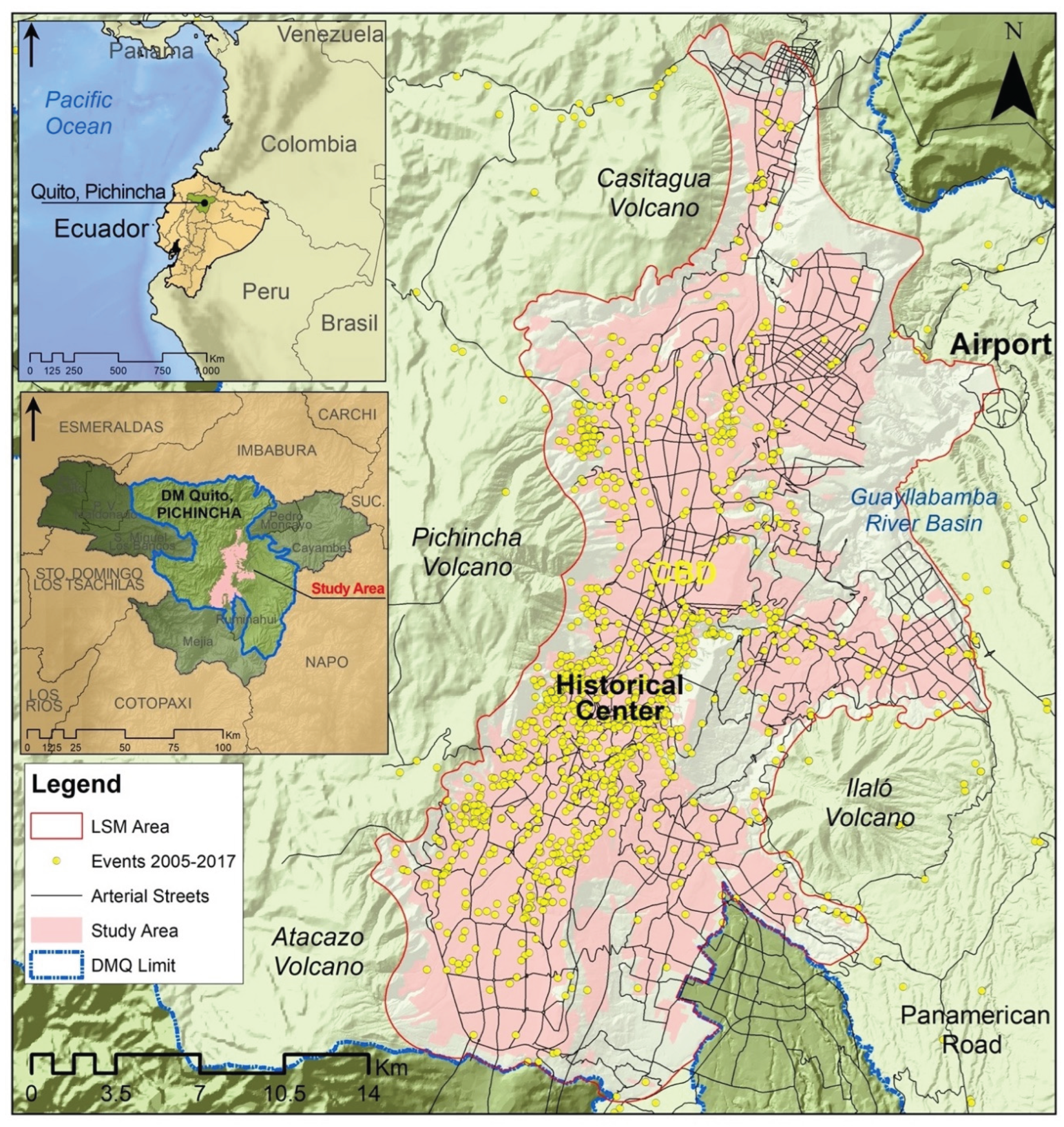
Figure 2.
Principal component analysis (PCA) process flowchart to determine the social vulnerability of urban Quito.
Figure 2.
Principal component analysis (PCA) process flowchart to determine the social vulnerability of urban Quito.
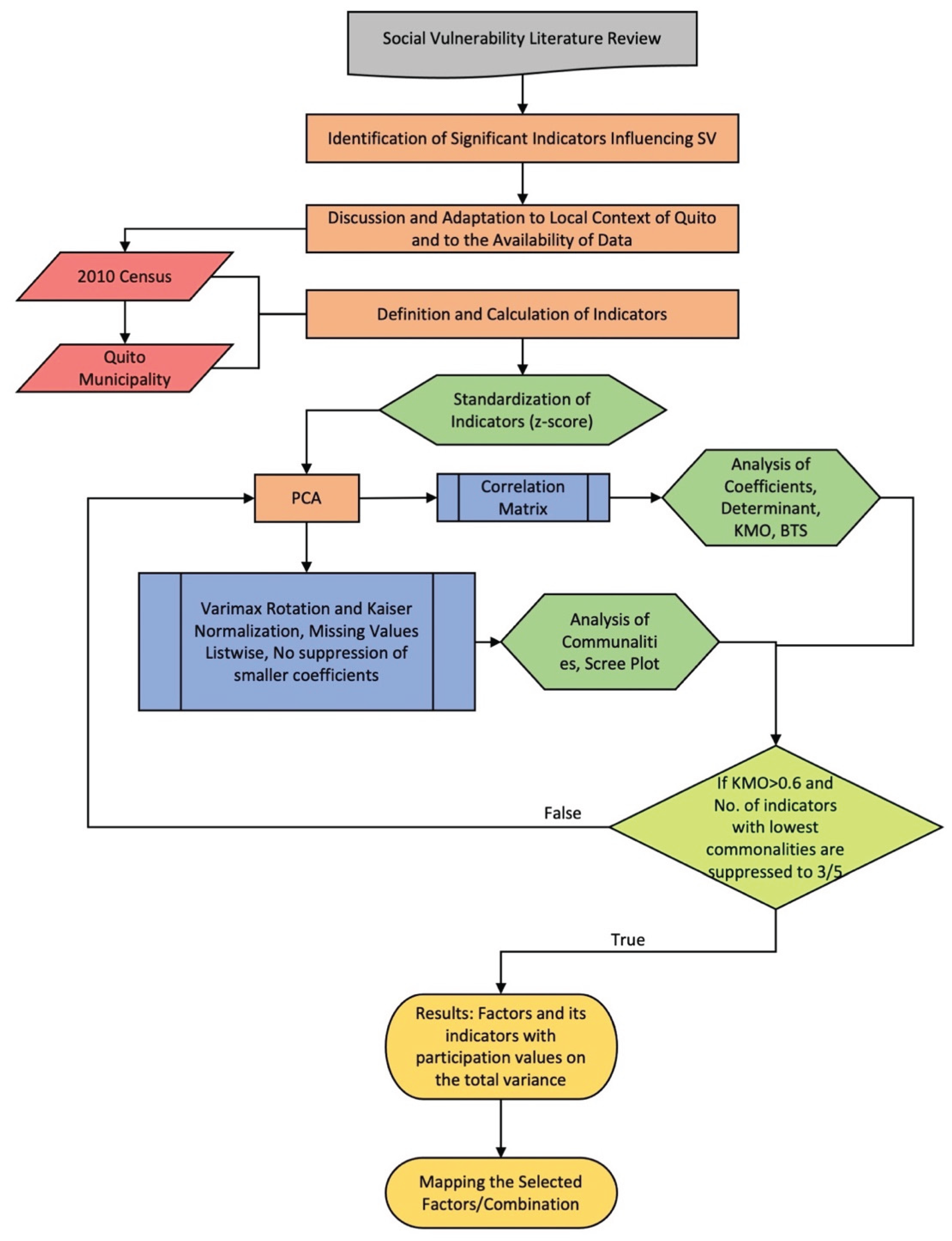
Figure 3.
Social vulnerability vs. landslide susceptibility cross-table: levels of risk. It works for any unit of analysis, whether census tracts, households or inhabitants. The dark-blue cell in the upper-left corner indicates the lowest risk level, whereas the dark-red cell in the lower-right corner indicates the highest risk level.
Figure 3.
Social vulnerability vs. landslide susceptibility cross-table: levels of risk. It works for any unit of analysis, whether census tracts, households or inhabitants. The dark-blue cell in the upper-left corner indicates the lowest risk level, whereas the dark-red cell in the lower-right corner indicates the highest risk level.
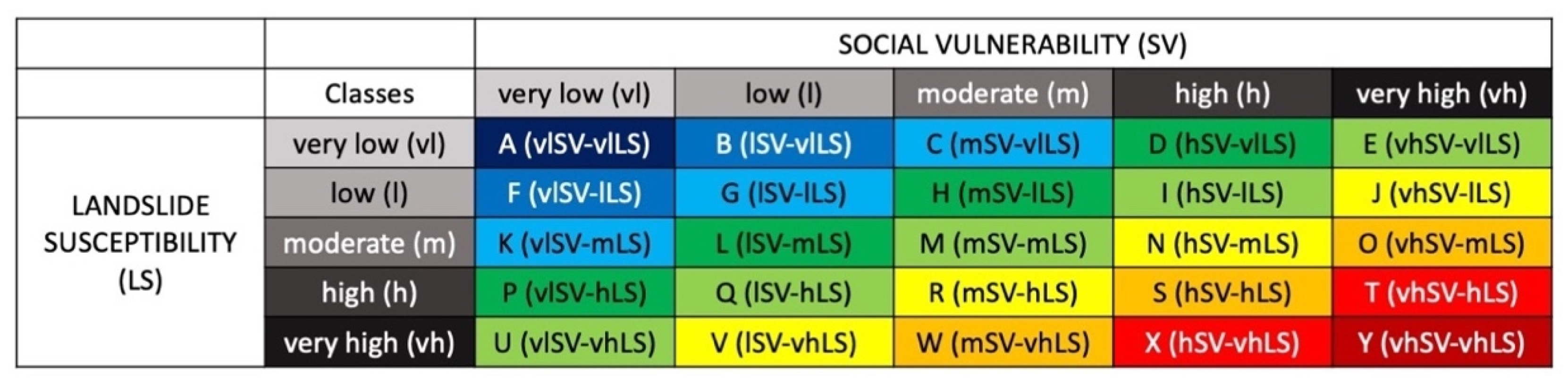
Figure 4.
CERI calculation from the landslide risk cross-table.
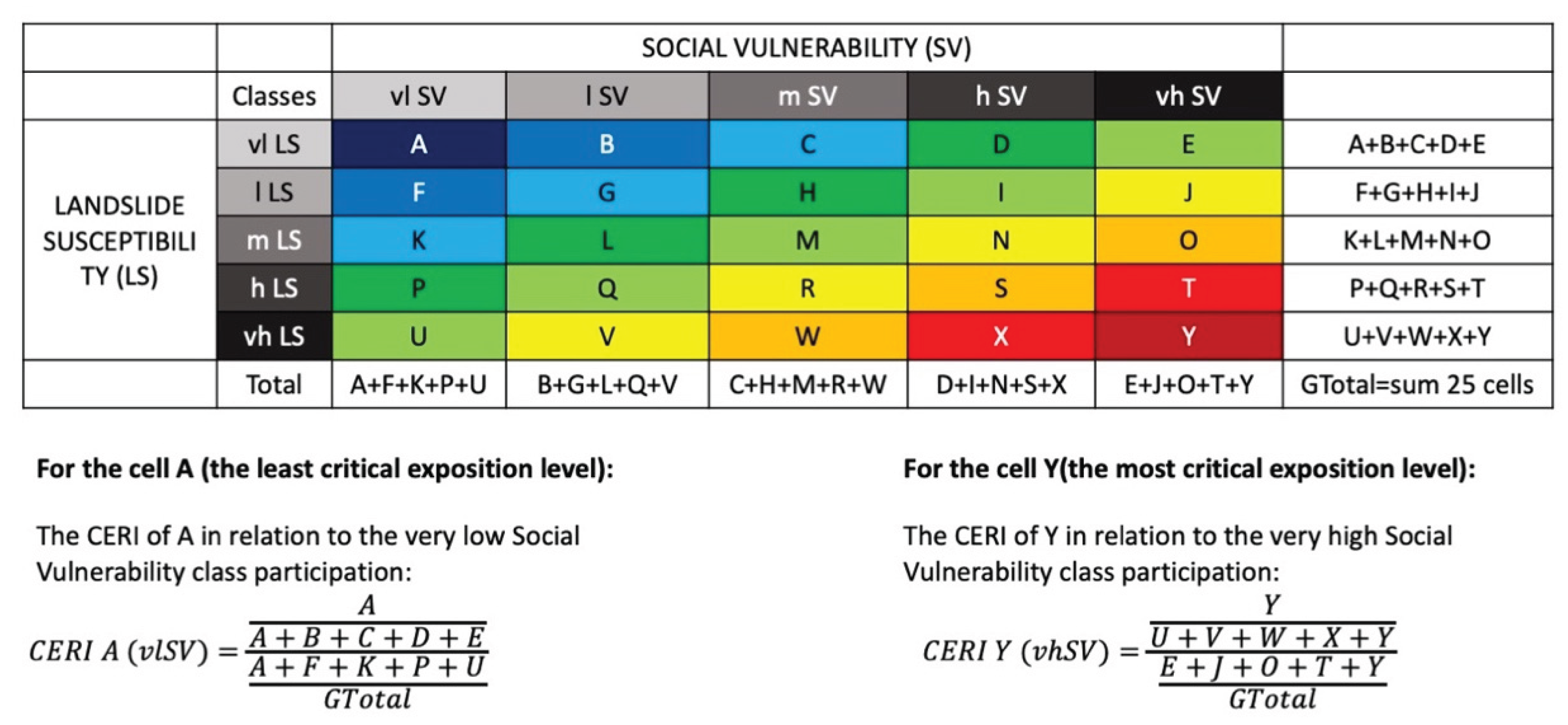
Figure 5.
Social vulnerability of urban Quito, based on Factor 1 (low-skilled populations with limited access to insurance and new technologies), shown in census tracts. Note: five classes of social vulnerability are presented, with three intermediate categories separated by one standard deviation each.
Figure 5.
Social vulnerability of urban Quito, based on Factor 1 (low-skilled populations with limited access to insurance and new technologies), shown in census tracts. Note: five classes of social vulnerability are presented, with three intermediate categories separated by one standard deviation each.
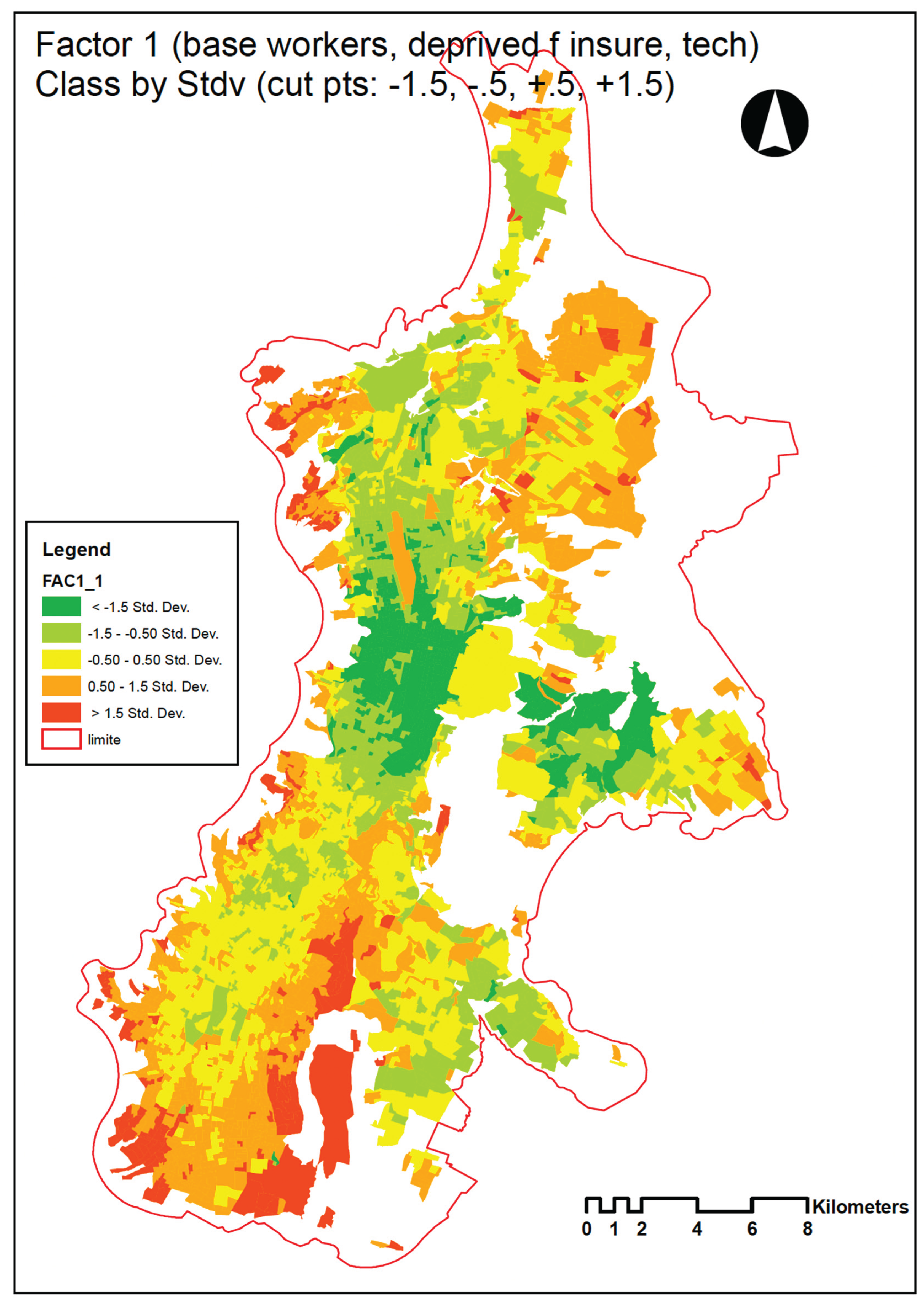
Figure 6.
Scree plot of the principal component analysis for social vulnerability in Quito.
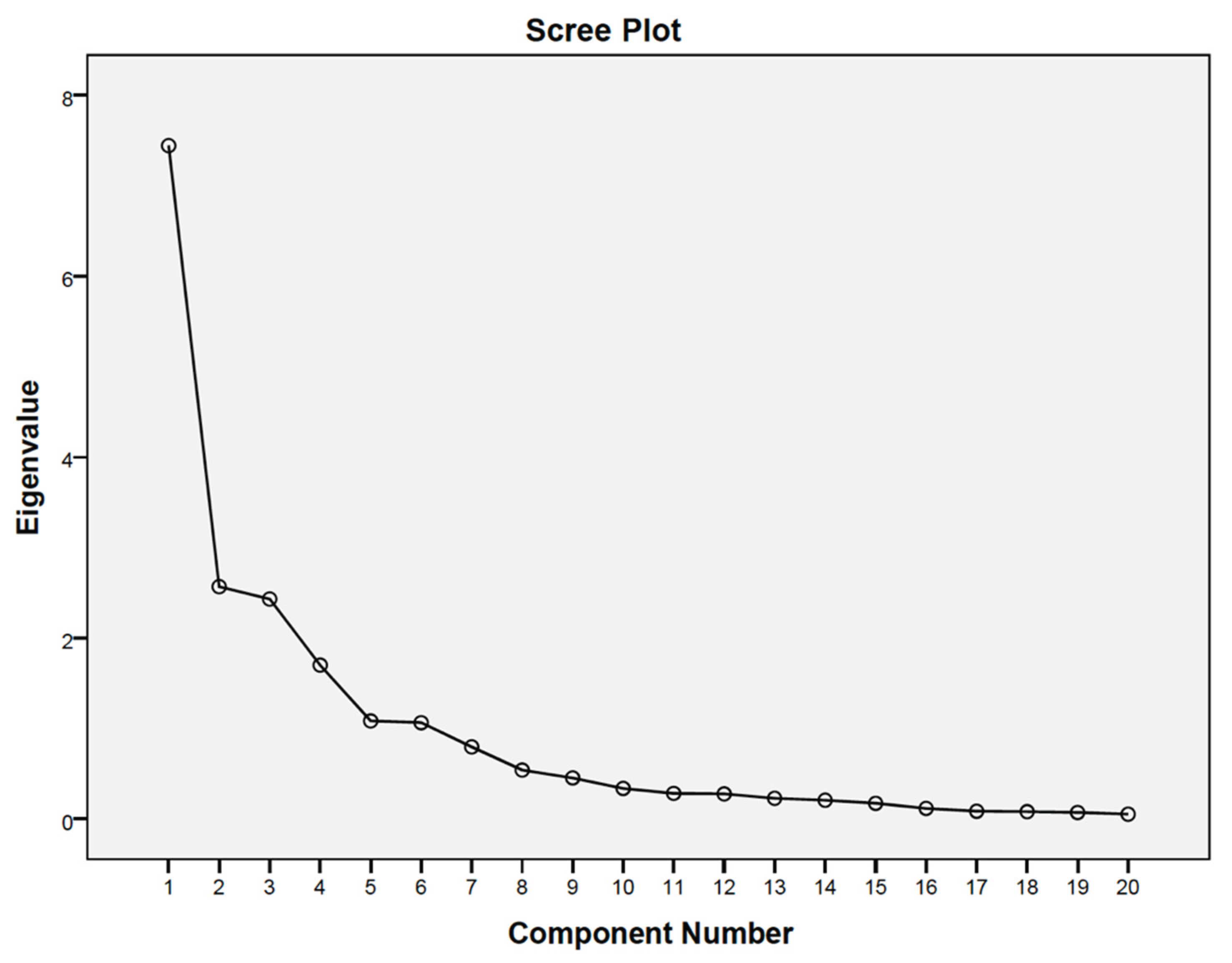
Figure 7.
Landslide susceptibility for urban Quito adapted to census tract units (average). Note: five classes are presented, with the three intermediate categories separated by one standard deviation each.
Figure 7.
Landslide susceptibility for urban Quito adapted to census tract units (average). Note: five classes are presented, with the three intermediate categories separated by one standard deviation each.
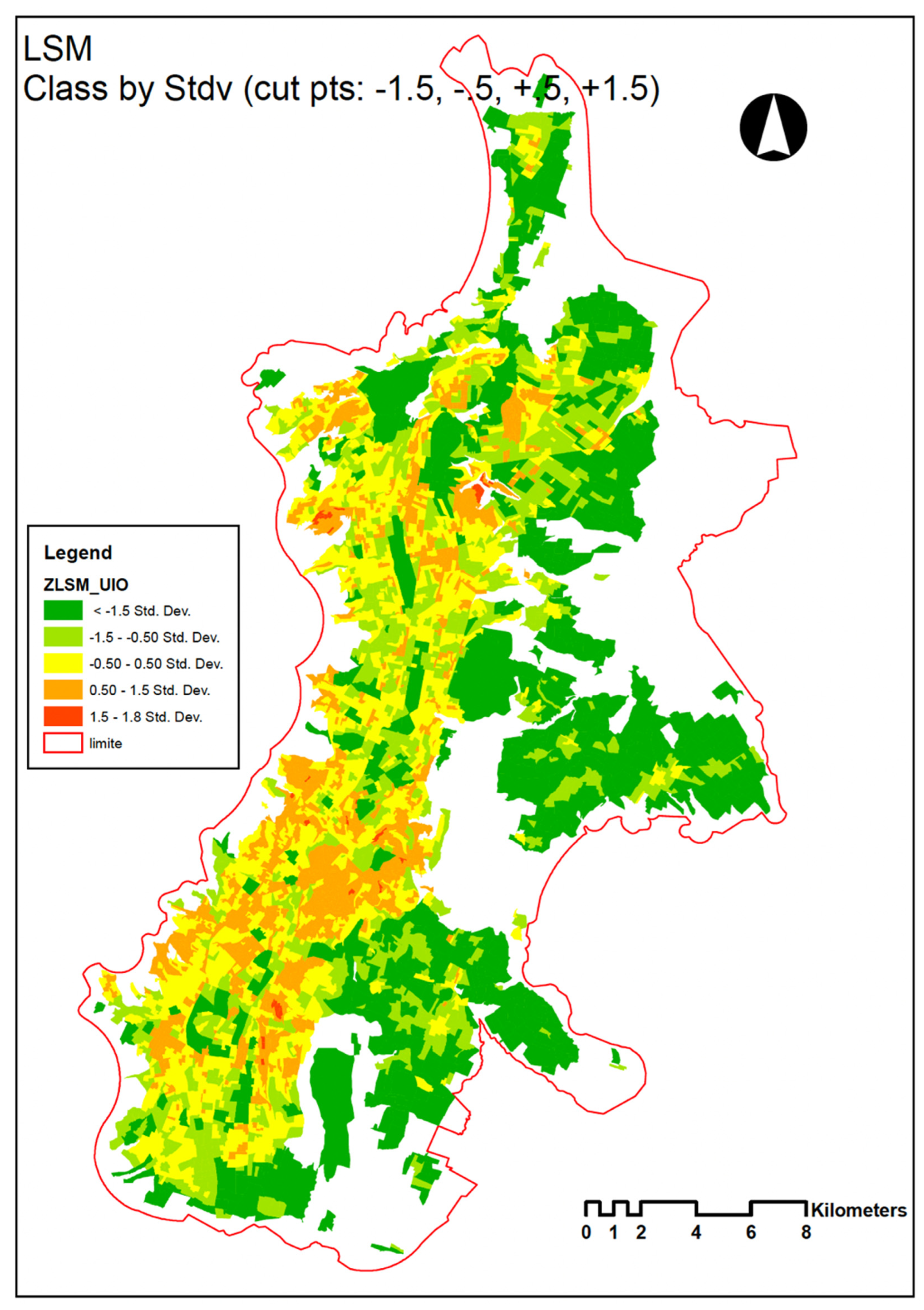
Figure 8.
Landslide risk map for urban Quito, in census tracts. Classification into nine categories results from the crossing of five social vulnerability classes and five landslide susceptibility classes.
Figure 8.
Landslide risk map for urban Quito, in census tracts. Classification into nine categories results from the crossing of five social vulnerability classes and five landslide susceptibility classes.
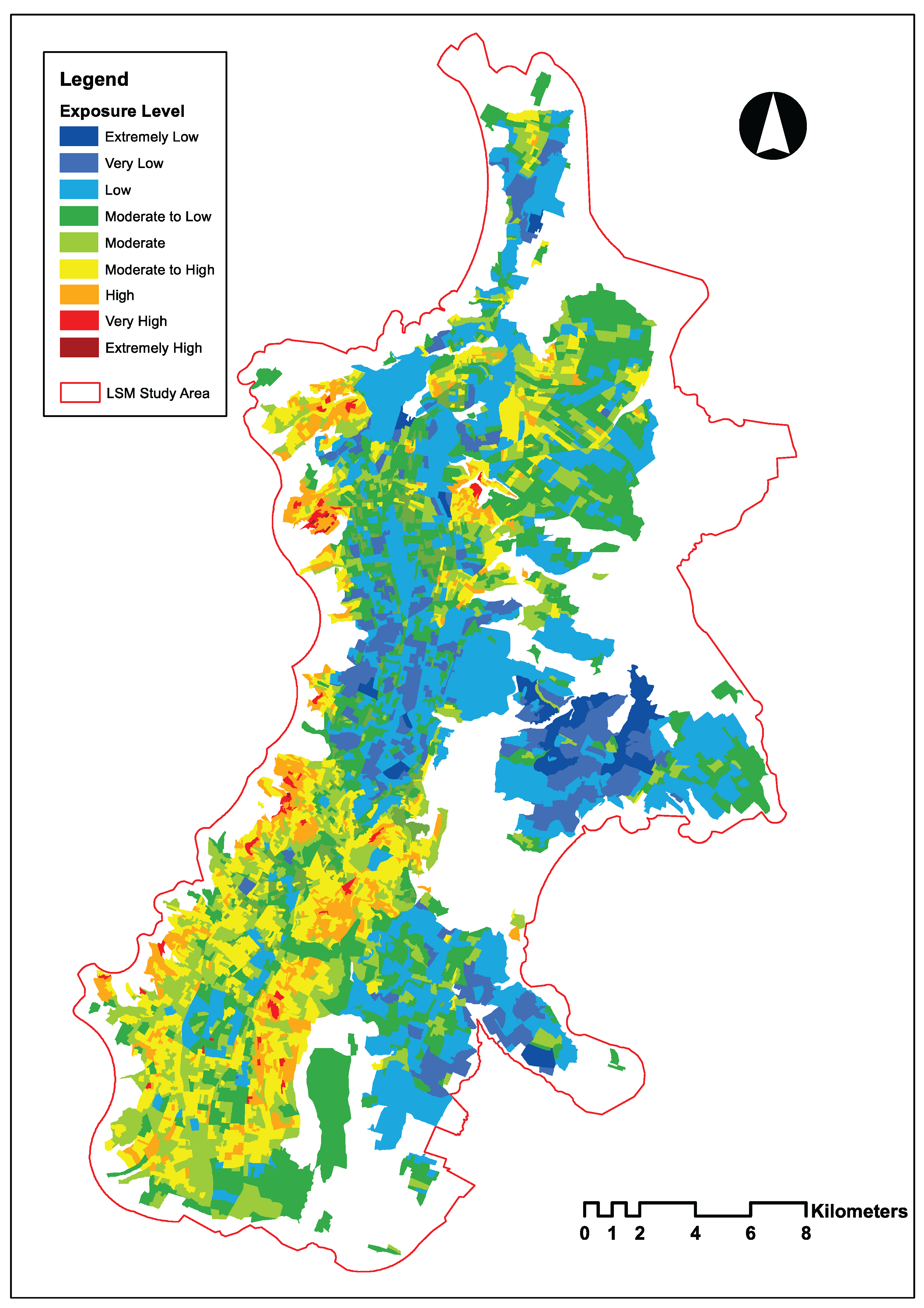
Figure 9.
Landslide risk map for Quito. Those with low social vulnerability living on highly landslide-susceptible land, and the highly socially vulnerable living on land with low landslide susceptibility.
Figure 9.
Landslide risk map for Quito. Those with low social vulnerability living on highly landslide-susceptible land, and the highly socially vulnerable living on land with low landslide susceptibility.
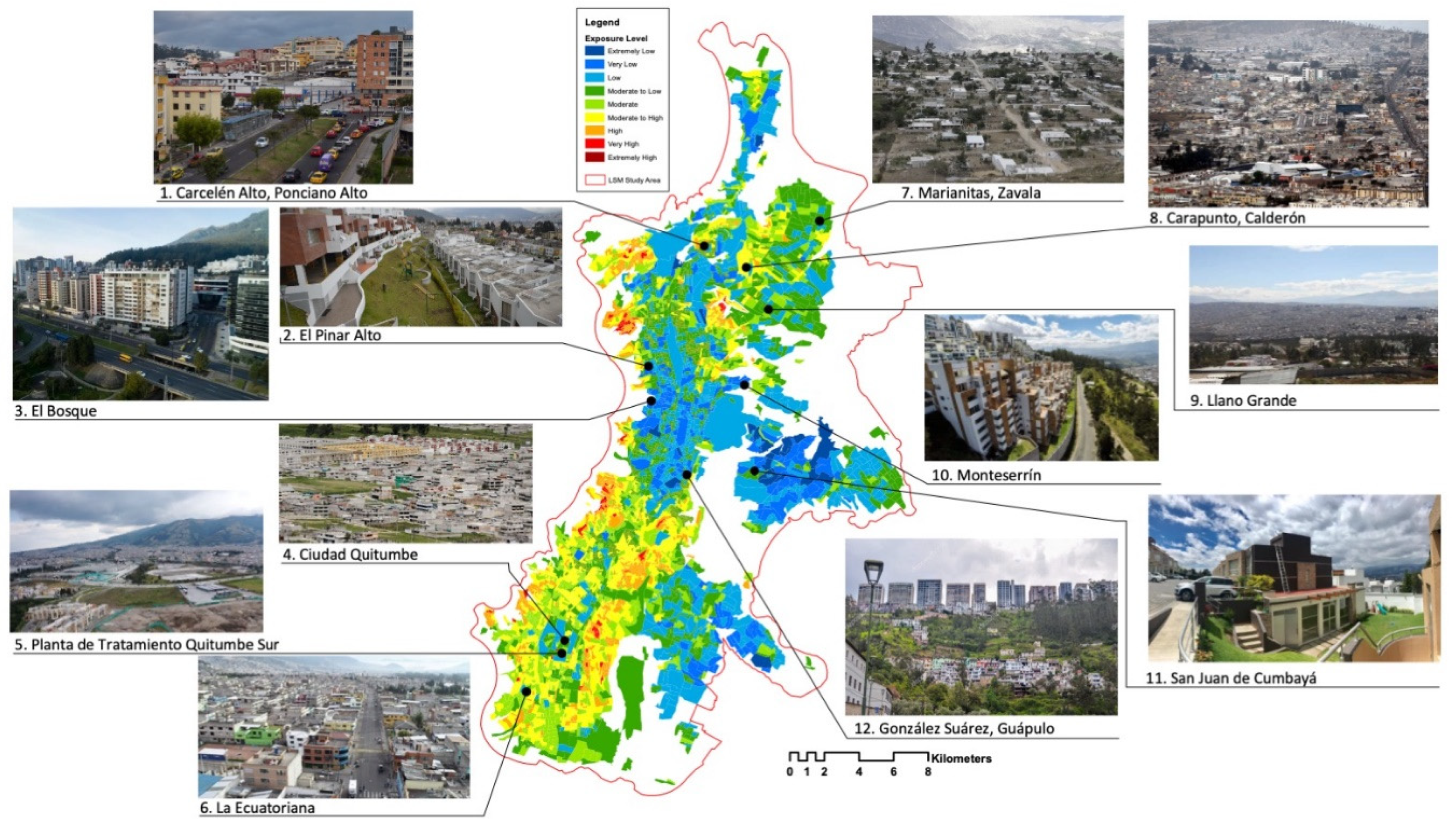

Table 1.
Explanation of total variance for the principal factor analysis for social vulnerability in Quito.
Table 1.
Explanation of total variance for the principal factor analysis for social vulnerability in Quito.
| Factor | Initial Eigenvalues | Rotation Sums of Squared Loadings | ||||
|---|---|---|---|---|---|---|
| Total | % of Variance | Cumulative % | Total | % of Variance | Cumulative % | |
| 1 (low skilled, no insurance, no new technology) | 7.444 | 37.219 | 37.219 | 7.156 | 35.780 | 35.780 |
| 2 (lack of higher educational degree) | 2.568 | 12.841 | 50.060 | 2.577 | 12.887 | 48.667 |
| 3 (housing owners) | 2.432 | 12.159 | 62.219 | 2.118 | 10.590 | 59.257 |
| 4 (other indicators) | 1.700 | 8.502 | 70.720 | 1.913 | 9.563 | 68.820 |
| 5 (other indicators) | 1.083 | 5.417 | 76.138 | 1.409 | 7.043 | 75.862 |
| 6 (other indicators) | 1.065 | 5.324 | 81.461 | 1.120 | 5.599 | 81.461 |
Table 2.
Landslide risk cross-table with Factor 1 of the principal factor analysis.
| Social Vulnerability (Factor 1) | |||||||
|---|---|---|---|---|---|---|---|
| Very low | Low | Moderate | High | Very high | Total | ||
| Landslide Susceptibi-lity | Very low | 22 | 96 | 264 | 162 | 8 | 552 |
| Low | 79 | 169 | 256 | 241 | 14 | 759 | |
| Moderate | 163 | 366 | 704 | 526 | 45 | 1804 | |
| High | 57 | 270 | 952 | 534 | 37 | 1850 | |
| Very high | 11 | 28 | 4 | 43 | |||
| Total | 321 | 901 | 2187 | 1491 | 108 | 5008 | |
Table 3.
Landslide risk table (Factor 1) expressed in terms of census tracts, households, and inhabitants.
Table 3.
Landslide risk table (Factor 1) expressed in terms of census tracts, households, and inhabitants.
| Social Vulnerability | ||||||||
|---|---|---|---|---|---|---|---|---|
| Very low | Low | Moderate | High | Very high | Total | |||
| Landslide Susceptibility | Very low | Census tracts | 22 | 96 | 264 | 162 | 8 | 552 |
| Households | 3,647 | 10,521 | 19,656 | 13,581 | 1,199 | 48,604 | ||
| Inhabitants | 12,435 | 36,072 | 71,635 | 52,163 | 4,796 | 177,101 | ||
| Low | Census tracts | 79 | 169 | 256 | 241 | 14 | 759 | |
| Households | 14,700 | 19,541 | 26,721 | 24,572 | 2,146 | 87,680 | ||
| Inhabitants | 43,482 | 62,375 | 95,630 | 94,429 | 8,685 | 304,601 | ||
| Moderate | Census tracts | 163 | 366 | 704 | 526 | 45 | 1,804 | |
| Households | 28,679 | 43,822 | 78,484 | 57,145 | 6,364 | 214,494 | ||
| Inhabitants | 80,199 | 138,005 | 270,363 | 214,400 | 24,924 | 727,891 | ||
| High | Census tracts | 57 | 270 | 952 | 534 | 37 | 1,850 | |
| Households | 10,229 | 35,632 | 104,489 | 58,529 | 5,414 | 214,293 | ||
| Inhabitants | 29,921 | 114,424 | 362,677 | 216,704 | 21,937 | 745,663 | ||
| Very high | Census tracts | 11 | 28 | 4 | 43 | |||
| Households | 987 | 3,103 | 448 | 4,538 | ||||
| Inhabitants | 3,510 | 11,424 | 1,788 | 16,722 | ||||
| Total | Census tracts | 321 | 901 | 2,187 | 1,491 | 108 | 5,008 | |
| Households | 57,255 | 109,516 | 230,337 | 156,930 | 15,571 | 569,609 | ||
| Inhabitants | 166,037 | 350,876 | 803,815 | 589,120 | 62,130 | 1,971,978 | ||
Table 4.
Comparative Environmental Risk Index (CERI) values for the social vulnerability and landslide susceptibility cross-tabulation.
Table 4.
Comparative Environmental Risk Index (CERI) values for the social vulnerability and landslide susceptibility cross-tabulation.
| Social Vulnerability | |||||||
|---|---|---|---|---|---|---|---|
| Very Low | Low | Moderate | High | Very High | Total | ||
| Landslide Susceptibility | Very Low | 0.83 | 1.14 | 0.99 | 0.99 | 0.86 | 1.00 |
| Low | 1.70 | 1.15 | 0.77 | 1.04 | 0.90 | 1.00 | |
| Moderate | 1.31 | 1.07 | 0.91 | 0.99 | 1.09 | 1.00 | |
| High | 0.48 | 0.86 | 1.19 | 0.97 | 0.93 | 1.00 | |
| Very High | 0.00 | 0.00 | 0.51 | 2.29 | 3.39 | 1.00 | |
| Total | 1.00 | 1.00 | 1.00 | 1.00 | 1.00 | 1.00 | |
Disclaimer/Publisher’s Note: The statements, opinions and data contained in all publications are solely those of the individual author(s) and contributor(s) and not of MDPI and/or the editor(s). MDPI and/or the editor(s) disclaim responsibility for any injury to people or property resulting from any ideas, methods, instructions or products referred to in the content. |
© 2026 by the authors. Licensee MDPI, Basel, Switzerland. This article is an open access article distributed under the terms and conditions of the Creative Commons Attribution (CC BY) license (http://creativecommons.org/licenses/by/4.0/).
Copyright: This open access article is published under a Creative Commons CC BY 4.0 license, which permit the free download, distribution, and reuse, provided that the author and preprint are cited in any reuse.


