

Submitted:
01 June 2026
Posted:
03 June 2026
You are already at the latest version
Abstract
Generative AI (Gen AI) adoption increasingly recognizes the need to access and validate virtue ethics in relation to Large Language Models (LLMs) and their integration into higher education. The focus is shifting from rules- or outcomes-based towards moral character, personality traits, integrity and practical wisdom (phronesis), although much of the existing work remains towards ethical paradigms from the Global North. This paper assesses the construct validity and reliability of the Virtue Ethics Measurement Scale (VEMS) within South African and the Continent’s largest Comprehensive Open Distance eLearning (ODEL) Higher Education Institution (HEI). Guided by the positivist paradigm, a cross-sectional 36-item measuring six virtue dimensions (justice, honesty, responsibility, care, prudence, and fortitude) was administered to a sample of N = 503 undergraduate and postgraduate university students. For construct validation, a confirmatory factor analysis (CFA) was employed to assess four competing models: (1) single-factor, (2a) six-factor first-order baseline, (2b) refined six-factor first-order, and (3) second-order hierarchical structure. While the single-factor model demonstrated poor fit, which rejected unidimensionality, the second-order model demonstrated a comparable fit, thus supported a hierarchical structure where six specific virtues successfully loaded onto an overarching virtue ethics construct. Through its robust psychometric properties, the proposed VEMS proves to be a reliable virtue ethics assessment instrument for adoption and use of Gen AI within South African higher education ODEL environment.
Keywords:
academic integrity
; confirmatory factor analysis
; generative AI
; higher education
; large language models
; open distance learning
; scale validation
; South Africa
; virtue ethics measurement scale
1. Introduction
The 21st century has been characterized by rapid technological advancement driven by the Fourth Industrial Revolution (4IR), thus fundamentally transforming how knowledge is produced, accessed, and applied across sectors. Among these developments, Artificial Intelligence (AI), particularly generative AI (Gen AI), has emerged as a disruptive force with profound implications for higher education. This proliferation has led to widespread adoption among students and academic staff for the purposes of supporting their academic activities such as assessment writing, content generation and problem solving [1,2]. As GenAI technologies, such as large language models (LLMs) and natural language processing systems (NLPs), are increasingly integrated into academic environments, this in turn is reshaping teaching, learning, assessment, and knowledge construction processes [3].
The emergence and pervasive nature of Gen AI tools, particularly LLMs, are regarded as part of transformative educational technologies presents both unprecedented opportunities and complex ethical challenges for higher education institutions (HEIs) around the globe, and for that matter South African HEIs are no exception. South Africa’s National Development Plan (NDP) 2030 positions higher education as a critical driver of economic transformation and social equity [4]. The 4IR revolution intensified this mandate, compelling HEIs to respond to rapid technological disruption while simultaneously addressing inequalities in access, quality and graduate readiness.
Within the context of Comprehensive Open Distance and e-Learning (CODEL), the integration of AI technologies assumes even greater significance. CODEL environments rely heavily on digital platforms, self-directed learning, and limited face-to-face interaction, making students more dependent on technological tools to support their academic activities. As a result, GenAI tools are increasingly becoming part of students’ independent learning strategies, raising important questions about how these technologies influence learning behaviours, decision-making, and ethical engagement.
Variety of ethics-based models, frameworks, approaches, and standards have since been developed aimed at validating virtue ethics behavioural traits. [5] argue that HEIs respond differently and reactively to the disruptive nature and influence of Gen AI, as they tend to communicate their stance of Gen AI through position statements, policy or guidelines as part of the legislative frameworks for AI governance. These frameworks often with limited understanding of how to effectively harness these tools for students’ benefit. According to [6] recent studies have begun to emphasise that GenAI has become deeply embedded in academic practices, thereby necessitating a critical examination of its implications for student ethical behaviour, practices and learning processes. Furthermore, the focus of the other strand of the literature is steadily shifting away from rules- or outcomes-based towards promoting moral character, personality traits and integrity and practical wisdom, also referred to as phronesis [7].
In the era of Gen AI and big data, ethical concerns extend beyond academic dishonesty and integrity [8,9] to include issues of digital divide [10] data privacy, biased algorithmic outputs and misinformation [11,12], cognitive justice [13] to balancing academic freedom [7]. Further to these issues, the over-reliance on AI tools in the review of students’ academic work [15,16] raises important considerations regarding the validity, consistency, and finality of feedback. The rationale as argued by [17] is that AI-generated outputs tend to be iterative and may continuously identify areas for refinement without necessarily reflecting substantive deficiencies in the work. These concerns therefore underline the need for a virtue ethics framework for HEIs operating within CODEL as [7] argue that implementation of AI framework that is driven by virtue ethics within these HEIs has a potential to propel research integrity and academic freedom.
In the era of proliferation of Gen AI tools permeating higher education landscape, the process of scale development and validation according to [18] is a crucial and critical one, for research on validated instruments aimed at assessing ethical awareness of users remain scant. Notwithstanding the developments in studies geared towards virtue-ethics, the focus of the extant literature is however heavily oriented and biased towards or by paradigms from the Global North.
As far as existing virtue ethics instruments and related studies are concerned, their assessment of Gen AI adoption and usage character traits is associated with individual autonomy, materialistic fairness, and objective neutrality, which are arguably oriented towards Western beliefs and ideals, through which HEIs are viewed through politically neutral lens [see 19;20]. Further to this observation, existing instruments assume linguistic expressions of “virtues” to be universally understandable across variety of student populations. However, given that students in South African HEIs come from vastly diverse socio-economic background and the country being a melting pot of 12 official language, scales validated from a different cultural or belief contexts (such as US, Europe, or Asia) may potentially suffer from measurement bias and construct drift. The thesis we put forward in this context is that South African students may likely interpret virtue terminology based on a distinct cultural lens from other dominating contexts. For example, students in are grappling digital divide and resource constraints [10], and South African students are no exception. Therefore, practice of virtue ethics and priority of their goals is seen in a different lens from that of well-resourced academic environments.
Drawing on the African lens, Global North scales lack orientation towards relational and communal virtues assimilating Ubuntu philosophy or African communitarianism anchoring indigenous ethical values and beliefs. The current paper intends to address this gap by acknowledging that South African HEIs’ operating environment is characterized by endeavours to advance social justice, measures to redress historical injustices, and mandate to decolonize education, learning and teaching. The current paper thus aims to assess the construct validity and reliability of the Virtue Ethics Measurement Scale (VEMS) within South African HEI, the Continent’s largest CODEL institution of higher learning. This paper is part of a larger research project aimed at examining students’ awareness, adoption, digital self-efficacy and perceptions on the ease-of-use Gen AI tools. Building on this background, the following research objectives guided the aim of the paper:
- Evaluate the construct validity and reliability of the Virtue Ethics Measurement Scale (VEMS) within the South African higher education context.
- Refine the VEMS into a more parsimonious and psychometrically robust scale by identifying redundant items and improving model fit.
- Propose a validated version of the VEMS for use in South African higher education research and practice.
2. Review of the Literature
2.1. Virtue Ethics Scale to Promote Responsible Students AI-Practices
The rapid proliferation of generative AI technologies into social, institutional, and professional life, and their profound influence on educational practices globally, necessitate research on integrating robust ethical frameworks to guide their use in higher education. The pace of technological development has far-reaching implications for the higher education system, which risks becoming functionally irrelevant in its current form if it fails to adapt its educational pedagogy and practices to a rapidly evolving digital knowledge ecosystem [21,22].
In addition, unsustainable educator and administrative workloads, inequalities in AI use, tensions between the need for rapid HEI responses and the complexity of AI, and AI-literacy deficits among educators and students further complicate adoption and use [23] Although GenAI offers educational benefits such as improved learning efficiency and enhanced student engagement through personalised AI tools, [23] caution that over-reliance and dependency may weaken students’ critical skills and contribute to a decline in academic integrity. [23] further identified another less commonly described risk, "a kind of omnipotence, which could potentially eliminate humbleness and consequently affect the development of selflessness and the sense for meaning in life". Given the stress and anxiety associated with adapting to the accelerated pace of technological progress, higher education institutions must provide robust support mechanisms, including guidelines and education on ethical AI use and AI literacy.
Virtue ethics, an ethical approach that focuses on character and the cultivation of virtue rather than merely adopting rule- or principle-based ethical guidelines, has emerged as an alternative and complementary framework for guiding responsible GenAI engagement in education [7,19,23]. One of the main reasons for this shift is an attempt to address an implementation gap described in scholarly literature: a deficit in moral character that normative, principle or rule-based frameworks do not address [7]. The implementation gap is evident in the rise in student academic integrity misconduct despite the existence of AI guidelines and policies, indicating that principle-based benchmarks have not effectively translated into responsible AI-engagement [19]. Virtue ethics extends the focus beyond external rules that ought to guide ethical AI decision-making to the intrinsic moral character, habits, and motivations of a moral agent, or, in this case, the higher education student.
The literature review explores six virtues – justice, honesty, responsibility, care, prudence and fortitude – identified across the AI literature as vital for ethical AI-engagement [7,19,20,24]. [7] continue to distinguish between core intellectual virtues and ethical anchors – practical wisdom and prudence – and moral virtues such as honesty, courage (fortitude), accountability (responsibility), care (harm-free AI use), integrity, and justice (fairness), which serve as ethical benchmarks in AI applications and engagements. Trust is at the heart of meaningful relationships in academic contexts. Academics must trust that their students are using GenAI tools responsibly and that they report their use honestly. Likewise, students must trust that they will receive the institutional support needed to equip them to use AI responsibly. However, the decision on the action rest with individual’s character, which principle-based frameworks fail to advance. [19] equates demonstrating these virtues with the acquisition of public trust in AI development, deployment and use.
These virtues are explored in alignment with their philosophical origins, their application to student AI-engagement and their implications for the cultivation of ethical GenAI practice in higher education context. The review entailed a thematic synthesis of peer-reviewed literature on virtue ethics (philosophy), AI ethics and information technology ethics.
2.2. Cultivating Virtue in Student AI Engagement: The Roles of Moral Virtues (Justice, Honesty, Responsibility, Care)
The landmark analysis by [25] in Nature ML (Machine Intelligence), which mapped 84 AI ethics documents from governments, private companies, and research Institutions worldwide, reveals a global convergence around five ethical principles, namely transparency, justice and fairness, non-maleficence, responsibility, and privacy. [19] demonstrates that the four foundational AI virtues, namely justice, honesty, responsibility, and care can be derived directly from the recurring principles, which can be identified in meta-studies of global AI ethics guidelines [25,26]
Justice, particularly distributive justice, refers to the fair distribution of benefits and burdens. Fairness is among the most frequently cited techno-moral virtues in global AI governance documents [25]. In a higher education context, it involves the fair distribution of the benefits and potential risks of emerging technologies, ensuring they are used in ways that respect the basic rights, dignity, and welfare of all stakeholders [20]. AI systems can perpetuate structural inequalities [22,27]. To demonstrate sensitivity to 'justice’, students must be able to demonstrate equitable, fair and unbiased application of AI in their academic work [20,25,26,28,29,30]. Justice in Gen AI use seeks to prevent discrimination and preserve diversity; both are applicable to how AI is used to guide student decision-making [7]. Students must be mindful that AI tools can reinforce biases and disadvantage marginalized groups, AI-generated content can misrepresent diverse perspectives and have detrimental societal implications. Essential to character formation is the development of competencies to advocate for inclusive AI tools and to challenge AI outputs that exhibit discriminatory or unfair assumptions.
2.3. Cultivating Virtue in Student AI Engagement: The Roles of Core Intellectual Virtues – Practical Wisdom and Prudence (Phronesis)
The ODEL environments risk students' foregoing intentional pedagogical opportunities for character development. Although scholars continue to debate the university’s role in character formation and moral education [33], contemporary literature increasingly suggests that responsible student engagement with generative AI requires more than regulatory compliance or punitive governance [7; 30b; 33]. Emerging approaches in higher education AI ethics emphasise the cultivation of ethical judgement and character-oriented dispositions, "delivering pedagogies that nudge learners towards long-term learning behaviour changes." [31, p. 572].
Practical wisdom and prudence are often used interchangeably. Both concepts relate to the intellectual virtue of phronesis, which supports decision-making in situations where rules do not provide clear answers. [34] shows that technology can blur boundaries in education, requiring students to balance competing demands such as efficiency and understanding. [35] argue that students must develop the ability to judge what is appropriate in context, not only what is permitted. However, existing studies often describe this need without explaining how students acquire such judgment. This paper addresses this gap by framing the intellectual virtue of phronesis (practical wisdom and prudence) prudence as a cultivated capacity that helps students interpret context, evaluate consequences, and make balanced decisions. Yet, even when students make sound judgments, they may still struggle to act on them under pressure.
Care draws attention to the relational effects of AI use. [36] show that students’ choices influence not only their own learning but also their peers, educators, and the integrity of the academic environment. [37] extends this view by emphasizing fairness, trust, authorship, and the avoidance of harm. These accounts highlight the importance of attending to others, but they often assume that students will recognize these responsibilities without guidance. This paper, therefore, positions care as a learned disposition that requires explicit support in educational settings. It encourages students to consider whether their AI use strengthens learning relationships and respects others' contributions. However, recognizing these responsibilities alone does not ensure sound decisions, which underscores the importance of judgment.
Fortitude focuses on the challenge of acting on ethical judgment under pressure. [38] identify time constraints, stress, and competition as key factors that push students toward excessive reliance on Gen AI. [39] confirm that students often recognize these risks but struggle to act differently. While these studies highlight the problem, they give less attention to how students can sustain ethical action. This paper argues that fortitude provides this missing link. It enables students to persist with honest work, resist shortcuts, and uphold their decisions even when doing so is difficult. The researchers sum this section by concluding that care, prudence, and fortitude form an integrated framework that connects ethical awareness, judgment, and action in student AI engagement. Therefore, frameworks that focus on character and virtue cultivation rather than rule- or principle-based ethical guidelines, are regarded as vital for guiding responsible GenAI use.
3. Materials and Methods
3.1. Research Philosophy and Design
Guided by the positivist research philosophy [40] the paper followed a quantitative approach and cross-sectional research design, through which VEMS measuring six virtue dimensions was administered to a sample of n = 503 undergraduate and postgraduate university students. Drawing from this intent, hypothesis testing was not the focus, but rather a scale validation and dimensionality testing.
3.2. Instrumentation, Item Development and Measurement
As part of content and construct validation, items were generated through a developmental review processes as illustrated in Figure 1. In the first stage, the conceptualization of the VEMS was theoretically grounded and literature-guided from Gen AI-oriented constructs [20; 25; 26; 28; 29; 30b]. This was followed by the review of normative AI ethics and governance frameworks, targeting those that measure virtuous characters.
In the third stage, necessary modifications were performed in line with ODEL context of HEI. The last stage involved face validity where panellist discussion with subject matter experts was conducted. This process assisted with refining items for clarity in their measurement intention, representativity and most importantly alignment with each virtue. This was followed by a pilot study with small sample (n=10) for further refinements.
The VEMS was comprised of 36 items across 6 dimensions (6 items each), namely Justice - assessing fairness in Gen AI use, Honesty - assessing transparency and integrity in AI use, Responsibility - 6 items assessing accountability in AI use, Care - assessing ethical harm-free AI use, Prudence - 6 items assessing critical reflection on AI use) and Fortitude - assessing courage in upholding AI ethics). This approach aligns with the general underlying (critical) assumption that the virtue scale can be operationalised/measured quantitatively. For the statistical analysis, the Likert scale was anchored so that 1 = Strongly disagree and 5 = Strongly agree. This to align with an operational definition where higher ratings would be associated with higher levels of self-reported virtue ethics [52a;19].
3.3. Data Collection, Screening and Preparation Procedures
Following ethics approval, data was gathered between August and November 2025 from registered undergraduate and postgraduate students through Google forms, an online structured survey. Prior to data analysis, various data quality checks were conducted done to ensure the inclusion of complete and valid cases.
3.4. Data Analysis Procedures
A systematic three-stage CFA model comparison analytical strategy was employed through statistical data analysis using IBM SPSS Version 30 and IBM SPSS Amos Version 28. Preliminary to the primary analysis and in addition to ensuring acceptable sample size adequacy, distributional normality was assessed. This procedure was followed by data assessment for the detection of any excessive outliers. We applied Tabachnick and Fidell (2014) procedure to assess the distributional properties through descriptive statistics and item-level analyses.
Focusing on scale validation, a covariance-based Confirmatory Factor Analysis (CFA) similar to [41], was thus performed to assess the psychometric properties of the VEMS. The intention was driven by a quest to examine virtue-driven ethical influences driving CODEL students perceived experiences and intentions in the use of and adoption GenAI in academia. Through this process, construct validity was assessed through aspects such reliability and internal consistency, model fit, convergent and discriminant validity. The scale validation was concluded with invariance analysis. This to determine if the whether the final adopted factor structure was consistent across groups. For this study, invariance was tested in relation to grouped age (younger than 30 years, vs older than 30 years).
4. Results
4.1. Demographic Description of the Sample
Owing to missing data, the sample from which the data is analyzed comprised of n= 503, from 608 respondents. The sample was characterized by diverse languages, educational backgrounds, age groups, and gender. As shown Female students were in the majority (68.6%, n=345) compared to 30.8% (n=155) representation for male students. Meanwhile those who preferred not to disclose accounted for less than 1%. The sample distribution closely aligns that of the institutional profile.

Table 1.
demographic description of the sample.
| Sample | Population | ||||
| n | % | N | % | ||
| Gender | Male | 155 | 30.8% | 109 902 | 28.7% |
| Female | 345 | 68.6% | 273 588 | 71.3% | |
| Grouped age | Younger than 20 | 4 | 0.8% | 29 992 | 7.8% |
| 20 – 29 | 165 | 32.8% | 206 572 | 53.9% | |
| 30 – 39 | 167 | 33.2% | 107 741 | 28.1% | |
| 40 – 49 | 107 | 21.3% | 30 567 | 8.0% | |
| 50 - 59 | 48 | 9.5% | 7 625 | 2.0% | |
| 60 - 69 | 8 | 1.6% | 906 | 0.2% | |
| Older than 70 | 3 | 0.6% | 87 | 0.0% | |
| Not specified | 1 | 0.2% | |||
| Disability status | Yes | 23 | 4.6% | 3 341 | 0.9% |
| No | 472 | 93.8% | 380 149 | 99.1% | |
| Not specified | 8 | 1.6% | |||
In terms of age distribution, 32.8% were between 20 to 29 years, while 33.2% and 21.3% were respectively between 30 to 39 and 40 to 49 years of age.
The sample size of n= 503 was also deemed sufficient for the statistical analysis, including CFA, as it exceeded the minimum recommended threshold of n = 500 or more for a robust factor analysis [43]. Furthermore, considering this advantage, a complex latent variable modelling would be feasible thus providing sufficient statistical power and stable parameters
4.2. Descriptive Statistics
The means (M) of individual scale items ranged between 3.59 to 4.39, suggesting a general tendency toward agreement with virtue-consistent statements regarding ethical GenAI use. Items reflecting Care have demonstrated observed higher mean scores (an average rating of M=4.20 across the six scale items), thus signifying stronger endorsement of these ethical positions among the respondents. Items underlying Honesty (M=4.04), Responsibility (M=4.05), Prudence (M=4.04) and Fortitude (M=4.03) report lower observed average ratings across their set of items.
Conversely, items about Justice reported the lowest mean levels of agreement (M=3.77) requiring active ethical agency or moral courage, such as those related to speaking up against unethical AI use or advocating for ethical policies) generated comparatively higher means. This direction leans towards more variability and a less uniform endorsement of these virtues by students.
Standard deviations (SD) ranged between 0.82 to 1.04, and this has reflected an adequate response dispersion and a good discrimination in differentiating between respondents’ responses.
For assessing normality of the data, skewness and kurtosis were computed in line with suggested procedure as described by Hair et al., (2012). Multivariate normality is an underlying assumption for covariance-based structural equation modelling (CB-SEM) where maximum likelihood estimation (MLE) is often a standard estimation approach. The skewness values were generally positive and within acceptable limits (between -2 to +2), with absolute values falling below 2. This suggested mild skewed responses towards right, consistent with ethically desirable responding. Similarly, kurtosis values fell within acceptable thresholds, with only one exceeding 2. West et al. in [45] considered kurtosis values greater than 7 as indicative of substantial departure from normality. Given the large sample size as alluded earlier, these distributional properties were considered suitable for covariance-based CFA.
4.3. Item Analysis
At the item level, patterns revealed that an observed higher proportion of respondents selected strongly agree or agree for statements related to unethical AI use (e.g., fabricating results, exploiting AI, or causing harm). This implied evidence of respondents’ high moral norms against overtly unethical practices. Items related to reflective judgement (prudence) and ethical resilience under pressure (fortitude) demonstrated moderately neutral and disagreement responses, which imply that respondents’ virtues may be susceptible to context-dependent and sensitive to institutional and situational constraints such as implementation of measures (e.g., academic integrity course, proctoring solutions and punitive measures) to guard against academic dishonesty and misconduct in promotion of academic integrity. Items measuring justice reported higher observed levels of ‘neutral’ and ‘disagreement’. This also reflects in the overall mean rating across the six items being the lowest.
Both the descriptive and item analyses indicate that the VEMS items exhibit sound distributional properties, meaningful variability, and conceptual sensitivity across the six virtue domains, supporting their suitability for subsequent reliability and CFA.
4.4. Reliability and Common Method Bias
The second stage of the statistical analysis involved assessing the reliability of the scales, as well as testing for potential common method bias (CMB).
To test the internal consistency reliability of the scales, Cronbach’s alpha was calculated. All six dimensions of VEMS as shown Table 2 demonstrated good to excellent internal consistency, with alpha values exceeding exceeded the recommended minimum criterion of α = ≥.70 [46] thus implying satisfactorily VEMS’ internal consistency.
Owing to the self-reported nature of the instrument, a Harman’s single-factor test was performed as an initial assessment of potential common method bias (CMB). Through unrotated exploratory solution forcing all items into a single factor, the results revealed that this single factor accounted for about 45% of the total variance. This is lower than the upper threshold of 50% proposed by [48] and therefore supports the initial notion that CMB is not expected to be a substantial threat to the validity of the findings. While Harman’s test is known for its diagnostic power limitations, [48] defend it as an accepted preliminary assessment in psychometric assessments provided conservative interpretation. In addition to this analysis, a single-factor CFA analysis was also conducted as part of assessing CMB. The results are reported below.
4.5. Measurement Model Assessment
In the third stage, four CFA model structures were fitted to identify the optimal factor structure for the VEMS. Model 1 represented a single-factor structure; Model 2a represented the original six-factor first-order structure; Model 2b represented an adjusted six-factor first-order structure; Model 3 represented a second-order structure; and Model 4 represented a bifactor structure based on the adjusted six-factor first-order structure to assess unidimensionality.
To evaluate model fit, multiple indices as proposed by Hair et al. (2022), and noted in Table 3, were used. These included the chi-square statistic and associated p-value, normed chi-square (CMIN/df), Comparative Fit Index (CFI), Tucker–Lewis Index (TLI), Root Mean Square Error of Approximation (RMSEA), and Standardized Root Mean Square Residual (SRMR). Lastly, the Akaike Information Criterion (AIC) and Bayesian Information Criterion (BIC) were also inspected.
Furthermore, convergent validity was assessed through the standardised factor loadings, composite reliability (CR) and average variance extracted (AVE). Standardised loadings of at least .5 is recommended, with value greater than 0.7 preferred. For CR a minimum threshold of .7 is deemed acceptable with an AVE > 0.5. Lastly, discriminant validity was assessed using the heterotrait–monotrait (HTMT) ratio. Ratio’s less than .85 is deemed acceptable.
Table 4 presents a comparison of the alternative CFA models and reported fit statistics.
4.5.1. Model 1 - Single Factor CFA
The first CFA model estimated a single-factor structure to assess whether Gen AI virtue ethics behavioural orientation could be represented as a simple unidimensional construct, with all items loading directly onto a single latent factor. Assessment of the single-factor confirmatory factor analysis indicated poor model fit to the data (χ²/df ≈ 6.30; CFI ≈ .73; TLI ≈ .72; RMSEA ≈ .10; SRMR ≈ .07; AIC ≈ 3888.4; BIC ≈ 4192.3). Standardised factor loadings ranged between .550 and .759, with only 12 of the 36 items reporting loadings above the preferred value of .7. A CR of .965 and an AVE of .434 is reported for the single factor. Figure 2 depicts the results of single factor model.
Depicted in Figure 2, the model is an indicative that ethical behavioural orientations towards AI are most likely a multi-faceted rather than monolithic or one dimensional.
The model fit results indicate that the observed measures could not be adequately represented by a single latent factor, despite the high CR. In addition, and following the initial assessment of common method variance, these results provide further support that CMV is unlikely to account for the majority of covariance among the study variables.
4.5.2. Model 2a – Six-Factor First-Order CFA
Illustrated in Figure 3 is the first-order model (Model 2a) specified by six correlated first-order latent factors and related 36 items from the scale, namely Justice, Honesty, Responsibility, Care, Prudence, and Fortitude. As the baseline measurement model, it was estimated to evaluate the theorised multidimensional structure underlying the VEMS framework. Assessment of the model indices from original first-order CFA suggest that all items have loaded significantly onto their hypothesised subscales. The standardised loadings ranged from .536 to .845, with 10 of the 36 items still reporting values below .7.
Model fit statistics reported: χ²/df ≈ 3.61; CFI ≈ 0.87; TLI ≈ 0.86; RMSEA ≈ 0.07; SRMR ≈ .054; AIC ≈ 2265.8; and BIC ≈ 2633.0). Positive and statistically significant inter-factor correlations were evident although they remained theoretically interpretable. Composite reliabilities were all above .7 and ranged between .849 and .902. Average variance extracted were all above .5. The HTMT ratios were below the conservative threshold of 0.85, indicating that the constructs are empirically distinct [63].
Although the model demonstrated substantial improvement relative to the single-factor model and exhibited acceptable convergent and discriminant validity, several global fit indices remained below recommended thresholds. Nevertheless, the findings provide support for the conceptualisation of justice, honesty, responsibility, care, prudence, and fortitude as related yet empirically distinct dimensions within the VEMS framework. Consistent with observations by [50] iterative refinement of complex measurement models may improve model representation and theoretical alignment; however, the remaining areas of model strain suggested the need for further respecification and examination of potential item redundancy or localised misspecification within the latent structure.
4.5.3. Model 2b – Six-Factor First-Order Adjusted CFA
As reported, Model 2a produced several standardised factor loadings below the recommended threshold of .70. Furthermore, examination of the standardised covariance residual matrix identified a number of relatively high residual values, indicating potential item redundancy and areas of model misspecification. In an effort to improve construct validity, reduce redundancy, and enhance model parsimony, an adjusted measurement model was estimated. The revised model as illustrated in Figure 4 retained 24 items, comprising four indicators per latent construct. This is consistent with guidance provided by [46] recommending that retaining at least four indicators per construct is optimal in achieving adequate construct representation, measurement stability, and reliable latent variable identification.
Standardised loadings ranged from .630 to .872. More critically, acceptable model fit statistics were presented: χ²/df ≈ 2.70; CFI ≈ .95; TLI ≈ .94; RMSEA ≈ 0.06; and SRMR ≈ .04. AIC and BIC were lowest compared to Model 1 and 2a (766.9 and 1032.8 respectively). Positive and statistically significant inter-factor correlations remained. Composite reliabilities were all above .7 and ranged between .819 and .869. Average variance extracted were all above .5. The HTMT ratios were below the conservative threshold of 0.85.
Collectively, these findings indicate that the revised six-factor first-order model provided an adequate representation of the multidimensional structure underlying the VEMS framework. Consequently, Model 2b was retained as the final first-order measurement model and served as the basis for subsequent higher-order and bifactor analyses.
4.5.4. Model 3 – Second-Order CFA
As demonstrated in Model 2a, the six virtue dimensions demonstrated adequate discriminant validity. However, given the theoretical and conceptual underpinnings of the scale, the positive and statistically significant inter-factor correlations support the presence of an overarching higher-order virtue construct. Consequently, a second-order CFA model as depicted if Figure 5 was estimated to evaluate this theoretical proposition. The second-order model demonstrated acceptable fit statistics comparable to those observed for Model 2a: χ²/df ≈ 2.99; CFI ≈ .93; TLI ≈ .93; RMSEA ≈ 0.06; SRMR ≈ .04; AIC ≈ 844.1; and BIC ≈ 1072.0. Standardised loadings between the six first-order constructs and the higher-order construct ranged between .7 (Justice) and .96 (Responsibility), with CR ≈ ,94 and AVE ≈ .74.
Collectively, these findings provide empirical support for conceptualising Gen AI virtue ethics behavioural orientation as a hierarchical multidimensional construct reflected through six related virtue dimensions. Accordingly, while the construct is not adequately represented by a simple undifferentiated single-factor structure, the results support the presence of a strong overarching higher-order virtue ethics behavioural orientation construct underlying the six first-order dimensions.
4.5.5. Model 4 – Bifactor CFA
The final step focused on conducting a bifactor CFA, also known as a hierarchical structure model or a nested-factor model. This model is illustrated in Figure 5. In a bifactor model, all items load simultaneously onto a general factor representing the common variance shared across all indicators, while subsets of items additionally load their first-order constructs representing domain-specific variance associated with subdimensions.
Figure 6.
Bifactor CFA.
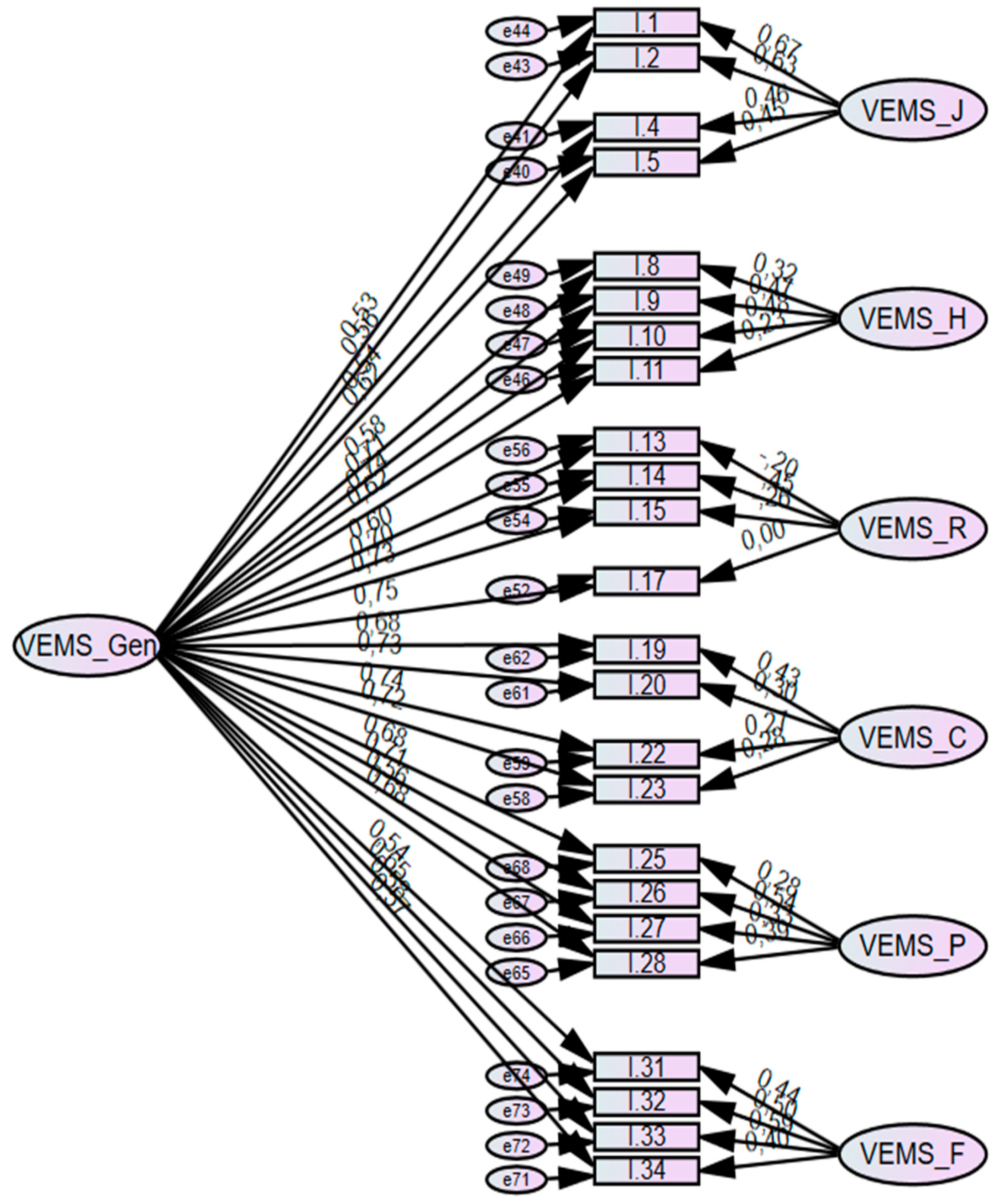
This approach further allowed assessment of whether the scale demonstrates sufficient essential unidimensionality to justify interpretation and use of a single total score, or whether the multidimensional structure warrants interpretation of separate subscale scores. Consequently, the bifactor analysis provided an important basis for evaluating the dimensional structure and appropriate scoring interpretation of the VEMS framework.
This ensures that the scale is used and interpreted accurately (general factor influencing all items and orthogonal group factors for subdomains).
To evaluate dimensionality, the Percent of Uncontaminated Correlations (PUC), Explained Common Variance (ECV), Omega Hierarchical (ωH), and Omega Hierarchical Subscale (ωHS) coefficients were examined, and the results are shown in Table 5. Following the interpretive guidelines proposed by Reise (2013), PUC values below .80, together with general factor ECV values exceeding .60 and OmegaH values above .70, may support the interpretation of a scale as essentially unidimensional despite the presence of some multidimensionality.
The bifactor results demonstrated a general factor ECV of .709 and an OmegaH value of .905, indicating that a substantial proportion of the common variance and reliable variance in total scores was attributable to the overarching general factor. These findings provide strong support for the presence of a dominant general Gen AI virtue ethics behavioural orientation construct.
Although the group factors retained some meaningful variance, the relatively low OmegaHS values across several subdimensions suggest that much of the reliable variance in the subscale scores was accounted for by the general factor. Collectively, the findings support the interpretation of the VEMS framework as exhibiting essential unidimensionality, thereby providing justification for the use and interpretation of an overall total score, while still acknowledging the presence of theoretically meaningful subdimensions.
4.5.6. Invariance Analysis
The last step in the analysis involved assessing measurement invariance so as to determine whether the adopted six-factor first-order adjusted model was equivalent across age groups. A stepwise approach was followed, beginning with configural invariance to establish whether the factor structure was consistent across groups. Metric invariance was then tested to examine the equivalence of factor loadings, followed by scalar invariance to assess the equality of intercepts. Strict invariance assesses the equivalence of residual variances.
Establishing these levels of invariance supports meaningful comparisons across groups [64]. The results are reported in Table 6. Furthermore, guidelines proposed by [64] in relation to differences were followed. A criterion of a .01 change in CFI, paired with changes in RMSEA of .015 and SRMR of .030 (for metric invariance) or .015 (for scalar and residual invariance).
Full invariance is supported on metric and scalar levels. For residual invariance, changes in both CFI and RMSEA are withing acceptable thresholds, but not for SRMR. These findings indicate that strict invariance was not fully supported, suggesting that the residual variances of at least some items differ across age groups. Despite this, support for scalar invariance is sufficient to justify the practical use of group comparisons.
5. Discussion
Guided by a systematic three-stage CFA model comparison analytical strategy, this paper validated the psychometric properties of the developed VEMS for assessing ethical behavioural orientations toward Gen AI use among 503 respondents from a South African HEI operating within ODEL environment. The study assessed the construct validity and reliability of the VEMS, refined it into a parsimonious instrument, and proposed a validated version for further assessment and adaptation within other HEIs in South Africa.
The descriptive statistics revealed a consistent affirmation of ethics-oriented Gen AI practices among sampled students, thus suggesting moderate to strong internalisation of ethical practices in relation to Gen AI use and adoption. This was particularly evident in harm-avoidance and integrity-related behaviours, reflected in the care and honesty dimensions. From a CFA perspective, the single-factor model exhibited poor fit, suggesting that virtue ethics in GenAI engagement cannot be meaningfully reduced to a single latent construct. Instead, the findings confirm a 24-item, six-factor hierarchically structured model. With strong support across statis-tical indicators, these findings affirm the VEMS as a valid, reliable, multidimensional and psychometrically robust instrument.
The findings effectively rejected unidimensionality of the ethical Gen AI engagement and therefore supported the conceptual distinction between various ethical virtues such as justice, honesty, responsibility, care, prudence, and fortitude. This aligns with virtue ethics theory [51;52b] which advance character-based approach to moral conduct. In essence, this view conceptualises individual’s ethical conduct as the integration of diverse moral characters instead of a unidimensional trait.
The process of refinement led to a more parsimonious model, with improved fit indices and stronger psychometric properties. This was achieved by deleting redundant items and the reducing residual covariances, thereby enhancing both statistical stability and conceptual clarity. These findings are validated by the measurement model results through which factor loadings and reliability coefficients exhibited strong internal consistency across constructs. Effectively, this has supported the viability of the VEMS as an operational instrument.
5.1. Advancing Validity of Virtue Ethics Assessment: From Principle-Based Scales to Character Development
The findings in this paper offer a compelling support for a parsimonious model. The validation of VEMS responds to the significant gap in the AI ethics discourse. Through a systematic assessment of 22 AI ethical guidelines, [19] found significant convergence towards normative principles, with practical implementation mechanisms of these principles significantly missing or unclear. In similar other work, [24] revealed that the discourse in ethical AI measurement has primarily focused on principles. Basically, the author asserts that rather than focusing on practices, dominant in the discourse is more on the 'what' aspects of AI ethics. Therefore, notwithstanding the increased awareness of potential issues and challenges around adoption and integration of Gen AI in higher education, the ability by those within AI governance and regulatory space to act on mitigating concomitant risks still at its infancy. [7] thus recommend an ethical framework that is rooted in virtue ethics for ethical AI integration within ODEL environment. The authors further argue that this framework should underscore the critical role of the core or intellectual virtues such as practical wisdom and prudence - in cultivating moral virtues.
5.2. Operationalizing the Identified Virtue Ethics Through Theoretical Validation
The identified six-factor parsimonious structure offer empirical validation for recent theoretical work recognizing justice, honesty, responsibility, and care as foundational Gen AI ethical virtues. These virtues represent distinctive motivational settings constituting precondition for ethical Gen AI engagement decision-making [19]. Drawing from earlier identified theoretical shortcomings of foundational or basic AI virtues our inclusion of prudence and fortitude as per [19] addresses distinct AI ethical demands of within the ODEL academic contexts.
Reflecting on how each of the dimensions can be operationalized reveals interesting observations. For example, justice as a first foundational dimension which measured extent to which students can demonstrate equitable and unbiased use and application of Gen AI, had items that assessed detection, represented fair AI use and advocates of inclusive tool loading together. This essentially confirmed that justice oriented ethical reasoning in Gen AI use constitutes a coherent dimension. However, with two items J1 and J2 which had moderate average scores implied a need for the dimension to have targeted development. This is arguably theoretically meaningful finding informed by the fact that the two items respectively probed students’ affirmation and assurance that the Gen AI tools they use do not reinforce biases against marginalized groups as well as their critical assessment of whether AI generated outputs is a fair representation of diverse perspective. The development could be looked within the lens of South African relevant “Ubuntu” philosophy or African communitarianism, which advances indigenous ethical, communal, and relational ethical systems, which are largely overlooked in the ethical AI discourse.
For the honesty dimension is concerned, the transparency and disclosure items demonstrated strong cohesive ethical behaviour, with average score closer to 4.20. This finding validated [20, p.122] conceptualization of honesty as going beyond lies to involve "exemplary respect for truth, along with the practical expertise to express that respect appropriately in technosocial contexts". In line with the recent work of [53] recommending avoiding using AI for “short-circuiting” our moral developments, the respondents strongly rejected fabrication in their engagement with Gen AI tools, whilst endorsing disclosure as a form of practicing inherent transparency. This suggests viewing honesty as a virtue that is well-internalized among university students under study.
Responsibility, measured through accountability had items that constituted a distinct factor. This reflects what virtue ethicists and practitioners describe as ownership of one’s role in AI-mediated outputs or content. A large body of theoretical AI ethics literature in South Africa is dominated by the promotion of academic integrity principles [9].
Notwithstanding the digital divide as described by [10]which may be bets explained by resource-constraint theoretical lens, which of course is not unique to South African HEI environment where student population are coming from diverse socio-economic backgrounds characterized by inequality and high rates of youth unemployment. However, the survey of theoretical literature suggests that as more students are emerging to gain access to transformative prowess of Gen AI tools to generate academic content [6,54], responsibility as one of the academic integrity principles is under threat. Furthermore, this challenge is exacerbated by the ineffectiveness of current AI detection tools in reliably identifying AI-generated content [55]. With these challenges in mind, the VEMS offer a pragmatic mechanism to evaluate plausibility of responsibility orientation traits in counterbalancing these threats [56].
The fourth foundational virtue, Care was proxied by items measuring harm-avoidance and well-being which showed the highest ethical validation. This suggested a strong ethical orientation toward preventing AI-mediated harm. This aligns with care as a basic AI virtue prioritizing well-being and minimizing harm in AI applications. The strong revelation suggests that, notwithstanding technological novelty, fundamental ethical intuitions about harm prevention transfer to AI context.
Prudence as the fifth dimension is the first of extended virtues and had critical reflection and bias-recognition items bounded as predicted. This virtue effectively operationalized phronesis (practical wisdom) adaptable to Gen AI environments. Given that only 46% of South African HEIs have formally legislated AI guidelines [57], this implies that almost half of South African students generally use Gen AI tools without formal approval by their institution of higher learning. This then raises questions about existence of blurred lines between technological efficiency and instances of academic misconduct. Therefore, the virtue dimension becomes particularly relevant in this context and aligned to virtue of being transparent, student’s prudence is tested when they can demonstrate to know the “when” and “how” of ethical and responsible Gen AI usage. As [58] argues, when students are able to demonstrate this virtue, ambiguity within this context will be addressed.
The last dimension, Fortitude proxied by courage which measured students’ ability to resist unethical pressures. Interestingly, the dimension had distinctive loadings, with endorsements of rejecting dishonest shortcuts. This implies that students may not easily fall into the trap of short-circuiting as described by [53] Ongoing research with South African working professionals in blended educational programs reveals how ambiguity in Gen AI regulations potentially lead to moral hazards, as students are continuously attempting to reconcile benefits of Gen AI usage with ethical constraints [59]. Under competitive pressures, such as assessment deadlines and examinations, GenAI may tempt students towards shortcuts. Fortitude therefore becomes a critical virtue for sustaining ethical commitments under pressure.
5.3. Differential Virtue Development and Ethical Preparedness in South African HEI Environment
Despite the digital divide association with diverse socio-economic environments [10] Gen AI often used in self-regulated ways within South African ODeL contexts because approved AI regulatory guidelines remain limited (see 57]) Drawing from this observation, the validated VEMS proves to have a direct relevancy for these contexts. In essence the scale advocates for the virtue ethics solution which implies moving beyond principle-based system often riddled with rigid rules to cultivate an individual’s moral character. By advancing ethical reasoning, this virtuous philosophical lens empowers stakeholders (HEIs, students, and academics) to traverse the Gen AI’s gray or blurred areas, particularly in the absence statutory regulatory frameworks.
The diagnostic value of a virtue ethics lens differs for each stakeholder group. For HEIs, the VEMS can help identify strengths and shortcomings across specific virtue domains within academic systems. Ethical GenAI competencies can then be explicitly integrated into learning, teaching and assessment. From regulatory perspective, these institutions’ policies can move from compliance-only models towards to ethics-in-practice frameworks from the rigid compliance-only models. Meanwhile for students, the emphasis shifts from mere conformity to the cultivation critical judgement (prudence) and ethical resilience (fortitude) complementary to foundational virtue ethics of honesty, care, courage honesty, justice and responsibility as identified by [52b;19]
In their study on balancing academic freedom within the same ODEL institution under study, [77] argue for core virtues (practical wisdom and prudence) as essential intellectual virtues , for the possess ability to empower both academics, researchers and students for careful management of the influence of Gen AI in education. Furthermore, they call for moral virtues in the application of Gen AI, virtue-driven Gen AI governance and continuous ethical development rooted in intellectual virtues. To respond to evolving ethical standards and maintain academic freedom, this continuous model improvement depends on regular assessment and adaptation of Gen AI applications through feedback loops. Aligned to consequentialism, the proposition we put forward is that foundational value of virtuous ethics is eudaimonia as captured in Aristotelian ethics [60], which captures the essence of human flourishing. So, instead of strict reliance on compliance, this ethical framework argues for developing a virtuous character toward a meaningful and fulfilled learning journey.
Drawing from this disposition it is without a doubt that higher education system in South Africa continue to face number of distinctive challenges. Structural inequalities and digital divide in AI technologies evident through unequal access continue to exacerbate the fairness of AI-mediated learning [10] This will continue to happen while ethical issues around data privacy, algorithmic bias, authorship [62] and the blurred lines between Gen AI’s power in facilitating teaching and learning and chances of engaging in academic cheating intensifies. As [58] argue ability of the users to maintain ethical orientations notwithstanding these pressures has implications for institutional cultures and individual values which may potentially offer some protective layer. Lastly, studying in an ODEL environment characterized by geographical dispersion, digital mode of delivery and transaction, flexibility and convenience expect distinctive demands on students on ethical self-regulation. As [56] assert, multi-faceted character of Gen AI competence is needed in this environment. Students in such context are therefore expectedly to develop autonomous requisite ethical capabilities for responsible GenAI engagement.
6. Limitations and Recommendation for Further Research
Despite of the contribution of the paper, it is not without limitations. First the paper relies on self-reported measures as derived from the administered research instrument. In Secondly, the cross-sectional nature of the research design limit understanding of insights as a result changes. Lastly as the focus was on structural validation, criterion validity was this not assessed. Future research should explore measurement invariance among various demographic groups. Furthermore, using scenario-based measures future studies should further refine or develop the VEMS within the African communitarianism lens. This line of research could potentially advance largely overlooked indigenous ethical, communal, and relational value systems. In essence, while acknowledging the traditional virtue framework originated in Western contexts, South African-oriented VEMS can draw on cross-cultural philosophical traditions such as Aristotelian, Confucian, and Buddhist which may not fully be captured by individualism-oriented ethical frameworks. Furthermore, examination of how Ubuntu principles (interconnectedness, communal responsibility, restorative rather than punitive justice) transect with virtue ethics frameworks. The moderate-to-strong endorsement in this study suggests the framework has relevance, but qualitative work is necessary to comprehend respondents’ interpretation of items within indigenous epistemologies and philosophical lenses. Lastly, future research needs to evaluate whether interpositions such as training on ethics, implementation of ethical regulatory framework through policies and guidelines, and changes in curriculum policy alter respondents’ perceptions on their practice of ethics.
7. Conclusions
Drawing on the critiques of rule-based frameworks characterized by principles of fairness, accountability, transparency as measures of upholding high standards of academic integrity within institutions of higher learning, findings in this paper contribute through complementary approach by advancing AI virtue ethics discourse. This implies a disposition-based perspective. While the rule-based regulatory frameworks stipulate what ethical values in the adoption of Gen AI should look like, the validated VEMS explain how expected ethical behavioural virtues are enacted and internalized. This is particularly relevant in ODEL environments, where students operate with greater autonomy and minimal or almost no supervision.
While virtue ethics conventionally focuses on individual moral development, the VEMS allows for population-level assessment. HEIs are enabled to identify collective ethical strong points and critical gaps, informing institutional ethical approaches. Through differentiation of ethical virtues (justice, honesty, responsibility, care, prudence, and fortitude), our discriminant validity analyses provide empirical evidence that these virtues are psychologically distinct ethical orientations. This justifies their separate conceptualization and measurement. Guided by theoretically coherent and empirically supported representation the single-factor model has exhibited poor fit, suggesting that virtue ethics in the Gen AI engagement cannot be meaningfully reduced to a single latent construct. Instead, the findings confirm a 24-item, six factor hierarchically structured model. We therefore demonstrate measurability of the VEMS through confirmation of bi-factor model that can be operationalized into measurable constructs with robust psychometric properties. These findings affirm the VEMS as a valid and reliable multidimensional and psychometrically robust instrument. This contests the dichotomous between "rigorous" quantitative ethical frameworks and "meaningful" qualitative virtuous ethics discourse.
The findings thus offer a compelling support for a parsimonious model. Therefore, a validated version of the VEMS is proposed for further assessment and adaptation within other HEIs in South Africa. The successful validation within South African HEIs’ ODEL context challenges centricity of European and Western values in Gen AI ethical frameworks. The VEMS extends beyond cultural and geographical boundaries meanwhile it is potentially compatible to South African relevant “Ubuntu” philosophy. In turn, the VEMS is potentially significant for the decolonizing AI ethics discourse.
Author Contributions
For research articles with several authors, a short paragraph specifying their individual contributions must be provided. The following statements should be used “Conceptualization, Tjano.; Methodology, van Zyl and Tjano; software, van Zyl, Tjano; Validation, van Zyl and Tjano. Formal analysis, van Zyl and Tjano.; Data collection, Tjano and Kamolane; data curation, Tjano and Kamolane; Writing—original draft preparation, Tjano, Prinsloo, Mphahlele; writing—review and editing, Visagie, Mphahlele, Carine, Thobejane, van Zyl, Project administration and ethical clearance, Louw, Visagie. All authors have read and agreed to the published version of the manuscript.
Funding
This research received no external funding.
Data Availability Statement
Supporting data can be provided on request.
Acknowledgments
We would like to extend our gratitude to the University of South Africa’s (UNISA) Professional Research Group (PRC) for their continued administrative support during the process of applying for ethical clearance. Also, appreciations go to Departmental of Information and Communication Technologies for technical support in administration of the survey. During the preparation of this manuscript/study, the author(s) used Grammarly for the purposes of grammar and language proficiency of this manuscript]. The authors have reviewed and edited the output and take full responsibility for the content of this publication.
Conflicts of Interest
The authors declare no conflicts of interest.
References
- Black, R.W.; Tomlinson, B. University students describe how they adopt AI for writing and research in a general education course. Sci. Rep. 2025, 15, 8799. [Google Scholar] [CrossRef]
- Matsiola, M.; Lappas, G.; Yannacopoulou, A. Generative AI in Education: Assessing Usability, Ethical Implications, and Communication Effectiveness. Societies 2024, 14, 267. [Google Scholar] [CrossRef]
- O’Dea, X. Generative AI: is it a paradigm shift for higher education? Stud. High. Educ. 2024, 49, 811–816. [Google Scholar] [CrossRef]
- National Planning Commission (NPC). National Development Plan 2030: Our future–make it work. Pretoria, South Africa. Sherino Printers. 2012. Available online: https://www.nationalplanningcommission.org.za/National_Development_Plan.
- Pramjeeth, S.; Ramgovind, P. Generative Artificial Intelligence (AI) Tools in Higher Education: A Moral Compass for the Future? Afr. J. Inter/Multidisciplinary Stud. 2024, 6, 1–13. [Google Scholar] [CrossRef]
- Rizun, N.; Bordean, O. N.; Nikiforova, A.; Beleiu, I. N.; Revina, A. Generative AI in Higher Education: Ethical and Behavioral Factors Influencing Students’ Intentions to Use ChatGPT. Comput. Educ. Open 2026, 100336. [Google Scholar] [CrossRef]
- Prinsloo, C.; Ramashego, S. M.; Visagie, R. G.; Tjano, R.N. Balancing academic freedom and research integrity through virtue ethics in the use of AI in open distance education. South Afr. J. High. Educ. 2025, 39, 236–262. [Google Scholar] [CrossRef]
- Bittle, K.; El-Gayar, O. Generative AI and Academic Integrity in Higher Education: A Systematic Review and Research Agenda. Information 2025, 16, 296. [Google Scholar] [CrossRef]
- Tjano, R.N. Unpacking the Role of Big Data, Artificial Intelligence, and Predictive Analytics in. Artif. Intell. Transform. High. Educ. 2025, 2, 141. [Google Scholar]
- Carter, L.; Liu, D.; Cantrell, C. Exploring the intersection of the digital divide and artificial intelligence: A hermeneutic literature review. AIS Trans. Hum.-Comput. Interact. 2020, 12, 253–275. [Google Scholar] [CrossRef]
- Stahl, B. C.; Schroeder, D.; Rodrigues, R. Ethics of artificial intelligence: Case studies and options for addressing ethical challenges (No. 1); Association for Computing Machinery (ACM), 2023. [Google Scholar] [CrossRef]
- Williams, R.T. The ethical implications of using generative chatbots in higher education. Front. Educ. 2024, 8, 1331607. [Google Scholar] [CrossRef]
- Tjano, R.N.; Mphahlele, R.S. Cultivating cognitive justice in AI-enhanced education: Harnessing intelligent tutoring systems and navigating ethical horizons. In Artificial Intelligence and Human Agency in Education: Volume One; Springer: Singapore, 2025; pp. 45–68. [Google Scholar]
- Abubakar, S.; Jeilani, A.; Yusuf, M. The role of over-reliance on AI in the negative consequences of student learning: The moderating effects of ethical concerns and institutional policies. Cogent Educ. 2025, 12, 1–15. [Google Scholar] [CrossRef]
- Pitts, G.; Rani, N.; Mildort, W.; Cook, E. M. Students’ reliance on ai in higher education: identifying contributing factors. In International Conference on Human-Computer Interaction; Springer Nature Switzerland: Cham, June 2025; pp. 86–97. [Google Scholar] [CrossRef]
- Zhai, C.; Wibowo, S.; Li, L. D. The effects of over-reliance on AI dialogue systems on students’ cognitive abilities: A systematic review. Smart Learn. Environ. 2024, 11, 1–37. [Google Scholar] [CrossRef]
- Fitriani, F.; Rini, P. Z. E. Can We Trust AI to Assess Writing? An Analysis of Scoring Reliability and Feedback Consistency. J. Profesi Kegur. 2025, 11, 66–79. [Google Scholar] [CrossRef]
- Demir, B.; Aydın, S. Construction and validation of the AI Ethics Scale in language research. Australas. J. Educ. Technol. 2026. [Google Scholar] [CrossRef]
- Hagendorff, T. A virtue-based framework to support putting AI ethics into practice. Philos. Technol. 2022, 35, 55. [Google Scholar] [CrossRef]
- Vallor, S. Technology and the virtues: A philosophical guide to a future worth wanting; Oxford University Press, 2016. [Google Scholar]
- Aoun, J. E. Robot-proof: Higher education in the age of artificial intelligence; MIT press, 2017. [Google Scholar]
- Seldon, A.; Abidoye, O. The fourth education revolution: Will artificial intelligence liberate or infantilise humanity? University of Buckingham Press, 2020. [Google Scholar]
- Fuszek, C.; Hofman, A.; Parikh, A.; Pastor, L.; Kosiak, A.; Zajączkowski, K. The Path to a Better Version of Yourself – Ethical Guidelines for Artificial Intelligence in Education. Karto-Teka Gdańska 2025, 1, 93–103. [Google Scholar] [CrossRef]
- Wilders, M.; de Troya, Í. M. D. R.; Dobbe, R. The Socratic Dialogue as a Method for Virtue Ethics in AI: A Case Study. Proc. AAAI/ACM Conf. AI Ethics Soc. 2025, 8, 2680–2691. [Google Scholar] [CrossRef]
- Jobin, A.; Ienca, M.; Vayena, E. The global landscape of AI ethics guidelines. Nat. Mach. Intell. 2019, 1, 389–399. [Google Scholar] [CrossRef]
- Fjeld, J.; Achten, N.; Hilligoss, H.; Nagy, A.; Srikumar, M. Principled artificial intelligence: Mapping consensus in ethical and rights-based approaches to principles for AI. Berkman Klein Cent. Res. Publ. 2020, 2020–1. [Google Scholar] [CrossRef]
- Lepri, B.; Oliver, N.; Letouzé, E.; Pentland, A.; Vinck, P. Fair, transparent, and accountable algorithmic decision-making processes: The premise, the proposed solutions, and the open challenges. Philos. Technol. 2018, 31, 611–627. [Google Scholar] [CrossRef]
- Floridi, L.; Cowls, J.; Beltrametti, M.; Chatila, R.; Chazerand, P.; Dignum, V.; Vayena, E. AI4People—An ethical framework for a good AI society: Opportunities, risks, principles, and recommendations. Minds Mach. 2018, 28, 689–707. [Google Scholar] [CrossRef] [PubMed]
- Morley, J.; Machado, C. C.; Burr, C.; Cowls, J.; Joshi, I.; Taddeo, M.; Floridi, L. The ethics of AI in health care: a mapping review. Soc. Sci. Med. 2020, 260, 113172. [Google Scholar] [CrossRef]
- Hagendorff, T. The ethics of AI ethics: An evaluation of guidelines. Minds Mach. J. Artif. Intell. Philos. Cogn. Sci. 2020, 30, 457–461. [Google Scholar] [CrossRef]
- Porayska-Pomsta, K.; Holmes, W.; Nemorin, S. Chapter 26: The ethics of AI in education. In Handbook of Artificial Intelligence in Education; Retrieved May 18, 2026; Edward Elgar Publishing: Cheltenham, UK, 2023. [Google Scholar] [CrossRef]
- Harrison, T.; Laco, D. Where’s the character education in online higher education? Constructivism, virtue ethics and roles of online educators. E-Learn. Digit. Media 2022, 19, 555–573. [Google Scholar] [CrossRef]
- Smith, N.; Vickers, D. Living well with AI: Virtue, education, and artificial intelligence. Theory and Research in Education 2024. [Google Scholar] [CrossRef]
- Hershkovitz, A. Boundaries in Formal Education and the Role of Technology in Breaking Them. Educ. Sci. 2025, 15, 1–21. [Google Scholar] [CrossRef]
- Johnson, K. M.; Lesser, J. Wisdom’s New Frontier: AI and the Quest for Understanding. Adv. Soc. Sci. Cult. 2025, 7, 12–41. [Google Scholar] [CrossRef]
- Henry, J. V.; Oliver, M. Who Will Watch the Watchmen? The Ethico-political Arrangements of Algorithmic Proctoring for Academic Integrity. Postdigital Sci. Educ. 2022, 4, 330–353. [Google Scholar] [CrossRef] [PubMed]
- Perkins, M. Academic Integrity considerations of AI Large Language Models in the post-pandemic era: ChatGPT and beyond. J. Univ. Teach. Learn. Pract. 2023, 20. [Google Scholar] [CrossRef]
- Aruna, K. T.; Athmika, A.; Deepalakshmi, A. R. Exploring the Impact of Artificial Intelligence on Student Academic Stress, Learning Satisfaction, and Coping Practices Across Educational Levels and Streams. Int. J. Multidiscip. Res. 2025, 7, 1–7. [Google Scholar] [CrossRef]
- Hussain, S. S.; Ahmad, J.; Ahmed, S. Investigating the impacts of Heavy Reliance on AI on Students’ Critical Thinking and Originality: A Qualitative Study of Students’ Perceptions. Soc. Sci. Rev. Arch. 2025, 3, 516–523. [Google Scholar] [CrossRef]
- Saunders, M. N.; Lewis, P.; Thornhill, A.; Bristow, A. Understanding research philosophy and approaches to theory development. In Research Methods for Business Students; Saunders, Mark N. K., Lewis, Philip, Thornhill, Adrian, Eds.; Pearson Education: Harlow, 2015; pp. 122–161. Available online: http://catalogue.pearsoned.co.uk/educator/product/..
- Aydın, S.; Tekin, I.; Akkaş, F. Construction and validation of the foreign language learning enjoyment scale. Psychol. Sch. 2024, 61, 657–670. [Google Scholar] [CrossRef]
- Tabanchnick, B.G.; Fidell, L.S. Using multivariate statistics, 6thed.; Pearson Education, Limited: Boston, 2014. [Google Scholar]
- MacCallum, R. C.; Widaman, K. F.; Zhang, S.; Hong, S. Sample size in factor analysis. Psychol. Methods 1999, 4, 84. [Google Scholar] [CrossRef]
- Hair, J. F.; Sarstedt, M.; Ringle, C. M.; Mena, J. A. An assessment of the use of partial least squares structural equation modeling in marketing research. J. Acad. Mark. Sci. 2012, 40, 414–433. [Google Scholar] [CrossRef]
- Byrne, B.M. Structural Equation Modelling with AMOS: basic concepts, applications, and programming, 2nd edition; Routledge, 2010. [Google Scholar]
- Hair, J.; Alamer, A. Partial Least Squares Structural Equation Modeling (PLS-SEM) in second language and education research: Guidelines using an applied example. Res. Methods Appl. Linguist. 2022, 1, 100027. [Google Scholar] [CrossRef]
- Fornell, C.; Larcker, D. F. Evaluating structural equation models with unobservable variables and measurement error. J. Mark. Res. 1981, 18, 39–50. [Google Scholar] [CrossRef]
- Podsakoff, P. M.; MacKenzie, S. B.; Lee, J. Y.; Podsakoff, N. P. Common method biases in behavioral research: a critical review of the literature and recommended remedies. J. Appl. Psychol. 2003, 88, 879. [Google Scholar] [CrossRef] [PubMed]
- Hu, L.T.; Bentler, P.M. Cutoff criteria for fit indexes in covariance structure analysis: Conventional criteria versus new alternatives. Struct. Equ. Model. A Multidiscip. J. 1999, 6, 1–55. [Google Scholar] [CrossRef]
- Kline, R. Principles and practice of structural equation modeling, 4th ed.; The Guilford Press, 2016. [Google Scholar]
- Hursthouse, R. Virtue Ethics. Stanford Encyclopedia of Philosophy. 2003. Available online: https://plato.stanford.edu/entries/ethics-virtue/.
- Hagendorff, T. AI virtues-The missing link in putting AI ethics into practice. arXiv 2020, arXiv:2011.12750. [Google Scholar] [CrossRef]
- Cuellar, M. J. A Virtue Ethics Approach for Using AI-Enabled Technologies. J. Comput. Inf. Syst. 2026, 1–14. [Google Scholar] [CrossRef]
- Zawacki-Richter, O.; Marín, V. I.; Bond, M.; Gouverneur, F. Systematic review of research on artificial intelligence applications in higher education–where are the educators? Int. J. Educ. Technol. High. Educ. 2019, 16, 39. [Google Scholar] [CrossRef]
- Deep, P. D.; Edgington, W. D.; Ghosh, N.; Rahaman, Md. S. Evaluating the Effectiveness and Ethical Implications of AI Detection Tools in Higher Education. Information 2025, 16, 1–23. [Google Scholar] [CrossRef]
- Lee, S. C.; Baby, T.; Vongvit, R.; Lee, J.; Kim, Y. W.; Cha, M. C.; Yoon, S. H. Development and validation of Generative AI Competence Scale (GenAIComp) among university students. Technol. Soc. 2026, 103059. [Google Scholar] [CrossRef]
- Jacobs-Basadien, M.; Pather, S. Assessing AI policy and guideline progress within the South African public higher education system: insights from documented policies. Univers. Access Inf. Soc. 2026, 25, 71. [Google Scholar] [CrossRef]
- Marengo, A.; Karaoglan-Yilmaz, F. G.; Yılmaz, R.; Ceylan, M. Development and validation of generative artificial intelligence attitude scale for students. Front. Comput. Sci. 2025, 7, 1528455. [Google Scholar] [CrossRef]
- Mind, Emergent. ETHICS Benchmark for AI Ethics. 2026. Available online: https://www.emergentmind.com/topics/ethics-benchmark.
- Nagel, T. Aristotle on eudaimonia. Phronesis 1972, 252–259. [Google Scholar] [CrossRef]
- Aoun, J. E. Robot-proof: Higher education in the age of artificial intelligence; MIT press, 2017. [Google Scholar]
- Stahl, B. C. From computer ethics and the ethics of AI towards ethics of digital ecosystems. AI Ethics 2022, 2, 65–77. [Google Scholar] [CrossRef]
- Henseler, J.; Ringle, C. M.; Sarstedt, M. A new criterion for assessing discriminant validity in variance-based structural equation modeling. J. Acad. Mark. Sci. 2015, 43, 115–135. [Google Scholar] [CrossRef]
- Putnick, D. L.; Bornstein, M. H. Measurement invariance conventions and reporting: The state of the art and future directions for psychological research. Dev. Rev. 2016, 41, 71–90. [Google Scholar] [CrossRef] [PubMed]
Figure 1.
Scale validation process.
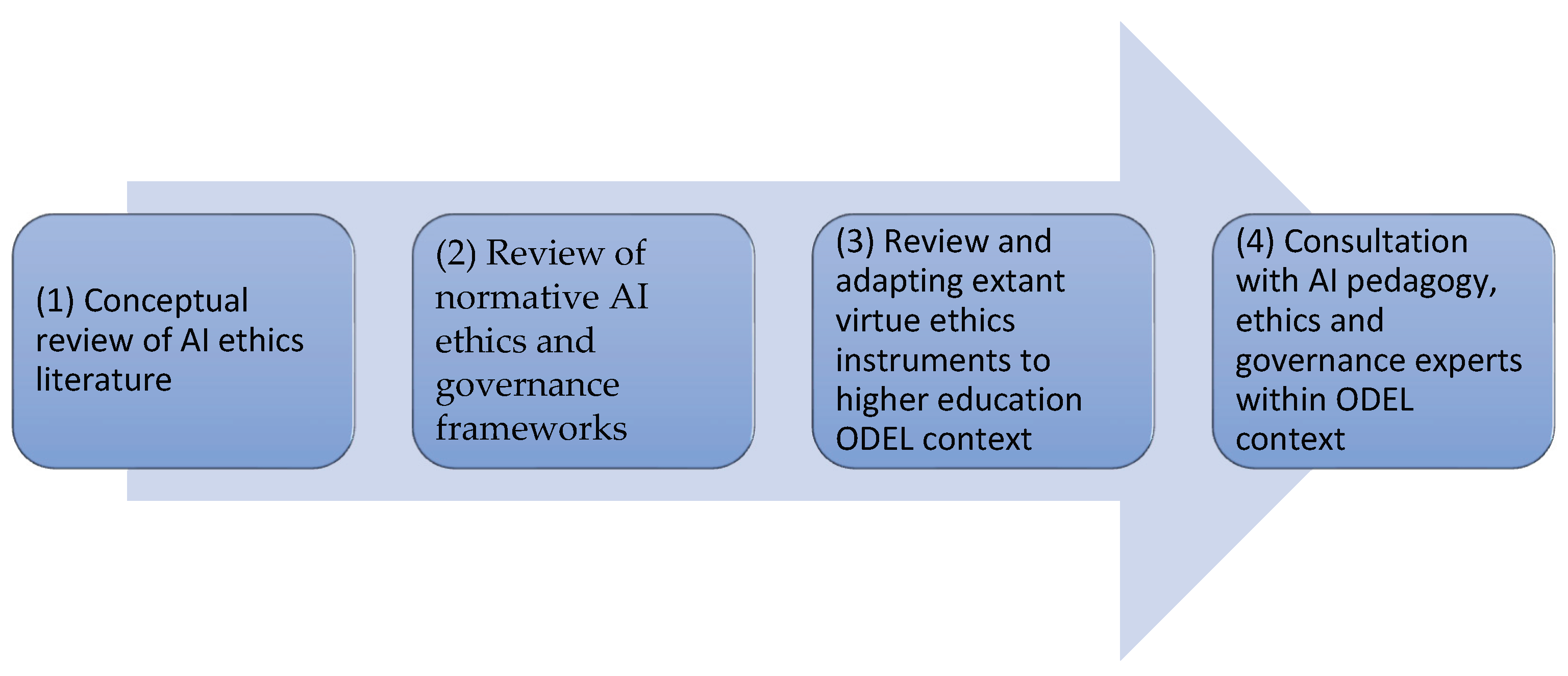
Figure 2.
Single factor CFA.
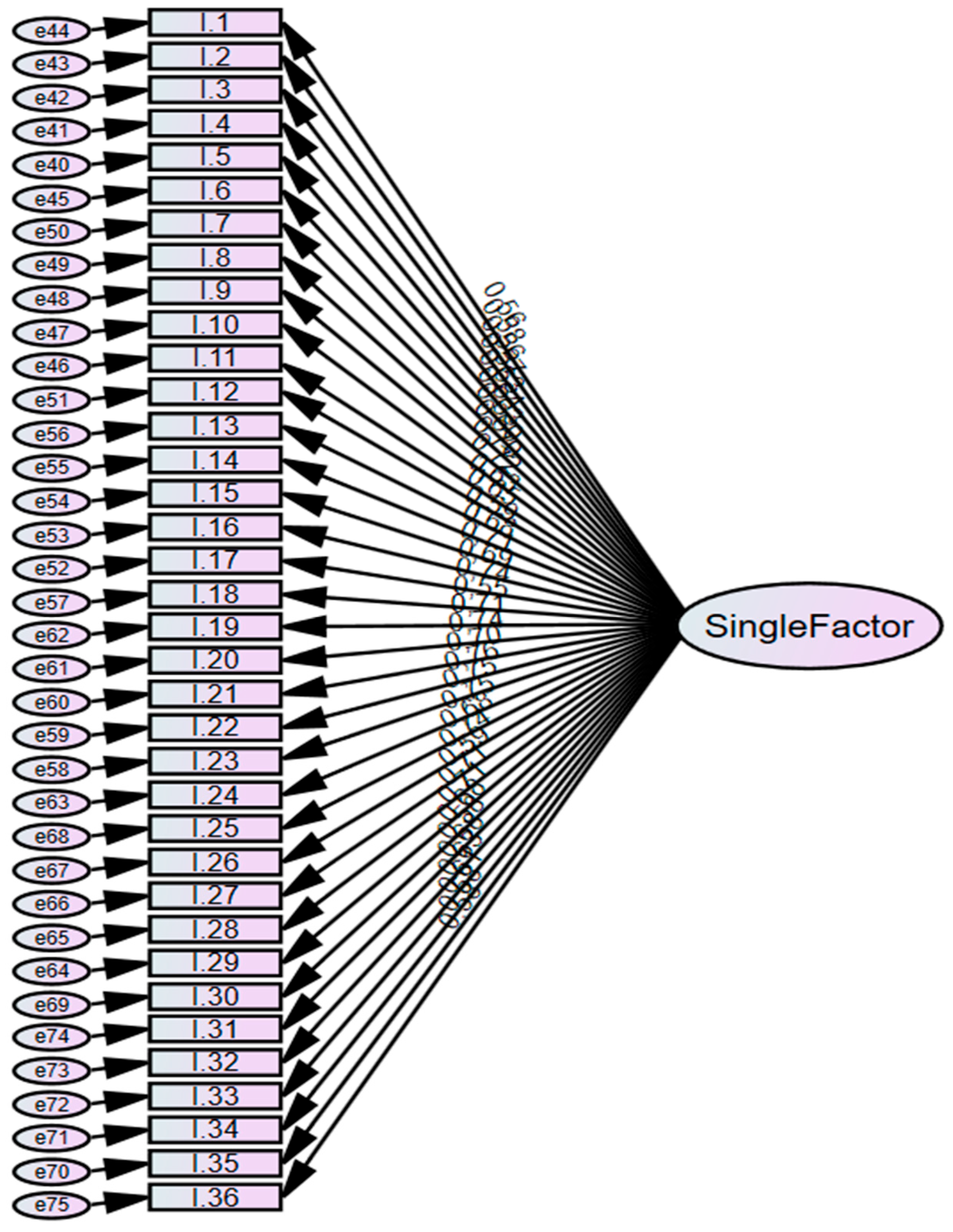
Figure 3.
Six-factor first order CFA.
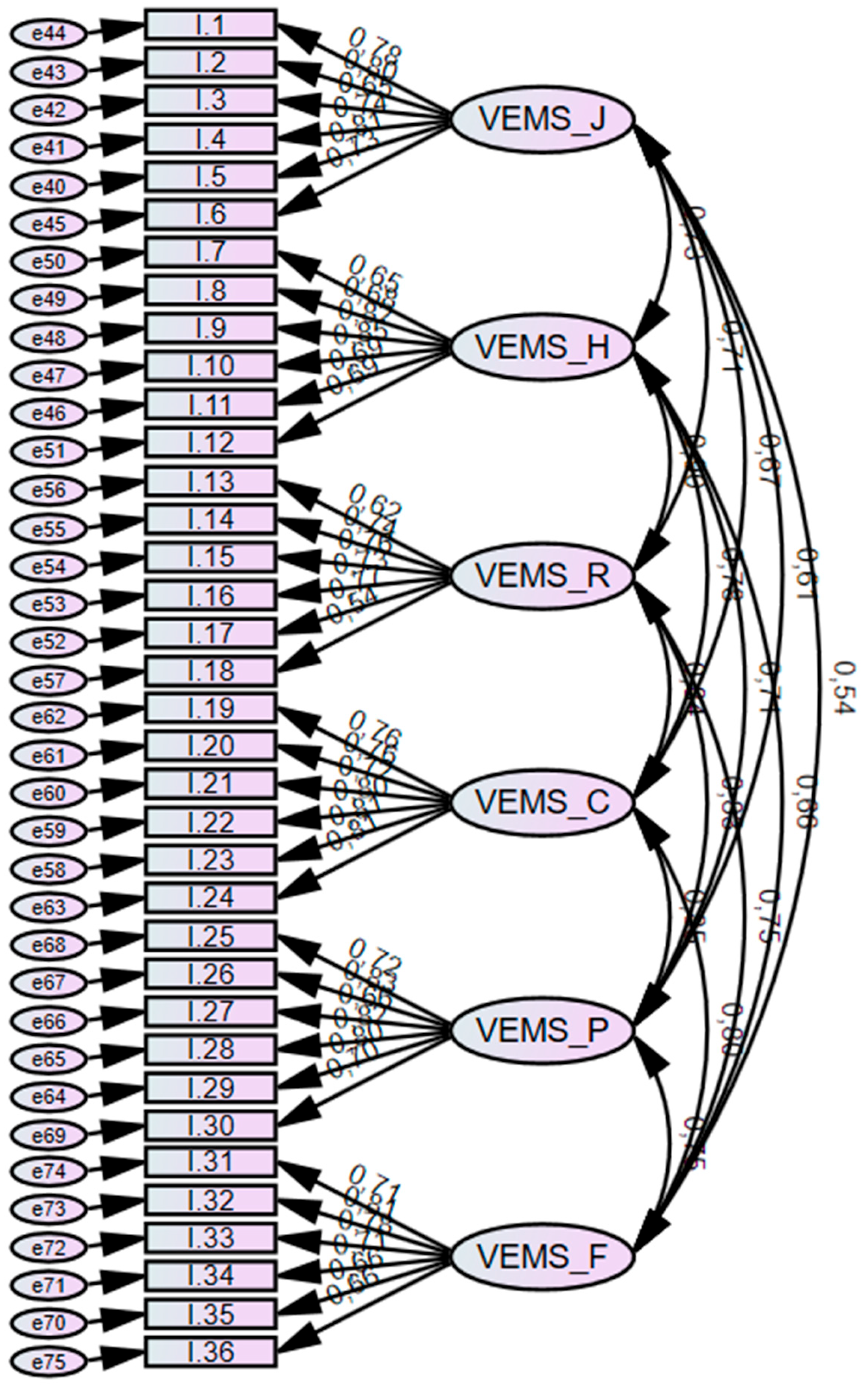
Figure 4.
Six-factor first order adjusted CFA.
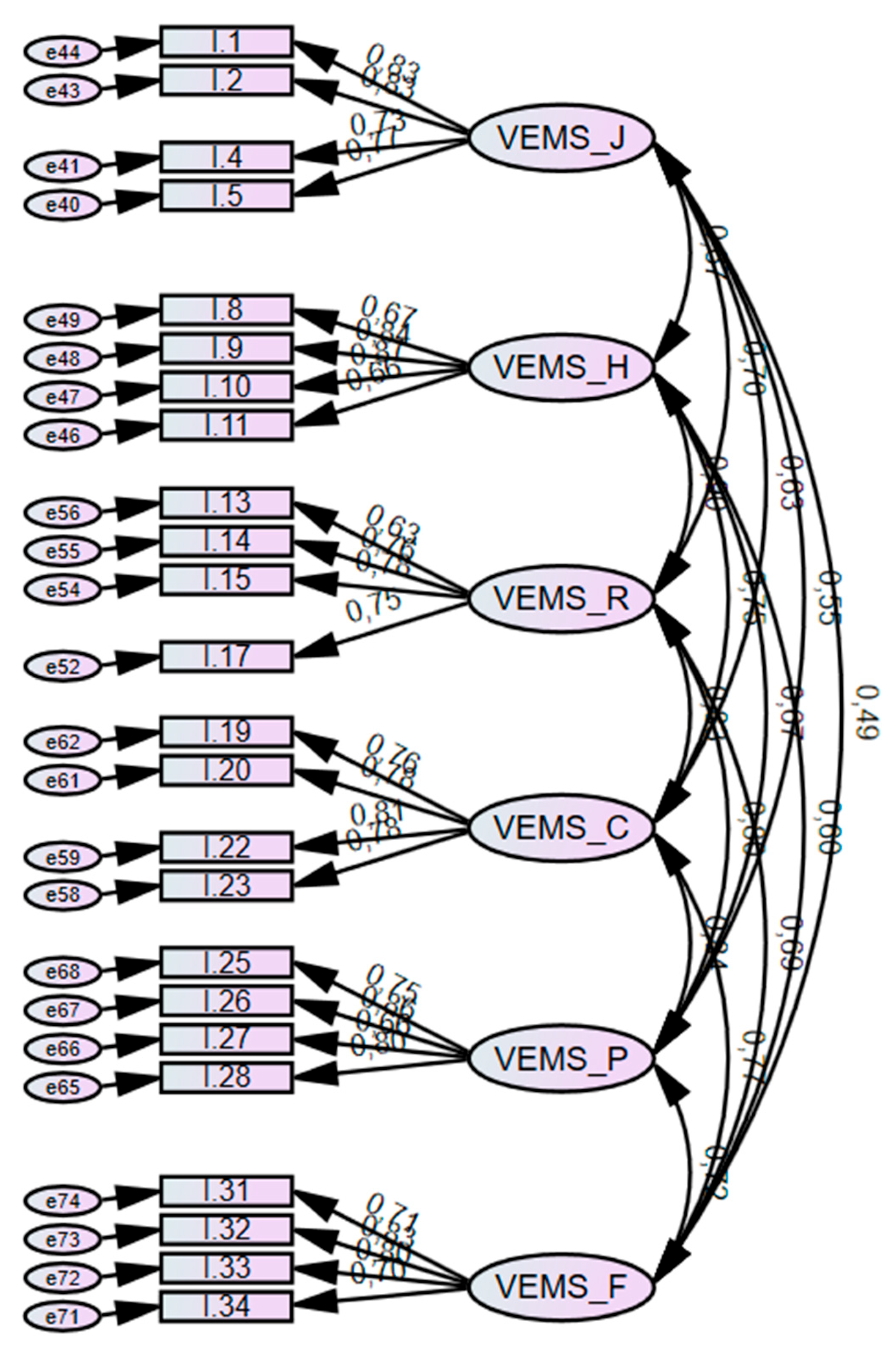
Figure 5.
Second-order CFA.
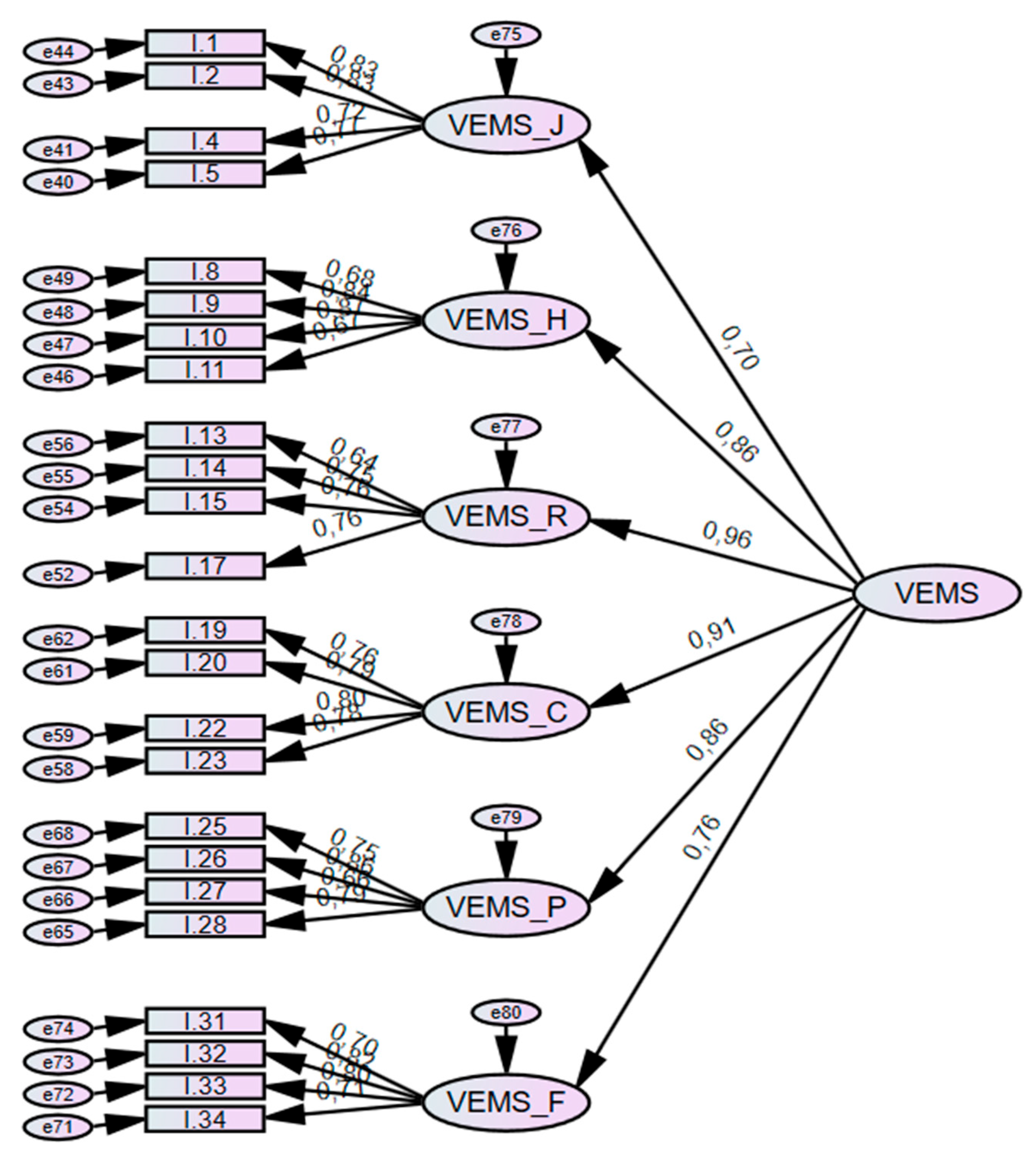
Table 2.
Cronbach’s alpha.
| Construct | Item | Cronbach’s α |
|---|---|---|
| Justice | I.1-I.6 | 0.884 |
| Honesty | I.7-I.12 | 0.871 |
| Responsibility | I.13-I.18 | 0.839 |
| Care | I.19-I.24 | 0,899 |
| Prudence | I.25-I.30 | 0.886 |
| Fortitude | I.31-I.36 | 0.866 |
Table 3.
CFA model fit indices and thresholds.
| Fit index | Criterion values for acceptable fit |
|---|---|
| CMIN | |
| Df | |
| P-value | > .05 |
| CMIN/df | < 3 |
| CFI | > .92 |
| TLI | >.92 |
| RMSEA | < .08 |
| SRMR | < .07 |
| AIC | Smaller values suggest better fit |
| BIC | Smaller values better fit |
Table 4.
Model fit comparison.
| CFA models | Chi-square | df | P-value | CMIN/df | CFI | TLI | RMSEA | SRMR | AIC | BIC |
|---|---|---|---|---|---|---|---|---|---|---|
| Model 1: Single factor | 3744.4 | 594 | <.001 | 6.30 | .74 | .72 | .10 | .07 | 3888.4 | 4192.3 |
| Model 2a: Six-factor first-order (baseline) | 2091.8 | 579 | <.001 | 3.61 | .87 | .86 | .07 | .05 | 2265.8 | 2633.0 |
| Model 2b: Six-factor first-order (adjusted) | 640.9 | 237 | <.001 | 2.70 | .95 | .94 | .06 | .04 | 766.9 | 1032.8 |
| Moel 3: Second order | 736.1 | 246 | <.001 | 2.99 | .93 | .93 | .06 | .04 | 844.1 | 1072.0 |
| Model 4: Bifactor | 654.4 | 228 | <.001 | 2.87 | .94 | .93 | .06 | .04 | 798.4 | 1102.3 |
Table 5.
Test for model multidimensionality.
| Construct | ECV (S&E) | ECV (NEW) | Omega/ OmegaS | OmegaH/ OmegaHS | Relative Omega | H | FD |
|---|---|---|---|---|---|---|---|
| Gen | 0,709 | 0,709 | 0,964 | 0,905 | 0,939 | 0,949 | 0,959 |
| J | 0,088 | 0,499 | 0,871 | 0,428 | 0,492 | 0,667 | 0,869 |
| H | 0,042 | 0,254 | 0,849 | 0,205 | 0,242 | 0,427 | 0,762 |
| R | 0,021 | 0,182 | 0,789 | 0,131 | 0,166 | 0,266 | 0,633 |
| C | 0,030 | 0,172 | 0,867 | 0,144 | 0,166 | 0,329 | 0,658 |
| P | 0,045 | 0,267 | 0,853 | 0,219 | 0,256 | 0,448 | 0,781 |
| F | 0,066 | 0,407 | 0,847 | 0,341 | 0,402 | 0,564 | 0,814 |
Table 6.
Invariance analysis - Age.
| Invariance | Chi-square | df | P-value | CFI | RMSEA | SRMR | Model comp | Δ CFI | Δ RMSEA | Δ SRMR | Decision |
|---|---|---|---|---|---|---|---|---|---|---|---|
| M1: Configural | 1077,9 | 474 | <.001 | 0,919 | 0,050 | 0,057 | |||||
| M2: Metric | 1111,1 | 492 | <.001 | 0,917 | 0,050 | 0,055 | M1 | 0,002 | 0,000 | 0,001 | Supported |
| M3: Scalar | 1153,7 | 516 | <.001 | 0,915 | 0,050 | 0,056 | M2 | 0,002 | 0,000 | 0,000 | Supported |
| M4: Residual | 1236,5 | 561 | <.001 | 0,910 | 0,049 | 0,085 | M3 | 0,005 | 0,001 | 0,029 | Partially |
Disclaimer/Publisher’s Note: The statements, opinions and data contained in all publications are solely those of the individual author(s) and contributor(s) and not of MDPI and/or the editor(s). MDPI and/or the editor(s) disclaim responsibility for any injury to people or property resulting from any ideas, methods, instructions or products referred to in the content. |
© 2026 by the authors. Licensee MDPI, Basel, Switzerland. This article is an open access article distributed under the terms and conditions of the Creative Commons Attribution (CC BY) license (http://creativecommons.org/licenses/by/4.0/).
Copyright: This open access article is published under a Creative Commons CC BY 4.0 license, which permit the free download, distribution, and reuse, provided that the author and preprint are cited in any reuse.


