

Submitted:
01 June 2026
Posted:
03 June 2026
You are already at the latest version
Abstract
This study analyzes the relationship between patterns of artificial intelligence (AI) use and university students’ academic goals, also incorporating a reflection on educational sustainability and the responsible use of digital technologies in higher education. Through cluster analysis, ANCOVA, correlations, and structural equation modeling (SEM), three AI usage profiles (low, balanced, and high) were identified, along with their association with learning, achievement, and social reinforcement goals. The re-sults show significant differences between profiles, as well as positive relationships between AI support dimensions (educational, informational, and emotional) and aca-demic goals. The structural model explains between 29% and 47% of the variance, evi-dencing a functional differentiation of AI as a cognitive and socio-emotional resource. Likewise, the findings suggest that a balanced and ethical use of AI can contribute to the development of more sustainable educational practices by fostering learning per-sonalization, resource optimization, and the promotion of responsible digital compe-tencies aligned with sustainability objectives in education. The results are discussed in light of Self-Determination Theory, Achievement Goal Theory, and current approaches to educational AI and sustainability.
Keywords:
artificial intelligence
; academic goals
; sustainable higher education
; motivation
; self-regulated learning
1. Introduction
Contemporary university education is undergoing a profound transformation driven by social, cultural, and technological changes that have radically modified the way students access, process, and use knowledge [1,2,3]. In this context, artificial intelligence (AI) has emerged both as a strategic tool and as a theoretical object of study, with practical and conceptual implications for higher education. From a theoretical and scientific perspective, AI models allow us to understand their functioning, predict their impact on learning, and analyze how they influence decision-making and the construction of individualized academic pathways [4,5].
Among the most relevant approaches are adaptive learning systems, which dynamically adjust content and difficulty according to student needs; intelligent tutoring systems, which simulate teacher interaction by providing immediate and personalized feedback; and cognitive assistants, designed to support study planning, complex problem solving, and academic information management [4,6]. These models not only explain how AI-based technologies are used but are also linked to theories of self-regulated learning and digital competencies, as they emphasize student interaction with systems that facilitate metacognition, personalized learning, and strategic management of educational resources [7,8,9,10].
Furthermore, the incorporation of AI in higher education is aligned with the principles of educational sustainability and responsible digital transformation promoted by international organizations such as UNESCO and the Sustainable Development Goals (SDGs). In particular, the efficient use of intelligent tools can contribute to a more inclusive, equitable, and sustainable education by optimizing academic resources, reducing barriers to knowledge access, and fostering personalized learning processes that help reduce educational inequalities [11,12,13]. From this perspective, AI represents not only a technological innovation but also an opportunity to strengthen sustainable university models oriented toward student well-being, critical digital literacy, and the development of competencies needed to address the social and environmental challenges of the 21st century.
In university practice, AI is applied in diverse ways: from text generation, information search and analysis, and conceptual doubt resolution, to study organization, exam preparation, and academic competency assessment [3]. In this scenario, educational sustainability and responsible digital transformation have become priority axes for higher education institutions, which seek to integrate innovative technologies that promote more inclusive, efficient training aligned with the Sustainable Development Goals [14,15,16].
This multiplicity of uses allows for personalization of the educational experience, reduction of cognitive load, provision of immediate feedback, and enhancement of students’ emotional well-being, impacting not only academic performance but also the holistic development of cognitive, metacognitive, and socio-emotional competencies [4,5,17]. The benefits of AI are recognized across three interrelated dimensions: academic (adaptive learning and intelligent tutoring), informational (advanced search engines and data analysis), and emotional (assistants that provide support and guidance for well-being and learning regulation) [18].
Regarding this, the evaluation of AI’s impact on university students is typically addressed from three complementary perspectives: perceptions of benefits and risks, concrete uses in academic practice, and general attitudes toward its integration in higher education, including ethical evaluation and individual willingness to use it. This approach allows for the identification of differentiated profiles of AI interaction, providing a theoretical and methodological framework to understand how these patterns relate to motivational factors, learning styles, and resource management strategies, and how they contribute to more personalized and efficient academic pathways [19,20].
In this context, academic motivation is a central factor in this analysis. Its study seeks to understand what drives students to learn, how effort is directed and sustained, and how they adopt innovative resources. Among the most influential theoretical models is Achievement Goal Theory, which distinguishes between learning goals and performance goals. Learning goals focus on acquiring knowledge and developing competencies, even in the face of mistakes, while performance goals are oriented toward achieving recognition, approval, or grades, while avoiding negative evaluations [21,22].
Within performance goals, social reinforcement goals are identified, aimed at obtaining approval from teachers, peers, or family, and achievement goals, oriented toward academic success and social mobility [23,24]. This theoretical framework connects with the perspective of self-regulated learning, which emphasizes planning, monitoring, and evaluating one’s own learning—competencies that can be enhanced through the strategic use of AI [10,25,26,27].
In particular, students in the social sciences show complex and multidimensional motivations combining personal learning goals, professional achievement goals, and social or altruistic purposes [28,29,30]. This motivational complexity suggests that interaction with AI may vary significantly depending on predominant academic goals. As Suárez Lima et al. [31] indicate, students oriented toward learning goals may perceive AI as an opportunity to deepen critical understanding, develop analytical skills, and foster creativity, whereas those prioritizing performance goals may focus on its utility for optimizing grades, meeting visible targets, and improving performance indicators.
Despite extensive research on academic motivation and AI integration in universities, studies that connect both perspectives remain limited, especially among social science students. Exploring this intersection is essential to understand how AI usage profiles relate to academic goals and to generate evidence that supports the design of more effective, personalized, and ethical pedagogical strategies.
In this framework, the main objective of this study is to identify AI usage profiles among university students and analyze how these are associated with academic goals, providing a comprehensive view of the role of motivation in the appropriation of emerging technologies, the promotion of self-regulated learning, and the development of digital competencies, as well as offering insights to optimize academic pathways in increasingly technology-mediated university contexts.
Based on these premises, the present study proposes the following research objectives:
1. To identify profiles of artificial intelligence, use among university students, considering perceived usefulness for academic, informational, and emotional/practical support purposes.
2. To explore whether AI usage profiles differentially influence the academic goals of social science students, distinguishing between learning, performance, and social goals.
3. To examine the association between AI dimensions (perceived usefulness for academic, informational, and emotional/practical support purposes) and academic goal dimensions (learning, performance, and social goals), in order to analyze possible relational patterns between both variables.
4. To apply a structural equation model (SEM) to comprehensively analyze the relationship between AI perceived usefulness dimensions and academic goals, evaluating the strength and direction of relationships between latent variables.
Research Hypotheses
H1: There are differentiated profiles of artificial intelligence use in the university context, determined by perceived usefulness for academic, informational, and emotional/practical support purposes.
H2: AI usage profiles have different effects on students’ academic goals, particularly in relation to learning, performance, and social goals.
H3: A significant association is expected between perceived usefulness of artificial intelligence and academic goal dimensions.
H4: The structural equation model will confirm that perceived usefulness dimensions of AI are significantly related to academic goals, showing the strength and direction of these relationships.
2. Materials and Methods
2.1. Participants
The study included a sample of 426 students from the field of Social and Legal Sciences, enrolled in different degree programs: 156 in Social Work (36.6%), 117 in Psychology (27.4%), 91 in Social Education (21.3%), and 62 in Criminology (14.6%). Regarding gender, 297 participants were women (69.7%) and 129 were men (30.3%). Students’ ages ranged from 18 to 30 years, with a mean age of 22.56 years (SD = 4.89). By age groups, 183 were between 18 and 22 years (42.9%), 118 between 23 and 26 years (27.8%), and 126 between 27 and 30 years (29.7%). Regarding academic year, 168 were in first year (39.4%), 89 in second year (20.8%), 77 in third year (18%), and 161 in fourth year (37.7%).
2.2. Instruments
To measure academic goals, the Achievement Goal Tendencies Questionnaire (AGTQ) [23] was used. This instrument consists of 20 items rated on a 5-point Likert scale (1 = never, 5 = always) and assesses three motivational dimensions in the university context. First, learning goals (LG), composed of 8 items, focus on knowledge acquisition, competence development, and mastery of academic tasks. Second, achievement goals (AG), composed of 6 items, focus on obtaining good grades, academic performance, and progress in the educational trajectory. Third, social reinforcement goals (SRG), also composed of 6 items, assess the search for approval and the avoidance of disapproval from significant others such as teachers or peers. Possible score ranges are 8 to 40 for learning goals and 6 to 30 for achievement and social reinforcement goals. In this study, the instrument showed adequate internal consistency, with reliability coefficients of α = .83 for learning goals, α = .75 for achievement goals, and α = .70 for social reinforcement goals, supporting its psychometric adequacy in university populations.
To assess the use of artificial intelligence (AI) in education, a 12-item questionnaire was designed based on González de la Garza [4] and Gutierrez-Castillo et al. [5], organized into three dimensions: academic support (intelligent tutoring systems and adaptive learning), informational support (search engines and data analysis tools), and emotional support (virtual assistants for stress management and well-being). Each item used a 5-point Likert scale (1 = never, 5 = always).
The questionnaire showed good content validity based on literature review and expert judgment in education and psychology. Exploratory factor analysis confirmed a three-factor structure explaining 70% of the variance (26% educational, 24% informational, 20% emotional). Adequacy indices were satisfactory: KMO = 0.84 and Bartlett’s test χ²(66) = 512.37, p < .001. Factor loadings ranged from .45 to .82, and internal reliability was high: α = .85 (educational), α = .82 (informational), α = .80 (emotional), and α = .87 overall.
2.3. Procedure
Data were collected using an online questionnaire distributed among Social Sciences students at the University of Alicante, with authorization from the Vice-Rectorate for Students. The survey was disseminated through the virtual campus, explaining the study objectives and providing a link to the questionnaire. Participation was voluntary, and completion time was approximately 10 minutes. All participants provided informed consent, including information about the study purpose, procedures, confidentiality, and voluntary participation. The study complied with the ethical principles of the Declaration of Helsinki (World Medical Association, 2013).
2.4. Statistical Analysis
To identify profiles of AI use and perceived usefulness among university students, a cluster analysis was conducted using both hierarchical and non-hierarchical techniques. First, an agglomerative hierarchical analysis was performed using Euclidean distance and average linkage, which allowed exploration of the underlying data structure and determination of the optimal number of groups based on students’ scores in the three AI dimensions: academic support, informational support, and emotional support.
Subsequently, a k-means clustering method was applied based on the number of clusters suggested by the hierarchical analysis. This allowed each participant to be assigned to a specific profile, maximizing within-group homogeneity and ensuring clear separation between profiles of perceived AI usefulness. For each cluster, means and standard deviations were calculated for the AI use dimensions, facilitating interpretation of profiles as low, balanced, or high perceived usefulness.
To examine the influence of AI profiles on academic goals, ANCOVAs were conducted, controlling for gender and age as covariates. Post-hoc comparisons were performed using Bonferroni correction, and Cohen’s d was calculated to estimate effect sizes. F, p, and partial η² values were reported, along with means and standard deviations for each cluster across academic goal dimensions.
Pearson correlation analyses were conducted between the three AI use dimensions and the three academic goal dimensions to determine the strength and direction of associations. In addition, 95% confidence intervals were calculated for each correlation coefficient.
To evaluate the structural relationship between AI use dimensions and academic goals, a Structural Equation Model (SEM) using maximum likelihood estimation was applied. This analysis examined the influence of academic, informational, and emotional support dimensions on learning, achievement, and social reinforcement goals, differentiating structural coefficients across identified clusters. Model fit indices and statistical significance of structural loadings were assessed, with p < .05 as the significance threshold. The SEM showed an adequate fit to the data (CFI = .96; TLI = .95; RMSEA = .048; SRMR = .041), indicating a satisfactory representation of relationships among variables.
All analyses were conducted using SPSS v27 and AMOS. Standardized coefficients were reported for the SEM, while correlation coefficients, means, and standard deviations were reported for all dimensions, providing a comprehensive analysis of the relationships between AI use profiles and academic goals.
3. Results
3.1. Identification of AI Use Profiles
A mixed cluster analysis was conducted on the three AI use dimensions (educational, informational, and emotional support). The hierarchical analysis suggested three clusters, which were confirmed through k-means clustering. Results, expressed in standardized z-scores, show systematic differences in perceived support levels across profiles. Since z-scores have a mean of 0 and a standard deviation of 1, negative values indicate below-average levels, while positive values indicate above-average levels (Figure 1).
In the low-use profile (25% of students), negative z-scores were observed across all dimensions: educational support (z = -1.20), informational support (z = -1.11), and emotional support (z = -1.18), indicating that this group is more than one standard deviation below the mean in all types of support, reflecting overall low availability of AI resources.
In the balanced-use profile (47%), positive z-scores were found in educational support (z = 0.85) and informational support (z = 0.72), while emotional support remained close to the mean (z = 0.10), suggesting a stronger instrumental use of AI with moderate emotional engagement.
In the high-use profile (25%), positive z-scores appeared across all dimensions, especially emotional support (z = 1.29), followed by informational support (z = 1.03) and educational support (z = 0.58), indicating above-average use, particularly in the emotional dimension.
3.2. Differences in Academic Goal Orientations by AI Use Profiles
An ANCOVA was conducted to examine the relationship between AI use profiles and academic goals, controlling for gender and age. Post-hoc comparisons used Bonferroni correction, and effect sizes were calculated using Cohen’s d. The analyses revealed statistically significant differences in all three academic goal dimensions across AI use profiles (Table 1).
For learning goals, significant differences were found, F(2, N) = 32.41, p < .001, with a large effect size (partial η² = .133; d = 0.85). Students in the high-use group showed the highest scores (M = 4.21, SD = 0.42), followed by the balanced group (M = 3.75, SD = 0.44), and the low-use group (M = 3.12, SD = 0.48), indicating a positive relationship between AI use and learning orientation.
For achievement goals, significant differences were also observed, F(2, N) = 18.76, p < .001, with a medium effect size (partial η² = .082; d = 0.62). The high-use group again showed the highest mean (M = 3.88, SD = 0.43), followed by the balanced group (M = 3.61, SD = 0.46), and the low-use group (M = 3.25, SD = 0.50), indicating a progressive increase with AI use level.
For social reinforcement goals, significant differences were found, F(2, N) = 14.58, p < .001, with a medium effect size (partial η² = .065; d = 0.64). The high-use group had the highest mean (M = 3.89, SD = 0.45), followed by the balanced group (M = 3.52, SD = 0.44), and the low-use group (M = 3.40, SD = 0.47).
3.3. Correlations Between AI Dimensions and Academic Goals
The results show positive and significant correlations between all AI dimensions and academic goals, although with different levels of intensity. For learning goals, educational support showed the strongest correlation, r = 0.62 (p < .01), followed by informational support (r = 0.55, p < .01) and emotional support (r = 0.42, p < .01) (Table 2).
For achievement goals, correlations were slightly lower: educational support was correlated at r = 0.48 (p < .01), informational support at r = 0.45 (p < .01), and emotional support at r = 0.36 (p < .01).
Finally, for social reinforcement goals, the strongest relationship was observed with emotional support (r = 0.51, p < .01), whereas educational and informational support showed moderate correlations of r = 0.32 (p < .01) and r = 0.28 (p < .01), respectively.
3.4. AI Use Profiles and Prediction of Goals Using SEM
Regarding the proposed structural equation model (SEM), the integrated analysis shows how the three dimensions of perceived usefulness of artificial intelligence, educational support, informational support, and emotional support, influence three types of academic goals: learning, achievement, and social reinforcement (Figure 2).
For learning goals, the model explained 47% of the variance (R² = 0.47). Educational support was the strongest predictor (β = 0.41, t = 7.12, p < .001), followed by informational support (β = 0.32, t = 5.48, p < .001), and emotional support (β = 0.18, t = 3.12, p = .002).
For achievement goals, the model explained 35% of the variance (R² = 0.35). Educational support was again the most relevant predictor (β = 0.36, t = 6.05, p < .001), followed by informational support (β = 0.29, t = 4.72, p < .001), while emotional support had a smaller but significant effect (β = 0.12, t = 2.01, p = .046).
For social reinforcement goals, the model explained 29% of the variance (R² = 0.29). In this case, emotional support was the strongest predictor (β = 0.44, t = 7.31, p < .001), followed by educational support (β = 0.15, t = 2.62, p = .009), while informational support did not reach statistical significance (β = 0.10, t = 1.78, p = .076).
4. Discussion
The results of this study allow an integrated understanding of how artificial intelligence (AI) is embedded in university learning processes as a multifunctional system that influences cognitive, motivational, and socio-emotional dimensions of students.
Regarding Objective 1, the existence of three differentiated AI usage profiles (low, balanced, and high) is confirmed, supporting the hypothesis that interaction with these technologies is not homogeneous but instead forms latent usage configurations. This finding is consistent with Niño-Carrasco et al. [19] and Stojanov et al. [20], who also identified differentiated patterns of interaction with tools such as ChatGPT in university students, highlighting that technological dependence is unevenly distributed depending on motivational and cognitive characteristics. These results also invite reflection on educational sustainability in digital university contexts, since balanced and critical AI use can foster more efficient, personalized, and sustainable learning models, optimizing academic resources and promoting responsible digital competencies aligned with the Sustainable Development Goals [14,15,16].
In this line, the low-use profile, characterized by negative scores across all support dimensions, can be interpreted through technology acceptance models, where perceived usefulness and ease of use determine technology adoption. This connects with Davis [32] and contemporary approaches to digital competence in higher education, where interaction with intelligent systems depends on metacognitive skills and self-regulated learning strategies [7,9,10]. Thus, low AI use may reflect limitations in planning and strategic learning management, central aspects of self-regulated learning.
In contrast, the high-use profile stands out especially in emotional support, in addition to educational and informational support, suggesting that AI is not only perceived as an academic tool but also as a companion-like agent. This aligns with Vázquez-Cano [18], who distinguishes three dimensions of AI impact in education: academic, informational, and emotional. Prior studies [4,5,17] also highlight AI’s role in enhancing socio-emotional competencies and personalized learning processes.
From a theoretical perspective, this phenomenon can be explained through Self-Determination Theory [33], particularly the need for relatedness, which may be partially satisfied through interactions with conversational AI systems. Intelligent tutoring systems and AI agents can generate a sense of social presence, supporting cognitive engagement and motivation [6].
Regarding Objective 2, significant differences in academic goals were confirmed according to AI usage profiles. Learning goals were highest in the high-use group, consistent with Achievement Goal Theory [34], which links learning goals with mastery orientation. This is also consistent with Alhadabi and Karpinski [21], Rodríguez Salmerón et al. [28], and Saborío-Taylor and Chaves [29], who emphasize the multidimensional nature of academic motivation in higher education.
Increases in achievement goals may also be interpreted in relation to academic self-efficacy [35], as AI provides immediate and personalized feedback that may strengthen perceived competence. However, as Hayamizu and Weiner [23] note, performance goals may also reflect extrinsic motivation oriented toward external evaluation, creating a tension between intrinsic and extrinsic orientations.
Social reinforcement goals also increased in the high-use group, suggesting that AI may indirectly support needs for approval and validation [36]. This aligns with Suriá Martínez and Castrillo [30] and Saborío-Taylor and Chaves [29], who highlight the relevance of social motivational dimensions in digitally mediated learning environments.
Regarding Objective 3, positive and significant correlations between AI dimensions and academic goals confirm a functional relationship between perceived support type and motivational orientation. Educational support showed the strongest association with learning goals, consistent with Zimmerman’s model of self-regulated learning [10], which emphasizes planning, monitoring, and evaluation processes. Likewise, Winne and Hadwin [27] argue that technological environments can enhance metacognitive regulation when they provide structured and adaptive feedback.
Informational support showed moderate relationships with learning and achievement goals, consistent with Ifenthaler and Yau [9], who emphasize the role of digital systems in efficient academic information management. Emotional support was most strongly related to social reinforcement goals, aligning with Vázquez-Cano [18] regarding the socio-emotional function of AI.
Finally, regarding Objective 4, the SEM confirms a clear functional differentiation among AI dimensions. Educational support emerges as the strongest predictor of learning and achievement goals, consistent with Delcker et al. [6], who demonstrated the effectiveness of intelligent tutoring systems in improving academic performance through guided problem-solving and personalization.
Informational support plays a moderate instrumental role, while emotional support is mainly associated with social reinforcement goals, reinforcing the idea that AI can fulfill perceived socio-affective functions in learning environments.
These findings suggest that AI in higher education operates not only as an academic tool but as a complex system integrating cognitive, informational, and emotional dimensions, influencing academic motivation in differentiated ways. This is consistent with Self-Determination Theory [33], Achievement Goal Theory [34], and Self-Regulated Learning models [7,10], confirming that AI can contribute both to academic performance and to the development of cognitive, metacognitive, and socio-emotional competencies.
From a sustainability perspective, these results suggest that responsible and balanced AI integration can foster more inclusive, efficient, and sustainable university models, optimizing learning resources and promoting digital literacy aligned with the Sustainable Development Goals [11,13].
Despite these contributions, several limitations must be acknowledged. The cross-sectional design prevents causal inferences, and self-report measures may introduce social desirability bias. Additionally, cluster solutions may vary across institutional or disciplinary contexts, limiting generalizability. Finally, the study relies on perceived rather than objective AI usage.
Future research should include longitudinal designs, mixed methods approaches, and the analysis of mediators such as digital self-efficacy, technological anxiety, and cognitive load. It would also be relevant to explore differences across academic disciplines and further examine how self-regulated learning interacts with AI use in demanding academic contexts.
In terms of practical implications, the findings support the development of tailored educational strategies to promote balanced AI use. Educational support emerges as a key driver of learning and achievement goals, reinforcing the value of integrating AI into self-regulated learning environments. Moreover, the emotional dimension highlights AI’s potential role in student well-being, suggesting that universities should consider AI not only as an academic tool but also as a socio-emotional support resource.
Author Contributions
Conceptualization, RS,FGC,CLS and JAGCR.; methodology, RS and FGC.; formal analysis, RS, FGC and CLS.; investigation, FGC and JAGCR; writing—original draft preparation, RS, FGC and JAGCR.; writing—review and editing, RS,FGC,CLS and JAGCR. All authors have read and agreed to the published version of the manuscript.
Funding
This study received no external funding.
Institutional Review Board Statement
This research has been approved by the Ethics Committee of the University of Alicante.
Informed Consent Statement
Informed consent was obtained from all subjects involved in the study.
Data Availability Statement
The data that support the findings of this study are available from the corresponding authors upon reasonable request.
Conflicts of Interest
The author declares no conflicts of interest.
References
- Delgado, N.; Carrasco, L.C.; de la Maza, M.S.; Etxabe-Urbieta, J.M. Aplicación de la Inteligencia Artificial (IA) en Educación: Los beneficios y limitaciones de la IA percibidos por el profesorado de educación primaria, educación secundaria y educación superior. Rev. Electrón. Interuniv. Form. Profr. 2024, 27(1), 207–224. [Google Scholar] [CrossRef]
- López De La Cruz, E.C.I.; Baldeón Canchaya, W.T. Inteligencia artificial en la evaluación de la inteligencia emocional en estudiantes universitarios: un análisis actualizado. Innov. Empres. 2024, 4(1), 35–39. [Google Scholar] [CrossRef]
- Urhahne, D.; Wijnia, L. Theories of motivation in education: an integrative framework. Educ. Psychol. Rev. 2023, 35(45). [Google Scholar] [CrossRef]
- González de la Garza, L.M. Inteligencia artificial y educación superior. Posibilidades, riesgos aceptables y limites que no se deben traspasar. Rev. Educ. Derecho 2024, (2 Extraordinario), 115–145. [Google Scholar] [CrossRef]
- Gutiérrez-Castillo, J.J.; Romero Tena, R.; León-Garrido, A. Beneficios de la Inteligencia Artificial en el aprendizaje de los estudiantes universitarios: una revisión sistemática. Edutec Rev. Electrón. Tecnol. Educ. 2025, 91, 185–206. [Google Scholar] [CrossRef]
- Delcker, J.; Heil, J.; Ifenthaler, D.; Seufert, S. First-year students AI-competence as a predictor of higher achievement. Int. J. Educ. Technol. High Educ. 2024, 21(18). [Google Scholar] [CrossRef]
- Boekaerts, M. Emotions, emotion regulation, and self-regulation of learning. In Handbook of self-regulation of learning and performance; Zimmerman, B.J., Schunk, D.H., Eds.; Routledge: New York, 2011; pp. 408–425. [Google Scholar]
- Holmes, W.; Porayska-Pomsta, K.; Holstein, K.; Sutherland, E.; Baker, T.; Shum, S.B.; et al. Ethics of AI in education: Towards a community-wide framework. Int. J. Artif. Intell. Educ. 2022, 32(3), 504–526. [Google Scholar] [CrossRef]
- Ifenthaler, D.; Yau, J.Y.K. Utilising learning analytics to support study success in higher education: a systematic review. Educ. Technol. Res. Dev. 2020, 68, 1961–1990. [Google Scholar] [CrossRef]
- Zimmerman, B.J. Becoming a self-regulated learner. Theory Pract. 2002, 41(2), 64–70. [Google Scholar] [CrossRef]
- González-Geraldo, J.L.; Ballesteros, J.A. Ecos de sostenibilidad: reflexiones sobre la inteligencia artificial a la luz de los Objetivos de Desarrollo Sostenible. Edetania Estud Propues. Socioeduc 2024, 65. [Google Scholar] [CrossRef]
- Gómez Cano, C.A.; Sánchez Castillo, V.; Jiménez Zapata, E.M. La innovación asistida por inteligencia artificial en la Educación Superior: un análisis de las principales tendencias y líneas futuras. Rev. Colomb. Tecnol. Av. 2025, 2(46), 1–12. [Google Scholar] [CrossRef]
- Suconota Pintado, L.; Sánchez Prado, R.; Orellana Peláez, C.; Ávila Aguilar, W. Inteligencia artificial y sostenibilidad: El compromiso de una Institución de educación superior. Mag. Cienc. Rev. Investig. Innov. 2024, 8(4), 12–28. [Google Scholar] [CrossRef]
- Castañeda de León, L.M. Gobernanza de la Inteligencia Artificial mediada por gobierno de TIC en la Educación Superior: Literatura científica y no convencional, 2020-2023. TIES Rev. Tecnol. Innov. Educ. Super. 2024, 10, 86–98. [Google Scholar] [CrossRef]
- Gallent Torres, C.; Zapata González, A.; Ortego Hernando, J.L. El impacto de la inteligencia artificial generativa en educación superior: una mirada desde la ética y la integridad académica. RELIEVE 2023, 29(2). [Google Scholar] [CrossRef]
- Vélez Rivera, R.; Muñoz Álvarez, D.; Leal-Orellana, P.; Ruiz-Garrido, A. Uso de Inteligencia Artificial en educación superior y sus implicancias éticas. Mapeo sistemático de literatura. Hachetetepé Rev. Cient. Educ. Comun. 2024, 28. [Google Scholar] [CrossRef]
- Quezada, K.A.; Bajaña, I.M.S.; Peñafiel, M.A.K.; Baldeon, D.P.M. La inteligencia artificial y la producción científica en el campo de la educación. Una revisión sistemática. Recimundo 2025, 9(2), 141–159. [Google Scholar] [CrossRef]
- Vázquez-Cano, E. Artificial intelligence and education: A pedagogical challenge for the 21st century. Educ. Process Int. J. 2021, 10(3), 7–12. [Google Scholar] [CrossRef]
- Niño-Carrasco, S.A.; Castellanos-Ramírez, J.C.; Perezchica Vega, J.E.; Sepúlveda Rodríguez, J.A. Percepciones de estudiantes universitarios sobre los usos de inteligencia artificial en educación. Rev. Fuentes 2025, 27(1), 94–106. [Google Scholar] [CrossRef]
- Stojanov, A.; Liu, Q.; Koh, J.H.L. University students’ self-reported reliance on ChatGPT for learning: A latent profile analysis. Comput Educ. Artif. Intell. 2024, 6(4), 100243. [Google Scholar] [CrossRef]
- Alhadabi, A.; Karpinski, A.C. Grit, self-efficacy, achievement orientation goals, and academic performance in university students. Int. J. Adolesc. Youth 2020, 25(1), 519–533. [Google Scholar] [CrossRef]
- Fuentes, S.; Rosário, P.; Valdés, M.; Delgado, A.; Rodríguez, C. Autorregulación del aprendizaje: Desafío para el aprendizaje universitario autónomo. Rev. Latinoam. Educ. Inclusiva. 2023, 17(1), 21–39. [Google Scholar] [CrossRef]
- Hayamizu, T.; Weiner, B. A test of Dweck’s model of achievement goals as related to perceptions of ability. J. Exp. Educ. 1991, 59(1), 31–44. [Google Scholar] [CrossRef]
- Vizcaino-Escobar, A.E.; Céspedes-Rodríguez, H.T.; Matos-Matos, A.G.; Sáez-Delgado, F. Aprendizaje autorregulado, rendimiento y estrés académico en estudiantes universitarios. Rev. Méd Electrón. 2024, 46. Available online: http://scielo.sld.cu/scielo.php?script=sci_arttext&pid=S1684-18242024000100116.
- Alfaleh, M. Sustainable AI-Driven Assessment in Higher Education: A Systematic Review of Fairness, Transparency, Pedagogical Innovation, and Governance. Sustainability 2026, 18, 785. [Google Scholar] [CrossRef]
- Haider, S. Exploring opportunities and challenges of artificial intelligence in social work education. In The Routledge international handbook of social work teaching; Routledge: London, 2024; pp. 46–62. [Google Scholar] [CrossRef]
- Winne, P.H.; Hadwin, A.F. Studying as self-regulated learning. In Metacognition in educational theory and practice; Hacker, D., et al., Eds.; Erlbaum: Hillsdale, 1998. [Google Scholar]
- Rodríguez Salmeron, J.M. Self-determined motivation in nonconventional sport areas. Rev. Esp. Educ. Fís Deport. 2011, 394, 87–97. [Google Scholar] [CrossRef]
- Saborío-Taylor, S.; Chaves, A.Á. Las metas académicas según escalas de aprendizaje, logro y refuerzo social: un estudio desde las percepciones según género. Rev. Ens. Pedag 2023, 18(2), 1–24. [Google Scholar] [CrossRef]
- Suriá Martínez, R.; Villegas Castrillo, E. Relationship between academic goals and prosocial behaviour in social work university students. Cuad. Trab. Soc. 2022, 35(2), 139–148. [Google Scholar] [CrossRef]
- Suárez Lima, G.J.; Posligua Fernández, J.A.; Carpio Cruz, O.J.; Ojanama Guriz, N. Aplicación de la inteligencia artificial para la personalización del aprendizaje en entornos universitarios: desafíos, oportunidades y su impacto en la mejora del rendimiento académico. Rev. Soc. Front. 2025, 5(4), e786. [Google Scholar] [CrossRef]
- Davis, F.D. Perceived usefulness, perceived ease of use, and user acceptance of information technology. MIS Q. 1989, 13(3), 319–340. [Google Scholar] [CrossRef] [PubMed]
- Deci, E.L.; Ryan, R.M. The “what” and “why” of goal pursuits: Human needs and self-determination of behavior. Psychol. Inq. 2000, 11(4), 227–268. [Google Scholar] [CrossRef]
- Elliot, A.J.; McGregor, H.A. A 2×2 achievement goal framework. J. Pers. Soc. Psychol. 2001, 80(3), 501–519. [Google Scholar] [CrossRef] [PubMed]
- Bandura, A. Self-efficacy: The exercise of control; Freeman: New York, 1997. [Google Scholar]
- Hogenhuis, A. Social Network Engagement during Human-robot Interaction. Companion of the 2023 ACM/IEEE International Conference on Human-Robot Interaction, 2023; pp. 757–759. [Google Scholar] [CrossRef]
Figure 1.
Z-scores by AI use profile and dimension.
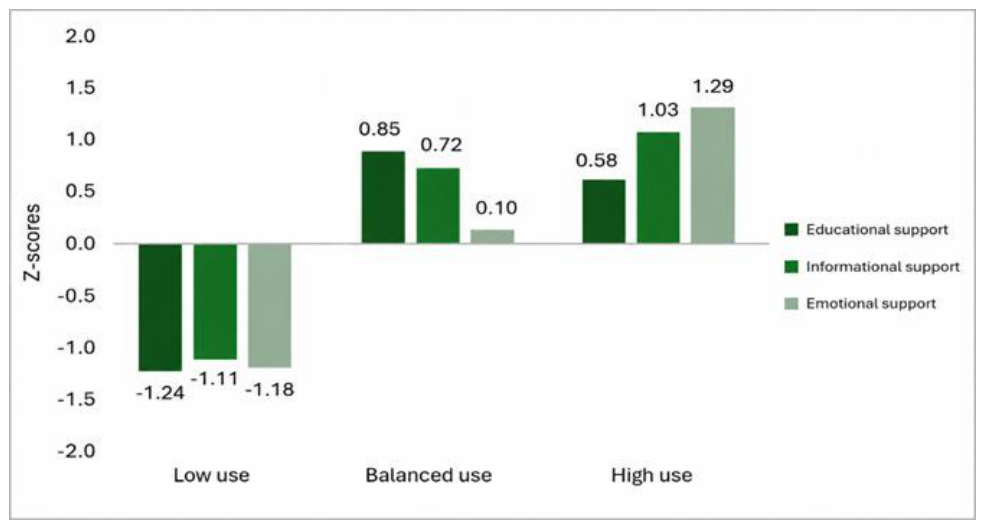
Figure 2.
SEM model: perceived usefulness of AI and academic goals. Note: *** p < .001; ** p < .01; * p < .05.
Figure 2.
SEM model: perceived usefulness of AI and academic goals. Note: *** p < .001; ** p < .01; * p < .05.
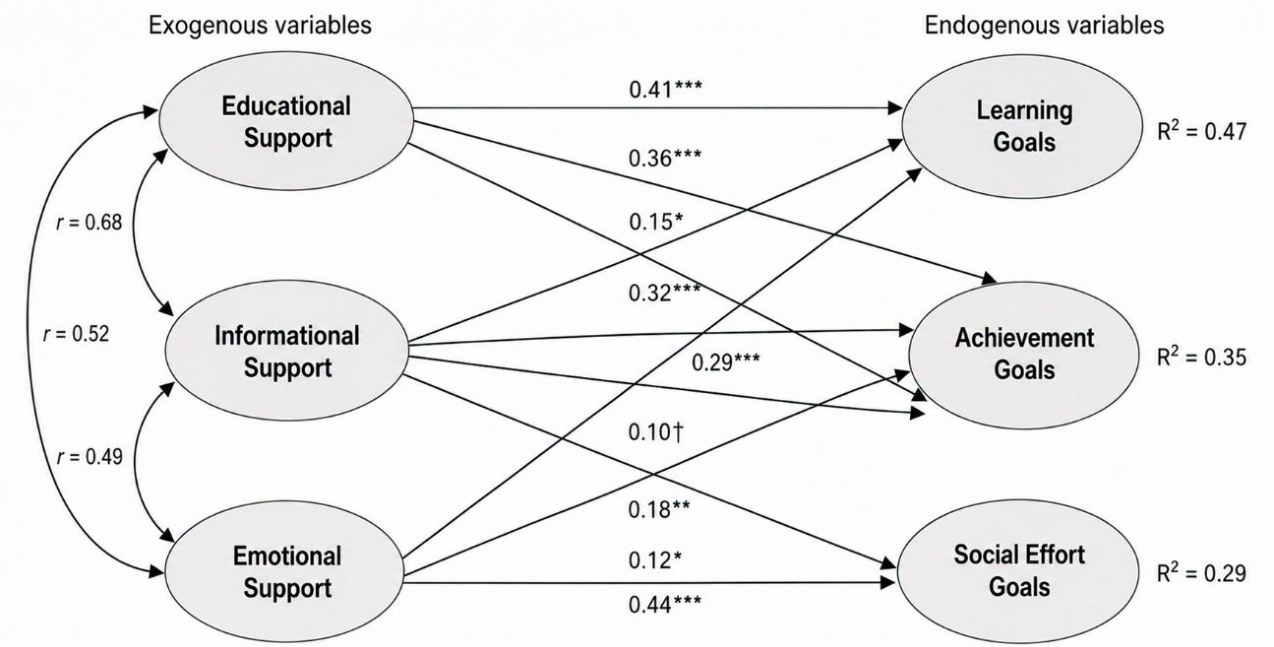

Table 1.
Academic goal differences according to AI usage profiles.
| Academic goal | Low use M (SD) | Balanced use M (SD) | High use M (SD) | F | p | partial η² |
|---|---|---|---|---|---|---|
| Learning goals | 3.12 (0.48) | 3.75 (0.44) | 4.21 (0.42) | 32.41 | < .001 | .133 |
| Achievement goals | 3.25 (0.50) | 3.61 (0.46) | 3.88 (0.43) | 18.76 | < .001 | .082 |
| Social reinforcement goals | 3.40 (0.47) | 3.52 (0.44) | 3.89 (0.45) | 14.58 | < .001 | .065 |
Note: M = mean; SD = standard deviation; η² = eta squared.
Table 2.
Pearson correlations between AI dimensions and academic goals.
| Academic goal | Educational support | Informational support | Emotional support |
|---|---|---|---|
| Learning goals | r = .62** | r = .55** | r = .42** |
| Achievement goals | r = .48** | r = .45** | r = .36** |
| Social reinforcement goals | r = .32** | r = .28** | r = .51** |
Note: **p < .01; *p < .05.
Disclaimer/Publisher’s Note: The statements, opinions and data contained in all publications are solely those of the individual author(s) and contributor(s) and not of MDPI and/or the editor(s). MDPI and/or the editor(s) disclaim responsibility for any injury to people or property resulting from any ideas, methods, instructions or products referred to in the content. |
© 2026 by the authors. Licensee MDPI, Basel, Switzerland. This article is an open access article distributed under the terms and conditions of the Creative Commons Attribution (CC BY) license (http://creativecommons.org/licenses/by/4.0/).
Copyright: This open access article is published under a Creative Commons CC BY 4.0 license, which permit the free download, distribution, and reuse, provided that the author and preprint are cited in any reuse.


