

Submitted:
01 June 2026
Posted:
03 June 2026
You are already at the latest version
Abstract
This study develops an integrated generative artificial intelligence (GAI) framework for enhancing business process performance in industrial enterprises. The main premise is that GAI should not be implemented as isolated chatbot use, but as a governed enterprise capability embedded in recurring workflows, enterprise information architectures, documented knowledge, and human decision roles. The proposed framework combines four process-cycle-based functional subframeworks – manufacturing, marketing and sales, accounting and finance, and human resource management – with a shared orchestration and governance layer. This layer coordinates enterprise process architecture, approved data and knowledge sources, reusable GAI capabilities, human-in-the-loop validation, traceability, escalation, and performance measurement. The framework distinguishes between GAI chatbots, which mainly support conversational assistance, drafting, summarization, and explanation, and GAI agents, which can support bounded multi-step workflows through retrieval, planning, tool use, and workflow coordination. A maturity-oriented validation is conducted using an adapted Smart Industry Readiness Index (SIRI) logic in the context of a smart-home industrial company. The results indicate that the overall enterprise readiness score increases from 41.60 before GAI implementation to 79.08 after implementation, corresponding to an absolute improvement of 37.48 points and a relative improvement of 90.10%. The strongest maturity gains are observed in accounting and finance and human resource management, followed by marketing and sales and manufacturing. The study contributes a process-centric, auditable, and human-supervised reference model for responsible enterprise-scale GAI implementation.
Keywords:
generative artificial intelligence
; industrial enterprises
; AI-enabled enterprise architecture
; business process management
; GAI chatbots
; GAI agents
; human-in-the-loop governance
; Smart Industry Readiness Index (SIRI)
; maturity assessment
; enterprise orchestration
1. Introduction
Industrial enterprises increasingly operate through digitally instrumented and data-intensive business processes that connect market demand, technical knowledge, material resources, financial capital, and human competences into products and services. Manufacturing, marketing and sales, accounting and finance, and human resource management remain four core functional areas in which process performance directly affects operational efficiency, customer value, financial reliability, and organizational capability. These functions are typically supported by enterprise resource planning (ERP), manufacturing execution systems (MES), customer relationship management (CRM), quality management systems (QMS), accounting platforms, and human resource information systems (HRIS). In Industry 4.0 environments, their integration is further shaped by reference architectures that emphasize lifecycle-spanning information flows and interoperable digital representations across technical and organizational levels [1,2]. Nevertheless, many operational and managerial decisions still depend on fragmented documentation, manual interpretation, siloed knowledge, and time-consuming cross-functional coordination.
Generative artificial intelligence (GAI), represented by large language models and related generative systems, has rapidly emerged as a general-purpose technology with major implications for intelligent information systems, enterprise software, and AI-enabled decision support. GAI refers to computational techniques capable of generating new and meaningful content, including text, images, audio, code, designs, and structured outputs, from training data [3]. Rather than only automating fixed rules, GAI can summarize, transform, compare, explain, and generate information in forms that are directly usable in business processes. Empirical evidence further shows that GAI can improve workplace productivity and service performance when it is used as augmentation rather than as a full substitute for human expertise [4].
For industrial enterprises, however, the value of GAI depends less on the model alone than on how it is embedded into enterprise information architectures, data flows, process logic, user roles, and governance mechanisms. This paper therefore uses GAI consistently as the umbrella term, while distinguishing between GAI chatbots and GAI agents. GAI chatbots mainly provide conversational assistance, explanation, summarization, and draft generation. GAI agents extend this capability by combining language models with retrieval, memory, planning, tool use, and bounded workflow execution [5]. This distinction matters because industrial applications range from low-risk documentary support to higher-impact actions that require escalation, validation, and managerial approval.
Across the four focal functional areas, GAI can support process documentation, production planning, quality-related knowledge work, customer communication, employee-service workflows, analytical reporting, and exception handling [3,6,7]. Yet these outputs should be treated as decision-support artifacts rather than autonomous decisions. In industrial settings, errors in generated content may affect product quality, delivery commitments, financial reporting, workforce decisions, compliance obligations, and cybersecurity exposure. Accordingly, the central challenge is not simple adoption, but responsible integration.
Despite the growing number of pilots and use cases, enterprise adoption remains fragmented. Current implementations often target isolated activities such as document drafting, chatbot-based service interactions, maintenance assistance, or internal knowledge retrieval. Such initiatives may create local efficiencies, but they provide limited guidance on how GAI chatbots, GAI agents, enterprise systems, validation roles, and process-performance measurement should be combined into one coherent enterprise-level operating model. This gap is especially relevant for industrial organizations, where digital tools must interact with established control structures, audit requirements, and cross-functional process dependencies.
The need for an integrated perspective is consistent with digital transformation and business process management (BPM) research. Digital transformation creates value when technologies are embedded into process architecture, managerial routines, and organizational strategy rather than introduced as disconnected tools [8]. BPM, in turn, views organizations as systems of interrelated processes that can be modeled, executed, monitored, controlled, and improved [9]. Recent work further indicates that large language models can support process modeling and process refinement, while still requiring systematic evaluation and error handling [10]. In this sense, GAI should be conceptualized not as an isolated application, but as a process-oriented enterprise capability.
The research problem addressed in this manuscript is therefore organizational and architectural rather than purely technical: how can GAI be organized as a governed enterprise capability for improving business process performance across several functional areas of an industrial enterprise? To address this problem, the paper proposes an integrated GAI-based framework that links enterprise data, process knowledge, GAI-supported workflows, and four functional subframeworks through a common orchestration layer. In this study, the orchestration layer denotes the coordination mechanism that connects prompts or agents, enterprise systems, validation roles, and output logging across process stages. The framework is intended for industrial enterprises and is illustrated through a smart-home manufacturing case.
The proposed framework contributes to AI-enabled enterprise information architecture design by specifying how data flows, process-cycle logic, validation roles, and orchestration mechanisms can connect GAI chatbots and GAI agents with ERP, MES, CRM, QMS, accounting, and HRIS environments. The framework is grounded in BPM, digital transformation, and responsible AI governance. It also adopts a human-in-the-loop governance logic, meaning that higher-impact outputs remain subject to human review, escalation, and approval before organizational action is taken.
Governance is a central condition for such deployment. The NIST AI Risk Management Framework positions trustworthy AI implementation around the functions of governance, mapping, measurement, and management and emphasizes the need to integrate trustworthiness considerations into AI design, development, use, and evaluation [11]. ISO/IEC 42001:2023 complements this view by specifying requirements for an artificial intelligence management system and by framing AI governance as an organizational management responsibility rather than a purely technical add-on [12]. These principles are consistent with human-centered AI research, which stresses transparency, reliability, accountability, and meaningful human control in AI-supported decision environments [13,14].
The objective of this research is to develop a GAI-based performance-enhancement framework for four core functional areas of an industrial enterprise: manufacturing, marketing and sales, accounting and finance, and human resource management. The manuscript makes three contributions. First, it conceptualizes GAI as an enterprise-level process and architecture capability rather than as an isolated chatbot application. Second, it develops four process-cycle-based functional subframeworks for the four focal functional areas. Third, it introduces a common governance, orchestration, and SIRI-based maturity-validation logic for responsible industrial deployment.
The proposed validation is maturity-oriented rather than purely outcome-oriented. In this manuscript, maturity-oriented validation means that the framework is assessed in terms of organizational readiness, integration capability, governance preparedness, and process maturity, rather than only short-term financial effects. For this purpose, the study adopts an adapted Smart Industry Readiness Index (SIRI) logic and applies it to a smart-home industrial company case [15]. This allows the paper to evaluate whether GAI supports not only individual tasks, but also the broader readiness of an industrial enterprise for integrated and human-supervised process improvement.
The remainder of the paper is organized as follows. Section 2 reviews related work on GAI, enterprise process augmentation, functional applications, agentic systems, and AI governance. Section 3 introduces the proposed integrated framework and its four functional subframeworks. Section 4 presents the SIRI-based validation logic and case application. Section 5 discusses the implications of the framework in comparison with existing research. Section 6 concludes the paper and outlines limitations and future research directions.
2. Related Work
The related work is organized around the main research streams that inform the proposed GAI-based framework for industrial enterprises. First, the section reviews generative artificial intelligence as a process-augmentation technology within business process management and enterprise information systems. Second, it summarizes recent applications of GAI in the four functional areas addressed in this study: manufacturing, marketing and sales, human resource management, and accounting and finance. Third, it discusses the distinction between GAI chatbots and GAI agents, together with governance, traceability, auditability, and human-in-the-loop control. Finally, the section clarifies the research gap related to enterprise-level integration, process-cycle logic, and maturity-oriented validation.
2.1. Generative AI and Enterprise Process Augmentation
Generative artificial intelligence has become an important research topic in business and information systems because it can generate, summarize, transform, compare, and explain both structured and unstructured information. Feuerriegel et al. conceptualize GAI as a socio-technical system rather than only a technical model, emphasizing its effects on work practices, information flows, and organizational decision support [3]. This interpretation is directly relevant to industrial enterprises, where business value is created through coordinated processes, enterprise systems, data flows, and human decision roles.
In the context of business process management (BPM), GAI can be interpreted as a process-augmentation technology. BPM views organizations as systems of interrelated processes that can be modeled, executed, monitored, controlled, and improved. Recent studies show that large language models can support process modeling and refinement by transforming textual descriptions into process models, assisting non-experts, and enabling iterative improvement [16]. However, these studies also indicate that generated outputs require evaluation, error handling, and governance.
This process-centric view is consistent with digital transformation research, which argues that business value emerges when digital technologies are embedded into process architecture, managerial routines, and organizational strategy rather than introduced as disconnected tools [8]. For industrial enterprises, this means that GAI should be connected not only to individual user tasks, but also to enterprise information architectures, process cycles, data structures, validation roles, and control points. The unresolved issue in the literature is how such process augmentation can be organized across several enterprise functions rather than within a single application or department.
2.2. Generative AI in Manufacturing Operations
Manufacturing is one of the most relevant domains for GAI because industrial firms already operate in digitally supported environments shaped by Industry 4.0, automation, IoT, predictive analytics, ERP, MES, and quality-management systems. Recent research suggests that GAI can complement these technologies by supporting product design, process planning, production documentation, quality control, predictive maintenance, supply-chain optimization, customization, and sustainability-oriented improvement [6,17].
In manufacturing practice, GAI can assist with standard operating procedures, work instructions, inspection checklists, root-cause analysis reports, corrective and preventive action drafts, maintenance summaries, and production KPI narratives. These tasks combine technical documentation, process knowledge, operational data, and quality evidence. However, manufacturing decisions may be safety-critical, quality-critical, and compliance-sensitive. Therefore, GAI-generated recommendations cannot be treated as autonomous decisions. Human engineers, production managers, quality managers, maintenance specialists, and compliance experts must validate outputs before process parameters are changed, batches are released, or corrective actions are closed.
The existing literature supports the relevance of GAI in manufacturing, but most studies remain focused on specific use cases, such as generative design, predictive maintenance, or documentation support. What remains insufficiently developed is the integration of these applications into a product–batch–operation cycle with threshold checks, deviation handling, human approval, and links to sales, finance, and HRM.
2.3. Generative AI in Marketing and Sales
Marketing and sales are directly affected by GAI because they rely on content, customer communication, segmentation, campaign design, sales proposals, and CRM data. Chan and Choi classify GAI applications in marketing around consumer adoption and concerns, service, advertising, and innovation [18]. Their review shows that GAI is increasingly used to support advertising, content creation, customer interaction, service communication, and marketing innovation.
Empirical evidence also supports the relevance of GAI in sales processes. Rodriguez et al. show that GAI can improve B2B sales-process effectiveness, administrative efficiency, and sales performance, especially when adoption is supported by management [19]. This finding indicates that GAI adoption in marketing and sales depends not only on technical availability, but also on organizational readiness, managerial support, and process integration.
GAI can support market intelligence, customer segmentation, campaign content generation, CRM summarization, product-message adaptation, proposal preparation, lead qualification, next-best-action recommendations, and customer-feedback analysis. However, marketing and sales outputs may create risks related to brand consistency, product claims, pricing, discounts, privacy, and customer commitments. Thus, the literature supports the development of a GAI-based marketing and sales subframework, but also points to the need for validation of customer-facing content, commercial-risk exposure, CRM data quality, and campaign-performance feedback loops.
2.4. Generative AI in Human Resource Management
Human resource management is a promising but sensitive area for GAI implementation. Li and Cheng provide a systematic review of ChatGPT in HRM and show that GAI is increasingly discussed in relation to HR planning, recruitment and selection, training and development, compensation, performance management, and employee support [7]. Their work suggests that GAI can improve efficiency and decision preparation in HR tasks, but that outcomes depend on organizational, technological, and process-related conditions.
In recruitment, GAI can assist with job-description drafting, candidate communication, CV summarization, interview-question generation, and initial screening support. Abdelhay et al. show that GAI can improve recruitment efficiency and candidate-quality assessment when mediated by process automation and supported by appropriate organizational conditions [20]. These findings indicate that GAI can reduce administrative burden and support HR decision preparation when embedded into structured workflows.
At the same time, HRM is a high-risk functional area because AI-supported outputs may affect hiring, promotion, compensation, employee monitoring, disciplinary action, and termination. These decisions have consequences for fairness, privacy, employee rights, and career development. Therefore, GAI in HRM should be used mainly as an assistive and preparatory tool, while sensitive decisions remain under human authority. The unresolved issue is how HRM-oriented GAI tools can be integrated into workforce-cycle and employee/talent-case processes while preserving fairness review, traceability, and managerial accountability.
2.5. Generative AI in Accounting and Finance
Accounting and finance are suitable for GAI support because they involve large volumes of structured and semi-structured documents, repetitive explanations, internal controls, compliance checks, forecasting, audit evidence, and reporting. Ali et al. identify several themes in GAI finance research, including financial decision support, ESG analytics, stock-market prediction, fraud detection, explainable AI, accounting applications, and sentiment analysis [21]. Their review also emphasizes replicability, methodological contingencies, and regulatory concerns, which are especially relevant in financial contexts.
In accounting and finance, GAI can support invoice and expense processing, transaction description classification, policy interpretation, variance commentary, management reporting, forecasting assistance, anomaly explanation, internal-control checking, audit-evidence preparation, and financial KPI narratives. These tasks require the combination of numerical data, accounting rules, internal policies, and documentary evidence. GAI can therefore create value as a reporting, explanation, reconciliation-support, and documentation assistant.
However, human professional judgment remains necessary because financial reports, postings, payments, tax submissions, audit conclusions, and compliance decisions require accountability and formal approval. Compared with other functions, accounting and finance are more strongly governed by standards, internal controls, audit trails, and evidence requirements. The literature therefore supports the view that GAI can improve efficiency and reporting quality, but it also shows the need for document completeness, transaction validity, account classification, approval paths, audit readiness, exception escalation, and final review.
2.6. Agentic GAI Systems, Governance, and Auditability
Recent enterprise GAI development is moving beyond simple chatbot use toward agentic systems. GAI chatbots are primarily conversational interfaces that provide explanation, summarization, draft generation, and interactive assistance. GAI agents extend this capability by combining language models with memory, retrieval, planning, tool use, and iterative execution in order to perform multi-step tasks under defined objectives and constraints [5]. The generative-agents literature further shows that agentic behavior depends on architectural components such as memory, reflection, planning, and interaction with an environment [22]. Other work on reasoning-and-acting patterns and reflective agents also shows that LLM-based systems can be extended from text generation toward action selection, tool use, and iterative self-improvement [23,24]. Multi-agent research additionally indicates that several LLM-based agents may coordinate, communicate, and divide tasks in complex environments, which further increases the need for governance and monitoring [25].
The distinction between chatbots and agents is important for industrial enterprises because different GAI tools require different governance mechanisms. A chatbot may help an employee draft a report, summarize a procedure, or answer a routine question. A GAI agent may retrieve records across systems, prepare a corrective-action dossier, compare financial transactions with policy rules, or route an exception to a responsible manager. These activities involve higher levels of autonomy, tool use, traceability, auditability, and operational risk than ordinary conversational assistance. Table 1 summarizes the main differences between GAI chatbots and GAI agents from an enterprise-process perspective.
The table synthesizes insights from the LLM-agent and human–AI interaction literature, where agents are commonly characterized by planning, memory, tool use, environmental interaction, reflection, and multi-step execution [5,22,23,24,25]. In the proposed framework, this distinction is used to separate conversational support from process-oriented agentic workflows. GAI chatbots are suitable for low-risk explanatory and documentary tasks, while GAI agents are suitable for structured multi-step support only when bounded by role-based access, output logging, human validation, and escalation rules.
Human-centered AI research emphasizes that AI systems should be designed for transparency, reliability, accountability, and meaningful human control [13,14]. These principles are especially important when GAI outputs may influence production release, customer commitments, financial reporting, audit evidence, recruitment, training, or employee-related decisions. At the organizational level, the NIST AI Risk Management Framework structures trustworthy AI implementation around governance, mapping, measurement, and management functions [11]. ISO/IEC 42001:2023 complements this view by specifying requirements for establishing, implementing, maintaining, and continually improving an artificial intelligence management system [12].
For the proposed framework, governance means that GAI-supported outputs must be linked to input data, source documents, prompts, model versions, tool calls, reviewers, approvals, and subsequent process decisions. Traceability means that the organization can identify where an output came from and how it was used. Auditability means that the organization can reconstruct how a recommendation, document, workflow action, or decision-support artifact was generated, reviewed, accepted, modified, rejected, or escalated. These principles are essential because the proposed framework connects GAI tools with enterprise systems, process-cycle logic, validation roles, and management decisions.
2.7. Research Gap
The reviewed literature confirms that GAI has substantial potential in manufacturing, marketing and sales, accounting and finance, and HRM. However, most studies remain function-specific. Manufacturing research often focuses on generative design, production documentation, quality control, or predictive maintenance. Marketing and sales research focuses on content generation, personalization, CRM support, or sales efficiency. HRM research examines recruitment, employee service, and training. Finance research addresses document automation, reporting, risk analytics, transaction control, and audit evidence.
This fragmentation creates a clear research gap. Existing research provides limited guidance on how GAI chatbots, GAI agents, enterprise systems, process cycles, threshold conditions, validation roles, governance rules, traceability, auditability, and performance measurement can be connected into one coherent operating model. Thus, the remaining gap is not only functional adoption, but enterprise architecture logic.
A further gap concerns validation. Existing studies often evaluate task-level benefits, such as productivity, quality of generated content, or administrative efficiency. Less attention is paid to whether GAI improves organizational readiness, integration capability, governance preparedness, and process maturity across functional areas. This motivates the use of maturity-oriented validation based on an adapted SIRI logic in the present study.
The proposed framework addresses these gaps by integrating four functional subframeworks into one enterprise-level architecture. It shifts the focus from isolated GAI use cases to governed, cross-functional, human-in-the-loop business process orchestration. Overall, the literature is mature enough to justify GAI applications in each functional area, but it remains insufficiently integrated at the enterprise level. What is still needed is a model that connects functional GAI capabilities into one orchestrated, auditable, maturity-assessable, and cross-functional operating model for industrial enterprises.
3. Proposed GAI-Based Frameworks for Industrial Enterprises by Functional Areas and Their Orchestration
The proposed GAI-based framework is grounded in the view that generative artificial intelligence should not be introduced into industrial enterprises as a set of isolated tools, but as a governed, process-oriented and architecture-level capability embedded in enterprise work. In this manuscript, GAI is conceptualized as a reusable enterprise capability that connects business processes, enterprise data, documented knowledge, human roles, validation routines, and performance feedback. This view is consistent with research showing that the organizational value of GAI emerges when generative models are linked with decision routines, business processes, domain knowledge, and role-specific responsibilities rather than used as free-standing assistants for ad hoc prompting [3,26,27]. It is also consistent with recent responsible-AI and GenAI governance research, which emphasizes lifecycle-based control, organizational accountability, risk management, and responsible engineering of information systems [28,29,30].
The proposed framework consists of two connected levels. The first level is the integrated enterprise orchestration and governance framework. It defines the common architecture through which GAI capabilities are coordinated across the main functional areas of an industrial enterprise. The second level contains four functional subframeworks: manufacturing, marketing and sales, accounting and finance, and human resource management. These subframeworks translate the general orchestration logic into process-cycle structures specific to each functional area.
3.1. Integrated Enterprise GAI Orchestration and Governance Framework
The integrated framework positions GAI as a cross-functional enterprise capability that supports, connects, and governs the four main functional areas of an industrial enterprise. Its central element is the enterprise GAI orchestration and governance layer. This layer is composed of five interrelated components: enterprise process architecture, data and documented knowledge, GAI capability layer, governance and human oversight, and performance measurement and continuous improvement.
The first component, enterprise process architecture, defines the end-to-end process structure and cross-functional alignment. It ensures that GAI is embedded in recurring enterprise processes rather than used as an isolated conversational tool. The second component, data and documented knowledge, represents enterprise data, standard operating procedures, policies, records, lessons learned, and external knowledge sources. These sources form the knowledge base from which GAI chatbots and agents retrieve, summarize, interpret, and generate process-relevant outputs. The third component, GAI capability layer, includes LLMs, retrieval tools, automation services, analytical modules, and agentic capabilities. This layer enables content generation, task decomposition, decision support, verification and validation, analytics and insights, and process improvement support [3,26,27]. The fourth component, governance and human oversight, defines the boundaries of responsible GAI use. It includes policies, access rules, validation roles, escalation paths, audit trails, and human-in-the-loop decision points. The fifth component, performance measurement and continuous improvement, connects GAI-supported processes with KPIs, analytics, benchmarking, feedback loops, and lessons learned. Thus, the integrated framework links process execution with organizational learning and maturity improvement. This logic is aligned with responsible-AI governance frameworks, which stress the importance of structural controls, procedural mechanisms, human oversight, traceability, and continuous risk management across the AI lifecycle [28,29,30].
Figure 1 presents the integrated enterprise GAI orchestration and governance framework, which connects the four functional subframeworks through a common enterprise process architecture, shared data and documented knowledge, reusable GAI capabilities, human-in-the-loop governance, and performance measurement and continuous improvement mechanisms.
The four surrounding functional blocks represent the operational domains in which GAI capabilities are applied. Manufacturing focuses on build and batch performance; marketing and sales focuses on campaign and opportunity performance; accounting and finance focuses on reporting and financial-cycle performance; and human resource management focuses on workforce-cycle performance. These areas are connected through cross-functional data flows, shared governance mechanisms, human validation, reusable GAI capabilities, and continuous improvement.
The integrated framework also has a temporal logic. Previous enterprise cycles provide historical data, performance results, lessons learned, and documented corrective actions. The current integrated enterprise cycle applies GAI-supported orchestration and governance across the four functional areas. The next enterprise cycle incorporates updated knowledge, improved workflows, refined recommendations, and enhanced performance indicators. In this way, the framework connects GAI adoption with continuous organizational learning and cross-functional process improvement.
3.2. Common Design Logic of the Four Functional Subframeworks
The four functional-area frameworks follow one common design logic. Each framework is positioned within the same upper context: the external manufacturing-sector institutional environment. This upper part should be identical in all four graphical frameworks. It represents the external environment in which the industrial enterprise operates, including regulations, professional standards, industry requirements, customer expectations, contractual obligations, labor rules, audit requirements, and sector-specific institutional pressures. This common upper part is important because the proposed framework does not treat GAI-supported processes as purely internal workflows. Instead, it recognizes that functional decisions in industrial enterprises are influenced by external institutional, regulatory, technological, and market conditions.
Inside this common environment, each functional framework is organized into three main parts. The central part represents the process-cycle logic of the functional area. It contains the main sequence of activities, decision gates, repetitions, subcycles, corrective actions, and final assessment of objectives. The left part represents the operational team and functional manager responsible for planning, preparation, execution, correction, and review. The right part represents the control, review, audit, compliance, ethics, or analytical counterpart that validates inputs, monitors outputs, checks risks, and ensures that GAI-supported outputs remain acceptable from the perspective of quality, compliance, traceability, and accountability.
The lower part of each framework expresses continuity across cycles. Each cycle n inherits data, lessons learned, unresolved issues, and improvement priorities from cycle n − 1 and transfers updated knowledge to cycle n + 1. This logic transforms the frameworks from static process diagrams into learning-oriented improvement cycles.
Across all four functional areas, GAI chatbots and agents are conceptualized primarily as cognitive and process-support instruments. GAI chatbots are suitable for explanation, summarization, drafting, interpretation, comparison, and interactive assistance. GAI agents are suitable for bounded multi-step tasks such as retrieving evidence, preparing structured dossiers, checking completeness, routing exceptions, and supporting workflow coordination. However, the proposed frameworks are GAI-supported rather than GAI-governed. Sensitive approvals, legally binding commitments, safety-related interventions, financial sign-off, employee-related decisions, and other high-impact outcomes remain under human responsibility. This position is consistent with responsible AI governance and human-centered AI principles, which emphasize transparency, accountability, human oversight, risk control, and avoidance of overreliance on automated recommendations [28,29,30].
3.3. GAI-Based Manufacturing Framework
The manufacturing framework is organized around a nested production logic with three levels: production cycle, batch, and operation. The central part starts with the production cycle. The enterprise sets production objectives, performs production planning, and completes pre-production preparation activities. After this stage, the batch starts and the framework enters the operation level. The current operation is set up, followed by execution and operational control. The main decision gate evaluates whether the operation result is acceptable.
If the operation result is acceptable, the process moves to the next operation. If the result is not acceptable, operational-level corrective actions are triggered. After all required operations are completed, the batch ends and the broader production cycle evaluates whether production objectives have been achieved. If the objectives are not achieved, production-cycle corrective actions are initiated and transferred into the following cycle.
This central structure is consistent with industrial production logic, where product-level objectives are achieved through batch-level execution and operation-level control. It is also aligned with recent literature on AI and GAI in manufacturing, where applications increasingly cover design and planning, process optimization, quality management, predictive maintenance, human-centered assistance, and new-generation intelligent manufacturing [6,31,32,33].
Figure 2 presents the manufacturing subframework, which organizes GAI-supported production activities around a production cycle, batch subcycle, and operation-level control, with the production team and operations manager responsible for execution and the quality manager and improvement team responsible for validation, compliance, and continuous improvement.
The left part of the manufacturing framework positions the production team and operations manager as the main process owners. Their tasks are organized into planning, pre-production preparation, in-process monitoring, post-run correction, and review. In the planning layer, they define production, quality, and safety goals. In the preparation layer, they prepare and validate work instructions and SOPs, verify material, tool, and equipment readiness, check data connectivity and sensor calibration, and conduct pilot runs or capability checks. During execution, they monitor real-time metrics and process signals, detect anomalies and out-of-control conditions, adjust process parameters and workflows, and generate alerts and recommended actions. During correction, they analyze defects and root causes, update control plans and process settings, and implement corrective actions. In the review layer, they examine KPIs and dashboards, assess performance trends and improvement opportunities, and capture lessons learned.
GAI can support this left-side operational logic by generating contextualized operator guidance, summarizing deviations, explaining anomalies, drafting corrective-action records, preparing maintenance or production summaries, and supporting knowledge transfer across shifts, batches, and teams. Recent studies on AI and GAI in manufacturing show that such systems can support operator assistance, production knowledge management, quality improvement, and intelligent manufacturing workflows [6,31,32,33]. However, GAI-generated outputs remain advisory and must be validated before they influence production parameters, batch release, or formal quality records.
The right part of the manufacturing framework represents the quality manager and improvement team. Their role is to protect process integrity, traceability, compliance, and continuous improvement. They review standards, policies, and regulatory requirements; validate process readiness and risk assessments; verify operator training and competency; check data quality, integration, and lineage; and approve control plans and inspection strategies. During execution, they monitor compliance and process conformance in real time, detect performance drift and emerging risks, validate alarms and corrective-action effectiveness, and ensure traceability of records and decisions. In the post-run correction layer, they review CAPA records, validate root-cause analyses and corrective fixes, confirm effectiveness and recurrence prevention, and approve updated control plans and documentation. In the review layer, they assess performance against KPIs and goals, validate SPC results and process capability, and summarize improvement findings and recommendations.
The separation between the left and right sides is conceptually important. The left side drives production execution, while the right side validates process quality, risk control, and improvement evidence. This structure ensures that GAI support remains coupled with engineering controls, inspection logic, and quality-management routines rather than acting autonomously in manufacturing decisions.
3.4. GAI-Based Marketing and Sales Framework
The marketing and sales framework is organized around a campaign cycle containing a target-segment subcycle and recurring interaction-level activities. The central part begins with the campaign cycle start, followed by the setting of campaign objectives, campaign planning, and campaign preparation activities. Once the campaign is configured, the target-segment cycle starts. The current interaction activity is set up, and segment campaign execution and interaction control are performed.
The first decision gate evaluates whether the interaction result is acceptable. If the interaction result is acceptable, the process proceeds to the next interaction. If it is not acceptable, interaction-level corrective actions are activated. After the planned interaction activities for the target segment are completed, the target-segment cycle ends. The broader campaign cycle then evaluates whether campaign objectives have been achieved. If objectives are not achieved, campaign-cycle corrective actions are triggered and used to improve the next campaign cycle.
This central structure reflects the logic of commercial processes, where campaign-level objectives are achieved through segment-level targeting and interaction-level execution. It is aligned with current marketing and sales research showing that GAI affects content generation, personalization, CRM usage, customer communication, campaign management, sales-support processes, and customer-experience enhancement [34,35,36,37].
Figure 3 presents the marketing and sales subframework, which structures GAI-supported commercial activities around a campaign cycle, target-segment subcycle, and interaction-level control, with the marketing and sales team and marketing manager driving campaign execution and the commercial controller and customer insights team validating customer-facing outputs, risks, and performance results.
The left part of the marketing and sales framework captures the activities of the marketing and sales team and the marketing manager. In the planning and preparation stages, they define campaign objectives and parameters, prepare product messaging, offers, and value propositions, prepare quotations and proposal templates, configure pricing logic, prepare CRM data, segments, and lead-scoring rules, and define workflow and approval rules. During execution, they monitor lead flows and customer engagement, monitor response quality and sales-support tasks, detect anomalies or weak signals, and adjust next-best actions and sales recommendations. During post-campaign correction, they analyze lost opportunities and customer feedback, update offers, messaging, and routing rules, and implement corrective actions while refining personalization models. In the review stage, they assess win/loss patterns and conversion drivers, evaluate administrative efficiency and campaign cost, and capture lessons learned and best practices.
GAI can support this left-side commercial logic by drafting campaign content, creating message variants, summarizing CRM interactions, explaining customer-segment behavior, preparing proposal drafts, suggesting follow-up messages, analyzing customer feedback, and supporting sales staff in customer-specific communication. However, human control must remain over pricing, contractual terms, product claims, discounts, and customer commitments. This distinction is important because recent marketing literature emphasizes both the value of GAI for customer experience and the need to manage trust, personalization, transparency, and strategic marketing risks [34,35,36,37].
The right part of the marketing and sales framework introduces the commercial controller and customer insights team as the review and validation layer. They review brand, compliance, and regulatory standards; validate CRM data quality, segment accuracy, and enrichment; validate content, offers, and personalization rules; verify proposal templates, quotations, and terms; and approve workflows and escalation rules. During execution, they monitor campaign, pipeline, and engagement KPIs; review traceability of customer communication; detect commercial risks and conduct compliance checks; and validate next-best actions and AI recommendations. During post-campaign correction, they review commercial risk exposures and write-offs, validate updates to offers, messaging, and routing, and confirm corrective actions and model recalibrations. In the review layer, they examine win/loss patterns and conversion drivers, validate attainment of KPIs and targets, and summarize performance findings and recommendations.
This right-side structure balances creativity and customer personalization with commercial discipline, legal consistency, and risk control. It ensures that GAI-enabled marketing and sales activities are not only efficient and personalized, but also traceable, compliant, and aligned with business strategy.
3.5. GAI-Based Accounting and Finance Framework
The accounting and finance framework is organized around a financial cycle containing a recurring document and transaction processing subcycle. The central part begins with the financial cycle start, the setting of financial objectives, financial planning, and financial preparation activities. The financial process then starts, and the current document or transaction activity is set up. The core execution stage is document and transaction processing and control.
The main decision gate evaluates whether the document or transaction result is acceptable. If the result is acceptable, the process continues to the next document or transaction. If the result is not acceptable, document-transaction corrective actions are triggered. Once the document and transaction processing subcycle is completed, the financial process ends. The broader financial cycle then evaluates whether financial objectives have been achieved. If not, financial-cycle corrective actions are initiated before the next financial cycle begins.
This structure reflects the financial-cycle logic of planning, document intake, transaction control, evidence validation, reporting, and review. It is compatible with finance and accounting literature, where GAI is increasingly discussed in relation to decision support, risk management, back-end processing, compliance work, audit preparation, financial reporting, alternative data, and financial-control activities [38,39,40,41].
Figure 4 presents the accounting and finance subframework, which organizes GAI-supported financial activities around a financial cycle, financial process subcycle, and document/transaction processing level, with the finance team and finance manager responsible for execution and the internal auditor and control and reporting team responsible for evidence validation, control monitoring, and audit readiness.
The left part of the accounting and finance framework is assigned to the finance team and finance manager. In the planning layer, they define financial reporting, control, compliance, and efficiency objectives. In the preparation layer, they collect and validate invoices, expense claims, and supporting documents; validate master data, accounting policies, and reporting schedules; and prepare templates, mappings, and chart-of-accounts structures. During processing and control, they support transaction classification and matching, handle exceptions and prepare resolution proposals, generate variance commentary and forecasting support, and perform internal-control checks to identify missing evidence. During correction, they analyze transaction exceptions and root causes, update accounting policies, workflow rules, and mappings, revise documentation, evidence, and financial narratives, and verify corrective actions, completeness, and supporting audit evidence. In the review layer, they assess close-cycle efficiency and KPIs, verify documentation completeness and supporting audit evidence, review forecasts, scenarios, and lessons learned, and capture lessons learned from forecast and scenario analysis.
GAI can support this left-side finance logic by classifying documents, drafting variance explanations, preparing management-reporting narratives, summarizing audit evidence, supporting reconciliation, comparing transactions with policies, and converting accounting data into understandable managerial commentary. However, GAI outputs must remain decision-support artifacts, not final accounting judgments. This position is consistent with recent finance and auditing research, which emphasizes both the opportunities of AI for efficiency and analytics and the need for explainability, robustness, evidential reliability, and professional judgment [38,39,40,41].
The right part of the accounting and finance framework introduces the internal auditor and control and reporting team as the formal assurance layer. They review accounting standards, compliance, and regulatory requirements; assess document completeness, accounting policies, and reporting schedules; verify master-data integrity and access controls; and validate templates, mappings, and standard reports. During processing and monitoring, they monitor control activities and transaction processing, evaluate control design and operating effectiveness, review variance commentary and forecasting assumptions, and ensure audit readiness and evidence consolidation. During correction, they oversee corrective actions and remediation, validate updates to policies, controls, and process improvements, and validate documentation updates and control improvements. In the review layer, they assess overall financial performance against objectives, validate compliance and control maturity, and summarize control findings and recommendations.
This right-side architecture is essential because finance and audit decisions require reproducibility, evidence completeness, internal-control reliability, and formal approval. The framework therefore reserves final approval of postings, financial reporting judgments, audit interpretations, and external disclosures for authorized human roles.
3.6. GAI-Based Human Resource Management Framework
The HRM framework is organized around a workforce cycle containing a recurring HR process and employee/case-level activities. The central part begins with the workforce cycle start, the setting of workforce objectives, HR process planning, and HR process preparation activities. The framework then enters the employee/case stage, where the current HR case is set up and handled through HR service execution and case control.
The key decision gate evaluates whether the case result is acceptable. If the case result is acceptable, the process continues to the next case activity or closes the case. If the result is not acceptable, case-level corrective actions are triggered. Once the employee/case subcycle ends, the broader workforce cycle evaluates whether workforce objectives have been achieved. If not, workforce-cycle corrective actions are initiated and transferred into the next cycle.
This central logic reflects the HRM process structure, where workforce-level objectives are achieved through HR process planning and employee/talent case handling. It is aligned with recent AI-HRM literature, which shows that AI and GAI affect HR planning, recruitment, selection, onboarding, training, performance management, employee services, and work redesign, while requiring human-centric implementation and careful treatment of fairness, trust, privacy, and compliance [42,43,44].
Figure 5 presents the HRM subframework, which structures GAI-supported workforce activities around a workforce cycle, HR process subcycle, and employee/case-level control, with the HR team and HR manager responsible for operational HR service delivery and the ethics and compliance officer and HR review team responsible for fairness, privacy, compliance, and human-in-the-loop validation.
The left part of the HRM framework places the HR team and HR manager in charge of the operational process. In the planning and preparation stages, they define workforce, HR service, learning, and compliance objectives; prepare job descriptions and role profiles; develop candidate communication and interview guides; create onboarding materials and resources; and prepare learning resources and training plans. During service and development monitoring, they support employee inquiries and service requests, develop training content and microlearning materials, provide policy guidance and compliance support, analyze workforce planning data and talent insights, monitor HR services and case resolution, and detect fairness or data-quality concerns. During correction, they analyze HR issues and root causes, update policies, workflows, and governance rules, revise materials and communication content, and implement corrective actions while tracking closure. In the review layer, they assess time-to-fill and quality of hire, review onboarding cycle time and completion, evaluate employee service efficiency, and review learning and development outcomes.
GAI can support this left-side HRM logic by drafting vacancy texts, job descriptions, onboarding instructions, HR FAQ responses, policy explanations, training materials, case summaries, and learning-content variants. It can also help HR staff summarize employee inquiries, identify recurring workforce issues, and prepare structured documentation for review. However, AI-supported HR outputs require particular caution because HR processes concern individual rights, career opportunities, fairness, privacy, and workplace trust [42,43,44].
The right part of the HRM framework introduces the ethics and compliance officer and the HR review team as the dedicated human-centered control layer. They review employment policies, privacy, fairness, and anti-discrimination controls; review job postings and selection materials for bias and clarity; review screening, interview, and assessment tools; validate onboarding plans, learning resources, and communication; and verify workflow rules, approvers, and access permissions. During service and development monitoring, they oversee employee-inquiry handling and service quality, review training content for accuracy, inclusiveness, and relevance, review policy guidance and explanations for fairness, monitor workforce metrics and service performance, and ensure human-in-the-loop review for sensitive decisions. During correction, they review corrective actions and policy updates, validate the effectiveness of changes, confirm documentation, traceability, and approvals, and ensure root causes address systemic risks. In the review layer, they assess HR performance against KPIs and goals, validate time-to-fill and onboarding outcomes, review employee service and learning effectiveness, and summarize HR performance findings and recommendations.
This right-side structure directly addresses one of the main conclusions of recent AI-HRM research: HR adoption cannot be evaluated only through efficiency gains. It must also be assessed in terms of fairness, trust, acceptance, well-being, privacy, ethics, and the continuing strategic role of HR in aligning technology with people management, culture, and compliance [42,43,44].
3.7. Transition from Functional Subframeworks to Enterprise Orchestration
Taken together, the four functional subframeworks propose a common enterprise grammar for introducing GAI chatbots and agents into industrial business processes. In each functional area, the GAI layer is positioned between domain knowledge, enterprise data, process documentation, and human decision roles. It supports process execution and improvement, but it does so within explicit boundaries of review, approval, escalation, and accountability.
This common grammar is what makes orchestration possible. The functional subframeworks can be connected through shared rules for access, prompting, retrieval, knowledge-base use, output logging, validation, escalation, cross-functional data exchange, and continuous improvement. The integrated orchestration and governance framework therefore acts as the higher-level architecture that connects the four functional subframeworks into one enterprise-wide operating model. It ensures that GAI-enabled improvements in one domain, such as manufacturing, remain aligned with commercial commitments, financial controls, workforce capacity, and external institutional requirements.
From an enterprise architecture perspective, the four subframeworks should use the same upper part: the external manufacturing-sector institutional environment. This common upper layer ensures consistency across the graphical models and shows that all functional processes are embedded in the same regulatory, market, professional, and industry-specific context. The central process cycle, the left operational team, the right validation/review team, and the lower inter-cycle continuity layer should also remain structurally consistent across the four diagrams. This visual consistency strengthens the message that the framework is not a collection of unrelated departmental models, but a coordinated enterprise architecture for responsible GAI-enabled business process improvement [3,26,27,28,29,30].
4. SIRI-Based Validation of the Proposed GAI-Based Framework
4.1. Validation Logic and Case-Study Context
The proposed framework is validated through a maturity-oriented case analysis of a smart home industrial company. The company develops, manufactures, markets, sells, and services electronic security and smart home products, including alarm systems, fire detection devices, access-control modules, sensors, smart control panels, IoT-based monitoring devices, and related software-supported solutions. Its operations are organized around the four functional areas included in the proposed framework: manufacturing, marketing and sales, accounting and finance, and human resource management.
The validation does not aim to prove that GAI alone causes all observed business performance changes. Instead, it evaluates whether the proposed GAI-based framework can improve the company’s readiness for smart, integrated, traceable, and human-supervised business process management. This approach is appropriate because the impact of GAI is not limited to direct financial results. It also affects process structure, documentation quality, enterprise data use, cross-functional integration, human validation, governance, and organizational learning.
For this purpose, the validation applies an adapted Smart Industry Readiness Index (SIRI) logic. SIRI was developed to assess industrial companies’ readiness for smart manufacturing transformation through three main building blocks: process, technology, and organization [15]. These building blocks are suitable for the present manuscript because the proposed GAI-based framework also combines process redesign, technological capability, and organizational governance. The adaptation of SIRI is further supported by Industry 4.0 maturity research, which treats digital transformation as a staged capability-building process rather than a single technological intervention [45]. Digital transformation research also emphasizes that value emerges when digital technologies are embedded in organizational processes, routines, and decision structures [8].
In this study, SIRI is used as a maturity and readiness assessment tool, not as a financial index. The objective is to evaluate whether the proposed four GAI-based subframeworks improve process maturity, technology maturity, organizational maturity, and cross-functional integration. The validation is therefore a proof-of-concept assessment of implementation readiness. It should not be interpreted as an official SIRI audit or as econometric causal proof of isolated GAI effects.
4.2. Implementation Assumption
The validation assumes that the company implements the four proposed GAI-based functional subframeworks and connects them through a common enterprise GAI orchestration and governance layer. GAI chatbots and GAI agents do not replace existing enterprise systems such as ERP, MES, CRM, QMS, accounting software, HRIS, or production-control systems. Instead, they operate as an additional cognitive, analytical, documentary, and decision-support layer.
In manufacturing, GAI supports production planning, work-instruction preparation, SOP drafting, quality-control documentation, deviation analysis, root-cause analysis, corrective and preventive action documentation, maintenance summaries, and production KPI reporting.
In marketing and sales, GAI supports market intelligence, customer segmentation, campaign content generation, product messaging, proposal preparation, CRM interaction summaries, lead qualification, customer follow-up, and after-sales communication.
In accounting and finance, GAI supports invoice and expense document summarization, transaction classification, variance commentary, reporting, internal-control checklists, audit-readiness documentation, and financial KPI explanation.
In HRM, GAI supports job-description drafting, recruitment communication, onboarding materials, employee service responses, training content, policy guidance, skills-gap summaries, and performance-support workflows.
The integration of the four subframeworks is achieved through the enterprise orchestration and governance layer. This layer connects data, documents, thresholds, process events, and feedback across functional areas. For example, increased demand identified by marketing and sales may trigger production-capacity analysis, financial forecasting, and HR workforce-capacity assessment. Similarly, a manufacturing quality deviation may trigger customer communication, cost-impact analysis, and operator training. This cross-functional logic is central to the proposed enterprise-level framework.
4.3. Validation Dimensions
The adapted SIRI-based validation uses three main maturity dimensions: process, technology, and organization. The process dimension evaluates whether workflows are structured, standardized, traceable, repeatable, and connected across functional areas. The technology dimension evaluates whether GAI chatbots, GAI agents, digital tools, enterprise systems, data repositories, and analytics capabilities are embedded into daily workflows. The organization dimension evaluates whether people, responsibilities, governance rules, validation procedures, training, collaboration, and managerial control support sustainable GAI adoption.
For each functional area, five function-specific evaluation dimensions are selected. The scores are not equal or nearly equal. Instead, they are differentiated to reflect realistic differences in baseline maturity and post-implementation development. The weighting scheme also differs by dimension because not all dimensions have the same relevance for each functional area.
Each maturity score is assigned on a 0–5 scale (Table 2).
A score of 3 means that GAI supports selected activities, but the workflow may still be partly fragmented. A score of 4 means that GAI is integrated into the workflow with human validation, traceability, and defined governance rules. A score of 5 would require adaptive, learning-oriented, and continuously optimized GAI-driven processes. In the present validation, post-implementation values do not reach 5, because the case represents an initial integrated implementation rather than a fully adaptive enterprise AI system.
4.4. SIRI-Based Evaluation Formulas
For each functional area FA, the SIRI-based readiness score is calculated as:
where is the maturity score of dimension i, is the weight assigned to dimension i and n is the number of assessed dimensions.
Since the weights within each functional area sum to 1, the formula can be simplified as:
The absolute improvement achieved after the implementation of the proposed GAI-based framework is calculated as:
where is the pre-implementation readiness score and is the post-implementation readiness score.
The relative improvement is calculated as:
The overall enterprise readiness score is calculated as the arithmetic mean of the four functional-area readiness scores:
where , and represent the readiness scores for Manufacturing, Marketing and Sales, Accounting and Finance, and Human Resource Management, respectively.
For the expert-based assessment, the maturity score of each dimension is calculated as the average of the evaluations provided by the experts.
4.5. Manufacturing Subframework Validation
The manufacturing subframework is evaluated through five dimensions: production process integration, quality documentation, shop-floor data use, maintenance support, and human-in-the-loop control (Table 3). Before GAI implementation, the company is assumed to have partly digital production documentation and some shop-floor data use, but production knowledge is still fragmented across documents, operators, quality records, and maintenance reports. After implementation, GAI supports work-instruction preparation, deviation summaries, defect analysis, CAPA drafting, maintenance documentation, KPI reporting, and lessons-learned reuse.
According to Equations (2)–(4), the weighted pre-implementation score, weighted post-implementation score, absolute SIRI change, and relative SIRI improvement for the manufacturing subframework are calculated as follows:
The manufacturing subframework shows a strong maturity increase. The largest improvements are observed in quality documentation and production process integration. This is consistent with the proposed framework because GAI can support work instructions, deviation summaries, CAPA drafts, process documentation, and knowledge transfer across batches and shifts. However, post-implementation shop-floor data use and maintenance support remain below the highest level, because fully adaptive manufacturing intelligence would require deeper real-time integration with MES, IoT sensors, maintenance systems, and closed-loop control.
4.6. Marketing and Sales Subframework Validation
The marketing and sales subframework is evaluated through CRM data use, campaign preparation, lead and opportunity support, customer feedback analysis, and commercial governance (Table 4). Before GAI implementation, the company is assumed to have basic CRM records and some digital sales support, but campaign preparation, segmentation, feedback analysis, and opportunity follow-up remain highly manual. After implementation, GAI supports product messaging, campaign variants, CRM summarization, proposal preparation, lead qualification, customer follow-up, win/loss summaries, and campaign-performance review.
The weighted pre-implementation score, weighted post-implementation score, absolute SIRI change, and relative SIRI improvement for the marketing and sales subframework are calculated as follows:
The marketing and sales subframework shows substantial improvement, especially in campaign preparation and customer feedback analysis. These activities are suitable for GAI because they are content-intensive, communication-intensive, and strongly dependent on CRM interpretation. Commercial governance improves more moderately because customer-facing messages, price offers, contractual terms, and product claims still require human review and commercial control.
4.7. Accounting and Finance Subframework Validation
The accounting and finance subframework is evaluated through document control, transaction processing, reporting support, internal-control readiness, and audit evidence traceability (Table 5). Before GAI implementation, finance processes are assumed to be document-heavy and dependent on manual checking, repetitive reporting, and delayed interpretation of accounting information. After implementation, GAI supports invoice and expense summarization, transaction classification, policy interpretation, variance commentary, forecast explanations, internal-control checklists, missing-evidence detection, audit-preparation notes, and management-report drafting.
The weighted pre-implementation score, weighted post-implementation score, absolute SIRI change, and relative SIRI improvement for the accounting and finance subframework are calculated as follows:
The accounting and finance subframework shows the highest post-implementation readiness score. This is explained by the document-intensive and rule-based character of financial work, where GAI can support summarization, classification, checking, explanation, and reporting. Nevertheless, GAI outputs in this functional area must remain decision-support artifacts, because accounting, payment, reporting, tax, audit, and compliance decisions require formal human approval and documented accountability.
4.8. Human Resource Management Subframework Validation
The HRM subframework is evaluated through recruitment support, onboarding support, employee service, learning and development, and HR governance and fairness (Table 6). Before GAI implementation, HRM processes are assumed to rely on manual document preparation, repetitive employee communication, and fragmented training or performance-support records. After implementation, GAI supports job descriptions, candidate communication, onboarding materials, employee FAQ answers, policy explanations, training content, microlearning materials, HR service summaries, skills-gap identification, fairness checks, and escalation of sensitive cases.
The weighted pre-implementation score, weighted post-implementation score, absolute SIRI change, and relative SIRI improvement for the human resource management subframework are calculated as follows:
The HRM subframework shows substantial maturity improvement. The strongest effects are expected in recruitment support, onboarding, learning-content preparation, and employee service. The post-implementation score for HR governance and fairness remains lower than the highest operational scores because HRM requires careful human review, fairness monitoring, privacy control, and ethical oversight.
4.9. Overall Enterprise-Level Readiness Improvement
Using the Equation (5), the overall effectiveness of the proposed framework is calculated as the average of the four functional-area scores:.
The overall SIRI-based readiness score increases from 41.60 before GAI implementation to 79.08 after implementation. This corresponds to an absolute improvement of 37.48 points and a relative improvement of 90.10%. The revised evaluation is more credible than an equal-score version because it reflects functional heterogeneity. Manufacturing has relatively stronger baseline shop-floor data use and human control, but weaker maintenance support. Marketing and sales has weaker baseline customer-feedback analysis. Accounting and finance has stronger transaction-processing maturity but weaker audit-evidence traceability. HRM has weaker baseline employee-service maturity but stronger governance awareness.
4.10. Cross-Functional Integration and Governance Readiness
The SIRI-based validation also evaluates whether the company’s functional areas become better connected after implementation. Cross-functional integration improves when production data are used in sales and finance decisions, customer demand data are used in production planning, financial data are used in pricing and cost-control decisions, HR skills data are used in production and sales planning, quality deviations trigger training and customer communication, and all functional areas use shared GAI-supported documentation and governance rules.
Governance readiness is evaluated through the presence of AI-use policies, approved knowledge sources, role-based access, output logging, validation procedures, escalation paths, traceability, and human approval for high-impact decisions. These controls are aligned with the NIST AI Risk Management Framework, which structures AI risk management around governance, mapping, measurement, and management functions [11]. They are also aligned with ISO/IEC 42001:2023, which frames AI governance as a management-system issue requiring documented processes, monitoring, performance evaluation, and continual improvement [12]. The NIST Generative AI Profile further stresses risks specific to GAI systems, including confabulation, data leakage, cybersecurity, intellectual property, and information-integrity risks [29].
The validation therefore supports the conclusion that the proposed framework does not merely automate isolated tasks. It increases the company’s readiness for smart, connected, traceable, and human-supervised process management across manufacturing, marketing and sales, accounting and finance, and HRM.
4.11. Interpretation and Limitations of the Validation
The SIRI-based validation indicates that the four proposed GAI-based subframeworks can improve enterprise readiness in three main ways. First, they improve process maturity by transforming fragmented manual activities into structured, repeatable, and monitored workflows. Second, they improve technology maturity by embedding GAI chatbots, GAI agents, enterprise data, and digital tools into operational and managerial processes. Third, they improve organizational maturity by strengthening human-in-the-loop governance, role clarity, cross-functional collaboration, and responsible AI control.
The strongest improvements are observed in accounting and finance and HRM, mainly because these areas contain many document-intensive, communication-intensive, and rule-sensitive activities that can benefit from GAI-supported drafting, summarization, classification, checking, and explanation. Manufacturing and marketing and sales also show substantial improvements through better planning, monitoring, documentation, decision support, and feedback integration.
Nevertheless, the validation has limitations. The maturity scores are based on an adapted SIRI-style assessment rather than on a full official SIRI audit. The scores should therefore be interpreted as a proof-of-concept maturity evaluation, not as an externally certified readiness score. In addition, the analysis does not isolate the causal effect of GAI from other organizational, technological, or market factors. Future studies should validate the framework through longitudinal implementation, multi-company comparison, expert scoring panels, and triangulation with operational KPIs, employee feedback, audit evidence, and financial indicators.
5. Discussion
The proposed framework addresses the central research problem of this manuscript: how generative artificial intelligence can be organized as a governed enterprise capability for improving business process performance across the main functional areas of an industrial enterprise. The results of the framework development and the SIRI-based validation suggest that GAI should not be understood only as a set of isolated chatbot applications, but as an enterprise-level process and architecture capability. This interpretation is consistent with the broader view of GAI as a socio-technical technology that affects work practices, information flows, decision support, and organizational routines [3,26,27].
The proposed framework extends existing research in three ways. First, it connects GAI with enterprise process architecture rather than with individual tasks alone. Second, it develops four process-cycle-based functional subframeworks for manufacturing, marketing and sales, accounting and finance, and human resource management. Third, it introduces a common orchestration, governance, human-in-the-loop, and maturity-assessment logic. In this way, the framework links GAI-supported execution with process control, traceability, accountability, and continuous improvement.
5.1. Comparison with Existing GAI and Enterprise Process Research
Previous studies show that GAI can support professional productivity, decision preparation, and process modeling [3,4,10,16]. For example, Kourani et al. demonstrate that large language models can assist in process modeling and refinement, but that their outputs still require evaluation, error handling, and quality control [16]. Similarly, Vial emphasizes that digital transformation creates value when digital technologies are embedded into organizational processes and managerial routines rather than deployed as disconnected tools [8]. The proposed framework builds directly on this logic.
However, the contribution of the present framework differs from these studies. Existing work mainly examines GAI as a productivity-enhancing tool, process-modeling support, or digital transformation enabler. The proposed framework moves further by specifying how GAI can be embedded into recurring functional cycles, validation roles, decision gates, and cross-functional orchestration mechanisms. Thus, it shifts the focus from “GAI can support work” to “GAI can be governed as an enterprise process capability”.
The proposed framework is therefore closer to an AI-enabled enterprise information architecture than to a single GAI use case. It specifies how data flows, process-cycle logic, validation roles, and orchestration mechanisms can connect GAI chatbots and GAI agents with ERP, MES, CRM, QMS, accounting, and HRIS environments. This is particularly relevant for Electronics, where intelligent systems, enterprise software, cyber-physical production environments, and AI-supported decision infrastructures are important research domains.
5.2. Comparison with Function-Specific GAI Applications
The related work confirms that GAI applications are already developing in the four functional areas addressed in this manuscript. In manufacturing, previous studies discuss GAI for design support, process planning, quality control, predictive maintenance, operator assistance, and intelligent manufacturing [6,17,31,32,33]. In marketing and sales, studies emphasize content generation, CRM, customer experience, personalization, sales-process effectiveness, and B2B sales support [18,19,34,35,36,37]. In accounting and finance, the literature identifies opportunities in financial decision support, auditing, reporting, alternative data, and financial control [21,38,39,40,41]. In HRM, current research discusses AI and GAI in recruitment, employee services, training, human–machine cooperation, and the changing role of HR [7,20,42,43,44].
These studies are highly relevant, but they remain mainly function-specific. They show what GAI can do in separate domains, but they provide less guidance on how GAI-supported activities should be connected across departments. The proposed framework addresses this limitation by introducing a common structure for all four functional areas: a central process cycle, a left-side operational team, a right-side validation and control layer, and a lower inter-cycle learning logic. This common structure allows functional differences to be preserved while maintaining enterprise-level consistency.
In manufacturing, the framework translates GAI support into a production–batch–operation logic. In marketing and sales, it translates GAI support into a campaign–target segment–interaction logic. In accounting and finance, it uses a financial cycle–process area–document/transaction logic. In HRM, it uses a workforce cycle–HR process–employee/case logic. This design provides a more systematic process structure than most function-specific GAI studies.
The comparison shows that the proposed framework does not replace existing domain-specific studies. Instead, it integrates their insights into one enterprise architecture. This integration is important because the performance of an industrial enterprise depends on cross-functional alignment. For example, customer demand affects production planning; production deviations affect customer communication and financial cost analysis; financial signals affect pricing and investment decisions; and HR capacity affects production and sales execution.
5.3. Chatbots, Agents, and Human-in-the-Loop Governance
A major design choice in the proposed framework is the distinction between GAI chatbots and GAI agents. The related work shows that GAI agents differ from chatbots because they can combine memory, retrieval, planning, tool use, reasoning, reflection, and multi-step execution [5,22,23,24,25]. This distinction is important for industrial enterprises because it affects governance requirements.
GAI chatbots are appropriate for lower-risk activities such as explanation, summarization, draft preparation, internal Q&A, report support, and communication assistance. GAI agents are more appropriate for bounded workflow support, such as retrieving evidence, checking document completeness, preparing exception dossiers, comparing records across systems, routing cases, and supporting multi-step process coordination. However, the more agentic the system becomes, the stronger the need for access control, logging, validation, escalation, and human approval.
The proposed framework therefore adopts a human-in-the-loop governance logic. This is consistent with human-centered AI principles, which emphasize transparency, reliability, accountability, and meaningful human control [13,14]. It is also aligned with the NIST AI Risk Management Framework and ISO/IEC 42001:2023, which position AI governance as an organizational responsibility involving risk management, documented controls, monitoring, and continual improvement [11,12]. The NIST Generative AI Profile further highlights risks specific to GAI, including confabulation, information integrity, cybersecurity, and data leakage [29].
The framework operationalizes these principles through validation roles in each functional area. In manufacturing, quality and improvement roles validate process integrity and CAPA evidence. In marketing and sales, commercial control and customer insights roles validate offers, messaging, and customer-facing outputs. In accounting and finance, internal audit and control roles validate reporting, transaction evidence, and audit readiness. In HRM, ethics, compliance, and HR review roles validate fairness, privacy, and sensitive employee-related outputs. This role-based validation structure is one of the main practical contributions of the framework.
5.4. Interpretation of the SIRI-Based Validation Results
The SIRI-based validation shows that the proposed framework can improve maturity across all four functional areas. The overall readiness score increases from 41.60 before GAI implementation to 79.08 after implementation, corresponding to an absolute increase of 37.48 points and a relative improvement of 90.10%. The differentiated scoring approach is important because it avoids artificial equal baseline values and reflects realistic functional differences in baseline maturity and post-implementation development.
The manufacturing score increases from 42.80 to 77.50. This improvement is mainly linked to production process integration, quality documentation, and human-in-the-loop control. The result is consistent with the manufacturing literature, which emphasizes the potential of AI and GAI for production planning, quality management, predictive maintenance, and operator assistance [31,32,33].
The marketing and sales score increases from 41.00 to 78.40. The strongest improvements appear in campaign preparation and customer feedback analysis. This is consistent with studies showing that GAI can support marketing content, CRM processes, customer experience, and B2B sales performance [18,19,34,35,36,37].
The accounting and finance score increases from 42.80 to 81.80. This is the highest post-implementation score. The result is plausible because accounting and finance contain many document-intensive, rule-based, and evidence-dependent processes that are suitable for GAI-supported classification, summarization, reporting, and audit-evidence preparation [21,38,39,40,41].
The HRM score increases from 39.80 to 78.60. This reflects improvements in recruitment support, onboarding, learning and development, employee services, and HR governance. At the same time, HR governance and fairness remain below the highest operational scores, which is appropriate because AI-supported HR decisions require strong human review, privacy protection, and fairness monitoring [7,20,42,43,44].
The results indicate that the proposed framework is most effective in domains where documentation, classification, explanation, communication, and evidence preparation are central. This does not mean that GAI autonomously improves enterprise performance. Rather, it indicates that GAI can increase maturity when embedded into governed workflows with human validation and process-cycle logic.
5.5. Theoretical Implications
The proposed framework contributes to the literature on AI-enabled business process management and enterprise information systems. It extends the process-augmentation view of GAI by showing how generative systems can be embedded into recurring enterprise cycles rather than only used for isolated tasks. It also contributes to digital transformation theory by conceptualizing GAI as an architecture-level capability that connects data, workflows, roles, governance, and performance feedback.
The framework also contributes to responsible AI research. Many governance studies emphasize principles such as transparency, accountability, traceability, human oversight, and risk management [11,12,13,14,28,29]. The proposed framework translates these principles into functional process structures. It shows where human validation is needed, which roles should perform it, and how GAI outputs can be connected to evidence, process decisions, and continuous improvement.
Finally, the framework contributes to maturity-based evaluation. Instead of evaluating GAI only through financial indicators or task-level productivity, it applies a SIRI-based logic to assess readiness, maturity, integration capability, and governance preparedness. This is particularly suitable for early-stage GAI adoption, where long-term causal performance effects may not yet be observable.
5.6. Managerial and Practical Implications
For industrial managers, the framework provides a practical reference model for implementing GAI in a responsible and measurable way. It suggests that GAI implementation should begin with process analysis rather than tool selection. Managers should identify recurring process cycles, decision gates, documentation requirements, validation roles, and cross-functional dependencies before introducing chatbots or agents.
The framework also shows that different GAI tools require different governance levels. Chatbots can be used for drafting, summarization, and explanation with content review. Agents require stronger controls because they may perform multi-step tasks, call tools, retrieve data, and route process cases. Therefore, companies should define role-based access, approved knowledge sources, output logging, escalation paths, and human approval rules before implementing agentic workflows.
For manufacturing companies, the framework suggests that GAI value increases when production, sales, finance, and HR data are connected. For example, quality deviations should not remain only manufacturing issues. They may affect customer communication, warranty costs, training needs, and financial forecasts. Similarly, demand signals from sales should inform production planning, inventory control, workforce planning, and cash-flow forecasting.
6. Conclusions
This manuscript proposed an integrated GAI-based framework for enhancing business process performance in industrial enterprises. The framework conceptualizes GAI as a governed, process-oriented, and architecture-level capability rather than as an isolated chatbot application. It connects four functional subframeworks—manufacturing, marketing and sales, accounting and finance, and human resource management—through a common enterprise orchestration and governance layer.
The proposed framework addresses a clear gap in the literature. Existing studies provide strong evidence that GAI can support individual functions, including manufacturing, marketing, sales, finance, accounting, and HRM. However, these studies remain largely function-specific and provide limited guidance on cross-functional integration. The framework developed in this manuscript responds to this gap by specifying how GAI chatbots and agents can be connected with enterprise systems, process cycles, validation roles, traceability mechanisms, and maturity-based evaluation.
The SIRI-based validation indicates that the framework can substantially improve digital and organizational readiness. The overall readiness score increases from 41.60 before GAI implementation to 79.08 after implementation, which corresponds to an absolute improvement of 37.48 points and a relative improvement of 90.10%. The highest post-implementation readiness is observed in accounting and finance, followed by HRM, marketing and sales, and manufacturing. These results suggest that GAI has strong potential in document-intensive, communication-intensive, rule-sensitive, and process-coordination activities.
The main contribution of the manuscript is threefold. First, it introduces an enterprise-level conceptualization of GAI as a process and architecture capability. Second, it proposes four process-cycle-based functional subframeworks with explicit operational and validation roles. Third, it develops a governance, orchestration, and SIRI-based maturity-validation logic for responsible industrial deployment.
From a managerial perspective, the framework can help industrial enterprises move from fragmented GAI experimentation toward structured, measurable, and human-supervised implementation. It highlights that the value of GAI depends not only on model performance, but also on process integration, data quality, validation roles, governance rules, and continuous improvement.
The study also emphasizes that GAI should support, but not replace, human responsibility in high-impact industrial decisions. Production release, quality approval, customer commitments, pricing decisions, financial reporting, audit conclusions, hiring, compensation, and other sensitive decisions must remain under human authority. This human-in-the-loop principle is essential for accountability, trust, safety, fairness, and compliance.
The framework is not without limitations. It remains a conceptual and maturity-oriented validation study rather than a full longitudinal empirical implementation. Future research should test the framework in real industrial settings, compare results across companies and sectors, and combine SIRI-based maturity evaluation with operational, financial, and human-centered performance indicators.
Future research should empirically test the proposed framework in multiple industrial enterprises and sectors through longitudinal case studies that examine operational KPIs, documentation quality, process cycle time, error rates, employee workload, customer response time, audit readiness, and cross-functional coordination. Further studies should also develop more detailed measurement instruments for the adapted SIRI-based GAI maturity assessment, including expert-scoring protocols, inter-rater reliability checks, weighting procedures, industry-specific maturity benchmarks, and comparison with other Industry 4.0 and digital transformation maturity models. Another important direction is the investigation of GAI agents in real enterprise systems, including their integration with ERP, MES, CRM, QMS, accounting, and HRIS platforms, as well as the technical implementation of access control, output logging, rollback mechanisms, escalation rules, and human approval. Finally, future work should examine the ethical, legal, and organizational implications of GAI-supported enterprise processes, especially in HRM, accounting and finance, customer communication, and safety-critical manufacturing, where fairness, privacy, accountability, cybersecurity, employee acceptance, and validated human oversight are critical.
The proposed framework provides a structured reference model for responsible GAI integration in industrial enterprises. It contributes to the development of AI-enabled enterprise information architectures by linking GAI chatbots, GAI agents, enterprise systems, functional process cycles, human validation, governance, and maturity assessment into one coherent operating model.
Author Contributions
Conceptualization, G.I. and Y.I.; methodology, G.I.; software, G.I. and Y.I.; validation, Y.I..; formal analysis, G.I.; investigation, G.I.; resources, Y.I.; data curation, G.I.; writing—original draft preparation, G.I.; writing—review and editing, G.I. and Y.I.; visualization, G.I.; supervision, Y.I.; project administration, G.I.; funding acquisition, G.I. All authors have read and agreed to the published version of the manuscript.
Funding
This research was partially supported by the Project “Digitalisation of the Economy in a Big Data Environment” BG16RFPR002-1.014-0013, funded by the European Regional Development Fund (ERDF) through the “Programme Research, Innovation and Digitalisation for Smart Transformation (PRIDST)”.
Data Availability Statement
The data supporting the findings of this study are contained within the article and no additional datasets were generated or analyzed.
Acknowledgments
The authors thank the academic editor and anonymous reviewers for their insightful comments and suggestions.
Conflicts of Interest
Author Yuliy Iliev was employed by the company Teletek Electronics. The remaining author declares that the research was conducted in the absence of any commercial or financial relationships that could be construed as a potential conflict of interest.
References
- Stachowiak, A.; Ragin-Skorecka, K.; Wojciechowski, H.; Misztal, A.; Motała, D.; Wojtkowski, R. Functionalities-Based ERP Class System Implementation and Development. Appl. Sci. 2023, 13, 11422. [CrossRef]
- DIN. DIN SPEC 91345:2016-04 Reference Architecture Model Industrie 4.0 (RAMI4.0); DIN Media: Berlin, Germany, 2016. https://dx.doi.org/10.31030/2436156.
- Feuerriegel, S.; Hartmann, J.; Janiesch, C.; Zschech, P. Generative AI. Bus. Inf. Syst. Eng. 2024, 66, 111–126. [CrossRef]
- Brynjolfsson, E.; Li, D.; Raymond, L.R. Generative AI at Work. Q. J. Econ. 2025, 140, 889–942. [CrossRef]
- Wang, L.; Ma, C.; Feng, X.; Zhang, Z.; Yang, H.; Zhang, J.; Chen, Z.; Tang, J.; Chen, X.; Lin, Y.; Zhao, W.X.; Wei, Z.; Wen, J.-R. A Survey on Large Language Model Based Autonomous Agents. Front. Comput. Sci. 2024, 18, 186345. [CrossRef]
- Shafiee, S. Generative AI in Manufacturing: A Literature Review of Recent Applications and Future Prospects. Procedia CIRP 2025, 132, 1–6. [CrossRef]
- Li, B.; Cheng, Y. ChatGPT in Human Resource Management: A Systematic Review of Influential Factors, Processes, and Outcomes. Heliyon 2025, 11, e44048. [CrossRef]
- Vial, G. Understanding Digital Transformation: A Review and a Research Agenda. J. Strateg. Inf. Syst. 2019, 28, 118–144. [CrossRef]
- Dumas, M.; La Rosa, M.; Mendling, J.; Reijers, H.A. Fundamentals of Business Process Management, 2nd ed.; Springer: Berlin/Heidelberg, Germany, 2018.
- Kourani, H.; Berti, A.; Schuster, D.; van der Aalst, W.M.P. Process Modeling with Large Language Models. arXiv 2024, arXiv:2403.07541.
- National Institute of Standards and Technology. Artificial Intelligence Risk Management Framework (AI RMF 1.0); NIST AI 100-1; NIST: Gaithersburg, MD, USA, 2023. [CrossRef]
- ISO/IEC. ISO/IEC 42001:2023 Information Technology—Artificial Intelligence—Management System; International Organization for Standardization/International Electrotechnical Commission: Geneva, Switzerland, 2023. Available online: https://www.iso.org/standard/42001 (accessed on 25 May 2026).
- Amershi, S.; Weld, D.; Vorvoreanu, M.; Fourney, A.; Nushi, B.; Collisson, P.; Suh, J.; Iqbal, S.T.; Bennett, P.N.; Inkpen, K.; Teevan, J.; Kikin-Gil, R.; Horvitz, E. Guidelines for Human-AI Interaction. In Proceedings of the 2019 CHI Conference on Human Factors in Computing Systems; ACM: New York, NY, USA, 2019; pp. 1–13. [CrossRef]
- Shneiderman, B. Human-Centered Artificial Intelligence: Reliable, Safe and Trustworthy. Int. J. Hum.-Comput. Interact. 2020, 36, 495–504. [CrossRef]
- Singapore Economic Development Board. The Smart Industry Readiness Index: Catalysing the Transformation of Manufacturing; Singapore Economic Development Board: Singapore, 2020. Available online: https://www.edb.gov.sg/content/dam/edb-japan/key-activities/advanced-manufacturing/the-singapore-smart-industry-readiness-index/the-sg-smart-industry-readiness-index-whitepaper.pdf (accessed on 25 May 2026).
- Kourani, H.; Berti, A.; Schuster, D.; van der Aalst, W.M.P. Evaluating Large Language Models on Business Process Modeling: Framework, Benchmark, and Self-Improvement Analysis. Softw. Syst. Model. 2025, advance online publication. [CrossRef]
- Doanh, D.C.; Dufek, Z.; Ejdys, J.; Ginevičius, R.; Korzyński, P.; Mazurek, G.; Paliszkiewicz, J.; Wach, K.; Ziemba, E. Generative AI in the Manufacturing Process: Theoretical Considerations. Eng. Manag. Prod. Serv. 2023, 15, 76–89. [CrossRef]
- Chan, H.-L.; Choi, T.-M. Using Generative Artificial Intelligence (GenAI) in Marketing: Development and Practices. J. Bus. Res. 2025, 191, 115276. [CrossRef]
- Rodriguez, M.; Deeter-Schmelz, D.R.; Krush, M.T. The Impact of Generative AI Technology on B2B Sales Process and Performance: An Empirical Study. J. Bus. Ind. Mark. 2025, advance online publication. [CrossRef]
- Abdelhay, S.; AlTalay, M.S.R.; Selim, N.; Altamimi, A.A.; Hassan, D.; Elbannany, M.; Marie, A. The Impact of Generative AI (ChatGPT) on Recruitment Efficiency and Candidate Quality: The Mediating Role of Process Automation Level and the Moderating Role of Organizational Size. Front. Hum. Dyn. 2025, 6, 1487671. [CrossRef]
- Ali, H.; Zafar, M.B.; Aysan, A.F. Generative AI in Finance: Replicability, Methodological Contingencies, and Future Research Directions. Financ. Res. Lett. 2025, 86, 108797. [CrossRef]
- Park, J.S.; O’Brien, J.C.; Cai, C.J.; Morris, M.R.; Liang, P.; Bernstein, M.S. Generative Agents: Interactive Simulacra of Human Behavior. In Proceedings of the 36th Annual ACM Symposium on User Interface Software and Technology, San Francisco, CA, USA, 29 October–1 November 2023; ACM: New York, NY, USA, 2023; Article 2, pp. 1–22. [CrossRef]
- Yao, S.; Zhao, J.; Yu, D.; Du, N.; Shafran, I.; Narasimhan, K.; Cao, Y. ReAct: Synergizing Reasoning and Acting in Language Models. In Proceedings of the International Conference on Learning Representations (ICLR), Kigali, Rwanda, 1–5 May 2023.
- Shinn, N.; Cassano, F.; Gopinath, A.; Narasimhan, K.; Yao, S. Reflexion: Language Agents with Verbal Reinforcement Learning. In Proceedings of the Advances in Neural Information Processing Systems (NeurIPS), New Orleans, LA, USA, 10–16 December 2023.
- Guo, T.; Chen, X.; Wang, Y.; Chang, R.; Pei, S.; Chawla, N.V.; Wiest, O.; Zhang, X. Large Language Model Based Multi-Agents: A Survey of Progress and Challenges. arXiv 2024, arXiv:2402.01680.
- Holmström, J.; Carroll, N. How Organizations Can Innovate with Generative AI. Bus. Horiz. 2025, 68, 559–573. [CrossRef]
- Albashrawi, M. Generative AI for Decision-Making: A Multidisciplinary Perspective. J. Innov. Knowl. 2025, 10, 100751. [CrossRef]
- Papagiannidis, E.; Mikalef, P.; Conboy, K. Responsible Artificial Intelligence Governance: A Review and Research Framework. J. Strateg. Inf. Syst. 2025, 34, 101885. [CrossRef]
- National Institute of Standards and Technology. Artificial Intelligence Risk Management Framework: Generative Artificial Intelligence Profile; NIST AI 600-1; National Institute of Standards and Technology: Gaithersburg, MD, USA, 2024. Available online: https://nvlpubs.nist.gov/nistpubs/ai/NIST.AI.600-1.pdf (accessed on 25 May 2026).
- Fetzer, D.; Gimpel, H.; Meindl, O.; Strickmann, J. Responsible Engineering of Information Systems Based on Generative Artificial Intelligence: An Action Design Research Study at a German Premium Car Manufacturer. Bus. Inf. Syst. Eng. 2025. [CrossRef]
- Gao, R.X.; Krüger, J.; Merklein, M.; Möhring, H.-C.; Váncza, J. Artificial Intelligence in Manufacturing: State of the Art, Perspectives, and Future Directions. CIRP Ann. 2024, 73, 723–749. [CrossRef]
- Zhang, C.; Xu, Q.; Yu, Y.; Zhou, G.; Zeng, K.; Chang, F.; Ding, K. A Survey on Potentials, Pathways and Challenges of Large Language Models in New-Generation Intelligent Manufacturing. Robot. Comput.-Integr. Manuf. 2025, 92, 102883. [CrossRef]
- Kiangala, K.S.; Wang, Z. A Generative Pre-Trained Transformer Industrial Bot to Improve Operators’ Working Experience in a Small Industry 5.0 Factory. Int. J. Adv. Manuf. Technol. 2025, 136, 3525–3541. [CrossRef]
- Grewal, D.; Satornino, C.B.; Davenport, T.; Guha, A. How Generative AI Is Shaping the Future of Marketing. J. Acad. Mark. Sci. 2025. [CrossRef]
- Alnofeli, K.K.; Akter, S.; Yanamandram, V. Unlocking the Power of AI in CRM: A Comprehensive Multidimensional Exploration. J. Innov. Knowl. 2025, 10, 100731. [CrossRef]
- Hautamäki, P.; Heikinheimo, M. Fully Leveraging AI in B2B Sales: Exploring Sales Managers’ Capabilities and Organizational Knowledge Processes. J. Bus. Res. 2025, 194, 115396. [CrossRef]
- Sahut, J.-M.; Laroche, M. Using Artificial Intelligence to Enhance Customer Experience and to Develop Strategic Marketing: An Integrative Synthesis. Comput. Hum. Behav. 2025, 170, 108684. [CrossRef]
- Aldasoro, I.; Gambacorta, L.; Korinek, A.; Shreeti, V.; Stein, M. Intelligent Financial System: How AI Is Transforming Finance. J. Financ. Stab. 2025, 81, 101472. [CrossRef]
- Kokina, J.; Blanchette, S.; Davenport, T.H.; Pachamanova, D. Challenges and Opportunities for Artificial Intelligence in Auditing: Evidence from the Field. Int. J. Account. Inf. Syst. 2025, 56, 100734. [CrossRef]
- Cao, S.S.; Jiang, W.; Lei, L.; Zhou, Q. Applied AI for Finance and Accounting: Alternative Data and Opportunities. Pac.-Basin Financ. J. 2024, 84, 102307. [CrossRef]
- Blankespoor, E.; DeHaan, E.; Li, Q. Generative AI in Financial Reporting. J. Account. Res. 2026. [CrossRef]
- Dima, J.D.; Gilbert, M.-H.; Dextras-Gauthier, J.; Giraud, L. The Effects of Artificial Intelligence on Human Resource Activities and the Roles of the Human Resource Triad: Opportunities and Challenges. Front. Psychol. 2024. [CrossRef]
- Fenwick, A.; Molnar, G.; Frangos, P. Revisiting the Role of HR in the Age of AI: Bringing Humans and Machines Closer Together in the Workplace. Front. Artif. Intell. 2024, 6, 1272823. [CrossRef]
- Jiang, Y.; Cai, Z.; Wang, X. Leverage Generative AI for Human Resource Management. Int. J. Hum. Resour. Manag. 2025. [CrossRef]
- Schuh, G.; Anderl, R.; Dumitrescu, R.; Krüger, A.; ten Hompel, M. Industrie 4.0 Maturity Index: Managing the Digital Transformation of Companies; acatech STUDY; Herbert Utz Verlag: Munich, Germany, 2017.
Figure 1.
Integrated GAI orchestration and governance framework for industrial enterprises.
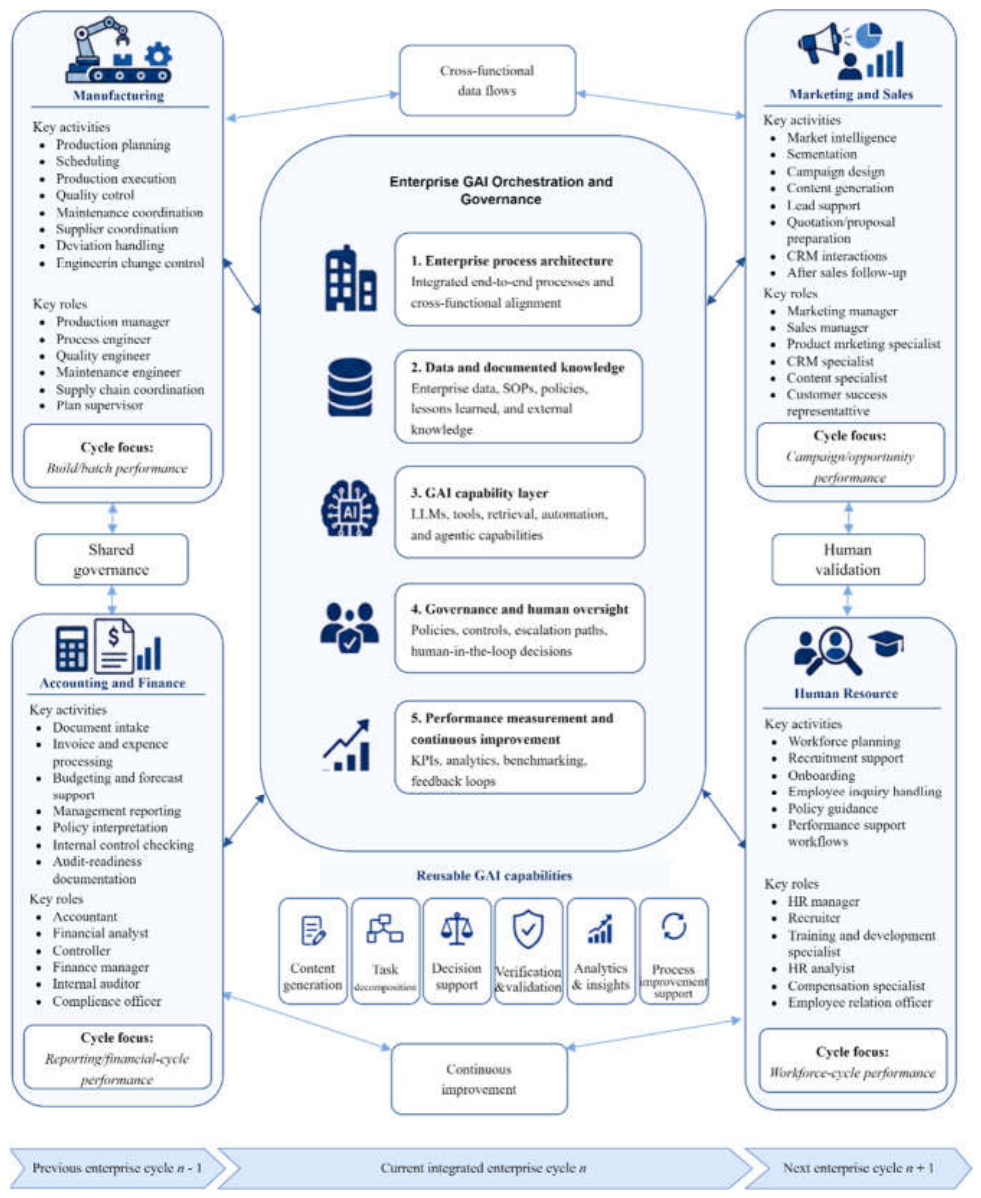
Figure 2.
GAI-based manufacturing subframework showing the production cycle, batch subcycle, and operation-level control.
Figure 2.
GAI-based manufacturing subframework showing the production cycle, batch subcycle, and operation-level control.
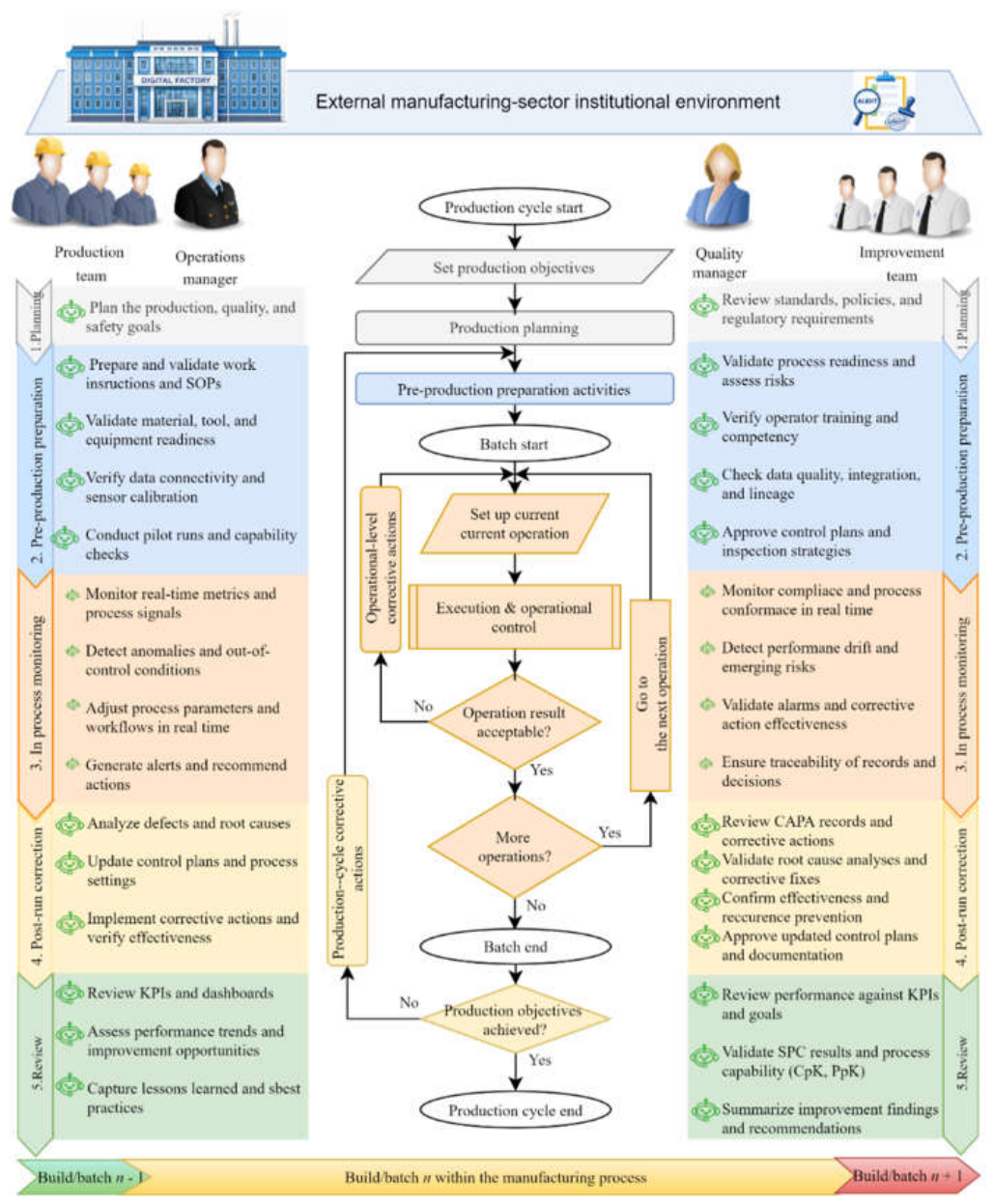
Figure 3.
GAI-based marketing and sales framework based on campaign-cycle, target-segment, and interaction-level logic.
Figure 3.
GAI-based marketing and sales framework based on campaign-cycle, target-segment, and interaction-level logic.
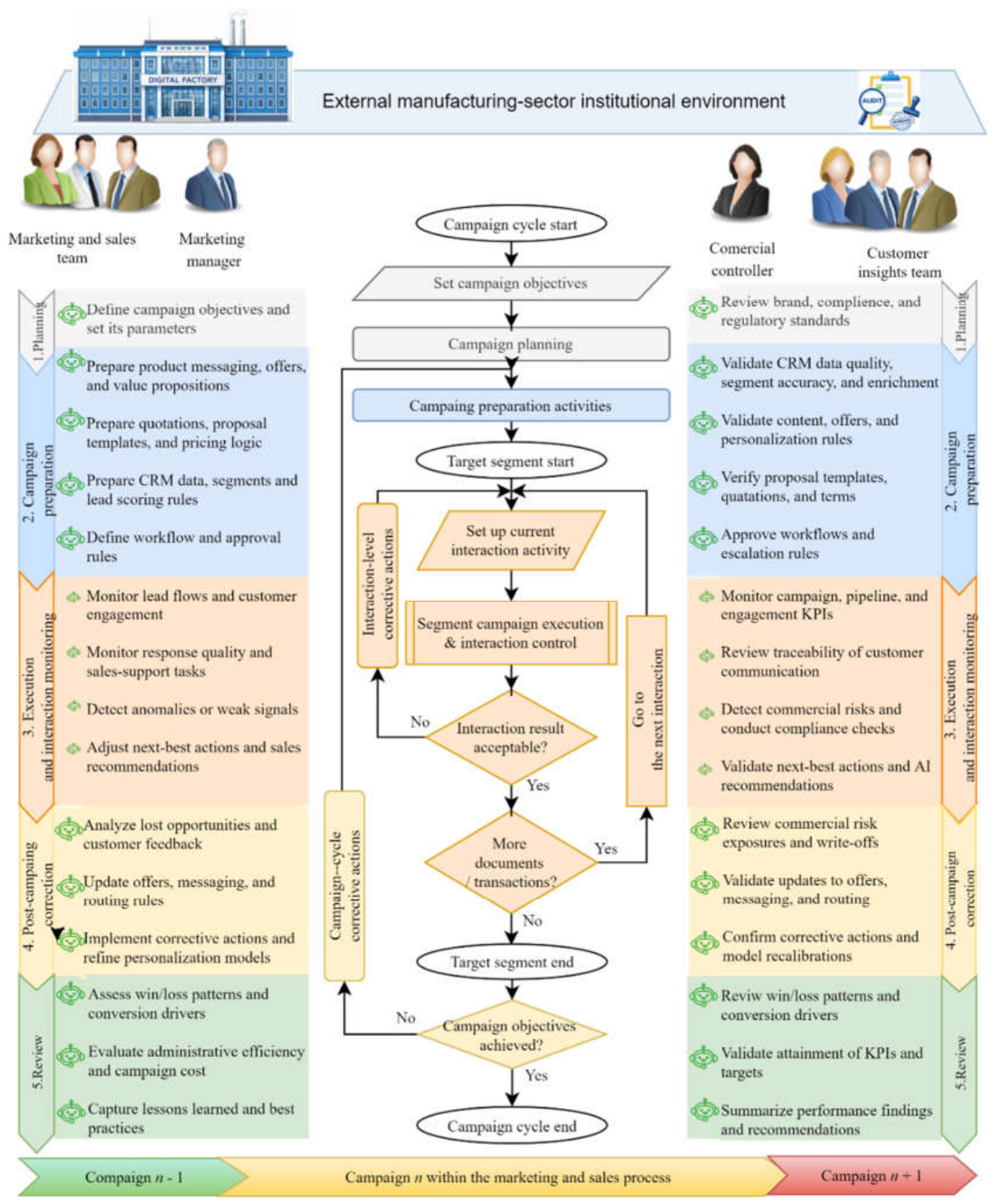
Figure 4.
GAI-based accounting and finance framework based on financial-cycle, process-area, and document/transaction-level logic.
Figure 4.
GAI-based accounting and finance framework based on financial-cycle, process-area, and document/transaction-level logic.
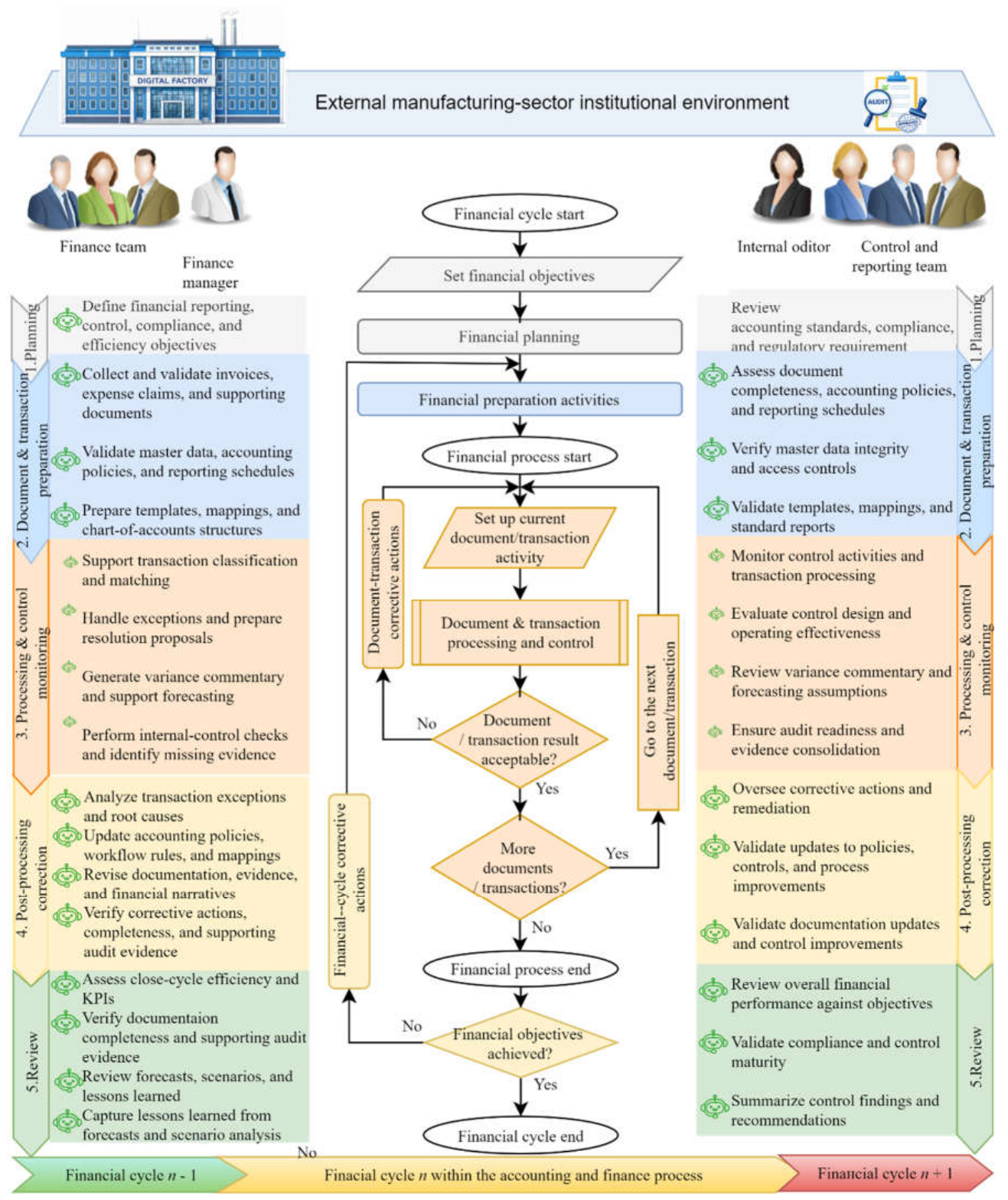
Figure 5.
GAI-based human resource management framework based on workforce-cycle, HR-process, and employee/case-level logic.
Figure 5.
GAI-based human resource management framework based on workforce-cycle, HR-process, and employee/case-level logic.
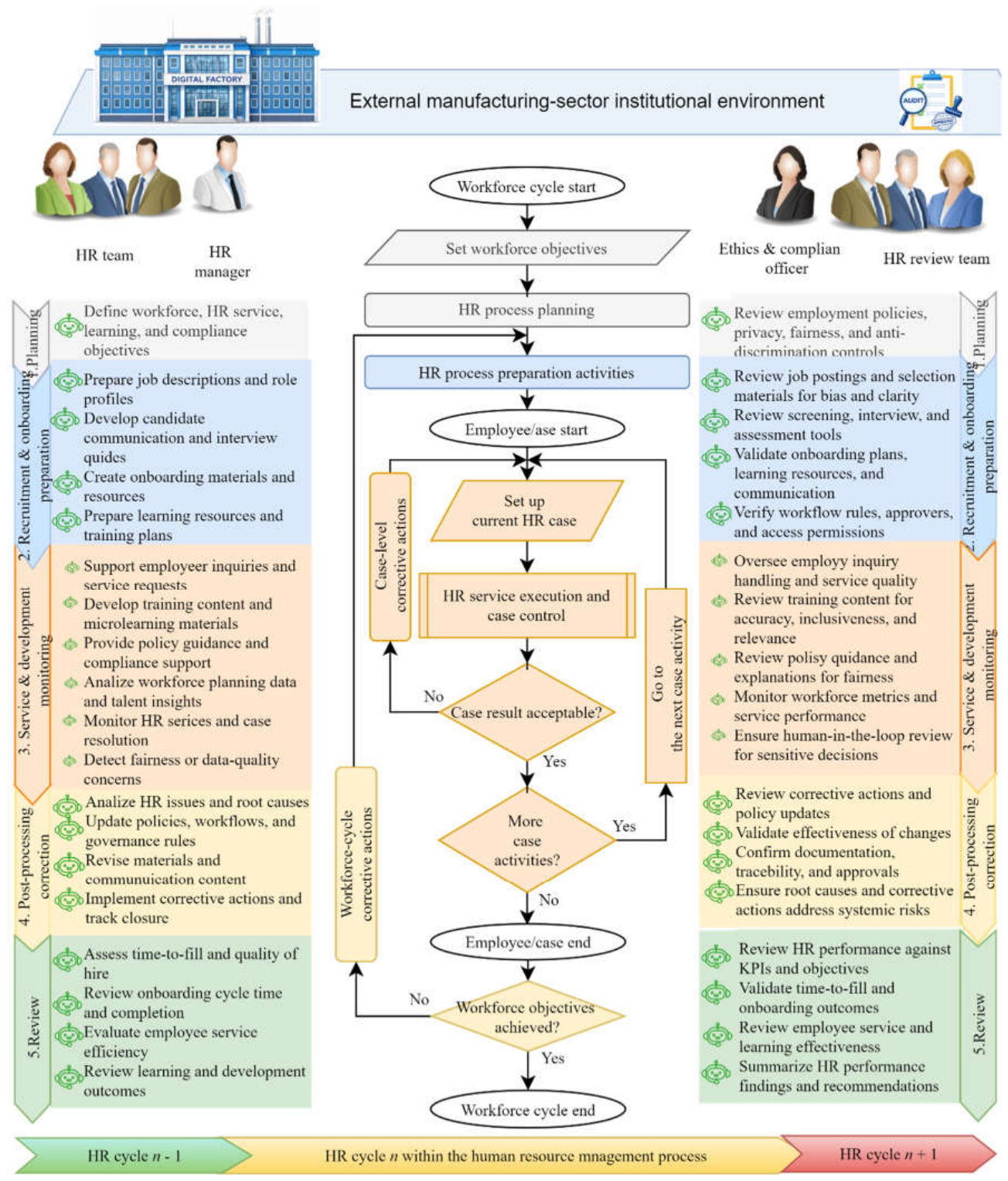

Table 1.
Distinction between GAI chatbots and GAI agents in enterprise process support.
| Attribute | GAI chatbot | GAI agent | Implication for enterprise governance |
|---|---|---|---|
| Primary interaction mode | Prompt–response conversation |
Goal-driven, multi-step workflow | Agents require stronger workflow control than chatbots |
| Main purpose | Explanation, summarization, drafting, Q&A | Task decomposition, execution support, exception routing | Agentic tasks need process ownership and escalation rules |
| Task scope | Narrow, session-bounded assistance | Broader process-oriented task execution | Agents should be mapped to process cycles and roles |
| Planning capability | Limited or implicit | Explicit planning, reasoning, and step sequencing | Plans should be logged and reviewable |
| Tool and system use | Optional or absent | Expected use of tools, APIs, databases, or enterprise systems | Access rights and permissions must be role-based |
| Memory and state | Short conversational context | Persistent state, retrieval, reflection, or working memory | Memory requires data-governance and privacy controls |
| Autonomy level | Low; user usually initiates each response | Medium to high; system may initiate or continue steps | Autonomy should be bounded by approval thresholds |
| Output type | Textual response, explanation, draft |
Decision-support package, workflow action, recommendation, routed case | Outputs require traceability to sources and actions |
| Typical enterprise use | SOP explanation, report drafting, HR FAQ, CRM summary | CAPA dossier preparation, cross-system reconciliation, lead routing, compliance checking | Agents require monitoring and audit trails |
| Main risks | Hallucination, inaccurate wording, privacy leakage |
Wrong tool action, unauthorized access, process disruption, cascading errors | Agents require stronger guardrails and rollback procedures |
| Human oversight | Content review and response validation |
Human-in-the-loop approval, exception review, and action confirmation | High-impact actions should remain human-approved |
| Logging requirement | Prompt, response, reviewer if needed |
Prompt, plan, tool calls, data sources, intermediate outputs, final action, reviewer | Agent logs should support auditability and accountability |
Note: The table summarizes the main differences between conversational GAI support and agentic GAI workflow support from the perspective of enterprise governance, traceability, and human-in-the-loop control.
Table 2.
Maturity scale for the adapted SIRI-based assessment of GAI-supported business processes.
| Score | Interpretation |
|---|---|
| 0 | No digital support |
| 1 | Basic digital records |
| 2 | Partly digital process |
| 3 | GAI-supported process |
| 4 | Integrated GAI workflow |
| 5 | Adaptive GAI-driven process |
Table 3.
Weighted pre- and post-implementation maturity assessment of the GAI-based manufacturing subframework.
Table 3.
Weighted pre- and post-implementation maturity assessment of the GAI-based manufacturing subframework.
| Manufacturing dimension | Weight | Pre-GAI | Post GAI |
|---|---|---|---|
| Production process integration | 0.25 | 2.1 | 4.0 |
| Quality documentation | 0.20 | 1.8 | 4.1 |
| Shop-floor data use | 0.20 | 2.4 | 3.6 |
| Maintenance support | 0.15 | 1.7 | 3.3 |
| Human-in-the-loop control | 0.20 | 2.6 | 4.2 |
* The pre- and post-implementation maturity scores are calculated as arithmetic means of the evaluations provided by three experts: Expert 1, representing process/operations expertise; Expert 2, representing digital transformation and IT expertise; and Expert 3, representing governance, control, and compliance expertise.
Table 4.
Weighted pre- and post-implementation maturity assessment of the GAI-based marketing and sales subframework.
Table 4.
Weighted pre- and post-implementation maturity assessment of the GAI-based marketing and sales subframework.
| Marketing and sales dimension | Weight | Pre-GAI | Post GAI |
|---|---|---|---|
| CRM data use | 0.25 | 2.3 | 4.0 |
| Campaign preparation | 0.20 | 1.9 | 4.2 |
| Lead and opportunity support | 0.20 | 2.2 | 3.7 |
| Customer feedback analysis | 0.20 | 1.4 | 4.0 |
| Commercial governance | 0.15 | 2.5 | 3.6 |
Table 5.
Weighted pre- and post-implementation maturity assessment of the GAI-based accounting and finance subframework.
Table 5.
Weighted pre- and post-implementation maturity assessment of the GAI-based accounting and finance subframework.
| Accounting and finance dimension | Weight | Pre-GAI | Post GAI |
|---|---|---|---|
| Document control | 0.25 | 2.0 | 4.3 |
| Transaction processing | 0.20 | 2.4 | 3.8 |
| Reporting support | 0.20 | 2.1 | 4.2 |
| Internal-control readiness | 0.20 | 2.5 | 4.0 |
| Audit evidence traceability | 0.15 | 1.6 | 4.1 |
Table 6.
Weighted pre- and post-implementation maturity assessment of the GAI-based human resource management subframework.
Table 6.
Weighted pre- and post-implementation maturity assessment of the GAI-based human resource management subframework.
| HRM dimension | Weight | Pre-GAI | Post GAI |
|---|---|---|---|
| Recruitment support | 0.25 | 2.2 | 4.1 |
| Onboarding support | 0.20 | 1.9 | 4.0 |
| Employee service | 0.20 | 1.5 | 3.5 |
| Learning and development | 0.20 | 2.0 | 4.1 |
| HR governance and fairness | 0.15 | 2.4 | 3.9 |
Disclaimer/Publisher’s Note: The statements, opinions and data contained in all publications are solely those of the individual author(s) and contributor(s) and not of MDPI and/or the editor(s). MDPI and/or the editor(s) disclaim responsibility for any injury to people or property resulting from any ideas, methods, instructions or products referred to in the content. |
© 2026 by the authors. Licensee MDPI, Basel, Switzerland. This article is an open access article distributed under the terms and conditions of the Creative Commons Attribution (CC BY) license (http://creativecommons.org/licenses/by/4.0/).
Copyright: This open access article is published under a Creative Commons CC BY 4.0 license, which permit the free download, distribution, and reuse, provided that the author and preprint are cited in any reuse.


