

Submitted:
27 May 2026
Posted:
28 May 2026
You are already at the latest version
Abstract
Due to the rapid rate of urbanisation in African cities, there is a high demand for land in the urban peripheries of cities in the developing world. In the case of Eswatini, many of the peri-urban areas are situated on land predominantly governed by traditional authorities according to customary land management systems. From 1992 to 2005, a leasehold tenure system was implemented through a Swaziland Urban Development Project (SUDP) funded by the World Bank. This paper explores the economic, socio-cultural and spatial impacts of the 99-year leasehold on peri-urban areas under chieftaincy using Mbabane, Eswatini as a case study, using a qualitative study involving field interviews of 45 people and critical analysis. The central argument of the paper is that the establishment of the leasehold tenure system has facilitated the integration of Swazi Nation Land into global economic dynamics of urban change through the hybridisation of statutory and customary practices, with some adverse effects.
Keywords:
99-year leasehold
; peri-urban land
; chieftaincy
; Swazi Nation Land
; Title Deed Land
1. Introduction
It is now widely acknowledged that cities in the developing world are experiencing rapid urban growth [1,2]. The rapid rate of urbanisation has caused a high demand for land in developing countries [3,4] Studies have shown that due to the availability of land at a low cost and proximity to jobs in cities, peri-urban areas have become the destination for infrastructural development [5,6,7]. Some researchers point out that peri-urban areas generally offer cheaper and easier access to land in the continent, therefore attracting both low and middle-income groups [8]. This phenomenon has put pressure on most peri-urban land in cities of the developing world [9,10,11,12]. In the case of Eswatini, the country’s population residing in the peripheries of Mbabane and Manzini was estimated by Lowsby and De Groot to be seven per cent of the total population by the mid-1990s [13]. The growing population created unplanned settlements in peri-urban areas, where traditional leaders also played a role by allocating land on Swazi Nation Land (SNL) which is land held in trust by the King on behalf of the Swazi nation [14].
Since the 1980s, a deluge of economic activities have occurred in peri-urban interface of the major cities [15]. These activities have contributed to a rapid rise in rental housing outside the formal urban market whereby subjects/residents under chiefs provide accommodation to those who were working in the factories, for students studying at the surrounding educational institutions, and for those who were working in town. This has occasionally caused disputes amongst chiefs and led to the degeneration of control mechanisms for traditional environmental resource management. The rise of crime in these areas in the 1980s was a serious urban issue (see The Swazi Observer, 9 January 1985; Times of Swaziland, 1 January 1985). Also, housing settlements were marginalising agricultural land. This led to increased refuse disposal, transport congestion, and the rapid rise in uncontrollable informal business. Most strikingly, informal housing was fostering a spatial growth of the city beyond its municipal borders, and as observed elsewhere in Africa, “The rural-urban divide had become blurred” [16] (p. 19). Invariably, peri-urban settlements became spaces where Swazi customary and ‘modern’ urban systems contended.
Following a baseline study on low-income housing and informal settlements undertaken by Marja Hoek-Smit in 1988 [17] and a few workshops by the government ministries, the Ministry of Housing and Urban Development (MHUD) acquired funding from the World Bank in 1992 to address the above-mentioned housing and urban development problems. The project was set up through partnerships with the ministry, Manzini City Council and Mbabane City Council for both Mbabane and Manzini. The project referred to as the Swaziland Urban Development Project (SUDP) was designed to be a comprehensive and integrated project. [18] (p. 521) point out, “A core component of the SUDP was the introduction of a 99-year lease, which was intended for residents who were willing to pay a nominal fee for the installation of the infrastructure in return for a title deed of the land.” The expansion of the city to the peri-urban areas of Mbabane corresponds to the patterns of inclusion as defined by Angel and colleagues [19]. In their study of urban expansion, Angel and co-authors conceptualise the different patterns that lead to the expansion of urban areas in developing and developed countries, which are the expansions by infill, leapfrog development and inclusion [19]. They define the pattern of inclusion as an area that entails all urban, rural and peri-urban built-up areas that were previously not included within the defined urban layout [19], which is the case in Eswatini.
2. Objectives of the Paper
This paper investigates the impact of the 99-year leasehold in a peri-urban environment of Eswatini from 2007 to 2023, looking at the case studies of Mahwalala and Nkwalini in Mbabane. Through a qualitative study involving field interviews and critical analysis, this research explores the economic, socio-cultural and spatial implications of the 99-year leasehold on peri-urban areas of Mbabane. It seeks to discuss leasehold as an economic tool shaping the transformation of territorial governance of land in peri-urban areas of Mbabane and its associated spatial implications for urban change, 16 years later. The central argument of the paper is that the establishment of leasehold ownership facilitates the unsettling integration of Swazi Nation Land into global economic dynamics of urban change through the hybridisation of statutory and customary practices associated with Title Deed Land.
This paper contributes towards the understanding of the 99-year leasehold and how it is perceived in the project area of Mbabane, Eswatini and its implications for the developing world. It contributes to the understanding of existing urban governance processes and the competing interests of actors in peri-urban areas as influenced by “actually existing neoliberalism” [20] (p. 351). It expands on the overall understanding of land tenure and how development projects impact people and spaces in cities of the developing world. By so doing, the paper provides a window through which to understand peri-urbanisation, in its territorial, functional, and transitional vectors of urban land governance. It also offers some insights into the rural-to-urban transformation, interaction and its associated spatiotemporal dynamics in the global south. Furthermore, the paper sheds light on the tensions that emerge from the encounter between urban and rural land practices, and it is essentially poised to inform policy on future interventions for fostering sustainable urban development in Eswatini.
2.1. Research Methods
The material for this paper was largely extracted from face-to-face interviews with residents from Mahwalala (Zone 2, 5 and 6) and Nkwalini (Zone 3 and 4), from City officials of the Municipal Council of Mbabane, as well as officers from banks. In total, forty-five (45) participants were interviewed, which entails 30 residents, 11 City officials and 4 officers from financial institutions. The interviews were conducted from March to May 2023. All interviews were selected through purposive sampling. All residences were purposively selected through the housing typology, whereby homes with a maximum of 2 building structures were selected. Apartments and single rooms (titimela1) were deliberately left out because this research required information from owners of the land, instead of people who are renting a room or apartment. Homes that were selected were random to have an equal probability in terms of gender and age. The areas of Mahwalala and Nkwalini are predominantly populated by black Swazi and some immigrants from Mozambique. All officials were purposively selected based on the department under which they work, which is related to the SUDP and the 99-year leasehold. The gender ratio among residents was 56 per cent women and 44 per cent men. All 4 bank officials were male, and City officials had a gender ratio of 55 per cent women and 45 per cent men.
Open-ended questions were employed to determine the impacts of the 99-year leasehold, a land tenure implemented in Msunduza, Mahwalala and Nkwalini through a development project known as the Swaziland Urban Development Project (SUDP). Residents were asked about how the 99-year leasehold has impacted their day-to-day practices as well as their land practises. All officials were asked about their role in the implementation of the SUDP, as well as how and why the 99-year leasehold was introduced into these spaces that were previously informal settlements.
Secondary sources of data were also used, such as reports prepared by the World Bank group in Eswatini, the Cities Alliance, the Municipal Council of Mbabane, and fact sheets used by City officials for the project, as well as newspaper articles and academic papers. Other sources of written work that were used for this research were legislation on land in the country. The open-ended questions asked in this research were to determine the impacts of the 99-year leasehold on peri-urban areas that are shaped by traditional leaders and rural practices. The SUDP and the 99-year leasehold were implemented first in Msunduza as a pilot study and later in Mahwalala and Nkwalini, making these sites relevant for this research.
Conducting face-to-face interviews provided more information about the study area with limited documentation. The reliance on word-of-mouth has its limitations, as far as verification is concerned. However, the information provided by participants had similarities, which addressed the issue of verification. Some of the information also correlated with the factsheets provided by the Municipal Council of Mbabane.
The first section of this paper discusses land leasing and its historical evolution. Section two unpacks the background of the (SUDP) in relation to land leasing. The third section looks at the impacts of the 99-year leasehold in the context of Eswatini in shaping urban spaces and the welfare of its citizens. In conclusion, section four analyses the socio-economic impacts of lease holding on the residents of the study sites in relation to security of tenure, accessibility and infrastructure. This section explores the cultural impacts on the residents in relation to traditional (or rural) land and social practices.
3. Literature Review: The History of Land Leasing in Africa from Pre-Colonial to Post-Colonial Times
The 99-year leasehold is not a new or foreign concept for the Americas and the African continent [21]. Land leases were administered during pre-colonial and colonial times through concessions in these two continents [22,23,24]. From the 18th and 19th centuries, European empires were expanding across the Americas and Africa, and the leasing model was used to obtain land for varying purposes. England, for one adopted land leasing for industrial and housing purposes [25,26,27]. Some European companies were given rights to large pieces of forest land [23,28,29], unoccupied land [22], and agricultural land during the colonial era in the African continent [30]. Olanya outlines that during colonial times in Africa, land leased to European settlers enabled the process of capital accumulation for the select few [31]. Settler colonialism created land displacement for the indigenes, separating them from the means of production [31,32,33,34]. For example, Southall points out that Black Africans were only allowed to own a home through 30-year leasehold rights in the 1960s in South Africa, which limited them from accumulating capital like their white counterparts [35].
In the case of Eswatini, Bonner gives details of the concession rush under King Mbandzeni from the 1800s. Crush and Bonner indicate that from the 1870s, 100-year leases were granted to European companies and corporations [28,34]. Daniel accounts that a Concession Committee was established to address a variety of issues among the concessioners in 1904 [36]. When the British gained control over the country, the Land Proclamation Act of 1907 was enacted to enable the conversion of concessioned land to freehold land [34,36,37]. The Land Proclamation was enacted to establish the partitioning of land into three parts, allowing white settlers to have freehold land in the country and creating land reserves for the Swazi people [37]. From a political economy point of view, Daniel argues that the Proclamation Act not only established white settler farmers in the country but also integrated the country’s mining and agricultural production into the global economy [36]. British companies acquired large concessions for farming and forestry. For example, Peak Timbers was a company established for forestry, north of Eswatini, which contributed to the country’s export revenue [36]. With such laws in place, Swazi indigenes became landless and were left out of the economy.
By the 1940s, the colonial state began to sell these concessioned lands which were referred to as Crown lands, to individual settlers and private companies [33]. This was mainly because the government could not incur the costs of developing this land [33]. The sale of these privately owned white farms to companies gave rise to the eviction of indigenous squatters [38]. By 1943, some private companies continued to threaten squatters with evictions and others offered terms where indigenes would offer their labour, but most indigenes left, thus intensifying the squatter issue in the county [38]. Some of the sectors later developed include: extraction of asbestos in Havelock in 1939 and Ngwenya Iron ore in 1964 in the northern part of the country; Ubombo Ranches in 1949 and Mhlume in 1958, processing sugar in the eastern parts of the country; Bhunya Pulp Company in 1959 and timber plantation and manufacturing of pulp in 1961 in the west; Malkerns pineapples, 15 km from Manzini in 1968 in the central part of the country [39]. To this end, several scholars posit that land leasing was and is still a model that advances capitalism [31,35,40,41,42].
From the 1960s, most African countries gained independence, which brought a wave of land reform and redevelopment programmes [43,44,45]. German et al. state that most land reform initiatives adopted land leasing [46]. Several African states, such as Ghana, Zimbabwe and Kenya, reintroduced land leasing as a form of tenure to work towards land tenure reform [47,48,49,50]. The way land was administered and managed in the process of reform in previous colonies from the 1960s to 1980s shifted to a neo-colonial system that benefited the elite African minority as opposed to the Europeans [36,51,52]. This neo-colonial system continued to displace natives) from their land, particularly poor smallholder farmers and thus establishing a rich peasantry [53] (p. 186). As such, from the independence era to contemporary Africa, land leasing can be best described as accumulation by dispossession by Harvey [54]. Levien and Batou both describe accumulation by dispossession as the seizing of land from poor citizens through other means [55,56]. It is widely observed that smallholder farmers across Africa and the Americas lost their land due to large land deals and development projects [53,57].
For example, when the Government of Ghana introduced leasehold tenure to transform their customary land tenure system [59] through what was called a “modern addition” to the customary land tenure system using the Concession Ordinance of 1962 and the Minerals Act of 1962 respectively [61], the chiefs used Customary Land Secretariats to sell and lease out the land to outsiders and investors for agricultural and residential purposes eventually displacing locals [62]. Similarly, the notion of agrarian reform in Kenya followed a neocolonial repressive pattern. From 1960, leading to Kenya’s independence in 1963, many black farmers (mainly Kikuyu, Embu and Meru tribes) were settling in abandoned or unmanaged farms, which presented a threat to the colonial economy [51]. By 1965, the Agricultural Development Corporation (previously known as the Ministry of Agriculture) was established to contain radical change but still favour Africans within the agricultural sector [51]. Wasserman points out that this Corporation bought and managed approximately 320 000 acres of farmland, and this land was eventually sold or leased to trained or experienced large-scale Kenyan farmers [58]. Many of the farmers were of the Kikuyu, mainly because the Kikuyu peasantry was vocal about agrarian reform, resulting in unrest [58].
Likewise, Eswatini reintroduced land leasing to large farming estates, including sugar and pineapple plantations, after independence in 1968. From the 1970s, contract farming began to thrive in the agriculture industry, with private companies leasing farms to smallholder farmers [55]. Apart from private companies that had freehold farms, research shows that some of the previously concessioned farms were bought back through a buy-back programme that was initiated by King Sobhuza II before independence [37,53,59,60]. Levin indicates that the buy-back programme was created to have as much land as possible under SNL [60]. However, land targeted by the buy-back programme was bought by Tibiyo, an entity established by the monarch in 1968 [37,61] – as an institution that works with the government and other stakeholders to pursue economic growth for the people of Eswatini. Parallel to private companies that leased land to smallholder farmers, Tibiyo also leased SNL to private companies such as Mhlume Sugar [60] and Simunye Sugar estate [62].
Like elsewhere in the continent, several scholars point out that when the Simunye Sugar Mill was established in the late 1970s, close to 500 families were forcefully evicted from their land for this estate [62,63,64]. Levin gives another scenario where families were evicted from their land by the Ministry of Agriculture, for the government to have a farm in Nkalashane [63]. Tisuka TakaNgwane, another entity established by the monarch in 1976 to develop the country’s wealth to support the Swazi people, also leased property to private companies or individual citizens to date [65]. However, the empowerment of ordinary citizens has not been achieved. Although legislation to leverage economic advantages for the indigenes was introduced, e.g., the enactment of the Land Speculation Act 8 of 1972 to favour local citizens, it has not been realised. Lea observed that the local Swazi elite (‘middle-class’ and rulers) systematically adapted and subjugated various elements of the inherited system of government to serve its own interests rather than those of the foreign and settler bourgeoisies [66].
With the adoption of Structural Adjustment Programmes (SAPs) in the 1980s, many African countries adopted leaseholding as a means to facilitate private ownership, further putting the interests of local citizens in an adverse position. The SAPs were imposed on most African countries by international organisations such as the IMF and World Bank during this time [67,68] and this did not lead to affirmation of land interests for local citizens. The SAPs implemented in Ghana, within the agricultural sector from 1987 to 1991, caused a great shift in land tenure [69,70]. Land reform was driven by neoliberalists instead of the government and this led to private companies having primary access to land [68]. Consequently, the private investors and speculators acquired large tracts of land and leased them out to private companies that evicted indigenes [69].
In Eswatini, the adoption of land leasing was influenced by the embrace of market policies from the period of independence. Hickel links this approach to the fact that several loans from the World Bank were obtained by the country since 1962 to fund various projects [71]. It was to be expected then that the government shifted towards obtaining more loans from the World Bank and the IMF under the conditionalities of structural adjustment programmes and was subjected to cutting tariffs and subsidies [71] when the country experienced a decline in its economy in the 1980s. Consequently, the government of Eswatini was assisted by the World Bank to implement a development programme for upgrading informal settlements in 1992 [72] under the conditionalities of the bank. In the process, land leasing was reintroduced through the implementation of an upgrading project known as the Swaziland Urban Development Project (SUDP) [73,74] under the Ministry of Housing and Urban Development (MHUD).
4. Land Leasing in Eswatini: The Background of the Swaziland Urban Development Project (SUDP)
The project was co-funded by the World Bank and the Government of Eswatini. The World Bank loaned the government US$29 million [75]. Although the project started in 1992 [76], this loan agreement between the government of Eswatini and the World Bank was signed in 1995 [72,77]. An amount of US$34 million was committed by the Government of Eswatini, making the total project cost US$63.4 million [77]. The objective of the project was to improve land tenure security in the settlements and to integrate these informal settlements into the urban fabric with good and efficient service delivery [72,78]. The project introduced the 99-year leasehold tenure in the peri-urban areas of Mbabane and Manzini. This is a form of tenure where the Eswatini government, with authorisation from King Mswati III, leased land to Swazi citizens for 99 years, mainly for residential purposes [72]. The main purpose of introducing this land holding was to improve individual security of tenure. According to the World Bank, the project aimed to improve the living conditions of residents through land reform and to provide better urban services for the urban poor in these sites [72].
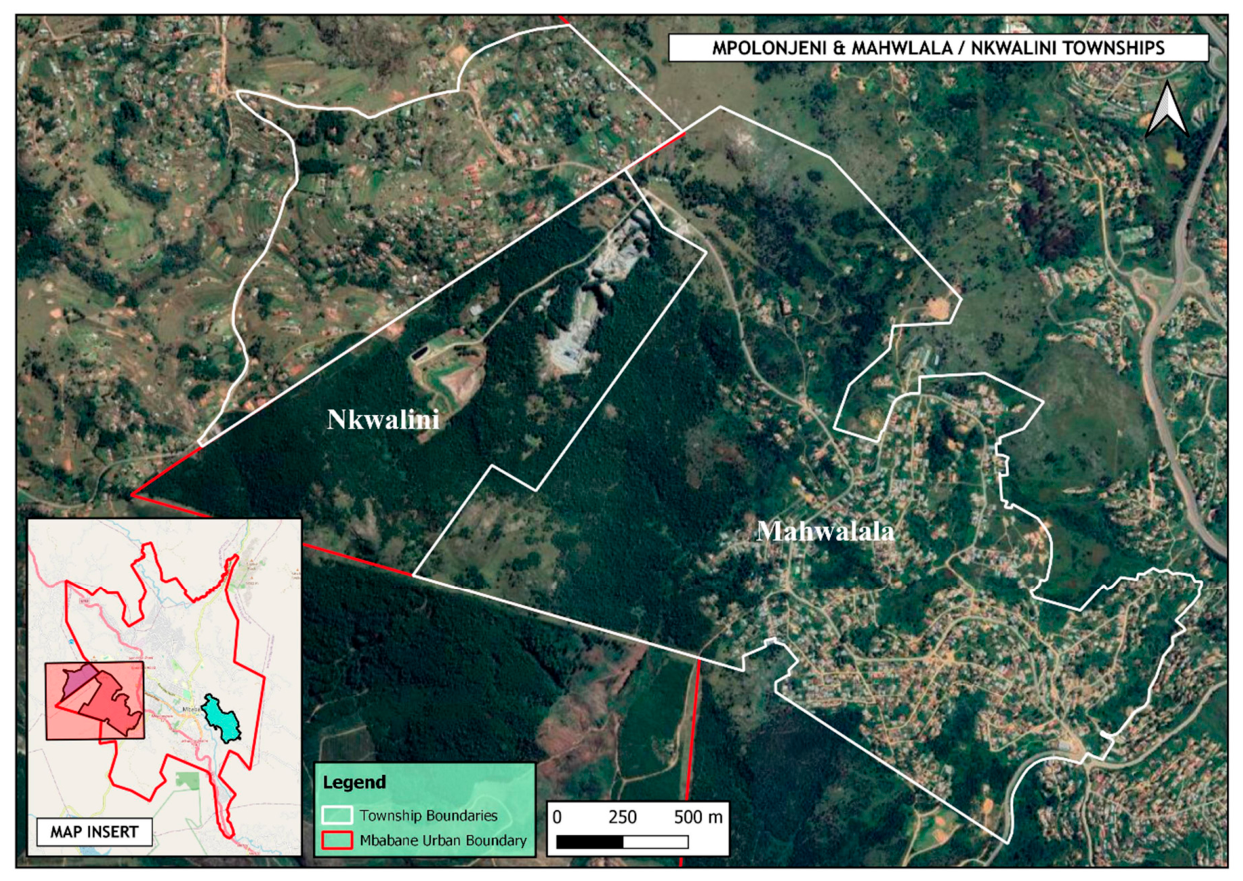
The government decided to upgrade Mahwalala (Zone 2, 5 and 6) and Nkwalini (Zone 3 and 4) in Mbabane. When the project started in 1992, the MHUD assigned the National Eswatini Housing Board to oversee the SUDP in Msunduza (site 1, see Figure 1), the pilot area for the project [72,78]. The first phase of the SUDP that took place in Msunduza is said to have been completed in 2002 [76]. The MHUD then assigned the Municipal Council of Mbabane to oversee the project sites of Nkwalini and Mahwalala which is the focus of this paper (see Figure 2 below). Since the National Eswatini Housing Board and the Municipal Council of Mbabane were the forerunners of this project under Msunduza, Nkwalini and Mahwalala, there were other supporting agencies. These agencies were main service providers, namely, the Eswatini Water and Services Corporation, Eswatini Electricity Company, Deeds Registry and Surveyor General [72,77,79,80].
Historically, there are different stories on how people migrated into the area. Some residents obtained land in the area through the acquisition of a permit from the District Commissioner’s office [81]. From the District Commissioner’s office, residents were given a temporary occupation permit that was renewable at a fee of E2 (less than €1) (Swaziland District Office, 1989). Another group of residents accessed the land through the kukhonta system, which is done under chiefs according to customary law.2 This occurs when a chief allocates land to a subject in return for paying allegiance [18]. The third group of residents is a population of migrants from rural to urban areas and migrants from neighbouring countries such as Mozambique [82] (p. 550) and South Africa [83] (p. 526).
After the development of all the plots, access to land was facilitated by a Plot Allocations Committee. This committee was established by the MHUD and the Municipal Council of Mbabane (MCM). This committee constituted of MHUD as Chair, the Eswatini Housing Board as secretariat, MCM officials and resident representatives of the different zones in Mahwalala and Nkwalini. The selected representatives were trained by officials of the Municipal Council. The purpose of this training was to inform and educate them on how to engage with residents [84]. It can be argued that this training was meant to sensitise the representatives on the delicate nature of land allocations that they were about to embark on. The committee set priority groups, with primary and secondary allocations. The primary group to be allocated plots were heads of households who already lived in the area before the project [84]. The secondary group of people was heads of households who were forced to move due to the development project or who had not built any structure on the land [84]. A supplementary allocation list was also done which included resident widows and resident children of the heads of households. In the case of a polygamous family, a second or third wife of the head of household was also considered a beneficiary [84]. The list went as far as including tenants who lived in the project area.
In 1994, a 99-year leasehold agreement was formulated together with the Allocations Criteria and Procedures and a Resettlement Policy and Guidelines. These documents set conditions to assist officials on how to allocate and register residents under this new land holding. The conditions included being a Swazi citizen; having no other residential properties within the project location; having proof that one can pay for the plot and annual rates, and applicants needed to pay a commitment fee of E400 upon submitting their application [84]. Since this was an in situ project, the Government of Eswatini made sure that no indigenes were evicted; they took priority (Simelane, 2014). Once the plots were developed and surveyed, indigenous residents were to be allocated the plots. Upon allocation of the plot, residents had to pay a commitment fee of E400, which is approximately €20 [85]. Allocated residents were required to pay for the servicing of the plot and this price was determined by the square metres of each plot. The Municipal Council of Mbabane registered the 99-year lease plots since the MHUD handed over the power of attorney to the Municipality.
The 99-year lease agreement stipulates that the contract is between the Government of Eswatini represented by the Municipal Council of Mbabane and the lessee (a resident). It states that the areas that have been developed into townships are under Crown land (farm) that has been disposed of by the Ministry of Housing and Urban Development, authorised by King Mswati III. Other details in this agreement are the size of the Crown land and the size of the individual plot leased out; the duration of 99 years to lease the plot, which can be extended; and the terms and conditions of using the plot with the sole purpose being residential (99-year title deed). The impacts of the new land system and the project itself are ongoing and have lasting effects on the residents.
5. Discussion: The Impacts of Land Leasing in Peri-Urban Areas
When residents were asked about how the 99-year leasehold has impacted their day-to-day living as well as their land practices in their area. Residents were also asked whether they found this landholding more secure compared to SNL or freehold. From the interviews, it was determined that this landholding has shifted residents’ perception of land tenure security and it has contributed to issues of land accessibility and women’s rights to land. The conversations with residents highlight how the infrastructure development of these areas has allowed market forces to shape the land value, considering poor land management and governance. The same issues pointed out by residents were raised by city and bank officials; however, they find that tenure security and land accessibility for women have improved. Amid these new encounters, the urban poor indigenes have been socially and economically displaced, leading to gentrification.
As a form of tenure, the 99-year leasehold was initially unacceptable and misconstrued by the residents and by financial institutions as either an SNL or a foreign land holding. The residents did not encourage its adoption besides the development of basic services such as roads, security lighting and skips. Most of the indigenes saw the new leasehold regulations as imposing restrictive land practices that they needed to gradually assimilate. Many stated their preference for the traditional lifestyle on SNL. This lifestyle allowed them to build more than two houses on their designated plot and they were free to keep livestock such as chickens, goats and cattle. The residents also saw the leasehold as something that championed the cause of the Municipality. This is parallel to the case study of Wa in Ghana, where the introduction of the leasehold favoured new inhabitants more than the lifestyle of indigenes [86].
The main concern for residents was the payment of rates compared with the method of a one-time payment used under customary tenure. This was contrary to the customary practice under chiefs where residents only take part in the practice of kuhlehla, which is a way of paying allegiance to the monarch3. One participant frustratedly stated, “…bekuncono ngoba besingakhokhi imali, besihlehla nje...” (participant #46, 2023) (literally meaning “it was better before because we did not pay with money, we would pay by doing work”). Most residents agreed with this sentiment and emphasised that they preferred to give their time to show allegiance to the chieftaincy instead of paying money to the City of Mbabane. Other residents complained that paying rates does not make a difference because the Municipality was slow in providing services. One respondent said, “kuyafana yesisi… nome siyabhadala nome asibhadali.” (participant # 29, 2023) – meaning, there is no difference, even if we pay rates, we do not receive the services.” Another issue was that not all residents can afford to pay the rates, making it difficult for the city to deliver services.
Not only did the residents appreciate the culture of kuhlehla, but there were also other practices that they appreciated from the traditional management system under chiefs. Most residents indicated that they can no longer bury their loved ones on their land. Under customary land management, the subjects are allowed to bury their loved ones within their land parcels. Contrary, this is not allowed within a municipal jurisdiction. Therefore, government officials were faced with the challenge of what to do with the already existing graves in the home sites during the plot surveying process. The existing burial places were “…nullified and demarcated as grave sites.”, as a city official indifferently said (participant #25, 2023), since grave sites cannot be zoned as a land use under residential areas according to the Town Planning Scheme of the city. This was due to two main reasons: the high costs that would be incurred by the government to exhume the deceased and the cultural practices linked to disturbing one’s ancestors once they have rested. With this new way of living under leasehold, the residents of this area were therefore compelled to buy grave sites that had been demarcated by the Municipality on the outskirts of the city. Although obtaining a grave site at the city’s cemetery had gradually become the norm, there was a price hike from E600 to E3,220 [88] which is an equivalence of € 28.72 to € 153. 15, respectively. Therefore, obtaining a grave site for a loved one has become expensive for the urban poor, motivating them to leave the developed leased areas. The same phenomenon is experienced in peri-urban areas of KwaZulu-Natal in South Africa, where residents still follow the tradition to bury their loved ones on their land; however, this is met with challenges such as the lack of space [89].
Other residents were lamenting how some of the developments have caused more harm than good. For example, some drainage facilities were poorly designed, and this caused water to damage their homes. When interviewed, an elderly widow exclaimed that she had issues with water flowing into her plot causing damage. She sadly expressed that, Lamanti achamuka lamgwacweni etelabaleni. Batsi ke nabasho akusiwo umgwaco lomkhulu labangangenela kuwo babone kutsi kwentekani. (participant #28, 2023). Translated, “The water flows through to my plot from the road. The city officials say that they cannot investigate the road because it is not a major road.” This means that only major roads that need maintenance were prioritised, which defeated the purpose of advancing the urban well-being of the residents in the area.
The other challenge about the leasehold area was that there was confusion about whether the area was still under SNL or a foreign form of landholding due to hybrid land practices. Interviewed officials from the formal banks indicate that they were unsure of the 99-year leasehold, as the land practices of SNL and TDL co-existed. One official doubtfully asked if the 99-year leasehold land is SNL. This has resulted in some institutions treating 99-year leasehold land as freehold land, while other institutions were still unsure of this land holding. Therefore, the financial institutions were sceptical of financing leasehold land because of the lack of information and the hybridity of the land that is under this tenure. The exception was the Eswatini Building Society bank, which worked closely with the Municipal Council of Mbabane in financing this land in the case study area. Nevertheless, despite the officials from the Society having good knowledge of how the 99-year leasehold land was financed, the understanding and interpretation of the 99-year leasehold by the other financial institutions was unclear due to the lack of policy. Bank officials shared the sentiment that the lack of a land policy in the country limits their institutions from financing this type of tenure. One bank official indicated that the financing of 99-year lease property is, “...not a fully commercialised undertaking...” (participant #59, 2024). This typifies the challenges of land hybridisation as witnessed in semi-urban areas such as Thembisile Hani in South Africa, where the authority responsible for land administration and management is unclear [90].
5.1. Hybridisation of Tenure and Governance Norms
Contrary to the challenges raised above, the 99-year leasehold was also seen to provide secure land tenure for the citizens of Eswatini, according to all interviewed government officials. The main school of thought was that this new form of tenure is more secure than land under the customary law of SNL. One official eagerly justified, “The 99-year lease is a secure form of land tenure because it gives one a paper [lease agreement contract] to say that they have user rights over a certain portion of land. In case of disputes, the lessee can use the paper to protect their rights, unlike in SNL [Swazi Nation Land], where there are land disputes and people cannot defend themselves, which increases chances of losing the land.” (participant #22, 2023). The issue of land disputes is a common phenomenon in the peripheries of cities of the South and this is due to the lack of effective land governance [91]. In the case of Eswatini, the 99-year leasehold, devoid of a policy, attempts to address the issues of disputes experienced in the peripheries.
In other words, the lease agreement contract or title given to residents provides a sense of security, especially when it comes to issues of land disputes and cases of inheritance. The title given in this case allows for land to be passed on to future generations. Section 10 of the Lease Agreement clearly stipulates that upon the death of the lessee, the lessor will not terminate the lease, but the lease agreement was assigned to the rightful heirs or executors of the estate. Other officials emphasised that the 99-year leasehold is a sub-category of freehold tenure, thus making it secure. Academic scholars define security of tenure as a right that every individual or group of people have that protects them against forceful eviction [92,93]. Therefore, it could be argued that the 99-year lease agreement covers the matter of protecting lessees from forceful evictions, which occurred on occasion under chiefdoms [94,95].
More scholars define security of tenure from an economic perspective [96,97,98], the definition of land tenure security from an economic perspective focuses on individualised land rights that ensure security and increase the chances of investment [97]. This scenario supports de Soto’s argument that the formalisation of land rights allows people to have some form of capital (an incentive), as it attracts a different group of urban citizens, which includes developers and the middle-income group, to settle in this area [96]. The incentive of having the opportunity to invest through tenure security demonstrates how indirect financial incentives, as analysed by Vitae [99], influence local governance beyond the framework of the SUDP and the 99-year leasehold. However, tenure security may offer incentives for some, while it further excludes others.
Land accessibility and women’s empowerment
It is noted that the enactment of a 99-year leasehold in this area marked a shift towards affirming women’s access to land. Women who were identified as heads of their households had land registered under their names, even in cases where women were identified as heads of their households or where their husbands or male counterparts were either deceased or no longer lived with them. Similarly, children above the age of 21 years were eligible beneficiaries under this project and land was registered under their own names, irrespective of gender. Therefore, the 99-year leasehold tenure was a tool of empowerment for women in this case.
This marks a major improvement to the Swazi customary process, which requires that a woman gain access to Swazi Nation Land through marriage, as reflected in other African countries [100]. In Eswatini, just as in many African countries like Malawi [101] and Uganda [102], a woman who had no husband can bring a male family representative, such as a father or son, to request land under customary law [94]. The case study was influenced by customary land practices, which are gendered in nature. However, the enactment of the Constitution of 2005 and the introduction of the 99-year leasehold in the peripheries have largely addressed easier access to land by women, which is one of the greatest challenges on the continent [103,104,105]. However, some countries are implementing gender-neutral land policies, such as the government of Botswana, which allocates land and housing on a “first-come first-serve” basis, and promotes market-based initiatives which ignore inequalities between men and women [106]
The 99-year leasehold has also challenged the Deeds Registry Act of 1968 in the affirmation of women’s rights to inheritance. Section 16 (3) of the Deeds Registry Act of 1968 stipulates:
Immovable property, bonds or other real rights shall not be transferred or ceded to, or registered in the name of, a woman married in community of property, save where such property, bonds or real rights are by law or by a condition of a request or donation excluded from the community [107]. This clause restricted women married in community of property from registering property under their own name. Lowsby and De Groot point out that land registered under this upgrading project was registered outside the jurisdiction of the Deeds Registry Act to allow all women to have land under their names [13]. The authors also argue that there was a need for the amendment of the Marriages, Deeds Registry, Estates and Succession Acts to cater to all women, whether married or not. In light of the Matrimonial Property Bill of 2022 and the Marriages Bill of 2022 in the pipeline, there is still a need to amend the Deeds Registry Act [108] as land access and ownership remain a challenge for some women, depriving them of the incentives that come with land ownership and tenure security.
5.2. Socio-Economic Exclusions and Financialization Dynamics
The improvement of infrastructure and services has influenced the land market in the area. Although the advancement of services within the study area was gradual, the level of land transfers under this land holding has increased. Land has been transferred or sold by indigenous residents to second and third-generation lessees. These land transfers or sales were shaped by market forces. As more land is transferred, developed and transferred again, the property values have increased. At the initial phase of the upgrading project, land plots were transferred at maximum prices of E30 000 (€1,500). Currently, vacant land can cost close to E100 000 (€5,000) and developed plots up to E1 million (€50,000). Through these land transfers, the development of new houses has increased, especially in Mahwalala. Most of these developed properties are for rental purposes. The proximity to the city centre makes the location of these rental properties ideal and they also cater to an increasing working class. This development has therefore created a supply for the existing rental housing demand in the city [109]. This is central to the neoliberal ethos of promoting market and entrepreneurial flare. Therefore, it is notable that the 99-year leasehold is bankable and enables lessees to invest using their property as the land is gradually becoming attractive to investors in Mahwalala and Nkwalini. This correlates to the economic behavioural patterns analysed by Adenuga and his colleagues. They conclude that beneficiaries who are given long-term land leasing options are more likely to invest on the management and development of their land as opposed those who have short-term rental land arrangements [110]. The 99-year leasehold in this case study area has contributed to such economic behaviours among urban citizens.
In addition, the heightened land value increase resonates with hedonic pricing methods, as recently studied by Barbot and Peroco, which is a method of determining the value of rental property based on the social composition of an area [111]. To rent a house or buy a plot of land, the social status of a landowner is considered along with one’s perception of how noisy the area is and if potential neighbours are of a similar or higher social status [114]. This is evident in Mahwalala, where investors are developing similar housing to attract the working class, and those who buy land as first-time homeowners are more attracted to areas with new property developments with no nearby shacks or older homes. This activity has led to the awareness of a social construct in Mbabane’s peripheries, in which social hierarchies are formed among the working class and the urban poor – an area in need of future research.
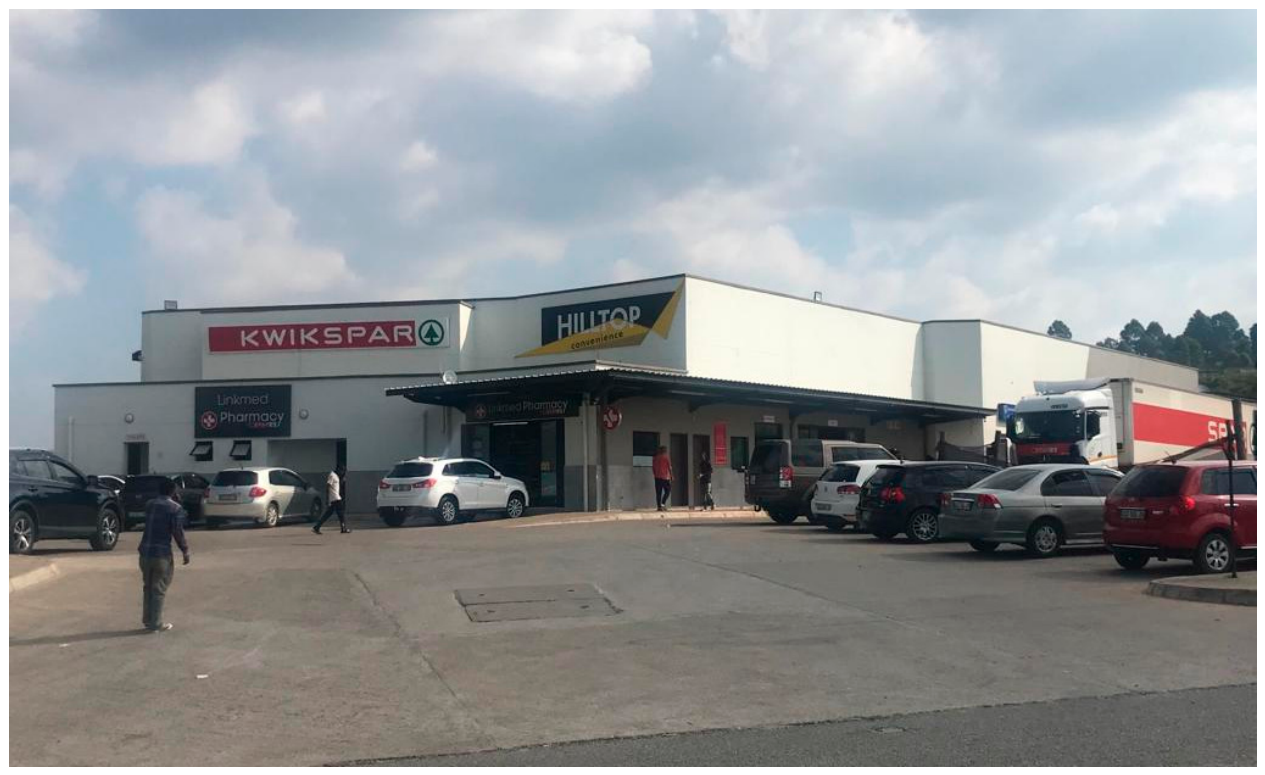
It is arguable, therefore, that the formalisation process of the leasehold system constitutes a crucial step in the economic development of these areas. The construction of roads provides accessibility for residents and other developers, which has increased the development of commercial zones in the area. The provision of municipal skips and flood lights marks an improvement in services, unlike the previous norm of disposing of waste in a pit in the area. The following picture shows the different types of development found in the study site.
Figure 3.
Hilltop Kwik Spar in Mahwalala developed in 2022. Picture by Nomathemba Dladla 2023.
5.3. Maladministration and Clientelistic Practices
Although there is accessibility of land in the peripheries, the implementation of the 99-year leasehold system unveiled loopholes in the real estate industry. Access to land is beneficial largely for the elite/well-to-do class. The poor struggle to get access and to maintain land ownership under leasehold. It is worthwhile to note that the issue of land maladministration is still prevalent. Some participants reported the issue of multiple sales of one plot and a lack of efficient land administration. One participant lamented that,
The project [SUDP] was really affected by the committee [Plot Allocation Committee]; some of them [Committee members] sold the land and kept some [land] for themselves. My mother was sold [bought] a plot that was already sold to someone else.” (participant #13, 2023).
This is compounded by a lack of formal documentation, resulting in unverified information on land transactions. In addition to poor administrative systems, places such as Mahwalala have been known to be areas of high crime [112,113,114]. With the implementation of the new land tenure system and the increased housing developments, more theft crimes have occurred in the area. A landlord from Mahwalala sadly conveyed to a reporter in the local newspaper that, “...most of the time the houses are empty and attracting tenants can become a hustle due to the cancer of crime...” [115]. According to Dhladhla, the high level of crime and lack of police presence have, however, propelled the residents to be more aware, and have developed community policing (emphoyisa emango) to deal with perpetrators. [113]. The lack of a strong police presence is a symptom of inadequate administrative and management systems for the area. Relying on community police is a similar occurrence in the peripheries of many townships in South Africa due to the lack of proper policing in these areas [116,117].
5.4. Gentrification and Socio-Spatial Inequalities
By and large, the formalisation of land rights through leasehold enhances capital development, but it does not enhance the well-being of the local citizens who do not have capital. Since the study area consists mostly of unemployed indigenes, many of them are negatively affected by this new land holding since they do not have the capital to pay rates or to develop their land following the municipal standards. It has been noted henceforth that the middle class tend to have more access to the land as the poor sell their land due to a lack of capital. The more the well-to-do move into these leasehold areas, the more gentrification takes place. Not only is the lack of affordability a push factor for the indigenes, but the change in land tenure. As observed in many countries around the continent, this is facilitated when land is largely regarded as a commodity, rather than performing a social function, also with consequent speculation contributing to social exclusion [118] (p. 183).
Several residents attested to this in the interviews. One resident claimed that “Bantfu abakhoni kubhadala ema-rates, babese bayatsengisa bayeka-Chief.” (participant #43, 2023). This means that people cannot afford to pay rates, and they then decide to sell the land and find a place under SNL. Another resident clearly articulated that, “The land system [99-year leasehold] scared many people, making people [them] leave and [go] back to SNL.” (participant #55, 2023). When residents were asked how they see Mahwalala-Nkwalini in the next 10 years, many indigenes expressed how the area will be developed, but they will be excluded. These sentiments indicate that gentrification has become central to the process of lease holding in the Municipality of Mbabane. Therefore, the 99-year lease has also unveiled loopholes in this new land tenure system of the country. This trend is well acknowledged in many poorer cities, such as Indian cities [119,120].
6. Conclusions
The adoption of the 99-year leasehold in Eswatini is creating a tripartite land tenure system, this being freehold land, SNL and the 99-year lease. While this form of land holding opens new prospects of development, it creates new challenges. It can be argued that the 99-year leasehold was implemented to improve the lives of the urban poor, especially by providing access to land for women; however, the urban poor are being replaced by the well-to-do on the ground. A new middle-class system is being formed through the implementation of the 99-year leasehold. The prospects and problems of the 99-year leasehold unpacked in this paper indicate the need for questioning the lack of legislation, such as the land law and the 99-year lease policy, to avoid an ambiguous connotation of the 99-year leasehold system. This suggests that the government of Eswatini must establish land and housing legislation and policies that support local citizens, especially the urban poor.
Since the government of Eswatini worked closely with Eswatini Building Society during the initial implementation of the SUDP, there is potential for the government to foster such a collaboration with other financial institutions in the country. This implies that the government should enact legislation that requires financial institutions to offer special home loans with an affordable interest rate for lower-income groups. Once land legislation is passed, various institutions and the public will have a clear guide on the financing of leasehold land. With policies in place, the leasing process in peri-urban areas should not only be a function of private enterprise, but can also be a means of incorporating people on SNL instead of being a means for degrading traditional systems under SNL. Like elsewhere in the continent, the government should adopt a transformational approach to customary tenure, issuing certificates that confer rights to convert customary lands into freehold tenure [121].
This suggest that a process of lease holding should not be limited to land access, lease holding should be part of a broader peri-urban strategy in which the government adopts an Environmental, Social, and Governance (ESG) approach that incorporates: operating as a steward of the environment and covers environmental issues like climate change, greenhouse gas emissions (GHG), deforestation, biodiversity, carbon emissions, waste management and pollution; considers the impact the leasehold has on people, culture and communities and looks at the social impact of diversity, inclusivity, human rights and supply chains; and, how the leasehold is directed and looks at corporate governance factors like executive compensation, succession planning, board management practices and shareholder rights. Sustainability must be at the heart of the country’s peri-urban development strategy. The strategy should have a social imperative as well as a commercial imperative. A social imperative means making sure that land dispossession, inadequate compensation, unfair working conditions, occupational health, and safety hazards and promotion of fundamental human rights are elevated. A commercial imperative means that lease holding in peri-urban areas drives co-investment, facilitates economic diversification, and considers opportunities to diversify and repurpose use of infrastructure through equitable revenue sharing, economic diversification, community development initiatives, sustainable employment and business opportunities. For example, cooperatives responsible for waste management, road and security light management can be established to leverage inclusive economic development.
Since there is a high rate of unemployment in this study area, the Municipal Council of Mbabane should assist the residents in creating cooperatives which will be responsible for certain management requirements in the area. These cooperatives can be subsidised with the rates that are paid, since not all residents can afford to pay rates. With the residents working and maintaining their surroundings, rate payers will appreciate the benefits of paying rates. Those who cannot afford to pay rates will get jobs through the cooperatives and facilitate their ability to afford services eventually. The Municipal Council of Mbabane will also benefit when services are paid for by the residents. However, the city should develop a system of monitoring and evaluation of development projects; and, for facilitating the involvement of all land stakeholders, including traditional leaders and residents, in exploring mechanisms for improving the leasehold system. This should be promoted through consistent dialogue between the city and the residents, paying attention to maintenance systems for the residential areas and ensuring responsible citizenship of the residents. Beyond participation, there is a need to understand the realities of each leasehold context and to provide tailor-made policies and guidelines for every case.
Author Contributions
Conceptualization, Professor Mfaniseni Sihlongonyane and Nomathemba Dladla; methodology, Nomathemba Dladla.; formal analysis, Professor Mfaniseni Sihlongonyane and Nomathemba Dladla.; investigation, Nomathemba Dladla.; resources, X.X.; data curation, X.X.; writing—original draft preparation, Nomathemba Dladla.; writing—review and editing, Professor Mfaniseni Sihlongonyane and Nomathemba Dladla.; visualization, Nomathemba Dladla.; supervision, Professor Mfaniseni Sihlongonyane.; funding acquisition, Professor Mfaniseni Sihlononyane. All authors have read and agreed to the published version of the manuscript.
Funding
This research received no external funding.
Acknowledgments
The authors have reviewed and edited the output and take full responsibility for the content of this publication.
Conflicts of Interest
The authors declare no conflicts of interest.
Abbreviations
The following abbreviations are used in this manuscript:
| MHUD | Ministry of Housing and Urban Development |
| SNL | Swazi Nation Land |
| 1 |
Titimela in English means trains (sititmela – singular train). This word was coined by Swazis to describe a line of attached singular rooms, commonly developed in peri-urban and rural areas for rental purposes. |
| 2 |
Kukhonta refers to a process whereby a traditional leader known as a Chief allocates a portion of land to individuals or a family that are seeking for land in a chiefdom within the area that is under the Chief’s stewardship. Access to the land is acquired once individual or family gives the local Chief a cow or gift and pays allegiance to the Chief. |
| 3 | The term kuhlehla means paying allegiance to the Monarch by rendering services such as free labour e.g. weeding the King’s fields [87]. |
References
- Ruhiiga, T.M. Managing Explosive Urbanisation in Africa. J. Hum. Ecol. 2013, 42, 43–52. [Google Scholar] [CrossRef]
- Güneralp, B.; Lwasa, S.; Masundire, H.; Parnell, S.; Seto, K.C. Urbanization in Africa: Challenges and Opportunities for Conservation. Environ. Res. Lett. 2017, 13, 1–8. [Google Scholar] [CrossRef]
- Sumari, N.S.; Cobbinah, P.B.; Ujoh, F.; Xu, G. On the Absurdity of Rapid Urbanization: Spatio-Temporal Analysis of Land-Use Changes in Morogoro, Tanzania. Cities 2019, 107. [Google Scholar] [CrossRef]
- Anane, G.K.; Cobbinah, P.B. Everyday Politics of Land Use Planning in Peri-Urbanisation. Habitat Int. 2022, 120, 1–13. [Google Scholar] [CrossRef]
- Simon, D.; McGregor, D.; Nsiah-Gyabaah, K. The Changing Urban–Rural Interface of African Cities: Definitional Issues and an Application to Kumasi, Ghana. Environ. Urban. 2004, 6, 235–248. [Google Scholar] [CrossRef]
- Thuo, A.D.M. Community and Social Responses to Land Use Transformations in the Nairobi Rural-Urban Fringe, Kenya; Hamilton, New Zealand, 2010. [Google Scholar]
- Ravetz, J.; Fertner, C.; Nielsen, T. The Dynamics of Peri-Urbanization. Peri-Urban Futures: Scenarios and Models for Land use Change in Europe 2013, 13–44. [Google Scholar]
- Cobbinah, P.B.M.; Erdiaw-Kwasie, M.O.; Amoateng, P. Africa’s Urbanisation: Implications for Sustainable Development. Cities 2015, 47, 62–72. [Google Scholar] [CrossRef]
- Akaateba, M.A. The Politics of Customary Land Rights Transformation in Peri-Urban Ghana: Powers of Exclusion in the Era of Land Commodification. Land Use Policy 2019, 88, 104197. [Google Scholar] [CrossRef]
- Adigeh, D.T.; Abebe, B.G. The Practice of Peri-Urban Land Acquisition by Expropriation for Housing Purposes and the Implications: The Case of Bahir Dar, Ethiopia. Urban Sci. 2023, 7, 41. [Google Scholar] [CrossRef]
- Rogerson, C.M. Rural-Urban Interface Glob. South Plan. Gov. Chall. 2023, 12.
- Sumbo, D.K.; Anane, G.K.; Inkoom, D.K.B. ‘Peri-Urbanisation and Loss of Arable Land’: Indigenes’ Farmland Access Challenges and Adaptation Strategies in Kumasi and Wa, Ghana. Land Use Policy 2023, 126, 106534. [Google Scholar] [CrossRef]
- Lowsby, J.; De Groot, D. A Brief History of Urban Development and Upgrading In Swaziland; Ministry of Economic Planning & Development Government of Swaziland, 2007. [Google Scholar]
- Dlamini, D.D.; Masuku, M.B. Land Tenure and Land Productivity: A Case of Maize Production in Swaziland. Asian J. Agric. Sci. 8.
- Sihlongonyane, M.F. Rural Urban Encounters in Swaziland: The Peri-Urban Interface in Manzini City. Town Reg. Plan. 2003, 46, 33–45. [Google Scholar]
- Bryceson, D.F.; Bank, L. End of Era: Africa’s Development Policy Parallax. J. Contemp. Afr. Stud. Journal of Contemporary African studies 2001, 19, 5–24.. 19(l), 5–24. [CrossRef]
- Hoek-Smit, M. Housing Markets in Swaziland: Update of the 1988 Housing and Household Survey; World Bank.: Mbabane Swaziland, 1989. [Google Scholar]
- Sihlongonyane, M.F.; Simelane, H. The Impact of Political Dualism on Urban Governance in Swaziland: A Case Study of Moneni in the City of Manzini. Afr. Stud. 2017, 76, 508–529. [Google Scholar] [CrossRef]
- Angel, S.; Alejandro, B.; Parent, P.; Lamson-Hall, P.; Sánchez, N.G.; Civco, D.; Lei, L.; Thom, R.Q.K. Atlas of Urban Expansion, 1st ed.; NYU Urban Expansion Program at New York University, UN-Habitat, and the Lincoln Institute of Land Policy: United States of America, 2016. [Google Scholar]
- Brenner, N.; Theodore, N. Cities and the Geographies of Actually Existing Neoliberalism. Antipode 2002, 34, 349–379. [Google Scholar] [CrossRef]
- Merrill, T.W. The Economics of Leasing. J. Leg. Anal. 2020, 12, 1–52. [Google Scholar] [CrossRef]
- Noronha, R. Land Tenure in Sub-Saharan Africa. AgEcon Search 1988, 993-2016–77639, 782–799. [Google Scholar]
- Larson, A.; Barry, M.; Dahal, D.G.R.; Pierce Colfer, C.J. Forests for People: Community Rights and Forest Tenure Reform; Earthscan: London, 2010. [Google Scholar]
- Alexopoulou, K.; Juif, D. Colonial State Formation Without Integration: Tax Capacity and Labour Regimes in Portuguese Mozambique (1890s–1970s). Int. Rev. Soc. His 2017, 62, 215–252. [Google Scholar] [CrossRef]
- Soens, T.; Thoen, E. The Origins of Leasehold in the Former County of Flanders; 2009; pp. 31–55. ISBN 978-2-503-52254-8. [Google Scholar]
- Meaby The History of Leasehold and Its Reform. In Meaby&Co Solicitors; 2018.
- Adenuga, A.; Jack, C.; McCarry, R. The Case for Long-Term Land Leasing: A Review of the Empirical Literature. Land 2021, 10, 238. [Google Scholar] [CrossRef]
- Bonner, P. Kings, Commoners and Concessionaires: The Evolution and Dissolution of the Nineteenth-Century Swazi State; Cambridge University Press: London, 1982. [Google Scholar]
- Ford, C. Reforestation, Landscape Conservation, and the Anxieties of Empire in French Colonial Algeria. AM HIST. REV 2008, 113, 341–362. [Google Scholar] [CrossRef]
- Fonjong, L.; Sama-Lang, I.; Fon, F.L. An Assessment of the Evolution of Land Tenure System in Cameroon and Its Effects on Women’s Land Rights and Food Security. Perspect. Glob. Dev. Technol. 2010, 154–169. [Google Scholar] [CrossRef]
- Olanya, D.R. Asian Capitalism, Primitive Accumulation, and the New Enclosures in Uganda. Afr. Identities 2014, 12, 76–93. [Google Scholar] [CrossRef]
- Marx, K. Grundrisse; Penguin.: New York, 1858. [Google Scholar]
- Crush, J.S. Settler-Estate Production, Monopoly Control, and the Imperial Response: The Case of the Swaziland Corporation Ltd. Afr. Econ. Hist. 1979, 8, 183–197. [Google Scholar] [CrossRef]
- Crush, J. The Colonial Division of Space: The Significance of the Swaziland Land Partition. Int. J. Afr. Hist. Stud. 1980, 13, 71. [Google Scholar] [CrossRef]
- Southall, R. African Capitalism in Contemporary South Africa. J. South. Afr. Stud. 1980, 7, 38–70. [Google Scholar] [CrossRef]
- Daniel, J. The Political Economy Of Colonial And Post-Colonial Swaziland. South Afr. Labour Bull. 1982, 7, 90–113. [Google Scholar]
- Mndzebele, A. A Presentation on Land Issues and Land Reform in Swaziland. In Proceedings of the Paper presented at the SARPN conference on Land Reform and Poverty Alleviation in Southern Africa, 2001. [Google Scholar]
- Simelane, S.H. The State, Landlords, and the Squatter Problem in Post-Colonial Swaziland. Can. J. Afr. Stud. 2002, 36, 329–354. [Google Scholar] [CrossRef]
- Temu, A.J. History of Manzini 1885-1990.; University of Western Cape: Cape Town, 1992. [Google Scholar]
- Wai-Chung Lai, L. Planning By Contract: The Leasehold Foundation Of A Comprehensively Planned Capitalist Land Market. Econ. Aff. 2005, 25, 16–18. [Google Scholar] [CrossRef]
- Moyo, S. Land in the Political Economy of African Development: Alternative Strategies for Reform. Afr. Dev. 2007, 32. [Google Scholar] [CrossRef]
- Akinola, A.O.; Wissink, H. Trajectory of Land Reform in Post-Colonial African States: The Quest for Sustainable Development and Utilization; Springer, 2018; ISBN 978-3-319-78701-5. [Google Scholar]
- West, H.W. On African Land Holding - A Review of Tenurial Change and Land Policies in Anglophone Africa; Vol. Studies in African Economic and Social Development; The Edwin Mellen Press: United States of America, 2000. [Google Scholar]
- Cotula, L.; Toulmin, C.; Hesse, C. Land Tenure and Administration in Africa: Lessons of Experience and Emerging Issues; 2004. [Google Scholar]
- Makaye, P. Effects of 99-Year Leases On Newly Resettled Farmers’ Farm Improvement, Productivity And Empowerment In Zimbabwe, 2007 To 2013. Ph.D. dissertation, Nelson Mandela University, South Africa, 2019. [Google Scholar]
- German, L.; Schoneveld, G.; Mwangi, E. Processes of Large-Scale Land Acquisition by Investors: Case Studies from Sub-Saharan Africa; Land Deals Politics Initiative (LDPI): Future Agricultures Consortium at the Institute of Development Studies, University of Sussex, 2011. [Google Scholar]
- Peters, B.L. The Political Economy of Land Reform and Agricultural Development in Zimbabwe, Namibia and Mozambique. SA Yearb. Int. Aff. 2003, 343–379. [Google Scholar]
- Bassett, E.M. The Persistence of the Commons: Economic Theory and Community Decision-Making on Land Tenure in Voi, Kenya. 2007, 9, 29. [Google Scholar]
- Obeng-Odoom, F. Land Reforms in Africa: Theory, Practice, and Outcome. Habitat Int. 2012, 36, 161–170. [Google Scholar] [CrossRef]
- Moyo, S.; Jha, P.; Yeros, P. Reclaiming Africa: Scramble and Resistance in the 21st Century; Springer: Singapore, 2019. [Google Scholar]
- Leys, C. Underdevelopment in Kenya; East African Publishers, 1975; ISBN 978-9966-46-581-8. [Google Scholar]
- Agbosu, L.K. Land Law In Ghana: Contradiction Between Anglo-American And Customary Conceptions Of Tenure And Practices. In Land Tenure Center University of Wisconsin–Madison; Land Tenure Center: University of Wisconsin–Madison, 2000. [Google Scholar]
- Levin, R. Contract Farming in Swaziland. In Social Relations in Rural Swaziland: Critical Analyses; Social Science Research Unit, University of Swaziland: Kwaluseni, 1987. [Google Scholar]
- Harvey, D. A Brief History of Neoliberalism.; Oxford University Press: Oxford, 2005. [Google Scholar]
- Levien, M. The Land Question: Special Economic Zones and the Political Economy of Dispossession in India. J. Peasant Stud. 2012, 39, 933–969. [Google Scholar] [CrossRef]
- Batou, J. Accumulation by Dispossession and Anti-Capitalist Struggles: A Long Historical Perspective. Sci. Soc. 2015, 79, 11–37. [Google Scholar] [CrossRef]
- Zambakari, D.C. Land Grab and Institutional Legacy of Colonialism: The Case of Sudan. J. Sustain. Dev. 2017, 19, 193–204. [Google Scholar]
- Wasserman, G. Continuity and Counter-Insurgency: The Role of Land Reform in Decolonizing Kenya, 1962–70. Can. J. Afr. Stud. Rev. Can. Des. éTudes Afr. 1973, 7, 133–148. [Google Scholar] [CrossRef]
- Rose, L.L. Project Report Prepared for the Ministry of Agriculture and Cooperatives, Mbabane, Swaziland and the Land Tenure Center, University of Wisconsin-Madison; Ministry of Agriculture and Cooperatives: Mbabane Swaziland, 1987; p. 66. [Google Scholar]
- Levin, R. When the Sleeping Grass Awakens; Witwatersrand University Press: Cape Town South Africa, 1997. [Google Scholar]
- de Satgé, R. Eswatini - Context and Land Governance; p. 10.
- Simelane, H.S. The Post-colonial State, Class and the Land Question in Swaziland. J. Contemp. Afr. Stud. 1992, 11, 22–50. [Google Scholar] [CrossRef]
- Levin, R. Is This The Swazi Way? State, Democracy And The Land Question. In Transformation; 1990. [Google Scholar]
- Matsebula, B. Factors Influencing the Growth of Informal Rental Housing in Swaziland: The Case of Matsapha Peri-Urban Areas. Master’s dissertation, University of Witwatersrand, South Africa, 2012. [Google Scholar]
- Tisuka TakaNgwane. Available online: https://www.tisuka.co.sz/about.php (accessed on 11 March 2025).
- Lea, J.L. Swaziland: Urban Local Government Subjugation in the Post-Colonial State. Rev. Afr. Political Econ. 1979, 6, 146–147. [Google Scholar] [CrossRef]
- Briggs, J.; Yeboah, I.E.A. Structural Adjustment and the Contemporary sub-Saharan African City. Area 2001, 33, 18–26. [Google Scholar] [CrossRef]
- Ubink, J.M.; Hoekema, A.J.; Assies, W.J. (Eds.) Legalising Land Rights: Local Practices, State Responses and Tenure Security in Africa, Asia and Latin America; Amsterdam University Press: Amsterdam, 2009; ISBN 978-90-8728-056-7. [Google Scholar]
- Berry, S. Building for the Future? Investment, Land Reform and the Contingencies of Ownership in Contemporary Ghana. World Dev. 2009, 37, 1370–1378. [Google Scholar] [CrossRef]
- Braimoh, A.K. Agricultural Land-Use Change during Economic Reforms in Ghana. Land Use Policy 2009, 26, 763–771. [Google Scholar] [CrossRef]
- Hickel, J. Neoliberal Plague: The Political Economy of HIV Transmission in Swaziland. J. South. Afr. Stud. 2012, 38, 513–529. [Google Scholar] [CrossRef]
- World Bank Upgrading Low Income Urban Settlements, Country Assessment Report: Swaziland; 2002.
- Simelane, H. Urban Land Management and Its Discontents: A Case Study of the Swaziland Urban Development Project (SUDP). J. Dev. Stud. 2016, 52, 797–812. [Google Scholar] [CrossRef]
- Simelane, H.Y. The Interplay of Urban Land Tenurial Systems and Its Effects on the Poor: A Case Study of Manzini in Swaziland. Ph.D. dissertation, Institute of Development Studies University of Sussex, United Kingdom, 2012. [Google Scholar]
- World Bank Implementation Completion Report; World Bank: Swaziland, 2005.
- Cities Alliance Mbabane Upgrading and Finance Project; Mbabane Swaziland, 2006.
- Simelane, H.Y. The Disjuncture between Gendered Legislation and the Practice of Urban Planning: A Case Study of the Swaziland Urban Development Project. IDS Bull. 2014, 45, 83–94. [Google Scholar] [CrossRef]
- Gulyani, S.; Connors, G. Urban Upgrading in Africa: A Summary of Rapid Assessments in Ten Countries.; World Bank.: Washington, DC, 2002. [Google Scholar]
- Municipal Council of Mbabane Urban Development Project Factsheet No. 1 General Project Information 1991.
- MHUD Swaziland Urban Development Technical Report 1. Ministry of Housing and Urban Development: Mbabane Eswatini, 1993; Vol. 1.
- Swaziland District Office The Crown Lands (Temporary Occupation) Proclamation of 1964 1989.
- McGregor, J. People without Fathers: Mozambicans in Swaziland 1888–1993. J. South. Afr. Stud. 1994, 20, 545–567. [Google Scholar] [CrossRef]
- Chandler, K. Apartheid Drone: Infrastructures of Militarism and the Hidden Genealogies of the South African Seeker. Soc. Stud. Sci. 2022, 52, 512–535. [Google Scholar] [CrossRef]
- Municipal Council of Mbabane Urban Development Project Factsheet No. 2 Allocation Criteria and Procedures. 1994.
- MHUD SUDP Plot Allocation Policy; Ministry of Housing and Urban Development: Mbabane Swaziland, 1994.
- Ahmed, A.; Korah, P.I.; Dongzagla, A.; Nunbogu, A.M.; Niminga-Beka, R.; Kuusaana, E.D.; Abubakari, Z. City Profile: Wa, Ghana. Cities 2020, 97, 102524. [Google Scholar] [CrossRef]
- Zulu, J. Kuhlehla A Violation Of Rights – Mayiwane Youth. Times of Eswatini, 2021. [Google Scholar]
- Hlatshwayo, S. Mbabane Cemetery Fees Up From E600 To E3 220. In Times of Eswatini; 2023. [Google Scholar]
- Ngcece, N.A. The Cultural Significance of Burial Sites among Africans: A Case Study of Inanda. Masters Thesis, University of KwaZulu-Natal, South Africa, 2019. [Google Scholar]
- Sithagu, A. The SDG Monitoring Framework Turns a Blind Eye to the Daily Realities of Lived Tenure Security in African Hybrid Land Transaction Systems: A South African Case. In Everyday Urban Practices in Africa; Routledge, 2024; pp. 172–188. [Google Scholar]
- Le Galès, P.; Vitale, T. Governing the Large Metropolis; 2013. [Google Scholar]
- Payne, G.; Durand-Lasserve, A.; Payne, G. “Hold. Secur. Tenure-Types Polic. Pract. Chall.” 2012, 78.
- Chigbu, U.E.; Schopf, A.; de Vries, W.T.; Masum, F.; Mabikke, S.; Antonio, D.; Espinoza, J. Combining Land-Use Planning and Tenure Security: A Tenure Responsive Land-Use Planning Approach for Developing Countries. J. Environ. Plan. Manag. 2017, 60, 1622–1639. [Google Scholar] [CrossRef]
- Manyatsi, A.M.; Singwane, S.S. Land Governance in eSwatini.
- Nhlabatsi, S.M. Forced Evictions and Disability Rights in Africa. Institute for Democracy and Leadership (IDEAL) and the Eswatini Litigation Centre: Mbabane; Available online: https://www.nyulawglobal.org/globalex/forced_evictions_disability_rights_africa1.html (accessed on 9 April 2025).
- De Soto, H. The Mystery of Capital: Why Capitalism Triumphs in the West and Fails Everywhere Else; Basic Books: New York, 2000. [Google Scholar]
- International Fund for Agricultural Development Improving Access to Land and Tenure Security; Rome, Italy, 2008.
- Simbizi, M.C.D.; Bennett, R.M.; Zevenbergen, J. Land Tenure Security: Revisiting and Refining the Concept for Sub-Saharan Africa’s Rural Poor. Land Use Policy 2014, 36, 231–238. [Google Scholar] [CrossRef]
- Vitale, T. Regulation by Incentives, Regulation of the Incentives in Urban Policies. Transnatl. Corp. Rev. 2010, 2, 35–45. [Google Scholar] [CrossRef]
- Whitehead, A.; Tsikata, D. Policy Discourses on Women’s Land Rights in Sub-Saharan Africa: The Implications of the Re-Turn to the Customary. J. Agrar. Change 2003, 3, 67–112. [Google Scholar] [CrossRef]
- Rose, L.L. Women’s Strategies for Customary Land Access in Swaziland and Malawi: A Comparative Study. Afr. Today 2002, 49, 123–149. [Google Scholar] [CrossRef]
- Hannay, L. Women’s Land Rights in Uganda 2014.
- Miles, M. Urbanisation in Swaziland: A Post-Independence Assessment of Its Implications on the Changing Role of Women. Urban Forum 2000, 11, 103–118. [Google Scholar] [CrossRef]
- Doss, C.; Summerfield, G.; Tsikata, D. Land, Gender, and Food Security. Fem. Econ. 2014, 20, 1–23. [Google Scholar] [CrossRef]
- Gaddis, I.; Lahoti, R.; Li, W. Gender Gaps in Property Ownership in Sub-Saharan Africa; World Bank: Washington, DC, 2018. [Google Scholar]
- Kalabamu, F. Patriarchy and Women’s Land Rights in Botswana. Land Use Policy 2006, 23, 237–246. [Google Scholar] [CrossRef]
- Deeds Registry Act Kingdom of Swaziland (Eswatini); 1968.
- Mhlongo, N. Law Seeks to Give Women Rights To Marital Property. Times Swazil. 2022, 3. [Google Scholar]
- Tolamo, K.; Nkhonjera, M. Africa Housing Finance Yearbook 2020: Eswatini 2020.
- Adenuga, A.H.; Jack, C.; McCarry, R. Behavioural Drivers of Long-Term Land Leasing Adoption: Application of an Extended Theory of Planned Behaviour. Env. Dev. Sustain 2024, 27, 16819–16839. [Google Scholar] [CrossRef]
- Barbot, M.; Peroco, M. Does a Good Neighborr Have a Price? Rental Prices and Residential Choices in 16ù-17û Century Milan. In Moving around in town: practices, pathways and contexts of intra-urban mobility from 1600 to the present day; Viella historical research; Viella: Roma, 2019; ISBN 978-88-6728-766-6. [Google Scholar]
- Shange, S. Mahwalala Most Wanted Man Arrested. Times of Eswatini, 2019. [Google Scholar]
- Dhladhla, K. Country Under Crime Siege. In Eswatini Observer; 2022. [Google Scholar]
- Mdluli, M. Cops Resume Night Patrols at Msunduza. In Times of Eswatini; 2023. [Google Scholar]
- No name Landlords Losing Business: Crime-Infested Mahwalala. In Times of Eswatini; 2023.
- Watt, M.H.; Meade, C.S.; Kimani, S.; MacFarlane, J.C.; Choi, K.W.; Skinner, D.; Pieterse, D.; Kalichman, S.C.; Sikkema, K.J. The Impact of Methamphetamine (“Tik”) on a Peri-Urban Community in Cape Town, South Africa. Int. J. Drug Policy 2014, 25, 219–225. [Google Scholar] [CrossRef]
- Bénit-Gbaffou, C. Who Control the Streets? Crime,‘Communities’ and the State in Post-Apartheid Johannesburg. In African cities; Brill, 2009; pp. 55–79. [Google Scholar]
- Watson, V. The Planned City Sweeps the Poor Away. Urban Planning and 21st Century Urbanisation. Prog. Plan. 2009, 72, 151–193. [Google Scholar] [CrossRef]
- Dupont, V. Conflicting Stakes and Governance in the Peripheries of Large Indian Metropolises—An Introduction. Cities 2007, 24, 89–147. [Google Scholar] [CrossRef]
- Roy, A. Why India Cannot Plan Cities: Informality, Insurgence and the Idiom of Urbanization. Plan. Theory 2009, 8, 76–87. [Google Scholar] [CrossRef]
- Fitzpatrick, D. Best Practice options for the Legal Recognition of Customary Tenure. Dev. Change 2005, 36, 449–475. [Google Scholar] [CrossRef]
Figure 1.
Location of Eswatini, capital city Mbabane and the case area number 2. Map developed by Nomathemba Dladla, 2023.
Figure 1.
Location of Eswatini, capital city Mbabane and the case area number 2. Map developed by Nomathemba Dladla, 2023.
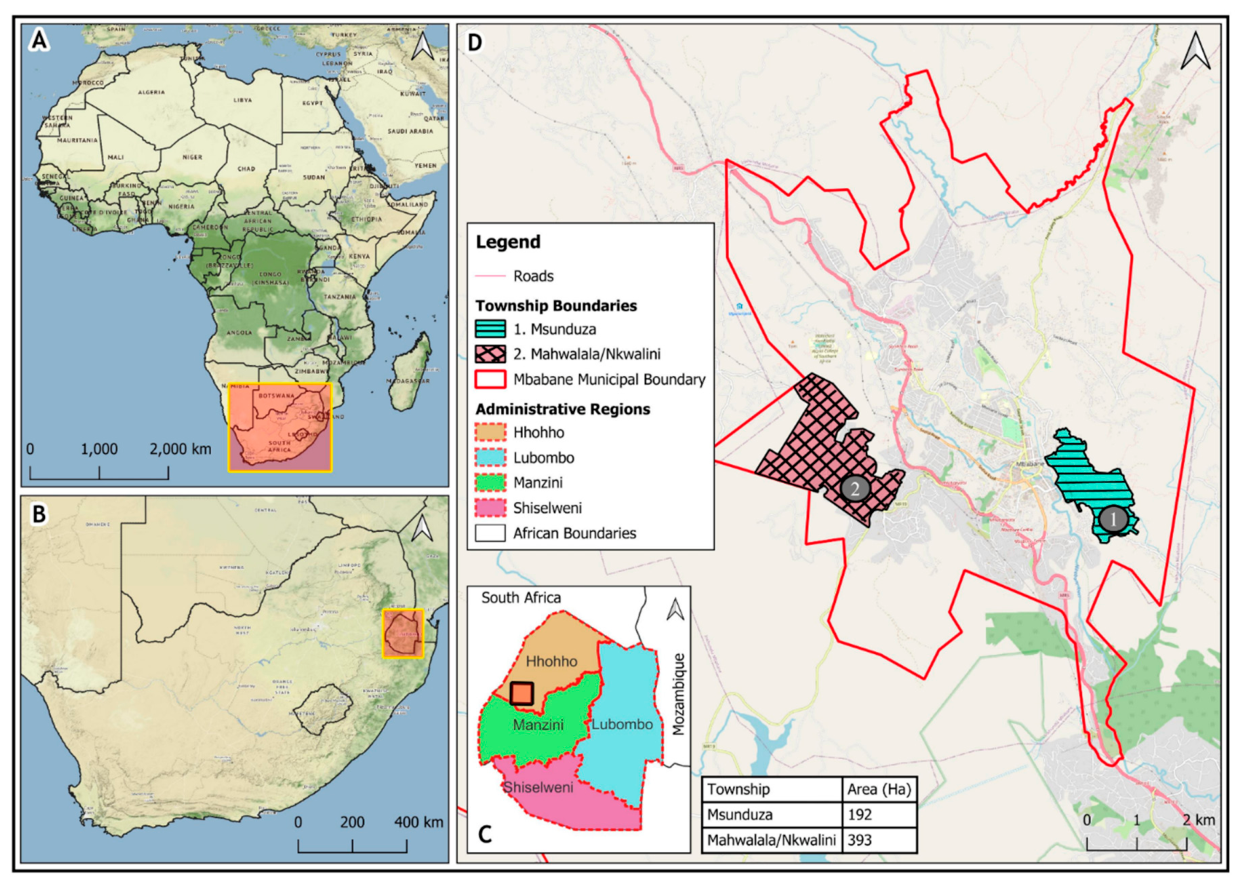
Figure 2.
Location of the case study of Nkwalini and Mahwalala in Mbabane. Map developed by Nomathemba Dladla, 2023.
Figure 2.
Location of the case study of Nkwalini and Mahwalala in Mbabane. Map developed by Nomathemba Dladla, 2023.
Disclaimer/Publisher’s Note: The statements, opinions and data contained in all publications are solely those of the individual author(s) and contributor(s) and not of MDPI and/or the editor(s). MDPI and/or the editor(s) disclaim responsibility for any injury to people or property resulting from any ideas, methods, instructions or products referred to in the content. |
© 2026 by the authors. Licensee MDPI, Basel, Switzerland. This article is an open access article distributed under the terms and conditions of the Creative Commons Attribution (CC BY) license.
Copyright: This open access article is published under a Creative Commons CC BY 4.0 license, which permit the free download, distribution, and reuse, provided that the author and preprint are cited in any reuse.


