

Submitted:
28 May 2026
Posted:
28 May 2026
You are already at the latest version
Abstract
The Semi-airborne frequency tipper sounding method (SFTS) based on tipper characteristics exhibits high lateral and vertical resolution, making it a promising technique for deep mineral exploration, particularly in challenging terrains where conventional ground-based electromagnetic methods face accessibility constraints. Currently, interpretation techniques for this method remain underdeveloped, limiting its practical application in mineral prospecting. To accelerate the application of SFTS in mineral exploration, this paper defines the full-zone apparent resistivity formula based on the complex implicit function relationship between tipper and background resistivity parameters, and iteratively calculates it using the binary search algorithm. An explicit calculation expression for the apparent depth of SFTS was constructed through data fitting, enabling fast full-zone apparent resistivity-depth imaging. The effectiveness of the imaging method is evaluated using one-dimensional layered models that simulate common geological scenarios in mineral exploration, including conductive sediment-hosted and resistive basement settings. Furthermore, the imaging characteristics of single and multiple anomalous bodies are analyzed using a three-dimensional synthetic model, with the anomalous bodies designed to represent typical mineral deposit types, such as massive sulfide orebodies (low resistivity) and porphyry systems (high resistivity). The proposed imaging method can achieve high-resolution and accurate positioning of subsurface anomalies, providing valuable guidance for targeting deep-seated mineral resources. The imaging results lay a foundation for data processing and inversion interpretation of SFTS in mineral exploration campaigns.
Keywords:
mineral exploration
; semi-airborne electromagnetic method
; apparent resistivity
; apparent depth
; fast imaging
1. Introduction
Semi-airborne Frequency Tipper Sounding method (SFTS) represents an innovative approach in semi-airborne electromagnetic exploration [1]. It entails transmitting a high-power frequency-domain electromagnetic field from the ground and measuring three-component magnetic field signals in the air. This allows for large-scale and rapid detection of underground targets. This methodology is suited for mineral exploration in mountainous or environmentally sensitive areas where ground access is limited, as the airborne receiver can operate efficiently without physical ground contact. The tipper parameters exhibit high-frequency occurrences in both magnetotelluric and controlled source electromagnetic methods. The frequency domain Z-Axis Tipper Electromagnetic (ZTEM) technique, a well-established natural source tipper exploration method [2,3,4,5,6]. Recognizing the significant effectiveness of tipper responses in natural source electromagnetic methods, scholars have progressively integrated tipper into artificial source electromagnetic methods [7,8,9,10,11,12]. However, current traditional ZTEM processing techniques fall short of meeting the requirements of the semi-airborne frequency tipper sounding method. Consequently, there is a pressing need for a set of fast imaging techniques suitable for the semi-airborne frequency tipper sounding method to expedite its application.
Electromagnetic exploration apparent resistivity imaging technology encompasses two crucial elements: apparent resistivity calculation and depth computation. Apparent resistivity serves as a critical parameter in controlled-source electromagnetic studies [13,14]. One of the purposes of fast imaging is to provide a more intuitive representation of subsurface electrical structures compared to electromagnetic components, which is convenient for the quality control of field measurements [15,16,17,18]. The apparent resistivity is difficult to define and calculate by explicit formulas [19,20], thus it is necessary to seek an approximation to simplify it [21] . One approach involves explicitly expressing apparent resistivity based on the relationship between electromagnetic fields, exemplified by the classic ratio of orthogonal electric and magnetic fields in CSAMT [22]. However, its applicability is limited and dependent on source location and type. Another approach establishes a complex implicit function relationship between resistivity and electromagnetic fields, deriving apparent resistivity for the entire region through iterative solving methods. This approach has found practicality and applicability in CSAMT, transient electromagnetic methods, and semi-airborne transient electromagnetic methods [16,23,24,25]. The spatial burial depth calculation of a target using electromagnetic responses has consistently posed a research challenge. Many depth estimation methods rely on empirical coefficients, resulting in limited applicability. Previous studies transformed electromagnetic field propagation characteristics using approximate expressions such as skin depth and diffusion depth [14,26,27,28]. There is a proliferation of methods for calculating apparent resistivity and apparent depth, employing diverse approaches to approximate these values. However, the accuracy, applicability, and real-time performance of these calculation methods vary. Therefore, establishing a set of high-precision, regionally applicable, and fast imaging methods is imperative.
This study defines full-zone apparent resistivity using an implicit function relationship between the tipper and apparent resistivity, and calculates the apparent resistivity through the binary search algorithm [29]. The concept of effective skin depth is introduced to define the apparent depth, and an explicit expression for the effective skin depth in relation to offset distance and frequency is established. This enables rapid computation of the apparent depth, forming a set of fast imaging techniques for the semi-airborne frequency tipper sounding method (SFTS) resistivity. The feasibility and applicability of these techniques were validated through imaging on typical models. The research findings provide technical support for data processing and the promotion of the method’s application.
2. Theory and Methods
2.1. Definition of Full-Zone Apparent Resistivity
The SFTS involves transmitting high-power electromagnetic field from ground and measuring the three-component magnetic field signals in air. Referring to the definition of tipper in the magnetotelluric [30], tipper is:
According to the schematic diagram of the layered model and dipole coordinates in Figure 1, we perform subdivision and finite summation calculations by Equation (2) [31].
where Idl is electric dipole moment, I is current magnitude, dl denotes length of electrical source, r is the distance from the projection point P0 of measurement point P on the ground to the midpoint of source, φ is the angle between the projection point P0 and the x-axis, , , ω represents angular frequency, μ represents magnetic permeability, σn is electrical conductivity of the nth layer; J0(λr) and J1(λr) are zeroth-order and first-order Bessel functions.
As Tx and Ty are complex, they can be further expressed as:
where , , , .
From Equation (3), tipper includes three terms, F1(λ), F2(λ), and F3(λ), each containing Bessel functions J0 and J1. Due to the influence of the height terms in the expression, simplifying it becomes challenging, making it difficult to establish a direct relationship between the tipper and resistivity. Therefore, the relationship between tipper and the apperent resistivity ρ is defined as implicit expression.
where and epresent amplitudes of Tx and Ty at the frequency of f0, and ξ, η represent the mapping relationship between the tipper amplitudes and resistivity.
Design half-space model with a resistivity range of 10-1Ω·m to 104Ω·m in a uniform space. The frequencies are 10Hz, 102Hz, 103Hz, and 104Hz. Figure 2 show the relationship between the tipper response at different locations and the resistivity of the half-space model. At varying offsets and frequencies, the amplitudes of the Tx and Ty components exhibit a monotonic change with resistivity, establishing a clear one-to-one correspondence. Leveraging these characteristics, the binary search algorithm can be iteratively employed to solve for the apparent resistivity across the entire zone.
Taking Ty as an example, the main process of calculating the regional apparent resistivity using the binary search algorithm involves the following three steps.
Step1. Assuming a frequency range of (fmin~fmax) and an apparent resistivity range (ρmin~ρmax), let’s consider the amplitude of the tipper at measurement point P corresponding to the frequency f0, denoted as Ty(ρy, P, f0).
Step2. Calculate the tipper response Ty(ρy(m), P, f0) corresponding to the midpoint of the set resistivity range and compare it with Ty(ρy, P, f0). If it does not satisfy the termination condition, adjust it based on the monotonic characteristic of the tipper with resistivity (Figure 2). The termination condition is given by Equation (6).
Step3. The compression of the range of apparent resistivity is realized by iteratively calculating and comparing the magnitude of Ty(ρy, P, f0) with that of Ty(ρy(m), P, f0). When the iteration termination condition is satisfied, the output apparent resistivity ρx(m).
2.2. Definition of Full-Zone Apparent Depth
The detection capability of SFTS extends beyond the plane wave region, and the three-component magnetic field response is significantly influenced by factors such as offset, frequency, and resistivity, particularly when the three-component receiving device has not yet entered the far-area range from the electrical source. Electromagnetic waves in the near and transition zones take the form of non-planar waves. Consequently, the skin depth of the plane wave region cannot be utilized to calculate the apparent depth within the non-far zone. To address this, the concept of effective skin depth [32,33,34] is introduced, drawing on frequency-domain electromagnetic methods. Considering the electromagnetic field generated by the electrical source as the superposition of plane waves with different complex incident angles, the effective skin depth δe is defined as the depth at which the amplitude of the electromagnetic field generated by the electrical source attenuates to 1/e (37%) of the amplitude at the surface.
Given that the skin depth is deepest for the Bz component among the three magnetic field components, the effective skin depth is calculated using the Bz component and is employed as the apparent depth in the SFTS. This approach involves collecting magnetic field signals at low altitudes, where electromagnetic wave attenuation is relatively minimal. To streamline the calculation method and enhance computational efficiency, the measurement point is positioned on the ground for effective skin depth computation. Setting the half-space resistivity at 100Ω·m and considering a measurement point offset distance range of 1 to 15,000 meters, the effective skin depth is computed at the measurement point for frequencies of 16Hz, 256Hz, and 2048Hz. The results are depicted in Figure 3a. The effective skin depth demonstrates an increasing trend followed by a decreasing trend as the offset distance gradually increases. Once the measurement point enters the plane wave region, the effective skin depth only varies with frequency, and the calculated result corresponds to the skin depth in the plane wave region, denoted as δ. Comparing the effective skin depths at different frequencies reveals that lower frequencies result in a larger plane wave region and smaller effective skin depths. In Figure 3b, the normalized effective skin depth curves indicate that the maximum effective skin depth at different frequencies is approximately 2.1 times the skin depth in the plane wave region.
As the calculation of the effective skin depth involves processing one point at a time for each frequency, which is time-consuming and unsuitable for fast imaging demands, there is a need to derive a direct calculation formula similar to the time-domain imaging depth [28]. This requires expressing the relationship between effective skin depth, offset, frequency, and resistivity with a mathematical explicit expression. In this study, we reference the calculation method from previous research [35] and define the induction number as S=r/δ. Figure 4 depicts the variation of normalized effective skin depth with the induction number S under different resistivity conditions. Assuming a uniform half-space, the trend of normalized effective skin depth with the induction number is nearly consistent.
The curves exhibit peaks, coinciding with the induction numbers corresponding to entering the plane-wave region, with the only difference being that lower resistivity leads to larger induction numbers. Based on this observation, the variation curve of normalized effective skin depth with S for different resistivities is approximated as a single curve. The effective skin depth under the condition of a larger induction number is considered as much as possible. According to this, the explicit expression between normalized effective skin depth and induction number can be obtained by fitting with rational numbers. Thus, the relationship between the effective skin depth and the offset and frequency is given by Equation (7). Table 1 displays the fitting coefficients obtained through rational number fitting.
The expression for effective skin depth is obtained through rational number fitting, allowing for the quick estimation of the full zone apparent depth across the entire frequency spectrum at different positions. Figure 5 presents a comparison between the theoretical results of effective skin depth and the rapid estimation results. The rapid estimation results for effective skin depth align closely with the theoretical calculation results, showing a relative error of less than 5% (Figure 6). These accurate results serve as one of the parameters for the fast imaging of the original data, fulfilling the requirements for swift imaging of actual data.
2.3. Workflow of the Fast Imaging Algorithm
The fast and high-resolution imaging method of SFTS employs a conversion algorithm to independently define and calculate the full-zone apparent resistivity and the apparent depth. In this paper, drawing from previous research experiences and incorporating the response characteristics of the SFTS, we define and calculate the full-zone apparent resistivity and apparent depth. Specifically, the amplitude of the tipper is utilized to compute the apparent resistivity based on the relationship between the tipper and the resistivity of the half-space model. Figure 7 illustrates the flow of the imaging algorithm.
3. Layered Model Imaging Test
3.1. Imaging of Two-Layer Model
A two-layered model was designed to represent common geological scenarios in mineral exploration. The upper layer, with a resistivity (ρ1) of 100 Ω·m and a thickness of 200 m, is intended to simulate typical sedimentary cover or altered host rocks commonly encountered in mineralized districts. The lower layer is characterized by a low-resistivity layer (D-type, simulating conductive targets such as graphitic zones, clay alteration halos associated with hydrothermal systems, or massive sulfide orebodies), with resistivity (ρ2) varied as 10, 20, and 50 Ω·m, and a high-resistivity layer (G-type, representing resistive targets such as quartz veins, unaltered granitic intrusions, or porphyry copper systems), with resistivity set to 500, 800, and 1000 Ω·m, respectively. The electrical source is positioned at the coordinate origin, with a source length of 1 km and a transmission current of 20 A.
Figure 8 shows the imaging curves for the D-type model. The solid black line represents the true resistivity curve of the model, the solid red line depicts the imaging curve for Tx, and the red dashed line represents the imaging curve for Ty. The apparent resistivity curves for different positions and various D-type models exhibit a similar overall trend with depth, accurately reflecting the true resistivity variations in the model. The initial segment of the curve precisely mirrors the resistivity of the upper layer of the model as 100 Ω·m. At the electrical interface (depth of 200m), the apparent resistivity curve exhibits varying degrees of sudden increase, attributed to interference caused by electromagnetic wave reflection when propagating through the electrical interface. In instances where the lower layer has low resistivity, a false peak emerges at the electrical interface. Beyond a depth of 200m, the apparent resistivity curve gradually decreases and approaches the true resistivity of the model. Comparing the Tx and Ty imaging results reveals that as the difference between the resistivity of the upper and lower layers diminishes, the disparity between the two imaging results also decreases. Conversely, when the difference in electrical properties between the upper and lower layers is more pronounced, a larger difference is observed, and Tx imaging results align more closely with the actual model resistivity than Ty.
Figure 9 presents the resistivity-depth imaging curves for the G-type model. The resistivity trends for different G-type models exhibit uniform behavior with depth. The initial segment of the curve reflects the actual resistivity of the upper layer of the model as 100 Ω·m. The apparent resistivity curves display varying degrees of decreasing anomalies at the electrical interface (depth of 200m), contrasting with the outcomes of the D-type model. This discrepancy arises from the higher resistivity of the lower layer in the G-type model relative to the upper layer. Beyond a depth of 200m, the apparent resistivity curve gradually ascends, and the tail branch of the curve exhibits a notable difference compared to the modeled true resistivity curve. This discrepancy is attributed to the electromagnetic method’s limited sensitivity to high-resistivity strata.
3.2. Imaging of Three-Layer Model
The parameters of the three-layer model are akin to the two-layer model, with the former being an extension of the latter by introducing an additional bottom layer. In the three-layer model, the lower layer of the two-layer model transforms into the intermediate layer, featuring a thickness of 100m. The resistivity of the third layer is identical to that of the first layer.
Figure 10 and Figure 11 shows the apparent resistivity-depth imaging curves of the H-type and K-type models. Similar to previous representations, the black solid line represents the true resistivity curve of the model, the red solid line depicts the imaging curve for Tx, and the red dashed line represents the imaging curve for Ty. The apparent resistivity-depth imaging curves of the H-type model at each measurement point accurately capture the trend of electrical changes. The apparent resistivity curve of the H-type model exhibits a concave shape, while the apparent resistivity curve of the K-type model is convex. These qualitative trends mirror the vertical electrical distribution of the model. Upon comparing the imaging results of the H-type and K-type models, it is evident that fast imaging possesses a relatively weak resolution capability for high-resistivity thin layers and can only reveal subtle trends in electrical differences. However, for thin-layer targets, the imaging results can qualitatively reflect the electrical characteristics and location of the thin layer, thereby validating the accuracy and reliability of the high-resolution imaging method.
4. Synthetic Modle Imaging Test
4.1. Single Low Resistivity Anomalous Body Model
In the Earth’s subsurface, mineral resources such as volcanogenic massive sulfide (VMS) deposits, magmatic copper-nickel sulfide orebodies, and graphitic shear zones exhibit three-dimensional forms characterized by significantly low resistivity relative to the host rock. Figure 12 illustrates a single low-resistivity model designed to represent a typical massive sulfide-type mineral deposit (e.g., a VMS or magmatic Ni-Cu sulfide body). The anomaly spans dimensions of 2 km in length and width each, with a top surface buried at a depth of 100 m and a thickness of 300 m. The background resistivity is 100 Ω·m, simulating typical host rocks (e.g., sedimentary or volcaniclastic sequences) , while the anomalous body has a resistivity of 1 Ω·m, representative of highly conductive massive sulfide mineralization. This resistivity contrast (two orders of magnitude) is characteristic of economic sulfide orebodies such as those found in the Hope deposit (Namibia) or the Huangshan-Jingerquan mineralization belt (Xinjiang, China) [35,36]. The airborne three-component observation height is 50 m, and the observation area measures 5 km×5 km. The electrical source has a length of 1 km, a current of 50 A, and is centered at coordinates (0, -5000, 0).
Based on the distribution of the anomaly body, cross-sectional profiles are extracted in front, behind, above, below, and through the anomaly body. Figure 13 depicts the cross-sectional profile imaging result of a single low-resistivity anomaly model. The imaging results at Depth=20m reveal the electrical characteristics at the top of the anomaly, where the apparent resistivity tends to approach the true resistivity of the surrounding rock, displaying subtle anomalies at the anomaly boundary. At Depth=260m, the imaging results distinctly indicate the presence of the low-resistivity anomaly, showing a clear low-resistivity anomaly at the central position of the study area, aligning with the actual location of the anomaly (black dashed line). The imaging results at Depth=500m portray the electrical characteristics at the bottom of the anomaly, with only faint low-resistivity anomalies occurring at the anomaly position. In the cross-sectional imaging results, both Tx and Ty imaging at Depth=260m exhibit noticeable low-resistivity distorted anomalies on the side of the anomaly away from the source. This phenomenon is attributed to the shadow effect caused by the electrical source.
Figure 14 shows the longitudinal-section profile imaging result of a single low-resistivity anomaly model. The y=-2000m profile, positioned between the source and the anomaly, accurately depicts a surrounding rock resistivity of 100Ω·m. At y=-300m, within the anomaly range, a prominent low-resistivity anomaly emerges in the shallow layer around x=±1km on the profile, aligning with the lateral boundary of the anomaly. This is interpreted as a low-resistivity anomaly induced by the anomaly’s boundary. Additionally, a significant low-resistivity area appears within the x=[-1km,1km] interval on the profile, exhibiting a vertical depth range of 100~400m, consistent with the anomaly’s burial depth. At y=2000m, where the profile is more distant from the anomaly, the imaging results portray a larger region of low resistivity anomalies within the anomaly’s burial depth. This aligns with the findings from the transverse profile in Figure 13b,e and is attributed to the shadow effect of the field source. Upon comparing the Tx and Ty cross-sectional imaging results, both accurately reflect the location and electrical information of the low-resistivity anomalies, but the Tx results are more affected by the shadowing effect than the Ty. In summary, the location and size of the low-resistivity anomaly region in the imaging results correspond to those of the real model, reflecting the lateral boundary location of the anomaly. However, the imaging effect of the single-electrical-source model is significantly influenced by the shadowing effect of the influencing electrical source.
4.2. Single High Resistivity Anomalous Body Model
The spatial position and size of the model are identical to the low-resistivity model. The resistivity of the single high-resistivity anomaly is 1000 Ω·m, representing resistive mineralized bodies such as porphyry copper systems, skarn deposits, or quartz-vein hosted gold mineralization. The background resistivity is 100 Ω·m. Anomalies of this type are relevant to the exploration of porphyry copper-molybdenum deposits, where the mineralized zone may exhibit moderate to high resistivity contrasting with surrounding alteration halos. The positions of the intercepted horizontal and vertical profiles align with those of the low-resistivity model. Figure 15 depicts the cross-sectional profile imaging result of a single high-resistivity anomaly model. At a depth of 20m, the imaging results accurately reflect the true resistivity of the surrounding rock, which is 100Ω·m, with weak high-resistivity anomalies appearing above the electrical interface on the side close to the source. Progressing to a depth of 260m, the imaging results exhibit weak reflections of the high-resistivity anomalies, featuring faint high-resistivity anomalies at the center and the center of the high-resistivity area shifting more towards the side far away from the source. The imaging results at Depth=500m mirror the electrical information at the bottom of the anomalies, which is in basic agreement with the resistivity of the surrounding rock. In the cross-sectional imaging results, both Tx and Ty exhibit significant high-resistivity distortions on the side away from the source at Depth=260m imaging. This is also attributed to the shadow effect of the electrical source.
Figure 16 shows the longitudinal-section profile imaging result of a single high-resistivity anomaly model. The imaging result of y=-2000m accurately reflects that the resistivity of the surrounding rock is 100Ω·m. The y=-0.5km profile is within the range of the anomalous body, and there is an obvious high-resistivity anomaly at the location of x=±1km, corresponding to the lateral boundary of the anomalous body. In the interval x=[-1km, 1km], a weak high-resistivity anomaly appears, aligning with the top boundary of the anomalous body at the top depth. In the imaging results of the y=2000m profile, noticeable high-resistivity anomalies appear in the depth range of 100~400m, corresponding to the true burial depth of the high-resistivity anomalies.
4.3. Complex Anomalous Body Model
Figure 17 illustrates the schematic diagram of a complex 3D anomaly model designed to represent a realistic mineral exploration scenario where multiple mineralization styles coexist. The background resistivity is 100 Ω·m simulating typical host rock lithology. In this model, a high-resistivity anomaly (resistivity 10000 Ω·m) is embedded in the center of a low-resistivity anomaly (resistivity 1 Ω·m). This configuration is representative of a porphyry copper-type system, where the high-resistivity core corresponds to the potassic alteration zone and mineralized porphyry stock, while the surrounding low-resistivity halo represents clay-rich phyllic or argillic alteration envelopes commonly associated with such deposits. The low-resistivity anomaly spans dimensions of 3km×3km×0.3 km, while the high-resistivity anomaly is contained within dimensions of 1km×1km×0.3 km, approximately scaling with typical porphyry deposit dimensions. Both anomalies share the same burial depth (top interface at 0.1 km) and thickness (0.3 km) as the single anomaly model. The parameters of the emitting source align with those of the single anomaly model.
Figure 18 shows the cross-sectional profile imaging result of the complex anomaly model. In comparison to a single low-resistivity anomaly, the complex anomaly model involves the embedding of high-resistivity anomalies in the middle of low-resistivity anomalies. The Depth=20m imaging results reflect the electrical information at the top of the anomalies, displaying resistivity anomalies that align more closely with the anomaly locations due to the influence of the electrical interface of the underlying anomalies. At Depth=260m, the imaging results reveal a significant high-resistivity anomaly in the center of the study area, coinciding with the location of the high-resistivity anomaly indicated by the red dashed line. The imaging results at Depth=500m depict clear electrical anomalies below the anomaly position, consistent with the distribution of high and low resistivity within the anomaly.
Figure 19 shows the longitudinal-section profile imaging results of the complex anomaly model. The imaging results at y=-2000m accurately depict the resistivity of the surrounding rock as 100Ω·m. In the y=-300m profile, within the anomaly, a substantial area of low-resistivity anomalies emerges in the intervals of x=[-2km, -0.5km] and x=[0.5km, 2km], aligning with the spatial location of the low-resistivity area in the anomaly. The electrical interface between the high- and low-resistivity anomalies is more precisely reflected than the interface between the low-resistivity and surrounding rock. A conspicuous high-resistivity anomaly area appears in the middle of the left and right low-resistivity anomalies, perfectly matching the location of the high-resistivity body indicated by the red dashed line. In the y=2000m profile imaging result, low-resistivity anomalies manifest on both sides of the profile, with relatively high resistivity in the middle. This mirrors the imaging result of a single anomaly and is attributed to the shadow effect of the electrical source. Comparing the imaging results of Tx and Ty, the differences between the two are minimal.
In summary, the fast imaging results exhibit a strong correspondence with the actual model. They demonstrate heightened sensitivity in delineating the spatial location and resistivity of low-resistivity anomalies. However, the portrayal of the real resistivity of high-resistivity anomalies is comparatively less pronounced. Notably, the algorithm excels in capturing the lateral boundary position, outperforming its depiction of the longitudinal boundary position. Consequently, the efficacy and reliability of the apparent resistivity-depth fast imaging algorithm are unequivocally validated.
5. Conclusions
The fast imaging technology of the semi-airborne frequency tipper sounding method holds significant practical importance for the rational assessment of instrument parameters, equipment layout, and the preliminary determination of the electrical structure of the study area. In this study, we present a fast high-resolution imaging algorithm tailored to this method. By integrating the binary search method and effective skin depth, we have independently defined the full-zone apparent resistivity and apparent depth for the semi-airborne frequency tipper sounding method. The conversion algorithm is employed to compute the apparent resistivity and apparent depth. The imaging results from the theoretical model illustrate that the fast imaging method exhibits excellent horizontal and vertical resolution. It can qualitatively depict the distribution of underground anomalies, outline the approximate locations of the anomalies, and achieve high-resolution localization. The imaging method displays varying sensitivities to anomalies in the horizontal and vertical directions, with higher accuracy in horizontal imaging compared to the vertical direction. We have established a rapid and high-resolution imaging system for the semi-airborne frequency tipper sounding method. The proposed fast and high-resolution imaging method of SFTS offers the advantages of simplicity in computation, rapid processing, and accurately characterized imaging. From a mineral exploration perspective, the method shows particular promise for rapid reconnaissance surveys in areas with limited geological knowledge, enabling exploration teams to prioritize prospective targets for subsequent detailed ground follow-up. Its ability to qualitatively map both conductive (sulfide-type) and resistive (porphyry-type) anomalies, despite differing sensitivity levels, provides valuable multi-target detection capability.
The proposed method should be further verified by a more realistic and complex three-dimensional model and more field experiments. Our future work includes optimizing the imaging accuracy and using the imaging results as an initial model for inversion to carry out 3D inversion.
Author Contributions
M.Y.,conceptualization, methodology, formal analysis, writing—original draft preparation; J.D.,conceptualization, methodology, writing—review and editing, funding acquisition; H.C.,project administration; M.F., writing—review and editing, funding acquisition; H.Y. and C.Y., conceptualization, methodology; J.H., writing—review and editing. All authors have read and agreed to the published version of the manuscript.
Funding
This research was funded by the National Natural Science Foundation of China (grant Nos. 42130811, 42304090 and 42374097), Autonomous Deployment Project of the National Key Laboratory of Uranium Resources Exploration-Mining and Nuclear Remote Sensing (grant Nos. 2025QZ-YZZ-03, 2024QZ-TD-15), China Magnetotelluric Array (SinoMTarray) National Science and Technology Major Project (grant No: 2024ZD1000204), National Science and Technology Project on Deep Earth Probe and Mineral Resources Exploration (grant No: 2024ZD1002207), National Key Research and Development Program of China (grant No. 2023YFC2906602), Science and Technology Project of Jiangxi Province (grant Nos. DHSQT42023001, 20242BAB20143) and Graduate Innovation Project of Jiangxi Province (grant No. YC2023-B212).
Data Availability Statement
The data that support the findings of this study are available from author upon reasonable request.
Conflicts of Interest
The authors declare no conflicts of interest.
Abbreviations
The following abbreviations are used in this manuscript:
| SFTS | Semi-airborne frequency tipper sounding method |
| ZTEM | Z-Axis Tipper Electromagnetic |
| CSAMT | Controlled source audio-frequency magnetotelluric method |
References
- Feng, M.; Chen, H.; Deng, J.; Yin, M.; Yu, H.; Zhou, C. Ground-airborne frequency tipper sounding method and charactersitics analysis of its one-dimensional forward modeling. Oil Geophysical Prospecting (in Chinese) 2022, 57, 728-737.
- Lo, B.; Zang, M. Numerical modeling of Z-TEM (airborne AFMAG) responses to guide exploration strategies. SEG Technical Program Expanded Abstracts 2008, 27, 1098–1102.
- Holtham, E.; Oldenburg, D.W. Three-dimensional inversion of ZTEM data. Geophys. J. Int. 2010, 182, 168-182. [CrossRef]
- Hübert, J.; Lee, B.M.; Liu, L.; Unsworth, M.J.; Richards, J.P.; Abbassi, B.; Rebagliati, M. Three-dimensional imaging of a Ag-Au-rich epithermal system in British Columbia, Canada, using airborne z-axis tipper electromagnetic and ground-based magnetotelluric data. Geophysics 2016, 81, B1-B12. [CrossRef]
- Legault, J.M.; Latrous, A.; Zhao, S.; Bournas, N.; Plastow, G.C.; Xue, G.G.Helicopter AFMAG (ZTEM) EM and magnetic results over sedimentary exhalative (SEDEX) lead-zinc deposits at Howard’s Pass in Selwyn Basin, Yukon. Explor. Geophys. 2016, 47, 170–178. [CrossRef]
- Lee, B.M.; Unsworth, M.J.; Hübert, J.; Richards, J.P.; Legault, J.M. 3D joint inversion of magnetotelluric and airborne tipper data: A case study from the Morrison porphyry Cu–Au–Mo deposit, British Columbia, Canada. Geophys. Prospect. 2018, 66, 397–421. [CrossRef]
- Shlykov, A.A; Saraev, A. K. Estimating the macroanisotropy of a horizontally layered section from controlled-source radiomagnetotelluric soundings. Izv., Phys. Solid Earth 2015, 51, 583-601. [CrossRef]
- Wang, K.; Cao, H.; Duan, C.; Huang, J.; Li, F. Three-dimensional scalar controlled-source audio-frequency magnetotelluric inversion using tipper data. J. Appl. Geophys. 2019, 164, 75–86. [CrossRef]
- Liu, C.; Zhang, M.; Ma, J.; Zhou, H.; Liang, J.; Lin, J. Divergence of tipper vector imaging for ground–airborne frequency-domain electromagnetic method with orthogonal sources. J. Electromagnet. Wave. 2020, 34, 316-329. [CrossRef]
- Cao, H.; Wang, K.; Wang, X.; Duan, C.; Lan, X.; Luo, W.; Zhang, Z. Tipper data forward modeling and inversion of three-dimensional tensor CSAMT. J. Appl. Geophys. 2021, 193, 104432. [CrossRef]
- Gao, W.; Wang, X.; Mao, L.; Luo, W. 3D Forward and Inversion Research on Frequency Domain Electromagnetic Tipper Data. J. Phys. : Conf. Ser. 2023, 2651, 012077.
- Yu, S.; Wang, H.; Liu, C.; Guo, Y.; Huang, J.; Zhou, H. Comparative analysis of divergence of tipper imaging with natural and orthogonal electric sources. J. Electromagnet. Wave. 2024, 38, 397-410. [CrossRef]
- Wilt, M.; Stark, M. A simple method for calculating apparent resistivity from electromagnetic sounding data. Geophysics 1982, 47, 1100–1105. [CrossRef]
- Spies, B.R. Depth of investigation in electromagnetic sounding methods. Geophysics 1989, 54, 872-888. [CrossRef]
- Das, U.C. Apparent resistivity curves in controlled-source electromagnetic sounding directly reflecting true resistivities in a layered earth. Geophysics 1995, 60, 53-60. [CrossRef]
- Van der Kruk, J.; Meekes, J.A.C.; Van Den Berg, P.M.; Fokkema, J.T. An apparent-resistivity concept for low-frequency electromagnetic sounding techniques. Geophys. Prospect. 2000, 48, 1033-1052. [CrossRef]
- Xue, G.; Li, X.; Gelius, L.J.; Qi, Z.; Zhou, N.; Chen, W. A New Apparent Resistivity Formula for In-loop Fast Sounding TEM Theory and Application. J.Environ. Eng. Geoph. 2015, 20, 107–118. [CrossRef]
- He, X.; Wang, H.; Ma, S. Translation algorithm of the apparent conductivity using the frequency-domain electromagnetic method of a magnetic dipole. J. Appl. Geophys. 2017, 146, 221–227. [CrossRef]
- Hou, D.; Xue, G.; Zhou, N.; He, Y.; Chen, W. Comparison between Different Apparent Resistivity Definitions of CSAMT. J.Environ. Eng. Geoph. 2019, 24, 119–127. [CrossRef]
- Wang, X.; Di, Q.; Deng, J.; Li, J. The full-time apparent resistivity definition of the multi-channel transient electromagnetic method. Comput. Geosci. 2021, 153, 104770. [CrossRef]
- Huang, X.; Tang, J.; Xiao, X.; Jiang, Q.; Yang, Z.; Hu, S. A novel apparent resistivity for land-based controlled-source electromagnetic method. J. Geophys. Eng. 2022, 19, 562–57. [CrossRef]
- Goldstein, M.A.; Strangway, D.W) Audio-frequency magnetotellurics with a grounded electric dipole source. Geophysics 1975, 40, 669-683. [CrossRef]
- Raiche, A.P.; Spies, B.R. Coincident loop transient electromagnetic master curves for interpretation of two-layer earths. Geophysics 1981, 46, 53–64. [CrossRef]
- Sheng, Y. A single apparent resistivity expression for long-offset transient electromagnetics. Geophysics 1986, 51, 1291–1297. [CrossRef]
- Zhang Y.; Li, X.; Li, J.; Zhao, Y.; Yao, W. Fast imaging technique of multi-source ground-airborne transient electromagnetic method. Progress in Geophysics(in Chinese) 2016, 31, 869-876.
- Fullagar, P. K.; Reid, J. E. Conductivity-depth transformation of fixed loop TEM data. Explor. Geophys. 1992, 23, 515-519. [CrossRef]
- Yin, C.; Qiu, C.; Liu, Y.; Cai, J. Time-domain electromagnetic diffusion and imaging depth for airborne electromagnetic data. Chin. J. Geophys. 2016, 59, 3079-3086.
- Xue, J.; Chen, W.; Wang H. Analysis and application of the detection depth of electrical source Short-offset TEM. Geophys. Geochem. Explor. 2017, 2, 381–384.
- Williams, L. F. A modification to the half-interval search (binary search) method. Proceedings of the 14th Annual Southeast Regional Conference on - ACM-SE 14. 1975, 95-101.
- Labson, V.F.; Becker, A.; Morrison, H.F.; Conti, U. Geophysical exploration with audio-frequency natural magnetic fields. Geophysics 1985, 50, 656–664. [CrossRef]
- Piao, H. The Principle of Electromagnetic Sounding. Geological Publishing House: Beijing, China, 1990.
- Reid, J.E.; Macnae, J.C. Doubling the effective skin depth with a local source. Geophysics 1999, 64, 732-738. [CrossRef]
- Singh, N.P.; Mogi, T. Effective skin depth of EM fields due to large circular loop and electric dipole sources. Earth, Planets Space 2003, 55, 301-313. [CrossRef]
- Chen, W.; Xue, G. Effective skin depth of whole EM field due to a grounded wire source. Chin. J. Geophys. 2014, 57, 2314-2320.
- Kotowski, P.O.; Becken, M.; Rochlitz, R.; Schmalzl, J.; Ueding, S.; Tolksdorf, P.; Wilelm, A.; Symons, G. Semi-airborne electromagnetic exploration of deep sulfide deposits with UAV-towed magnetometers-Part 1: Processing and modeling. Geophysics 2025, 90, WA261-WA274. [CrossRef]
- Wu, J.; Xiao, D.; Zhi, Q.; Wang, X.; Deng, X.; Chen, X.; Zhao, Y.; Zhang, J.; Yang, Y. Exploration with loop-source Semi-Airborne transient electromagnetic method (LSATEM) in the shallow coverage area of East Tianshan, Xinjiang, Northwest China. Ore Geology Reviews 2025, 186, 106853. [CrossRef]
Figure 1.
Illustration of the semi-airborne with electrical source.
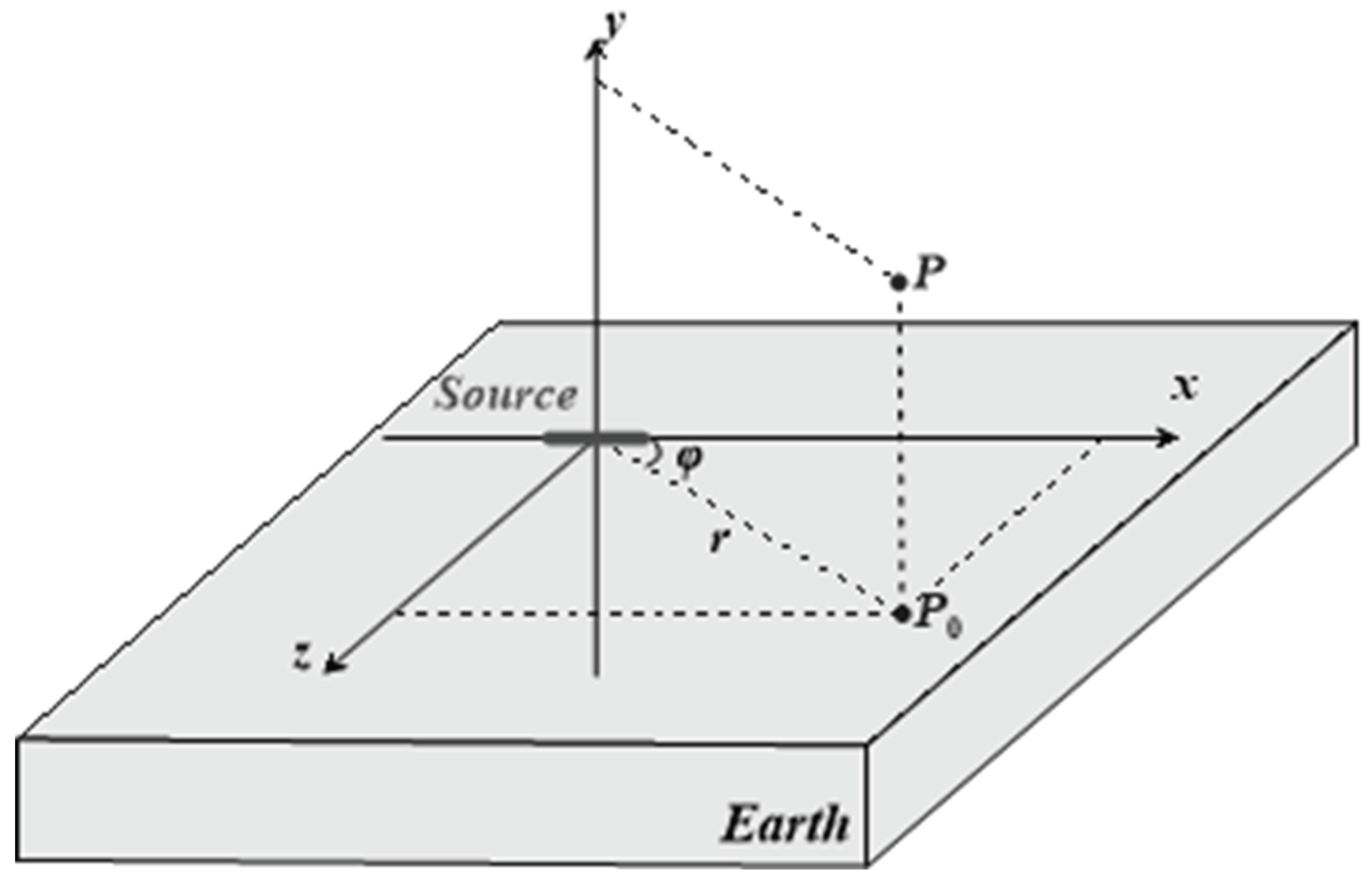
Figure 2.
Variation of tipper with resistivity of half space. (a)~(d) Amplitude of Tx; (e)~(h) Amplitude of Ty.
Figure 2.
Variation of tipper with resistivity of half space. (a)~(d) Amplitude of Tx; (e)~(h) Amplitude of Ty.
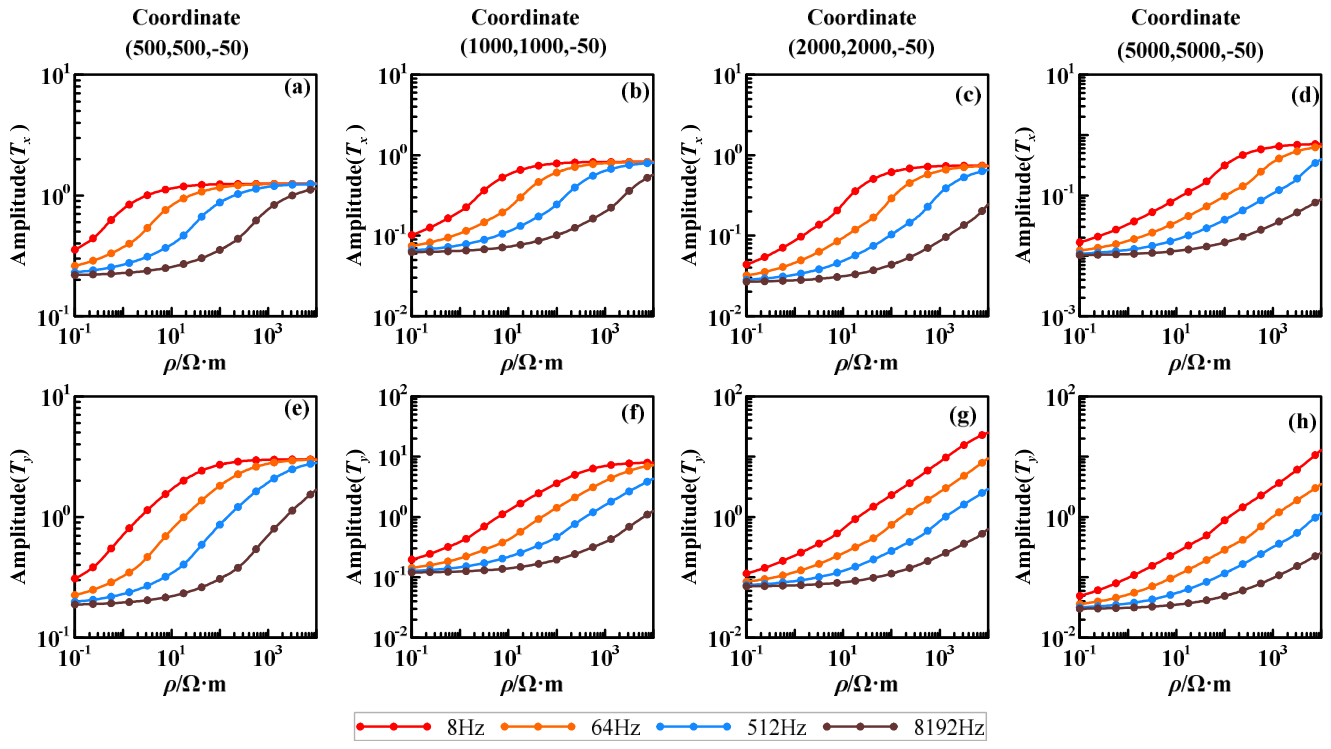
Figure 3.
Curve of effective skin depth with offset at different frequencies. (a) Effective skin depth, (b) Normalized effective skin depth.
Figure 3.
Curve of effective skin depth with offset at different frequencies. (a) Effective skin depth, (b) Normalized effective skin depth.
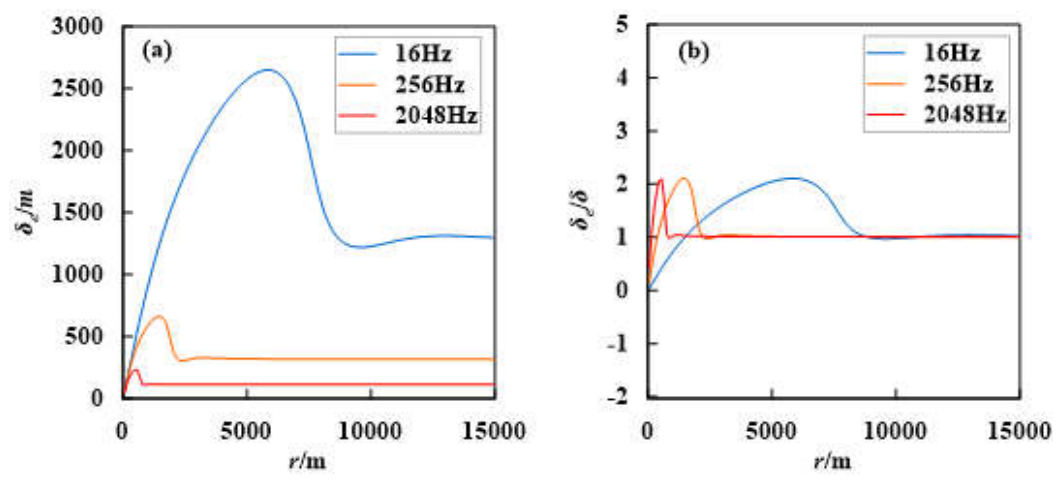
Figure 4.
Variation curve of normalized effective skin depth with induction number S under different resistivity conditions.
Figure 4.
Variation curve of normalized effective skin depth with induction number S under different resistivity conditions.
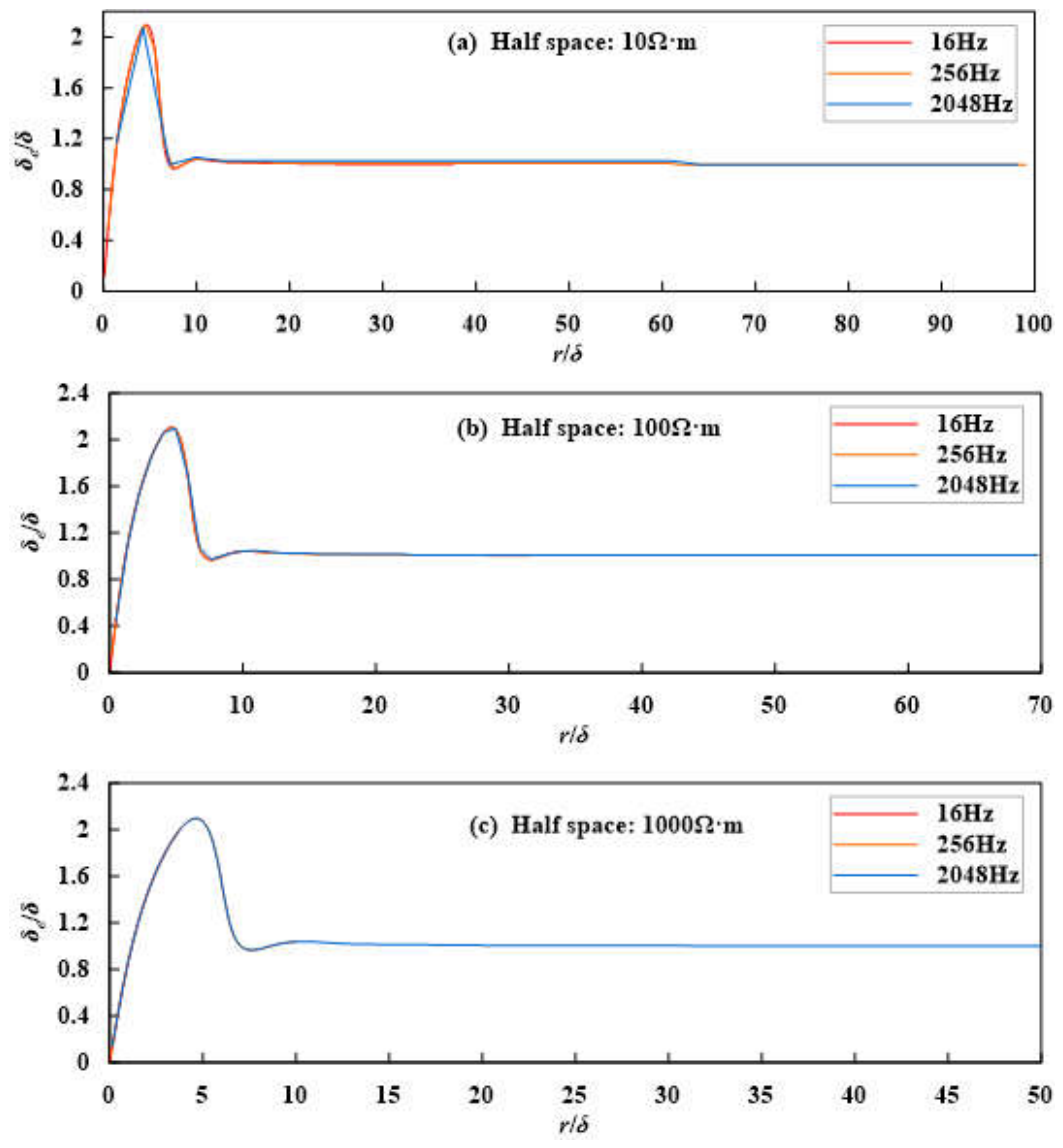
Figure 5.
Theoretical calculation and rapid estimation results of effective skin depth under different resistivities of half spaces.
Figure 5.
Theoretical calculation and rapid estimation results of effective skin depth under different resistivities of half spaces.
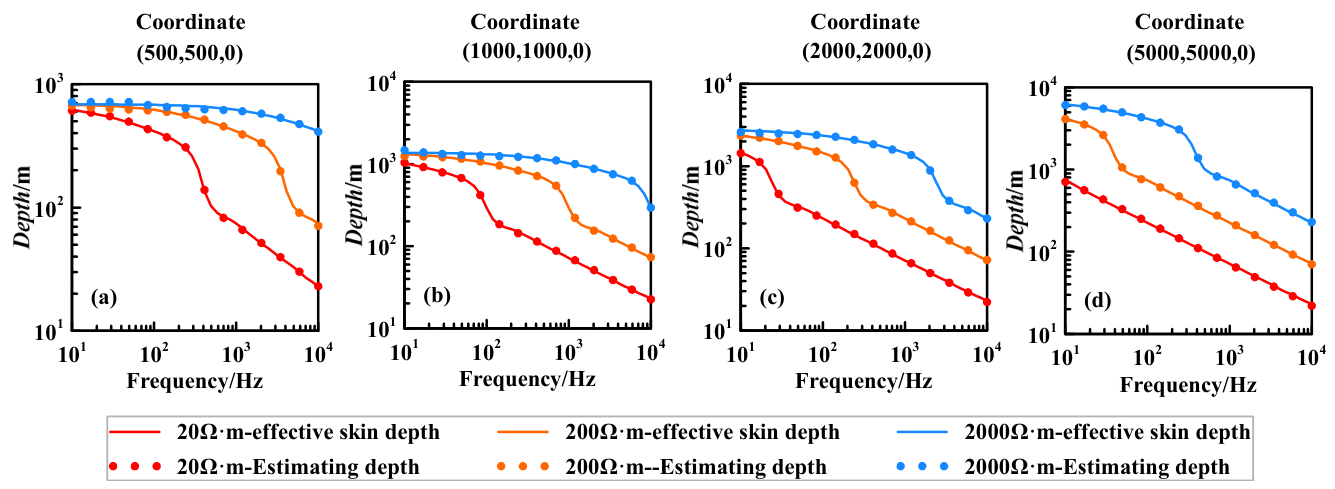
Figure 6.
Relative error between theoretical calculation and rapid estimation of effective skin depth under different resistivities of half spaces.
Figure 6.
Relative error between theoretical calculation and rapid estimation of effective skin depth under different resistivities of half spaces.
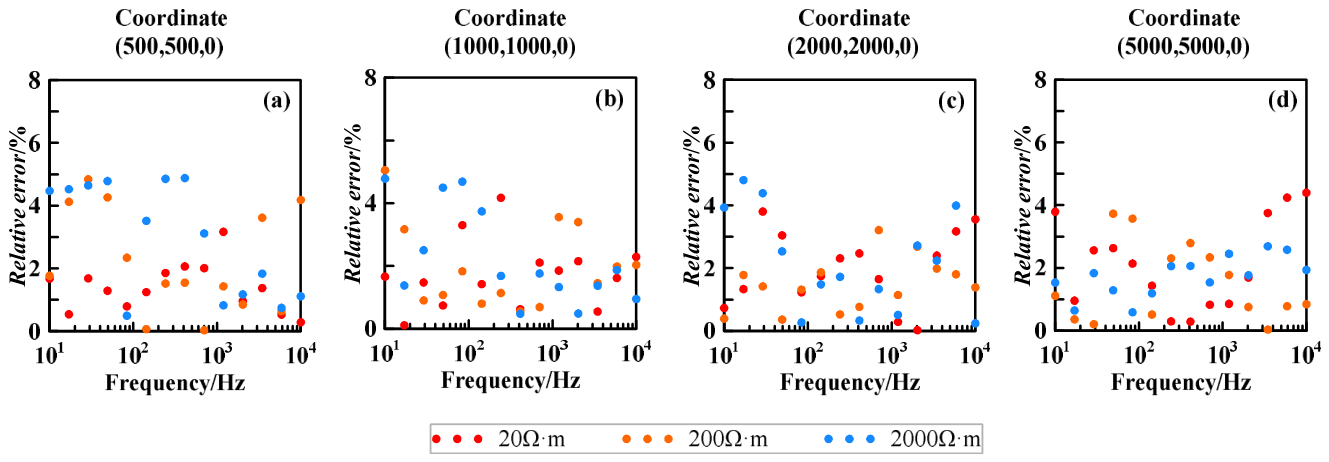
Figure 7.
Flow chart of fast imaging method.
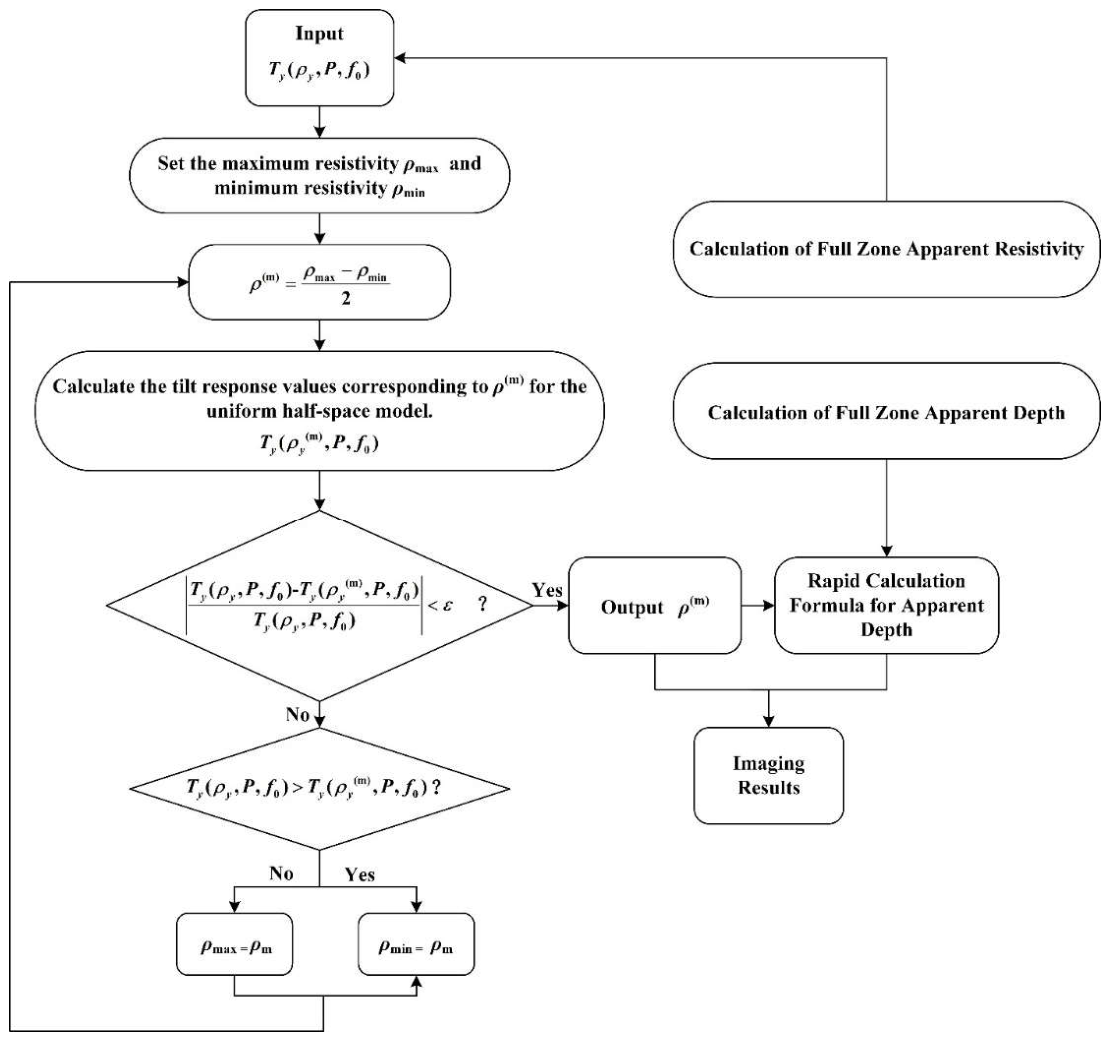
Figure 8.
D-type model imaging curve: (a)~(d) resistivity (ρ2) of lower layer is 10 Ω·m; (e)~(h) resistivity (ρ2) of lower layer is 20 Ω·m; (i)~(l) resistivity (ρ2) of lower layer is 50 Ω·m.
Figure 8.
D-type model imaging curve: (a)~(d) resistivity (ρ2) of lower layer is 10 Ω·m; (e)~(h) resistivity (ρ2) of lower layer is 20 Ω·m; (i)~(l) resistivity (ρ2) of lower layer is 50 Ω·m.
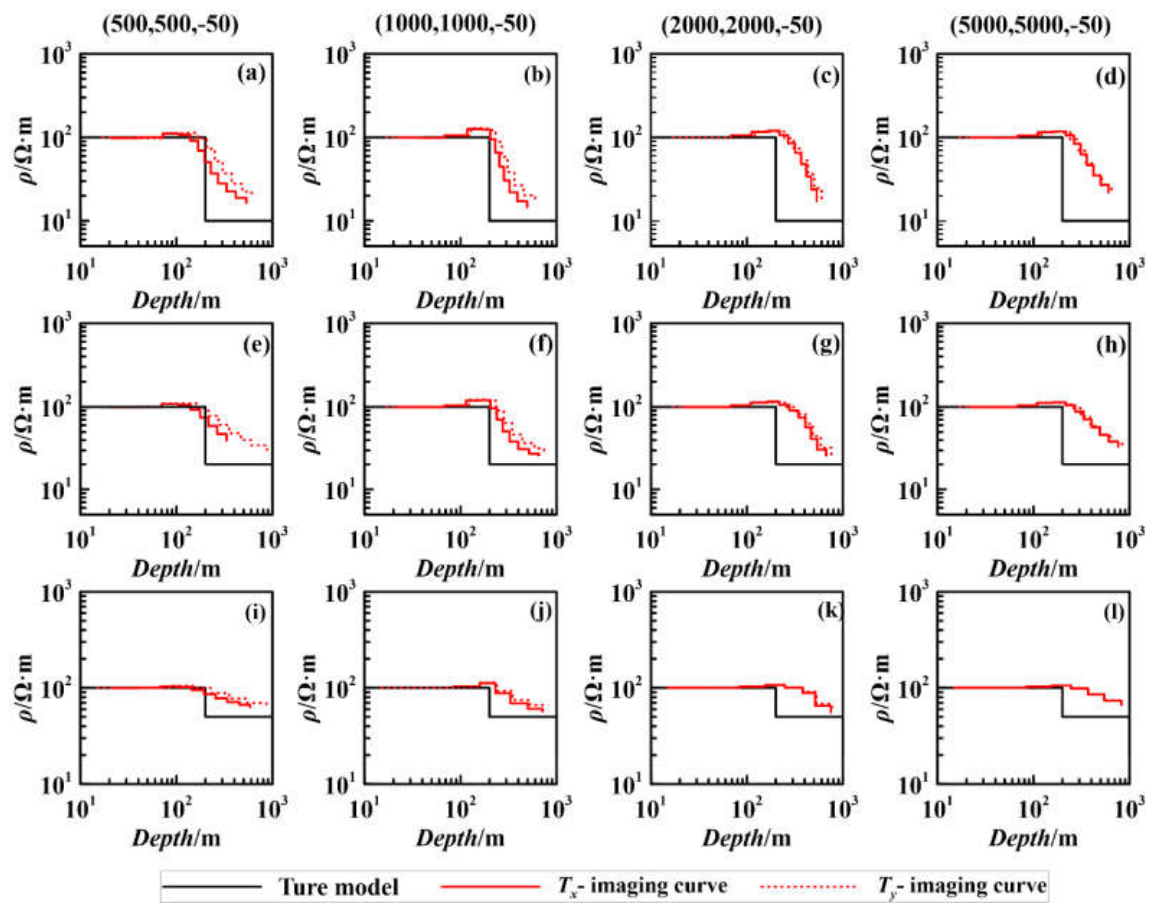
Figure 9.
G-type model imaging curve: (a)~(d) resistivity (ρ2) of lower layer is 500 Ω·m; (e)~(h) resistivity (ρ2) of lower layer is 800 Ω·m; (i)~(l) resistivity (ρ2) of lower layer is 1000 Ω·m.
Figure 9.
G-type model imaging curve: (a)~(d) resistivity (ρ2) of lower layer is 500 Ω·m; (e)~(h) resistivity (ρ2) of lower layer is 800 Ω·m; (i)~(l) resistivity (ρ2) of lower layer is 1000 Ω·m.
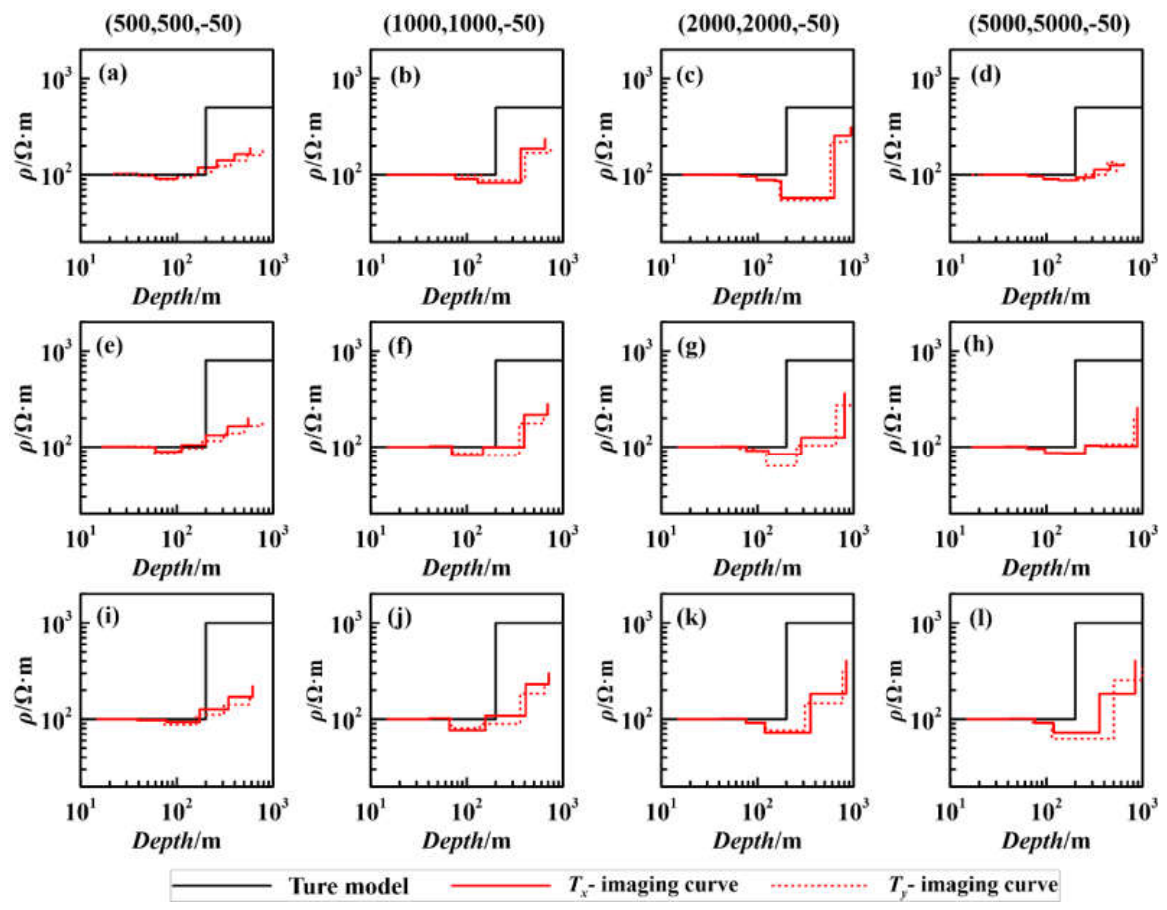
Figure 10.
H-type model imaging curve: (a)~(d) resistivity (ρ2) of intermediate layer is 10 Ω·m; (e)~(h) resistivity (ρ2) of intermediate layer is 20 Ω·m; (i)~(l) resistivity (ρ2) of intermediate layer is 50 Ω·m.
Figure 10.
H-type model imaging curve: (a)~(d) resistivity (ρ2) of intermediate layer is 10 Ω·m; (e)~(h) resistivity (ρ2) of intermediate layer is 20 Ω·m; (i)~(l) resistivity (ρ2) of intermediate layer is 50 Ω·m.
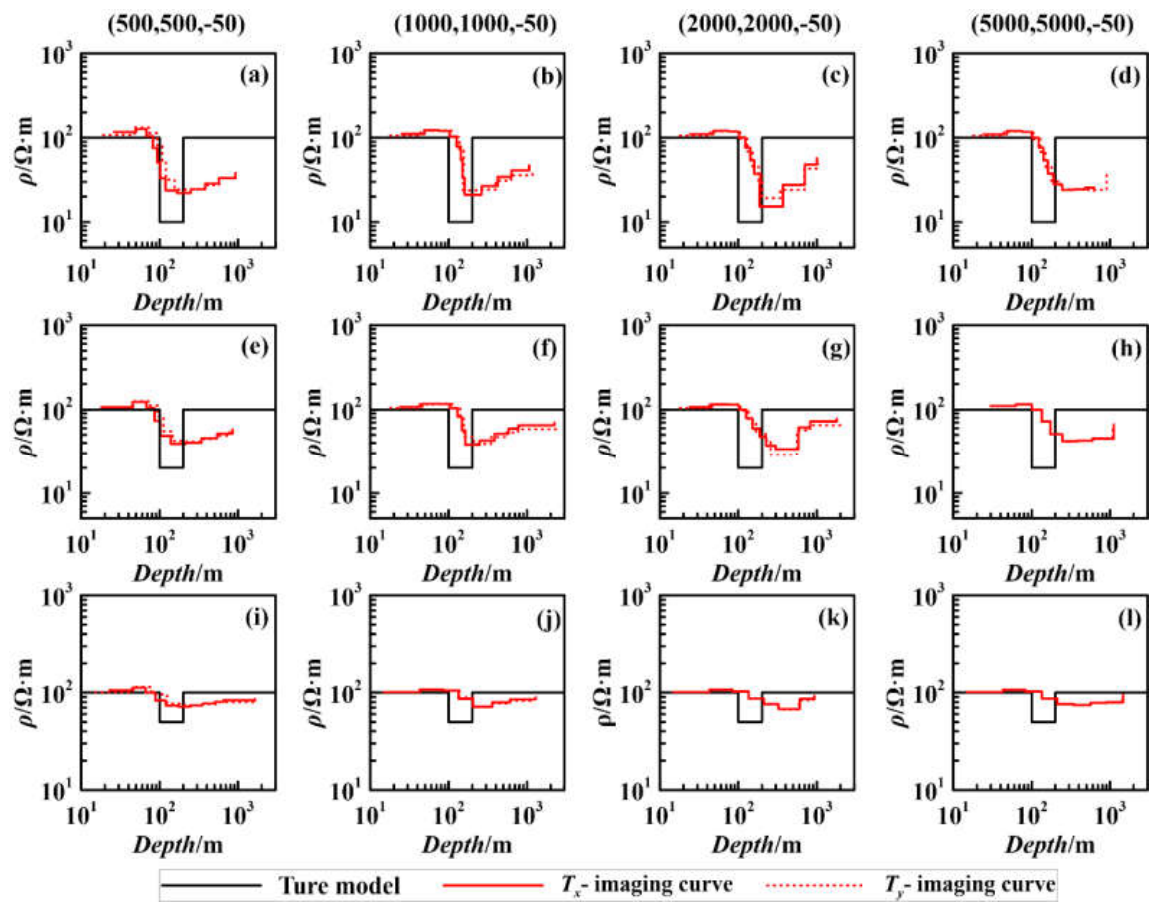
Figure 11.
K-type model imaging curve: (a)~(d) resistivity (ρ2) of intermediate layer is 500 Ω·m; (e)~(h) resistivity (ρ2) of intermediate layer is 800 Ω·m; (i)~(l) resistivity (ρ2) of intermediate layer is 1000 Ω·m.
Figure 11.
K-type model imaging curve: (a)~(d) resistivity (ρ2) of intermediate layer is 500 Ω·m; (e)~(h) resistivity (ρ2) of intermediate layer is 800 Ω·m; (i)~(l) resistivity (ρ2) of intermediate layer is 1000 Ω·m.
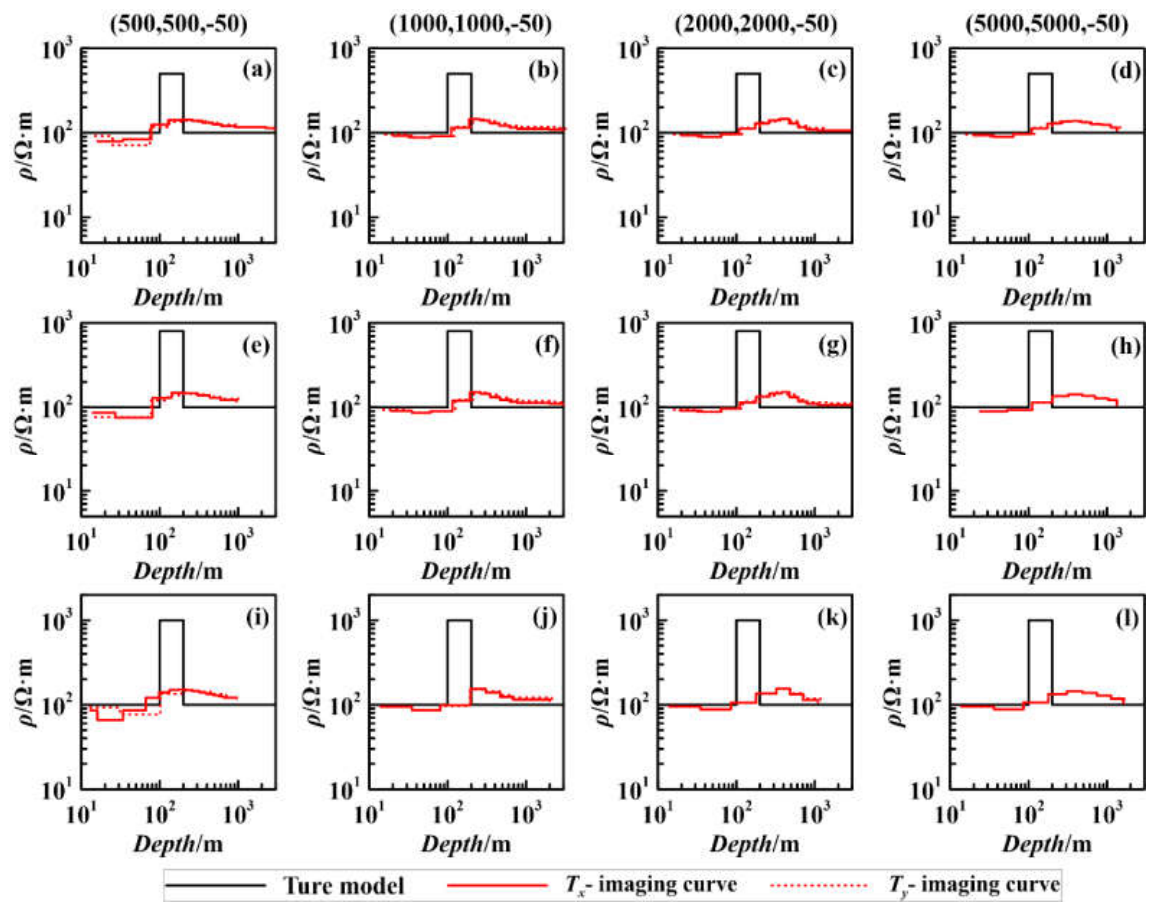
Figure 12.
Three-dimensional model of single abnormal with low resistivity. (a) Planform; (b) Cross-section.
Figure 12.
Three-dimensional model of single abnormal with low resistivity. (a) Planform; (b) Cross-section.
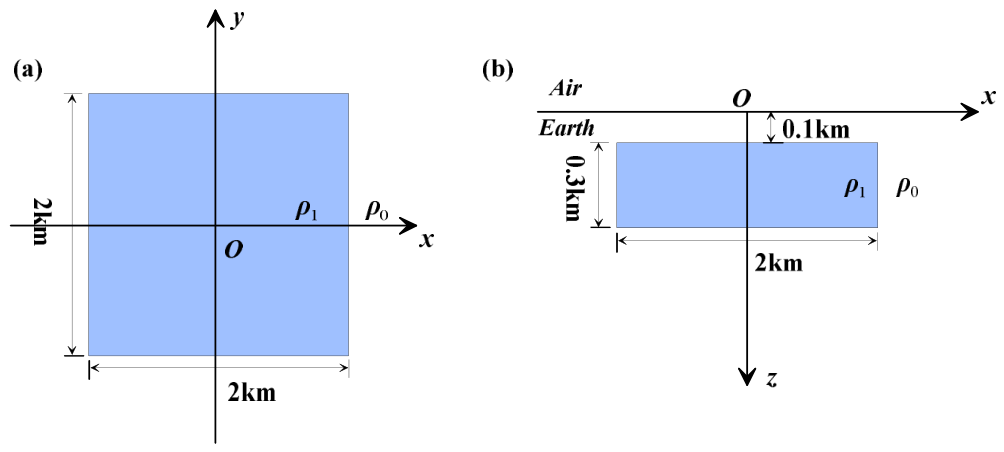
Figure 13.
Cross section imaging results of single low resistivity abnormal model: (a)~(c) are the imaging results for Tx; (d)~(f) are the imaging results for Ty; sections at Depth=20m, Depth=260m, Depth=500m, represent x-y plane cross-sections, with the Depth=20m section positioned above the anomaly, Depth=260m section intersecting the anomaly, and Depth=500m section below the anomaly.
Figure 13.
Cross section imaging results of single low resistivity abnormal model: (a)~(c) are the imaging results for Tx; (d)~(f) are the imaging results for Ty; sections at Depth=20m, Depth=260m, Depth=500m, represent x-y plane cross-sections, with the Depth=20m section positioned above the anomaly, Depth=260m section intersecting the anomaly, and Depth=500m section below the anomaly.
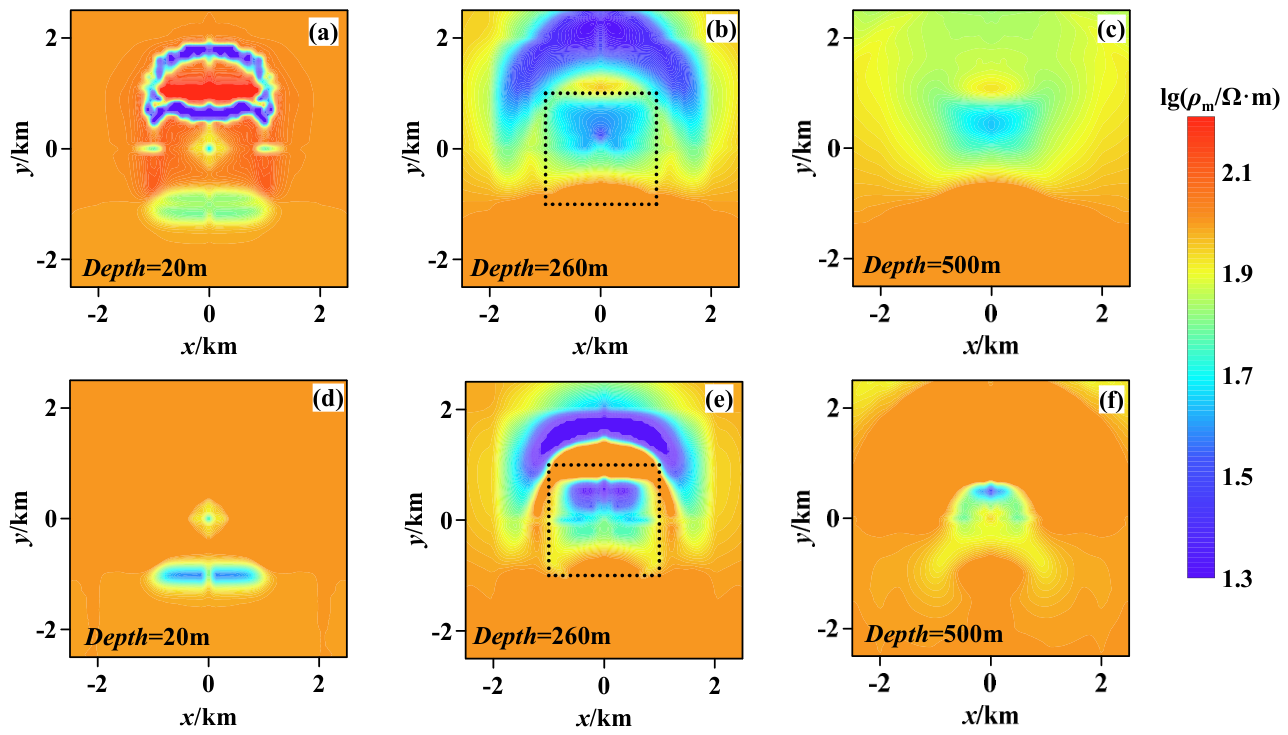
Figure 14.
Longitudinal profile imaging results of single low resistivity abnormal model: (a)~(c) are the imaging results for Tx; (d)~(f) are the imaging results for Ty; sections at y=-2000m, y=-300m, y=2000m, represent x-z plane longitudinal-sections, with the y=-300m section intersecting the anomaly, y=-2000m and y=2000m are located on either side of the anomaly.
Figure 14.
Longitudinal profile imaging results of single low resistivity abnormal model: (a)~(c) are the imaging results for Tx; (d)~(f) are the imaging results for Ty; sections at y=-2000m, y=-300m, y=2000m, represent x-z plane longitudinal-sections, with the y=-300m section intersecting the anomaly, y=-2000m and y=2000m are located on either side of the anomaly.
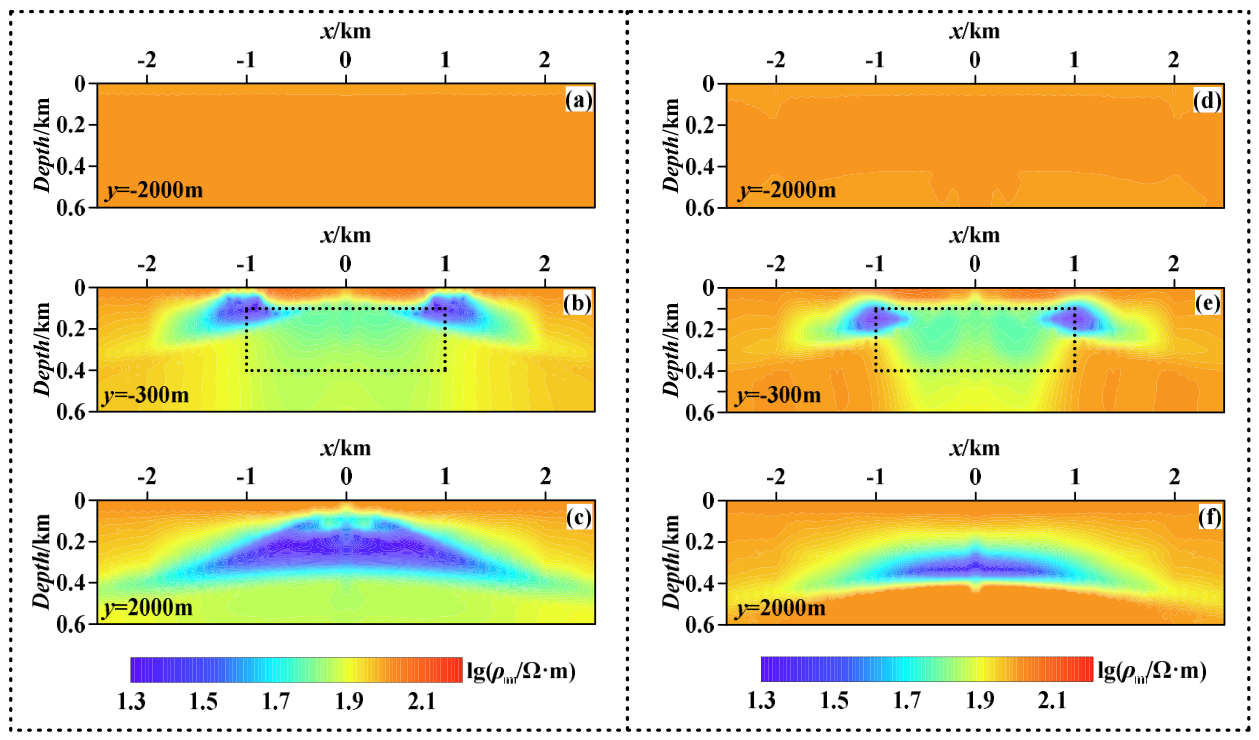
Figure 15.
Cross section imaging results of single high resistivity abnormal model: (a)~(c) are the imaging results for Tx; (d)~(f) are the imaging results for Ty; sections at Depth=20m, Depth=260m, Depth=500m, represent x-y plane cross-sections, with the Depth=20m section located above the anomaly, Depth=260m section intersecting the anomaly, and Depth=500m section below the anomaly.
Figure 15.
Cross section imaging results of single high resistivity abnormal model: (a)~(c) are the imaging results for Tx; (d)~(f) are the imaging results for Ty; sections at Depth=20m, Depth=260m, Depth=500m, represent x-y plane cross-sections, with the Depth=20m section located above the anomaly, Depth=260m section intersecting the anomaly, and Depth=500m section below the anomaly.
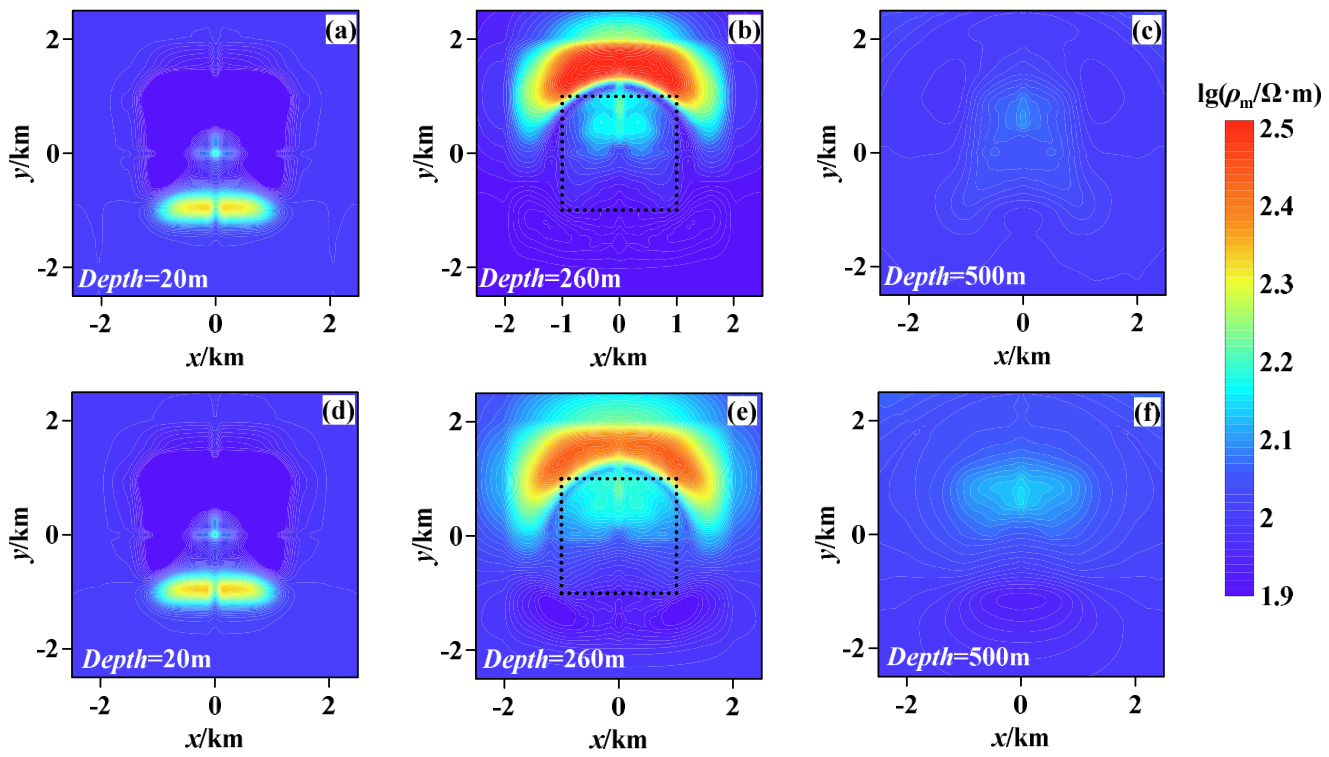
Figure 16.
Longitudinal profile imaging results of single high resistivity abnormal model: (a)~(c) are the imaging results for Tx; (d)~(f) are the imaging results for Ty; sections at y=-2000m, y=-300m, y=2000m, represent x-z plane longitudinal-sections, with the y=-300m section intersecting the anomaly, y=-2000m and y=2000m are located on either side of the anomaly.
Figure 16.
Longitudinal profile imaging results of single high resistivity abnormal model: (a)~(c) are the imaging results for Tx; (d)~(f) are the imaging results for Ty; sections at y=-2000m, y=-300m, y=2000m, represent x-z plane longitudinal-sections, with the y=-300m section intersecting the anomaly, y=-2000m and y=2000m are located on either side of the anomaly.
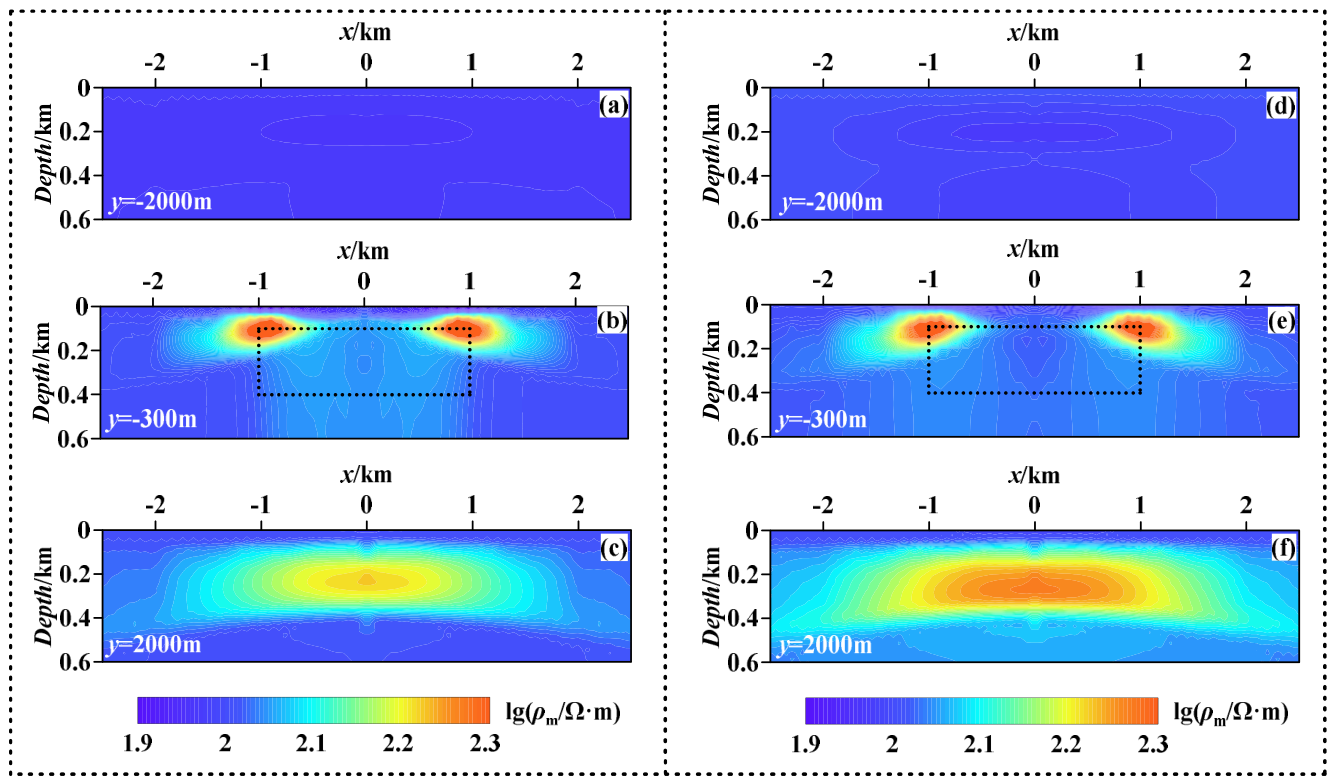
Figure 17.
Three-dimensional model of complex abnormal. (a) Planform; (b) Cross-section.
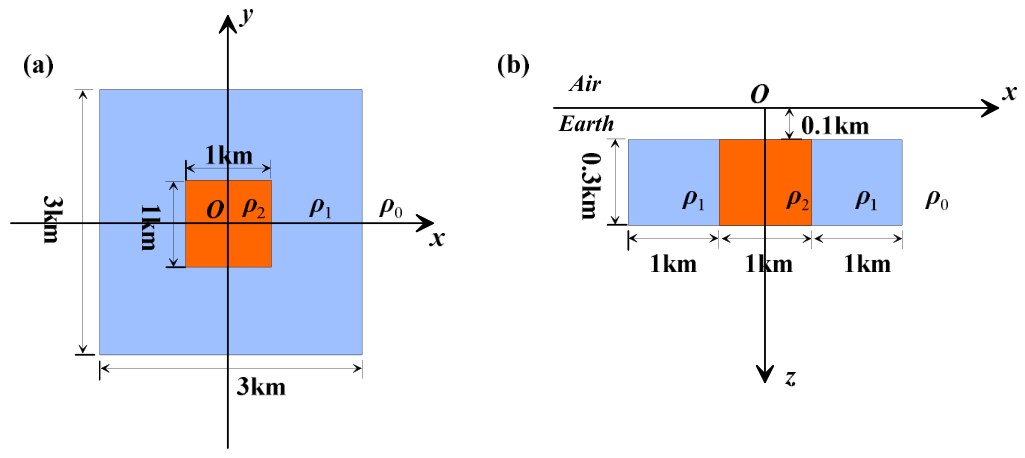
Figure 18.
Cross section imaging results of complex anomalous model: (a)~(c) are the imaging results for Tx; (d)~(f) are the imaging results for Ty; sections at Depth=20m, Depth=260m, Depth=500m, represent x-y plane cross-sections, with the Depth=20m section located above the anomaly, Depth=260m section intersecting the anomaly, and Depth=500m section below the anomaly.
Figure 18.
Cross section imaging results of complex anomalous model: (a)~(c) are the imaging results for Tx; (d)~(f) are the imaging results for Ty; sections at Depth=20m, Depth=260m, Depth=500m, represent x-y plane cross-sections, with the Depth=20m section located above the anomaly, Depth=260m section intersecting the anomaly, and Depth=500m section below the anomaly.
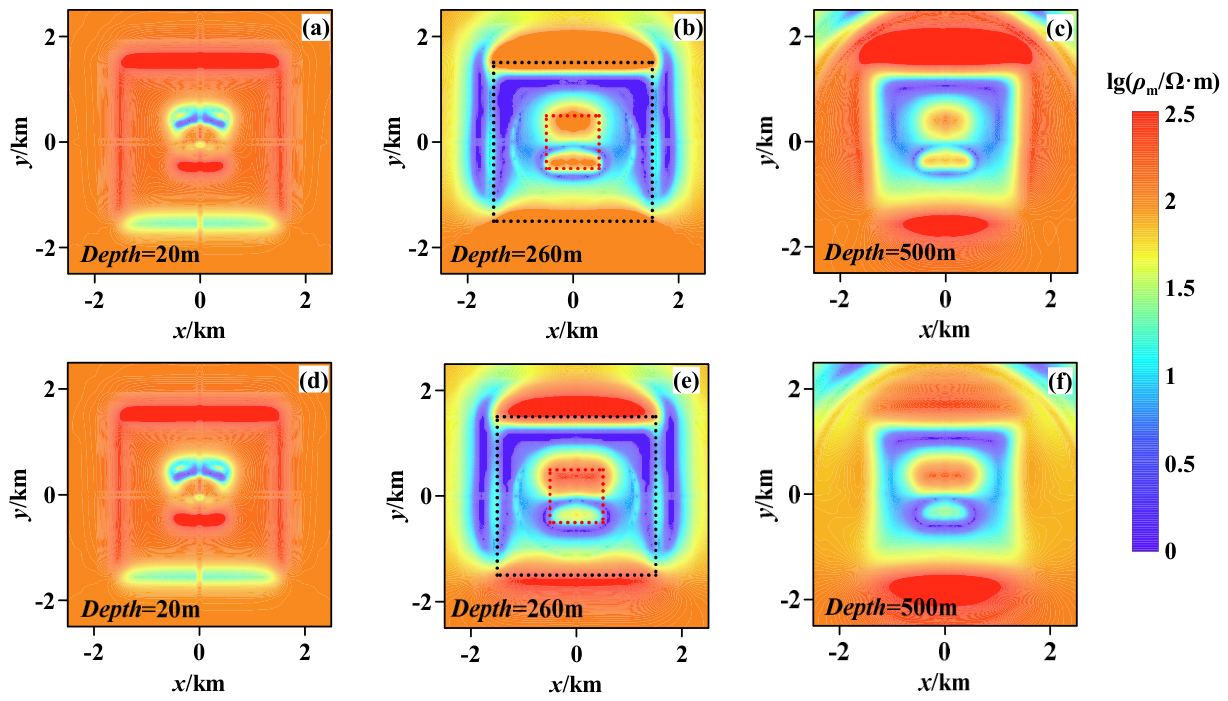
Figure 19.
Longitudinal profile imaging results of complex anomalous model: (a)~(c) are the imaging results for Tx; (d)~(f) are the imaging results for Ty; sections at y=-2000m, y=-300m, y=2000m, represent x-z plane longitudinal-sections, with the y=-300m section intersecting the anomaly, y=-2000m and y=2000m are located on either side of the anomaly.
Figure 19.
Longitudinal profile imaging results of complex anomalous model: (a)~(c) are the imaging results for Tx; (d)~(f) are the imaging results for Ty; sections at y=-2000m, y=-300m, y=2000m, represent x-z plane longitudinal-sections, with the y=-300m section intersecting the anomaly, y=-2000m and y=2000m are located on either side of the anomaly.
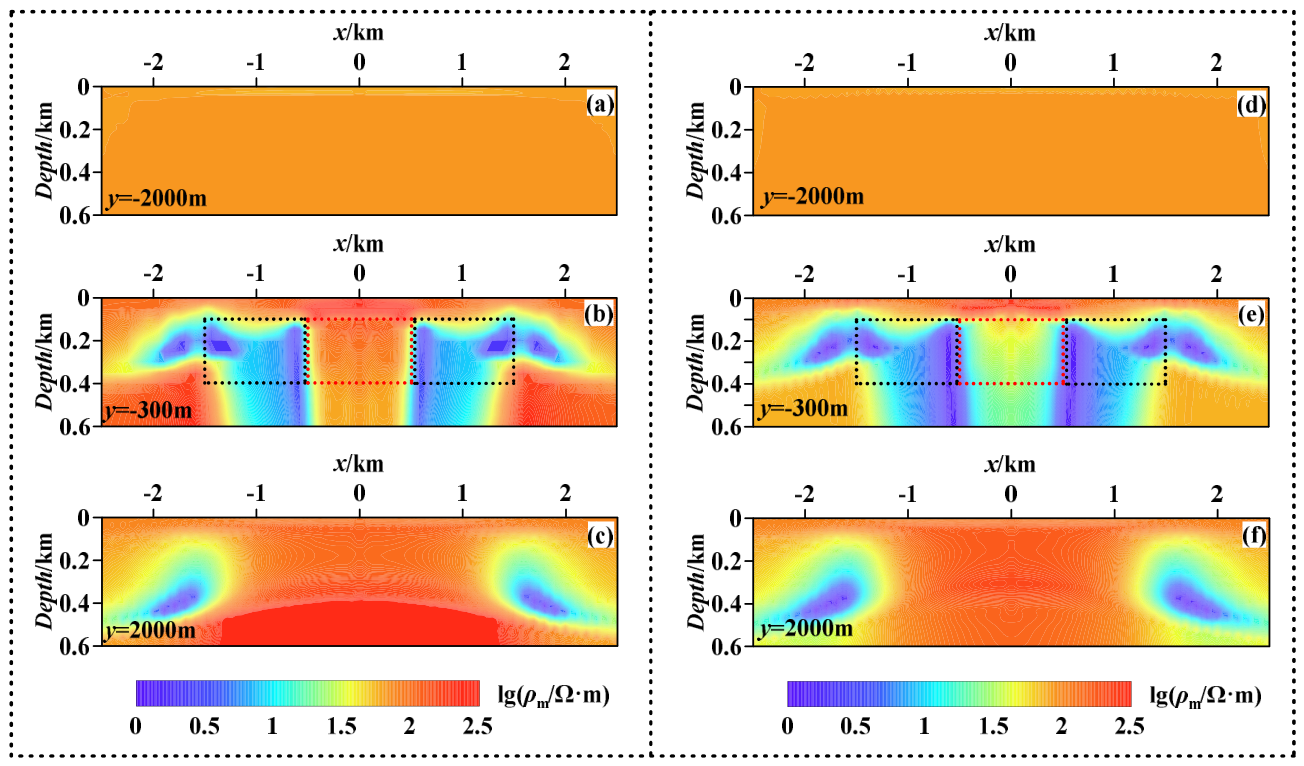

Table 1.
Rational number fitting coefficient table.
| Fitting coefficient | P | Q |
|---|---|---|
| 1 | 0.9715 | -12.05 |
| 2 | -9.777 | 47.53 |
| 3 | 11.36 | -86.08 |
| 4 | 100.7 | 198.9 |
| 5 | -53.72 | -99.06 |
| 6 | -6.315 | \ |
Disclaimer/Publisher’s Note: The statements, opinions and data contained in all publications are solely those of the individual author(s) and contributor(s) and not of MDPI and/or the editor(s). MDPI and/or the editor(s) disclaim responsibility for any injury to people or property resulting from any ideas, methods, instructions or products referred to in the content. |
© 2026 by the authors. Licensee MDPI, Basel, Switzerland. This article is an open access article distributed under the terms and conditions of the Creative Commons Attribution (CC BY) license (http://creativecommons.org/licenses/by/4.0/).
Copyright: This open access article is published under a Creative Commons CC BY 4.0 license, which permit the free download, distribution, and reuse, provided that the author and preprint are cited in any reuse.


