

Submitted:
19 May 2026
Posted:
20 May 2026
You are already at the latest version
Abstract
Low productivity in sub-Saharan Africa is closely linked to declining soil fertility and suboptimal fertilizer use. While balanced fertilization can improve yields and sustain soils, evidence for fertilizer optimization in smallholder maize systems remains limited and site-specific. This study evaluated maize yield responses to various of N, P, K, and secondary and micronutrients (SMN) combinations across agroecological zones (AEZs) in Uganda. Multi-location trials were conducted on 101 farms over two seasons using a randomized complete block design, with varying N and P rates in combination with K and SMN applications. Results indicate strong heterogeneity of maize yields across AEZs mostly due to soil properties. Nitrogen was the most dominant yield limiting nutrient. The N × P interaction was not significant (p > 0.05). Nitrogen response followed a quadratic trend, with strong yield gains (45–132%) at 30–80 kg N ha⁻¹ but gains beyond 120–160 kg N ha⁻¹, were not significant. Responses to K and SMN were inconsistent and site-specific. AEZ explained 77% of yield variation, fertilizer treatments 13%, with soil properties accounted for additional explanatory power. These findings highlight the emphasis on prioritizing N management with adequate P supply and guided, site-specific K and SMN applications.
Keywords:
balanced fertilization
; NP response surface
; nutrient mining
; nutrient use efficiency
; secondary and micronutrient
1. Introduction
Maize is a major crop for smallholders in Uganda and contributes to food security, rural income and employment. However, national average maize yield are well below attainable yields, mainly due to low inherent soil fertility, particularly N and P deficiencies, exacerbated by soil fertility depletion [1,2], minimal fertilizer use (https://data.worldbank.org/indicator/AG.CON.FERT.ZS - 2022) together with other biotic and abiotic constraints, and poor adoption of other productivity enhancing technologies [3]. These multiple challenges in crop production are common across most countries in sub-Saharan Africa (SSA). It is estimated that about 46% of Uganda’s soils are degraded and 10% are very degraded including soil acidity [4]. The low inherent fertility is due to highly weathered and nutrient deficient parent materials [5], and to depleting soil organic matter. Nutrient mining is increasing through soil erosion, crop harvest and crop residues removal, with no-or less use of external sources of nutrients. These problems have resulted in low nutrient use efficiency, low crop productivity and deteriorating soil health.
The average fertilizer use rate in Uganda is only 3.3 kg ha-1 year-1, which is much lower compared to SSA average of 22 kg ha-1, and the Comprehensive Africa Agriculture Development Programme (CAADP) target of 50 kg ha-1 year-1 of nutrients by 2015 and the global average of 154 kg ha-1 (https://www.theglobaleconomy.com/Uganda/fertilizer_use/; accessed on 26 November 2025). The less or no fertilizer use is due to unavailability in time and quantity, limited knowledge, lack of awareness of the potential of fertilizers to increase crop yield and fertilizers being not affordable for most smallholder farmers due to high cost. Midamba et al. [6] studied the reasons behind low use of inorganic fertilizers in Western Uganda. Their study suggested that major barriers of farmers adoption of inorganic fertilizers are high cost of fertilizers, distance to market (poor access), lack of extension services, particularly for women farmers, limited financial capacity and household labor constraints. Many smallholder farmers are cultivating with little or no fertilizer (organic and inorganic), leading to nutrient mining [7]. Nutrient loss (N, P and K) is estimated at 87 kg ha-1 year-1 [8] and their balance in the soil is negative [9] Moreover, farmers lack awareness on the use of balanced fertilization and 4Rs (right source, right rate, right time and right placement) of nutrient stewardship. To meet the food security target of the country, crop productivity must be increased, and fertilizer plays a critical role in achieving this. Vanlauwe and Dobermann [10] suggested that sustainable intensification is needed to improve system productivity, and this cannot happen without the use of fertilizers.
It is important to understand maize yield response to fertilizers to develop optimum fertilizer recommendations and improve profitability. However, studies on balanced fertilization for maize cultivation in Uganda are very limited. Few studies were conducted under the project ‘Optimizing fertilizer recommendations in Africa (OFRA)’ where Kaizzi et al. [11] conducted 22 field trials across 4 Agro-ecological zones (AEZs) to determine optimum fertilizers for maize cultivation. This study identified that N is the most limiting nutrient for maize cultivation and application of N doubled the yields compared to without N, and the economic N rate ranged from 25-45 kg ha-1 depending on the cost of nutrient (C) to farmgate price of produce (P), i.e., C:P ratio. This economic N rate was also confirmed by a recent study by Falconnier et al. [12], who reported 24 kg N ha-1 as profit maximizing N input. They reported application of phosphorus (P) had a marginal benefit on yields, particularly in the regions where deficiency of P is evident, suggesting that blanket P application is less profitable compared to N. Effect of potassium (K) was not significant on yields, except in the areas where soil test shows K deficiency. Those trials confirmed that nitrogen is the most limiting nutrient for maize across studied sites, while K, and secondary and micronutrients (SMN) including S, Zn, B do not have significant effects on yields. This suggests that fertilizer recommendations should focus on correcting N deficiency first, leading to more efficient and cost-effective maize production strategies. However, their study was focused on smallholders’ financial constraints and cost of fertilizer while developing recommendations, rather than determining agronomic optimum yields.
Another study by Sadina et al. [13] also highlighted the importance of managing N fertilizers for improved maize yield. They investigated the combination of soybean residue with N fertilizer for improved maize production across Eastern Uganda and reported that 120 kg N ha-1 together with soybean residue at 4 mt ha-1 increased yield by about 141% over the control.
Although N is the most liming nutrient for maize cultivation in Uganda, continuous application of a single nutrient may lead to mining of other nutrients from soils. A recent meta-analysis conducted by Mhoro et al. [14] confirmed that a significant mining of N and K from SSA soils. Soil fertility is continuously declining due to cropping with less use of fertilizers. The current level of production is at the cost of nutrient mining, and this cannot be sustained in the future [15]. Also, farmers may not be able to sustain maximizing profit with only N application. In this context, we hypothesized that N response on maize yield could be affected by application of P, and K and SMN respond to the yield when N and P are applied at optimum rate. A meta-analysis by Kihara et al. [16] showed widespread deficiency of S and micronutrients (Zn, B, Cu) and they affected crop performance, grain quality and human nutrition. However, their response on maize yields varied—some reported increased yields, while other finds benefits on grain quality. This spatial variation suggests the importance of representative field trials across wide range of soil types, climatic conditions, and management domains. Thus, it is important to conduct fertilizer response trials across different AEZs to determine the effects of balanced fertilization on crop yield and profits. Therefore, this study was conducted to determine the optimum rate of N and P, and effects of K and SMN across different nutrient regimes, with the following specific objectives.
- To determine the NP response surface (NP interaction) on maize yield and nitrogen use efficiency.
- To determine the effects of K application across medium and high NP rates on maize yield.
- To determine the effects of SMN on maize yields when N only, NP and NPK are applied.
- To assess the effects of soil properties on maize grain yields.
2. Materials and Methods
2.1. Description of the Study Sites
The study was conducted across 5 agroecological zones, namely Lake Victoria Crescent (LVC), Mbale Farmlands (Mbale), Mt. Elgon High Farmlands (MHF), Northen Moist Farmlands (NMF) and Western Medium High Farmlands (WMHF) [17] during the long and short rain seasons of 2023 referred to as season 2023A and 2023B, respectively (Figure 1). Season 2023A runs from March to June and season 2023B runs from September to December. These AEZs receives rainfall above 1200 mm per year in a bimodal pattern for LVC, Mbale, MHF and WMHF, and in a unimodal pattern for the NMF.
Soil properties show wide variability across AEZ. They are slightly acidic to neutral. Soil OC ranged from 1.3-3.2%, and total N ranged from 0.1-0.2%, both were higher in Mt. Elgon, Mbale farmlands and Western medium high farmlands and lower in LVC and NMF. Available P was lower in Mt. Elgon (2.6 mg kg-1) and higher in Mbale (196 mg kg-1). Similarly, exchangeable bases (K, Ca, and Mg) varied widely across regions—they were relatively higher in Mbale, while lower in NMF. Micronutrient Zn was higher in LVC compared to other regions. The details of soil properties are shown in Table 1.
2.2. Treatments and Experimental Design
Treatment structure tested for the FOT (fertilizer optimization trial) follows trials originally developed by OFRA under an AGRA grant and builds upon that work. There are some changes adopted including addition of the SMN to selected treatments, selection of fertilizer sources that are used by fertilizer blenders, and micronutrients coated onto NP (K) granules to optimize distribution and use efficiency, fewer N and P combinations that form an NP response surface. Hypothesis of designing treatment structure is that N is most limiting, followed by P, K and SMN. Thus, N response increases by increasing P, while P responds well at medium to high N rates and K responds at higher NP rates. The proposed treatment structures (combination of NPK and SMN) help to determine the better combination of N, P, K and SMN that will result in higher return on fertilizer investment and whether this combination varies by sites. There are three sets of treatments (NP response, K response and SMN response) (Table 2 and Table 3), but all of them were laid out together in each site and separated for data analysis (see data analysis section for detail). The NP response treatments are T1-T9 for 2023A and T1-T11 for 2023B, K response treatments are T9-T11 for 2023A and T7, T11-T15 for 2023B, and SMN response treatments are T2, T4, T11-T14 for 2023A and T4, T12, T15-T18 for 2023B, respectively. Given that most fertilizer blenders in SSA coat micronutrients in blended fertilizers, this treatment structures provide better idea whether adding micronutrient is important for yield and economics. Fertilizer mixing and blending as per treatment was done centrally at IFDC in Nairobi, Kenya and shipped to National Agricultural Research Organization (NARO), Uganda. Pre-weighed fertilizers were provided to each trial site. Treatments were arranged in a randomized complete block design at each site, and a farm was considered as a replication.
A total of 39 trials were conducted in first season of 2023 (2023A) across 3 agroecological zones (AEZs) (10 in Northern Moist Farmlands, 17 in Lake Victoria Crescent, and 12 in Mt. Elgon Farmlands and Mbale Farmlands). Similarly, a total of 62 trials were conducted in the second season 2023 (2023B), namely 28 in LVC (Bugweri 10, Tororo 11 and Mityana 7), 20 in Western Medium High Farmlands (Mubende) and 14 in Mbale Farmlands (Bulambuli). The treatment structures for the second season were slightly modified (Table 3) from the first season.
2.3. Planting and Crop Management
In each farm, individual plot (4.5 m x 6 m) was prepared following agronomic practices as recommended by NARO. Maize planted at spacing—row to row (75 cm) and plant to plant within a row (60 cm). Maize seeds (cv, hybrid, Bazooka) were planted 2 seeds per hole every 60 cm along the row. Distance from the last row of one plot to another was 1.5 m. The same variety and planting geometry were adopted across AEZs and seasons.
Each plot was labelled properly before applying fertilizer to ensure accurate application. Pre-weighed fertilizers were applied to each plot in a row and frequency was as per treatment. The total fertilizer weighed for each plot was equally divided for each row to ensure precise application. Basal fertilizers distributed in the planting hole at 10 cm depth and covered with 5 cm of soil. The fertilizers were placed to the side of the seeds in the same planting hole and covered with 5 cm of soil. Basal fertilizers (blends) were applied basally during planting time and topdressing (urea) was applied 45 days later.
2.4. Harvest and Data Collection
Each trial was harvested at maturity stage. Data was recorded for number of plants, number of prolific plants, total number of cobs, missing or stolen plants, plants affected by disease pest, weight of cobs with grains and grains from harvest area of each plot. Grain yield was calculated at hectare basis from fresh grain yield per plot and adjusted at 14% moisture content. For stover, sub-samples were oven-dried and stover yields estimated on oven dry basis. In addition to grain and stover yields, agronomic nitrogen use efficiency (maize yield increase per kg of N applied; AE-N) and partial factor productivity of N (yield per kg of N applied; PFP-N) were calculated based on grain yields from fertilized treatments and the control.
2.5. Data Analysis
Data analysis was performed in R software. Data was analyzed for descriptive statistics, multiple regression, analysis of variance (ANOVA) and post-hoc test, analysis of covariance (ANCOVA), principal component analysis (PCA). Although ANOVA was conducted to determine interaction of treatment and AEZ, considering variations in yields and soil properties, agroclimatic, and unequal number of experiments across AEZs and years, data is presented by AEZ and years. Before running the analysis, trends and patterns of treatments were evaluated by AEZ as per hypothesis. Data were checked for normality (Shapiro wilk test), and homogeneity of variance (Levene’s test).
Although all treatments were established within the same experiment at each site, data were analyzed according to pre-defined analytical objectives (NP response surface, K response, and SMN response). For NP response surface analysis, data from the NP combination treatments (9 treatments [1,2,3,4,5,6,7,8,9] for 2023A and 11 [1,2,3,4,5,6,7,8,9,10,11] for 2023B) were used to determine the combined effects of N and P. A multiple regression approach was adopted to characterize the NP response surface. The initial model included linear, quadratic and cubic terms for N and P, as well as their interaction terms.
Y = β0 + β1N + β2P + β3N2 + β4P2 + β5NP + β6N3 + β7P3 + ε
Model was simplified eliminating non-significant higher-order terms. NP interaction term was non-significant across any AEZ and seasons, thus, excluded from the final model, indicating that N response was independent of P rate within the range evaluated. Higher-order polynomial terms were also excluded (although marginally significant) where they do not contribute to a biologically interpretable response. When quadratic terms were significant, response curves were generated accordingly, and linear model was retained in the regions where yield increased linearly with N over the evaluated range.
For AEZs where only N effects were significant, N response curves were generated by averaging yields across P rates, and N was modeled as a quantitative factor to identify response shape and agronomic optimum. Quadratic regression was performed to identify the relationships between various N rates and maize yields. Quadratic regression was used based on the fitted line with a higher coefficient of determination (R2) value over the linear model to explain the relationship between N fertilizer supply and yields. The N-response curve (N rate vs yield) was used to identify the right rate of N fertilizer to produce the optimum yield across the agroecological zones. A linear regression model was fitted to identify the relationship between various soil chemical parameters and maize yield across the agroecological zones.
To complement regression analysis and facilitate comparison among discrete treatment combinations, an ANOVA was also conducted on 9 and 11 NP combination treatments for 2023A and 2023B, respectively. For each season (year) a two-factor ANOVA (fixed effects model) was conducted with the following factors: (1) treatments and (2) agroecological zones, including their interactions, keeping maize yield and nutrient use efficiency (PFPN and AEN) as the dependent variable.
Similarly, K response was evaluated using treatments specifically designed to test increasing K rates (0, 30 and 60 Kg K2O ha-1) at fixed N and P levels (T9-T11 for 2023A and T7, T11-T15 for 2023B, respectively). Grain yields data were analyzed using ANOVA with K rate as a fixed effect and block (farm) as a random effect. Since agroecological zones were purposively chosen to capture the effects of fertilizer treatments, these factors were considered fixed rather than random in the analysis. Factors that showed significant effects were further examined using a post-hoc test (Tukey’s HSD) at the 5% significance level.
The effects of SMN (with and without) were evaluated under three fertilizer contexts (N only, NP and NPK for 2023A; low NP, medium NP and high NPK for 2023B) (T2, T4, T11-T14 for 2023A and T4, T12, T15-T18 for 2023B, respectively). Treatments were structured to test whether the addition of SMN resulted in a yield response when applied in combination with each of these nutrient regimes. Accordingly, SMN effects were assessed using planned (hypothesis-driven) constants, rather than full pairwise mean comparison. At each nutrient context, contrasts compared with and without SMN while other nutrients remained constant (effects of SMN when applied with N only, NP and NPK). Statistical significance of contrasts was evaluated using t-tests at the 5% probability level.
Since experiments were conducted across multiple AEZs (varying soil properties) with unequal numbers of site-years per zone, analysis was conducted within AEZ to avoid confounding treatment effects with variable soil properties and agroclimatic conditions. Therefore, an Analysis of Covariance (ANCOVA) was applied to evaluate whether soil covariates (17 parameters) confounded the treatment effects on maize yield. Both full and reduced ANCOVA models were tested. The full model included the two categorical factors (treatment and agroecological zone) along with all 17 soil covariates. Soil covariates that did not show significant confounding effect were not included in the reduced model. Moreover, to address multicollinearity among soil parameters, variance inflation factors (VIF) were calculated, and covariates with VIF values greater than 3 were excluded. A principal component analysis (PCA) was also conducted to examine relationships among soil variables, identify strongly correlated variables, and guide covariate reduction. Thus, the reduced model includes factors and only significant non collinear soil covariates. The reduced model therefore comprised two categorical factors and five soil covariates (pH, P, K, CEC and N), and their effects on maize yield were analyzed.
3. Results
3.1. Effects of NP Response Surface on Maize Yield
Multiple regression shows that N response on maize yields was consistent across P levels as nitrogen had no significant interaction effect with P (p>0.05). Across both the 2023A and 2023B seasons (Figure 2 and Figure 3), N response curves consistently showed strong, nonlinear increases in maize yield with N application. However, the magnitude and shape of the response varied across agroecological zones. When aggregated across sites, yields rose steeply at low to moderate N rates and generally plateaued between 100–140 kg N ha−1, as indicated by well-fitted quadratic models (R2 = 0.94–0.95). AEZs such as the Northern Moist Farmlands and the Western Medium High Farmlands exhibited the strongest and most sustained yield increases, with high R2 values (0.99) and no clear yield plateau within the applied N range in 2023A and 2023B, respectively. In contrast, the Lake Victoria Crescent and Mbale/Mt. Elgon zones showed substantial gains at low to moderate N levels but diminishing marginal returns beyond roughly 90–120 kg N ha−1, reflecting clear quadratic saturation patterns (R2 = 0.76–0.94). Overall, the two seasons demonstrate consistent trends: maize yield is highly responsive to N supply, but the agronomic optimum varies across agroecological zones, with all sites showing reduced marginal yield gains at higher N inputs. Overall nutrient response relative to the control treatment was higher in Mt. Elgon than in other regions (Figure S1).
Following the NP response surface analysis, which indicated no significant N x P interaction and a significant nonlinear response to N, treatment means were further evaluated using ANOVA to identify discrete fertilizer combinations that resulted in statistically different maize yields.
In the 2023A season, N application significantly increased grain yields across AEZs. However, yield gains beyond low-medium N rates (40 kg N ha-1 in LVC and Mt. Elgon; 80 kg N ha-1 in NMF) were modest and not statistically significant (Figure 4). Most NP treatment combinations produced statistically similar yields. Although P application at lower N rates (e.g., N40 vs N40P30) tended to increase yield, the increment was not statistically significant. Across AEZs, Mt. Elgon High Farmlands consistently recorded higher yields than the other AEZs, with fertilized plots averaging 8-10 mt ha-1 compared to approximately 5 mt ha-1in the control. In contrast, yields in the LVC and NMF ranged between 4-6 mt ha-1 under fertilized conditions.
In the 2023B season, NP treatment effects varied significantly across regions. Nitrogen effects were significant in all AEZs, consistent with results from 2023A. However, increasing N rate beyond 30-60 kg ha-1 (in combination with the minimum P rate of 17 kg P2O5 ha-1) did not produce statistically significant additional yield gains in any AEZ (Figure 4). In the Western Medium High Farmlands, yields increased progressively with the combined N and P application, with the highest yields (>4.5 t ha−1) observed at 120 kg N ha−1 with the highest P rate. Nevertheless, these yields were not significantly different from those obtained at 60 kg N ha-1 combined with 17 kg P2O5 ha-1. In the Lake Victoria Crescent, yields ranged more narrowly (1.2–3.2 mt ha−1), but N application significantly incrased yield relative to the control. Similarly, in the Mbale Farmlands, yield responses were more modest and primarily driven by N supply. In both Mbale and LVC, increasing N rate beyond 30 kg ha-1 (with minimum P) did not result in significant yield gains.
3.2. Nitrogen Use Efficiency (NUE)
Similar to grain yield, both AE-N and PFP-N showed wide variability across AEZs and N application rates (Table 4). The AE-N was higher at lower to moderate N rates and showed declining trend with increasing N rates. PFP-N showed a similar trend, markedly higher value was observed at lower N rate, reduced at higher rates. Relatively higher AE-N and PFP-N was observed in high potential AEZ (Mt. Elgon high farm lands) followed by Lake Victoria Crescent, and Northern Moist Farmlands.

Table 4.
Average (± standard error of mean) partial factor productivity of N (PFP-N) and agronomic efficiency of N (AEN) (aggregated and disaggregated) in 2023A. Average value followed the same letters are not significantly different at 5% probability level.
Table 4.
Average (± standard error of mean) partial factor productivity of N (PFP-N) and agronomic efficiency of N (AEN) (aggregated and disaggregated) in 2023A. Average value followed the same letters are not significantly different at 5% probability level.
| Treatment | PFPN | AEN | ||||||
|---|---|---|---|---|---|---|---|---|
| Average | LVC | Mt. Elgon | NMF | Average | LVC | Mt. Elgon | NMF | |
| N40 P0 | 144 ± 10 a | 132 ± 10 a | 210 ± 18 a | 85 ± 8 a | 56 ± 7 a | 41 ± 8 abc | 97 ± 14 ab | 32 ± 6 b |
| N80 P0 | 75 ± 5 cd | 70 ± 5 bc | 107 ± 7 c | 46 ± 5 cd | 30 ± 3 bc | 23 ± 4 bcde | 50 ± 5 cde | 16 ± 3 b |
| N40 P30 | 151 ± 11 a | 136 ± 8 a | 224 ± 18 a | 91 ± 8 a | 61 ± 8 a | 43 ± 6 ab | 110 ± 17a | 31 ± 7 b |
| N80 P30 | 77 ± 5 c | 73 ± 5 bc | 106 ± 8 c | 51 ± 7 bcd | 32 ± 4 bc | 27 ± 5 bcde | 49 ± 8 cde | 21 ± 6 b |
| N120 P30 | 57 ± 4 cd | 50 ± 5 cd | 76 ± 5 c | 45 ± 3 cd | 27 ± 3 c | 20 ± 4 de | 39 ± 5 e | 25 ± 2 b |
| N80 P60 | 112 ± 8 b | 100 ± 7 b | 159 ± 11 b | 75 ± 6 ab | 51 ± 5 ab | 38 ± 5 abcd | 83 ± 11 abcd | 36 ± 4 ab |
| N120 P60 | 56 ± 2 cd | 50 ± 3 cd | 78 ± 2 c | 40 ± 2 d | 26 ± 2 c | 19 ± 2 de | 41 ±3 e | 20 ± 2 b |
| N160 P60 | 45 ± 2 d | 39 ± 3 d | 64 ± 5c | 33 ± 2 d | 22 ± 2 c | 16 ± 2 e | 36 ± 5 e | 18 ± 2 b |
SMN applied to all NP combination treatments.
Table 5.
Average (± standard error of mean) partial factor productivity of N (PFP-N) and agronomic efficiency of N (AEN) (aggregated and disaggregated) in 2023B. Average value followed the same letters are not significantly different at 5% probability level.
Table 5.
Average (± standard error of mean) partial factor productivity of N (PFP-N) and agronomic efficiency of N (AEN) (aggregated and disaggregated) in 2023B. Average value followed the same letters are not significantly different at 5% probability level.
| Treatment | PFPN | AEN | ||||||||||||
|---|---|---|---|---|---|---|---|---|---|---|---|---|---|---|
| Average | LVC | Mbale | WMHF | Average | LVC | Mbale | WMHF | |||||||
| N30 P0 | 92±8 | ab | 53±3 | a | 98±10 | a | 53±8 ab | 23±3 ab | 29±4 | |||||
| N60 P0 | 40± 4 | cde | 28±2 | bc | 59±5 | bcd | 21±3 d | 13±2 bcd | 24±4 | |||||
| N30 P17 | 80± 10 | b | 50±4 | a | 100±9 | a | 42±8 bc | 20±3 abc | 31±6 | |||||
| N60 P17 | 49± 6 | c | 30±3 | b | 66±6 | b | 30±6 cd | 15±3 abcd | 32±3 | |||||
| N30 P34 | 101±11 | a | 54±6 | a | 105±10 | a | 63±11 a | 25±6 a | 36±7 | |||||
| N60 P34 | 41±4 | cde | 30±3 | b | 62±5 | bc | 22±3 d | 15±3 bcd | 27±2 | |||||
| N90 P34 | 30±4 | de | 17±1 | de | 45±3 | cd | 17±4 d | 7±1 d | 22±2 | |||||
| N60 P51 | 48±6 | cd | 26±2 | bcd | 61±5 | bc | 29±5 cd | 11±2 cd | 26±3 | |||||
| N90 P51 | 27±3 | e | 18±2 | cde | 45±3 | cd | 15±2 d | 8±2 d | 21±2 | |||||
| N120 P51 | 23±3 | e | 14±1 | e | 39±3 | d | 14±3 d | 7±1 d | 22±2 | |||||
3.3. Effects of K on Maize Yield
For 2023A, K response was evaluated at a fixed high NP rates (120 kg N ha-1 and 60 kg P2O5 ha-1). Yield responses to K application varied across AEZs. In Mt. Elgon High Farmlands, application K of 30 kg K2O ha-1 significantly increased maize yield by 14% (p<0.05) compared with the K-0 control. However, increasing the rate to 60 kg K2O ha-1 did not result in further yield improvement, with yields comparable to the K control treatment. In constrast, no significant yield responses to either 30 or 60 kg/ha were observed in the NMF or LVC (Figure 5).
In the 2023B season, K response was evaluated across two NP nutrient regimes—a medium NP rate (60 kg N ha-1 and 34 kg P2O5 ha-1) and a high NP rate (120 kg N ha-1 and 51 kg P2O5 ha-1). Analysis of variance indicated no significant interaction between K rate and NP nutrient regime (K x NP, p>0.05). Therefore, K effects were interpreted across NP regimes using averaged means. Application of 25 kg K2O ha-1 significantly increased maize yields by 10% in Western Medium High Farmlands and by 15% in the Lake Victoria Crescent compared with the K control. No significant K response was observed in Mbale Farmlands. Across all three regions, the high NP nutrient regime consistently produced significantly higher yields than the medium NP regime, irrespective of K application rate.
3.4. Effects of SMN on Maize Yield
The Effects of SMN application with N only, NP and NPK on maize yields varied considerably across AEZs and seasons. Overall, the results did not support the hypothesis that SMN applications would consistently increase yield when applied together with optimum NPK rates. Although SMN tended to increase yield when combined with NPK in some cases, these effects were not statistically significant compared with treatments without SMN.
In the 2023A season, SMN applications with NP fertilizer significantly reduced maize yields in NMF region in 2023A (Table 5). In contrast, during the 2023B season, SMN applied at medium NP rates increased maize yields by 14% in the Western Medium High Farmlands. However, no significant SMN effects were observed in Mbale Farmlands or the Lake Victoria Crescent. Furthermore, SMN did not improve yields when applied with low NP rates or with high NPK rates; in several cases, yields tended to decline relative to the treatments without SMN (Table 5).
3.5. Effects of Soil Properties on Maize Yield
Across both seasons, ANCOVA results showed that maize yield variation was jointly influenced by fertilizer treatments, agroecological zone (AEZ), and key soil properties (Table 6). In 2023A, AEZ was the dominant source of explained variation (77%), followed by fertilizer treatments (13%) and soil covariates. Among soil properties, CEC had the strongest effect, with additional contributions from total N, available P, exchangeable K, and soil pH, indicating that inherent soil fertility and agroclimatic conditions substantially shaped crop responses. The details of the regression relationships of soil properties and yields are presented in Figures S2–S5
In the 2023B season, treatment and AEZ again had highly significant effects on yield (p < 0.001), consistent with 2023A findings. After adjusting for these factors, several soil nutrients remained significant covariates. Macronutrients including P, Mg, K, and Ca showed strong positive associations with yield (p < 0.001), while micronutrients such as Mn and Cu also contributed significantly. Soil texture (sand and clay fractions) further explained yield differences, underscoring the importance of both chemical and physical soil characteristics. In contrast, S, Zn, C, N, CEC, and Na showed no detectable effects in the second season, suggesting seasonal or site-specific variability in their influence. Overall, maize yield responses were highest in nutrient-rich and finer-textured soils, while sandy or nutrient-depleted soils exhibited weaker responses.
A combined analysis of covariance contributions for 2023B showed that fertilizer treatments explained only 9% of total variability, agroecological zone 19.1%, and soil covariates 32.5%, with 39.4% remaining unexplained. Collectively, these results highlight that while fertilizer inputs drive yield gains, inherent soil fertility and agroecological context are equally critical determinants of maize productivity across Uganda.
3.6. Principle Component Analysis
The PCA was conducted separately by season (2023A and 2023B; Figure 6 and Figure 7)). In 2023A, PCA biplot illustrates two principal components—PC1 explains 53% variance while PC2 explains 13% variance (Figure 6). PC1 is driven by high sand content as opposed by silt and clay. Other soil properties including available P, exchangeable K, Ca, Mg and Na showed a moderate loading on PC1, suggesting that nutrient variability was less influential than the soil texture. PC2 is driven by soil pH and micronutrients Zn and Mn. PCA biplot demonstrate that soil texture and pH-micronutrient relationships are the major multivariate drivers of soil variability. These suggest that these factors are to be considered to understand the maize yield potential and fertilizer effects across sites.
In 2023B, PCA biplot revealed a clear pattern in how soil properties influenced maize yield variation across sampled fields. The first two principal components explained 61.6% of the total variability (PC1-46.2% and PC2-15.38%) (Figure 7). Most samples clustered near the origin, indicating relatively similar soil conditions and corresponding yields, while a few samples, i.e., those positioned farther along PC1 were distinguished by higher concentrations of K, Ca, Mg, and S, as indicated by the longer vectors in this direction (major driver of yield differences). Conversely, samples positioned aways from these vectors exhibited lower levels of these nutrients, aligning with reduced yield. Overall, the PCA for 2023B highlights that maize yield variation was strongly associated with gradients in soil fertility, with nutrient-rich soils supporting comparatively higher yields.
4. Discussion
Our results show that maize yield response is predominantly driven by N, while responses to P, K and SMN are comparatively smaller, highly variable, and site-specific. The NP response surface analysis showed no significant N x P interaction across any AEZs and seasons, suggesting that N response is not dependent on P. Nitrogen response on maize yields was predominantly quadratic (Figure 1 and Figure 2), indicating diminishing marginal returns at higher N rates. Although the magnitude of response varied among AEZs, and seasons, the general pattern was consistent, strong yield increased at low to moderate N rates (30-80 kg N ha-1) followed by plateau.
The N response curve showed that yield increased sharply at low N rate and leveled off beyond moderate application levels (>80 kg N ha-1). Although agronomic optima observed at higher N rates (120-160 kg N ha-1), ANOVA of discrete treatment indicated that yield gains beyond 40-80 kg N ha-1 in 2023A and 30-60 kg N ha-1 in 2023B were not statistically significant. This suggests that the moderate N rates capture most of the attainable yield benefit under farmer conditions. These findings align with earlier studies in Uganda and East Africa, which reported relatively low economic optimum N rates (24-45 kg ha-1) for maize production [11,18]. Yield increased sharply at low to moderate N rates and plateaued between 120–160 kg N ha−1, indicating diminishing marginal returns. Since application of P, K and SMN had no additive effects on yields, the flattening of the N curve could be due to other constraints, which can be biotic and abiotic. Although optimum N rate approached at 120–160 kg N ha−1, it may not be economical due to the high cost of nutrient (C) to farmgate price (P) ratio, which requires comprehensive economic analysis to determine the economical optimum rate. From both economic and environmental perspectives, the plateauing of the N response curve is important. Increasing N beyond moderate rates produced only marginal yield grains while potentially increasing risks of N losses through volatilization, leaching, and denitrification and nitrous oxide emissions. Smallholder farmers facing economic constraints—particularly where fertilizer markets are unsubsidized—necessitate integrating agronomic and economic optima while developing recommendations to farmers.
It is well known that the optimal nutrient requirement for crop production depends on soil’s inherent nutrient supply, crop management practices, including the use of organic and inorganic inputs, and crop’s yield potential or nutrient demand. Across different AEZs in Uganda, soil fertility is generally of low inherent fertility (particularly N deficiency), and N supply is low to moderate in most soils due to low OC and continuous nutrient mining, low use efficiency of applied N due to increased losses from ammonia volatilization, leaching and nitrification-denitrification. Because of low fertilizer use knowledge by farmers, they are not adopting the 4Rs nutrient Stewardship. All of these and no- or less use of fertilizer makes N the most yield-limiting nutrient for maize. Naturally N and P are the most limiting nutrients in soils of Uganda like in other tropical countries. Moreover, most smallholder farmers have poor access to fertilizers, thus, they apply little or no fertilizers, resulting in further nutrient mining from soils.
The observed variations in nitrogen use efficiency (AE-N and PFP-N) across AEZs suggest that soil and environmental conditions play a critical role in yield response to fertilizers. Agroecological zones such as the Mt. Elgon Farmlands and Lake Victoria Crescent, which are characterized by higher organic matter content, better soil structure, and more favorable pH, consistently exhibited greater NUE compared with the Northern Moist Farmlands, where lower soil fertility and co-limiting factors constrained crop response. These findings are consistent with PCA and ANCOVA results, which identified soil texture, pH, CEC, and nutrient status as major drivers of yield variability and fertilizer response. It is well known that soil organic matter (SOC) and pH are among the factors determing soil fertility in Uganda soils as is the case in tropical soils. The CEC is equally important due to low activity clays 1:1 in tropical soils. Since NUE was higher at low to moderate level of N rates, farmers may get better economic returns while using low to moderate N rate synchronizing with soil fertility status. The reduced NUE at higher N rates further suggests the need of site-specific fertilizer recommendation as increasing application rate not only reduce farm profit but also increase losses of N to the environment. Overall, the efficiency results reinforce the need for AEZ- and soil-specific fertilizer management strategies that optimize agronomic returns while minimizing environmental externalities, in line with previous findings from Uganda and other sub-Saharan African maize systems [11,18,19].
Balanced fertilization should be viewed as a context-specific strategy that can enhance crop productivity, nutrient use efficiency, and long-term soil fertility when aligned with soil nutrient status and expected returns [20,21]. In this study, we have hypothesized that crop response to K and SMN occur after correcting N and P deficiency. Although the NP interaction was not statistically significant in the response surface model, P application provided modest yield improvements at lower N rates in some AEZs. This indicates that while N is the primary limiting nutrient, minimal P supply is necessary to optimize N use efficiency. The limited and inconsistent P response may reflect moderate native P levels in soil (Table 1). Ugandan soils, particularly volcanic or alluvial, have an adequate amount of P. It is reported that mycorrhizal activity is good, and maize could access more P from soil. This could partly explain why N response was not dependent on P [11]. Nevertheless, although large P increments may not consistently increase yields, maintaining an adequate baseline level of P remains important for sustaining soil fertility. From an economic perspective, P application should be guided by expected return on investment and soil fertility status, rather than routine or blanket application.
Potassium and SMN responses were highly variable, but significant across some AEZs. For example, moderate K rates (25-30 kg K2O ha-1) increased yields by 14% in Mt. Elgon in 2023A and 12-13% in Western Medium High Farmlands and LVC in 2023B, when applied with adequate NP. Potassium response was independent of NP regime within the tested range. Secondary and micronutrients combination significantly increased yield only in Western Medium High Farmlands (Table 5), and across most other sites it tended to decrease yields. These variabilities may be attributed to site-specific soil conditions, pH, texture, moisture regime, or nutrient interactions. Similar context-dependent micronutrient responses have been documented across East African cereal systems [18,22]. Moreover, maize yield response to K and SMN is an indication that K and SMN levels are depleting in soils. The low or negative response (some AEZs) of K and SMN could be due to low maize yield levels, particularly in the 2023B season, which could be attributed to other abiotic and biotic factors and soils in these regions generally supply sufficient K for maize growth and require SMN in small quantities [18]. These findings caution against blanket recommendations of K and SMN without clear diagnostic evidence. Nevertheless, maize still requires these nutrients for optimal growth and development and sustaining soil fertility and health. Application of N only usually results in depletion of other nutrients; thus, becoming limiting resulting in reduced PFP-N and agronomic efficiency. Some additional yield gains from SMN (S, Zn, B) treatments highlight the importance of addressing multi-nutrient limitations rather than relying solely on NP fertilizers, importantly to sustain soil fertility in the long run. Several studies have emphasized that cereal systems in East Africa are transitioning from single nutrient (mainly N) and two nutrients (NP) to multi-nutrient deficiency landscapes due to continuous nutrient mining, soil acidification, and soil organic matter decline [18,22]. Thus, fertilization strategies should prioritize site-specific balanced nutrient management, complemented by practices that enhance soil organic matter such as residue retention, organic input/manure use, and reduced tillage—to sustain long-term productivity and soil health plus good agronomic practices (GAP). Although benefits are minimal, farmers may not get considerable economic gain by using SMN and K across the sites with low response, their balanced use is important to address not only the poor soil fertility, but also for improving animal and human nutritional value, mainly due to nutrient mining [23]. So, this study suggested that farmers should apply P, K and SMN at minimum rates to reduce nutrient mining and maintain soil fertility for improved crop production and soil health. However, the choice of fertilizers depends on their purchasing power and profitability.
Multivariate analyses (PCA and ANCOVA) demonstrated that AEZ and soil properties were major determinants of yield variability, often explaining a greater proportion of variation than fertilizer treatments. The PCA suggests that S, Zn, and B may help to unlock yield potential where NPK demands are already met, particularly across high-yielding clusters. Similar multi-nutrient limitations have been reported in Uganda, Kenya, and Ethiopia [22,24]. The PCA emphasized that soil texture, pH, CEC, OC and pH-micronutrient interactions are major determinants of maize yield potential confirming the need for site-specific fertilizer management practice. The PCA separated sites along gradients of soil fertility—high-yielding clusters were associated with higher organic carbon, total N, and exchangeable bases, while nutrient-depleted or sandy soils grouped with lower yields. These patterns are consistent with multi-location trials across SSA, where low fertility and poor moisture retention reduce agronomic efficiency of applied nutrients [25]. Multivariate analyses further emphasized the dominant role of soil properties and climate in shaping fertilizer response.
Fertilizer responses on maize yields varied across agroecological zones, indicating that inherent soil fertility and agro-climate including other local land and soil management practices plus other biotic and abiotic factors determine maize yields. Relatively higher maize yields (>10 t ha−1) in the Mt. Elgon High Farmlands (2023A), could be associated with higher OC, cooler temperatures, and better moisture regimes, where fertilizer expressed the full benefits (Figure 3). In contrast, nutrient-depleted or sandy soils, such as those in the Northern Moist Farmlands, had lower yields even with fertilization, illustrating that climate and soil properties constrain nutrient use efficiency [26,27]. ANCOVA results confirmed that AEZ was the strongest determinant of yield variability (77% of explained variation), followed by fertilizer treatments (13%) and soil covariates including CEC, total N, available P, exchangeable K, and soil pH. Such interactions between soil fertility and climate are widely documented across SSA [28] and highlight the importance of site-specific recommendations rather than the traditional blanket fertilizer rates common across SSA. Previous studies have also demonstrated strong spatial variation in fertilizer response, indicating that blanket fertilize recommendations are inefficient and that tailored recommendations should consider key covariates such as soil fertility characteristics, agro-climatic conditions, crop management practices, and farmers’ affordability. A long-term approach could be sustainable intensification together with integrated soil fertility management.
5. Conclusions
This study identifies that N is the primary yield-limiting nutrient for maize across Uganda’s diverse agroecological zones, provided that a minimum level of P is supplied. Maize yields responded strongly to moderate N application, with diminishing returns observed beyond 120–160 kg N ha−1. In contrast, responses to K and SMN (S, Zn, B) were inconsistent and highly site-specific, likely due to variation in soil fertility status, agroclimatic conditions, and relatively low yield levels compared to the breeder’s potential. The yield potential is strongly influenced by soil properties, particularly OC, total N, texture, and pH—as well as by local climate, underscoring the need for site-specific nutrient management. The observed variability in K and SMN responses indicates that, in soils with adequate nutrient reserves, their omission can improve short-term profitability without compromising yields, as indigenous soil supply may sustain crop demand for extended periods. Therefore, blanket recommendations for their routine application are not justified. Instead, balanced fertilization should be viewed as a contest-specific and dynamic strategy, where the inclusion of K, S, Zn, and B depends on soil nutrient status, yield targets, and expected depletion rates. Overall, these findings highlight that soil test-based, targeted nutrient management—prioritizing N and P while judiciously applying other nutrients—can optimize both agronomic and economic returns. For smallholder farmers, integrating such approaches with practices that enhance soil organic matter offers a sustainable pathway to improve maize productivity and maintain long-term soil fertility in Uganda and similar environments.
Supplementary Materials
The following supporting information can be downloaded at the website of this paper posted on Preprints.org, Figure S1. Yield difference across the AEZs by treatments over the control treatments. Figure S2. Regression analysis of maize grain yield as influenced by soil pH, organic carbon (OC) and soil texture (sand%). Scatter points represent observed values, and solid lines denote fitted regression models. Figure S3. Regression analysis of maize grain yield as influenced by soil macro nutrients (N, P, K and Ca). Scatter points represent observed values, and solid lines denote fitted regression models. Figure S4. Regression analysis of maize grain yield as influenced by soil micronutrients (Zn and Mn). Scatter points represent observed values, and solid lines denote fitted regression models.
Author Contributions
Conceptualization, J.W., U. S., and K. C. K..; methodology, K.C.K., J. M., A. N., O. F., N. E..; formal analysis, Y.K.G, and N.R.P.; data curation, Y.K.G., K.C.K., N.E., O. F.; writing—original draft preparation, Y. K. G.; writing—review and editing, Y.K.G., K.C.K, J.W., L.N., K.S.E., U.S., Z. P. S.; project administration, L. N., and J. W.; funding acquisition, L. N. and U. S. All authors have read and agreed to the published version of the manuscript.
Funding
This research was funded by the U.S. Agency for International Development (USAID) Bureau for Resilience, Environment, and Food Security (REFS)-funded Sustainable Opportunities for Improving Livelihoods with Soils (SOILS) Consortium-Space to Place (S2P) initiative, implemented by IFDC.
Institutional Review Board Statement
Not applicable.
Informed Consent Statement
Not applicable.
Data Availability Statement
The original contributions presented in this study are included in the article/supplementary material. Further inquiries can be directed to the corresponding author(s).
Acknowledgments
We would like to thank the field staff, participating farmers, and the administrative and financial teams of International Fertilizer Development Center and National Agricultural Research Laboratories for the timely release of funds and logistical support during the implementation of field activities. We also acknowledge the staff of the soil laboratory at NARL for their assistance in soil sample preparation and analysis.
Conflicts of Interest
The authors declare no conflicts of interest.
Abbreviations
The following abbreviations are used in this manuscript:
| AE-N | Agronomic efficiency of N |
| AEZ | Agroecological zones |
| ANCOVA | Analysis of covariance |
| FOT | Fertilizer optimization trials |
| LVC | Lake Victoria Crescent |
| MHF | Mt. Elgon High Farmlands |
| NMF | Northern Moist Farmlands |
| OFRA | Optimization of fertilizer recommendation in Africa |
| PCA | Principal component analysis |
| PFP-N | Partial factor productivity of N |
| SMN | Secondary and micronutrients |
| SSA | Sub-Saharan Africa |
| WMHF | Western Medium High Farmlands |
References
- Bekunda, M.A.; Bationo, A.; Ssali, H. Soil fertility management in Africa. A Review of selected research trials. p. 63–79. In Replenishing soil fertility in Africa. SSSA Spec. Publ. 51 SSSA; Buresh, R.J., Sanchez, P.A., Calhoun, F., Eds.; Madison, WI, 1997. [Google Scholar]
- Sanchez, P. A.; Shepherd, K. D.; Soule, M. J.; Place, F. M.; Buresh, R. J.; Izac, A. M. N.; Mokwunye, A. U.; Kwesiga, F. R.; Ndiritu, C. G.; Woomer, P. L. Soil fertility replenishment in Africa: An investment in natural resource capital. In Replenishing soil fertility in Africa; Buresh, R. J., Sanchez, P. A., Calhoun, F., Eds.; Soil Science Society of America, 1997; Volume SSSA Special Publication No. 51, pp. 1–46. [Google Scholar] [CrossRef]
- Sime, M.; Ballo, S.; Abro, Z.; Gugissa, D.A.; Mendesil, E.; Tefera, T. Farmers’ perception of maize production constraints and the effects of push-pull technology on soil fertility, pest infestation, and maize yield in Southwest Ethiopia. Agricuture 2024, 14(3), 381. [Google Scholar] [CrossRef]
- NSOER. National State of Environment Report of Uganda, 2024. NEMA, 2024.
- Minmi, J.O. Assessing the spatial variability of soils in Uganda. In Open Access Theses. 581; 2015; Available online: https://docs.lib.purdue.edu/open_access_theses/581.
- Midamba, D.C.; Agbolosoo, J.A.; Ouya, F.O.; et al. The contribution of Socio-Economic factors to adoption of inorganic fertilizers among maize farmers in Western Uganda. Discov. Sustain 2025, 6, 683. [Google Scholar] [CrossRef]
- Nkonya, E.; Kaizzi, C.; Pender, J. Determinants of nutrient balances in a maize farming system in eastern Uganda. Agric. Syst. 2005, 85, 155–182. [Google Scholar] [CrossRef]
- Wortmann, C.S.; Kaizzi, C.K. Nutrient balances and expected effects of alternative practices in farming systems of Uganda. Agric. Ecosyst. Environ. 1998, 71(1-3), 115–129. [Google Scholar] [CrossRef]
- Esilaba, A.O.; Nyende, P.; Nalukenge, G.; Byalebeka, J.B.; Delve, R.J.; Ssali, H. Resource flows and nutrient balances for crop and animal production in smallholder farming systems in easter Uganda. Agric. Ecosyst. Environement 2005, 109, 192–201. [Google Scholar] [CrossRef]
- Vanlauwe, B.; Dobermann, A. Sustainable intensification of agriculture in sub-Saharan Africa: first things first. Front. Agr. Sci. Eng. 2020, 7(4), 376–382. [Google Scholar] [CrossRef]
- Kaizzi, K.C.; Byalebeka, J.; Semalulu, O.; Alou, I.; Zimwanguyizza, W.; Nansamba, A.; Musinguzi, P.; Ebanyat, P.; Hyuha, T.; Wortmann, C.S. Maize response to fertilizer and nitrogen use efficiency in Uganda. Agron. J. 2012, 104, 73–82. [Google Scholar] [CrossRef]
- Falconnier, G.N.; Leroux, L.; Beillouin, D.; Corbeels, M.; Hijmans, R.J.; Bonilla-Cedrez, C.; van Wijk, M.; Descheemaeker, K.; Zongore, S.; Affholder, F.; Lopez-Ridaura, S.; Valezieux, E.; Makowski, D.; Rurinda, J.; van Ittersum, M.K.; Vanlauwe, B.; Giller, K.E.; Lammoglia, S.; Waha, K. Increased mineral fertilizer use on maize can improve both household food security and regional food production in East Africa. Agric. Syst. 2023, 205, 103588. [Google Scholar] [CrossRef]
- Sadina, B.; Amoding, A.; Amayo, R.; Biruma, M. Integrating Soybean Residues With Nitrogen Fertilizer for Improved Maize Production in Eastern Uganda. Journal Agric. Sci. 2019, 11(8), 206–218. [Google Scholar] [CrossRef]
- Mhoro, L.; Meya, A. I.; Amuri, N. A.; Ndakidemi, P. A.; Mtei, K. M. Influence of farmers’ socio-economic characteristics on nutrient flow and implications for system sustainability in smallholdings: a review. Front. Soil. Sci. 2023, 3, 1112629. [Google Scholar] [CrossRef]
- ten Berge, H.F.M.; Hijbeek, R.; van Loon, M.P.; Rurinda, J.; Tesfaye, K.; Zingore, S.; Craufurd, P.; van Heerwaarden, J.; Brentrup, F.; Schröder, J.J.; et al. Maize crop nutrient input requirements for food security in sub-Saharan Africa. Glob. Food Secur. 2019, 23, 9–21. [Google Scholar] [CrossRef]
- Kihara, J.; Bolo, P.; Kinyua, M.; Rurinda, J.; Piikki, K. Micronutrient deficiencies in African Soils and the human nutritional nexus: opportunities with staple crops. Env. Geochem Health 2020, 42, 3015–3033. [Google Scholar] [CrossRef] [PubMed]
- Wortmann, C.S.; Eledu, C.A. Uganda’s Agroecological Zones: A guide for planners and policy makers; Centro Intenacional de Agricultura Tropical: Kampala, Uganda, 1999. [Google Scholar]
- Vanlauwe, B.; Descheemaeker, K.; Giller, K. E.; Huising, J.; Merckx, R.; Nziguheba, G.; Wendt, J.; Zingore, S. Integrated soil fertility management in sub-Saharan Africa: unravelling local adaptation. SOIL 2015, 1, 491–508. [Google Scholar] [CrossRef]
- Wortmann, C.S.; Kaizzi, K.C.; Maman, N.; Cyamweshi, A.; Dicko, M.; Garba, M.; Milner, M.; Senkoro, C.; Tarfa, B.; Tettah, F.; Kibunja, C.; Munthali, M.; Nalivata, P.; Nkonde, D.; Nabahungu, L.; Ouattara, K.; Serme, I. Diagnosis of crop secondary and micronutrient deficiencies in sub-Saharan Africa. Nutr. Cycl. Agroecosystems 2019. [Google Scholar] [CrossRef]
- Fageria, N.K.; Baligar, V.C. Enhancing nitrogen use efficiency in crop plants. Adv. Agron. 2005, 88, 97–185. [Google Scholar] [CrossRef]
- Aulakh, M.S.; Malhi, S.S. Interactions of nitrogen with other nutrients and water: Effect on crop yield, quality, nutrient use efficiency, carbon sequestration and environmental pollution. Adv. Agron. 2005, 86, 341–409. [Google Scholar] [CrossRef]
- Adolwa, I.S.; Mutegi, J.; Muthamia, J.; Gitonga, A.; Njoroge, S.; Kiwia, A.; Manoti, D.; Mairura, F.S.; Nchanji, E.B. Enhancing sustainable agri-food systems using multi-nutrient fertilizers in Kenyan smallholder farming systems. Heliyon 2023, 9, e15320. [Google Scholar] [CrossRef] [PubMed]
- Scientific Panel on Responsible Plant Nutrition. Plant nutrients are essential for the alleviation of chronic and hidden hunger. Issue Brief 05. 2023. Available online: https://sprpn.org.
- Smaling, E.M.A.; Nandwa, S.M.; Janssen, B.H. Soil fertility in Africa is at stake. In Replenishing soil fertility in Africa; Buresh, R. J., Sanchez, P. A., Calhoun, F., Eds.; Soil Science Society of America, 1997; Volume SSSA Special Publication No. 51, pp. 1–46. [Google Scholar] [CrossRef]
- Integrated soil fertility management in Africa: principles, practices and developmental process. In Tropical Soil Biology and Fertility (TSBF); Sanginga, N., Woomer, P. L., Eds.; International Centre for Tropical Agriculture (CIAT): Nairobi, KE, 2009; Available online: https://hdl.handle.net/10568/54461.
- Tittonell, P.; Giller, K.E. When yield gaps are poverty traps: The paradigm of ecological intensification in African smallholder agriculture. Field Crop Res. 2013, 143, 76–90. [Google Scholar] [CrossRef]
- Zingore, S.; Murwira, H.K.; Delve, R.J.; Giller, K.E. Influence of nutrient management strategies on variability of soil fertility, crop yields and nutrient balances on smallholder farms in Zimbabwe. Agric. Ecosyst. Environ. 2007, 119, 112–126. [Google Scholar] [CrossRef]
- Heisse, C.; Morimoto, R. Climate vulnerability and fertilizer use-panel evidence from Tanzanian farmers. Clim. Dev. 2023, 16(3), 242–254. [Google Scholar] [CrossRef]
Figure 1.
Map of Uganda showing trial sites across different agroecological zones (AEZs) and seasons (2023A and 2023B).
Figure 1.
Map of Uganda showing trial sites across different agroecological zones (AEZs) and seasons (2023A and 2023B).
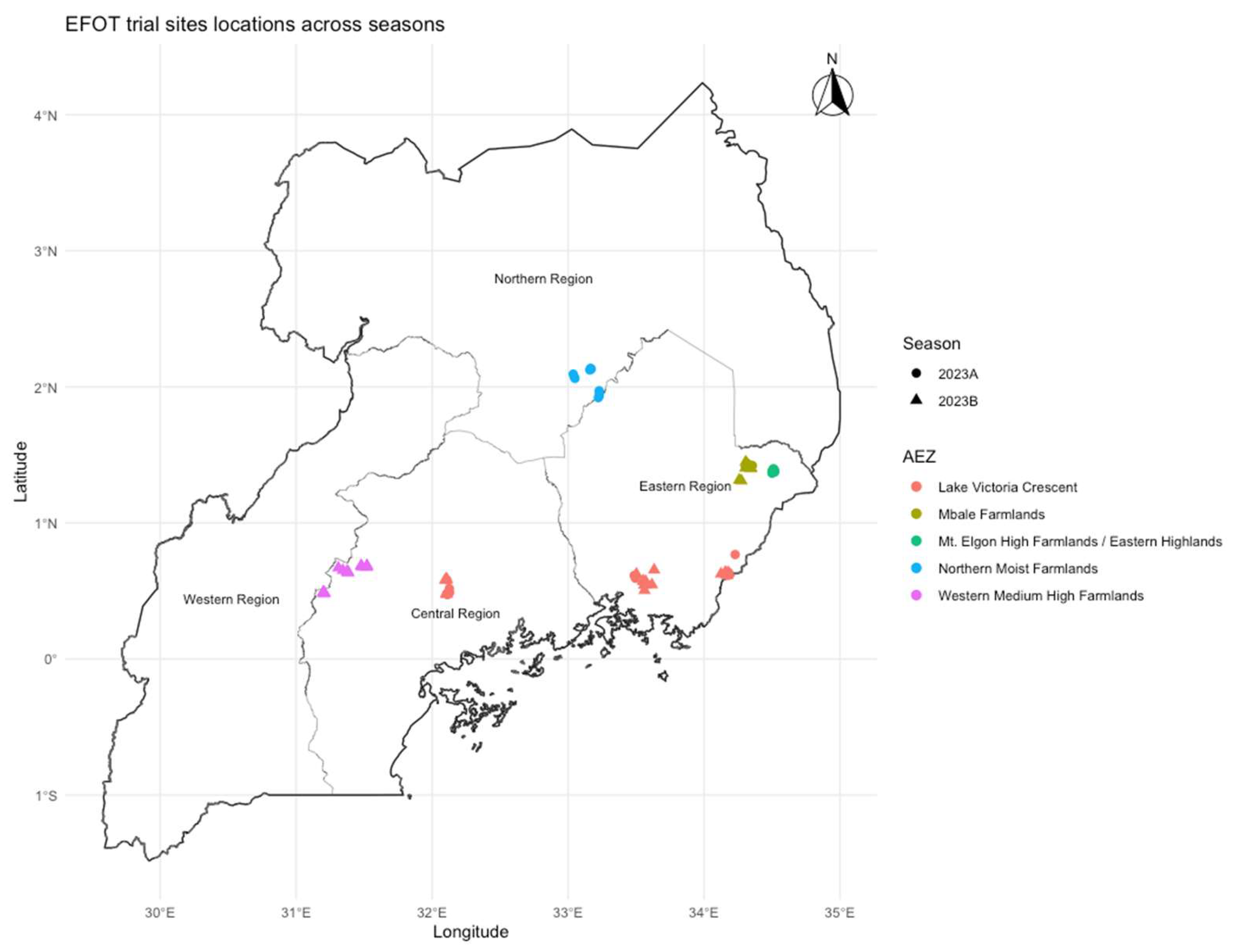
Figure 2.
Nitrogen response curves for maize grain yield across three agroecological zones in Uganda during the first season (2023A) and agregated of all the AEZs. Points show observed yields, and red lines represent fitted quadratic models illustrating the nonlinear yield response to increasing N rates application.
Figure 2.
Nitrogen response curves for maize grain yield across three agroecological zones in Uganda during the first season (2023A) and agregated of all the AEZs. Points show observed yields, and red lines represent fitted quadratic models illustrating the nonlinear yield response to increasing N rates application.
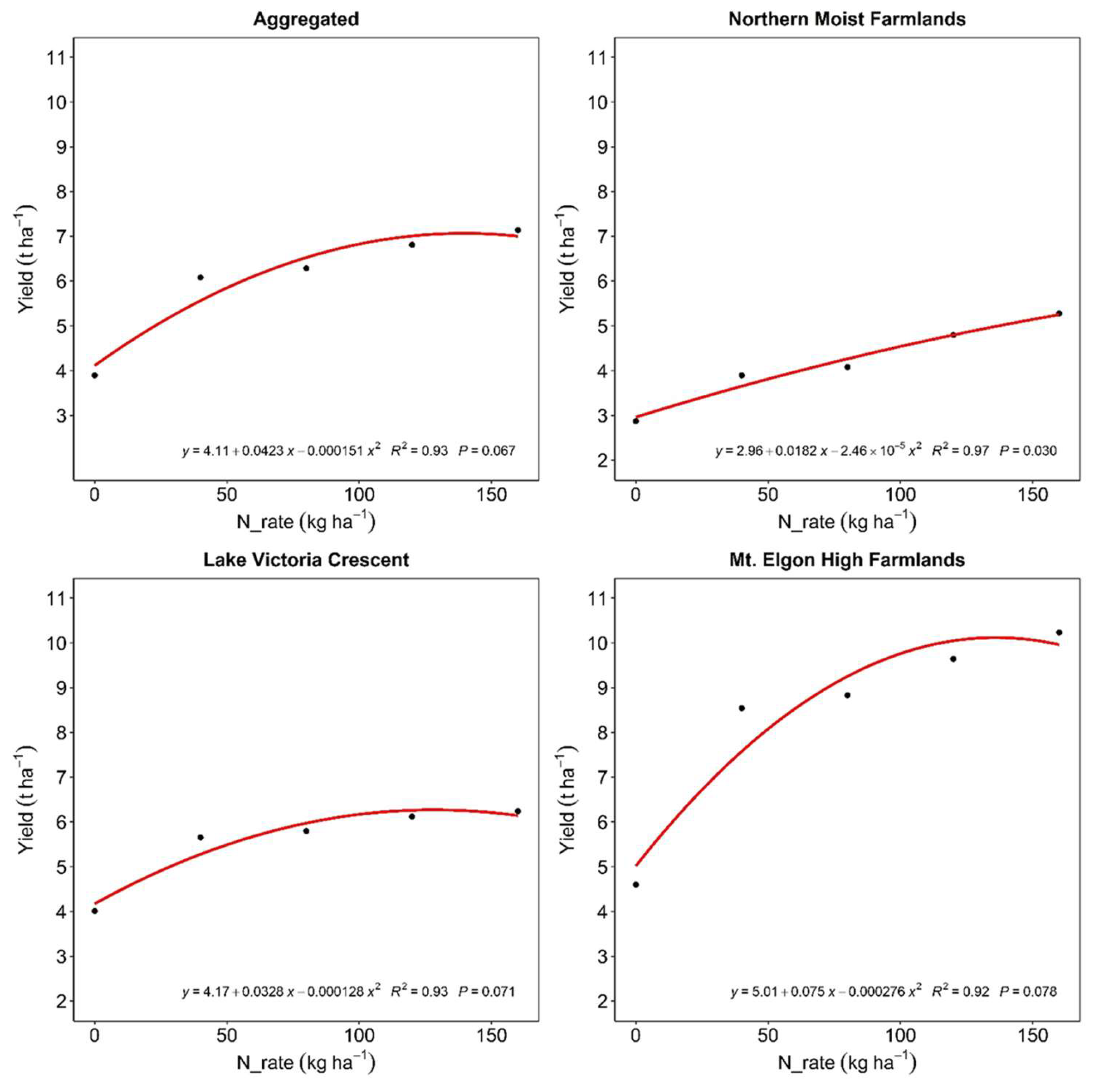
Figure 3.
Nitrogen response curves for maize grain yield across three agroecological zones in Uganda during the second season (2023B). Points show observed yields, and red lines represent fitted quadratic models illustrating the nonlinear yield response to increasing N rates application.
Figure 3.
Nitrogen response curves for maize grain yield across three agroecological zones in Uganda during the second season (2023B). Points show observed yields, and red lines represent fitted quadratic models illustrating the nonlinear yield response to increasing N rates application.
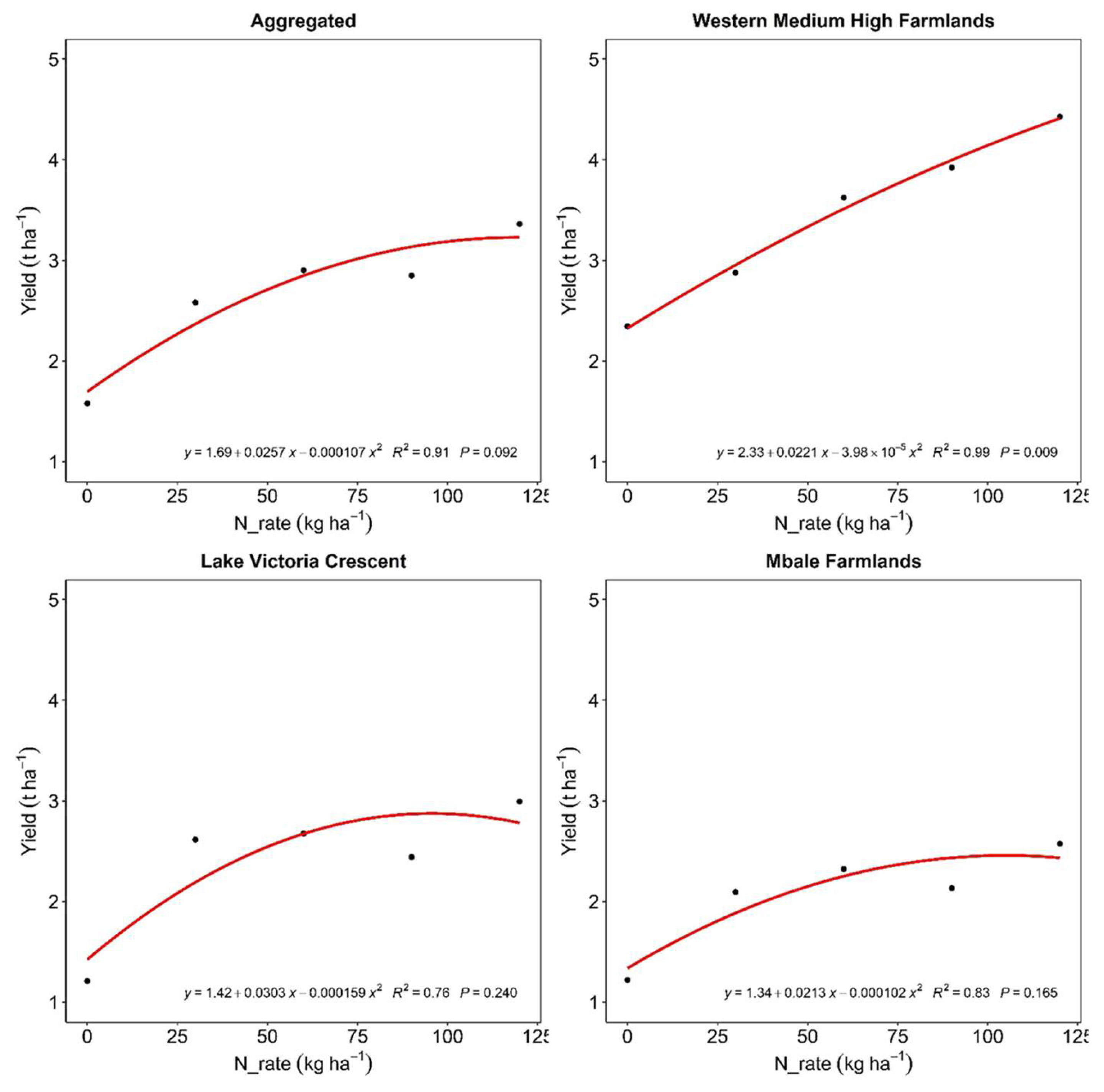
Figure 4.
Maize grain yield among different NP fertilizer treatments across different AEZs (Mt. Elgon Farmlands, Mbale Farmlands, Lake Victoria Crescent, Nothern Moist Farmlands, and Western Medium High Farmlands,), Uganda (Seasons 2023A, 2023B). Within the season and AEZ, average values with the same letters are not significantly different at 5% probability level.
Figure 4.
Maize grain yield among different NP fertilizer treatments across different AEZs (Mt. Elgon Farmlands, Mbale Farmlands, Lake Victoria Crescent, Nothern Moist Farmlands, and Western Medium High Farmlands,), Uganda (Seasons 2023A, 2023B). Within the season and AEZ, average values with the same letters are not significantly different at 5% probability level.
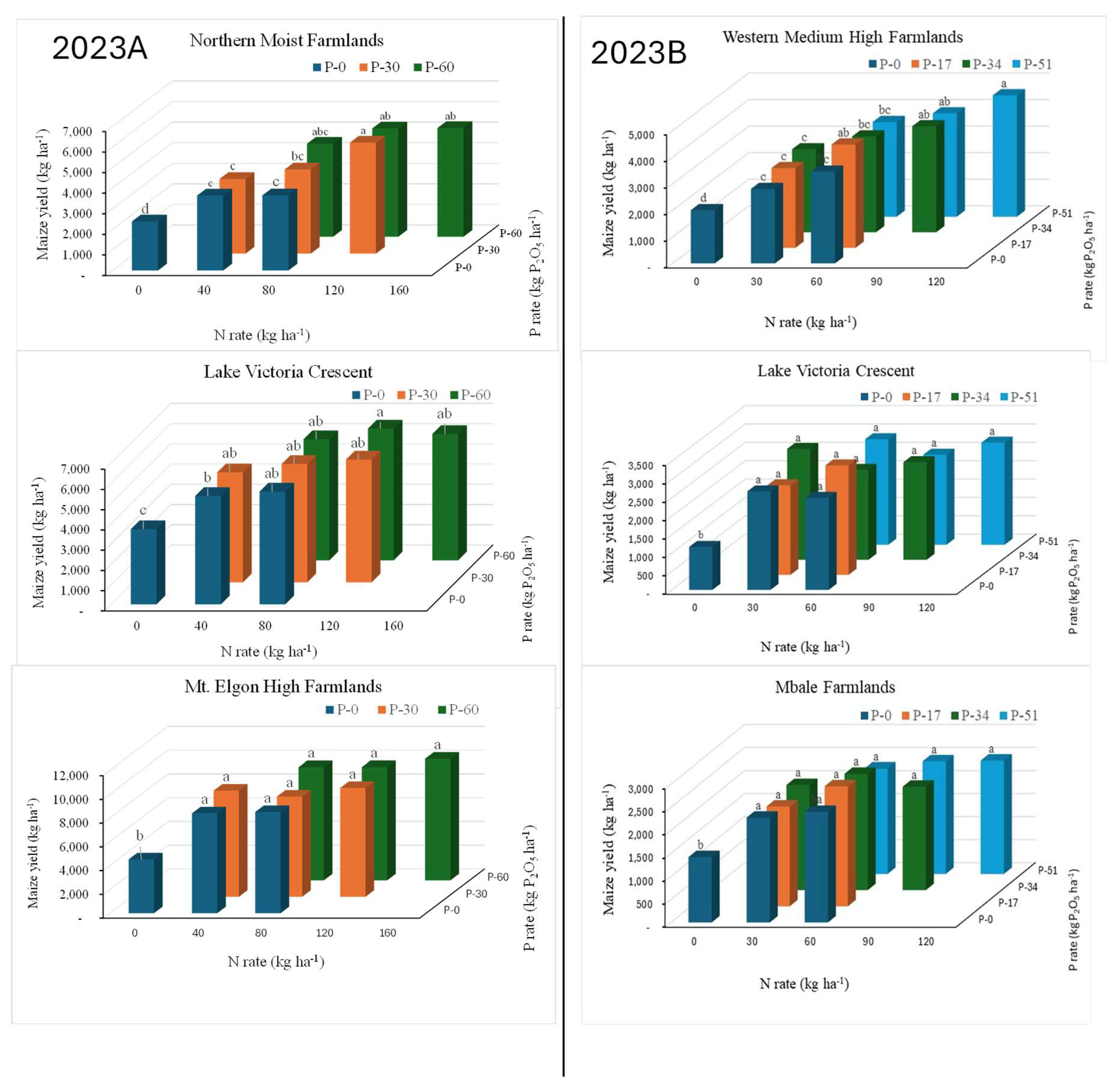
Figure 5.
Effects of different K rates at fixed high NP rates (120 kg N and 60 kg P2O5 ha-1) on maize grain yield (average±standar error) across different AEZs in 2023A and 2023B seasons in Uganda. In 2023B, yields are average across medium NP rates (60 kg N/ha and 34 kg P2O5/ha) and high NP rates (120 kg N/ha and 60 kg P2O5/ha). NMF, LVC, MHF, WMHF and Mbales stands for Northern Moist Famlands, Lake Victoria Crescent, Mt. Elgon High Farmlands, Western Medium High Farmlands, respectively.
Figure 5.
Effects of different K rates at fixed high NP rates (120 kg N and 60 kg P2O5 ha-1) on maize grain yield (average±standar error) across different AEZs in 2023A and 2023B seasons in Uganda. In 2023B, yields are average across medium NP rates (60 kg N/ha and 34 kg P2O5/ha) and high NP rates (120 kg N/ha and 60 kg P2O5/ha). NMF, LVC, MHF, WMHF and Mbales stands for Northern Moist Famlands, Lake Victoria Crescent, Mt. Elgon High Farmlands, Western Medium High Farmlands, respectively.
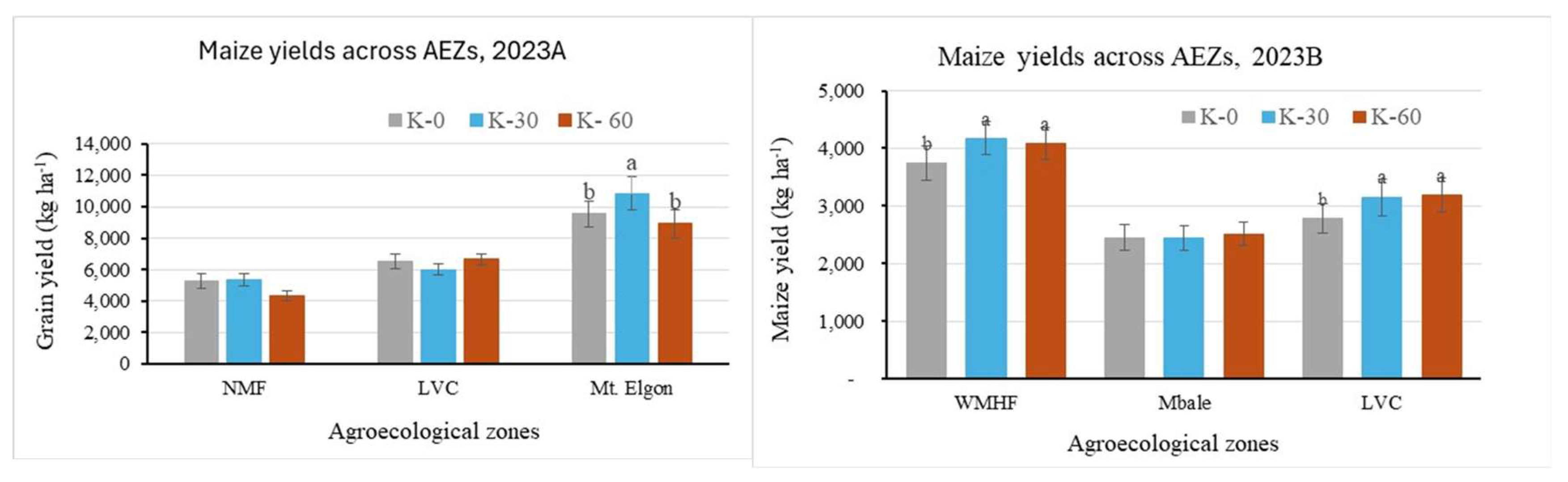
Figure 6.
Principal component analysis (PCA) biplot of soil physicochemical properties and maize yield in 2023A. Two principal components identified, PC1 explains 53% variance (sand content) while PC2 explains 13% variance.
Figure 6.
Principal component analysis (PCA) biplot of soil physicochemical properties and maize yield in 2023A. Two principal components identified, PC1 explains 53% variance (sand content) while PC2 explains 13% variance.
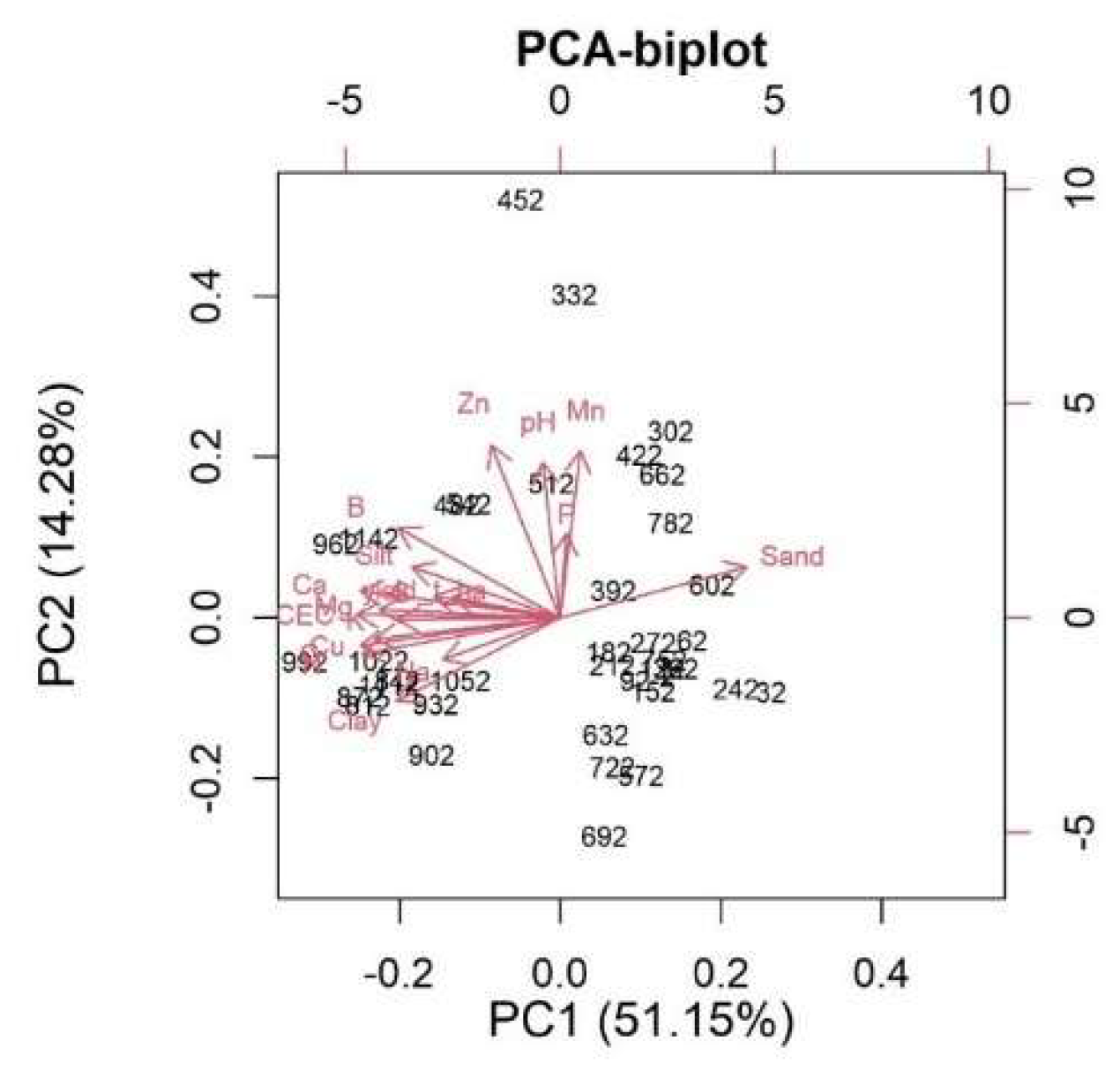
Figure 7.
Principal component analysis (PCA) biplot of soil physicochemical properties and maize yield in 2023B. Two principal components identified, PC1 explains 46% variance (sand content) while PC2 explains 15% variance.
Figure 7.
Principal component analysis (PCA) biplot of soil physicochemical properties and maize yield in 2023B. Two principal components identified, PC1 explains 46% variance (sand content) while PC2 explains 15% variance.
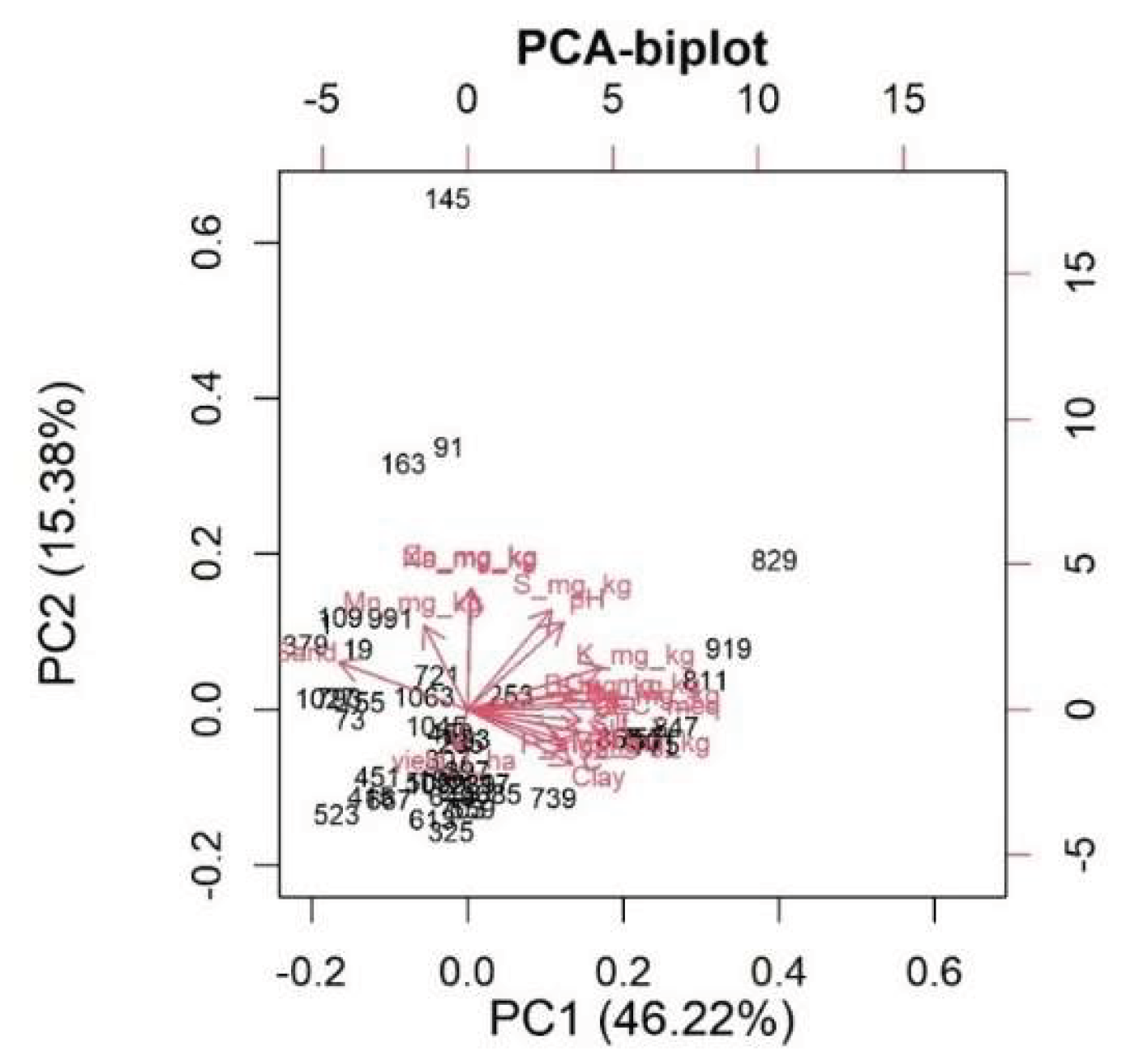
Table 1.
Soil physicochemical properties across different agroecological zones (AEZs) in Uganda.
| Soil properties | Mean value | SEM | Mean value | SEM | Mean value | SEM | Mean value | SEM | Mean value | SEM | Mean value | SEM |
|---|---|---|---|---|---|---|---|---|---|---|---|---|
| First Season (2023A) | Second Season (2023B) | |||||||||||
| LVC | Mt. Elgon | NMF | LVC | Mbale | WMHF | |||||||
| pH | 6.1 | 0.1 | 6.0 | 0.1 | 6.1 | 0.0 | 6.4 | 0.1 | 7.1 | 0.1 | 6.3 | 0.1 |
| P (mg kg-1) | 17.7 | 6.4 | 2.6 | 0.5 | 6.0 | 0.8 | 125.8 | 29.2 | 196.3 | 32.4 | 45.8 | 13.0 |
| K (mg kg-1) | 184.5 | 40.3 | 411.4 | 42.3 | 152.1 | 10.6 | 315.7 | 40.5 | 1121.3 | 133.0 | 280.6 | 34.6 |
| Ca (mg kg-1) | 1437.2 | 181.7 | 3068.3 | 201.9 | 1066.2 | 136.0 | 2131.0 | 171.5 | 5854.1 | 519.2 | 1861.6 | 156.7 |
| Mg (mg kg-1) | 207.7 | 29.5 | 463.3 | 53.0 | 170.5 | 16.5 | 279.3 | 23.4 | 913.7 | 80.9 | 339.2 | 33.2 |
| S (mg kg-1) | 12.3 | 0.6 | 15.5 | 1.3 | 11.2 | 0.6 | 13.9 | 1.2 | 17.3 | 1.4 | 15.2 | 0.4 |
| Na (mg kg-1) | 19.7 | 1.2 | 25.9 | 1.4 | 19.3 | 0.9 | 31.4 | 7.8 | 26.7 | 1.9 | 18.1 | 1.9 |
| Mn (mg kg-1) | 348.2 | 60.4 | 177.5 | 22.8 | 156.2 | 12.4 | 220.4 | 27.4 | 150.1 | 12.9 | 185.0 | 15.3 |
| B (mg kg-1) | 0.5 | 0.0 | 0.7 | 0.1 | 0.4 | 0.0 | 0.9 | 0.1 | 1.4 | 0.1 | 1.0 | 0.1 |
| Zn (mg kg-1) | 4.0 | 0.8 | 4.1 | 0.5 | 1.1 | 0.1 | 10.5 | 4.2 | 5.0 | 0.8 | 4.3 | 0.4 |
| Cu (mg kg-1) | 3.4 | 0.4 | 33.5 | 1.2 | 2.5 | 0.2 | 2.1 | 0.2 | 13.4 | 1.2 | 1.7 | 0.2 |
| CEC_meq | 11.9 | 1.3 | 25.8 | 1.6 | 9.0 | 0.9 | 16.1 | 1.1 | 42.0 | 3.2 | 15.1 | 1.1 |
| Sand (%) | 56.3 | 3.6 | 27.9 | 1.4 | 60.5 | 3.0 | 50.8 | 2.3 | 29.6 | 6.3 | 44.9 | 2.6 |
| Silt (%) | 15.2 | 1.8 | 19.9 | 0.7 | 10.6 | 1.2 | 16.1 | 1.1 | 23.8 | 1.2 | 14.3 | 1.0 |
| Clay (%) | 28.6 | 3.2 | 52.2 | 1.6 | 28.9 | 2.5 | 34.2 | 1.7 | 48.3 | 3.6 | 41.4 | 1.7 |
| C (%) | 1.8 | 0.2 | 3.2 | 0.1 | 1.3 | 0.1 | 2.1 | 0.1 | 2.9 | 0.1 | 2.9 | 0.1 |
| N (%) | 0.1 | 0.0 | 0.2 | 0.0 | 0.1 | 0.0 | 0.1 | 0.0 | 0.2 | 0.0 | 0.2 | 0.0 |
Table 2.
Treatment structures from combination of different rates of N, P, K plus secondary and micronutrients (SMN) tested for maize in Uganda, 2023A.
Table 2.
Treatment structures from combination of different rates of N, P, K plus secondary and micronutrients (SMN) tested for maize in Uganda, 2023A.
| Nutrient applied in kg ha-1 | |||||||
|---|---|---|---|---|---|---|---|
| Treat no | Description | N | P2O5 | K2O | S | Zn | B |
| T1 | N0P0 | 0 | 0 | 0 | 0 | 0 | 0 |
| T2 | N40P0 SZnB | 40 | 0 | 0 | 10 | 1 | 0.3 |
| T3 | N80P0 SZnB | 80 | 0 | 0 | 10 | 1 | 0.3 |
| T4 | N40P30 SZnB | 40 | 30 | 0 | 10 | 1 | 0.3 |
| T5 | N80P30 SZnB | 80 | 30 | 0 | 10 | 1 | 0.3 |
| T6 | N120P30 SZnB | 120 | 30 | 0 | 10 | 1 | 0.3 |
| T7 | N80P60 SZnB | 80 | 60 | 0 | 10 | 1 | 0.3 |
| T8 | N120P60 SZnB | 120 | 60 | 0 | 10 | 1 | 0.3 |
| T9 | N160P60 SZnB | 160 | 60 | 0 | 10 | 1 | 0.3 |
| T10 | N120P60K30 SZnB | 120 | 60 | 30 | 10 | 1 | 0.3 |
| T11 | N120P60K60 SZnB | 120 | 60 | 60 | 10 | 1 | 0.3 |
| T12 | N120P60K60 | 120 | 60 | 60 | 0 | 0 | 0 |
| T13 | N40P0 | 40 | 0 | 0 | 0 | 0 | 0 |
| T14 | N40P30 | 40 | 30 | 0 | 0 | 0 | 0 |
Table 3.
Treatment structures from combination of different rates of N, P, K plus secondary and micronutrients (SMN) tested for maize in Uganda, 2023B (low-medium yield potential districts: Bugweri, Mubende, Tororo, and Mityana).
Table 3.
Treatment structures from combination of different rates of N, P, K plus secondary and micronutrients (SMN) tested for maize in Uganda, 2023B (low-medium yield potential districts: Bugweri, Mubende, Tororo, and Mityana).
| Nutrient applied in kg ha-1 | ||||||||
|---|---|---|---|---|---|---|---|---|
| Treat no | Description | N | P2O5 | K2O | S | Zn | B | Cu |
| T1 | N0P0 | 0 | 0 | 0 | 0 | 0 | 0 | 0 |
| T2 | N40P0 | 30 | 0 | 0 | 0 | 0 | 0 | 0 |
| T3 | N80P0 | 60 | 0 | 0 | 0 | 0 | 0 | 0 |
| T4 | N40P17 | 30 | 17 | 0 | 10 | 1 | 0.3 | 0.3 |
| T5 | N80P17 | 60 | 17 | 0 | 10 | 1 | 0.3 | 0.3 |
| T6 | N40P34 | 30 | 34 | 0 | 10 | 1 | 0.3 | 0.3 |
| T7 | N80P34 | 60 | 34 | 0 | 10 | 1 | 0.3 | 0.3 |
| T8 | N120P34 | 90 | 34 | 0 | 10 | 1 | 0.3 | 0.3 |
| T9 | N80P69 | 60 | 51 | 0 | 10 | 1 | 0.3 | 0.3 |
| T10 | N120P69 | 90 | 51 | 0 | 10 | 1 | 0.3 | 0.3 |
| T11 | N160P69 | 120 | 51 | 0 | 10 | 1 | 0.3 | 0.3 |
| T12 | N80P34K25 | 60 | 34 | 30 | 10 | 1 | 0.3 | 0.3 |
| T13 | N80P34K50 | 60 | 34 | 60 | 10 | 1 | 0.3 | 0.3 |
| T14 | N120P69K25 | 120 | 51 | 30 | 10 | 1 | 0.3 | 0.3 |
| T15 | N120P69K50 | 120 | 51 | 60 | 10 | 1 | 0.3 | 0.3 |
| T16 | N40P17 | 30 | 17 | 0 | 0 | 0 | 0 | 0 |
| T17 | N80P34K25 | 60 | 34 | 30 | 0 | 0 | 0 | 0 |
| T18 | N120P69K50 | 120 | 51 | 60 | 0 | 0 | 0 | 0 |
For high potential district (Bulambuli), N rates 30, 60, 90 and 120 are replaced by 40, 80, 120 and 160, and the highest P rate 51 is replaced by 69. All other treatment combinations are the same with low-medium potential districts. Treatment structures for the second season in Bulambuli had slightly higher N and P rates as this region is considered high potential area.
Table 5.
Planned contrast comparisons of maize grain yield with and without secondary and micronutrients (SMN) under N-only, NP, and NPK fertilizer treatments in 2023A and 2023B seasons across different AEZs in Uganda.
Table 5.
Planned contrast comparisons of maize grain yield with and without secondary and micronutrients (SMN) under N-only, NP, and NPK fertilizer treatments in 2023A and 2023B seasons across different AEZs in Uganda.
| AEZ | Nutrient regime | Yield (-SMN, kg ha-1) |
Yield (+SMN kg ha-1) |
Δ Yield (kg ha-1) |
SE | t value | p value |
|---|---|---|---|---|---|---|---|
| 2023A | |||||||
| NMF | N only | 4,022 | 3,644 | -378 | 554 | 0.415 | 0.679 |
| NP | 4,861 | 3,629 | -1231 | 554 | 2.184 | 0.033 | |
| NPK | 4,182 | 4,345 | 163 | 554 | -0.018 | 0.986 | |
| LVC | N only | 5,484 | 5,349 | -134 | 752 | 1.072 | 0.286 |
| NP | 5,799 | 5,434 | -365 | 752 | 0.485 | 0.628 | |
| NPK | 6,084 | 6,647 | 563 | 752 | -0.931 | 0.354 | |
| Mt. Elgon HF | N only | 8,709 | 8,408 | -301 | 909 | 0.376 | 0.708 |
| NP | 8,206 | 8,946 | 740 | 909 | -0.806 | 0.423 | |
| NPK | 10,087 | 8,921 | -1,167 | 909 | 1.283 | 0.204 | |
| 2023B | |||||||
| WMHF | Low NP | 2902 | 2854 | -48 | 0.223 | 0.825 | |
| Medium NP | 3421 | 3913 | 492 | -2.970 | 0.007 | ||
| High NPK | 4354 | 4380 | 27 | -0.104 | 0.917 | ||
| Mbale Farmlands | Low NP | 2171 | 1999 | -172 | 1.354 | 0.198 | |
| Medium NP | 2505 | 2525 | 20 | -0.133 | 0.918 | ||
| High NPK | 2948 | 2782 | -166 | 0.818 | 0.427 | ||
| LVC | Low NP | 2838 | 2276 | -562 | 2.061 | 0.049 | |
| Medium NP | 2992 | 2680 | -311 | 1.947 | 0.062 | ||
| High NPK | 3407 | 3080 | -327 | 1.976 | 0.056 |
Table 6.
Analysis of covariance (ANCOVA) (reduced model, considering non-significant soil variables and higher variance inflation factors (VIF) showing the effects of agroecological zones, fertilizer treatments, and key soil properties on maize grain yield across trial sites in different agroecolgies, Uganda.
Table 6.
Analysis of covariance (ANCOVA) (reduced model, considering non-significant soil variables and higher variance inflation factors (VIF) showing the effects of agroecological zones, fertilizer treatments, and key soil properties on maize grain yield across trial sites in different agroecolgies, Uganda.
| Source of variance | Df | SS | MS | F value | Pr (>F) |
|---|---|---|---|---|---|
| 2023A | |||||
| Treatment | 13 | 335.6 | 25.82 | 10.17 | <0.0001 |
| AEZ | 2 | 1939.14 | 969.57 | 382.07 | <0.0001 |
| Soil pH | 1 | 12.73 | 12.73 | 5.01 | 0.0255 |
| Available P | 1 | 12.73 | 12.73 | 5.02 | 0.0043 |
| Exchangeable K | 1 | 19.55 | 19.55 | 7.71 | <0.001 |
| CEC | 1 | 124.19 | 124.19 | 48.94 | <0.0001 |
| N | 1 | 44.98 | 44.98 | 17.73 | <0.0001 |
| Residuals | 503 | 1276.43 | 2.54 | ||
| 2023B | |||||
| Treatment | 17 | 207.66 | 12.22 | 9.02 | <0.00001 |
| AEZ | 2 | 319.79 | 159.89 | 118.10 | <0.00001 |
| Soil pH | 1 | 21.18 | 21.18 | 15.65 | <0.00001 |
| Available P | 1 | 256.57 | 256.57 | 189.51 | <0.00001 |
| CEC | 1 | 96.10 | 97.10 | 70.98 | <0.00001 |
| C | 1 | 25.40 | 25.39 | 18.76 | <0.00001 |
| Residuals | 1092 | 1478.43 | 1.35 |
Disclaimer/Publisher’s Note: The statements, opinions and data contained in all publications are solely those of the individual author(s) and contributor(s) and not of MDPI and/or the editor(s). MDPI and/or the editor(s) disclaim responsibility for any injury to people or property resulting from any ideas, methods, instructions or products referred to in the content. |
© 2026 by the authors. Licensee MDPI, Basel, Switzerland. This article is an open access article distributed under the terms and conditions of the Creative Commons Attribution (CC BY) license (http://creativecommons.org/licenses/by/4.0/).
Copyright: This open access article is published under a Creative Commons CC BY 4.0 license, which permit the free download, distribution, and reuse, provided that the author and preprint are cited in any reuse.


