

Submitted:
26 February 2026
Posted:
27 February 2026
You are already at the latest version
Abstract
The positive impact of strategic self-talk on performance in various sports tasks has been well-documented. Contemporary research has therefore started to explore the potential mechanisms through which self-talk affects performance. The purpose of the present study was to examine aspects of the attentional mechanisms underlying performance on a golf putting task, endorsing a psychophysiological perspective through the assessment of Heart-Rate Variability. Participants were 40 male sport science students, with no prior experience in golf putting, who were randomly assigned to control and experimental groups. The experiment was completed over four sessions, including baseline assessment, two training sessions, and final assessment. Participants of both groups followed the same training protocol, with the experimental group practicing strategic self-talk training and developing personal self-talk plans for the final assessment. Performance and HRV were recorded during the baseline and final assessments. Repeated measures analysis of variance showed that the experimental group showed greater performance improvement from baseline to final assessment and superior performance compared to the control group at the final assessment. Analysis of the HRV data provided indications that the experimental group showed different patterns of RMSSD activation at the final assessment, showing a greater activation of the para-sympathetic nervous system, in particular so, towards the latest stages of the golf-putting task. The findings are in line with an attentional interpretation of self-talk effectiveness through a more relaxed / less effortful processing, showing that when ego depletion was likely induced, the use of strategic self-talk mitigated any adverse effects.
Keywords:
attention
; psychophysiology
; self-regulation
; sport
; performance enhancement
1. Introduction
Strategic self-talk has been identified as a pivotal process for regulating behavior, particularly in the context of sport performance. As a result, research on strategic self-talk in sport has experienced a notable expansion, driven by its numerous practical implications, through the implementation of performance-enhancing interventions. Foundational reviews (e.g., Hatzigeorgiadis et al., 2020; Tod et al., 2011) and a meta-analysis (e.g., Hatzigeorgiadis et al., 2011) have provided compelling evidence for the effectiveness of the strategic self-talk interventions. However, research identifying the factors governing self-talk effectiveness highlights the necessity for a comprehensive examination of the fundamental mechanisms underlying the strategic self-talk-performance relationship. Such an examination would facilitate the development of targeted, individualized approaches for athletes, thereby enhancing the effectiveness of strategic self-talk interventions.
An initial conceptual model (Hardy et al., 2008) and an empirically based model (Galanis et al., 2016) provided preliminary postulations regarding clusters of mechanisms (e.g., cognitive, motivational, affective, behavioural). The two models are in agreement about two broad and most dominant clusters of mechanisms that have attracted significant research interest in the existing literature: attentional and motivational. The first cluster, which is particularly relevant for fine tasks, relates to the attentional interpretation of the facilitative effects of self-talk. This cluster involves the effects of self-talk on various dimensions of attention, such as intensity, vigilance, selectivity, as well as decision making, spatial orienting, distractibility, mental effort, and mental fatigue (Hatzigeorgiadis & Galanis, 2017). The second cluster, which relates to the motivational interpretation, involves effects on cognitive, affective, and behavioral aspects of motivation. Within this cluster, strategic self-talk has been linked with outcomes such as increased self-efficacy, self-confidence, anxiety regulation, effort, and persistence (Galanis et al., 2016).
In recent years, a considerable body of experimental studies on the attentional mechanisms has provided consistent evidence for the effect of self-talk on attention; either directly, assessing attention as an outcome in non-sport contexts through computerized tasks (e.g., Gregersen et al., 2017), or indirectly through studies exploring the effect of strategic self-talk on performance in tasks with particular attentional demands (e.g., Galanis, Nurkse, et al., 2022), implicitly attributing any observed performance enhancements to underlying changes in attentional functioning. In a review of the attentional mechanism, Hatzigeorgiadis and Galanis (2017), argued that strategic self-talk can help regulate attentional focus and buffer the detrimental effects of adverse conditions on attention. Regarding the former, evidence supporting the facilitative effects of strategic self-talk on attentional focus have led to the proposition that it can assist in directing attention to appropriate stimuli (e.g., Gregersen et al., 2017), shifting attention across different attentional styles (e.g., Mallett & Hanrahan, 1997), and enhancing the appropriate focus of attention (Bell & Hardy, 2009). Regarding the latter, considerable attention has been devoted to the examination of the buffering effects of strategic self-talk on adverse conditions. This research has addressed a number of important attention-inhibiting factors, including ego depletion, physical fatigue, and external distractions. Ego depletion has been linked with performance impairment, such as slower reaction times in sprint (Englert & Bertrams, 2014), increased false starts in track-and-field (Englert et al., 2015), and poor accuracy in dart-throwing (McEwan et al., 2013). A study that examined the effects of a strategic self-talk intervention on selective attention in a state of ego depletion revealed that self-talk led to enhanced performance in a computerized task, as participants of the self-talk group demonstrated faster reaction times in visual and auditory tests, and higher percentage of correct answers in the visual test, compared to the control group (Gregersen et al., 2017). Furthermore, a study involving a sport task demonstrated that strategic self-talk mitigated the effects of ego depletion and enhanced golf-putting (Galanis, Nurkse, et al., 2022).
Moreover, studies have investigated the potential benefits of strategic self-talk interventions for enhancing performance in attention tasks and sport performance under conditions of physical fatigue. In a laboratory setting, Galanis, Papagiannis, and colleagues (2022) investigated the potential of strategic self-talk to enhance attentional performance in a divided attention test, following a near-exhaustion run on a treadmill. The results showed that the experimental group displayed faster reaction times and a lower number of mistakes on the divided attention test. Following a similar design, Galanis, Hatzigeorgiadis, Charachousi, et al. (2022) replicated this study attempting to approximate conditions encountered in the field. In this study, basketball players were asked to shoot free throws, a task requiring composure and focused attention, immediately after a demanding shuttle run. The results showed that the strategic self-talk group displayed performance comparable to that observed at the baseline neutral condition, while exhibiting superior performance relative to the control group, whose performance declined.
Another common attention-impairing factor in sport is external distractions, such as crowd movements and intense noise. It has been demonstrated that such distractions have the potential to impede an individual's performance by directing attention away from the task at hand and consequently reducing processing efficiency, which ultimately hinders performance (Eysenck, 2015). Galanis et al. (2018) conducted two experiments to examine the effectiveness of strategic self-talk under conditions of external auditory distraction: one in the lab, using a computerized game, and one in the field, with athletes performing basketball free throw. The findings of both experiments indicated that, when confronted with distractions, the experimental group demonstrated superior performance compared to the control group.
Summarising the above, there is a significant body of evidence indicating that strategic self-talk exerts influence on attention through various functions that are contingent on the requirements of a given task and the nature of the task itself. Yet, a recent review highlighted the necessity of adopting a more comprehensive psychophysiological approach to the study of self-talk mechanisms, to help us understand what happens to the body that facilitates attention (Hatzigeorgiadis et al., 2020).
An important physiological indicator that has been receiving increased interest in recent years within the sport psychology literature is Heart Rate Variability (HRV). The HRV metric reflects the dynamic regulation of the autonomic nervous system, comprising the sympathetic and the parasympathetic nervous system, providing insights into an individual's physiological responses to physical and psychological stress (Stanfield, 2017). Of particular interest from a self-regulation perspective is the functioning of the parasympathetic nervous system. The parasympathetic nervous system is responsible for regulating several physiological processes, through the activation of the vagus nerve, which slows down bodily functions and conserves energy, and is linked with physiological changes, such as increased HRV, reduction in heart rate, and decreased myocardial contractility (Stanfield, 2017).
During exercise or stress, the sympathetic nervous system is activated, thus eliciting a fight-or-flight response and resulting in the opposite physiological effects as those induced by the parasympathetic nervous system (Goldsmith et al., 2000). According to Wheat and Larkin (2010), elevated HRV indicates that the autonomic nervous system is proficient in regulating physiological arousal in accordance with situational demands, whereas diminished HRV signifies an incapacity to adjust to the situation. Furthermore, heightened HRV has been associated with feelings of relaxation, while decreased HRV has been linked to anxiety and stress. The evidence suggests that competitive and anxiety-inducing conditions can induce a state of sympathetic predominance in athletes (Cervantes Blásquez et al., 2009). This physiological response is often associated with decreased performance in several tasks (Thayer & Lane, 2000).
With regard to aiming sport tasks, there is evidence demonstrating that athletes in pistol shooting (Tremayne & Barry, 2001) and golf (Boucher & Zinsser, 1990) display a brief cardiac deceleration prior to the execution of the task. The observed effect, which is more prevalent in elite athletes, has been linked with increased performance (Neumann & Thomas, 2009). In parallel, higher parasympathetic activation has been linked to enhanced performance (Ortega & Wang, 2018). In accordance with the intake-rejection hypothesis proposed by Lacey and Lacey (2017), the deceleration of heart rate may be associated with a reduction in feedback to the brain, which in turn leads to a more efficient allocation of attentional resources and ultimately enhanced performance. This hypothesis may also provide an explanation for the findings reported by Hatfield et al. (2004), who observed reduced cerebral cortex activity in elite shooters in comparison to novices, suggesting a higher level of automaticity in execution.
In a recent study, Lee et al. (2023) investigated the impact of psychological skills training, encompassing techniques such as self-talk, imagery, relaxation, and goal-setting, on HRV. The results showed no statistically significant alterations in HRV, which was attributed to the limited number of participants. Nevertheless, intriguing trends emerged, indicating that the psychological skills training group exhibited heightened relaxation. In a similar study, Galanis et al. (2025) examined the HRV in a cohort of sport science students, during and after an endurance cycling task. The findings revealed that no statistically significant differences were observed during the initial 12 minutes of cycling; however, notable differences emerged later, towards the completion of the task, with changes in HRV. In particular, the results showed greater vagal suppression for the control group compared to the self-talk group. These differences in vagal modulations were attributed to the self-regulating effects of strategic self-talk, indicating a less effortful performance, supporting the calming physiological effects of self-talk. The authors argued that self-talk helped athletes maintain a more relaxed state and keep a relatively effortless performance, providing indications for the calming physiological effects of self-talk.
Integrating physiological indices with behavioral evidence in sport tasks would advance our understanding of the mechanisms through which performance enhancement is achieved via self-talk interventions. Considering the significance of attention in aiming tasks, the established benefits of strategic self-talk for task performance, and the need to identify factors that govern self-talk effectiveness through a comprehensive psychophysiological approach, the present study investigated the effects of a strategic self-talk intervention on performance in a fine golf-putting task requiring sustained attention, as well as its potential impact on autonomic nervous system activity. Using a randomised control trial with a strategic self-talk intervention, we hypothesized that performance of the two study groups would improve due to the golf practice, but also that the performance benefits would be greater for the strategic self-talk group. Moreover, we expected that the strategic self-talk group would display higher parasympathetic activation during the task.
2. Materials and Methods
Participants
Power analysis (G*Power 3.1.9.7) was conducted to estimate the number of participants required to achieve a minimum power of 0.80 at an alpha of .05, based on an estimated effect size of .48 (meta-analysis, Hatzigeorgiadis et al., 2011). The analysis indicated that 37 participants were required in total. To account for potential losses, 40 male sport science students were recruited and randomly assigned into two equal groups. The mean age of the participants was 19.33 years (SD = 2.40). The participants in this study were required to be right-handed, as the golf club used was for right-handed people, and not to have any prior experience with golf putting. Participation was entirely voluntary, and participants were offered course credit in return for their participation.
Apparatus and Measures
Performance
To evaluate putting performance, a custom-designed point system was established (Figure 1). The objective of this system was to provide a more nuanced and comprehensive assessment of performance, considering not only the number of successful putts but also the precision and force of missed shots, and to award points accordingly. The points awarded for each putt were the total of the vertical and horizontal scores as these appear in each distinct area in Figure 1. On-target balls were awarded 25 points. This approach aimed to provide a more accurate reflection of the participants' putting skill, with emphasis on accuracy and precision, but maintaining an ecological golf perspective. The putting task was conducted using an Amilla Mini-putter (for right-handed), on a specially designed grass strip that featured an uphill slope, from a distance of 2.5m.
Heart Rate Variability
To measure HRV, a Polar V800 connected to an H9 sensor on a chest strap was utilized. HRV data were transmitted through the PolarFlow app and subsequently analyzed using Kubios (Biosignal Analysis and Medical Imaging Group, Department of Applied Physics, University of Eastern Finland, Finland) to obtain a time domain and a frequency domain HRV index.
RMSSD is the principal time-domain metric for the assessment of vagal activity (Gullett et al., 2023). It is calculated as the square root of the average of the squares of the differences between adjacent normal R-R intervals. RMSSD reflects the influence of the parasympathetic nervous system on heart rate variability. Higher values of RMSSD indicate greater parasympathetic activity, while lower values suggest a decrease in parasympathetic activity.
HF is a frequency-domain measure of efferent vagal activity, identified as a reliable index reflecting the influence of the parasympathetic nervous system on the heart. Higher values of HF power indicate greater parasympathetic activity, while lower values suggest decreased parasympathetic activity.
Procedure
The study was approved by the institution’s ethics committee (ref: 2097). Participants were recruited through open calls and from the applicants, 40 were randomly randomly selected. They were contacted and informed about the study procedures and were randomly assigned into control and experimental groups (20 students per group). The experiment was completed in four sessions, one baseline measurement, two training sessions, and one final measurement. In an attempt to minimize the impact of external factors on the autonomic nervous system, the baseline and final measurements were conducted on the same day and hour, one week apart. The day before each measurement, participants were contacted and instructed to refrain from consuming alcohol, coffee, or energy drinks for three hours as well as avoiding large meals in the last three hours before the measurement. These requirements were self-reportedly confirmed by participants upon arrival for the assessment.
In the first session, participants received detailed information about the procedures and signed consent forms. They were then introduced to the golf putting technique, given instructions, and asked to perform 20 putts for familiarization, during which they received feedback and further instructions. Following the familiarization, the polar sensors were fitted and participants began the baseline performance measurement, during which they received no feedback or instructions. Following each putt, a researcher close to the hole recorded the score and cleared the ball off the course, while a second researcher was placing a new ball on the 2.5m mark. Three sets of 20 shots from 2.5m were performed, with one-minute intervals in-between sets. The whole procedure lasted approximately 60 minutes, with each of the three performance sets lasting around 8 minutes.
The next two sessions involved the practice. Both groups were asked to take 3 sets of 20 putts from different distances (2m, 2.5m, and 3m) in order to reduce the distance learning effect. During the practice, participants of both groups were provided with technical feedback, according to a standard list of potential mistakes from the initial instructions. Participants of the experimental group received in addition a brief standard introduction to self-talk, and practiced with the use of different instructional self-talk cues. Self-talk cues were at first provided by the researcher; however, participants eventually had input on the selection of instructional cues they practiced, and ultimately chose the cue that they would use in the final measurement. The most commonly used cues were ‘’Steady’’, ‘’In-line’’, and ‘’Smooth’’.
In the final measurement, the same procedures as the baseline were applied. Participants performed 20 warm-up shots, during which they received no feedback or instructions and then proceeded to take 3 sets of 20 putts, with a one-minute break in between. Subsequently, a manipulation check was administered to the experimental group, asking participants to indicate on a scale from 1 (never) to 10 (all the putts) the degree to which they used their self-talk cue.
3. Results
Preliminary Analyses
The screening of the data revealed outlying HRV values for one participant, due to bradycardia; the participant was therefore excluded from further analyses. An independent samples t-test was conducted to test for differences in performance between the two groups at baseline. The analysis showed no baseline differences, t(37)=.602, p=.551. Multivariate analysis of variance was conducted to test for differences in HRV measures at baseline. Τhe results revealed a non-significant multivariate effect, F(2, 36)=0.35, p=.71; accordingly, the univariate effects showed non-significant differences between the two groups; for RMSSD, F(2,36)=.553, p=.462, and for HF, F(1,37)=.610, p=.440. Inspection of the manipulation check questions showed that participants of the experimental group used their cues with great consistency (M=9.67 SD=0.66)
Performance
A repeated-measures ANOVA with one repeated factor (time) and one independent factor (group) was conducted to examine the effect of group and time on performance score. The results indicated a significant time by group interaction, F(1,37)= 5.67, p=.02. From pairwise comparisons, it is revealed that both the control, F(1,37)= 14.72, p<.001, and experimental group, F(1,37)=54.01, p<.001, improved significantly from the baseline (Mctr=660.47 SDctr=24.67, Mexp=639.75, SDexp=24.04) to the final assessment (Mctr=787.42 SDctr=28.81, Mexp=876.80, SDexp=28.08). Nevertheless, it was also shown that (a) the effect for the experimental group (partial η2= .59) was considerably higher than that of the control group (partial η2= .29), and (b) in the final assessment, the experimental group had a significantly higher performance compared to the control group, F(1,37)= 4.935, p=0.033 The changes in performance are presented in Figure 2.
Heart Rate Variability
A two-way repeated-measures MANOVA with one repeated factor (time) and one independent factor (group) was conducted to examine the interaction of group and time on the HRV variables. The analysis showed a non-significant multivariate effect, F(2,36)=1.98, p=.15; nevertheless, examination of the univariate effects provided some useful insights. In particular, for RMSSD the univariate analysis showed a marginal time by group interaction, F(1,37)= 4.03, p=.05; the examination of the pairwise comparisons showed that the experimental group showed increases in RMSSD (p= .02), whereas no differences were recorded for the control group (p= .59). Non-significant effects were identified for HF, F(1,37)=.334, p=.567. The changes in the HRV indices are portrayed in Figure 3.
To further explore the effect identified for RMSSD in relation to the length of the experimental task that included three performance sets, a three-way repeated measures ANOVA with two repeated factors, time (pre, post) and putting set (1st, 2nd, 3rd) and one independent factor (group) was conducted. The analysis yielded a marginally non-significant multivariate three-way interaction, F(2,36)=3.021, p=.061. To further examine this three-way interaction, two-way ANOVAs with two repeated factors, time (pre, post) and putting set (1st, 2nd, 3rd) were conducted separately for each group. The analysis for the control group did not exhibit a significant multivariate interaction effect, F(2,17)=.076, p=.927, whereas a marginal interaction was identified for the experimental group, F(2,18)=3.476, p=.053. Examination of the pairwise comparisons showed that while for the control group no differences in RMSSD were recorded between the three sets across baseline and final assessment, for the experimental group RMSSD increased from set 2 to set 3 in the final assessment, resulting also in a significant difference for set 3 between baseline and final assessment (Table 1). The identified patterns for RMSSD across time and set for the two groups are presented in Figure 4.
4. Discussion
The purpose of this study was to explore the potential impact of strategic self-talk on a golf-putting task and the functioning of the autonomic nervous system, attempting to provide physiological evidence for the attentional interpretation of the strategic self-talk effectiveness. A randomized controlled trial was implemented, where performance and heart-rate variability were measured before and following a strategic self-talk intervention. Through the self-talk practices, participants were gradually given input on the use of the self-talk cues with the intention to maximize the effectiveness of the training. Consistent with the literature, the self-talk intervention had a considerable effect on performance. Furthermore, the results from the HRV analyses, despite the lack of multivariate significance, yielded interesting patterns of changes for RMSSD, which provided indications for a more relaxed physiological state for the experimental group during task execution, and in particular in the latest stages of the task.
As anticipated, both the control and experimental groups had improved performance, due to the learning effect induced by the two training sessions on a task that was initially unfamiliar to the participants. Nonetheless, the experimental group was found to have a more substantial improvement and a significantly superior performance in the final measurement compared to the control group. This adds further evidence for the effectiveness of self-talk interventions in facilitating learning and enhancing sports task performance, in particular for fine tasks.
The analysis of the HRV variables measured as an average for the duration of the experiment revealed a non-significant multivariate effect. However, further examination through univariate tests revealed a significant difference in RMSSD values between the groups, with the experimental group demonstrating higher values. These results provided indications that the self-talk group exhibited an increase in the activation of the parasympathetic system, which reflects more relaxed states. These findings are consistent with existing physiological research on aiming tasks, which have found that higher performance groups exhibit higher RMSSD values (Ortega & Wang, 2018). Follow-up analysis yielded further interesting evidence, as it was identified that for the strategic self-talk group RMSSD values significantly increased, and differed from those of the control group, during the last golf-putting set. Similar effects have been noticed by Galanis et al. (2025) in a strategic self-talk intervention with a running task. In particular, it was reported that participants of the strategic self-talk group showed a smaller decline of parasympathetic activation compared to the control group during the last 8min of the 20min trial. Studies in the self-talk literature have supported that strategic self-talk can mitigate the adverse effects under challenging conditions, such as distraction (Galanis et al., 2018), physical exertion (Galanis, Papagiannis et al., 2022), and, mostly relevant to this study, ego-depletion (Galanis, Nurkse, et al., 2022). Regarding the latter, the study of Galanis et al. (2025) provided evidence that strategic self-talk assisted performance in two experiments involving golf-putting following ego-depletion manipulations. Considering the buffering effect of strategic self-talk, the authors forwarded an attentional interpretation, suggesting that when depleted, self-talk can help individuals maintain attention processing efficiency. Bearing in mind the length of the experimental assessment in the present experiment (approximately 60 min), it is reasonable to assume that participants eventually became depleted. The identified self-talk effect in the later stages of the assessment seems to coincide with the above findings and provides support for the attentional self-talk mechanism, postulating that strategic self-talk can mitigate the impact of ego-depletion through the facilitation of attentional processing.
Considering the duration of the task and the mental load that was required to maintain attention and composure for the golf putting task, it is likely that participants experienced some levels of depletion. Indeed, the analysis indicated that in the baseline measurement participants’ RMSSD values were reduced. However, in the final measurement, the experimental group exhibited not only a mitigation of this decrease from the first to the second set, but also demonstrated an increase in RMSSD values during the third and final set, surpassing even their values in their first set. Accordingly, considering the changes in RMSSD for the last putting set, it could be assumed that the use of strategic self-talk may have mitigated the potential depletion effect. This finding is consistent with previous research conducted by Gregersen et al. (2017) on a computerized attention task and Galanis, Nurkse, et al. (2022) on a similar golf putting task under divided attention.
Considerations and Future Research Directions
Two considerations should be taken into account when interpreting the present findings. First, the lack of multivariate significance in the original analysis. Even though the performance effect was considerable, and the analysis was well-powered, the HRV changes were not supported at the multivariate level. This study, however, provides new evidence for subsequent power analyses involving HRV measures. Therefore, the interpretation of these results should be cautious; yet, the results from the follow-up analysis enhance our confidence for this cautious interpretation. Second, the interpretation from the follow-up, set by set, analysis regarding the ego-depletion effect, should be cautious as ego-depletion was not assessed but rather assumed due to the length of the experimental procedure. That the RMSSD showed a decline from the first to the second set, provides some indication about ego-depletion.
Finally, although HRV is a reliable indicator of psychophysiological states, additional physiological measures should be incorporated to deepen our understanding of self-talk mechanisms. In particular, evaluating brain activity concurrently with HRV would yield more informative data regarding psychophysiological states involving attention. Moreover, the utilization of eye-tracking technology may also prove advantageous when measuring psychological influences on aiming tasks, as eye gaze, quiet eye phenomenon, and pupil dilation have all been linked to attention and performance.
Author Contributions
Conceptualization, AH and EG; Methodology, ET, TP, AH, EG; Investigation, ET, TP, OP, EN; Formal Analysis, ET, TP, OP, AH; Data curation, ET, TP, AH, EG.; writing—original draft preparation, ET; writing—review and editing, AH, EG, YT, NC; Supervision, AH, YT. All authors have read and agreed to the published version of the manuscript.
Funding
This research received no external funding
Institutional Review Board Statement
The study was conducted in accordance with the Declaration of Helsinki, and approved by the Ethics Committee of University of Thessaly (2097, 8 February 2023).
Informed Consent Statement
Informed consent was obtained from all subjects involved in the study.
Data Availability Statement
Data available upon request to the corresponding author.
Conflicts of Interest
The authors declare no conflicts of interest.
Abbreviations
The following abbreviations are used in this manuscript:
| HRV | Heart-Rate Variability |
| RMSSD | Root Mean Square of Successive Differences |
| HF | High-Frequency |
References
- Bell, J. F., & Hardy, J. D. (2009). Effects of attentional focus on skilled performance in golf. Journal of Applied Sport Psychology, 21(2), 163–177. [CrossRef]
- Cervantes Blásquez, J. C., Rodas Font, G., & Capdevila Ortís, L. (2009). Heart-rate variability and precompetitive anxiety in swimmers. Psicothema, 21(4), 531–536.
- Englert, C., & Bertrams, A. (2014). The Effect of Ego Depletion on Sprint Start Reaction Time. Journal of Sport and Exercise Psychology, 36(5), 506-515. [CrossRef]
- Englert, C., Persaud, B. N., Oudejans, R. R., & Bertrams, A. (2015). The influence of ego depletion on sprint start performance in athletes without track and field experience. Frontiers in psychology, 6, 1207. [CrossRef]
- Eysenck, M. W. (2015). Anxiety: The Cognitive Perspective. Psychology Press.
- Galanis, E., Hatzigeorgiadis, A., Charachousi, F., Latinjak, A. T., Zourbanos, N., & Theodorakis, Y. (2022). Strategic self-talk assists basketball free throw performance under conditions of physical exertion. Frontiers in Sports and Active Living, 4. [CrossRef]
- Galanis, E., Papagiannis, E., Nurkse, L., Theodorakis, Y., & Hatzigeorgiadis, A. (2022). The effects of strategic self-talk on divided attention following physical exhaustion. International Journal of Sport and Exercise Psychology, 1–11. [CrossRef]
- Galanis, E., Hatzigeorgiadis, A., Zourbanos, N., Charachousi, F., & Sanchez, X. (2018). From the lab to the field: Effects of self-talk on task performance under distracting conditions. Sport Psychologist, 32(1), 26–32. [CrossRef]
- Galanis, E., Hatzigeorgiadis, A., Zourbanos, N., & Theodorakis, Y. (2016). Why self-Talk is effective? Perspectives on self-talk mechanisms in sport. Elsevier EBooks, 181–200. [CrossRef]
- Galanis, E., Nurkse, L., Kooijman, J. W., Papagiannis, E., Karathanasi, A., Zourbanos, N., Theodorakis, Y., & Hatzigeorgiadis, A. (2022). Effects of a strategic self-talk intervention on attention functions and performance in a golf task under conditions of ego depletion. Sustainability, 14(12), 7046. [CrossRef]
- Galanis, E., Stojković, Z., Proskinitopoulos, T., Tzormpatzakis, E., Comoutos, N., Theodorakis, Y., & Hatzigeorgiadis, A. (2025). A psychophysiological approach to the study of strategic self-talk mechanisms through heart rate variability during a cycling task. Retos, 70, 1334–1342. [CrossRef]
- Goldsmith, R. L., Bloomfield, D. M., & Rosenwinkel, E. T. (2000). Exercise and autonomic function. Coronary Artery Disease, 11(2), 129–135. [CrossRef]
- Gregersen, J., Hatzigeorgiadis, A., Galanis, E., Zourbanos, N., & Papaioannou, A. (2017). Countering the consequences of ego depletion: The effects of self-talk on selective attention. Journal of Sport & Exercise Psychology, 39(3), 161–171. [CrossRef]
- Gullett, N., Zajkowska, Z., Walsh, A., Harper, R., & Mondelli, V. (2023). Heart rate variability (HRV) as a way to understand associations between the autonomic nervous system (ANS) and affective states: A critical review of the literature. International journal of psychophysiology : official journal of the International Organization of Psychophysiology, 192, 35–42. [CrossRef]
- Hardy, J. D., Oliver, E. J., & Tod, D. (2008). A framework for the study and application of self-talk within sport. Routledge EBooks, 37–74.
- Hatfield, B. D., Haufler, A. J., Hung, T. M., & Spalding, T. L. (2004). Electroencephalographic studies of skilled psychomotor performance. Journal of Clinical Neurophysiology, 21(3), 144–156. [CrossRef]
- Hatzigeorgiadis, A., & Galanis, E. (2017). Self-talk effectiveness and attention. Current Opinion in Psychology, 16, 138–142. [CrossRef]
- Hatzigeorgiadis, A., Galanis, E., & Theodorakis, Y. (2020). Strategic self-talk interventions. In A.T. Latinjak & A. Hatzigeorgiadis (Eds.), Self-talk in Sport (1st Ed., pp. 123-135). New York, Routledge.
- Hatzigeorgiadis, A., Zourbanos, N., Galanis, E., & Theodorakis, Y. (2011). Self-Talk and sports performance. Perspectives on Psychological Science, 6(4), 348–356. [CrossRef]
- Lacey, B. C., & Lacey, J. H. (2017). Studies of heart rate and other bodily processes in sensorimotor behavior. Routledge EBooks, 538–564. [CrossRef]
- Lee, G., Ryu, J., & Kim, T. (2023). Psychological skills training impacts autonomic nervous system responses to stress during sport-specific imagery: An exploratory study in junior elite shooters. Frontiers in Psychology, 14. [CrossRef]
- McEwan, D., Martin Ginis, K. A., & Bray, S. R. (2013). The effects of depleted self-control strength on skill-based task performance. Journal of sport & exercise psychology, 35(3), 239–249. [CrossRef]
- Neumann, D. L., & Thomas, P. R. (2009). The relationship between skill level and patterns in cardiac and respiratory activity during golf putting. International Journal of Psychophysiology, 72(3), 276–282. [CrossRef]
- Ortega, E., & Wang, C. J. K. (2018). Pre-performance physiological state: Heart rate variability as a predictor of shooting performance. Applied Psychophysiology and Biofeedback, 43(1), 75–85. [CrossRef]
- Stanfield, C. L. (2017). Principles of Human Physiology.
- Thayer, J. F. & Lane, R. D. (2000). A model of neurovisceral integration in emotion regulation and dysregulation. Journal of Affective Disorders, 61, 201–216.
- Tod, D., Hardy, J. D., & Oliver, E. J. (2011). Effects of self-talk: A systematic review. Journal of Sport & Exercise Psychology, 33(5), 666–687. [CrossRef]
- Tremayne, P., & Barry, R. J. (2001). Elite pistol shooters: physiological patterning of best vs. worst shots. International Journal of Psychophysiology, 41(1), 19–29. [CrossRef]
- Wheat, A. L., & Larkin, K. (2010). Biofeedback of heart rate variability and related physiology: A critical review. Applied Psychophysiology and Biofeedback, 35(3), 229–242. [CrossRef]
Figure 1.
Scoring system used to measure putting performance.
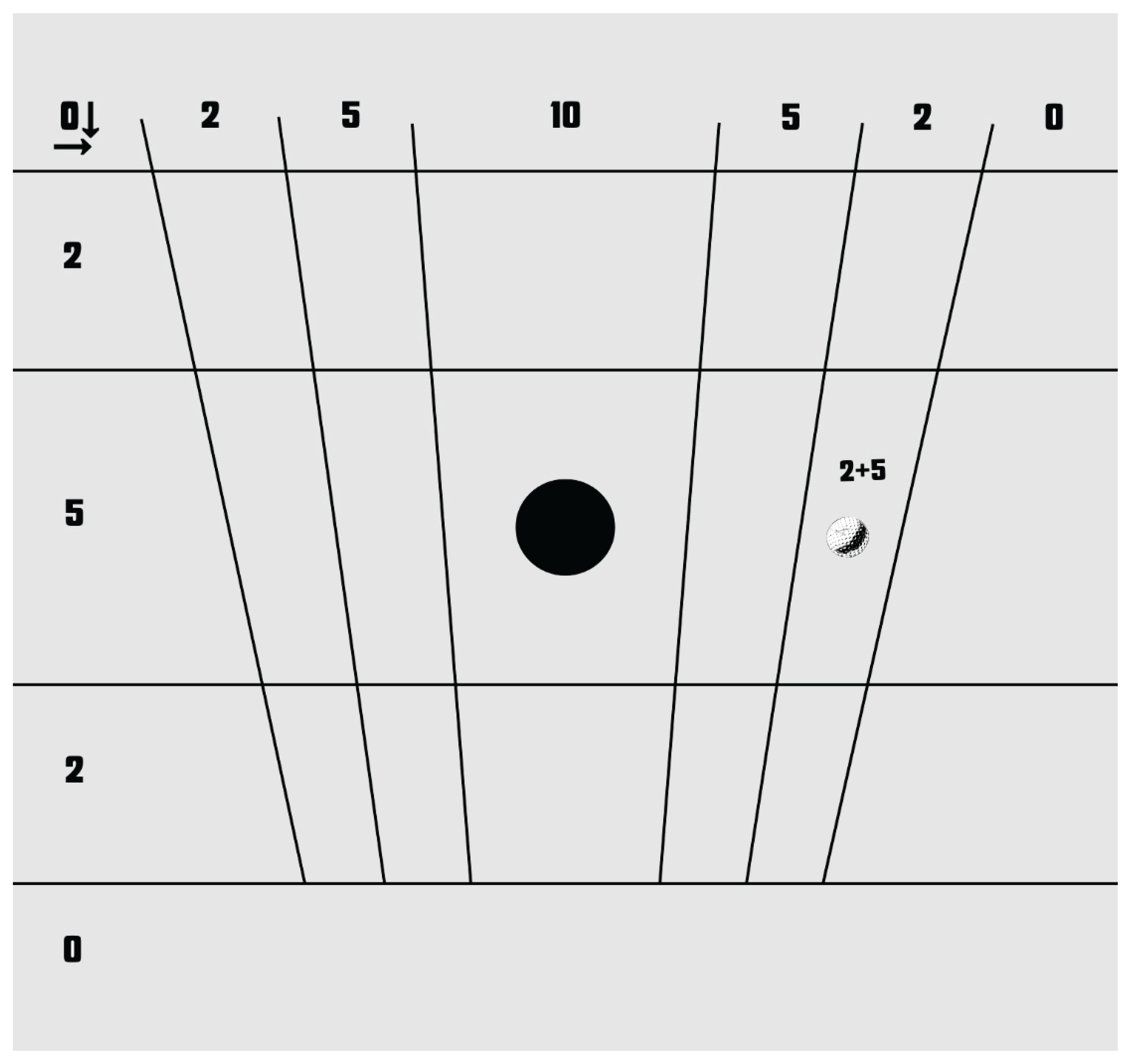
Figure 2.
Changes in performance for the two groups from baseline to final assessment.
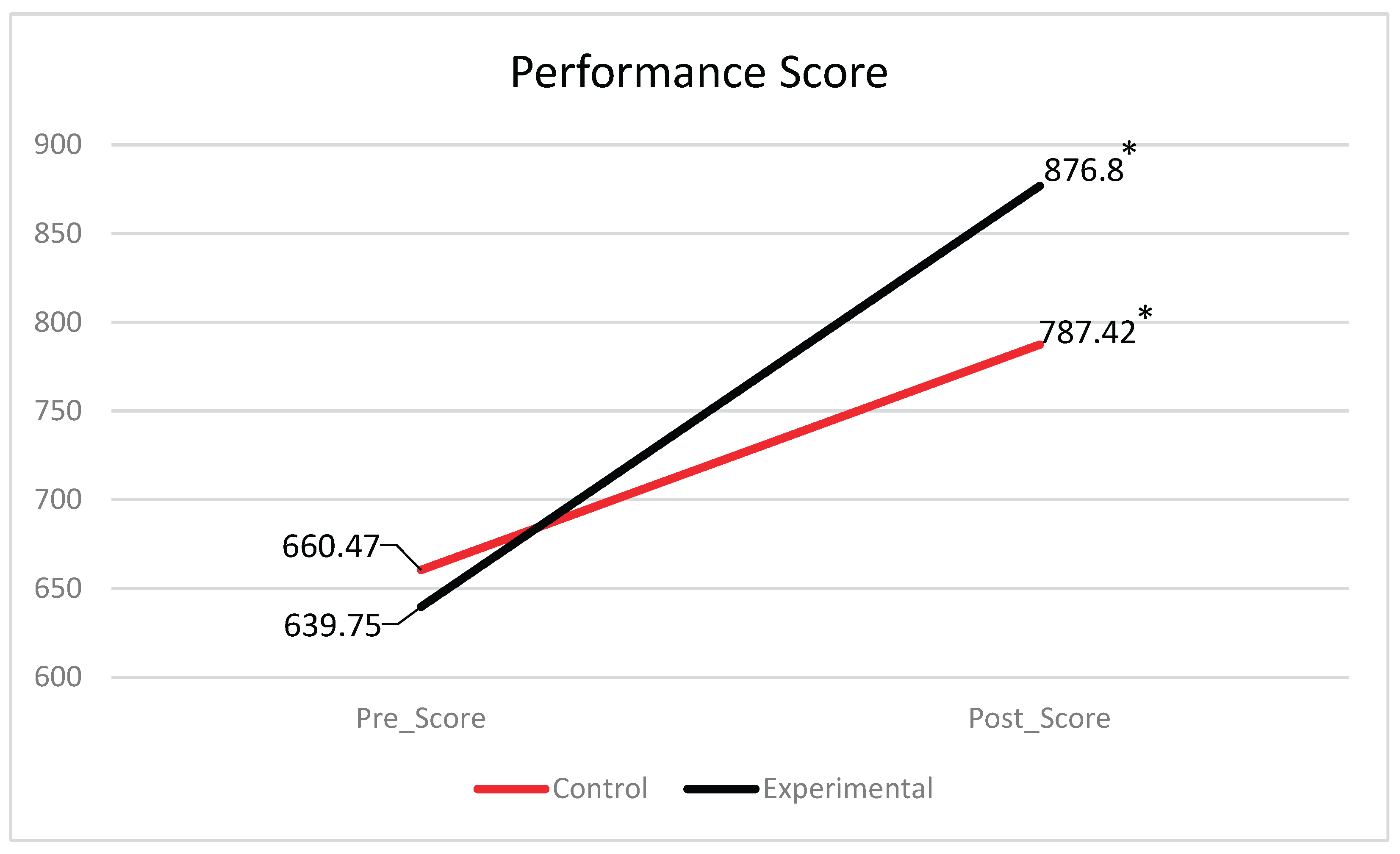
Figure 3.
Changes in RMSSD and HF from baseline to final assessment for the two groups.
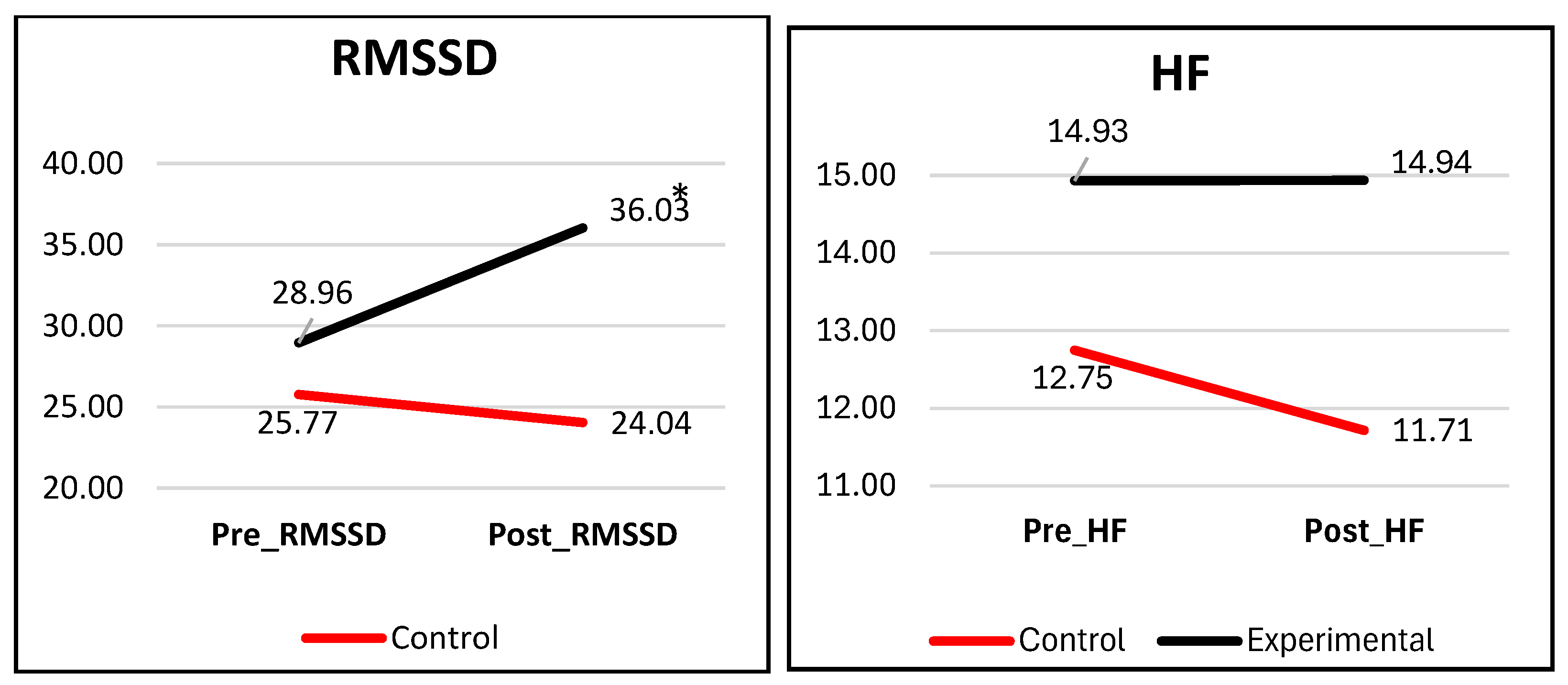
Figure 4.
Changes in RMSSD per time per set for the control and experimental group.
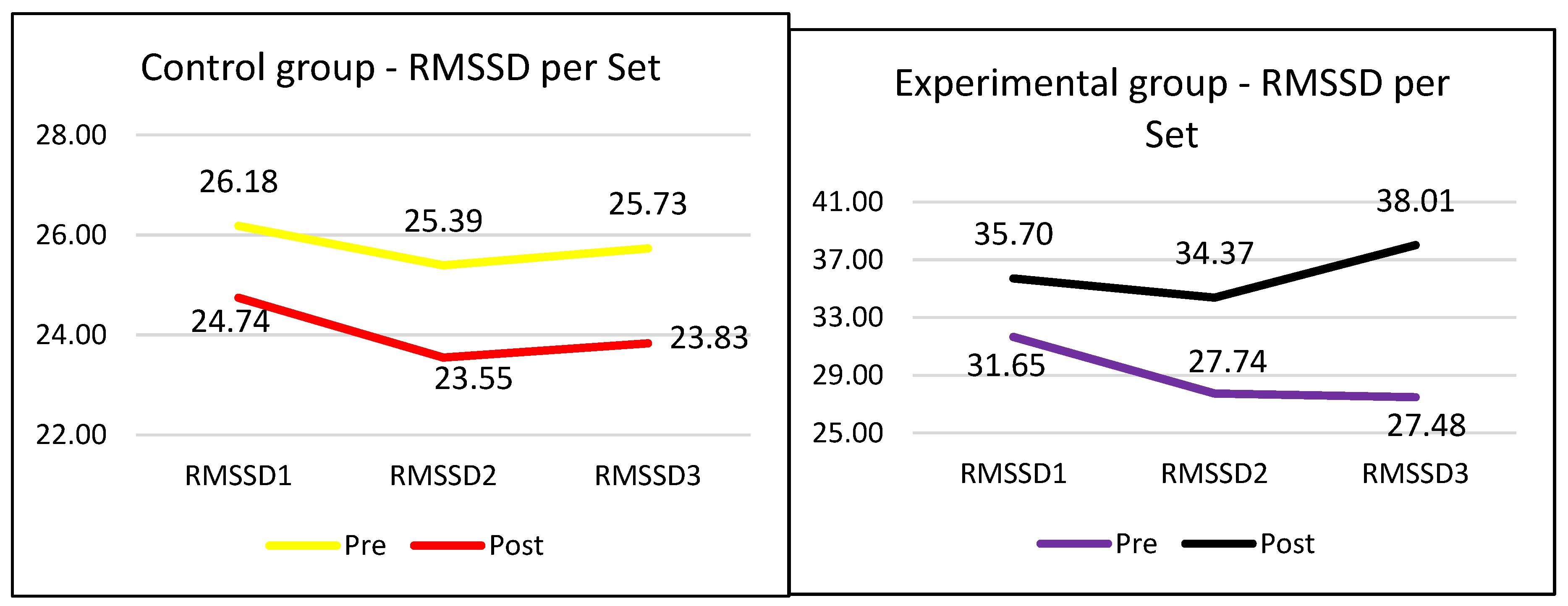

Table 1.
Pairwise comparisons between and across sets for baseline and final assessment for RMSSD values.
Table 1.
Pairwise comparisons between and across sets for baseline and final assessment for RMSSD values.
| Control | p | Experimental | p | ||||||||
| Set 1 | Set 2 | Set 3 | 1vs2 | 2vs3 | Set 1 | Set 2 | Set 3 | 1vs2 | 2vs3 | ||
| Baseline | Mean SD |
26.18 9.61 |
25.39 8.87 |
25.73 9.14 |
.35 | .65 | 31.65 18.70 |
27.74 15.68 |
27.48 15.68 |
.001 | .76 |
| Final | Mean SD |
24.74 10.48 |
23.55 9.16 |
23.83 8.08 |
.17 | .59 | 35.70 32.02 |
34.37 27.21 |
38.01 29.29 |
.62 | .05 |
| p | .51 | .34 | .33 | .18 | .10 | .02 | |||||
Disclaimer/Publisher’s Note: The statements, opinions and data contained in all publications are solely those of the individual author(s) and contributor(s) and not of MDPI and/or the editor(s). MDPI and/or the editor(s) disclaim responsibility for any injury to people or property resulting from any ideas, methods, instructions or products referred to in the content. |
© 2026 by the authors. Licensee MDPI, Basel, Switzerland. This article is an open access article distributed under the terms and conditions of the Creative Commons Attribution (CC BY) license (http://creativecommons.org/licenses/by/4.0/).
Copyright: This open access article is published under a Creative Commons CC BY 4.0 license, which permit the free download, distribution, and reuse, provided that the author and preprint are cited in any reuse.