
Submitted:
19 February 2026
Posted:
26 February 2026
You are already at the latest version
Abstract
IoT-Infused Pedagogies Empowering Resilient Digital Societies via Next-Gen Smart Campus Innovations presents a transformative vision for education in an interconnected era. This paper explores how Internet of Things (IoT) technologies revolutionize pedagogical approaches within smart campuses, fostering adaptive learning ecosystems that extend beyond classrooms to cultivate robust digital communities. By integrating real-time data from sensors, wearables, and AI-driven analytics, next-generation innovations enable personalized instruction, predictive resource management, and immersive simulations that mirror real-world challenges. Key contributions include conceptual models for IoT-embedded teaching strategies that enhance student engagement, operational efficiency, and crisis resilience such as automated safety protocols and energy-optimized environments. Drawing from evolving smart campus infrastructures, augmented reality integrations, and gamified platforms, the framework addresses implementation hurdles like data privacy and scalability through ethical guidelines and modular designs. Ultimately, these advancements position universities as prototypes for resilient digital societies, equipping learners with skills in data literacy, collaborative innovation, and sustainable digital governance. This work bridges theory and practice, offering actionable strategies for educators and policymakers to harness IoT for equitable, future-proof education amid rapid technological shifts.
Keywords:
IoT pedagogies
; smart campuses
; resilient digital societies
; next-gen innovations
; sensor integration
; personalized learning
; educational resilience
; digital transformation
1. Introduction
The integration of Internet of Things (IoT) technologies into educational frameworks represents a pivotal evolution in pedagogy, transforming static learning environments into interconnected, intelligent systems capable of real-time adaptation [1]. This introduction establishes the foundational context for IoT-infused pedagogies, which leverage sensor networks, data analytics, and automation to empower resilient digital societies through next-generation smart campus innovations. By bridging physical infrastructure with digital intelligence, these approaches not only enhance teaching efficacy but also prepare students for a hyper-connected world, fostering skills in data-driven decision-making and collaborative resilience amid technological disruptions [2].
1.1. Background on IoT in Education
The background of IoT in education originates from the convergence of wireless sensor technologies and cloud computing in the early 2010s, initially applied in simple automation like smart whiteboards and attendance tracking systems that evolved into comprehensive campus-wide ecosystems [3]. Early adopters in higher education institutions experimented with environmental sensors to monitor classroom occupancy and air quality, revealing correlations between physical conditions and cognitive performance, which spurred broader integrations such as wearable devices for student health metrics during lectures. This progression mirrored global digital transformation trends, where IoT shifted from operational efficiencies reducing energy waste by up to 30% in pilot programs to pedagogical enhancements, enabling real-time feedback loops that personalize content delivery based on learner engagement data [4].
Influential studies from institutions like MIT and Stanford underscored how IoT facilitates experiential learning, such as virtual labs simulating industrial IoT deployments, thereby cultivating interdisciplinary skills essential for future workforces [5]. Today, this foundation supports resilient digital societies by modelling scalable, adaptive infrastructures that withstand crises like pandemics through predictive analytics and automated safety protocols.
1.2. Objectives and Scope
The primary objectives of this paper are to delineate a robust framework for IoT-infused pedagogies that empower resilient digital societies, specifically through next-gen smart campus innovations, while providing actionable strategies for implementation across diverse educational contexts [6]. It aims to analyse how IoT-driven tools enhance pedagogical resilience by integrating real-time data streams for personalized learning pathways, resource optimization, and crisis-responsive environments, ultimately equipping learners with competencies in digital governance and collaborative innovation.
The scope encompasses theoretical modelling of IoT ecosystems from sensor infrastructures and AI analytics to augmented reality simulations alongside practical case studies of global deployments, ethical considerations like data privacy via blockchain, and scalability roadmaps for under-resourced institutions [7]. Exclusions include granular hardware specifications or sector-specific adaptations beyond higher education, focusing instead on strategic empowerment for educators, administrators, and policymakers to foster equitable digital transformation.
This targeted approach bridges current gaps in literature, projecting long-term societal benefits such as reduced operational costs and heightened community adaptability in an era of rapid technological flux [8].
2. Literature Review
The literature review synthesizes scholarly works on smart campuses and IoT pedagogies, tracing their development to underscore transformative potential in education. Spanning engineering, computer science, and pedagogy journals from 2000 onward, it highlights how IoT transitions campuses from isolated facilities to integrated digital ecosystems that support resilient learning [9]. Key themes include technological convergence, empirical case studies, and theoretical models, revealing gaps in ethical implementation and scalability that this paper addresses through next-gen innovations.
2.1. Evolution of Smart Campuses
The evolution of smart campuses began around 2000 with pioneering concepts integrating video conferencing and ubiquitous computing, as noted in early works by Kaneko et al., progressing through the 2010s via IoT sensors for environmental control and RFID for access management [12]. By mid-decade, institutions like MIT and the University of Murcia advanced to comprehensive platforms combining microgrids, big data analytics, and BIM for real-time building optimization, achieving energy savings of 20-40% while enhancing user experiences.
Literature from 2010-2020, including reviews in IEEE and Springer, categorizes progress into smart buildings, mobility, and living spaces, with Chinese universities like Tsinghua emphasizing interoperability standards amid challenges like data silos [13]. Recent studies project Phase 3 campuses fully autonomous via AI edge computing modelling smart cities by embedding predictive maintenance and adaptive infrastructures that foster pedagogical resilience against disruptions.
2.2. IoT Pedagogies Overview
IoT pedagogies encompass teaching strategies leveraging connected devices for experiential, data-centric learning, evolving from basic sensor labs in the 2010s to immersive ecosystems today. Scholarly overviews, such as those in PMC and Arduino publications, detail applications like wearable analytics for cognitive load monitoring and VR-fed simulations that boost retention by 25-35% through real-time personalization [15].
Core models emphasize flipped classrooms with IoT dashboards for collaborative problem-solving, addressing digital literacy gaps via hands-on projects simulating industrial deployments. Reviews highlight benefits in engagement and equity but note underexplored areas like ethical data use and interdisciplinary curricula integration, positioning IoT as a cornerstone for resilient digital societies where pedagogies adapt dynamically to learner needs and global challenges [16].
3. Conceptual Framework
This conceptual framework integrates IoT technologies with core pedagogical principles to design resilient educational ecosystems within smart campuses, emphasizing interconnected devices that enhance learning adaptability through continuous data processing and adaptive feedback systems [17].
It positions IoT-infused pedagogies as dynamic structures where resilience develops from real-time analytics and collaborative human-AI interactions, scaling campus-based innovations to broader societal applications [18]. The model highlights how intelligent infrastructures transform universities into prototypes for digital communities capable of withstanding disruptions while promoting inclusive, data-informed education.
3.1. IoT-Infused Pedagogical Models
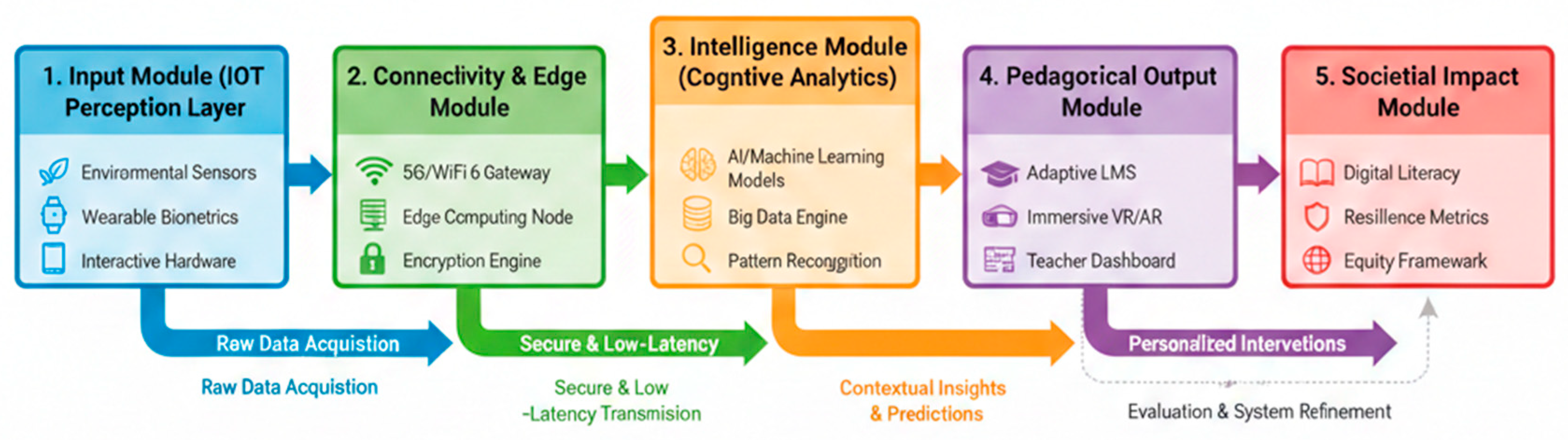
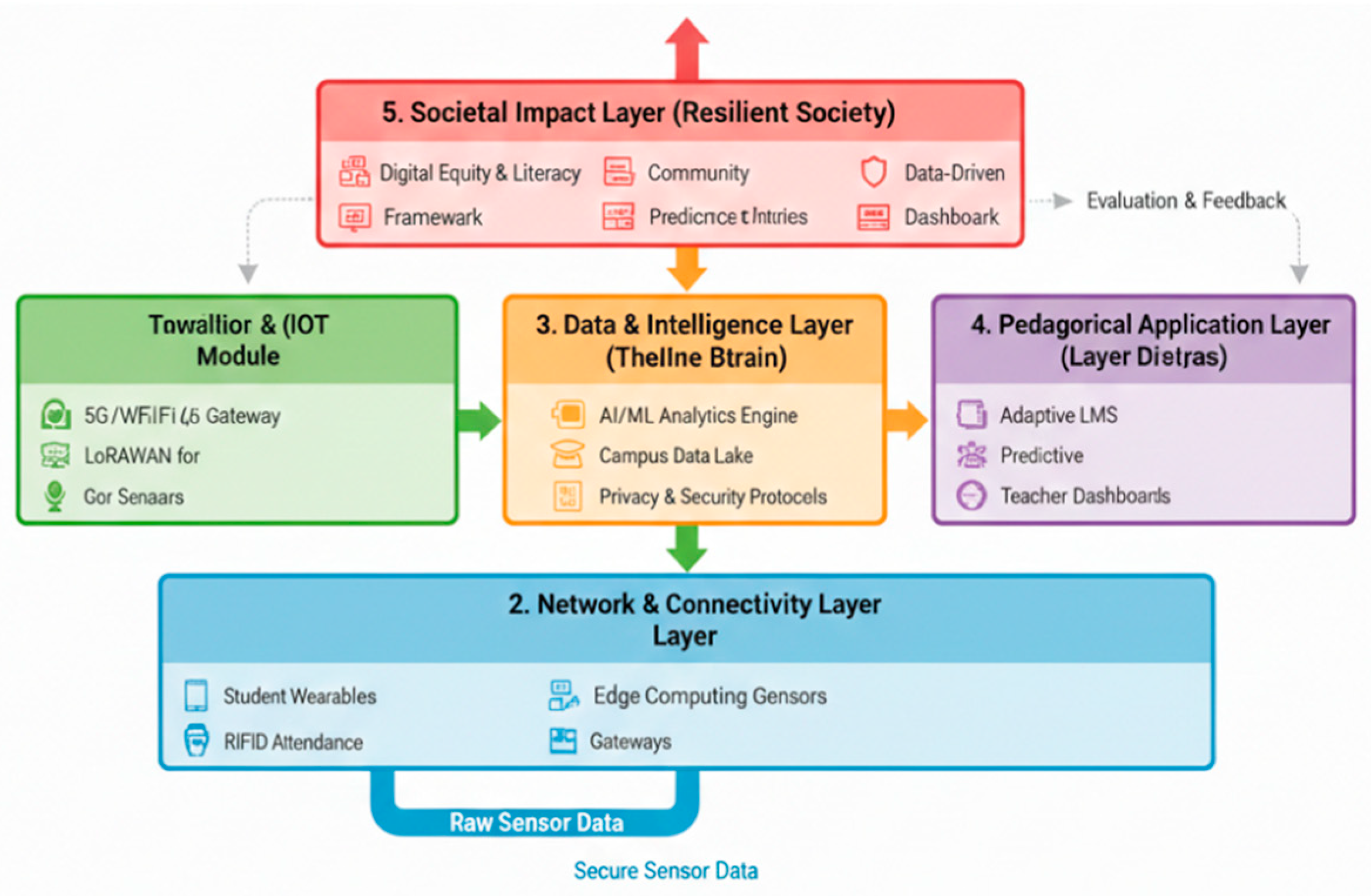
IoT-infused pedagogical models function through a structured multi-layer architecture that starts with connectivity at the base, where sensors and actuators create seamless networks linking physical spaces to digital platforms for immediate environmental and learner responses [19].
These models prioritize resource optimization by dynamically allocating devices based on real-time usage patterns, enabling personalized learning paths that adjust instructional content according to individual engagement levels captured from wearables and classroom monitors [20].
In hybrid settings, they combine traditional flipped classrooms with immersive virtual overlays powered by live data streams, allowing students to engage in realistic simulations of complex global scenarios that build interdisciplinary problem-solving abilities [22].
Practical implementations demonstrate significant improvements in knowledge retention and student motivation, as educators gain actionable insights into group dynamics and individual progress, facilitating proactive adjustments that turn potential learning barriers into opportunities for growth [24].
This approach establishes scalable templates for institutions aiming to evolve into self-regulating learning environments resilient to external challenges like technological outages or sudden enrolment shifts [26].
Figure 1.
Functional Block Diagram of the Next-Gen Smart Campus System Architecture.
3.2. Resilient Digital Societies
Resilient digital societies take shape as IoT pedagogies extend smart campus frameworks to wider communities, training individuals to handle interconnected complexities through shared platforms that simulate real-world crises and foster collective problem-solving [31].
Campuses act as initial testing grounds for self-sustaining systems, including energy networks and communication grids that maintain operations during emergencies by redistributing resources based on predictive patterns observed in educational settings [33].
Ethical data-sharing mechanisms ensure privacy while enabling community-wide insights, building trust essential for large-scale adoption [34].
Educational programs within these models emphasize proactive strategies, such as automated maintenance protocols and adaptive safety measures, which prepare participants for urban challenges by demonstrating how interconnected intelligence prevents cascading failures [36].
Through hands-on experiences in collaborative innovation hubs, learners develop governance skills that promote equitable access and long-term stability, transforming universities from isolated entities into catalysts for societal endurance in an era defined by rapid digital evolution and unforeseen disruptions [38].
4. Next-Gen Smart Campus Innovations
Next-generation smart campus innovations harness IoT alongside AI and edge computing to create adaptive, self-optimizing environments that elevate learning while modelling sustainable digital societies [39]. These advancements integrate sensors, automation, and predictive analytics to streamline operations from energy use to personalized education, positioning campuses as living laboratories for resilient technologies. By fostering seamless connectivity across infrastructure, they empower pedagogies that respond dynamically to user needs, reducing costs and enhancing inclusivity in higher education.
4.1. IoT-Enabled Infrastructure
IoT-enabled infrastructure serves as the foundational nervous system of next-gen smart campuses, deploying networks of sensors, actuators, and connected devices to monitor and regulate environmental conditions, occupancy patterns, and resource flows in real time for unprecedented operational intelligence [43]. Systems automatically adjust lighting, HVAC, and ventilation based on live data from room sensors and weather feeds, achieving energy reductions of up to 40% while maintaining optimal comfort for focused learning sessions.
Integrated platforms centralize data into AI-driven dashboards that predict maintenance needs for elevators or plumbing before failures occur, minimizing disruptions and extending asset lifespans through proactive interventions [45]. Security layers incorporate facial recognition and geofencing alongside anomaly detection algorithms that alert administrators to unusual crowd densities or unauthorized access, creating layered defences that enhance safety without invasive oversight.
This interconnected backbone not only optimizes physical spaces but also feeds pedagogical tools, such as adaptive classroom layouts that reconfigure seating via motorized furniture based on attendance analytics, transforming static buildings into responsive ecosystems that support innovative teaching and resilient community building [48].
4.1.1. Sensors and Wearables
Sensors and wearables form the sensory layer of IoT-enabled infrastructure, capturing granular data on human and environmental dynamics to drive hyper-responsive campus operations and personalized pedagogies [52]. Deployed across lecture halls, libraries, and outdoor spaces, fixed sensors continuously track air quality, temperature, noise levels, and foot traffic, automatically triggering adjustments like fresh air circulation during peak cognitive demand periods or dimmed lighting in low-occupancy zones to conserve energy while preserving focus.
Wearables such as smart badges and fitness trackers equipped with biometric sensors monitor student vital signs, stress indicators, and movement patterns, feeding anonymized aggregates into AI systems that recommend optimal break timings or collaborative grouping based on energy levels detected during classes [55]. Integration with mobile apps allows seamless data syncing, enabling faculty to access real-time engagement metrics that inform dynamic lesson pacing, such as shortening complex topics when collective fatigue rises.
This technology transforms passive observation into proactive enhancement, fostering healthier learning environments that adapt to individual rhythms and group dynamics, ultimately building resilient habits for digital society participation [56].
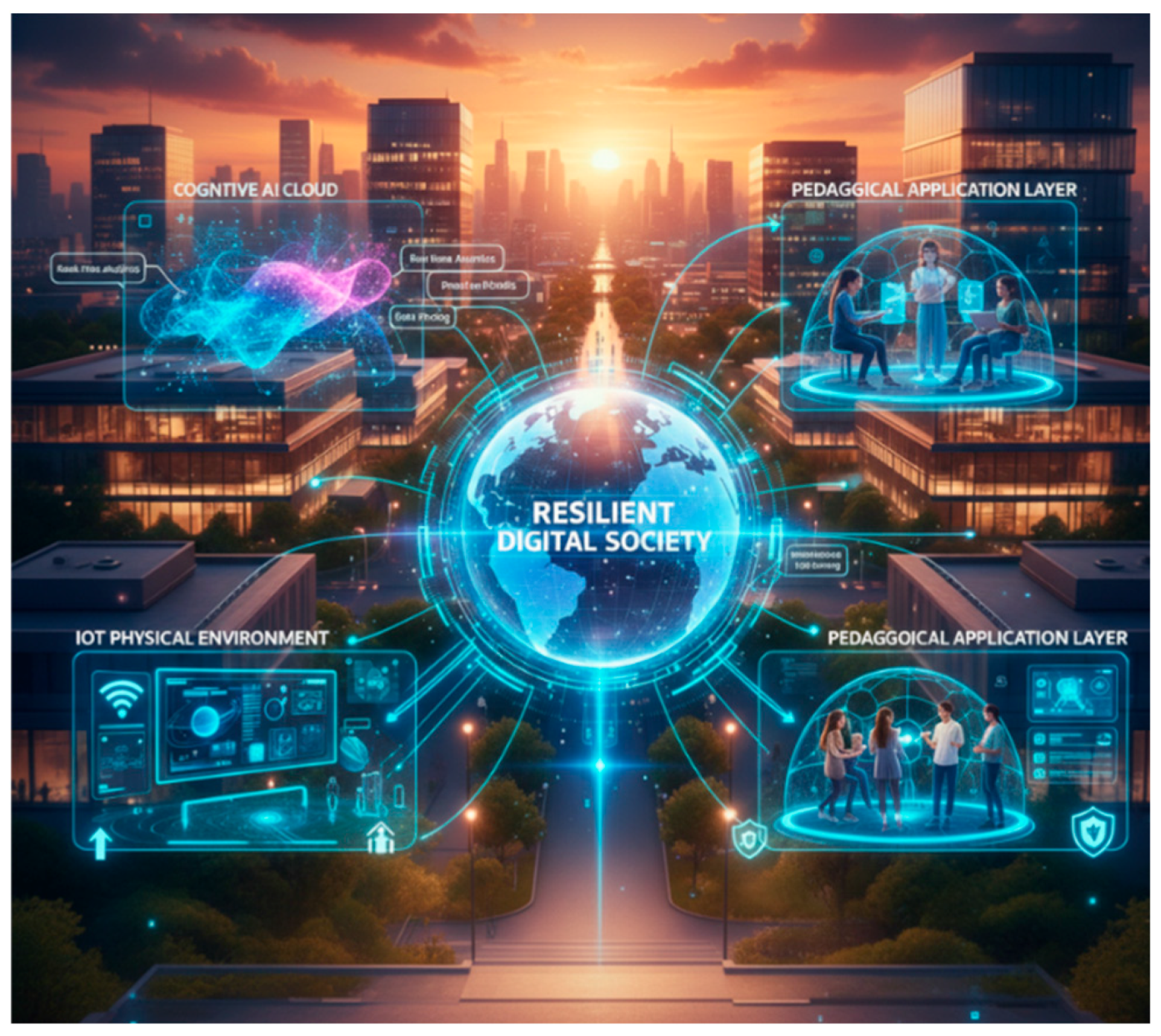
Figure 2.
Level-1 Data Flow Diagram (DFD) Illustrating the Pedagogical Feedback Loop.
4.1.2. Energy Management Systems
Energy management systems leverage IoT connectivity to orchestrate intelligent resource distribution throughout smart campuses, minimizing waste through predictive algorithms that analyse historical usage patterns alongside real-time inputs from weather stations and occupancy sensors [60].
Building controllers dynamically balance loads by pre-cooling high-traffic areas before rush hours and powering down unused facilities, achieving substantial reductions in electricity consumption often 30-50% while integrating renewable sources like solar panels whose output gets optimized via machine learning forecasts [62]. These systems extend to microgrids that isolate campus sections during grid failures, ensuring uninterrupted power for critical zones such as data centres and emergency medical stations through seamless battery storage switching.
Pedagogical applications emerge as students interact with live dashboards during sustainability courses, analysing energy flow visualizations to propose optimization strategies that the system tests in real time, bridging theoretical environmental science with practical governance skills [65]. Beyond cost savings, this infrastructure models circular economy principles for future digital societies, demonstrating how interconnected intelligence sustains operations amid resource constraints and climate uncertainties.
4.2. Augmented and Virtual Reality Integration
Augmented and virtual reality integration within next-gen smart campuses fuses IoT data streams with immersive simulations to create blended learning realms that extend physical boundaries into interactive digital experiences tailored for complex problem-solving [67].
AR overlays project real-time IoT metrics such as structural stress data from campus bridges or live biodiversity readings from green spaces directly onto students’ mobile views during field exercises, enabling instant analysis of environmental dynamics without specialized equipment [69].
VR environments, populated by sensor-fed avatars representing actual classroom interactions, allow remote learners to participate in group dissections or architectural walkthroughs with haptic feedback mimicking material textures, fostering empathy across disciplines [71]. These technologies synchronize with IoT infrastructure to dynamically update scenarios based on current campus conditions, like simulating disaster evacuations using occupancy patterns from hallway sensors, which heightens situational awareness and decision-making under pressure.
Faculty leverage integration platforms to embed quizzes within VR modules, tracking progress through gaze analytics for adaptive difficulty scaling, thus transforming abstract concepts into tangible skills vital for resilient digital societies [73].
4.3. Gamification and Collaborative Platforms
Gamification and collaborative platforms harness IoT connectivity to infuse competition and teamwork into everyday campus life, turning routine tasks into engaging quests that build essential digital citizenship competencies [74].
Leaderboards powered by wearable data reward students for sustainable behaviours like bike commuting tracked via geofencing or energy-conscious lab usage monitored through appliance sensors, with virtual badges unlocking privileges such as priority lab access [77]. Collaborative platforms extend this through cloud-synced hubs where cross-disciplinary teams co-design IoT prototypes, sharing live sensor feeds from shared maker spaces to iterate on solutions for real campus issues like optimizing shuttle routes during peak hours.
Narrative-driven challenges simulate global crises, assigning roles based on skill profiles derived from past performance data, encouraging persistent collaboration via integrated chat and version control akin to professional dev environments. Progress analytics inform instructors on team dynamics, prompting interventions like reshuffling groups when engagement dips, ensuring equitable participation [80].
These platforms cultivate resilience by mirroring distributed workforces, preparing learners for interconnected societies where gamified incentives drive innovation and collective problem-solving amid uncertainty [81].
Figure 3.
Multi-Tiered Technical Architecture for IoT-Driven Educational Environments.
5. Implementation Strategies
Implementation strategies provide practical roadmaps for deploying IoT-infused pedagogies across smart campuses, emphasizing phased integration, stakeholder training, and performance metrics to ensure sustainable adoption. These approaches prioritize interoperability standards and pilot testing to mitigate risks, scaling from single buildings to institution-wide systems that enhance operational resilience [82]. By aligning technology with pedagogical goals, they transform theoretical innovations into measurable outcomes supporting digital society empowerment.
5.1. Campus Management Applications
Campus management applications consolidate IoT data into unified platforms offering administrators real-time oversight of facilities, attendance, and user behaviours through intuitive dashboards that predict trends and automate routines [83]. These tools integrate disparate sensors into centralized hubs, enabling one-click optimizations like reallocating underused rooms during peak demand or scheduling maintenance during off-hours based on vibration and usage analytics.
Faculty access subset views tailored to teaching needs, such as class sentiment gauges from microphone sentiment analysis combined with biometric inputs, facilitating immediate instructional tweaks. Scalability features support modular expansions, from basic monitoring to AI-orchestrated operations, with built-in analytics tracking ROI through metrics like reduced vacancy rates and faster response times to incidents [84]. Ethical modules enforce data governance, automatically purging personal identifiers after aggregation, ensuring compliance while unlocking collective intelligence for resilient campus ecosystems.
5.1.1. Security and Safety Enhancements
Security and safety enhancements deploy IoT-driven perimeter defences and indoor monitoring to pre-empt threats through layered detection systems that fuse video analytics, motion sensors, and access controls into proactive shields [85]. Cameras equipped with facial recognition and behavioural anomaly algorithms flag unauthorized loiterers or aggressive postures in real time, triggering silent alerts to security teams alongside automated lockdowns of adjacent zones, reducing response times from minutes to seconds.
Environmental hazards like gas leaks or fire risks activate through multi-sensor fusion smoke detectors linked to HVAC shutdowns and evacuation path lighting guided by occupancy heatmaps ensuring orderly egress even in low-visibility conditions [86]. Wearable panic buttons on student IDs connect directly to nearest responders with location pings and vital signs, while air quality networks detect biohazards early, integrating with health protocols for contact tracing. Table 1 below summarizes key enhancement metrics from leading implementations.
5.1.2. Personalized Learning Environments
Personalized learning environments harness IoT analytics to craft adaptive spaces where classroom configurations, content delivery, and pacing respond to collective and individual learner states detected through multi-modal sensors [87]. Smart furniture with pressure sensors auto-arranges desks into collaborative clusters when group tasks activate, while lighting and acoustics adjust via occupant biometrics dimming for focus sessions or amplifying for discussions based on voice energy levels.
Digital signage beams customized prompts to student devices, suggesting supplementary modules when engagement dips per gaze-tracking cameras, creating feedback loops that evolve lessons mid-session. Faculty dashboards visualize class heatmaps overlaying fatigue scores, participation equity, and comprehension proxies from interaction logs, empowering targeted interventions like pairing high-performers with struggling peers [88]. Accessibility layers accommodate diverse needs, auto-translating lectures via microphone streams or amplifying audio for hearing aids cued by proximity beacons. Table 2 illustrates personalization impact across dimensions.
5.2. Case Studies and Best Practices
Case studies and best practices illuminate successful IoT deployments on smart campuses, offering replicable blueprints for scaling pedagogical innovations amid diverse institutional contexts [89]. Arizona State University’s parking optimization via IoT sensors delivered real-time availability maps through its mobile app, reducing search times by 25% and easing congestion for over 128,000 users, while integrating with broader stadium analytics for event-driven adjustments.
The University of Nebraska-Lincoln’s HVAC sensor network prevented system failures through predictive algorithms, slashing energy waste and maintenance costs by monitoring thousands of in-room conditions to balance comfort with efficiency [90]. At the University of Oulu’s Tellus Innovation Arena, 331 LoRaWAN nodes tracked temperature, CO2, and occupancy across shared spaces, enabling spatial usage studies that informed adaptive layouts and supported novel teaching experiments in IoT-driven pedagogy.
Best practices emphasize phased pilots starting with high-impact areas like energy and security, interdisciplinary teams blending IT with faculty input, rigorous data governance via anonymization protocols, and continuous feedback loops measuring outcomes against baselines. Table 3 captures key metrics from these implementations, highlighting pathways to resilient digital transformation publications.
6. Challenges and Solutions
Challenges and solutions in IoT-infused pedagogies address critical hurdles that could impede smart campus transformations, offering pragmatic countermeasures to ensure robust deployment and long-term viability [90]. Technical glitches demand resilient architectures, while ethical dilemmas require governance frameworks that safeguard user trust without stifling innovation. Scalability concerns hinge on modular designs and inclusive training, converting potential roadblocks into catalysts for equitable digital empowerment across diverse institutional landscapes.
6.1. Technical and Ethical Issues
Technical issues arise from fragmented IoT ecosystems where legacy systems clash with modern sensors, causing data silos and interoperability failures that disrupt real-time analytics essential for adaptive pedagogies. Network latency in high-density deployments overwhelms bandwidth, while cybersecurity vulnerabilities expose sensitive student biometrics to breaches, eroding confidence in connected learning [91]. Ethical challenges compound these through pervasive surveillance perceptions, as constant monitoring via wearables raises privacy invasions and algorithmic biases that unfairly profile learners based on incomplete data profiles.
Consent fatigue emerges when users face endless permission prompts, undermining adoption. Solutions counter these through standardized protocols like MQTT for seamless device communication, edge computing to process data locally and slash latency by 70%, and zero-trust security models enforcing continuous authentication across endpoints. Ethically, federated learning preserves privacy by training models on decentralized data without central aggregation, complemented by transparent audit trails and bias-detection algorithms that recalibrate outputs quarterly.
Blockchain ledgers anonymize identities while enabling verifiable data provenance, fostering trust as institutions demonstrate compliance through annual ethics impact assessments published openly.
6.2. Scalability and Adoption Barriers
Scalability barriers manifest in escalating costs for campus-wide sensor blankets and the complexity of integrating thousands of devices without overwhelming IT infrastructures, particularly straining underfunded public universities [92]. Adoption falters amid faculty resistance to tech-heavy pedagogies, fearing steep learning curves that divert time from core teaching, alongside student digital divides where not all possess compatible wearables or high-speed connectivity.
Solutions pivot to modular architectures allowing incremental rollouts starting with pilot buildings expandable via plug-and-play nodes coupled with cloud-hybrid models that offload computation to minimize upfront hardware investments by leveraging pay-per-use analytics. Adoption accelerates through immersive faculty bootcamps blending hands-on IoT labs with peer mentoring, achieving 80% proficiency within one semester as evidenced by gamified certification tracks.
Student equity programs distribute subsidized wearables tied to financial aid, while offline-capable apps ensure continuity during connectivity lapses. Change management frameworks embed success metrics into performance reviews, incentivizing buy-in, and cross-institutional consortia share open-source templates, democratizing access to proven implementations that scale resilience from single campuses to regional educational networks.
7. Future Directions
Future directions outline emerging trajectories for IoT-infused pedagogies, projecting integrations with cutting-edge technologies and supportive policies to sustain resilient digital societies beyond current smart campus paradigms. These visions emphasize proactive evolution, addressing gaps in quantum-secure networks and global standardization to amplify educational impacts amid accelerating digital convergence.
7.1. Emerging Technologies
Emerging technologies promise to supercharge next-gen smart campuses through 6G networks delivering microsecond latency for holographic classrooms where remote students manipulate shared IoT objects in real time, fostering unprecedented global collaborations. Edge AI processors embedded in every sensor enable instantaneous decisions like auto-adjusting lab hazards based on predictive failure patterns eliminating cloud dependency for mission-critical functions during outages.
Quantum sensors offer atomic-level precision in biometric tracking, detecting subtle cognitive shifts to pre-empt learning slumps before they manifest, while neuromorphic chips mimic brain efficiency to handle petabytes of campus data sustainably. Blockchain evolution into decentralized identity systems grants students sovereign control over their educational profiles, portably verifying achievements across institutions without central vulnerabilities.
Swarms of autonomous drones integrated with ground IoT map dynamic crowd flows for instant event adaptations, and bio-hybrid interfaces blending wearables with neural implants preview pedagogies attuned to subconscious learning states. These advancements converge to create self-evolving campuses that anticipate societal needs, training digital natives for hybrid human-machine ecosystems where innovation accelerates continuously.
7.2. Policy Recommendations
Policy recommendations urge governments to embed IoT literacy as a core K-20 competency, mandating national curricula that progress from sensor programming in primary schools to ethical AI governance at university levels, backed by public-private funds targeting underserved regions. Institutions should receive tiered grants tied to measurable resilience milestones like 50% renewable energy via IoT grids while tax incentives reward open-sourcing campus frameworks for global reuse [93]. International accords standardizing IoT protocols, akin to IEEE 802.15.4 expansions, prevent vendor lock-in and enable cross-border data flows under GDPR-equivalent privacy tiers.
Faculty tenure tracks must incorporate digital pedagogy innovation metrics, with sabbaticals dedicated to smart campus R&D collaborations. Equity mandates require subsidized device access bundled with admissions, audited annually for digital divide closure. Regulatory sandboxes permit experimental deployments exempt from legacy compliance, accelerating adoption while ethics boards comprising students, faculty, and civil experts oversee bias mitigation through mandatory algorithmic transparency reports. These policies transform universities into national digital resilience hubs, incubating scalable models that propel societies toward adaptive, inclusive futures.
Conclusion
IoT-infused pedagogies fundamentally reshape educational landscapes by embedding intelligent connectivity into smart campuses, creating adaptive ecosystems that empower resilient digital societies through continuous innovation and real-time responsiveness. This paper has traced the journey from foundational IoT integrations and pedagogical models to advanced implementations like sensor-driven personalization and gamified collaborations, demonstrating measurable gains in engagement, efficiency, and crisis preparedness across global case studies. Challenges in technical interoperability and ethical data stewardship yield to modular solutions and transparent governance, paving pathways for scalable adoption. Looking ahead, emerging technologies such as edge AI and 6G networks, coupled with robust policy frameworks, position universities as vanguard prototypes for societal transformation, equipping learners with indispensable skills in digital literacy, collaborative governance, and sustainable innovation. Ultimately, next-gen smart campuses transcend physical boundaries to cultivate self-sustaining communities capable of thriving amid uncertainty, affirming IoT not merely as a tool but as the architectural backbone of equitable, forward-resilient education.
References
- Devi, K.; Indoria, D. Digital Payment Service In India: A Review On Unified Payment Interface. Int. J. of Aquatic Science 2021, 12(3), 1960–1966. [Google Scholar]
- Rathi, Y. AI Governance for Multi-Cloud Data Compliance: A Comparative Analysis of India and the USA. Emerging Frontiers Library for The American Journal of Interdisciplinary Innovations and Research 2025, 7(8), 32–42. [Google Scholar] [CrossRef]
- Ravi, V.; Srivastava, V. K.; Singh, M. P.; Burila, R. K.; Kassetty, N.; Vardhineedi, P. N.; De, I. Explainable AI (XAI) for Credit Scoring and Loan Approvals. In International Conference on Web 6.0 and Industry 6.0; Springer Nature Singapore: Singapore, February 2025; pp. 351–368. [Google Scholar]
- Shinkar, A. R.; Joshi, D.; Praveen, R. V. S.; Rajesh, Y.; Singh, D. Intelligent solar energy harvesting and management in IoT nodes using deep self-organizing maps. 2024 International Conference on Emerging Research in Computational Science (ICERCS), 2024, December; IEEE; pp. 1–6. [Google Scholar]
- Thatikonda, R.; Thota, R.; Tatikonda, R. Deep Learning based Robust Food Supply Chain Enabled Effective Management with Blockchain. International Journal of Intelligent Engineering & Systems 2024, 17(5). [Google Scholar]
- Roohani, B. S.; Sharma, N.; Kasula, V. K.; Mamoria, P.; Modh, N. N.; Kumar, A.; Singh, V. Urban Computing Solutions in Healthcare Edge Computing. In Building Data-Driven Edge Systems for Business Success; IGI Global Scientific Publishing, 2026; pp. 377–400. [Google Scholar]
- Devi, K.; Indoria, D. The Critical Analysis on The Impact of Artificial Intelligence on Strategic Financial Management Using Regression Analysis. Res Militaris 2023, 13(2), 7093–7102. [Google Scholar]
- Kumar, N.; Kurkute, S. L.; Kalpana, V.; Karuppannan, A.; Praveen, R. V. S.; Mishra, S. Modelling and Evaluation of Li-ion Battery Performance Based on the Electric Vehicle Tiled Tests using Kalman Filter-GBDT Approach. 2024 International Conference on Intelligent Algorithms for Computational Intelligence Systems (IACIS), 2024, August; IEEE; pp. 1–6. [Google Scholar]
- Sharma, P.; Naveen, S.; JR, M. D.; Sukla, B.; Choudhary, M. P.; Gupta, M. J. Emotional Intelligence And Spiritual Awareness: A Management-Based Framework To Enhance Well-Being In High-Stressed Surgical Environments. Vascular and Endovascular Review 2025, 8(10s), 53–62. [Google Scholar]
- Arun, V.; Biradar, R. C.; Mahendra, V. Design and Modeling of Visual Cryptography For Multimedia Application–A Review. Solid State Technology 2020, 238–248. [Google Scholar]
- Kumar, H.; Mamoria, P.; Dewangan, D. K. Vision technologies in autonomous vehicles: progress, methodologies, and key challenges. International Journal of System Assurance Engineering and Management 2025, 16(12), 4035–4068. [Google Scholar] [CrossRef]
- Yamuna, V.; Praveen, R. V. S.; Sathya, R.; Dhivva, M.; Lidiya, R.; Sowmiya, P. Integrating AI for Improved Brain Tumor Detection and Classification. 2024 4th International Conference on Sustainable Expert Systems (ICSES), 2024, October; IEEE; pp. 1603–1609. [Google Scholar]
- Gupta, M. K.; Mohite, R. B.; Jagannath, S. M.; Kumar, P.; Raskar, D. S.; Banerjee, M. K.; Đurin, B. Solar Thermal Technology Aided Membrane Distillation Process for Wastewater Treatment in Textile Industry—A Technoeconomic Feasibility Assessment. Eng 2023, 4(3), 2363–2374. [Google Scholar] [CrossRef]
- Sahoo, A. K.; Prusty, S.; Swain, A. K.; Jayasingh, S. K. Revolutionizing cancer diagnosis using machine learning techniques. In Intelligent Computing Techniques and Applications; CRC Press, 2025; pp. 47–52. [Google Scholar]
- Tatikonda, R.; Kempanna, M.; Thatikonda, R.; Bhuvanesh, A.; Thota, R.; Keerthanadevi, R. Chatbot and its Impact on the Retail Industry. 2025 3rd International Conference on Intelligent Data Communication Technologies and Internet of Things (IDCIoT), 2025, February; IEEE; pp. 2084–2089. [Google Scholar]
- Prova, N. N. I.; Ravi, V.; Singh, M. P.; Srivastava, V. K.; Chippagiri, S.; Singh, A. P. Multilingual sentiment analysis in e-commerce customer reviews using GPT and deep learning-based weighted-ensemble model. International Journal of Cognitive Computing in Engineering 2025. [Google Scholar] [CrossRef]
- Lopez, S., Sarada. Artificial intelligence challenges and role for sustainable education in india: Problems and prospects. Sandeep Lopez, Vani Sarada, RVS Praveen, Anita Pandey, Monalisa Khuntia, Bhadrappa Haralayya (2024) Artificial Intelligence Challenges and Role for Sustainable Education in India: Problems and Prospects. Library Progress International 2024, 44, 18261–18271. [Google Scholar]
- Indoria, D.; Devi, K. Exploring The Impact of Creative Accounting on Financial Reporting and Corporate Responsibility: A Comprehensive Analysis in Earnings Manipulation in Corporate Accounts. Journal of Marketing & Social Research 2025, 2, 668–677. [Google Scholar]
- Shrivastava, A.; Praveen, R. V. S.; Vemuri, H. K.; Peri, S.S.S.R.G.; Sista, S.; Hasan, M. M. Future Directions and Challenges in Smart Agriculture and Cybersecurity. Sustainable Agriculture Production Using Blockchain Technology 2027, 265–276. [Google Scholar]
- Toni, M. Conceptualization of circular economy and sustainability at the business level. circular economy and sustainable development. International Journal of Empirical Research Methods 2023, 1(2), 81–89. [Google Scholar] [CrossRef]
- Naveen, S.; Sharma, P. Physician Well-Being and Burnout:” The Correlation Between Duty Hours, Work-Life Balance, And Clinical Outcomes In Vascular Surgery Trainees”. Vascular and Endovascular Review 2025, 8(6s), 389–395. [Google Scholar]
- Sharma, S.; Vij, S.; Praveen, R. V. S.; Srinivasan, S.; Yadav, D. K.; VS, R. K. Stress Prediction in Higher Education Students Using Psychometric Assessments and AOA-CNN-XGBoost Models. 2024 4th International Conference on Sustainable Expert Systems (ICSES), 2024, October; IEEE; pp. 1631–1636. [Google Scholar]
- Kumar, H.; Sachan, R.; Tiwari, M.; Katiyar, A. K.; Awasthi, N.; Mamoria, P. Hybrid Sign Language Recognition Framework Leveraging MobileNetV3, Mult-Head Self Attention and LightGBM. Journal of Electronics, Electromedical Engineering, and Medical Informatics 2025, 7(2), 318–329. [Google Scholar] [CrossRef]
- Akat, G. B.; Magare, B. K. Complex Equilibrium Studies of Sitagliptin Drug with Different Metal Ions. Asian Journal of Organic & Medicinal Chemistry 2022. [Google Scholar]
- Singh, C.; Praveen, R. V. S.; Vemuri, H. K.; Peri, S. S. S. R. G.; Shrivastava, A.; Husain, S. O. Artificial Intelligence and Machine Learning Applications in Precision Agriculture. Sustainable Agriculture Production Using Blockchain Technology 2027, 167–178. [Google Scholar]
- Zambare, P.; Liu, Y. Understanding cybersecurity challenges and detection algorithms for false data injection attacks in smart grids. IFIP International Internet of Things Conference, 2023, October; Springer Nature Switzerland: Cham; pp. 333–346. [Google Scholar]
- Ravi, V.; Srivastava, V. K.; Singh, M. P.; Burila, R. K.; Chippagiri, S.; Pasam, V. R.; Prova, N. N. I. AI-powered fraud detection in real-time financial transactions. In International Conference on Web 6.0 and Industry 6.0; Springer Nature Singapore: Singapore, February 2025; pp. 431–447. [Google Scholar]
- Praveen, R. V. S.; Hemavathi, U.; Sathya, R.; Siddiq, A. A.; Sanjay, M. G.; Gowdish, S. AI Powered Plant Identification and Plant Disease Classification System. 2024 4th International Conference on Sustainable Expert Systems (ICSES), 2024, October; IEEE; pp. 1610–1616. [Google Scholar]
- Atmakuri, A.; Sahoo, A.; Mohapatra, Y.; Pallavi, M.; Padhi, S.; Kiran, G. M. Securecloud: Enhancing protection with MFA and adaptive access cloud. In Advances in Electrical and Computer Technologies; CRC Press, 2025; pp. 147–152. [Google Scholar]
- Natesh, R.; Arun, V. WLAN NOTCH ULTRA WIDEBAND ANTENNA WITH REDUCED RETURN LOSS AND BAND SELECTIVITY. Indian Journal of Electronics and Electrical Engineering (IJEEE) 2014, 2(2), 49–53. [Google Scholar]
- Vandana, C. P.; Basha, S. A.; Madiajagan, M.; Jadhav, S.; Matheen, M. A.; Maguluri, L. P. IoT resource discovery based on multi faected attribute enriched CoAP: smart office seating discovery. Wireless Personal Communications, 2024. [Google Scholar]
- Vikram, A. V.; Arivalagan, S. Engineering properties on the sugar cane bagasse with sisal fibre reinforced concrete. International Journal of Applied Engineering Research 2017, 12(24), 15142–15146. [Google Scholar]
- Shrivastava, A.; Hundekari, S.; Praveen, R. V. S.; Peri, S. S. S. R. G.; Husain, S. O.; Bansal, S. Future of Farming: Integrating the Metaverse Into Agricultural Practices. In The Convergence of Extended Reality and Metaverse in Agriculture; IGI Global Scientific Publishing, 2026; pp. 213–238. [Google Scholar]
- Tatikonda, R.; Thatikonda, R.; Potluri, S. M.; Thota, R.; Kalluri, V. S.; Bhuvanesh, A. Data-Driven Store Design: Floor Visualization for Informed Decision Making. 2025 International Conference in Advances in Power, Signal, and Information Technology (APSIT), 2025, May; IEEE; pp. 1–6. [Google Scholar]
- Anuprathibha, T.; Praveen, R. V. S.; Sukumar, P.; Suganthi, G.; Ravichandran, T. Enhancing Fake Review Detection: A Hierarchical Graph Attention Network Approach Using Text and Ratings. 2024 Global Conference on Communications and Information Technologies (GCCIT), 2024, October; IEEE; pp. 1–5. [Google Scholar]
- Chavan, P. M.; Nikam, S. V. A Critique of Religion and Reason in William Golding’s The Spire. Labyrinth: An International Refereed Journal of Postmodern Studies 2014, 5(4). [Google Scholar]
- Khatri, E.; VR, M. S.; Sharma, P. Multifactor Model For Assessing The Performance Of Mutual Funds. International Journal of Environmental Sciences 2025, 11(8s), 347–352. [Google Scholar]
- Kale, D. R.; Shinde, H. B.; Shreshthi, R. R.; Jadhav, A. N.; Salunkhe, M. J.; Patil, A. R. Quantum-Enhanced Iris Biometrics: Advancing Privacy and Security in Healthcare Systems. 2025 International Conference on Next Generation Information System Engineering (NGISE) 2025, Vol. 1, 1–6. [Google Scholar]
- Devi, K.; Indoria, D. Recent Trends of Financial Growth and Policy Interventions in the Higher Educational System. Advances in Consumer Research 2025, 2(2). [Google Scholar]
- Kemmannu, P. K.; Praveen, R. V. S.; Banupriya, V. Enhancing Sustainable Agriculture Through Smart Architecture: An Adaptive Neuro-Fuzzy Inference System with XGBoost Model. 2024 International Conference on Sustainable Communication Networks and Application (ICSCNA), 2024, December; IEEE; pp. 724–730. [Google Scholar]
- Mamoria, P.; Raj, D. Comparison of mamdani fuzzy inference system for multiple membership functions. International Journal of Image, Graphics and Signal Processing 2016, 8(9), 26. [Google Scholar] [CrossRef]
- Zambare, P.; Liu, Y. Understanding security challenges and defending access control models for Cloud-based Internet of Things network. IFIP International Internet of Things Conference, 2023, October; Springer Nature Switzerland: Cham; pp. 179–197. [Google Scholar]
- Praveen, R. V. S.; Peri, S. S. S. R. G.; Vemuri, H.; Sista, S.; Vemuri, S. S.; Aida, R. Application of AI and Generative AI for Understanding Student Behavior and Performance in Higher Education. 2025 International Conference on Intelligent Communication Networks and Computational Techniques (ICICNCT), 2025, September; IEEE; pp. 1–6. [Google Scholar]
- ASARGM, K. Survey on diverse access control techniques in cloud comuting. 2025. [Google Scholar]
- Srivastava, V. K.; Ravi, V.; Singh, M. P.; Prova, N. N. I. Federated Learning Optimization for Privacy-Preserving AI in Cloud Environments. 2nd International Conference on Sustainable Business Practices and Innovative Models (ICSBPIM-2025), 2025, November; Atlantis Press; pp. 825–840. [Google Scholar]
- Praveen, R. V. S. Data Engineering for Modern Applications; Addition Publishing House, 2024. [Google Scholar]
- Agnihotri, S.; Mamoria, P.; Moorthygari, S. L.; Chandel, P.; Raju, S. G. The role of reflective practice in enhancing teacher efficacy. Educational Administration: Theory and Practice 2024, 30(6), 1689–1696. [Google Scholar] [CrossRef]
- Jadhav, S.; Durairaj, M.; Reenadevi, R.; Subbulakshmi, R.; Gupta, V.; Ramesh, J. V. N. Spatiotemporal data fusion and deep learning for remote sensing-based sustainable urban planning. International Journal of System Assurance Engineering and Management 2024, 1–9. [Google Scholar] [CrossRef]
- Naveen, S.; Sharma, P.; Veena, A.; Ramaprabha, D. Digital HR Tools and AI Integration for Corporate Management: Transforming Employee Experience. In Corporate Management in the Digital Age; IGI Global Scientific Publishing, 2025; pp. 69–100. [Google Scholar]
- Kumar, S.; Nutalapati, P.; Vemuri, S. S.; Aida, R.; Salami, Z. A.; Boob, N. S. GPT-Powered Virtual Assistants for Intelligent Cloud Service Management. 2025 World Skills Conference on Universal Data Analytics and Sciences (WorldSUAS), 2025, August; IEEE; pp. 1–6. [Google Scholar]
- Toni, M.; Mehta, A. K.; Chandel, P. S.; MK, K.; Selvakumar, P. Mentoring and Coaching in Staff Development. In Innovative Approaches to Staff Development in Transnational Higher Education; IGI Global Scientific Publishing, 2025; pp. 1–26. [Google Scholar]
- Ramaswamy, S. N.; Arunmohan, A. M. Static and Dynamic analysis of fireworks industrial buildings under impulsive loading. IJREAT International Journal of Research in Engineering & Advanced Technology 2013, 1(1). [Google Scholar]
- Praveen, R. V. S.; Hundekari, S.; Parida, P.; Mittal, T.; Sehgal, A.; Bhavana, M. Autonomous Vehicle Navigation Systems: Machine Learning for Real-Time Traffic Prediction. 2025 International Conference on Computational, Communication and Information Technology (ICCCIT), 2025, February; IEEE; pp. 809–813. [Google Scholar]
- Saunkhe, M. J.; Lamba, O. S. The basis of attack types, their respective proposed solutions and performance evaluation techniques survey. Int J Sci Technol Res 2019, 8(12), 2418–2420. [Google Scholar]
- Vidhya, T.; Arun, V. Design and analysis of OFDM based CRAHN with common control channel. 2012 International Conference on Computing, Communication and Applications, 2012, February; IEEE; pp. 1–5. [Google Scholar]
- Kumar, S.; Rambhatla, A. K.; Aida, R.; Habelalmateen, M. I.; Badhoutiya, A.; Boob, N. S. Federated Learning in IoT Secure and Scalable AI for Edge Devices. 2025 IEEE International Conference on Advances in Computing Research On Science Engineering and Technology (ACROSET), 2025, September; IEEE; pp. 1–6. [Google Scholar]
- Zambare, P.; Liu, Y. A Survey of Pedestrian to Infrastructure Communication System for Pedestrian Safety: System Components and Design Challenges. IFIP International Internet of Things Conference, 2023, October; Springer Nature Switzerland: Cham; pp. 14–35. [Google Scholar]
- Arunmohan, A. M.; Bharathi, S.; Kokila, L.; Ponrooban, E.; Naveen, L.; Prasanth, R. An experimental investigation on utilisation of red soil as replacement of fine aggregate in concrete. Psychology and Education Journal 2021, 58. [Google Scholar]
- Praveen, R. V. S.; Raju, A.; Anjana, P.; Shibi, B. IoT and ML for Real-Time Vehicle Accident Detection Using Adaptive Random Forest. 2024 Global Conference on Communications and Information Technologies (GCCIT), 2024, October; IEEE; pp. 1–5. [Google Scholar]
- Atmakuri, A.; Sahoo, A.; Behera, D. K.; Gourisaria, M. K.; Padhi, S. Dynamic Resource Optimization for Cloud Encryption: Integrating ACO and Key-Policy Attribute-Based Encryption. 2024 4th International Conference on Soft Computing for Security Applications (ICSCSA), 2024, September; IEEE; pp. 424–428. [Google Scholar]
- Kumar, S.; Praveen, R. V. S.; Aida, R.; Varshney, N.; Alsalami, Z.; Boob, N. S. Enhancing AI Decision-Making with Explainable Large Language Models (LLMs) in Critical Applications. 2025 IEEE International Conference on Advances in Computing Research On Science Engineering and Technology (ACROSET), 2025, September; IEEE; pp. 1–6. [Google Scholar]
- Bhuvaneswari, E.; Prasad, K. D. V.; Ashraf, M.; Jadhav, S.; Rao, T. R. K.; Rani, T. S. A human-centered hybrid AI framework for optimizing emergency triage in resource-constrained settings. Intelligence-Based Medicine 2025, 12, 100311. [Google Scholar] [CrossRef]
- Zambare, P.; Dabhade, S. Improved Ex-LEACH Protocol based on Energy Efficient Clustering Approach. International Journal of Computer Applications 2013, 67(24). [Google Scholar] [CrossRef]
- Karni, S. Serverless & Event-Driven Architectures: Redefining Distributed System Design. Emerging Frontiers Library for The American Journal of Interdisciplinary Innovations and Research 2025, 7(10), 13–22. [Google Scholar]
- Sharma, P.; Manjula, H. K.; Kumar, D. Impact of gamification on employee engagement-an empirical study with special reference to it industry in bengaluru. 3rd International Conference on Reinventing Business Practices, Start-ups and Sustainability (ICRBSS 2023), 2024, February; Atlantis Press; pp. 479–490. [Google Scholar]
- Hanabaratti, K. D.; Shivannavar, A. S.; Deshpande, S. N.; Argiddi, R. V.; Praveen, R. V. S.; Itkar, S. A. Advancements in natural language processing: Enhancing machine understanding of human language in conversational AI systems. International Journal of Communication Networks and Information Security 2024, 16(4), 193–204. [Google Scholar]
- Mohammed Nabi Anwarbasha, G. T.; Chakrabarti, A.; Bahrami, A.; Venkatesan, V.; Vikram, A. S. V.; Subramanian, J.; Mahesh, V. Efficient finite element approach to four-variable power-law functionally graded plates. Buildings 2023, 13(10), 2577. [Google Scholar] [CrossRef]
- Nikam, S. Literary Echoes: Exploring Themes, Voices and Cultural Narratives; Chyren Publication, 2025. [Google Scholar]
- Nutalapati, V.; Aida, R.; Vemuri, S. S.; Al Said, N.; Shakir, A. M.; Shrivastava, A. Immersive AI: Enhancing AR and VR Applications with Adaptive Intelligence. 2025 World Skills Conference on Universal Data Analytics and Sciences (WorldSUAS), 2025, August; IEEE; pp. 1–6. [Google Scholar]
- Arunmohan, A. M.; Lakshmi, M. Analysis of modern construction projects using montecarlo simulation technique. International Journal of Engineering & Technology 2018, 7(2.19), 41–44. [Google Scholar] [CrossRef]
- Bhopale, S.; Mulla, T.; Salunkhe, M.; Dange, S.; Patil, S.; Raut, R. Machine Learning for Cardiovascular Disease Prediction: A Comparative Analysis of Models. In International Conference on Smart Trends for Information Technology and Computer Communications; Springer Nature Singapore: Singapore, January 2025; pp. 1–11. [Google Scholar]
- Shrivastava, A.; Hundekari, S.; Praveen, R.; Hussein, L.; Varshney, N.; Peri, S. S. S. R. G. Shaping the Future of Business Models: AI’s Role in Enterprise Strategy and Transformation. 2025 International Conference on Engineering, Technology & Management (ICETM), 2025, May; IEEE; pp. 1–6. [Google Scholar]
- Thota, R.; Potluri, S. M.; Kaki, B.; Abbas, H. M. Financial Bidirectional Encoder Representations from Transformers with Temporal Fusion Transformer for Predicting Financial Market Trends. 2025 International Conference on Intelligent Computing and Knowledge Extraction (ICICKE), 2025, June; IEEE; pp. 1–5. [Google Scholar]
- Jadhav, S.; Aruna, C.; Choudhary, V.; Gamini, S.; Kapila, D.; Reddy, C. P. Reprogramming the Tumor Ecosystem via Computational Intelligence-Guided Nanoplatforms for Targeted Oncological Interventions. Trends in Immunotherapy 2025, 210–226. [Google Scholar] [CrossRef]
- Jose, A. Ku Band Circularly Polarized Horn Antenna for Satellite Communications. International Journal of Applied Engineering Research 2015, 10(19). [Google Scholar]
- Praveen, R. V. S.; Aida, R.; Rambhatla, A. K.; Trakroo, K.; Maran, M.; Sharma, S. Hybrid Fuzzy Logic-Genetic Algorithm Framework for Optimized Supply Chain Management in Smart Manufacturing. 2025 10th International Conference on Communication and Electronics Systems (ICCES), 2025, October; IEEE; pp. 1487–1492. [Google Scholar]
- Sahoo, P. A. K.; Aparna, R. A.; Dehury, P. K.; Antaryami, E. Computational techniques for cancer detection and risk evaluation. Industrial Engineering 2024, 53(3), 50–58. [Google Scholar]
- Praveen, R.; Shrivastava, A.; Sharma, G.; Shakir, A. M.; Gupta, M.; Peri, S. S. S. R. G. Overcoming Adoption Barriers Strategies for Scalable AI Transformation in Enterprises. 2025 International Conference on Engineering, Technology & Management (ICETM), 2025, May; IEEE; pp. 1–6. [Google Scholar]
- Zambare, P.; Thanikella, V. N.; Liu, Y. Seeing Beyond Frames: Zero-Shot Pedestrian Intention Prediction with Raw Temporal Video and Multimodal Cues. 2025 3rd International Conference on Artificial Intelligence, Blockchain, and Internet of Things (AIBThings), 2025, September; IEEE; pp. 1–5. [Google Scholar]
- Toni, M.; Jithina, K. K.; Thomas, K. V. Patient satisfaction and patient loyalty in medical tourism sector: a study based on trip attributes. International Journal of Health Sciences 2022, 6(S7), 5236–5244. [Google Scholar] [CrossRef]
- Alfurhood, B. S.; Danthuluri, M. S. M.; Jadhav, S.; Mouleswararao, B.; Kumar, N. P. S.; Taj, M. Real-time heavy metal detection in water using machine learning-augmented CNT sensors via truncated factorization nuclear norm-based SVD. Microchemical Journal 2025, 115375. [Google Scholar] [CrossRef]
- Rahman, Z.; Mohan, A.; Priya, S. Electrokinetic remediation: An innovation for heavy metal contamination in the soil environment. Materials Today: Proceedings 2021, 37, 2730–2734. [Google Scholar] [CrossRef]
- Praveen, R. V. S.; Aida, R.; Trakroo, K.; Rambhatla, A. K.; Srivastava, K.; Perada, A. Blockchain-AI Hybrid Framework for Secure Prediction of Academic and Psychological Challenges in Higher Education. 2025 10th International Conference on Communication and Electronics Systems (ICCES), 2025, October; IEEE; pp. 1618–1623. [Google Scholar]
- Ata, S. A.; Salunkhe, M. J.; Asiwal, S.; Gupta, M. K.; Patil, S. M.; Raskar, D. S.; Jain, T. K. AI-Enhanced Analysis of Transformational Leadership’s Impact on CSR Participation. 2025 International Conference on Next Generation Communication & Information Processing (INCIP), 2025, January; IEEE; pp. 5–9. [Google Scholar]
- Praveen, R. V. S.; Peri, S. S. S. R. G.; Labde, V. V.; Gudimella, A.; Hundekari, S.; Shrivastava, A. AI in Talent Acquisition: Enhancing Diversity and Reducing Bias. Journal of Marketing & Social Research 2025, 2, 13–27. [Google Scholar]
- Samal, D. A.; Sharma, P.; Naveen, S.; Kumar, K.; Kotehal, P. U.; Thirulogasundaram, V. P. Exploring the role of HR analytics in enhancing talent acquisition strategies. South Eastern European Journal of Public Health 2024, 23(3), 612–618. [Google Scholar] [CrossRef]
- Nikam, S. V.; Sonar, S. N. D. A Study of Symbiotic Relationship Between Media Responsibility and Media Ethics.” Let noble thoughts come to us from every side; Rigveda, 2022. [Google Scholar]
- Shrivastava, A.; Rambhatla, A. K.; Aida, R.; MuhsnHasan, M.; Bansal, S. Blockchain-Powered Secure Data Sharing in AI-Driven Smart Cities. 2025 IEEE International Conference on Advances in Computing Research On Science Engineering and Technology (ACROSET), 2025, September; IEEE; pp. 1–6. [Google Scholar]
- Thota, R.; Potluri, S. M.; Alzaidy, A. H. S.; Bhuvaneshwari, P. Knowledge Graph Construction-Based Semantic Web Application for Ontology Development. 2025 International Conference on Intelligent Computing and Knowledge Extraction (ICICKE), 2025, June; IEEE; pp. 1–6. [Google Scholar]
- Praveen, R. V. S.; Peri, S. S. R. G.; Labde, V. V.; Gudimella, A.; Hundekari, S.; Shrivastava, A. Neuromarketing in the Digital Age: Understanding Consumer Behavior Through Brain-Computer Interfaces. Journal of Informatics Education and Research 2025, 5(2), 2112–2132. [Google Scholar] [CrossRef]
- Vijay Vikram, A. S.; Arivalagan, S. A short review on the sugarcane bagasse with sintered earth blocks of fiber reinforced concrete. Int J Civil Eng Technol 2017, 8(6), 323–331. [Google Scholar]
- Jadhav, S.; Chakrapani, I. S.; Sivasubramanian, S.; RamKrishna, B. V.; Mouleswararao, B.; Gangwar, S. Designing Next-Generation Platforms with Machine Learning to Optimize Immune Cell Engineering for Enhanced Applications. Trends in Immunotherapy 2025, 226–244. [Google Scholar] [CrossRef]
- Victor, S.; Kumar, K. R.; Praveen, R. V. S.; Aida, R.; Kaur, H.; Bhadauria, G. S. GAN and RNN Based Hybrid Model for Consumer Behavior Analysis in E-Commerce. 2025 2nd International Conference on Intelligent Algorithms for Computational Intelligence Systems (IACIS), 2025, August; IEEE; pp. 1–6. [Google Scholar]

Table 1.
Security Enhancement Performance Metrics.
| Feature | Reduction Achieved | Response Time | Integration Level |
| Anomaly Detection | 65% incidents | <10 seconds | High |
| Automated Lockdown | 80% breach time | Instant | Medium |
| Evacuation Guidance | 40% egress time | Real-time | High |
| Biohazard Monitoring | 90% early alerts | <30 seconds | High |
Table 2.
Personalization Impact Metrics.
| Dimension | Improvement Rate | Key Sensors Used | Adaptivity Type |
| Engagement | 35% uplift | Biometrics, Gaze | Real-time |
| Retention | 28% gain | Interaction Logs | Content scaling |
| Inclusivity | 45% equity | Proximity, Audio | Auto-adjust |
| Pacing Optimization | 32% efficiency | Pressure, Movement | Layout dynamic |
Table 3.
Case Study Performance Outcomes.
| Institution | Focus Area | Key Achievement | Efficiency Gain | Scalability Notes |
| Arizona State University | Parking Management | Real-time maps via app | 25% time saved | Campus-wide expansion |
| Univ. of Nebraska-Lincoln | Energy/HVAC | Predictive failure detection | 30% cost reduction | 1000s sensors deployed |
| University of Oulu | Space Utilization | 331 LoRaWAN nodes analysis | 40% usage optimization | Teaching integration |
| Instituto Superior Técnico | Energy Control | User preference apps | 20% energy cut | Multi-building rollout |
Disclaimer/Publisher’s Note: The statements, opinions and data contained in all publications are solely those of the individual author(s) and contributor(s) and not of MDPI and/or the editor(s). MDPI and/or the editor(s) disclaim responsibility for any injury to people or property resulting from any ideas, methods, instructions or products referred to in the content. |
© 2026 by the authors. Licensee MDPI, Basel, Switzerland. This article is an open access article distributed under the terms and conditions of the Creative Commons Attribution (CC BY) license (http://creativecommons.org/licenses/by/4.0/).
Copyright: This open access article is published under a Creative Commons CC BY 4.0 license, which permit the free download, distribution, and reuse, provided that the author and preprint are cited in any reuse.