

Submitted:
19 February 2026
Posted:
27 February 2026
You are already at the latest version
Abstract
The rapid electrification of road vehicles has fundamentally reshaped the priorities of noise, vibration, and harshness (NVH) engineering. In the absence of combustion-related broadband masking, tonal and order-related phenomena originating from the electric machine, inverter switching, and high-speed reduction gearing have become clearly per-ceptible and, in many cases, acoustically dominant. Consequently, drivetrain noise in electric vehicles can no longer be assessed at component level alone; it must be understood as a coupled system response shaped by excitation mechanisms, structural dynamics, transfer paths, radiation efficiency, and ultimately human perception. This review adopts a source-to-perception perspective and consolidates the principal physical mechanisms governing vibro-acoustic behaviour in integrated electric drive units. Electromagnetic force harmonics and torque ripple are discussed alongside transmission-error-driven gear mesh excitation, while bearing and shaft nonlinearities are examined in the context of high-speed operation. In addition, ancillary thermoacoustic and aerodynamic contribu-tions are considered, reflecting the increasingly integrated packaging of modern e-axle architectures. On this mechanism-oriented basis, dominant excitation types are linked to frequency-appropriate modelling strategies, spanning electromagnetic force extraction, multibody drivetrain simulation, structural finite element analysis, transfer path analysis, and acoustic radiation prediction. Particular attention is given to workflow integration across domains. Finally, the paper identifies research challenges that predominantly arise at system level, including multi-source interaction effects, installation-dependent trans-fer-path variability, emergent resonances in assembled structures, manufacturing-induced tonal artefacts, and the still limited correlation between predicted vibration fields and perceived sound quality.
Keywords:
electric vehicle (EV)
; NVH
; electric drive unit (EDU)
; electromagnetic noise
; transmission error (TE)
; multiphysics simulation
; radiated noise
1. Introduction
Electric vehicles (EVs) have reshaped automotive NVH (noise, vibration, harshness) engineering by exposing tonal and order-related noise components that were previously masked by internal combustion engines.
EVs have shifted the dominant NVH problem from broadband engine and exhaust noise toward tonal and order-driven phenomena arising from electric machines, inverter switching, and high-speed reduction gearing. Large-scale reviews consistently report that the absence of combustion masking makes drivetrain-related tonal components more prominent, raising customer sensitivity to whine/whistle-like signatures and to order-related sound quality issues during acceleration and cruising [1].
Modern “premium” EVs demand extremely low tonal noise even at high speeds. pressuring designers to optimize each component and the entire powertrain. Simulation-based design is key: by modeling the full system early. companies achieve fewer prototypes and shorter development times [2,3]. For example. best-in-class firms report ~27% fewer prototypes and 29% shorter cycles after adopting simulation-driven design [4]. Regulatory and customer pressures amplify this need: stringent exterior and interior noise limits (including pedestrian alert regulations) must be met. and customers expect an EV to sound smoother and quieter than an ICE vehicle. In short sustainable EV development relies on virtual NVH optimization to reduce waste and expedite design. making multiphysics NVH simulation indispensable. These drivers further justify the system-level source-to-ear interpretation adopted in this review [5].
A key implication for simulation is that EV drivetrain noise should be treated as an emergent system-level phenomenon, rather than a sum of isolated component excitations. The same nominal excitation (e.g., a TE order or an electromagnetic force harmonic) can produce very different acoustic outcomes depending on transfer path impedances, mounting conditions, housing and body resonances, and radiation efficiency. Transfer Path Analysis (TPA) studies further reinforce this system-oriented interpretation. Receiver-side responses are not solely governed by the intrinsic strength of a given excitation, but by the dynamic coupling between source and structure. In this context, the quality of the source characterization becomes decisive. Robust source descriptions—such as blocked forces or equivalent force representations—enable predictive synthesis across different assemblies and installation variants, thereby supporting early-stage design decisions without reliance on full prototype configurations.
It is equally important to recognize that acoustic comfort in electric vehicles extends beyond airborne sound pressure levels measured at the occupant’s ear. The perceptual experience is inherently multimodal. Structure-borne vibrations transmitted through the electric drive unit, mounting system, and vehicle body can propagate toward tactile interfaces including the steering wheel, seat rails, floor panels, and even mirror assemblies. These vibrations may not always manifest as dominant radiated noise, yet they can be directly sensed by occupants through touch, contributing significantly to the subjective impression of harshness. Consequently, a comprehensive NVH assessment must integrate both airborne and structure-borne pathways, accounting for their interaction and combined influence on perceived quality.
Consequently, EV NVH must be treated as a source-to-human perception problem, in which both auditory and tactile perception pathways originate from common excitation sources and structural transmission mechanisms.
Figure 1 illustrates the complete source-to-ear noise transmission chain in electric vehicle drivetrains. Unlike conventional internal combustion vehicles, EV noise is dominated by structure-borne excitations originating from electromagnetic forces, gear meshing phenomena, and power-electronic harmonics. These excitations are transmitted through shafts, bearings, gearbox housings, and motor mounts into the body-in-white, forming the dominant structure-borne noise paths at low and mid frequencies. Structural vibrations travel through the system components. These vibrations reach the panels and interior trim. The vibrating surfaces then convert the energy into airborne noise. Radiated sound level scales with surface vibration velocity, but the conversion into airborne sound is controlled by the radiation efficiency of the structure. In real applications, the acoustic environment is formed by superposed exterior and interior contributions. Perceived sound quality begins with the excitation strength, then emerges from how the structure transmits, amplifies, and radiates that excitation. Transmission paths then modify the acoustic signal. Structural dynamics define how the system responds. Conversion mechanisms ultimately determine the final sound quality.
Excitation sources generate structure-borne vibrations that propagate through drivetrain components and the vehicle body. These vibrations contribute both to airborne noise through structural radiation and to tactile vibration perceived directly by the occupant via steering wheel, seat, and body interfaces.
Figure 2.
Simplified source-to-ear noise transmission chain in electric vehicle drivetrains.
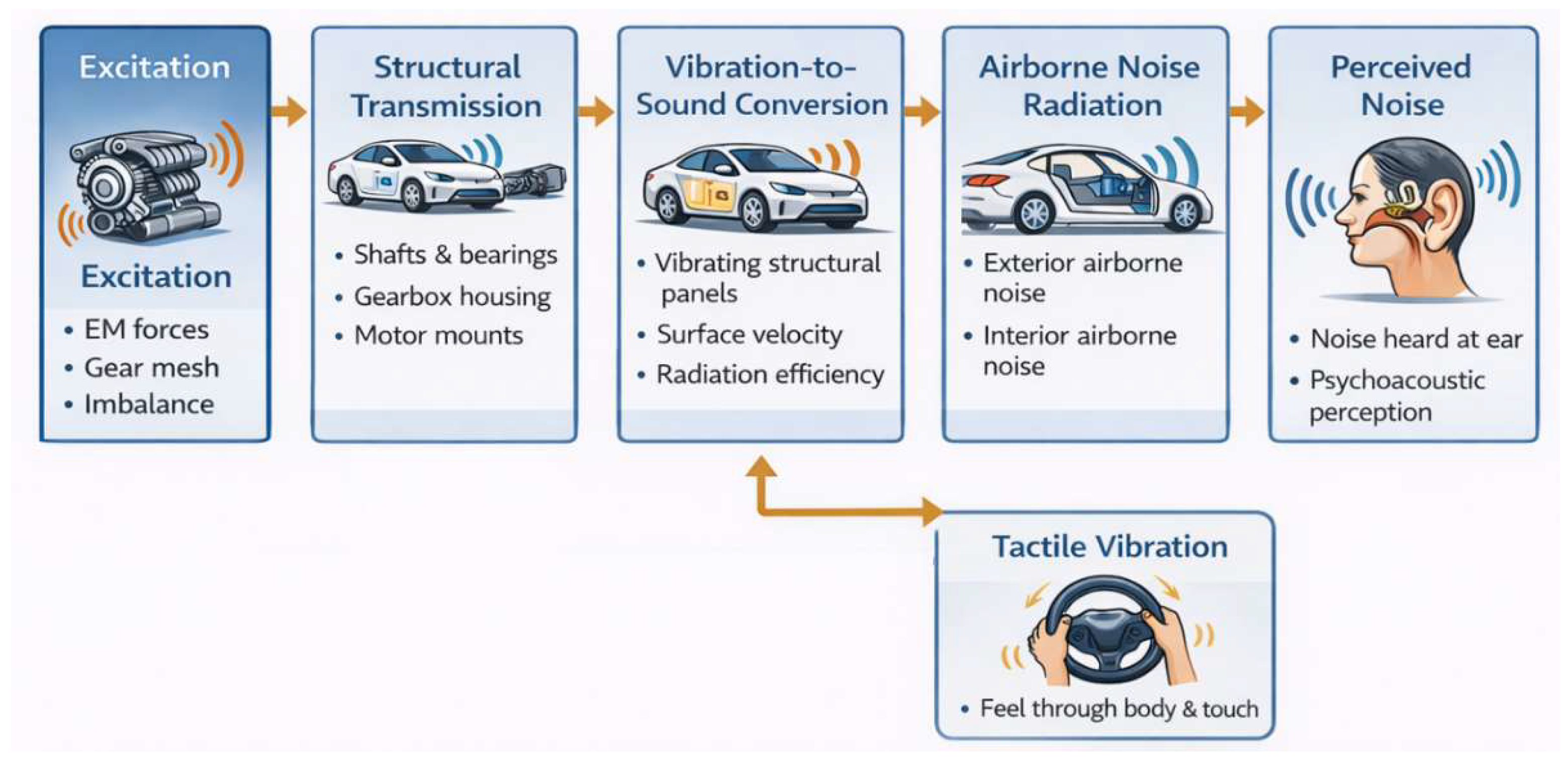
Excitation sources generate structural vibrations that propagate through drivetrain components and mounting interfaces. These vibrations are converted into airborne noise through structural radiation and contribute to exterior and interior sound fields, which ultimately determine perceived noise at the occupant’s ear.
Within integrated electric drive units (EDUs) and e-axles, multiple excitation mechanisms—electromagnetic forces and torque ripple, inverter/PWM-induced harmonics, gear-mesh transmission error (TE) and time-varying meshing stiffness, bearing nonlinearities, and ancillary aero-/thermoacoustic sources—interact through structural transfer paths and system resonances before radiating as airborne sound to the exterior and, critically, the passenger compartment. These observations motivate a source-to-ear interpretation of EV drivetrain NVH, where excitation, transmission, radiation, and perception must be treated as a coupled system rather than isolated phenomena.
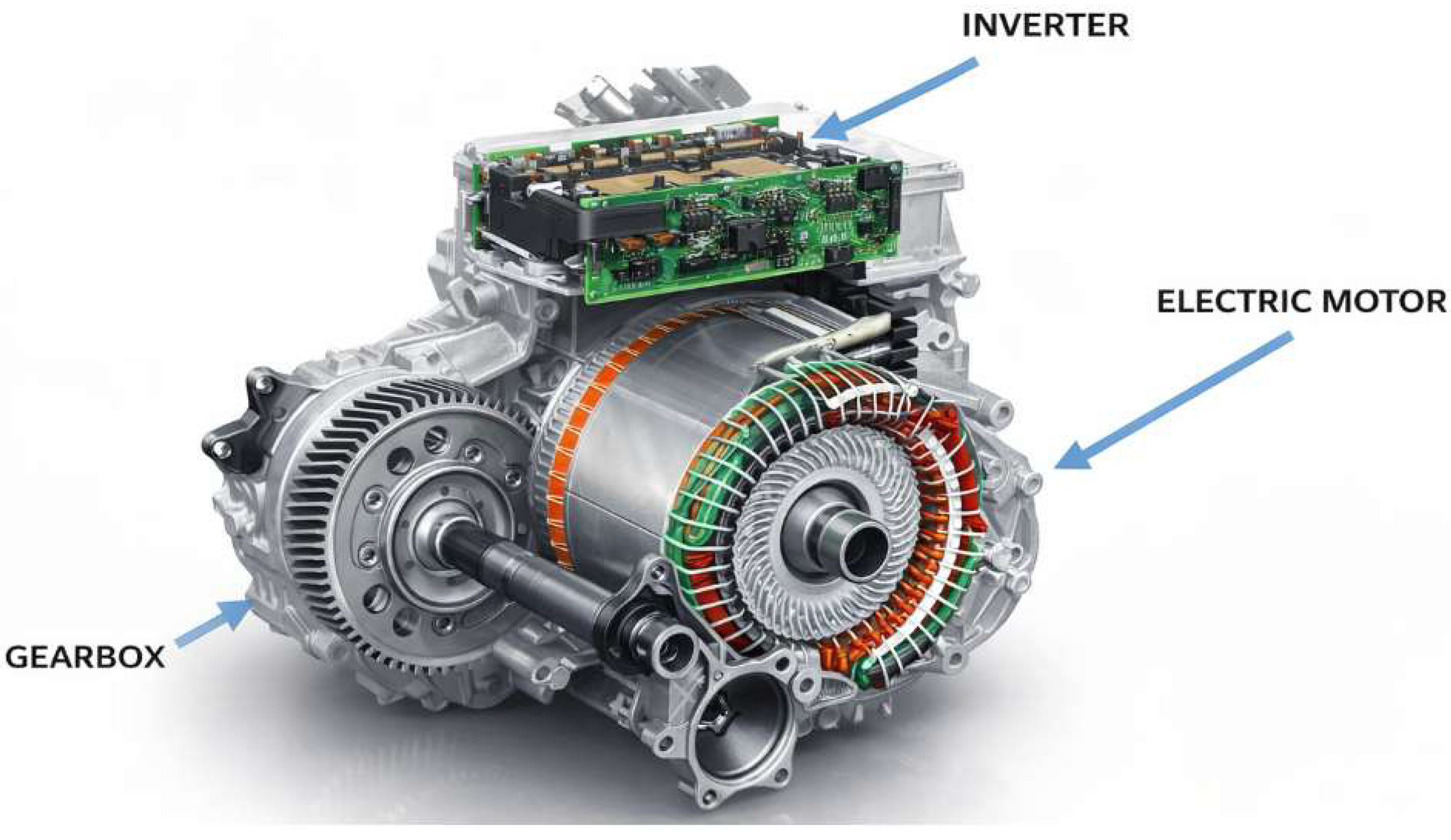
Gear transmissions and e-motors are primary NVH sources in EV drivetrains. Transmission error (TE) – the angular deviation between meshing gear teeth – is the dominant cause of gear whine [7]. In an ideal, infinitely stiff system with perfect tooth geometry, TE would be zero; in practice, manufacturing imperfections and elastic deformations induce time-varying TE and thus vibration [8]. Gear mesh stiffness, the instantaneous stiffness of the contacting teeth, largely determines dynamic loads; its variation during rotation (TVMS) drives TE and noise. EV motors introduce new excitation mechanisms: electromagnetic (EM) torque ripple and radial forces from stator–rotor interactions can cause shaft and housing vibration, while high-frequency inverter switching (PWM harmonics) can induce audible noise. Vibrations propagate through structure-borne paths (via shafts, bearings, mounts to the housing) and radiate as airborne noise from surfaces. A holistic NVH model must therefore integrate structural modes, component resonances, and acoustic radiation. To predict the sound perceived by passengers, models often compute Equivalent Radiated Power (ERP) or perform full acoustic BEM/FEM analysis from structural vibration results. Efficient system reduction (e.g., Craig–Bampton modal synthesis) is widely used to condense complex shafts, gear bodies, and housings into manageable dynamic models [8]. With these fundamentals established. The following sections review the physical mechanisms and their modeling implications.
Figure 3.
Main Sources of NVH.
This review therefore follows a mechanism-centric structure: it first consolidates physical mechanisms for noise generation and transmission in EV drivetrains, then maps those mechanisms to numerical modeling paradigms and their frequency-domain applicability, and finally identifies research gaps—especially those that appear only at system level (multi-source interaction, transfer-path uncertainty, emergent resonances, and vibration-to-perceived-noise mapping). The resulting synthesis is anchored by two figures: a gap map covering excitation → transmission → resonance → radiation/perception, and an iterative multiphysics workflow connecting electromagnetic, mechanical, structural, and acoustic domains.
2. Materials and Methods
This review follows a PRISMA-style methodology adapted for engineering literature reviews, with explicit reporting of search strategy, inclusion/exclusion criteria, and screening steps. The PRISMA 2020 statement was used as the reporting backbone for transparency and reproducibility [9].
Searches were conducted across Web of Science, Scopus, IEEE Xplore, ScienceDirect, and MDPI’s journal platform, reflecting the multidisciplinary nature of e-NVH (electrical machines, drivetrain dynamics, structural vibration, acoustics, and sound quality). The MDPI author guidelines and WEVJ style were used as basic requirements for references [10].
Keyword blocks were combined with Boolean logic:
- (“electric vehicle” OR “e-axle” OR “electric drive unit”) AND (“NVH” OR vibroacoustic* OR “gear whine” OR “transmission error”)
- (“Maxwell force” OR “electromagnetic noise” OR “torque ripple” OR PWM OR inverter) AND (noise OR vibration OR acoustic)
- (“transfer path analysis” OR “blocked force” OR “operational path analysis”) AND (electric vehicle OR e-drive)
- (BEM OR “FEM–BEM” OR SEA OR “hybrid FE-SEA”) AND (drivetrain OR gearbox OR “electric powertrain”)
Inclusion criteria prioritized peer-reviewed journal articles (primary), with tightly scoped exceptions for seminal methodological sources (e.g., foundational TPA or hybrid FE–SEA validation papers) when widely cited and frequently reused in modern EV contexts. Studies were included if they (i) addressed EV drivetrains directly (EDU/e-axle/reducer/e-machine), or (ii) contributed transferable methods clearly applicable to EV drivetrain vibroacoustics (e.g., blocked-force TPA validation, coupled gear-bearing-housing radiation modeling, or hybrid FE–SEA mid-frequency modeling). Exclusion criteria removed non-technical commentary, marketing-only documents, and works lacking sufficient methodological detail for synthesis.
Records were deduplicated, screened by title/abstract for topical relevance, and then assessed in full text for methodological suitability and EV drivetrain relevance. A PRISMA-style flow diagram summarizing identification, screening, eligibility, and inclusion is shown in Figure 4.
3. Physical Mechanisms of Noise Generation and Transmission in EV Drivetrains
For consistency with the source-to-human perception framework introduced in Section 1, the following discussion explicitly separates excitation generation mechanisms from transmission and conversion mechanisms.
Noise generation and perception in electric vehicle drivetrains result from a sequence of coupled physical processes. Mechanical and electromagnetic excitation mechanisms generate dynamic forces within the drivetrain, which are subsequently transmitted through structural paths such as shafts, bearings, housings, mounts, and body interfaces. These structure-borne vibrations can be converted into airborne sound via radiation from vibrating surfaces, which ultimately shapes the acoustic response perceived either inside the cabin or in the vehicle exterior. The relative contribution of transmission, conversion, and radiation is strongly frequency dependent, and it is often highly sensitive to system integration choices, boundary conditions, and assembly-related effects. To provide a structured view of these interactions, this section decomposes EV drivetrain NVH into: (i) excitation mechanisms (source-side physics). (ii) transmission and structural–acoustic conversion processes (system-side physics). and (iii) modulation by resonances, damping, and frequency-dependent modeling considerations.
Electric vehicle drivetrain noise can be understood through a causal physical chain in which excitation sources generate forces and torques that propagate through structural transmission paths, interact with resonances and damping, and ultimately result in acoustic radiation and perceived sound quality. Electric vehicles have multiple excitation mechanisms. These mechanisms exist at the same time. This is different from conventional powertrains. Their relative importance changes with operating conditions. The drivetrain architecture also influences which mechanism is dominant. System integration further affects how these forces act. [1]. For clarity, the following subsections distinguish explicitly between noise generation mechanisms (source-side physics) and noise transmission and conversion mechanisms (system-side physics).
3.1. Noise Generation Mechanisms (Source-Side Physics)
These source-side mechanisms define the spectral and order content of drivetrain excitation, but do not alone determine the resulting acoustic response. Noise generation mechanisms define the spectral content, order structure, and temporal characteristics of the excitations acting on the drivetrain. At this stage, no assumptions are made regarding how these excitations propagate or radiate; the focus is strictly on how forces and moments are created.
As conceptually illustrated in Figure 5, the measured noise spectrum in EV drivetrains originates from multiple excitation domains. However, these contributions do not combine through simple linear addition; instead, they interact via structural dynamics, transfer path effects, and frequency-dependent radiation mechanisms.
3.1.1. Electromagnetic Excitation Mechanisms
Electromagnetic noise originates from time-varying Maxwell stresses and force waves in the air gap, which are influenced by slot–pole combinations, winding layouts, magnetic saturation, and control-induced harmonic content. Coupled electromagnetic–structural–acoustic modeling is frequently advocated because force harmonics can coincide with structural eigenmodes and produce amplified radiated noise. For example, workflows that derive excitation forces from Maxwell stress tensors and subsequently apply them in structural and acoustic simulations are explicitly described in recent open-access EV motor studies [11].
Modern NVH workflows often couple electromagnetic simulation (e.g., ANSYS Maxwell. JMAG) to multibody solvers. For instance. ANSYS recommends using Maxwell to compute time-varying forces. Then transfer those into Mechanical/VRX for vibro-acoustic analysis. AVL’s workflow pre-calculates EM forces in a dedicated E-Motor tool to feed its EXCITE M dynamics solver. Such co-simulation ensures “highest fidelity” predictions by capturing motor torque ripple and even controller effects within the NVH model [13].
A practical EV-specific complication arises from inverter switching and current control. PWM-fed drives introduce additional harmonic families that alter both the frequency content and the order structure of the excitation. Studies on PWM-controlled machines demonstrate that acoustic noise spectra are strongly shaped by motor–inverter interaction and that PWM strategy directly affects audible tonal components. Classic IEEE work showed measurable differences in radiated acoustic noise between sinusoidal supply and PWM operation and established theoretical descriptions for the resulting noise spectra in inverter-fed machines [14].
3.1.2. Mechanical Excitation Mechanisms in Gears, Shafts, and Bearings
Reduction gear stages in EVs operate at high input speeds and are particularly sensitive to tonal excitation. Among mechanical sources, transmission error (TE) is widely treated as a primary indicator and driver of gear whine. Measurement-focused studies have demonstrated industrially feasible approaches for TE measurement and positioned TE as a robust NVH indicator in all-electric vehicle gearboxes [15].
Recent research on electric drive units further strengthens the causal link between dynamic transmission error (DTE) and audible gear whine by combining analytical stiffness modeling with experimental validation. These studies frame DTE as a root cause for radiated tonal whine and explicitly connect time-varying meshing stiffness to excitation force modulation [16].
Bearings and shafts contribute to structural excitation through nonlinear effects like clearance and misalignment. These forces are critical in dynamic models, especially during high-speed or transient operations [17].
3.1.3. Tooth Flank Waviness and Manufacturing-Induced “Ghost Orders”
An EV-specific manufacturing–NVH challenge is the emergence of “ghost orders,” which are commonly associated with tooth flank waviness introduced during finishing operations such as grinding or honing. In EV gearboxes, the reduced masking effect of combustion noise makes these ghost orders particularly salient, and recent studies report them as a dominant contributor to tonal noise under certain operating conditions [18].
Importantly, the topic has moved beyond isolated case reports. A recent EV-focused review links tooth flank waviness to periodic transmission error and increased tonal noise risk, and it argues that robust system-level prediction requires integrated surface metrology, stochastic tolerance modeling, and fully coupled vibroacoustic simulation workflows [19].
3.1.4. Aero- and Thermoacoustic Excitation Sources
As overall powertrain noise levels decrease in electric vehicles, ancillary subsystems that were previously masked can become perceptible sources of acoustic excitation [20]. Cooling fans, auxiliary pumps, and especially heat-pump compressors may dominate low-frequency interior noise under specific operating conditions [20,21]. Applied acoustics studies on heat-pump systems indicate that compressor-induced structure-borne vibration is the primary contributor to noise up to several hundred hertz, exceeding the influence of fluid-borne pressure pulsations in this range [22]. Moreover, active current shaping of the compressor’s electric drive has been shown to suppress integer compressor orders without measurably changing refrigerant pressure pulsation levels, thereby linking electrical control strategies directly to acoustic outcomes [22].
Complementary studies employing experimental modal testing and finite element model correlation demonstrate that the structural dynamics of the compressor housing play a decisive role in noise radiation. These investigations show that housing vibration modes govern both airborne and structure-borne noise transmission into the passenger compartment, thereby reinforcing that thermal management–related NVH in electric vehicles is not purely aerodynamic in nature but is strongly coupled to structural excitation mechanisms [22,23].
3.2. Noise Transmission Paths and Structural–Acoustic Conversion (System-Side Physics)
While excitation mechanisms define the forces acting on a system, transmission mechanisms govern how these forces propagate along structural paths, how they are amplified or attenuated, and how they are ultimately converted into airborne sound at the receiver location [24,25]. Transmission behavior is inherently frequency dependent. It is also strongly shaped by system integration factors, including boundary conditions, structural connectivity, and the dynamic properties of mounting interfaces. As a result, identical excitation sources can produce markedly different acoustic responses depending on the global dynamic behavior of the assembled structure [26].
In vehicle applications, and particularly in electric vehicles, the reduced background noise level increases the perceptual relevance of structure-borne transmission paths [21]. Vibrational energy originating from powertrain or auxiliary components is transmitted through multiple coupled paths into load-bearing structures, panels, and enclosures, where modal participation and impedance mismatches govern the efficiency of structural–acoustic conversion [27]. This conversion is especially pronounced near structural resonances, where small excitation forces can generate disproportionately high sound radiation levels [16]. As a result, accurate prediction and control of interior noise requires a system-level source–path–receiver description that explicitly accounts for coupled structural and acoustic dynamics rather than isolated component behavior [28].
3.2.1. Structure-Borne Transmission Paths
In electric vehicle drivetrains, structure-borne transmission through shafts, bearings, housings, mounts, and body interfaces often dominates the low- and mid-frequency NVH response [24,25]. Accurate identification of the excitation sources is therefore necessary but not sufficient. The resulting vibration and radiated noise depend critically on the dynamic impedances of the transfer paths and on the coupling conditions between source and receiver structures. Comparative work in EV-relevant applications shows that different transfer path analysis (TPA) formulations—such as classical force-based TPA and operational or response-based variants—can yield different contribution estimates, depending on measurement conditions, path coupling, and the modeling assumptions used to reconstruct source inputs [24].
A consistent conclusion across modern TPA frameworks is that robust and installation-independent source characterization significantly improves the transferability of NVH predictions across varying boundary conditions [24,29]. In this context, blocked-force concepts have been shown to provide a physically meaningful description of structure-borne excitation, enabling more reliable synthesis of receiver responses when mounting or system integration conditions change [30]. Experimental validation studies have demonstrated the transferability of blocked-force representations and have explicitly applied in-situ blocked-force TPA to electric drivetrain systems, including electric rear axle drives, using interior cabin sound pressure as the target response quantity [31].
3.2.2. Structural-to-Acoustic Conversion
Structural vibration alone does not constitute audible noise; sound is generated only when vibrating surfaces efficiently radiate acoustic energy into the surrounding fluid medium [25]. The effectiveness of this structural-to-acoustic conversion is governed by the spatial distribution of surface velocities, radiation efficiency, and the relationship between structural bending wavelengths and acoustic wavelengths in air [25]. As a result, vibration components that are energetically dominant in the structure do not necessarily correspond to dominant acoustic contributors unless they couple efficiently to the surrounding acoustic field.
In drivetrain and electric powertrain applications, housing vibration fields are therefore commonly treated as boundary conditions for acoustic radiation analyses [32]. Finite element–based structural simulations are typically coupled with boundary element or hybrid vibroacoustic methods to predict airborne sound radiation into the vehicle interior or surrounding environment [32,33]. This coupling enables the identification of frequency bands and surface regions with high acoustic radiation efficiency, which are often associated with specific structural modes.
The conversion from structure-borne vibration to airborne sound represents a critical transformation step in the physical NVH chain. Validation studies consistently show that relatively small changes in modal characteristics, boundary conditions, or surface velocity patterns can lead to disproportionately large differences in radiated sound pressure levels [32,33]. Consequently, accurate NVH prediction requires not only reliable excitation and transmission modeling, but also precise representation of structural–acoustic coupling mechanisms at the radiating interfaces. This highlights that structural vibration levels alone are insufficient predictors of perceived noise without accounting for radiation efficiency and receiver sensitivity.
3.3. Role of Resonances and Damping
Resonances and damping form a critical coupling layer between excitation mechanisms and noise transmission in electric vehicle drivetrains. Alignment between excitation orders and structural eigenmodes can result in pronounced dynamic amplification, particularly when lightly damped modes are activated within the assembled system [34,35]. The severity of these resonant responses is governed not only by modal frequencies but also by the spatial distribution of material and joint damping, which can vary significantly after assembly due to contact interfaces and bolted joints [36].
Importantly, many resonance phenomena are not observable at the component level but emerge only after assembly, when housings, shafts, bearings, mounts, and supporting structures become dynamically coupled [36,37]. Assembly-induced changes in stiffness and damping can shift natural frequencies and alter mode shapes, leading to unanticipated resonance speeds and elevated vibration and noise levels [35]. This behavior explains why component-level NVH optimization does not necessarily translate into acceptable system-level performance.
Recent system-level studies further demonstrate that moderate changes in joint properties or drivetrain configuration can substantially modify modal participation and energy dissipation, thereby determining whether a resonance becomes acoustically critical or remains benign [36,38]. These resonance-driven amplification mechanisms provide a physical basis for the system-level interaction effects discussed in the following section and underline the necessity of integrated, assembly-aware NVH modeling in electric powertrain development [39].
3.4. Frequency-Domain View of Excitation Sources and Modeling Applicability
Electric vehicle drivetrain NVH phenomena span a wide frequency range, and no single simulation method is capable of accurately describing all relevant excitation, transmission, and radiation mechanisms across this spectrum. A frequency-domain perspective is therefore essential to understand (i) which physical sources dominate in different frequency bands and (ii) which numerical modeling approaches are applicable or reliable in each regime.
Figure X illustrates a conceptual frequency-band mapping of dominant EV drivetrain excitation sources together with the simulation paradigms typically employed for their analysis. The diagram emphasizes that both the physical origin of the excitation and the choice of modeling method are strongly frequency dependent.
At low frequencies, typically below ~200–300 Hz, drivetrain NVH is governed mainly by rigid-body motion and the lowest-order structural dynamics of the coupled system [34,40]. In this regime, electromagnetic torque ripple, low-order gear mesh excitation, shaft torsional compliance, bearing stiffness characteristics, and mount dynamics have a decisive influence on the vibration response [40,41,42]. These mechanisms primarily excite global drivetrain modes and body-in-white motions, making structure-borne transmission the dominant propagation path [34].
Such low-frequency phenomena are well suited to time-domain or frequency-domain multibody dynamics formulations, including rigid-body MBD and elastic multibody simulation (eMBS), which are capable of capturing essential nonlinearities such as backlash effects, bearing contact behavior, and load-dependent stiffness variations [43,44]. Numerous studies have demonstrated that incorporating elastic shafts, compliant bearings, and realistic mount models is essential to accurately reproduce low-frequency resonance behavior and critical operating conditions in electrified drivetrains [1].
In this regime, structural vibration typically manifests as coherent, system-level motion rather than localized panel dynamics, and relatively small changes in stiffness or damping can significantly alter global mode shapes and resonance speeds [37]. As a consequence, accurate low-frequency NVH prediction requires a system-level multibody representation that explicitly accounts for drivetrain–mount–body coupling rather than isolated component behavior [43].
In the mid-frequency range, approximately between 300 Hz and 1–2 kHz, drivetrain NVH behavior is increasingly governed by dynamic transmission error, time-varying gear mesh stiffness, flexible gear body modes, housing panel dynamics, and local bearing-seat resonances [45,46]. This frequency band is particularly critical for electric vehicle gear whine perception, as tonal excitation components frequently coincide with lightly damped structural modes of gears and housings, leading to pronounced noise amplification [47].
In this regime, purely rigid-body representations are no longer sufficient, and coupled modeling strategies become necessary. Multibody dynamics (MBD or eMBS) models are commonly employed to generate physically consistent, speed-dependent excitation forces arising from gear meshing and electromechanical interactions. These excitations are subsequently transferred to structural finite element (FEM) models to resolve modal behavior, vibration amplitudes, and frequency-dependent transfer characteristics of housings and supporting structures. To quantify how these excitations propagate through shafts, bearings, housings, mounts, and subframes toward the receiver locations, Transfer Path Analysis (TPA) methods are particularly relevant in this frequency band. Recent studies emphasize that blocked-force–based TPA formulations offer improved robustness for mid-frequency applications, enabling clearer separation of source strength and path dynamics under varying installation conditions [48].
At higher frequencies, above approximately 1–2 kHz, the modal density of drivetrain and vehicle structural components increases substantially, and deterministic structural models become increasingly sensitive to uncertainties in damping, joint stiffness, and material variability [49,50]. In this frequency range, acoustic radiation efficiency rises, and airborne noise mechanisms gain importance alongside structure-borne contributions, particularly for thin housings, panels, and interior trim components. To predict sound radiation under these conditions, Boundary Element Method (BEM) or coupled FEM–BEM approaches are commonly employed, using surface velocity fields obtained from structural simulations or measurements as boundary conditions for the acoustic domain [51].
At even higher frequencies, typically above several kilohertz, resolving individual structural modes becomes neither practical nor physically meaningful. Instead, statistical approaches such as Statistical Energy Analysis (SEA) are more appropriate, as they describe vibroacoustic behavior in terms of average energy flow between subsystems rather than deterministic modal responses [52,53]. These methods are particularly well suited for broadband noise prediction and for addressing the so-called mid-frequency gap, where neither pure FEM nor classical SEA alone provides reliable results [52].
Hybrid FE–SEA approaches combine deterministic finite element descriptions for dynamically critical subsystems with statistical representations for components exhibiting high modal density, such as large body panels or interior cavities [53]. Such hybrid formulations are especially attractive for electric vehicle applications, where accurate deterministic modeling is required for drivetrain housings and local structural details, while statistical energy descriptions are more appropriate for extensive vehicle structures and acoustic trim. Validation studies have demonstrated that hybrid FE–SEA models can achieve a favorable balance between predictive accuracy and computational efficiency across the full frequency range relevant to EV NVH development [54].
Importantly, the figure also highlights that electromagnetic and power-electronic excitation mechanisms span a broad frequency range. While low-frequency torque ripple directly excites drivetrain dynamics, inverter PWM harmonics and switching-related sidebands can extend into the kilohertz range, where they may interact with structural resonances and acoustic radiation mechanisms. This reinforces the need for coherent order-based and frequency-domain analysis across electrical, mechanical, and acoustic domains.
Overall, the frequency-based mapping underscores that EV drivetrain NVH prediction is inherently a multi-method problem. Robust system-level simulation requires not only accurate excitation modeling but also a careful selection and coupling of numerical methods that are appropriate for the relevant frequency band. This perspective provides a practical framework for organizing both the reviewed literature and the recommended multiphysics workflows presented in subsequent sections. This frequency-based mapping provides a unifying framework for selecting modeling fidelity based on dominant physics rather than tool availability.
Figure 6 presents a frequency-oriented conceptual mapping of dominant excitation mechanisms in EV drivetrains. It should be noted that the domains are not strictly separated but interact through structural and acoustic coupling mechanisms.
4. System-Level Perspective and Interaction Effects
A recurring development lesson in EV NVH is that optimizing components in isolation does not guarantee a quiet system. Several mechanisms explain this mismatch:
- Multi-source excitation interaction: electromagnetic force harmonics, inverter-induced components, and gear-mesh orders can overlap or modulate each other in speed–frequency space, leading to combined peaks that are not predictable by single-source studies alone. EV sound-quality literature on PWM-fed powertrains explicitly connects high-frequency acoustic components to degraded subjective perception under some operating conditions [55].
- Transfer-path dominance and mounting uncertainty: the same excitation can produce different cabin SPL depending on mount stiffness, housing ribbing, bearing support conditions, and body coupling. TPA and blocked-force frameworks emphasize that receiver response depends on dynamic coupling and that installation changes can invalidate inverse-force estimates derived for a specific assembly [56].
- Emergent resonances: alignment between excitation orders and structural eigenmodes can appear only after assembly (housing + shafts + mounts + body). Work on gearbox vibration/noise prediction that compares modal formulations (e.g., housing–shaft coupled modes versus simplified housing-only modes) underscores that simplified structural representations can miss coupled modal behavior relevant to radiated noise [57].
These points justify system-level models that explicitly connect physics across domains and across subsystems, rather than treating acoustics as an afterthought to isolated vibration analyses.
The system-level interaction mechanisms outlined above provide the basis for evaluating how current research addresses different parts of the excitation–transfer–radiation chain, and where consistent integration is still lacking. This motivates the structured gap map presented in the following section.
While the gap map clarifies where current research coverage is strong or limited, addressing these gaps requires a clear understanding of how different parts of the physical chain are modeled in practice. The following section therefore reviews the numerical modeling paradigms commonly used for vibro- and aeroacoustic simulation of electric vehicle drivetrains.
Figure 7 illustrates a mind-map representation of the dominant excitation sources in electric vehicle drivetrains. Unlike conventional internal combustion powertrains, EVs exhibit a superposition of mechanical, electromagnetic, power-electronic, and fluid-related excitations, which act simultaneously and interact across multiple physical domains. Mechanical excitations are primarily associated with gear meshing forces, transmission error (both kinematic and dynamic), time-varying meshing stiffness, and bearing and shaft dynamics, including nonlinear contact effects and misalignment-induced forces. Electromagnetic excitations originate from air-gap force harmonics, torque ripple, and control-dependent effects, while power-electronic sources introduce additional tonal components through inverter switching, PWM sidebands, and harmonic interactions. Cooling and thermal management systems contribute further excitation through fluid-borne and aeroacoustic mechanisms, particularly as overall powertrain noise levels decrease. Importantly, the diagram highlights integration-induced excitations, such as EM–gear–inverter coupling and phase or order coincidence effects, which do not exist at component level but emerge only at system level. This classification emphasizes that EV NVH behavior cannot be attributed to isolated sources, but rather results from the interaction of multiple excitation mechanisms acting through shared structural transfer paths.
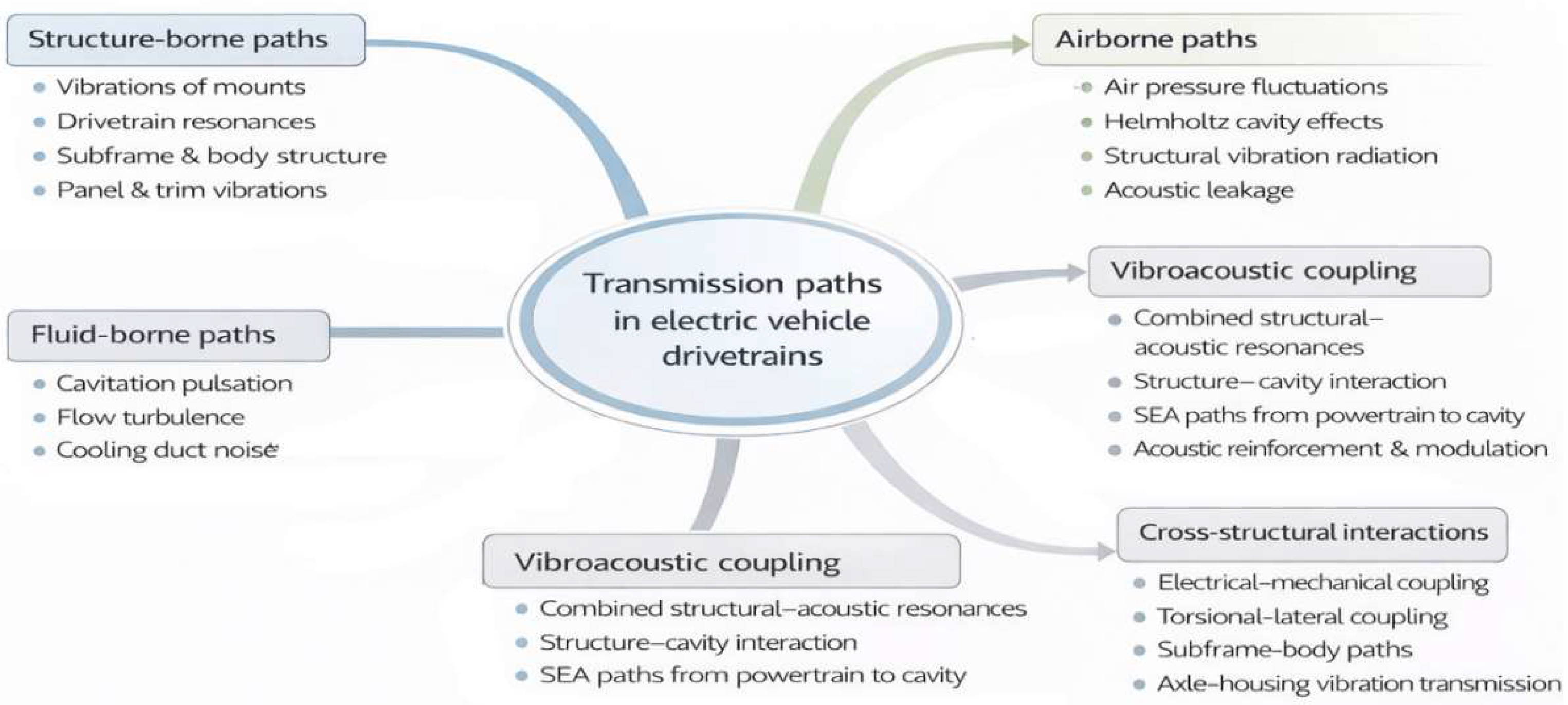
In electric vehicle drivetrains, noise and vibration generated at the source propagate toward the vehicle interior and exterior through multiple, partially coupled transmission paths [58,59]. Structure-borne transmission through shafts, bearings, housings, mounts, and body interfaces typically dominates at low and mid frequencies, whereas airborne and fluid-borne paths become increasingly relevant as excitation frequencies increase and as cooling, HVAC, and thermal management subsystems contribute to the overall NVH response [60]. Experimental and numerical studies demonstrate that these transmission paths do not act independently: structural–acoustic coupling, interface compliance, and assembly-dependent boundary conditions can substantially modify the effective transfer of vibrational energy [61].
As a consequence, identical excitation sources may lead to markedly different vibration and noise responses depending on system integration, dynamic stiffness of interfaces, and transfer-path characteristics [61]. This behavior has been consistently observed in vehicle-level investigations comparing structure-borne and airborne contributions, as well as in studies applying system-level transfer path analysis to electric and electrified drivetrains [60]. These findings underline the necessity of system-level transmission path analysis frameworks capable of simultaneously accounting for structure-borne, airborne, and fluid-borne mechanisms in electric vehicle NVH prediction [62].
Figure 8.
Conceptual mind map illustrating the dominant transmission paths of noise and vibration in electric vehicle drivetrains. The diagram distinguishes structure-borne, airborne, and fluid-borne paths and highlights their role in conveying vibrational energy from excitation sources toward radiating structures and acoustic receivers. The representation emphasizes that EV NVH behavior is governed by multiple interacting transmission mechanisms rather than a single dominant path.
5. Gap Map of Current Research
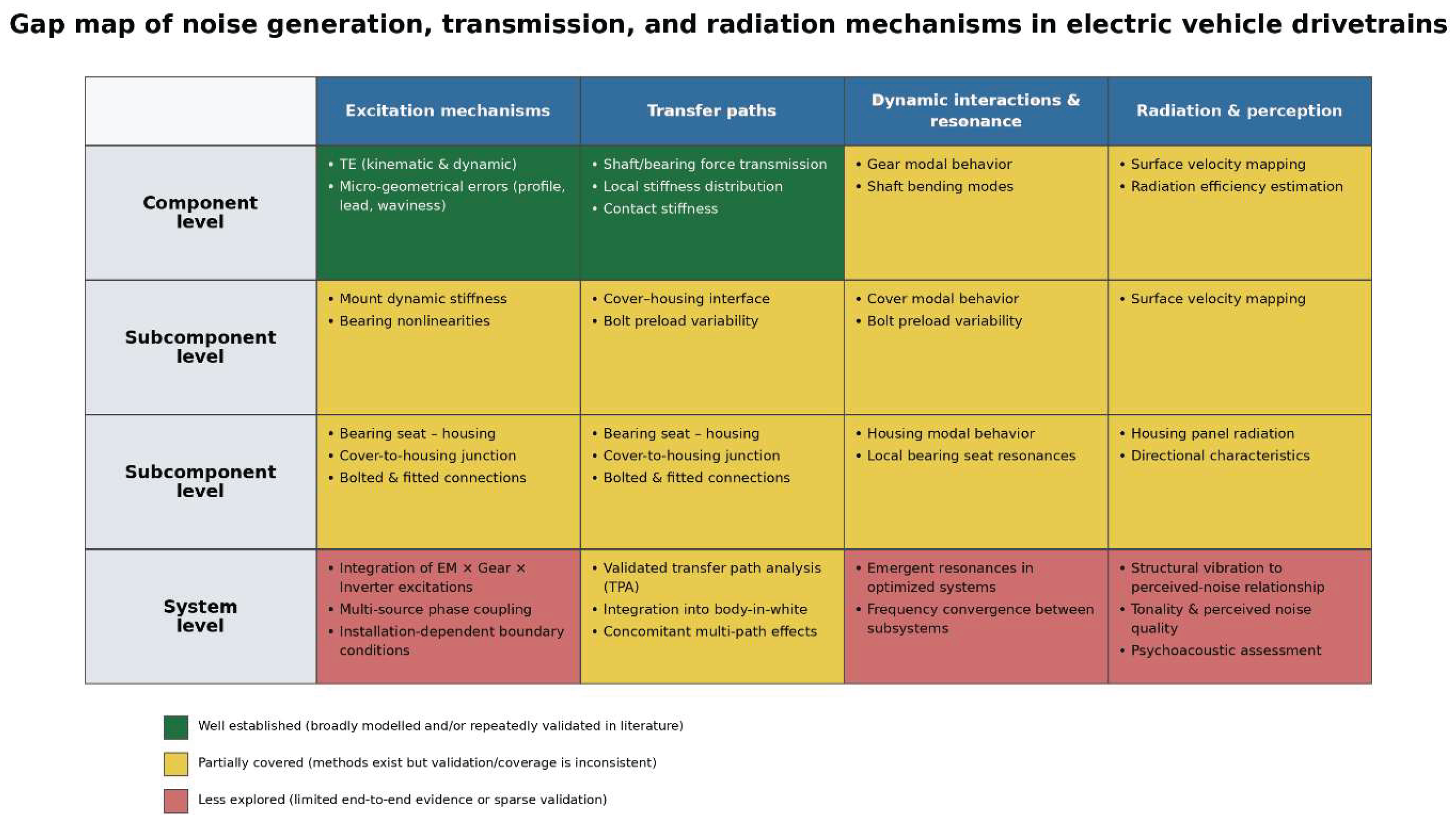
Figure X provides a structured gap map for EV drivetrain e-NVH modeling coverage along the physical chain excitation → transfer paths → resonances/coupling → radiation/perception. The intent is to distinguish mature areas, where methods are validated and widely replicated, from emerging areas with partial coupling and limited validation, and from gaps where system-level evidence or integration remains scarce. Established coverage is concentrated at the component level, particularly in electromagnetic excitation modeling (Maxwell force harmonics and torque ripple), transmission-error-based gear whine assessment, and deterministic structural vibration analysis. In contrast, system-level phenomena—including multi-source excitation interaction, installation-dependent transfer paths, and emergent resonances—are treated less consistently across the literature.
Evidence for electromagnetic–structural–acoustic coupling and for blocked-force–based transfer path analysis exists, but consistent integration across physical domains and modeling levels remains uneven. In particular, the transition from predicted structural vibration to perceived sound quality is rarely treated in a unified framework, despite its clear relevance for electric vehicle customer perception.The gap map is intentionally organized along the causal physical chain rather than by numerical method or component type. This structure emphasizes that many unresolved research questions do not originate from missing simulation techniques, but from incomplete coupling between excitation sources, transmission paths, resonant behavior, and acoustic radiation at system level. The gap map therefore serves as a conceptual bridge between the mechanism-oriented discussion in Section 2 and Section 3 and the numerical modeling paradigms reviewed in the following section.
Figure 9.
Gap map for EV drivetrain e-NVH modelling coverage: established areas tend to cluster around component-level excitation modeling (gear TE, EM force harmonics) and deterministic structural vibration modeling; key gaps persist around multi-source interaction, system-level transfer paths under installation variability, emergent resonances, and vibration-to-perceived-noise mapping.
6. Numerical Modeling Paradigms and Simulation Methods
Numerical simulation is a key enabler for understanding and predicting NVH behavior in electric vehicle drivetrains. EV NVH involves multiple coupled physical domains, including electromagnetic excitation, nonlinear mechanical dynamics, structural vibration, and acoustic radiation. Electromagnetic field simulations based on Maxwell’s equations provide physically consistent force and torque excitations and typically form the first step of the workflow. These excitations are then transferred to multibody dynamics models to capture system-level motion, load transfer, and nonlinear effects. Multibody simulations generate dynamic loads that excite flexible drivetrain and vehicle structures represented by finite element models. Structural finite element analysis resolves modal behavior, vibration amplitudes, and frequency-dependent transfer characteristics. The resulting structural vibration fields provide boundary conditions for acoustic radiation simulations of housings, panels, and interior cavities. Acoustic radiation and interior noise are commonly predicted using boundary element, statistical energy, or hybrid vibroacoustic approaches, selected according to frequency range and modal density. No single modeling approach can capture all relevant phenomena across the full frequency spectrum with uniform accuracy. EV NVH prediction therefore relies on a hierarchy of coupled numerical paradigms chosen to match the dominant physics in each regime. Accordingly, this section reviews the main simulation methods in a structured manner, clarifying their role, assumptions, and limitations within an integrated multiphysics EV NVH workflow.
6.1. Analytical and Semi-Analytical Approaches
Analytical and semi-analytical methods remain important for early design screening, especially for gear contact and TE estimation. Recent benchmarking work comparing gear contact analysis software for static transmission error (STE) emphasizes that STE predictions can vary significantly across modeling approaches and tool implementations when microgeometry, mounting defects, and lightweight gear features are considered. This has direct downstream implications because TE/STE is a key vibroacoustic excitation input. [63].
For electric machines, harmonic-based force identification and semi-analytical excitation modeling are often combined with FEM to quantify vibration and noise contributions. Recent EV motor studies explicitly use analytical excitation source identification followed by FEM-based evaluation of electromagnetic noise and vibration [64].
6.2. Electromagnetic Excitation Modeling
Electromagnetic excitation constitutes a primary source of noise and vibration in electric vehicle drivetrains and represents the first step of the multiphysics NVH simulation workflow [64,65]. Maxwell-equation-based electromagnetic field simulations are widely used to compute spatially and temporally varying air-gap flux densities, radial and tangential force distributions, and electromagnetic torque ripple arising from slotting effects, winding configurations, and inverter-induced current harmonics. These excitation mechanisms are well established as dominant contributors to tonal vibration and noise in electric traction machines, particularly in the absence of broadband masking typical of internal combustion engines [66].
The principal output of electromagnetic simulations is not the acoustic response itself, but physically consistent excitation quantities such as force density spectra, integrated bearing forces, unbalanced magnetic forces, and torque ripple waveforms. Depending on the intended level of coupling and computational effort, these quantities may be represented in the time domain, as harmonic order spectra, or as reduced excitation models suitable for subsequent mechanical simulations. Numerous studies demonstrate that accurate prediction of electromagnetic force harmonics is essential for reliable NVH assessment, as small changes in electromagnetic design or control strategy can lead to pronounced differences in vibration and radiated noise levels [67,68].
In practical EV NVH workflows, electromagnetic excitation models are typically coupled in a sequential manner to multibody dynamics or elastic multibody simulations, where they serve as external inputs that drive system-level motion, load transfer, and nonlinear contact behavior. This coupling allows electromagnetic design choices—such as slot–pole combinations, skewing strategies, and current modulation schemes—to be connected to structural vibration and acoustic radiation outcomes through the downstream mechanical and vibroacoustic simulation chain [67,68]. Accordingly, electromagnetic field simulation functions as an enabling source-side modeling step for system-level NVH prediction rather than as a standalone acoustic analysis method [69].
6.3. Multibody Dynamics and Flexible Multibody Approaches
Multibody dynamics (MBD) and electrified multibody system models (eMBS) are widely used for gear–shaft–bearing dynamic response, including mesh forces, bearing loads, and DTE. Work on EV drivetrain vibration and dynamics highlights the relevance of dynamic mesh force responses, bearing load variation, and torsional fluctuation under excitations such as motor torque ripple and gear mesh [21].
The role of MBD is particularly strong in capturing nonlinearities (bearing contact, backlash, rattle) and for generating physically consistent force time histories for subsequent structural and acoustic analysis. Gear rattle and driveline dynamics modeling in journal literature demonstrates how reduced-order dynamic models capture lash take-up and rattle phenomena, which remain relevant for EV drivetrains under low-load or transient conditions [70].
6.4. Structural Dynamics (FEM), Substructuring, and Transfer Path Analysis
FEM remains the standard for predicting housing vibration, modal characteristics, and transfer-path FRFs. However, practical EV drivetrain modeling often relies on substructuring and model reduction to keep computations feasible across design iterations. Component mode synthesis approaches (e.g., Craig–Bampton) are widely referenced in reduction literature, and substructuring is closely aligned with TPA concepts that separate source and receiver descriptions [71].
Within EV-specific contexts, coupled drivetrain–housing workflows that compute bearing support forces, map them to a housing FEM model, and derive surface velocities as acoustic boundary conditions represent a common and validated modeling pattern [72].
TPA methods sit at the interface of modeling and testing, offering a structured way to identify dominant paths and to quantify contributions. EV-focused comparisons between classical TPA and operational approaches underline that method choice matters under real operating conditions [6].
Recent work continues to advance operational TPA for EV applications through improved regularization and multi-stage formulations intended to stabilize ill-posed path identification under complex working-condition data [72].
6.5. Acoustic Radiation: BEM, FEM–BEM Coupling, and SEA
For exterior radiation problems, BEM is widely used because it naturally handles unbounded domains. A comprehensive BEM survey in acoustics summarizes formulations, frequency-domain considerations, and interior/exterior problem setups, making it a useful baseline reference for drivetrain radiation modeling [73].
Many gearbox noise studies follow the sequence: compute housing vibration (often surface velocity) and then compute radiated sound using BEM. This workflow appears explicitly in gear-bearing-housing coupled modeling literature and in EV drivetrain vibration/noise simulation studies that apply BEM to derive whine noise from computed bearing forces and housing response [15].
At mid- and high frequencies, deterministic FEM/BEM becomes expensive and sensitive to uncertainty. SEA and hybrid FE–SEA methods were developed precisely to bridge the “mid-frequency gap,” where modal density is high and uncertainty plays a larger role. Validation literature emphasizes that FE and SEA have complementary limits and that hybrid FE–SEA can address problems that are not well suited to either method alone. [74].
Foundational SEA discussions and special-issue collections provide context on when an energetic/statistical description is appropriate [75].
6.6. Aeroacoustic Simulation of Cooling and Thermal Subsystems
Aero- and thermoacoustic noise modeling is commonly based on computational fluid dynamics (CFD) formulations, ranging from Reynolds-averaged Navier–Stokes (RANS) to large-eddy simulation (LES), combined with acoustic analogies such as the Ffowcs Williams–Hawkings (FW-H) formulation, or alternative approaches including the lattice Boltzmann method (LBM) [76]. These methods are well established for predicting flow-induced noise from fans, ducts, and external aerodynamic components, where turbulence-driven pressure fluctuations constitute the primary excitation mechanism [77].
In electric vehicle applications, however, numerous studies indicate that the dominant NVH coupling is frequently electromechanical rather than purely aerodynamic, particularly for thermal management subsystems. Investigations of electric heat pump systems demonstrate that compressor vibration, driven by electromagnetic excitation and motor control strategies, can dominate low-frequency noise radiation, while classical flow-induced mechanisms play a secondary role in the relevant frequency range [78]. Experimental and numerical results further show that active current shaping can reduce integer compressor orders and associated structural vibration without significantly affecting pressure pulsation levels, thereby directly linking electrical excitation control to acoustic outcomes [22].
While the numerical methods reviewed above address individual segments of the excitation–response–radiation chain, they are typically implemented using multiple specialized tools rather than within a single unified simulation environment [79]. As a consequence, practical EV NVH analysis relies on sequential coupling of electromagnetic, mechanical, structural, and acoustic models across software boundaries. This observation motivates a subsequent discussion of software categories as modeling paradigms, followed by an integrated gap map and a recommended multiphysics workflow that reflects both physical causality and industrial practice.
7. Software Categories, Gap Map, and Recommended Workflow
Industrial software ecosystems typically align with modeling paradigms rather than providing complete end-to-end e-NVH prediction in a single environment. Semi-analytical and MBD-centric drivetrain tools (commonly used for gears, shafts, and bearings) are particularly strong for generating TE-related excitations and dynamic bearing loads, while high-fidelity structural and acoustic prediction often relies on dedicated FEM/BEM/SEA solvers.
This separation is reinforced by benchmarking literature: a recent peer-reviewed comparison of gear contact analysis software explicitly included Romax DT, MASTA, and ANSYS versions in an STE-focused benchmarking framework, and highlighted that modeling choices (microgeometry, mounting defects, lightweight cutouts) materially affect excitation predictions [80].
Modern drivetrain simulation environments are built upon semi-analytical gear contact modeling and system-level dynamics formulations (e.g., time-varying mesh stiffness, transmission error excitation), rather than stand-alone acoustic solvers [81]. Accordingly, tools such as Romax and MASTA are best discussed as representatives of integrated contact + drivetrain dynamics paradigms.
Summary table of key publications:
Table 1 summarizes frequently cited peer-reviewed studies used as anchors for EV drivetrain vibroacoustic and aeroacoustic modeling. For each reference. the table highlights the main contribution to the excitation–response–radiation chain or to multiphysics workflow integration.
Table 2 maps key EV drivetrain phenomena to commonly used simulation methods and typical outputs. It also summarizes recurring limitations that motivate hybrid workflows combining electromagnetic. multibody. structural. and acoustic modeling.
7.1. Recommended Multiphysics e-NVH Simulation Workflow
The common pipeline is: calculate motor forces (Maxwell). import into MBD solver (e.g., Adams. RecurDyn. AVL Excite) where gear/bearing contacts run with flexible bodies. then pass housing vibration to an acoustic solver.
Figure 10 summarizes an iterative workflow that connects electromagnetic excitation, drivetrain dynamics, structural transfer paths, and acoustic radiation/perception. Importantly, it includes feedback loops: structural mode alignment and stiffness updates can change drivetrain dynamic loads, and acoustic results can guide frequency-band prioritization for structural refinement.
The workflow explicitly follows a source-to-ear logic, ensuring that each modeling stage contributes to the prediction of occupant-perceived noise rather than isolated subsystem metrics. The workflow and gap map together highlight not only methodological coverage but also the limitations that persist when integrating multiphysics models at system level. These limitations are discussed explicitly in the following section on research gaps and challenges.
8. Research Gaps and Challenges
Data scarcity is pervasive: few open experimental datasets exist that span EM excitation through radiated noise for an entire EV drivetrain. This hampers validation; many studies validate only sub-blocks (e.g., gearbench TE vs FEA. or stand-alone motor forces). Transparency of proprietary solvers is limited: for example. AVL’s built-in motor force calculator is not open. and coupling interfaces vary between platforms. Model uncertainty due to manufacturing tolerances is often ignored: while some groups are beginning to include stochastic variations. most pipelines assume nominal geometry. This is a serious gap. as even small deviations can shift NVH peaks. Finally. comparisons between tools (RecurDyn vs Adams vs MASTA. etc.) are rare in literature. making it hard to judge trade-offs.
Several directions emerge consistently from the synthesized literature.
Multi-source interaction modeling (EM × gear × inverter).
While electromagnetic excitation and gear excitation are well studied individually, system-level work that treats them as interacting sources remains limited. PWM-fed powertrain sound-quality studies and classic inverter-fed machine noise research underline that drive–motor interaction shapes acoustic outcomes, implying that EV drivetrain prediction should include electrical harmonics and mechanical orders in a coherent order-tracking framework.
Transfer-path uncertainty and robust source descriptions.
Blocked-force and advanced TPA frameworks offer a pathway to improve transferability across mounting and boundary conditions. EV-specific blocked-force validation and EV cabin-target applications show clear feasibility, yet broader adoption in end-to-end simulation workflows remains uneven.
Emergent resonances and mid-frequency predictability.
Hybrid FE–SEA methods and mid-frequency modeling literature emphasize that neither pure FE nor pure SEA is sufficient across the full EV operating envelope, especially in built-up structures with uncertain properties. The practical research challenge is not simply increased model fidelity, but the robust identification and treatment of coupled resonances that emerge only at system level.
Manufacturing-induced variability and ghost orders.
Tooth flank waviness and ghost orders demonstrate that manufacturing deviations can dominate tonal risk in EV gearboxes. Although recent work has improved mechanistic understanding, standardized pipelines that connect metrology, stochastic variability, and system-level vibroacoustic prediction remain limited.
Vibration-to-perceived-noise mapping.
Despite the widespread reliance on sound pressure level metrics, the relationship between structural vibration, radiated sound, and subjective sound quality is nonlinear and remains only weakly integrated into predictive simulation workflows.
While excitation mechanisms such as transmission error and electromagnetic force harmonics are well understood at the component level, substantially less attention has been devoted to their interaction through system-level transmission paths and to the conversion from structural vibration to perceived noise. This imbalance indicates that future research should prioritize integrated, system-aware NVH modeling frameworks. Such frameworks should explicitly account for installation effects. They should also incorporate manufacturing variability. They should further include robust vibration-to-perception mappings.
9. Future Research Directions
Future research in EV drivetrain vibro- and aeroacoustic simulation is expected to shift toward more tightly integrated, system-level methodologies. Hybrid physics-based and data-driven approaches are a promising direction for addressing multi-source interaction and uncertainty. Surrogate models, machine learning, and reduced-order representations can complement physics-based simulations by capturing variability effects and accelerating design iteration without sacrificing physical interpretability.
Digital Twin concepts are also expected to become more influential, particularly for manufacturing-aware NVH prediction. Integrating metrology data, operational sensing, and model updating offers a pathway to managing unit-to-unit variability and lifecycle-dependent noise behavior in electric drive units. In parallel, manufacturing-aware and installation-aware modeling frameworks should be further developed to improve robustness against mounting changes, tolerance scatter, and production-induced excitation mechanisms such as ghost orders.
Perception-oriented NVH prediction remains a key frontier. Future workflows are likely to introduce psychoacoustic metrics and perceptual weighting earlier in the simulation chain. This enables design decisions that target not only noise reduction but also acceptable and pleasant sound signatures.
10. Discussion
While the following discussion builds on previously established multiphysics insights into EV drivetrain vibroacoustics, the present review interprets these findings through a mechanism-centric and system-level lens. In particular, the emphasis is shifted from individual modeling workflows toward the physical chain of noise generation, transmission, radiation, and perception, as well as toward identifying where current research coverage remains incomplete.
The surveyed works collectively show that multiphysics NVH simulation is maturing but remains challenging. Gear contact analysis (analytical or FE-based) provides accurate excitations, and flexible MBD can propagate those loads through moving parts. Modal FEM of housing then enables radiated noise prediction. This chain works in theory, but in practice each step introduces uncertainties. Electromagnetic force prediction relies on accurate machine models and may ignore saturation or eddy effects at high PWM frequencies. Gear LTCA requires precise geometric input, which is often only available from CAD models or high-resolution measurements. Bearing contact models are similarly demanding because their stiffness and damping behavior is strongly nonlinear and load dependent. Computational cost therefore forces practical compromises, such as truncating mode sets, coarsening meshes, or neglecting minor excitation sources that are unlikely to dominate in the target operating range. Even with these constraints, recent work—including industry case reports and several review papers—shows steady progress toward hybrid co-simulation workflows that are demonstrated routinely at conferences and, increasingly, embedded in product development. Industry examples also suggest a shift in practice, where virtual NVH is treated as a decisive development capability for meeting interior noise targets with fewer prototypes. Overall, the field is expanding rapidly in terms of tools and coupling strategies, but it still needs to balance accuracy, runtime, and engineering practicality.
The reviewed literature also exposes a validation paradox in EV drivetrain NVH research. Excitation models, structural dynamics, and acoustic radiation are frequently validated in isolation. End-to-end validation from source excitation to perceived noise, however, remains comparatively rare, especially under installation-dependent boundary conditions. As a consequence, system-level predictive confidence is often inferred indirectly rather than demonstrated by fully coupled validation studies.
A key conclusion of this synthesis is that the primary limitation is no longer the availability of suitable component-level methods. The dominant weakness is the incomplete and inconsistent integration of these methods across the excitation–transfer–radiation chain. Individual domains can be modeled with high fidelity, yet physical continuity is often weakened by simplifying assumptions at interfaces, inconsistent data transfer, or validation strategies that remain domain specific.
Beyond reinforcing the need for multiphysics integration, this review contributes a gap-oriented mapping of the literature along the excitation–transfer–radiation–perception chain. This perspective highlights challenges that are easy to miss in isolated component studies, including multi-source excitation interaction, transfer-path uncertainty, and emergent resonances that only become apparent when the full system is analyzed across coupled domains and frequency ranges.
11. Conclusions
In contrast to earlier multiphysics-oriented reviews, this work does not organize the literature primarily by numerical method or software category, but by the physical noise generation and transmission mechanisms that govern EV drivetrain NVH. By structuring the review along the excitation–transfer–radiation–perception chain, the analysis highlights where current modeling practice is mature and where system-level integration remains insufficient.
This review has synthesized recent literature on multiphysics vibroacoustic modeling for EV e-drives. We have traced the chain from electromagnetic excitation through mechanical transmission to acoustic radiation, highlighting key phenomena and modeling strategies at each stage. While software tools and methods are increasingly capable, their combined use reveals both power and complexity: achieving accurate NVH prediction demands careful choice of models and assumptions. The field is evolving rapidly, with trends toward more integrated, data-driven, and robust simulation workflows. However, fundamental challenges—especially validation and data exchange—remain. Overcoming these will require not only technical innovation, but collaboration on standards and open datasets. In the meantime, engineers must judiciously use the best available multiphysics methods (analytical, semi-analytical, numerical) to design quiet, efficient EV drivetrains. Our review underscores the importance of a holistic NVH approach: in EVs, component design and system acoustics are inseparable, and true predictive modeling spans electromagnetics to acoustics in one pipeline. Importantly, the source-to-ear perspective adopted here also accounts for structure-borne vibration perceived directly by occupants through steering wheel, seat, and interior trim, extending beyond airborne noise alone. This reinforces the view that EV NVH is inherently multimodal, combining acoustic perception with tactile vibration and harshness.
Taken together, the reviewed literature indicates that truly predictive NVH simulation for electric vehicle drivetrains has not yet been fully achieved. While multiphysics workflows are increasingly demonstrated, robust prediction across operating conditions, installations, and manufacturing variability remains an open challenge. Addressing this gap will require not only higher-fidelity models, but also consistent system-level validation strategies and tighter coupling between simulation and measurement.
Future EV NVH research will therefore benefit from models that are not only multiphysics in nature, but also explicitly system-level, frequency-aware, and perception-oriented from the earliest design stages.
References
- Horváth, K.; Zelei, A. Simulating Noise, Vibration, and Harshness Advances in Electric Vehicle Powertrains: Strategies and Challenges. World Electric Vehicle Journal 2024, 15(8), 367. [Google Scholar] [CrossRef]
- Horváth, K.; Zelei, A. Noise reduction methods in the vehicle industry: Using vibroacoustic simulation for sustainability. Chemical Engineering Transactions 2024, 114, 763–768. [Google Scholar] [CrossRef]
- Kato, T.; Yokote, R. Effect of Driving Sound of Electric Vehicle on Product Attractiveness. Human-Centric Intelligent Systems 2023, 3, 416–424. [Google Scholar] [CrossRef]
- Morandotti, D.; Pelosi, A. Toward Digital Twin and Simulation-Driven New Product Development. R&D Management Conference 2018, Milan, Italy, 2018. [Google Scholar]
- Praticò, F.; Fedele, R. Electric vehicles diffusion: changing pavement acoustic design? Noise Mapping 2021, 8, 281–294. [Google Scholar] [CrossRef]
- Diez-Ibarbia, A.; Battarra, M.; Palenzuela, J.; Cervantes, G.; Walsh, S.; De-la-Cruz, M.; Theodossiades, S.; Gagliardini, L. Comparison between transfer path analysis methods on an electric vehicle. Applied Acoustics 2017, 118, 83–101. [Google Scholar] [CrossRef]
- Im, D.; Chung, WJ.; Lee, H.; et al. Analysis of gear transmission error in helical gear using enhanced tooth contact analysis model considering measured tooth profile errors. Sci Rep 2025, 15, 5981. [Google Scholar] [CrossRef]
- Marafona, J. D.; Marques, P. M. T.; Martins, R. C.; Seabra, J. H. O. Mesh stiffness models for cylindrical gears: A detailed review. Mechanism and Machine Theory 2021, 166, 104472. [Google Scholar] [CrossRef]
- Page, M. J.; McKenzie, J. E.; Bossuyt, P. M.; Boutron, I.; Hoffmann, T. C.; Mulrow, C. D.; Shamseer, L.; Tetzlaff, J. M.; Akl, E. A.; Brennan, S. E.; Chou, R.; Glanville, J.; Grimshaw, J. M.; Hróbjartsson, A.; Lalu, M. M.; Li, T.; Loder, E. W.; Mayo-Wilson, E.; McDonald, S.; Mo 1 her, D. The PRISMA 2020 statement: An updated guideline for reporting systematic reviews. BM 2 J 2021, 372, Article n71. [Google Scholar] [CrossRef]
- MDPI. Instructions for authors: World Electric Vehicle Journal (WEVJ). n.d. Available online: https://www.mdpi.com/journal/wevj/instructions.
- Hou, P.; Ge, B.; Tao, D.; Wang, Y.; Pan, B. Coupling Analysis of Electromagnetic Vibration and Noise of FeCo-Based Permanent-Magnet Synchronous Motor. Energies 2022, 15(11), 3888. [Google Scholar] [CrossRef]
- Dai, Y.; Lee, H.-J. Torque Ripple and Electromagnetic Vibration Suppression of Fractional Slot Distributed Winding ISG Motors by Rotor Notching and Skewing. Energies 2024, 17(19), 4964. [Google Scholar] [CrossRef]
- AVL. NVH and Transmission Simulation for E-Drive Development. AVL List GmbH. n.d. Available online: https://www.avl.com/en/simulation-solutions/e-mobility-simulation/e-drive-simulation/nvh-and-transmission-simulation-e-drive-development (accessed on 7 February 2026).
- Lo, W. C.; Chan, C. C.; Zhu, Z. Q.; Xu, L.; Howe, D.; Chau, K. T. Acoustic noise radiated by PWM-controlled induction machine drives . IEEE Transactions on Industrial Electronics 2000, 47(4), 762–771. [Google Scholar] [CrossRef]
- Palermo, A.; Britte, L.; Janssens, K.; Mundo, D.; Desmet, W. The measurement of gear transmission error as an NVH indicator: theoretical discussion and industrial application via low-cost digital encoders to an all-electric vehicle gearbox. Mechanical Systems and Signal Processing 2018, 110, 368–389. [Google Scholar] [CrossRef]
- Mughal, H.; Dolatabadi, N.; Rahmani, R.; King, P.; Gnanakumarr, M.; Varnier, O. Comprehensive tribodynamic analysis of lubricated gear contacts for direct identification of gear whine noise in electric drive units . Mechanical Systems and Signal Processing 2025, 236, 113054. [Google Scholar] [CrossRef]
- Han, J.; Liu, Y.; Yu, S.; Zhao, S.; Ma, H. Acoustic-vibration analysis of the gear-bearing-housing coupled system . Applied Acoustics 2021, 178, 108024. [Google Scholar] [CrossRef]
- Tang, J.; Han, J.; Tian, X.; You, T.; Li, G.; Xia, L.; Liu, X.; Hu, Y.; Wang, J. Research on tooth flank waviness analysis and gear noise control strategies based on internal gearing power honing . Journal of Manufacturing Processes 2025, 92. [Google Scholar] [CrossRef]
- Horvath, K.; Feszty, D. Surface Waviness of EV Gears and NVH Effects—A Comprehensive Review. World Electric Vehicle Journal 2025, 16(9), 540. [Google Scholar] [CrossRef]
- Guo, R.; Cao, C.; Mi, Y.; Huang, Y. Experimental investigation of the noise, vibration and harshness performances of a range-extended electric vehicle. Proceedings of the Institution of Mechanical Engineers, Part D: Journal of Automobile Engineering 2016, 230, 650–663. [Google Scholar] [CrossRef]
- Hua, X.; Thomas, A.; Shultis, K. Recent progress in battery electric vehicle noise, vibration, and harshness. Science Progress 2021, 104. [Google Scholar] [CrossRef] [PubMed]
- Thielecke, A.; Brovia, S.; Hübel, J.; Gänzle, D.; Herbst, J.; Becker, S. Active electric machine control to reduce compressor noise in heat pumps. Applied Acoustics 2023. [Google Scholar] [CrossRef]
- Zhiwei, C.; Yigang, L. Diagnosis and analysis of abnormal noise in the pure electric vehicle’s air condition compressor at idle. Journal of Low Frequency Noise, Vibration and Active Control 2018, 37, 711–724. [Google Scholar] [CrossRef]
- Guo, R.; Qiu, S.; Yu, Q.; Zhou, H.; Zhang, L. Transfer path analysis and control of vehicle structure-borne noise induced by the powertrain. Proceedings of the Institution of Mechanical Engineers, Part D: Journal of Automobile Engineering 2012, 226, 1100–1109. [Google Scholar] [CrossRef]
- Kim, S.; Singh, R. Structure-Borne Noise Measures and Their Correlation to Sound Radiation over a Broad Range of Frequencies. SAE transactions 2003, 112, 1617–1626. [Google Scholar] [CrossRef]
- Turin, I.; September, T.; Politecnico, •.; Torino, D.; Zucchini, A.; Naets, F.; H¨ulsmann, A. Transmissibility and insulation evaluation inside a multi-degrees of freedom system. In Proceedings of the 10th Convention of the European Acoustics Association Forum Acusticum 2023, 2022. [Google Scholar] [CrossRef]
- Fish, D.; Roberts, S.; Franco-Jorge, M. Experimental Modeling Techniques for Understanding Road Noise. Noise & Vibration Worldwide 2000, 31, 28–32. [Google Scholar] [CrossRef]
- Seijs, M. Experimental dynamic substructuring: Analysis and design strategies for vehicle development. 2016. [Google Scholar] [CrossRef]
- Seijs, M. Experimental dynamic substructuring: Analysis and design strategies for vehicle development. 2016. [Google Scholar] [CrossRef]
- Zabel, D. Structure-borne sound transmission within electric power steering systems. 2018. [Google Scholar]
- Lennström, D.; Olsson, M.; Wullens, F.; Nykänen, A. Validation of the blocked force method for various boundary conditions for automotive source characterization. Applied Acoustics 2016, 102, 108–119. [Google Scholar] [CrossRef]
- Xiao, S.; He, J.; Xu, G.; Li, Y.; San, Y.; Cheng, S. Study on interior noise control of minibus based on structural acoustic radiation. Proceedings of the Institution of Mechanical Engineers, Part D: Journal of Automobile Engineering 2023, 238, 2350–2367. [Google Scholar] [CrossRef]
- Panza, M. A Review of Experimental Techniques for NVH Analysis on a Commercial Vehicle. Energy Procedia 2015, 82, 1017–1023. [Google Scholar] [CrossRef]
- Tuononen, A.; Lajunen, A. Modal analysis of different drivetrain configurations in electric vehicles. Journal of Vibration and Control 2016, 24, 126–136. [Google Scholar] [CrossRef]
- Souza, M.; Andreou, P.; Offner, G.; Sopouch, M.; Diwoky, F.; Haris, A.; Mohammadpour, M.; Theodossiades, S. Whistle, whine and modal implications due to the electromechanical coupling of an electric powertrain. Proceedings of the Institution of Mechanical Engineers, Part D: Journal of Automobile Engineering 2024, 239, 6245–6266. [Google Scholar] [CrossRef]
- Akhtar, W.; Brezing, A. Modelling and Validation of Joint Properties for NVH Simulation Model of an Electrified Passenger Vehicle Drivetrain. Journal of the Society of Automotive Engineers Malaysia 2019. [Google Scholar] [CrossRef]
- Tuononen, A.; Lajunen, A. Modal analysis of different drivetrain configurations in electric vehicles. Journal of Vibration and Control 2016, 24, 126–136. [Google Scholar] [CrossRef]
- Savva, K.; Haris, A.; Motato, E.; Mohammadpour, M.; Theodossiades, S.; Rahnejat, H.; Kelly, P.; Vakakis, A.; Bergman, L.; McFarland, D. Damping effects introduced by a nonlinear vibration absorber in automotive drivelines at idle engine speeds. 2016. [Google Scholar] [CrossRef]
- Drichel, P.; Jaeger, M.; Möller-Giebeler, M.; Berroth, J.; Schroder, M.; Behler, G.; Jacobs, G.; Hameyer, K.; Vorländer, M. Influence of Model Detail Level on the Prognosis Quality of the Perceived Sound of an Electrified Passenger Car Powertrain. IOP Conference Series: Materials Science and Engineering 2021, 1097. [Google Scholar] [CrossRef]
- Hua, X.; Gandee, E. Vibration and dynamics analysis of electric vehicle drivetrains . Journal of Low Frequency Noise, Vibration and Active Control 2021, 40(3), 1241–1251. [Google Scholar] [CrossRef]
- Liao, Z.; Hua, X.; Cheng, X.; Ning, X.; Liu, Z.; Chen, G. Dynamic simulation of a motor longitudinally mounted on a centralized electric drive systems for pure electric vehicles under torque ripple and transmission error excitations. Science Progress 2023, 106. [Google Scholar] [CrossRef] [PubMed]
- Jin-Li, X.; Lei, W.; Wenxin, L. Influence of Bearing Stiffness on the Nonlinear Dynamics of a Shaft-Final Drive System. Shock and Vibration 2016, 2016, 1–14. [Google Scholar] [CrossRef]
- Rahnejat, H.; Johns-Rahnejat, P.; Dolatabadi, N.; Rahmani, R. Multi-body dynamics in vehicle engineering. Proceedings of the Institution of Mechanical Engineers, Part K: Journal of Multi-body Dynamics 2023, 238, 3–25. [Google Scholar] [CrossRef]
- Wischmann, S.; Mann, A.; Jacobs, G.; Brecher, C.; Hoepfner, G.; Westphal, C. Validation of models for calculating the NVH behavior of gearbox systems in an elastic multibody simulation. Forschung im Ingenieurwesen 2025, 89. [Google Scholar] [CrossRef]
- Franck, M.; Rickwärtz, J.; Butterweck, D.; Nell, M.; Hameyer, K. Transient System Model for the Analysis of Structural Dynamic Interactions of Electric Drivetrains; Energies, 2021. [Google Scholar] [CrossRef]
- Müller, J.; Jacobs, G.; Wischmann, S.; Hoepfner, G. Accelerating NVH optimization of eMBS system models through efficient parallelization of transient runup simulations. Forschung im Ingenieurwesen 2025, 89. [Google Scholar] [CrossRef]
- Souza, M.; Offner, G.; Soltoggio, A.; Mohammadpour, M.; Theodossiades, S. Design of electric powertrains to achieve NVH performance using autoencoders and a physical meaningful latent space. Neural Computing and Applications 2025, 37, 10287–10308. [Google Scholar] [CrossRef]
- Steinbach, K.; Lechler, D.; Kraemer, P.; Gross, I.; Reith, D. A Novel Approach to Predict the Structural Dynamics of E-Bike Drive Units by Innovative Integration of Elastic Multi-Body-Dynamics. Vehicles 2023. [Google Scholar] [CrossRef]
- Treszkai, M.; Feszty, D. Review of Hybrid Finite Element – Statistical Energy Analysis methods in vehicle NVH predictions. Acta Technica Jaurinensis 2019. [Google Scholar] [CrossRef]
- Claeys, M.; Canas, H.; Alcoverro, B. Full-Frequency Vibroacoustic Modeling of a Ballistic Re-Entry Aeroshell and Validation through Diffuse Field Acoustic Testing. Applied Sciences 2022. [Google Scholar] [CrossRef]
- De Walque, C.; Jamaluddin, R. Vibro-acoustic Study of a Full Vehicle Excited by an Electric Motor: Structure-borne and Air-borne Noise Comparison. In SAE Technical Paper Series; 2023. [Google Scholar] [CrossRef]
- Su, J.; Zheng, L.; Deng, Z.; Jiang, Y. Research Progress on High-Intermediate Frequency Extension Methods of SEA. In Shock and Vibration; 2019. [Google Scholar] [CrossRef]
- Erensoy, E.; Sevginer, C. Modeling and Validation Processes of an Electric Vehicle with Statistical Energy Analysis; 2015. [Google Scholar]
- Yoo, J.; Chae, K.; Charpentier, A.; Lim, J. Development of FE-SEA Hybrid Model for the Prediction of Vehicle Structure-borne Noise at Mid-frequencies. Transactions of The Korean Society for Noise and Vibration Engineering 2014, 24, 606–612. [Google Scholar] [CrossRef]
- Fang, Y.; Zhang, T. Sound quality of the acoustic noise radiated by PWM-fed electric powertrain. IEEE Transactions on Industrial Electronics 2018, 65(5), 4534–4542. [Google Scholar] [CrossRef]
- Wang, H.; Naets, F. NVH modeling and simulation of drivetrain gearboxes. In Proceedings of the International Conference for Acoustic and Vibration Engineers (NVHH 2025) (Paper No. NVHH2025-0026). Diamond Congress Ltd. 2025. [Google Scholar]
- Li, S.; Zuo, S.; Yin, B.; Jin, M.; Xu, Y.; Li, H. A new method for analyzing gearbox vibration and noise in electric drive systems based on different modal forms. Journal of Vibration and Control 2025. [Google Scholar] [CrossRef]
- Pasch, G.; Jacobs, G.; Berroth, J. Numerical Transfer Path Analysis for NVH System-Simulation Models. IOP Conference Series: Materials Science and Engineering 2021, 1097. [Google Scholar] [CrossRef]
- Bouvet, P.; Rißmann, M. Industrial Methodologies for the Prediction of Interior Noise Inside Railway Vehicles: Airborne and Structure Borne Transmission. 2021, 41–54. [Google Scholar] [CrossRef]
- Morariu, M.; Lupea, I.; Anderson, C. Troubleshooting Technics to Identify the Airborne and Structure-Borne Noise Content inside an Electric Vehicle. Applied Mechanics and Materials 2013, 430, 297–302. [Google Scholar] [CrossRef]
- Fernholz, C.; Nessler, G. Prediction of Vehicle Steering System NVH from Component-Level Test Data. 2006. [Google Scholar] [CrossRef]
- Qian, K.; Hou, Z.; Liang, J.; Liu, R.; Sun, D. Interior Sound Quality Prediction of Pure Electric Vehicles Based on Transfer Path Synthesis. Applied Sciences 2021, 11, 4385. [Google Scholar] [CrossRef]
- Li, H.; Xu, P.; Cao, C.; Hu, D.; Yan, X.; Song, Z. Acoustic Simulation of the Electric Vehicle Motor. Journal of Physics: Conference Series 2021, 2095. [Google Scholar] [CrossRef]
- Kim, M.; Lee, S.; Kim, H. The Development of a Method for NVH Prediction in Electrical Driving Systems Using a Quasi-Transient Excitation Force. Processes 2024. [Google Scholar] [CrossRef]
- Müller, K.; Wanke, A.; Burkhardt, Y.; Gersem, H. Evaluation of Torque Ripple and Tooth Forces of a Skewed PMSM by 2D and 3D FE Simulations. ArXiv 2025, abs/2503.16279. [Google Scholar] [CrossRef]
- Spargo, C.; Mecrow, B.; Widmer, J. A Seminumerical Finite-Element Postprocessing Torque Ripple Analysis Technique for Synchronous Electric Machines Utilizing the Air-Gap Maxwell Stress Tensor. IEEE Transactions on Magnetics 2014, 50, 1–9. [Google Scholar] [CrossRef]
- Cawkwell, T.; Haris, A.; Gonzalez, J.; Rodrigues, L.; Shirokov, V. A Methodology for Applying Skew in an Automotive Interior Permanent Magnet Rotor for Robust Electromagnetic and Noise, Vibration and Harshness Performance. World Electric Vehicle Journal 2023. [Google Scholar] [CrossRef]
- Bang, T.; Shin, K.; Lee, J.; Lee, H.; Cho, H.; Choi, J. Experimental and Comparative Study of Rotor Vibrations of Permanent Magnet Machines with Two Different Fractional Pole/Slot Combinations. Applied Sciences 2020. [Google Scholar] [CrossRef]
- Xu, J.; Zhang, L.; Meng, D.; Su, H. Simulation, Verification and Optimization Design of Electromagnetic Vibration and Noise of Permanent Magnet Synchronous Motor for Vehicle. Energies 2022. [Google Scholar] [CrossRef]
- Shangguan, W.-B.; Liu, X.-L.; Yin, Y.-M.; Rakheja, S. Modeling of automotive driveline system for reducing gear rattles. Journal of Sound and Vibration 2018, 416, 136–153. [Google Scholar] [CrossRef]
- Shanmugam, A.; Padmanabhan, C. A fixed–free interface component mode synthesis method for rotordynamic analysis. Journal of Sound and Vibration 2006, 297(3–5), 664–679. [Google Scholar] [CrossRef]
- Jin, M.; Zuo, S.; Wu, X.; Li, S.; Li, H.; Shi, L.; Chen, Y. Multistage operation transfer path analysis of an electric vehicle based on the regularization of total least squares. Mechanical Systems and Signal Processing 2025, 225, 112250. [Google Scholar] [CrossRef]
- Kirkup, S. The boundary element method in acoustics: A survey. Applied Sciences 2019, 9(8), 1642. [Google Scholar] [CrossRef]
- Cotoni, V.; Shorter, P.; Langley, R. Numerical and experimental validation of a hybrid finite element–statistical energy analysis method. The Journal of the Acoustical Society of America 2007, 122(1), 259–270. [Google Scholar] [CrossRef] [PubMed]
- Heron, K. H. Advanced statistical energy analysis. Philosophical Transactions of the Royal Society A: Mathematical, Physical and Engineering Sciences 1994, 346(1681), 431–444. [Google Scholar] [CrossRef]
- Doleschal, F.; Ewert, R. Pleasantness and magnitude of tonal content of electric vehicle interior sounds. Applied Acoustics 2022, 185, 108442. [Google Scholar] [CrossRef]
- Hamiga, W.; Ciesielka, W. Aeroaocustic Numerical Analysis of the Vehicle Model. Applied Sciences 2020. [Google Scholar] [CrossRef]
- Zhiwei, C.; Yigang, L. Diagnosis and analysis of abnormal noise in the pure electric vehicle’s air condition compressor at idle. Journal of Low Frequency Noise, Vibration and Active Control 2018, 37, 711–724. [Google Scholar] [CrossRef]
- De Walque, C.; Jamaluddin, R. Vibro-acoustic Study of a Full Vehicle Excited by an Electric Motor: Structure-borne and Air-borne Noise Comparison. SAE Technical Paper Series 2023. [Google Scholar] [CrossRef]
- Bejar, F.; Perret-Liaudet, J.; Bareille, O.; Ichchou, M.; Fontana, M. Review and benchmarking study of different gear contact analysis software in terms of the static transmission error response . Results in Engineering 2024, 22, 102286. [Google Scholar] [CrossRef]
- Gear Noise and Vibration; Kahraman, A., Singh, R., Eds.; CRC Press, 2014. [Google Scholar]
Figure 1.
Simplified source-to-human perception chain for electric vehicle drivetrains.
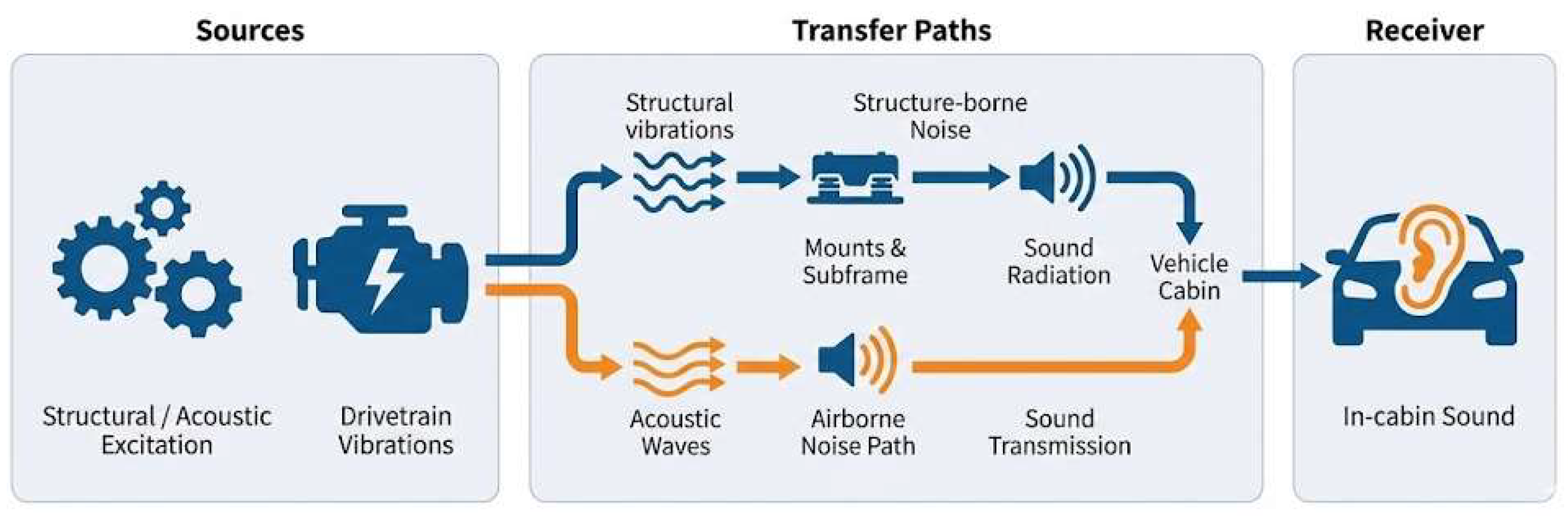
Figure 4.
PRISMA-style flow diagram for study identification and screening (adapted from PRISMA 2020 reporting logic). The diagram format aligns with PRISMA’s intent to document identification, screening, eligibility assessment, and inclusion [9].
Figure 4.
PRISMA-style flow diagram for study identification and screening (adapted from PRISMA 2020 reporting logic). The diagram format aligns with PRISMA’s intent to document identification, screening, eligibility assessment, and inclusion [9].
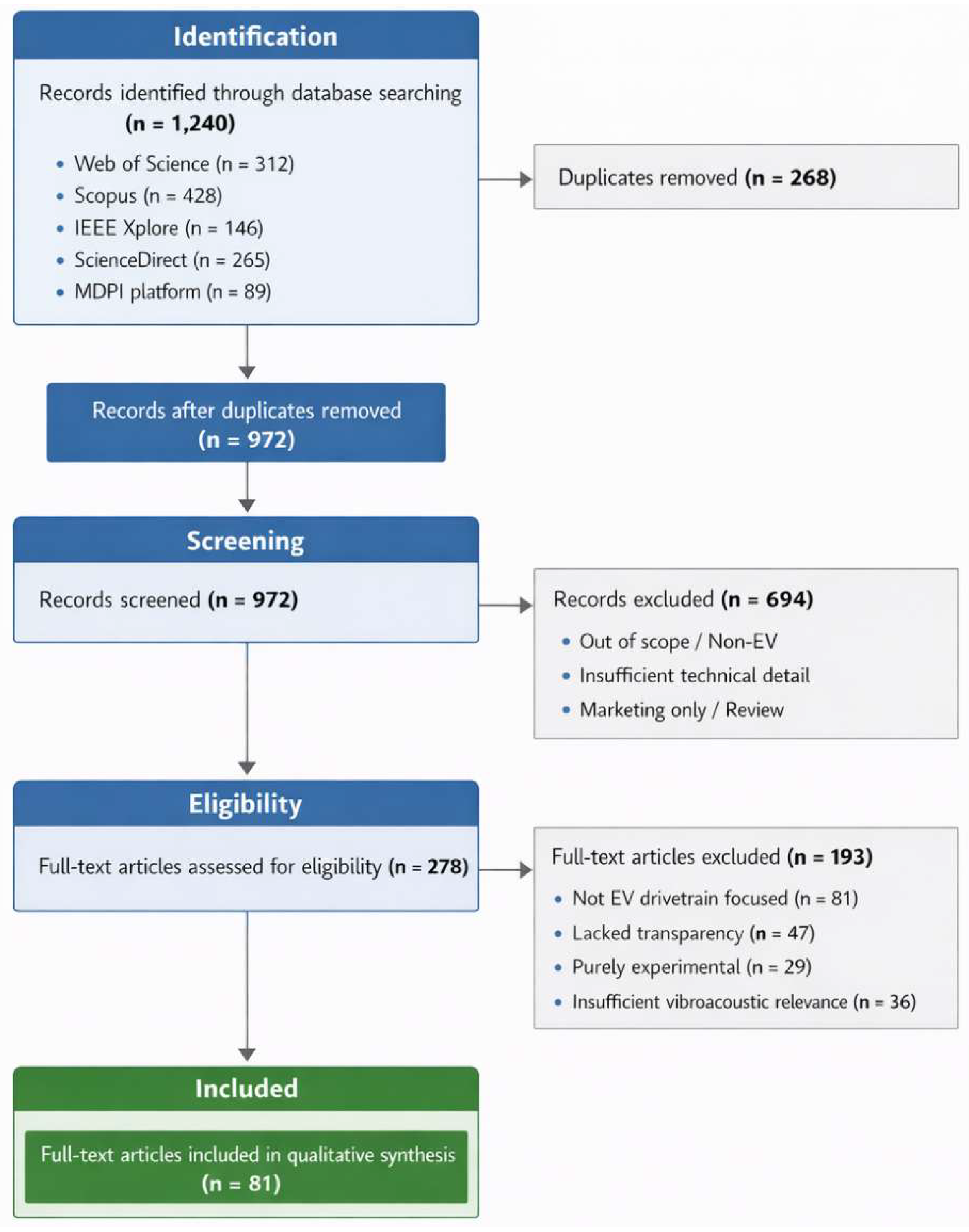
Figure 5.
Conceptual illustration of major excitation domains in EV drivetrains and their coupled contribution to the resulting noise spectrum.
Figure 5.
Conceptual illustration of major excitation domains in EV drivetrains and their coupled contribution to the resulting noise spectrum.
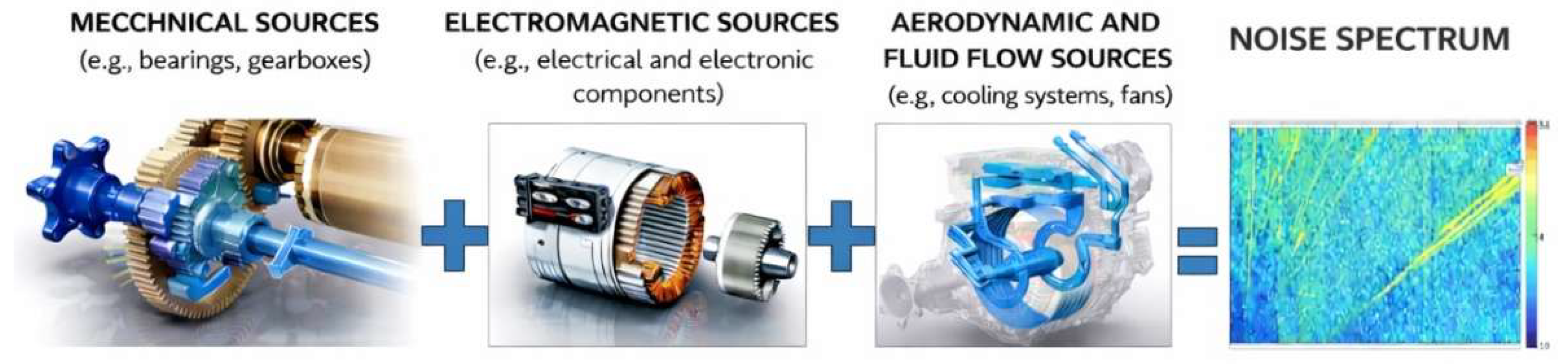
Figure 6.
Frequency-domain mapping of dominant EV drivetrain excitation sources and applicable simulation methods.
Figure 6.
Frequency-domain mapping of dominant EV drivetrain excitation sources and applicable simulation methods.
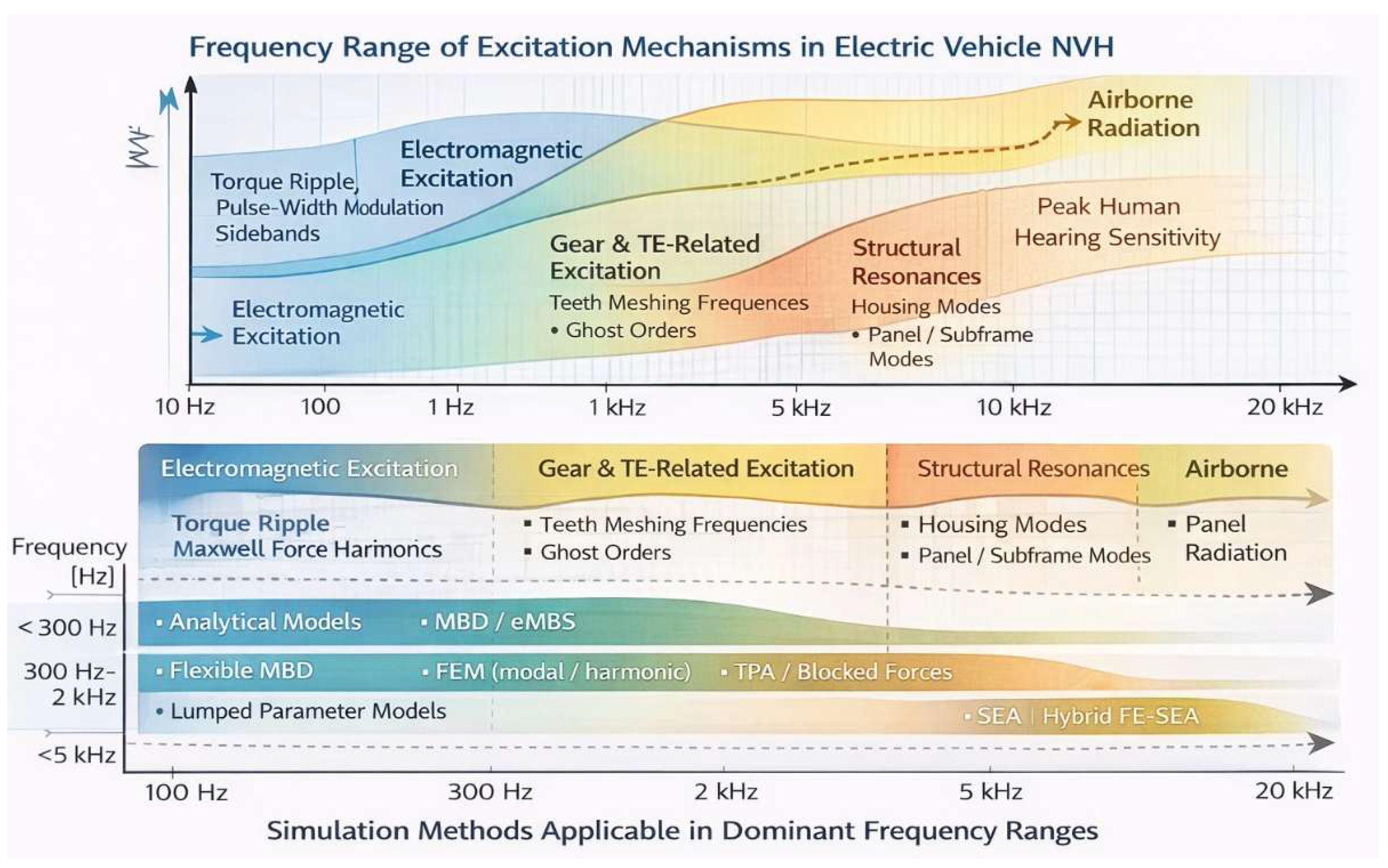
Figure 7.
Conceptual mind map of excitation sources in electric vehicle drivetrains. Mechanical, electromagnetic, power-electronic, fluid-related, and integration-induced excitations are shown together with their dominant sub-mechanisms. The diagram emphasizes that several excitation sources interact across physical domains and contribute jointly to system-level NVH behavior.
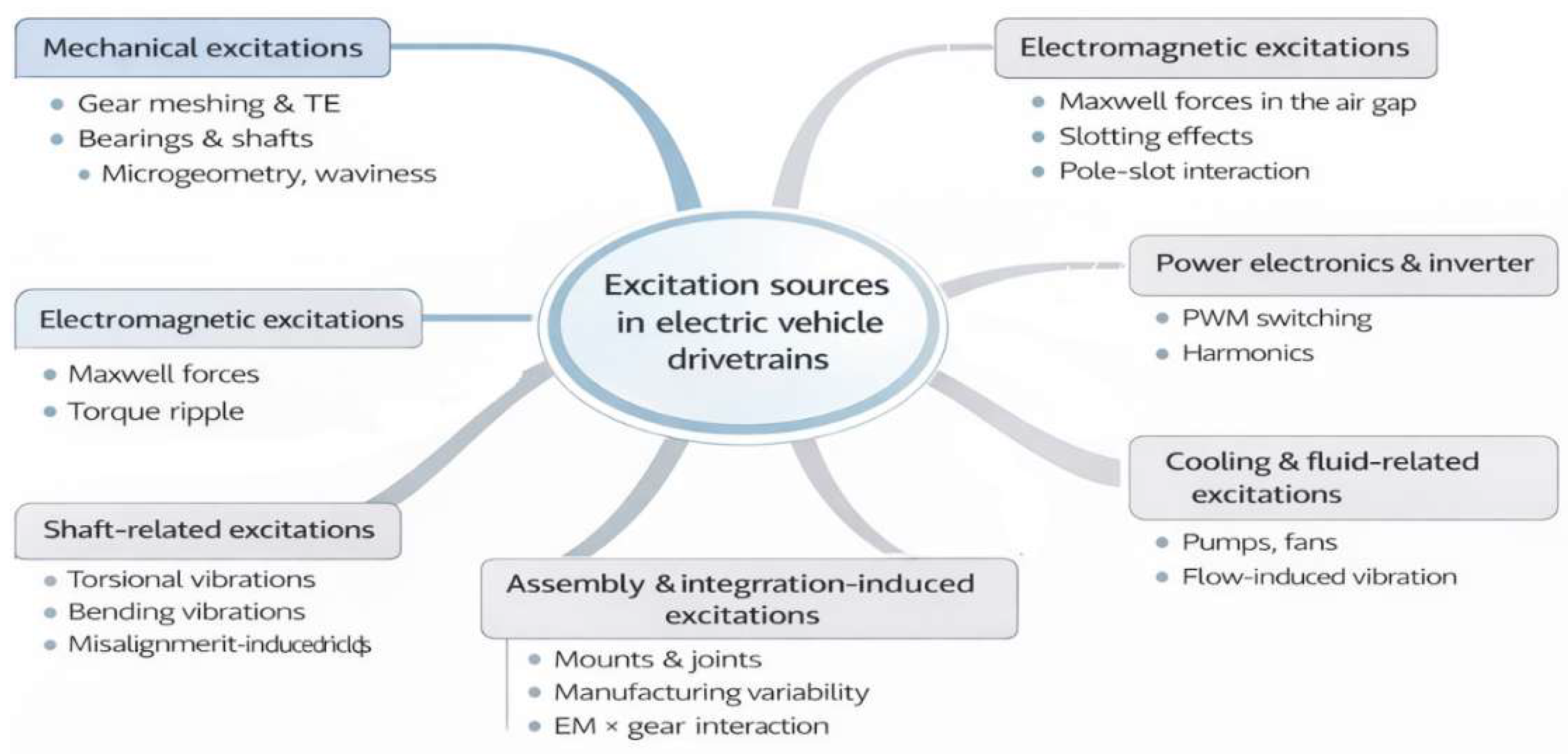
Figure 10.
Recommended iterative multiphysics e-NVH workflow: electromagnetic excitation → drivetrain dynamic response → structural dynamics & transfer paths → acoustic radiation & perception. The workflow reflects the practical coupling implied by EV-NVH reviews, TE-centric gearbox studies, blocked-force TPA validation, and BEM-based radiation modeling [1].
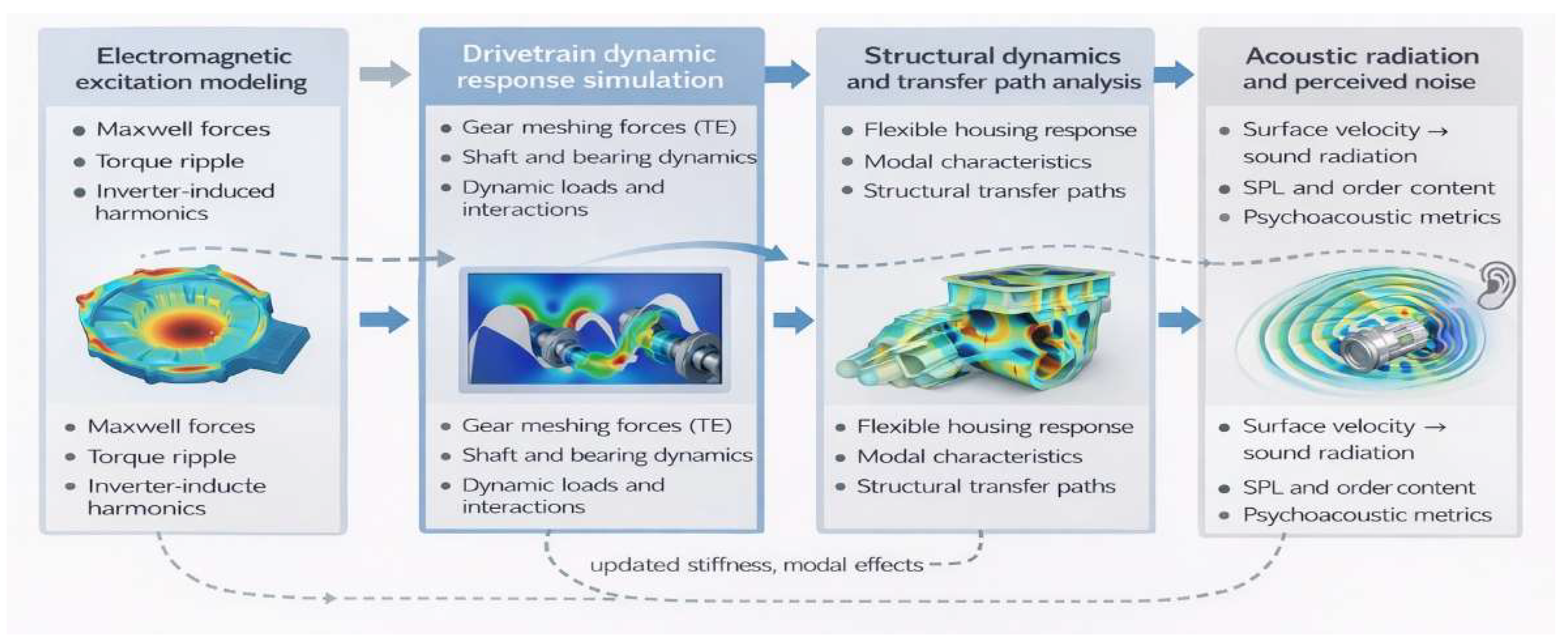

Table 1.
Representative peer-reviewed anchor studies for EV drivetrain vibroacoustic and aeroacoustic modeling and workflow integration.
Table 1.
Representative peer-reviewed anchor studies for EV drivetrain vibroacoustic and aeroacoustic modeling and workflow integration.
| Authors (Year) | Focus | Modeling approach | Main contribution |
| Horváth & Zelei (2024) | EV powertrain NVH overview | Review | Consolidates EV-specific NVH challenges across motor, inverter, and gears |
| Hua et al. (2021) | BEV NVH status | Review | Summarizes BEV sources including powertrain, tire, wind, ancillaries |
| Masri et al. (2024) | Modern vehicle NVH survey | Review | Cross-technology synthesis (EV/HEV/ICE) with mitigation strategies |
| Diez-Ibarbia et al. (2017) | EV TPA method comparison | Experimental TPA vs OPA | Shows method sensitivity and practical differences in EV path ranking |
| van der Seijs et al. (2016) | TPA framework | Theory/classification | Unifies TPA concepts; clarifies source/receiver partition and techniques |
| Lennström et al. (2016) | Blocked-force validation + EV case | In-situ blocked-force TPA | Demonstrates blocked-force transferability; EV rear axle cabin target |
| Palermo et al. (2018) | TE measurement as NVH indicator | Measurement method | Practical TE measurement; positions TE as gear-whine indicator |
| Mughal et al. (2025) | EDU gear whine | Analytical + experimental | Frames DTE as root cause; derives TVMS and connects to whine |
| Han et al. (2021) | Gear–bearing–housing radiation | Dynamics → FEM → BEM | Full chain from bearing forces to radiated noise via BEM |
| Bejar et al. (2024) | STE tool benchmark | Comparative study | Shows STE sensitivity to modeling choices; includes Romax/MASTA/ANSYS |
| Hou et al. (2025) | Microgeometry optimization | Validated coupled model | Links microgeometry to TE reduction and NVH improvement |
| Tang et al. (2025) | Tooth flank waviness & ghost orders | Manufacturing + theory | Mechanistic modeling for waviness-induced ghost orders in EV gearboxes |
| Kirkup (2019) | BEM survey | Review | Provides acoustics/BEM foundation used in drivetrain radiation studies |
| Cotoni et al. (2007) | Hybrid FE–SEA validation | Hybrid method | Establishes mid-frequency motivation and hybrid FE–SEA validation |
| Wu et al. (2016) | Hybrid ES–FE–SEA | Hybrid method | Demonstrates hybrid approaches for mid-frequency prediction |
| Thielecke et al. (2023) | Heat pump compressor noise | Active current shaping | Links electrical control to reduced compressor vibration/noise orders |
| Doleschal & Verhey (2022) | EV tonal content pleasantness | Psychoacoustic study | Quantifies tonal perception effects relevant to EV sound quality |
Table 2.
EV drivetrain phenomena mapped to simulation methods. typical outputs. and recurring limitations motivating hybrid workflows.
Table 2.
EV drivetrain phenomena mapped to simulation methods. typical outputs. and recurring limitations motivating hybrid workflows.
| Phenomenon / chain element | Dominant physics | Typical methods | Typical outputs | Frequent limitation |
| Maxwell force harmonics | Electromagnetic | EM-FEM + harmonic analysis. | Force waves, order content | Boundary conditions/control coupling uncertainty |
| Torque ripple & current harmonics | EM + control | Field–circuit coupling + EM-FEM. | Torque time series, orders | Controller implementation detail affects spectra |
| PWM acoustic signatures | Electrical + structural | Drive–motor interaction models. | Spectral sidebands, tonal peaks | High-frequency structural resonances sensitive to modeling |
| Gear TE/DTE & TVMS | Mechanical contact | LTCA/STE/TE + MBD/eMBS | DTE, mesh forces, bearing loads | Manufacturing scatter often simplified |
| Waviness & ghost orders | Manufacturing + dynamics | Waviness-informed TE models | Ghost-order prediction | Limited standardized metrology-to-model pipelines |
| Bearing nonlinearities | Nonlinear mechanics | Nonlinear MBD, bearing models | Nonlinear forces, modulation | Parameter identification (preload/clearance) |
| Transfer paths to cabin | Structural dynamics | FRFs + TPA/blocked forces | Path contributions, synthesized response | Installation variability can dominate |
| Housing vibration fields | Structural | FEM + modal/FRF analysis | Mode shapes, surface velocities | Joint/coupling damping uncertainty |
| Exterior radiation | Acoustics | BEM / FEM–BEM | Radiated SPL, directivity | Cost and conditioning at higher frequencies |
| Mid-frequency cabin SPL | Vibroacoustic | SEA / hybrid FE–SEA | Band SPL, energy flow | Assumption validity and model partitioning |
| Heat pump/compressor orders | Mechatronic + structural | Control + structural dynamics | Compressor orders, noise reduction | Coupling of mounts and vehicle body often simplified |
| Perceived sound quality | Psychoacoustics | Metrics + listening tests | Tonal content, pleasantness trends | Nonlinear mapping from vibration to perception |
Disclaimer/Publisher’s Note: The statements, opinions and data contained in all publications are solely those of the individual author(s) and contributor(s) and not of MDPI and/or the editor(s). MDPI and/or the editor(s) disclaim responsibility for any injury to people or property resulting from any ideas, methods, instructions or products referred to in the content. |
© 2026 by the authors. Licensee MDPI, Basel, Switzerland. This article is an open access article distributed under the terms and conditions of the Creative Commons Attribution (CC BY) license (http://creativecommons.org/licenses/by/4.0/).
Copyright: This open access article is published under a Creative Commons CC BY 4.0 license, which permit the free download, distribution, and reuse, provided that the author and preprint are cited in any reuse.