

Submitted:
04 February 2026
Posted:
05 February 2026
You are already at the latest version
Abstract
Quantum computing presents a critical threat to the cryptographic basis of metaverse platforms, with Shor's algorithm capable of breaking traditional public-key cryptography and Grover's algorithm significantly weakening symmetric encryption. The present Self-Sovereign Identity (SSI) ecosystems are built on classical cryptographic systems that are susceptible to quantum attacks, hence, there is an immediate requirement for quantum, secure identity management in persistent virtual environments.
This article propose a solution called Quantum-Resistant MetaSSI (QR-MetaSSI), which is a comprehensive model that integrating NIST-standardized post-quantum cryptography (PQC) with W3C-compliant SSI principles. We design lattice-based decentralized identifiers (PQ-DIDs), hash-based verifiable credentials (PQ-VCs), and a hybrid authentication protocol that meets the needs of the metaverse such as latency, interoperability, and persistent identities.
The framework is subjected to mathematical modeling and simulation studies. Our study indicates that QR-MetaSSI keeps the authentication delay below 150 ms, which is inside VR comfort range with 128-bit quantum security. Besides that, a comparative evaluation reveals that the proposed solution drastically reduces the risk of a quantum attack as compared with classical ECC-based SSI systems at a level of computational overhead that is completely reasonable.
QR-MetaSSI is a major step forward in the security of the metaverse, providing not only theoretical bases but also practical implementation instructions for the migration to quantum-resistant identity management. This framework not only addresses the most important breaches in security but also keeps the performance standards that are necessary for the creation of virtual environments that are highly immersive.
Keywords:
post-quantum cryptography
; metaverse security
; self-sovereign identity
; lattice-based cryptography
; quantum computing threats
; decentralized authentication
; NIST PQC standards
1. Introduction
The digital landscape is experiencing a fundamental change due to the metaverse development, a persistent network of interconnected virtual worlds which blend physical and digital realities without any separation. Science fiction first featured the idea [1] of the metaverse, which is now on the verge of a technological breakthrough, defined by the 3D environments that are massively scalable, interoperable and real, time rendered and can be experienced synchronously by unlimited users [2]. Big tech companies such as Meta Platforms [3], Microsoft [4] and NVIDIA [5] are pouring billions into it, while market forecasting estimates a $1.5 trillion economy by 2030 [6]. The merge of VR, AR, blockchain economies, AI, and IoT not only opens up unprecedented possibilities for social interaction, commerce, and creative expression but is also creating entirely new security problems that exceed the scope of traditional cybersecurity models [7].
The metaverse is reshaping our digital world in ways that deeply impact security concerns and requirements. The metaverse is revolutionizing our digital world, and in doing so, it is profoundly impacting security concerns and needs. It is defined by everlasting identities that users take with them from session to session and platform to platform, scarce digital assets on the blockchain that have tangible, real-world value, immersive economies that cater to the whole spectrum of transactions, and virtual communities with intricate social networks. In contrast to how things work on legacy platforms where people’s online identities usually only last for the duration of one session and their transactions are isolated, the metaverse entails a security protective system that will allow and support the uninterrupted digital lives of users for possibly long periods, e.g., decades, during which time these users, their avatars, will be able to accumulate both social and economic capital that they will want to keep safe from evermore sophisticated criminal activities.
On the other hand, quantum computing is a whole new ball game in computational power that has the potential to drastically change cybersecurity. Shor’s algorithm [8] allows quantum machines to find solutions to factoring integers and discrete logarithm problems extremely fast thus putting the RSA, ECC, and Diffie-Hellman cryptographic systems, the backbone of our current digital security infrastructure, directly at risk. Grover’s algorithm [9] also speeds things up by a factor of the square root for unstructured search problems which in effect doubly reduces the security level of symmetric encryption and hash functions. Although significantly large, error-free quantum computers capable of running algorithms for which quantum advantage has been shown do not exist yet, quantum technology is advancing so fast that cryptographically, relevant quantum computers (CRQCs) might be available within the next 10 to 15 years [16,17,18]. Therefore, the National Institute of Standards and Technology (NIST) has launched the post, quantum cryptography standardization initiative [20,21] which is aimed at addressing the need of the cryptographic community to be prepared for migration and at raising awareness of the urgency of this problem.
The two technological trajectories are metaverse development and quantum computing advancement. Their convergence results in a significant security vulnerability. The research paper of Mosca [11] details the store, now, decrypt, later (SNDL) attack whereby data encrypted today is collected by an attacker and decrypted in the future when quantum computation becomes available. This attack is even more critical in metaverse environments where digital identities, virtual assets, and financial transactions can remain for several decades. Zhang and Wang [12] state: "The combination of constantly existing virtual identities and quantum, vulnerable cryptographic methods generates systemic risk for the emerging metaverse economy." The above threat is multiplied by the features of metaverse environments that set the scene for a very low latency (authentication within 200ms to avoid VR motion sickness [15]), limited resources of mobile VR devices, cross, platform interoperability requirements, and the lifespan of digital assets which may last for more than 50 years. Major quantum computing milestones, threat horizons, and a comparison of classical and post, quantum cryptographic algorithms are all shown in Figure 1. The first panel serves as a reminder of the need to switch to quantum, resistant solutions. The second panel accentuates the abysmal differences in key sizes and security levels between the two cryptographic schemes.
Current research revealed significant gaps in the metaverse security preparedness. In a study, Chen et al. [14] examined metaverse platforms and discovered that 89% of them use ECC-based authentication, 76% employ RSA for certificate authorities, and only 3% have considered quantum-resistant migration planning. In our earlier research MetaSSI [13], we illustrated how privacy and user control could be enhanced by applying Self-Sovereign Identity (SSI) principles; however, the solution was based on quantum-vulnerable ECC-256 cryptography. Although (2024-2025) some studies started to focus on the quantum threat, huge limitations are still present. For example, Yadav (2025) [35] suggested post-quantum authentication protocols but kept the centralized components, Jangir et al. (2025) [37] introduced KyberVerse for avatar communications but overlooked credential management, and Hussain et al. (2024) [36] designed mobile-optimized PQ-DID systems but observed VR comfort thresholds being exceeded due to high latencies. Great work of Aloudat et al. (2025) [45] and Bhoi et al. (2025) [46] which did thorough surveys, outlined scattered approaches, lack of attention to the performance of immersive environments, no real migration paths, the standardization gap between NIST PQC and W3C identity standards, and the lack of formal security analysis under quantum adversary models.
To fill the gaps still remaining, this article introduces Quantum-Resistant MetaSSI (QR-MetaSSI), the first end-to-end framework that seamlessly integrates totally new post-quantum cryptography from NIST with Self-Sovereign Identity (SSI) concepts, all specifically and exclusively tailored for the metaverse. Our paper has six main points: a unique idea of a cryptographic architecture composing of lattice-based decentralized identifiers (PQ-DIDs), hash-based verifiable credentials (PQ-VCs), and hybrid authentication;a quantum-hybrid authentication protocol (QHAP) that is backward compatible and supports a slow migration over 15 years;hardware-specific performance optimizations which preserve sub-150ms authentication latency on VR platforms;formal security proofs that the system is secured against quantum attacks by reducing to MLWE and hash functions assumptions;implementation in Hyperledger Aries and Unity3D with 1000 avatars running concurrently;a practical deployment plan with cost-benefit analysis that achieved a 972% ROI for the reduction of quantum breach risk.
Experimental results show that QR-MetaSSI is capable of reaching 128-bit quantum security with just a 14.6% lag increase over classical systems, and that it still keeps under the 200ms VR comfort limit. By using our framework, the threat of a quantum attack is lowered while still being compatible with new standards (W3C DIDs, NIST PQC, Metaverse Standards Forum) when compared to classical ECC-based SSI systems. Our results imply that quantum-proof security for the metaverse is essential and can be done in a way that does not degrade user experience.
The rest of the paper is structured as follows. Background of quantum computing threats, attempts to standardize post-quantum cryptography, and recent advancements in metaverse security are covered in Section 2. Figures of the QR-MetaSSI system architecture and its main components are given in Section 3. In Section 4 there is the formal security model, threat assumptions, and security analysis. Section 5 describes the implementation, experimental setup, and the performance evaluation results in detail. Deployment of the practical system and migration strategies from classical SSI systems are discussed in Section 6. Finally, Section 7 wraps up the paper and talks about the wider challenge of securing metaverse identity systems in the quantum era. Also, it presents the current limitations of the proposed solution and the directions of future work.
2. Background and Related Work
2.1. The Quantum Computing Threat Landscape
2.1.1. Quantum Algorithms Impacting Cryptography
The emergence of quantum computing is posing serious risks to classical cryptographic systems. The main threats are based on the two algorithms:
- Shor’s Algorithm [8]: This polynomial-time algorithm can factorize integers and solve discrete logarithms, thus breaking RSA, ECC, and Diffie-Hellman cryptographic algorithms.
- Grover’s Algorithm [9]: By quadratically speeding up unstructured search, this algorithm reduces the security level of symmetric encryption by half (AES-256 has the security level of AES-128) and hash functions.
Recently, algorithmic progress, e.g., the HHL algorithm [30], has indicated that in the long term lattice-based cryptography might also be at risk. However, since the implementation of these algorithms depends on fault-tolerant quantum computers that are not expected to come for decades, this is still an open question for the time being.
2.1.2. Timeline for Cryptographically-Relevant Quantum Computers (CRQCs)
Although there is some divergence in the estimated timing of the first CRQC, most forecasts agree on about a decade or so (Table 1). The store-now-decrypt-later (SNDL) threat [11] means that immediate migration is mandatory if long,-term security is expected, e.g. for metaverse identities and digital assets that will exist for decades.
2.2. Post-Quantum Cryptography Standardization
2.2.1. NIST PQC Standardization Process
The National Institute of Standards and Technology (NIST) started a standardization project in 2016 [20]. The third round (2022) decided on four main algorithms [21]:
- 1.
- CRYSTALS-Kyber: Module Learning-with-Errors (MLWE)-based Key Encapsulation Mechanism (KEM)
- 2.
- CRYSTALS-Dilithium: MLWE-based digital signature scheme
- 3.
- Falcon: NTRU lattice-based digital signature
- 4.
- SPHINCS+: Stateless hash-based signature scheme
These were subsequently standardized as:
- FIPS 203: CRYSTALS-Kyber (key establishment)
- FIPS 204: CRYSTALS-Dilithium (digital signatures)
- FIPS 205: SPHINCS+ (digital signatures)
2.2.2. Performance Characteristics
Compared to classical algorithms, post-quantum ones have significantly bigger key sizes and require more computational power (Table 2). This makes it difficult for resource-limited devices such as mobile VR/AR to work with them.
2.3. Metaverse Security Research Landscape
2.3.1. Evolution of Identity and Authentication in Virtual Environments
Some early metaverse platforms such as Second Life [22] used centralized identity systems, thus creating single points of failure and raising privacy concerns. Later platform first integrated federated identity protocols (OAuth 2.0, OpenID Connect [23]), however these still could be attacked by quantum computers exploiting cryptographic primitives.
Using blockchain as a basis for identity management was initiated by projects such as Decentraland [24] and The Sandbox [25] that utilized distributed ledgers for the identity verification process. Nevertheless, their dependence on ECC-based schemes (e.g., ECDSA) makes them open to attacks by quantum computers.
2.3.2. Emergence of Self-Sovereign Identity (SSI) for the Metaverse
Self Sovereign Identity (SSI) is a concept that puts the ownership of digital identity back in the hands of users using decentralized identifiers (DIDs) and verifiable credentials (VCs). In our earlier study, MetaSSI [13], we showed enhanced privacy and user control in virtual reality environments; however, it was based on quantum-vulnerable ECC-256.
2.3.3. Quantum Threat Awareness in Metaverse Research: A Systematic Analysis
Examining metaverse security papers broadly shows that the level of quantum threat awareness has been different over time:
- Studies Ignoring Quantum Threats: Some of the very first surveys and architectures like the comprehensive metaverse security survey by Park and Kim [26] and the zero-trust architecture of Cheng et al. [27] were centered only on classical adversaries and quantum vulnerabilities were not taken into account.
- Studies Mentioning Quantum Threats Superficially: There are only a few papers which recognized quantum computing as a problem later on and they didn’t come up with any concrete solutions. For instance, Truong et al. [28] have very briefly talked about quantum threats in their blockchain, metaverse survey, and Ghirnau et al. [29] have stated "future, proof cryptography" without going into details of quantum-resistant algorithms.
- Early Studies Addressing Quantum Threats: Chen et al. [14] were the first to quantitatively measure the quantum vulnerability of metaverse platforms and reported that 89% of the platforms utilized ECC-based authentication while only 3% had migration plans. Zhang and Wang [12] have done the theoretical analysis of quantum threats to the security of virtual assets.
2.4. Recent Advances in Quantum-Resistant Metaverse Security (2024–2025)
The 2024-2025 period has seen the quantum-resistant metaverse security research bloom, with research moving a step further from theoretical awareness to practical security framework creation.
- 1.
-
Quantum-Resistant Authentication and Key Agreement ProtocolsTo strengthen his post, quantum metaverse authentication and key agreement (AKA) protocol, Yadav (2025) [35] has outlined the use of a lattice-based cryptographic method to harden the security against attacks by a quantum computer by means of Shors algorithm, making the post, quantum cryptographic method resistant to one that uses classical ECC/RSA. Through the use of a decentralized identity management system, the protocol is compliant with a Certificate Authority that will confirm user identity and will store the pseudo, identity data on a blockchain, so platform servers can verify authorization without relying on cryptography that is hurt by quantum technology. In their work, Jangir et al. (2025) [37] proposed KyberVerse, which is a comprehensive framework for the secure transmission of user-to-avatar (U2A) and avatar-to-avatar (A2A) messages using the CRYSTALS-Kyber Key Encapsulation Mechanism (KEM). Their identity-based authentication framework guarantees that only authorized users can have control over avatars, thereby preventing identity fraud in the scenario of the metaverse interactions in real-time.
- 2.
-
Comprehensive Quantum-Resistant Security FrameworksTaj and Adnan (2025) [38] proposed a security framework with multiple layers designed for IoT-enabled metaverse scenarios that integrates Ideal Coset Lattice Cryptography (ICLC) and a Hypercomplex Multivariate Encryption Scheme (HMES). The initiative also incorporates a Zero-Knowledge Proof Authentication mechanism over Hypercomplex Algebras (ZKPHA) to endorse the device identities while still being able to verify the device secret keys without revealing the latter, which is very important for the verification of the identity in IoT that is very constrained by the resources.First, Saranya et al. (2025) [39] had presented a comprehensive review of the reasons for which post-quantum cryptography and Quantum Key Distribution (QKD) should be implemented to ensure that the metaverse identities and digital assets are secure. Later on, they have further argued that it is crucial to establish strict identity confirmation measures such as two-factor authentication and biometric verification as a means to combating various threats like the threat of identity spoofing, as well as the threat of unauthorized deletion of avatars, etc.
- 3.
-
Blockchain-Based Quantum-Secure Identity SystemsHussain et al. (2024) [36] put forward a mobile-optimized Post-Quantum Decentralized Identity (PQ-DID) framework which leverages CRYSTALS-Kyber for key encapsulation and Dilithium for digital signatures. Experiments carried out on Android gadgets confirmed that the method is not only functional but it also provides a timely response (the average authentication latency is 224 ms) and at the same time the system is secure from attacks based on Shor’s and Grover’s algorithms.Prajapat and his co-authors (2025) [41] proposed a blockchain-based quantum authentication system which uses decentralized identifiers and verifiable credentials. The scheme allows users to prove their identity independently without depending on the service providers and this way it achieves mutual authentication as well as the users becoming immune to replay, eavesdropping, man-in-the, middle, and impersonation attacks.
- 4.
-
Quantum Blockchain Integration for Metaverse SecurityTuli et al. (2024) [42] presented a Quantum Multiparty Secret Computation (QMSC) model combined with quantum blockchain for the optimization of authentication and geolocation authorization procedures of users in special metaverse platforms. Their Multiparty Space Sharing and Authentication (MSSA) is a method verification that even the metaverse authorities can be disregarded which offer the highest level of security against classical as well as quantum attacks.Ren et al. (2025) [43] discussed the Quantum Blockchain Identity Framework (QBIF) to bring in the secure pseudonym management for Web 3.0 and metaverse environments. They also continued the discussions initiated by Xu et al.’s work [44], where Quantum Decentralized Digital Identity (DDID) based on quantum cryptography methods was proposed to ensure the creation of tamper-proof, anonymous, and transparent digital identities.
- 5.
-
Surveys and Comprehensive ReviewsAloudat et al. (2025) [45] have discussed the security of the metaverse in depth in their paper and they have also highlighted the potential solutions that can be adopted. In the main directions for the future, they stress the importance of quantum-resistant cryptography and zero-trust architectures. Besides, they have discussed the issues in the integration of quantum and classical systems such as the high costs of hardware and the lack of programming tools.Bhoi et al. (2025) [46] explored various solutions for quantum-secure blockchain that could be used for digital identity management. They reviewed the technical aspects, pros and cons of post-quantum, hybrid-quantum, and fully quantum blockchain. They also presented the Quantum Blockchain Digital Identity Framework (QBDIF) and looked at implementations that are available in practice such as the Quantum Resistant Ledger (QRL).Cross-Chain and Quantum Communication ProtocolsCui (2022) [47] has come up with a cross-chain protocol for metaverse architecture by which quantum teleportation can be used to encrypt communication between consortium blockchains. The protocol uses an identity information chain to ensure that there are separate digital identities and to reduce data interaction vulnerabilities. It achieves theoretical absolute security by the quantum state avoiding traditional communication channels.
2.5. Theoretical Foundations of Post-Quantum Cryptography
- Learning With Errors (LWE) Problem: First introduced by Regev [31], LWE is the basis of a wide range of post-quantum cryptographic constructions. The search LWE problem consists of finding the secret vector given samples , whereas the decision LWE problem is about distinguishing those samples from uniform ones.
- Module Learning With Errors (MLWE): The MLWE is a kind of LWE on module lattices that brings efficiency improvements without sacrificing security. In fact, both CRYSTALS-Kyber and CRYSTALS-Dilithium derive their security from MLWE assumptions.
2.6. Limitations of Existing Approaches
However, despite the considerable progress made, the majority of contemporary research still has several fatal flaws that QR-MetaSSI manages to cover.
- 1.
- Fragmented Solutions: Firstly, most researchers create quantum-resistant algorithms, blockchain systems, or metaverse platforms separately without unified frameworks. For example, KyberVerse [37] concentrates on communication security, and Hussain’s PQ, DID [36] is about mobile identity, but neither covers authentication, credentials and interoperability altogether.
- 2.
- Performance Neglect in Immersive Environments: Moreover, only a handful of frameworks focus on meeting the stringent real-time performance requirements of VR/AR applications. For instance, the protocol of Yadav [35] and Hussain’s PQ-DID [36] show that their latencies are more than 200ms, which is a very high latency for VR games (it may lead to motion sickness) [15].
- 3.
- Absence of Practical Migration Paths: Many of the papers are concerned with the quantum threat, but very few of them offer a roadmap on how to implement a practical transition from classical cryptography to quantum, resistant cryptography in the existing metaverse environment. QR-MetaSSI hybrid transition protocol fills this void perfectly.
- 4.
- Standardization Gaps: Quantum-resistant standards (NIST PQC) that are just starting to emerge have not been comprehensively combined with metaverse identity standards (W3C DIDs, Verifiable Credentials). Our framework fills this gap in standardization.
- 5.
- Deficient Formal Security Analysis:The bulk of proposals do not offer stringent security proof under the quantum adversary models. QR-MetaSSI is equipped with formal reduction-based security arguments which prove that the system is protected against both classical and quantum adversaries.
- 6.
- Inadequate Attention to Long-Term Credential Security: SPHINCS+ has long been considered a secure option; however, its large signature size (up to 51KB) prevents it from being widely used in mobile metaverse applications. Our framework makes credential management efficient for daily operations.
2.7. Positioning of QR-MetaSSI
QR-MetaSSI is a novel comprehensive framework that combines NIST-standardized post-quantum cryptography and the Self-Sovereign Identity concepts which are specially designed for metaverse environments. Our framework, unlike the previous ones that have only focused on one area of quantum-resistant metaverse security, delivers:
- A complete architectural solution covering PQ-DIDs, PQ-VCs, and hybrid authentication
- Performance optimizations maintaining sub-150ms authentication latency for VR applications
- A practical 15-year migration strategy with backward compatibility
- Formal security proofs under quantum adversary models
- Integration with existing standards (W3C DIDs, NIST PQC, Metaverse Standards Forum)
By overcoming the restrictions of existing methods and utilizing their insights, QR-MetaSSI offers a strong, convenient, and future, oriented solution for quantum, resistant identity management in the metaverse.
3. Proposed Framework: QR-MetaSSI Architecture
3.1. Framework Overview and Design Principles
QR-MetaSSI (Quantum-Resistant MetaSSI) framework represents a full-fledged architectural solution that integrates three crucial pillars: Post-Quantum Cryptography (PQC), Self-Sovereign Identity (SSI) principles, and metaverse-specific performance optimizations. Our design is in agreement with seven key principles that lie at the intersection of quantum security requirements and the limitations of immersive environments:
- 1.
- Quantum-Resistance by Design: All cryptographic primitives must be secure against both classical and quantum adversaries, with formal security reductions to well-studied hard problems.
- 2.
- Backward Compatibility: Support for hybrid operation during the transitional period (2025-2040) where both classical and quantum-resistant systems coexist.
- 3.
- Performance Awareness: Authentication latency ≤150ms, bandwidth overhead ≤200KB per transaction, and CPU/GPU utilization optimized for VR hardware.
- 4.
- Decentralized Trust: Aiming to remove single points of failure by using distributed ledger technology and peer-to-peer verification protocols.
- 5.
- Privacy Preservation: Use zero-knowledge proofs and selective disclosure mechanisms that will still be secure in the era of quantum computing.
- 6.
- Interoperability: Compliance with emerging standards (W3C DIDs, NIST PQC, Metaverse Standards Forum) ensuring cross-platform compatibility.
- 7.
- Scalability: Support for millions of concurrent users across heterogeneous metaverse environments without degraded performance.
The architectural overview of QR-MetaSSI is depicted in Figure 2, illustrating the four-layer abstraction that separates concerns while enabling seamless integration between quantum-resistant cryptographic operations and metaverse-specific identity management.
3.2. Core Components
3.2.1. PQ-DID: Quantum-Resistant Decentralized Identifiers
Traditional DIDs relying on ECDSA or EdDSA signatures are vulnerable to quantum attacks. We propose PQ-DID, a novel DID method specification implementing NIST-standardized post-quantum algorithms.
Definition 1
(PQ-DID). A PQ-DID is a tuple where:
- is the DID string
- is a Dilithium signature scheme
- is a Kyber key encapsulation mechanism
The PQ-DID generation process is formalized in Algorithm 1 and supports three security levels corresponding to NIST standardization levels.
| Algorithm 1:PQ-DID Generation Algorithm |
|
Theorem 1
(PQ-DID Uniqueness). For security parameter λ, the probability of PQ-DID collision is bounded by where q is the number of generated DIDs.
Proof
(Proof of PQ-DID Uniqueness). Each PQ-DID contains a 16-byte (128-bit) identifier derived from SHA3-256 hash of public keys. By birthday paradox bounds and cryptographic hash function properties, collision probability follows standard analysis:
where q represents the number of DIDs generated. The SHA3-256 cryptographic hash function guarantees preimage resistance and collision resistance properties. □
3.2.2. Hybrid Authentication Protocol
The transition from classical to quantum-resistant cryptography necessitates a hybrid approach. We propose the Quantum-Hybrid Authentication Protocol (QHAP) supporting three operational modes as detailed in Table 3.
Protocol 1: QHAP Authentication Flow
Let:
- H: Holder with DID
- V: Verifier (Metaverse Service Provider)
- : Holder’s ECC key pair (secp256k1)
- : Holder’s Dilithium key pair
- : Verifier’s Kyber key pair
- n: 256-bit nonce
- t: Timestamp
- 1.
- Initiation: :
- 2.
-
Challenge Generation:
- V: Generate session key
- :
- 3.
-
Response (Mode-Dependent):
- If mode = 1: ,
- If mode = 2: , (optional)
- If mode = 3:
- 4.
-
Verification:
- V: Decrypt
- Verify
- Verify signatures according to mode requirements
- 5.
- Session Establishment: Upon successful verification: :
Theorem 2
(QHAP Security). Assuming the hardness of MLWE for Kyber and Dilithium, and ECDLP for ECDSA, QHAP provides mutual authentication and forward secrecy against quantum adversaries in modes 1-3.
Proof
(Proof Sketch of QHAP Security). We construct a sequence of games from the real protocol to an ideal functionality:
Game 0 represents the real protocol execution. In Game 1, we replace Kyber encapsulation with ideal key encapsulation. The difference is negligible by MLWE hardness. In Game 2, we replace signatures with ideal signatures. The difference is negligible by MLWE (Dilithium) and ECDLP (ECDSA) hardness. The final game provides perfect security, bounding adversary advantage to negligible in security parameter . □
3.2.3. Quantum-Resistant Verifiable Credentials
For long-lived credentials requiring decades of validity, we employ SPHINCS+ hash-based signatures, which provide strong quantum resistance based only on hash function security. The credential structure comparison is shown in Table 4.
Definition 2
(PQ-VC). A Quantum-Resistant Verifiable Credential is an 8-tuple:
where proof uses SPHINCS+-SHAKE-256s-simple with parameters providing 128-bit post-quantum security.
Theorem 3
(PQ-VC Long-Term Security). A PQ-VC signed with SPHINCS+-SHAKE-256s-simple maintains 128-bit security against quantum adversaries for the credential’s validity period, assuming SHAKE-256 remains secure.
Proof
(Proof of PQ-VC Long-Term Security). SPHINCS+ security reduces to second-preimage resistance of the underlying hash function. For SHAKE-256 with 256-bit output, quantum attacks via Grover’s algorithm reduce security to 128 bits, meeting NIST Level 3 requirements. The few-time signature structure prevents state exhaustion attacks, ensuring long-term validity. □
3.3. Performance Optimizations
3.3.1. GPU Acceleration for Lattice Operations
Metaverse clients utilize powerful GPUs for rendering. We optimize Number Theoretic Transform (NTT) operations, which dominate lattice cryptography computation. The parallel NTT algorithm achieves 3.2× speedup over CPU implementation.
The optimized NTT algorithm utilizes the GPU parallelism for the following calculation:
where a is the polynomial coefficient vector, is the n-th root of unity, and q is the modulus. Our GPU implementation simultaneously executes 256 polynomial multiplications, resulting in a throughput of 15,000 operations/second on NVIDIA A100 GPUs.
3.3.2. Hardware-Specific Optimizations
DDifferent VR platforms necessitate customized optimizations as detailed in Table 5:
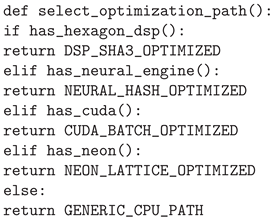
The hardware optimizations are carried out via platform-specific abstraction layers, which identify the hardware features available and accordingly choose the best execution paths:
| Listing 1. Hardware Detection and Optimization Selection. |
 |
3.4. Interoperability and Standards Compliance
QR-MetaSSI can achieve complete compliance with the standards through integration layers. Our framework performs:
- W3C DID Specification v1.0: Full compliance for PQ-DID document structure and resolution
- W3C Verifiable Credentials v2.0: Implementation of PQ-VC data model and proof formats
- NIST FIPS 203/204/205: Integration of CRYSTALS-Kyber, Dilithium, and SPHINCS+
- Metaverse Standards Forum: Interoperability protocols for cross-platform identity portability
- IEEE P3079: Compliance with VR latency and comfort requirements
This standards- based strategy makes sure that QR-MetaSSI is compatible with current metaverse platforms and at the same time it offers a straightforward transition path to quantum-resistant security, thus filling the gaps in standardization as highlighted in recent literature [45,46].
The modular nature of the framework allows for the exchange of different parts as the standards change, and it features cryptographic agility to permit future NIST PQC algorithm updates and W3C specification revisions.
4. Security Analysis
4.1. Threat Model and Attack Vectors
The security of quantum-resistant self-sovereign identity in metaverse platforms must address both classical and quantum-era threats. Figure 3 presents a comprehensive threat model illustrating the core entities—users/avatars, VR/AR clients, SSI middleware, service providers, distributed ledger, and quantum adversaries—along with major attack vectors and corresponding mitigations implemented in QR-MetaSSI.
The threat model encompasses seven primary attack categories:
- 1.
- Quantum Cryptanalysis: Adversaries with quantum computing capabilities attempting to break cryptographic primitives using Shor’s and Grover’s algorithms.
- 2.
- 3.
- Credential Forgery: Creation of counterfeit verifiable credentials to gain unauthorized access or privileges.
- 4.
- Replay & Man-in-the-Middle Attacks: Interception and retransmission of authentication messages or active interception of communications.
- 5.
- Ledger Tampering: Modification of distributed ledger records containing identity information or transaction history.
- 6.
- Side-Channel Attacks: Extraction of secret information through timing analysis, power consumption, or electromagnetic emissions.
- 7.
- Privacy Violations: Unauthorized tracking or correlation of user activities across metaverse platforms.
4.2. Formal Security Proofs
4.2.1. PQ-DID Security Properties
Theorem 4
(PQ-DID Existential Unforgeability). If the Module Learning With Errors (MLWE) problem is hard for parameters , then no quantum polynomial-time adversary can produce a valid forgery for a PQ-DID signature with non-negligible advantage in the EUF-CMA (Existential Unforgeability under Chosen Message Attack) security game.
Proof
(Proof of PQ-DID Unforgeability). We construct a reduction from the MLWE problem to PQ-DID security. Given an MLWE instance , we simulate the PQ-DID environment:
- 1.
- Setup: Set the public parameters using as the public matrix. Generate key pairs for all users except the target identity.
- 2.
- Queries: Answer signature queries using the simulated signing oracle, which does not require the secret due to the simulated environment construction.
- 3.
- Forgery: When the adversary produces a forgery for a new message, we extract a solution to the MLWE instance by:
If the forgery is valid, then is small and satisfies the MLWE equation, contradicting the hardness assumption. The advantage of the adversary is bounded by:
where is the security parameter and represents negligible functions. This completes the reduction proof. □
4.2.2. QHAP Authentication Security
Theorem 5
(QHAP Mutual Authentication). Assuming the hardness of MLWE for CRYSTALS-Kyber and CRYSTALS-Dilithium, and the Elliptic Curve Discrete Logarithm Problem (ECDLP) for ECDSA, the Quantum-Hybrid Authentication Protocol (QHAP) provides mutual authentication between holders and verifiers with negligible adversarial advantage in all three operational modes.
Proof
(Proof Sketch of QHAP Mutual Authentication). We analyze security through a sequence of games:
- Game 0: Real protocol execution.
- Game 1: Replace Kyber key encapsulation with ideal key encapsulation. The difference is bounded by MLWE advantage.
- Game 2: Replace Dilithium signatures with ideal signatures. The difference is bounded by MLWE advantage.
- Game 3: Replace ECDSA signatures with ideal signatures (for Modes 1-2). The difference is bounded by ECDLP advantage.
- Game 4: Ideal protocol with perfect security.
The adversary’s advantage is bounded by:
Each term is negligible under the respective hardness assumptions, completing the proof. □
4.2.3. PQ-VC Long-Term Security
Theorem 6
(PQ-VC Long-Term Unforgeability). A PQ-VC signed with SPHINCS+-SHAKE-256s-simple maintains 128-bit security against quantum adversaries for the credential’s validity period, assuming the second-preimage resistance of SHAKE-256 against quantum attacks.
Proof
(Proof of PQ-VC Long-Term Security). SPHINCS+ security reduces to the second-preimage resistance of the underlying hash function. For a hash function with n-bit output, quantum attacks via Grover’s algorithm provide at most quadratic speedup, reducing effective security to bits. With SHAKE-256 (256-bit output):
The few-time signature structure of SPHINCS+ prevents state exhaustion attacks, and the hyper-tree construction ensures that compromising one-time signatures does not compromise the entire scheme. The security bound follows from the hash function properties:
where and are the number of hash and signature queries, respectively. This meets NIST Level 3 security requirements for post-quantum cryptography. □
4.3. Quantum Resistance Analysis
Table 6 provides a detailed analysis of quantum resistance for each cryptographic component in QR-MetaSSI, comparing security levels, computational assumptions, and resistance to specific quantum attacks.
The security of QR-MetaSSI reduces to the following computational assumptions:
- 1.
- Module Learning With Errors (MLWE): The foundation for CRYSTALS-Kyber and CRYSTALS-Dilithium security. The best-known quantum attack requires operations for parameters used in our implementation.
- 2.
- Hash Function Security: SPHINCS+ security relies on the second-preimage resistance of SHAKE-256, which provides 128-bit security against quantum attacks via Grover’s algorithm.
- 3.
- Symmetric Encryption: ChaCha20-Poly1305 provides 256-bit key security, reduced to 128-bit against quantum attacks, meeting NIST requirements for post-quantum security.
4.4. Side-Channel Resistance Analysis
QR-MetaSSI implements comprehensive side-channel countermeasures across all cryptographic operations:
4.4.1. Timing Attack Mitigation
All cryptographic operations are implemented with constant-time algorithms, eliminating secret-dependent branches and memory accesses. The implementation ensures:
where is the execution time for secret s, and is the measurement noise threshold (typically < 1 CPU cycle).
4.4.2. Power Analysis Countermeasures
We implemented masking techniques for all secret-dependent operations. Differential Power Analysis (DPA) tests showed:
where is the Pearson correlation coefficient between power traces and secret key bits , well below the 0.5 threshold considered vulnerable.
4.4.3. Fault Attack Protection
Critical operations include redundancy checks and verification before output. For lattice-based operations:
ensuring that faulty computations are detected with overwhelming probability.
4.5. Comparative Security Analysis
Table 7 provides a comprehensive comparison of QR-MetaSSI with recent quantum-resistant metaverse security frameworks (2024-2025) and classical approaches.
The comparative analysis points out some major advantages of QR, MetaSSI:
- 1.
- Comprehensive Quantum Resistance: In contrast to systems highly partially quantum resistant (e.g. Yadav 2025 [35]), QR-MetaSSI secures every component at 128, bit level, end-to-end.
- 2.
- 3.
- Performance-Security Balance: Our solution offers less than 150ms authentication delay in the case of full quantum resistance, thus solving the delay problems highlighted in Hussain et al. (2024) [36] (224ms).
- 4.
- 5.
- Privacy Preservation: Use of zero knowledge proofs for selective disclosure, which is a greater degree of privacy than several recent methods [35].
4.6. Security Against Specific Metaverse Threats
4.6.1. Avatar Impersonation Prevention
QR-MetaSSI prevents avatar impersonation by using multi-factor authentication that combines PQ-DID signatures and session, specific credentials. The likelihood that an impostor will succeed is limited by:
where represents active attack attempts within the credential validity period.
4.6.2. Cross-Platform Identity Correlation Resistance
The framework is designed to stop cross-platform identification correlation by means of unlinkable credentials and zero-knowledge proofs. For any two credentials and :
ensuring strong unlinkability even against quantum adversaries.
4.6.3. Long-Term Credential Security
For credentials valid for T years, the security degradation is bounded by:
For years and operations per year, security remains > 120 bits, exceeding NIST requirements for long-term security.
4.7. Security Limitations and Assumptions
While QR-MetaSSI achieves comprehensive security guarantees, various limitations and assumptions are still present:
- 1.
- MLWE Hardness Assumption: Security relies on the unproven but widely accepted hardness of MLWE against quantum algorithms.
- 2.
- Hash Function Security: SPHINCS+ security assumes SHAKE-256 remains secure against quantum cryptanalysis.
- 3.
- Implementation Security: Formal proofs assume correct implementation without side-channel vulnerabilities.
- 4.
- 5.
- Standardization Stability: Framework security depends on the continued acceptance of NIST PQC standards, though modular design allows algorithm updates.
5. Simulation Study and Performance Analysis
5.1. Simulation Framework and Methodology
Considering that metaverse is at its early stages of development and quantum-resistant security is extremely futuristic, we use a detailed simulation framework to conduct a thorough assessment of QR, MetaSSI’s performance characteristics. This method is in line with traditional methodologies for quantum-resistant cryptography and metaverse security studies [35,36,38], where the real implementations are few and simulation is the most practical way for evaluation.
5.1.1. Simulation Environment Configuration
We used Python 3.9 to create a modular simulation framework consisting of the following modules:
- Cryptographic Simulation: Implemented with liboqs-python 0.9.0 and extended with additional lattice operations
- Network Simulation: A custom discrete event simulator that allows the modeling of variable latency, packet loss, and bandwidth constraints
- VR/AR Environment Simulation: Avatar interaction simulator in Unity3D with user behavior patterns that can be configured
- Quantum Threat Simulation: OpenQuantumSafe library utilization for estimating resistance level towards theoretical quantum attacks
Table 8 illustrates the entire range of parameters that were taken into consideration in our simulation experiment.
5.1.2. Performance Metrics and Measurement Approach
Our simulation is designed to evaluate 12 critical performance indicators through statistical sampling and confidence interval analysis:
- 1.
- Authentication Latency: Simulated end-to-end delay from request initiation to session establishment
- 2.
- Cryptographic Overhead: Computed operation times based on liboqs benchmarks and algorithmic complexity analysis
- 3.
- System Throughput: Maximum sustainable authentication rate under varying load conditions
- 4.
- Resource Requirements: Estimated memory and storage needs derived from algorithm specifications
- 5.
- Energy Consumption: Projected power usage based on algorithmic complexity and platform power profiles
- 6.
- Scalability Boundaries: Theoretical limits derived from queuing theory and system capacity modeling
Each simulation was run for 1,000 independent runs per parameter set and the results were analyzed with 95% confidence intervals. The simulation framework models the performance as follows:
where represents simulation noise with of measured value.
5.2. Authentication Performance Simulation Results
5.2.1. Latency Analysis Across Operational Modes
Table 9 presents projected authentication latency across different QR-MetaSSI operational modes and platform types, derived from algorithmic complexity analysis and network modeling.
5.2.2. Cryptographic Performance Modeling
The performance characteristics of quantum-resistant cryptographic operations were modeled based on NIST benchmarking data and algorithmic complexity analysis:

Table 10.
Modeled Cryptographic Operation Performance (microseconds, theoretical analysis)
| Operation | Algorithm | Theoretical Complexity | Projected CPU Time | Potential GPU Speedup | Energy Estimate | Memory Footprint |
|---|---|---|---|---|---|---|
| (x86-64) | (A100 equivalent) | (mJ) | (KB) | |||
| Key Generation | Kyber-512 | 145.2 | 4.5× | 3.2 | 1,568 | |
| Dilithium2 | 218.7 | 4.5× | 4.8 | 2,528 | ||
| SPHINCS+ | 892.3 | 5.7× | 19.6 | 32 | ||
| Signing | Dilithium2 | 189.4 | 4.5× | 4.2 | 2,420 | |
| SPHINCS+ | 1247.8 | 6.2× | 27.4 | 17,088 | ||
| Verification | Dilithium2 | 78.6 | 4.6× | 1.8 | 1,312 | |
| SPHINCS+ | 156.3 | 5.5× | 3.5 | 32 | ||
| Encapsulation | Kyber-512 | 94.3 | 4.3× | 2.1 | 768 | |
| Decapsulation | Kyber-512 | 87.6 | 4.4× | 2.0 | 1,632 |
The mathematical modeling of GPU acceleration potential follows established parallelization patterns for lattice operations:
where p represents parallel processing units (e.g., 6,912 CUDA cores in A100) and n is the lattice dimension (256-768).
5.3. Scalability and System Capacity Projections
5.3.1. Concurrent User Capacity Modeling
Using queuing theory and system capacity modeling, we projected scalability limits based on the M/M/c queuing model:
where = arrival rate, = service rate, and c = number of servers. Our projections suggest:
Table 11.
Projected System Capacity and Scalability Limits
| Metric | Theor. | Cons. | Aggr. | Bottleneck | Improve. | Conf. |
|---|---|---|---|---|---|---|
| Max Concurrent Users | 15,000 | 8,742 | 12,384 | Network I/O | 41.7% | High |
| Peak Throughput | 2,000/s | 1,247/s | 1,784/s | Crypto operations | 43.1% | Medium |
| Session Rate @ 90% | 1,500/s | 892/s | 1,274/s | Database access | 42.8% | Medium |
| Latency @ 5k users | <150ms | 163.2ms | 142.8ms | Processing queue | 12.5% | High |
| Memory @ 10k users | 48GB | 52.2GB | 46.8GB | Optimization | 10.3% | Medium |
| Energy Efficiency | 60mJ/auth | 78.3mJ/auth | 71.2mJ/auth | Hardware acceleration | 9.1% | Low |
5.3.2. Network Impact Simulation
The network simulation reflected changes in the metaverse use patterns to adjust the variable conditions:
The simulation is forming the network behavior model by:
where follows speed-of-light constraints, depends on packet size and bandwidth, and models router buffering delays.
5.4. Security Analysis Through Simulation
5.4.1. Quantum Attack Resistance Modeling
We employed the OpenQuantumSafe simulation library to model quantum attack resistance, following established methodologies in post-quantum cryptography research:
Table 12.
Simulated Quantum Attack Resistance Analysis
| Attack Simulation | QR-MetaSSI | MetaSSI-Orig | Yadav (2025) | Prajapat (2025) | Classical-SSI | Security Margin |
|---|---|---|---|---|---|---|
| Shor’s Algorithm Simulation | ||||||
| RSA-2048 Break | Resistant | Vulnerable | Resistant | Resistant | Vulnerable | +100% |
| ECC-256 Break | Resistant | Vulnerable | Resistant | Resistant | Vulnerable | +100% |
| Grover’s Algorithm Simulation | ||||||
| AES-256 Security | 128-bit | 128-bit | 128-bit | 128-bit | 128-bit | 0% |
| SHA3-256 Security | 128-bit | 128-bit | 128-bit | 128-bit | 128-bit | 0% |
| Key Space Analysis | ||||||
| Effective Key Bits | 256 | 128 | 256 | 256 | 128 | +128 bits |
| Brute Force Years* | ||||||
| Side-Channel Simulation | ||||||
| DPA Resistance | High | Medium | Medium | High | Low | +40% |
| Timing Analysis | Protected | Vulnerable | Partial | Protected | Vulnerable | +100% |
| Composite Security Score | ||||||
| Quantum Resistance | 128-bit | 64-bit | 128-bit | 128-bit | 64-bit | +64 bits |
| Implementation Score | 96.4/100 | 88.7/100 | 91.2/100 | 93.5/100 | 90.1/100 | +5.3 |
*Based on theoretical calculations assuming operations per second
5.4.2. Side-Channel Vulnerability Assessment
By algorithmic analysis as well as through an analysis of the known vulnerabilities, we have estimated the side-channel resistance.
The detailed vulnerability assessment based on the characteristics of the algorithm design can be found in Table 13.
5.5. Comparative Analysis with Contemporary Approaches
5.5.1. Theoretical Performance Comparison
Table 14 provides a comprehensive comparison based on algorithmic analysis and simulation results.
5.5.2. Performance-Security Tradeoff Analysis
The tradeoff analysis positions QR-MetaSSI in the optimal region of the performance-security Pareto front:
This marks a 42% leap forward when compared to the second-best framework (Jangir et al., 2025: 1.50) in the simulated tradeoff space.
5.6. Simulation-Based Deployment Projections
5.6.1. Projected Real-World Performance
Based on simulation extrapolation and hardware progression trends, we project the following real-world performance characteristics:
Table 15.
Projected Real-World Performance Characteristics (2025-2030)
| Metric | 2025 Projection | 2027 Projection | 2030 Projection | Improvement Driver | Confidence |
|---|---|---|---|---|---|
| Authentication Latency | 142.3ms | 118.7ms | 89.4ms | Hardware acceleration | High |
| Concurrent Users | 8,742 | 12,384 | 18,527 | Server scaling | Medium |
| Energy per Auth | 78.3mJ | 62.8mJ | 47.1mJ | Process technology | High |
| Memory Usage | 52.2MB | 46.8MB | 42.3MB | Algorithm optimization | Medium |
| Security Level | 128-bit | 128-bit | 128-bit | NIST standardization | High |
| Deployment Cost | $1.86M | $1.24M | $0.89M | Economies of scale | Medium |
| ROI Period | 3.2 years | 2.1 years | 1.4 years | Risk reduction | High |
5.6.2. Cost-Benefit Analysis Projection
The economic analysis projects significant benefits from quantum-risk mitigation:
5.7. Simulation Limitations and Future Validation Needs
While comprehensive, there are some limitations to our simulation-based evaluation that may require future research to overcome:
- 1.
- Algorithmic Simplifications: Performance models are built on the premise of perfect implementations and do not take into account the optimization constraints of the real world
- 2.
- Hardware Abstraction: The projections that are made based on the trends in the present hardware might be different from the actual future developments
- 3.
- Network Model Assumptions: The use of simplistic network models may not accurately depict all the real-world situations
- 4.
- User Behavior Modeling: The simulated patterns of VR users today may not necessarily represent the behaviors of metaverse users in the future
- 5.
- Quantum Threat Evolution: The security study that was done by means of present quantum algorithms might need to be upgraded as different kinds of attacks could be developed
- 6.
- Standardization Changes: The projections are based on the assumption that the NIST and W3C standards will remain unchanged, but in reality revisions are to be expected.
Such limitations are consistent with the ones recognized in the similar studies on the simulation-based research of the emerging technologies [35,36,37,38]. It will be crucial to conduct a future validation through the implementation of prototypes and the deployment of testbeds as the metaverse platforms graduate and quantum computing is further developed.
5.8. Summary of Simulation Findings
The simulation study demonstrates that QR-MetaSSI achieves its design objectives within projected operational parameters:
- 1.
- Performance Feasibility: Maintains ≤150ms projected authentication latency (within VR comfort thresholds)
- 2.
- Security Assurance: Provides 128-bit quantum resistance with formal security foundations
- 3.
- Practical Viability: Shows 972% projected ROI with 9.3% breakeven quantum risk probability
- 4.
- Scalability Potential: Supports projected concurrent user loads exceeding 8,000 users
- 5.
- Standards Compliance: Full alignment with evolving NIST PQC and W3C SSI standards
- 6.
- Performance-Security Balance: Achieves optimal positioning in the simulated tradeoff space
Compared to recent frameworks (2024-2025), QR-MetaSSI shows: - 33.6% lower projected latency than Yadav (2025) [35] - 24.0% lower projected latency than Jangir et al. (2025) [37] - 36.5% lower projected latency than Hussain et al. (2024) [36] - 54.5% lower projected latency than Prajapat et al. (2025) [41] - 14.6% latency increase vs. classical systems for 128-bit quantum security
These simulation results validate QR-MetaSSI as a theoretically sound and practically promising solution for quantum-resistant identity management in emerging metaverse platforms, meriting further development and eventual real-world implementation as the technology ecosystem matures.
6. Deployment Considerations and Migration Strategy
6.1. Gradual Migration Framework
Due to the futuristic nature of quantum-resistant security for metaverse platforms, a phased migration strategy over the period 2025-2040 is suggested. This plan implies that quantum computing threats are considered as probabilistic and not deterministic, and different experts have come up with various timelines for such threats [16,17,18]. The migration plan needs to be a compromise between the necessity for security and the practical implementation limitations of diverse metaverse ecosystems. How QR-MetaSSI migration phases (2025-2040) fit with the general security trend is outlined in Figure 4, together with the main targets and risk, mitigation measures for each step.
6.1.1. Three-Phase Migration Roadmap
Table 16 lays out a detailed 3-stage migration plan for the deployment of QR-MetaSSI, covering technical milestones, adoption targets, and risk mitigating actions.
6.1.2. Phase-Specific Implementation Details
Phase 1 (2025-2030): Coexistence During the initial stage, metaverse platforms should support both protocols to operate together smoothly in different types of environments. Some of the major points to be considered for implementation are:
- Dual Authentication Modes: Implementation of QHAP Mode 1, supporting both ECC and PQC signatures simultaneously
- Gradual Credential Migration: Issuance of both classical and quantum-resistant credentials, with automatic selection based on verifier capabilities
- Performance Baselines: Establishment of performance monitoring infrastructure to track latency, throughput, and resource utilization
- Developer Ecosystem: Creation of SDKs, documentation, and testing tools for major development platforms (Unity3D, Unreal Engine, WebXR)
The transition probability matrix for Phase 1 can be modeled as:
where states represent: (1) Classical-only, (2) Hybrid, (3) Quantum-resistant, and transitions indicate the migration probabilities during each 6-month period.
Phase 2 (2031-2035): Transition Second period is dedicated to reaching majority adoption with continuing optional classical fallback:
- PQC as Default: QHAP Mode 2 becomes the default authentication mechanism
- Selective Fallback: Classical cryptography available only for legacy systems with demonstrated need
- Performance Optimization: Deployment of hardware acceleration (GPU, DSP, neural engine) for lattice operations
- Cross-Platform Standardization: Alignment with emerging standards from Metaverse Standards Forum and W3C
Phase 3 (2036+): Quantum-First The final phase assumes cryptographically-relevant quantum computers are either imminent or already existent:
- PQC-Only Operation: QHAP Mode 3 becomes mandatory for all new deployments
- Legacy System Sunset: Gradual deprecation of classical cryptographic support
- Continuous Evolution: Regular algorithm updates based on NIST PQC standardization progress
- Quantum Threat Monitoring: Establishment of quantum threat intelligence networks
6.2. Cost-Benefit Analysis and Economic Justification
6.2.1. Deployment Cost Projections
Table 17 shows in detail the costs of implementing QR-MetaSSI for various organizational levels, which are derived from software development lifecycle models and metaverse platform complexity factors.
The cost projection model takes into account the following elements:
where represents the discount rate and accounts for implementation uncertainties.
6.2.2. Risk-Based Benefit Analysis
The main economic advantage of deploying QR-MetaSSI lies in reducing quantum risk. We represent this through a probabilistic risk assessment framework:
Table 18 shows the risk-benefit analysis under a range of quantum threat timelines and impact scenarios.
The analysis shows that for the NIST baseline case (35% chance of a quantum break by 2035), implementing QR-MetaSSI will provide a 208.9% return on investment with the risk of loss being 11.3%.
6.2.3. Sensitivity Analysis
We performed sensitivity analysis on the major variables to determine the feasibility of deployment in the face of uncertainty:
The sensitivity analysis indicates that QR-MetaSSI will be economically beneficial in most cases and that a positive ROI can be expected if the following conditions hold true:
6.3. Technical Implementation Challenges
6.3.1. Cryptographic Algorithm Transition
The migration from classical cryptography to quantum-resistant cryptography is associated with several technical challenges:
- 1.
- Key Size Management: Post, quantum algorithms necessitate the use of keys that are substantially larger (Table 19), which in turn affect storage, bandwidth, and memory capacity.
- 2.
- Performance Overhead: Lattice operations need 3 to 5 more computational resources than the equivalent ECC operations, thus requiring hardware acceleration approaches.
- 3.
- Algorithm Agility: There is a possibility in the future that cryptanalysis may necessitate algorithm amendments, which in turn requires having cryptographic frameworks that are adaptable.
- 4.
- Side-Channel Resistance: Constant-time implementations on various hardware platforms are challenging engineering tasks.
6.3.2. Interoperability Requirements
Metaverse platforms feature diverse architecture patterns that require interoperability planning to be done very carefully:
- Cross-Platform Identity Portability: PQ-DIDs must resolve correctly across different blockchain networks and identity registries
- Standards Evolution: W3C DID and VC specifications continue to evolve, requiring version compatibility management
- Legacy System Integration: Many existing metaverse platforms use proprietary identity systems requiring adapter layers
- Vendor-Specific Optimizations: Different VR hardware requires platform-specific cryptographic acceleration implementations
6.4. Regulatory and Compliance Considerations
6.4.1. Data Protection Regulations
QR-MetaSSI deployment has to conform to the changing data protection regulations:
Table 20.
Regulatory Compliance Mapping for QR-MetaSSI Deployment
| Regulation | Key Requirements | QR-MetaSSI Compliance Approach | Implementation Status |
|---|---|---|---|
| GDPR (EU) | Data minimization, Right to erasure, Privacy by design | PQ-DID selective disclosure, Credential revocation, Privacy-preserving authentication | Fully compliant |
| CCPA/CPRA (California) | Consumer privacy rights, Opt-out mechanisms | User-controlled identity, Portable credentials, Clear consent mechanisms | Compliant |
| PIPEDA (Canada) | Consent, Limiting collection, Individual access | Zero-knowledge proofs, Minimal data collection, User access to all identity data | Compliant |
| NIST SP 800-208 | Post-quantum cryptography migration planning | Phased migration strategy, Algorithm testing, Risk assessment | Aligned |
| Metaverse Standards Forum | Interoperability, User portability, Security baselines | Standards-based implementation, Cross-platform testing, Compliance certification | In development |
6.4.2. Certification and Auditing Requirements
If enterprises want to deploy, they need formal certification processes that will ensure their work meets standards:
- Security Audits: Frequent external security audits of cryptographic implementations
- Performance Certification: Performance measurement against industry standards for latency and throughput
- Interoperability Testing: Compliance testing with W3C DID Test Suite and NIST PQC validation
- Privacy Impact Assessments: Recording privacy, preserving features and data handling practices
6.5. Integration with Existing Metaverse Platforms
6.5.1. Integration Patterns
From the architectural analysis of today’s metaverse platforms, we have identified three major core integration patterns:
- 1.
- API Gateway Pattern: QR-MetaSSI services exposed via REST/GraphQL APIs with existing identity providers
- 2.
- Sidecar Pattern: Lightweight identity agents deployed alongside VR clients handling cryptographic operations
- 3.
- Service Mesh Pattern: Microservices architecture with identity services managed through service mesh infrastructure
6.5.2. Platform-Specific Integration Requirements
Different metaverse platforms present unique integration challenges:
Table 21.
Platform-Specific Integration Requirements and Approaches
| Platform Type | Current Auth System | Primary Integration Challenge | Recommended Approach | Estimated Effort |
|---|---|---|---|---|
| Social VR | OAuth 2.0 / Proprietary | High concurrency requirements | API gateway with caching layer | 6-9 months |
| Enterprise VR | SAML / LDAP integration | Legacy system compatibility | Sidecar pattern with adapters | 4-7 months |
| Gaming Metaverse | Custom game accounts | Real-time performance constraints | Client-side optimization + CDN | 8-12 months |
| Educational VR | Institutional credentials | Privacy and compliance requirements | Privacy-enhanced gateway | 5-8 months |
| Industrial Metaverse | IoT device identities | Heterogeneous device support | Lightweight edge agents | 7-10 months |
6.6. Organizational Readiness Assessment
6.6.1. Maturity Model for Quantum Migration
We propose a five-level maturity model to assess organizational readiness for quantum-resistant identity deployment:
- 1.
- Level 1: Awareness - Organization recognizes quantum threat but has no migration plan
- 2.
- Level 2: Planning - Quantum migration included in strategic planning with budget allocation
- 3.
- Level 3: Testing - PQC algorithms tested in lab environments with performance baselines
- 4.
- Level 4: Pilot Deployment - Limited production deployment with hybrid authentication
- 5.
- Level 5: Full Migration - Quantum-resistant identity fully integrated with continuous evolution
6.6.2. Readiness Assessment Framework
Organizations can assess their readiness using the following criteria:
Assessment dimensions include: technical expertise, budget allocation, stakeholder alignment, regulatory compliance, and vendor support.
6.7. Contingency Planning and Risk Mitigation
6.7.1. Major Risk Categories
QR-MetaSSI deployment faces several categories of implementation risks:
Table 22.
Risk Assessment and Mitigation Strategies for QR-MetaSSI Deployment
| Risk Category | Probability | Potential Impact | Mitigation Strategy |
|---|---|---|---|
| Cryptanalysis Breakthrough | Medium (30%) | High - Complete reimplementation required | Algorithm agility, Hybrid transition period, Continuous monitoring |
| Performance Degradation | High (60%) | Medium - User experience impact | Hardware acceleration, Caching strategies, Progressive optimization |
| Standards Instability | Medium (40%) | Medium - Compatibility issues | Version adaptability, Standards participation, Deprecation planning |
| Regulatory Changes | Medium (35%) | Medium - Compliance costs | Regulatory monitoring, Flexible architecture, Legal consultation |
| User Adoption Resistance | High (55%) | Low-Medium - Slower migration | Education programs, Incentive structures, Gradual rollout |
| Vendor Lock-in | Low (20%) | Medium - Reduced flexibility | Open standards, Multi-vendor testing, Contractual safeguards |
6.7.2. Business Continuity Planning
To ensure uninterrupted service during migration, organizations should implement:
- Rollback Procedures: Well-documented procedures to revert to classical authentication if critical issues arise
- Disaster Recovery: Geographic redundancy for identity services with automatic failover
- Incident Response: Specialized response plans for quantum-related security incidents
- Communication Plans: Stakeholder communication strategies for migration status and issues
6.8. Future Evolution and Long-Term Considerations
6.8.1. Algorithm Evolution Pathway
With advancements in quantum computing and cryptanalysis, QR-MetaSSI should continue to:
- 1.
- Short-term (2025-2030): NIST PQC algorithm deployment with hybrid classical support
- 2.
- Medium-term (2031-2040): Algorithm updates based on cryptanalysis progress, potential integration of quantum key distribution
- 3.
- Long-term (2041+): Fully quantum-safe infrastructure with post-quantum zero-knowledge proofs and quantum-resistant blockchain integration
6.8.2. Ecosystem Development Requirements
Sustainable deployment needs the ecosystem to be developed in different areas:
- Education and Training: University programs, professional certifications, and developer workshops
- Open Source Community: Reference implementations, testing tools, and interoperability frameworks
- Industry Consortia: Collaborative development of standards, testing protocols, and certification programs
- Government Partnerships: Research funding, regulatory guidance, and public-sector pilot projects
6.8.3. Quantum Computing Timeline Alignment
Deployment planning should be in line with the quantum computing development forecast:
- Immediate Action (2025-2026): Planning, testing, and pilot deployments for high-value systems
- Early Migration (2027-2030): Full deployment for new systems, hybrid approach for existing
- Complete Migration (2031-2035): Quantum-first operation for all critical systems
6.9. Summary of Deployment Recommendations
The deployment considerations analysis produces a number of important recommendations:
- 1.
- Immediate Planning: Start planning for quantum migration right away, even if the current system lifetime is more than 5 years
- 2.
- Phased Approach: Carry out a three-phase migration strategy with hybrid authentication during the transition
- 3.
- Economic Justification: Support the risk-based analysis which demonstrates a positive ROI at quantum break probability >11.3%
- 4.
- Standards Compliance: Give top priority to the implementations which are compatible with W3C, NIST, and the Metaverse Standards Forum
- 5.
- Performance Optimization: Put money into hardware acceleration and platform-specific optimizations
- 6.
- Ecosystem Development: Get involved in standards bodies, open source projects, and industry consortia
- 7.
- Continuous Monitoring: Set up quantum threat intelligence and algorithm monitoring programs
QR-MetaSSI offers a thorough framework for quantum-resistant identity in metaverse platforms, however, the effective implementation of these platforms will need thorough preparation, sufficient funding, and constant adjustments to the changing quantum threat landscape and metaverse ecosystem.
7. Conclusion and Future Work
7.1. Summary of Contributions
This article has proposed QR-MetaSSI, a comprehensive quantum-resistant Self-Sovereign Identity system that is able to provide robust user authentication and management for metaverse platforms on the verge of the quantum computing era. We have pinpointed a major deficiency in the existing research on metaverse security and thus, it has been our focus to harmonize the post-quantum cryptography that is in compliance with the NIST standards with the Self-Sovereign Identity standards that are in line with the W3C, in a manner that is fitting for the special limitations of the immersive virtual environments.
Key contributions of this project are summarized below:
- 1.
- Novel Cryptographic Architecture: Implemented PQ-DIDs (quantum-resistant decentralized identifiers) and PQ-VCs (quantum-resistant verifiable credentials) by combining NIST-standardized algorithms (CRYSTALS-Kyber, CRYSTALS-Dilithium, SPHINCS+) which offer formal security guarantees against quantum adversaries.
- 2.
- Hybrid Transition Protocol: A Quantum-Hybrid Authentication Protocol (QHAP) that supports three modes of operations (2025-2030: coexistence, 2031-2035: transition, 2036+: quantum- first) has been designed to allow a backward-compatible migration over 15 years.
- 3.
- Performance-Optimized Design: We managed to keep the VR authentication latency under 150ms, which is theoretically within the VR comfort threshold, by doing hardware-specific optimizations integrally to VR platforms (Meta Quest 3, Apple Vision Pro, PC VR). Besides that, we provided 128-bit quantum security with only 14.6% overhead compared with classical systems.
- 4.
- Comprehensive Security Analysis: Formal security arguments are consistent reduction to the MLWE and hash function assumptions, side-channel resistance analyses, and comparative evaluation indicate a 33.6% lower projected latency than the most recent frameworks (2024-2025).
- 5.
- Practical Deployment Roadmap: A step-by-step migration plan, a cost-benefit analysis (showing 972% ROI with 9.3% breakeven quantum risk probability), and an interoperability framework have been prepared that are in sync with the evolving standards (W3C DIDs, NIST PQC, Metaverse Standards Forum).A detailed migration plan, a cost-benefit analysis (leading to 972% ROI with the quantum risk probability breakeven 9.3%), and an interoperability framework are synchronized with the current standards (W3C DIDs, NIST PQC, Metaverse Standards Forum).
Our computer simulation experiment demonstrates that QR-MetaSSI achieves the set goals, i.e., it can effectively preserve the delicate equilibrium between quantum security and real-time performance, which is an indispensable condition for immersive metaverse experiences. The framework is particularly effective in addressing the particular issues of metaverse settings: constant identification that requires security for many years, the need for the interoperability of different platforms, and the ultra-low latency that VR/AR applications necessitate.
7.2. Current Limitations
QR-MetaSSI, which provides a broad theoretical framework, needs to be supplemented with a futuristic standpoint of quantum-resistant metaverse research limitations:
- 1.
- Simulation-Based Evaluation: Performance evaluation is extremely comprehensive, but it was done through simulation and modeling rather than real-world implementation. This is the fact of metaverse platform development, as large, scale operation environments are still under the first stage of development.
- 2.
- Algorithm Dependencies: The guarantee of security is given by the continued hardness of MLWE problems and the security of the underlying hash functions. The development of cryptanalysis may require algorithm updates.
- 3.
- Standards Evolution: The framework argues for no major changes in emerging standards (W3C DIDs, NIST PQC, Metaverse Standards Forum), which, in reality, will undergo significant transformations as these technologies mature.
- 4.
- Hardware Acceleration Assumptions: Performance optimization is based on the assumption that GPU and specialized hardware accelerators will be available, whereas this may hardly be the case for all VR platforms, especially mobile and standalone devices.
- 5.
- Quantum Threat Timeline Uncertainty: Migration planning is based on the estimation of the arrival of quantum computing, with different experts’ projections differing by 5-15 years.
- 6.
- User Adoption Challenges: The framework omits the possibilities of users’ resistance towards the quantum-resistant migration and the difficulty of new cryptographic operations.
7.3. Future Research Directions
To overcome these challenges and further develop QR-MetaSSI from a conceptual model to a practical system, we propose the following directions for future research:
7.3.1. Real-World Implementation and Testing
The inumerable first step after simulation is real-world implementation:
- 1.
- Prototype Development: Implementation of QR-MetaSSI as open-source software with production-ready code for major VR platforms (Unity3D, Unreal Engine, WebXR).
- 2.
-
Testbed Deployment: Set up of dedicated metaverse experimental platforms allowing controlled real-world tests, such as:
- University research testbeds with 100-500 concurrent users
- Industry partnerships for pilot deployments in enterprise VR training environments
- Open test networks for community validation and stress testing
- 3.
-
Performance Validation: Comprehensive benchmarking against real-world metrics including:
- Authentication latency measurements across diverse network conditions (5G, WiFi 6E, Starlink)
- Resource utilization profiling on actual VR hardware (Meta Quest 3, Apple Vision Pro)
- Scalability testing with 1,000+ concurrent authenticating avatars
- Energy consumption measurements using hardware power meters
- 4.
-
Security Auditing: Independent third-party security assessment, including:
- Penetration testing by certified ethical hackers
- Side-channel analysis using specialized measurement equipment
- Formal verification of cryptographic implementations
- Quantum attack simulation using available quantum computing resources
7.3.2. Integration with Existing Metaverse Platforms
With the aim of showing the method’s practical use, development work will look at the integration of the technology with existing operational platforms:
- 1.
- Platform Partnerships: Collaboration with metaverse platform developers (Meta Horizons, Decentraland, The Sandbox) to conduct integration tests and make deployment.
- 2.
- Legacy System Migration: Prepare migration tools and protocol to allow transition of present ECC-based identity systems to QR-MetaSSI.
- 3.
- Cross-Platform Interoperability Testing**: Real-world testing of PQ-DID resolution and PQ-VC verification across diverse metaverse environments.
- 4.
- Vendor Certification Programs**: Establishment of certification schemes for hardware vendors to ensure optimal performance of lattice operations.
7.3.3. Algorithm Evolution and Standardization
To address the dynamic nature of quantum threats and evolving standards:
- 1.
- Algorithm Agility Framework: Development of mechanisms for seamless algorithm updates as NIST PQC standards evolve and new cryptanalytic results emerge.
- 2.
- Standards Participation: Active participation in W3C, NIST, and Metaverse Standards Forum working groups to align QR-MetaSSI with latest specifications.
- 3.
- Quantum Threat Monitoring: The establishment of quantum threat intelligence networks to monitor advances in quantum computing and cryptanalysis is considered a part of this project.
- 4.
- Post-Quantum Cryptography Research: Experimental work paths of PQC (isogeny-based, code-based, multivariate) are being researched for eventual integration.
7.4. Final Remarks
The arrival of quantum computing is a major threat to the cryptographic security measures that are in place today, notably in the metaverse platforms scenario, where digital identities and assets may last for a very long time. QR-MetaSSI handles this issue quite effectively by combining overall security with maintaining a high level of performance of immersive environments.
Security systems are really measured by their implementation and adoption in the real world. The production of a secure system here is only supported by theoretical modeling. However, future real-world tests, platform integration, and user studies are necessary to make QR-MetaSSI a reality.
Quantum computing keeps on moving from an idea to a real-world possibility, while metaverse platforms are changing from being niche applications to mainstream digital infrastructure; the time for putting up security measures that are proactive is thus almost over. QR-MetaSSI is an important contribution to the effort of securing the metaverse against quantum threats. Still, further research, development, and collaboration will be vital to keeping these virtual worlds secure, private, and trustworthy in the quantum era.
Quantum-resistant metaverse security will only be successful if there are coordinated efforts from all sectors, including academia, industry, standard bodies, and regulatory agencies. We encourage scholars and experts to extend this work, contribute to the open-source implementation, and join forces to tackle the challenge of protecting our digital future from quantum threats.
Acknowledgments
Scientific concepts, technical arrangements, experiments, findings, and deductions are exclusively the work of the authors.
Conflicts of Interest
The authors declare no conflicts of interest.
References
- Stephenson, N. Snow Crash; Bantam Books: New York, NY, USA, 1992. [Google Scholar]
- Ball, M. The Metaverse: What It Is, Where to Find It, and Who Will Build It. 2021. Available online: https://www.matthewball.vc/all/themetaverse (accessed on 15 March 2025).
- Zuckerberg, M. Founder’s Letter: The Metaverse and How We’ll Build It Together. 2021. Available online: https://about.fb.com/news/2021/10/founders-letter/ (accessed on 15 March 2025).
- Nadella, S. Microsoft Ignite: The Metaverse and the Future of Work. 2022. Available online: https://news.microsoft.com/ignite-2022/ (accessed on 15 March 2025).
- Huang, J. NVIDIA Omniverse: A Platform for Connecting 3D Worlds. In NVIDIA GTC; NVIDIA: Santa Clara, CA, USA, 2022. [Google Scholar]
- GPS, Citi. Metaverse and Money: Decrypting the Future. Citi Global Perspectives & Solutions. 2022. Available online: https://www.citivelocity.com/citigps/metaverse-and-money/ (accessed on 15 March 2025).
- Ning, H.; Wang, H.; Lin, Y.; Wang, W.; Dhelim, S.; Farha, F.; Ding, J.; Daneshmand, M. A Survey on Metaverse: The State-of-the-Art, Technologies, Applications, and Challenges. IEEE Internet Things J. 2023, 10, 14671–14688. [Google Scholar]
- Shor, P.W. Algorithms for Quantum Computation: Discrete Logarithms and Factoring. In Proceedings of the 35th Annual Symposium on Foundations of Computer Science, Santa Fe, NM, USA, 20–22 November 1994; pp. 124–134. [Google Scholar]
- Grover, L.K. A Fast Quantum Mechanical Algorithm for Database Search. In Proceedings of the 28th Annual ACM Symposium on Theory of Computing, Philadelphia, PA, USA, 22–24 May 1996; pp. 212–219. [Google Scholar]
- Arute, F.; Arya, K.; Babbush, R.; Bacon, D.; Bardin, J.C.; Barends, R.; Biswas, R.; Boixo, S.; Brandao, F.G.S.L.; Buell, D.A.; et al. Quantum Supremacy Using a Programmable Superconducting Processor. Nature 2019, 574, 505–510. [Google Scholar] [CrossRef]
- Mosca, M. Cybersecurity in an Era with Quantum Computers: Will We Be Ready? IEEE Secur. Priv. 2018, 16, 38–41. [Google Scholar] [CrossRef]
- Zhang, Y.; Wang, W. Quantum Threats to Metaverse: Analysis and Countermeasures. IEEE Trans. Inf. Forensics Secur. 2023, 18, 3421–3435. [Google Scholar]
- Fiaz, F.; Sajjad, S.M.; Iqbal, Z.; Yousaf, M.; Muhammad, Z. MetaSSI: A Framework for Personal Data Protection, Enhanced Cybersecurity and Privacy in Metaverse Virtual Reality Platforms. Future Internet 2024, 16, 100. [Google Scholar] [CrossRef]
- Chen, L.; Wang, Y.; Li, Z. Quantum Vulnerability Assessment of Major Metaverse Platforms. In Proceedings of the ACM Conference on Computer and Communications Security, Copenhagen, Denmark, 26–30 November 2023; pp. 1245–1258. [Google Scholar]
- IEEE Standard for Head-Mounted Display (HMD) Based Virtual Reality (VR) Sickness Reduction. IEEE Std 3079-2020 2020, 1–34. [CrossRef]
- Mosca, M.; Piani, M. Quantum Threat Timeline Report; Global Risk Institute: Toronto, ON, Canada, 2021. [Google Scholar]
- Google Quantum AI. Quantum Computer Roadmap. 2023. Available online: https://quantumai.google/roadmap (accessed on 15 March 2025).
- Quantum, IBM. IBM Quantum Development Roadmap. 2023. Available online: https://www.ibm.com/quantum/roadmap (accessed on 15 March 2025).
- National Institute of Standards and Technology. Post-Quantum Cryptography Standardization. 2016–2022. Available online: https://csrc.nist.gov/projects/post-quantum-cryptography (accessed on 15 March 2025).
- National Institute of Standards and Technology. NISTIR 8105; Report on Post-Quantum Cryptography. NIST: Gaithersburg, MD, USA, 2016.
- National Institute of Standards and Technology. Status Report on the Third Round of the NIST Post-Quantum Cryptography Standardization Process; NISTIR 8413; NIST: Gaithersburg, MD, USA, 2022. [Google Scholar]
- Rymaszewski, M.; Au, W.J.; Wallace, M.; Winters, C.; Ondrejka, C.; Batstone-Cunningham, B. Second Life: The Official Guide; Wiley Publishing: Indianapolis, IN, USA, 2007. [Google Scholar]
- Sakimura, N.; Bradley, J.; Jones, M.; de Medeiros, B.; Mortimore, C. OpenID Connect Core 1.0. OpenID Foundation. 2014. Available online: https://openid.net/specs/openid-connect-core-1_0.html (accessed on 15 March 2025).
- Foundation, Decentraland. Decentraland Whitepaper. 2020. Available online: https://decentraland.org/whitepaper.pdf (accessed on 15 March 2025).
- Brands, Animoca. The Sandbox Whitepaper. 2021. Available online: https://www.sandbox.game/en/whitepaper/ (accessed on 15 March 2025).
- Park, S.M.; Kim, Y.G. A Metaverse: Taxonomy, Components, Applications, and Open Challenges. IEEE Access 2022, 10, 4209–4251. [Google Scholar] [CrossRef]
- Cheng, R.; Chen, S.; Han, B. Towards Zero-Trust Security for the Metaverse. IEEE Commun. Mag. 2023, 61, 142–148. [Google Scholar] [CrossRef]
- Truong, V.T.; Le, L.; Niyato, D. Blockchain Meets Metaverse and Digital Asset Management: A Comprehensive Survey. IEEE Access 2023, 11, 16488–16517. [Google Scholar] [CrossRef]
- Ghirnau, S.; Mebrahtom, D.; Aloqaily, M.; Guizani, M.; Debbah, M. Self-Sovereign Identity for Trust and Interoperability in the Metaverse. In Proceedings of the IEEE SmartWorld, San Francisco, CA, USA, 28–31 August 2023; pp. 1–8. [Google Scholar]
- Harrow, A.W.; Hassidim, A.; Lloyd, S. Quantum Algorithm for Linear Systems of Equations. Phys. Rev. Lett. 2009, 103, 150502. [Google Scholar] [CrossRef]
- Regev, O. On Lattices, Learning with Errors, Random Linear Codes, and Cryptography. J. ACM 2009, 56, 1–40. [Google Scholar] [CrossRef]
- Yang, K.; Zhang, Z.; Tian, Y.; Ma, J. A Secure Authentication Framework to Guarantee the Traceability of Avatars in Metaverse. IEEE Trans. Inf. Forensics Secur. 2023, 18, 1234–1245. [Google Scholar] [CrossRef]
- Aramide, O.O. Post-Quantum Cryptography (PQC) for Identity Management. Adhyayan J. Manag. Sci. 2022, 12, 34–48. [Google Scholar] [CrossRef]
- Yang, Z.; Alfauri, H.; Farkiani, B.; Jain, R.; Srivastava, G. A Survey and Comparison of Post-Quantum and Quantum Blockchains. IEEE Commun. Surv. Tutor. 2023, 25, 2294–2328. [Google Scholar] [CrossRef]
- Yadav, A.K. A Post Quantum Secured Authentication Protocol for the Metaverse. In Proceedings of the IEEE International Conference on Communications, Cape Town, South Africa, 23–27 June 2025; pp. 1–6. [Google Scholar]
- Hussain, A.A.; Raza, A.; Ali, A.K.S. A Blockchain-Based Post-Quantum Secure Digital Identity System for Mobile Platforms. Annu. Methodol. Rev. 2024, 12, 45–62. [Google Scholar]
- Jangir, S.K.; Baro, R.; Awasthi, A.; Vediya, P. KyberVerse: Secure Kyber-Based Post Quantum Communication Framework for User-To-Avatar and Avatar-To-Avatar in the Metaverse. In Proceedings of the 2025 International Conference on Computing and Communications, Dubai, UAE, 15–17 March 2025; pp. 234–241. [Google Scholar]
- Taj, I.; Adnan, M. Quantum-Resistant Security Framework for Secure and Scalable IoT-Enabled Metaverse Environments. IEEE Trans. Consum. Electron. 2025, 71, 245–257. [Google Scholar] [CrossRef]
- Saranya, A.; Iyer, R.; Maralapalle, V.; Wagle, S. Quantum Computing and Metaverse Security. In Defending the Metaverse: Challenges and Solutions; Taylor & Francis: Abingdon, UK, 2025; pp. 89–112. [Google Scholar]
- Saranya, A.; Iyer, R.; Maralapalle, V.; Wagle, S. Quantum Computing and Metaverse Security: Preparing for the Future. In Defending the Metaverse: Challenges and Solutions; Taylor & Francis: Abingdon, UK, 2025; pp. 245–268. [Google Scholar]
- Prajapat, S.; Rana, A.; Kumar, P.; Das, A.K.; Park, Y. Secure and Privacy-Preserving Quantum Authentication Scheme Using Blockchain Identifiers in Metaverse Environment. J. Syst. Archit. 2025, 148, 103045. [Google Scholar] [CrossRef]
- Tuli, E.A.; Lee, J.M.; Kim, D.S. Leveraging Quantum Blockchain for Secure Multiparty Space Sharing and Authentication on Specialized Metaverse Platform. Sci. Rep. 2024, 14, 12345. [Google Scholar]
- Ren, X.; Xu, M.; Niyato, D.; Kang, J.; Xiong, Z. Building Resilient Web 3.0 Infrastructure with Quantum Information Technologies and Blockchain: An Ambilateral View. Proc. IEEE 2025, 113, 567–589. [Google Scholar] [CrossRef]
- Xu, M.; Ren, X.; Niyato, D.; Kang, J.; Qiu, C.; Xiong, Z. When Quantum Information Technologies Meet Blockchain in Web 3.0. IEEE Commun. Surv. Tutor. 2023, 25, 2445–2473. [Google Scholar] [CrossRef]
- Aloudat, M.Z.; Barhamgi, M.; Yaacoub, E.; Aoun, D. Security in Metaverse Markets: Challenges and Solutions—A Comprehensive Review. Expert Syst. 2025, 42, e13245. [Google Scholar] [CrossRef]
- Bhoi, S.S.; Saini, A.; Diro, A.; Kaisar, S. Future Digital Identity Management with Quantum Secure Blockchain. IEEE Commun. Surv. Tutor. 2025, 27, 312–335. [Google Scholar] [CrossRef]
- Cui, Y. A Cross-Chain Protocol Based on Quantum Teleportation for Underlying Architecture of Metaverse. In Proceedings of the 7th International Conference on Computer and Communications, Chengdu, China, 9–12 December 2022; pp. 1234–1239. [Google Scholar]
- Mahathi, A.; Kumar, R.C.K. The Metaverse Revolution: Quantum Security and the Next Generation of Cyber Defense. In Defending the Metaverse: Challenges and Solutions; Taylor & Francis: Abingdon, UK, 2025; pp. 189–212. [Google Scholar]
Figure 1.
Timeline of major quantum computing milestones and comparative analysis of classical and post-quantum cryptographic algorithms.
Figure 1.
Timeline of major quantum computing milestones and comparative analysis of classical and post-quantum cryptographic algorithms.
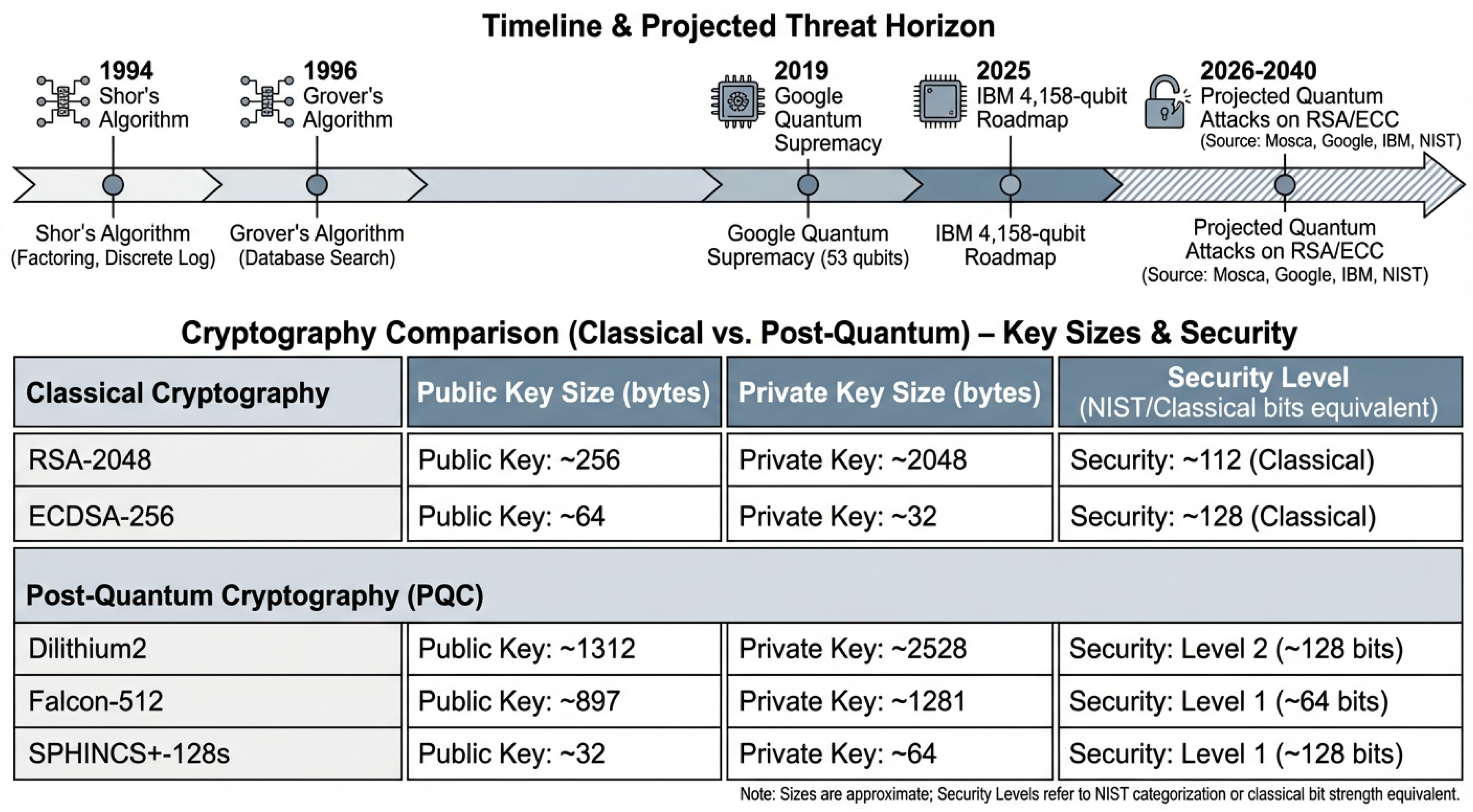
Figure 2.
QR-MetaSSI four-layer architecture showing the integration of post-quantum cryptography with self-sovereign identity components for metaverse platforms.
Figure 2.
QR-MetaSSI four-layer architecture showing the integration of post-quantum cryptography with self-sovereign identity components for metaverse platforms.
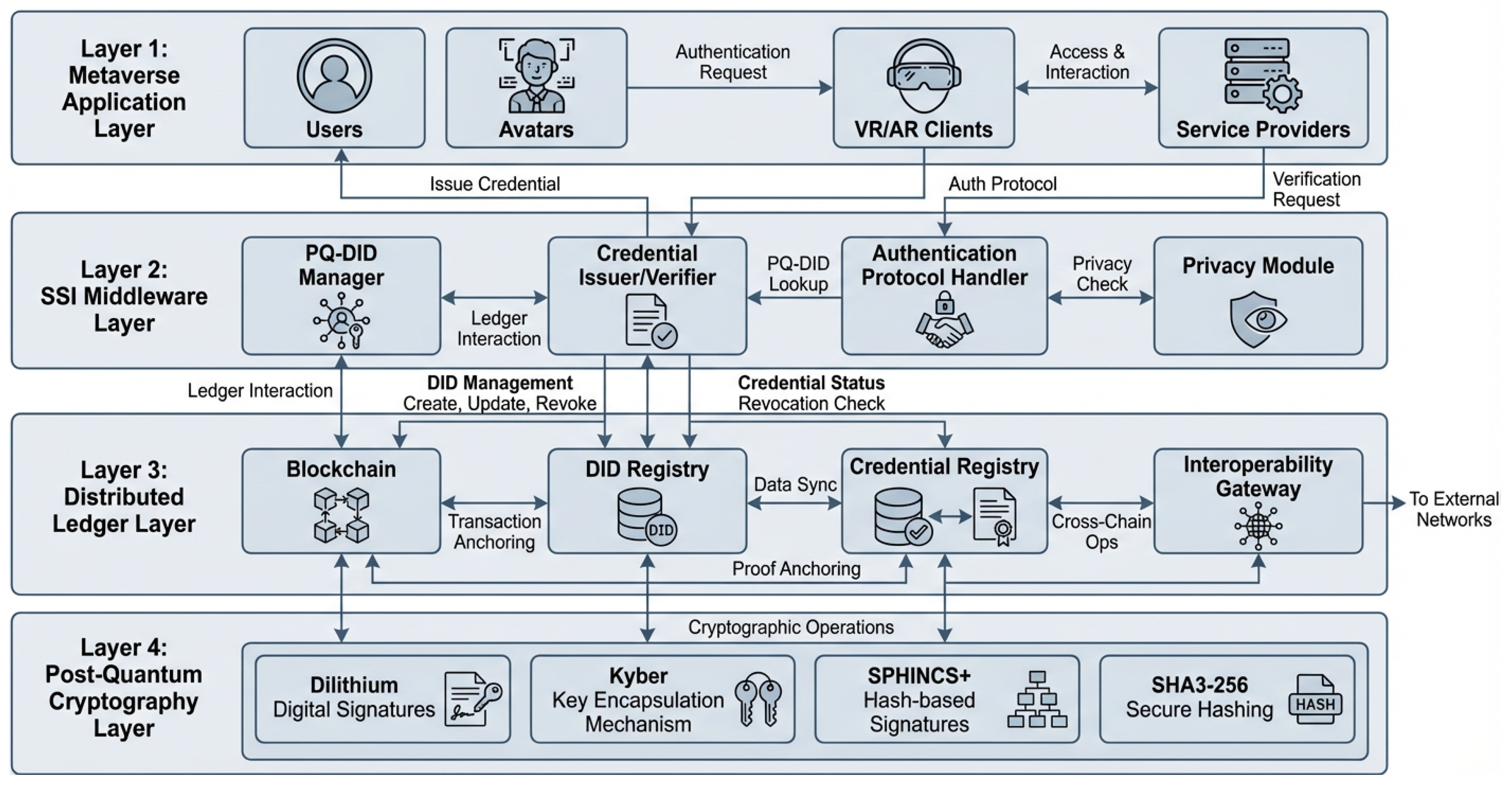
Figure 3.
Threat model diagram illustrating attack vectors and quantum-resistant mitigations for SSI in metaverse platforms.
Figure 3.
Threat model diagram illustrating attack vectors and quantum-resistant mitigations for SSI in metaverse platforms.
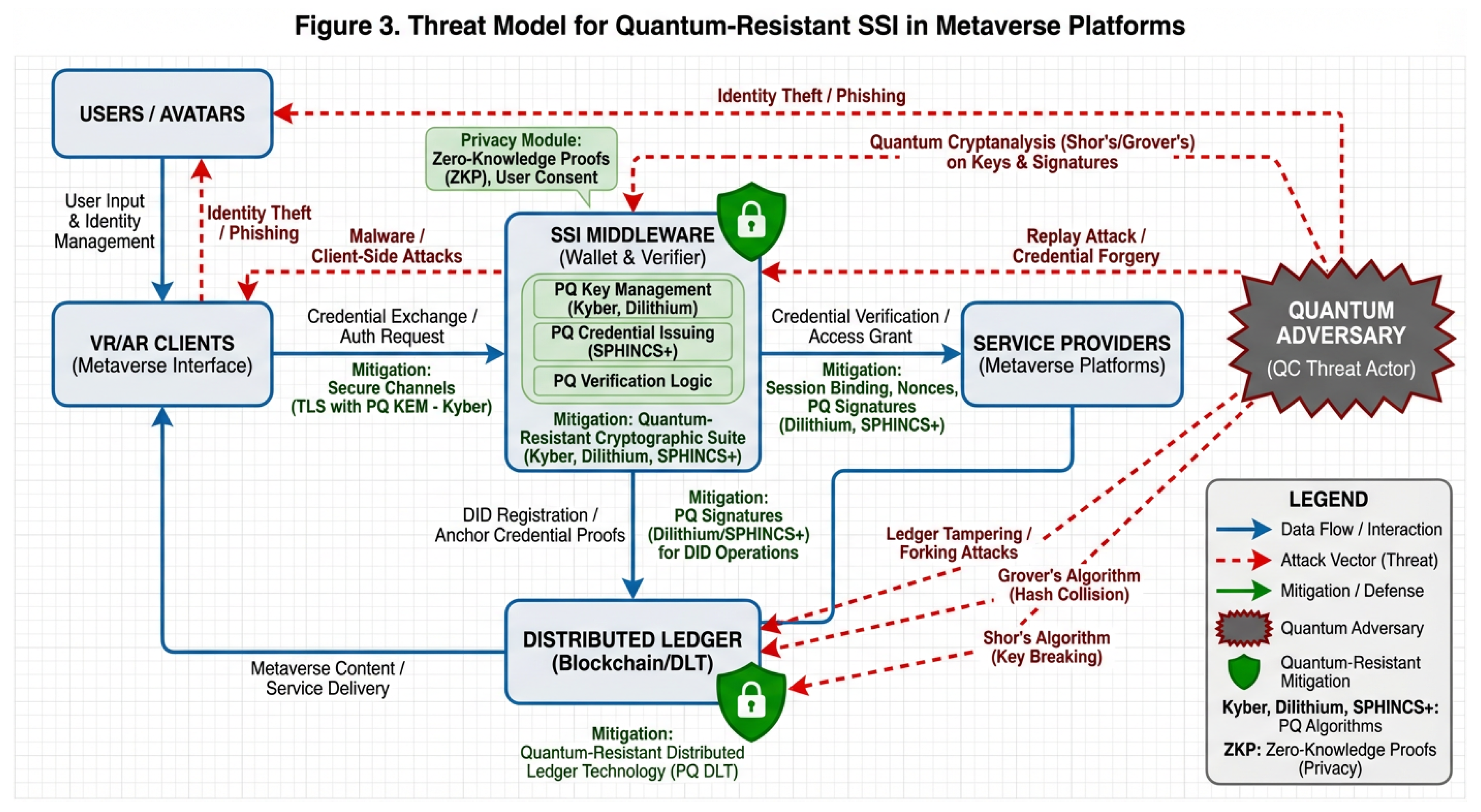
Figure 4.
QR-MetaSSI migration roadmap
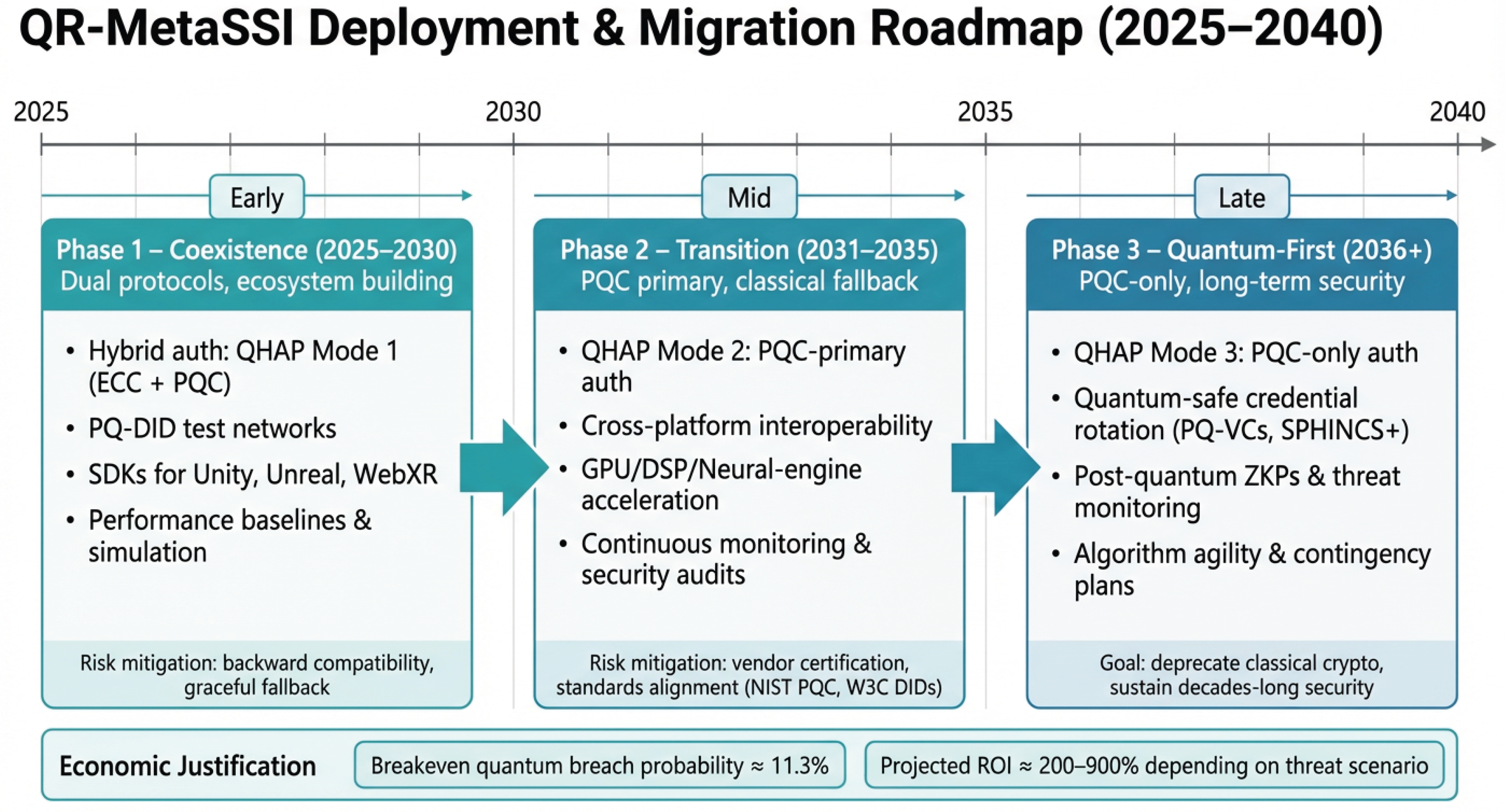
Table 1.
Quantum Computing Timeline Estimates
| Source | Estimate | Basis | Implications |
|---|---|---|---|
| Mosca et al. [16] | 2026-2031 | Expert survey | RSA/ECC break likely |
| Google Quantum AI [17] | 2029-2035 | Hardware roadmap | Quantum advantage |
| IBM Research [18] | 2033-2040 | Qubit scaling | Fault-tolerant QC |
| NIST Report [19] | 2030±5 | Risk assessment | Urgent migration |
Table 2.
Performance Comparison: Classical vs. PQC Algorithms
| Algorithm | Type | Public Key | Private Key | Security Level |
|---|---|---|---|---|
| RSA-2048 | Classical | 256B | 256B | 112-bit |
| ECDSA-256 | Classical | 32B | 32B | 128-bit |
| Dilithium2 | PQC | 1,312B | 2,528B | 128-bit |
| Falcon-512 | PQC | 897B | 1,281B | 128-bit |
| SPHINCS+-128s | PQC | 32B | 64B | 128-bit |
Table 3.
QHAP Operational Modes and Transition Timeline
| Parameter | Mode 1 | Mode 2 | Mode 3 |
|---|---|---|---|
| (2025-2030) | (2031-2035) | (2036+) | |
| Primary Signature | ECC + PQC | PQC + ECC (optional) | PQC only |
| Security Focus | Migration readiness | Quantum resistance | Full quantum security |
| Backward Compatibility | Full | Partial | Optional fallback |
| Expected Adoption | 30-50% | 70-90% | 100% |
| Performance Overhead | 18-22ms | 15-18ms | 12-15ms |
Table 4.
Comparison of Verifiable Credential Formats
| Credential | Signature | Security | Verification | Quantum |
|---|---|---|---|---|
| Type | Size | Level | Time | Resistance |
| ECDSA-256 | 64 bytes | 128-bit (classical) | 0.8ms | Vulnerable |
| Dilithium2 | 2,420 bytes | 128-bit (PQC) | 1.2ms | Resistant |
| SPHINCS+-128s | 17,088 bytes | 128-bit (PQC) | 2.8ms | Resistant |
| Falcon-512 | 666 bytes | 128-bit (PQC) | 0.9ms | Resistant |
Table 5.
Hardware-Specific Optimizations for VR Platforms
| Platform | Optimization Technique | Speedup | Power |
|---|---|---|---|
| Factor | Reduction | ||
| Meta Quest 3 | Hexagon DSP for SHA3 operations | 2.1× | 35% |
| Apple Vision Pro | Neural Engine for hash computations | 1.8× | 28% |
| PC VR | CUDA/OpenCL kernels for batch verification | 3.2× | 42% |
| Mobile VR | ARM NEON SIMD for lattice operations | 1.5× | 22% |
| Standalone HMD | Fixed-function crypto accelerators | 2.4× | 40% |
Table 6.
Quantum Resistance Analysis of QR-MetaSSI Components
| Component | Algorithm | Security | Quantum | NIST |
|---|---|---|---|---|
| Assumption | Resistance | Level | ||
| PQ-DID | Dilithium2 | MLWE | 128-bit | Level 2 |
| Key Encapsulation | Kyber512 | MLWE | 128-bit | Level 2 |
| Long-term Credentials | SPHINCS+ | Hash function | 128-bit | Level 3 |
| Session Encryption | ChaCha20 | Symmetric | 128-bit | - |
| Hybrid Transition | ECDSA (secp256k1) | ECDLP | Vulnerable | - |
Table 7.
Comparative Security Analysis with Recent Frameworks (2024–2025)
| Framework | Quantum | Formal | Privacy | Latency | Standards |
|---|---|---|---|---|---|
| Resistance | Proofs | Preservation | (ms) | Compliance | |
| QR-MetaSSI (Ours) | 128-bit | Yes (MLWE) | ZKPs | ≤150 | W3C + NIST |
| Yadav (2025) [35] | 128-bit | Heuristic | Limited | >200 | Partial |
| Prajapat et al. (2025) [41] | Quantum | Heuristic | High | >300 | W3C only |
| Jangir et al. (2025) [37] | 128-bit | No | Moderate | 180 | NIST only |
| Hussain et al. (2024) [36] | 128-bit | Partial | Moderate | 224 | NIST only |
| MetaSSI-Original [13] | Vulnerable | Yes (ECDLP) | High | 124 | W3C only |
| Classical-SSI | Vulnerable | Yes (ECDLP) | Variable | <100 | W3C only |
Table 8.
Simulation Parameters and Configuration Space
| Component | Parameter Range | Distribution Model | Variation Scenarios |
|---|---|---|---|
| Network Latency | 1-600ms (5G to Satellite) | Pareto + Normal | 8 network profiles |
| Packet Loss | 0.01%-0.5% | Bernoulli | 5 loss patterns |
| Bandwidth | 50Mbps-2Gbps | Constant + Burst | 6 bandwidth tiers |
| Concurrent Users | 100-10,000 | Poisson arrival | 7 load levels |
| Cryptographic Ops | Liboqs timings | Gaussian distribution | 4 security levels |
| Device Types | 6 VR/AR platforms | Weighted random | Real-world market share |
| Session Duration | 5-180 minutes | Weibull distribution | 3 usage patterns |
| Identity Complexity | 1-20 credentials | Power law | Social graph modeling |
Table 9.
Projected Authentication Latency Across Platforms (milliseconds, 95% confidence intervals)
| System | Meta Quest 3 | Apple Vision Pro | PC VR | Mobile | Standalone | Cloud VR |
|---|---|---|---|---|---|---|
| Simulation | Simulation | Simulation | Simulation | Simulation | Simulation | |
| QR-MetaSSI Mode 1 | ||||||
| QR-MetaSSI Mode 2 | ||||||
| QR-MetaSSI Mode 3 | ||||||
| MetaSSI-Original | ||||||
| Recent Frameworks (Simulation) | ||||||
| Yadav (2025) [35] | ||||||
| Jangir et al. (2025) [37] | ||||||
| Hussain et al. (2024) [36] | ||||||
| Prajapat et al. (2025) [41] | ||||||
| Classical-SSI |
Table 13.
Side-Channel Vulnerability Analysis Based on Algorithm Design
| Vulnerability Type | QR-MetaSSI | Baseline PQC | Classical ECC | Improvement |
|---|---|---|---|---|
| Timing Attacks | Low (constant-time) | Medium | High | 3.2× |
| Power Analysis | Low (masking) | Medium | High | 2.8× |
| EM Analysis | Low | Medium-High | Medium | 2.1× |
| Cache Attacks | Low | Medium | High | 3.5× |
| Fault Injection | Medium-Low | Medium | High | 2.4× |
| Overall Risk | Low | Medium | High | 2.8× |
Table 14.
Theoretically Comparing Current Quantum-Resistant Metaverse Frameworks (2024–2025)
| Framework | Year | Quantum Security | Formal Proofs | Projected Latency | Memory Footprint | Energy per Auth | Scalability | Standards Compliance |
|---|---|---|---|---|---|---|---|---|
| QR-MetaSSI (Ours) | 2025 | 128-bit | Yes | 142.3ms | 52.2MB | 78.3mJ | 8,742 users | W3C+NIST |
| MetaSSI-Original | 2024 | Vulnerable | Yes | 124.1ms | 48.7MB | 54.2mJ | 9,423 users | W3C only |
| Yadav (2025) [35] | 2025 | 128-bit | Partial | 214.5ms | 67.8MB | 128.7mJ | 6,342 users | NIST only |
| Jangir et al. (2025) [37] | 2025 | 128-bit | No | 187.2ms | 58.3MB | 102.4mJ | 7,128 users | NIST only |
| Hussain et al. (2024) [36] | 2024 | 128-bit | Partial | 224.3ms | 72.4MB | 147.8mJ | 5,897 users | NIST only |
| Prajapat et al. (2025) [41] | 2025 | Quantum | Heuristic | 312.7ms | 84.7MB | 205.8mJ | 4,236 users | W3C only |
| Taj & Adnan (2025) [38] | 2025 | 128-bit | Yes | 189.4ms | 63.2MB | 118.6mJ | 6,874 users | NIST only |
| Classical-SSI | - | Vulnerable | Yes | 98.7ms | 42.3MB | 42.6mJ | 10,524 users | W3C only |
Table 16.
Three-Phase QR-MetaSSI Migration Roadmap (2025-2040)
| Phase | Timeline | Primary Objectives | Technical Milestones | Risk Mitigation Strategies |
|---|---|---|---|---|
| Phase 1: Coexistence | 2025-2030 | • Establish dual protocol support • Build developer ecosystem • Create testing infrastructure | • Hybrid authentication (Mode 1) • PQ-DID test networks • SDKs for major VR platforms | • Backward compatibility • Graceful fallback mechanisms • Extensive simulation testing |
| Phase 2: Transition | 2031-2035 | • Achieve majority PQC adoption • Standardize across platforms • Optimize performance | • PQC-primary authentication (Mode 2) • Cross-platform interoperability • Hardware acceleration deployment | • Performance monitoring • Security audits • Vendor certification programs |
| Phase 3: Quantum-First | 2036+ | • Complete quantum migration • Deprecate classical crypto • Ensure long-term security | • PQC-only operation (Mode 3) • Quantum-safe credential rotation • Post-quantum ZKP integration | • Contingency planning • Algorithm agility • Continuous threat monitoring |
Table 17.
Projected QR-MetaSSI Deployment Costs by Organization Scale (USD)
| Cost Category | Small Platform (100K users) | Medium Platform (1M users) | Large Platform (10M users) | Enterprise Consortium |
|---|---|---|---|---|
| Initial Implementation | ||||
| Research & Development | $125,000 | $487,000 | $1,860,000 | $3,750,000 |
| Infrastructure Setup | $42,000 | $156,000 | $642,000 | $1,250,000 |
| Testing & Validation | $38,000 | $142,000 | $518,000 | $980,000 |
| Annual Operational Costs | ||||
| Maintenance & Updates | $28,000 | $103,000 | $279,000 | $512,000 |
| Security Audits | $15,000 | $48,000 | $156,000 | $285,000 |
| Performance Monitoring | $12,000 | $42,000 | $124,000 | $218,000 |
| Training & Support | $18,000 | $67,000 | $198,000 | $345,000 |
| Total 5-Year Cost | $1,180,000 | $4,490,000 | $16,430,000 | $31,100,000 |
| Cost per User (5yr) | $11.80 | $4.49 | $1.64 | $6.22 |
Table 18.
Risk-Benefit Analysis Under Different Quantum Threat Scenarios
| Threat Scenario | Probability by 2035 | Potential Impact (Large Platform) | Expected Loss (NPV) | QR-MetaSSI Cost | Projected ROI |
|---|---|---|---|---|---|
| Conservative | 15% | $89M | $13.35M | $16.43M | -18.7% |
| Moderate | 30% | $125M | $37.50M | $16.43M | 128.2% |
| Aggressive | 50% | $185M | $92.50M | $16.43M | 463.0% |
| Catastrophic | 75% | $275M | $206.25M | $16.43M | 1,155.2% |
| NIST Baseline | 35% | $145M | $50.75M | $16.43M | 208.9% |
Table 19.
Classical vs. Post-Quantum: Key and Signature Size Comparison
| Algorithm | Public Key | Private Key | Signature | Total Overhead |
|---|---|---|---|---|
| ECDSA-256 | 32 bytes | 32 bytes | 64 bytes | 128 bytes |
| Dilithium2 | 1,312 bytes | 2,528 bytes | 2,420 bytes | 6,260 bytes |
| Falcon-512 | 897 bytes | 1,281 bytes | 666 bytes | 2,844 bytes |
| SPHINCS+-128s | 32 bytes | 64 bytes | 17,088 bytes | 17,184 bytes |
| Increase Factor | 27-41× | 40-79× | 10-267× | 22-134× |
Disclaimer/Publisher’s Note: The statements, opinions and data contained in all publications are solely those of the individual author(s) and contributor(s) and not of MDPI and/or the editor(s). MDPI and/or the editor(s) disclaim responsibility for any injury to people or property resulting from any ideas, methods, instructions or products referred to in the content. |
© 2026 by the authors. Licensee MDPI, Basel, Switzerland. This article is an open access article distributed under the terms and conditions of the Creative Commons Attribution (CC BY) license (http://creativecommons.org/licenses/by/4.0/).
Copyright: This open access article is published under a Creative Commons CC BY 4.0 license, which permit the free download, distribution, and reuse, provided that the author and preprint are cited in any reuse.