

Submitted:
14 January 2026
Posted:
15 January 2026
You are already at the latest version
Abstract
Background/Objectives: There are limited data on the dynamic changes in daily composition of movement behaviors (sleep, moderate to vigorous physical activity; MVPA, light physical activity; LPA, and sedentary time; SED) and their associations with body weight in postpartum women. The purpose of this study was to examine associations of reallocating time in one behavior to an-other with body weight at different times in the first year postpartum. Methods: The study included 86 women who delivered a singleton infant at ≥ 37 weeks gestation. Physical activity and sleep were measured via actigraphy in early, mid, and late postpartum. Body weight was measured at each timepoint. Isotemporal substitution models were used to examine the association of reallocating ten minutes of one behavior (MVPA, LPA, SED, or sleep) to another on body weight. Results: Participants spent most of their day in SED (~52-53%), followed by sleep (~30%), LPA (~12-13%), and then MVPA (~2%) throughout the first year postpartum. In early and mid-postpartum, but not late postpartum, reallocating 10 minutes of MVPA to LPA, SED, or sleep was associated with lower body weight (Range: 3.07-4.03 kg lower). In early and late postpartum, reallocating 10 minutes of SED to LPA was associated with a lower body weight (4.03kg and 1.04kg, respectively). In participants who slept ≥ 7 hours per day, reallocating sleep to LPA in early postpartum, and MVPA time to LPA in mid postpartum was associated with lower body weight. In those who slept < 7 hours, no significant associations with body weight were found when reallocating time from one behavior to another. Conclusions: Encouraging LPA throughout the post-partum period may be beneficial for weight loss and having enough sleep may be especially important for early to mid-postpartum. Future research examining the impact of changes in LPA on body weight in the postpartum period are needed along with postpartum specific 24h-hour movement guidelines.
Keywords:
twenty-four-hour movement behaviors
; sleep
; physical activity
; postpartum
1. Introduction
In a 24-hour day, individuals can partake in four main types of movement behaviors: sedentary behavior (SED), light physical activity (LPA), moderate to vigorous physical activity (MVPA), and sleeping. These four behaviors have individually been associated with changes in body weight and obesity [1,2,3]. However, increasing time spent in one behavior will displace time spent in another behavior, making it important to examine all four behaviors together in the 24-hour activity cycle (24-HAC) [4]. Countries, such as Canada, have implemented 24-hour movement guidelines [5] . For adults, they recommend less than 8 hours of sedentary behavior a day, ≥150 minutes of moderate to vigorous physical activity a week, sleeping 7-9 hours a night, and several hours of light physical activity.
In the postpartum period, women experience changes and new barriers to physical activity, such as caring for an infant, that may affect time spent in each of the 24-HAC behaviors [6]. There is evidence of changes in time spent in SED, LPA, MVPA, and sleeping during the postpartum period, but there have been limited studies that examine all four behaviors during the postpartum period [7,8,9,10,11,12]. Since the behaviors of the 24-HAC are related to health outcomes, examining the 24-HAC in postpartum women will give insight into how women are spending their day throughout the postpartum period and if there are potential areas to intervene in order to improve health outcomes.
Additionally, many women are not returning to their pre-pregnancy weight within the first year postpartum, which may put them at risk for obesity in the future [13,14,15,16]. Physical activity and sleep duration have been associated with weight changes in the postpartum period. One study found higher levels of LPA and total physical activity levels at 3 months postpartum were associated with lower postpartum weight retention at 6 and 12 months postpartum [17]. Short sleep duration during the postpartum period has been associated with greater adiposity and weight retention [18,19]. In adult and adolescent populations, the composition of the 24-HAC has been associated with body weight outcomes [20,21]. However, no study has examined the associations of reallocating time from one behavior in the 24-HAC to another behavior with changes in body weight in postpartum women. Since the postpartum period can be a time of body weight change, examining the associations of reallocating behaviors of the 24-HAC with body weight may provide insight into what behaviors provide the greatest benefit for reducing weight retention. The purpose of this study is to examine the associations of reallocating time spent in one of the 24-HAC behaviors to another 24-HAC behavior with body weight during first year postpartum.
2. Results
2.1. Participant Characteristics
Eighty-six participants had valid sleep and activity data at early, mid and late postpartum. At the mid timepoint, 4 participants had data from 4 months postpartum and 82 had data from 6 months postpartum. At the late timepoint, 17 participants had data from 9 months postpartum, and 69 participants had data from 12 months postpartum. Participant characteristics are displayed in Table 1.
2.2. Time Allocation in Each Behavior
The percentage of time spent in sedentary time, LPA, MVPA, and sleep is displayed in Table 2. At all three timepoints, SED accounted for 51-52% of 24 hours, followed by sleep which accounted for approximately 30%. LPA accounted for 12-13% and MVPA accounted for the smallest proportion of approximately 2%. The number of participants meeting the Canadian 24-hour movement guidelines at each timepoint are displayed in Table 3. At the early and mid-timepoints, no participants met all Canadian 24-hour movement guidelines. During late postpartum, one participant met all three Canadian 24-hour movement guidelines.
2.3. Cross-Sectional Isotemporal Substitution Models (ISM) by Timepoint
Results from the cross-sectional ISM are displayed in Figure 1. The reallocations are symmetrical (for example: reallocating time from sleep to LPA or LPA to sleep will result in the same estimate, but in the opposite direction), therefore only one direction of the reallocation is displayed in the figure.
2.3.1. Early Postpartum
In early postpartum, reallocating 10 minutes of MVPA, SED, or sleep to LPA was associated with a 4.6kg, 1.3kg, and 1.5kg lower body weight (95% Confidence Interval (CI): -7.9, -1.3, p=0.0064; CI: -2.5, -0.07, p=0.0387; CI: -2.5, -0.4, p=0.0058, respectively). Reallocating 10 minutes of LPA, SED, or sleep to MVPA was associated with a 4.6kg, 3.4kg, and 3.2kg higher body weight (CI: 1.3, 7.9, p=0.0064; CI: 0.7, 6.0, p=0.014; CI: 0.4, 5.9, p=0.0238). Reallocating 10 minutes of LPA or MVPA to SED was associated with a 1.3kg higher or 3.4kg lower body weight (CI: 0.06, 2.5, p=0.0387; CI: -6.0, -0.7, p=0.014). Lastly, reallocating LPA or MVPA to sleep was associated with a 1.4kg higher and 3.2kg lower body weight (CI: 0.4, 2.5, p=0.0058; CI: -5.9, -0.4, p=0.0238), respectively.
2.3.2. Mid Postpartum
In mid-postpartum, reallocating 10 minutes of MVPA or SED to LPA was associated with a 4.8kg and 1.1kg lower body weight (CI: -8.5, -1.1, p=0.0185; CI: -2.2, -0.06, p=0.039). Reallocating 10 minutes of LPA, SED, or sleep to MVPA was associated with a 4.8kg, 3.6kg, and 3.9kg higher body weight (CI: 1.1, 8.5, p=0.0113; CI: 0.5, 6.8, p=0.0256; CI: 0.7, 7.1, p=0.0185). Reallocating 10 minutes of LPA or MVPA to SED was associated with a 1.1kg higher and 3.6kg lower body weight (CI: 0.06, 2.2, p=0.039; -6.8, -0.5, p=0.0256). Lastly, reallocating 10 minutes of MVPA to sleep was associated with a 3.9kg lower body weight (CI: -7.1, -0.7, p=0.0185).
2.3.3. Late Postpartum
In late postpartum, reallocating 10 minutes of SED to LPA was associated with a 1.1kg lower body weight (CI: -2.1, -0.08, p=0.0353) and conversely, reallocating 10 minutes of LPA to SED was associated with a 1.1kg higher body weight (CI: 0.08, 2.1, p=0.0353).
2.3.4. Isotemporal Substitution Models (ISM) with Physical Activity
Due to limitations with using cut points to determine LPA and MVPA from actigraphy we also examined the ISMs using a combined physical activity (PA) variable. However, when only PA, SED, and sleep were in the models, there were no significant associations when reallocating time from one behavior to another.
2.3.5. Isotemporal Substitution Models (ISM) for Short and Normal Sleep Duration
It is recommended that adults sleep 7-9 hours per day for optimal health [31]. Therefore, we ran additional ISMs in participants who slept <7 hours per day and those who slept ≥7 hours. The number of short sleepers (<7 hours per day) was 35 in early, 38 in mid, and 33 in late postpartum. In short sleepers, there were no significant associations when reallocating time from one behavior to another.
For participants with normal sleep durations (≥ 7 hours per day), results are displayed in Figure 2. In early postpartum, reallocating 10 minutes of sleep to LPA was associated with a 2.0kg lower body weight (CI: -3.4, -0.6, p=0.0058). In mid postpartum, reallocating 10 minutes of LPA or SED to MVPA was associated with a 5.2kg and 4.7kg higher body weight (CI: 0.6, 9.8, p=0.029; CI: 0.4, 9.0, p=0.0315), respectively. There were no significant associations during late postpartum.
3. Discussion
This study provides objectively measured descriptive data on the behaviors comprising the 24-HAC over the first year postpartum and the associations of reallocating behaviors with body weight. To our knowledge, this is the first study to examine the associations of reallocating 24-HAC behaviors with body weight at different timepoints in the postpartum period.
Throughout the postpartum period, participants spent over half their day in SED, ~30% of their day sleeping, ~ 12-13% in LPA, and ~2% MVPA. Recently, Canadian guidelines for physical activity, sedentary behavior, and sleep throughout the first year postpartum were published [32]. These guidelines provide recommendations for engaging in physical activity by gradually increasing physical activity levels based on healing and contraindications and recommend at least 120 minutes of MVPA a week. However, there are yet to be optimal sleep time and LPA recommendations for the postpartum period, so we will compare the results of our participants to the Canadian 24-hour movement guidelines.
Considering the Canadian 24-hour movement guidelines, a little over half the participants met the guideline for sleeping 7-9 hours a night at each timepoint, the majority of participants met the guidelines for 150 minutes of MVPA per week, but no participants met the guidelines for <8 hours of sedentary behavior in early and mid-postpartum [5]. Only two participants met the sedentary time guideline during late postpartum. This highlights that decreasing sedentary behavior may be an area to target for future interventions. Additionally, only one participant met all three guidelines during late postpartum. While this emphasizes room for improvement in meeting the guidelines, it is also important to point out that these guidelines are for the general adult population. More research is needed to determine optimal sleep duration and the impact of LPA during the postpartum period to develop postpartum specific 24-hour movement behavior guidelines [32].
The findings from this analysis suggest increasing time in LPA may be beneficial for weight maintenance or loss during the postpartum period. Reallocating time from MVPA to LPA during early and mid- postpartum and reallocating time from SED to LPA during early, mid, and late-postpartum were all associated with lower body weight. Another study found similar results in overweight and obese adults where reallocating SED to LPA was associated with a lower waist circumference [33]. Furthermore, a study in postpartum women previously found higher levels of total PA and LPA in early postpartum was associated with less postpartum weight retention at one year postpartum [17].
Nevertheless, our results for MVPA are intriguing. The average MVPA in our study was approximately 175, 191, and 232 minutes per week at early, mid, and late postpartum. This is above the recommended minimum of 150 minutes MVPA per week for the general poplulation. Reallocating time from LPA, SED, and sleep to MVPA were all associated with a higher body weight in early and mid-postpartum, but not late postpartum. A systematic review of studies in adult populations found reallocating time to MVPA to be associated with lower body mass index, waist circumference, and body fat percentage [34]. However, the direction of the association with MVPA and body weight are in our results are unclear. There may be behavioral changes leading to changes in physical activity and body weight that were unmeasured. For example, an individual who has lost less weight during postpartum may be more likely to participate in MVPA. Additionally, there is evidence total daily energy expenditure does not increase equally with an increase in physical activity energy expenditure [35,36]. Some individuals may participate in more sedentary behavior after participating in exercise, leading to a lower non-physical activity energy expenditure, and potentially impacting body weight. Nevertheless, MVPA is likely beneficial for other health outcomes, and as the Canadian postpartum guidelines recommend, women who return to exercise withing 12 weeks after delivering have are likely to experience psychological benefits, improved sleep quality, and cardiometabolic benefits [32]. Our results suggest that the influence of MVPA on weight may be changing over time during the postpartum period and that additional MVPA in this population who already had spent an average of 175-232 minutes per week on MVPA is unlikely to lead to greater weight loss.
Interestingly, different results were found for individuals whose sleep was <7 hours versus those ≥7 hours a night. In those sleeping <7 hours a day, no significant association with weight was found for any reallocation of time. In those sleeping ≥7 hours a night, reallocating LPA or SED to MVPA in mid-postpartum was associated with higher body weights, and reallocating sleep to LPA in early postpartum was associated with lower body weight. This may indicate that achieving the recommended 7-9 hours of sleep a day is needed for reallocation of the other behaviors to impact body weight. There is also evidence that the time-of-day MVPA is performed can impact sleep outcomes [37]. Examining when MVPA is performed in relation to sleeping and if sleep time is being shortened in order to participate in MVPA is needed to better understand the relationship between sleep and MVPA in the postpartum period. More research in a larger sample of postpartum women is necessary to examine if this finding is transient and specific to the postpartum period.
Additionally, there are not validated cut points for physical activity in postpartum women. We used the Troiano et al., [24] cut points, which have been validated in adults and used previously in postpartum women. However, studies that have compared different physical activity cut points in postpartum women have found large differences in the amount of MVPA and LPA depending on what cut points were used [8,11,38]. Using different physical activity cut points may impact the results of this study. However, our results indicate that the time allocated to LPA and MVPA does matter.
Currently, the physical activity guidelines for the postpartum period are not specific to timing after delivery. These results demonstrate a need to further investigate the behaviors of the 24-HAC specifically during the postpartum period to develop guidelines for optimal health. It may be difficult for women to achieve the recommended sleep guidelines during postpartum since short sleep may be due to the infant’s sleep pattern, but providing specific SED, LPA, and MVPA guidelines may be beneficial to improve health outcomes in mothers. The results from the ISM models suggest engaging in LPA and reducing SED may be beneficial for weight loss during early and mid, and late postpartum. Additionally, since many participants were spending greater than 50% of their day sedentary, replacing SED with LPA may be a potential area to intervene.
The strengths of this study include objective assessment of the 24-HAC in a cohort of women from 6-8 weeks to 12 months postpartum. Previous ISM literature has not included objectively measured sleep in their analyses [34], making the inclusion of objectively determined sleep a major strength of the study. While the inclusion of actigraphy is a strength of this study, actigraphy does have limitations. For sleep measures, actigraphy has low specificity in detecting wakefulness during the sleep period and may overestimate total sleep time [39,40]. There is also evidence actigraphy is better at classifying MVPA than LPA [41]. Furthermore, while participants were instructed to wear the Actiwatch all day and night and the Actigraph during waking hours, some participants had non-wear time and therefore their total time in all four behaviors did not equal 24 hours. It is unknown what behaviors participants were partaking in when the actigraphs were removed. As discussed earlier, there are not validated cut points for physical activity in postpartum women and use of different cut points could impact the results of this study.
Additionally, results of our study should be interpreted with caution as this was in a small sample of postpartum women and an exploratory analysis. Replication of these findings in a larger sample is needed as our results could be influenced by the small sample size. Additionally, our sample may not be generalizable to other postpartum populations. Lastly, ISM findings are not a true temporal substitution and may represent more population level changes in behavior [42].
4. Materials and Methods
4.1. Participants and Study Design
Data are from a prospective cohort study that examined trajectories of body weight, body fat, and sleep parameters in Black and White women from 6-8 weeks to 12 months postpartum [12,22]. Women were from the Columbia metropolitan area in South Carolina and were recruited from October 2018 – January 2020. Measures took place during early (6-8 weeks), mid (6 months), and late postpartum (12 months). If participants did not have 6- or 12-month data available 4- or 9-month data was used, if available, respectively. The inclusion criteria for the study included women ≥ 18 years of age, delivered a singleton infant at ≥ 37 weeks gestation, self-identified as Black or White, and were providing care for the infant [11]. Women were excluded if they self-reported diseases or medications that may affect body weight or sleep, such as thyroid disease, diabetes, sleep apnea, clinical depression, and the use of the contraceptive Depo-Provera. The study protocol was approved by the Institutional Review Board of the University of South Carolina – Columbia, SC (Pro00076434). All participants signed an informed consent form prior to participation.
4.2. Measurements
4.2.1. Physical Activity and Sedentary Behavior
Activity was objectively measured using actigraphy (GT3X+; Actigraph, Pensacola, FL, USA). At each timepoint participants were instructed to wear the GT3X+ on their hip for 7 days. Participants removed the monitor for sleep and water activities and were instructed to record when the monitor was removed and put back on. Data were collected at a sampling rate of 30Hz in 10 second epochs and were analyzed in the manufacturer provided software (ActiLife software version 6.13.4). Non-wear time was excluded using the Choi algorithm available in ActiLife which defines 90 consecutive minutes of zero counts as non-wear [23]. A valid day of wear time was defined as 600 or more minutes of accumulative wear [24]. Sedentary behavior, LPA, and MVPA were determined using the Troiano et al. [24] cut points as follows: Sedentary 0 - 99, Light 100 - 2019, Moderate 2020-5998, and Vigorous > 5999 counts per minute. At least 3 valid days of wear time were required [25] to be included in this analysis.
4.2.2. Total Sleep Time
A different Actigraphic monitor was used to measure total sleep time in a 24-hour period (Actiwatch Spectrum Plus: Phillips Respironics; Bend, OR, USA). Participants were instructed to wear the monitor on their nondominant wrist for 7 days (same as activity monitor) at each timepoint and were instructed to only remove it for activities in salt-water. The Actiwatch has a small event marker button that participants were instructed to press when they were trying to fall asleep and when they woke up. Participants were also instructed to fill out a daily sleep log during the same 7 days. Participants recorded the time they got into bed, time trying to sleep, time waking up, time out of bed, and nap times. The manufacturer’s software (Philips Actiware 6) was used to analyze the actigraphy data in 30-second epochs. A standardized approach using a hierarchical ranking of inputs was used to determine time in bed [event markers, sleep diary, light intensity, and activity counts] [26,27]. Rest intervals for naps were created if a diary or event marker indicated an attempt to sleep by the participant and minor rest intervals were auto calculated by the software to catch potential naps not recorded by the event markers or sleep log. The minimum rest interval size was set to 15 minutes with high sensitivity. Once time in bed was determined, the software provided total sleep time. All sleep bouts that occurred in a 24-hour period, including the nighttime sleep interval and naps, were included in total sleep time. Participants with at least 3 nights of wear were required to be included in the analysis, as previous research has found 3 nights of sleep are needed when examining means of characteristics [28].
4.2.3. Body Weight
Body weight was measured at each timepoint using a calibrated digital scale (Health O Meter® Professional, Pelstar LLC, McCook, IL, USA). Women wore standard scrubs and were without shoes. Weight was taken two times and measured to the nearest 0.1 kg. If the two measurements varied by more than 0.1 kg a third measure was taken. The average of the two weights, if different, were used for analysis
4.2.4. Statistical Analysis
Descriptive statistics, such as means, standard deviations, and proportions were calculated. Daily means for each behavior (SED, LPA, MVPA, and sleep) were divided by 24 hours to calculate the percentage of time spent in that behavior in a 24-hour day at early, mid- and late-postpartum. To examine the associations of body weight with reallocating time from one behavior to another, isotemporal substitution models (ISM) were performed. The ISM includes a variable for total time, which equals the amount of time spent in Sleep (total sleep time) + SED + LPA + MVPA, which is roughly 24 hours for each individual [29]. An example of an ISM for when SED is omitted is below:
Body Weight = (β1) Sleep + (β2) LPA + (β3) MVPA + (β4) Total Time + ε
In this model with SED removed, the influence of SED is distributed to other behaviors. Thus, the coefficients for the other behaviors represent the effect of reallocating 1 minute of that behavior in place of SED with all other variables held constant. ISMs were performed for early, mid, and late postpartum with sleep, SED, LPA, and MVPA as independent variables in the model. Additional models were run with MVPA and LPA combined into a total physical activity variable in the model. All models were adjusted for age, race, parity, and wake after sleep onset (in minutes). It is recommended to adjust for wake after sleep onset when examining the 24-HAC because wake after sleep onset is different from daytime sedentary or activity behavior, it is not a behavior one chooses to partake in but is a component of the 24-hour day [30]. ISM results are displayed in 10-minute reallocations. Statistical significance was set to p < 0.05 and all analyses were performed in SAS 9.4 (SAS institute Inc., Cary, NC).
5. Conclusions
In conclusion, when comparing to the Canadian 24-hour Movement Guidelines, postpartum women in this sample had much higher SED than recommended. Throughout postpartum, reallocating time to LPA and reducing SED may be beneficial for weight maintenance or loss. However, the relative importance of the 24-HAC behaviors may change throughout the first year postpartum. Sleeping more than 7 hours may be especially important in early to mid-postpartum. Future research examining the associations of the 24-HAC with health outcomes and development of guidelines more specific to duration after childbirth is needed.
Author Contributions
Conceptualization, E.E.K. and X.W.; Methodology, E.E.K. and X.W.; Formal analysis, E.E.K.; Investigation, E.E.K. and X.W.; Resources, X.W.; Data curation, E.E.K. and X.W.; Writing – original draft, Erin Elizabeth Kishman; Writing – review & editing, E.E.K., S.D.Y. and X.W.; Visualization, E.E.K. and X.W.; Supervision, X.W.; Project administration, E.E.K. and X.W.; Funding acquisition, S.D.Y. and X.W. All authors have read and agreed to the published version of the manuscript.”.
Funding
This research was funded by the National Institute on Minority Health and Health Disparities of the National Institutes of Health under award number R21MD012740.
Institutional Review Board Statement
The study was conducted according to the guidelines of the Declaration of Helsinki and approved by the University of South Carolina Institutional Review Board (Protocol number: Pro00076434, approved on 25 April 2018).
Informed Consent Statement
Informed consent was obtained from all subjects involved in the study.
Data Availability Statement
Data sharing is available upon reasonable written request to the corresponding author and execution of a data sharing agreement.
Acknowledgments
We thank the research staff, clinic staff, and administrators for their assistance in the recruitment of participants and data collection.
Conflicts of Interest
The authors declare no conflicts of interest.
References
- Patel, SR; Hu, FB. Short sleep duration and weight gain: a systematic review. Obesity (Silver Spring) 2008, 16(3), 643–653. [Google Scholar] [CrossRef]
- Schmitz, K; Jacobs, D; Leon, A; Schreiner, P; Sternfeld, B. Physical activity and body weight: associations over ten years in the CARDIA study. International journal of obesity 2000, 24(11), 1475–1487. [Google Scholar] [CrossRef]
- Silveira, EA; et al. Sedentary behavior, physical inactivity, abdominal obesity and obesity in adults and older adults: A systematic review and meta-analysis. Clinical nutrition ESPEN 2022, 50, 63–73. [Google Scholar] [CrossRef]
- Rosenberger, ME; et al. The 24-Hour Activity Cycle: A New Paradigm for Physical Activity. Med Sci Sports Exerc. 2019, 51(3), 454–464. [Google Scholar] [CrossRef]
- Ross, R; et al. Canadian 24-Hour Movement Guidelines for Adults aged 18–64 years and Adults aged 65 years or older: an integration of physical activity, sedentary behaviour, and sleep. Applied Physiology, Nutrition, and Metabolism 2020, 45(10), S57–S102. [Google Scholar] [CrossRef]
- Saligheh, M; McNamara, B; Rooney, R. Perceived barriers and enablers of physical activity in postpartum women: a qualitative approach. BMC Pregnancy Childbirth 2016, 16(1), 1–8. [Google Scholar] [CrossRef]
- Evenson, KR; Brouwer, RJ; Østbye, T. Changes in physical activity among postpartum overweight and obese women: results from the KAN-DO study. Women & health 2013, 53(3), 317–334. [Google Scholar]
- Hesketh, KR; Evenson, KR; Stroo, M; Clancy, SM; Østbye, T; Benjamin-Neelon, SE. Physical activity and sedentary behavior during pregnancy and postpartum, measured using hip and wrist-worn accelerometers. Preventive medicine reports 2018, 10, 337–345. [Google Scholar] [CrossRef]
- Kang, MJ; Matsumoto, K; Shinkoda, H; Mishima, M; Seo, YJ. Longitudinal study for sleep-wake behaviours of mothers from pre-partum to post-partum using actigraph and sleep logs. Psychiatry and Clinical Neurosciences 2002, 56(3), 251–252. [Google Scholar] [CrossRef] [PubMed]
- Kracht, CL; et al. Maternal 24-h movement patterns across pregnancy and postpartum: The LIFE-Moms consortium. Preventive Medicine Reports 2024, 42, 102740. [Google Scholar] [CrossRef] [PubMed]
- Kishman, EE; Castleberry, LA; Wang, X. Physical Activity Participation of Black and White Women during the First Year Postpartum: Results and Study Recruitment Strategies. Healthcare 2023, 11(19), 2625. [Google Scholar] [CrossRef]
- Kishman, EE; Liu, J; Youngstedt, SD; Yang, C-H; Armstrong, B; Wang, X. Sleep characteristics during the first year postpartum in a cohort of Black and White women. Sleep epidemiology 2024, 4, 100096. [Google Scholar] [CrossRef] [PubMed]
- Endres, LK; et al. Postpartum weight retention risk factors and relationship to obesity at one year. Obstet Gynecol. 2015, 125(1), 144. [Google Scholar] [CrossRef] [PubMed]
- Kirkegaard, H; Stovring, H; Rasmussen, KM; Abrams, B; Sørensen, TIA; Nohr, EA. How do pregnancy-related weight changes and breastfeeding relate to maternal weight and BMI-adjusted waist circumference 7 y after delivery? Results from a path analysis. Am J Clin Nutr. 2014, 99(2), 312–319. [Google Scholar] [CrossRef] [PubMed]
- Linné, Y; Dye, L; Barkeling, B; Rössner, S. Long-term weight development in women: a 15-year follow-up of the effects of pregnancy. Obesity research 2004, 12(7), 1166–1178. [Google Scholar] [CrossRef]
- Michel, S; Raab, R; Drabsch, T; Guenther, J; Stecher, L; Hauner, H. Do lifestyle interventions during pregnancy have the potential to reduce long-term postpartum weight retention? A systematic review and meta-analysis. Obesity Reviews 2019, 20(4), 527–542. [Google Scholar] [CrossRef]
- Ha, AVV; et al. Postpartum physical activity and weight retention within one year: A prospective cohort study in Vietnam. International journal of environmental research and public health 2020, 17(3), 1105. [Google Scholar] [CrossRef]
- Gunderson, EP; et al. Association of fewer hours of sleep at 6 months postpartum with substantial weight retention at 1 year postpartum. Am J Epidemiol. 2008, 167(2), 178–187. [Google Scholar] [CrossRef]
- Taveras, EM; Rifas-Shiman, SL; Rich-Edwards, JW; Gunderson, EP; Stuebe, AM; Mantzoros, CS. Association of maternal short sleep duration with adiposity and cardiometabolic status at 3 years postpartum. Obesity (Silver Spring) 2011, 19(1), 171–178. [Google Scholar] [CrossRef]
- Cabanas-Sánchez, V; et al. Twenty four-hour activity cycle in older adults using wrist-worn accelerometers: The seniors-ENRICA-2 study. Scandinavian Journal of Medicine & Science in Sports 2020, 30(4), 700–708. [Google Scholar]
- Carson, V; Tremblay, MS; Chaput, J-P; Chastin, SFM. Associations between sleep duration, sedentary time, physical activity, and health indicators among Canadian children and youth using compositional analyses. Appl Physiol Nutr Metab. 2016, 41((6) Suppl 3, S294–302. [Google Scholar] [CrossRef]
- Wang, X; et al. Body weight and fat trajectories of Black and White women in the first postpartum year. Obesity 2023. [Google Scholar] [CrossRef]
- Choi, L; Liu, Z; Matthews, CE; Buchowski, MS. Validation of accelerometer wear and nonwear time classification algorithm. Med Sci Sports Exerc. 2011, 43(2), 357. [Google Scholar] [CrossRef]
- Troiano, RP; Berrigan, D; Dodd, KW; Masse, LC; Tilert, T; McDowell, M. Physical activity in the United States measured by accelerometer. Med Sci Sports Exerc. 2008, 40(1), 181. [Google Scholar] [CrossRef]
- Trost, SG; Mciver, KL; Pate, RR. Conducting accelerometer-based activity assessments in field-based research. Medicine & science in sports & exercise 2005, 37(11), S531–S543. [Google Scholar]
- Patel, SR; et al. Reproducibility of a Standardized Actigraphy Scoring Algorithm for Sleep in a US Hispanic/Latino Population. Sleep. 2015, 38(9), 1497–1503. [Google Scholar] [CrossRef] [PubMed]
- Ancoli-Israel, S; et al. The SBSM Guide to Actigraphy Monitoring: Clinical and Research Applications. Behavioral Sleep Medicine 2015, 13, S4–S38. [Google Scholar] [CrossRef]
- Rowe, M; et al. Actigraphy in older adults: comparison of means and variability of three different aggregates of measurement. Behavioral sleep medicine 2008, 6(2), 127–145. [Google Scholar] [CrossRef] [PubMed]
- Mekary, RA; Willett, WC; Hu, FB; Ding, EL. Isotemporal substitution paradigm for physical activity epidemiology and weight change. Am J Epidemiol. 2009, 170(4), 519–527. [Google Scholar] [CrossRef] [PubMed]
- Sabia, S; Yerramalla, MS; Liu-Ambrose, T. Importance of characterising sleep breaks within the 24-h movement behaviour framework. International Journal of Behavioral Nutrition and Physical Activity 2022, 19(1), 1–4. [Google Scholar] [CrossRef]
- Hirshkowitz, M; et al. National Sleep Foundation’s updated sleep duration recommendations: final report. Sleep Health 2015, 1(4), 233–243. [Google Scholar] [CrossRef]
- Davenport, MH; et al. 2025 Canadian guideline for physical activity, sedentary behaviour and sleep throughout the first year post partum. British Journal of Sports Medicine 2025, 59(8), 515–526. [Google Scholar] [CrossRef]
- Healy, GN; Winkler, EA; Brakenridge, CL; Reeves, MM; Eakin, EG. Accelerometer-derived sedentary and physical activity time in overweight/obese adults with type 2 diabetes: cross-sectional associations with cardiometabolic biomarkers. PLoS One 2015, 10(3), e0119140. [Google Scholar] [CrossRef]
- Grgic, J; et al. Health outcomes associated with reallocations of time between sleep, sedentary behaviour, and physical activity: a systematic scoping review of isotemporal substitution studies. International Journal of Behavioral Nutrition and Physical Activity 2018, 15(1), 1–68. [Google Scholar] [CrossRef] [PubMed]
- Melanson, E. The effect of exercise on non-exercise physical activity and sedentary behavior in adults. Obesity Reviews 2017, 18, 40–49. [Google Scholar] [CrossRef] [PubMed]
- Hand, GA; et al. The effect of exercise training on total daily energy expenditure and body composition in weight-stable adults: a randomized, controlled trial. Journal of Physical Activity and Health 2020, 17(4), 456–463. [Google Scholar] [CrossRef]
- Wendt, A; da Silva, ICM; Gonçalves, H; Menezes, A; Barros, F; Wehrmeister, FC. Short-term effect of physical activity on sleep health: A population-based study using accelerometry. Journal of Sport and Health Science 2022, 11(5), 630–638. [Google Scholar] [CrossRef] [PubMed]
- Evenson, KR; Herring, AH; Wen, F. Self-reported and objectively measured physical activity among a cohort of postpartum women: the PIN postpartum study. Journal of physical activity and health 2012, 9(1), 5–20. [Google Scholar] [CrossRef]
- Marino, M; et al. Measuring sleep: accuracy, sensitivity, and specificity of wrist actigraphy compared to polysomnography. Sleep. 2013, 36(11), 1747–1755. [Google Scholar] [CrossRef] [PubMed]
- Sadeh, A. The role and validity of actigraphy in sleep medicine: an update. Sleep Medicine Reviews 2011, 15(4), 259–267. [Google Scholar] [CrossRef]
- Kozey-Keadle, S; Libertine, A; Lyden, K; Staudenmayer, J; Freedson, PS. Validation of wearable monitors for assessing sedentary behavior. Medicine & Science in Sports & Exercise 2011, 43(8), 1561–1567. [Google Scholar] [CrossRef] [PubMed]
- Buman, MP; et al. Reallocating time to sleep, sedentary behaviors, or active behaviors: associations with cardiovascular disease risk biomarkers, NHANES 2005-2006. Am J Epidemiol. 2014, 179(3), 323–334. [Google Scholar] [CrossRef] [PubMed]
Figure 1.
Impact of reallocating 10 minutes of one behavior to another on body weight (kg) at early, mid-, and late postpartum. The regression coefficients are from Isotemporal Replacement Models at each time point.
Figure 1.
Impact of reallocating 10 minutes of one behavior to another on body weight (kg) at early, mid-, and late postpartum. The regression coefficients are from Isotemporal Replacement Models at each time point.

Figure 2.
Impact of reallocating 10 minutes of one behavior to another on body weight (kg) at early, mid-, and late postpartum in those sleeping ≥7 hours a day. The regression coefficients are from Isotemporal Replacement Models at each time point.
Figure 2.
Impact of reallocating 10 minutes of one behavior to another on body weight (kg) at early, mid-, and late postpartum in those sleeping ≥7 hours a day. The regression coefficients are from Isotemporal Replacement Models at each time point.
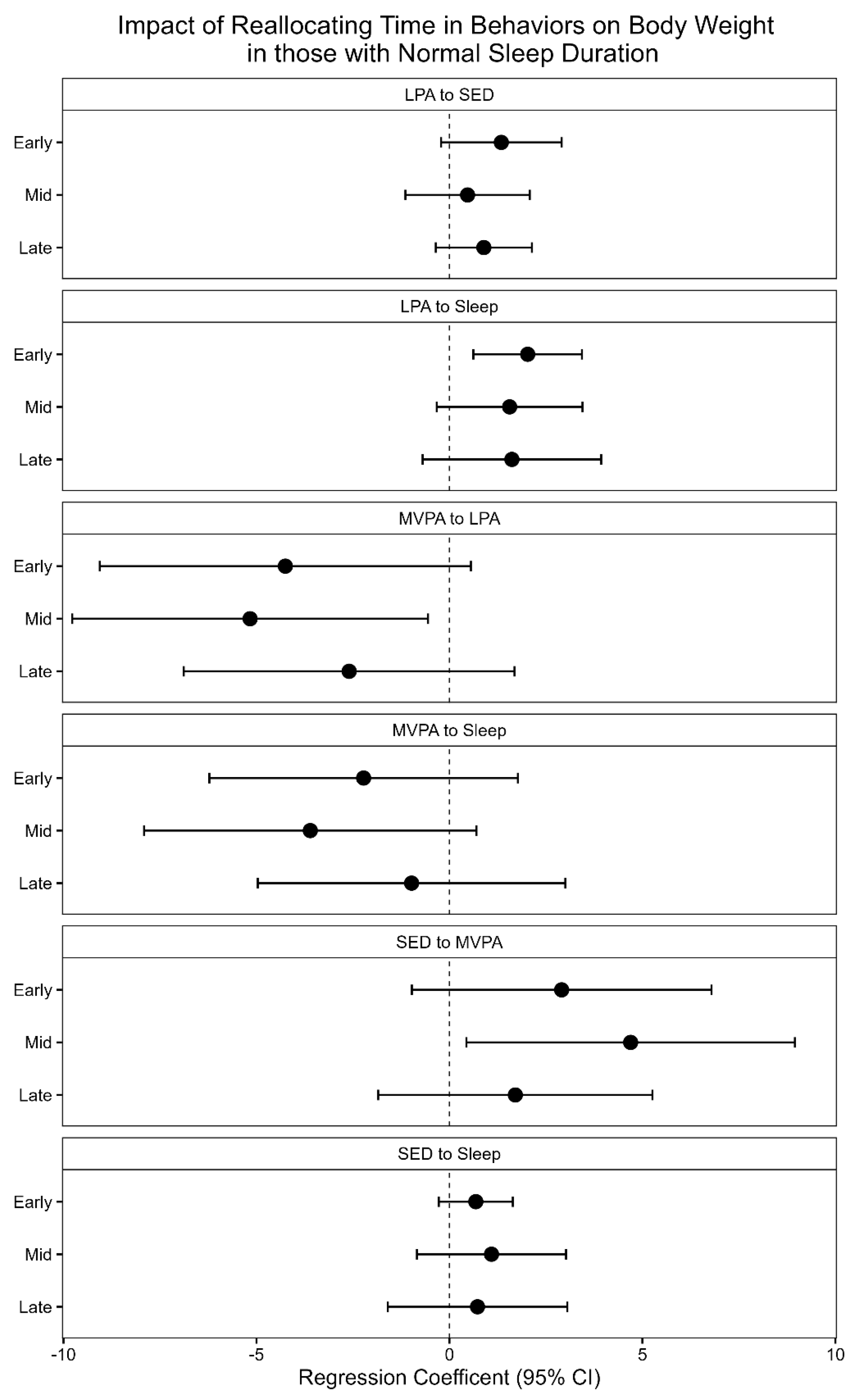

Table 1.
Participant Characteristics.
| Early | Mid | Late | ||
| Age (years) | 31.3 ± 4.4 | 31.3 ± 4.4 | 31.3 ± 4.4 | |
| Body Weight (kg) | 79.3 ± 17.6 | 77.6 ± 19.6 | 77.3 ± 21.3 | |
| Daily Servings of Fruits and Vegetables | 3.3 ± 3.4 | 2.8 ± 4.0 | 2.8 ± 2.9 | |
| Race | ||||
| Black | 21 (24) | |||
| White | 65 (76) | |||
| BMI | ||||
| Normal | 19 (22) | 28 (33) | 29 (34) | |
| Overweight | 36 (42) | 31 (36) | 30 (35) | |
| Obese | 31 (36) | 27 (31) | 27 (31) | |
| Parity | ||||
| Primiparous | 32 (37) | |||
| Multiparous | 54 (63) | |||
| Breastfeeding | ||||
| Exclusively | 65 (75) | 42 (49) | 18 (21) | |
| Some | 10 (12) | 16 (19) | 20 (24) | |
| None | 11 (13) | 28 (33) | 47 (55) | |
| Employment | ||||
| On maternity leave | 40 (46) | 1 (1) | 0 (0) | |
| Employed | 22 (26) | 65 (76) | 60 (71) | |
| Unemployed | 24 (28) | 20 (23) | 24 (29) | |
| Education | ||||
| High School | 4 (5) | 4 (5) | 4 (5) | |
| Some College | 22 (25) | 22 (25) | 22 (25) | |
| College Graduate | 31 (36) | 31 (36) | 31 (36) | |
| Graduate Degree | 29 (34) | 29 (34) | 29 (34) | |
| Income n(%) | ||||
| <$40,000 | 20 (23) | 22 (26) | 18 (21) | |
| $40,000-$80,000 | 30 (35) | 25 (29) | 30 (35) | |
| >$80,000 | 36 (42) | 39 (45) | 37 (44) | |
Data are Mean ± Standard Deviation or n(%).
Table 2.
Percent of the day spent in each of the 24-HAC behaviors.
| Behavior | Early Postpartum | Mid Postpartum | Late Postpartum |
| SED, % | 51.0 ± 12.2 | 52.1± 13.0 | 52.3 ± 14.2 |
| LPA, % | 12.1 ± 2.8 | 12.9 ± 2.8 | 13.5 ± 3.7 |
| MVPA, % | 1.9 ± 1.1 | 2.0 ± 0.9 | 2.3 ± 1.3 |
| Sleep, % | 30.6 ± 4.5 | 29.6 ± 3.8 | 29.5 ± 3.4 |
Mean ± Standard Deviation LPA, light physical activity. MVPA, moderate to vigorous physical activity, SED sedentary behavior.
Table 3.
Number of participants meeting Canadian Movement Behavior Guidelines.
| Guideline | Early Postpartum | Mid Postpartum | Late Postpartum |
| SED <8 hours/day | 0 (0) | 0 (0) | 2 (2) |
| MVPA ≥ 150 min/week | 49 (57) | 56 (65) | 66 (77) |
| Sleep 7-9 hours/day | 48 (56) | 47 (55) | 53 (62) |
Data are presented as n(%).
Disclaimer/Publisher’s Note: The statements, opinions and data contained in all publications are solely those of the individual author(s) and contributor(s) and not of MDPI and/or the editor(s). MDPI and/or the editor(s) disclaim responsibility for any injury to people or property resulting from any ideas, methods, instructions or products referred to in the content. |
© 2026 by the authors. Licensee MDPI, Basel, Switzerland. This article is an open access article distributed under the terms and conditions of the Creative Commons Attribution (CC BY) license (http://creativecommons.org/licenses/by/4.0/).
Copyright: This open access article is published under a Creative Commons CC BY 4.0 license, which permit the free download, distribution, and reuse, provided that the author and preprint are cited in any reuse.