

Submitted:
06 January 2026
Posted:
08 January 2026
You are already at the latest version
Abstract
We present a rigorous reformulation of Einstein’s General Relativity using the real Clifford algebra Cl1,3, constructed from Dirac gamma matrices. In this framework, all geometric and dynamical structures—including the metric, spin connection, curvature, and energy-momentum tensor—are expressed using algebraic operations (symmetrized products, commutators, and traces) of Clifford generators. Rather than invoking the full machinery of differential geometry, we reconstruct the Einstein field equations entirely within an operator algebra framework, while maintaining exact equivalence with the classical theory. The underlying metric structure is assumed through the anticommutation relations defining the Clifford algebra, and is algebraically reconstructed using trace identities. This approach provides a unified representation of both geometry and spinor fields and may offer conceptual and pedagogical advantages in connecting gravity with operator-based formulations. Potential extensions involving bivector sectors and torsion are briefly discussed.
Keywords:
1. Introduction
- In Section 2, we review the relevant properties of Clifford algebra , define symmetrized gamma products, and introduce the Clifford-valued spin connection and covariant derivative.
- outlines the algebraic form of the Dirac Lagrangian [13] in curved space.
- Section 4 provides a detailed proof of the equivalence between the algebraically constructed Einstein field equations and their standard geometric counterparts.
- Section 5 discusses the conceptual advantages and possible extensions of this algebraic formulation, including perspectives on torsion and the role of bivector sectors.
2. Clifford Algebra and the Gamma Matrix Framework
2.1. Overview of Real Clifford Algebra
2.2. Dirac Gamma Matrices and Clifford Generators
- Scalars:
- Vectors:
- Bivectors:
- Trivectors:
- Pseudoscalar:
2.3. Symmetric and Antisymmetric Structures
- Symmetric combinations , which corresponds to the spacetime metric;
- Antisymmetric combinations , which form the generators of the local Lorentz group [18].
2.4. Clifford-Valued Covariant Derivative and Spin Connection
2.5. Algebraic Curvature Operator
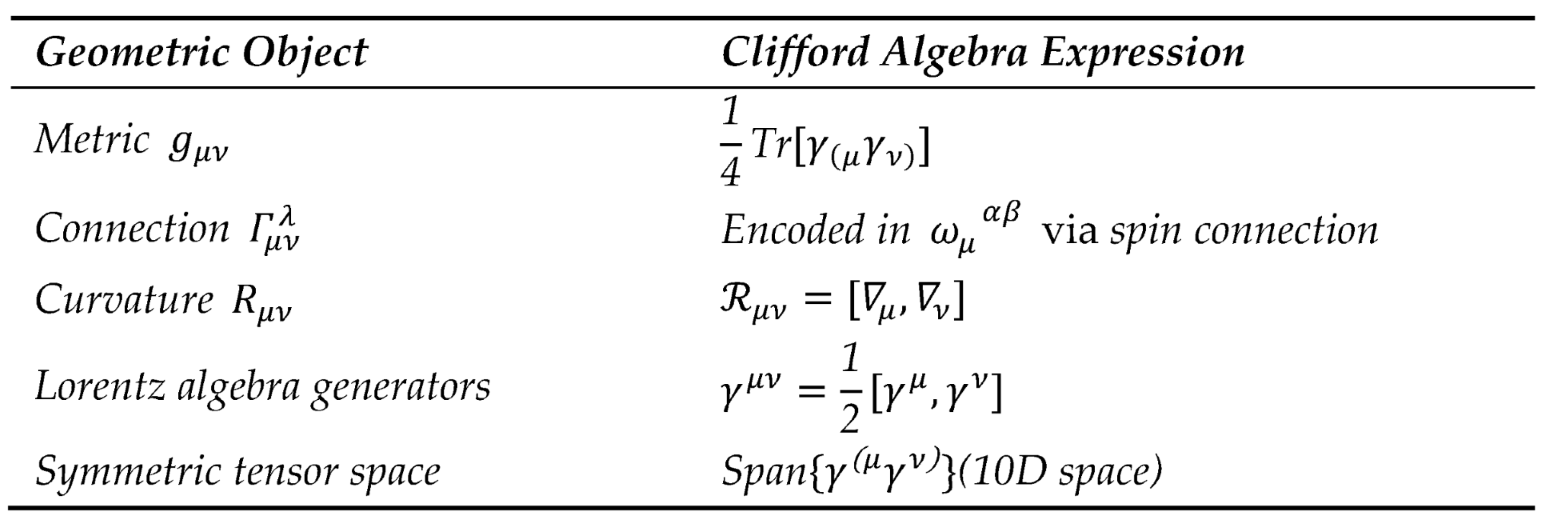
2.6. Summary Table
3. The Energy-Momentum Tensor in Clifford Algebra
3.1. Physical Motivation and Overview
3.2. Spinor Fields and Dirac Bilinears in Clifford Form
3.3. Dirac Lagrangian and Stress-Energy Tensor
3.4. Clifford Algebraic Embedding of
3.5. Conservation Law in Algebraic Form
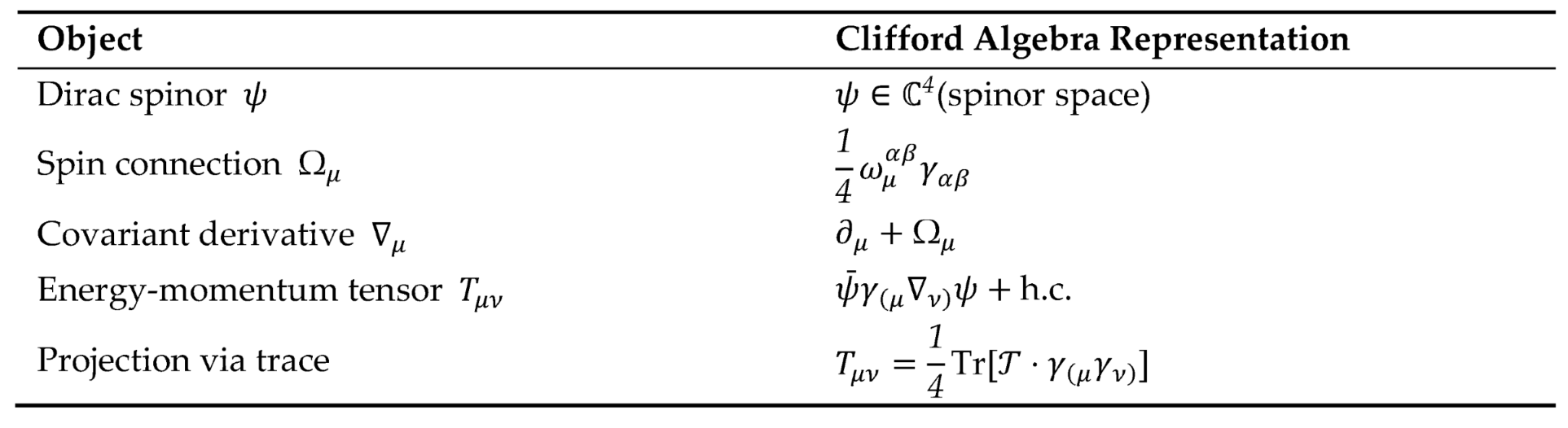
3.6. Summary Table: Algebraic Structures
4. Equivalence with the Standard Formulation of Einstein’s Field Equations
4.1. Objective
- The Clifford-algebraic Einstein tensor matches the standard
- The Clifford-curvature operator yields the same Riemann tensor structure
- The energy-momentum tensor constructed from spinor bilinears maps correctly to the geometric stress-energy tensor
4.2. Reconstructing the Metric Tensor
4.3. Curvature from Commutators of Covariant Derivatives
4.4. Ricci Tensor and Scalar Curvature
4.5. Einstein Tensor from Clifford Curvature
4.6. Energy-Momentum Tensor Equivalence
4.7. Conservation Laws and Bianchi Identity
- The algebraic structure of
- The antisymmetry of curvature generators
- The compatibility condition
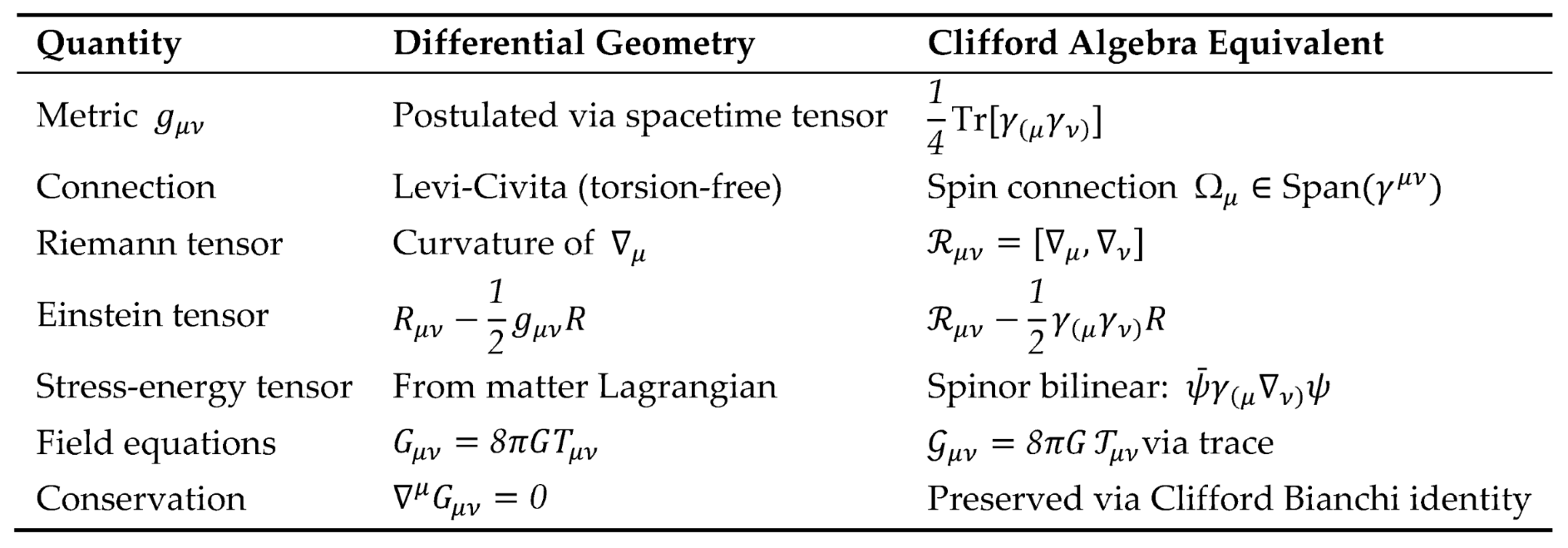
4.8. Equivalence Summary
5. Conceptual Implications and Advantages of the Clifford-Algebraic Formulation
5.1. Unification of Geometry and Matter in a Single Algebra
- The metric tensor is encoded in symmetric products of gamma matrices:
- The stress-energy tensor arises from spinor bilinear forms in the same algebra:This allows both curvature and energy-momentum to be expressed as elements of the same operator space. The result is a self-contained algebraic language where geometry and spinor matter are not artificially separated.
5.2. Natural Incorporation of Spinors and Lorentz Symmetry
- Clifford algebra natively contains spinors and gamma matrices.
- The spin connection appears as a natural Clifford-valued operator.
- Local Lorentz transformations are realized as inner automorphisms of the algebra.
5.3. Torsion and Einstein–Cartan Extensions
- Naturally generalizes to include torsion via antisymmetric parts of the connection for repulsive gravity, similar to the repulsive force due to Pauli’s expulsive principle [34] in the atomic orbital theory.
- The commutator of covariant derivatives:can accommodate torsional components through modified spin connection terms.
5.4. Reinterpreting the Cosmological Constant [35] (Future Direction)
5.5. Compatibility with Quantum and Operator-Based Gravity
- Geometry (curvature, metric) and matter (spinors, energy-momentum) all appear as operator-valued elements.
- This opens a possible path to algebraic quantization of gravity, in the spirit of matrix models or geometric algebra field theory.
- The formulation also aligns with non-commutative geometry and spin foam models, where fundamental degrees of freedom are algebraic rather than manifold-based.
5.6. Mathematical Economy and Structural Clarity
- Algebraic operations (commutators, traces)
- Operator-valued quantities in Clifford space
- Clear separation between symmetric (metric) and antisymmetric (Lorentz) structures
6. Comparative Analysis of Gravitational Frameworks
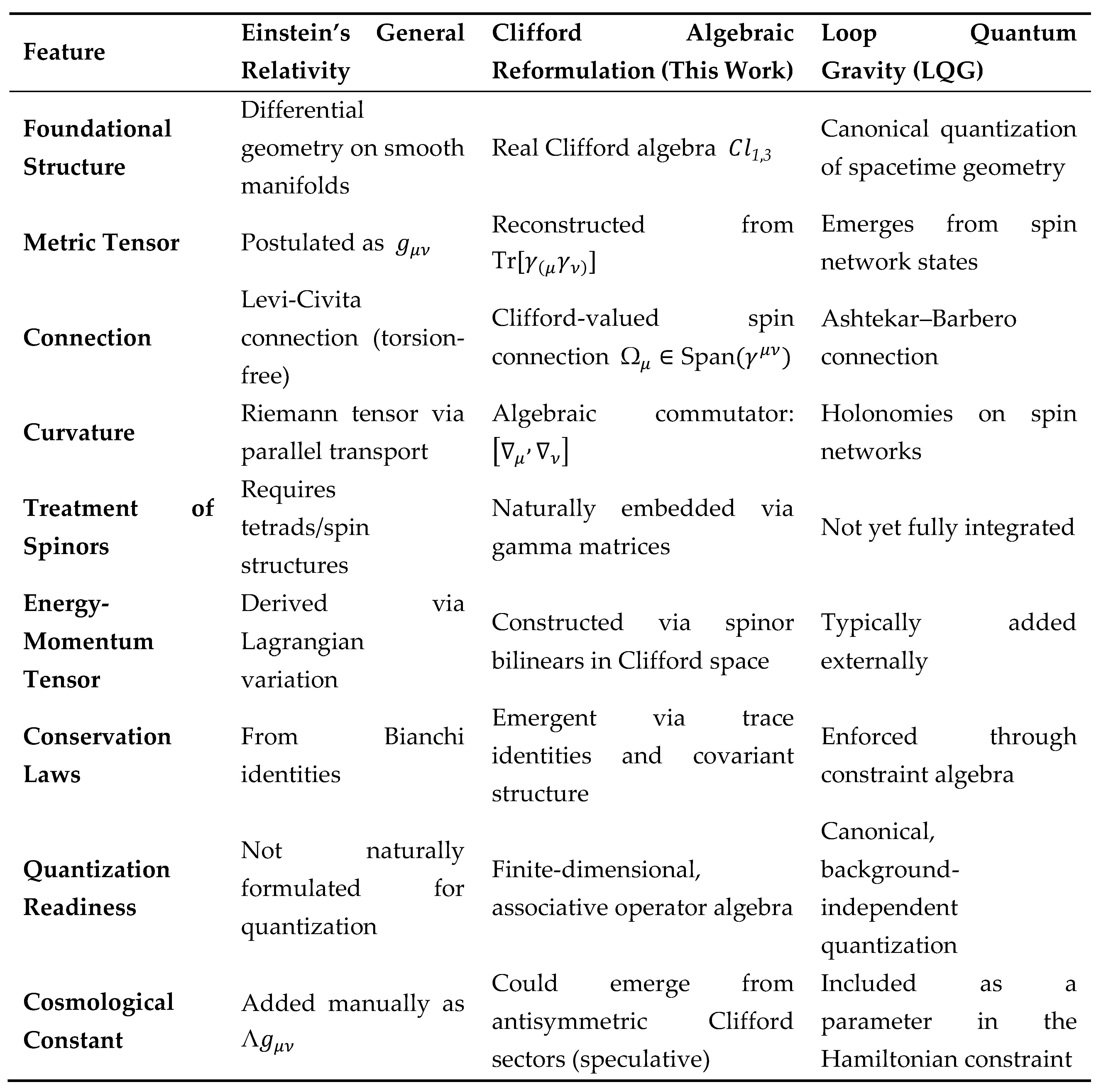
6.1. Comparison Table
6.2. Interpretation
- Einstein’s GR is a geometrically intuitive classical theory, but separates geometry and matter conceptually.
- Loop Quantum Gravity [36] is a promising non-perturbative quantization of geometry, but its integration of spinor fields and matter remains under development.
-
The Clifford-algebraic formulation provides:
- ○
- A unified operator space for both geometry and spinors.
- ○
- Compatibility with quantum structures due to its algebraic, operator-valued basis.
- ○
- A compact language that may ease connections between classical and quantum regimes.
6.3. Scope and Philosophy
- A structurally unified framework that captures the full content of Einstein’s equations.
- A bridge between differential geometry and operator algebra, potentially easing future transitions to quantum-compatible theories.
- A mathematically self-contained foundation to explore extensions, such as torsion, non-commutative geometry, and algebraic sources of repulsion.
6.4. Possible Applications and Extensions
- Quantum Foundations: The operator structure and trace-based observables suggest alignment with non-commutative geometry, matrix models, and geometric algebra field theories.
- Numerical Relativity: Clifford algebra offers compact, coordinate-free expressions for curvature and dynamics, possibly advantageous in simulation frameworks.
- Cosmology and High-Energy Extensions: The antisymmetric (bivector) sector may encode internal degrees of freedom relevant to inflation, dark energy, or early-universe dynamics — topics reserved for future work.
7. Conclusion and Outlook
- Recast Einstein’s theory in an algebraic language that naturally incorporates both geometry and matter.
- Eliminated the need for external geometric scaffolding (manifolds, connections) by embedding all dynamics into the operator structure of Clifford algebra.
- Unified the treatment of spacetime curvature and fermionic fields, enabling compact representations and direct algebraic manipulation.
- The formulation is particularly well-suited for pedagogical purposes, offering a coordinate-free, trace-based framework that may simplify teaching and computation.
- It provides a bridge between classical gravity and algebraic structures prevalent in quantum theory.
- The operator-valued formulation aligns with non-commutative geometry and may be extensible to discrete or matrix-based models of spacetime.
- Torsion-inclusive extensions: The Clifford framework naturally allows antisymmetric extensions of the spin connection, enabling investigations into Einstein–Cartan gravity.
- Cosmological constant and repulsive sectors: The role of bivector (antisymmetric) elements in Cl1,3 may offer algebraic mechanisms for modeling effective repulsive gravity or emergent cosmological terms.
- Quantum gravity: The finite-dimensional, associative nature of Clifford algebra positions it as a potential foundation for operator-based quantization, compatible with spinor fields, gravity, and geometric quantization.
Author Contributions
Funding
Data Availability Statement
Conflict of Interest
References
- Einstein, A. Die Feldgleichungen der Gravitation. In Sitzungsberichte der Königlich Preussischen Akademie der Wissenschaften (Berlin), Physikalisch-Mathematische Klasse; 1915; pp. 844–847. [Google Scholar]
- Wald, R.M. General Relativity; University of Chicago Press: Chicago, 1984. [Google Scholar]
- Peskin, M.E.; Schroeder, D.V. An Introduction to Quantum Field Theory; Addison–Wesley: Reading, MA, 1995. [Google Scholar]
- Penrose, R.; Rindler, W. Spinors and Space-Time, Volume 1: Two-Spinor Calculus and Relativistic Fields; Cambridge University Press: Cambridge, 1984; Volume 1. [Google Scholar]
- Lounesto, P. Clifford Algebras and Spinors, 2nd ed.; Cambridge University Press: Cambridge, 2001. [Google Scholar]
- Dirac, P.A.M. The Quantum Theory of the Electron. Proceedings of the Royal Society of London A 1928, 117, 610–624. [Google Scholar] [CrossRef]
- Cartan, É. The Theory of Spinors, English ed.; Hermann: Paris; Dover, 1937. [Google Scholar]
- Hestenes, D. Space-Time Algebra; Gordon and Breach: New York, 1966. [Google Scholar]
- Kibble, T.W.B. Lorentz Invariance and the Gravitational Field. Journal of Mathematical Physics 1961, 2, 212–221. [Google Scholar] [CrossRef]
- Hehl, F.W.; von der Heyde, P.; Kerlick, G.D.; Nester, J.M. General Relativity with Spin and Torsion: Foundations and Prospects. Reviews of Modern Physics 1976, 48, 393–416. [Google Scholar] [CrossRef]
- Weyl, H. Space–Time–Matter; Methuen: London, 1922. [Google Scholar]
- Kobayashi, S.; Nomizu, K. Foundations of Differential Geometry; Wiley: New York, 1963; Vol. 1. [Google Scholar]
- Utiyama, R. Invariant Theoretical Interpretation of Interaction. Physical Review 1956, 101, 1597–1607. [Google Scholar] [CrossRef]
- Friedrich, T. Dirac Operators in Riemannian Geometry; American Mathematical Society: Providence, RI, 2000. [Google Scholar]
- Nakahara, M. Geometry, Topology and Physics, 2nd ed.; CRC Press: Boca Raton, 2003. [Google Scholar]
- Atiyah, M.; Bott, R.; Shapiro, A. Clifford Modules. Topology 1964, 3 Suppl. 1, 3–38. [Google Scholar] [CrossRef]
- Baez, J.C.; Muniain, J.P. Gauge Fields, Knots and Gravity; World Scientific: Singapore, 1994. [Google Scholar]
- Ashtekar, A. New Variables for Classical and Quantum Gravity. Physical Review Letters 1986, 57, 2244–2247. [Google Scholar] [CrossRef] [PubMed]
- Hitchin, N.J. Harmonic Spinors. Advances in Mathematics 1974, 14, 1–55. [Google Scholar] [CrossRef]
- Rovelli, C. Quantum Gravity; Cambridge University Press: Cambridge, 2004. [Google Scholar]
- Benn, M.; Tucker, R.W. An Introduction to Spinors and Geometry with Applications in Physics; Institute of Physics Publishing: Bristol, 1987. [Google Scholar]
- Connes, A. Noncommutative Geometry; Academic Press: San Diego, 1994. [Google Scholar]
- Polchinski, J. String Theory, Vol. 1: An Introduction to the Bosonic String; Cambridge University Press: Cambridge, 1998; Vol. 1. [Google Scholar]
- Weinberg, S. The Quantum Theory of Fields, Vol. 1: Foundations; Cambridge University Press: Cambridge, 1995; Vol. 1. [Google Scholar]
- Hestenes, D.; Sobczyk, G. Clifford Algebra to Geometric Calculus: A Unified Language for Mathematics and Physics; Reidel: Dordrecht, 1984. [Google Scholar]
- Parker, L.; Toms, D. Quantum Field Theory in Curved Spacetime: Quantized Fields and Gravity; Cambridge University Press: Cambridge, 2009. [Google Scholar]
- DeWitt, B.S. The Global Approach to Quantum Field Theory; Oxford University Press: Oxford, 2003. [Google Scholar]
- Wald, R.M. Quantum Field Theory in Curved Spacetime and Black Hole Thermodynamics; University of Chicago Press: Chicago, 1994. [Google Scholar]
- Dimock, J. Dirac Quantum Fields on a Manifold. Transactions of the American Mathematical Society 1982, 269, 133–147. [Google Scholar] [CrossRef]
- Isham, J. Topological and Global Aspects of Quantum Theory. In Relativity, Groups and Topology II, Les Houches 1983; DeWitt, B., Stora, R., Eds.; North-Holland: Amsterdam, 1984; pp. 1059–1290. [Google Scholar]
- Trautman, A. Spin and Torsion May Avert Gravitational Singularities. Nature Physical Science 1973, 242, 7–8. [Google Scholar] [CrossRef]
- Vassilevich, V. Heat Kernel Expansion: User’s Manual. Physics Reports 2003, 388, 279–360. [Google Scholar] [CrossRef]
- Lawson, H.B.; Michelsohn, M.-L. Spin Geometry; Princeton University Press: Princeton, NJ, 1989. [Google Scholar]
- Tang, J.; Tang, Q. Quantum-Corrected Gravity from Non-Associative Gauge Theory Explains Galactic Rotation Curves Without Dark Matter. 2025. [Google Scholar] [CrossRef]
- Vaz, J., Jr.; da Rocha, R. An Introduction to Clifford Algebras and Spinors; Oxford University Press: Oxford, 2016. [Google Scholar]
- Cartan, É. On Manifolds with an Affine Connection and the Theory of General Relativity. Annales Scientifiques de l’École Normale Supérieure 1923, 40, 325–412. [Google Scholar] [CrossRef]
- Weyl, H. Gravitation and Electricity. Sitzungsberichte der Preussischen Akademie der Wissenschaften 1918, 465–480. [Google Scholar] [CrossRef]
- Connes, A.; Marcolli, M. Noncommutative Geometry, Quantum Fields and Motives; American Mathematical Society: Providence, RI, 2008. [Google Scholar]
- Frankel, T. The Geometry of Physics: An Introduction, 3rd ed.; Cambridge University Press: Cambridge, 2011. [Google Scholar]
- Haag, R. Local Quantum Physics: Fields, Particles, Algebras, 2nd ed.; Springer: Berlin, 1996. [Google Scholar]
- Dixmier, J. Dixmier, Les C*-algèbres et leurs représentations; Gauthier-Villars: Paris, 1969. [Google Scholar]
- Wightman, S. Quantum Field Theory in Terms of Vacuum Expectation Values. Physical Review 1956, 101, 860–866. [Google Scholar] [CrossRef]
Disclaimer/Publisher’s Note: The statements, opinions and data contained in all publications are solely those of the individual author(s) and contributor(s) and not of MDPI and/or the editor(s). MDPI and/or the editor(s) disclaim responsibility for any injury to people or property resulting from any ideas, methods, instructions or products referred to in the content. |
© 2026 by the author. Licensee MDPI, Basel, Switzerland. This article is an open access article distributed under the terms and conditions of the Creative Commons Attribution (CC BY) license.