

Submitted:
02 January 2026
Posted:
04 January 2026
You are already at the latest version
Abstract
Waterlogging stress, particularly during flowering severely constrains wheat production, yet the optimal timing and frequency of waterlogging stress memory and its linkage to post-stress nitrogen acquisition remain unclear. We conducted pot experiments under glasshouse over two consecutive growing seasons (2022/23 and 2023/24) using the Japanese bread wheat cultivar Norin 61 to evaluate eight treatment combinations of waterlogging stress memory applied at the tillering, stem elongation, and booting stages, followed by waterlogging during flowering stage. Leaf greenness (SPAD), chlorophyll fluorescence (Fv′/Fm′), photosynthetic rate, yield and its components, and nitrogen dynamics were assessed. To quantify post-stress nitrogen uptake, 15N-labeled ammonium sulfate was applied immediately after waterlogging termination at flowering, and 15N uptake and allocation to plant organs and grains were determined during grain filling and at harvest. Treatments that included tillering-stage stress memory consistently delayed leaf senescence, maintained higher photosynthetic performance, increased thousand-grain weight, and improved grain yield relative to the non-primed treatment, with reproducible effects across both seasons. These treatments also showed higher post-stress 15N uptake and greater 15N allocation to grains. Overall, tillering-stage waterlogging stress memory was associated with improved tolerance to flowering-stage waterlogging in wheat through maintenance of post-stress nitrogen uptake capacity and nitrogen allocation to grains.
Keywords:
1. Introduction
2. Materials and Methods
2.1. Cultivation Environments and Waterlogging Stress Memory Treatment
2.2. Measurements and Sampling
2.3. Statistical Analysis
3. Results
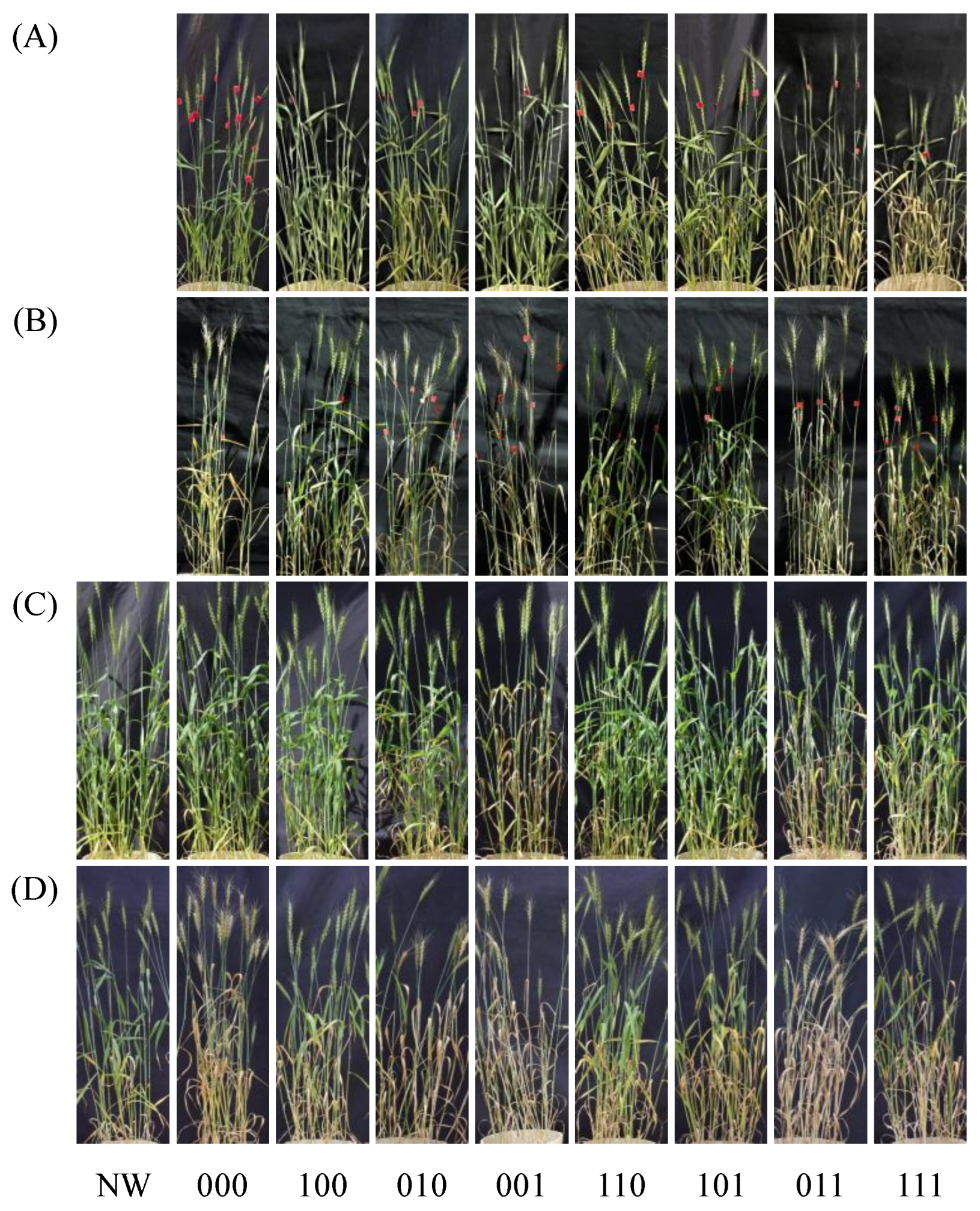
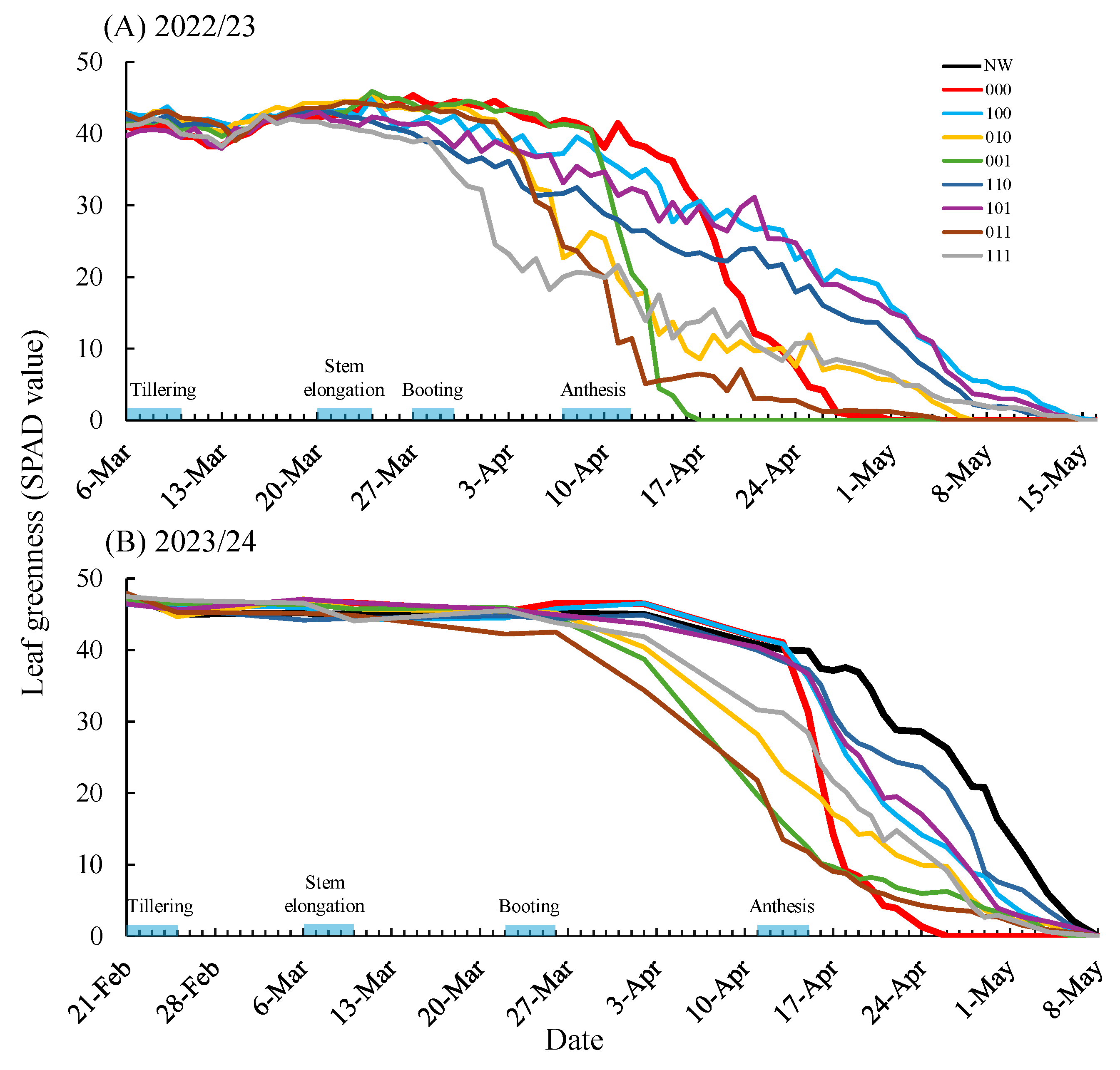
3.1. Leaf Senescence (Chlorosis and Necrosis)
3.2. Photosynthetic Performance
3.3. Grain Yield and Its Components
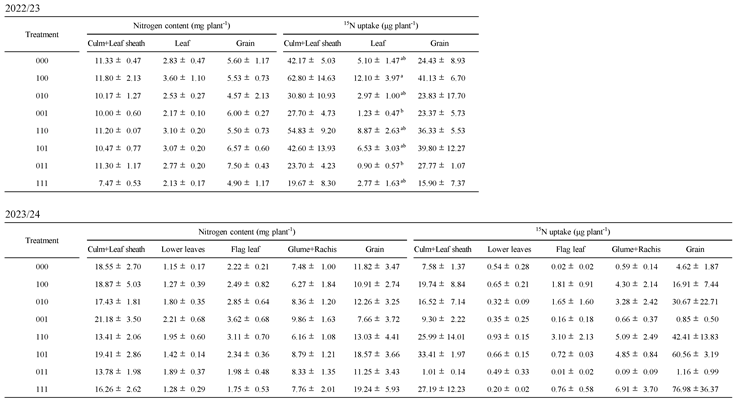
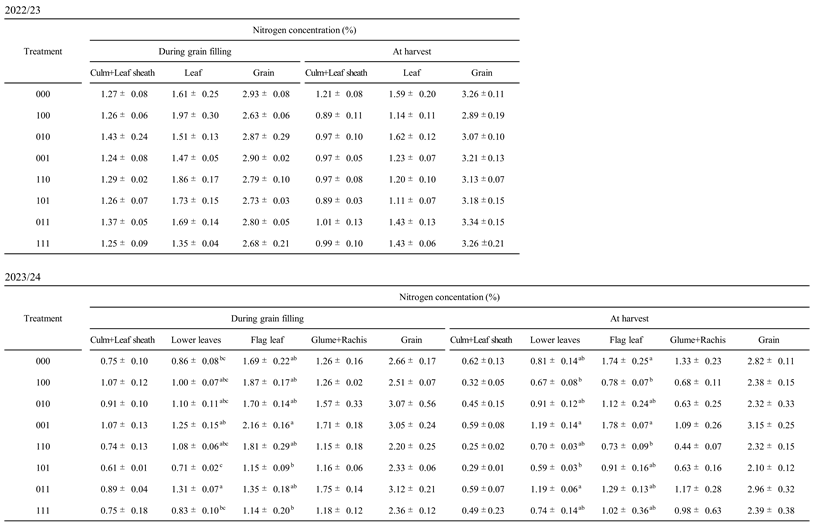
3.4. Nitrogen Uptake Capacity and Remobilization
3.5. Correlation Between SPAD and leaf δ15N or Thousand-Grain Weight
4. Discussion
5. Conclusion
Author Contributions
Funding
Data Availability Statement
Acknowledgments
Conflicts of Interest
Abbreviations
| 15N | Nitrogen stable isotope |
| δ15N | Nitrogen stable isotope composition |
| Fv′/Fm′ | Quantum yield of photosystem II |
Appendix A
Appendix A.1

Appendix A.2
Appendix A.3
References
- Donat, M. G.; Angélil, O.; Ukkola, A.M. Intensification of precipitation extremes in the world’s humid and water-limited regions. Environ. Res. Lett. 2019, 14, 065003. [Google Scholar] [CrossRef]
- Zhang, Y.; Chen, X.; Geng, S.; Zhang, X. A review of soil waterlogging impacts, mechanisms, and adaptive strategies. Front. Plant Sci. 2025, 16, 1545912. [Google Scholar] [CrossRef] [PubMed]
- Hossain, M.A.; Uddin, S.N. Mechanisms of waterlogging tolerance in wheat: Morphological and metabolic adaptations under hypoxia or anoxia. Aust. J. Crop Sci. 2011, 5, 1094–1101. [Google Scholar]
- Kawaguchi, K. Wet Injury of Wheat in Upland Field Converted from Paddy Field in Japan. In Proceedings of the 7th Asian Crop, Bogor, Indonesia, 27–30 September 2011; Science Association Conference; pp. 147–152. [Google Scholar]
- Cannell, R.Q.; Belford, R.K.; Gales, K.; Dennis, C.W; Prew, R.D. Effects of waterlogging at different stages of development on the growth and yield of winter wheat. J. Sci. Food Agri 1980, 31, 117–132. [Google Scholar] [CrossRef]
- Araki, H.; Hamada, A.; Hossain, M.A.; Takahashi, T. Waterlogging at jointing and/or after anthesis in wheat induces early leaf senescence and impairs grain filling. Field Crops Res. 2012, 137, 27–36. [Google Scholar] [CrossRef]
- de San Celedonio, R.P.; Abeledo, L.G.; Miralles, D.J. Identifying the critical period for waterlogging on yield and its components in wheat and barley. Plant Soil 2014, 378, 265–277. [Google Scholar] [CrossRef]
- Hossain, M.A.; Araki, H.; Takahashi, T. Poor grain filling induced by waterlogging is similar to that in abnormal early ripening in wheat in Western Japan. Field Crops Res. 2011, 123, 100–108. [Google Scholar] [CrossRef]
- Distelfeld, A.; Avni, R.; Fischer, A.M. Senescence, nutrient remobilization, and yield in wheat and barley. J. Exp. Bot. 2014, 65, 3783–3798. [Google Scholar] [CrossRef]
- Zhou, B.; Serret, M.D.; Pie, J.B.; Shah, S.S.; Li, Z. Relative contribution of nitrogen absorption, remobilization, and partitioning to the ear during grain filling in Chinese winter wheat. Front. Plant Sci. 2018, 9, 01351. [Google Scholar] [CrossRef]
- Jiang, D.; Fan, X.; Dai, T.; Cao, W. Nitrogen fertiliser rate and post-anthesis waterlogging effects on carbohydrate and nitrogen dynamics in wheat. Plant Soil 2008, 304, 301–314. [Google Scholar] [CrossRef]
- Sinclair, T.R.; de Wit, C.T. Analysis of the carbon and nitrogen limitations to soybean yield. Agron. J. 1976, 68, 319–322. [Google Scholar] [CrossRef]
- Sakuraba, Y. Molecular basis of nitrogen starvation-induced leaf senescence. Front. Plant Sci. 2022, 13, 1013304. [Google Scholar] [CrossRef] [PubMed]
- Bruce, T.J.A.; Matthes, M.C.; Napier, J.A.; Pickett, J.A. Stressful memories of plants: evidence and possible mechanisms. Plant Sci. 2007, 173, 603–608. [Google Scholar] [CrossRef]
- Liu, H.; Able, A.J.; Able, J.A. Priming crops for the future: rewiring stress memory. Trends Plant Sci. 2022, 27, 699–716. [Google Scholar] [CrossRef] [PubMed]
- Sharma, M.; Kumar, P.; Verma, V.; Sharma, R.; Bhargava, B.; Irfan, M. Understanding plant stress memory response for abiotic stress resilience: Molecular insights and prospects. Plant Physiol. Biochem. 2022, 179, 10–24. [Google Scholar] [CrossRef] [PubMed]
- Siddique, A.; Parveen, S.; Rahman, M.Z.; Rahman, J. Revisiting plant stress memory: mechanisms and contribution to stress adaptation. Physiol. Mol. Biol. Plants 2024, 30, 349–367. [Google Scholar] [CrossRef]
- Aswathi, K.P.R.; Ul-Allah, S.; Puthur, J.T.; Siddique, K.H.M.; Frei, M.; Farooq, M. The Plant Mind: Unraveling Abiotic Stress Priming, Memory, and Adaptation. Physiol. Plant. 2025, 177, e70372. [Google Scholar] [CrossRef]
- Agualongo, D.A.P; Da-Silva, C.J.; Garcia, N.; de Oliveira, F.K.; Shimoia, E.P.; Posso, D.A.; de Oliveira, A.C.B.; de Oliveira, D.D.C.; do Amarante, L. Waterlogging priming alleviates the oxidative damage, carbohydrate consumption, and yield loss in soybean (Glycine max) plants exposed to waterlogging. Funct. Plant Biol. 2022, 49, 1029–1042. [Google Scholar] [CrossRef]
- Zhou, R.; Jiang, F.; Yu, X.; Abdelhakim, L.; Li, X.; Rosenqvist, E.; Ottosen, C.; Wu, Z. Dominant and priming role of waterlogging in tomato at e[CO2] by multivariate analysis. Int. J. Mol. Sci. 2022, 23, 12121. [Google Scholar] [CrossRef]
- Li, C.; Jiang, D.; Wollenweber, B.; Li, Y.; Dai, T.; Cao, W. Waterlogging pretreatment during vegetative growth improves tolerance to waterlogging after anthesis in wheat. Plant Sci. 2011, 180, 672–678. [Google Scholar] [CrossRef]
- Zhang, Y.F.; Wang, X.; Malko, M. M.; Zhou, Q.; Cai, J.; Zhong, Y.; Huang, M.; Jiang, D. Unravelling the long-term beneficial effects of stress priming-induced tolerance to waterlogging stress in wheat. Plant Growth Regul. 2025, 105, 2067–2084. [Google Scholar] [CrossRef]
- Jin, N.; Cai, Z.; Ye, L.; Shen, Q.; Zhang, G.; Xu, Z. Improvement of waterlogging tolerance in wheat by the stress priming through inducing aerenchyma formation. Plant Growth Regul. 2025, 105, 245–255. [Google Scholar] [CrossRef]
- Taulemesse, F.; Le Gouis, J.; Gouache, D.; Gibon, Y.; Allard, V. Post-flowering nitrate uptake in wheat is controlled by N status at flowering, with a putative major role of root nitrate transporter NRT2.1. PLoS ONE 2015, 10, e0120291. [Google Scholar] [CrossRef] [PubMed]
- McNeill, A.M.; Unkovich, M.J. Estimates of N accumulated below-ground by grain legumes derived using leaf or stem 15N-feeding: in search of a practical method for potential use at remote field locations. Plant Soil 2024, 500, 721–741. [Google Scholar] [CrossRef]
- Pais, I.P.; Moreira, R.; Semedo, J.N.; Ramalho, J.C.; Lidon, F.C.; Coutinho, J.; Maças, B.; Scotti-Campos, P. Wheat crop under waterlogging: Potential soil and plant effects. Plants 2023, 12, 149. [Google Scholar] [CrossRef]
- Li, L.; Dong, X.; He, M.; Huang, M.; Cai, J.; Zhou, Q.; Zhong, Y.; Jiang, D.; Wang, X. Unravelling the role of adventitious roots under priming-induced tolerance to waterlogging stress in wheat. Environ. Exp. Bot. 2023, 216, 105516. [Google Scholar] [CrossRef]
- Zhang, Y.; Wang, X.; Malko, M.M.; Zhou, Q.; Cai, J.; Zhong, Y.; Huang, M.; Jiang, D. The physiological mechanisms of waterlogging priming on aerenchyma formation in secondary roots of wheat under waterlogging stress. Environ. Exp. Bot. 2025, 237, 106207. [Google Scholar] [CrossRef]
- Herzog, M.; Striker, G.G.; Colmer, T.D.; Pedersen, O. Mechanisms of waterlogging tolerance in wheat—A review of root and shoot physiology. Plant Cell Environ. 2016, 39, 1068–1086. [Google Scholar] [CrossRef]
- Fradgley, N.S.; Bentley, A.R.; Swarbreck, S.M. Defining the physiological determinants of low nitrogen requirement in wheat. Biochem. Soc. Trans. 2021, 49, 609–616. [Google Scholar] [CrossRef]
- de San Celedonio, R.P.; Abeledo, L.G.; Miralles, D.J. Nitrogen accumulation and remobilisation in wheat and barley plants exposed to waterlogging at different developmental stages. Crop Pasture Sci. 2022, 73, 615–626. [Google Scholar] [CrossRef]
- Ren, B.; Dong, S.; Zhao, B.; Liu, P.; Zhang, J. Responses of nitrogen metabolism, uptake and translocation of Maize to water logging at different growth stages. Front. Plant Sci. 2017, 8, 01216. [Google Scholar] [CrossRef]
Disclaimer/Publisher’s Note: The statements, opinions and data contained in all publications are solely those of the individual author(s) and contributor(s) and not of MDPI and/or the editor(s). MDPI and/or the editor(s) disclaim responsibility for any injury to people or property resulting from any ideas, methods, instructions or products referred to in the content. |
© 2026 by the authors. Licensee MDPI, Basel, Switzerland. This article is an open access article distributed under the terms and conditions of the Creative Commons Attribution (CC BY) license (http://creativecommons.org/licenses/by/4.0/).