

Submitted:
18 December 2025
Posted:
19 December 2025
You are already at the latest version
Abstract
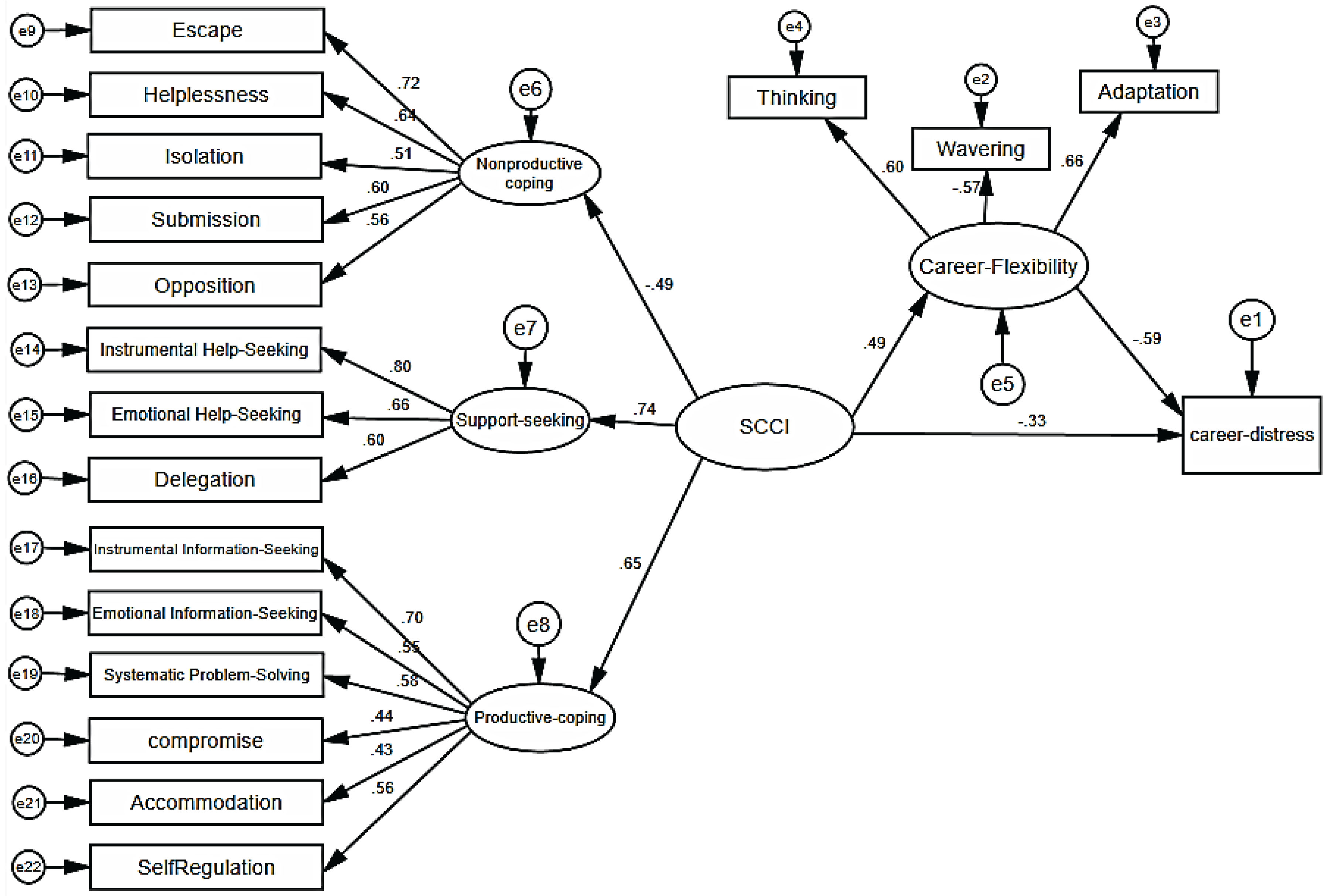
Objective: To investigate the mediating role of career flexibility in the relationship between strategies for coping with career indecision and career distress among university students, and to conduct a psychometric validation of the Persian version of the Career Flexibility Inventory (CFI). Method: A two-phase, cross-sectional study was conducted with a sample of 517 Iranian university students. Phase one involved a Confirmatory Factor Analysis (CFA) to validate the CFI. Phase two tested the proposed mediation model using Structural Equation Modeling (SEM) with a bootstrapping procedure. Findings: The CFA confirmed th)e psychometric soundness and three-factor structure (Wavering, Adaptation, Flexible Thinking) of the Persian CFI, with excellent model fit (CFI = .975, RMSEA = .036). SEM results revealed that career flexibility partially mediated the relationship between coping strategies and career distress. Productive coping was associated with lower distress indirectly through its positive effect on Adaptation (Standardized Indirect Effect = –.124), while nonproductive coping was linked to higher distress indirectly through its positive effect on Wavering (Standardized Indirect Effect = .106). Conclusion: Career flexibility is a crucial mechanism explaining how coping strategies influence career distress; productive coping enhances active flexibility (Adaptation) to reduce distress, whereas nonproductive coping fosters passive flexibility (Wavering) that exacerbates it. The study provides a validated instrument for the Iranian context and highlights the importance of designing career interventions that build adaptive flexibility, rather than merely targeting distress.
Keywords:
Introduction:
Career Distress and Career Indecision
Strategies for Coping with Career Indecision and Career Flexibility
Career Flexibility and Career Distress
The Present Study
Method
Results
Discussion
Practical Implications
Limitations and Future Directions
Conclusion
References
- Kim, B. (2019). Development and psychometric evaluation of the career flexibility inventory. Korea Journal of Counseling, 20(4), 113-131.
- Kline, R. B. (2023). Principles and practice of structural equation modeling. Guilford publications.
- Baron, R. M., & Kenny, D. A. (1986). The moderator–mediator variable distinction in social psychological research: Conceptual, strategic, and statistical considerations. Journal of personality and social psychology, 51(6), 1173.
- Judd, C. M., & Kenny, D. A. (1981). Process analysis: Estimating mediation in treatment evaluations. Evaluation Review, 5 (5), 602–619. [CrossRef]
- Nguyen, H. T., Ha, C. T. M., Nguyen, V. H. A., Tran, D. T. T., Tran-Thien, G. P., & Luu, K. (2024). Exploring career decision-making anxiety among high school students. Multidisciplinary Science Journal, 6(9), 2024195-2024195.
- Lipshits-Braziler, Y., Gati, I., & Tatar, M. (2016). Strategies for coping with career indecision. Journal of Career Assessment, 24(1), 42-66.
- Şensoy, G., & Siyez, D. M. (2019). The career distress scale: structure, concurrent and discriminant validity, and internal reliability in a Turkish sample. International Journal for Educational and Vocational Guidance, 19, 203-216.
- Lee, K. H. (2005). Coping with career indecision: Differences between four career choice types. Journal of Career Development, 31, 279–289. [CrossRef]
- Larson, M. L., & Majors, M. S. (1998). Applications of the coping with career indecision instrument with ado- lescents. Journal of Career Assessment, 6, 163–179. [CrossRef]
- DeLongis, A., & Holtzman, S. (2005). Coping in context: The role of stress, social support, and personality in coping. Journal of Personality, 73, 1633–1656. [CrossRef]
- Lipshits-Braziler, Y., Gati, I., & Tatar, M. (2016). Strategies for coping with career indecision. Journal of Career Assessment, 24(1), 42-66. Journal of Career Assessment.
- Skinner, E. A., Edge, K., Altman, J., & Sherwood, H. (2003). Searching for the structure of coping: A review and critique of category systems for classifying ways of coping. Psychological Bulletin, 129, 216–269. [CrossRef]
- Frydenberg, E., & Lewis, R. (1993). Adolescent coping scale. Melbourne: Australian Council for Educational Research.
- Wang, T., Zhang, Y., Wang, J., Miao, H., & Guo, C. (2024). Career decision self-efficacy mediates social support and career adaptability and stage differences. Journal of Career Assessment, 32(2), 264-282.
- Syafril, S., Selvanus, S., As-Syahri, H., Susanto, H., Wahyudi, W., & Syaifullah, S. (2024). Path analysis of factors that influence students in choosing a study program to get to their dream job. Jurnal Ekonomi, 13(01), 740-755.
- Saka, N., Gati, I., & Kelly, K. R. (2008). Emotional and personality-related aspects of career-decision-making difficulties. Journal of Career Assessment, 16, 403–424. [CrossRef]
- Brown, S. D., & Rector, C. C. (2008). Conceptualizing and diagnosing problems in vocational decision making. In S. D. Brown & R. W. Lent (Eds.), Handbook of counseling psychology (pp. 392–407). New York, NY: Wiley.
- Doğanülkü, H. A., & Korkmaz, O. (2024). Do difficulties in career affect life satisfaction? examining the relationships between life satisfaction, career decision regret, and career distress. Mersin Üniversitesi Eğitim Fakültesi Dergisi, 20(2), 267-283.
- Boo, S., & Kim, S. H. (2020). Career indecision and coping strategies among undergraduate students. Journal of Hospitality & Tourism Education, 32(2), 63-76.
- Atitsogbe, K. A., Samson, A., Sarazin-Frey-Pépin, É., El Hamdany, Y., & McCrindle, C. R. (2024). The influence of career indecision on life satisfaction among grade 12 Ontario students: career choice support as mediator and moderator. International Journal for Educational and Vocational Guidance, 1-25.
- Frainer, J., & Janeiro, I. N. (2023). Career flexibility and its relation to time perspective: a study with college students in the Portuguese context. Frontiers in psychology, 14, 1078752.
- Kim, B. (2019). Development and psychometric evaluation of the career flexibility inventory. Korea Journal of Counseling, 20(4), 113-131. [CrossRef]
- Kim, B., Lee, S., & Lee, S. M. (2020). Exploration of latent profiles of the career flexibility inventory among Korean college students. journal of employment counseling, 57(2), 50-65.
- Porfeli, E. J., & Lee, B. (2012). Career development during childhood and adolescence. New directions for youth development, 2012(134), 11-22.
- Creed, P. A., Hood, M., Praskova, A., & Makransky career distress. Journal of Career Assessment, 24(4), 732-746.
- Kim, B., Lee, S., & Lee, S. M. (2020). Exploration of latent profiles of the career flexibility inventory among Korean college students. journal of employment counseling, 57(2), 50-65.
- Lee, A., & Jung, E. (2022). University students’ career adaptability as a mediator between cognitive emotion regulation and career decision-making self-efficacy. Frontiers in Psychology, 13, 896492.
- Browning, M., & Heinesen, E. (2012). Effect of job loss due to plant closure on mortality and hospitalization. Journal of Health Economics, 31 (4), 599–616. [CrossRef]
- Akmal, S. Z., Hood, M., & Creed, P. A. (2023). Career distress scale (cds). In C. U. Krägeloh, M. Alyami, & O. N. Medvedev (Eds.), International handbook of behavioral health assessment (pp. 1–13). Springer International Publishing. [CrossRef]
- Hengen, K. M., & Alpers, G. W. (2021). Stress makes the difference: Social stress and social anxiety in decision-making under uncertainty. Frontiers in Psychology, 12. [CrossRef]
- Qazi, W., Qazi, Z., Raza, S. A., Hakim, F., & Khan, K. (2023). Students’ employability confidence in covid-19 pandemic: Role of career anxiety and perceived distress. Journal of Applied Research in Higher Education, 16, 120–133. [CrossRef]
- Schilbach, M., Baethge, A., & Rigotti, T. (2023). How past work stressors influence psychological well-being in the face of current adversity: Affective reactivity to adversity as an explanatory mechanism. Journal of Business and Psychology. [CrossRef]
- Laditka, J., Laditka, S., Arif, A., & Adeyemi, O. (2023). Psychological distress is more common in some occupations and increases with job tenure: A thirty-seven year panel study in the united states. BMC Psychology, 11. [CrossRef]
- Chen, H., Pang, L., Liu, F., Fang, T., & Wen, Y. (2022). “be perfect in every respect”: The mediating role of career adaptability in the relationship between perfectionism and career decision-making difficulties of college students. BMC Psychology, 10(1), 137.
- Lipshits-Braziler, Y., Gati, I., & Tatar, M. (2016). Strategies for coping with career indecision. Journal of Career Assessment, 24(1), 42-66.
- Cheung, R., & Jin, Q. (2016). Impact of a career exploration course on career decision making, adaptability, and relational support in Hong Kong. Journal of Career Assessment, 24(3), 481-496.
- Lent, R. W., Ireland, G. W., Penn, L. T., Morris, T. R., & Sappington, R. (2017). Sources of self-efficacy and outcome expectations for career exploration and decision-making: A test of the social cognitive model of career self-management. Journal of Vocational Behavior, 99, 107-117.
- Karacan-Ozdemir, N. (2019). Associations between career adaptability and career decision-making difficulties among Turkish high school students. International Journal for Educational and Vocational Guidance, 19, 475-495.
- Turan, M. E., & Çelik, E. (2023). The effect of a career adaptability psycho-educational programme on coping with career indecision and career adaptability: A pilot study. Counselling and Psychotherapy Research, 23(3), 709-717.
- Hamzah, S. R. A., Kai Le, K., & Musa, S. N. S. (2021). The mediating role of career decision self-efficacy on the relationship of career emotional intelligence and self-esteem with career adaptability among university students. International Journal of Adolescence and Youth, 26(1), 83-93.
- Parmentier, M., Pirsoul, T., & Nils, F. (2021). Career Adaptability Profiles and Their Relations with Emotional and Decision-Making Correlates among Belgian Undergraduate Students. Journal of Career Development, 1-17.
- Lazarus, R. S., & Folkman, S. (1984). Stress, Appraisal, and Coping. Springer Publishing Company.

| Item/Factors | Mean | SD | Skewn | Kurtosis | CFA | z-Value |
| Wavering | ||||||
| 1 | 3.03 | 0.893 | 0.038 | -0.132 | 0.728 | 0.0001 |
| 2 | 3.01 | 0.846 | -0.115 | -0.263 | 0.645 | 0.0001 |
| 3 | 3.28 | 0.953 | -0.06 | -0.47 | 0.612 | 0.0001 |
| 4 | 2.98 | 0.786 | 0.037 | -0.393 | 0.651 | 0.0001 |
| 5 | 2.72 | 0.876 | 0.087 | -0.24 | 0.604 | 0.0001 |
| Adaptation | ||||||
| 6 | 3.16 | 0.853 | -0.095 | -0.123 | 0.74 | 0.0001 |
| 7 | 2.88 | 0.869 | -0.024 | -0.348 | 0.673 | 0.0001 |
| 8 | 2.94 | 0.97 | 0.043 | -0.459 | 0.707 | 0.0001 |
| 9 | 3.12 | 0.919 | -0.138 | -0.343 | 0.653 | 0.0001 |
| 10 | 3.01 | 0.864 | 0.028 | -0.353 | 0.699 | 0.0001 |
| Thinking | ||||||
| 11 | 2.78 | 0.858 | 0.085 | -0.177 | 0.743 | 0.0001 |
| 12 | 2.91 | 0.882 | 0.154 | -0.261 | 0.636 | 0.0001 |
| 13 | 2.43 | 0.852 | 0.209 | -0.21 | 0.688 | 0.0001 |
| 14 | 3.26 | 0.961 | -0.122 | -0.463 | 0.543 | 0.0001 |
| 15 | 3.12 | 0.916 | -0.042 | -0.433 | 0.492 | 0.0001 |
| Career Flexibility | ||||||
| Wavering | 0.723 | 0.0001 | ||||
| Adaptation | -0.664 | 0.0001 | ||||
| Thinking | 0.691 | 0.0001 | ||||
| SD = standard deviation, CFA = confirmatory factor analysis standardized factor loadings | ||||||
| Variables | 1 | 2 | 3 | 4 | 5 | 6 | 7 | 8 | 9 | 10 | 11 | 12 | 13 | 14 | 15 | 16 | 17 | 18 |
| career distress | 1 | |||||||||||||||||
| Wavering | 0.45 | 1 | ||||||||||||||||
| Adaptation | -.50 | -.34 | 1 | |||||||||||||||
| Thinking | -.46 | -.34 | 0.38 | 1 | ||||||||||||||
| Escape | 0.30 | 0.17 | -.21 | -.16 | 1 | |||||||||||||
| Helplessness | 0.22 | 0.06 | -.17 | -.12 | 0.46 | 1 | ||||||||||||
| Isolation | 0.19 | 0.09 | -.13 | -.13 | 0.37 | 0.34 | 1 | |||||||||||
| Submission | 0.23 | 0.09 | -.13 | -.04 | 0.43 | 0.37 | 0.28 | 1 | ||||||||||
| Opposition | 0.25 | 0.04 | -.18 | -.10 | 0.37 | 0.39 | 0.29 | 0.33 | 1 | |||||||||
| InstrumentalHelp | -.37 | -.16 | 0.22 | 0.21 | -.25 | -.14 | -.15 | -.15 | -.16 | 1 | ||||||||
| Emotional Help | -.24 | -.10 | 0.12 | 0.14 | -.11 | -.12 | -.11 | -.11 | -.09 | 0.52 | 1 | |||||||
| Delegation | -.23 | -.10 | 0.12 | 0.07 | -.10 | -.04 | -.02 | -.11 | -.08 | 0.46 | 0.43 | 1 | ||||||
| Instrumental Information | -.27 | -.16 | 0.17 | 0.15 | -.16 | -.03 | -.09 | -.08 | -.11 | 0.26 | 0.22 | 0.24 | 1 | |||||
| Emotional Information | -.21 | -.11 | 0.12 | 0.07 | -.14 | -.07 | -.06 | -.15 | -.09 | 0.26 | 0.23 | 0.21 | 0.38 | 1 | ||||
| Problem-Solving | -.20 | -.07 | 0.07 | 0.07 | -.10 | -.08 | -.09 | -.13 | -.09 | 0.21 | 0.18 | 0.22 | 0.42 | 0.32 | 1 | |||
| compromise | -.14 | -.07 | 0.12 | 0.07 | -.11 | 0.02 | -.05 | -.07 | -.06 | 0.20 | 0.14 | 0.20 | 0.33 | 0.21 | 0.24 | 1 | ||
| Accommodation | -.12 | -.08 | 0.09 | 0.05 | -.06 | -.09 | -.03 | -.13 | -.01 | 0.14 | 0.13 | 0.13 | 0.30 | 0.26 | 0.23 | 0.16 | 1 | |
| Self-Regulation | -.22 | -.11 | 0.11 | 0.09 | -.11 | -.02 | -.06 | -.08 | 0.01 | 0.27 | 0.26 | 0.22 | 0.37 | 0.28 | 0.32 | 0.25 | 0.27 | 1 |
| Coefficients above 0.09 are significant at the 0.05 level. | ||||||||||||||||||
| IV | Mediator | DV | β | 95% CI | ||
| Nonproductive Coping | → | Adaptation | → | CD | 0.094 | [0.044, 0.144] |
| Nonproductive Coping | → | Wavering | → | CD | -0.081 | [-0.131, -0.031] |
| Nonproductive Coping | → | Thinking | → | CD | 0.086 | [0.036, 0.136] |
| Support-seeking | → | Adaptation | → | CD | -0.141 | [-0.191, -0.091] |
| Support-seeking | → | Wavering | → | CD | 0.121 | [0.071, 0.171] |
| Support-seeking | → | Thinking | → | CD | -0.128 | [-0.178, -0.078] |
| Productive Coping | → | Adaptation | → | CD | -0.124 | [-0.174, -0.074] |
| Productive Coping | → | Wavering | → | CD | 0.106 | [0.056, 0.156] |
| Productive Coping | → | Thinking | → | CD | -0.113 | [-0.163, -0.063] |
| SCCI | CF | CD | -0.289 | [-0.454, -0.187] | ||
| SCCI: Strategies for Coping with Career Indecision | CF: Career Flexibility | CD: Career Distress | ||||
| Indirect(i,m)= λi × βSCCI→CFI × λm × βCFI→CDQ | ||||||
Disclaimer/Publisher’s Note: The statements, opinions and data contained in all publications are solely those of the individual author(s) and contributor(s) and not of MDPI and/or the editor(s). MDPI and/or the editor(s) disclaim responsibility for any injury to people or property resulting from any ideas, methods, instructions or products referred to in the content. |
© 2025 by the authors. Licensee MDPI, Basel, Switzerland. This article is an open access article distributed under the terms and conditions of the Creative Commons Attribution (CC BY) license.