
Submitted:
07 December 2025
Posted:
08 December 2025
You are already at the latest version
Abstract
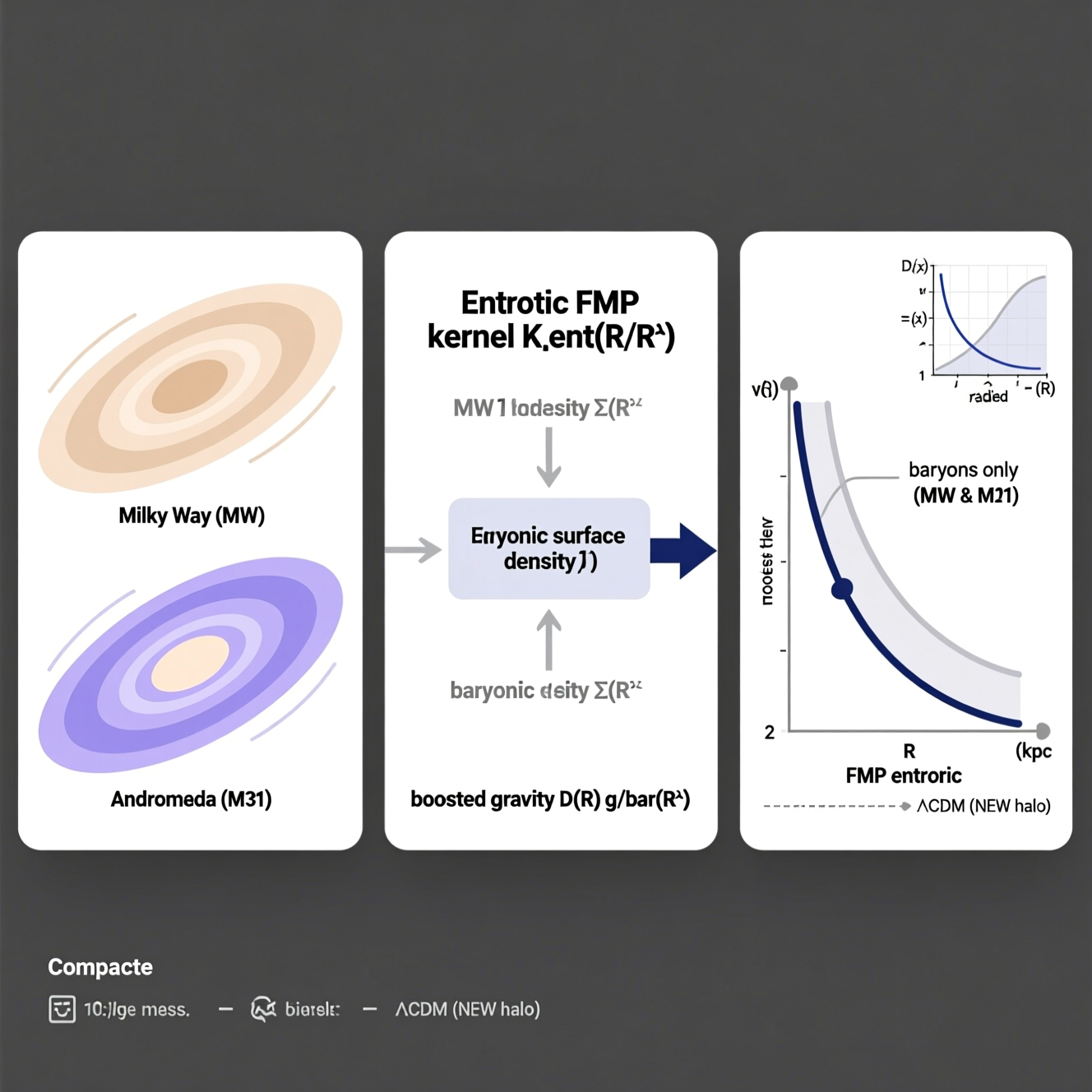
Future–Mass Projection (FMP) gravity is a non–local extension of general relativity in which the metric at a spacetime point couples to a weighted integral over the future stress–energy tensor along a closed time path. In earlier work, bilocal kernels in Fourier space of the form Ξd(k) = ε/(1 + k2/k2 0) were shown to lead, in the quasi–Newtonian limit, to configuration–space boost factors D(R)−1 ∝ K0(k0R) multiplying the baryonic acceleration, where K0 is a modified Bessel function of the second kind. This paper extends that framework by introducing an entropic response of the bilocal kernel to fluctuations in the baryonic surface density and tests the resulting effective boost function against the rotation curves of the Milky Way (MW) and M31 (Andromeda). Instead of treating each galaxy separately, we construct a phenomenological entropic boost D(x) as a function of scaled radius x = R/Rd, where Rd is the exponential disk scale length. The parametrisation D(x) = 1 + ε1 h 1 − e−(x/xs1)2i + ε2 h 1 − e−(x/xs2)2i is understood as an effective representation of a superposition of K0–type modes. We fit the global parameters (xs1, xs2, ε1, ε2) jointly toMWand M31 using fixed bulge+disk mass models from Sofue, while keeping track of the dominant baryonic systematics (thin– disk geometry and gas disks). For the stellar bulge+disk alone we find a joint best fit at xs1 = 0.50, xs2 = 3.0, ε1 = −0.231, ε2 = 1.50. This corresponds to a mild suppression of the effective gravity in the inner disk, D(0.5) ≃ 0.90, and an outer–disk boost asymptoting to D(x ≳ 5) ≃ 2.18 (velocity enhancement √ D ∼ 1.48). Applied to the Milky Way rotation curve of Sofue (2020) in the range 2–60 kpc and to a refined M31 curve in the range 2–40 kpc, the model reproduces the overall amplitude and radial trend with fractional root–mean–square deviations of ∼ 13% (MW) and ∼ 12% (M31). However, the formal reduced chi–squares are large (χ2 ν ≈ 25 for MW and χ2 ν ≈ 5 for M31), indicating that the combination of our simplified baryonic modelling and overly rigid kernel is not yet statistically acceptable. We estimate that including a gas disk with massMg ∼ 1010M⊙ and scale length Rg ∼ 7 kpc would raise the outer baryonic rotation speed by ∼ 5–8kms−1 in M31 beyond R ≳ 20 kpc, and yield a similar effect for the Milky Way, reducing the required outer boost amplitude ε2 by roughly 10–15%. Conversely, the spherical approximation for the stellar disk is known to overestimate the circular speed by ∼ 10–15% near R ≈ 2Rd compared to a thin exponential disk. These two systematics partially compensate each other but do not remove the need for a non–trivial boost. Within these caveats, a single, smooth boost in scaled radius is sufficient to bring MW and M31 rotation curves to within ∼ 10–15% in circular velocity using baryons only, suggesting that entropic FMP gravity is a promising but not yet competitive alternative to ΛCDM halo models on galaxy scales.
Keywords:
modified gravity
; dark matter
; galaxies: kinematics and dynamics
; Galaxy: kinematics and dynamics
; galaxies: individual (M31)
Copyright: This open access article is published under a Creative Commons CC BY 4.0 license, which permit the free download, distribution, and reuse, provided that the author and preprint are cited in any reuse.


