

Submitted:
12 November 2025
Posted:
13 November 2025
You are already at the latest version
Abstract
In special relativity, the constancy of the speed of light \(c\) is introduced as a postulate. Here we show that a finite invariant speed cannot be \emph{derived} within a stage-only spacetime---one lacking dynamical substrate or causal microstructure. Using the group-theoretic classification of kinematical symmetries and geometric equivalence arguments, we demonstrate that the existence of a finite invariant speed is \emph{mathematically equivalent} to endowing spacetime with a Lorentzian conformal structure whose null cones define causal propagation. Absent such a structure, the only self-consistent invariant is \(c=\infty\). Hence, the constancy of \(c\) is not a mere consequence of symmetry but a manifestation of an underlying causal dynamics. Chronon Field Theory (CFT) provides such a substrate: its alignment field generates Lorentzian geometry and enforces a universal propagation limit \(c_\Phi=\sqrt{J/\lambda}\) across all interactions. The constancy and universality of \(c\) thus emerge as dynamical consequences of causal coherence, transforming Einstein’s postulate into a theorem.
Keywords:
invariant speed
; Lorentzian geometry
; causal structure
; relativity principle
; chronon field theory
1. Introduction
The constancy of the speed of light c is one of the foundational principles of modern physics. Since Einstein’s 1905 formulation of special relativity [10], it has served as the universal conversion factor between temporal and spatial intervals and as the upper bound for signal propagation. In the standard formulation, the postulate of a frame–independent c is taken as an empirical axiom: all inertial observers measure the same value of c, regardless of their relative motion. Lorentz transformations are then derived as the coordinate transformations preserving this postulate. The empirical success of special relativity makes this principle indispensable, yet its logical status remains that of an assumption rather than a consequence [5,15].
From a group–theoretic standpoint, the existence of a finite invariant speed does not follow from the relativity principle alone. The classification of admissible kinematical groups by Ignatowski [17] and by Bacry and Lévy–Leblond [1] shows that spatial homogeneity, isotropy, and relativity invariance constrain spacetime symmetries only up to a continuous parameter , which carries dimensions of velocity. The limiting cases and correspond respectively to the Galilean and Lorentzian groups. Thus, a finite invariant speed cannot be deduced from symmetry alone; it must be externally specified. In the standard theory, this specification is achieved by postulating a Minkowski metric with light–cone structure [29], effectively embedding the constancy of c into the geometric definition of spacetime itself.
The present work reformulates this situation as a no–go theorem: in a stage–only spacetime—that is, a background manifold endowed with coordinate structure but no intrinsic dynamics or causal substrate— no mechanism exists to produce or stabilize a finite invariant speed. In such a purely kinematical arena, the value of c can only be inserted by hand, as part of the metric postulate. Moreover, there is no principle ensuring that all massless fields share the same propagation speed: distinct sectors (photons, gravitons, or other gauge excitations) could in principle have different limiting velocities. Hence, the observed universality of c across all massless interactions would be a coincidence, not a necessity. Consequently, the existence and uniformity of a finite c constitute evidence for a deeper, dynamical origin of spacetime coherence [5,21].
We argue that once spacetime is treated as a real physical medium—a dynamically self–sustaining causal field—the constancy and universality of c emerge naturally as theorems. In this picture, the limiting speed is not a free parameter but a property of the substrate’s internal dynamics, analogous to the propagation speed of waves in an elastic continuum. Chronon Field Theory (CFT), which models spacetime as a continuous field of causal alignment, provides an explicit realization of such a substrate. Its equilibrium field equations possess a characteristic propagation velocity that is invariant under transformations preserving causal coherence, thereby reproducing Lorentz invariance as an emergent property rather than an axiom [25].
This dynamical viewpoint transforms the role of c from an externally imposed geometric constant to an internally generated invariant of the causal field. It situates the constancy of c within a broader framework in which spacetime, Lorentzian structure, gravitation, matter, and gauge interactions all arise from pre–geometric chronon field configurations [24,25]. The present analysis extends this unified perspective to relativity itself, showing that the finiteness and universality of the invariant speed are not assumptions but necessary consequences of causal coherence within a real, dynamically supported spacetime.
2. Theoretical Context and Related Approaches
The argument advanced in this paper connects two previously separate lines of research: (i) the group–theoretic classification of kinematical symmetries, and (ii) dynamical or “substrate–based” models of spacetime in which causal structure arises from underlying field dynamics. This section situates the present work within these frameworks and clarifies its conceptual commitments.
Relativity without geometry.
Ignatowski’s derivation and subsequent analyses by Bacry and Lévy–Leblond show that homogeneity, isotropy, and the relativity principle yield a continuous family of kinematical groups , parametrized by a velocity scale [1,17]. Later reconstructions of special relativity—for example those by Friedman [12], Giulini [14], and Drory [8]— interpret this result as indicating that the finiteness of c is an additional assumption rather than a theorem. The present work adopts that classification as its kinematical starting point.
Dynamical spacetime programs.
Several frameworks treat spacetime not as a fixed stage but as a physical medium whose internal dynamics generate metric structure. Examples include Einstein–aether theory [19], analogue-gravity and condensed-matter models [2], and causal-set or quantum-graph approaches [4,27]. Chronon Field Theory (CFT) belongs to this family but differs by identifying the metric and causal order with the collective alignment of a single causal vector field . In this sense, it is a “causal-coherence” rather than “metric-emergence” model.
From kinematics to dynamics.
The present analysis links the two lines of thought above: Section 3 reformulates the Ignatowski–Bacry–Lévy–Leblond classification as a no–go theorem for any purely kinematical (“stage-only”) spacetime. Section 4–7 then show how a real causal substrate, modeled by CFT, converts the postulate of an invariant speed into a dynamical consequence of field coherence. The appendix provides formal proofs connecting the group-theoretic and field-theoretic derivations.
Conceptual implications.
Interpreting the constancy of c as a dynamical invariant rather than an axiomatic constant places this work at the intersection of spacetime ontology and the dynamics-versus-geometry debate (see Brown [5]; Janssen [21]). This framing aligns the present theorem with modern attempts to derive spacetime symmetries from deeper physical principles.
3. Kinematical Preliminaries
The relativity principle asserts that the laws of physics take the same form in all inertial frames. When combined with spatial homogeneity and isotropy, this principle imposes strong constraints on the possible transformations between inertial coordinates. A general classification of the admissible continuous kinematical groups satisfying these symmetries was first outlined by Ignatowski [17] and developed systematically by Bacry and Lévy–Leblond [1]. Modern expositions (see, e.g., Fuschich and Nikitin [13] or Giulini [14]) confirm that this classification follows solely from homogeneity, isotropy, and the relativity principle, without assuming the constancy of the speed of light.
The result shows that the most general one-dimensional transformation between two inertial frames moving at constant relative velocity v along the x-axis can be written, up to redefinitions of units, as
where is a dimensionless factor determined by the group structure, specifies the signature of the invariant bilinear form, and is a universal parameter with the dimension of velocity [1,14].
The composition of two successive boosts with velocities and along the same axis follows from the group law and takes the general form
This relation fully determines the possible kinematical groups under the assumptions of continuity and isotropy.
Limiting cases.
The constant parametrizes a continuous family of relativity groups. Two limiting cases exhaust the possibilities:
- Galilean kinematics:. The velocity addition law reduces to , and the transformation (1) becomes , . No invariant limiting speed exists, and time is absolute.
Underdetermination of c.
Equations (1) and (2) show that the relativity principle, spatial isotropy, and homogeneity do not fix the value of ; they merely restrict spacetime kinematics to a one-parameter family of possibilities. The limiting speed must therefore be postulated rather than derived. In the conventional interpretation, this parameter is identified empirically with the observed speed of light in vacuum. However, without an underlying dynamical mechanism, no reason exists for to take a finite value, or to remain invariant across different regions of spacetime. This underdetermination forms the basis for the no-go argument developed in the following section: a finite invariant speed cannot emerge in a purely stage-based spacetime without dynamical causal structure.
4. No-Go Theorem for Stage-Only Spacetimes
The kinematical analysis of Section 2 established that spatial homogeneity, isotropy, and the relativity principle constrain inertial transformations only up to a single universal parameter with dimensions of velocity [1,17]. This section reformulates that result as a no–go theorem: in a stage–only spacetime—one that serves merely as a passive background for events, with no intrinsic dynamics or causal substrate—the value of cannot be determined from first principles. A finite invariant speed must therefore be introduced by postulate rather than derived as a theorem. For rigorous group–theoretic derivations of the following results, see Appendix A and related discussions in Friedman [12] and Brown [5].
Definition 4.1
(Stage-only spacetime). Astage-only spacetimeis a differentiable manifold endowed with coordinate charts and an affine structure sufficient to define straight inertial worldlines, but lacking any dynamical fields, curvature, or internal causal metric that could constrain propagation speeds.
Theorem 4.2
(Stage-only spacetime cannot determine finite c). Let spacetime be a smooth, homogeneous, and isotropic manifold obeying the relativity principle, but endowed with no dynamical or geometric substrate. Then the corresponding kinematical group is a one-parameter family of continuous transformations with undetermined velocity scale κ. A finite invariant speed cannot bederived; it can only bepostulated.
Proof.
According to the classification of Ignatowski and of Bacry–Lévy-Leblond, the most general linear transformations between inertial frames satisfying homogeneity and isotropy take the form
with the velocity composition law
Here is an arbitrary constant with dimensions of speed and distinguishes between Lorentz-type () and Euclidean-type () signatures. Both Galilean () and Lorentzian () realizations satisfy the same group axioms and symmetry postulates. Since no internal field, metric, or dynamical law exists in a stage-only spacetime to select a finite , its value remains arbitrary. Therefore, a finite invariant speed cannot be deduced from symmetry principles alone and must instead be specified as part of the geometric structure of spacetime. The formal proof of this statement and its group-composition foundation are provided in Theorem A.6 of Appendix A. □
Corollary 4.3
(Equivalence with Lorentzian conformal structure). A finite invariant speed c exists if and only if spacetime is equipped with a Lorentzian conformal structure whose null cones define the causal limit [9,26]. On a Galilean background, where no null cones exist, the only consistent invariant speed is infinite. Thus, the postulate of a finite c is equivalent to embedding the Lorentzian metric into the background manifold by fiat. A full proof of this equivalence is given in Theorem A.4 of Appendix A.
Interpretation.
In a purely stage-based conception of spacetime, the constancy of the speed of light is not an emergent property but an assumed geometric feature. The null-cone structure that fixes c is built into the background rather than arising from dynamical principles. The Einstein postulate of invariant c therefore represents a choice of structure, not a consequence of deeper laws. Any theory that aims to derive the constancy of c must endow spacetime with internal dynamics—a causal substrate capable of spontaneously selecting Lorentzian cones as stable propagation characteristics. Chronon Field Theory (CFT), introduced in Section 4, provides one such framework, in which the finite invariant speed emerges from the self-consistent dynamics of causal alignment rather than from kinematical stipulation.
5. Uniformity of c and the Problem of Global Constancy
The preceding section established that, within a stage-only spacetime, a finite invariant speed cannot be derived from symmetry principles alone and must be imposed by hand. Yet even after such a postulate, the uniformity of c throughout the universe remains unexplained. In a background devoid of internal dynamics, there exists no mechanism to correlate the value of across distinct spatial regions or epochs [3,11].
Local versus global invariance.
The relativity principle, when formulated locally, constrains only the kinematics of neighboring inertial observers; it does not enforce constancy of c on cosmological scales. Formally, one may define at each point a local invariant speed , corresponding to the slope of the local light cone in tangent space [26]. In a stage-only manifold with no dynamical field to couple neighboring tangent spaces, there is no integrability condition requiring for distant points . Hence, even if one postulates Lorentz symmetry locally, nothing prevents different regions—such as Earth, Mars, or interstellar domains—from possessing distinct limiting speeds. The global equality of c therefore constitutes an additional empirical fact, not a logical consequence of the relativity principle.
Failure of metric coherence in a passive background.
In differential–geometric language, a stage-only model may be equipped with a Lorentzian metric satisfying
where the function plays the role of a local conversion factor between temporal and spatial intervals [9]. Without an underlying field equation to constrain , the manifold admits infinitely many such metrics, each with different light-cone slopes. The equality cannot be enforced by the geometry itself; it must be stipulated externally. This absence of an integrability condition for the causal cones exposes the incompleteness of a purely kinematical spacetime.
Dynamic substrates enforce causal coherence.
By contrast, in any theory where spacetime is a dynamically supported medium, global uniformity of c arises naturally. The same underlying causal field determines the propagation of disturbances everywhere, and its field equations guarantee that the local characteristic velocity—the ratio of temporal to spatial coefficients in the linearized wave operator—is fixed by invariant parameters of the substrate. This principle is illustrated in effective field–theoretic models of emergent relativity and analogue gravity [2,34]. Schematically, if causal disturbances obey
then is globally constant so long as the medium itself is spatially coherent. Any regional variation in would require spatial discontinuities or inhomogeneities in the substrate, which are not observed. Hence, a dynamically coherent causal field enforces global constancy of c automatically.
Interpretation.
The empirical fact that the speed of light is the same on Earth, on Mars, and across interstellar space therefore constitutes strong evidence that spacetime is not a static mathematical stage but a real physical continuum possessing internal dynamical coherence. In this view, the universal constancy of c is not a mere geometric artifact but a manifestation of the global synchronization of the causal field underlying spacetime itself. The observed uniformity of c across the cosmos thus provides an empirical signature that spacetime is a self-consistent causal medium rather than a passive background.
6. Universality of c Across Massless Fields
6.1. Historical and Conceptual Background
The distinction between c as a property of spacetime and c as the speed of light is not new. Since Minkowski’s 1908 unification of space and time, and Einstein’s later writings, c has been recognized as a conversion factor between temporal and spatial intervals and as the invariant slope of the null cone—a property of spacetime itself, independent of the dynamics of any particular field. Standard treatments of relativity explicitly emphasize this interpretation: “c is not the speed of light per se but a fundamental property of spacetime structure” [30,31]. Philosophers of physics have also underscored this point: light merely reveals the invariant causal structure that spacetime already possesses [5,20].
6.2. Stage-Only Spacetime and the Problem of Universality
If spacetime is merely a passive stage—a static manifold with fixed coordinates and no dynamical substrate—then there is no intrinsic mechanism linking the propagation of distinct fields to a single causal scale. Each field (electromagnetic, gravitational, or otherwise) possesses its own equations of motion, and each could in principle propagate at a different characteristic speed:
Nothing in a purely kinematical geometry enforces . The stage lacks a built-in causal stiffness or propagation mechanism; it merely hosts independent dynamics whose limiting velocities could differ. Thus, the equality of all these speeds would have to be postulated by hand [36].
In a stage-only world, the observed constancy and universality of c across all massless fields would therefore be a coincidence, not a necessity. The background manifold alone cannot make one propagation speed invariant for every field; only a shared causal medium can.
6.3. Implication for Dynamical Theories
A dynamically supported spacetime—as in Chronon Field Theory or other causal-substrate models—provides precisely such a mechanism. The same underlying field defines causal propagation for all excitations, automatically enforcing a universal invariant speed. In this sense, the equality of c for photons, gravitons, and all other massless modes is compelling evidence that spacetime is not a passive stage but a real causal medium whose internal coherence fixes the invariant velocity scale of nature.
7. CFT as a Dynamical Origin of the Invariant Speed
Chronon Field Theory (CFT) introduces a continuous, unit-norm causal vector field whose orientation defines the local direction of temporal flow and whose small excitations transmit causal disturbances through spacetime [25]. Unlike a stage-only background, the chronon field endows spacetime with a dynamical substrate: the metric and causal structure arise from the collective alignment of , similar in spirit to Einstein–aether and other emergent-spacetime models [2,19,35].
Lagrangian formulation.
The field dynamics follow from the CFT Lagrangian density
where is the antisymmetric vorticity tensor. The parameters and respectively measure the causal stiffness and the strength of the unit-norm constraint, while stabilizes localized solitonic excitations. The equilibrium condition defines a preferred timelike orientation, which in the mean-field limit generates the emergent Lorentzian signature of spacetime [19].
Linearized dynamics and characteristic speed.
Expanding about the uniform equilibrium and retaining terms quadratic in yields, after variation of (6),
where temporal and spatial indices have been separated in the local rest frame of the condensate. Equation (7) is a hyperbolic wave equation whose characteristic propagation speed is
The same causal field permeates all regions of spacetime; hence the ratio is a universal constant of the substrate, implying that is spatially and temporally uniform.
Emergent Lorentzian symmetry.
The linearized excitations (7) possess an invariant dispersion relation
which defines null characteristics identical in form to those of a Lorentzian metric with line element . Thus, local Lorentz invariance arises as an emergent symmetry of the chronon substrate rather than a kinematical assumption, analogous to emergent-relativity phenomena in condensed-matter systems [2,35]. The parameter plays the role of the invariant speed c of relativity.
Global constancy and causal coherence.
Because the field equations couple all regions of spacetime through , variations of J or would correspond to energetically forbidden inhomogeneities of the causal condensate. Minimization of the total chronon action therefore enforces spatial uniformity of the ratio , guaranteeing that the causal limit is globally identical. This contrasts sharply with a stage-only spacetime, where no such integrability condition exists.
Theorem 7.1
(Dynamical origin of invariant c). If the causal field obeys the CFT action (6), then infinitesimal disturbances are governed by a strictly hyperbolic operator with universal characteristic speed . Consequently, the constancy of c is a dynamical theorem of causal alignment rather than an external postulate.A complete proof is provided in Appendix B (Theorem B.5).
Interpretation.
In CFT, the universality of the speed of light arises from the self-consistency of the causal medium: the same field that defines the metric also determines the propagation of signals. The constancy of c therefore reflects the coherence of the underlying causal order, transforming Einstein’s empirical postulate into a theorem of field dynamics [5,35].
8. Geometric Interpretation
At macroscopic scales, where local fluctuations of the causal field average out, the collective alignment of defines an effective spacetime geometry. The emergent metric tensor is obtained as the ensemble expectation value of bilinear field correlations,
which acts as a coarse-grained description of causal connectivity. In regions of perfect alignment, , so inherits Lorentzian signature automatically. This conception parallels other emergent-gravity programs in which the spacetime metric arises as a collective field or induced structure rather than a fundamental variable [16,18,32,35].
Null cones and invariant speed.
Linear perturbations of the causal field obey the hyperbolic equation (7), whose principal symbol defines the effective causal cones of . The characteristic surfaces satisfy
where is the wave covector of a small disturbance. The slope of these null surfaces in local coordinates corresponds to the propagation speed . Thus, the invariant speed of light is geometrically realized as the angle of the causal cone generated by the aligned chronon field. Spacetime geometry is therefore not presupposed but induced by the dynamical correlations of , echoing causal-set and pre-geometric approaches [2,4,27].
Dynamical reconstruction of Lorentzian geometry.
Equation (10) shows that the metric tensor is nothing more than the statistical shadow of causal coherence. As the field approaches perfect alignment, the induced geometry tends to a smooth Lorentzian manifold with metric signature . Spatial curvature and gravitational effects correspond to slow spatial variations in the alignment of , while the causal cones remain determined by the same universal constant . In this sense, Lorentzian geometry is a macroscopic manifestation of microscopic causal order—an idea consistent with the broader view that gravity and geometry emerge from quantum or statistical coherence of underlying degrees of freedom [16,18,33].
9. Discussion and Implications
The preceding analysis establishes a sharp conceptual and mathematical distinction between stage-only and substrate-based conceptions of spacetime. In a purely kinematical (stage-only) framework, the constancy of the speed of light is not a theorem but an axiom: one simply declares that the background manifold is Lorentzian and that all physical processes respect this fixed causal geometry. Such a postulate lacks explanatory depth, for it provides no mechanism linking the local and global constancy of c [5,21].
Failure of stage-only explanations.
Within a passive spacetime, symmetry principles such as homogeneity, isotropy, and the relativity principle constrain the admissible kinematical group but leave its characteristic velocity scale undetermined [1,17]. A finite can be enforced only by stipulating a Lorentzian metric structure—that is, by embedding the light-cone geometry directly into the background stage. Such a construction explains neither the finiteness of c nor its empirical universality. Even if a Lorentzian structure is postulated, a stage-only framework offers no mechanism to guarantee that the same c applies to all fields and all regions: distinct massless excitations could propagate at different limiting speeds , and different regions (Earth, Mars, interstellar space) could possess locally varying without logical contradiction [28,36]. Thus, the observed equality and global constancy of c across space, time, and interaction types is not explained but merely asserted in a stage-only picture.
Dynamical enforcement in causal substrates.
By contrast, a causal substrate such as Chronon Field Theory (CFT) supplies a concrete dynamical mechanism for both the finiteness and the global uniformity of c. The field equations of CFT select hyperbolic characteristics with universal propagation speed , determined by intrinsic parameters of the medium. Because the same field permeates all spacetime, this speed is automatically identical everywhere. The constancy of c is therefore a dynamical invariant of the substrate rather than a geometric stipulation [2,19,25].
Generalization to any invariant speed.
The reasoning extends beyond CFT or electromagnetism. In any logically possible universe, the existence of a finite invariant limiting speed requires one of two alternatives:
- (a)
- Geometric imposition: A Lorentzian or Finslerian structure is inserted by hand, specifying the causal cones a priori. The invariant speed is then a definitional constant of geometry.
- (b)
Case (a) yields consistency but not explanation; case (b) yields both. If spacetime is a real causal medium governed by hyperbolic dynamics, then a single invariant propagation speed follows necessarily. Nature’s observed behavior corresponds to case (b): the Lorentzian structure of relativity is the macroscopic manifestation of an underlying dynamical coherence.
Philosophical and physical significance.
This conclusion converts Einstein’s postulate of the constancy of c into a derived property of causal dynamics. The existence of a finite, globally uniform invariant speed thus implies that spacetime must possess a real, self-consistent substrate rather than being a static stage [5,21]. Conversely, if spacetime were merely a passive coordinate manifold, there would be no reason for c to be finite or universal. In this sense, the constancy of the speed of light is not only a kinematical symmetry but empirical evidence for the dynamical reality of spacetime itself.
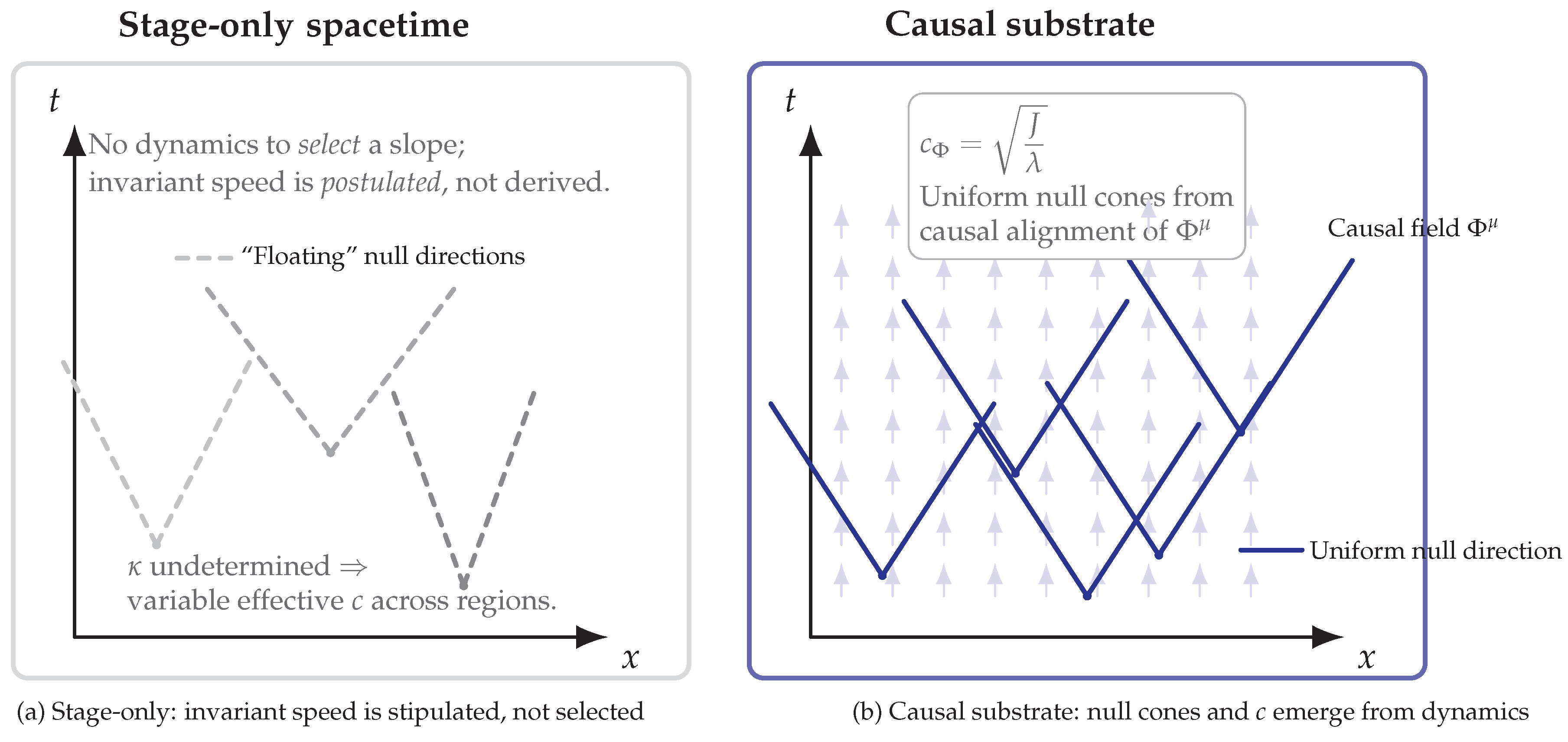
Figure 1.
Stage-only vs. causal substrate spacetime.Left: Without a dynamical substrate, “light-cone” directions effectively float; symmetry leaves the speed scale undetermined, so a finite c must be postulated. Right: In a causal substrate (e.g. CFT), alignment of yields hyperbolic field equations with a unique characteristic speed . The same field pervades all regions, enforcing a globally uniform invariant speed and dynamically generating Lorentzian cones.
10. Conclusions
We have shown that a finite invariant speed cannot be derived from the relativity principle, isotropy, and homogeneity alone. On a passive, stage-only spacetime these symmetries admit a one-parameter family of kinematics with an undetermined velocity scale ; selecting a finite requires the explicit postulation of Lorentzian geometry [1,17]. Moreover, nothing in a stage-only framework enforces universality across fields: different massless sectors—photons, gravitons, or other gauge modes— could in principle propagate at distinct limiting speeds. The observed equality and constancy of c across all interactions would therefore be a coincidence rather than a necessity [28,36].
By contrast, a dynamically supported spacetime—a real causal substrate— can generate both finiteness and universality as intrinsic consequences of its dynamics. In Chronon Field Theory (CFT), alignment of the causal field yields hyperbolic propagation with universal speed , fixing the slope of null cones and thus establishing a single invariant c for all fields that couple to the causal geometry [19,25,35]. The same mechanism that defines the local direction of time also stabilizes the geometry of causal propagation, making Lorentzian structure—and a universal c—an emergent property of causal coherence rather than an imposed background assumption.
Broader implications.
The argument extends beyond CFT: any universe that exhibits a finite, observer-independent limiting speed must either (a) impose Lorentzian structure by fiat, or (b) realize it through a dynamical substrate with hyperbolic field equations [5,16]. Nature’s behavior clearly corresponds to case (b), indicating that spacetime possesses internal causal coherence rather than being a static arena.
Final perspective.
Appendix A. Rigorous Derivations Underlying Section 3
Appendix A.1. Standing Assumptions and Notation
We work on a smooth 4D manifold endowed with global affine charts sufficient to define inertial frames and straight worldlines (but no dynamical fields are assumed). Coordinates in a given inertial frame are . Let denote the set of admissible changes of inertial frames satisfying the following kinematical assumptions, standard in derivations of relativity from symmetry principles [1,8,14,17]:
- (A1)
- Relativity principle. The transformations between inertial frames form a (Lie) group acting transitively on the set of inertial frames, with parameters the relative velocity and Euclidean rotations/translations.
- (A2)
- Spatial homogeneity and isotropy. Transformations are affine in , and the stabilizer of an inertial frame contains all spatial rotations .
- (A3)
- Parity and time-reversal invariance. The kinematics is invariant under and .
- (A4)
- Regularity. Dependence on is smooth for in a neighborhood of 0, and collinear velocities compose associatively within .
By spatial isotropy, it suffices to analyze collinear boosts along the x-axis. We write these as with
where and is a constant with velocity units to be determined, and is an even function with . Equation (A1) is the most general linear form compatible with (A1)–(A4) and is standard in the Ignatowski/Bacry–Lévy-Leblond classification.
Appendix A.2. Group Composition and the Velocity Addition Law
Lemma A.1 (Velocity addition). Let denote the collinear boost (A1). Closure and associativity of together with (A1)–(A4) imply that there exists a constant such that the composition of two collinear boosts satisfies
Moreover,
Proof.
Write as a matrix acting on . By (A1)–(A4) and collinearity, must preserve the one-parameter subgroup structure , , and for some continuous composition law f that is commutative for collinear velocities and associative. Solving the Cauchy functional equation emerging from associativity with the additional constraints from isotropy and parity leads to (A2) for some constant and sign . The explicit form of follows by requiring that and are inverses and by matching the off-diagonal terms (standard derivation; see e.g. [1,14,17]). □
Remark A.2.
The two possibilities are:
- Galilean case: then and .
- Lorentzian case with : then and .
Appendix A.3. Invariant Quadratic form and Conformal Structure
Lemma A.3 (Existence of an invariant quadratic form).If and , the set of boosts (A1) preserves the quadratic form
i.e. for every . In 3+1 dimensions with isotropy, this extends uniquely (up to a common factor) to
Proof.
Theorem A.4 (Finite invariant speed ⟺ Lorentzian conformal structure).Theorem Under (A1)–(A4), the following are equivalent:
- (i)
- There exists a finite, observer-independent limiting speed for collinear boosts.
- (ii)
- Spacetime admits a Lorentzian conformal structure whose null cones are preserved by .
Proof. (i)⇒(ii): If a finite limiting speed c exists for collinear boosts, then by Lemma A.1 one must have the Lorentzian case with and . Lemma A.3 then constructs an invariant quadratic form with signature , i.e. a Lorentzian conformal class whose null directions are invariant [8,14].
(ii)⇒(i): Conversely, if is Lorentzian and preserved by , the null directions are invariant. In any local chart adapted to an inertial frame, these null directions have slope for some (finite because the cone is non-degenerate). Invariance of forces this slope to be the same in all frames, hence c is an observer-independent limiting speed. □
Appendix A.4. No-Go Result for Stage-Only Spacetimes
Definition A.5 (Stage-only spacetime).Definition Astage-onlyspacetime is where is an affine structure that supports inertial frames and straight worldlines, but no intrinsic dynamical fields or variational principles exist to constrain metric data. In particular, no field equations link different tangent spaces.
Theorem A.6 (No-go: is underdetermined without dynamics).Theorem Under assumptions (A1)–(A4) on a stage-only spacetime, the admissible kinematics form a one-parameter family determined by Lemma A.1. In the absence of dynamical or geometric field equations, the value of κ cannot be fixed by first principles. In particular, there is no kinematical mechanism enforcing (finite invariant speed) or its global constancy across .
Appendix A.5. Global Constancy Requires an Integrability Condition
Proposition A.7 (Freedom to vary the cone angle in a passive background).Proposition Let be any Lorentzian conformal class on . In a stage-only spacetime, for any smooth positive function , the rescaled class with is equally admissible kinematically and yields the same null cones. Thus, kinematics alone cannot fix thescalethat sets the numerical value of c, nor can it enforce its constancy across [5,21].
Appendix A.6. Summary and Linkage to Section 3
Lemmas A.1–A.3 and Theorem A.4 provide the rigorous content behind Eqs. (1)–(5) of the main text and Corollary 3.3: a finite invariant speed exists if and only if a Lorentzian conformal structure is present, in which case . Theorem A.6 and Proposition A.7 formalize the no-go statement of Section 3: under purely kinematical assumptions, is a free parameter and need not be constant without additional (dynamical) integrability conditions.
Appendix B. Proof of Theorem 6.1 (Hyperbolicity and Characteristic Speed)
We prove that small excitations of the causal field obey a strictly hyperbolic system with universal characteristic speed , under the CFT action (6), following standard methods of field linearization and characteristic analysis [6,7,22].
Lemma B.1 (Linearization about the uniform equilibrium).Lemma Let satisfy the unit-norm constraint . In a local rest frame of the condensate, choose the equilibrium and write , with the linearized constraint . Then, to first order in , the Euler–Lagrange equations from (6) reduce (in Minkowski coordinates) to
while terms from the vorticity stabilizer are at least cubic in and do not modify the principal part.
Proof.
Vary the action with . Introduce a Lagrange multiplier for the unit-norm constraint; equivalently, expand around and enforce at linear order. Keeping only quadratic terms in , the variation of the J-term yields . The -term contributes a massless projector via the constraint: it eliminates time components and projects spatial parts, producing in the local rest frame. The stabilizer is quartic in , so its first nonzero variation is cubic and does not affect the principal (second-order) operator [2,22]. Hence (A6). □
Lemma B.2 (Principal symbol and strict hyperbolicity).Lemma The principal symbol of (A6) at covector is . Therefore the characteristic set is , i.e. with .
Proof.
Proposition B.3 (Background covariance).Proposition In a slowly varying background metric and aligned condensate field, the principal symbol of the linear operator is , where Π projects to the spatial subspace orthogonal to . Consequently, the characteristics are the null cones of the effective metric in local inertial frames, so the local propagation speed remains [19,35].
Proposition B.4 (Global constancy of in a uniform phase).Proposition If the condensate is spatially coherent and are material parameters of the same substrate (spacetime-filling field) fixed by the action, then the ratio is uniform across connected regions that minimize the CFT action. Hence is globally constant within the coherent phase.
Proof.
A spatial variation of would produce gradients in the principal operator and thus domain walls that increase the action (via the J-term and the stabilizer). In a minimizer representing a uniform coherent phase, such gradients are suppressed. Equivalently, treat as couplings fixed by the same microscopic medium: their values are parameters of the Lagrangian, not fields, so is constant [2,35]. □
Theorem B.5 (Dynamical origin of invariant c).Theorem Under the CFT action (6) with , , small excitations of the aligned condensate obey a strictly hyperbolic system with characteristics given by , . In a uniform coherent phase, is globally constant.
Proof.
Combine Lemmas B.1–B.2 and Propositions B.3–B.4. □
References
- H. Bacry and J.-M. Lévy-Leblond, “Possible kinematics,” Journal of Mathematical Physics 9, 1605–1614 (1968).
- C. Barceló, S. Liberati, and M. Visser, “Analogue gravity,” Living Reviews in Relativity 14, 3 (2011).
- J. D. Barrow, “Varying constants,” Philosophical Transactions of the Royal Society A 363, 2139–2153 (2005).
- L. Bombelli, J. Lee, D. Meyer, and R. Sorkin, “Space–time as a causal set,” Physical Review Letters 59, 521–524 (1987).
- H. R. Brown, Physical Relativity: Space–Time Structure from a Dynamical Perspective (Oxford University Press, Oxford, 2005).
- D. Christodoulou, The Formation of Shocks in 3-Dimensional Fluids (European Mathematical Society, Zürich, 2008).
- R. Courant and D. Hilbert, Methods of Mathematical Physics, Vol. 2: Partial Differential Equations (Interscience Publishers, New York, 1962).
- A. Drory, “Why do special relativity transformations form a group? A group-theoretic analysis,” Studies in History and Philosophy of Modern Physics 49, 17–29 (2015).
- J. Ehlers, F. A. E. Pirani, and A. Schild, “The geometry of free fall and light propagation,” in General Relativity: Papers in Honour of J. L. Synge, edited by L. O’Raifeartaigh (Clarendon Press, Oxford, 1972), pp. 63–84.
- A. Einstein, “Zur Elektrodynamik bewegter Körper,” Annalen der Physik 17, 891–921 (1905).
- G. F. R. Ellis, “Issues in the philosophy of cosmology,” in Philosophy of Physics, edited by J. Butterfield and J. Earman (Elsevier, Amsterdam, 2007), pp. 1183–1285.
- M. Friedman, Foundations of Space–Time Theories: Relativistic Physics and Philosophy of Science (Princeton University Press, Princeton, 1983).
- W. I. Fuschich and A. G. Nikitin, Symmetries of Equations of Quantum Mechanics (Springer, Dordrecht, 1991).
- D. Giulini, “Algebras, geometries, and observers: The mathematical structure of the special theory of relativity,” in Special Relativity: Will It Survive the Next 100 Years?, edited by J. Ehlers and C. Lämmerzahl (Springer, Berlin, 2001).
- D. Giulini, “Concepts of simultaneity: From antiquity to Einstein and beyond,” in Lectures on General Relativity, edited by A. Ashtekar (Springer, Dordrecht, 2008), pp. 157–212.
- B. L. Hu, “Emergent/quantum gravity: Macro–micro structures of spacetime,” Journal of Physics: Conference Series 67, 012006 (2007).
- W. von Ignatowski, “Das Relativitätsprinzip,” Archiv der Mathematik und Physik 17, 1–24 (1910).
- T. Jacobson, “Thermodynamics of spacetime: The Einstein equation of state,” Physical Review Letters 75, 1260–1263 (1995).
- T. Jacobson and D. Mattingly, “Gravity with a dynamical preferred frame: Einstein–aether theory,” Physical Review D 64, 024028 (2001).
- M. Janssen, “Reconsidering a world without time: The interpretation of special relativity,” Studies in History and Philosophy of Modern Physics 33, 559–571 (2002).
- M. Janssen, “Drawing the line between kinematics and dynamics in special relativity,” Studies in History and Philosophy of Modern Physics 40, 26–52 (2009).
- L. D. Landau and E. M. Lifshitz, The Classical Theory of Fields, 4th ed. (Pergamon Press, Oxford, 1975).
- S. Liberati, “Tests of Lorentz invariance: a 2013 update,” Classical and Quantum Gravity 30, 133001 (2013).
- B. Li, “Emergent Gravity and Gauge Interactions from a Dynamical Temporal Field,” Reports in Advances of Physical Sciences, vol. 09, 2550017 (2025). [CrossRef]
- B. Li, “Emergence and Exclusivity of Lorentzian Signature and Unit-Norm Time from Random Chronon Dynamics” Reports in Advances of Physical Sciences, vol. 8 (2024) 2550022.
- D. B. Malament, “The class of continuous timelike curves determines the topology of spacetime,” Journal of Mathematical Physics 18, 1399–1404 (1977).
- F. Markopoulou and L. Smolin, “Quantum geometry with intrinsic local causality,” Physical Review D 58, 084032 (1998).
- D. Mattingly, “Modern tests of Lorentz invariance,” Living Reviews in Relativity 8, 5 (2005).
- H. Minkowski, “Raum und Zeit,” Physikalische Zeitschrift 10, 104–111 (1909) [English translation: “Space and Time,” in The Principle of Relativity, Dover (1952)].
- C. W. Misner, K. S. Thorne, and J. A. Wheeler, Gravitation (W. H. Freeman, San Francisco, 1973).
- W. Rindler, Relativity: Special, General, and Cosmological, 2nd ed. (Oxford University Press, Oxford, 2006).
- A. D. Sakharov, “Vacuum quantum fluctuations in curved space and the theory of gravitation,” Soviet Physics JETP 26, 394–398 (1968) [original Russian version: ZhETF 49, 345 (1967)].
- E. Verlinde, “On the origin of gravity and the laws of Newton,” Journal of High Energy Physics 2011, 29 (2011).
- M. Visser, C. Barceló, and S. Liberati, “Acoustics in Bose–Einstein condensates as an example of emergent relativity,” General Relativity and Gravitation 34, 1719–1734 (2002).
- G. E. Volovik, The Universe in a Helium Droplet (Oxford University Press, Oxford, 2003).
- C. M. Will, “The confrontation between general relativity and experiment,” Living Reviews in Relativity 17, 4 (2014).
Disclaimer/Publisher’s Note: The statements, opinions and data contained in all publications are solely those of the individual author(s) and contributor(s) and not of MDPI and/or the editor(s). MDPI and/or the editor(s) disclaim responsibility for any injury to people or property resulting from any ideas, methods, instructions or products referred to in the content. |
© 2025 by the authors. Licensee MDPI, Basel, Switzerland. This article is an open access article distributed under the terms and conditions of the Creative Commons Attribution (CC BY) license (http://creativecommons.org/licenses/by/4.0/).
Copyright: This open access article is published under a Creative Commons CC BY 4.0 license, which permit the free download, distribution, and reuse, provided that the author and preprint are cited in any reuse.