
Submitted:
19 October 2025
Posted:
03 November 2025
You are already at the latest version
Abstract
This study reviews recent advances in the scientific and technological archaeology of ancient Chinese jade artifacts, focusing on material identification, alteration, provenance tracing. Using non-destructive analytical techniques such as portable XRF, SEM, FTIR, Raman spectroscopy, and LA-ICP-MS, archaeometric research has clarified the mineralogical diversity of jades and established systematic methods for differentiating nephrite and turquoise sources. Controlled heating and acid–base experiments have elucidated the mechanisms and color formation of alteration, providing key insights into post-depositional processes. Provenance studies integrating trace-element, rare-earth-element, and isotopic analyses have built multi-level hierarchical models for source discrimination. Micro-wear and experimental replication have reconstructed ancient jade-working technologies, while machine learning offers new perspectives for typology and cultural interpretation. Overall, these interdisciplinary approaches demonstrate that the integration of material science and archaeology is crucial for understanding the technological, cultural, and exchange networks that shaped Chinese jade culture from the Neolithic to the Qing period.
Keywords:
ancient jade artifacts
; nephrite
; turquoise
; China
Introduction
Throughout the development of Chinese civilization, artifacts made from a wide range of materials have appeared successively including stone, jade, pottery, porcelain, bronze, iron, glass, and textiles. As technology advanced, some materials emerged while others were gradually replaced or abandoned. However, jade artifacts have remained in continuous use up to the present day, occupying a significant place in ancient human activities.
The use of jade in ancient China was closely related to human society and cultural practices. Chronologically, jade artifacts have been used since the Neolithic period (ca. 9000 BC) [1], continuing through the Qing dynasty and even into modern times, reflecting an exceptionally long duration of use. Spatially, the use of jade had already spread widely during the Neolithic period, extending from the northeast to the south of China, from Tibet in the west to the coastal and insular regions in the east, and even beyond the present-day borders of China—demonstrating its broad geographical distribution. Functionally, jade artifacts served diverse purposes, including ritual jade artifacts, ornamental jades, funerary jades, and daily-use jades, reflecting their broad social roles and cultural importance.
The life history of ancient Chinese jade artifacts can be divided into five stages: the raw-material stage, manufacturing stage, usage stage, burial or transmission stage, and the archaeological research and conservation stage (Figure 1) [2]. In the first stage—the raw-material stage—jade raw material was obtained either through collection or mining, with early societies relying mainly on collection. In the second stage—the manufacturing stage—ancient craftspeople selected appropriate jade raw materials according to different purposes and design requirements. The jade artifacts were then shaped, carved, and polished through multiple processes, resulting in objects with specific decorative patterns and forms.The third stage—the usage stage—can be divided according to function into ornamental jades, ritual jade artifacts, funerary jades, and daily-use jades, with variations in function and meaning across historical periods.In the fourth stage, jade artifacts were either buried with their owners or passed down through generations. In some cases, tombs of earlier periods were reopened by later generations, and the buried jades were reused and reburied, demonstrating the cyclical nature of jade use and transmission.The fifth stage begins after archaeological excavation, when unearthed jade artifacts undergo research, documentation, and conservation. These studies not only reveal aspects of ancient human behavior and jade culture, but also contribute to the preservation and continuation of Chinese cultural heritage.
Corresponding to this life history, research on ancient Chinese jades can be categorized into seven main areas: provenance study of jade raw materials, material analysis, jade craftsmanship and manufacturing technology, archaeological typology study, jade culture research, conservation of ancient jades, and alteration studies (Figure 1). Among these, jade culture research, archaeological typology study, and material analysis have developed into mature and systematic research fields with well-established methodologies and extensive results, forming a comprehensive understanding of jade artifacts from different periods and regions. By contrast, alteration studies, technological craftsmanship studies, and provenance studies are still developing; their research systems are under construction, and their methodologies are becoming increasingly sophisticated. Over the past decade, significant progress has been achieved in the alteration, craftsmanship, and provenance studies of ancient jades. This paper provides a systematic review of recent advances in the material analysis, alteration, and provenance study of ancient Chinese jade artifacts.
Material Studies of Ancient Jades
Over the past two decades, one of the most significant achievements in the material study of ancient jade artifacts has been the use of archaeometric techniques to more accurately determine the mineralogical composition of ancient jades. These advances have expanded the known material spectrum of ancient Chinese jade artifacts to over forty types, encompassing four major categories: nephrite, other natural gemstones, organic gemstones, and synthetic gemstones (Table 1). Among these, nephrite indisputably occupies the dominant position throughout the long history of Chinese jade craftsmanship, serving as the principal material for ancient jade artifacts. The identification of multiple gem materials also provides strong evidence that extensive cultural and technological exchanges were already occurring in China as early as the Neolithic period.
Alteration Studies of Ancient Jades
The alteration (qin se) of ancient jade artifacts is one of the most distinctive and fascinating features of Chinese jade culture. Research on alteration represents a foundational component of all jade studies, influencing material, typological, and cultural analyses alike. Over the past ten years, significant breakthroughs have been made in the scientific study of jade alteration [3].
In archaeology and heritage science, the term qin refers to a series of physicochemical changes that jade undergoes as a result of human use and environmental exposure. The term shouqin (“subjected to alteration”) denotes the entire process of transformation, while alteration refers specifically to the color phenomena associated with alteration. Based on color, alteration can be divided into seven major types: white, black, green, yellow–brown, red, blue, and purple. Earlier studies sometimes referred to qin using geological terms such as weathering or secondary alteration [4,5,6]; however, these are conceptually distinct. In geology, secondary alteration refers to mineralogical changes occurring after formation, and weathering describes the mechanical and chemical decomposition of rocks near the Earth’s surface [7]. In contrast, Qin, as understood in archaeology, incorporates strong cultural and anthropogenic connotations. Therefore, the author advocates the continued use of the archaeological term qin to emphasize its unique cultural meaning.
The formation of alteration can be divided into two major types according to whether the jade artifact had entered a burial context. The first type occurs before burial, involving human-related processes such as handling, heating, or ritual exposure to fire. The second type occurs after burial, driven by the combined effects of the burial and natural environments. In many cases, both types act in combination. The formation of alteration thus involves the entire life history of a jade artifact—from mining and crafting to burial and excavation—and is deeply intertwined with human activity.
The distinction between pi (jade rind) and qin (alteration) should be noted (Figure 2). The jade rind refers to natural weathering or oxidation of the raw jade material prior to human use, whereas alteration arises from changes that occur after human interaction.
Similarly, jade color (Yu Se), rind color (Pi Se), and alteration color (Qin Se) must be clearly differentiated (Figure 2). Jade color is the inherent hue of the jade raw material; rind color develops through natural weathering prior to human modification; and alteration color results from post-use transformations caused by human and environmental factors. These three color phenomena may coexist on a single jade artifact.
The study of jade alteration can be divided into two main research approaches. The first focuses on the direct observation and analytical characterization of alteration colors and surface microstructures. The second relies on experimental simulations, including thermal experiments and acid–alkali immersion tests, to investigate the mechanisms of alteration formation. Research employing acid–alkali experiments remains limited, whereas in recent years, scholars have predominantly conducted thermal simulation experiments on jades of different mineralogical compositions to examine their thermal responses, clarify the mechanisms of heat-induced alteration, and establish diagnostic criteria for identifying thermally altered jades [8,9,10].
Integrating the results of both empirical and experimental studies, alteration colors can be categorized into seven major types (Figure 3): red, green, blue, purple, yellow–brown, white, and black. The color and distribution of alteration on unearthed jade artifacts are often complex—some display a single alteration color, while others show multiple colors simultaneously. Each color type may result from various mechanisms, and multiple causes may operate concurrently within a single artifact [1,11,12,13]. Based on mineralogical and contextual evidence, eight major formation factors have been identified: (1) thermal alteration, (2) natural weathering, (3) corrosion products of bronzes, (4) corrosion products of iron objects, (5) soil constituents, (6) textile fibers, (7) mercury, and (8) manganese (Mn) (Figure 4).
Provenance Study of Jade Raw Materials in Ancient Jades
The provenance study of jade raw materials is one of the most important and challenging aspects of research on unearthed jade artifacts. It represents a vast and long-term endeavor requiring the cumulative efforts of several generations of scholars. Current research on the provenance of ancient jade materials focuses primarily on two minerals: nephrite (tremolite-actinolite jade) and turquoise.
Provenance Study of Nephrite
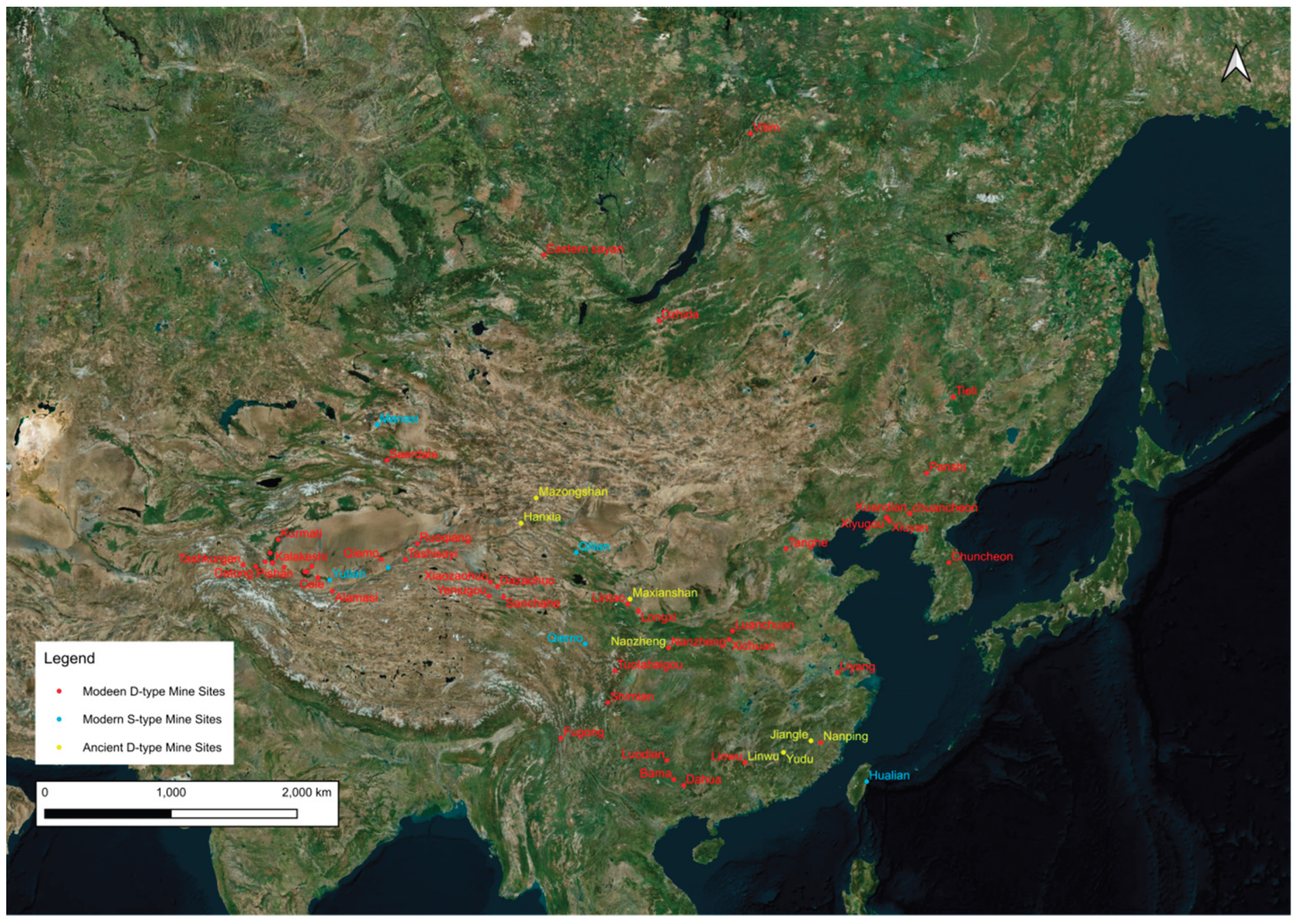
The identification of nephrite provenance has become a major focus in both archaeometry and gemmology during the past decade. Known deposits of tremolite-actinolite jade include: Xinjiang (Hotan, Yutian, Qiemu), Liaoning (Xiuyan), Qinghai, Sichuan (Longxi and Shimian), Guizhou, Henan (Xichuan), Jiangsu (Liyang), Fujian (Nanping), Guangxi (Dahua), Taiwan (Hualien), as well as deposits in Korea (Chuncheon), Russia, Canada, Alaska (USA), New South Wales (Australia), and New Zealand. Comprehensive databases of jade deposits are being established across China and worldwide, and efforts are underway to develop robust and reproducible analytical methods for provenance identification of nephrite.
From a genetic perspective, nephrite deposits can be divided according to their host rock and iron content. Deposits formed within magnesium-rich metamorphic rocks (such as dolomitic marble or dolostone) with low iron content are classified as D-type nephrite. China hosts numerous D-type nephrite deposits [14], and most ancient Chinese jade artifacts were made from this type [15,16]. In contrast, nephrite formed in serpentinized ultrabasic rocks with higher iron content, known as S-type nephrite, is relatively rare in China, but occurs in Taiwan (Hualien) [17], Hotan–Yutian [18], Manasi [19,20], Qiemu (Xinjiang) [21], Qilian (Qinghai) [22,23], and Shimian (Sichuan) [24].
To date, several D-type ancient jade-mining sites have been discovered, including Mazongshan in Subei (Gansu) [25,26,27,28,29,30,31], Hanzhong (Shaanxi) [32], Linwu (Hunan) [33,34], Yudu (Jiangxi) [35], Nanping [36] and Jiangle (Fujian) [37], among others. However, such archaeological discoveries remain limited in number. Therefore, relying solely on these few ancient mining sites to explain the raw-material sources of all ancient Chinese jade artifacts is insufficient. A comprehensive understanding of ancient jade provenance must combine archaeological evidence with comparative analyses of modern nephrite deposits.
Figure 5.
Distribution of nephrite deposits in China.
(1) Studies of Modern Nephrite Deposits
Modern nephrite provenance research primarily employs four analytical dimensions: spectroscopic techniques, trace-element geochemistry, isotopic analysis, and geochronology.
Spectroscopic Techniques
Spectroscopic methods—including infrared spectroscopy (FTIR), Raman spectroscopy, X-ray powder diffraction (XRD), and terahertz time-domain spectroscopy (THz-TDS)—have been extensively applied to distinguish nephrite from different deposits. These non-destructive techniques, especially when combined with chemometric approaches, provide new perspectives for the provenance identification of nephrite jade [38,39,40,41,42,43,44,45,46,47,48,49,50].
Trace-Element Geochemistry
Trace elements serve as crucial geochemical indicators in mineralogy, petrology, and gemmology. Even among nephrite deposits of similar genetic types, variations in tectonic setting, host-rock composition, fluid chemistry, and P–T conditions result in subtle differences in trace-element patterns. By comparing trace-element data from nephrite of different provenances, researchers attempt to define geochemical fingerprints that can differentiate jade sources. Analytical techniques employed include X-ray fluorescence spectroscopy (XRF), electron probe microanalysis (EPMA), laser ablation inductively coupled plasma mass spectrometry (LA-ICP-MS), laser-induced breakdown spectroscopy (LIBS), and proton-induced X-ray emission (PIXE). Geochemical characterization based on major, trace, and rare-earth elements (REEs), combined with discriminant and cluster analysis, has improved the accuracy of provenance determination and offered new insights for studying the origins of ancient jade artifacts [51,52,53,54,55,56,57,58,59].
Isotopic Studies
Isotopic analysis of nephrite, though initiated early, remains relatively limited in scope and application. Hydrogen and oxygen isotope ratios have proven effective in distinguishing nephrite from China, Russia, and Korea, but isotopic overlap becomes significant when comparing deposits within northwestern China, reducing discriminative power. [60,61,62]
Geochronology
Common isotopic dating methods include U–Th–Pb, Rb–Sr, Sm–Nd, Lu–Hf, K–Ar, and Re–Os systems. Earlier studies often employed K–Ar or ⁴⁰Ar/³⁹Ar dating, but more recently U–(Th)–Pb dating has become the preferred approach. Zircon and titanite within nephrite-bearing rocks are typically analyzed, and ages of related intrusive rocks (e.g., granites) are also used to constrain nephrite formation ages. The growing dataset now allows for quantitative evaluation of the potential role of mineralization ages in nephrite provenance studies [63].
(2) Provenance Study of Ancient Jade Artifacts
Archaeometric Approaches
The provenance study of ancient jade artifacts integrates microscopic [64,65,66], mineralogical [67], geochemical [68,69,70,71,72,73,74,75,76,77,78,79,80,81], and isotopic analyses [82,83]. Methods include high-resolution hyperspectral imaging, gray-level co-occurrence matrix (GLCM) analysis, principal component analysis (PCA), and hierarchical clustering to identify provenance-related patterns. While geological context and mineral paragenesis can suggest the type of deposit, precise provenance determination remains limited. Isotopic applications are still at an early stage, with few conclusive results, whereas trace-element and REE analyses have proven the most effective. Based on regional metallogenic characteristics of tremolite jade deposits in China, researchers have proposed multi-strategy linear discriminant models using combined REE and trace-element data to explore how alteration may influence major- and trace-element compositions [41]. This has led to the establishment of a hierarchical provenance framework, enabling stepwise analysis from regional to local levels. In future research, the integration of trace-element and REE datasets will likely become the principal approach for jade provenance studies.
However, current studies predominantly focus on unweathered (unaltered) ancient jades. Given that unearthed jade artifacts have undergone significant changes during their life history, especially due to alteration processes, these transformations must be considered when determining provenance. Chemical modifications induced by alteration may significantly affect element distributions and isotopic signatures, potentially leading to misinterpretations if ignored. Therefore, provenance studies must adapt modern nephrite analytical methods to account for post-depositional alteration effects. Developing provenance techniques specifically suited to altered jade artifacts is thus a foundational task for major future research. Ultimately, establishing comprehensive isotopic and geochemical databases for both jade deposits and unearthed jades will be essential for understanding the role of jade resource utilization in the emergence, formation, and development of Chinese civilization and jade culture.
Provenance Study of Turquoise
Substantial progress has been achieved in the provenance study of turquoise, with systematic research conducted on dozens of modern deposits, mineralization sites, and ancient mining sites across China (Figure 6 and Table 2). Through comprehensive comparative analysis, researchers have identified characteristic mineralogical and geochemical features for each deposit. Two key parameters—indicator minerals and trace elements—serve as the principal criteria for provenance discrimination.
Indicator Minerals
Turquoise from sedimentary–metamorphic-type deposits typically contains carbonaceous components, giving the mineral a darker tone, and its surface often exhibits black iron veins. In contrast, turquoise from igneous-type deposits commonly shows white speckles (“white spots”) on its surface. Turquoise from the Ma’anshan deposit (Anhui Province) has relatively lower density, and the bright, positive-toned blue color is a distinctive feature. Furthermore, each turquoise deposit contains specific associated or accessory minerals that can serve as mineralogical indicators for provenance identification.
Trace-Element Characteristics
Based on the distinct enrichment patterns of trace elements under different geological settings, multivariate statistical methods have been successfully applied to establish provenance discrimination models for turquoise from various deposit types, mining districts, and mineral belts. Using cross-validation and hierarchical provenance tracing, researchers have constructed a multi-evidence provenance system for turquoise that can be effectively applied to unearthed turquoise artifacts.
Effects of Alteration and Weathering
By analyzing the structural and compositional differences between the altered (weathered) and fresh layers of turquoise, it has been found that physicochemical weathering leads to dissolution and leaching of major components such as Al₂O₃ and P₂O₅, along with the loss of trace elements including Cr, Co, and U. These processes increase microporosity in the surface layer, producing a whitening effect and forming a weathered crust approximately tens of micrometers thick. Importantly, the study concludes that alteration and weathering effects exert no significant influence on the accuracy of provenance determination for unearthed turquoise artifacts [84,85,86,87,88,89,90,91,92,93,94,95,96,97,98,99,100,101,102,103,104,105,106,107,108,109,110,111,112,113,114,115,116,117,118,119,120,121,122,123,124,125,126,127,128,129,130,131,132,133,134,135,136,137,138,139,140,141,142,143].
Discussion
Recent advances in archaeometric research have greatly enhanced the study of ancient jade artifacts in China. With the aid of portable analytical instruments, the material identification of jade artifacts can now be conducted rapidly, accurately, and non-destructively. Future work should focus on the large-scale application of such techniques to unearthed jade artifacts, ensuring comprehensive and reliable material characterization. On this foundation, big data analyses may be used to explore the historical trajectories of different materials, particularly the introduction and use of exotic gem materials, providing new evidence for trade and cultural exchange along the Silk Road.
Research on alteration, the characteristic surface transformation of ancient jade artifacts—was once among the most challenging topics in jade studies. Over the past two decades, however, major breakthroughs have been achieved. Systematic classification and simulation experiments have clarified the mechanisms of formation for each type of alteration color, leading to a more comprehensive understanding of this phenomenon. These advances have provided a scientific foundation for all subsequent fields of jade research. In the future, alteration studies will become increasingly integrated with jade culture research, offering new perspectives on ritual systems and patterns of use.
The provenance study of jade materials remains one of the most prominent and complex research areas and will continue to be a central focus for future investigations. The discovery of ancient jade-mining sites represents a major breakthrough, offering direct evidence for raw-material acquisition. Technological progress, including the application of ICP-MS and portable XRF (p-XRF), has greatly improved the analytical capacity of provenance studies. The integration of multiple data types—especially trace-element and rare-earth-element (REE) data—has enabled the construction of multi-strategy linear discriminant models, leading to multi-level hierarchical provenance frameworks. Key research challenges for future provenance studies include: Discovering and confirming a larger number of ancient jade-mining sites; Establishing analytical methods for pebble-derived raw materials (river pebbles); Assessing the influence of alteration types on provenance results; Optimizing data acquisition by replacing large-scale instruments with portable devices; and Refining analytical approaches to develop multi-dimensional provenance models, beyond composition-based analyses alone.
Craftsmanship studies represent another core dimension of jade research. Over the past two decades, high-resolution digital microscopy, 3D optical microscopy, and scanning electron microscopy (SEM) have been applied to analyze micro-wear and tool traces on jade surfaces. Combined with experimental archaeology, these results have reconstructed the technological systems and traditions of ancient Chinese jade craftsmanship. The discovery of jade workshops provides crucial archaeological evidence for production processes. Future studies should integrate archaeological remains of workshops with replicative experiments, enabling a more comprehensive understanding of technological development across different regions and periods.
Archaeological typology, as a methodological bridge between archaeology and jade culture research, is now entering a transformative stage. The application of machine learning and related artificial-intelligence techniques promises to revolutionize typological classification and cultural analysis. Although their use in jade research remains limited, these methods represent one of the most promising directions for future exploration.
Research on the conservation of ancient jade artifacts remains minimal. No dedicated institutions or teams currently focus on this field, largely because most ancient jades are relatively physically stable and chemically inert. However, as excavation, exhibition, and environmental factors increase, the long-term conservation of ancient jade should receive greater attention.
Conclusions
Over the past two decades, the scientific study of ancient Chinese jade artifacts has achieved substantial progress, forming an increasingly mature system of methods and frameworks. Significant advances have been made in material identification, alteration studies, and provenance research. Among these, provenance study is expected to become the most critical and influential field in the coming years. Nevertheless, provenance research faces numerous challenges: it requires locating ancient jade mines, accounting for the effects of alteration on compositional data, dealing with the non-destructive and immobile nature of most excavated jades, and considering that many raw materials may have originated from naturally collected pebbles rather than mined deposits. These factors demand new analytical strategies and data-processing models. Furthermore, the study of gemstone materials—especially those rarely used in ancient China but widely used elsewhere—provides important evidence for cross-cultural trade and exchange. The rapid development of artificial intelligence also introduces new methodologies for typological classification and craftsmanship analysis, expanding the scope and depth of jade research. Ultimately, the study of jade is not only central to understanding ancient Chinese civilization, but also serves as a key lens for examining Eurasian cultural interactions and trade networks. Future interdisciplinary research—combining archaeology, materials science, and data science—will continue to reveal new perspectives and deepen our appreciation of ancient human creativity and technological sophistication.
Future Directions
Material Studies of Ancient Jade Artifacts: The analytical methods for material identification of ancient jade artifacts have become highly mature. With the application of portable archaeometric instruments, the composition and mineral species of jade artifacts can now be determined rapidly, accurately, and non-destructively. Future research should promote the widespread application of scientific techniques in jade studies, establishing a comprehensive and systematic understanding of jade materials. Particular attention should be given to identifying the earliest periods of use and developmental trajectories of different jade materials. The study of exotic gem materials introduced into China will provide crucial evidence for cultural interaction and trade exchange, especially along the Silk Road.
Alteration Studies: Research on alteration in ancient jades has now reached a mature stage, forming a coherent methodological framework for investigating the color and mechanism of alteration. Future work should aim to refine and expand the current understanding of alteration mechanisms, with a focus on acid–base simulation experiments, which are expected to play a central role in revealing the natural weathering processes of jade. Additionally, it will be essential to examine how alteration and surface weathering may affect the outcomes of provenance studies, ensuring that the influence of post-depositional changes is accurately assessed in material-source analyses.
Craftsmanship Studies: Current research on jade craftsmanship relies primarily on high-resolution photography, 3D digital microscopy, and scanning electron microscopy (SEM) to document and analyze micro-wear features and tool traces on jade artifacts. Future research should emphasize the integration of scientific and technological approaches into the study of jade craftsmanship by establishing a large-scale database of micro-trace evidence. Combining this with experimental archaeology, scholars can reconstruct the complete technological processes of jade production, thereby achieving a deeper understanding of ancient jade carving and polishing techniques and the technological evolution of jade-working traditions in different regions and periods.
Provenance Studies: With the recent breakthroughs in alteration research, the provenance study of ancient jade materials will undoubtedly become the most significant research frontier in the coming decades. The archaeological discovery of ancient jade-mining sites has provided valuable physical evidence for raw-material studies, while continuous refinement of data acquisition and analytical methods has led to the establishment of an increasingly robust scientific framework for provenance research. The progress in alteration studies now provides the necessary theoretical foundation for more reliable and integrated provenance analyses, and the collective development of all other jade research fields—material, alteration, and craftsmanship—lays a solid groundwork for the future of source-tracing research.
Typological and AI-Assisted Research: The rapid advancement of artificial intelligence (AI) has opened new pathways for archaeological typology and cultural analysis. AI-driven methods such as machine learning and computer vision hold the potential to revolutionize the classification systems and interpretive frameworks of jade typology. Although the use of AI in jade research remains in its infancy, it represents a key frontier for future development, promising to transform both methodology and theory in the study of ancient jade culture.
Conservation of Ancient Jade Artifacts: In the past, the conservation of ancient jades received limited attention, largely due to their relative physical stability. However, recent advances in alteration research have highlighted the importance of active conservation and provided valuable references for preservation practices. Future conservation work will involve two key components: The extraction and protection of fragile jade artifacts during excavation, particularly from major Neolithic sites such as the Liangzhu culture, the Lingjiatan culture, and the Dayuanzi cemetery in Yunnan; The long-term conservation of jade collections in museums. The protection of fragile jades is both crucial and challenging—it requires the integration of archaeological excavation and conservation science from the earliest stages of fieldwork. This combined approach represents the future direction for the preservation of excavated artifacts of all material types.
Author Contributions
Writing, review and editing, Y.B. All authors have read and agreed to the published version of the manuscript.
Funding
This study is funded by the Major Project of the National Social Science Foundation of China (23&ZD272).
Data Availability Statement
Data are available from the authors upon reasonable request.
Conflicts of Interest
The authors declare no conflicts of interest.
References
- Li, Y.Q.; Song, J.Q.; Yang, Y.C.; et al. Brief report on the 2015 excavation of Area I at the Xiaonanshan site, Raohe County, Heilongjiang. Kaogu (Archaeology) 2024, 02, 3–16. (in Chinese).
- Bao, Y. Materials-Science Research on the Alteration (“Qin”) of Unearthed Jades. Ph.D. Thesis, Fudan University, Shanghai, China, 2019. (in Chinese).
- Bao, Y.; Ye, X.H. Reflections on analytical methods for nephrite Chinese jades excavated from archaeological contexts. Southern Cultural Relics 2025, 02, 237–244. (in Chinese).
- Ding, S.C.; Jiang, C.L. A review of secondary alterations in ancient jades. Zhongyuan Wenwu (Cultural Relics of Central China) 2012, 06, 1–15. (in Chinese).
- Jing, Z.C.; Xu, G.D.; He, Y.L.; Tang, J.G. Geoarchaeological study of jades from Tomb M54. In Yinxu Huayuanzhuang Dongdi: Shang-Dynasty Tombs at Anyang; Science Press: Beijing, China, 2007; pp. 123–145. (in Chinese).
- Kuang, Y.H.; Zhou, S.L. Types and causes of “qin se” (surface alterations) on ancient jades and experimental replication for imitation. Ultra-Hard Mater. Eng. 2006, 01, 1–8. (in Chinese).
- Bao, Y. A Study of Materials and “Qin” Alteration of Western Zhou Guo State Jades from Western Henan and Warring States Jades in the Ebo Museum Collection. Master’s Thesis, China University of Geosciences (Wuhan), Wuhan, China, 2015. (in Chinese).
- Chen, T.H.; Menu, M. Heating effect on serpentine jades. AIP Conf. Proc. 2010, 1239, 21–24. [CrossRef]
- Bao, C.; Zhao, C.H.; et al. A method of determining heated ancient nephrite jades in China. Sci. Rep. 2018, 8, 13523. [CrossRef]
- Wang, R.; Dong, J.Q. A preliminary study of heat-treated steatite artifacts in pre-Qin China. Dongnan Wenhua (Southeast Culture) 2021, 01, 88–96. (in Chinese).
- Bao, Y.; Zhao, C.; Li, Y.; Yuan, X. A method of determining heated ancient nephrite jades in China. Sci. Rep. 2018, 8, 13523. [CrossRef]
- Bao, Y.; Yun, X.; Zhao, C.; Wang, F.; Li, Y. Nondestructive analysis of alterations of Chinese jade artifacts from Jinsha, Sichuan Province, China. Sci. Rep. 2020, 10, 18476. [CrossRef]
- Bao, Y.; Xu, C.; Zhu, Q.; Li, Y. Chinese ancient jades with mercury alteration unearthed from the Lizhou’ao Tomb: An analytical study. Sci. Rep. 2019, 9, 19849. [CrossRef]
- Harlow, G.E.; Sorensen, S.S. Jade (nephrite and jadeitite) and serpentinite: Metasomatic connections. Int. Geol. Rev. 2005, 47, 113–146. [CrossRef]
- Wen, G.; Jing, Z.C. A geoarchaeological study of ancient Chinese jades III: Western Zhou jades from Fengxi. Kaogu Xuebao (Acta Archaeol. Sin.) 1993, 02, 251–280. (in Chinese).
- Barnes, G.L. Understanding Chinese jade in a world context. J. Br. Acad. 2018, 6, 1–63. [CrossRef]
- Yui, T.F.; Yeh, H.W.; Lee, C.W. Stable isotope studies of nephrite deposits from Fengtien, Taiwan. Geochim. Cosmochim. Acta 1988, 52(3), 593–602. [CrossRef]
- Shi, M.; Yu, B.S.; Guo, Y.; Yuan, Y.; Ng, Y.N. Structural and mineralogical characterization of green nephrite in Hetian, Xinjiang, China. Key Eng. Mater. 2015, 633, 159–164. [CrossRef]
- Wan, D.F.; Wang, D.P.; Zou, T.R. Silicon and oxygen isotopic compositions of Hetian jade, Manasi green jade and Xiuyan “old jade” (tremolite). Acta Petrol. Mineral. 2002, 21, 110–114. (in Chinese).
- Zhang, X.M. Mineralogy and Genesis of Green Nephrite in the Western Manas Region (Xinjiang). Ph.D. Thesis, China University of Geosciences (Beijing), Beijing, China, 2020. (in Chinese).
- Jia, Y.H.; Liu, X.F.; Liu, Y.; Zhang, Q.C.; Zhang, Y.; Li, Z.J. Petrogenesis of the serpentinite-related nephrite deposit in Qiemo County, Xinjiang. Acta Petrol. Mineral. 2018, 37(5), 824–838. (in Chinese).
- Liu, X.F.; Zhang, H.Q.; Liu, Y.; Zhang, Y.; Li, Z.J.; Zhang, J.H.; et al. Mineralogical characteristics and genesis of green nephrite from around the world. Rock Mineral Anal. 2018, 37(5), 479–489. (in Chinese). [CrossRef]
- Zhang, B.L. Systematic Gemmology; Geological Publishing House: Beijing, China, 2006; p. 381. (in Chinese).
- Xu, Y.X.; Lu, B.Q.; Qi, L.J. Petro-mineralogical and SEM microstructural analysis of nephrite in Sichuan Province. Shanghai Land Resour. 2015, 36(3), 87–89. (in Chinese).
- Chen, G.K.; Yang, Y.S. Preliminary archaeological observations on early mining of tremolite deposits in the Hexi Corridor. Dunhuang Res. 2021, 05, 85–94. (in Chinese).
- Chen, G.K.; Wang, H.; Li, Y.X. A brief report on the survey of the ancient jade mine site at Mazongshan, Subei, Gansu. Wenwu (Cultural Relics) 2010, 10, 27–33. (in Chinese).
- Zhao, J.L.; Wang, H.; Chen, G.K.; et al. Preliminary excavation report of the Mazongshan jade-mine site, Subei, Gansu, in 2011. Wenwu (Cultural Relics) 2012, 08, 38–44. (in Chinese).
- Chen, G.K.; Jiang, C.N.; Wang, H.; et al. The Mazongshan jade-mine site in Subei County, Gansu. Kaogu (Archaeology) 2015, 07, 3–14. (in Chinese).
- Chen, G.K.; Wang, H.; Yang, Y.G.; et al. Brief report on the 2012 excavation of the Mazongshan jade-mine site, Subei County, Gansu. Kaogu (Archaeology) 2016, 01, 40–53. (in Chinese).
- Miao, P.; Han, F.; Sun, M.X.; et al. Brief report on the 2016 excavation of the Jingbao’er Ranch jade-mine site at Mazongshan, Subei, Gansu. Wenwu (Cultural Relics) 2020, 04, 31–45. (in Chinese).
- Chen, G.K.; Qiu, Z.L.; Jiang, C.N.; et al. Archaeological survey of the Hanxia jade-mine site, Dunhuang, Gansu. Kaogu Yu Wenwu (Archaeol. Cult. Relics) 2019, 04, 12–22. (in Chinese).
- Dong, H.N. Mineralogical Characteristics of Diorite-Bearing Jades in Hanzhong, Shaanxi Province. Master’s Thesis, China University of Geosciences, Beijing, China, 2020. (in Chinese).
- Meng, D.Y. Gemmological Study of Tremolite Jade from the Xianghualing Area, Hunan Province. Master’s Thesis, Hebei GEO University, Hebei, China, 2019. (in Chinese).
- Hou, Z.H.; Ye, P.; Zeng, S.Q.; Li, J.; Peng, J.; Guo, M.C. Preliminary exploration of a quality-grading system for Linwu tremolite jade. Hunan Nonferrous Met. 2021, 37(6), 79–82. (in Chinese).
- Huang, H.N.; Jiang, B.C. Applied study of tremolite in low-temperature fast-firing tiles. J. Ceram. 1993, 9(2), 67–75. (in Chinese).
- Tang, D.P.; Lin, G.X.; Jiang, A.G.; Yu, J.C.; Chen, W.B. First discovery of nephrite in Fujian, China. J. China Univ. Geosci. 1997, 3(4), 396–399. (in Chinese).
- Zheng, N.L.; Huang, W.X. Geological characteristics of tremolite deposits in Changle, Fujian, and their application in the ceramic industry. China Non-Metallic Mining Ind. Herald 1993, 02, 24–29. (in Chinese).
- Guo, L.H.; Han, J.Y. Infrared spectral analysis of M1 and M3 cation site occupancies in Hetian nephrite, Manasi “jasper” and Xiuyan “old jade”. Acta Petrol. Mineral. 2002, S1, 68–71. (in Chinese).
- Chen, Q.L.; Bao, D.Q.; Yin, Z.W. XRD and IR studies of Xinjiang (Hotan) and Liaoning (Xiuyan) nephrite. Spectrosc. Spectr. Anal. 2013, 33(11), 3142–3146. (in Chinese).
- Sui, J.; Liu, X.L.; Guo, S.G. Spectroscopic study of Korean and Qinghai nephrite. Prog. Laser Optoelectron. 2014, 51(07), 179–185. (in Chinese).
- Li, L.; Liao, Z.T.; Zhong, Q.; et al. Chemical and spectroscopic characteristics of nephrite from Luodian (Guizhou) and Dahua (Guangxi), China. J. Gems Gemmol. (Chin. & Engl.) 2019, 21(05), 18–24. (in Chinese).
- Jiang, C.; Peng, F.; Wang, W.W.; et al. Spectroscopic characteristics and provenance tracing of nephrite from Dahua (Guangxi) and Luodian (Guizhou), China. Spectrosc. Spectr. Anal. 2021, 41(04), 1294–1299. (in Chinese).
- Zhi, Y.X.; Liao, Z.T.; Zhou, Z.Y.; et al. Types of structural water in nephrite and near-infrared spectral interpretation. Spectrosc. Spectr. Anal. 2013, 33(06), 1481–1486. (in Chinese).
- Gu, A.; Luo, H.; Yang, X.D. Feasibility of nondestructive provenance identification of nephrite by near-infrared spectroscopy combined with chemometrics. Cult. Relics Conserv. Archaeol. Sci. 2015, 27(03), 78–83. (in Chinese).
- Xu, H.D.; Lin, L.L.; Li, Z.; et al. Provenance discrimination of nephrite using Raman spectroscopy and pattern recognition algorithms. Acta Opt. Sin. 2019, 39(03), 388–394. (in Chinese).
- Maimaitiming, A.; Xiong, W.; Guo, X.J.; et al. Terahertz spectral study of Hetian (Hotan) nephrite. Spectrosc. Spectr. Anal. 2010, 30(10), 2597–2600. (in Chinese).
- Meng, Q. Terahertz Spectroscopy Study on Crystal Structure and Properties of Minerals. Master’s Thesis, China University of Petroleum (Beijing), Beijing, China, 2018. (in Chinese).
- Yang, T.T.; Wang, X.; Huang, B.; et al. Provenance identification of white nephrite based on terahertz time-domain spectroscopy. Acta Petrol. Mineral. 2020, 39(03), 314–322. (in Chinese).
- Lin, H.M.; Cao, Q.H.; Zhang, T.J.; et al. Identification of nephrite and simulants based on terahertz time-domain spectroscopy and pattern recognition. Spectrosc. Spectr. Anal. 2021, 41(11), 3352–3356. (in Chinese).
- Lv, X.M.; Zhang, Q.J.; Zhou, A.L.; et al. Terahertz spectroscopy determination of Hetian nephrite from different regions and simulated Hetian nephrite. Chin. J. Inorg. Anal. Chem. 2021, 11(06), 56–59. (in Chinese).
- Liao, R.Q.; Zhu, Q.W. Chemical compositions of nephrite from various localities in China. J. Gems Gemmol. 2005, 01, 25–30. (in Chinese).
- Zhou, Z.H.; Feng, J.R. Petrographic and mineralogical comparative study of Xinjiang and Xiuyan nephrite. Acta Petrol. Mineral. 2010, 29(3), 331–339. (in Chinese).
- Zhong, Y.P.; Qiu, Z.L.; Li, L.F.; et al. Exploratory provenance identification of Chinese nephrite using rare-earth element patterns and parameters. J. Chin. Rare Earth Soc. 2013, 31(06), 738–748. (in Chinese).
- Xiang, F.; Wang, C.S.; Jiang, Z.D.; et al. REE characteristics and raw-material sources of jades from the Jinsha site, Chengdu. J. Earth Sci. Environ. 2008, 30(01), 54–56. (in Chinese).
- Qiu, Z.L.; Zhang, Y.F.; Yang, J.; et al. Newly discovered ancient jade mine at Hanxia, Dunhuang, Subei County, Gansu: A potential early source of raw materials for ancient jades. J. Gems Gemmol. (Chin. & Engl.) 2020, 22(05), 1–12. (in Chinese).
- Luo, Z.M.; Yang, M.X.; Shen, A.H. Origin determination of dolomite-related white nephrite through IB-LDA. Gems Gemol. 2015, 51(3), 300–311.
- Wang, Y.J.; Yuan, X.Q.; Shi, B.; et al. Provenance identification of nephrite using LIBS combined with partial least squares discriminant analysis. Chin. J. Lasers 2016, 12, 260–267. (in Chinese).
- Yu, J.L.; Hou, Z.Y.; Sheta, S.; et al. Provenance classification of nephrite jades using multivariate LIBS: A comparative study. Anal. Methods 2017, 10(3), 281–289. [CrossRef]
- Bao, P.J.; Chen, Q.L.; Zhao, A.D.; et al. Provenance tracing of pale green to white nephrite using LIBS and artificial neural networks. Spectrosc. Spectr. Anal. 2023, 43(01), 25–30. (in Chinese).
- Wang, S.Q.; Yuan, X.M. Application of isotope methods to determining geographic origins of raw materials for ancient jades. In Proceedings of the 1st “Earth Science and Culture” Symposium and the 17th Annual Meeting of the Committee for the History of Geology in China; China Geological Survey & Geological Society of China: Beijing, China, 2005; p. 9. (in Chinese).
- Gao, K.; Fang, T.; Lu, T.J.; et al. Hydrogen and oxygen stable isotope ratios of dolomite-related nephrite: Relevance for its geographic origin and geological significance. Gems Gemol. 2020, 56(2), 266–280. [CrossRef]
- Schmitt, A.K.; Liu, M.C.; Kohl, I.E. Sensitive and rapid oxygen isotopic analysis of nephrite jade using large-geometry SIMS. J. Anal. At. Spectrom. 2019, 34(3), 561–569. [CrossRef]
- Adams, C.J.; Beck, R.J.; Campbell, H.J. Characterisation and origin of New Zealand nephrite jade using its strontium isotopic signature. Lithos 2007, 97(3–4), 307–322. [CrossRef]
- Chen, D.; Pan, M.; Huang, W.; et al. Provenance of nephrite in China based on multi-spectral imaging and gray-level co-occurrence matrix. Anal. Methods 2018, 10(33), 4053–4062. [CrossRef]
- Wen, G. Geoarchaeological study of Neolithic jades in southern Jiangsu. Wenwu (Cultural Relics) 1986, 10, 42–49. (in Chinese).
- Wen, G.; Jing, Z.C. Geoarchaeological study of Fukuanshan and Songze jades—II of the geoarchaeology of ancient Chinese jades. Kaogu (Archaeology) 1993, 07, 627–644, 675–678. (in Chinese).
- Zheng, J. Identification report of jades unearthed from the Zhanglingshan Dongshan site, Wuxian (Wu County). Wenwu (Cultural Relics) 1986, 10, 39–41. (in Chinese).
- Chen, T.R.; Qin, L.; Wu, W.H.; et al. Preliminary scientific analysis of jades unearthed from feature 07M23 at the Lingjiatan site, Anhui. South. Cult. Relics 2020, 03, 151–158. (in Chinese).
- Wang, S.Q. Xiuyan nephrite and the Hongshan culture. J. Anshan Norm. Univ. 2004, 03, 40–43. (in Chinese).
- Cheng, J.; Wang, C.S.; Li, D.W.; et al. Phase and trace-element analyses of jades unearthed from the Liangzhu cultural sites and the Fangwanggang Han tomb. Kaogu (Archaeology) 2005, 07, 70–75. (in Chinese).
- Gan, F.X.; Cao, J.Y.; Cheng, H.S.; et al. Nondestructive analyses of jades unearthed from the Liangzhu site complex, Yuhang, Zhejiang. Sci. China Technol. Sci. 2011, 41(01), 1–15. (in Chinese).
- Dong, J.Q.; Sun, G.P.; Wang, N.Y.; et al. Technological analysis of jade “jue” from three Neolithic sites in Zhejiang. Spectrosc. Spectr. Anal. 2017, 37(9), 2905–2913. (in Chinese).
- Gu, D.H.; Gan, F.X.; Cheng, H.S.; et al. Nondestructive analysis of Liangzhu jades unearthed from the Gaocengdun site, Jiangyin. Cult. Relics Conserv. Archaeol. Sci. 2010, 22(04), 42–52. (in Chinese).
- Hung, H.C.; Iizuka, Y.; Bellwood, P.; et al. Ancient jades map 3000 years of prehistoric exchange in Southeast Asia. Proc. Natl. Acad. Sci. USA 2007, 104(50), 19745–19750. [CrossRef]
- Li, J.; Gao, J.; Tong, X.R.; et al. Comparative study of Liyang nephrite (Jiangsu) and nephrite from the Zhuangqiaofen site of the Liangzhu culture. J. Gems Gemmol. 2010, 12(03), 19–25, 33. (in Chinese).
- Lu, H.; Fu, W.L.; Chai, J.; et al. Composition analyses and related issues of jade artifacts unearthed from the Sanxingdui site. Palace Mus. J. 2021, 09, 123–142, 147. (in Chinese).
- Yang, J.; Qiu, Z.L.; Sun, B.; et al. Nondestructive testing and provenance analysis of Dawenkou-culture serpentinite jades using p-FTIR and p-XRF. Spectrosc. Spectr. Anal. 2022, 42(02), 446–453. (in Chinese).
- Su, Y. Provenance Tracing Methodology and Applications for Tremolite Nephrite Based on Elemental Geochemistry. Ph.D. Thesis, China University of Geosciences, Wuhan, China, 2024. (in Chinese).
- Xiang, F.; Wang, C.S.; Yang, Y.F.; et al. Raw-material sources of jades from the Jinsha site. Jianghan Archaeol. 2008, 03, 104–108. (in Chinese).
- Xiang, F.; Wang, C.S.; Jiang, Z.D.; et al. REE characteristics and raw-material sources of jades from the Jinsha site, Chengdu. J. Earth Sci. Environ. 2008, 01, 54–56. (in Chinese).
- Cheng, J.; Yang, X.M.; Yang, X.Y.; et al. REE characteristics of Liangzhu jades and their archaeological significance. Chin. Rare Earths 2000, 04, 1–4. (in Chinese).
- Wen, G. Geoarchaeological study of jades from Han tomb No. 2 at Shenjushan, Gaoyou—IV of the geoarchaeology of ancient Chinese jades. Wenwu (Cult. Relics) 1994, 05, 83–94. (in Chinese).
- Liu, L. Key Technologies and Applications for Provenance Tracing of Turquoise Unearthed in China. Ph.D. Thesis, China University of Geosciences, Wuhan, China, 2023. (in Chinese). [CrossRef]
- Li, Y.X.; Xian, Y.H.; Chen, K.L.; et al. Survey of the Heikou turquoise mining site, Luonan, Shaanxi. Kaogu Yu Wenwu (Archaeol. Cult. Relics) 2016, 03, 11–17, 55. (in Chinese).
- Wang, Y. Investigation of the Zhuyuangou Turquoise Mining Site, Lushi County, Henan Province. Master’s Thesis, Northwest University, Xi’an, China, 2020. (in Chinese).
- Li, Y.X.; Tan, Y.C.; Jia, Q.; et al. Preliminary investigation of two ancient turquoise mining sites in Hami, Xinjiang. Kaogu Yu Wenwu (Archaeol. Cult. Relics) 2019, 06, 22–27. (in Chinese).
- Cao, J.E.; Sun, J.S.; Sun, J.J.; et al. Brief survey report on the Haobeiru ancient turquoise mining site, Alxa Right Banner, Inner Mongolia. Kaogu Yu Wenwu (Archaeol. Cult. Relics) 2021, 03, 23–32. (in Chinese).
- Tang, B.S.; Huang, W.; Li, C.X. Current status, problems and suggestions for the turquoise industry in Hubei Province. Resour. Environ. Eng. 2018, 32(03), 489–493, 503. (in Chinese).
- Xian, Y.H. Study on Mining Remains at Laziyá Site and Characteristics of Turquoise Sources around Luonan, Shaanxi. Master’s Thesis, Univ. Sci. Technol. Beijing, Beijing, China, 2016. (in Chinese).
- Overview of the Yu’ertan turquoise mine, Baihe County, Shaanxi. Northwest Geol. 1972, 05, 12–14. (in Chinese).
- Zhao, X.K.; Li, J.L.; Liu, Y.L.; et al. Overview and genetic analysis of Baihe turquoise resources, Ankang City. Shaanxi Geol. 2017, 35(02), 46–51. (in Chinese).
- Wang, J.S.; Yan, W.X.; Wei, Q. Solid-state rheological structures in E’xi Yungaisi area and their control on turquoise mineralization. Hubei Geol. 1996, 10(2), 62–70. (in Chinese).
- Chen, Q.L.; Yin, Z.W.; Qi, L.J.; et al. Turquoise from Zhushan County, Hubei Province, China. Gems Gemol. 2012, 48(3), 198–204. [CrossRef]
- Chen, Q.L.; Ding, W.; Xu, F.S.; et al. Infrared spectral features and composition of the so-called “oil pine” turquoise from Zhushan, Hubei. Spectrosc. Spectr. Anal. 2021, 41(04), 1246–1252. (in Chinese).
- Shi, Z.R.; Cai, K.Q. Yu’ertan turquoise and secondary crandallite-group minerals: A study. Acta Petrol. Mineral. 2008, 02, 164–170. (in Chinese).
- Shi, Z.R.; Cai, K.Q. Weathering decomposition products of Yu’ertan turquoise and their characteristics. Ultra-Hard Mater. Eng. 2007, 04, 56–60. (in Chinese).
- Zhang, J.; Yu, X.Z.; Li, Y.C. Prospecting prediction for leaching-type turquoise mineralization on the NW margin of the Wudang uplift. Geophys. Geochem. Explor. 2019, 43(02), 273–280. (in Chinese).
- Tu, H.K. Study on prospecting targets of turquoise and uranium mineralization. Acta Geol. Gansu 1997, 6(1), 74–79. (in Chinese).
- Ku, Y.L.; Yang, M.X. Spectroscopic characteristics of blue “ripple-pattern” turquoise from Shiyan, Hubei. Spectrosc. Spectr. Anal. 2021, 41(02), 636–642. (in Chinese).
- Ku, Y.L.; Yang, M.X.; Li, Y. Spectroscopic study of yellow-green to green turquoise and associated minerals from Zhushan, Hubei. Spectrosc. Spectr. Anal. 2020, 40(06), 1815–1820. (in Chinese).
- Jiang, Z.C.; Chen, D.M.; Wang, F.Y.; et al. Thermal properties and associated minerals of turquoise from Hubei and Shaanxi. Acta Mineral. Sin. 1983, 03, 198–206, 247. (in Chinese).
- Ku, Y.L.; Yang, M.X.; Liu, J. Spectroscopic characteristics of reddish-brown banded turquoise from Shiyan, Hubei. Spectrosc. Spectr. Anal. 2020, 40(11), 3639–3643. (in Chinese).
- Xie, J.T.; Han, L.; Xu, P.; et al. Genesis and ore-controlling factors of the Guanshansi turquoise deposit, Zhushan, Hubei. Miner. Explor. 2022, 13(11), 1656–1666. (in Chinese).
- Luo, Y.F. Gemmological Study of Turquoise from Luonan, Shaanxi. Master’s Thesis, China University of Geosciences (Beijing), Beijing, China, 2017. (in Chinese).
- Luo, Y.F.; Yu, X.Y.; Zhou, Y.G.; et al. Structural and textural characteristics of turquoise from Luonan, Shaanxi. Acta Petrol. Mineral. 2017, 36(01), 115–123. (in Chinese).
- Xian, Y.H.; Liang, Y.; Fan, J.Y.; et al. Preliminary provenance study of turquoise artifacts from Tomb 1 at Xigou site, Barkol (Balikun), Xinjiang. Front. Archaeol. Res. 2020, 01, 445–454. (in Chinese).
- Ren, J.W. Hexi Dianzi and Hami turquoise. Diqiu (Earth) 1985, 01, 30. (in Chinese).
- Chen, J.H. Discovery of gem-quality turquoise from Hami, Xinjiang. J. Gems Gemmol. 2000, 03, 42–66. (in Chinese).
- Luan, B.A. Investigation record of the ancient turquoise mine at Heishanling, Hami, Xinjiang. China Gems Jade 2001, 04, 66–67. (in Chinese).
- Liu, X.F.; Lin, C.L.; Li, D.D.; et al. Mineralogical and spectroscopic characteristics of turquoise from Hami, Xinjiang. Spectrosc. Spectr. Anal. 2018, 38(04), 1231–1239. (in Chinese).
- Shen, C.H. Mineralogical characteristics and genesis of pseudomorphic turquoise from Dahuangshan, Anhui Province. Acta Mineral. Sin. 2020, 40(03), 313–322. (in Chinese).
- Shen, C.H.; Zhao, E.Q. Ore mineral characteristics and genesis of the turquoise deposit at Bijiashan, Anhui Province. J. Jilin Univ. (Earth Sci. Ed.) 2019, 49(06), 1591–1606. (in Chinese).
- Xue, Y.; Deng, W.H.; He, X.M.; et al. Gemmological characteristics of turquoise from the Hubei–Shaanxi region. In Proceedings of the 2013 China Jewelry and Gemstone Academic Exchange Conference, Beijing, China, 2013; p. 9. (in Chinese).
- Li, J.L.; Liu, W.W.; Zhou, X.N.; et al. Metallogenic geological conditions and prospecting direction of the Xujiawan turquoise deposit, Zhuxi County, Hubei. China Nonmetallic Min. Ind. Guide 2022, 03, 25–29, 54. (in Chinese).
- Wei, D.G.; Guan, R.H.; Ma, A.S. Distribution, genesis and indicators of turquoise deposits in the Ma’anshan area. Min. Express 2003, 10, 19–20. (in Chinese).
- Zuo, R.; Dai, H.; Wang, F.; et al. Infrared spectral characteristics and mineral composition of turquoise from Tongling, Anhui. Anhui Geol. 2018, 28(04), 316–320. (in Chinese).
- Chen, Q.L.; Qi, L.J.; Yuan, X.Q.; et al. Thermal properties of turquoise with apatite pseudomorphs. Earth Sci.—J. China Univ. Geosci. 2008, 33(3), 416–422. (in Chinese).
- Chen, Q.L.; Zhang, Y. Gemmological and mineralogical characteristics of turquoise with apatite pseudomorphs. J. Gems Gemmol. 2005, 7(4), 13–16, 32. (in Chinese).
- Dai, H.; Zhou, Y.; Zhang, Q.; et al. Mineralogical and spectroscopic characteristics of apatite-pseudomorphic turquoise from Ma’anshan, Anhui. In Proceedings of the 2015 China Jewelry and Gemstone Academic Exchange Conference, Beijing, China, 2015; p. 5. (in Chinese).
- Shen, G.Y.; Lu, B.Q.; Qi, L.J. Mineralogical and spectroscopic characteristics of turquoise with apatite pseudomorphs. Shanghai Land Resour. 2013, 34(04), 96–100. (in Chinese).
- Yue, D.Y. Study of pseudomorphic turquoise in the Ma’anshan area, Anhui. Acta Petrol. Mineral. 1995, 01, 79–83. (in Chinese).
- Zhang, Q.; Dai, H.; Yang, S.; et al. Genetic discussion of pseudomorphic turquoise and wavellite from Ma’anshan, Anhui. Anhui Geol. 2016, 26(02), 153–157. (in Chinese).
- Yue, D.Y. Study of pseudomorphic turquoise in the Ma’anshan area, Anhui. Acta Petrol. Mineral. 1995, 14(1). (in Chinese).
- Liu, J.; Wang, Y.M.; Liu, F.L.; et al. Gemmological characteristics of turquoise from Tongling, Anhui. J. Gems Gemmol. (Chin. & Engl.) 2019, 21(06), 58–65. (in Chinese).
- Zuo, R.; Dai, H.; Huang, W.Q.; et al. UV–visible spectral characteristics and color representation of turquoise from Tongling, Anhui. J. Gems Gemmol. (Chin. & Engl.) 2020, 22(01), 13–19. (in Chinese).
- Zhou, Y.; Qi, L.J.; Dai, H.; et al. Gemmological study of turquoise from Dainan Mountain, Anhui. J. Gems Gemmol. 2013, 15(04), 37–45. (in Chinese).
- Huang, X.Z. Metallogenic characteristics and prospecting direction of turquoise deposits. China Nonmetallic Min. Ind. Guide 2003, 06, 50–51. (in Chinese).
- Tu, H.K. Study on prospecting targets of turquoise and uranium mineralization. Acta Geol. Gansu 1997, 6(1), 74–79. (in Chinese).
- Shen, C.H. Genesis of Typical Turquoise Deposits in the Ma’anshan Turquoise Belt, Ningwu Basin. Ph.D. Thesis, China University of Geosciences (Beijing), Beijing, China, 2020. (in Chinese).
- Wang, H.T.; Zhang, C.S.; He, J.R. Characteristics and formation mechanisms of several supergene phosphate minerals in the Ningwu and Luzong volcanic areas. Acta Mineral. Sin. 1990, 01, 58–65, 102. (in Chinese).
- Yang, X.Y.; Wang, K.R.; Liu, X.H. Geochemistry of rare earth elements in various types of turquoise from the Ma’anshan area. Chin. Rare Earths 1997, 04, 3–5, 31. (in Chinese).
- Fang, H. Study of turquoise artifacts unearthed in Northeast China. Kaogu Yu Wenwu (Archaeol. Cult. Relics) 2007, 01, 39–45, 66. (in Chinese).
- Feng, M.; Mao, Z.W.; Pan, W.B.; et al. Preliminary provenance study of turquoise from the Jiahu site. Cult. Relics Conserv. Archaeol. Sci. 2003, 15(3). (in Chinese).
- Tu, H.K. Geological characteristics of turquoise deposits in the Shaanxi–Hubei border area. Shaanxi Geol. 1996, 14(2), 59–64, 9–12. (in Chinese).
- Li, Y.X.; Zhao, X.; Jia, Q.; et al. Provenance exploration of turquoise artifacts unearthed from the Qijiaping and Mogou sites, Gansu. J. Northwest Minzu Univ. (Nat. Sci. Ed.) 2021, 27(03), 1–3. (in Chinese).
- Xian, Y.H.; Fan, J.Y.; Li, X.T.; et al. Preliminary provenance study of turquoise artifacts from Tomb 1 at Xigou site, Barkol (Balikun). Front. Archaeol. Res. 2020, 01, 445–454. (in Chinese).
- Xian, Y.H.; Li, X.T.; Zhou, X.Q.; et al. Compositional analysis and provenance discrimination of turquoise artifacts from two sites in Xinjiang. Spectrosc. Spectr. Anal. 2020, 40(03), 967–970. (in Chinese).
- Xian, Y.H.; Li, Y.X.; Tan, Y.C.; et al. Preliminary application of LA-ICP-AES to distinguish turquoise from different origins. Spectrosc. Spectr. Anal. 2016, 36(10), 3313–3319. (in Chinese).
- Xian, Y.H.; Li, Y.X.; Wang, W.L.; et al. Provenance discrimination of turquoise using portable XRF combined with principal component analysis. Kaogu Yu Wenwu (Archaeol. Cult. Relics) 2016, 03, 112–119. (in Chinese).
- Yu, L.Z.; Qin, Y.; Feng, M.; et al. Preliminary analysis of micro-Raman spectra of turquoise and implications for provenance. Spectrosc. Spectr. Anal. 2008, 09, 2107–2110. (in Chinese).
- Li, X.Y.; Jiang, Y.; Zhang, Y.G. Searching for indicator minerals of copper deposits in arid climates—Atacamite. Xinjiang Nonferrous Met. 2003, 03, 13–14, 17. (in Chinese).
- Arcuri, T.; Brimhall, G. The chloride source for atacamite mineralization at the Radomiro Tomic porphyry copper deposit, northern Chile. Econ. Geol. 2003, 98(8), 1667–1681. [CrossRef]
- Cameron, E.M.; Leybourne, M.I.; Palacios, C. Atacamite in the oxide zone of copper deposits in northern Chile: Involvement of deep formation waters. Miner. Deposita 2007, 42(3), 205–218. [CrossRef]
Figure 1.
Schematic diagram showing the life history of ancient Chinese jade artifacts and the main research domains in the study of unearthed jades.
Figure 1.
Schematic diagram showing the life history of ancient Chinese jade artifacts and the main research domains in the study of unearthed jades.
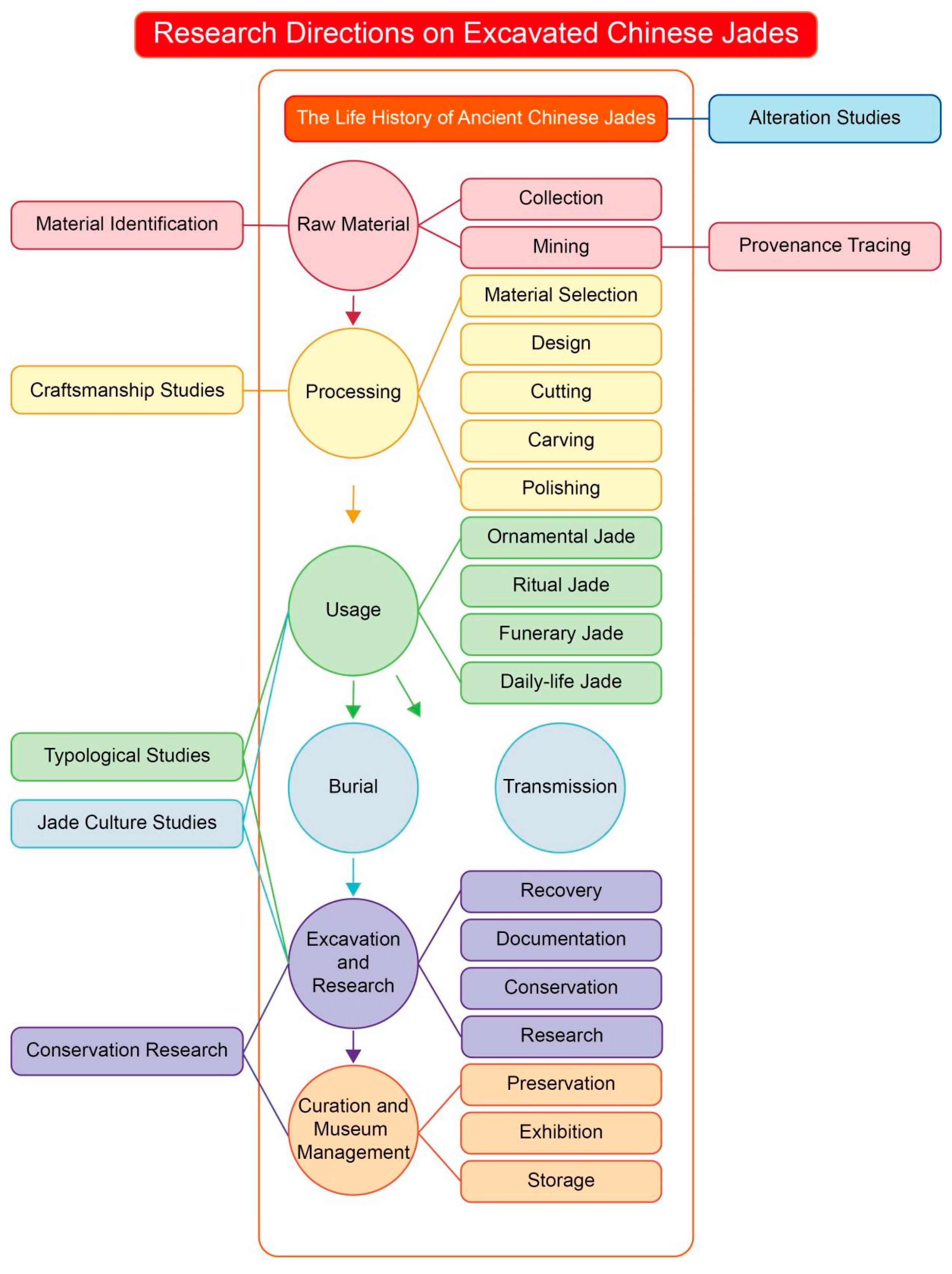
Figure 2.
Relationship between jade mine, jade rind (pi) and alteration (qin).
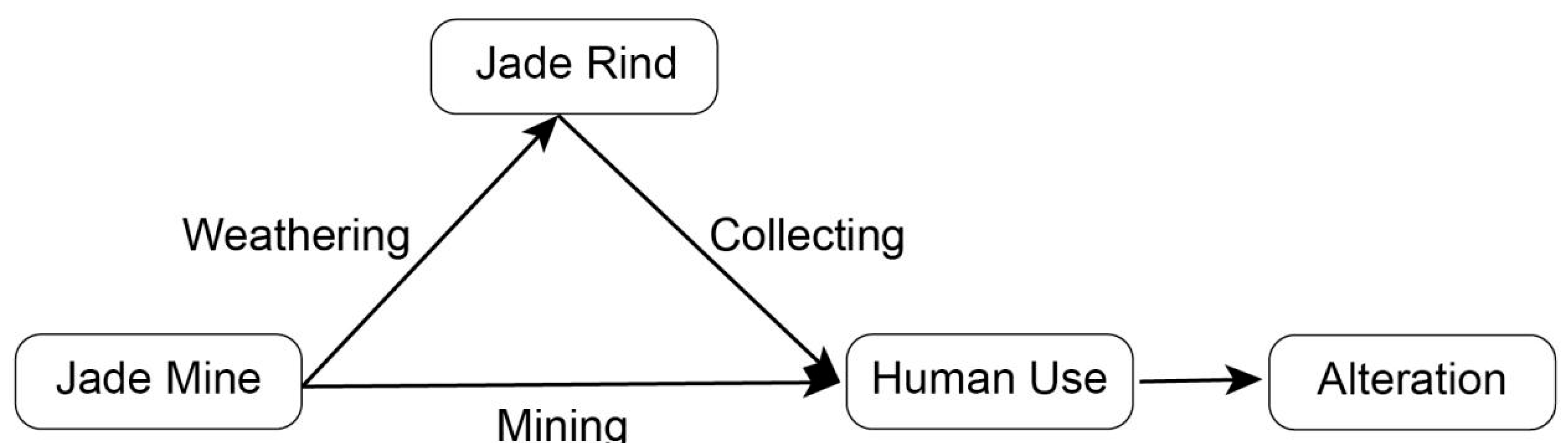
Figure 3.
Schematic color classification of alteration in ancient jade artifacts.
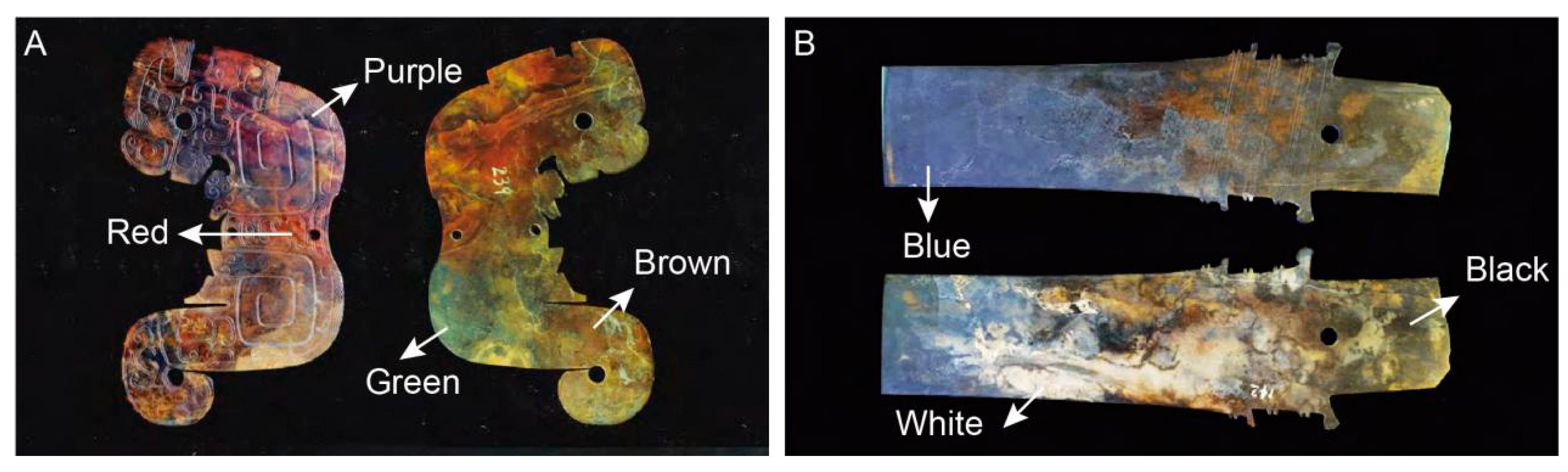
Figure 4.
Color classification and formation mechanisms of alteration in unearthed jade artifacts.
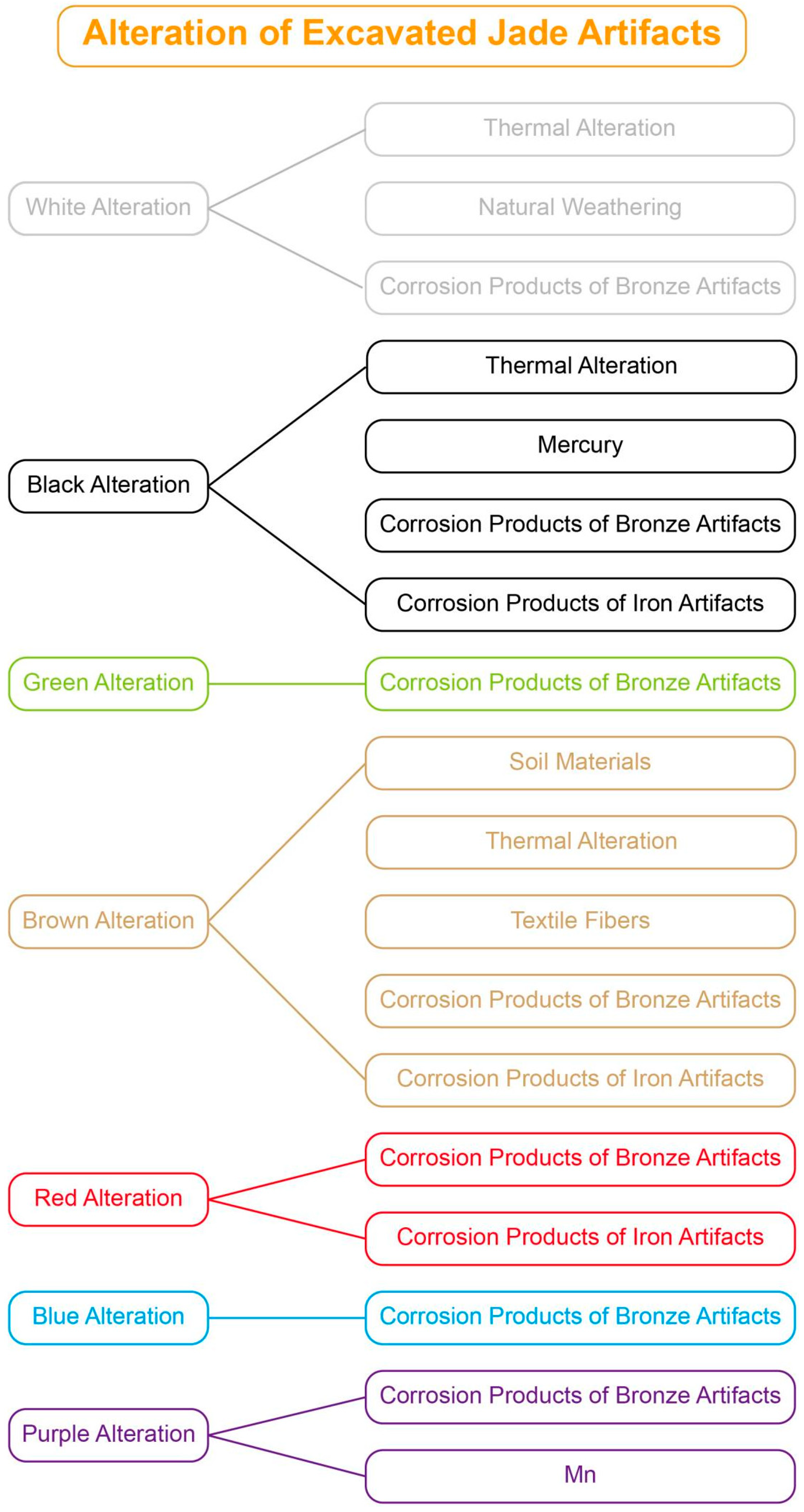
Figure 6.
Distribution of turquoise deposits in China.
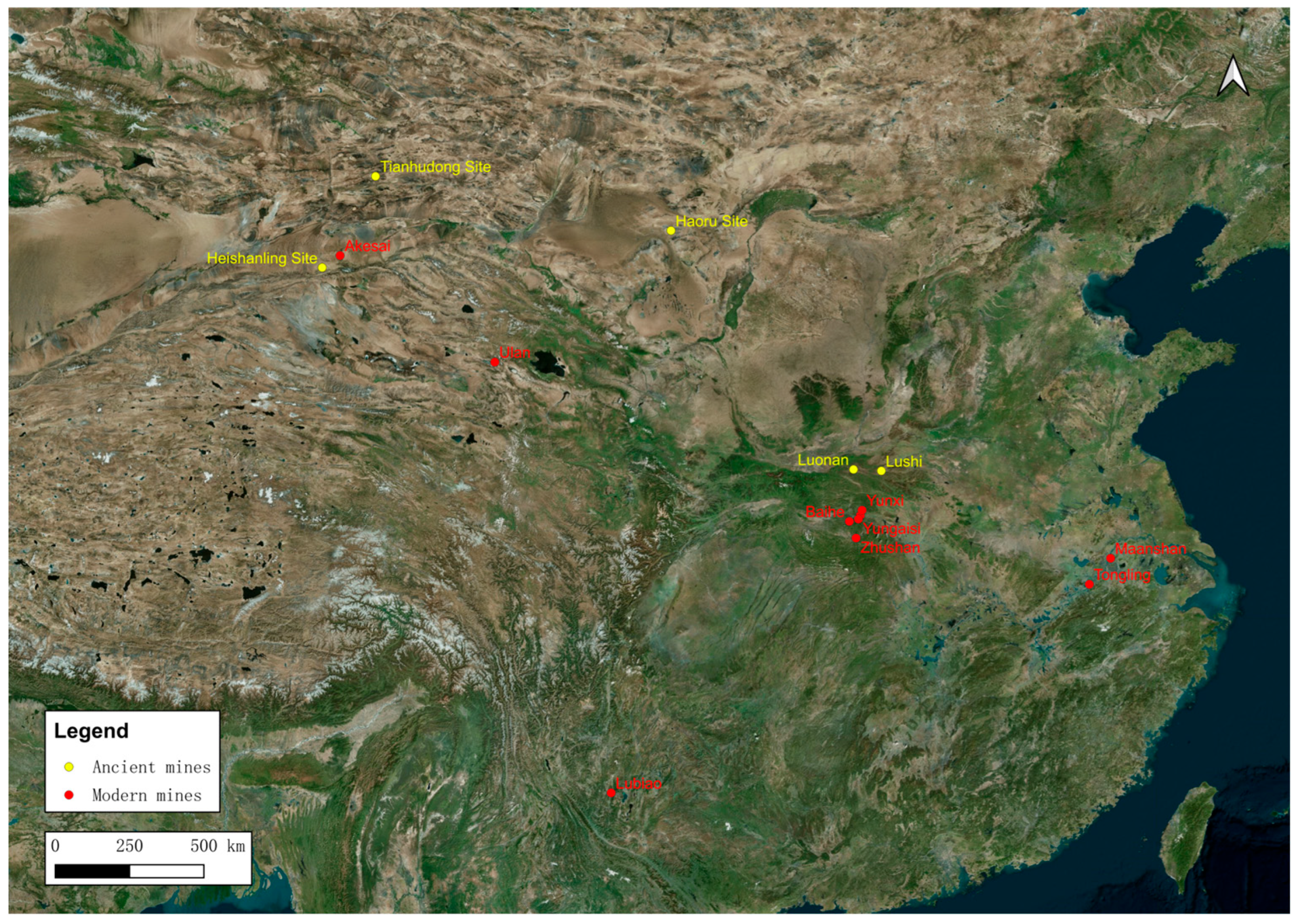

Table 1.
Types of jade materials used in ancient China.
| Category | Gem | Chemical Formula | Archaeological Example | |
| 1 | Jade category | Nephrite | Ca2(Mg,Fe)5Si8O22(OH)2 | Heilongjiang Raohe Xiaonanshan Site(7250–6650 BC) |
| 2 | Jadeite | NaAlSi2O6 | Beijing Palace Museum | |
| 3 | Agate / Chalcedony | SiO2 | Heilongjiang Raohe Xiaonanshan Site(7250–6650 BC) | |
| 4 | Pyrophyllite | Al2Si4O10(OH)2 | Zhejiang Yuyao Hemudu Site(5050–4550 BC) | |
| 5 | Talc | Mg3Si4O10(OH)2 | Heilongjiang Raohe Xiaonanshan Site(7250–6650 BC) | |
| 6 | Chlorite | (Mg,Fe)3(Si,Al)4O10(OH)2·nH2O | Heilongjiang Raohe Xiaonanshan Site(7250–6650 BC) | |
| 7 | Kaolinite | Al2Si2O5(OH)4 | Zhejiang Tongxiang Luojiajiao Site(5050 BC) | |
| 8 | Dickite | Al2Si2O5(OH)4 | Zhejiang Yuyao Tianluoshan Site(5050 BC) | |
| 9 | Illite | K,H3O)(Al,Mg,Fe)2(Si,Al)4O10 [(OH)2,(H2O)] | Shanxi Xiajin Tomb(2500 BC) | |
| 10 | Serpentine | (Mg,Fe)3Si2O5(OH)4 | Heilongjiang Raohe Xiaonanshan Site(7250–6650 BC) | |
| 11 | Mica | KAl2(AlSi3O10)(OH)2 | Heilongjiang Raohe Xiaonanshan Site(7250–6650 BC) | |
| 12 | Calcite | CaCO3 | Henan Xinzheng Tanghu Site(7650–5850 BC) | |
| 13 | Gypsum | CaSO4·2H2O | Henan Xichuan Xiawanggang Site(1680–1610 BC) | |
| 14 | Celestite | SrSO4 | Hubei Jingmen Zuozhong Chu Tomb(475–221 BC) | |
| 15 | Alunite | KAl3(SO4)2(OH)6 | Anhui Hanshan Lingjiatan Site(3350–3650 BC) | |
| 16 | Malachite | Cu2CO3(OH)2 | Liaoning Dalian Dapanjiacun Site(3050–2050 BC) | |
| 17 | Lapis Lazuli | Na8(AlSiO4)6(SO4,S,Cl)2 | Heilongjiang Raohe Xiaonanshan Site(7250–6650 BC) | |
| 18 | Turquoise | CuAl6(PO4)4(OH)8·4H2O | Henan Wuyang Jiahu Site(7050–5550 BC) | |
| 19 | Feldspar | KAlSi3O8 – NaAlSi3O8 – CaAl2Si2O8 | Liaoning Jianping Niuheliang Site(3550–3050 BC) | |
| 20 | Marble | CaCO3 (metamorphic calcite) | Shanxi Xiajin Tomb(2500 BC) | |
| 21 | Opal | SiO2·nH2O | Henan Anyang Yinxu Site(1290–1046 BC) | |
| 22 | Cinnabar | HgS | Hubei Liangzhuang Prince Tomb(1368–1644 AD) | |
| 23 | Gemstone category | Sillimanite | Al2SiO5 | Henan Wuyang Jiahu Site(7050–5550 BC) |
| 24 | Fluorite | CaF2 | Henan Hebi Liuzhuang Site(1680–1550 BC) | |
| 25 | Garnet | (Fe,Mg,Ca,Mn)3(Al,Fe)2(SiO4)3 | Henan Anyang Yinxu Hougang Site(1290–1046 BC) | |
| 26 | Single Crystal Quartz | SiO2 | Anhui Hanshan Lingjiatan Site(3650–3350 BC) | |
| 27 | Beryl | Be3Al2Si6O18 | Hubei Liangzhuang Prince Tomb(1368–1644 AD) | |
| 28 | Chrysoberyl | BeAl2O4 | Hubei Liangzhuang Prince Tomb(1368–1644 AD) | |
| 29 | Corundum | Al2O3 | Hubei Liangzhuang Prince Tomb(1368–1644 AD) | |
| 30 | Tourmaline | Na(Mg,Fe,Li,Al)3Al6(BO3)3Si6O18(OH)4 | Hubei Liangzhuang Prince Tomb(1368–1644 AD) | |
| 31 | Hypersthene | (Mg,Fe)SiO3 | Liaoning Jianping Niuheliang Site(3550–3050 BC) | |
| 32 | Apatite | Ca5(PO4)3(F,Cl,OH) | Henan Anyang Yinxu Anyang Gangtiechang Site(1290–1046 BC) | |
| 33 | Epidote | Ca2(Al,Fe)3(SiO4)3(OH) | Henan Dengzhou Baligang Site(5050 BC) | |
| 34 | Spinel | MgAl2O4 | Hubei Liangzhuang Prince Tomb(1368–1644 AD) | |
| 35 | Zircon | ZrSiO4 | Hubei Liangzhuang Prince Tomb(1368–1644 AD) | |
| 36 | Wavellite | Al3(PO4)2(OH,F)3·5H2O | Henan Hebi Liuzhuang Site(1680–1550 BC) | |
| 37 | Triplite | (Mn,Fe)2(PO4)(F,OH) | Jiangxi Xingan Dayangzhou Shang Tomb(1250–1090 BC) | |
| 38 | Organic gemstones | Pearl | CaCO3·nH2O (aragonite + organic matter) | Hubei Liangzhuang Prince Tomb(1368–1644 AD) |
| 39 | Tortoiseshell | Organic keratin (protein material) | Hunan Changsha Mawangdui Han Tomb(202–157 BC) | |
| 40 | Jet (Lignite) | C (amorphous carbon) | Liaoning Shenyang Xinle Site(5350–4850 BC) | |
| 41 | Amber | C10H16O (approx.) | Jiangxi Haihunhou Han Tomb(202 BC–9 AD) | |
| 42 | Shell | CaCO3 (mainly aragonite) | Xinjiang Tashikuergan Jierzankale Tomb(450–650 BC) | |
| 43 | Ivory | Ca10(PO4)6·(OH)2 + organic collagen | Hubei Yejiashan Tomb(1046–771 BC) | |
| 44 | Coral | CaCO3 (calcite or aragonite) | Xinjiang Niya Site(220–420 AD) | |
| 45 | Synthetic gem materials | Liuli (Chinese glass) | PbO–BaO–SiO2 (lead-barium glass) | Xinjiang Tashikuergan Jierzankale Tomb(450–650 BC) |
| 46 | Glass | Non-crystalline silicate (varies) | Guangxi Hepu Han Tomb(206 BC–220 AD) | |
| 47 | Faience | SiO2 (with alkali glaze) | Henan Sanmenxia Guo State Tomb(1046–771 BC) |
Table 2.
Major turquoise deposits in China.
| Deposit Type | Mining Area | Mineralization Belt | Mining Site | Type | Period of Exploitation |
| Sedimentary–metamorphic type | Hubei–Henan–Shaanxi region | Southern belt | Baihe, Zhushan, Yunxi, Yungaisi | Modern deposit | — |
| Central belt | Xichuan | Mineralized point | — | ||
| Northern belt | Hekou | Ancient mining site | ca. 3925–535 years BP | ||
| Guǐyu | Ancient mining site | Zhou Dynasty (Western–Eastern Zhou) | |||
| Qinghai | Ulan | Duancengshan, Gaotelamon | Modern deposit | — | |
| Xinjiang | Hami | Tianhu East site, Heishanling site | Ancient mining site | ca. 3470–2390 years BP | |
| Yunnan | Lubian Town | — | — | — | |
| Gansu | Aksai | — | — | — | |
| Inner Mongolia | Alxa | Haobeiru site | Ancient mining site | Eastern Zhou period | |
| Magmatic type | Anhui | Ma’anshan | Bijiashan, Dian’anshan, Dahuangshan | Modern deposit | — |
| Tongling | — | Modern deposit | — |
Disclaimer/Publisher’s Note: The statements, opinions and data contained in all publications are solely those of the individual author(s) and contributor(s) and not of MDPI and/or the editor(s). MDPI and/or the editor(s) disclaim responsibility for any injury to people or property resulting from any ideas, methods, instructions or products referred to in the content. |
© 2025 by the authors. Licensee MDPI, Basel, Switzerland. This article is an open access article distributed under the terms and conditions of the Creative Commons Attribution (CC BY) license (http://creativecommons.org/licenses/by/4.0/).
Copyright: This open access article is published under a Creative Commons CC BY 4.0 license, which permit the free download, distribution, and reuse, provided that the author and preprint are cited in any reuse.


