

Submitted:
29 August 2025
Posted:
03 September 2025
Read the latest preprint version here
Abstract
For n ∈ N, let En = {1 = xk, xi + xj = xk, xi · xj = xk : i, j, k ∈ {0, . . . , n}}. For n ∈ N, f (n) denotes the smallest b ∈ N such that if a system of equations S ⊆ En has a solution in Nn+1, then S has a solution in {0, . . . , b}n+1. The author proved earlier that the function f : N → N is computable in the limit and eventually dominates every computable function g : N → N. We present a short program in MuPAD which for n ∈ N prints the sequence { fi(n)}∞ i=0 of non-negative integers converging to f (n). For n ∈ N, β(n) denotes the smallest b ∈ N such that if a system of equations S ⊆ En has a unique solution in Nn+1, then this solution belongs to {0, . . . , b}n+1. The author proved earlier that the function β : N → N is computable in the limit and eventually dominates every function δ : N → N with a single-fold Diophantine representation. We present a short program in MuPAD which for n ∈ N prints the sequence {βi(n)}∞ i=0 of non-negative integers converging to β(n).
Keywords:
computable function
; eventual domination
; limit-computable function
; non-computable function
; single-fold Diophantine representation
MSC: 03D20
1. Introduction
It is known that there exists a limit-computable function which is not computable, see Theorem 1. Every known proof of this fact does not lead to the existence of a short computer program that computes f in the limit. In particular, this observation applies to the proof of Theorem 1 in [5], see also Observation Section 1.
Observation 1.
Let be a computable bijection fromto the set of all Diophantine equations. For , let
The function is computable in the limit. A negative solution to Hilbert’s 10th problem implies that the function is not computable. There is no known for which there exists a short computer program that computes in the limit.
MuPAD is a part of the Symbolic Math Toolbox in MATLAB R2019b. In this article, we present a short program in MuPAD that computes in the limit a function which eventually dominates every computable function .
2. A Limit-Computable Function Which Eventually Dominates Every Computable Function
For , let
Theorem 1.
([5]). There exists a limit-computable function which eventually dominates every computable function .
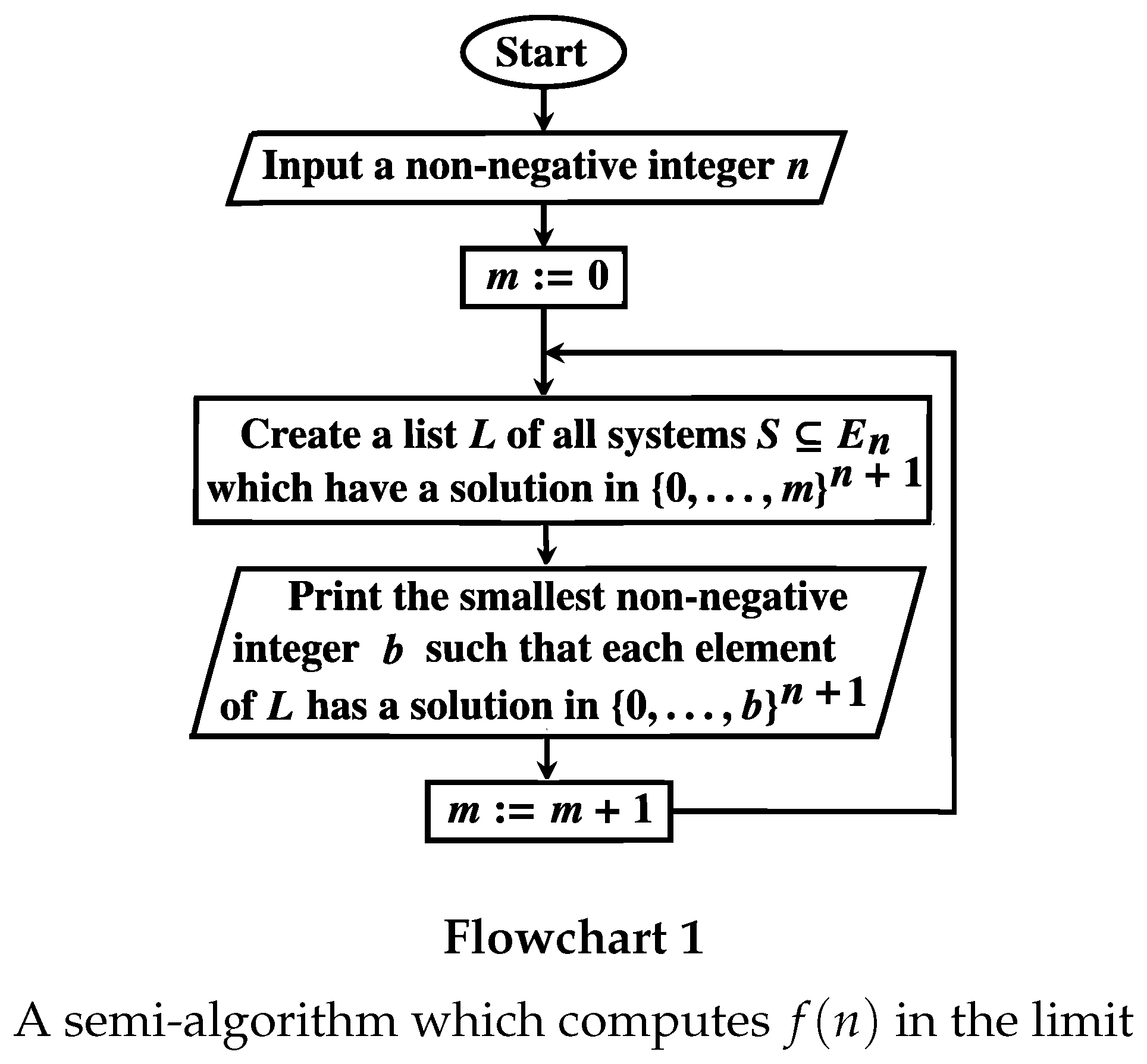
We present an alternative proof of Theorem 1. For , denotes the smallest such that if a system of equations has a solution in , then has a solution in . The function is computable in the limit and eventually dominates every computable function , see [7]. The term "dominated" in the title of [7] means "eventually dominated". Flowchart 1 shows a semi-algorithm which computes in the limit, see [7].
3. A Short Program in MuPAD that Computes in the Limit
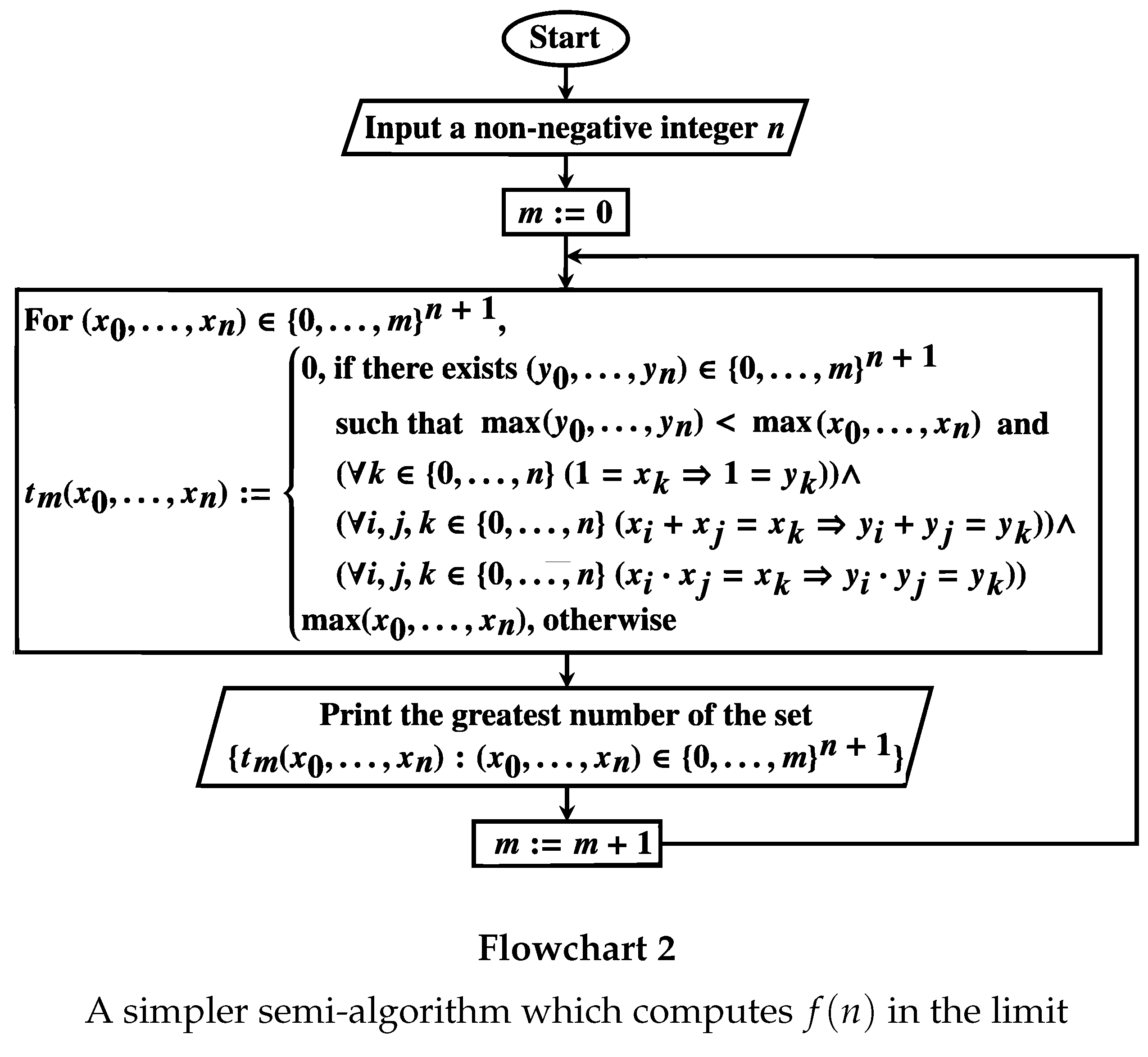
Flowchart 2 shows a simpler semi-algorithm which computes in the limit.
Lemma 1.
For every , the number printed by Flowchart 2 does not exceed the number printed by Flowchart 1.
Proof.
For every ,
□
Lemma 2.
For every , the number printed by Flowchart 1 does not exceed the number printed by Flowchart 2.
Proof.
Let . For every system of equations , if and solves , then solves the following system of equations:
□
Theorem 2.
For every , Flowcharts 1 and 2 print the same number.
Proof.
It follows from Lemmas 1 and 2. □
The following program in MuPAD implements the semi-algorithm shown in Flowchart 2.
input("Input a non-negative integer n",n):
m:=0:
while TRUE do
X:=combinat::cartesianProduct([s $s=0..m] $t=0..n):
Y:=[max(op(X[u])) $u=1..(m+1)^(n+1)]:
for p from 1 to (m+1)^(n+1) do
for q from 1 to (m+1)^(n+1) do
v:=1:
for k from 1 to n+1 do
if 1=X[p][k] and 1<>X[q][k] then v:=0 end_if:
for i from 1 to n+1 do
for j from i to n+1 do
if X[p][i]+X[p][j]=X[p][k] and X[q][i]+X[q][j]<>X[q][k] then v:=0 end_if:
if X[p][i]*X[p][j]=X[p][k] and X[q][i]*X[q][j]<>X[q][k] then v:=0 end_if:
end_for:
end_for:
end_for:
if max(op(X[q]))<max(op(X[p])) and v=1 then Y[p]:=0 end_if:
end_for:
end_for:
print(max(op(Y))):
m:=m+1:
end_while:
For , denotes the smallest such that if a system of equations has a solution in , then has a solution in . From [7] and Lemma 3 in [6], it follows that the function is computable in the limit and eventually dominates every computable function . A bit shorter program in MuPAD computes h in the limit.
4. A Limit-Computable Function of Unknown Computability Which Eventually Dominates Every Function with a single-fold Diophantine Representation
The Davis-Putnam-Robinson-Matiyasevich theorem states that every listable set has a Diophantine representation, that is
for some polynomial W with integer coefficients, see [2]. The representation (R) is said to be single-fold, if for any the equation has at most one solution .
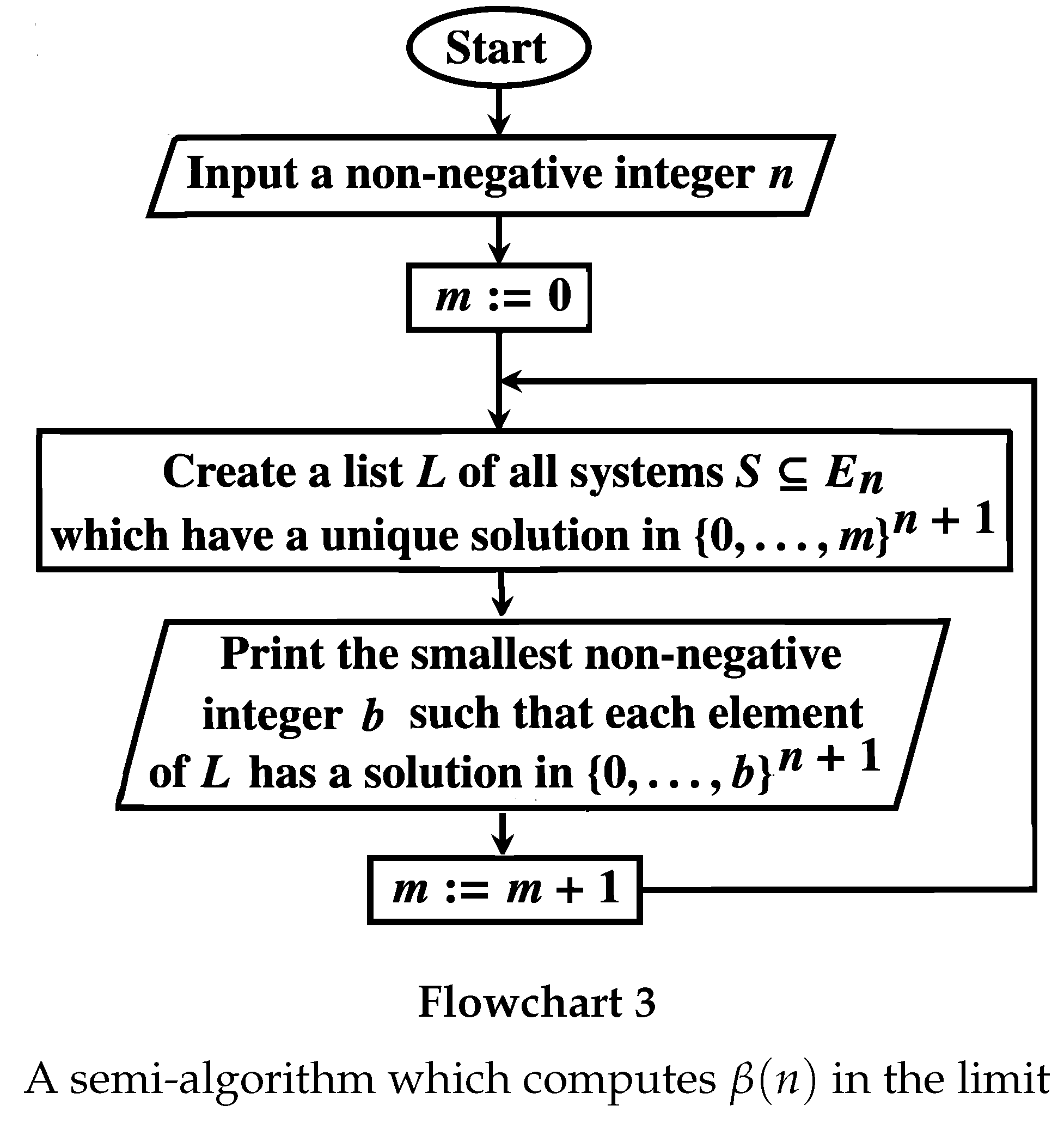
For , denotes the smallest such that if a system of equations has a unique solution in , then this solution belongs to . The computability of is unknown.
Theorem 3.
The function is computable in the limit and eventually dominates every function with a single-fold Diophantine representation.
5. A Short Program in MuPAD that Computes in the Limit
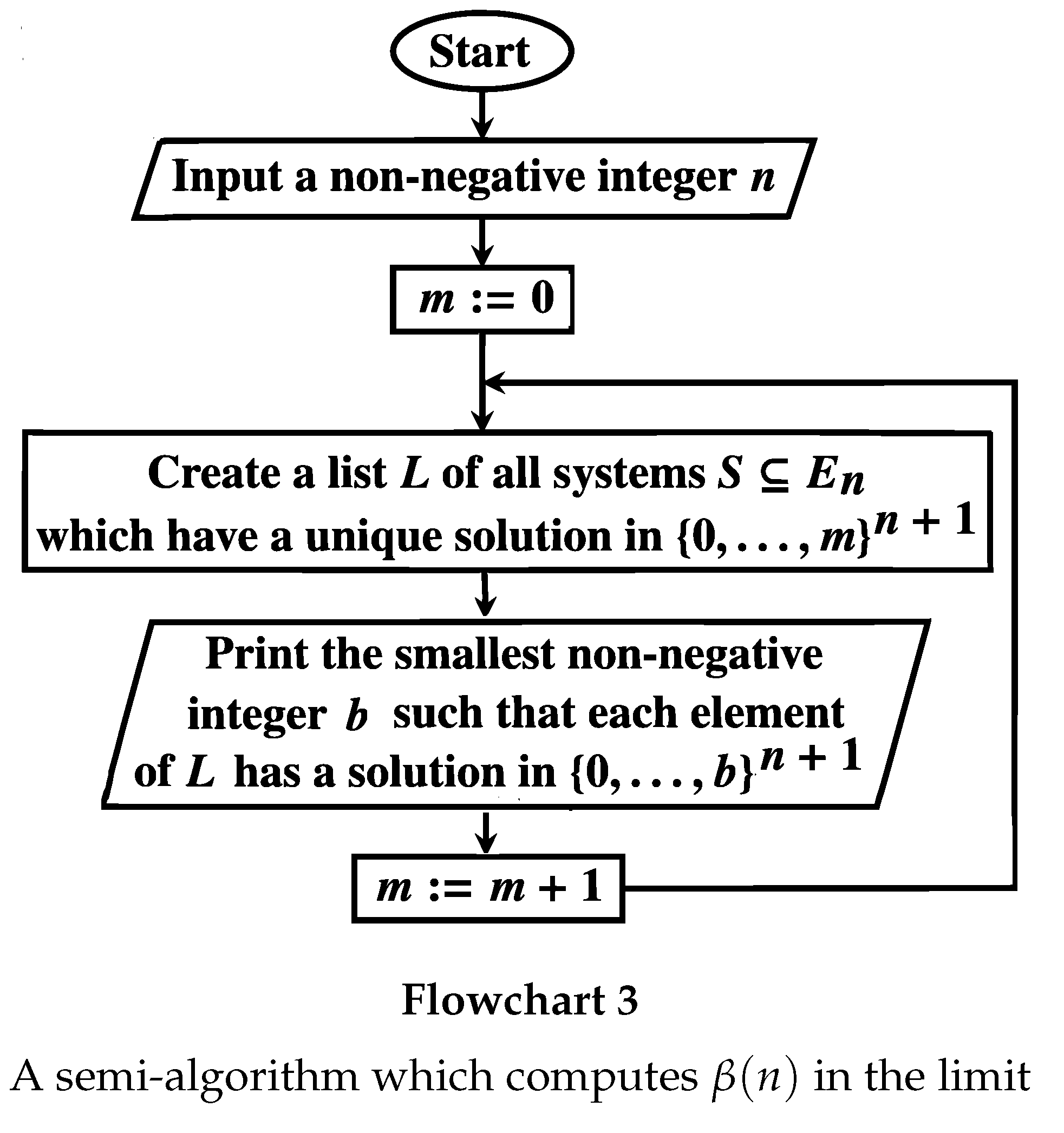
Flowchart 4 shows a simpler semi-algorithm which computes in the limit.
Lemma 3.
For every , the number printed by Flowchart 4 does not exceed the number printed by Flowchart 3.
Proof.
For every ,
□
Lemma 4.
For every , the number printed by Flowchart 3 does not exceed the number printed by Flowchart 4.
Proof.
Let . For every system of equations , if is a unique solution of in , then solves the system , where
By this and the inclusion , has exactly one solution in , namely . □
Theorem 4.
For every , Flowcharts 3 and 4 print the same number.
Proof.
It follows from Lemmas 3 and 4. □
The following program in MuPAD implements the semi-algorithm shown in Flowchart 4.
input("Input a non-negative integer n",n):
m:=0:
while TRUE do
X:=combinat::cartesianProduct([s $s=0..m] $t=0..n):
Y:=[max(op(X[u])) $u=1..(m+1)^(n+1)]:
for p from 1 to (m+1)^(n+1) do
for q from 1 to (m+1)^(n+1) do
v:=1:
for k from 1 to n+1 do
if 1=X[p][k] and 1<>X[q][k] then v:=0 end_if:
for i from 1 to n+1 do
for j from i to n+1 do
if X[p][i]+X[p][j]=X[p][k] and X[q][i]+X[q][j]<>X[q][k] then v:=0 end_if:
if X[p][i]*X[p][j]=X[p][k] and X[q][i]*X[q][j]<>X[q][k] then v:=0 end_if:
end_for:
end_for:
end_for:
if q<>p and v=1 then Y[p]:=0 end_if:
end_for:
end_for:
print(max(op(Y))):
m:=m+1:
end_while:
References
- M. Davis, Yu. Matiyasevich, J. Robinson, Hilbert’s tenth problem, Diophantine equations: positive aspects of a negative solution; in: Mathematical developments arising from Hilbert problems (ed. F. E. Browder), Proc. Sympos. Pure Math., vol. 28, Part 2, Amer. Math. Soc., Providence, RI, 1976, 323–378; reprinted in: The collected works of Julia Robinson (ed. S. Feferman), Amer. Math. Soc., Providence, RI, 1996, 269–324. [CrossRef]
- Yu. Matiyasevich, Hilbert’s tenth problem, MIT Press, Cambridge, MA, 1993.
- Yu. Matiyasevich, Hilbert’s tenth problem: what was done and what is to be done, in: Proceedings of the Workshop on Hilbert’s tenth problem: relations with arithmetic and algebraic geometry (Ghent, 1999), Contemp. Math. 270, Amer. Math. Soc., Providence, RI, 2000, 1–47, . [CrossRef]
- Yu. Matiyasevich, Towards finite-fold Diophantine representations, J. Math. Sci. (N. Y.) vol. 171, no. 6, 2010, 745–752, . [CrossRef]
- J. S. Royer and J. Case, Subrecursive Programming Systems: Complexity and Succinctness, Birkhäuser, Boston, 1994.
- A. Tyszka, A hypothetical upper bound on the heights of the solutions of a Diophantine equation with a finite number of solutions, Open Comput. Sci. 8 (2018), no. 1, 109–114, . [CrossRef]
- A. Tyszka, All functions g:N→N which have a single-fold Diophantine representation are dominated by a limit-computable function f:N∖{0}→N which is implemented in MuPAD and whose computability is an open problem, in: Computation, cryptography, and network security (eds. N. J. Daras, M. Th. Rassias), Springer, Cham, 2015, 577–590,. [CrossRef]
Disclaimer/Publisher’s Note: The statements, opinions and data contained in all publications are solely those of the individual author(s) and contributor(s) and not of MDPI and/or the editor(s). MDPI and/or the editor(s) disclaim responsibility for any injury to people or property resulting from any ideas, methods, instructions or products referred to in the content. |
© 2025 by the authors. Licensee MDPI, Basel, Switzerland. This article is an open access article distributed under the terms and conditions of the Creative Commons Attribution (CC BY) license (http://creativecommons.org/licenses/by/4.0/).
Copyright: This open access article is published under a Creative Commons CC BY 4.0 license, which permit the free download, distribution, and reuse, provided that the author and preprint are cited in any reuse.


