
Submitted:
15 July 2025
Posted:
16 July 2025
You are already at the latest version
Preprints on COVID-19 and SARS-CoV-2
Abstract
Several studies have reported the initially unexpected presence of COVID-19 vaccine artifacts (modified mRNA, spike protein) in human tissues and bodily fluids. Questions remain regarding the true persistence of both spike protein and mRNA, and the mechanism of this phenomenon, which defies initial expectations. While n1-methyl-pseudouridine was chosen for its ability to resist immune degradation, it was still expected to decay at a time course somewhat similar to that characterized for RNA or pseudouridinylated RNA. Recent studies have indicated possible persistence exceeding one year in duration, motivating explanation. This review examines the methodologies for which spike protein, mRNA, or other vaccine contents (e.g., lipid nanoparticles) have been detected at long durations since the last injection, the tissues or bodily fluids in which they have been identified, and the accompanying sensitivities of the assays. This review also discusses potential explanations for the persistent vaccine artifacts.
Keywords:
COVID-19 vaccines
; mRNA vaccines
; BNT162b2
; mRNA1273
; spike protein
Introduction
Bahl et al. evaluated mRNA concentration in mice following injection, though the formulation used in that study lacked nucleoside modifications [6]. Other studies have provided limited information regarding the production of the target antigen or the persistence of vaccine genetic material (Table 1). Studies since the vaccination campaign have revealed persistence of injection-related artifacts in individuals for months or even years past their last dose [10,11].
To date, the persistence of both the vaccine antigen and the modified mRNA defies explanation [10,12]. While mechanisms have been offered , including prolonged stability of n1-methyl-pseudouridinylated RNA [12], or expression of plasmid DNA contamination discovered in vaccine vials [13,14], the phenomenon is not well understood.
Prior to the COVID-19 mRNA vaccine trials in 2020, there were only five years of data on the behaviour of modified n1-methyl-pseudouridinylated mRNA [15]. While it was known that its decay curve was significantly slower than that of unmodified mRNA, the observed results only sufficiently explained differences in lifespan within an order of magnitude [15].
Throughout the development of vaccines during 2020 and their wide rollout in 2021, there was significant public interest in how the novel mRNA platform compared to traditional vaccines [16]. One proposed advantage of RNA vaccines was the transience of the genetic material, as RNA is less stable than DNA [17] and, in principle, avoids the risk of genomic integration [18].
After the initial clinical trials for the Pfizer and Moderna vaccines [19,20], they were soon granted emergency use authorization (EUA) in the United States [21], as well as the respective authorization in countries across the globe. Approximately 70% of the global populationhas received a COVID-19 vaccine, with about 30% of the doses being mRNA vaccines [22]. Following the mass vaccination campaigns, several articles were published demonstrating the persistence of vaccine-derived mRNA or spike protein in recipients [10,11,23].
This article aims to summarize the current findings on the decay kinetics of nucleoside-modified mRNA and spike protein after injection with a COVID-19 mRNA vaccine. The question of vaccine artifact persistence has ramifications for vaccine safety and for the future use and regulation of the mRNA vaccine platform.
Methods
To identify records for the 16 types of bodily fluids identified in [24], we performed a literature search using the PUBMED search terms:
(“[Name of bodily fluid or tissue/organ]” AND “spike protein”) OR (“[Name of bodily fluid or tissue/organ]” AND “COVID-19 vaccine mRNA”)
The search timeframe was kept general to allow shorter term records to be included, which may inform about the time course of mRNA degradation and spike protein expression.
We specified the following inclusion criteria.
- (1)
- Article must use an analytical technique to show direct or proxy evidence for spike protein or vaccinal mRNA.
- (2)
- Sample must be taken from a vaccinated individual.
We specified the following exclusion criteria.
- (1)
- Spike protein is attributed to SARS-CoV-2 infection by the study authors.
For spike protein persistence in tissue and organs, we conducted a separate literature search focusing on autopsies and biopsies. Prior meta-analyses performed on autopsies of people plausibly deceased due to COVID-19 vaccines are available in the literature and provide a curated summary of the autopsy reports published up to the date of writing (17–19). For this literature search, we analyzed individual cases in the cited literature reviews on autopsy.
For the case of spike protein or RNA found in organs and tissues, we employed the following search terms:
("biopsy" AND "spike protein" AND "vaccine") OR ("biopsy" AND "mRNA" AND "vaccine").
The same inclusion and exclusion criteria described above for bodily fluids were applied to tissue and organ studies.
Results
Our search revealed 11 fitting results for studies testing the persistence of vaccine artifacts in bodily fluids (Table 2).
Analytical Techniques
Several different analytical techniques were used to identify the presence of injection artifacts in bodily fluids, depending on the substance observed [34,35,36,37,38]. Spike protein in biological samples was identified using ELISA [26], SIMOA [11,26], Western blotting [11,30], mass spectrometry [10,12,23,27], immunohistochemistry [11,25], immunofluorescence [39], flow cytometry [26,40], and ELISpot [40,41].
Detection and quantification of vaccine-derived mRNA were achieved using a combination of RT-qPCR [10,25,32,33], droplet digital PCR (ddPCR) [11,27], RT-PCR [28,39], in situ hybridization [11,42,43], and branched DNA (bDNA) assays [11].
Detection of lipid nanoparticles (LNPs) was primarily accomplished through extracellular vesicle (EV) isolation via sequential centrifugation and electron microscopy [28].
Tissue/Organ Spike/mRNA Persistency
For vaccine artifacts found in biopsies or autopsies, our search revealed 6 results (Table 3).
Characterizing the Decay Curves
Experimental data exists for the presence of three vaccinal artefacts for various time points: spike protein, mRNA sequences and LNP. While traditional sequencing technologies typically cannot distinguish between modified n1-methyl-pseudouridinylated RNA and unmodified mRNA, recent advances in nanopore sequencing have made this differentiation possible [48].
A recent study [27] characterized the decay kinetics of modified mRNA and the ionizable lipids composing the LNP in 19 individuals. By day 28 post-vaccination, all subjects exhibited vaccinal mRNA concentrations <0.001ng/mL in blood plasma (Figure 1A). The study also tracked levels of SM-102, an ionizable lipid composing part of the LNP (Figure 1B). The same study reported, that in day 14-15 post-immunization 37% of recipients still had detectable mRNA. Notably, fragmented or non-intact mRNA was detectable for longer time periods than the intact mRNA [27] (Figure 1C).
Li et al. [49] investigated the stability of various SARS-CoV-2 proteins in human lung epithelial cells and found that spike protein is relatively stable, with a half-life exceeding 8 hours. To our knowledge, to date, there are no published studies that measure the decay rate of vaccine-derived spike protein in a quantitative manner over time. However, mutations introduced into the vaccine-encoded spike protein are expected to confer enhanced biochemical stability [49]. It has been shown that vaccine spike protein is more resistant to heat stress and freeze-thaw cycles, persisting in the prefusion state up to 30 minutes, whereas the native viral spike protein aggregates or unfolds more rapidly under the same conditions [50]. It can thus be inferred that the have a half-life of the vaccinal spike protein likely exceeds that of the virus-derived spike protein.
Spike as a Potential Biomarker
In individuals with vaccine-associated myocarditis, spike protein has been detected at elevated concentrations for at least three weeks post-vaccination —the longest time point assessed in the study [26]. It appears to be the concentrations of full-length spike protein that differs between myocarditis patients and controls, as measurements for S1 subunit reveal smaller differences between controls and patients. Both Yonker et al. [26] (Figure 2A) and Bhattacharjee et al. [29] (Figure 2B) have identified increased levels of circulating spike in vaccine-associated myocarditis patients and Post-Acute COVID-19 Vaccination Syndrome (PACVS) patients, respectively, when compared to healthy controls. These findings potentially support the use of spike protein levels as a diagnostic biomarker for PACVS and other vaccine-related adverse events. \
While the authors of the above studies generally attribute the presence of the vaccinal artefacts to vaccination, for the case of the spike protein, this can be produced either by infection or injection. The vaccinal spike can be differentiated by testing for vaccine specific sequences [12], which provides unequivocal evidence of the source being the vaccine. A less definitive means of testing for the source of the spike is by testing for the presence of the nucleocapsid (N) protein, which accompanies infection. However, it has been previously shown that the spike protein is one of the more stable SARS-CoV-2 proteins while the nucleocapsid protein can degrade rapidly [51]. Until definitive studies comparing the rate of degradation of spike and nucleocapsid proteins in different tissues are demonstrated, absence of evidence of the nucleocapsid protein cannot be used definitively as evidence of absence of viral infection.
Persistent spike protein and its genetic code may be of concern, as in vitro and in vivo studies support several pathological mechanisms linking it to myocarditis and other adverse events [52,53,54,55]. In the case of myocarditis, in vitro studies have shown spike protein inducing damage to cardiac pericytes [56]. In addition to myocarditis [57] and other acute adverse events [58], chronic effects exist as well [59]. One novel condition, termed Post-Acute Vaccination Syndrome (PACVS, also referred to as Post-Vaccination Syndrome; PVS) [60,61], manifests similarly to Post-Acute Covid-19 Syndrome (PACS; “long COVID”) or Myalgic Encephalomyelitis/ or Chronic fatigue Syndrome (ME/CFS) [59]. PACVS is characterized by exercise intolerance, fatigue and brain fog as major symptoms, though individual presentation differs significantly [62].
In the case of PACS, persisting viral fragments [63], including spike protein [64], may be a driver of the condition. Spike protein may induce PACVS via multiple mechanisms [52]. Should the spike protein be a major driver of disease in PACS and/or PACVS, it is important to investigate mechanisms for its inactivation [65] and removal [52,66], along with addressing any lingering damage [22].
Proposed Persistence Mechanisms
Two foundational assumptions were required to hold for safe and limited biodistribution. Firstly, it was claimed that vaccination contents remained at the site of injection [67]. The findings of systemic biodistribution dispute this claim (Table 2 and 3). Secondly, the claim that the spike protein was short lasting [67], requires additional analysis.
The injection volume of 0.5mL for adults, containing 100ug (Moderna) or 30ug (Pfizer) of n1-methyl-pseudouridinylated RNA, of length 3828nt [68]and 4284nt [69], respectively corresponds to roughly 5x10¹³ and 2x10¹³ copies of the RNA template respectively. The standard RNA half-life in human blood is 16.4 hours [70], in n1-methyl-pseudouridinylated RNA, this value is 5-6 days [15]. The time to degrade the RNA to <1 copy would be 272 days and 263 days for Pfizer and Moderna, respectively. The slower decay kinetics may partially explain the persistence of spike protein in vaccinees, which has been observed at durations as extreme as 709 days post-vaccination [29], with other studies showing extended durations [23].
To this day, it remains an open question how long n1-methyl-pseudouridinylated RNA lasts in human systems [15], and what factors influence its degradation. The durations observed in Table 2 and Table 3 suggest that the vaccinal artifacts resist degradation at durations of months to possibly even years. This finding motivates the question of how the vaccine artifacts are persisting. Brogna et al. hypothesized three possible mechanisms for vaccine artifact persistence from a modified RNA template [12] (Figure 3). The first mechanism is integration of modified mRNA into human cells [10,12]; this has not been observed directly in the scientific literature. However, the recently discovered reverse transcriptase activity of polymerase theta (Polθ) [71,72], and LINE-1 elements [73] theoretically provides a potential mechanism. Recent reports of contamination by bacterial DNA [13,14,74,75] now pose another potential reservoir of spike protein encoding genetic material.
The second mechanism proposed is persistence of the modified mRNA template itself. As mentioned previously, the decay curve of n1-methyl pseudouridinylated RNA is not well described [15], with modest experimental studies beginning in 2015 [15]. Furthermore, very limited biological precedent is available for comparison as the n1-methyl pseudouridine occurs rarely in nature and only at specific sites in tRNA and rRNA [76], i.e. it is present in natural systems at far lower concentrations than would be present in a modified mRNA injection. Until global mass immunization with COVID-19 mRNA vaccines, presence of n1-methyl pseudouridine in humans have never been described.
The third mechanism proposed is integration of the RNA vaccine genetic code into bacterial cells [12]. This may proceed via the endogenous reverse transcription enzymes of the bacteria themselves [77]. An additional possibility is incorporation of bacterial plasmic DNA, present as a contaminant in mRNA vaccines [13], into bacterial cells, serving as a stable reservoir and producing spike protein.
Finally, it is conceivable that spike protein itself could be taken up by certain cells and retained for extended duration depending on co-interaction with other present biological components or the degradation efficiency of a specific cell type. Some evidence exists that spike protein, particularly S1 subunit can persists within non-classical monocytes for extended periods post infection or vaccination [23,29,78].
Regardless of the mechanism of persistence, inadvertent biodistribution and chronic expression of spike protein presents challenges for mRNA technology, which relies on the same delivery mechanism (lipid nanoparticle formulations) and template type (n1-methyl-pseudouridinylated RNA). Unless these issues are fixed, future vaccines using the same technology will have unexpected spillage to other organs and tissues besides the target injection site and lymph nodes. Given that intravenous injection of the vaccine contents can result in myocarditis in a mouse model [79], inadvertent biodistribution presents a safety concern.
Discussion
The use of mRNA technology in humans marks a significant advancement in biomedical science, yet it also introduces a new frontier laden with uncertainty. The persistence and systemic distribution of vaccine components, namely spike protein, modified mRNA, and lipid nanoparticles have defied early expectations that such materials would degrade within days. Instead, studies have found these components in blood, tissues, and other biological fluids months and even years post-injection (Table 2 and Table 3). This unexpected longevity raises critical questions about degradation pathways, tissue-specific retention, and immune system interactions with these synthetic biomolecules. The foundational assumptions of rapid decay and localized distribution have not consistently held, suggesting that we still lack a complete understanding of how nucleoside-modified mRNA vaccines behave in human systems. These results prompt re-evaluation of the kinetic models of the clearance of these molecules.
A deeper investigation into the mechanisms of action, persistence, and biodistribution of mRNA vaccine components is urgently needed. Further research questions should cover individual variation for degradation of these molecules, which will provide insights into the regulation of the decay pathways. To alleviate these concerns, vaccine delivery systems require improved localization that ensures complete degradation of the genetic material, and verifying absence of off-target effects. Equally important is the continued optimization of translation fidelity [80], and enhancing purification protocols to eliminate residual bacterial DNA contaminants [13] from in vitro–transcribed mRNA to ensure that translation products derive exclusively as intended from the synthetic transcripts. Addressing these gaps will be essential for the safe and effective development of future mRNA-based therapies.
Despite the current challenges, mRNA technology holds immense potential for gene therapy, rapid vaccine development, and treatment of chronic diseases [81,82]. With rigorous research, transparent evaluation, and engineering improvements, this novel platform can be refined into a transformative tool for human health. Moving forward, solving these issues is not only vital for public trust but also for unlocking the full therapeutic potential of mRNA technologies for the benefit of global health [83,84].
References
- M. T. J. Halma, J. Rose, and T. Lawrie, “The Novelty of mRNA Viral Vaccines and Potential Harms: A Scoping Review,” J, vol. 6, no. 2, Art. no. 2, Jun. 2023. [CrossRef]
- M. Alberer et al., “Safety and immunogenicity of a mRNA rabies vaccine in healthy adults: an open-label, non-randomised, prospective, first-in-human phase 1 clinical trial,” The Lancet, vol. 390, no. 10101, pp. 1511–1520, Sep. 2017. [CrossRef]
- R. A. Feldman et al., “mRNA vaccines against H10N8 and H7N9 influenza viruses of pandemic potential are immunogenic and well tolerated in healthy adults in phase 1 randomized clinical trials,” Vaccine, vol. 37, no. 25, pp. 3326–3334, May 2019. [CrossRef]
- on behalf of the iHIVARNA consortium et al., “iHIVARNA phase IIa, a randomized, placebo-controlled, double-blinded trial to evaluate the safety and immunogenicity of iHIVARNA-01 in chronically HIV-infected patients under stable combined antiretroviral therapy,” Trials, vol. 20, no. 1, p. 361, Dec. 2019. [CrossRef]
- C. Aldrich et al., “Proof-of-concept of a low-dose unmodified mRNA-based rabies vaccine formulated with lipid nanoparticles in human volunteers: A phase 1 trial,” Vaccine, vol. 39, no. 8, pp. 1310–1318, Feb. 2021. [CrossRef]
- K. Bahl et al., “Preclinical and Clinical Demonstration of Immunogenicity by mRNA Vaccines against H10N8 and H7N9 Influenza Viruses,” Mol. Ther., vol. 25, no. 6, pp. 1316–1327, Jun. 2017. [CrossRef]
- J. M. Jacobson et al., “Dendritic Cell Immunotherapy for HIV-1 Infection Using Autologous HIV-1 RNA: A Randomized, Double-Blind, Placebo-Controlled Clinical Trial,” vol. 72, no. 1, 2016. [CrossRef]
- R. T. Gandhi et al., “Immunization of HIV-1-Infected Persons With Autologous Dendritic Cells Transfected With mRNA Encoding HIV-1 Gag and Nef: Results of a Randomized, Placebo-Controlled Clinical Trial,” vol. 71, no. 3, 2016. [CrossRef]
- L. Leal et al., “Phase I clinical trial of an intranodally administered mRNA-based therapeutic vaccine against HIV-1 infection,” AIDS, vol. 32, no. 17, pp. 2533–2545, Nov. 2018. [CrossRef]
- L. G. Boros, A. M. Kyriakopoulos, C. Brogna, M. Piscopo, P. A. McCullough, and S. Seneff, “Long-lasting, biochemically modified mRNA, and its frameshifted recombinant spike proteins in human tissues and circulation after COVID-19 vaccination,” Pharmacol. Res. Perspect., vol. 12, no. 3, p. e1218, 2024. [CrossRef]
- I. Pateev, K. Seregina, R. Ivanov, and V. Reshetnikov, “Biodistribution of RNA Vaccines and of Their Products: Evidence from Human and Animal Studies,” Biomedicines, vol. 12, no. 1, p. 59, Dec. 2023. [CrossRef]
- C. Brogna et al., “Detection of recombinant Spike protein in the blood of individuals vaccinated against SARS-CoV-2: Possible molecular mechanisms,” PROTEOMICS – Clin. Appl., vol. 17, no. 6, p. 2300048, Nov. 2023. [CrossRef]
- B. König and J. O. Kirchner, “Methodological Considerations Regarding the Quantification of DNA Impurities in the COVID-19 mRNA Vaccine Comirnaty®,” Methods Protoc., vol. 7, no. 3, Art. no. 3, Jun. 2024. [CrossRef]
- D. Speicher, J. Rose, L. Gutschi, D. Wiseman, and K. McKernan, Speicher DJ et al, DNA fragments detected in COVID-19 vaccines in Canada. DNA fragments detected in monovalent and bivalent. 2023.
- O. Andries, S. Mc Cafferty, S. C. De Smedt, R. Weiss, N. N. Sanders, and T. Kitada, “N1-methylpseudouridine-incorporated mRNA outperforms pseudouridine-incorporated mRNA by providing enhanced protein expression and reduced immunogenicity in mammalian cell lines and mice,” J. Controlled Release, vol. 217, pp. 337–344, Nov. 2015. [CrossRef]
- C. Leong, L. Jin, D. Kim, J. Kim, Y. Y. Teo, and T.-H. Ho, “Assessing the impact of novelty and conformity on hesitancy towards COVID-19 vaccines using mRNA technology,” Commun. Med., vol. 2, no. 1, pp. 1–6, May 2022. [CrossRef]
- H. Zhang et al., “Fluorescence-Based Quantification of Messenger RNA and Plasmid DNA Decay Kinetics in Extracellular Biological Fluids and Cell Extracts,” Adv. Biosyst., vol. 4, no. 5, p. 2000057, 2020. [CrossRef]
- J. B. Ulmer, P. W. Mason, A. Geall, and C. W. Mandl, “RNA-based vaccines,” Vaccine, vol. 30, no. 30, pp. 4414–4418, Jun. 2012. [CrossRef]
- F. P. Polack et al., “Safety and Efficacy of the BNT162b2 mRNA Covid-19 Vaccine,” N. Engl. J. Med., vol. 383, no. 27, pp. 2603–2615, Dec. 2020. [CrossRef]
- L. R. Baden et al., “Efficacy and Safety of the mRNA-1273 SARS-CoV-2 Vaccine,” N. Engl. J. Med., vol. 384, no. 5, pp. 403–416, Feb. 2021. [CrossRef]
- “Authorizations of Emergency Use of Two Biological Products During the COVID-19 Pandemic; Availability,” Federal Register. Accessed: Jun. 02, 2025. [Online]. Available: https://www.federalregister.gov/documents/2021/01/19/2021-01022/authorizations-of-emergency-use-of-two-biological-products-during-the-covid-19-pandemic-availability.
- M. T. J. Halma, C. Plothe, P. Marik, and T. A. Lawrie, “Strategies for the Management of Spike Protein-Related Pathology,” Microorganisms, vol. 11, no. 5, Art. no. 5, May 2023. [CrossRef]
- B. K. Patterson et al., “Detection of S1 spike protein in CD16+ monocytes up to 245 days in SARS-CoV-2-negative post-COVID-19 vaccine syndrome (PCVS) individuals,” Hum. Vaccines Immunother., vol. 21, no. 1, p. 2494934, Dec. 2025. [CrossRef]
- L. Huang et al., “Human body-fluid proteome: quantitative profiling and computational prediction,” Brief. Bioinform., vol. 22, no. 1, pp. 315–333, Jan. 2021. [CrossRef]
- A. J. Krauson, F. V. C. Casimero, Z. Siddiquee, and J. R. Stone, “Duration of SARS-CoV-2 mRNA vaccine persistence and factors associated with cardiac involvement in recently vaccinated patients,” Npj Vaccines, vol. 8, no. 1, p. 141, Sep. 2023. [CrossRef]
- L. M. Yonker et al., “Circulating Spike Protein Detected in Post–COVID-19 mRNA Vaccine Myocarditis,” Circulation, vol. 147, no. 11, pp. 867–876, Mar. 2023. [CrossRef]
- S. J. Kent et al., “Blood Distribution of SARS-CoV-2 Lipid Nanoparticle mRNA Vaccine in Humans,” ACS Nano, vol. 18, no. 39, pp. 27077–27089, Oct. 2024. [CrossRef]
- N. Hanna et al., “Detection of Messenger RNA COVID-19 Vaccines in Human Breast Milk,” JAMA Pediatr., vol. 176, no. 12, p. 1268, Dec. 2022. [CrossRef]
- B. Bhattacharjee et al., “Immunological and Antigenic Signatures Associated with Chronic Illnesses after COVID-19 Vaccination,” Feb. 25, 2025, medRxiv. [CrossRef]
- T. E. Fertig et al., “Vaccine mRNA Can Be Detected in Blood at 15 Days Post-Vaccination,” Biomedicines, vol. 10, no. 7, p. 1538, Jun. 2022. [CrossRef]
- J. A. S. Castruita et al., “SARS-CoV -2 spike mRNA vaccine sequences circulate in blood up to 28 days after COVID -19 vaccination,” APMIS, vol. 131, no. 3, pp. 128–132, Mar. 2023. [CrossRef]
- K. Röltgen et al., “Immune imprinting, breadth of variant recognition, and germinal center response in human SARS-CoV-2 infection and vaccination,” Cell, vol. 185, no. 6, pp. 1025-1040.e14, Mar. 2022. [CrossRef]
- J. M. Low et al., “Codominant IgG and IgA expression with minimal vaccine mRNA in milk of BNT162b2 vaccinees,” Npj Vaccines, vol. 6, no. 1, p. 105, Aug. 2021. [CrossRef]
- “National Center for Biotechnology Information.” Accessed: May 25, 2025. [Online]. Available: https://www.ncbi.nlm.nih.gov/.
- “Thermo Fisher Scientific - US.” Accessed: May 25, 2025. [Online]. Available: https://www.thermofisher.com/us/en/home.html.
- “Leading Life Science Research & Clinical Diagnostics | Bio-Rad.” Accessed: May 25, 2025. [Online]. Available: https://www.bio-rad.com/.
- CDC, “About OneLabTM,” CDC Laboratory Training. Accessed: May 25, 2025. [Online]. Available: https://www.cdc.gov/lab-training/php/onelab/index.html.
- “Ultra-Sensitive Biomarker Detection,” Quanterix. Accessed: May 25, 2025. [Online]. Available: https://www.quanterix.com/.
- Z. Rong et al., “Persistence of spike protein at the skull-meninges-brain axis may contribute to the neurological sequelae of COVID-19,” Cell Host Microbe, vol. 32, no. 12, pp. 2112-2130.e10, Dec. 2024. [CrossRef]
- J. S. Turner et al., “SARS-CoV-2 mRNA vaccines induce persistent human germinal centre responses,” Nature, vol. 596, no. 7870, pp. 109–113, Aug. 2021. [CrossRef]
- E. Taus et al., “Persistent memory despite rapid contraction of circulating T Cell responses to SARS-CoV-2 mRNA vaccination,” Front. Immunol., vol. 14, p. 1100594, Feb. 2023. [CrossRef]
- N. Ota et al., “Expression of SARS-CoV-2 spike protein in cerebral Arteries: Implications for hemorrhagic stroke Post-mRNA vaccination,” J. Clin. Neurosci., vol. 136, p. 111223, Jun. 2025. [CrossRef]
- L. Martin-Navarro, C. De Andrea, B. Sangro, and J. Argemi, “In situ detection of vaccine mRNA in the cytoplasm of hepatocytes during COVID-19 vaccine-related hepatitis,” J. Hepatol., vol. 78, no. 1, pp. e20–e22, Jan. 2023. [CrossRef]
- M. Mörz, “A Case Report: Multifocal Necrotizing Encephalitis and Myocarditis after BNT162b2 mRNA Vaccination against COVID-19,” Vaccines, vol. 10, no. 10, p. 1651, Oct. 2022. [CrossRef]
- Y. Yoshimura et al., “An autopsy case of COVID-19-like acute respiratory distress syndrome after mRNA-1273 SARS-CoV-2 vaccination.,” Int. J. Infect. Dis., vol. 121, pp. 98–101, Aug. 2022. [CrossRef]
- C. M. Nyein, Z. H. S. Liew, W.-Q. Leow, P. S. J. Yeong, and G. H. Ho, “Severe de novo liver injury after Moderna vaccination – not always autoimmune hepatitis,” J. Hepatol., vol. 77, no. 2, pp. 556–558, Aug. 2022. [CrossRef]
- E. Magen et al., “Clinical and Molecular Characterization of a Rare Case of BNT162b2 mRNA COVID-19 Vaccine-Associated Myositis,” Vaccines, vol. 10, no. 7, p. 1135, Jul. 2022. [CrossRef]
- A. M. Fleming and C. J. Burrows, “Nanopore sequencing for N1-methylpseudouridine in RNA reveals sequence-dependent discrimination of the modified nucleotide triphosphate during transcription,” Nucleic Acids Res., vol. 51, no. 4, pp. 1914–1926, Feb. 2023. [CrossRef]
- W. Li et al., “Stability of SARS-CoV-2-Encoded Proteins and Their Antibody Levels Correlate with Interleukin 6 in COVID-19 Patients,” mSystems, vol. 7, no. 3, pp. e00058-22, May 2022. [CrossRef]
- M. Lu et al., “SARS-CoV-2 prefusion spike protein stabilized by six rather than two prolines is more potent for inducing antibodies that neutralize viral variants of concern,” Proc. Natl. Acad. Sci., vol. 119, no. 35, p. e2110105119, Aug. 2022. [CrossRef]
- Y. V. Khramtsov et al., “Intracellular Degradation of SARS-CoV-2 N-Protein Caused by Modular Nanotransporters Containing Anti-N-Protein Monobody and a Sequence That Recruits the Keap1 E3 Ligase,” Pharmaceutics, vol. 16, no. 1, Art. no. 1, Jan. 2024. [CrossRef]
- M. T. J. Halma, P. E. Marik, and Y. M. Saleeby, “Exploring autophagy in treating SARS-CoV-2 spike protein-related pathology,” Endocr. Metab. Sci., vol. 14, p. 100163, Mar. 2024. [CrossRef]
- P. I. Parry et al., “‘Spikeopathy’: COVID-19 Spike Protein Is Pathogenic, from Both Virus and Vaccine mRNA,” Biomedicines, vol. 11, no. 8, Art. no. 8, Aug. 2023. [CrossRef]
- I. P. Trougakos et al., “Adverse effects of COVID-19 mRNA vaccines: the spike hypothesis,” Trends Mol. Med., vol. 28, no. 7, pp. 542–554, Jul. 2022. [CrossRef]
- M. Cosentino and F. Marino, “Understanding the Pharmacology of COVID-19 mRNA Vaccines: Playing Dice with the Spike?,” Int. J. Mol. Sci., vol. 23, no. 18, p. 10881, Sep. 2022. [CrossRef]
- E. Avolio et al., “The SARS-CoV-2 Spike protein disrupts human cardiac pericytes function through CD147 receptor-mediated signalling: a potential non-infective mechanism of COVID-19 microvascular disease,” Clin. Sci. Lond. Engl. 1979, vol. 135, no. 24, pp. 2667–2689, Dec. 2021. [CrossRef]
- A. Buoninfante, A. Andeweg, G. Genov, and M. Cavaleri, “Myocarditis associated with COVID-19 vaccination,” Npj Vaccines, vol. 9, no. 1, pp. 1–8, Jun. 2024. [CrossRef]
- J. Fraiman et al., “Serious adverse events of special interest following mRNA COVID-19 vaccination in randomized trials in adults,” Vaccine, vol. 40, no. 40, pp. 5798–5805, Sep. 2022. [CrossRef]
- A. K. Mundorf et al., “Clinical and Diagnostic Features of Post-Acute COVID-19 Vaccination Syndrome (PACVS),” Vaccines, vol. 12, no. 7, Art. no. 7, Jul. 2024. [CrossRef]
- B. Platschek and F. Boege, “The Post-Acute COVID-19-Vaccination Syndrome in the Light of Pharmacovigilance,” Vaccines, vol. 12, no. 12, Art. no. 12, Dec. 2024. [CrossRef]
- F. Scholkmann and C.-A. May, “COVID-19, post-acute COVID-19 syndrome (PACS, ‘long COVID’) and post-COVID-19 vaccination syndrome (PCVS, ‘post-COVIDvac-syndrome’): Similarities and differences,” Pathol. - Res. Pract., vol. 246, p. 154497, Jun. 2023. [CrossRef]
- H. M. Krumholz et al., “Post-Vaccination Syndrome: A Descriptive Analysis of Reported Symptoms and Patient Experiences After Covid-19 Immunization,” medRxiv, p. 2023.11.09.23298266, Nov. 2023. [CrossRef]
- B. Chen, B. Julg, S. Mohandas, S. B. Bradfute, and RECOVER Mechanistic Pathways Task Force, “Viral persistence, reactivation, and mechanisms of long COVID,” eLife, vol. 12, p. e86015, May 2023. [CrossRef]
- T. C. Theoharides, “Could SARS-CoV-2 Spike Protein Be Responsible for Long-COVID Syndrome?,” Mol. Neurobiol., vol. 59, no. 3, pp. 1850–1861, Mar. 2022. [CrossRef]
- N. Hulscher, P. A. McCullough, and D. E. Marotta, “Strategic deactivation of mRNA COVID-19 vaccines: New applications for siRNA therapy and RIBOTACs,” J. Gene Med., vol. 26, no. 9, p. e3733, 2024. [CrossRef]
- P. A. McCullough, C. Wynn, and B. C. Procter, “Clinical rationale for SARS-CoV-2 base spike protein detoxification in post COVID-19 and vaccine injury syndromes,” J Am Physicians Surg, vol. 28, pp. 90–3, 2023. [CrossRef]
- “Spike Protein Behavior.” Accessed: Oct. 01, 2022. [Online]. Available: https://www.science.org/content/blog-post/spike-protein-behavior.
- “Synthetic construct HCV1146 Moderna (mRNA-1273) SARS-CoV-2 vaccine sequence.” Sep. 28, 2021. Accessed: May 16, 2025. [Online]. Available: http://www.ncbi.nlm.nih.gov/nuccore/OK120841.1.
- “Wayback Machine.” Accessed: May 16, 2025. [Online]. Available: https://web.archive.org/web/20210105162941/https://mednet-communities.net/inn/db/media/docs/11889.doc.
- C. Wang and H. Liu, “Factors influencing degradation kinetics of mRNAs and half-lives of microRNAs, circRNAs, lncRNAs in blood in vitro using quantitative PCR,” Sci. Rep., vol. 12, no. 1, p. 7259, May 2022. [CrossRef]
- G. Chandramouly et al., “Polθ reverse transcribes RNA and promotes RNA-templated DNA repair,” Sci. Adv., vol. 7, no. 24, p. eabf1771, Jun. 2021. [CrossRef]
- L. G. Boros, T. P. J. Krüger, T. Letoha, J. A. Tuszynski, P. D. Dorfsman, and J. C. Lech, “To stabilize or not to stabilize RNA - that is still the question,” Science Advances. Accessed: Jan. 01, 7AD. [Online]. Available: https://advances.sciencemag.org/content/7/24/eabf1771.
- C. R. Beck, J. L. Garcia-Perez, R. M. Badge, and J. V. Moran, “LINE-1 Elements in Structural Variation and Disease,” Annu. Rev. Genomics Hum. Genet., vol. 12, no. Volume 12, 2011, pp. 187–215, Sep. 2011. [CrossRef]
- T. J. Wang, A. Kim, and K. Kim, “A rapid detection method of replication-competent plasmid DNA from COVID-19 mRNA vaccines for quality control,” J. High Sch. Sci., vol. 8, no. 4, pp. 427–439, Dec. 2024. [CrossRef]
- K. McKernan, Y. Helbert, L. T. Kane, and S. McLaughlin, “Sequencing of bivalent Moderna and Pfizer mRNA vaccines reveals nanogram to microgram quantities of expression vector dsDNA per dose,” OSF Prepr. April, vol. 10, 2023. [CrossRef]
- K. Chatterjee et al., “The archaeal COG1901/DUF358 SPOUT-methyltransferase members, together with pseudouridine synthase Pus10, catalyze the formation of 1-methylpseudouridine at position 54 of tRNA,” RNA, vol. 18, no. 3, pp. 421–433, Mar. 2012. [CrossRef]
- F. Sharifi and Y. Ye, “Identification and classification of reverse transcriptases in bacterial genomes and metagenomes,” Nucleic Acids Res., vol. 50, no. 5, p. e29, Dec. 2021. [CrossRef]
- B. K. Patterson et al., “Persistence of SARS CoV-2 S1 Protein in CD16+ Monocytes in Post-Acute Sequelae of COVID-19 (PASC) up to 15 Months Post-Infection,” Front. Immunol., vol. 12, 2022, Accessed: Oct. 05, 2022. [Online]. Available: https://www.frontiersin.org/articles/10.3389/fimmu.2021.746021.
- C. Li et al., “Intravenous Injection of Coronavirus Disease 2019 (COVID-19) mRNA Vaccine Can Induce Acute Myopericarditis in Mouse Model,” Clin. Infect. Dis. Off. Publ. Infect. Dis. Soc. Am., vol. 74, no. 11, pp. 1933–1950, Aug. 2021. [CrossRef]
- T. E. Mulroney et al., “N1-methylpseudouridylation of mRNA causes +1 ribosomal frameshifting,” Nature, vol. 625, no. 7993, Art. no. 7993, Jan. 2024. [CrossRef]
- N. Chaudhary, D. Weissman, and K. A. Whitehead, “mRNA vaccines for infectious diseases: principles, delivery and clinical translation,” Nat. Rev. Drug Discov., vol. 20, no. 11, pp. 817–838, Nov. 2021. [CrossRef]
- N. Pardi, M. J. Hogan, F. W. Porter, and D. Weissman, “mRNA vaccines — a new era in vaccinology,” Nat. Rev. Drug Discov., vol. 17, no. 4, Art. no. 4, Apr. 2018. [CrossRef]
- M. T. J. Halma and J. Guetzkow, “Public Health Needs the Public Trust: A Pandemic Retrospective,” BioMed, vol. 3, no. 2, Art. no. 2, Jun. 2023. [CrossRef]
- Y. Dong and D. G. Anderson, “Opportunities and Challenges in mRNA Therapeutics,” Acc. Chem. Res., vol. 55, no. 1, pp. 1–1, Jan. 2022. [CrossRef]
Figure 1.
Decay curve of Vaccine mRNA and LNP. (A) Decay curve of SARS-CoV-2 vaccine mRNA in plasma. (B) Kinetics of ionizable lipids in plasma. (C) Kinetics of intact and non-intact vaccinal mRNA in plasma. Reproduced from [27] under a CC BY 4.0 license https://creativecommons.org/licenses/by/4.0/.
Figure 1.
Decay curve of Vaccine mRNA and LNP. (A) Decay curve of SARS-CoV-2 vaccine mRNA in plasma. (B) Kinetics of ionizable lipids in plasma. (C) Kinetics of intact and non-intact vaccinal mRNA in plasma. Reproduced from [27] under a CC BY 4.0 license https://creativecommons.org/licenses/by/4.0/.
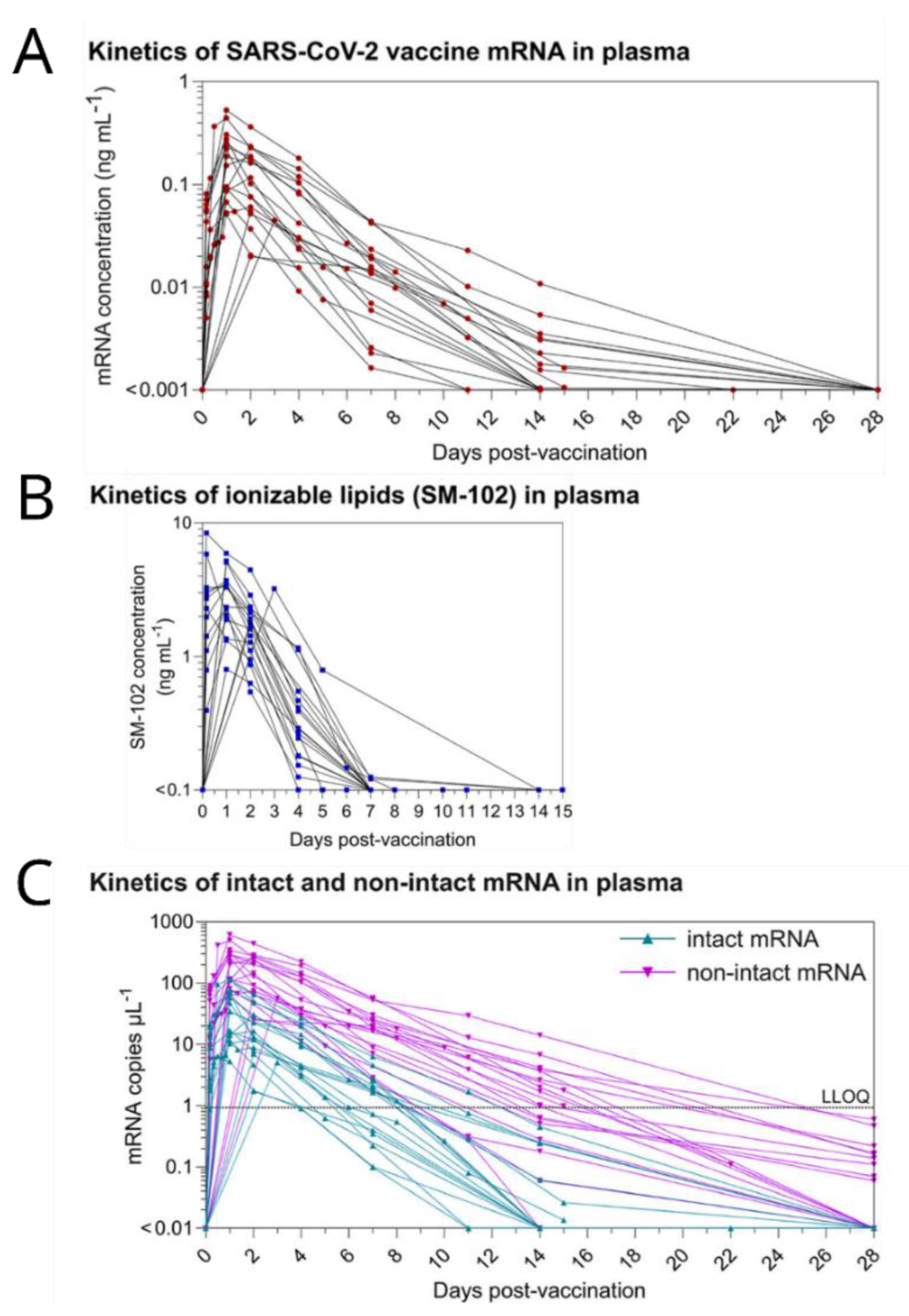
Figure 2.
Spike protein concentrations differ between vaccine-injured and healthy vaccine recipients (A) Plasma spike protein concentrations (pg/mL) measured at various days post-vaccination in individuals with vaccine-associated myocarditis (red) and healthy controls (blue), as reported by Yonker et al. [26]. Myocarditis patients exhibited elevated spike levels compared to controls. (B) S1 subunit concentrations (nM) in plasma over time following vaccination, comparing Post-Acute COVID-19 Vaccination Syndrome (PACVS) patients (magenta, purple) and healthy controls (light and dark blue), as reported by Bhattacharjee et al. [29]. + I and – I refer to individuals with a previous Covid-19 infection and individuals without a previous Covid-19 infection, respectively.
Figure 2.
Spike protein concentrations differ between vaccine-injured and healthy vaccine recipients (A) Plasma spike protein concentrations (pg/mL) measured at various days post-vaccination in individuals with vaccine-associated myocarditis (red) and healthy controls (blue), as reported by Yonker et al. [26]. Myocarditis patients exhibited elevated spike levels compared to controls. (B) S1 subunit concentrations (nM) in plasma over time following vaccination, comparing Post-Acute COVID-19 Vaccination Syndrome (PACVS) patients (magenta, purple) and healthy controls (light and dark blue), as reported by Bhattacharjee et al. [29]. + I and – I refer to individuals with a previous Covid-19 infection and individuals without a previous Covid-19 infection, respectively.
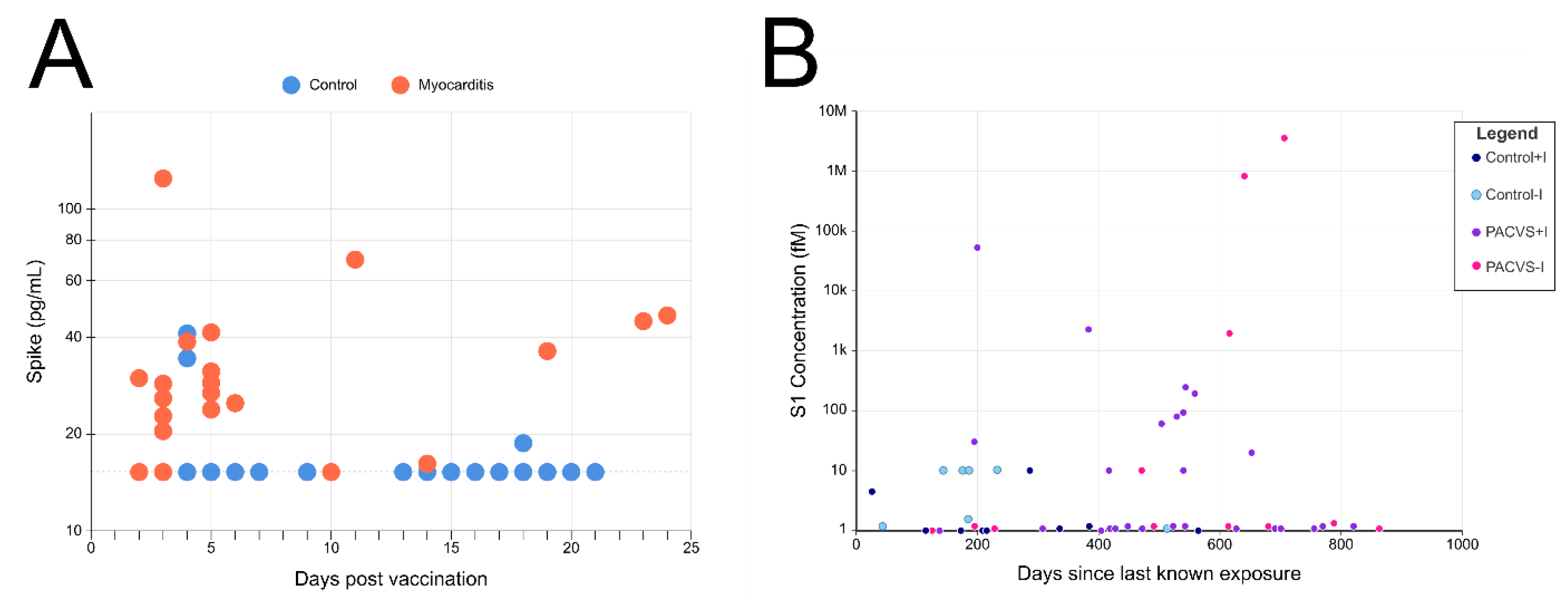
Figure 3.
Possible Mechanisms of Spike Protein Persistence in Covid-19 mRNA Vaccination. Reproduced from [12] under an Attribution-NonCommercial-NoDerivatives 4.0 International license.
Figure 3.
Possible Mechanisms of Spike Protein Persistence in Covid-19 mRNA Vaccination. Reproduced from [12] under an Attribution-NonCommercial-NoDerivatives 4.0 International license.
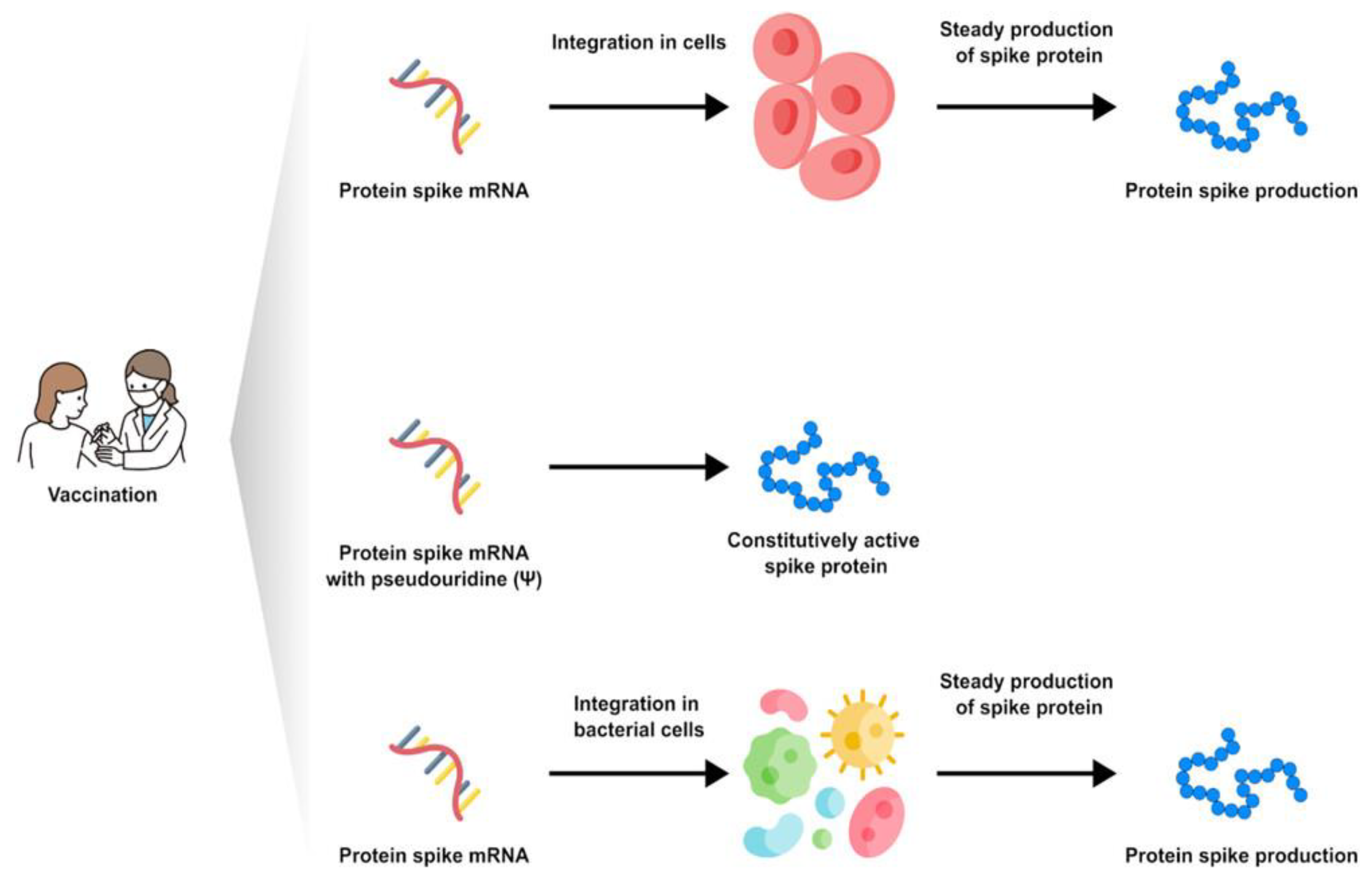

Table 1.
Non-COVID mRNA viral vaccines test duration ATI: Analytical treatment interruption; bDNA: Branched DNA assay; CI: Confidence interval; CFSE: Carboxyfluorescein succinimidyl ester; CTL: Cytotoxic T lymphocyte; DC: Dendritic cell; ELISA: Enzyme-linked immunosorbent assay; ELISPOT: Enzyme-linked immunospot assay; Gag: Group-specific antigen (HIV structural protein); GMT: Geometric mean titer; HA: Hemagglutinin (Influenza virus surface protein); HAI: Hemagglutination inhibition assay; HTI: HIVACAT T-cell immunogen (conserved HIV-1 epitopes); ICS: Intracellular cytokine staining; ID: Intradermal; IM: Intramuscular; IU: International unit; LNP: Lipid nanoparticle; MN: Microneutralization assay; Mod: mRNA modification; Nef: Negative factor (HIV regulatory protein); NHP: Nonhuman primate; PCR: Polymerase chain reaction; pVL: Plasma viral load; RABV-G: Rabies virus glycoprotein; Rev: Regulator of virion protein (HIV regulatory protein); RFFIT: Rapid fluorescent focus inhibition test; RT-PCR: Reverse transcription polymerase chain reaction; SFC: Spot-forming cells; TCID50: 50% tissue culture infectious dose; VL: Viral load; Vpr: Viral protein R (HIV regulatory protein); ↑: Increase (used to indicate change from baseline); ↓: Decrease (used to indicate change from baseline).The initial trials varied in their duration of subject monitoring, ranging from a few days to a full 12 months post-vaccination. In atrial of an HIV RNA vaccine, the immune response was monitored up to week 24 [9]. Lorna et al. also measured the expression of proviral HIV-RNA, but that cannot be attributed to the vaccine, instead the proviral reservoir is the likely source [9]. A phase I trial of influenza vaccines tracked antibody in two vaccines for 183 and 205 days, respectively [3]. In this case, immune titers were measured, but not the antigen itself. Another HIV RNA vaccine trial monitored immune parameters for 12 weeks post-vaccination [4]. Messenger RNA vaccines were first deployed on a large scale during the COVID-19 pandemic. Any novel technology can expect to experience technical challenges during its first iterations; and COVID-19 pandemic marked the first deployment of mRNA vaccines, aside from clinical trials involving 385 participants [1]. The first mRNA vaccine trial began in 2013 (published in 2017), testing a rabies vaccine [2]; therefore, at the time of approval for the COVID-19 vaccines in 2020, mRNA vaccines had approximately seven years of clinical observation [1]. Initial trials did not characterize biodistribution of vaccinal components in human subjects, or test for the persistence of antigens or vaccinal mRNA over time. Instead, studies evaluated immune response at durations up to one year (Table 1).
Table 1.
Non-COVID mRNA viral vaccines test duration ATI: Analytical treatment interruption; bDNA: Branched DNA assay; CI: Confidence interval; CFSE: Carboxyfluorescein succinimidyl ester; CTL: Cytotoxic T lymphocyte; DC: Dendritic cell; ELISA: Enzyme-linked immunosorbent assay; ELISPOT: Enzyme-linked immunospot assay; Gag: Group-specific antigen (HIV structural protein); GMT: Geometric mean titer; HA: Hemagglutinin (Influenza virus surface protein); HAI: Hemagglutination inhibition assay; HTI: HIVACAT T-cell immunogen (conserved HIV-1 epitopes); ICS: Intracellular cytokine staining; ID: Intradermal; IM: Intramuscular; IU: International unit; LNP: Lipid nanoparticle; MN: Microneutralization assay; Mod: mRNA modification; Nef: Negative factor (HIV regulatory protein); NHP: Nonhuman primate; PCR: Polymerase chain reaction; pVL: Plasma viral load; RABV-G: Rabies virus glycoprotein; Rev: Regulator of virion protein (HIV regulatory protein); RFFIT: Rapid fluorescent focus inhibition test; RT-PCR: Reverse transcription polymerase chain reaction; SFC: Spot-forming cells; TCID50: 50% tissue culture infectious dose; VL: Viral load; Vpr: Viral protein R (HIV regulatory protein); ↑: Increase (used to indicate change from baseline); ↓: Decrease (used to indicate change from baseline).The initial trials varied in their duration of subject monitoring, ranging from a few days to a full 12 months post-vaccination. In atrial of an HIV RNA vaccine, the immune response was monitored up to week 24 [9]. Lorna et al. also measured the expression of proviral HIV-RNA, but that cannot be attributed to the vaccine, instead the proviral reservoir is the likely source [9]. A phase I trial of influenza vaccines tracked antibody in two vaccines for 183 and 205 days, respectively [3]. In this case, immune titers were measured, but not the antigen itself. Another HIV RNA vaccine trial monitored immune parameters for 12 weeks post-vaccination [4]. Messenger RNA vaccines were first deployed on a large scale during the COVID-19 pandemic. Any novel technology can expect to experience technical challenges during its first iterations; and COVID-19 pandemic marked the first deployment of mRNA vaccines, aside from clinical trials involving 385 participants [1]. The first mRNA vaccine trial began in 2013 (published in 2017), testing a rabies vaccine [2]; therefore, at the time of approval for the COVID-19 vaccines in 2020, mRNA vaccines had approximately seven years of clinical observation [1]. Initial trials did not characterize biodistribution of vaccinal components in human subjects, or test for the persistence of antigens or vaccinal mRNA over time. Instead, studies evaluated immune response at durations up to one year (Table 1).
| Analytical Technique | Substance Found | Population | Intervention | Outcome measures | Max Duration Vaccine-Test | Reference |
|---|---|---|---|---|---|---|
| RFFIT, IgG and IgM ELISA, ICS | RABV-G-specific IgG/IgM; T cells (IFN-γ, TNF-α, IL-2, CD107a) |
Human: 101 adults (18–40 y), rabies-naïve, BMI: 18–32 kg/m² Groups: needle-syringe (n=42; 18 ID, 24 IM), needle-free (n=59; 46 ID, 13 IM) |
Vaccine: CV7201 (mRNA-RABV-G) Packaging: lyophilized, protamine-complexed mRNA Mod: protamine-stabilized Antigen: RABV-G Route: ID/IM via needle-syringe or needle-free injector Doses: 80–640 µg, 3 doses Schedule: days 0, 7, 28 or 0, 28, 56 Booster: 80 µg at 1 y (n=14) |
Neutralizing titers (RFFIT ≥0.5 IU/mL): ID (needle-free): GMT 0.83 IU/mL (95% CI: 0.51–1.34); IM: GMT 0.44 IU/mL (95% CI: 0.10–1.90); Responders: 71% ID, 46% IM Cytokines: ↑ at day 42; polyfunctionality ↑ (p<0.0001) |
1 year | [2] |
| HAI, MN, ELISPOT | Antibody responses (HAI, MN titers); RNA not directly measured |
Human: 201 adults (18–64 y) Groups: 25–400 µg IM (n=23–30), 25–50 µg ID (n=16–23), placebo (n=35) |
Vaccine: H10N8 mRNA or H7N9 mRNA Packaging: LNP Mod: not specified Antigen: H10N8 or H7N9 HA Route: IM or ID Doses: IM: 10–400 µg; ID: 25–50 µg, 2 doses Schedule: days 1 and 21 Booster: 25 or 50 µg H7N9 at 6 months (n=53) |
HAI titers: H10N8 100 µg IM: 100% ≥1:40, GMT 68.8; H7N9 25 µg IM: 96.3% ≥1:40, GMT 87.0 MN: H10N8: 87.0% ≥1:20, GMT 38.8; H7N9: 100% ≥1:20, GMT ≥1280 (post-booster, 6 months) |
1 y | [3] |
| ELISPOT, ICS, pVL PCR, ultrasensitive viral PCR | HIV-1 RNA (cell-associated RNA); no RNA measured in vivo |
Human: 70 HIV-1 adults (≥18 y), Stable cART ≥3 y, Nadir CD4⁺ ≥350 cells/µL, current CD4⁺ ≥450 cells/µL, HIV RNA <50 copies/mL Groups: iHIVARNA-01 (n=40), TriMix (n=15), placebo (n=15) |
Vaccine: iHIVARNA-01 (HTI-TriMix mRNA) Packaging: naked mRNA (no LNP) Mod: not specified Antigen: HTI Adjuvant: TriMix (CD40L, caTLR4, CD70) Route: intranodal inguinal Doses: not specified, 3 doses Schedule: weeks 0, 2, 4 |
HTI-specific T cell (ELISPOT): weeks 0, 6, 18, ↑ CD4⁺/CD8⁺ T cell (ELISPOT, ICS): weeks 0, 6, 30, ↑ CD8⁺ suppression (in vitro): weeks 6, 18, ↑ VL rebound, % with <50 copies/mL: weeks 18, 30, partial control Viral reservoir: proviral DNA, RNA: : weeks 0, 6, 18, no significant change Viral escape, host mRNA expression: weeks 0, 6, 18, no significant change |
30 weeks | [4] |
| RFFIT, ELISA | RABV-G-specific IgG |
Human: 55 adults (18–40 y), rabies-naive, BMI: 18–32 kg/m² Groups: 1 µg (n=16), 2 µg (n=16), 5 µg (n=10), Rabipur control (n=11) |
Vaccine: CV7202 (mRNA-RABV-G) Packaging: LNP Mod: unmodified mRNA Antigen: RABV-G Route: IM, needle-syringe Doses: 1–5 µg, 1–2 doses Schedule: days 1, 29 Control: Rabipur (≥2.5 IU/mL; days 1, 8, 29) |
Neutralizing titers (RFFIT ≥0.5 IU/mL, days 1–57): 1 µg: 63–100%, GMT 4.8 IU/mL; 2 µg: 83–100%, GMT 4.2 IU/mL; 5 µg (1 dose): 22%; Rabipur: 100%, GMT 13.5 IU/mL IgG (day 43): 1 µg: 34,186 U/mL; 2 µg: 20,707 U/mL; Rabipur: 33,373 U/mL |
57 days (interim); long-term follow-up to 2 y | [5] |
| HAI, MN, ELISA (IgG1/IgG2a), ELISPOT, TCID50, bDNA, Western blot | Vaccine mRNA; HA protein (Western blot) |
Mouse: BALB/c, F, 5–8 weeks (n not specified) Ferret: M, 13–15 weeks (n not specified) NHP: Cynomolgus, 2–4 y (n=1/group) Human: 31 adults (23 vaccine, 8 placebo) |
Vaccine: H10N8 or H7N9 mRNA Packaging: LNP (50:10:38.5:1.5 ionizable lipid:DSPC:cholesterol:PEG-lipid ratio), 80–100 nm, >90% encapsulation Mod: pseudouridine, 5-methylcytidine, cap-1 Antigen: HA Route: IM Doses: Mouse: not specified, single dose; Ferret: 100 µg H10N8 mRNA or 50 µg H7N9 mRNA, 2 doses; NHPs: 6mg H10N8 mRNA, single dose; Human: not specified, 2 doses Schedule: days 1 and 21 (2 doses) |
NHP tissue mRNA conc. (ng/mL): Muscle: 5,680; Lymph nodes: 2,120; Spleen: 86.9; Liver: 47.2; Plasma: 5.47; Heart: 0.799; Brain: 0.429; Lung: 1.82 HAI titers (ferret): ↑ at days 21-49 (p < 0.0001) Viral load (TCID₅₀, lung – mouse, ferret): ↓ post-vaccination |
Mouse: 11 days; Ferret: 49 days; Human: 43 days (interim); Titers stable 1 y (mouse) |
[6] |
| Flow cytometry, RT-PCR, ELISA, cytokine multiplex | HIV-1 RNA (Gag, Nef, Rev, Vpr mRNA in DCs) |
Human: 54 HIV-1 adults (37 vaccine, 17 placebo), median CD4 count 450 cells/mm³ |
Vaccine: AGS-004 (DCs loaded with HIV Gag, Nef, Rev, Vpr RNA) Packaging: autologous DCs Mod: none Antigen: autologous HIV-1 Gag, Nef, Rev, Vpr Route: ID Dosage: 1.2 × 10⁷ DCs/mL, 4 doses Schedule: every 4 weeks (q4w) |
CTL (CD28⁺/CD45RA⁻): 69% at week 8, 83% at week 18, 92% at week 26 (vs 25% placebo) VL (week 11/12 ATI): 4.39 vs 4.47 log₁₀ HIV RNA (p=0.73) HIV DNA: no difference at weeks 8, 18, 28 |
28 weeks | [7] |
| ELISPOT, CFSE proliferation, ICS | HIV-1 Gag and Nef mRNA (in DCs) |
Human: 15 HIV-1 adults (median age: 47 y), median CD4 count 556 cells/mm³ |
Vaccine: DCs loaded with HIV-1 Gag/Nef mRNA Packaging: autologous DCs Mod: Kozak sequence, codon-optimized, lysosomal targeting Antigen: Gag, Nef (Clade B, 2001) Route: ID Dosage: 5–15M DCs, 4 doses Schedule: weeks 0, 2, 6, 10 |
CD4 to Nef: 2.3-fold ↑ from baseline (95% CI: 1.04–5.04); 6.3-fold ↑ vs placebo (95% CI: 1.6–24.6), p=0.009 CD4 to Gag: 2.5-fold ↑ from baseline (95% CI: 1.17–5.21), p=0.054 CD8 to Nef: 4.8-fold ↑ vs placebo (95% CI: 0.9–24.7), p=0.062 ELISPOT: no ↑ |
48 weeks; Peak effect: week 14 |
[8] |
Table 2.
Vaccine artifacts found in bodily fluids. CD16⁺: Cluster of differentiation 16 positive; ddPCR: Droplet digital polymerase chain reaction; ELISA: Enzyme-linked immunosorbent assay; EV: Extracellular vesicle; fM: Femtomolar; HR2: Heptad-repeat 2 (domain of spike protein); IHC: Immunohistochemistry; LC–MS: Liquid chromatography–mass spectrometry; LC–SACI–MS: Liquid chromatography–surface-activated chemical ionization–mass spectrometry; LN: Lymph node; LLOD: Lower limit of detection; LLOQ: Lower limit of quantification; LOD: Limit of detection; LoQ: Limit of quantification; PACVS: Post-acute COVID-19 vaccine syndrome; PB: Peripheral blood; qPCR: Quantitative polymerase chain reaction; RNA-seq: RNA sequencing; RT-qPCR: Reverse transcription quantitative PCR; SIMOA: Single molecule array; SM-102: Ionizable lipid in Moderna lipid nanoparticle formulation; SPEAR: Successive Proximity Extension Amplification Reaction; TEM: Transmission electron microscopy; WT: Wild-typeVaccine artifacts were detected in blood components up to 709 days post-vaccination (spike protein) [29], and breast milk for up to 7 days (mRNA) [33] after vaccination (Table 2). However, it should be noted that sequence-confirmed vaccinal spike protein fragments have been observed in blood for the duration of 187 days post-immunization [12]. Vaccine artifacts were also found in lymph nodes up to two months after injection [32], though this is expected due to normal immune processing. No reports were found documenting the vaccine artifacts in other bodily fluids.
Table 2.
Vaccine artifacts found in bodily fluids. CD16⁺: Cluster of differentiation 16 positive; ddPCR: Droplet digital polymerase chain reaction; ELISA: Enzyme-linked immunosorbent assay; EV: Extracellular vesicle; fM: Femtomolar; HR2: Heptad-repeat 2 (domain of spike protein); IHC: Immunohistochemistry; LC–MS: Liquid chromatography–mass spectrometry; LC–SACI–MS: Liquid chromatography–surface-activated chemical ionization–mass spectrometry; LN: Lymph node; LLOD: Lower limit of detection; LLOQ: Lower limit of quantification; LOD: Limit of detection; LoQ: Limit of quantification; PACVS: Post-acute COVID-19 vaccine syndrome; PB: Peripheral blood; qPCR: Quantitative polymerase chain reaction; RNA-seq: RNA sequencing; RT-qPCR: Reverse transcription quantitative PCR; SIMOA: Single molecule array; SM-102: Ionizable lipid in Moderna lipid nanoparticle formulation; SPEAR: Successive Proximity Extension Amplification Reaction; TEM: Transmission electron microscopy; WT: Wild-typeVaccine artifacts were detected in blood components up to 709 days post-vaccination (spike protein) [29], and breast milk for up to 7 days (mRNA) [33] after vaccination (Table 2). However, it should be noted that sequence-confirmed vaccinal spike protein fragments have been observed in blood for the duration of 187 days post-immunization [12]. Vaccine artifacts were also found in lymph nodes up to two months after injection [32], though this is expected due to normal immune processing. No reports were found documenting the vaccine artifacts in other bodily fluids.
| Analytical Technique | Substance Found | Fluid/Tissue | Vaccine | Sensitivity | Specificity | Concentration Observed | Duration Since Last Vaccination | Max Duration Observed | Reference |
|---|---|---|---|---|---|---|---|---|---|
| RT-qPCR, IHC | mRNA | Axillary LN (lymph) | BNT162b2; mRNA-1273 (HR2) | LOD: BNT162b2: 6 ssRNA copies/reaction; mRNA-1273: 11 ssRNA copies/reaction | Vaccine-specific sequences; none detected in unvaccinated or uninjected tissues | ~1–30 copies/ng total RNA (lymph); heart values not numerically reported | Detected primarily within 30 days | 30 days | [25] |
| SIMOA, Flow cytometry, ELISA | Spike protein (free and total) | Plasma (adolescents/young adults) | BNT162b2; mRNA-1273 | SIMOA LOD not stated | Free spike detected only in myocarditis cases; not in vaccinated controls | Free spike (myocarditis): 33.9 ± 22.4 pg/mL | Up to 24 days | 24 days | [26] |
| Flow cytometry, LC-MS | S1 subunit, S2 subunit, Mutant S1 peptides | CD16⁺ monocytes (PB) | mRNA-1273, Janssen, AstraZeneca | >99% sort purity; high-resolution peptide matching | S1 only in symptomatic group (p < 0.0007); cytokines matched PASC | S1 CD16⁺ monocytes: 92% of symptomatic (11/12); not in 9/10 controls | Range: 38–245 days; mean: 105 days | 245 days | [23] |
| LC–SACI–MS | Spike protein (vaccine-specific) | Blood (dried spot) | BNT162b2; mRNA-1273 | Not reported | 100% specificity: not found in unvaccinated controls | Detected in 50% of vaccinated subjects | 69–187 days | 187 days | [12] |
| ddPCR | mRNA (intact and degraded) | Plasma | mRNA-1273 bivalent | LLOQ: 0.001 ng/mL | ddPCR primers specific to vaccine mRNA; no WT S-gene amplification | Peak: 0.529 ng/mL (731 copies/μL); Range (4h): 6.5–112 copies/μL; 37% had 0.001–0.01 ng/mL at day 14–15 | 0–15 days | 15 days | (29) |
| LC-MS | SM-102 (ionizable lipid) | Plasma | mRNA-1273 bivalent | LLOQ: 0.01 ng/mL | R² = 0.9852 correlation to SM-102 concentration | Peak median: 3.22 ng/mL; Range (4h): 0.39–8.39 ng/mL; ≥0.12 ng/mL at day 7 | 0–7 days | 7 days | [27] |
| RT-qPCR, EV isolation | mRNA | Breast milk | BNT162b2; mRNA-1273 | Detection limit: 1 pg/mL | Trace mRNA in 3/11 participants | 1.3–11.7 pg/mL | 1 to 45 hours | 45 hours | [28] |
| SPEAR | Spike protein | Plasma | BNT162b2; mRNA-1273 | LLOD: 1.81 fM; LLOQ: 8.24 fM | Detected in 36% of controls; 43% of PACVS patients | Mean: 17 pM vs 10 fM (controls) | 26 to 709 days | 709 days | [29] |
| SPEAR | S1 subunit | Plasma | BNT162b2; mRNA-1273 | LLOD: 5.64 fM | Detected in 32% of controls; 36% of PACVS patients | Mean: 60 pM vs 3 fM (controls) | 26 to 709 days | 709 days | [29] |
| qPCR (codon-optimized), TEM | mRNA | Plasma and blood | BNT162b2 | LoQ: 10 copies/reaction (~5.26% CV); Efficiency 1.92–2.14; R²: 0.991–0.999 | No amplification of SARS-CoV-2 RNA or human genome | 50–300 copies/µg input RNA (plasma) | 1–15 days | 15 days | [30] |
| RNA-seq | mRNA | Plasma | BNT162b2; mRNA-1273 | Not stated | Unknown | Detected, not quantified | Up to 28 days | 28 days | [31] |
| RT-qPCR | mRNA | LN germinal centers | BNT162b2 | Not reported | BNT162b2-specific sequence targeted | Detected, not quantified | Up to 60 days | 60 days | [32] |
| RT-qPCR | mRNA | Breast milk | BNT162b2 | Not quantified; standard curve with ≥6 replicates | BNT162b2-specific sequence targeted | Max: 2 ng/mL in few samples | Up to 6 weeks post 2nd dose | 7 days post 2nd dose | [33] |
Table 3.
Vaccine artifacts found in autopsies or tissue biopsies. 3'UTR: 3' untranslated region; ALN: axillary lymph node; AU: arbitrary units; bDNA: branched DNA assay; bp: base pairs; dpi: days post-infection; ELISA: enzyme-linked immunosorbent assay; ELISpot: enzyme-linked immunospot assay; FISH: fluorescence in situ hybridization; FNA: fine needle aspiration; H&E: hematoxylin and eosin; HAI: hemagglutination inhibition; IHC: immunohistochemistry; IDMS: isotope dilution mass spectrometry; IgG: immunoglobulin G; ISH: in situ hybridization; LC–MS/MS: liquid chromatography–tandem mass spectrometry; LLOQ: lower limit of quantification; LN: lymph nodes; LOD: limit of detection; LV: left ventricle; qRT-PCR: quantitative reverse-transcription polymerase chain reaction; RNA-seq: RNA sequencing; RNAscope: RNA in situ hybridization; RT-qPCR: reverse-transcription quantitative polymerase chain reaction; RV: right ventricle; SIMOA: single molecule array; ssRNA: single-stranded RNA.
Table 3.
Vaccine artifacts found in autopsies or tissue biopsies. 3'UTR: 3' untranslated region; ALN: axillary lymph node; AU: arbitrary units; bDNA: branched DNA assay; bp: base pairs; dpi: days post-infection; ELISA: enzyme-linked immunosorbent assay; ELISpot: enzyme-linked immunospot assay; FISH: fluorescence in situ hybridization; FNA: fine needle aspiration; H&E: hematoxylin and eosin; HAI: hemagglutination inhibition; IHC: immunohistochemistry; IDMS: isotope dilution mass spectrometry; IgG: immunoglobulin G; ISH: in situ hybridization; LC–MS/MS: liquid chromatography–tandem mass spectrometry; LLOQ: lower limit of quantification; LN: lymph nodes; LOD: limit of detection; LV: left ventricle; qRT-PCR: quantitative reverse-transcription polymerase chain reaction; RNA-seq: RNA sequencing; RNAscope: RNA in situ hybridization; RT-qPCR: reverse-transcription quantitative polymerase chain reaction; RV: right ventricle; SIMOA: single molecule array; ssRNA: single-stranded RNA.
| Analytical Technique | Substance Found | Tissue/Organ | Vaccine | Sensitivity | Concentration Observed / Signal | Duration Sampled | Max Duration Observed | Reference |
|---|---|---|---|---|---|---|---|---|
| RT-qPCR, IHC | mRNA | Axillary LN (ALN), LV, RV, mediastinal LN, liver, spleen | BNT162b2; mRNA-1273 (HR2 domain) | LOD: BNT162b2: 6 ssRNA copies/reaction; mRNA-1273: 11 ssRNA copies/reaction | ~1–30 copies/ng total RNA (ALN); heart tissue values not explicitly reported | 1–154 days | ALN: 26 days; LV: 12 days; RV: 19 days | [25] |
| IHC | Spike protein | Brain (frontal cortex, nucleus ruber, capillary endothelium, microglia, astrocytes); heart (LV, endothelial cells); vasculature (aorta, iliac, basal cerebral arteries) | BNT162b2; ChAdOx1 nCov-19 | Not reported (described as “abundant deposits” in affected tissues) | Spike protein observed in brain, heart, and vessels; N protein absent | 3 weeks post 3rd dose | 3 weeks | [44] |
| IHC | Spike protein | Lungs | mRNA-1273 | Not reported | Spike protein not detected | 18 days (autopsy) | Negative at 18 days | [45] |
| FISH | mRNA | Liver | BNT162b2 | Probes targeted spike mRNA sequence; cross-reactivity with viral mRNA possible | Qualitative detection of cytoplasmic mRNA in hepatocytes | 12 days | 12 days | [43] |
| IHC, ISH | Spike protein; mRNA | Cerebral arteries | BNT162b2; mRNA-1273 | Spike: 43.8% (7/16 cases); mRNA: detected in 3/3 tested cases | Spike in vessel intima/smooth muscle (7/16); vaccine mRNA confirmed in 3 cases via FISH | Months after vaccination | Up to 17 months | [42] |
| IHC | Spike protein | Liver parenchyma | mRNA-1273 | Not reported | Qualitative detection of spike protein in liver tissue | 5 weeks | 5 weeks | [46] |
| RNA-seq | mRNA fragments | Right deltoid and quadriceps muscles | BNT162b2 | 75 bp vaccine-specific fragment aligned to spike mRNA | Qualitative detection of mRNA fragments | 4 weeks | 4 weeks | [47] |
Disclaimer/Publisher’s Note: The statements, opinions and data contained in all publications are solely those of the individual author(s) and contributor(s) and not of MDPI and/or the editor(s). MDPI and/or the editor(s) disclaim responsibility for any injury to people or property resulting from any ideas, methods, instructions or products referred to in the content. |
© 2025 by the authors. Licensee MDPI, Basel, Switzerland. This article is an open access article distributed under the terms and conditions of the Creative Commons Attribution (CC BY) license (http://creativecommons.org/licenses/by/4.0/).
Copyright: This open access article is published under a Creative Commons CC BY 4.0 license, which permit the free download, distribution, and reuse, provided that the author and preprint are cited in any reuse.