

Submitted:
04 July 2025
Posted:
04 July 2025
You are already at the latest version
Abstract
Exposure to per- and polyfluoroalkyl substances (PFASs) can cause detrimental health effects. The consumption of contaminated food is viewed as the major exposure pathway for humans, but the relationship between agriculture and PFAS has not been investigated thoroughly, which becomes a pressing issue since health advisories are continuously being reassessed. This review connects the release, environmental fate and agriculture uptake of PFASs to enhance comprehension and identify knowledge gaps which limit accurate risk assessment. It focuses on the heavily agricultural state of Minnesota, USA, which is representative of the large Midwestern US corn-belt in terms of agricultural activities and because PFASs are being monitored in Minnesota since the beginning of the 21st century. PFAS contamination is a complex issue due to the over 14,000 individual PFAS compounds which have unique chemical properties that interact differently with air, water, soil, and biological systems. Moreover, the lack of field studies and monitoring of agricultural sites makes accurate risk assessments challenging. Researchers, policymakers and farmers must work closely together to reduce the risk of PFASs exposure as the understanding of the potential health effects increases and legacy PFASs are displaced with shorter fluorinated replacements.
Keywords:
PFAS
; Agriculture
; Environmental fate
; Knowledge gaps
; Mitigation
; Midwest
1. Introduction
Perfluoroalkyl and polyfluoroalkyl substances (PFASs) are ubiquitous and can be detected in the environment, wildlife, human serum and tissue1–4. PFASs can accumulate in the human body over time and cause different toxicological effects5,6. Researchers have found evidence that links exposure to particular PFASs to specific health implications (e.g., cancer, kidney and liver disease, adverse effect on reproductivity and development) (Fenton et al., 2020). The mean half-lives for some of the most common PFASs, namely perfluorooctane sulfonic acid (PFOS), perfluorohexane sulfonic acid (PFHxS), and perfluorooctanoic acid (PFOA), are 5.4 years, 8.5 years and 3.8 years respectively7.
PFASs are defined as aliphatic substances which contain at least one carbon atom on which all hydrogen atoms have been replaced with fluorine atoms. Perfluoroalkyl substances are all substances in which all hydrogen atoms attached to the carbon chain have been substituted by fluorine, and polyfluoroalkyl substances are not fully fluorinated8. The Organisation for Economic Co-operation and Development (OECD) proposes a broader definition by suggesting that any compound containing at least one fully fluorinated methyl or methylene group be referred to as a PFAS9. There are currently over 14,000 chemicals listed as PFAS in the United States Environmental Protection Agency toxicity databases10.
PFASs can be found in many products, such as firefighting foams, food packaging materials, household products, medical devices, pesticide formulations, and surfactants11. The widespread industrial and commercial utilization of these substances is based on their chemical and physicochemical properties. The carbon-fluorine bond is the strongest bond in organic chemistry, with a dissociation energy up to 536 kJ/mol12. Therefore, the PFAS family of chemicals shows exceptionally high chemical and thermal stability13–15. Due to their polar nature, most PFASs show a high solubility in water16 and are, therefore, environmentally mobile17. Four main activities are responsible for the contamination of PFAS in the air, water, and soil. These are leakages and emissions of PFASs at manufacturing sites, use of aqueous film-forming foam (AFFF) for firefighting activities, leaching from landfills, and application of biosolids from wastewater treatment18–21.
Although there are multiple potential exposure paths for PFASs to humans, a significant exposure route of concern is the consumption of contaminated food22. PFASs can accumulate from the environment in crops and produce that are consumed directly by humans23, or the PFAS in fodder and grain used to feed livestock can lead to the contamination of the animals and their related food products24,25. In Maine, USA, dairy farms were shut down due to PFAS contamination in their products, with PFASs detected on more than 50 farms26–29. Most environmental research has primarily focused on PFAS sources and the fate of these substances in the air, water, and soil30. Research on downstream biological systems, such as agricultural crops and livestock, experiencing PFAS contamination is lacking. Understanding the relationship between PFASs in the environment and agriculture is critical as humans are dependent on the food produced and approximately 44% of habitable land surface is used for agricultural purposes31.
This review details the sources of PFAS contaminations in agriculture, the environmental fate of PFASs, and outlines the connection to agriculture for identifying knowledge gaps. The history, contamination levels, and actions regarding PFASs are discussed for a typical Midwestern state (Minnesota, USA) so that findings can be put into the historical context, and other agricultural areas can assess their paths towards protecting their agricultural sector from contamination issues. Based on these findings, actions are suggested that can reduce risks of contaminating food supplies.
2. PFASs in Minnesota
2.1. History of PFASs in Minnesota
Minnesota’s experience with PFASs is deeply intertwined with the beginning of PFAS production in the 1940’s. PFOS- and PFOA-related substances and other fluorochemicals were manufactured at the Minnesota Mining and Manufacturing (officially renamed 3M in 2002) production facility in Cottage Grove, MN32. As early as 1955, research indicated that PFOS could impact biological systems, as protein binding properties of PFOS were observed33. In 1961, DuPont researchers found that these chemicals can potentially increase the liver size in rats and rabbits34. In 1997, 3M was selling almost 1,900 metric tons of PFASs in the U.S.35. Waste products, sludges and wastewater were generated, disposed of at landfills or discharged to the Mississippi River36. In 2002, 3M informed the Minnesota Pollution Control Agency (MPCA) that PFOA and PFOS had been detected in groundwater reservoirs used near the production and disposal sites37.
A number of locations linked to PFAS wastes in and around Cottage Grove, MN, were investigated to examine the extent of contamination38. While Cottage Grove and the surrounding areas with contamination were more rural areas when 3M began disposal of PFAS wastes, their population grew to become part of the greater Twin-Cities (Minneapolis-St. Paul) metropolitan area. According to the MPCA, 3M’s manufacturing activities led to the contamination of groundwater covering more than 150 square miles, which affected the drinking water quality of more than 140,000 Minnesotans. Different PFASs were detected at varying concentrations in all samples, including groundwater, surface water, municipal wells, sediment, sludges, influent/effluent, fish, plants, leachates, and gas condensates at landfills36,38. Further research analyzed the PFAS contamination in the air39, fish and bald eagles40,41, leachate and gas condensates from landfills42, and yard waste sites43. Statistical evaluations showed that residents of affected communities (e.g., Oakdale) were 30% more likely to be diagnosed with prostate cancer, and infants were 34% more likely to be born with low birth weight compared to unaffected communities44.
3M decided to terminate the manufacturing of PFOS- and PFOA-related compounds after the initial discovery of contamination2,45. In 2010, The Minnesota Attorney General sued over contaminated drinking water and natural resource findings46. More recently, 3M announced it will cease all PFAS manufacturing and selling products containing PFASs by 2025 due to “rapidly evolving external regulatory […] landscape”47. Communities are still tremendously concerned about PFAS exposure and the associated health effects, and urgently demand that appropriate actions are being taken.
2.2. Contamination in Minnesota
The detection of major contamination around the Twin Cities metropolitan area (TCMA) led to a larger effort to examine PFAS contamination and spread than is seen in other communities and states. While Cottage Grove was the single most sampled area, rural areas throughout Minnesota were also heavily sampled. Much of the data has been reported to the MPCA, who publishes it as part of their role in investigating and regulating pollution in the state48. With this extensive data set, Minnesota provides a temporally and geographically complete example for assessing issues related to PFAS contamination. That said, these datasets are complex and difficult to interpret because of the many unique PFAS chemical species and behaviors, plus the changing testing protocols as the field has advanced.
2.2.1. Drinking Water Standards as a Guide
The potential human health risks of consuming contaminated drinking water have meant that most Minnesota and nationwide PFAS investigations have concentrated on the contaminant levels in drinking water48,49. However, the extent of the problem has meant that Minnesota has expanded testing to surface and groundwater statewide. While the dangers represented by drinking water contamination are different than agricultural PFAS contamination, water data provides the best guide to understanding contamination in agriculture. The vast PFAS water data set from different sites and examining different types of PFASs required that a metric be established to help evaluate locations where contamination levels are potentially detrimental to health.
The Health Index (HI) was adopted by Minnesota in 2002 to evaluate the associated risk of consuming drinking water, and it is continuing to be updated as new data emerges50. The HI uses drinking water guidance values for perfluorobutanoic acid (PFBA) (7.000 µg/L), perfluorobutanesulfonic acid PFBS (2.000 µg/L), perfluorohexanoic acid PFHxA (0.200 µg/L), PFHxS (0.047 µg/L), PFOA (0.035 µg/L), and PFOS (0.015 µg/L) (see equation (1))51.
HI=([PFBA])⁄(7 µg/L)+([PFBS])⁄(2 µg/L)+([PFHxA])⁄(0.2 µg/L)
+([PFHxS])⁄(0.047 µg/L)+([PFOA])⁄(0.035 µg/L)+([PFOS])⁄(0.015 µg/L)
+([PFHxS])⁄(0.047 µg/L)+([PFOA])⁄(0.035 µg/L)+([PFOS])⁄(0.015 µg/L)
If the HI is greater than 1, the drinking water is considered to have potentially adverse health implications. More information on the regulation of PFAS contamination levels is provided in section 2.3.
As of July 2024, 919 Community Water Systems (CWSs) out of 966 have been tested by the MPCA with five exceeding the proposed HI. The contaminated CWSs are in larger urban areas except for Swanville, a small community in central Minnesota. Most CWSs showing PFAS contamination are located in the Twin Cities Metropolitan Area (TCMA), which can be linked to the 3M production in Cottage Grove (see section 2.1)48.
The geospatial distribution of wells that contain at least one PFAS that exceeds health-based guidance values and the proximity to wellhead protection areas (WHPAs), which surround public water supply wells and where groundwater is contributed to the respective wells, is shown in Figure 1. Out of 13,884 locations/timepoint sampling combinations, 17% contained at least one exceedance and 4,189 total exceedances were detected52. These were found both in urban and rural/agricultural regions (see Figure 1).
2.2.2. Air Pollution
The first extensive study on PFAS levels in ambient air was published by the MPCA in April of 202239. Researchers sampled the ambient air at four different sites. Three sites were located near PFAS-emitting sites in urban areas (Duluth, St. Louis Park, and Eagan), while the fourth site (Grand Portage) was in a rural area and was expected to be a low PFAS reference site. During the observation duration, 17 different PFASs were detected, varying in concentration and time of observation. The MPCA found PFBA, PFBS, PFOA, and PFOS in all air samples, with PFBA contributing approximately between 47% and 70% of the total PFAS concentration. The authors attribute the abundant occurrence of PFBS to the direct emission and degradation of precursors in the atmosphere. Precursors are used as intermediates in the manufacturing process of surfactants or fluoropolymers. They are also used as substitutes for chlorofluorocarbons, coolants, solvents, or fire suppressors53. 6:2 Fluorotelomer sulfonate (6:2 FTS) is known to replace PFOS at chrome plating facilities (e.g., at the St. Louis Park site) and is additionally applied in AFFFs Therefore, 6:2 FTS was regularly detected in ambient air39.
Though Grand Portage was chosen due to its remote location, low population (684 in 2019), and limited industry, it showed the second highest airborne PFAS contamination with a mean concentration of about 100 pg/m3. The authors hypothesise that this surprising finding is likely due to emissions from the local fire department and the solid waste transfer station. They also speculate that long-distance atmospheric transport might contribute to the relatively high concentrations. The findings that the rural community of Grand Portage could have high detectable levels of airborne PFAS indicates that rural/agricultural areas should not assume that their relative isolation is potentially sufficient to limit exposure of airborne PFASs.
3. Significant Sources for PFAS in the Environment
3.1. Release of PFASs During their Production, Use, and Disposal Phases
Manufacturing plants that produce PFAS or use PFAS in production of other products contribute significantly to environmental contamination of PFAS54. During the manufacturing process, PFASs can be emitted into the atmosphere39,55, or discharged as contaminated wastewater that is often not sufficiently treated at wastewater treatment plants (WWTPs) before it enters the aquatic environment36,54. Hazardous wastes containing PFAS can also be generated during the production process, which may not always be mitigated when incinerated or disposed of. Improper storage or burial might contaminate the environment56.
PFASs can enter the environment during the use of the PFAS containing product [14]. For example, some carpets contain PFASs to repel stains, which might be released from carpet fibers over time57. Functional textiles (e.g., outdoor clothing) are also treated to have water repelling properties. They are exposed to radiation, rain, heat, and abrasive stress that can cause the emission of the repellents58. Many non-stick pans were coated using PFAS precursors which can flake off during cooking or during the cleaning process. PFASs are present in more than 200 use categories14, which have the potential to lead to unintentional PFAS release.
After their use, roughly 146 million metric tons (50%) of solid wastes were landfilled in 2018 in the U.S.59. Solid waste management facilities are viewed as important point sources of PFAS pollution, and thus many researchers have investigated PFAS concentration in landfill leachates60–62. PFASs undergo long-term leaching and precursors degrade63, as they are exposed to sunlight, microbial activity, varying redox conditions (available oxygen, pH-value, content of redox active species, etc.), or wastewater treatment64. PFAS leachate and gas condensates at solid waste landfills were evaluated across the state by the MPCA between 2005 and 2008. Down-gradient (points where water flows away from landfill) and upgradient (points where water flows to the landfill) groundwater samples were taken and found to have significant concentration differences for PFBA and PFOA, with the PFAS concentrations higher in the water leaving the sites. PFOS was detected in 10% of the samples. There were noteworthy differences between the median PFOA and PFBA concentrations in the groundwater at lined and unlined landfills. The median concentrations at lined landfills were 2.39 ng/L and 33.2 ng/L respectively. The median concentrations at unlined landfills for PFOA and PFBA were at 0.36 ng/L and 7.29 ng/L respectively. The same study also showed that gas condensates were contaminated42.
In total, the MPCA investigated the groundwater at 102 out of 111 landfills of interest. Out of those, 98 % showed elevated PFAS levels, and the drinking water guidance values of the Minnesota Department of Health (MDH) were exceeded at 62 sites65. The landfills included both metro and rural landfills. The rural landfills are often outside cities and adjacent to active farming operations. Most of the rural landfills analyzed in these efforts are landfills that were closed or consolidated as more stringent environmental rules increased requirements for siting and management. However, these closed landfills are likely to be leaching PFAS for decades. They are typical of small town/county size landfills found throughout the US Midwest.
Mass balancing PFAS leachates and estimating total releases is challenging as they depend on various fluctuating factors (e.g., rainfall, number/concentration of PFASs)66. Lang et al. estimated that the total PFAS mass release from leachates at landfills in the U.S. is approximately 600 kg/year60.
3.2. Aqueous Film-Forming Foam (AFFF)
Over 240 individual PFAS compounds (e.g., Perfluoroalkyl carboxylic acids (PFCAs), perfluorosulfonic acid (PFSAs), perfluoroalkyl sulfonamido compounds) are used in AFFF formulations67,68 to enhance the wetting at the hydrocarbon-water and air-water interface14,69. In practical terms, this allows firefighting foams with AFFF to more easily encapsulate flammable liquid fuels and starve them of oxygen when attempting to stop a fuel fire. Firefighting and training activities (e.g., at airports, fire training areas, or military sites) have resulted in the contamination of surrounding surface waters and groundwater. However, data describing the lower volume AFFF use at smaller airports has not been collected, so it is difficult to assess70 how significant this problem may be at rural airports. As many precursors present in these foams undergo transformation processes71,72, the fate of AFFF contaminated sites is not fully understood67.
Many rural airports are located immediately adjacent to agricultural fields which provide the open land needed for runway safety. Use of AFFF at these sites, either for training or to combat an actual fire has the potential to contaminate nearby groundwater and fields.
3.3. Biosolids From Wastewater Treatment
Biosolids consist of organic matter that are recovered from sewage during wastewater treatment. They are often applied in agriculture to improve soil fertility by enriching it with nutrients and organic matter73. Biosolids are heterogeneous and have varying concentrations of organic matter, microorganisms, bacterial constituents, inorganic materials, and of water74. As a result, PFASs can bind to various sites of these components with different strengths75–77. PFAS-contaminated biosolids are generated in the wastewater treatment process because PFASs cannot be efficiently removed from sewage being treated during biosolid separation. Some studies even showed that the concentration of stable perfluoroalkyl acids (PFAAs) increases during treatment due to the oxidation of precursors (e.g., fluorotelomer alcohols)78,79. Hence, WWTPs are considered an important point source of PFAS15. Although sewage and treated biosolids from residential sanitation systems are known to contain somewhat higher levels of background PFASs, sewage from industrial wastewater treatment is a primary source of more highly contaminated biosolids80.
Once the contaminated biosolids are applied on a field, the fate of the PFASs is influenced by physicochemical properties of the respective substances and soil. It was shown that the half-lives of different PFASs in soils can range from a few days up to years depending on their chain length, functional groups, and their dissociation constant81,82. Furthermore, the substances can be accumulated by various plants83–85 or leach into the groundwater22,86. As a result, PFASs were detected in livestock and thus, food production can pose an exposure pathway to consumers87. Lindstrom et al. investigated well water and surface water close to fields where contaminated biosolids were applied for 12 years and observed elevated PFAS concentrations (up to 11 µg/L for PFOA in surface water)88.
The EPA estimated that 1.15 million dry metric tons of biosolids were applied to agricultural land in 202189. The yearly loading of PFASs on agricultural land in the U.S. is estimated at 1,375-2,070 kg/year90. Thus, concerns arise if and to what extent biosolids pose a threat to the food supply and, therefore, the economic security of farmers91,92. While a typical application of biosolids is not expected to dramatically increase PFAS concentrations in the soil, the worry is that multiple biosolid applications or use of heavily contaminated biosolids may increase soil contamination to the point where food or livestock feed would have high levels of PFAS.
Regulatory agencies became aware of the contamination potential of biosolids in 2016, when elevated PFASs levels were detected in milk products of a dairy farm in Maine. The Maine Department of Environmental Protection found combined PFOA and PFOS concentrations of up to 1.420 μg/L. In addition, a PFOS concentration of 32.200 μg/L was detected in the dairy products on another farm in 202093.
3.4 PFAS in Pesticide Formulations
Approximately 68,000 metric tons of pesticides are yearly applied in the Midwestern U.S (United States Geological Survey, 2017). PFASs have been part of some pesticide formulations as active or identified as inert ingredients in the past [92]. However, it is not fully clear how many currently used pesticides in the US contain PFAS as active ingredients or for other reasons. Lasee et al. found 6 out of 10 insecticide formulations contained PFAS concentrations between 3.92 mg/kg and 19.2 mg/kg [93]. However, these. results could not be verified in a separate investigation and no PFASs were detected above the detection limit of 0.2 μg/L [94].
International pesticide active ingredient and application differences also increase the difficulty of quantifying PFAS application to land. N-ethyl perfluorooctane sulfonamide (EtFOSA), also called sulfuramid, is an effective insecticide used to control leaf cutting ants (Atta and Acromyrmex) [95]. It can be transformed to PFOS in the environment. Even though sulfuramid was internationally phased out by 2016 [96], it is still used in South America. Estimates are that Brazilian sulfuramid use has been responsible for the release of up to 487 metric tons of PFOS/FOSA between 2004 and 2015 [97].
Storage containers can also be a PFAS source in pesticides via leaching. Nguyen [98] observed gradual leaching from fluorinated high density polyethylene containers. The total PFAS concentration was 15 µg/L when methanol was used as a solvent, and 3 µg/L for water. However, the relatively small contribution of PFAS from the container to any applied chemical would be difficult to detect. Consider an example container that holds 9 liters of pesticide covering 4 hectares of crops which could leach 15 μg PFAS per liter of pesticide, leaching would result in 34 μg/ha or 3.3 ng/m². This is below the background levels as noted by Qian and French [94]. Generally, pesticide use is very crop, weather, and geographically specific. Thus, the load of pesticide related PFAS must be calculated on a case-by-case basis.
3.5. PFASs in Rural Versus Urban Communities
It is evident that rural and urban areas are impacted by different PFAS contaminant sources as they vastly differ in their industrial activities, population density and land use [99]. This is reflected by the site-specific contamination patterns, which reveal information about the PFAS discharge in the area [100].
The background levels should be lower in rural areas due to the reduced human activities, but similar to urban areas point sources are primarily responsible for the pollution in rural areas. It is important to explicitly discuss sites likely to face contamination issues in agricultural and rural areas. While a significant amount of contamination has been observed in areas near PFAS production sites and in industries utilizing PFAS, such occurrences are relatively uncommon in rural areas. Very few facilities produce PFAS nationwide and facilities using large volumes of PFAS in industrial application tend to be closer to urban centers that can supply labor. Therefore, most contamination in rural areas is from the application of high PFAS concentration biosolids, use of AFFF, application of PFAS containing pesticides, or leaching from landfills. While there is spread of some species of PFAS by air in rural environments, it should not be significantly different than the global background levels. Lastly, there are in total 321 airports, seaplane bases, and heliports statewide in Minnesota that are generally linked to enhanced contamination levels [101].
4. Behavior and Transport of PFASs in the Agricultural Environment
The fate of PFASs in the environment and its entry into the agricultural ecosystems depends on various parameters. The physicochemical properties of the particular PFAS species determine their movement, partitioning, and transformation behavior, also called the environmental fate [102]. The PFAS chain length [103] and functional groups [104] significantly impact their solubility, mobility, and bioavailability. Thus, each substance has a unique environmental fate, which makes it challenging to develop predictive models in agricultural soils, plants, and livestock [105].
4.1. PFASs in the Atmosphere
Non-ionic PFASs (typically precursors) are often sufficiently volatile that they are transported in the atmosphere [106]. Long-range transport of PFASs, on the order of days to weeks, can occur in the atmosphere. For example, researchers attributed the contamination of the European Arctic to long-atmospheric transport processes, the resulting degradation processes, and local sources (e.g., consumer products and AFFFs) [107,108]. The total historical global emissions of PFCAs due to indirect air emissions are estimated to be as high as 350 metric tons, which contributes between 4.8% and 10.9% of total historical PFCA emissions [109].
Airborne PFASs can migrate to the soil or into surface water via dry (direct deposition) or wet deposition (ab- or adsorption by/at water) [108,110,111,112]. Compared with other types of movement of PFASs, airborne movement likely spreads material over a wider area at a lower concentration. This compares to PFAS movement in water, biosolids, or other solid/liquid mediums. This is likely a primary mechanism for the background PFAS found in many isolated rural communities, both agricultural and non-agricultural.
4.2. PFASs in Surface, Sediment, and Groundwater
About 40 different PFASs have been detected in the aquatic environment [106]. PFASs with low pKa values and vapor pressure (e.g., PFCAs and PFSAs) are ionic at common environmental pH values. These ionic PFASs are mainly observed in water or bound to particles and sediment [109,113]. The PFASs that persist in the aquatic environment can be transported downstream by rivers until they end up in the marine environment, where PFASs can reenter the atmosphere via sea spray [114]. During this process, the total PFAS concentration decreases downstream until it reaches the oceans [106].
Multiple studies have investigated the sorption behavior of PFASs between water and different sediments/soils [104,113,115,116]. Sediments can store organic pollutants over a long period since the sediments show hydrophobic behavior in the aquatic atmosphere [117], and trends of released PFASs (e.g., replacing PFOA with HFPO-DA) can be observed in sediment cores [118]. Other important parameters for the sorption are the pH-value, organic carbon (OC) content, and the coexistence of certain metal cations (e.g., Ca2+) [104,113,115,116].
Generally, PFCAs with a chain length shorter than seven carbon atoms were exclusively found in the liquid phase [104], and every extra CF2-moiety on the molecule increases binding affinity to the solid phase. Moreover, the sulfonate group enhances the absorption strength further in comparison to the PFCA analogues [115]. Linear PFAS isomers tend to sorb to sediments due to their lower hydrophilicity compared to their branched isomers [119].
Many worldwide studies have investigated groundwater contamination levels [120,121,122,123,124]. Groundwater contamination can be attenuated by the vadose zone due to sorption phenomena [84], and surface water was identified as a key source for groundwater contamination [125,126,127]. In contrast to the atmosphere and deposition on surface water, which retain PFASs for short terms, groundwater (and soil column) contaminations reflect long-term retention of PFASs [128].
The biotransformation of precursors is another important factor in evaluating if aquifer contamination is a potential source of danger for the environment [123] or human health [6,129]. Biotransformations are highly dependent on the oxic conditions of the soil [71,130,131].
As groundwater enters springs, lakes, rivers, and wetlands or is used for irrigation [132], PFASs present can reenter the water cycle [123] and thus might be reintegrated into the biosphere. Overall, PFAS groundwater contamination processes are not well understood and further research is needed to improve modeling [133].
4.3. Behavior and Uptake of PFASs in Soils
4.3.1. PFAS Sorption
The modelling of soil PFAS adsorption is complicated by the wide variation in soil components and the resulting soil’s physical and chemical properties. Soils are a mix of mineral, organic, and biologically active materials and other compounds that can change over the distance of a few meters. These variations interact in concert with the chemical property differences of PFAS species. Some soils simultaneously have surface sites that are charged positively and negatively. The surface charge strongly depends on the pH and on the soil type [134,135]. At the same time, several PFASs occur ionic or zwitterionic (equal number of positively and negatively charged functional groups present in molecule) in the environment [136,137].
Several studies investigated the vertical distribution of PFASs in the ground after contamination due to biosolids application or AFFF use [3,20,138,139,140]. In most cases, the observation was that the vertical loading of PFASs in the vadose zone decreased sharply with increasing depths. In contrast, Nickerson et al. [141] found that total PFAS concentrations increased along the vertical profile of the soil and the maximum concentrations were observed at a depth of 3-5 m. The retention and life-time of PFASs, especially precursors, differ vastly depending on the soil [142,143,144].
The factors influencing the adsorption of PFASs (mainly PFOA and PFOS) onto soils have been investigated thoroughly. It is apparent that the sorption PFASs is not dependent on one factor, and that models must use multiple parameters to describe sorption accurately. Organic carbon (OC) is often attributed as the driving parameter of PFAS adsorption in the soil [115,145,146,147,148,149].
Another important factor is the content of dissolved inorganic salts in the soil column since they can change the properties of the aqueous phase. Investigations showed a positive correlation between the ionic strength and the sorption of anionic PFAS onto soils [115,147,148,150,151]. It was found that with increasing ion concentrations, the mobility of the PFASs along the soil profile decreased (especially for long-chain PFASs with C >10) [150].
Most sorption processes of PFASs might be explainable when considering the OC, pH, and the clay content due the importance of electrostatic interaction for the sorption processes together. More data is needed to conduct multivariate data analysis techniques, which might provide a more accurate understanding [76]. This would be very helpful as literature values of field- and laboratory-derived partitioning coefficient for PFOS, PFOA, PFNA, and PFDA vary by a factor of 1.6, 10.9, 1.9, and 1.7 respectively. All field-derived values were larger than the laboratory-derived values [76]. More soil adsorption research is needed, which should include a precise characterization of the soil properties to facilitate future analysis of sorption processes. If the sorption mechanisms are fully understood, farms and areas can be identified that are likely to have the potential for high concentration of sorbed PFASs. This ensures an effective employment of resources in the mitigation efforts.
4.3.2. PFAS Retention
The retention of PFASs in soils depends not only on the interactions between the compound and the soil but also on (1) adsorption at the air-water interfaces, (2) partitioning to soil gases, (3) adsorption at non-aqueous phase liquid (NAPL)-water interfaces and (4) partitioning to the NAPL [152,153]. The combination of general partitioning mechanisms might not be sufficient to predict the retention in some cases [154]. One field study investigated the PFAS partitioning behavior at AFFF-affected sites and observed that at 87 % of the examined sites the concentration levels in the soil exceeded those of the groundwater, indicating the significance of the retention (citation?).
However, a laboratory study revealed that between 80% and 90% of the ten investigated PFASs were eluted in the flow-through soil column experiments [155]. It is questionable to what extent the results of the study can be transferred to environmental conditions. A further important contributor to PFAS transport is the presence of co-contaminations [156]. Those can increase sorption by providing additional binding sites or lower PFAS sorption by competing for existing sorption sites in the soil [157].
4.3.3. PFASs in Agricultural and Rural Soils
These PFAS release mechanisms of concern for agriculture are all point sources of contamination that first impact the specific release sites. Thus, preventing agricultural plant and animal systems from being exposed to PFAS requires an understanding of local point sources of contamination and the potential for movement into the agricultural environment.
Depending on factors such as surface and sub-surface water flows and soil types, the areas adjacent to the initial contamination sites can become polluted over time. As described above, the rate of movement is dependent on many different soil, water, and PFAS physical and chemical properties as well as concentration gradients. Based on the data from Minnesota contamination sites, it is likely that subsurface movement of PFAS from a contamination site can take several years per kilometer of movement in typical soils. This time is reduced in soils with high groundwater flows. In contrast, contamination moves very quickly in surface waters.
The risk of PFAS translocation should be insignificant for the consumer if the products were grown on fields with no history of direct PFAS application and underwent minimal industrial processing. However, the general lack of monitoring of agricultural sites makes it challenging to give accurate risk assessments.
5. PFASs in Plant and Animal Systems
Agricultural plants and animals are in direct, constant interaction with the outdoor environment, and thus they can take up PFAS from their surroundings. A better understanding of the uptake mechanism of agricultural plants and animals consuming plants is required to reduce the potential risks of human exposure to PFAS from agricultural products. This section describes the current understanding of these interactions and the potential for contamination of agricultural goods during production.
5.1. Plant uptake of PFASs
5.1.1. PFAS Uptake Mechanisms in Plants
The predominant pathway for plant accumulation is root uptake [158,159,160,161]. Aboveground parts of the plant can also absorb airborne PFASs to a smaller degree [162,163,164]. In the first step of the root uptake process, the contaminants diffuse passively into the surface tissue of the root system. The PFASs are then gradually distributed and accumulate in the root tissue. This only occurs in cell walls that have not sufficiently developed protective layers (e.g., cuticle layer) [165]. If the molecule has sufficient lipid solubility, it can pass the lipid bilayer of the membrane and enter the aqueous phase inside the cell. Charged or polar particles might be hindered from entering the cell membrane by the lipid bilayer but proteins can function as a transport system [166] due to the high affinity between PFASs and proteins [167]. After they entered the root tissue, PFASs can be absorbed by apoplastic cell wall tissue outside root cell membranes and transferred through the xylem up to the plant’s shoot (see Figure 2). Here, the Casparian strip inhibits the translocation of long-chain PFCAs, PFSAs, FOSAs, and chlorinated polyfluorinated ether sulfonates by sealing the space between the cell membranes and cells [82]. As a result, long-chain PFASs are mainly limited to the root system and accumulate in the shoot system to a smaller amount [83,160,168].
PFAS concentrations in fruits decrease further due to the additional barriers as the contaminants are translocated in the aboveground plant tissue [170]. It is important to note that uptake mechanisms are plant specific [82]. For example, Liu et al. [55] linked differences in PFAS uptake in different crops to the varying lipid and protein content. Another study showed that the shoot accumulation of long-chain PFAS might be related to the surface area to tissue ratio and is enhanced with increasing surface area [171].
5.1.2. Uptake Rates of Different Crops
Since most plant uptake experiments have utilized varying conditions (e.g., soil vs. hydroponic cultivation, different plants or soil types, contamination levels, etc.), uptake metrics have been developed to improve the comparability of the plant uptake across different studies. The bioaccumulation factor (BAF) gives the ratio between the PFAS concentration in the plant to the concentration levels in the surrounding environment (equation 2) [172]. The second important factor is the translocation factor (TF) which describes the distribution of the compound of interest within the plant (e.g., TFleaf/root) and is calculated similar to the BAF (equation 3) [173].
BAF=[PFASplant tissue]/[PFASsoil]
TF=[PFASleaf]/[PFASroot]
The literature shows a direct positive correlation between the PFAS concentration in the soil and the plant [82,83,174]. Moreover, the bioaccumulation of PFAS by plants depends on various plant and soil factors. The physicochemical properties of the respective PFASs, contamination levels, plant type, and environmental conditions all interact to determine the uptake rate. An interesting trend was that, while TFs varied throughout the plant, BAFs are higher for vegetative plant parts than reproductive and storage organs [83,173]. The Casparian strip plays an important role in impeding the translocation within the plant, and the translocation is also decreased by a relatively low protein content in the aboveground tissue [169].
Krippner et al. investigated the influence of the chain length (C4 to C10 for PFCA; C4, C6 and C8 for PFSAs) on the uptake and distribution of PFCAs and PFSAs in corn and observed that the uptake rates (BAF) exhibited a U-shaped trend. The lowest uptake rates were observed for PFHpA and PFHxS [175]. In contrast, the TF showed a negative correlation with the chain length for the tested PFCAs and PFSAs. Longer chain length PFASs possessed a higher affinity for the lipid bilayer of the membranes, which reduces overall movement within the plant [175]. PFOS showed the highest mean uptake rates, possibly due to different uptake mechanisms [176]. However, the BAFs for PFOS in different plants are generally considerably lower than those for PFOA or PFHxS [177]. It is apparent that the translocation is more hindered with increasing chain length and the risk of exposure is higher for short-chain PFAS that are less studied [178]. It should be noted that Krippner et al.’s study grew the plants in nutrient solutions, which is a less realistic approach since the interactions with soil components are missing [83].
In a case study, Liu et al. [55] examined the PFAS concentration in the soil and crops at two distances (0.3 km and 10 km) from a mega fluorochemical industrial park. The soil had total contamination levels between 79.9 µg/kg and 200 µg/kg, with PFOA being the most abundant substance. The PFAS levels in the crops were between 58.8 µg/kg and 8,050 µg/kg, with the BAFs of edible parts reaching levels up to 48.0 µg/kg (radish) in shoot vegetables. The ranking for BAFs in terms of highest bioaccumulation of the different plants grown at the field 0.3 km from the pollution source were: shoot vegetable (24.3 µg/kg) > Fruit vegetable (6.63 µg/kg) > Flower vegetable (4.23 µg/kg) > Grain crops (4.05 µg/kg) > Root vegetable (3.58 µg/kg).
PFAS impacts on plant health were examined by Stahl et al. [159], who studied the uptake of PFOA and PFOS by different plants by spiking the soil with concentrations between 0-50 mg/kg. They found that the exposure of 50 mg/kg led to a significant reduction in corn (Zea mays) yield, mainly due to reduced ear mass. However, these high contamination levels are only likely found at sites where PFASs are directly released (e.g., manufacturing or AFFF affected sites) [179], and studies investigating the PFAS uptake at more typical environmentally relevant concentration levels are lacking [180].
5.2. PFAS contamination in Livestock
The primary mechanism for PFAS contamination of livestock and the resulting animal-based productions they provide is consumption of contaminated feed or water. PFASs can be absorbed by the gastrointestinal tract [181,182] and bind to blood serum proteins [183,184]. The distribution in animal tissue is PFAS and species dependent. For example, PFOA, PFOS, and PFBS accumulate to a higher degree in the liver in most species, whereas PFBA and PFHxS can be found to a higher degree in the blood serum [181].
Kowalczyk et al. [185] investigated the kinetics of PFBS, PFHxS, PFOS, and PFOA in dairy cows by feeding them contaminated grass silage and hay for 21 days. Plasma concentration levels of PFBS (mean = 1.8 ±0.8 µg/L) and PFOA (mean = 8.5±5.7 µg/L) were relatively low compared to those of PFOS (2,462 ± 411 µg/L on day 44) and PFHxS (419±172 µg/L on day 29). Additionally, the concentrations in the milk samples were proportional to blood serum levels and the highest cumulative secretion was observed for PFOS (14 ± 3.6% µg/L). PFBS (0.01 ± 0.02% µg/L) and PFOA (0.1 ± 0.06% µg/L) were secreted into the milk in a low amount [185]. Similarly, it was shown that PFOA is excreted significantly faster compared to PFOS in sheep. PFOA was mainly excreted with urine (51-55%) and could not be detected after day 42. In contrast, the highest PFOS excretion was detected in feces (4-5%) followed by milk. The PFOS-levels in the tissue of the sheep did not decrease during the 21-day PFASs-free feeding period [186]. Since the animals were exposed to contaminated fodder for a relatively short time, serum and/or tissue concentrations might have not reached a steady state, possibly leading to a significant underestimation of these values [187].
In general, few studies have focused on PFAS in livestock and their focus was put on the uptake and elimination. Potential adverse health effects were hardly investigated for different animal species, specially livestock [85]. Studies in monkeys showed a link between the exposure of PFASs and liver toxicity, altered thyroid hormone concentrations, decreased cholesterol serum concentrations, weight loss, and glycogen metabolism [188]. It is assumed that animals are capable of tolerating high PFAS concentrations [85], but more research is needed to investigate potential adverse health effects in livestock. In food products, a study by Hlouskova et al. found that PFAS concentrations from common farm livestock decrease in the order: pig/bovine liver > egg > meat > dairy products (butter) [193]. Pasecnaja et al. summarized several studies that assessed the contamination levels in the European food market. They found that most important sources were fish, meat, eggs, fruit, and vegetables with fruits and vegetables exceeding the levels found in meat [189].
5.3. PFAS transfer through the food chain
Several parameters influence the PFAS as it moves through the food production chain (Figure 3).
The large number of individual PFAS molecules and their unique fates, make it challenging to provide highly accurate PFAS risk assessments [22] for food production systems. While short-chain PFASs have not been the focus of research, they show the highest mobility in the environment and across the food web, and their emissions are expected to increase. Recent studies showed that they might cause adverse health effects similar to long-chain PFASs [178,190,191], indicating the dire need for intensive investigations on shorter-chain PFASs.
There seems to be a disconnection between the fact that diet is a major exposure pathway [22] and the limited resources being used to address PFASs in agriculture. This might be partially due to early studies suggesting that dietary exposure is neglectable [192]. However, recent studies suggest that even an extremely low exposure might cause detrimental health effects, which is underlined by the EPA’s updated drinking water health guidance values [193] (see Figure 4).
The complexity of soil to plant, plant to human/livestock, and milk/meat to human PFAS interactions combined with the vast number of PFAS species limits our understanding of how and which PFASs are transferred through the food web. Making accurate assessments of the posed threat to consumers is nearly impossible without more information.
6. Policy and Regulations
In the US, regulation and policy for pollution issues often occurs at both the federal and state level. There are currently no nationwide restrictions on PFAS contamination levels in food in the U.S. The State of Maine Department of Agriculture, Conservation and Forestry (DACF) established PFOS action levels for beef (3.4 μg/kg) and milk (0.21 μg/L) [194]. The European Food Safety Authority set tolerable weekly intake (TWI) for the sum of PFOA, PFNA, PFHxS, and PFOS at 4.4 (ng/kg food)/(week*kg bw) [195].
Most PFAS regulation and research funding has been directed at drinking water standards. Due to Minnesota’s longer history of PFAS pollution issues, Minnesota has had much stricter PFAS drinking water standards than the federal government. In the last few years, the federal government has begun to set more stringent requirements for drinking water (Figure 4).
Until recently, neither the state nor federal government had addressed PFAS contamination issues in agriculture. In 2023, the Minnesota Legislature passed bills (SF 1955 and HF 2310) regulating pesticide products that contain intentionally added perfluoroalkyl and polyfluoroalkyl substances (PFAS) [198]. One of the new laws requires pesticide registrants to inform the Minnesota Department of Agriculture (MDA) if a pesticide product contains intentionally added PFAS. The EPA is studying this issue and determining the scope and scale of pesticide related PFAS issues.
Both Minnesota and the Federal government have set up near-term plans for further research and rulemaking on PFAS related issues. Minnesota’s PFAS staff group has observed that it is challenging to manage PFASs sufficiently through regulatory actions as several vital areas (e.g., pollution prevention and waste management or understanding risks and how they relate to exposure through food/water) are overlapping (citation).The EPA’s roadmap’s goals for 2021 to 2024 are to increase the understanding of the effects of PFAS exposure on human health and ecological systems, prevent the release of those substances into the environment, and facilitate remediation efforts at contaminated sites [199]. In Minnesota, the MPCA, MDH, Department of Natural Resources (DNR), and MDA published Minnesota’s PFAS Blueprint for addressing the PFAS problem systematically and efficiently at the beginning of 2021. Minnesota’s blueprint lists the following areas of concern: (1) Preventing PFAS pollution, (2) measuring PFAS effectively and consistently, (3) quantifying PFAS risks to human health, (4) limiting PFAS exposure from drinking water, (5) reducing PFAS exposure from consuming fish and game, (6) limiting PFAS exposure from food, (7) understanding risks from PFAS in the air, (8) protecting ecosystem health, (9) remediating PFAS contaminated sites.
While all agree that the potential for PFAS contamination in food production needs to be addressed [22], regulating agriculture is often made more difficult due to political and practical issues. Minnesota’s Department of Employment and Economic Development (DEED) estimated that the agricultural sector in Minnesota generated about $17 billion in sales with $8.85 billion being contributed from the cultivation of crops in the year 2022 [200]. Similar economic impacts are generated by agriculture in states throughout the US Midwest. Agriculture is an important industry that supplies the planet with needed food, thus state and federal regulators are often cautious with changing rules for agriculture. However, care needs to be taken to reduce the potential that agricultural products are a source of exposure to PFAS in people. Poorly addressing PFAS issues has the potential to negatively impact human health, threaten economic sustainability, and cause consumer backlash.
The PFAS cycle must be broken long-term to prevent further contamination on agricultural sites. This requires far-reaching regulations governing the production, use and disposal of PFASs, as it is very challenging to prevent the emission of PFASs into the environment over their life cycle [201]. Therefore, restricting production and utilisation is the best option to prevent further contamination. For example, the state of Minnesota banned the use of PFAS-containing firefighting foam with a few exceptions, plus limited intentionally adding PFASs to food packaging material in 2024 [202]. Biosolids for land application should be thoroughly investigated, and PFAS contaminates treated as they are primary contamination sources in rural areas. The Maine legislature went so far as to ban the land application in August 2022 [203]. Moreover, existing wastes should be handled adequately so they will not enter the groundwater or atmosphere.
7. Agricultural Challenges and Strategies for PFAS Mitigation
It is clear that the US agriculture community faces challenges in identifying the risks that PFASs present to today’s ag-based food systems. More work is needed to understand the scope of these challenges and develop long-term strategies for mitigating the related risks. It is also important to recognize that there is a difficult question of responsibility for PFAS contamination, as farms were most likely contained without the knowledge of the farmers. However, they may suffer financial losses due to contamination or mitigation. A rapid response and sufficient resources are needed for establishing a framework to tackle the PFAS crisis.
7.1. Agricultural Challenges and Strategies for PFAS
Arguably, most US farmers have not heard of the term PFAS. Thus, a knowledge gap in the farming community is an initial barrier to mitigating risks to agriculture and the food supply. Little guidance and literature are available that is geared towards informing agricultural practitioners about PFAS. The agriculture sector is already under heavy pressure to act on other environmental issues (e.g., greenhouse gases, nitrates, fossil fuels, and pesticides), which makes it difficult to incorporate the additional information about PFAS in outreach materials to producers and their cropping advisors. Without this information, farmers are unlikely to even be aware that they should consider potential risks to their crop or livestock products from PFAS.
It is also clear that the outlined knowledge gaps need to be addressed regarding the translocation in agricultural plants and livestock. Therefore, more research on PFAS translocation and presence is needed in every step of food production (soil sorption, plant uptake/translocation, transfer to livestock, and consumption). In many products, long chain PFASs have been replaced with shorter alternatives (e.g., GenX), which are more mobile in agricultural systems. However, there are uncertainties about their toxicological potentials that must be studied. Field studies are needed that deal with the plant uptake to enhance the understanding of the respective uptake mechanisms. Clinical studies that expose the livestock to relatively high PFAS loads have a limited applicability as well, which makes it challenging for regulators to establish suitable action plans. One helpful measure would be to develop TWI values to increase the transparency and trust of consumers.
These suggested efforts require immediate action, many resources, and the bundling of expertise across biological, chemical, and medical fields as the question must be answered under which conditions crops and livestock can be safely grown.
Finding data on PFAS contaminated agricultural sites that present risks to farm operations is also difficult. States with robust environmental protection policies or a known existing issue with PFAS may have a well-developed database on PFAS manufacture, use, or contamination sites. For example, Minnesota has a repository of PFAS related test data available online in raw and searchable (map based) formats [48]. A further challenge for producers that have identified a potential PFAS contamination risk is the lack of resources on subsequent steps to verify the risks. Educational and consulting resources for farmers in the US are typically centered on state universities and their federally funded Agricultural Extension staff. Extension staff in some states have begun outreach efforts on agricultural PFAS issues [204], typically in states with known significant PFAS problems. However, the majority of state universities do not have staff focused on the issue. Farmers at high risk for PFAS contamination will likely need to refer to information from other states or outside the agricultural sector.
Should a producer believe that they may be at risk for PFAS issues in their operations, the next step would be testing. The availability of testing labs and methods needed for performing soil/plant/animal testing will be another challenge for farmers. Tests for PFAS are very sensitive, detecting at the parts per billion or trillion level. A simple web-based search indicates that most certified labs testing drinking water samples in the US charge between $250 and $600 per sample. It is likely that testing soil or products would add additional costs. Between the costs of tests and the sampling work, it is likely that farmers would find testing unaffordable. Moreover, financial support should be provided for contaminated farms so that farmers do not fear testing. It may be necessary for states to assist with the expertise and cost of conducting PFAS tests. There is also the issue of interpreting test results, as there are currently no guidelines for defining soil contamination in an agricultural context.
7.2. Strategies for PFAS Risk Reduction on Farms
Understanding the sources and associated entry of PFASs into the environment is crucial to identify locations with higher associated risks and develop mitigation strategies to ensure an efficient use of resources [69]. Based on the findings in Minnesota, these include rural sites located by landfills, airports, or that have had application of contaminated biosolids. In the case of landfills and airports, these are typically matters of public record. Farmers who have been applying biosolids will typically know how much and how often they have applied them to their land. This work can all be done at the individual farm level or by mapping farms adjacent to known contamination sites.
Another approach to identifying risks of PFAS in agriculture that may play an increasing role in the future is machine learning (e.g., farms in proximity to airports or military sites). Maine is already examining machine learning related methods [194]. However, extensive PFAS and environmental monitoring data is required for these methods to be efficiently applied.
Once identified, sites with elevated contamination levels or at high risk for new contamination must be further evaluated to assess if and how the farming can be continued. Remediating agricultural sites is currently not economically feasible due to the energy and cost-intensive nature of the respective methods. Alternative crops that have lower BAFs or are not used for food production (e.g., bioenergy or fiber crops) may need to be produced on contaminated land. PFASs would still be present in both land and crop but would not put livestock or humans at risk.
Another contamination related issue is irrigation and ground water. Agricultural lands may not necessarily be heavily contaminated, but irrigation water pumped from contaminated aquifers could pose a risk. Again, the primary rural sources of contamination for water are landfills, thus it is prudent to test irrigation water being pumped from wells near landfills. This should also be done for drinking water provided to livestock.
At present, these are concrete steps that can be taken to mitigate PFAS risks. They will likely need to be re-evaluated and updated as more information becomes available on both PFAS in general and specifically its linkage to agriculture. The rapid development of strict drinking water standards suggests that PFAS regulation will be developed for agriculture in the near future so that we can reduce the potential for PFAS contamination in the food supply.
8. Conclusions
The experience with PFAS in Minnesota makes it evident that PFAS contamination in agriculture is an area of concern that needs to be more fully examined by the scientific community, policymakers, and farmers to mitigate risks for the environment and consumers. Knowledge gaps (e.g., sorption and partitioning behavior in soil, plants, and livestock) are a critical issue, as consuming PFAS contaminated foodstuffs is identified as an important exposure pathway. Moreover, data and reports that specifically evaluate contamination levels at agricultural sites are scarce. Minnesota, with its historical relationship to PFASs and a strong agricultural sector provides a glimpse into the major sources of agricultural contamination (landfills, biosolids, and airports) and can be used as a model region for other rural areas. The current strategies to limit agricultural PFAS contamination rely on avoiding known contamination from these sources of contamination or leachates spreading from them in ground water. Remediation efforts will likely play a significant role in the future for some agricultural sites as the methods become economically competitive or are required by future regulations.
Author Contributions
Sven Reetz: Conceptualization, Investigation, Writing-original draft, Writing-review and editing, Visualization. Joel Tallaksen: Conceptualization, Funding acquisition, Writing-review and editing, Project administration. John Larson: Conceptualization, Data curation, Visualization, Writing-review and editing. Christof Wetter: Supervision, Project administration, Editing.
Funding
Funding for this project was provided by the Minnesota Environment and Natural Resources Trust Fund as recommended by the Legislative-Citizen Commission on Minnesota Resources (LCCMR) Project # 2022-251.
Data Availability Statement
The raw data supporting the conclusions of this article will be made available by the authors on request.
References
- Rankin, K.; Mabury, S.A.; Jenkins, T.M.; Washington, J.W. A North American and global survey of perfluoroalkyl substances in surface soils: Distribution patterns and mode of occurrence. Chemosphere 2016, 161, 333–341. [Google Scholar] [CrossRef] [PubMed]
- Giesy, J.P.; Kannan, K. Global distribution of perfluorooctane sulfonate in wildlife. Environ. Sci. Technol. 2001, 35, 1339–1342. [Google Scholar] [CrossRef] [PubMed]
- Jian, J.-M.; Chen, D.; Han, F.-J.; Guo, Y.; Zeng, L.; Lu, X.; Wang, F. A short review on human exposure to and tissue distribution of per- and polyfluoroalkyl substances (PFASs). Sci. Total Environ. 2018, 636, 1058–1069. [Google Scholar] [CrossRef] [PubMed]
- Lewis, R.C.; Johns, L.E.; Meeker, J.D. Serum Biomarkers of Exposure to Perfluoroalkyl Substances in Relation to Serum Testosterone and Measures of Thyroid Function among Adults and Adolescents from NHANES 2011–2012. Int. J. Environ. Res. Public Health 2015, 12, 6098–6114. [Google Scholar] [CrossRef]
- Pérez, F.; Nadal, M.; Navarro-Ortega, A.; Fàbrega, F.; Domingo, J.L.; Barceló, D.; Farré, M. Accumulation of perfluoroalkyl substances in human tissues. Environ. Int. 2013, 59, 354–362. [Google Scholar] [CrossRef]
- Sunderland, E.M.; Hu, X.C.; Dassuncao, C.; Tokranov, A.K.; Wagner, C.C.; Allen, J.G. A Review of the Pathways of Human Exposure to Poly- and Perfluoroalkyl Substances (PFASs) and Present Understanding of Health Effects. J. Expo. Sci. Environ. Epidemiol. 2018, 29, 131–147. [Google Scholar] [CrossRef]
- Olsen, G.W.; Burris, J.M.; Ehresman, D.J.; Froehlich, J.W.; Seacat, A.M.; Butenhoff, J.L.; Zobel, L.R. Half-life of Serum Elimination of Perfluorooctanesulfonate,Perfluorohexanesulfonate, and Perfluorooctanoate in Retired Fluorochemical Production Workers. Environ. Health Perspect. 2007, 115, 606–630. [Google Scholar] [CrossRef]
- Buck, R.C.; Franklin, J.; Berger, U.; Conder, J.M.; Cousins, I.T.; Voogt, P. de; Jensen, A.A.; Kannan, K.; Mabury, S.A.; van Leeuwen, S.P.J. Perfluoroalkyl and polyfluoroalkyl substances in the environment: terminology, classification, and origins. Integr. Environ. Assess. Manag. 2011, 7, 513–541. [Google Scholar] [CrossRef]
- OECD. Reconciling Terminology of the Universe of Per- and Polyfluoroalkyl Substances: Recommendations and Practical Guidance. Available online: https://one.oecd.org/document/ENV/CBC/MONO (accessed on day month year).
- EPA. PFAS structures in DSSTox. Available online: https://comptox.epa.gov/dashboard/chemical-lists/PFASSTRUCT (accessed on 10 July 2024).
- Wang, Z.; DeWitt, J.C.; Higgins, C.P.; Cousins, I.T. A Never-Ending Story of Per- and Polyfluoroalkyl Substances (PFASs)? Environ. Sci. Technol. 2017, 51, 2508–2518. [Google Scholar] [CrossRef]
- Ross, I.; McDonough, J.; Miles, J.; Storch, P.; Kochunarayanan, P.T.; Kalve, E.; Hurst, J.; Dasgupta, S.S.; Burdick, J. A review of emerging technologies for remediation of PFASs. Rem. 2018, 28, 101–126. [Google Scholar] [CrossRef]
- Bolan, N.; Sarkar, B.; Yan, Y.; Li, Q.; Wijesekara, H.; Kannan, K.; Tsang, D.C.W.; Schauerte, M.; Bosch, J.; Noll, H.; et al. Remediation of poly- and perfluoroalkyl substances (PFAS) contaminated soils - To mobilize or to immobilize or to degrade? J. Hazard. Mater. 2021, 401, 123892. [Google Scholar] [CrossRef] [PubMed]
- Glüge, J.; Scheringer, M.; Cousins, I.T.; DeWitt, J.C.; Goldenman, G.; Herzke, D.; Lohmann, R.; Ng, C.A.; Trier, X.; Wang, Z. An overview of the uses of per- and polyfluoroalkyl substances (PFAS). Environ. Sci. Process. Impacts 2020, 22, 2345–2373. [Google Scholar] [CrossRef] [PubMed]
- Meegoda, J.N.; Kewalramani, J.A.; Li, B.; Marsh, R.W. A Review of the Applications, Environmental Release, and Remediation Technologies of Per- and Polyfluoroalkyl Substances. Int. J. Environ. Res. Public Health 2020, 17. [Google Scholar] [CrossRef]
- EPA. Emerging Contaminants: Perfluorooctane Sulfonate (PFOS) and Perfluorooctanoic Acid (PFOA). Available online: https://semspub.epa.gov/work/HQ/100002767.pdf (accessed on 2 July 2024).
- Barlow, C.A.; Boyd, C.A.; Kemp, M.J.; Hoppe Parr, K.A. PFAS Toxicology: What is Driving Variation in Drinking Water Standards?, 2019. Available online: https://portal.ct.gov/-/media/DEEP/PFASTaskForce/HHCBarlowBoydKempHoppeParr2019PFASToxicologypdf.pdf.
- Carey, G.R.; Hakimabadi, S.G.; Singh, M.; McGregor, R.; Woodfield, C.; van Geel, P.J.; Pham, A.L.-T. Longevity of colloidal activated carbon for in situ PFAS remediation at AFFF-contaminated airport sites. Remediation Journal 2022, 33, 3–23. [Google Scholar] [CrossRef]
- Helmer, R.W.; Reeves, D.M.; Cassidy, D.P. Per- and Polyfluorinated Alkyl Substances (PFAS) cycling within Michigan: Contaminated sites, landfills and wastewater treatment plants. Water Res. 2022, 210, 117983. [Google Scholar] [CrossRef]
- Johnson, G.R. PFAS in soil and groundwater following historical land application of biosolids. Water Res. 2022, 211, 118035. [Google Scholar] [CrossRef]
- Salvatore, D.; Mok, K.; Garrett, K.K.; Poudrier, G.; Brown, P.; Birnbaum, L.S.; Goldenman, G.; Miller, M.F.; Patton, S.; Poehlein, M.; et al. Presumptive Contamination: A New Approach to PFAS Contamination Based on Likely Sources. Environ. Sci. Technol. Lett. 2022, 9, 983–990. [Google Scholar] [CrossRef]
- Silva, A.O. de; Armitage, J.M.; Bruton, T.A.; Dassuncao, C.; Heiger-Bernays, W.; Hu, X.C.; Kärrman, A.; Kelly, B.; Ng, C.; Robuck, A.; et al. PFAS Exposure Pathways for Humans and Wildlife: A Synthesis of Current Knowledge and Key Gaps in Understanding. Environ. Toxicol. Chem. 2020, 40, 631–657. [Google Scholar] [CrossRef]
- Klenow, S.; Heinemeyer, G.; Brambilla, G.; Dellatte, E.; Herzke, D.; Voogt, P. de. Dietary exposure to selected perfluoroalkyl acids (PFAAs) in four European regions. Food Addit. Contam. Part A 2013, 30, 2141–2151. [Google Scholar] [CrossRef]
- Kowalczyk, J.; Ehlers, S.; Fürst, P.; Schafft, H.; Lahrssen-Wiederholt, M. Transfer of Perfluorooctanoic Acid (PFOA) and Perfluorooctane Sulfonate (PFOS) from Contaminated Feed Into Milk and Meat of Sheep: Pilot Study. Arch. Environ. Contam. Toxicol. 2012, 63, 288–298. [Google Scholar] [CrossRef]
- Kowalczyk, J.; Ehlers, S.; Oberhausen, A.; Tischer, M.; Fürst, P.; Schafft, H.; Lahrssen-Wiederholt, M. Absorption, Distribution, and Milk Secretion of the Perfluoroalkyl Acids PFBS, PFHxS, PFOS, and PFOA by Dairy Cows Fed Naturally Contaminated Feed. J. Agric. Food Chem. 2013, 61, 2903–2912. [Google Scholar] [CrossRef] [PubMed]
- Treat, S.A. With a second farm shuttered due to massive PFAS contamination, Maine legislators weigh easing access to the courts. Available online: https://www.iatp.org/blog/202007/second-farm-shuttered-due-massive-pfas-contamination-maine-legislators-weigh-easing (accessed on 11 July 2024).
- Leigh, V. There are no tears left Arundel dairy farmer devastated by PFAS fights for state help, 2022. Available online: https://www.newscentermaine.com/article/tech/science/environment/pfas/there-are-no-tears-left-arundel-dairy-farmer-devastated-by-pfas-fights-for-state-help-maine-agriculture/97-1d7f1b97-84f5-4dd3-8f51-90f36e72af6e (accessed on 14 April 2023).
- Miller, K. More than 50 Maine farms impacted by PFAS, but state officials see ‘glimmer of hope’. Available online: https://www.mainepublic.org/environment-and-outdoors/2023-02-01/more-than-50-maine-farms-impacted-by-pfas-but-state-officials-see-glimmer-of-hope (accessed on 10 July 2024).
- O'Brien, K. ‘Forever chemicals’ upended a Maine farm — and point to larger problem. The Washington Post [Online], April 11, 2022. Available online: https://www.washingtonpost.com/nation/2022/04/11/pfas-forever-chemicals-maine-farm/ (accessed on 14 April 2023).
- Kolpin, D.W.; Hubbard, L.E.; Cwiertny, D.M.; Meppelink, S.M.; Thompson, D.A.; Gray, J.L. A Comprehensive Statewide Spatiotemporal Stream Assessment of Per- and Polyfluoroalkyl Substances (PFAS) in an Agricultural Region of the United States. Environ. Sci. Technol. Lett. 2021, 8, 981–988. [Google Scholar] [CrossRef]
- Ritchie, H.; Roser, M. Land Use, 2019. Available online: https://ourworldindata.org/land-use#:~:text=Almost%20half%20 (accessed on day month year).
- 3M. Facility-wide Fluorochemical Investigation Work Plan 3M Cottage Grove, 2004. Available online: https://www.ag.state.mn.us/Office/Cases/3M/docs/PTX/PTX1933.pdf (accessed on 19 July 2023).
- Nordby, G.L.; Luck, J.M. PERFLUOROOCTANOIC ACID INTERACTIONS WITH HUMAN SERUM ALBUMIN. Journal of Biological Chemistry 1955, 219, 399–404. [Google Scholar] [CrossRef]
- Rich, N. The Lawyer Who Became DuPont’s Worst Nightmare. Available online: https://www.nytimes.com/2016/01/10/magazine/the-lawyer-who-became-duponts-worst-nightmare.html (accessed on 10 July 2024).
- 3M. FLUOROCHEMICAL USE, DISTRIBUTION AND RELEASE OVERVIEW, 1999. Available online: https://www.ag.state.mn.us/Office/Cases/3M/docs/PTX/PTX2754.pdf (accessed on 19 July 2023).
- Oliaei, F.; Kriens, D.; Weber, R.; Watson, A. PFOS and PFC releases and associated pollution from a PFC production plant in Minnesota (USA). Environ. Sci. Pollut. Res. 2013, 20, 1977–1992. [Google Scholar] [CrossRef]
- State of Minnesota. SETTLEMENT AGREEMENT AND CONSENT ORDER, 2007. Available online: https://www.ag.state.mn.us/Office/Cases/3M/docs/PTX/PTX2576.pdf (accessed on 19 July 2023).
- Oliaei, F.; Kriens, D.; Kessler, K. Investigation of Perfluorochemical (PFC) Contamination in Minnesota: Phase One, 2006. Available online: https://www.leg.mn.gov/archive/leg/minutes/database/84-s-1261-0-20060227-a.pdf (accessed on 18 April 2023).
- MPCA. PFAS Air and Deposition Monitoring Report, 2022. Available online: https://www.pca.state.mn.us/sites/default/files/tdr-g1-23.pdf (accessed on 26 April 2023).
- MPCA. 2007 MPCA Metro Lakes PFC Fish Data – first 10 of 30 lakes, 2007. Available online: https://www.pca.state.mn.us/sites/default/files/pfc-metro-lakes-fish.pdf (accessed on 27 April 2023).
- MPCA. Update: Urban Lakes PFCs Study, 2008. Available online: https://www.pca.state.mn.us/sites/default/files/pfc-fishdata.pdf (accessed on 27 April 2023).
- MPCA. 2005-2008 Perfluorochemical Evaluation at Solid Waste Facilities in Minnesota Technical Evaluation and Regulatory Management Approach, 2010. Available online: https://www.pca.state.mn.us/sites/default/files/c-pfc4-01.pdf (accessed on 27 April 2023).
- wood. Site Investigation Report: Investigation of Per- and Polyfluoroalkyl Substances at Select Source Separated Organic Material and Yard Waste Sites, Minnesota, 2019. Available online: https://www.pca.state.mn.us/sites/default/files/w-sw4-37.pdf (accessed on 26 April 2023).
- Sunding, D.L. Damage to Minnesota's Matural Resources Resulting from 3M's Disposal of PFCs in Washington County, MN, 2017. Available online: https://minnesotareformer.com/wp-content/uploads/2022/12/David-Sunding-Expert-Witness-Report-1.pdf (accessed on 20 August 2023).
- Olsen, G.W.; Mair, D.C.; Reagen, W.K.; Ellefson, M.E.; Ehresman, D.J.; Butenhoff, J.L.; Zobel, L.R. Preliminary evidence of a decline in perfluorooctanesulfonate (PFOS) and perfluorooctanoate (PFOA) concentrations in American Red Cross blood donors. Chemosphere 2007, 68, 105–111. [Google Scholar] [CrossRef]
- MPCA. East Metro | 3M PFAS contamination. Available online: https://www.pca.state.mn.us/local-sites-and-projects/east-metro-3m-pfas-contamination#:~:text=The%203M%20chemicals%20that%20contain,its%20Cottage%20Grove%20manufacturing%20facility. (accessed on 10 July 2024).
- 3M. 3M to Exit PFAS Manufacturing by the End of 2025. Available online: https://news.3m.com/2022-12-20-3M-to-Exit-PFAS-Manufacturing-by-the-End-of-2025 (accessed on 2 July 2024).
- MPCA. PFAS Testing of Minnesota Community Water Systems, 2024. Available online: https://mdh.maps.arcgis.com/apps/MapSeries/index.html?appid=63515695237f425ea7120d1aac1fd09a (accessed on 17 July 2024).
- EWG. PFAS Contamination in the U.S., 2022. Available online: https://www.ewg.org/interactive-maps/pfas_contamination/map/ (accessed on 26 April 2023).
- Croll, H.; Capelle, R. Cottage Grove Pilot Study Final Report, 2022. Available online: https://3msettlement.state.mn.us/sites/3msettlement/files/2023-02/c-pfc3-22.pdf (accessed on 28 April 2023).
- Minnesota Geospatial Commons. Minnesota Groundwater Contamination Atlas. Available online: https://gisdata.mn.gov/dataset/env-mn-gw-contamination-atlas (accessed on 8 July 2024).
- MPCA. PFAS and closed landfills. Available online: https://www.pca.state.mn.us/air-water-land-climate/pfas-and-closed-landfills (accessed on 22 July 2024).
- Young, C.J.; Mabury, S.A. Atmospheric Perfluorinated Acid Precursors: Chemistry, Occurrence, and Impacts. Rev. Environ. Contam. Toxicol. 2010, 208, 1–109. [Google Scholar] [CrossRef]
- Valsecchi, S.; Rusconi, M.; Mazzoni, M.; Viviano, G.; Pagnotta, R.; Zaghi, C.; Serrini, G.; Polesello, S. Occurrence and sources of perfluoroalkyl acids in Italian river basins. Chemosphere 2015, 129, 126–134. [Google Scholar] [CrossRef]
- Liu, Z.; Lu, Y.; Song, X.; Jones, K.; Sweetman, A.J.; Johnson, A.C.; Zhang, M.; Lu, X.; Su, C. Multiple crop bioaccumulation and human exposure of perfluoroalkyl substances around a mega fluorochemical industrial park, China: Implication for planting optimization and food safety. Environ. Int. 2019, 127, 671–684. [Google Scholar] [CrossRef]
- Neely, N.; Gillespie, D.; Schauf, F.; Walsh, J. Remedial Actions at Hazardous Waste Sites: Survey and Case studies, 1981. Available online: https://nepis.epa.gov/Exe/ZyPDF.cgi/9101OX8Y.PDF?Dockey=9101OX8Y.PDF (accessed on 21 August 2023).
- Wu, Y.; Romanak, K.; Bruton, T.; Blum, A.; Venier, M. Per- and polyfluoroalkyl substances in paired dust and carpets from childcare centers. Chemosphere 2020, 251, 126771. [Google Scholar] [CrossRef]
- Schellenberger, S.; Liagkouridis, I.; Awad, R.; Khan, S.; Plassmann, M.; Peters, G.; Benskin, J.P.; Cousins, I.T. An Outdoor Aging Study to Investigate the Release of Per- And Polyfluoroalkyl Substances (PFAS) from Functional Textiles. Environ. Sci. Technol. 2022, 56, 3471–3479. [Google Scholar] [CrossRef]
- EPA. National Overview: Facts and Figures on Materials, Wastes and Recycling. Available online: https://www.epa.gov/facts-and-figures-about-materials-waste-and-recycling/national-overview-facts-and-figures-materials (accessed on 4 July 2024).
- Lang, J.R.; Allred, B.M.; Field, J.A.; Levis, J.W.; Barlaz, M.A. National Estimate of Per- and Polyfluoroalkyl Substance (PFAS) Release to U. S. Municipal Landfill Leachate. Environ. Sci. Technol. 2017, 51, 2197–2205. [Google Scholar] [CrossRef] [PubMed]
- Zhang, M.; Zhao, X.; Zhao, D.; Soong, T.-Y.; Tian, S. Poly- and Perfluoroalkyl Substances (PFAS) in Landfills: Occurrence, Transformation and Treatment. Waste Manag. 2023, 155, 162–178. [Google Scholar] [CrossRef] [PubMed]
- Huset, C.A.; Barlaz, M.A.; Barofsky, D.F.; Field, J.A. Quantitative determination of fluorochemicals in municipal landfill leachates. Chemosphere 2011, 82, 1380–1386. [Google Scholar] [CrossRef] [PubMed]
- Yan, H.; Cousins, I.T.; Zhang, C.; Zhou, Q. Perfluoroalkyl acids in municipal landfill leachates from China: Occurrence, fate during leachate treatment and potential impact on groundwater. Sci. Total Environ. Sci. Total Environ. 2015, 524-525, 23–31. [Google Scholar] [CrossRef]
- Capozzi, S.L.; Leang, A.L.; Rodenburg, L.A.; Chandramouli, B.; Delistraty, D.A.; Carter, C.H. PFAS in municipal landfill leachate: Occurrence, transformation, and sources. Chemosphere 2023, 334, 138924. [Google Scholar] [CrossRef]
- Hamid, H.; Li, L.Y.; Grace, J.R. Review of the fate and transformation of per- and polyfluoroalkyl substances (PFASs) in landfills. Environ. Pollut. 2018, 235, 74–84. [Google Scholar] [CrossRef]
- Houtz, E.F.; Sutton, R.; Park, J.-S.; Sedlak, M. Poly- and perfluoroalkyl substances in wastewater: Significance of unknown precursors, manufacturing shifts, and likely AFFF impacts. Water Res. 2016, 95, 142–149. [Google Scholar] [CrossRef]
- Barzen-Hanson, K.A.; Roberts, S.C.; Choyke, S.; Oetjen, K.; McAlees, A.; Riddell, N.; McCrindle, R.; Ferguson, P.L.; Higgins, C.P.; Field, J.A. Discovery of 40 Classes of Per- and Polyfluoroalkyl Substances in Historical Aqueous Film-Forming Foams (AFFFs) and AFFF-Impacted Groundwater. Environ. Sci. Technol. 2017, 51, 2047–2057. [Google Scholar] [CrossRef]
- Moody, C.A.; Field, J.A. Perfluorinated Surfactants and the Environmental Implications of Their Use in Fire-Fighting Foams. Environ. Sci. Technol. 2000, 34, 3864–3870. [Google Scholar] [CrossRef]
- Hu, X.C.; Andrews, D.Q.; Lindstrom, A.B.; Bruton, T.A.; Schaider, L.A.; Grandjean, P.; Lohmann, R.; Carignan, C.C.; Blum, A.; Balan, S.A.; et al. Detection of Poly- and Perfluoroalkyl Substances (PFASs) in U.S. Drinking Water Linked to Industrial Sites, Military Fire Training Areas, and Wastewater Treatment Plants. Environ. Sci. Technol. Lett. 2016, 3, 344–350. [Google Scholar] [CrossRef]
- Harding-Marjanovic, K.C.; Houtz, E.F.; Yi, S.; Field, J.A.; Sedlak, D.L.; Alvarez-Cohen, L. Aerobic Biotransformation of Fluorotelomer Thioether Amido Sulfonate (Lodyne) in AFFF-Amended Microcosms. Environ. Sci. Technol. 2015, 49, 7666–7674. [Google Scholar] [CrossRef] [PubMed]
- Yi, S.; Harding-Marjanovic, K.C.; Houtz, E.F.; Gao, Y.; Lawrence, J.E.; Nichiporuk, R.V.; Iavarone, A.T.; Zhuang, W.-Q.; Hansen, M.; Field, J.A.; et al. Biotransformation of AFFF Component 6:2 Fluorotelomer Thioether Amido Sulfonate Generates 6:2 Fluorotelomer Thioether Carboxylate under Sulfate-Reducing Conditions. Environ. Sci. Technol. Lett. 2018, 5, 283–288. [Google Scholar] [CrossRef] [PubMed]
- Beecher, N.; Crawford, K.; Goldstein, N.; Kester, G.; Lono-Batura, M.; Dziezyk, E. A National Biosolids Regulation, Quality, End Use & Disposal Survey, 2007. Available online: https://static1.squarespace.com/static/54806478e4b0dc44e1698e88/t/5488541fe4b03c0a9b8ee09b/1418220575693/NtlBiosolidsReport-20July07.pdf (accessed on 14 April 2023).
- Collivignarelli, M.C.; Canato, M.; Abbà, A.; Miino, M.C. Biosolids: What are the different types of reuse? Journal of Cleaner Production 2019, 238, 117844. [Google Scholar] [CrossRef]
- Hellsing, M.S.; Josefsson, S.; Hughes, A.V.; Ahrens, L. Sorption of perfluoroalkyl substances to two types of minerals. Chemosphere 2016, 159, 385–391. [Google Scholar] [CrossRef]
- Johnson, R.L.; Anschutz, A.J.; Smolen, J.M.; Simcik, M.F.; Penn, R.L. The Adsorption of Perfluorooctane Sulfonate onto Sand, Clay, and Iron Oxide Surfaces. J. Chem. Eng. Data 2007, 52, 1165–1170. [Google Scholar] [CrossRef]
- Li, Y.; Oliver, D.P.; Kookana, R.S. A critical analysis of published data to discern the role of soil and sediment properties in determining sorption of per and polyfluoroalkyl substances (PFASs). Sci. Total Environ. 2018, 628-629, 110–120. [Google Scholar] [CrossRef]
- Arvaniti, O.S.; Stasinakis, A.S. Review on the occurrence, fate and removal of perfluorinated compounds during wastewater treatment. Sci. Total Environ. 2015, 524-525, 81–92. [Google Scholar] [CrossRef]
- Lenka, S.P.; Kah, M.; Padhye, L.P. A review of the occurrence, transformation, and removal of poly- and perfluoroalkyl substances (PFAS) in wastewater treatment plants. Water Res. 2021, 199, 117187. [Google Scholar] [CrossRef]
- Sharifan, H.; Bagheri, M.; Wang, D.; Burken, J.G.; Higgins, C.P.; Liang, Y.; Liu, J.; Schaefer, C.E.; Blotevogel, J. Fate and transport of per- and polyfluoroalkyl substances (PFASs) in the vadose zone. Sci. Total Environ. 2021, 771, 145427. [Google Scholar] [CrossRef]
- Guo, B.; Zeng, J.; Brusseau, M.L. A Mathematical Model for the Release, Transport, and Retention of Per- and Polyfluoroalkyl Substances (PFAS) in the Vadose Zone. Water Resour. Res. 2020, 56. [Google Scholar] [CrossRef]
- Sivaram, A.K.; Lee, E.; Curnow, A.; Surapaneni, A.; Kannan, K.; Megharaj, M. Uptake, accumulation, and toxicity of per- and polyfluoroalkyl substances in Allium cepa grown in soils amended with biosolids. Environmental Challenges 2023, 10, 100670. [Google Scholar] [CrossRef]
- Costello, M.C.S.; Lee, L.S. Sources, Fate, and Plant Uptake in Agricultural Systems of Per- and Polyfluoroalkyl Substances. Curr Pollution Rep 2020. [CrossRef]
- Ghisi, R.; Vamerali, T.; Manzetti, S. Accumulation of perfluorinated alkyl substances (PFAS) in agricultural plants: A review. Environ. Res. 2019, 169, 326–341. [Google Scholar] [CrossRef] [PubMed]
- Xiao, F.; Simcik, M.F.; Halbach, T.R.; Gulliver, J.S. Perfluorooctane sulfonate (PFOS) and perfluorooctanoate (PFOA) in soils and groundwater of a U. S. metropolitan area: migration and implications for human exposure. Water Res. 2015, 72, 64–74. [Google Scholar] [CrossRef]
- Death, C.; Bell, C.; Champness, D.; Milne, C.; Reichman, S.; Hagen, T. Per- and polyfluoroalkyl substances (PFAS) in livestock and game species: A review. Sci. Total Environ. 2021, 774, 144795. [Google Scholar] [CrossRef]
- Lindstrom, A.B.; Strynar, M.J.; Delinsky, A.D.; Nakayama, S.F.; McMillan, L.; Libelo, E.L.; Neill, M.; Thomas, L. Application of WWTP biosolids and resulting perfluorinated compound contamination of surface and well water in Decatur, Alabama, USA. Environ. Sci. Technol. 2011, 45, 8015–8021. [Google Scholar] [CrossRef]
- EPA. Basic Infromation about Biosolids. (accessed on 16 July 2024).
- Venkatesan, A.K.; Halden, R.U. National inventory of perfluoroalkyl substances in archived U.S. biosolids from the 2001 EPA National Sewage Sludge Survey. J. Hazard. Mater 2013, 252-253, 413–418. [Google Scholar] [CrossRef]
- Pepper, I.L.; Brusseau, M.L.; Prevatt, F.J.; Escobar, B.A. Incidence of Pfas in soil following long-term application of class B biosolids. Sci. Total Environ. 2021, 148449. [Google Scholar] [CrossRef]
- Pepper, I.L.; Kelley, C.; Brusseau, M. Is PFAS from land applied municipal biosolids a significant source of human exposure via groundwater? Sci. Total Environ. 2023, 864, 161154. [Google Scholar] [CrossRef]
- Moavenzadeh Ghaznavi, S.; Zimmerman, C.; Shea, M.E.; MacRae, J.D.; Peckenham, J.M.; Noblet, C.L.; Apul, O.G.; Kopec, A.D. Management of per- and polyfluoroalkyl substances (PFAS)-laden wastewater sludge in Maine: Perspectives on a wicked problem. Biointerphases 2023, 18. [Google Scholar] [CrossRef]
- Gaines, L.G.T. Historical and current usage of per- and polyfluoroalkyl substances (PFAS): A literature review. Am. J. Ind. Med. 2023, 66, 353–378. [Google Scholar] [CrossRef] [PubMed]
- Lasee, S.; McDermett, K.; Kumar, N.; Guelfo, J.; Payton, P.; Yang, Z.; Anderson, T.A. Targeted analysis and Total Oxidizable Precursor assay of several insecticides for PFAS. Journal of Hazardous Materials Letters 2022, 3, 100067. [Google Scholar] [CrossRef]
- Qian, Y.; French, D. Verification Analysis for PFAS in Pesticide Products, 2023. Available online: https://www.epa.gov/system/files/documents/2023-05/BEAD%20PFAS%20Study%20Results%202023.pdf.
- Guida, Y.; Torres, F.B.M.; Barizon, R.R.M.; Assalin, M.R.; Rosa, M.A. Confirming sulfluramid (EtFOSA) application as a precursor of perfluorooctanesulfonic acid (PFOS) in Brazilian agricultural soils. Chemosphere 2023, 325, 138370. [Google Scholar] [CrossRef] [PubMed]
- UNEP. SC-4/17: Listing of perfluorooctane sulfonic acid, its salts and perfluorooctane sulfonyl fluoride, 2009. Available online: http://www.pops.int/Portals/0/download.aspx?d=UNEP-POPS-COP.4-SC-4-17.English.pdf.
- Löfstedt Gilljam, J.; Leonel, J.; Cousins, I.T.; Benskin, J.P. Is Ongoing Sulfluramid Use in South America a Significant Source of Perfluorooctanesulfonate (PFOS)? Production Inventories, Environmental Fate, and Local Occurrence. Environ. Sci. Technol. 2016, 50, 653–659. [Google Scholar] [CrossRef]
- Nguyen, T. Results of EPA’s Analytical Chemistry Branch Laboratory Study of PFAS Leaching from Fluorinated HDPE Containers, 2022.
- Ratcliffe, M.; Burd, C.; Holder, K.; Fields, A. Defining Rural at the U.S. Census Bureau, 2016. Available online: https://www.researchgate.net/profile/Michael-Ratcliffe-2/publication/311533270_Defining_Rural_at_the_US_Census_Bureau/links/584aad3708aeb19dcb758910/Defining-Rural-at-the-US-Census-Bureau.pdf (accessed on 22 August 2023).
- Simcik, M.F.; Dorweiler, K.J. Ratio of Perfluorochemical Concentrations as a Tracer of Atmospheric Deposition to Surface Waters. Environ. Sci. Technol. 2005, 39, 8678–8683. [Google Scholar] [CrossRef]
- MnDOT. Minnesota Airports. Available online: https://www.dot.state.mn.us/aero/operations/minnesotaairports.html (accessed on 30 July 2024).
- Ahrens, L.; Bundschuh, M. Fate and effects of poly- and perfluoroalkyl substances in the aquatic environment: a review. Environ. Toxicol. Chem. 2014, 33, 1921–1929. [Google Scholar] [CrossRef]
- Martin, J.W.; Mabury, S.A.; Solomon, K.R.; Muir, D.C.G. Bioconcentration and tissue distribution of perfluorinated acids in rainbow trout (Oncorhynchus mykiss). Environ. Toxicol. Chem. 2002, 22, 196–204. [Google Scholar]
- Ahrens, L.; Taniyasu, S.; Yeung, L.W.Y.; Yamashita, N.; Lam, P.K.S.; Ebinghaus, R. Distribution of polyfluoroalkyl compounds in water, suspended particulate matter and sediment from Tokyo Bay, Japan. Chemosphere 2010, 79, 266–272. [Google Scholar] [CrossRef]
- Naidu, R.; Nadebaum, P.; Fang, C.; Cousins, I.; Pennell, K.; Conder, J.; Newell, C.J.; Longpré, D.; Warner, S.; Crosbie, N.D.; et al. Per- and poly-fluoroalkyl substances (PFAS): Current status and research needs. Environmental Technology & Innovation 2020, 19, 100915. [Google Scholar] [CrossRef]
- Ahrens, L. Polyfluoroalkyl compounds in the aquatic environment: a review of their occurrence and fate. J. Environ. Monit. 2011, 13, 20–31. [Google Scholar] [CrossRef]
- Kwok, K.Y.; Yamazaki, E.; Yamashita, N.; Taniyasu, S.; Murphy, M.B.; Horii, Y.; Petrick, G.; Kallerborn, R.; Kannan, K.; Murano, K.; et al. Transport of perfluoroalkyl substances (PFAS) from an arctic glacier to downstream locations: Implications for sources. Sci. Total Environ. 2013, 447, 46–55. [Google Scholar] [CrossRef] [PubMed]
- Kallenborn, R.; Berger, U.; Järnberg, U. Perfluorinated alkylated substances (PFAS) in the Nordic environment; Nordic Council of Ministers' Publishing House: Copenhagen, 2004; ISBN 9789289310512. [Google Scholar]
- Prevedouros, K.; Cousins, I.T.; Buck, R.C.; Korzeniowski, S.H. Sources, Fate and Transport of Perfluorocarboxylates. Environ. Sci. Technol. 2006, 40, 32–44. [Google Scholar] [CrossRef] [PubMed]
- Chen, H.; Zhang, L.; Li, M.; Yao, Y.; Zhao, Z.; Munoz, G.; Sun, H. Per- and polyfluoroalkyl substances (PFASs) in precipitation from mainland China: Contributions of unknown precursors and short-chain (C2-C3) perfluoroalkyl carboxylic acids. Water Res. 2019, 153, 169–177. [Google Scholar] [CrossRef] [PubMed]
- Liu, W.; Jin, Y.; Quan, X.; Sasaki, K.; Saito, N.; Nakayama, S.F.; Sato, I.; Tsuda, S. Perfluorosulfonates and perfluorocarboxylates in snow and rain in Dalian, China. Environ. Int. 2009, 35, 737–742. [Google Scholar] [CrossRef]
- Kwok, K.Y.; Taniyasu, S.; Yeung, L.W.Y.; Murphy, M.B.; Lam, P.K.S.; Horii, Y.; Kannan, K.; Petrick, G.; Sinha, R.K.; Yamashita, N. Flux of Perfluorinated Chemicals through Wet Deposition in Japan, the United States, And Several Other Countries. Environ. Sci. Technol. 2010, 44, 7043–7049. [Google Scholar] [CrossRef]
- Ahrens, L.; Yamashita, N.; Yeung, L.W.Y.; Taniyasu, S.; Horii, Y.; Lam, P.K.S.; Ebinghaus, R. Partitioning behavior of per- and polyfluoroalkyl compounds between pore water and sediment in two sediment cores from Tokyo Bay, Japan. Environ. Sci. Technol. 2009, 43, 6969–6975. [Google Scholar] [CrossRef]
- Li, L.; Zheng, H.; Wang, T.; Cai, M.; Wang, P. Perfluoroalkyl acids in surface seawater from the North Pacific to the Arctic Ocean: Contamination, distribution and transportation. Environ. Pollut. 2018, 238, 168–176. [Google Scholar] [CrossRef]
- Higgins, C.P.; Luthy, R.G. Sorption of Perfluorinated Surfactants on Sediments. Environ. Sci. Technol. 2006, 40, 7251–7256. [Google Scholar] [CrossRef]
- Liu, J.; Lee, L.S. Solubility and Sorption by Soils of 8:2 Fluorotelomer Alcohol in Water and Cosolvent Systems. Environ. Sci. Technol. 2005, 39, 7535–7540. [Google Scholar] [CrossRef]
- Bigus, P.; Tobiszewski, M.; Namieśnik, J. Historical records of organic pollutants in sediment cores. Mar. Pollut. Bull. 2014, 78, 26–42. [Google Scholar] [CrossRef]
- Zhong, H.; Zheng, M.; Liang, Y.; Wang, Y.; Gao, W.; Wang, Y.; Jiang, G. Legacy and emerging per- and polyfluoroalkyl substances (PFAS) in sediments from the East China Sea and the Yellow Sea: Occurrence, source apportionment and environmental risk assessment. Chemosphere 2021, 282, 131042. [Google Scholar] [CrossRef] [PubMed]
- Schulz, K.; Silva, M.R.; Klaper, R. Distribution and effects of branched versus linear isomers of PFOA, PFOS, and PFHxS: A review of recent literature. Sci. Total Environ. 2020, 733, 139186. [Google Scholar] [CrossRef] [PubMed]
- Chen, S.; Jiao, X.-C.; Gai, N.; Li, X.-J.; Wang, X.-C.; Lu, G.-H.; Piao, H.-T.; Rao, Z.; Yang, Y.-L. Perfluorinated compounds in soil, surface water, and groundwater from rural areas in eastern China. Environ. Pollut. 2016, 211, 124–131. [Google Scholar] [CrossRef] [PubMed]
- Hepburn, E.; Madden, C.; Szabo, D.; Coggan, T.L.; Clarke, B.; Currell, M. Contamination of groundwater with per- and polyfluoroalkyl substances (PFAS) from legacy landfills in an urban re-development precinct. Environ. Pollut. 2019, 248, 101–113. [Google Scholar] [CrossRef]
- Ng, K.; Alygizakis, N.; Androulakakis, A.; Galani, A.; Aalizadeh, R.; Thomaidis, N.S.; Slobodnik, J. Target and suspect screening of 4777 per- and polyfluoroalkyl substances (PFAS) in river water, wastewater, groundwater and biota samples in the Danube River Basin. J. Hazard. Mater. 2022, 436, 129276. [Google Scholar] [CrossRef]
- Pétré, M.-A.; Genereux, D.P.; Koropeckyj-Cox, L.; Knappe, D.R.U.; Duboscq, S.; Gilmore, T.E.; Hopkins, Z.R. Per- and Polyfluoroalkyl Substance (PFAS) Transport from Groundwater to Streams near a PFAS Manufacturing Facility in North Carolina, USA. Environ. Sci. Technol. 2021, 55, 5848–5856. [Google Scholar] [CrossRef]
- Sammut, G.; Sinagra, E.; Sapiano, M.; Helmus, R.; Voogt, P. de. Perfluoroalkyl substances in the Maltese environment - (II) sediments, soils and groundwater. Sci. Total Environ. 2019, 682, 180–189. [Google Scholar] [CrossRef]
- Xu, B.; Liu, S.; Zhou, J.L.; Zheng, C.; Weifeng, J.; Chen, B.; Zhang, T.; Qiu, W. PFAS and their substitutes in groundwater: Occurrence, transformation and remediation. J. Hazard. Mater. 2021, 412, 125159. [Google Scholar] [CrossRef]
- Liu, Z.; Lu, Y.; Wang, T.; Wang, P.; Li, Q.; Johnson, A.C.; Sarvajayakesavalu, S.; Sweetman, A.J. Risk assessment and source identification of perfluoroalkyl acids in surface and ground water: Spatial distribution around a mega-fluorochemical industrial park, China. Environ. Int. 2016, 91, 69–77. [Google Scholar] [CrossRef]
- Davis, K.L.; Aucoin, M.D.; Larsen, B.S.; Kaiser, M.A.; Hartten, A.S. Transport of ammonium perfluorooctanoate in environmental media near a fluoropolymer manufacturing facility. Chemosphere 2007, 67, 2011–2019. [Google Scholar] [CrossRef]
- Shin, H.-M.; Vieira, V.M.; Ryan, P.B.; Detwiler, R.; Sanders, B.; Steenland, K.; Bartell, S.M. Environmental Fate and Transport Modeling for Perfluorooctanoic Acid Emitted from the Washington Works Facility in West Virginia. Environ. Sci. Technol. 2011, 45, 1435–1442. [Google Scholar] [CrossRef] [PubMed]
- Sharma, B.M.; Bharat, G.K.; Tayal, S.; Larssen, T.; Bečanová, J.; Karásková, P.; Whitehead, P.G.; Futter, M.N.; Butterfield, D.; Nizzetto, L. Perfluoroalkyl substances (PFAS) in river and ground/drinking water of the Ganges River basin: Emissions and implications for human exposure. Environ. Pollut. 2016, 208, 704–713. [Google Scholar] [CrossRef] [PubMed]
- Zhang, S.; Lu, X.; Wang, N.; Buck, R.C. Biotransformation potential of 6:2 fluorotelomer sulfonate (6:2 FTSA) in aerobic and anaerobic sediment. Chemosphere 2016, 154, 224–230. [Google Scholar] [CrossRef] [PubMed]
- Zhang, S.; Szostek, B.; McCausland, P.K.; Wolstenholme, B.W.; Lu, X.; Wang, N.; Buck, R.C. 6:2 and 8:2 Fluorotelomer Alcohol Anaerobic Biotransformation in Digester Sludge from a WWTP under Methanogenic Conditions. Environ. Sci. Technol. 2013, 47, 4227–4235. [Google Scholar] [CrossRef]
- Siebert, S.; Burke, J.; Faures, J.M.; Frenken, K.; Hoogeveen, J.; Döll, P.; Portmann, F.T. Groundwater use for irrigation – a global inventory. Hydrol. Earth Syst. Sci. 2010, 14, 1863–1880. [Google Scholar] [CrossRef]
- Tokranov, A.K.; LeBlanc, D.R.; Pickard, H.M.; Ruyle, B.J.; Barber, L.B.; Hull, R.B.; Sunderland, E.M.; Vecitis, C.D. Surface-water/groundwater boundaries affect seasonal PFAS concentrations and PFAA precursor transformations. Environ. Sci. Process. Impacts 2021, 23, 1893–1905. [Google Scholar] [CrossRef]
- Qafoku, N.P.; van Ranst, E.; Noble, A.; Baert, G. Variable Charge Soils: Their Mineralogy, Chemistry and Management. In ; pp 159–215.
- Tombácz, E.; Szekeres, M. Surface charge heterogeneity of kaolinite in aqueous suspension in comparison with montmorillonite. Applied Clay Science 2006, 34, 105–124. [Google Scholar] [CrossRef]
- Du, Z.; Deng, S.; Bei, Y.; Huang, Q.; Wang, B.; Huang, J.; Yu, G. Adsorption behavior and mechanism of perfluorinated compounds on various adsorbents: A review. J. Hazard. Mater. 2014, 274, 443–454. [Google Scholar] [CrossRef]
- Gao, X.; Chorover, J. Adsorption of perfluorooctanoic acid and perfluorooctanesulfonic acid to iron oxide surfaces as studied by flow-through ATR-FTIR spectroscopy. Environ. Chem. 2012, 9, 148. [Google Scholar] [CrossRef]
- Baduel, C.; Mueller, J.F.; Rotander, A.; Corfield, J.; Gomez-Ramos, M.-J. Discovery of novel per- and polyfluoroalkyl substances (PFASs) at a fire fighting training ground and preliminary investigation of their fate and mobility. Chemosphere 2017, 185, 1030–1038. [Google Scholar] [CrossRef]
- Washington, J.W.; Yoo, H.; Ellington, J.J.; Jenkins, T.M.; Libelo, E.L. Concentrations, Distribution, and Persistence of Perfluoroalkylates in Sludge-Applied Soils near Decatur, Alabama, USA. Environ. Sci. Technol. 2010, 44, 8390–8396. [Google Scholar] [CrossRef] [PubMed]
- Liu, M.; Munoz, G.; Vo Duy, S.; Sauvé, S.; Liu, J. Per- and Polyfluoroalkyl Substances in Contaminated Soil and Groundwater at Airports: A Canadian Case Study. Environ. Sci. Technol. 2022, 56, 885–895. [Google Scholar] [CrossRef]
- Nickerson, A.; Rodowa, A.E.; Adamson, D.T.; Field, J.A.; Kulkarni, P.R.; Kornuc, J.J.; Higgins, C.P. Spatial Trends of Anionic, Zwitterionic, and Cationic PFASs at an AFFF-Impacted Site. Environ. Sci. Technol. 2021, 55, 313–323. [Google Scholar] [CrossRef] [PubMed]
- Mejia-Avendaño, S.; Vo Duy, S.; Sauvé, S.; Liu, J. Generation of Perfluoroalkyl Acids from Aerobic Biotransformation of Quaternary Ammonium Polyfluoroalkyl Surfactants. Environ. Sci. Technol. 2016, 50, 9923–9932. [Google Scholar] [CrossRef] [PubMed]
- Wang, N.; Szostek, B.; Buck, R.C.; Folsom, P.W.; Sulecki, L.M.; Gannon, J.T. 8-2 fluorotelomer alcohol aerobic soil biodegradation: pathways, metabolites, and metabolite yields. Chemosphere 2009, 75, 1089–1096. [Google Scholar] [CrossRef]
- Yoo, H.; Washington, J.W.; Ellington, J.J.; Jenkins, T.M.; Neill, M.P. Concentrations, Distribution, and Persistence of Fluorotelomer Alcohols in Sludge-Applied Soils near Decatur, Alabama, USA. Environ. Sci. Technol. 2010, 44, 8397–8402. [Google Scholar] [CrossRef]
- Milinovic, J.; Lacorte, S.; Vidal, M.; Rigol, A. Sorption behaviour of perfluoroalkyl substances in soils. Sci. Total Environ. 2015, 511, 63–71. [Google Scholar] [CrossRef]
- Li, F.; Fang, X.; Zhou, Z.; Liao, X.; Zou, J.; Yuan, B.; Sun, W. Adsorption of perfluorinated acids onto soils: Kinetics, isotherms, and influences of soil properties. Sci. Total Environ. 2019, 649, 504–514. [Google Scholar] [CrossRef]
- Chen, H.; Zhang, C.; Yu, Y.; Han, J. Sorption of perfluorooctane sulfonate (PFOS) on marine sediments. Mar. Pollut. Bull. 2012, 64, 902–906. [Google Scholar] [CrossRef]
- Chen, Y.-C.; Lo, S.-L.; Li, N.-H.; Lee, Y.-C.; Kuo, J. Sorption of perfluoroalkyl substances (PFASs) onto wetland soils. Desalination and Water Treatment 2013, 51, 7469–7475. [Google Scholar] [CrossRef]
- Ahrens, L.; Yeung, L.W.Y.; Taniyasu, S.; Lam, P.K.S.; Yamashita, N. Partitioning of perfluorooctanoate (PFOA), perfluorooctane sulfonate (PFOS) and perfluorooctane sulfonamide (PFOSA) between water and sediment. Chemosphere 2011, 85, 731–737. [Google Scholar] [CrossRef] [PubMed]
- Cai, W.; Navarro, D.A.; Du, J.; Ying, G.; Yang, B.; McLaughlin, M.J.; Kookana, R.S. Increasing ionic strength and valency of cations enhance sorption through hydrophobic interactions of PFAS with soil surfaces. Sci. Total Environ. 2022, 817, 152975. [Google Scholar] [CrossRef] [PubMed]
- You, C.; Jia, C.; Pan, G. Effect of salinity and sediment characteristics on the sorption and desorption of perfluorooctane sulfonate at sediment-water interface. Environ. Pollut. 2010, 158, 1343–1347. [Google Scholar] [CrossRef] [PubMed]
- Brusseau, M.L. Assessing the potential contributions of additional retention processes to PFAS retardation in the subsurface. Sci. Total Environ. 2018. [Google Scholar] [CrossRef]
- Lyu, Y.; Brusseau, M.L.; Chen, W.; Yan, N.; Fu, X.; Lin, X. Adsorption of PFOA at the Air-Water Interface during Transport in Unsaturated Porous Media. Environ. Sci. Technol. 2018, 52, 7745–7753. [Google Scholar] [CrossRef]
- Hunter Anderson, R.; Adamson, D.T.; Stroo, H.F. Partitioning of poly- and perfluoroalkyl substances from soil to groundwater within aqueous film-forming foam source zones. J. Contam. Hydrol. 2019, 220, 59–65. [Google Scholar] [CrossRef]
- Gellrich, V.; Stahl, T.; Knepper, T.P. Behavior of perfluorinated compounds in soils during leaching experiments. Chemosphere 2012, 87, 1052–1056. [Google Scholar] [CrossRef]
- Guelfo, J.L.; Higgins, C.P. Subsurface Transport Potential of Perfluoroalkyl Acids at Aqueous Film-Forming Foam (AFFF)-Impacted Sites. Environ. Sci. Technol. 2013, 47, 4164–4171. [Google Scholar] [CrossRef]
- Hatton, J.; Holton, C.; DiGuiseppi, B. Occurrence and behavior of per- and polyfluoroalkyl substances from aqueous film-forming foam in groundwater systems. Rem. 2018, 28, 89–99. [Google Scholar] [CrossRef]
- Lee, H.; Tevlin, A.G.; Mabury, S.A.; Mabury, S.A. Fate of Polyfluoroalkyl Phosphate Diesters and Their Metabolites in Biosolids-Applied Soil: Biodegradation and Plant Uptake in Greenhouse and Field Experiments. Environ. Sci. Technol. 2014, 48, 340–349. [Google Scholar] [CrossRef]
- Stahl, T.; Heyn, J.; Thiele, H.; Hüther, J.; Failing, K.; Georgii, S.; Brunn, H. Carryover of Perfluorooctanoic Acid (PFOA) and Perfluorooctane Sulfonate (PFOS) from Soil to Plants. Arch. Environ. Contam. Toxicol. 2009, 57, 289–298. [Google Scholar] [CrossRef]
- Wen, B.; Li, L.; Zhang, H.; Ma, Y.; Shan, X.-Q.; Zhang, S. Field study on the uptake and translocation of perfluoroalkyl acids (PFAAs) by wheat (Triticum aestivum L.) grown in biosolids-amended soils. Environ. Pollut. 2014, 184, 547–554. [Google Scholar] [CrossRef] [PubMed]
- Lechner, M.; Knapp, H. Carryover of Perfluorooctanoic Acid (PFOA) and Perfluorooctane Sulfonate (PFOS) from Soil to Plant and Distribution to the Different Plant Compartments Studied in Cultures of Carrots (Daucus carota ssp. Sativus), Potatoes (Solanum tuberosum), and Cucumbers (Cucumis Sativus). J. Agric. Food Chem. 2011, 59, 11011–11018. [Google Scholar] [CrossRef] [PubMed]
- Shan, G.; Wei, M.; Zhu, L.; Liu, Z.; Zhang, Y. Concentration profiles and spatial distribution of perfluoroalkyl substances in an industrial center with condensed fluorochemical facilities. Sci. Total Environ. 2014, 490, 351–359. [Google Scholar] [CrossRef] [PubMed]
- Collins, C.; Fryer, M.; Grosso, A. Plant Uptake of Non-Ionic Organic Chemicals. Environ. Sci. Technol. 2006, 40, 45–52. [Google Scholar] [CrossRef]
- Chen, H.; Yao, Y.; Zhao, Z.; Wang, Y.; Wang, Q.; Ren, C.; Wang, B.; Sun, H.; Alder, A.C.; Kannan, K. Multimedia Distribution and Transfer of Per- and Polyfluoroalkyl Substances (PFASs) Surrounding Two Fluorochemical Manufacturing Facilities in Fuxin, China. Environ. Sci. Technol. 2018, 52, 8263–8271. [Google Scholar] [CrossRef]
- Kvesitadze, E.; Sadunishvili, T.; Kvesitadze, G. Mechanisms of Organic Contaminants Uptake and Degradation in Plants. International Journal of Biological, Biomolecular, Agricultural, Food and Biotechnological Engineering 2009, 2009, 361–371. [Google Scholar]
- Briskin, D.P. Membranes and Transport Systems in Plants: An Overview. Weed sci. 1994, 42, 255–262. [Google Scholar] [CrossRef]
- Wen, B.; Wu, Y.; Zhang, H.; Liu, Y.; Hu, X.; Huang, H.; Zhang, S. The roles of protein and lipid in the accumulation and distribution of perfluorooctane sulfonate (PFOS) and perfluorooctanoate (PFOA) in plants grown in biosolids-amended soils. Environ. Pollut. 2016, 216, 682–688. [Google Scholar] [CrossRef]
- Zhang, L.; Sun, H.; Wang, Q.; Chen, H.; Yao, Y.; Zhao, Z.; Alder, A.C. Uptake mechanisms of perfluoroalkyl acids with different carbon chain lengths (C2-C8) by wheat (Triticum acstivnm L.). Sci. Total Environ. 2019, 654, 19–27. [Google Scholar] [CrossRef]
- Mei, W.; Sun, H.; Song, M.; Jiang, L.; Li, Y.; Lu, W.; Ying, G.-G.; Luo, C.; Zhang, G. Per- and polyfluoroalkyl substances (PFASs) in the soil-plant system: Sorption, root uptake, and translocation. Environ. Int. 2021, 156, 106642. [Google Scholar] [CrossRef]
- Blaine, A.C.; Rich, C.D.; Sedlacko, E.M.; Hundal, L.S.; Kumar, K.; Lau, C.; Mills, M.A.; Harris, K.M.; Higgins, C.P. Perfluoroalkyl Acid Distribution in Various Plant Compartments of Edible Crops Grown in Biosolids-Amended Soils. Environ. Sci. Technol. 2014, 48, 7858–7865. [Google Scholar] [CrossRef] [PubMed]
- Müller, C.E.; LeFevre, G.H.; Timofte, A.E.; Hussain, F.A.; Sattely, E.S.; Luthy, R.G. Competing mechanisms for perfluoroalkyl acid accumulation in plants revealed using an Arabidopsis model system. Environ. Toxicol. Chem. 2015, 35, 1138–1147. [Google Scholar] [CrossRef]
- Zhang, D.Q.; Wang, M.; He, Q.; Niu, X.; Liang, Y. Distribution of perfluoroalkyl substances (PFASs) in aquatic plant-based systems: From soil adsorption and plant uptake to effects on microbial community. Environ. Pollut. 2020, 257, 113575. [Google Scholar] [CrossRef] [PubMed]
- Lesmeister, L.; Lange, F.T.; Breuer, J.; Biegel-Engler, A.; Giese, E.; Scheurer, M. Extending the knowledge about PFAS bioaccumulation factors for agricultural plants: A review. Sci. Total Environ. 2021, 766, 142640. [Google Scholar] [CrossRef]
- Krippner, J.; Falk, S.; Brunn, H.; Georgii, S.; Schubert, S.; Stahl, T. Accumulation Potentials of Perfluoroalkyl Carboxylic Acids (PFCAs) and Perfluoroalkyl Sulfonic Acids (PFSAs) in Maize (Zea mays). J. Agric. Food Chem. 2015, 63, 3646–3653. [Google Scholar] [CrossRef]
- Krippner, J.; Brunn, H.; Falk, S.; Georgii, S.; Schubert, S.; Stahl, T. Effects of chain length and pH on the uptake and distribution of perfluoroalkyl substances in maize (Zea mays). Chemosphere 2014, 94, 85–90. [Google Scholar] [CrossRef]
- Wen, B.; Li, L.; Liu, Y.; Zhang, H.; Hu, X.; Shan, X.-Q.; Zhang, S. Mechanistic studies of perfluorooctane sulfonate, perfluorooctanoic acid uptake by maize (Zea mays L. cv. TY2). Plant Soil 2013, 370, 345–354. [Google Scholar] [CrossRef]
- Knight, E.R.; Bräunig, J.; Janik, L.J.; Navarro, D.A.; Kookana, R.S.; Mueller, J.F.; McLaughlin, M.J. An investigation into the long-term binding and uptake of PFOS, PFOA and PFHxS in soil - plant systems. J. Hazard. Mater. 2021, 404, 124065. [Google Scholar] [CrossRef]
- Ateia, M.; Maroli, A.; Tharayil, N.; Karanfil, T. The overlooked short- and ultrashort-chain poly- and perfluorinated substances: A review. Chemosphere 2019, 220, 866–882. [Google Scholar] [CrossRef]
- Brusseau, M.L.; Anderson, R.H.; Guo, B. PFAS concentrations in soils: Background levels versus contaminated sites. Sci. Total Environ. 2020, 740, 140017. [Google Scholar] [CrossRef]
- Li, J.; Sun, J.; Li, P. Exposure routes, bioaccumulation and toxic effects of per- and polyfluoroalkyl substances (PFASs) on plants: A critical review. Environ. Int. 2022, 158, 106891. [Google Scholar] [CrossRef] [PubMed]
- Pizzurro, D.M.; Seeley, M.; Kerper, L.E.; Beck, B.D. Interspecies differences in perfluoroalkyl substances (PFAS) toxicokinetics and application to health-based criteria. Regul. Toxicol. Pharmacol. 2019, 106, 239–250. [Google Scholar] [CrossRef] [PubMed]
- Toxicological Effects of Perfluoroalkyl and Polyfluoroalkyl Substances; DeWitt, J. C., Ed.; Springer International Publishing: Imprint: Humana: Cham, 2015; ISBN 978-3-319-15518-0. [Google Scholar]
- Jones, P.D.; Hu, W.; Coen, W. de; Newsted, J.L.; Giesy, J.P. Binding of perfluorinated fatty acids to serum proteins. Environ. Toxicol. Chem. 2003, 22, 2639–2649. [Google Scholar] [CrossRef] [PubMed]
- Ylinen, M.; Auriola, S. Tissue Distribution and Elimination of Perfluorodecanoic Acid in the Rat after Single Intraperitoneal Administration. Pharmacol. Toxicol. 1990, 66, 45–48. [Google Scholar] [CrossRef]
- Kowalczyk, J.; Ehlers, S.; Oberhausen, A.; Tischer, M.; Fürst, P.; Schafft, H.; Lahrssen-Wiederholt, M. Absorption, Distribution, and Milk Secretion of the Perfluoroalkyl Acids PFBS, PFHxS, PFOS, and PFOA by Dairy Cows Fed Naturally Contaminated Feed. J. Agric. Food Chem. 2013, 61, 2903–2912. [Google Scholar] [CrossRef]
- Kowalczyk, J.; Ehlers, S.; Fürst, P.; Schafft, H.; Lahrssen-Wiederholt, M. Transfer of Perfluorooctanoic Acid (PFOA) and Perfluorooctane Sulfonate (PFOS) from Contaminated Feed into Milk and Meat of Sheep: Pilot Study. Arch. Environ. Contam. Toxicol. 2012, 63, 288–298. [Google Scholar] [CrossRef]
- Drew, R.; Hagen, T.G.; Champness, D. Accumulation of PFAS by livestock - determination of transfer factors from water to serum for cattle and sheep in Australia. Food Addit. Contam. Part A 2021, 38, 1897–1913. [Google Scholar] [CrossRef]
- Seacat, A.M.; Thomford, P.J.; Hansen, K.J.; Olsen, G.W.; Case, M.T.; Butenhoff, J.L. Subchronic toxicity studies on perfluorooctanesulfonate potassium salt in cynomolgus monkeys. Toxicol. Sci. 2002, 68, 249–264. [Google Scholar] [CrossRef]
- Pasecnaja, E.; Bartkevics, V.; Zacs, D. Occurrence of selected per- and polyfluorinated alkyl substances (PFASs) in food available on the European market - A review on levels and human exposure assessment. Chemosphere 2022, 287, 132378. [Google Scholar] [CrossRef]
- Brendel, S.; Fetter, É.; Staude, C.; Vierke, L.; Biegel-Engler, A. Short-chain perfluoroalkyl acids: environmental concerns and a regulatory strategy under REACH. Environ. Sci. Eur. 2018, 30, 9. [Google Scholar] [CrossRef]
- Pan, Y.; Zhang, H.; Cui, Q.; Sheng, N.; Yeung, L.W.Y.; Guo, Y.; Sun, Y.; Dai, J. First Report on the Occurrence and Bioaccumulation of Hexafluoropropylene Oxide Trimer Acid: An Emerging Concern. Environ. Sci. Technol. 2017, 51, 9553–9560. [Google Scholar] [CrossRef] [PubMed]
- EFSA. Perfluoroalkylated substances in food: occurrence and dietary exposure. EFS2 2012, 10. [CrossRef]
- EPA. Per- and Polyfluoroalkyl Substances National Primary Drinking Water Regulation. Available online: https://www.regulations.gov/document/EPA-HQ-OW-2022-0114-0027 (accessed on 16 July 2024).
- DACF. PFAS Response, 2021. Available online: https://www.maine.gov/dacf/ag/pfas/pfas-response.shtml (accessed on 3 April 2024).
- Schrenk, D.; Bignami, M.; Bodin, L.; Chipman, J.K.; Del Mazo, J.; Grasl-Kraupp, B.; Hogstrand, C.; Hoogenboom, L.R.; Leblanc, J.-C.; Nebbia, C.S.; et al. Risk to human health related to the presence of perfluoroalkyl substances in food. EFSA J. 2020, 18, e06223. [Google Scholar] [CrossRef] [PubMed]
- MDH. History of MDH Activities: Per- and Polyfluoroalkyl Substances (PFAS), 2024. Available online: https://www.health.state.mn.us/communities/environment/hazardous/topics/history.html (accessed on 3 April 2024).
- EPA. Drinking Water Health Advisories for PFOA and PFOS, 2024. Available online: https://www.epa.gov/sdwa/drinking-water-health-advisories-pfoa-and-pfos (accessed on 3 April 2024).
- MDA. PRODUCTS WITH ADDED PFAS, 2023. Available online: https://www.mda.state.mn.us/environment-sustainability/products-added-pfas (accessed on 3 April 2024).
- EPA. PFAS Strategic Roadmap: EPA's Commitments to Action 2021-2024, 2021. Available online: https://www.epa.gov/system/files/documents/2021-10/pfas-roadmap_final-508.pdf (accessed on 3 May 2023).
- DEED. Food & Agriculture: We hope you're hungry. There's a lot to take in. Available online: https://mn.gov/deed/joinusmn/key-industries/food-agriculture/ (accessed on 17 July 2024).
- Evich, M.G.; Davis, M.J.B.; McCord, J.P.; Acrey, B.; Awkerman, J.A.; Knappe, D.R.U.; Lindstrom, A.B.; Speth, T.F.; Tebes-Stevens, C.; Strynar, M.J.; et al. Per- and polyfluoroalkyl substances in the environment. Science 2022, 375, eabg9065. [Google Scholar] [CrossRef]
- MPCA. PFAS use prohibitions, 2023. Available online: https://www.pca.state.mn.us/air-water-land-climate/pfas-use-prohibitions (accessed on 8 April 2024).
- DACF. Per- and Polyfluoroalkyl Substances (PFAS), 2023. Available online: https://www.maine.gov/dep/spills/topics/pfas/ (accessed on 8 April 2024).
- University of Maine. Cooperative Extension: Agriculture: Guide to Investigating PFAS Risk on Your Farm, 2022. Available online: https://extension.umaine.edu/agriculture/guide-to-investigating-pfas-risk-on-your-farm/ (accessed on 3 April 2024).
Figure 1.
PFAS exceedance data obtained from the MPCA by request. Regions in black represent counties with less than 2.7 % of county land area used for corn production. The TCMA is excluded. White regions represent counties with greater than 2.7 % of county land area used for corn production.
Figure 1.
PFAS exceedance data obtained from the MPCA by request. Regions in black represent counties with less than 2.7 % of county land area used for corn production. The TCMA is excluded. White regions represent counties with greater than 2.7 % of county land area used for corn production.
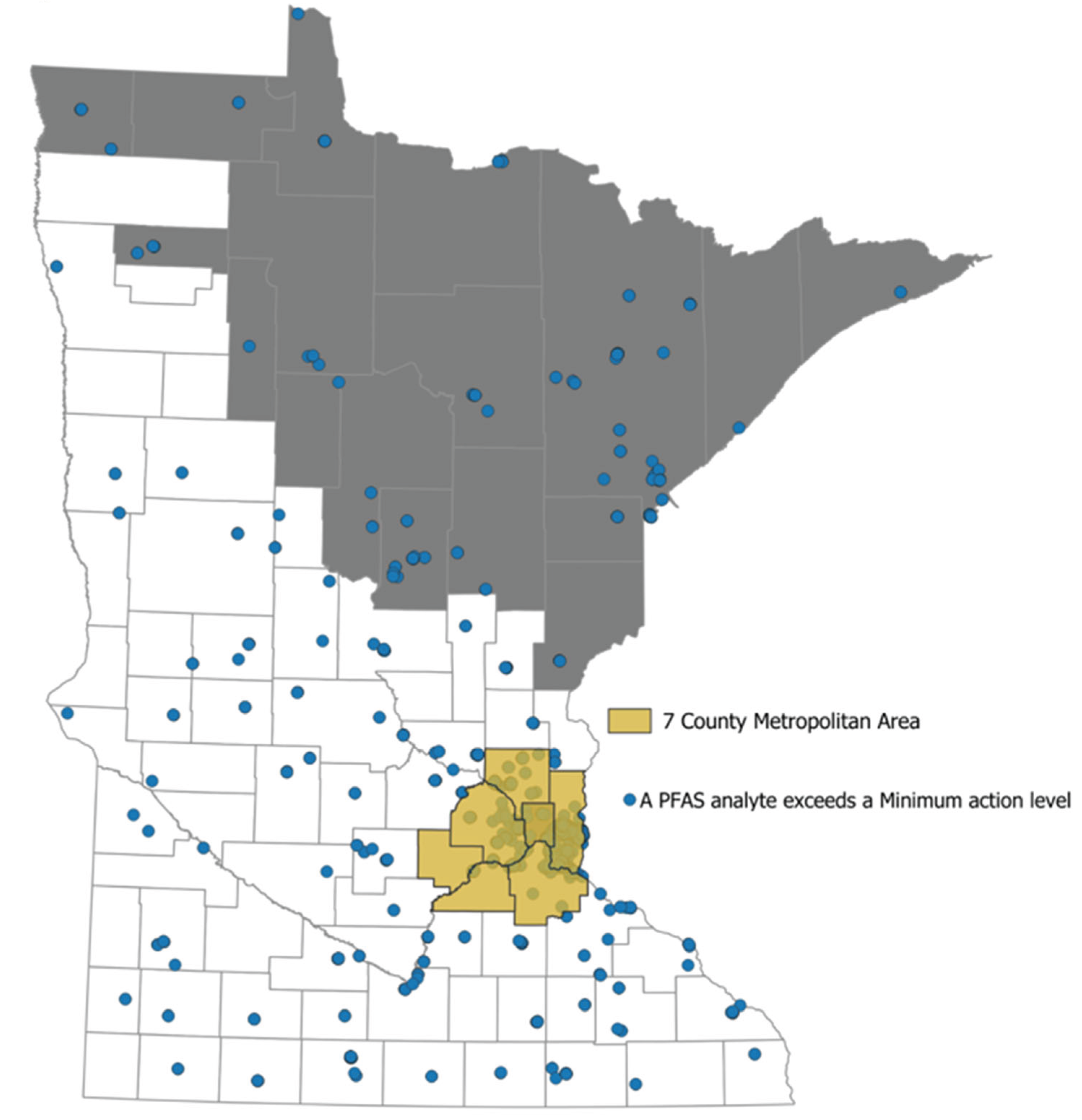
Figure 2.
Schematic illustration of the possible pathways of PFAS translocation in plants. Vertical root section and transportation (A), PFAS movement in root cross section (B). The movement along cell walls (apoplastic) is indicated with the green arrows, and the translocation through cells (symplastic) is displayed with blue arrows [169].
Figure 2.
Schematic illustration of the possible pathways of PFAS translocation in plants. Vertical root section and transportation (A), PFAS movement in root cross section (B). The movement along cell walls (apoplastic) is indicated with the green arrows, and the translocation through cells (symplastic) is displayed with blue arrows [169].
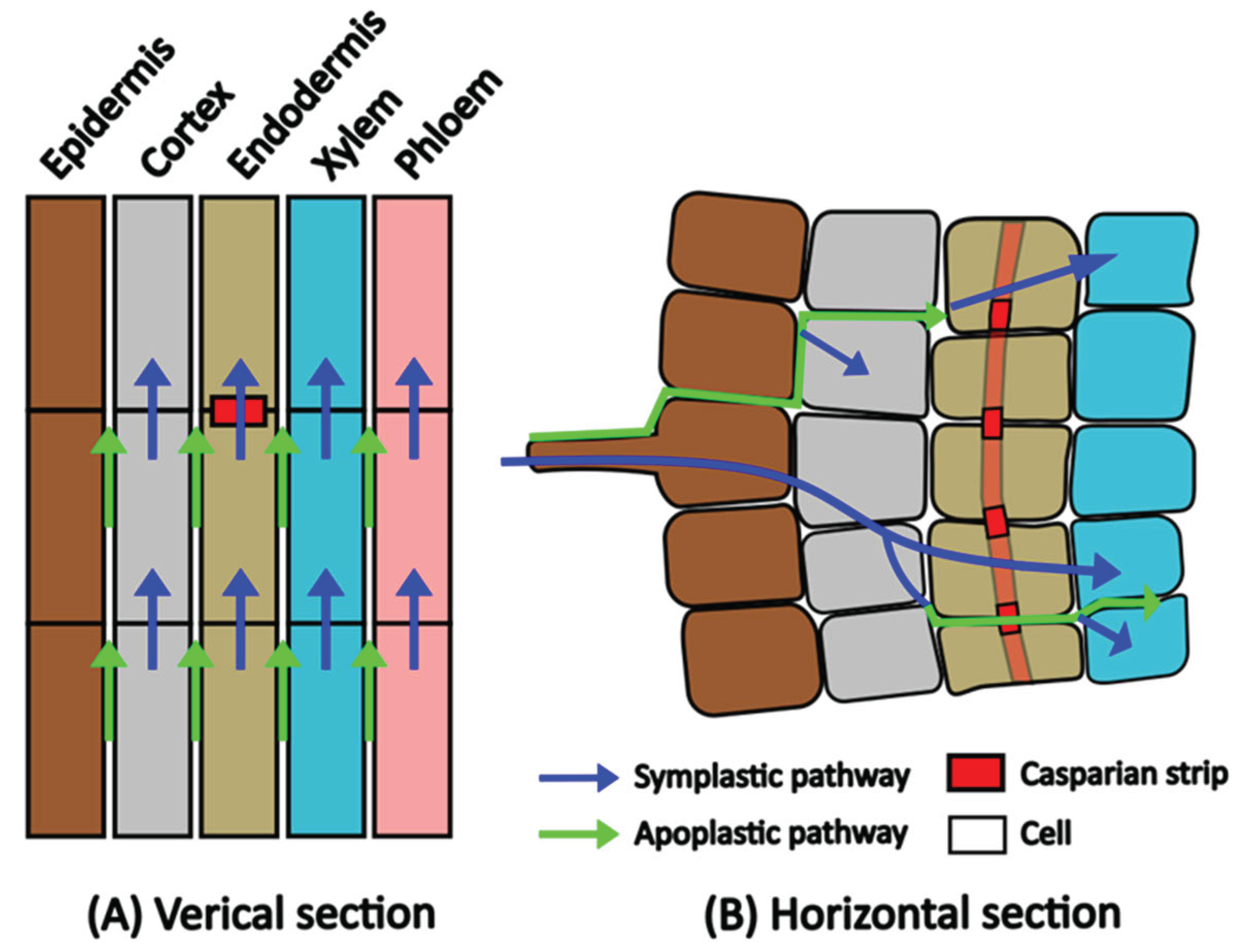
Figure 3.
Illustration of the PFAS cycle in relation to agriculture. (A) shows the release of PFASs by point sources (manufacturing sites, landfills, AFFFs, biosolids), which is followed by (B) the uptake by crops and livestock. Lastly, (C) contaminated products are consumed. Arrows indicate the direction of PFAS translocation, and the accumulation along food production.
Figure 3.
Illustration of the PFAS cycle in relation to agriculture. (A) shows the release of PFASs by point sources (manufacturing sites, landfills, AFFFs, biosolids), which is followed by (B) the uptake by crops and livestock. Lastly, (C) contaminated products are consumed. Arrows indicate the direction of PFAS translocation, and the accumulation along food production.
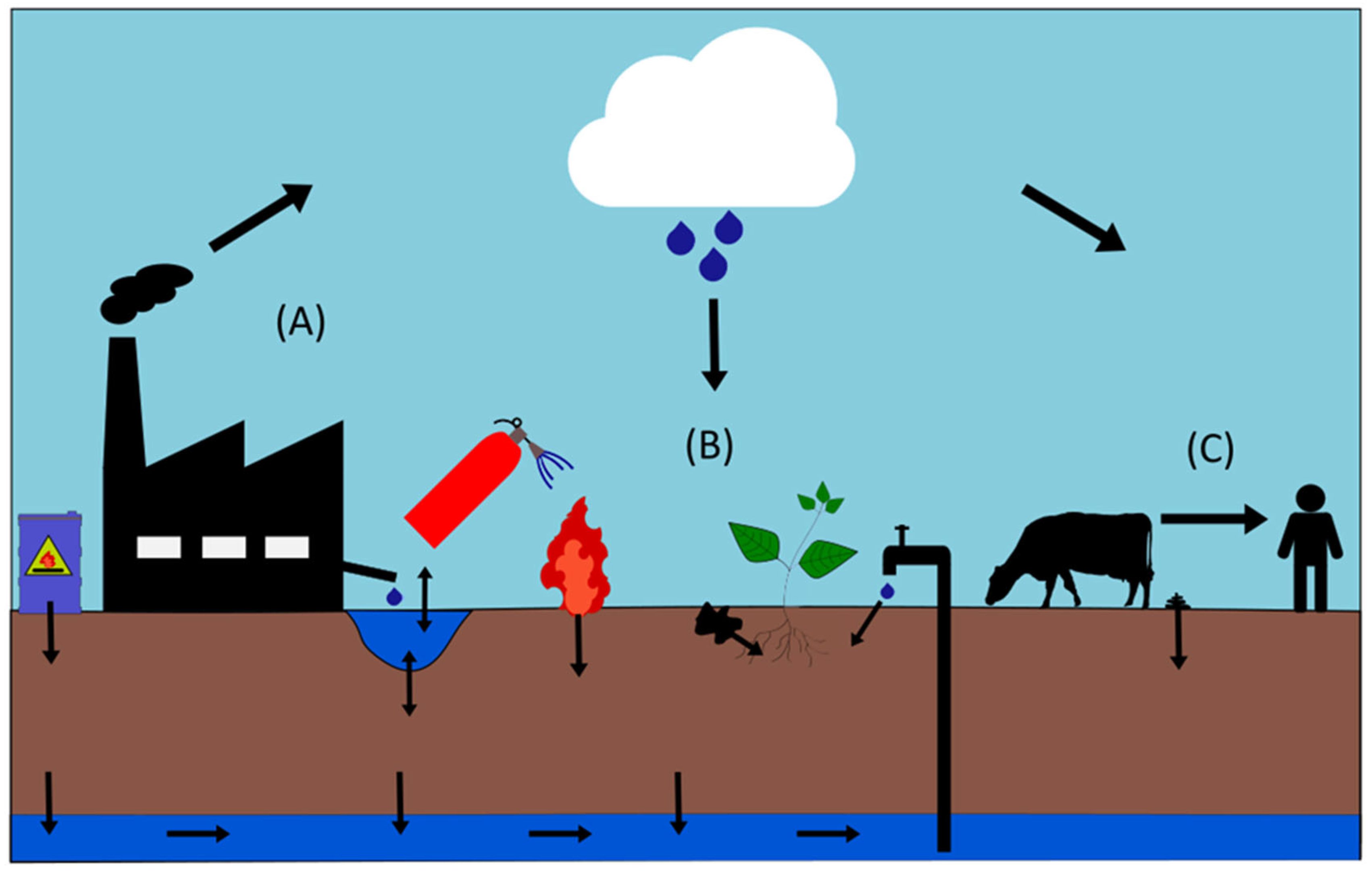
Figure 4.
Comparison of
the proposed health advisory levels for PFOA (black) and PFOS (grey) drinking
water standards by the Minnesota Department of Health (MDH) (continuous) and US
Environmental Protection Agency (EPA) (dotted) between 2002 and 2024 [196,197]. Note that the scale is a log scale, so
proposed standards for 2024 are on the order of 100,000 times more stringent
than in 2002.
Figure 4.
Comparison of
the proposed health advisory levels for PFOA (black) and PFOS (grey) drinking
water standards by the Minnesota Department of Health (MDH) (continuous) and US
Environmental Protection Agency (EPA) (dotted) between 2002 and 2024 [196,197]. Note that the scale is a log scale, so
proposed standards for 2024 are on the order of 100,000 times more stringent
than in 2002.
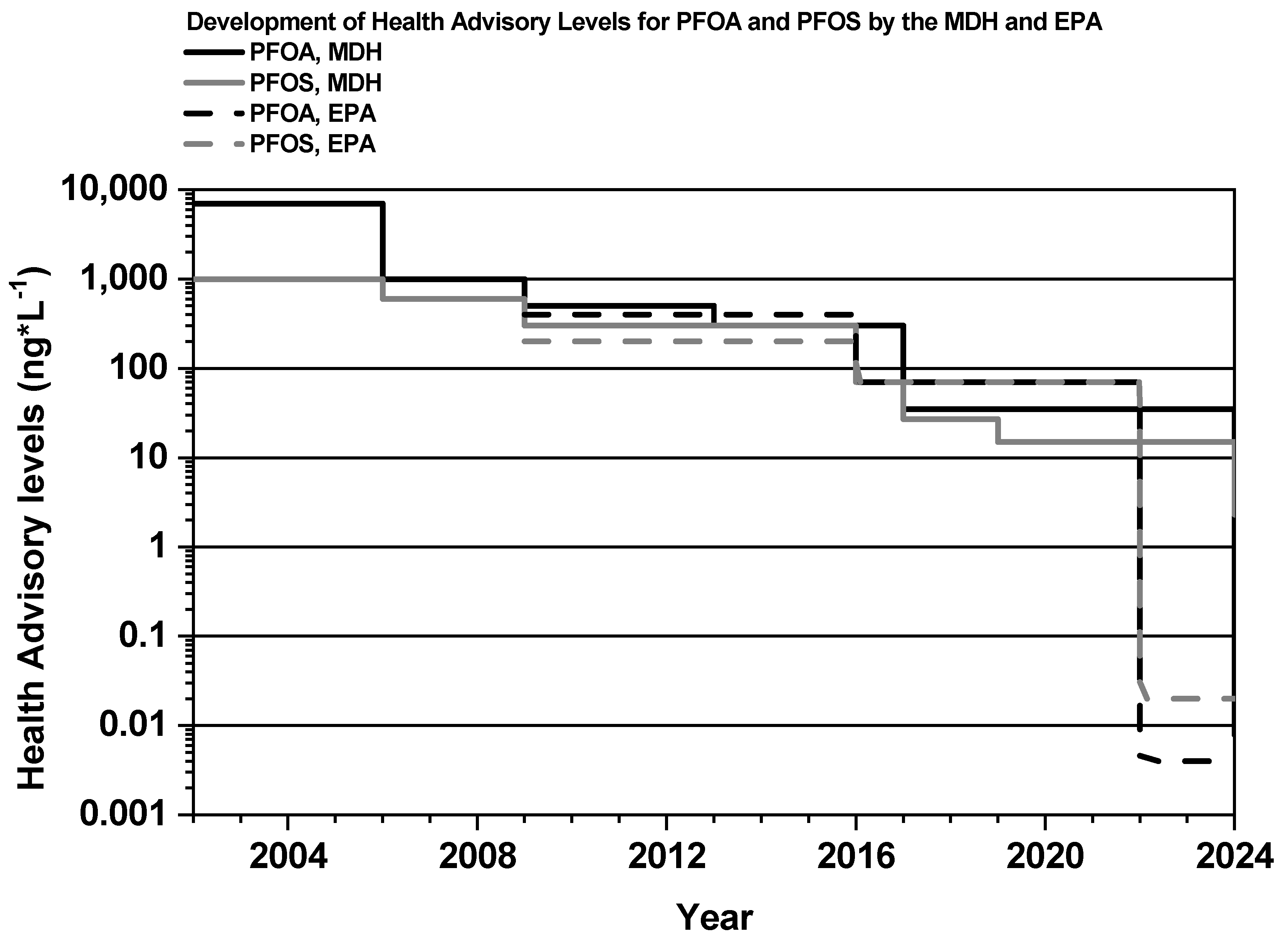
Disclaimer/Publisher’s Note: The statements, opinions and data contained in all publications are solely those of the individual author(s) and contributor(s) and not of MDPI and/or the editor(s). MDPI and/or the editor(s) disclaim responsibility for any injury to people or property resulting from any ideas, methods, instructions or products referred to in the content. |
© 2025 by the authors. Licensee MDPI, Basel, Switzerland. This article is an open access article distributed under the terms and conditions of the Creative Commons Attribution (CC BY) license (http://creativecommons.org/licenses/by/4.0/).
Copyright: This open access article is published under a Creative Commons CC BY 4.0 license, which permit the free download, distribution, and reuse, provided that the author and preprint are cited in any reuse.


