

Submitted:
12 June 2025
Posted:
13 June 2025
You are already at the latest version
Abstract
The seeds of camelina (Camelina sativa L.) are a valuable source of glyceride oil, which contains about 30% of essential omega-3 fatty acid (alpha-linolenic acid, 18:3). On the one hand, this high content of linolenic acid is healthy and hence preferable, but on the other hand, highly unsaturated oils are easily deteriorated. The stabilization of such oils with respect to their oxidative changes is a significant problem in fat technology and is directly related to the quality of food, pharmaceutical and cosmetic products. Therefore, the aim of this work was to evaluate the effect of ascorbyl palmitate in various concentrations (0.1-2.0 mM) as an additional antioxidant in camelina seed oil during its autoxidation, by deter-mination of oil induction periods and other oxidative kinetic parameters. The results re-vealed that the added ascorbyl palmitate caused decrease in oxidation rate, but in terms of oil stability and induction period opposite effects were observed depending on its concen-tration. Thus, at low levels (0.1-0.2 mM) ascorbyl palmitate had a prooxidant effect and the induction period decreased, no effect was observed in its presence of 1.0 mM, whereas 2.0 mM ensured high level of oxidative stability. Effects of rosmarinic acid as individual an-tioxidant and as mixture with ascorbyl palmitate were evaluated as well.

Keywords:
Camelina sativa L.
; seed oil
; oxidative stability
; omega-3 fatty acids
; antioxidants
; ascorbyl palmitate
; rosmarinic acid
1. Introduction
Climatic changes severely impact the crop production in Europe and impose the search for new stress tolerant plant with good qualities for human, animal or technical use. Plant breeding goals vary accordingly the market and farmers needs and selection of this crops has led to registration of varieties with contrasting characteristics of the grain and oil [1].
The oil extracted from Camelina sativa seeds contains more than 50% polyunsaturated fatty acids of which 35–40% are alpha-linolenic acid (18:3), an essential omega-3 fatty acid [2]. Camelina oil is a potentially important functional food ingredient providing beneficial essential fatty acids without the instability problems typical for highly unsaturated oils [3]. However, camelina is still grown as a non-food crop in some regions of Europa and North America and has a limited use as a food oil. Glucosinolates and erucic acid (13-22:1) are the major obstacles for consumption of camelina as a nutritionally complete food product due to their effects on the thyroid gland and the cardiovascular system [4]. The erucic acid at high levels is considered responsible for increasing of fat deposits in heart muscle, and adrenals of rodents as well as impairing growth [5]. This fact has led to the challenge of developing new varieties with low erucic acid by analogy with canola oil.
More than 3000 units of scientific literature on camelina have been analyzed [6] in the context of detailed review recognizing its current and potential future uses. As a rich source of omega-3 fatty acids, phytosterols, especially β-sitosterol, tocopherols and carotenoids the oil from camelina seeds has attracted attention from a nutritional perspective. The seeds of oil crops usually are rich source of phenolic compounds but the most polar of them remain in the cake after oil extraction [6,7]. Applications can be grouped depending on whether they relate to the camelina seeds, oil or cake (pomace after oil extraction) and include, but are not limited to, animal feed, functional food and diet supplements, cosmetic additives, bio-lubricants, adhesives, polymers, biofuels and compost. Very interesting is the application of camelina oil as a co-solvent in supercritical fluid extraction methods for extraction of easily degradable compounds as carotenoids [8]. Regardless of the application, it is necessary to ensure and increase as much as possible the oxidative stability of the oil.
Deterioration of oil quality leads not only to the loss of its organoleptic properties, but also to decrease in the biological activity, i.e. to the destruction of essential fatty acids, fat-soluble vitamins and to formation of physiologically harmful substances. For that reason, stabilization of oils with respect to their oxidative changes is an important problem in fat technology and has a direct bearing on the quality of food, pharmaceutical or cosmetic products [9,10]. The stability of plant oils depends on their native antioxidants, the most spread/common of which are tocopherols, on one hand, and the fatty acids composition, on the other. Synthetic or natural antioxidants can also be added to the lipid systems.
Ascorbyl palmitate (AscPH) is considered a “synthetic” antioxidant and as a fatty acid ester of ascorbic acid is often used in fat-containing foods. However, it is regarded as “natural” antioxidant because is fully hydrolyzed to ascorbic acid and palmitate [11]. As additive E 304 (i) no maximum levels are specified and it shall be used in accordance with good manufacturing practice.
Thus, the aim of study was to test the potential of such popular antioxidant as ascorbyl palmitate to stabilize a highly unsaturated oil as camelina seed oil, investigating the main kinetic parameters of oxidation as well as after addition of a second antioxidant.
2. Materials and Methods
2.1. Samples and Reagents
The camelina (Camelina sativa L.), variety Lenka, was cultivated at the experimental field of the Agricultural University – Plovdiv, Bulgaria (420 8` 49.05`` N/ 240 48` 42.46`` E). Spring sowing and standard technology were used with minimal cultural practices and low input of nutrients before sowing – only 30 kg/ha active substance of nitrogen. No additional pesticides were applied. The vegetation was short (from end of March to beginning of June) and a good phytosanitary condition of the crop was maintained till the end. The seeds were harvested at full maturity, dried in a dark place at room temperature, then milled and the oil was extracted as describe below in 2.2. Solvents of HPLC grade were used for extraction and preparative thin layer chromatography (TLC) whereas only iso-octane was of spectroscopic grade. Reagents for transmethylation and oxidative stability investigations were of analytical grade (Merck, Sigma-Aldrich). Reference mixture of fatty acids methyl esters (FAME), ascorbyl palmitate and rosmarinic acid were from Sigma-Aldrich Co. (St. Louis, MO, USA).
2.2. Oil Content of the Seeds
Portions of 30 g (precisely weighed) milled seeds of camelina were extracted in Soxhlet apparatus with n-hexane for 8 h. Then the solvent was distilled in rotary evaporator and the residue was weighted to calculate the oil content as follows:
Oil content, % = (m oil / m seeds) x 100,
where m was the mass [g], respectively of the residue (oil) and the initial sample (camelina seeds). Three parallel determinations were done. The oil was kept at -20oC until analyses.
2.3. Analysis of Fatty Acids Composition
After transesterification of oil with 1% methanolic sulfuric acid the resulting fatty acids methyl esters were firstly purified by preparative TLC [12], and then were analyzed by gas chromatography. A Shimadzu GC 2030 chromatograph equipped with a flame ionization detector and Simplicity Wax capillary column (30 m × 0.32 mm × 0.25 μm, Supelco) was used for the purpose, under the following conditions: a temperature program from 170°C to 260°C at 2°C/min and 5 min held at the final temperature, injector and detector temperatures of 260°C and 280°C, respectively, nitrogen as a carrier gas at a flow rate of 0.6 mL/min, split 1:50. The peaks identification was according to retention times compared to that of the reference FAME mixture. The results are presented as relative %.
2.4. Determination of Conjugated Dines and Trienes Content
The content of conjugated dienes and trienes was evaluated by their absorbance at 232 nm and 268 nm, respectively, of 1 % solution of oil in iso-octane measured in 1 cm quartz cuvette by Cecil Series 8000 UV/VIS spectrophotometer with reference of pure solvent. The results are presented as K232 and K268, respectively.
2.5. Determination of Peroxide Value, Induction Period and Other Oxidation Kinetic Parameters
Peroxide value (PV, expressed as meqv О2/kg oil) was estimated by modified iodometric method [13]. The induction period (IP) was evaluated by the following procedure: 2 g oil were oxidized in a glass vessel at 100°C by blowing a stream of air and the oil oxidation kinetics was monitored. Aliquots were taken in fixed time intervals and the degree of oxidation was estimated by iodometric determination of the primary products (hydroperoxides) as peroxide value. The induction period (IP, hours) was determined by method of tangents to both parts of the kinetic curves. Oxidation rates (R) were found by the tangents to the linear part of the kinetic curves. The protection factor (PF) was determined as ratio between the induction periods in presence (IPA) and in absence (IPC) of the antioxidant as follows: PF = IPA/IPC. The inhibition degree (ID) as a measure of antioxidant reactivity, i.e. the possibility of antioxidants to change the initial oxidation rate and to take part in side reactions of the oxidation process, was calculated as ID = RC/RA, where RC and RA were the oxidation rates, respectively, without and in the presence of the antioxidant.
3. Results and Discussion
The camelina seeds had oil content of 32.5 ± 1.7%. Camelina oil is among the several oils rich in alpha-linolenic acid (18:3 ω-3) like perilla (Perilla frutescens L.) [14], flaxseed (Linum usitatissimum L.) [15], purslane (Portulaca oleracea L.) [16] and rosehip (Rosa canina L.) [17] seed oils thus being a valuable source of the essential omega-3 fatty acid.
3.1. Fatty Acid Composition
The camelina oil used for these experiments contained 31 % alpha-linolenic acid, almost 20 % linoleic acid (18:2 ω-6), 17 % oleic acid (18:1 ω-9), 15 % 20:1 and other 13 fatty acids below 6% (Figure 1). Such a significant amount of unsaturated fatty acids, 89.3% in total, is beneficial for health, but, on the other hand, produces an oil susceptible to oxidation and, as a result, causes easy deterioration of the quality.
3.2. Oxidative Stability
3.2.1. Current State of the Oil Stability
The oxidation of oils is a complex process with multi-step mechanism. Conjugated dienes and trienes are among the primary products of oxidation and their amounts enable fast and easy estimation of initial oil quality. The values of 2.1 for conjugated dienes and 0.6 for conjugated trienes (Table 1) reveal camelina oil in good quality suitable for subsequent investigation of its oxidative stability.
3.2.2. Kinetics of Lipid Autoxidation and Inhibition Effect of Antioxidants
Figure 2 presents kinetics of lipid peroxides (LOOH, the primary oxidation products) accumulation during bulk phase autoxidation of the oil. The respective kinetic parameters obtained after processing the curves are presented in Table 2.
Naturally occurring tocopherols (650-950 mg/kg) contained in the camelina oil ensure some oxidative stability. In general, polyunsaturated oils are difficult for stabilization since the concentrations of their native antioxidants are optimal and usually fortification with additional amounts of tocopherols is ineffective. Whereas the addition of phenolic compounds to plant oils has limited effectiveness, the synergists which reinforce the antioxidant activity of native phenols (tocopherols) are recommended. The presence of ascorbyl palmitate in oral supplements contributes to the vitamin C (ascorbic acid) content and helps protection of fat-soluble antioxidants in the supplements [18].
In this work, addition of ascorbyl palmitate to camelina seed oil reduced or did not change significantly the oxidation rate (R, Table 2). However, in terms of oil stability and induction period IPA, opposite effects were observed depending on its concentration, namely at low levels of 0.1-0.2 mM, a prooxidant effect of AscPH was achieved (Figure 2, curves 1 and 2) and the induction period (IPA) decreased by 4-5 hours compared to the control sample (IPC). No change in the value of the factor PF was observed in presence of 1.0 mM AscPH but 2.0 mM ensured high level of oxidative stability of the oil and the highest inhibition degree ID, reducing the oxidation rate 3-fold. As a co-antioxidant regenerating tocopherols molecules, the effect of ascorbate or its lipid-soluble esters is highly concentration-dependent but the substrate factor and the experimental conditions are also very important.
Abramovic and Abram [19] studied the protective effect of 0.2% rosemary extract on the oxidative stability of Camelina sativa oil by periodic determination of its peroxide value as well as the induction time measured by Rancimat test (110°C) during storage at room temperature. The presence of added extract extended the induction period of freshly obtained camelina oil by 60%. In our study 0.2 mM (~0.01%) rosmarinic acid ensured 20% raise of IPA. On one hand, rosmarinic acid prolonged the induction period thus increasing the protection factor PF of the oil, but, on the other hand, it decreased the inhibition degree ID, a parameter closely related to the degree of an antioxidant participation in side reactions (Table 2).
The kinetic curves 5 and 6 in Figure 2 and the results in Table 2 revealed that the activity of rosmarinic acid significantly decreased in presence of equimolar concentration of 0.2 mM ascorbyl palmitate. Thus, it could be concluded that there was a lack of cooperative effect of both antioxidants. Their effect as a binary mixture (Figure 2, curve 6) was significantly lower than that of the sum of their individual IPA: IPMIX < IPRA + IPAscPH.
4. Conclusions
The effect of ascorbyl palmitate as a co-antioxidant regenerating naturally occurring tocopherols is highly concentration-dependent. At low levels of 0.1-0.2 mM a prooxidant effect is observed and induction period IPA decreases by 4-5 hours compared to the control sample. The 1.0 mM ascorbyl palmitate has no effect but 2.0 mM ensures high level of oil oxidative stability. Also, 0.2 mM rosmarinic acid ensures 20% raise of IPA. On one hand, rosmarinic acid prolongs the induction period and increases the protection factor PF of the oil, but, on the other hand, it decreases the inhibition degree ID which parameter is closely related to the degree of participation of the antioxidant in side reactions. Its activity significantly decreases in presence of equimolar concentration of 0.2 mM ascorbyl palmitate. The results obtained show that there is a lack of cooperative effect between the two antioxidants and even antagonism can be observed.
Author Contributions
Conceptualization, A.K., S.M. and M.M.; methodology, A.K. and S.M.; formal analysis, A.K and S.T.; investigation, A.K. and S.T.; resources, M.M.; writing—original draft preparation, A.K. and S.M.; writing—review and editing, A.K., S.M. and M.M. All authors have read and agreed to the published version of the manuscript.
Funding
This research received no external funding.
Data Availability Statement
All data supporting the findings of this study are available within the paper. Any raw data files are available from the corresponding author upon reasonable request..
Acknowledgments
The support of the Centre of Competence “Sustainable Utilization of Bio-resources and Waste of Medicinal and Aromatic Plants for Innovative Bioactive Products” (BIORESOURCES BG), project BG16RFPR002-1.014-0001, funded by the Program “Research, Innovation and Digitization for Smart Transformation” 2021-2027, co-funded by the EU, was greatly acknowledged.
Conflicts of Interest
The authors declare no conflict of interest. The funders had no role in the design of the study; in the collection, analyses, or interpretation of data; in the writing of the manuscript; or in the decision to publish the results.
Abbreviations
The following abbreviations are used in this manuscript:
| AscPH | Ascorbyl palmitate |
| RA | Rosmarinic acid |
| IPA | Induction period |
| PF | Protection factor |
| R | Initial rate of oxidation |
| ID | Inhibition degree |
References
- Montero-Muñoz, I.; Mostaza-Colado, D.; Capuano, A.; Mauri Ablanque, P.V. Seed and Straw Characterization of Nine New Varieties of Camelina sativa (L.) Crantz. Land 2023, 12, 328. [Google Scholar] [CrossRef]
- Afzal, M.F.; Khalid, W.; Armghan Khalid, M.; Zubair, M.; Akram, S.; Kauser, S.; Noreen, S.; Jamal, A.; Kamran Khan, M.; Al-Farga, A. Recent industrials extraction of plants seeds oil used in the development of functional food products: A Review. Int J Food Prop 2022, 25, 2530–2550. [Google Scholar] [CrossRef]
- Xu, T.-T.; Li, J.; Fan, Y.-W.; Zheng, T.-W.; Deng, Z.-Y. Comparison of Oxidative Stability among Edible Oils under Continuous Frying Conditions. Int J Food Prop 2015, 18, 1478–1490. [Google Scholar] [CrossRef]
- Tripathi, M.K.; Mishra, A.S. ; Glucosinolates in animal nutrition: A review. Anim Feed Sci Technol 2007, 132, 1–27. [Google Scholar] [CrossRef]
- Alim, M.A.; Iqbal, Z.; Dutta, P.C. Studies on the characterization and distribution of fatty acids and minor components of high-erucic acid mustard oil and low-erucic acid rapeseed oil. Emir J Food Agric 2012, 24, 281–287. [Google Scholar]
- Sydor, M.; Kurasiak-Popowska, D.; Stuper-Szablewska, K.; Rogoziński, T. Camelina sativa. Status quo and future perspectives. Ind Crops Prod 2022, 187 B, 115531. [Google Scholar] [CrossRef]
- Terpinc, P.; Polak, T.; Makuc, D.; Ulrich, N.P.; Abramovič, H. The occurrence and characterization of phenolic compounds in Camelina sativa seed, cake and oil. Food Chem 2012, 131, 580–589. [Google Scholar] [CrossRef]
- Popescu, M.; Iancu, P.; Plesu, V.; Bildea, C.S. Carotenoids recovery enhancement by supercritical CO2 extraction from tomato using seed oils as modifiers. Processes 2022, 10, 2656. [Google Scholar] [CrossRef]
- Wang, J.; Han, L.; Wang, D.; Sun, Y.; Huang, J.; Shahidi, F. Stability and stabilization of omega-3 oils: A review. Trends Food Sci Technol 2021, 118, 17–35. [Google Scholar] [CrossRef]
- Garcia-Mendoza, M.d.P.; Espinosa-Pardo, F.A.; Savoire, R.; Harscoat-Schiavo, C.; Cansell, M.; Subra-Paternault, P. Improvement of the oxidative stability of camelina oil by enrichment with phospholipid-quercetin formulations. Food Chem 2021, 34, 128234. [Google Scholar] [CrossRef] [PubMed]
- EFSA Panel on Food Additives and Flavorings (FAF), Opinion on the re-evaluation of ascorbyl palmitate (E 304i) as a food additive in foods for infants below 16 weeks of age and the follow-up of its re-evaluation as a food additive for uses in foods for all population groups. EFSA Journal 2020, 18, 6153. [CrossRef]
- Taneva, S.; Momchilova, S. Effect of the extraction method on the lipid composition of purslane (Portulaca oleracea L.) seed oil. Discover Food 2024, 4, 112. [Google Scholar] [CrossRef]
- Yanishlieva, N.; Popov, A.; Marinova, E. Eine Modifizierte Jodometrische Methode zur Bestimmung der Peroxidzahl in kleinen Lipidproben. C R Acad Bulg Sci 1978, 31, 869–871. [Google Scholar]
- Bondioli, P.; Folegatti, L.; Rovellini, P. Oils rich in alpha linolenic acid: Chemical composition of perilla (Perilla frutescens) seed oil. OCL 2020, 27, 67. [Google Scholar] [CrossRef]
- Saini, R.K.; Keum, Y.-S. Omega-3 and omega-6 polyunsaturated fatty acids: Dietary sources, metabolism, and significance — A review. Life Sci 2018, 203, 255–267. [Google Scholar] [CrossRef] [PubMed]
- Zhou, Y.-X.; Xin, H.-L. Portulaca oleracea L.: A Review of Phytochemistry and Pharmacological Effects. BioMed Res Int 2015, 2015, 925631. [Google Scholar] [CrossRef] [PubMed]
- Taneva, S.; Konakchiev, A.; Totzeva, I.; et al. , Super-critical carbon dioxide extraction as an effective green technology for production of high quality rose hip oil. Bulg Chem Commun 2017, 49B, 126–131. [Google Scholar]
- Łupina, K.; Kowalczyk, D.; Drozłowska, E. Polysaccharide/gelatin blend films as carriers of ascorbyl palmitate - a comparative study. Food Chem 2020, 333, 127465. [Google Scholar] [CrossRef] [PubMed]
- Abramovic, H.; Abram, V. Effect of added rosemary extract on oxidative stability of Camelina sativa oil. Acta Agric Slov 2006, 87, 255–261. [Google Scholar] [CrossRef]
Figure 1.
Fatty acids composition of oil from camelina seeds.
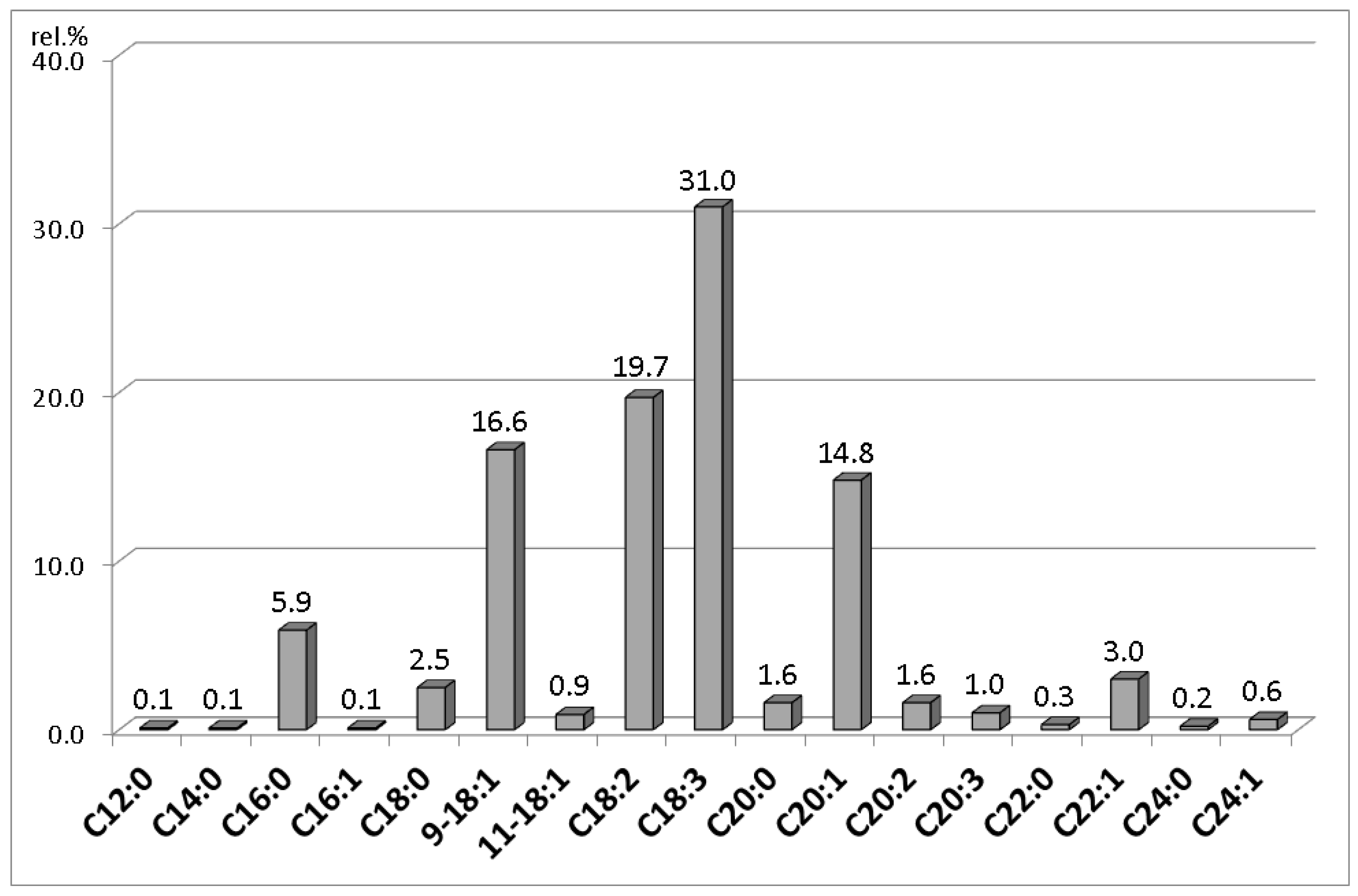
Figure 2.
Kinetics of lipid hydroperoxides accumulation during autoxidation at 100°C of camelina seed oil before (control, C) and after addition of ascorbyl palmitate at concentrations 0.1 mM, 0.2 mM, 1.0 mM and 2.0 mM (curves 1-4), 0.2 mM rosmarinic acid individually (curve 5) and in equimolar binary mixture with ascorbyl palmitate (curve 6).
Figure 2.
Kinetics of lipid hydroperoxides accumulation during autoxidation at 100°C of camelina seed oil before (control, C) and after addition of ascorbyl palmitate at concentrations 0.1 mM, 0.2 mM, 1.0 mM and 2.0 mM (curves 1-4), 0.2 mM rosmarinic acid individually (curve 5) and in equimolar binary mixture with ascorbyl palmitate (curve 6).
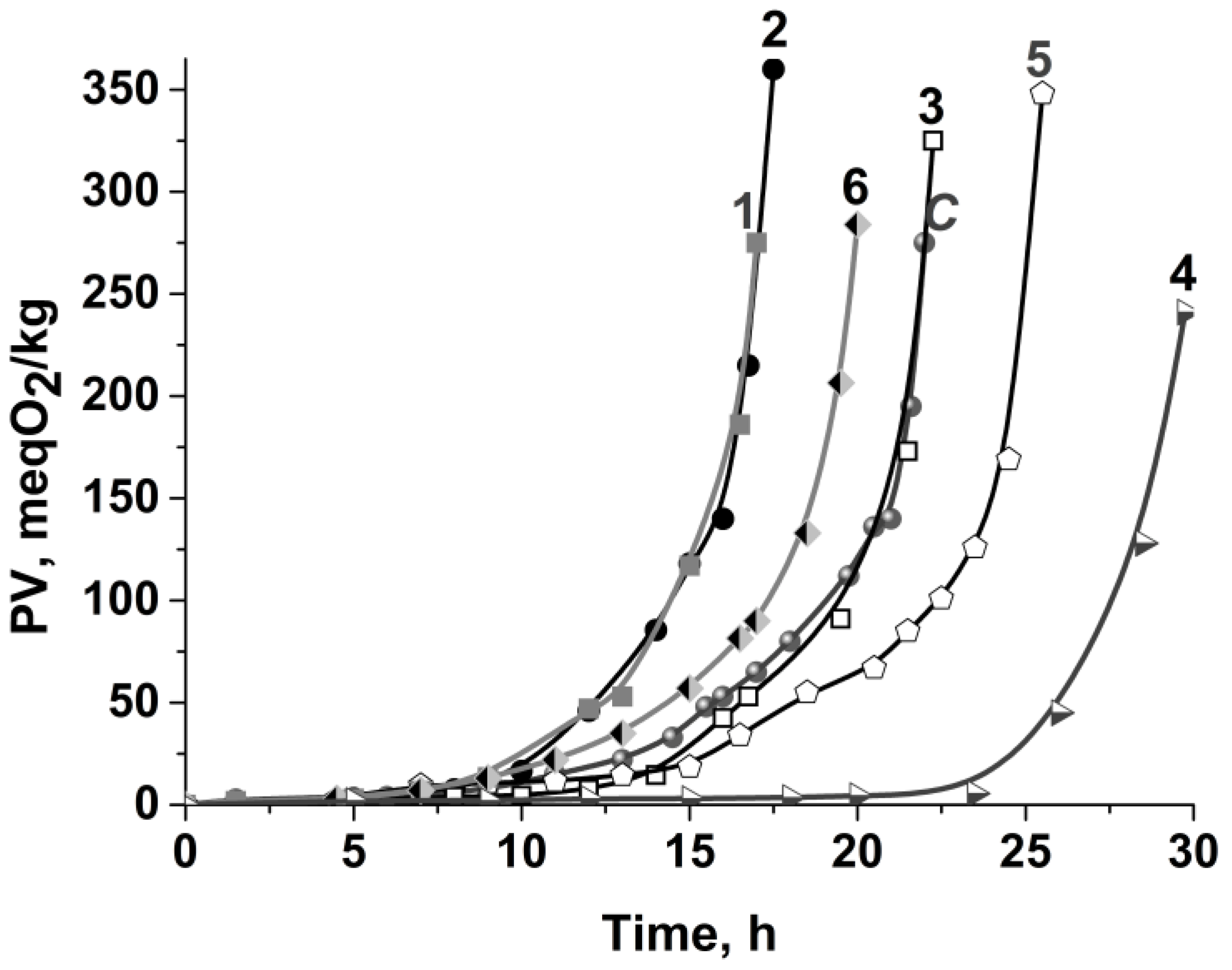

Table 1.
Conjugated dienes and trienes in seed oil of Camelina sativa L.
| Camelina seed oil | Mean ± SD |
|---|---|
| Conj. Dienes (K232) | 2.2 ± 0.1* |
| Conj. Trienes (K268) | 0.6 ± 0.01 |
* Mean value of 3 measurements ± standard deviation.
Table 2.
Kinetic parameters characterizing camelina seed oil before and after addition of ascorbyl palmitate (AscPH) and rosmarinic acid (RA).
Table 2.
Kinetic parameters characterizing camelina seed oil before and after addition of ascorbyl palmitate (AscPH) and rosmarinic acid (RA).
| Sample | Abbrev. | IPA, h | PF | R, 10-7 Ms-1 | ID |
|---|---|---|---|---|---|
| Control sample | C | 20 ± 2* | - | 1.15 ± 0.05 | - |
| Samples enriched with: | |||||
| 0.1 mM AscPH 0.2 mM AscPH 1.0 mM AscPH 2.0 mM AscPH |
1 | 15.6 ± 1.5 | 0.8 | 1.30 ± 0.05 | 0.88 |
| 2 | 16.0 ± 1.5 | 0.8 | 1.24 ± 0.06 | 0.93 | |
| 3 | 20.5 ± 1.5 | 1.0 | 0.69 ± 0.03 | 1.67 | |
| 4 | 28 ± 2 | 1.4 | 0.31 ± 0.02 | 3.71 | |
| 0.2 mM RA AscPH:RA (1:1) |
5 | 24 ± 2 | 1.2 | 1.60 ± 0.05 | 0.72 |
| 6 | 18 ± 2 | 0.9 | 1.40 ± 0.05 | 0.82 |
* Mean value of 3 measurements ± standard deviation.
Disclaimer/Publisher’s Note: The statements, opinions and data contained in all publications are solely those of the individual author(s) and contributor(s) and not of MDPI and/or the editor(s). MDPI and/or the editor(s) disclaim responsibility for any injury to people or property resulting from any ideas, methods, instructions or products referred to in the content. |
© 2025 by the authors. Licensee MDPI, Basel, Switzerland. This article is an open access article distributed under the terms and conditions of the Creative Commons Attribution (CC BY) license (http://creativecommons.org/licenses/by/4.0/).
Copyright: This open access article is published under a Creative Commons CC BY 4.0 license, which permit the free download, distribution, and reuse, provided that the author and preprint are cited in any reuse.