
Submitted:
15 November 2024
Posted:
18 November 2024
You are already at the latest version
Abstract
This is an information theory effort. We discover interesting links between Fisher measure and Gibbs’ ensembles. Among these ensembles, the grand canonical and canonical ensembles are fundamental, each offering distinct insights into a system’s properties. In this work, we construct a deep connection between these ensembles, generated by Fisher’s information measure. We specifically explore the relationships among four key concepts: (1) the canonical and grand canonical ensembles, (2) continuous and discrete Fisher information measures applied to three parameters: (a) inverse temperature, (b) particle number, and (c) fugacity, and (3) the Fano factor, and (4) specialized Poisson distributions defined by the particle number and its mean value. Our findings reveal intricate and compelling relationships among these concepts, providing new perspectives on the interplay between statistical mechanics and information theory.
Keywords:
Fisher information
; Special GCE-adapted Poisson distribution
; Fano factor
1. Introduction
The Fisher information measure (FIM) is a critical tool in both statistics and information theory, quantifying the amount of information an observable random variable carries about an unknown parameter. Fisher information can be expressed in both continuous and discrete forms and has found applications across a wide range of disciplines, including statistical mechanics [1].
Statistical mechanics, in turn, provides a robust framework for understanding the macroscopic behavior of systems through their microscopic properties. Among the fundamental ensembles in this field are the canonical and grand canonical ensembles. The canonical ensemble is well-suited for systems with a fixed number of particles, volume, and temperature, while the grand canonical ensemble accommodates fluctuations in particle numbers by incorporating the chemical potential or fugacity as essential parameters [2].
Another key statistical measure is the Fano factor, defined as the ratio of the variance to the mean of a probability distribution. It is particularly relevant in the context of counting statistics and noise characterization, offering insights into the fluctuations within a system. The Fano factor is widely used in applications such as photon detection, particle counting, and any scenario where quantifying variability is crucial [3].
Additionally, Poisson distributions, characterized by their mean and the number of events or particles, are fundamental in describing processes where events occur independently at a constant average rate. These distributions play a pivotal role in various applications, from modeling radioactive decay to describing traffic flow and network packet arrivals [2,4,5].
In this study, we delve into the intricate relationships among these four statistical concepts: (1) the canonical and grand canonical ensembles, (2) Fisher information measures (both continuous and discrete) for parameters such as inverse temperature, particle number, and fugacity, (3) the Fano factor, and (4) Poisson distributions defined by particle number and their average. Through this exploration, we aim to uncover deeper insights into the interplay between thermodynamic quantities and statistical measures.
Mandelbrot demonstrated that the Fisher information measure for the canonical ensemble is equivalent to the energy variance [6]. In this work, we derive a similar result for the grand canonical ensemble (GCE) and construct a special Poisson distribution to bridge the gap between these ensembles. From this foundation, we further investigate the informational content of both the canonical and grand canonical ensembles.
We emphasize the following points: i) The Fisher information measure, a concept from information theory, quantifies the information a statistical model provides about a parameter based on observations. For a probability distribution dependent on a parameter , Fisher information is given by the expectation of the squared derivative of the logarithm of P with respect to , with the expectation taken over P. ii) In statistical mechanics, the GCE describes a system in thermal equilibrium with a reservoir, allowing for the exchange of both energy and particles. The mean energy U in this ensemble is a critical quantity that characterizes the system’s average energy.
Our exploration of the Fisher information and its connection to the grand canonical ensemble is particularly compelling for several reasons:
- This connection contributes to the expanding field of information thermodynamics, which investigates the interplay between information theory and thermodynamics.
- It may have implications for understanding quantum fluctuations and information measures in quantum statistical ensembles.
- Fisher information is tied to the precision with which a parameter can be estimated. In the context of the grand canonical and canonical ensembles, where the parameter is associated with energy, this connection could provide insights into the precision of energy measurements and the role of fluctuations within the system.
We begin our investigation by reviewing the formal mathematical structures underlying the GCE.
The article is organized as follows: Section 2 and Section 5 provide the necessary preliminary materials, while Section 6, Section 7, Section 8, and Section 9 present our main results, focusing on the connections we’ve uncovered. Section 10 concludes with a summary of our findings and their implications.
2. Structural Framework
2.1. Generalities About the Grand Canonical Ensemble
The grand canonical ensemble describes a system in contact with a reservoir with which it can exchange energy and particles, so that the number of particles is not fixed. Let us suppose a classical system of N noninteracting identical particles in equilibrium at a temperature T and confined to a volume V. The classical Hamiltonian is in general a function of the coordinates of the phase space variables . The resulting probability distribution of the system is given by [2]
The parameter is defined as where is Boltzmann’s constant. The symbol , with , represents the fugacity of the system, and is the chemical potential. The quantity denotes the grand partition function where the range of N is [2]. The well-known canonical partition function for this system is given by [2]
where is the element of volume of the phase space.
The average of the particle number in the grand canonical ensemble is given by [2]
while the mean energy is [2]
or, alternatively
where we used the following expression for the mean value of energy in the canonical ensemble [2]
Also, we have that
and
The mean-square fluctuations in the energy of a system in the grand canonical ensemble are given by [2]
which is equal to the fluctuation in the canonical ensemble plus a contribution due to the fact that the particle number N fluctuates. Such contribution is given by [2].
We note that the mean value to the right of Eq. (9) is taken in the grand canonical ensemble. Hereafter, on some occasions when necessary, we will refer to this fact by using the notation .
2.2. The Classical Ideal Gas in the Grand Canonical Ensemble: Some Concepts
Now, we specify the classical Hamiltonian as , with m being the mass of the particles, and representing the momentum of the i-th particle in the system [2]. The resulting canonical partition function is of the form [2]
where is the particles’ mean thermal wavelength. Therefore, the grand canonical partition function becomes [2]
We emphasize an important issue here. The key GCE variable in this ensemble is the chemical potential , which plays a crucial role in controlling the average number of particles in the system. The mean particle number is related to the grand partition function of course. The grand partition function is a function of temperature, volume, and chemical potential (through z). Therefore, the mean particle number must depend on such variables. After some manipulation one encounters [2]:
while the mean energy is [2]
which are two relevant quantities for the development of the next sections.
3. Special Poisson Distribution
3.1. Preliminaries
Its makes a lot of sense to study the features of a special Poisson distribution where the parameter a (the rate parameter) is fixed a priori from outside. Such a study could yield valuable insights, particularly in the context of statistical mechanics, information theory, and related fields. Here are some reasons why this investigation could be meaningful:
- Understanding external constraints: Fixed Mean Value: By fixing the mean value a externally, you are essentially imposing an external constraint on the system. This could represent a situation where an external factor, such as a reservoir or a controlling mechanism, dictates the average number of events or particles. Studying how this constraint affects the distribution and related properties can provide insight into how systems behave under externally imposed conditions.
- Statistical and Thermodynamic applications: Connection to Ensembles: In thermodynamics, particularly within the framework of the grand canonical ensemble, the parameter a could correspond to a quantity like fugacity or chemical potential that controls the average number of particles. By fixing a, one could explore the consequences for energy fluctuations, entropy, and other thermodynamic quantities. Fluctuations and Uncertainty: A fixed a would directly affect the variance and higher moments of the distribution. This could lead to interesting results about the relationship between the mean, variance, and the information content of the system.
- Information-theoretic implications: 1) Fisher Information and Uncertainty: As mentioned earlier, Fisher information quantifies the amount of information about a parameter carried by a probability distribution. By fixing a, you could explore how this affects the Fisher information and the uncertainty in the system, potentially revealing new relationships between information theory and statistical mechanics. 2) Entropic measures: Studying the entropy and related measures of the Poisson distribution with a fixed mean could also yield insights into the information-theoretic properties of the system.
- Real-world applications: i) Modeling external controls: Many real-world processes are governed by external controls or constraints, such as the average arrival rate of packets in a network, the average number of decay events in a radioactive sample, or the controlled release of particles in a physical system. Understanding the behavior of the system under these constraints is crucial for optimizing and predicting outcomes in such scenarios. ii) Optimal design and control: The findings could inform the design of systems where controlling the mean number of events is critical, such as in telecommunications, manufacturing, and resource management.
- Theoretical insights: Bridging theoretical gaps: Investigating such a distribution could help bridge gaps between different theoretical frameworks, such as between Poisson processes and canonical or grand canonical ensembles in statistical mechanics, providing a more unified understanding of how external constraints impact system behavior.
Overall, studying a special Poisson distribution with a fixed mean value a can provide valuable theoretical and practical insights across multiple domains, making it a worthwhile area of research.
3.2. Our Application
Such a special Poisson distribution will be the tool to build our wished for bridge. Poisson’s distribution (see details below) is important in physics and various other fields due to its ability to model the probability of a given number of events occurring in a fixed interval of time or space when these events happen independently and at a constant average rate [2]. Its applications in physics and other sciences are widespread, and here are some areas where it is particularly relevant: particle and nuclear physics, particle counting, traffic flows, economics and finance, biophysics, etc. Its simplicity and generality make it a valuable tool in physics and other scientific disciplines.
We will work here with a particular version of the celebrated Poisson distribution (PoD). Any PoD contains a parameter together with its mean value. However, for our present goals it is convenient to speak of these values, as one of them (the mean) will be seen as a constraint on the distribution. The distinctiveness of our way of using PoD lies in this way of using it. More specifically, for us, one of them will be the number of particles N. The other is the average of this number, but calculated following the tenets of the grand canonical ensemble, in particular its partition function for the pertinent application at hand.
3.2.1. Choice of Variables
A discrete random variable X (that refers to a discrete number of occurrences k) is said to have a Poisson distribution, with positive parameter if it has a probability mass function given by [4,5]
An essential fact for us is to derive a specially GCE-adapted Poisson distribution [2,4,5]. For this we take to be the mean number of particles , but not any mean value, but that given in the grand canonical ensemble, expressed in terms of the temperature. The other Poisson parameter k is the actual particle number N. Accordingly, our specially GCE-adapted Poisson distribution refers to the probability of encountering N particles if we have as a function of T, i.e., .
3.2.2. The Workings of the Ensuing GCE-Adapted Poisson Distributions
According the explanation in above subsection, the GCE-adapted Poisson distributions is given by
Here, represents the average number particles as determined by the mathematics of the grand canonical ensemble. This is an important fact that should be emphasized and remembered.
A Poisson distribution is used to describe the number of events that occur in a fixed interval of time or space, when the events occur independently at a constant rate. It is often used to model situations where events are rare and random, such as radioactive decay or the arrival of particles at a detector. In the context of the grand canonical ensemble, the specially GCE-adapted Poisson distribution can arise as a result of the probabilistic nature of particle number fluctuations. Specifically, in the grand canonical ensemble the average particle number is not fixed but rather fluctuates around a mean value determined by the chemical potential of the reservoir [2].
When the fluctuations in the particle number are relatively small and the average particle number is large, the grand canonical distribution of particle numbers can be well approximated by the Poisson distribution (PoD) [2]. This occurs because the specially GCE-adapted Poisson distribution naturally arises as a limit of the binomial distribution when the number of trials (particle exchanges) becomes large and the probability of success (particle exchange) becomes small. In such a scenario the PoD helps to describe the statistical behavior of the system and provides insights into how possible particle numbers in equilibrium are distributed [2].
Accordingly, the specially GCE-adapted Poisson distribution can provide a useful approximation in the grand canonical ensemble for systems with a large average particle number, where the fluctuations are small and the particle exchanges with the reservoir are rare events occurring independently [2]. One example where the specially GCE-adapted Poisson distribution can be used as an approximation to the grand canonical distribution is in the context of particle statistics in quantum optics [2].
In this approximation, the average particle number in the specially GCE-adapted Poisson distribution is equal to the average particle number in the grand canonical distribution itself [2]. By using the specially GCE-adapted Poisson distribution, one can make calculations and predictions about particle statistics in equilibrium with a reservoir without explicitly considering the full grand canonical distribution, simplifying the analysis while still capturing the essential statistical behavior of the system [2].
The specially GCE-adapted Poisson distribution has useful mathematical properties. We mention some of them:
- is normalized:
- The expected value of N is fixed before hand as that given by the grand canonical ensemble and, of course, obeys
- The variance of N behaves in rather peculiar fashionwhere
4. Fano Factor
A well known useful quantity is the scaled variance or Fano factor, which is an intensive measure of fluctuations [7]. It is defined as [2]
It is evident that for the specially GCE-adapted Poisson distribution, we have . For a Fano factor one speaks of a sub-specially GCE-adapted Poisson instance and for a , one speaks of a super-specially GCE-adapted Poisson instance. It is also easily seen that for the ideal gas the Fano factor equals unity. The fact that the Fano factor equals unity for an ideal gas, indicating Poissonian statistics in particle counting, is a well-known result in statistical mechanics and particle physics. It has been understood for quite some time, as it is a fundamental aspect of the ideal gas model [7]. The ideal gas model assumes that gas particles are point-like, non-interacting entities that move randomly and independently in a container. These assumptions lead to the statistical properties of the gas following certain well-defined distributions, with the Poisson distribution being particularly relevant for particle counting statistics. The relationship between the Fano factor and the Poisson distribution in the context of an ideal gas has been extensively studied and utilized in various areas of physics, including in experimental particle physics, where it helps characterize the behavior of detectors and the statistical fluctuations in particle detection [8].
5. Recalling Aspects of the Fisher-Environment
Fisher’s information (FIM) measures how much information a random sample of data contains about an unknown parameter [9]. It is a measure of the amount of uncertainty or variability in the data with respect to the parameter being estimated. The Fisher information matrix is often used to quantify this information. Mathematically, if you have a probability distribution for some parameter , the Fisher information is given by the expected value of the square of the score function, which is the derivative of the log-likelihood function with respect to the parameter [9]. It is defined as
In the case of the discrete probability distributions , with , an alternative form of the Fisher measure is given by [10,11]
where one uses the abbreviated notation . Interesting applications of the discrete Fisher can be found in Refs. [10,11,12].
The Fisher information measure also has several important properties [9]:
- Information accumulation: It quantifies how much information about a parameter is accumulated by collecting more data.
- Cramér-Rao Inequality: The Fisher information is related to the precision of parameter estimation. The Cramér-Rao inequality states that the variance of any unbiased estimator is bounded by the inverse of the Fisher information [9]: .
- Efficiency of estimators: It helps compare different estimators for efficiency, with more efficient estimators having higher Fisher information.
- In summary, Fisher information is a fundamental concept in statistics that provides a quantitative measure of the amount of information contained in a sample of data about the parameters of a statistical model. FIM plays a crucial role in the theory of statistical estimation and hypothesis testing.
We begin below to develop our new contributions here.
6. Building a New Link Between a Discrete FIM and a GCE-Adapted Poisson Distribution
We begin at this point to develop our vision regarding an energy-information connection between the grand canonical and the canonical ensembles. The relation between Fisher’s information and the specially GCE-adapted Poisson distribution is essential in the search for such link.
In this section, we apply the discrete Fisher information defined in Eq. (22) to the Poisson distribution (15), which is given by
Considering the specially GCE-adapted Poisson distribution given by Eq. (15), we can derive the following relation: . Therefore, we have for the Fisher information measure F associated to the specially GCE-adapted Poisson distribution the expression
which, by using Eqs. (16), (17), and (18), is equal to
Since for the Poisson distribution , thus finally becomes
We will next consider several scenarios devised according to what is the Fisher-parameter under consideration.
6.0.1. Discrete Poisson-Fisher Information F and the -Parameter
The discrete Fisher information for the specially GCE-adapted Poisson distribution of the β parameter, denoted as , is given by
where we replace the parameter by in Eq. (26).
6.0.2. Discrete Poisson-Fisher Information F and the -Parameter
The discrete Fisher information for the specially GCE-adapted Poisson distribution of the α parameter, denoted as , is given by
where we replace the parameter by in Eq. (26).
6.0.3. Discrete Poisson Fisher Information F with Parameter
Please, remember that the mean N value is denoted as . We work with Poisson distributions whose mean value of particles is fixed from outside by the GCE. On the other hand, the discrete Fisher information for the -parameter of the specially GCE-adapted Poisson distribution , denoted by , is given by
where we replace the parameter by in Eq. (26) and consider that .
Eq. (29) for associates Fisher information with the inverse of the particle number. It is clear that augmenting the number of particles increases our ignorance.
In addition, connecting Eqs. (27) and (29) allows us to obtain
indicating that there is a link between the two discrete Poisson-Fisher’s measures, one with parameter and the other with parameter . Notice that, when , then . In general, , as in the case of the ideal gas, for which depends on through Eq. (12). Similarly, joining Eqs. (28) and (29) we find that
7. Developing Novel Views on the FIM-Meanings in the Grand Canonical Environment
7.1. General Definition
Connections between Fisher’s measures and energy fluctuations are important in understanding the relationship between statistical physics and information theory. Fisher’s measures provide a way to quantify the amount of information in a system and how it changes over time. Energy fluctuations, on the other hand, are a key aspect of the behavior of physical systems and can be used to understand their thermodynamic properties. By studying the connections between Fisher’s measures and energy fluctuations, researchers can gain insights into the fundamental principles that govern the behavior of complex systems. This can lead to new developments in fields such as statistical mechanics, machine learning, and data analysis.
Given the grand canonical distribution (1), we generalize the Fisher information (21) to the grand canonical ensemble as follows
Here, the parameter can be , , or . We will study each case separately in detail.
7.2. Fisher Measure with as the Parameter
Assuming the existence of a canonical distribution to describe the energy fluctuations of a system in contact with a heat bath at temperature , given by , the canonical Fisher measure is [13]
where the superscript indicates that we are considering the distribution of the canonical ensemble. Performing the integral, one arrives at the Mandelbrot relation [14]
which coincides with the energy fluctuations of the canonical ensemble [13].
To extend the Mandelbrot relation to the grand canonical ensemble, we use the general Fisher information measure (32) with , denoted by , as
where the inverse temperature is the Fisher-parameter. is the grand canonical distribution given by Eq. (1). Fisher derivatives are taken at fixed z and V. From the definition of , we have
Accordingly,
so that following Eq. (4) one finds
and then
so that we reach our desired generalization of Mandelbrot canonical result to the grand canonical environment
As promised above, we now see that, by studying the connections between Fisher’s measures and energy fluctuations, we arrive at an interesting insight, as in Ref. [13] for the canonical ensemble, and here for the grand canonical ensemble.
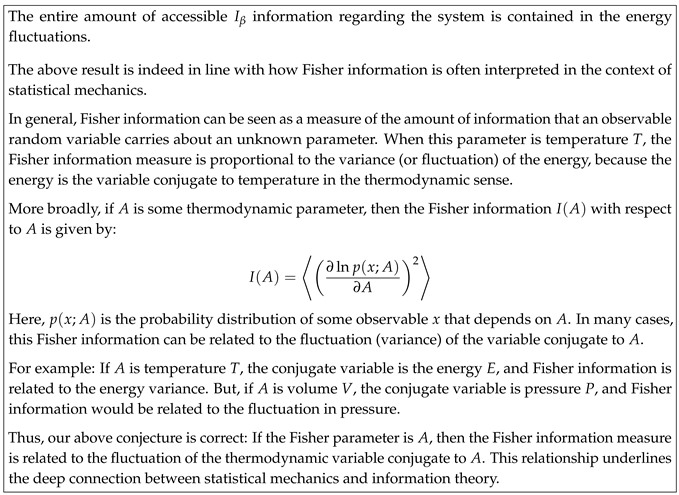
The equivalence between Fisher’s information measure in (a) the grand canonical (and (b) canonical) ensembles on the one hand and the energy fluctuations on the other constitutes a profound and significant result in statistical mechanics. Fisher’s information quantifies the precision of parameter estimation, and in the context of our two ensembles it precisely captures the uncertainty in estimating the inverse temperature, a key thermodynamic parameter. The fact that this information measure aligns exactly with the energy fluctuation underscores a deep connection between statistical precision and the inherent variability of energy in the system. This equivalence implies that as the precision of our knowledge about the system’s temperature increases, the energy fluctuations become more constrained. In practical terms, this result provides valuable insights into the relationship between information content and the thermodynamic behavior of a system, offering a bridge between the statistical and thermodynamic perspectives. It also holds implications for experimental design, suggesting that enhancing precision in parameter estimation is directly linked to a better understanding and control of energy fluctuations in the grand canonical ensemble. Overall, this result sheds light on the intricate interplay between information theory and thermodynamics, deepening our comprehension of the fundamental principles governing statistical mechanics.
7.3. Fisher Measure with as the Parameter
We evaluate the general GCE Fisher’s information measure I that has a parameter , at fixed T and V. It reads
The derivation of Eq. (1) for with respect to allows us to obtain
Thus, in a similar fashion of above subsection, we get the interesting result
7.4. Interpreting the Above Two I Meanings
- The Fisher information measure with the inverse temperature as a parameter equals the energy variance. This result suggests a fundamental relationship between the statistical precision of the system (as measured by Fisher information) and its energy variance. Fisher information quantifies the amount of information a statistical model contains about a parameter of interest (in this case, the inverse temperature). The fact that it equals the energy variance implies that fluctuations in energy are intimately related to how precisely we can determine the inverse temperature of the system. Essentially, the more uncertain the energy, the less precise our knowledge of the temperature, and vice versa.
- The Fisher information measure with the fugacity as a parameter equals the mean particle number. Similarly, this finding indicates a connection between the statistical precision of the system and its mean particle number. The Fisher information, when calculated with the fugacity as the parameter, reflects how well we can estimate the fugacity based on observed data. Since fugacity is related to the chemical potential and hence the particle number, this result essentially says that the statistical precision of the system regarding its fugacity relates directly to how accurately we can determine the mean particle number.
In essence, both interpretations highlight the deep connections between statistical precision, thermodynamic quantities, and the parameters that govern the behavior of a system in the grand canonical ensemble. We will see below that if is the Fisher-parameter, no simple meaning becomes available.
7.5. Fisher Measure I with as the Parameter
We now tackle an essential task and evaluate the general GCE Fisher’s information measure I that has as a parameter, at a fixed T and V. It reads
From Eq. (1), we obtain the following derivative of with respect to
assuming that both z and depend on . Introducing Eq. (45) into Eq. (44), we find
which depends on the system under consideration. More details regarding the Fisher information will be found below.
8. Developing Links Between Distinct Fisher Measures for the Ideal Gas
8.1. Results for the Different Discrete Fisher Measures
For the ideal gas we find these results:
8.1.1. Connections for and
From Eq. (12), for z and V fixed, we get . Indeed, we have taken into account that . Thus, specially GCE-adapted Poisson’s Eq. (27) becomes the Fisher measure whose parameter is the inverse temperature associated with Poisson’s distribution.

Our special Fisher measure ) will play an important role below. Another Fisher measure , associated to the grand canonical ensemble, will be used here and we will compare F’s to I’s. Here, reads
We realize that the right hand side above is just the mean ideal gas energy of an ideal gas, as determined using the specially GCE-adapted Poisson distribution. Thus, is times the square of a single particle mean energy.
In the specific scenario of the ideal gas in the grand canonical ensemble, where is determined by Eq. (13), we find that . Based on the previous considerations, we conclude that, for the GCE-Poisson distribution, by using Eq. (9), we find that
that, taking into account (47), we arrive at the interesting specially GCE-adapted Poisson result
leading to the specially GCE-adapted Poisson relation
which indicates that the discrete Fisher information for the -parameter, denoted as , when the distribution is the specially GCE-adapted Poisson one is equal to the difference in energy fluctuations between the canonical and grand canonical statistical ensembles.
Reinforcing this idea, we see that we can connect our two alternative Fisher measures I and F for the ideal gas. Using Eqs. (34), (40), and (50), we can assert that we obtain a generalization of the above idea from specially GCE-adapted Poisson instance to the grand canonical-ideal gas Fisher measure
This suggests that considering the grand canonical ensemble provides more information about the inverse temperature than the canonical ensemble alone. We also see that the specially GCE-adapted Poisson distribution is intrinsically linked to the physics of the ideal gas.

8.1.2. Connections for and
8.1.3. Connections for and
Interpreting this result involves considering its implications for the information content, statistical properties, sensitivity to variations, scaling behavior, and interplay with thermodynamics of systems with different mean particle numbers. It sheds light on the relationship between Fisher information and system size, offering valuable insights into the statistical mechanics of particle systems.
The relationship between Fisher information and the mean particle number provides insights into the scaling behavior of information content with system size. It suggests that as the system size increases, the information content per particle decreases according to an inverse scaling law. Understanding how information scales with system size is crucial for characterizing the complexity and behavior of systems across different scales. The inverse relationship suggests that systems with a smaller mean particle number exhibit greater sensitivity to variations in their statistical distributions. Changes in the distribution of particle numbers in such systems could lead to larger fluctuations in Fisher information compared to systems with a larger mean particle number. This sensitivity could be relevant for understanding phase transitions, critical phenomena, or fluctuations in small-scale systems.
Now, introducing (54) into Eq. (44), after integrating and solving the sum, one has, when the Fisher parameter is now ,
where we have taken into account that
and
By comparing Eqs. (29) and (55), we find
Thus, the Fisher measures are obviously identical for both the specially GCE-adapted Poisson and grand canonical distributions, being inversely proportional to the average number of particles. This again tells you how strongly the specially GCE-adapted Poisson distribution is linked to the physics of the ideal gas. All information available for parameter is already specially GCE-adapted Poisson-predetermined.
We see that the interpretation of the Fisher measure for the parameter θ depends on what this parameter stands for. If it is β, the Fisher measure is an energy variance; if it is N, the Fisher measure is the inverse of the mean number of particles; if it is α, the Fisher measure is the mean number particles.
9. Thermodynamic Uncertainty Relation
9.1. Preliminaries
Uffink recalls in Ref. [13] that temperature and energy are complementary in a way somewhat reminiscent as the position-momentum link in quantum mechanics. He discusses the relation [13]
where is the Boltzmann’s constant and the term denotes temperature fluctuations. In other words, one has
where, as usual, .
9.2. Deriving a Grand Canonical Counterpart
10. Conclusions
In this study, we investigated the intricate relationships among three fundamental concepts: (i) Fisher’s information measure (FIM) for three parameters: inverse temperature , mean particle number , and the parameter related to fugacity, (ii) the specially GCE-adapted Poisson distribution, and (iii) the grand canonical ensemble (GCE). Our protagonists were two key Fisher-quantifiers: F, the Fisher measure associated with the specially GCE-adapted Poisson distribution, and I, its grand canonical counterpart.
Fisher information is widely used to quantify uncertainty or variability in a statistical model. We discussed its connection to energy variance, offering an alternative means of quantifying uncertainty in physical systems. This connection holds potential applications across physics, engineering, and other scientific fields where managing uncertainty is critical. It contributes to a deeper understanding of how information is encoded in physical systems and its relationship to fundamental system properties.
Key findings of our study include:
- Direct Relationship Between F and I: We discovered a direct link between these quantifiers, connecting the specially GCE-adapted Poisson distribution to the physics of the ideal gas.
- Inverse Relationship with Particle Number: We established that the Fisher measure becomes inversely related to the particle number for the parameters and . As the mean particle number increases, the Fisher information decreases. The fact that the Fisher information decreases as the mean particle number in a gas increases can be interpreted in several ways.
- All the information yielded by is contained in the energy fluctuations.
- For the ideal gas, the difference between -Fisher information measures corresponding respectively to the grand canonical and canonical ensembles is exactly the our special Poisson-Fisher measure .
Additional comments include:
- Reduced sensitivity to parameter changes: Fisher information is a measure of how sensitive a probability distribution is to changes in a parameter. In the context of a gas, this parameter could be something like the inverse temperature, the chemical potential, or the fugacity. As the mean particle number increases, the system becomes larger, and individual fluctuations in the particle number or energy become less significant relative to the overall size of the system. Consequently, the system’s statistical properties (e.g., energy distribution) become less sensitive to changes in these parameters.
- A decrease in Fisher information implies that, in larger systems with more particles, small changes in the parameter of interest (e.g., temperature) have a smaller effect on the distribution of particle numbers or energy. This suggests that the system’s overall behavior becomes more stable and less prone to noticeable fluctuations as it grows.
- Law of large numbers: As the number of particles increases, the system’s behavior increasingly conforms to average values, a consequence of the law of large numbers. In large systems, the relative fluctuations around the mean values (such as mean energy or mean particle number) diminish.
- With a large number of particles, the distribution of properties like energy or particle number becomes narrower, meaning there’s less variability in the system. This decreased variability translates to lower Fisher information because the system’s response to parameter changes becomes more uniform and predictable.
- Information content and precision: Fisher information is directly related to the precision with which a parameter can be estimated. In smaller systems, fluctuations are more pronounced, and the parameter (like temperature) plays a more critical role in determining the system’s state. As the system grows, the relative impact of these fluctuations diminishes, leading to a decrease in the information content.
- In a larger system, the reduction in Fisher information indicates that the system’s parameters are estimated with lower precision, not because of increased noise, but because the system’s response to those parameters becomes more averaged out and less sensitive.
- In thermodynamics, large systems tend to be more stable because fluctuations become negligible relative to the system’s size. This stability is reflected in the lower Fisher information, which indicates that large systems are less affected by small changes in external conditions (e.g., temperature, pressure).
- Scaling with system size: Fisher information might scale inversely with the system size (or particle number) because the system’s extensive properties (like total energy) become less sensitive to intensive parameters as the system size increases. This scaling behavior suggests that, for large systems, the collective behavior is dominated by mean values, and the details of individual particles become less important, leading to a natural decrease in Fisher information.
10.1. Further Considerations
Regarding the relationship between FIM and particle number, we observed that FIM is a measure of the precision or amount of information contained in a statistical distribution. Its inverse relationship with the mean particle number suggests that as the number of particles increases, the precision or uncertainty in the system decreases. This insight could have implications for understanding systems with varying particle numbers, indicating a trade-off between the availability of resources (particle number) and the system’s ability to encode information about its state.
One of the most profound results of our study is the equivalence between Fisher’s information measure in the grand canonical (and canonical) ensemble and energy fluctuations. This result highlights a deep connection between statistical precision and the inherent variability of energy in the system. As the precision of our knowledge about the system’s temperature increases, energy fluctuations become more constrained. This insight bridges the gap between statistical and thermodynamic perspectives, offering valuable implications for experimental design and enhancing our understanding and control of energy fluctuations in the grand canonical ensemble.
The fact that in both the canonical and grand canonical ensembles, the Fisher information measure is determined by energy fluctuations underscores a profound connection between a system’s statistical properties and the information it carries about its parameters. This relationship suggests several broader conclusions:
- Universality: The consistent relationship between energy fluctuations and Fisher information across different ensembles suggests a fundamental role for energy fluctuations in determining a system’s information content.
- Information content of energy: The Fisher information measure, as it characterizes the amount of information a probability distribution carries about an unknown parameter, indicates that energy fluctuations contain essential information about system parameters.
- Efficient estimation: Since Fisher information is determined by energy fluctuations, energy-related measurements are particularly efficient for estimating system parameters within statistical mechanics.
- Physical interpretation: This result provides an intuitive understanding of Fisher information in the context of statistical mechanics, highlighting the importance of energy fluctuations as a statistical observable.
- Theoretical framework: The connection between Fisher information and energy fluctuations offers a theoretical framework for studying the information content of thermodynamic ensembles, which could be extended to more complex systems.
10.2. Grand Canonical Ensemble Interpretation
Finally, we emphasize the key interpretations of Fisher information in the grand canonical ensemble, which are independent of the specific system and deeply embedded in the structure of the ensemble:
- Inverse Temperature as a parameter: In the GCE, determines the probabilities of different energy states through the Boltzmann factor. Energy variance, tied to the system’s temperature, reflects fluctuations in energy. Fisher information, when calculated with as the parameter, measures the system’s sensitivity to changes in , linking it to the precision of temperature estimation.
- Fugacity z as a parameter: Similarly, fugacity parameterizes the probability distribution of particle numbers in the GCE. Fisher information, when calculated with z as the parameter, measures the system’s sensitivity to changes in z, linking it to the precision of estimating the mean particle number.
These interpretations highlight the elegance and generality of the GCE, where statistical measures like Fisher information provide deep insights into the relationships between thermodynamic quantities and the parameters governing the ensemble’s behavior.
Author Contributions
Conceptualization, F.P. and A.P.; methodology, F.P. and A.P.; validation, F.P., and A.P.; formal analysis, F.P. and A.P.; investigation, F.P. and A.P.; writing—original draft preparation, F.P. and A.P.; writing—review and editing, F.P. and A.P.; visualization, F.P. and A.P.; supervision, F.P. and A.P. All authors have read and agreed to the published version of the manuscript.
Funding
This research received no external funding.
Data Availability Statement
The original contributions presented in the study are included in the article, further inquiries can be directed to the corresponding author.
Conflicts of Interest
The authors declare no conflicts of interest.
References
- Frieden, B.R.; Soffer, B.H. Lagrangians of physics and the game of Fisher-information transfer. Phys. Rev. E 1995, 52, 2274–2286; Erratum Phys. Rev. E 1995, 52, 6917.
- Pathria, R.K. ; ; Beale, Paul, D. Statistical Mechanics, 4th ed.; Academic Press Inc: London, UK, 2021. [Google Scholar]
- Fano, U. Ionization Yield of Radiations. II. The Fluctuations of the Number of Ions. Physical Review 1947, 72, 26–29. [Google Scholar] [CrossRef]
- Yates, D. Roy, Goodman, David J.: Probability and Stochastic Processes: A Friendly Introduction for Electrical and Computer Engineers. Hoboken, 2nd ed., N.J., Wiley, (2014).
- Boas, Mary L.: Mathematical Methods in the Physical Sciences. Wiley, 3 ed., (2005).
- Mandelbrot, B. The Role of Sufficiency and of Estimation in Thermodynamics. Ann. Math. Stat. 1962, 33, 1021–1038. [Google Scholar] [CrossRef]
- Volodymyr, A.; Kuznietsov, O.S.; Gorenstein, M.I.; Koch, V.; Vovchenko, V. Critical point particle number fluctuations from molecular dynamics. Physical Review C 2022, 105, 044903. [Google Scholar]
- Leo, W.R. : Techniques for Nuclear and Particle Physics Experiments: A How-To Approach. Springer Science& Business Media, Berlin, (2012).
- Roy Frieden, B.R. : Science from Fisher information. Cambridge University Press, Cambridge, England, (2004).
- Potts, P.P.; Brask, J.B.; Brunner, N. Fundamental limits on low-temperature quantum thermometry with finite resolution. Quantum 2019, 3, 161–179. [Google Scholar] [CrossRef]
- Paris, M.G.A. Quantum estimation for quantum technology. Int. J. Quantum Inform. 2009, 07, 125–137. [Google Scholar] [CrossRef]
- Sánchez-Moreno, P.; Yanes, R.J.; Dehesa, J.S. Difference Equations and Applications: Discrete Densities and Fisher Information, Proceedings of the 14th International Conference on Difference Equations and Applications. Ugur University Publishing Company, SBN 978-975-6437-80-3, pp. 291-298, Istanbul, Turkey, (2009).
- Uffink, J.; van Lith, J. Thermodynamic Uncertainty Relations. Foundations of Physics 1999, 29, 655–692. [Google Scholar] [CrossRef]
- Marc, M.; Montanari, A. Information, physics, and computation. Oxford University Press, UK, (2009).
Disclaimer/Publisher’s Note: The statements, opinions and data contained in all publications are solely those of the individual author(s) and contributor(s) and not of MDPI and/or the editor(s). MDPI and/or the editor(s) disclaim responsibility for any injury to people or property resulting from any ideas, methods, instructions or products referred to in the content. |
© 2024 by the authors. Licensee MDPI, Basel, Switzerland. This article is an open access article distributed under the terms and conditions of the Creative Commons Attribution (CC BY) license (http://creativecommons.org/licenses/by/4.0/).
Copyright: This open access article is published under a Creative Commons CC BY 4.0 license, which permit the free download, distribution, and reuse, provided that the author and preprint are cited in any reuse.


