
Submitted:
09 October 2024
Posted:
09 October 2024
You are already at the latest version
Abstract
A little-known thermomechanical relation between entropy and action, originally discovered by Boltzmann in the classical domain, was later reconsidered by de Broglie in relation to the wave-particle duality in the free propagation of single particles. In this paper we present a version adapted to the phenomenological description of the hadronization process. The substantial difference with respect to the original de Broglie scheme is represented by the universality of the temperature at which the process occurs; this in fact coincides with the Hagedorn temperature. The main results are: 1) a clear connection between the universality of the temperature and the existence of a confinement radius of the color forces; 2) a lower bound on the hadronic mass, represented by the universal temperature, in agreement with experimental data; 3) a scale invariance which allows the reproduction of the well-known hadronic mass spectrum solution of the statistical bootstrap model. The approach therefore presents a heuristic interest connected to the study of the strong interaction.
Keywords:
Thermomechanics
; hadronization
; Hagedorn temperature
; color confinement
; scale invariance
1. Introduction
In a previous work [1], the little-known thermomechanical relation between entropy and action, initially proposed by Boltzmann and later reconsidered by de Broglie in the context of the wave-particle duality of single elementary particles ([2] and references cited in [1]), has been re-elaborated in a slightly modified form. According to this reformulation, this relation defines a connection between the virtual processes of dissociation-recombination of a single particle and its propagation as a renormalized particle, physically observable as an asymptotic state. The particle process therefore presents two polarities. The first is that of the virtual phenomena of dissociation and recombination on the Compton scale, introduced by Quantum Field Theory (QFT) in its relativistic formulation [3] and here described phenomenologically as “thermal” phenomena. The second is the propagation of the renormalized particle, which represents the “mechanical” polarity of the process; only this second level is accessible to observation. The topic is directly connected to the problem of the propagation of the phase wave associated with the particle [2], and more generally to the phenomenon of the emergence of its proper time [1].
A question that arises spontaneously is whether the thermomechanical entropy-action relation can be applied not only to the propagation phase of an elementary particle, but also to the phase of its creation or annihilation. In our opinion, the answer depends on the interaction that mediates the process of creation or annihilation. Excluding from our considerations the gravitational interaction, on which there is not sufficient experimental information, the electroweak and strong interactions remain. To our best knowledge, there is no literature about the existence of a specific temperature associated with electroweak interactions, so it seems difficult to apply thermomechanical reasoning to them. It is well known, however, that in the context of strong interactions the phenomena of hadronization and deconfinement occur at a well-defined temperature, experimentally well characterized, which is the Hagedorn temperature TH [4,5,6,7,8]. In this paper we intend to investigate the possibility of applying the entropy-action relation to the phenomena of creation and annihilation of hadrons.
To better understand our program, let us first consider, briefly, the propagation phase of a free hadron, specializing the general scheme described in Ref. [1] to the hadronic case. If M is the rest mass of the hadron and c is the limit speed, it is possible to define a temperature T through the relation:
kT = Mc2
where k is the Boltzmann constant. The hypothesis advanced by de Broglie [2] is that the hadron, in its free propagation, is in contact with a “hidden” thermostat at the temperature T. In [1] this thermostat exchanges heat with the degrees of freedom of the virtual processes associated, according to the QFT description, with the free propagation of the hadron. The exchanged heat is a clock, which measures a cyclic time. At the end of a cycle, the total heat released by the thermostat to these processes is Mc2. In this interval, the relation between the entropy Sp exchanged by these processes with the thermostat and their mechanical action Ap is the following (p = propagation):
Sp/k = Ap/h
where h is the Planck constant. At the end of the interval is Sp = k, Ap = h; the entropy Sp is returned to the thermostat, while the action Ap is released to the renormalized particle. In other words, the action of the free, renormalized hadron is increased by h while its quantum phase is increased by 2π and its proper time is increased of h/Mc2. This process fuels the propagation of the hadronic phase wave, which can be experimentally detected by interferometric measurements (see, for example, [9] for a description of neutron interferometry procedures). Note that (2) connects the thermodynamic quantity Sp with the mechanical quantity Ap, directly and without statistical mediations. That is, it is a thermomechanical relation, in the sense historically intended by Boltzmann and Helmoltz.
The question now is whether a similar scheme can be applied to hadron creation or annihilation, rather than to hadron propagation. Since the hadron formation process is clearly reversible (the inverse of creation is annihilation), we will focus here on hadron creation, maintaining that the same line of reasoning applies to the inverse process. In hadron creation processes a certain amount of energy is released by the reaction between the particles entering the interaction vertex (e.g., e+e- annihilation); this energy is partly converted into the creation of outgoing hadrons.
A non-intuitive fact, first highlighted by Hagedorn in 1965 [4] and then extensively explored by other authors [10,11,12,13,14], is that the formation of new hadrons occurs at a defined “hadronization temperature” TH, today commonly known as the Hagedorn temperature. This temperature is universal, i.e. independent of the specific hadron. It is modernly interpreted as the deconfinement temperature of the quark-gluon plasma which is the constituent of all hadrons [15,16]. In attempting to elaborate a thermomechanical scheme analogous to that of the propagation, one must therefore first consider that the thermostat involved in the formation phase is different from the one involved in the propagation phase. It is not constituted by the virtual processes of the non-renormalized hadron, which does not yet exist, but by the rapid thermalization – by the quark and gluonic degrees of freedom – of the energy made available to them by the reaction. As in the case of propagation, this energy is expressed, as far as the formation of a single hadron of mass M is concerned, by the rest energy Mc2; this is in fact the energy required for the formation of a renormalized hadron (M is the renormalized mass, that is, the one experimentally measured). However, the temperature at which this energy is exchanged will no longer be the temperature T defined by (1); it will instead be TH. The universality of TH is connected with the rapid loss of memory of the state preceding the thermalization.
From the point of view of our idealized description, the process can be simplified in the following terms: the ideal thermostat with which the renormalized hadron in formation exchanges the heat Q = Mc2 is the same for all hadrons, and it constitutes a thermal reservoir at the temperature TH. Since, as we have seen, the exchange is reversible, the formation entropy of the hadron is Sf = Q/TH = Mc2/TH. This relation can be put in the same form as Eq. (2):
Sf/k = Af/h
(f = formation) assuming that hadronic formation is associated with a change in action:
Af = h ⋅ (Mc2)/(kTH)
The time interval for the formation of the hadron is therefore:
independent on the hadron. This is an important difference with respect to propagation, because in the latter the duration h/Mc2 of the cycle depends on the hadron. It is in fact possible to define a hadronization radius:
T0 ≈ Af/(Mc2) = h/(kTH)
R0 = cT0 ≈ hc/(kTH)
which is a property of the quark-gluon plasma, independent on the hadron. We can say that the property of the color charge appears only on scales smaller than R0, while on larger scales it disappears leaving colorless hadronic matter.
In summary, we propose that the Boltzmann-de Broglie entropy-action relation [1,2] can be applied to the hadronic creation or annihilation phase, assuming that in this phase the forming or dissolving hadron exchanges heat with a specific hidden thermostat at the Hagedorn temperature. In the Materials and Methods section we justify this proposal, supporting it with a simple general thermodynamical argument. In the Results section we show how the present phenomenological scheme involves a scale invariance, leading to the hadronic mass spectrum which is the solution of the statistical bootstrap equation. In the Discussion section we examine a possible geometric justification of this scale invariance. In the Conclusions section the connections with the general leitmotifs of the history of hadronic phenomenology are briefly stated.
2. Materials and Methods
Equations (2) and (3) can be seen as specializations of the well-known Bekenstein relation [17] which gives the maximum entropy content S of a system with energy content E enclosed in a volume of radius R:
S/k = (ER)/(hc)
Let us first consider the propagation equation (2). It is comparable to (7) at the only instant in which it admits a space-time representation, that is, at the end of a thermal cycle [1]. In such conditions, as we have already mentioned, we have Sp = k, Ap = h. If the entropy Sp, returned to the thermostat, is substituted for S in Eq. (2), we have ER = hc, that is, the action ER/c equals h, as required by (2). But the end of the thermal cycle corresponds to a completely renormalized particle, whose energy content E is Mc2. This statement is true in the rest frame of the particle, but Eq. (2) is relativistically invariant ([1] and references cited therein). It follows that the radius R, within which the virtual phenomena of dissociation and recombination involving the particle are confined, is given by R = h/Mc. In other words, the renormalization scale is the Compton scale. In the case of a hadron, which is a composite entity, the radius r = h/Mc will not only represent the scale at which a hadronic dissociation is recovered by a hadronic recombination; it will also be the confinement scale of the internal quark and gluonic processes, which are permanently virtual because they do not appear as separate asymptotic states with a separately defined proper mass. In this sense we will allow ourselves to identify r as the “radius” of the hadron. This identification is compatible with experimental data ([18], Chapter 5).
Let us now turn to the formation equation (3). Here the entropy of formation is, as we have previously stated, Sf = Mc2/TH. We have also seen that it is, again, E = Mc2. Substituting Sf for S in (7) we then have: R = hc/kTH = R0. In other words, the interpretation of R0 as a hadronization radius is confirmed. We can therefore affirm that (3) and (4) are consistent with known thermodynamics. Since the final phase of the hadronization process must consist in the production of the renormalized hadron, the radius r associated with the propagation of the latter must be contained within the radius R0 that sizes the region of origin. That is, must be r ≤ R0, a condition from which the inequality Mc2 ≥ kTH follows. This relationship is well verified experimentally. The different determinations of kTH give values included in the range 140-160 MeV [19,20], therefore superimposable on the rest energy of the lightest hadron, i.e. the pion, which is about 140 MeV.
We note that from the relations Sf = Mc2/TH, Mc2 ≥ kTH, it follows that Sf/k ≥ 1. This is another difference between the formation phase and the propagation phase, in which instead, as previously illustrated, we have Sp/k = 1 at the end of the thermal cycle. In both cases, however, the average entropy S⋅p(S) is ≤ 1 in units k. In the case of free propagation, in fact, the probability p(S) of the state is identically 1 due to the absence of fluctuations in the entropy exchanged in a cycle, which is identically equal to 1 in units k; therefore S⋅p(S) = 1 ⋅ 1 = 1. This implies an action exchanged in a cycle that is identically h, in accordance with the conservation principles that guarantee free propagation. In the case of formation, on the other hand, S⋅p(S) = S ⋅ exp(-S) ≤ 1, from which we obtain an average action associated with the formation process ≤ h. This result is consistent with the virtual nature of the processes occurring at the interaction vertex where the hadron is generated.
The narrative presented in the first two sections can be reversed by observing that strong interactions between hadrons are contact interactions. They are mediated by hadrons and can therefore always be reduced to interaction vertices into which hadrons enter and from which hadrons exit. This feature cannot be extended to electroweak or gravitational interactions, which are mediated by gauge quanta (such as the photon, the graviton, etc.) distinct from the particles they connect. The hadrons entering or leaving a strong interaction vertex will have distinct masses M, and distinct renormalization radii r = h/Mc. It follows that the size of the interaction vertex is, approximately, expressed by the maximum value of r, i.e. by h/M0c, where M0 is the minimum hadronic mass. It is known that this is the mass of the pion. Thus, the strong charges within the quark-gluon plasma, the universal constituent of hadrons, become renormalized (by generation of hadrons) on a scale R0 ≈ hc/M0c2 = h/M0c, which corresponds to a temperature TH defined by M0c2 ≈ kTH. R0 and TH are therefore properties of the plasma and, as such, independent on the mass M of a specific hadron.
The uncertainty relation associated with the actualization of a single outgoing hadron, Af ≥ h, is, by virtue of Eq. (4), consistent with the assumption M ≥ M0, from which the relations Mc2 ≥ kTH, Sf/k ≥ 1 follow. The relation Af ≥ h also expresses the independence of the hadronization radius R0 and hadron formation time T0 on the mass M [Eqs.(5-6)]. In other terms, the coalescence of the quark-gluon plasma into hadrons occurs at a temperature TH independent on the values of M and r = h/Mc, i.e. in a manner (approximately) independent on the scale.
The ready deletion, by thermalization, of the memory of hadrons entering a strong interaction vertex thus implies the approximate scale invariance of the interactions. The idea of an approximately scale invariant hadronic formation stimulates an application of the conceptual scheme proposed here, which is set out in the next section.
3. Results
If, in a strong interaction vertex, the annihilation of the incoming hadrons brings into play an energy ≥ Mc2, then a portion Mc2 of this energy can be converted into the creation of a hadron of mass M. In this case, if n(M) is the number of virtual hadrons of that mass potentially exiting the vertex, one of them will be actualized as an actually outging hadron. However, we have seen, in the previous section, that these hadrons are associated with a renormalization/confinement “radius” r = h/Mc. The approximate scale invariance of the interaction means that, approximately, n(M) must be independent of M. The approximation should be better the further away we are from the upper limit R0 of the variable r, due to the foreseeable decrease in edge effects. In other words, the approximation should tend to the exact result in the limit M → ∞.
From a phenomenological point of view, the function n(M) can be constructed as the product of three factors. First, the same mass M can correspond to hadronic states of different quantum numbers; we will indicate with N(M) the number of distinct hadronic states of identical mass M. We then observe that if the interaction volume has dimensions ≈ R03, as indicated in the previous sections, the number of hadrons of a specific state that can find place in this volume is given by [R0/(r(M)]3, where r(M) = h/Mc is the “radius” of the hadron of mass M. Consequently, in the interaction volume there can be ≈ [R0/(h/Mc)]3 distinct virtual hadrons in the same state of mass M.
The transfer of energy Mc2 actualizes a virtual hadron which is a quantum fluctuation in energy of amplitude Mc2, manifested in a thermostat at temperature TH. As we know from statistical mechanics, the probability of such a fluctuation is exp(-Mc2/kTH). The exponent is nothing other than the entropy of formation Sf already discussed in the previous sections. Therefore n(M) = N(M) ⋅ [R0/(h/Mc)]3 ⋅ exp(-Mc2/kTH). The requirement that n(M) be constant then translates into the relation:
N(M) ∝ M-3 exp(Mc2/kTH)
This approximate expression, which tends to the exact value in the limit M → ∞, is nothing else than the well-known analytical solution [21] of the statistical bootstrap model [22,23]. It is demonstrated experimentally both by direct inspection of the systematics of hadronic states reported in the Particle Data Group publications, as was done historically by Frautschi and co-workers [24,25,26], and by the analysis of the distribution of transverse momenta in strong interactions between hadrons, as originally done by Hagedorn [5]. Its present derivation without reference to the fractality (or self-similarity) of the hadronic generation mechanism, invoked by Hagedorn in his seminal work, is not surprising. In fact, fractality is connected to scale invariance [27,28], which is the starting point of the present derivation.
The conceptually relevant point is that the function n(M) seems to continue to have a meaning even in the regime of full thermalization at T = TH, so much so that it gives rise, with its approximate constancy, to the experimentally verified relation (8). In other words, although for temperatures T > TH there is an effective deconfinement and the concept of hadron is no longer applicable, for T = TH this concept is still applicable, but the coalescence of quarks and gluons in hadrons becomes independent of the hadronic “radius” r. For T = TH, a sort of critical opalescence occurs, manifested in correspondence with a critical phase of the quark-gluon plasma in the process of cooling [29]. The process goes as if in the regime T > TH the interaction energy were converted into the creation of strong charges (quarks and gluons), which homogeneously populate a region of size R0; once this conversion is completed, this region fissions into smaller subregions, the hadrons, approximately without preference for the size r of each subregion. This second phase occurs at the temperature TH defined by the geometric size R0 according to (6).
While we do not here dwell on the old question of whether the geometric constraint R0 is derivable from QFT or is additional to it, referring the reader to the substantial literature on the subject ([30,31,32,33,34,35,36] for a taste), in the next section we show a simple geometric model of hadronization that qualitatively satisfies the requirements emerging from these considerations; in particular, it is functional to illustrate the link between the finite confinement radius and scale invariance.
4. Discussion
The confinement, i.e. the finite value of R0, is connected with the stability of the vacuum with respect to the creation of quark-antiquark pairs of “up” and “down” flavor; in other words, the separation of such pairs has a finite energetic cost, plausibly originated from the symmetry breakings that give mass to quarks. Since pions of all charge states originate from separation processes of this type, they have positive mass and this fact, as we have seen, implies a finite value of R0. In other works ([37,38] and work in progress [39]) we have proposed a geometric description of confinement, which can be linked to non-perturbative aspects of quantum chromodynamics, along a line of reasoning conceptually similar to that followed by Feynman for the derivation of the curved space of general relativity from the non-linear terms of quantum gravity on a flat space [40]. We will not go into the description of this proposal in depth, referring the interested reader to the articles in which it is exposed, since what we need in the context of this article is only an intuitive model that accounts for the dynamics of hadronization that emerges from the argumentation exposed in the previous sections.
It is enough to say that, according to this proposal, a position eigenstate of a hadron corresponds to a de Sitter space (dS) tangent to spacetime at the point-event relative to that eigenstate. The constant-time section of the dS space is a four-dimensional sphere of radius r= h/Mc (M = hadron mass), tangent to ordinary space. The strong charges (quarks and gluons) are assumed to be confined on the surface of this 4-sphere, while their spacetime positions are given by the vertical projection, onto spacetime, of their positions on the 4-sphere. Since the 4-spherical space is closed, Gauss's theorem imposes a condition of white global color on the 4-sphere [41], while the spatial distance between two charges cannot exceed 2r.
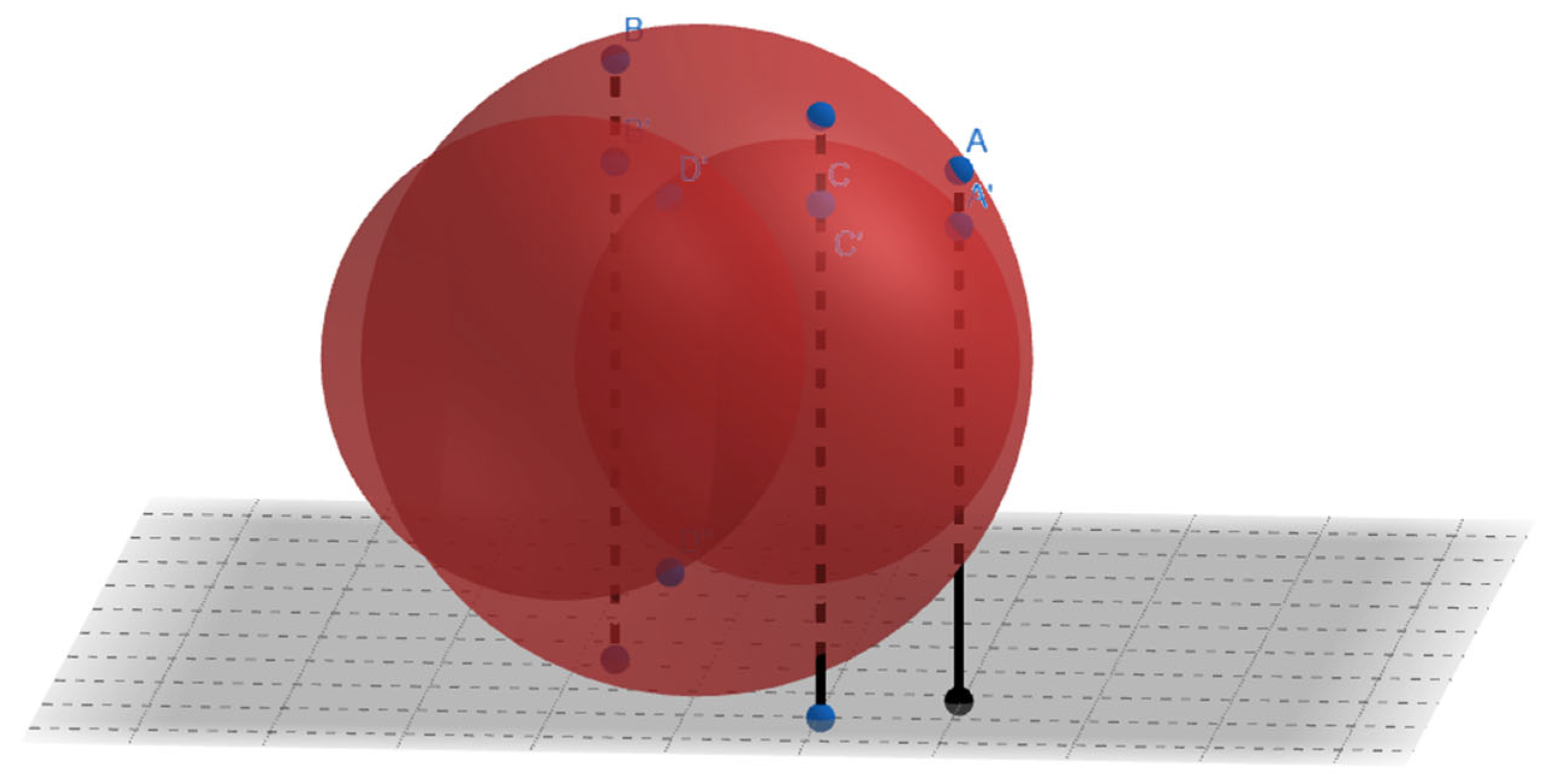
A 4-sphere on which are confined, say, the valence quarks A, B, C can then split into two 4-spheres on which are confined, respectively, the quarks A’, D’, C’ and D’’, B’. Here A’, B’, C’ are respectively the projections of A, B, C on the two new 4-spheres and have the same color as the original quarks, while D’ and D’’ have opposite colors (D’ has the same color as B) and are the projection, on the two new 4-spheres, of a point of the original 4-sphere that was neutral (Figure 1). Naturally, in addition to the process of fission of a hadron into two or more hadrons, the inverse process of fusion of several hadrons is also imaginable, with annihilation of charges of opposite colors. Let us remember, however, that the radius r is limited above by R0.
It is now possible to hazard a geometric description of what happens in a vertex of strong interaction. The hadrons entering the vertex are melted if the constituent charges thermalize rapidly at a temperature T > TH, and the result is the quantum delocalization of the individual strong charges along each spatial coordinate, including the fifth perpendicular to spacetime. The average extent of this delocalization is R0 and it corresponds, by the uncertainty principle, to a minimum energy kTH, connected to R0 by (6). When cooling brings the plasma to the minimum temperature TH, the color charges are completely delocalized in the space delimited by the projection of the 4-sphere of radius R0 on spacetime. The dynamics of their interaction is therefore approximately independent of the scale. At this point the formation of the outgoing hadrons begins, which will be conditioned by this approximate invariance, and by the erasure of the memory of the previous states due to thermalization. Under such conditions, the mass spectrum of the outgoing hadrons will satisfy relation (8).
For a correct appreciation of this construction it should be noted that for all hadrons the hadronization time T0 is orders of magnitude smaller than the decay time; only in the case of decays mediated by the strong interaction are the two times approximately superimposable [42]. The only exception is the top quark whose lifetime (~ 5 × 10-25 s) is one order of magnitude smaller than T0; for this reason the top quark does not form hadrons. According to the proposed description, a top-antitop pair generated in an associated production process remains delocalized on a 4-sphere of radius R0 and it decays before forming hadrons.
5. Conclusions
The Eq.(8) represents, as is known, the exact analytical solution of the statistical bootstrap model [21]. This model was formulated in an era in which hadrons were considered to have no internal structure, and it envisaged a distribution of the energy, released at the interaction vertex, of a fractal type. Hadrons, in other words, had to be composed of other hadrons, these latter of still others and so on [43].
This vision merged with that of the bootstrap in wider sense, proposed by Chew and Frautschi [44], or was at least parallel to it. The bootstrap interpreted hadrons at the same time as elementary particles and as mediators of (strong) force between them. The role played by the hadron in a specific reaction, interacting particle or interaction mediator, could be exchanged through the operation of crossing the interaction diagrams. It was assumed that the mediation of the interaction occurred through rapid thermalization (a hypothesis we have revisited), which made the weight of the interaction channel proportional to the phase space factor [26]. Neglecting, on the basis of heuristic considerations, the correlation terms, the exchange was then described by a summation of contributions from distinct hadronic states. A duality property of the strong interactions thus emerged.
What we are interested in noting here is that this duality seems to emerge, as an approximation, from (8) and then, retracing our journey backwards, from (3); that is, in a seemingly unexpected way, from a simple adaptation of the de Broglie thermal model to the hadronic formation phase. In this adaptation, a peculiar role is played by the presence of a confinement radius R0 of the strong force which, on the one hand, originates a universal hadronization temperature through Eq. (6), on the other hand determines the fractal nature of the process through Eq. (8). This role of R0 can be clarified by simple geometric-topological modeling, regardless of the –however possible- justification of such models in terms of an underlying gauge theory. In this sense, it seems to us that the proposed adaptation presents at least a heuristic value in the phenomenological description of the non-perturbative regime of the strong interaction.
Funding
This research received no external funding.
Data Availability Statement
No new data were created in this study.
Conflicts of Interest
The author declares no conflicts of interest.
References
- Chiatti, L. On Some Forgotten Formulas of L. de Broglie and the Nature of Thermal Time. Entropy 2024, 26, 692. [Google Scholar] [CrossRef] [PubMed]
- de Broglie, L. The Thermodynamics of the isolated particle (or the hidden thermodynamics of particles); Gauthier-Villars: Paris, France, 1964. [Google Scholar]
- Bjorken, J.D.; Drell, S. Relativistic Quantum Fields; McGraw-Hill: New York, NY, USA, 1965; ISBN 0-07-005494-0. [Google Scholar]
- Hagedorn, R. Statistical thermodynamics of strong interactions at high energies. Nuovo Cim. Suppl. 1965, 3, 147. [Google Scholar]
- Hagedorn, R.; Ranft, J. Statistical thermodynamics of strong interactions at high energies. 2.Momentum spectra of particles produced in pp collisions. Nuovo Cim. Suppl. 1968, 6, 169. [Google Scholar]
- Hagedorn, R. Statistical thermodynamics of strong interactions at high energies. 3. Heavy-pair (quark) production rates. Nuovo Cim. Suppl. 1968, 6, 311. [Google Scholar]
- Hagedorn, R. Hadronic matter near the boiling point. Nuovo Cim. A 1968, 56, 1027. [Google Scholar] [CrossRef]
- Hagedorn, R. Thermodynamics of Strong Interactions. CERN-Report 71-12, 1971.
- Rauch, H.; Werner, S.A. .Neutron Interferometry: Lessons in Experimental Quantum Mechanics, Wave-Particle Duality, and Entanglement; Oxford University Press: Oxford, UK, 2015; ISBN 978-0-19-871251-0. [Google Scholar]
- Venugopalan, R.; Prakash, M. Thermal properties of interacting hadrons. Nuclear Physics A 1992, 546(4), 718. [Google Scholar] [CrossRef]
- Cleymans, J.; Worku, D. The Hagedorn temperature revisited. Mod. Phys. Lett. A 2011, 16, 1197. [Google Scholar] [CrossRef]
- Broniowski, W.; Florkowski, W.; Glozman, L.Y. Update of the Hagedorn mass spectrum. Phys. Rev. D 2004, 70, 117503. [Google Scholar] [CrossRef]
- Rafelski, J.; Danos, M. The importance of the reaction volume in hadronic collisions. Phys. Lett. B 1980, 97, 279. [Google Scholar] [CrossRef]
- Blanchard, P.; Fortunato, S.; Satz, H. The Hagedorn temperature and partition thermodynamics. Eur. Phys. J. C 2004, 34, 361. [Google Scholar] [CrossRef]
- Cabibbo, N.; Parisi, G. Exponential hadronic spectrum and quark liberation. Phys. Lett. B 1975, 59, 67. [Google Scholar] [CrossRef]
- Cleymans, J.; Redlich, K.; Satz, H.; Suhonen, E. The hadronisation of a quark-gluon plasma. Zeit. Phys. C Particles and Fields 1993, 58, 347. [Google Scholar] [CrossRef]
- Bekenstein, J.D. Universal upper bound on the entropy-to-energy ratio for bounded systems. Phys. Rev. D 1981, 23, 287–298. [Google Scholar] [CrossRef]
- Mc Gregor, M. The enigmatic electron; Fundamental theories of physics vol. 49; Springer: Heidelberg, Germany, 2014; ISBN 978-94-015-8074-8. [Google Scholar]
- Andronic, A. An overview of the experimental study of quark-gluon matter in high energy nucleus-nucleus collisions. Int. J. Mod. Phys. A 2014, 29, 1430047. [Google Scholar] [CrossRef]
- Stachel, J.; Andronic, A.; Braun-Munzinger, P.; Redlich, K. Confronting LHC data with the statistical hadronization model. J. Phys. Conf. Ser. 2014, 509, 012019. [Google Scholar] [CrossRef]
- Nahm, W. Analytical solution of the statistical bootstrap model. Nucl. Phys. B 1972, 45, 525. [Google Scholar] [CrossRef]
- Hagedorn, R.; Rafelski, J. Hot hadronic matter and nuclear collisions. Phys. Lett. B 1980, 136. [Google Scholar] [CrossRef]
- Redlich, K.; Satz, H. The Legacy of Rolf Hagedorn: Statistical Bootstrap and Ultimate Temperature. In Melting Hadrons, Boiling Quarks. From Hagedorn Temperature to Ultra-Relativistic Heavy-Ion Collisions at CERN. With a Tribute to Rolf Hagedorn; Rafelski, J., Ed.; Springer: Heidelberg, Germany, 2016; pp. 49–68. [Google Scholar] [CrossRef]
- Frautschi, S. Statistical Bootstrap Model of Hadrons. Phys. Rev. D 1971, 3, 2821. [Google Scholar] [CrossRef]
- Hamer, C.J.; Frautschi, S. Determination of Asymptotic Parameters in the Statistical Bootstrap Model. Phys. Rev. D 1972, 4, 2125, Erratum: Phys. Rev. D 1972, 5, 1235. [Google Scholar] [CrossRef]
- Hamer, C.J. The statistical bootstrap model. PhD Thesis, California Institute of Technology, Pasadena, 1972. [Google Scholar]
- Mandelbrot, B.B. The Fractal Geometry of Nature; W.H. Freeman: San Francisco, USA; ISBN 978-0-7167-1186-5.
- Hutchinson, J.E. Fractals and self-similarity. Indiana University Mathematics Journal 1981, 30, 713. [Google Scholar] [CrossRef]
- Stock, R. Hadronization revisited: The Dynamics behind hadro-chemical equilibrium. In Proceedings of the 3rd International Workshop on Critical Point and Onset of Deconfinement, Florence, Italy, 3-6 July 2006. [Google Scholar] [CrossRef]
- Roman, P.; Haavisto, J. Higgs Fields, Curved Space, and Hadron Structure. Int. Journ. Theor. Phys. 1977, 16, 915. [Google Scholar] [CrossRef]
- Rosu, H.C. Hybridizing the skyrmion with an anti-de Sitter bag. Nuovo Cim. B 1993, 108, 313. [Google Scholar] [CrossRef]
- Sijacki, Dj.; Ne’eman, Y. QCD as an effective strong gravity. Phys. Lett. B 1990, 247, 571. [Google Scholar] [CrossRef]
- Brindejonc, V.; Cohen-Tannoudji, G. An Effective Strong Gravity Induced by QCD. Mod. Phys. Lett. A 1995, 10, 1711–10. [Google Scholar] [CrossRef]
- Holdom, B.; Ren, J. QCD analogy for quantum gravity. Phys. Rev. D 2016, 93, 124030. [Google Scholar] [CrossRef]
- Akinto, O.F.; Tahir, F. Strong Gravity Approach to QCD and General Relativity. Preprint arXiv:1606.06963.
- Kirchbach, M.; Popov, T.; Vallejo, J.A. The Conformal-Symmetry–Color-Neutrality Connection in Strong Interaction. In Lie Theory and Its Applications in Physics LT 2021, Springer Proceedings in Mathematics & Statistics, vol 396; Dobrev, V., Ed.; Springer: Singapore, 2023. [Google Scholar] [CrossRef]
- Chiatti, L.; Licata, I. Particle Model from Quantum Foundations. Quant. Stud. Math. Found. 2017, 4, 181–204. [Google Scholar] [CrossRef]
- Chiatti, L. Bit from Qubit. A Hypothesis on Wave-Particle Dualism and Fundamental Interactions. Information 2020, 11, 571. [Google Scholar] [CrossRef]
- Licata, I.; Chiatti, L. Particles as solutions of a rescaled WdW equation. Preprint. Preprint.
- Feynman, R. Feynman lectures on gravitation; Taylor & Francis: Boca Raton, FL, USA, 2003; ISBN 13: 978-0-8133-4038-8. [Google Scholar]
- Kirchbach, M.; Compean, C.B. De Sitter Special Relativity as a Possible Reason for Conformal Symmetry and Confinement in QCD. Preprint, arXiv:1701.00450.
- Chiatti, L. Power laws and elementary particle decays. Sci 2019, 1, 59. [Google Scholar] [CrossRef]
- Rafelski, J. Melting Hadrons, Boiling Quarks. From Hagedorn Temperature to Ultra-Relativistic Heavy-Ion Collisions at CERN. With a Tribute to Rolf Hagedorn; Springer: Heidelberg, Germany, 2016. [Google Scholar]
- Chew, G.F.; Frautschi, S.C. Principle of Equivalence for all Strongly Interacting Particles within the S-Matrix Framework. Phys. Rev. Lett. 1961, 7, 394. [Google Scholar] [CrossRef]
Figure 1.
Visual representation, using three-dimensional spheres, of the fission of a hadron into two hadrons, with the creation of a pair of opposite colored charges. All the spheres are tangent to ordinary space. For clarity, the relativistic contraction of the radii of the spheres is not shown. The additional coordinate, perpendicular to spacetime, is only an aid in visualizing the intrinsic curvature of the positional constraint on strong charges and has no physical relevance in itself.
Figure 1.
Visual representation, using three-dimensional spheres, of the fission of a hadron into two hadrons, with the creation of a pair of opposite colored charges. All the spheres are tangent to ordinary space. For clarity, the relativistic contraction of the radii of the spheres is not shown. The additional coordinate, perpendicular to spacetime, is only an aid in visualizing the intrinsic curvature of the positional constraint on strong charges and has no physical relevance in itself.
Disclaimer/Publisher’s Note: The statements, opinions and data contained in all publications are solely those of the individual author(s) and contributor(s) and not of MDPI and/or the editor(s). MDPI and/or the editor(s) disclaim responsibility for any injury to people or property resulting from any ideas, methods, instructions or products referred to in the content. |
© 2024 by the authors. Licensee MDPI, Basel, Switzerland. This article is an open access article distributed under the terms and conditions of the Creative Commons Attribution (CC BY) license (http://creativecommons.org/licenses/by/4.0/).
Copyright: This open access article is published under a Creative Commons CC BY 4.0 license, which permit the free download, distribution, and reuse, provided that the author and preprint are cited in any reuse.


