

Submitted:
19 September 2024
Posted:
19 September 2024
You are already at the latest version
Abstract
This comprehensive review examines the role of fenoldopam, a selective dopamine-1 receptor agonist, in preventing and treating acute kidney injury (AKI) during cardiac surgery. AKI remains a significant complication in cardiac surgery, associated with increased morbidity, mortality, and healthcare costs. The review explores fenoldopam's pharmacological properties, mechanism of action, and clinical applications, synthesizing evidence from randomized controlled trials, meta-analyses, and observational studies. While some studies have shown promising results in improving renal function and reducing AKI incidence, others have failed to demonstrate significant benefits. The review discusses these conflicting findings, explores potential reasons for discrepancies, and identifies areas requiring further research. It also compares fenoldopam to other renoprotective strategies, including dopamine, diuretics, and N-acetylcysteine. The safety profile of fenoldopam, including common side effects and contraindications, is addressed. Current guidelines and recommendations for fenoldopam use in cardiac surgery are presented, along with a cost-effectiveness analysis. The review concludes by outlining future research directions and potential new applications of fenoldopam in cardiac surgery. By providing a thorough overview of the current state of knowledge, this review aims to facilitate informed decision-making for clinicians and researchers while highlighting areas for future investigation.
Keywords:
Acute Kidney Injury
; AKI
; Renoprotection
; Dopamine-1 Receptor Agonist
; Ischemia-Reperfusion Injury
; Cardiopulmonary Bypass
; Renal Blood Flow
; Pharmacological Intervention
; Perioperative Care
1. Introduction
Cardiac surgery, while often life-saving, is associated with significant risks, including acute kidney injury (AKI). The incidence of AKI following cardiac surgery ranges from 8.9% to 39%, depending on the definition used and the specific patient population [1,2]. This complication is associated with increased morbidity, mortality, length of hospital stay, and healthcare costs [3,4]. Fenoldopam is a selective dopamine-1 receptor agonist that has gained attention in recent years as a potential renoprotective agent in cardiac surgery [5]. Originally approved for the treatment of severe hypertension, Fenoldopam has been investigated for its ability to increase renal blood flow and urine output, potentially mitigating the risk of AKI in high-risk patients [6,7]. The kidneys are particularly vulnerable during cardiac surgery due to several factors, including hemodynamic changes, ischemia-reperfusion injury, inflammation, and oxidative stress [8,9]. These insults can lead to AKI, which not only affects short-term outcomes but can also have long-term consequences, including the development of chronic kidney disease [10]. Therefore, strategies to protect renal function during and after cardiac surgery are of paramount importance. Traditional approaches to renal protection have included maintaining adequate perfusion pressure, optimizing fluid management, and avoiding nephrotoxic agents [11]. However, these measures alone have not been sufficient to significantly reduce the incidence of AKI, leading to a search for pharmacological interventions that could provide additional protection [12]. This comprehensive review aims to examine the pharmacological properties of Fenoldopam and its mechanism of action in the context of renal protection, evaluating the clinical evidence for the use of Fenoldopam in cardiac surgery, including its efficacy in preventing and treating AKI. We also compare Fenoldopam to other renoprotective strategies used in cardiac surgery and analyze the safety profile and cost-effectiveness of Fenoldopam in this setting. It ultimately discusses current guidelines and recommendations for the use of Fenoldopam in cardiac surgery and identifies areas for future research and potential new applications, providing to clinicians and researchers with a comprehensive understanding of its potential benefits and limitations, facilitating informed decision-making and highlighting areas for further investigation.
2. Pharmacology of Fenoldopam
Fenoldopam is a selective dopamine-1 (D1) receptor agonist, with no significant activity at dopamine-2 (D2) or α-adrenergic receptors (Figure 1) [13]. Its primary mechanism of action involves the stimulation of D1 receptors in the renal, mesenteric, and coronary vascular beds. In the kidneys, fenoldopam activates D1 receptors on the renal tubules and vasculature, leading to vasodilation of the afferent and efferent arterioles, as well as the arcuate and interlobular arteries [14].
This vasodilation results in increased renal blood flow, glomerular filtration rate (GFR), and sodium excretion [15]. Fenoldopam is administered intravenously [16]. It has a rapid onset of action, with hemodynamic effects observed within 5 minutes [17]. The drug has a short half-life of approximately 5-10 minutes, allowing for precise titration and quick offset of effects upon discontinuation [18]. Fenoldopam is primarily metabolized in the liver through conjugation, with no active metabolites identified. Approximately 90% of the drug is excreted in the urine within 24 hours, with the remainer eliminated in feces [19]. The primary pharmacodynamic effects of fenoldopam are related to its renal actions. At therapeutic doses, fenoldopam increases renal blood flow by 30-40%, enhances GFR by 15-20%, and promotes natriuresis and diuresis [20]. These effects are dose-dependent and occur without significant changes in heart rate or cardiac output. In addition to its renal effects, Fenoldopam has been shown to have systemic vasodilatory properties, leading to a reduction in blood pressure [21]. This effect is particularly pronounced in hypertensive patients but is also observed to a lesser extent in normotensive individuals [22]. Fenoldopam also exhibits potential anti-inflammatory and anti-oxidative properties, which may contribute to its renoprotective effects in the setting of ischemia-reperfusion injury [23]. These properties include the suppression of pro-inflammatory cytokines and the reduction of oxidative stress markers [24]. The drug's pharmacodynamic profile makes it particularly attractive for use in cardiac surgery, where maintaining renal perfusion and function is crucial. However, the systemic vasodilatory effects necessitate careful monitoring and potential adjustments in concurrent vasopressor therapy [6].
3. Renal Protection in Cardiac Surgery
The incidence of AKI in this setting ranges from 8.9% to 39%, depending on the definition used and the specific patient population [1]. Understanding the pathophysiology of AKI in cardiac surgery and implementing effective renoprotective strategies are crucial for improving patients’ outcomes. The development of AKI in cardiac surgery is multifactorial and involves complex interactions between patient-related risk factors and perioperative events [8]. Key mechanisms include ischemia-reperfusion injury, hemodynamic instability, systemic inflammatory response, exposure to nephrotoxins, embolic events, and hemodilution. Cardiopulmonary bypass (CPB) can lead to periods of renal hypoperfusion followed by reperfusion, triggering oxidative stress and inflammation [25]. Fluctuations in blood pressure and cardiac output during surgery can compromise renal perfusion [26], while CPB initiates a systemic inflammatory cascade that contributes to renal injury [27]. Exposure to contrast agents, antibiotics, and other medications can exacerbate renal damage [28], and atherosclerotic debris or air emboli can cause renal microinfarcts [29]. Additionally, CPB-induced hemodilution can reduce oxygen delivery to the kidneys [30]. Several strategies have been employed to mitigate the risk of AKI in cardiac surgery. These include optimizing hemodynamics by maintaining adequate mean arterial pressure and cardiac output to ensure renal perfusion [31], and implementing balanced fluid management to avoid both hypovolemia and fluid overload [32]. Minimizing exposure to potentially harmful agents and adjusting drug dosages appropriately is crucial [33]. In some cases, performing coronary artery bypass grafting without CPB (off-pump surgery) may reduce the risk of AKI [34]. Some studies suggest that pulsatile flow during CPB may better preserve renal function compared to non-pulsatile flow [35]. Remote ischemic preconditioning, involving brief periods of limb ischemia before surgery, may confer renoprotection, although results have been mixed [36]. Various pharmacological agents have been investigated for their potential renoprotective effects, including N-acetylcysteine, statins, and erythropoietin, with varying degrees of success [12]. Despite these measures, AKI remains a significant challenge in cardiac surgery, highlighting the need for novel and more effective renoprotective strategies. The investigation of Fenoldopam as a potential renoprotective agent represents one such approach [5].
4. Clinical Applications of Fenoldopam in Cardiac Surgery
The use of Fenoldopam in cardiac surgery has been explored in various clinical contexts, with the primary goal of preserving renal function and preventing AKI. Its applications span the preoperative, intraoperative, and postoperative phases of cardiac surgery, each with distinct considerations and potential benefits. Preoperative administration of Fenoldopam has been investigated as a strategy to optimize renal function before cardiac surgery, particularly in high-risk patients. Cogliati et al. (2007) conducted a randomized clinical study involving 193 patients undergoing cardiac surgery with CPB [15]. They administered Fenoldopam (0.1 μg/kg/min) or placebo for 24 hours before surgery. The Fenoldopam group showed significantly lower incidence of AKI (12.6% vs. 27.6%, p = 0.02) and shorter intensive care unit stay. This study suggested that preoperative Fenoldopam infusion might have a protective effect on renal function in high-risk cardiac surgery patients. The intraoperative use of Fenoldopam has been the focus of several studies, aiming to mitigate the renal stress associated with CPB. Ranucci et al. (2010) evaluated the effects of intraoperative Fenoldopam in a randomized trial of 80 patients undergoing cardiac surgery with CPB [37]. Fenoldopam was administered at a dose of 0.1 μg/kg/min from the onset of CPB until 12 hours postoperatively. The Fenoldopam group demonstrated better urine output, lower serum creatinine levels, and a reduced incidence of AKI compared to the control group. The application of Fenoldopam in the postoperative period has also been explored, particularly in patients showing early signs of renal dysfunction. Tumlin et al. (2009) conducted a multicenter, randomized, double-blind, placebo-controlled trial involving 155 cardiac surgery patients with early acute renal dysfunction [22]. Fenoldopam (0.1 μg/kg/min) or placebo was administered for up to 96 hours postoperatively. While the primary endpoint of dialysis-free survival at 21 days did not reach statistical significance, the Fenoldopam group showed trends towards improved renal function and reduced mortality.Despite these promising results, it's important to note that not all studies have shown consistent benefits. For instance, Bove et al. (2014) conducted a large multicenter randomized trial involving 667 cardiac surgery patients and found no significant difference in the incidence of AKI between the Fenoldopam and placebo groups [38].
5. Evidence from Clinical Trials
The efficacy of Fenoldopam in preventing and treating AKI in cardiac surgery has been the subject of numerous clinical trials, yielding a mix of promising results and conflicting evidence. This section provides a comprehensive overview of the key RCTs, meta-analyses, and observational studies that have shaped our understanding of Fenoldopam's role in this clinical context (Table 1).
Several landmark RCTs have evaluated Fenoldopam in cardiac surgery. Cogliati et al. (2007) conducted a single-center RCT involving 193 high-risk cardiac surgery patients [15]. They found that preoperative Fenoldopam infusion (0.1 μg/kg/min for 24 hours before surgery) significantly reduced the incidence of AKI compared to placebo (12.6% vs. 27.6%, p = 0.02). This study suggested a potential protective effect of Fenoldopam when administered preoperatively. Conversely, a large multicenter RCT by Landoni et al. (2014) in over 20 Italian hospitals found no significant difference in the incidence of AKI between Fenoldopam and placebo groups [39]. Fenoldopam was administered at 0.1 μg/kg/min from the onset of cardiopulmonary bypass for 96 hours or until ICU discharge. The primary endpoint of AKI incidence was similar in both groups (Fenoldopam 20% vs. placebo 18%; p = 0.47). Bove et al. (2014) conducted a double-blind RCT of patients undergoing cardiac surgery with cardiopulmonary bypass [38]. They found that 20% of patients in Fenoldopam group and 18% in placebo group received renal replacement therapy (p = 0.47). Several meta-analyses have attempted to synthesize the available evidence. Landoni et al. (2007) performed a meta-analysis of 16 RCTs involving 1,290 patients and found that Fenoldopam significantly reduced the risk of acute renal failure (OR 0.43, 95% CI 0.32-0.59, p < 0.001) and the need for renal replacement therapy (OR 0.54, 95% CI 0.34-0.84, p = 0.007) [6]. A more recent meta-analysis by Gillies et al. (2015) included 6 RCTs specific to cardiac surgery [5]. They found that Fenoldopam was associated with a reduced incidence of AKI (RR 0.46, 95% CI 0.27-0.79) and a lower requirement for renal replacement therapy (RR 0.27, 95% CI 0.06-1.19). However, they noted significant heterogeneity among studies and emphasized the need for larger, high-quality trials. The evidence from clinical trials presents a mixed picture of Fenoldopam's efficacy in preventing and treating AKI in cardiac surgery. While some studies have shown promising results, others have failed to demonstrate significant benefits. The heterogeneity in study designs, patient populations, dosing regimens, and definitions of AKI contribute to the difficulty in drawing definitive conclusions. Future large-scale, multicenter RCTs with standardized protocols are needed to clarify the role of Fenoldopam in this clinical setting. Additionally, identifying specific patient subgroups that may benefit most from Fenoldopam therapy remains an important area for further investigation.
6. Comparison with Other Renoprotective Strategies
The search for effective renoprotective strategies in cardiac surgery has led to the investigation of various pharmacological and non-pharmacological interventions. Fenoldopam's efficacy and safety profile must be considered in the context of these alternative approaches. This section compares Fenoldopam with other commonly used or studied renoprotective strategies in cardiac surgery.
6.1. Dopamine
Dopamine, a precursor to Fenoldopam, was once widely used for renal protection due to its presumed ability to increase renal blood flow at low doses. However, several studies and meta-analyses have failed to demonstrate consistent benefits. Friedrich et al. (2005) conducted a meta-analysis of 61 trials involving 3,359 patients and found no significant benefit of low-dose Dopamine in preventing acute renal failure, need for dialysis, or mortality [40]. Unlike Fenoldopam, Dopamine acts on both D1 and D2 receptors, as well as α and β adrenergic receptors, leading to potentially undesirable systemic effects. Fenoldopam's selective D1 receptor agonism may provide a more targeted renal protective effect with fewer systemic side effects compared to Dopamine [6,41].
6.2. Diuretics
Loop diuretics, particularly furosemide, have been widely used in an attempt to prevent or treat AKI in cardiac surgery. However, their efficacy in this context remains controversial. A meta-analysis by Ho and Power (2010) found no significant benefit of Furosemide in preventing or treating AKI in adults [42]. In contrast, Fenoldopam's mechanism of action focuses on improving renal blood flow rather than simply increasing urine output. Some studies have suggested that the combination of Fenoldopam and Furosemide may be more effective than either agent alone in managing fluid balance and preserving renal function in critically ill patients [43].
6.3. N-Acetylcysteine
N-acetylcysteine (NAC) has been studied for its potential antioxidant and renoprotective effects. A meta-analysis by Adabag et al. (2008) of 10 randomized controlled trials in cardiac surgery found that NAC did not significantly reduce the incidence of postoperative AKI or mortality [44]. Some studies have explored the combination of Fenoldopam and NAC, suggesting potential synergistic effects, but further research is needed to confirm these findings [32,45].
6.4. Statins
Preoperative Statin therapy has shown some promise in reducing the risk of AKI after cardiac surgery. A meta-analysis by Kuhn et al. (2014) found that preoperative Statin therapy was associated with a reduced incidence of AKI (RR 0.76, 95% CI 0.67-0.87) [46]. While the mechanism differs from Fenoldopam, the potential complementary effects of combining statins with fenoldopam warrant further investigation.
While each of these strategies has shown varying degrees of promise, Fenoldopam's unique mechanism of action and targeted effect on renal vasculature distinguish it from other approaches. The ideal renoprotective strategy may involve a combination of interventions, tailored to individual patient risk factors and surgical characteristics. Future research should focus on head-to-head comparisons between Fenoldopam and other renoprotective strategies, as well as investigating potential synergistic effects of combination therapies.
7. Safety Profile and Side Effects
The use of Fenoldopam in cardiac surgery necessitates a thorough understanding of its safety profile and potential side effects. The most frequently reported side effect of Fenoldopam is hypotension, which is directly related to its vasodilatory properties [13]. In a meta-analysis by Landoni et al. (2007), the incidence of hypotension was significantly higher in patients receiving Fenoldopam compared to control groups [6]. This effect is dose-dependent and generally manageable with dose adjustment or concurrent vasopressor use. However, it underscores the importance of careful hemodynamic monitoring during Fenoldopam administration, particularly in the perioperative setting where blood pressure fluctuations can be critical. Other commonly reported side effects include: tachycardia, in response to Fenoldopam-induced vasodilation [47]; headache, likely related to cerebral vasodilation [14]; flushing, for skin vasodilation [5]; nausea and vomiting [15]. These side effects are transient and resolve upon discontinuation of the drug or dose adjustment.
7.1. Contraindications and Precautions
Fenoldopam is contraindicated in patients with known hypersensitivity to the drug or any of its components. Caution is advised in patients with: glaucoma, as Fenoldopam can increase intraocular pressure; intracranial hypertension, due to cerebral vasodilation; severe aortic stenosis [20]; Fenoldopam can increase urinary potassium excretion [48]. Drug interactions are another important consideration: concomitant use of Fenoldopam with beta-blockers or other vasodilators or antihypertensive agents may result in additive hypotensive effects [38,49]. In the context of cardiac surgery, the potential for Fenoldopam to cause hypotension is of particular concern. Perioperative hypotension can compromise organ perfusion and potentially negate any renoprotective benefits. Therefore, careful titration of Fenoldopam and close hemodynamic monitoring are crucial [39] and this suggests that lower doses may offer a more favorable balance between renoprotective effects and hemodynamic stability. Long-term safety data on Fenoldopam use in cardiac surgery patients are limited, as most studies have focused on short-term perioperative use. Further research is needed to evaluate potential long-term effects or delayed complications.
8. Cost-Effectiveness Analysis
The adoption of Fenoldopam as a renoprotective strategy in cardiac surgery necessitates a thorough evaluation of its cost-effectiveness. While the potential benefits of reducing AKI incidence and severity are clear, the associated costs of fenoldopam administration must be weighed against these benefits and compared to alternative strategies. A recent study by Bove et al. (2014) incorporated economic data into their randomized controlled trial of Fenoldopam in cardiac surgery patients [38]. While they did not find a significant difference in AKI incidence between Fenoldopam and placebo groups, they noted that Fenoldopam use was associated with reduced need for RRT, which has significant cost implications. The authors estimated that the use of Fenoldopam could result in cost savings of approximately €1,800 per patient, primarily due to avoided RRT costs. However, these findings must be interpreted cautiously. The cost-effectiveness of Fenoldopam may vary based on the patient's risk profile, more convenient in high-risk patients who are more likely to develop AKI [39], on the local healthcare costs [4], on dosing regimen, and on incidence of side effects. A comprehensive cost-effectiveness analysis should also consider the long-term economic impact of preventing AKI. Coca et al. (2012) demonstrated that even mild AKI is associated with increased long-term risks of chronic kidney disease and mortality [50]. Preventing these long-term sequelae could result in substantial cost savings over time, although quantifying these benefits in the context of fenoldopam use remains challenging. It's also important to compare the cost-effectiveness of Fenoldopam to other renoprotective strategies. For instance, remote ischemic preconditioning has shown promise in reducing AKI in cardiac surgery and may be more cost-effective due to its non-pharmacological nature [36]. Similarly, the cost-effectiveness of Fenoldopam should be compared to that of other pharmacological interventions such as statins or N-acetylcysteine [51]. Future cost-effectiveness analyses should aim to incorporate data from larger, multicenter trials and consider a broader range of outcomes, including long-term renal function and quality of life measures. Additionally, as personalized medicine advances, identifying specific patient subgroups in which fenoldopam is most cost-effective will be crucial for optimizing its use in clinical practice.
9. Current Guidelines and Recommendations
The use of fenoldopam in cardiac surgery has been the subject of ongoing debate and research, leading to varying recommendations across different guidelines and expert consensus statements. This section summarizes the current stance of major cardiovascular and nephrology societies regarding the use of fenoldopam for renoprotection in cardiac surgery. The 2021 European Association for Cardio-Thoracic Surgery (EACTS)/European Association of Cardiothoracic Anaesthesiology (EACTA) Guidelines do not specifically recommend Fenoldopam for renoprotection [52]. These guidelines focus more on overall strategies to prevent acute AKI, such as maintaining adequate perfusion pressure and avoiding nephrotoxic agents. The Kidney Disease: Improving Global Outcomes (KDIGO) Clinical Practice Guideline for Acute Kidney Injury, updated in 2012, does not provide a specific recommendation for Fenoldopam use in cardiac surgery [53]. However, they do suggest that fenoldopam may be considered in high-risk patients undergoing cardiac surgery, based on low-quality evidence. The American College of Cardiology (ACC)/American Heart Association (AHA) Guidelines for Coronary Artery Bypass Graft Surgery, last updated in 2011, do not mention Fenoldopam as a renoprotective strategy [54]. This omission likely reflects the mixed evidence available at the time of guideline development. The Society of Thoracic Surgeons (STS) Practice Guideline Series: Blood Glucose Management During Adult Cardiac Surgery, published in 2009, briefly mentions Fenoldopam as a potential renoprotective agent but does not provide a specific recommendation for its use [55]. The European Society of Intensive Care Medicine (ESICM) consensus statement on prevention of acute kidney injury, published in 2017, mentions Fenoldopam but does not recommend its routine use for prevention of cardiac surgery-associated AKI due to conflicting evidence [56]. It's important to note that the lack of strong recommendations for Fenoldopam use in major guidelines does not necessarily preclude its potential benefits in specific clinical scenarios. Many guidelines acknowledge the need for individualized patient care and the consideration of emerging therapies in high-risk populations. Several expert consensus statements and review articles have provided more nuanced recommendations:
A 2016 expert consensus statement on renal protection in cardiac surgery suggests that Fenoldopam may be considered in high-risk patients, particularly those with pre-existing renal dysfunction [57]. A 2018 review by Bellomo et al. on perioperative kidney protection strategies mentions Fenoldopam as a potential option but emphasizes the need for further large-scale trials before widespread adoption [58]. The 2019 Canadian Society of Nephrology commentary on the KDIGO clinical practice guideline on AKI suggests that Fenoldopam may be considered in select high-risk patients undergoing cardiac surgery, but emphasizes the need for careful hemodynamic monitoring [59]. In conclusion, current guidelines and recommendations regarding Fenoldopam use in cardiac surgery are cautious and generally do not provide strong endorsements for its routine use. This reflects the mixed evidence from clinical trials and the need for further high-quality studies. Clinicians considering Fenoldopam as a renoprotective strategy should carefully weigh the potential benefits against risks, considering individual patient factors and institutional experiences. As new evidence emerges, it is likely that future guideline updates will provide more definitive recommendations on the role of Fenoldopam in cardiac surgery-associated AKI prevention and management.
10. Future Directions
Several ongoing clinical trials are investigating various aspects of Fenoldopam use in cardiac surgery. The FINNAKI-FENO trial (NCT04612985) is a large, multicenter, randomized controlled trial evaluating the efficacy of Fenoldopam in preventing AKI in high-risk cardiac surgery patients. Another trial (NCT04434482) is investigating the combination of remote ischemic preconditioning and Fenoldopam for renoprotection in cardiac surgery. This approach may offer synergistic benefits and could potentially overcome some of the limitations of Fenoldopam monotherapy. The KIDNEY-CARE trial (NCT04612998) is exploring the use of a biomarker-guided approach to initiate Fenoldopam therapy in cardiac surgery patients at high risk for AKI. This personalized medicine approach could help identify patients most likely to benefit from Fenoldopam. Future research should also explore optimization of Fenoldopam dosing [5]; combination therapies, investigating the potential synergistic effects of Fenoldopam with other renoprotective agents; extended follow-up, to assess the impact of fenoldopam-mediated renoprotection on chronic kidney disease progression and long-term mortality [50]; genetic factors, [60]; novel delivery methods [61]; biomarker-guided therapy [57]; cost-effectiveness studies [4]; integration with artificial intelligence; non-cardiac surgery applications [62]; and mechanistic studies [23]. As these research directions are pursued, it will be crucial to conduct well-designed, adequately powered studies that address the limitations of previous trials. The future of Fenoldopam in cardiac surgery will likely depend on our ability to identify the right patients, optimize dosing strategies, and potentially combine it with other renoprotective approaches.
11. Conclusions
Fenoldopam, a selective dopamine-1 receptor agonist, has shown potential for renoprotection in cardiac surgery, particularly in high-risk patients, but evidence remains mixed. Safety considerations, primarily related to its vasodilatory effects, necessitate careful patient selection and close hemodynamic monitoring during administration. The role of Fenoldopam in cardiac surgery remains an area of active research and debate. While current evidence suggests potential benefits in certain patient populations, there are still significant gaps in our understanding that need to be addressed. Current guidelines do not strongly endorse routine use of Fenoldopam in cardiac surgery, reflecting the need for more definitive evidence from large-scale clinical trials. Future research directions, including biomarker-guided therapy and combination approaches, may help refine Fenoldopam's role in preventing acute kidney injury. The decision to use Fenoldopam should be made on a case-by-case basis, considering individual patient risk factors, institutional experience, and the latest available evidence, while awaiting results from ongoing clinical trials and further research to fully elucidate its optimal use in cardiac surgery. Future research directions should focus on refining the use of Fenoldopam and exploring new avenues for renoprotection in cardiac surgery.
Author Contributions
Conceptualization, G.C. and L.L.V.; investigation, L.L.V.; data curation, G.C.; writing—original draft preparation, G.C., L.L.V., G.M.; writing—review and editing, G.G., M.S. and F.P.; supervision, F.P.; All authors have read and agreed to the published version of the manuscript.
Funding
This research received no external funding.
Institutional Review Board Statement
Not applicable.
Informed Consent Statement
Not applicable.
Data Availability Statement
Not applicable.
Acknowledgments
None.
Conflicts of Interest
The authors declare no conflicts of interest.
References
- Hu, J.; Chen, R.; Liu, S.; Yu, X.; Zou, J.; Ding, X. Global Incidence and Outcomes of Adult Patients With Acute Kidney Injury After Cardiac Surgery: A Systematic Review and Meta-Analysis. Journal of cardiothoracic and vascular anesthesia 2016, 30, 82–89. [Google Scholar] [CrossRef] [PubMed]
- O'Neal, J.B.; Shaw, A.D.; Billings, F.T.t. Acute kidney injury following cardiac surgery: current understanding and future directions. Critical care (London, England) 2016, 20, 187. [Google Scholar] [CrossRef]
- Corredor, C.; Thomson, R.; Al-Subaie, N. Long-Term Consequences of Acute Kidney Injury After Cardiac Surgery: A Systematic Review and Meta-Analysis. Journal of cardiothoracic and vascular anesthesia 2016, 30, 69–75. [Google Scholar] [CrossRef]
- Dasta, J.F.; Kane-Gill, S.L.; Durtschi, A.J.; Pathak, D.S.; Kellum, J.A. Costs and outcomes of acute kidney injury (AKI) following cardiac surgery. Nephrology, dialysis, transplantation : official publication of the European Dialysis and Transplant Association - European Renal Association 2008, 23, 1970–1974. [Google Scholar] [CrossRef]
- Gillies, M.A.; Kakar, V.; Parker, R.J.; Honoré, P.M.; Ostermann, M. Fenoldopam to prevent acute kidney injury after major surgery-a systematic review and meta-analysis. Critical care (London, England) 2015, 19, 449. [Google Scholar] [CrossRef]
- Landoni, G.; Biondi-Zoccai, G.G.; Tumlin, J.A.; Bove, T.; De Luca, M.; Calabrò, M.G.; Ranucci, M.; Zangrillo, A. Beneficial impact of fenoldopam in critically ill patients with or at risk for acute renal failure: a meta-analysis of randomized clinical trials. American journal of kidney diseases : the official journal of the National Kidney Foundation 2007, 49, 56–68. [Google Scholar] [CrossRef]
- Meco, M.; Cirri, S. The effect of various fenoldopam doses on renal perfusion in patients undergoing cardiac surgery. The Annals of thoracic surgery 2010, 89, 497–503. [Google Scholar] [CrossRef]
- Wang, Y.; Bellomo, R. Cardiac surgery-associated acute kidney injury: risk factors, pathophysiology and treatment. Nature reviews. Nephrology 2017, 13, 697–711. [Google Scholar] [CrossRef]
- Putaggio, A.; Tigano, S.; Caruso, A.; La Via, L.; Sanfilippo, F. Red Blood Cell Transfusion Guided by Hemoglobin Only or Integrating Perfusion Markers in Patients Undergoing Cardiac Surgery: A Systematic Review and Meta-Analysis With Trial Sequential Analysis. Journal of cardiothoracic and vascular anesthesia 2023, 37, 2252–2260. [Google Scholar] [CrossRef] [PubMed]
- 10.1053/j.jvca.2023.08.001.
- Coca, S.G.; Singanamala, S.; Parikh, C.R. Chronic kidney disease after acute kidney injury: a systematic review and meta-analysis. Kidney international 2012, 81, 442–448. [Google Scholar] [CrossRef] [PubMed]
- Huen, S.C.; Parikh, C.R. Predicting acute kidney injury after cardiac surgery: a systematic review. The Annals of thoracic surgery 2012, 93, 337–347. [Google Scholar] [CrossRef] [PubMed]
- Meersch, M.; Schmidt, C.; Zarbock, A. Perioperative Acute Kidney Injury: An Under-Recognized Problem. Anesthesia and analgesia 2017, 125, 1223–1232. [Google Scholar] [CrossRef] [PubMed]
- Murphy, M.B.; Murray, C.; Shorten, G.D. Fenoldopam: a selective peripheral dopamine-receptor agonist for the treatment of severe hypertension. The New England journal of medicine 2001, 345, 1548–1557. [Google Scholar] [CrossRef]
- Mathur, V.S.; Swan, S.K.; Lambrecht, L.J.; Anjum, S.; Fellmann, J.; McGuire, D.; Epstein, M.; Luther, R.R. The effects of fenoldopam, a selective dopamine receptor agonist, on systemic and renal hemodynamics in normotensive subjects. Critical care medicine 1999, 27, 1832–1837. [Google Scholar] [CrossRef]
- Cogliati, A.A.; Vellutini, R.; Nardini, A.; Urovi, S.; Hamdan, M.; Landoni, G.; Guelfi, P. Fenoldopam infusion for renal protection in high-risk cardiac surgery patients: a randomized clinical study. Journal of cardiothoracic and vascular anesthesia 2007, 21, 847–850. [Google Scholar] [CrossRef]
- Brogden, R.N.; Markham, A. Fenoldopam: a review of its pharmacodynamic and pharmacokinetic properties and intravenous clinical potential in the management of hypertensive urgencies and emergencies. Drugs 1997, 54, 634–650. [Google Scholar] [CrossRef]
- Weber, R.R.; McCoy, C.E.; Ziemniak, J.A.; Frederickson, E.D.; Goldberg, L.I.; Murphy, M.B. Pharmacokinetic and pharmacodynamic properties of intravenous fenoldopam, a dopamine1-receptor agonist, in hypertensive patients. British journal of clinical pharmacology 1988, 25, 17–21. [Google Scholar] [CrossRef]
- Allison, N.L.; Dubb, J.W.; Ziemniak, J.A.; Alexander, F.; Stote, R.M. The effect of fenoldopam, a dopaminergic agonist, on renal hemodynamics. Clinical pharmacology and therapeutics 1987, 41, 282–288. [Google Scholar] [CrossRef]
- Chertow, G.M.; Sayegh, M.H.; Allgren, R.L.; Lazarus, J.M. Is the administration of dopamine associated with adverse or favorable outcomes in acute renal failure? Auriculin Anaritide Acute Renal Failure Study Group. The American journal of medicine 1996, 101, 49–53. [Google Scholar] [CrossRef]
- Halpenny, M.; Rushe, C.; Breen, P.; Cunningham, A.J.; Boucher-Hayes, D.; Shorten, G.D. The effects of fenoldopam on renal function in patients undergoing elective aortic surgery. European journal of anaesthesiology 2002, 19, 32–39. [Google Scholar] [CrossRef]
- Shusterman, N.H.; Elliott, W.J.; White, W.B. Fenoldopam, but not nitroprusside, improves renal function in severely hypertensive patients with impaired renal function. The American journal of medicine 1993, 95, 161–168. [Google Scholar] [CrossRef] [PubMed]
- Tumlin, J.A.; Finkel, K.W.; Murray, P.T.; Samuels, J.; Cotsonis, G.; Shaw, A.D. Fenoldopam mesylate in early acute tubular necrosis: a randomized, double-blind, placebo-controlled clinical trial. American journal of kidney diseases : the official journal of the National Kidney Foundation 2005, 46, 26–34. [Google Scholar] [CrossRef] [PubMed]
- Aravindan, N.; Natarajan, M.; Shaw, A.D. Fenoldopam inhibits nuclear translocation of nuclear factor kappa B in a rat model of surgical ischemic acute renal failure. Journal of cardiothoracic and vascular anesthesia 2006, 20, 179–186. [Google Scholar] [CrossRef]
- Aravindan, N.; Samuels, J.; Riedel, B.; Shaw, A. Fenoldopam improves corticomedullary oxygen delivery and attenuates angiogenesis gene expression in acute ischemic renal injury. Kidney & blood pressure research 2006, 29, 165–174. [Google Scholar] [CrossRef]
- Bastin, A.J.; Ostermann, M.; Slack, A.J.; Diller, G.P.; Finney, S.J.; Evans, T.W. Acute kidney injury after cardiac surgery according to Risk/Injury/Failure/Loss/End-stage, Acute Kidney Injury Network, and Kidney Disease: Improving Global Outcomes classifications. Journal of critical care 2013, 28, 389–396. [Google Scholar] [CrossRef]
- Lannemyr, L.; Bragadottir, G.; Krumbholz, V.; Redfors, B.; Sellgren, J.; Ricksten, S.E. Effects of Cardiopulmonary Bypass on Renal Perfusion, Filtration, and Oxygenation in Patients Undergoing Cardiac Surgery. Anesthesiology 2017, 126, 205–213. [Google Scholar] [CrossRef]
- Rosner, M.H.; Okusa, M.D. Acute kidney injury associated with cardiac surgery. Clinical journal of the American Society of Nephrology : CJASN 2006, 1, 19–32. [Google Scholar] [CrossRef]
- Medalion, B.; Cohen, H.; Assali, A.; Vaknin Assa, H.; Farkash, A.; Snir, E.; Sharoni, E.; Biderman, P.; Milo, G.; Battler, A.; et al. The effect of cardiac angiography timing, contrast media dose, and preoperative renal function on acute renal failure after coronary artery bypass grafting. The Journal of thoracic and cardiovascular surgery 2010, 139, 1539–1544. [Google Scholar] [CrossRef]
- Sreeram, G.M.; Grocott, H.P.; White, W.D.; Newman, M.F.; Stafford-Smith, M. Transcranial Doppler emboli count predicts rise in creatinine after coronary artery bypass graft surgery. Journal of cardiothoracic and vascular anesthesia 2004, 18, 548–551. [Google Scholar] [CrossRef]
- Karkouti, K.; Beattie, W.S.; Wijeysundera, D.N.; Rao, V.; Chan, C.; Dattilo, K.M.; Djaiani, G.; Ivanov, J.; Karski, J.; David, T.E. Hemodilution during cardiopulmonary bypass is an independent risk factor for acute renal failure in adult cardiac surgery. The Journal of thoracic and cardiovascular surgery 2005, 129, 391–400. [Google Scholar] [CrossRef]
- Azau, A.; Markowicz, P.; Corbeau, J.J.; Cottineau, C.; Moreau, X.; Baufreton, C.; Beydon, L. Increasing mean arterial pressure during cardiac surgery does not reduce the rate of postoperative acute kidney injury. Perfusion 2014, 29, 496–504. [Google Scholar] [CrossRef] [PubMed]
- Haase, M.; Bellomo, R.; Story, D.; Letis, A.; Klemz, K.; Matalanis, G.; Seevanayagam, S.; Dragun, D.; Seeliger, E.; Mertens, P.R.; et al. Effect of mean arterial pressure, haemoglobin and blood transfusion during cardiopulmonary bypass on post-operative acute kidney injury. Nephrology, dialysis, transplantation : official publication of the European Dialysis and Transplant Association - European Renal Association 2012, 27, 153–160. [Google Scholar] [CrossRef] [PubMed]
- Mariscalco, G.; Lorusso, R.; Dominici, C.; Renzulli, A.; Sala, A. Acute kidney injury: a relevant complication after cardiac surgery. The Annals of thoracic surgery 2011, 92, 1539–1547. [Google Scholar] [CrossRef] [PubMed]
- Garg, A.X.; Devereaux, P.J.; Yusuf, S.; Cuerden, M.S.; Parikh, C.R.; Coca, S.G.; Walsh, M.; Novick, R.; Cook, R.J.; Jain, A.R.; et al. Kidney function after off-pump or on-pump coronary artery bypass graft surgery: a randomized clinical trial. Jama 2014, 311, 2191–2198. [Google Scholar] [CrossRef] [PubMed]
- Mahmoud, A.B.; Burhani, M.S.; Hannef, A.A.; Jamjoom, A.A.; Al-Githmi, I.S.; Baslaim, G.M. Effect of modified ultrafiltration on pulmonary function after cardiopulmonary bypass. Chest 2005, 128, 3447–3453. [Google Scholar] [CrossRef]
- Zarbock, A.; Schmidt, C.; Van Aken, H.; Wempe, C.; Martens, S.; Zahn, P.K.; Wolf, B.; Goebel, U.; Schwer, C.I.; Rosenberger, P.; et al. Effect of remote ischemic preconditioning on kidney injury among high-risk patients undergoing cardiac surgery: a randomized clinical trial. Jama 2015, 313, 2133–2141. [Google Scholar] [CrossRef]
- Ranucci, M.; De Benedetti, D.; Bianchini, C.; Castelvecchio, S.; Ballotta, A.; Frigiola, A.; Menicanti, L. Effects of fenoldopam infusion in complex cardiac surgical operations: a prospective, randomized, double-blind, placebo-controlled study. Minerva anestesiologica 2010, 76, 249–259. [Google Scholar]
- Bove, T.; Zangrillo, A.; Guarracino, F.; Alvaro, G.; Persi, B.; Maglioni, E.; Galdieri, N.; Comis, M.; Caramelli, F.; Pasero, D.C.; et al. Effect of fenoldopam on use of renal replacement therapy among patients with acute kidney injury after cardiac surgery: a randomized clinical trial. Jama 2014, 312, 2244–2253. [Google Scholar] [CrossRef]
- Landoni, G.; Bove, T.; Pasero, D.; Comis, M.; Orando, S.; Pinelli, F.; Guarracino, F.; Corcione, A.; Galdieri, N.; Zucchetti, M.; et al. Fenoldopam to prevent renal replacement therapy after cardiac surgery. Design of the FENO-HSR study. HSR proceedings in intensive care & cardiovascular anesthesia 2010, 2, 111–117. [Google Scholar]
- Friedrich, J.O.; Adhikari, N.; Herridge, M.S.; Beyene, J. Meta-analysis: low-dose dopamine increases urine output but does not prevent renal dysfunction or death. Annals of internal medicine 2005, 142, 510–524. [Google Scholar] [CrossRef]
- Sorbello, M.; Morello, G.; Paratore, A.; Cutuli, M.; Mistretta, G.; Belluoccio, A.A.; Veroux, M.; Veroux, P.; Macarone, M.; Gagliano, M.; et al. Fenoldopam vs dopamine as a nephroprotective strategy during living donor kidney transplantation: preliminary data. Transplantation proceedings 2007, 39, 1794–1796. [Google Scholar] [CrossRef] [PubMed]
- Ho, K.M.; Power, B.M. Benefits and risks of furosemide in acute kidney injury. Anaesthesia 2010, 65, 283–293. [Google Scholar] [CrossRef] [PubMed]
- Pannu, N.; Nadim, M.K. An overview of drug-induced acute kidney injury. Critical care medicine 2008, 36, S216–223. [Google Scholar] [CrossRef] [PubMed]
- Adabag, A.S.; Ishani, A.; Bloomfield, H.E.; Ngo, A.K.; Wilt, T.J. Efficacy of N-acetylcysteine in preventing renal injury after heart surgery: a systematic review of randomized trials. European heart journal 2009, 30, 1910–1917. [Google Scholar] [CrossRef]
- Sorbello, M.; Morello, G.; Parrinello, L.; Molino, C.; Rinzivillo, D.; Pappalardo, R.; Cutuli, M.; Corona, D.; Veroux, P.; Veroux, M. Effect of N-acetyl-cysteine (NAC) added to fenoldopam or dopamine on end-tidal carbon dioxide and mean arterial pressure at time of renal artery declamping during cadaveric kidney transplantation. Transplantation proceedings 2010, 42, 1056–1060. [Google Scholar] [CrossRef]
- Kuhn, E.W.; Liakopoulos, O.J.; Stange, S.; Deppe, A.C.; Slottosch, I.; Choi, Y.H.; Wahlers, T. Preoperative statin therapy in cardiac surgery: a meta-analysis of 90,000 patients. European journal of cardio-thoracic surgery : official journal of the European Association for Cardio-thoracic Surgery 2014, 45, 17–26, discussion 26. [Google Scholar] [CrossRef]
- Tumlin, J.A.; Wang, A.; Murray, P.T.; Mathur, V.S. Fenoldopam mesylate blocks reductions in renal plasma flow after radiocontrast dye infusion: a pilot trial in the prevention of contrast nephropathy. American heart journal 2002, 143, 894–903. [Google Scholar] [CrossRef]
- Caimmi, P.P.; Pagani, L.; Micalizzi, E.; Fiume, C.; Guani, S.; Bernardi, M.; Parodi, F.; Cordero, G.; Fregonara, M.; Kapetanakis, E.; et al. Fenoldopam for renal protection in patients undergoing cardiopulmonary bypass. Journal of cardiothoracic and vascular anesthesia 2003, 17, 491–494. [Google Scholar] [CrossRef]
- Allgren, R.L.; Marbury, T.C.; Rahman, S.N.; Weisberg, L.S.; Fenves, A.Z.; Lafayette, R.A.; Sweet, R.M.; Genter, F.C.; Kurnik, B.R.; Conger, J.D.; et al. Anaritide in acute tubular necrosis. Auriculin Anaritide Acute Renal Failure Study Group. The New England journal of medicine 1997, 336, 828–834. [Google Scholar] [CrossRef]
- Coca, S.G.; Yusuf, B.; Shlipak, M.G.; Garg, A.X.; Parikh, C.R. Long-term risk of mortality and other adverse outcomes after acute kidney injury: a systematic review and meta-analysis. American journal of kidney diseases : the official journal of the National Kidney Foundation 2009, 53, 961–973. [Google Scholar] [CrossRef]
- Billings, F.T.t.; Hendricks, P.A.; Schildcrout, J.S.; Shi, Y.; Petracek, M.R.; Byrne, J.G.; Brown, N.J. High-Dose Perioperative Atorvastatin and Acute Kidney Injury Following Cardiac Surgery: A Randomized Clinical Trial. Jama 2016, 315, 877–888. [Google Scholar] [CrossRef] [PubMed]
- Wahba, A.; Milojevic, M.; Boer, C.; De Somer, F.; Gudbjartsson, T.; van den Goor, J.; Jones, T.J.; Lomivorotov, V.; Merkle, F.; Ranucci, M.; et al. 2019 EACTS/EACTA/EBCP guidelines on cardiopulmonary bypass in adult cardiac surgery. European journal of cardio-thoracic surgery : official journal of the European Association for Cardio-thoracic Surgery 2020, 57, 210–251. [Google Scholar] [CrossRef]
- Khwaja, A. KDIGO clinical practice guidelines for acute kidney injury. Nephron. Clinical practice 2012, 120, c179–184. [Google Scholar] [CrossRef] [PubMed]
- Hillis, L.D.; Smith, P.K.; Anderson, J.L.; Bittl, J.A.; Bridges, C.R.; Byrne, J.G.; Cigarroa, J.E.; Disesa, V.J.; Hiratzka, L.F.; Hutter, A.M., Jr.; et al. 2011 ACCF/AHA Guideline for Coronary Artery Bypass Graft Surgery: a report of the American College of Cardiology Foundation/American Heart Association Task Force on Practice Guidelines. Circulation 2011, 124, e652–735. [Google Scholar] [CrossRef]
- Lazar, H.L.; McDonnell, M.; Chipkin, S.R.; Furnary, A.P.; Engelman, R.M.; Sadhu, A.R.; Bridges, C.R.; Haan, C.K.; Svedjeholm, R.; Taegtmeyer, H.; et al. The Society of Thoracic Surgeons practice guideline series: Blood glucose management during adult cardiac surgery. The Annals of thoracic surgery 2009, 87, 663–669. [Google Scholar] [CrossRef]
- Joannidis, M.; Druml, W.; Forni, L.G.; Groeneveld, A.B.J.; Honore, P.M.; Hoste, E.; Ostermann, M.; Oudemans-van Straaten, H.M.; Schetz, M. Prevention of acute kidney injury and protection of renal function in the intensive care unit: update 2017 : Expert opinion of the Working Group on Prevention, AKI section, European Society of Intensive Care Medicine. Intensive care medicine 2017, 43, 730–749. [Google Scholar] [CrossRef]
- Meersch, M.; Schmidt, C.; Hoffmeier, A.; Van Aken, H.; Wempe, C.; Gerss, J.; Zarbock, A. Prevention of cardiac surgery-associated AKI by implementing the KDIGO guidelines in high risk patients identified by biomarkers: the PrevAKI randomized controlled trial. 2017, 43, 1551–1561. [Google Scholar] [CrossRef]
- Bellomo, R.; Ronco, C.; Mehta, R.L.; Asfar, P.; Boisramé-Helms, J.; Darmon, M.; Diehl, J.L.; Duranteau, J.; Hoste, E.A.J.; Olivier, J.B.; et al. Acute kidney injury in the ICU: from injury to recovery: reports from the 5th Paris International Conference. Intensive care medicine 2017, 7, 49. [Google Scholar] [CrossRef]
- James, M.; Bouchard, J.; Ho, J.; Klarenbach, S.; LaFrance, J.P.; Rigatto, C.; Wald, R.; Zappitelli, M.; Pannu, N. Canadian Society of Nephrology commentary on the 2012 KDIGO clinical practice guideline for acute kidney injury. American journal of kidney diseases : the official journal of the National Kidney Foundation 2013, 61, 673–685. [Google Scholar] [CrossRef]
- 10.1053/j.ajkd.2013.02.350.
- Tang, W.H.; Vagelos, R.H.; Yee, Y.G.; Fowler, M.B. Impact of angiotensin-converting enzyme gene polymorphism on neurohormonal responses to high- versus low-dose enalapril in advanced heart failure. American heart journal 2004, 148, 889–894. [Google Scholar] [CrossRef]
- Hou, J.; Pan, Y.; Zhu, D.; Fan, Y.; Feng, G.; Wei, Y.; Wang, H.; Qin, K.; Zhao, T.; Yang, Q.; et al. Targeted delivery of nitric oxide via a 'bump-and-hole'-based enzyme-prodrug pair. 2019, 15, 151–160. [Google Scholar] [CrossRef]
- Goren, O.; Matot, I. Perioperative acute kidney injury. British journal of anaesthesia 2015, 115 Suppl 2, ii3–14. [Google Scholar] [CrossRef]
Figure 1.
Chemical structure of Fenoldopam.
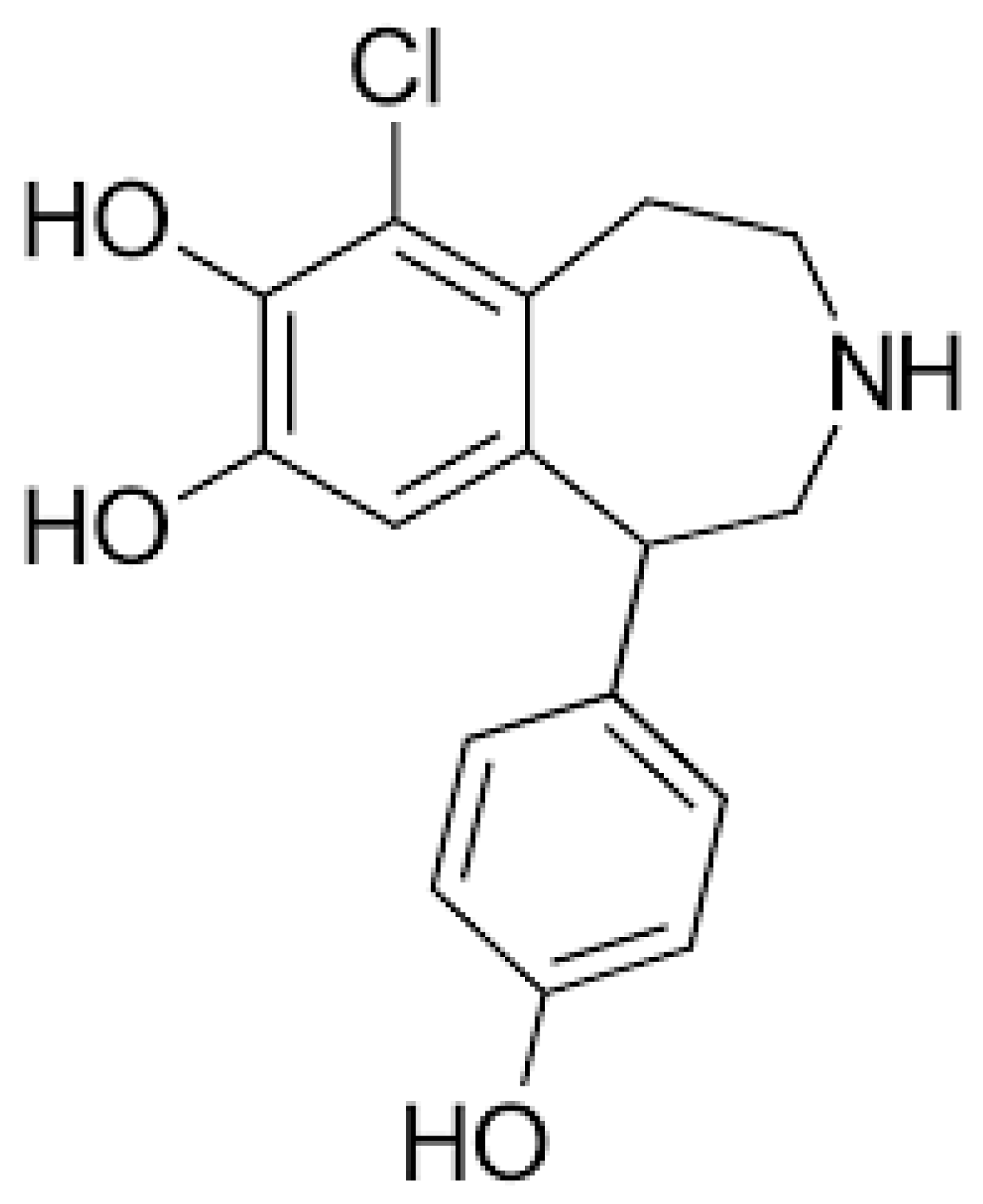

Table 1.
Summary.
| Study | N. Patients | Dosing of Fenoldopam | Comparison | Results | Outcomes |
|---|---|---|---|---|---|
| Cogliati et al. | 193 (95 Fenoldopam; 98 Placebo) | 0.1 mcg/kg/min | Placebo | Serum creatinine baseline: 1.8 ± 0.4 mg/dL Fenoldopam; 1.9 ± 0.3 mg/dL Placebol; After 24 hours: 1.6 ± 0.2 mg/dL Fenoldopam; 2.5 ± 0.6 mg/dL Placebo; After 48 hours: 1.5 ± 0.3 mg/dL Fenoldopam; 2.8 ± 0.4 mg/dL Placebo |
Fenoldopam prevented acute kidney injury in a high-risk population undergoing cardiac surgery |
| Ranucci et al. | 80 (40 Fenoldopam; 40 Placebo) | 0.1 mcg/kg/min | Placebo | Serum creatinine baseline: 1.39±1.65 mg/dL Fenoldopam; 1.08±0.43 mg/dL Placebo; After 12h: 1.1±0.2 mg/dL Fenoldopam; 1.3±0.9 mg/dL Placebo |
Fenoldopam significantly improves renal function and prevents AKI and major morbidity. |
| Barr et al. | 79 (19 Fenoldopam; 20 N-acetylcysteine; 21 Fenoldopam+N-acetylcysteine; 19 Placebo) | 0.1 mcg/kg/min | N-acetylcysteine 600 mg os twice a day | Creatinine clearance from preoperative to postoperative day 3: -1.47±2 mL/min Fenoldopam; -0.67±2 mL/min N-acetylcysteine; -3.08±1.95 mL/min Fenoldopam+N-acetylcysteine; -8.15±2.18 mL/min Placebo | Perioperative fenoldopam and N-acetylcysteine abrogate the early postoperative decline in renal function of patients who have chronic renal insufficiency |
| Tumlin et al. | 155 (80 Fenoldopam; 75 Placebo) | 0.1 mcg/kg/min | Placebo | Incidence of dialysis therapy or all-cause mortality at 21 days: 27.5% Fenoldopam; 38.7% Placebo. Serum creatinine baseline: 1.17 mg/dL Fenoldopam; 1.25 mg/dL Placebo 2.25 mg/dL; After 72h: 2.0 mg/dL Fenoldopam; 2.25mg/dL Placebo |
Fenoldopam does not reduce the incidence of death or dialysis therapy in intensive care unit patients with early ATN |
| Bove et al. | 667 (338 Fenoldopam; 329 Placebo) | 0.1 mcg/kg/min | Placebo | RRT: 20% Fenoldopam; 18% Placebo; Mortality at 30 days: 23% Fenoldopam; 22% Placebo |
Fenoldopam did not reduce the need for renal replacement therapy or risk of 30-day mortality, but was associated with increased of hypotension |
AKI: Acute Kidney Injury; ATN: Acute Tubular Necrosis; RRT: Renal Replacement Therapy.
Disclaimer/Publisher’s Note: The statements, opinions and data contained in all publications are solely those of the individual author(s) and contributor(s) and not of MDPI and/or the editor(s). MDPI and/or the editor(s) disclaim responsibility for any injury to people or property resulting from any ideas, methods, instructions or products referred to in the content. |
© 2024 by the authors. Licensee MDPI, Basel, Switzerland. This article is an open access article distributed under the terms and conditions of the Creative Commons Attribution (CC BY) license (http://creativecommons.org/licenses/by/4.0/).
Copyright: This open access article is published under a Creative Commons CC BY 4.0 license, which permit the free download, distribution, and reuse, provided that the author and preprint are cited in any reuse.